MISO officials clarified that the 1,420-MW J.H. Campbell coal plant — kept online and in retirement limbo by the U.S. Department of Energy’s series of emergency orders — is not eligible for the RTO’s capacity market and is not receiving special treatment for dispatch.
Executive Director of Market and Grid Strategy Zak Joundi and Managing Assistant General Counsel Michael Kessler appeared before the Organization of MISO States during a teleconference Dec. 18 to explain the Michigan plant’s role in RTO operations.
Joundi said the plant participates only in the energy and ancillary markets. He told state regulators and regulatory staffers that, based on language in the DOE orders, the plant “cannot be deemed a capacity resource and cannot participate in MISO’s capacity auctions.”
Joundi said “it would not be unexpected for” DOE to continue to issue extensions every 90 days to postpone the plant’s retirement, given the first two extensions.
South Dakota Public Utilities Commissioner Chris Nelson asked whether anyone would conduct a prudence review of the plant’s costs.
Kessler said a review would take place once Consumers files for recovery of its costs with FERC under its MISO Midwest load-ratio share allocation. At that point, Kessler said interested parties can inquire about how the plant was “operated and dispatched in the market” and debate the costs Consumers proposes to collect.
“I think all of those issues will come to the forefront once the cost recovery filing is made at FERC,” Kessler said.
Joundi said at this point, no costs relating to the plant have been recovered. He said MISO members can expect statements stemming from the plant to be charged under the real-time miscellaneous category.
Bill Booth, a consultant to the Mississippi Public Service Commission, asked whether the plant has a must-offer requirement.
Joundi said per MISO’s understanding, the Campbell plant doesn’t have a must-offer requirement like resources that cleared the capacity auction but has “an obligation” to offer energy because of the orders.
Booth questioned whether MISO is dispatching the plant economically.
“If the conditions allow it, it will be dispatched,” Joundi said. “I can’t talk to you about their bidding strategy.”
Mikhaila Calice, a staff member of the Public Service Commission of Wisconsin, pressed the RTO on how it plans to “preserve the merit order” of dispatch while minimizing costs to MISO Midwest.
“We’re using our market,” Joundi responded. He said MISO is committing and dispatching the plant under its normal process and is not using alternative market rules.
Calice asked if MISO is planning for emergency orders for other plants preparing for retirement.
Kessler said any future generation owners under DOE orders would have to follow Consumers’ steps and start by filing a complaint at FERC to seek a cost recovery mechanism. He said MISO considers itself “well positioned” to handle future emergency orders.
Minnesota Public Utilities Commissioner and outgoing OMS President Joseph Sullivan cautioned MISO again about its tone on resource adequacy issues at a Board of Directors meeting Dec. 11.
“We need to ensure that the states’ narrative and MISO’s narrative do not drift too far apart. Data matters, and so do the stories we tell about that data,” Sullivan told board members and leadership.
Sullivan noted the Campbell plant’s costs are rising while the plant isn’t included in MISO’s planning models.
“This is an affordability issue that we must be mindful of — no unnecessary costs,” Sullivan said in summarizing the situation.
Bowing to opposition from suppliers, IESO said it will not include a termination option in its procurement for long lead-time (LLT) resources.
“There has been much discussion on this item. I’ll skip to the punch line: We have heard you, and we have decided not to include any kind of optional termination provisions in the LLT contracts,” Dave Barreca, IESO’s supervisor of resource acquisition, said during an engagement session Dec. 18. “This is … our assessment of balancing the risks and the benefits of such a provision … assisted by your feedback. So this item is now closed, and we can move on.”
The ISO had said it would seek to reduce risks in the procurement by allowing the ISO and generation developers to cancel deals in the first two or three years after the contract date.
But suppliers said the termination option would increase developers’ risk, make financing more expensive and reduce participation levels. They also said it could discourage participation by Indigenous communities that seek to invest in projects with a high likelihood of reaching commercial operation.
IESO officials said they have reduced the minimum security from suppliers from $350,000 to $300,000.
“That is probably not as low as some are asking for,” Barreca acknowledged.
In a presentation, the ISO said it recognized that even the reduced security might prove an obstacle for small hydro projects. But it said the amount needs to be “significant enough” to ensure the proponent has the financial backing to complete the project on schedule and operate it in accordance with contractual requirements.
Potential Delay
IESO plans to seek 600 to 800 MW of capacity and up to 1 TWh of energy from resources requiring at least five years of lead time. The ISO created the long lead-time procurement because energy storage resources such as compressed air and pumped hydro require longer planning cycles than the four-year lead times for resources offering in the pending Long Term 2 (LT2) procurement. (See IESO Open to Broader Range of Storage Technologies in Long Lead-time Procurement.)
The energy stream of the LLT RFP will be open to new build hydroelectric facilities with a nameplate capacity of at least 1 MW that do not include pumped storage. Long-duration energy storage (LDES) projects will be eligible for the capacity stream.
The ISO had hoped to issue a final request for proposals and contracts by the end of the first quarter of 2026, with the solicitation expected in the fourth quarter.
IESO’s Ben Weir said the “biggest risk” to that timeline is uncertainty over whether the ISO will be required to incentivize the use of Ontarian or Canadian components and services under Bill 5 (Protect Ontario by Unleashing Our Economy Act).
“The rest of the stuff that remains under consideration, from a design perspective, I think is well in hand,” he said.
“What we’re doing at this stage … is seeking feedback for these technologies — hydropower and long-duration energy storage,” Weir said. “What are you expecting to do in terms of capital spend on product within Ontario and/or Canada? [And] what would you be capable of doing within Ontario and Canada, and how you expect any of those changes … to affect project costs?
“This is going to be super helpful for us to inform those discussions about … what’s in the realm of the possible.”
Team Member Experience
IESO is revising its proposed requirements for team member experience for the energy and capacity streams.
All projects must have at least two members with experience in planning, developing, financing, constructing and operating at least one “qualifying” project: a generation or storage facility that reached commercial operation in the past 15 years in Canada or the U.S. (minimum 1 MW for energy stream projects and 10 MW for capacity).
Proposed Class II LDES capacity projects must have two team members with experience planning and developing a project with the same technology (minimum 1 MW) that is expected to reach commercial operation in Canada, the U.S., the U.K., Italy, France, Australia, Germany or Japan by the end of 2029.
Midterm Extended Outages
IESO said it will consider allowing more flexibility for midterm extended outages but said it needed more information on their timing, frequency and duration.
The ISO had proposed a single outage of up to 12 months after the 20th anniversary of the contract. Stakeholders said they would prefer the ability to take multiple outages beginning after Year 10 that add up to 12 months.
“What is it that you want to use these outages for? Just give us some details,” Barreca asked. “You can give us this feedback confidentially.”
Must-offer, Regulation Requirements
In response to stakeholder feedback and internal data from the real-time and day-ahead energy markets, ISO officials said they will not include a real-time component to the must-offer provision in the LLT capacity contract.
They said they still are considering the merits and potential costs of expanding the qualifying hours in the LLT(c) contract to include weekends and holidays.
They also are considering stakeholders’ proposal to require all energy projects to be ready to offer regulation services. IESO had planned to make readiness a rated criteria category (non-price factors used to evaluate proposals).
“Rated criteria points and percentage impact on the evaluated proposal price will be established once all rated criteria are determined,” IESO said.
Other Considerations
ISO officials highlighted several other decisions on the procurement:
In contrast to the Long Term 2 RFP, the LLT procurement will not offer incentives for projects to locate in the north. Recognition for projects located outside of Prime Agricultural Areas will be applicable only to capacity projects.
IESO proposes that municipal support confirmations be dated no later than Aug. 21, 2026, to avoid periods during municipal election years in which municipal actions are restricted.
The ISO proposes to award rated criteria points for projects offering more than the minimum eight hours of continuous energy. “The corresponding reduction to evaluated proposal price for a 12-hour duration relative to an eight-hour [duration] will be commensurate with internal IESO studies on the impact of longer durations on effective load-carrying capacity for storage technology,” the ISO said.
Boom-bust Concern
Paul Norris, president of the Ontario Waterpower Association, said he was surprised and alarmed that the ISO is considering only one LLT procurement.
“You’re going to create what we try to avoid, which is a boom-and-bust approach to energy procurement,” he said. “There’s got to be an LLT 2 and an LLT 3.
Paul Norris, president of the Ontario Waterpower Association, said he was surprised and alarmed that the ISO is considering only one LLT procurement. | IESO
“The whole point of a cadenced procurement is to line up … partnerships with Indigenous communities; to work with municipalities; to work with suppliers,” he continued. “A one-shot deal … doesn’t serve anyone well, in my mind.”
Weir noted the ISO previously said it had a government directive for only the initial procurement.
“New-build hydropower hasn’t been procured in Ontario in quite a while. … LDES has not been procured at the scale that we’re procuring it in Ontario ever. So there are a lot of unknowns from a cost-effectiveness perspective as to these resources,” he said. “I think that the outcomes of the LLT will heavily inform what the government wants to do on subsequent rounds.
“Certainly, if we get another directive in the future to run subsequent rounds, we’ll run subsequent rounds,” he added.
Next Steps
The ISO asked stakeholders to provide feedback on its latest refinements by Jan. 15 via engagement@ieso.ca.
FERC issued a long-awaited order Dec. 18 on co-location of load and generation in PJM, which is meant to facilitate service for data centers while preserving grid reliability for consumers (EL25-49).
“Today’s order is a monumental step toward fortifying America’s national and economic security in the AI revolution, while ensuring we preserve just and reasonable rates for all Americans,” FERC Chair Laura Swett said in a statement. “I look forward to tackling more of these critical national issues with my colleagues in the new year.”
The rules require that any existing plant used to serve co-located load can start such a contract only after completion of any needed transmission upgrades to ensure reliability after the capacity is withdrawn from the grid, which Swett told reporters would ensure reliability.
FERC asked PJM for a report within 30 days on the ways it is considering maintaining resource adequacy in its Critical Issue Fast Path stakeholder process. FERC met just a day after PJM’s capacity market cleared short of its reserve margin target, so each of the commissioners mentioned resource adequacy concerns in their comments. (See PJM Capacity Auction Clears at Max Price, Falls Short of Reliability Requirement.)
“PJM has great momentum in addressing, currently, in their stakeholder process, various approaches to getting shovel-ready generation to the front of their process,” Swett said. “And we didn’t want that momentum to stop, which is why we are requiring this informational filing within 30 days, and that will include detailed scheduling proposals, and we’re going to keep a close eye on that to ensure that we have enough reliability.”
The order found PJM’s tariff unjust and unreasonable because it was unclear on the rates, terms and conditions that applied to customers seeking co-located service.
FERC directed changes to the interconnection rules, requiring any interconnecting generators that plan to be paired with a co-located load specify the customer being served. Generators with co-located loads can ask for interconnection service below maximum facility output and can use existing procedures to speed up the interconnection process if it requires no network upgrades or further studies.
The changes allow interconnecting generators to request provisional interconnection service and surplus interconnection service.
PJM now must revise its tariff to require eligible transmission customers serving co-located load to choose from several transmission service options.
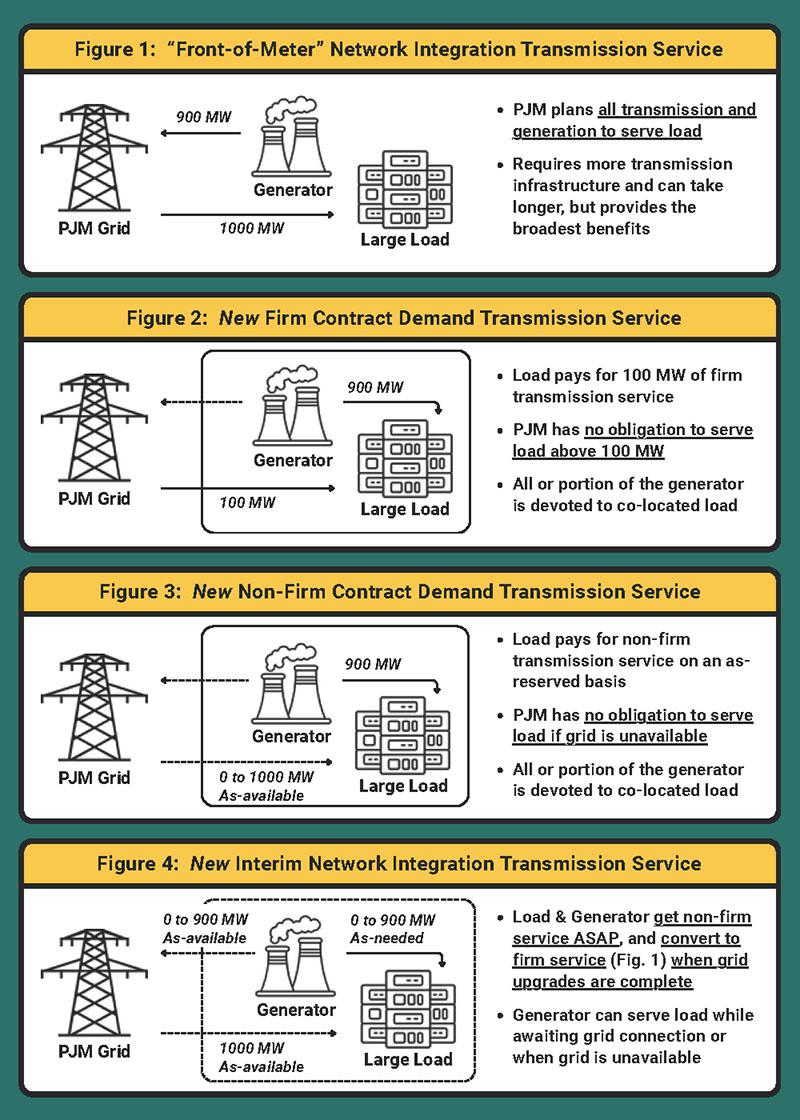
Eligible customers can pick from four options — network integration transmission service (NITS), a new and interim non-firm service customers use while waiting for NITS, a new firm contract demand transmission service, and a new non-firm contract demand service.
A chart produced by FERC Commissioner David Rosner explaining the new transmission service options available for co-located load customers | Office of FERC Commissioner David Rosner
Under the new firm contract demand service, PJM is responsible for serving some load from a co-located load customer, but nothing above that specific megawatt level. The non-firm contract demand transmission service could have the co-located customer served entirely by the grid if the capacity is available, but if it is not then PJM has no obligation to serve the customer.
The firm contract demand transmission service and non-firm contract demand transmission service are the subject of a paper hearing that FERC will use to determine their just and reasonable rates, terms and conditions. PJM’s initial briefs for that hearing are due Feb. 16, 2026.
“The replacement rate will ensure that eligible customers on behalf of co-located load take transmission service and incur transmission costs in a way that is at least roughly commensurate with their derived benefits,” FERC said. “The replacement rate will also ensure that eligible customers on behalf of co-located load are able to take transmission services that reflect their actual impact on the transmission system, which in many cases may be more limited relative to conventional front-of-meter load and generation.”
Regardless of which option customers pick, they will have to pay for regulation and black start service on a gross demand basis. FERC is specifically taking comments on whether customers on non-firm contract demand service should face other fees given that regulation and black start rely on the transmission system.
The order also found the RTO’s rules on behind-the-meter generation (BTMG) no longer are just and reasonable because the resources are not fully accounted for in resource adequacy planning and shift costs onto other customers. The BTMG rules will have to be updated, with a transition period and grandfathering for existing contracts.
The order declines to address jurisdictional matters on the interconnection of retail loads served by a co-location agreement. That issue is in front of FERC in Energy Secretary Chris Wright’s ANOPR on the interconnection of large loads.
Rosner and Chang Weigh in with Concurrences
The order drew a pair of concurrences from Commissioners David Rosner and Judy Chang, with Rosner explaining how FERC is trying to reconcile two fundamentals of utility regulation.
“We are trying to meet surging demand while upholding two fundamental values that underpin the electric industry in our country: first, that all customers have a right to receive electric service on a timely basis; and second, that electric service should be reliable and affordable for all customers,” Rosner said. “Given the scale of new large loads putting demand on our grid today, it is clear that fostering both of these values requires intervention.”
The order seeks to break the logjam by requiring PJM rules to allow for the co-location of load at generators and load flexibility, which cuts large loads’ reliance on the grid while ensuring they pay their fair share, Rosner said.
Chang’s concurrence brings up whether the new transmission service options for large loads should come with a minimum charge to avoid cost shifts to other customers.
“All generators, and as relevant here, all generators that are part of co-located arrangements, rely on the PJM transmission system to operate,” Chang said. “Without the PJM grid, co-located loads and their associated generators would be islanded.”
The costs for black start and regulation are nearly inconsequential so just paying for those two ancillary services does not mean co-located loads are paying their fair share, she added. If co-located loads do not pay for anything else, they will not contribute to PJM’s administrative costs that are recovered via transmission charges.
For the paper hearing, the order asks about developing transmission charges to ensure co-located loads pay their fair share. Chang argued that could be accomplished with a minimum charge and sought comments on the concept.
“This minimum charge would provide a floor to the co-located load’s cost responsibilities to pay for a portion of system costs, commensurate with the benefits that the co-located load receives from the system, even where it plans to draw little or no energy from that system,” Chang said.
Early Reactions from the Industry
The Electric Power Supply Association (EPSA) includes members that have considered co-location deals, and its CEO Todd Snitchler called FERC’s order a welcome move.
“The optionality that the commission laid out at the open meeting is helpful in recognizing the variety of co-location approaches that may be utilized to meet the moment,” Snitchler said. “Clearly, this is the first step in a process that will require quick action and durable consensus from many stakeholders and highlights the urgency in getting solutions onto the system, and for that we applaud FERC’s approach. We look forward to working with FERC and other stakeholders to deliver solutions that enable new technologies, encourage the addition of new generation and ensure the continued provision of reliable, cost-effective wholesale power for all customers.”
Advanced Energy United called the order promising, but like the commissioners themselves said at the open meeting, it was only part of the answers needed around resource adequacy.
“The capacity auction shortfall, along with this new FERC order, should be seen as a warning to PJM that more system-wide issues still need attention, including transmission build-out, generator interconnection, capacity reforms, and better integration of demand and distributed energy resources,” AEU Director Jon Gordon said in a statement. “PJM needs to heed FERC’s message that grid flexibility enables speed, affordability and reliability. As PJM proposes new rules to enable fast-tracking large load interconnections, it should prioritize the advanced energy technologies that are quickest to build and enable flexibility.”
PJM Delays Decision on CIFP
FERC’s order recognizes that regardless of the rules around co-location, PJM needs more resources. So it asked the RTO to file a report within 30 days on the options it has examined there.
During the Dec. 17 Members Committee meeting, PJM Board of Managers Chair David Mills revised the target for selecting and submitting a proposal to FERC from December to January. With a dozen proposals submitted, more time is needed for the board to grapple with all the issues raised by the CIFP process and the proposed solutions. (See PJM Stakeholders Reject All CIFP Proposals on Large Loads and PJM Stakeholders to Vote on Large Load CIFP Proposals)
“I had not expected a dozen proposals, and obviously the proposals contain many important elements for the board to consider,” Mills said.
The board also has two members who joined partway through the CIFP after Robert Ethier, a former ISO-NE executive, and Le Xie, faculty co-director of the Power and AI Initiative at the Harvard School of Engineering and Applied Sciences, were appointed to the board in September. (See PJM Members Confirm 2 Board Nominees; States Call for Governance Overhaul.)
The PJM-sponsored proposal would create a 10-month Expedited Interconnection Track for state-sponsored resources, particularly those paired with large loads. Utilities submitting large load adjustments would be required to ask customers whether their projects are duplicative, to identify instances where developers may be considering multiple sites.
The RTO’s price responsive demand (PRD) resource class would be reworked to replace the dynamic retail rate with an energy market bid price and align the resource class with DR by requiring it to respond to dispatch regardless of bid price, subject it to performance assessment interval penalties and mirror their 30-minute energy bid price caps.
The highest vote-getter was a Southern Maryland Electric Cooperative proposal built off PJM’s package, but with a lower energy market strike price for PRD.
A joint package from Amazon, Calpine, Constellation Energy, Google, Microsoft and Talen Energy would establish an alternative reliability backstop triggered if a Base Residual Auction (BRA) clears below 98% of the reliability requirement, allowing eligible resources to submit capacity offers for up to seven-year terms. That would include new or reactivated resources; existing resources with offers higher than the maximum price for the BRA that cleared short; and traditional DR.
PJM’s 2027/28 Base Residual Auction procured 134,479 MW in unforced capacity at the $333.44/MW-day maximum price, falling 6,623 MW short of the reliability requirement and setting a clearing price record.
Executive Vice President of Market Services and Strategy Stu Bresler said the largest driver of the capacity shortfall was 5,250 MW of load growth forecast for the 2027/28 delivery year, nearly 5,100 MW of which are attributed to data centers. While the amount of supply participating in the auction increased by about 370 MW, that was unable to keep pace with accelerating load growth.
The auction is the third in a row to clear at record prices: The 2026/27 auction cleared at $329.17/MW-day, up $59.22 (22%) over the prior year. (See PJM Capacity Prices Spike 10-fold in 2025/26 Auction.) If not for a settlement between PJM and Pennsylvania Gov. Josh Shapiro (D) to collar capacity prices, the 2027/28 auction would have cleared at $529/MW-day, with the Dominion zone separating at $542/MW-day.
The agreement initially limited prices to between $175 and $325/MW-day, with adjustments accounting for shifting accreditation values for the combustion turbine reference resource. About 800 MW would have cleared with the higher price cap, including some resources that entered into agreements to export their capacity to other regions because of their offer price being higher than the price cap.
Speaking at a press briefing after the auction results were posted Dec. 17, Bresler said the reliability requirement shortfall does not mean PJM will not be able to reliably serve load. The auction cleared with a 14.8% reserve margin, albeit short of the 20% target, and several factors could improve the reliability outlook. Those include resources scheduled for deactivation continuing to operate, availability of winter-only resources that did not receive an annual commitment, and an expectation that 2027/28 peak loads will fall in the 2026 Load Forecast.
Bresler said changes to PJM’s processes for utilities submitting large load adjustments and its review of them are expected to reduce the data center load projected in the 2026 forecast, which could flow into the amount procured in the Third Incremental Auction scheduled for February 2027. Econometric modeling of energy efficiency trends and reduced economic optimism also could push the load forecast down. While the load forecast values will not be finalized and published until January, there will be an “appreciable” difference in the 2027/28 forecast, he said.
“We believe that these factors will result in the system being very close to the one-in-10 standard in the delivery year,” Bresler said in an announcement of the auction results. “But this auction leaves no doubt that data centers’ demand for electricity continues to far outstrip new supply, and the solution will require concerted action involving PJM, its stakeholders, state and federal partners, and the data center industry itself.”
Price Collar to Expire
The settlement with Pennsylvania applies to only the 2026/27 and 2027/28 auctions, with the intention of stabilizing the market while several design changes were implemented.
The governors of Pennsylvania, Virginia, New Jersey, Maryland, Illinois and Delaware signed a letter sent to the PJM Board of Managers on Dec. 3 requesting the price cap be extended by one year. That also was an element of a Critical Issue Fast Path proposal sponsored by the Data Center Coalition, Exelon, PPL and several state governors.
In a statement following the posting of the auction results, Shapiro’s office said the settlement prevented PJM consumers from being assessed $9.9 billion in capacity costs without a corresponding reliability benefit, in large part because of generation development being unable to keep up with load growth.
“I sued PJM because it is unacceptable for them to do nothing as consumers pay sky-high utility bills while getting nothing in return,” Shapiro said. “My administration has once again stopped billions of dollars in unnecessary and unjustified energy price hikes from being passed on to families and businesses. PJM needs real reform, and they are running out of time to protect consumers from their inaction.”
Asked whether PJM would consider revising the maximum price for the 2028/29 auction, Bresler said there was strong stakeholder support for the Quadrennial Review proposal the board approved in October, and those are the auction rules the RTO is planning on proceeding with. (See PJM Board of Managers Approves Quadrennial Review Proposal.)
PJM Power Providers Group (P3) President Glen Thomas told RTO Insider the Quadrennial Review parameters create a stable platform to support the investment in new capacity needed to meet the demand the RTO is forecasting. Early signals show there is interest in developing in PJM, but the RTO needs to avoid political interference in its markets that could undermine the long-term thesis for investment, he said.
“People can look at this market and understand the supply-and-demand dynamics; you can understand and appreciate that we have a market that is sending a signal that supply is low and demand is high, and that should be a place where investment is attracted. … If we let these markets do what they have successfully done for decades,” that will let the markets serve the projected demand, Thomas said.
The Electric Power Supply Association and P3 said in a joint statement that the auction results are an early indicator of future electricity needs associated with data center proliferation, electrification and economic expansion. They wrote that PJM’s competitive markets remain the strongest tool for delivering the capacity that will be needed without overbuilding.
“Competitive generators are responding to recent price signals with new supply, and the market has multiple safeguards in place to meet reliability needs and adjust as system conditions evolve,” they wrote. “Today’s results don’t fully reflect the wave of recent investment announcements because projects take years to deliver and the auction calendar has been compressed over multiple auction cycles. The reality is that while customers enjoyed record-low supply prices over the past decade, we are in a new era, and there will be a cost to building the projected necessary resources on the timeline required.”
Sierra Club Senior Adviser Jessi Eidbo said the expiration of the price cap creates concerns for future auctions.
“It’s little surprise that this capacity auction also hit the auction ceiling and ended with record-high prices for customers,” she said. “We were fortunate to have the price collar in place, but this is the last auction with these guardrails, creating serious concern over next year’s auctions. As we approach the holiday season, families should be spending their hard-earned dollars on family meals and presents for each other, not forking more money over to the utility companies and Big Tech’s power needs. … PJM should be doing everything in their power to lower prices for their millions of customers, and planning for enough clean energy to meet the demands of data centers. Instead, PJM continues to uphold market structures that favor pricey fossil fuels and stick everyday customers with Big Tech’s power bills.”
GridLab Program Director Nikhil Kumar said PJM’s backlogged interconnection queue is preventing new entry from responding to price signals, leaving consumers with high costs.
“While the price cap has provided short-term relief, it’s clear that PJM’s interconnection process is broken,” Kumar said in a statement. “Texas has demonstrated that adding energy resources like solar, wind and batteries can significantly reduce grid risks and costs. PJM must act quickly to implement reforms and bring energy projects online to address the growing demand.”
“After a third straight auction marked by unacceptably high prices, it is painfully obvious that our capacity market is breaking under the weight of data center demand and a dysfunctional interconnection queue,” the Illinois Citizens Utility Board said in a statement. “Even worse, since the auction results fell below the reliability requirement, consumers are getting the worst of all worlds: paying more money for reduced electric reliability, while existing generators get a windfall.”
Demand Response Grows with Modeling Changes
An additional 371 MW of UCAP cleared in the auction, including 774 MW of new generation and unit uprates. The amount offered increased by 956 MW. The resource mix includes 43% natural gas, 21% nuclear, 20% coal, 5% DR, 4% hydroelectric, 2% wind, 2% oil and 1% solar.
Demand response saw the most significant increase, with 7,299 MW offered into the auction, up 1,768 MW. Bresler said that largely was from the effective load-carrying capability rating for the resource class increasing because of the elimination of the availability window to instead model DR as being dispatchable in all hours. That boosted DR’s rating from 69 to 92%. (See PJM Stakeholders Endorse More Detailed Demand Response Modeling.)
The supply stack includes the 1,289-MW Brandon Shores and 397-MW H.A. Wagner in accordance with a temporary provision FERC approved to allow deactivating resources operating on reliability-must-run agreements to be modeled as capacity in the 2026/27 and 2027/28 auctions. PJM outlined its intention to ask FERC to permit a one-year extension at the Markets and Reliability Committee’s meeting in October. (See “PJM to Seek Extension of Order Defining Wagner, Brandon Shores as Capacity,” DOE Extends Order Lifting Run Hour Limits on Md. Generator.)
The newest iteration of New York’s energy road map maintains a zero-emission grid as a target but acknowledges an uncertain path to that goal, and likely a longer reliance on fossil fuels.
The State Energy Plan approved Dec. 16 is a directional guide for policymakers, not a binding set of rules, and it is a living document, with its next review due in just two years.
So change is inevitable, but as a snapshot in time, it reflects a late 2025 landscape in which high costs and federal policy gyrations make firm planning for clean energy difficult.
The plan’s uncertainties butt up against a central requirement of the state’s landmark Climate Leadership and Community Protection Act (CLCPA) of 2019: 100% zero-emission electricity by 2040.
Environmental activists pounced on the plan when it was released in draft form in July, and they pounced on it again after the Dec. 16 vote on the final version. (See N.Y. Considers New Fossil Generation as Renewables Lag.)
Public Power NY charged the plan violates the CLCPA and added: “New York’s energy policy under Gov. Kathy Hochul has become increasingly similar to Donald Trump’s energy policy.”
The Natural Resources Defense Council said the plan lacks a focus on renewable energy: “This failure of state leadership risks locking New Yorkers into higher and more volatile energy costs for decades to come.”
Clean energy advocates have repeatedly criticized Hochul, a Democrat, for what she and her administration frame as a pragmatic attempt to keep New Yorkers’ already-high utility rates from getting too much higher amid rising costs for renewables and disappearing federal subsidies.
In recent months, Hochul or her appointees have vexed various constituencies by:
lowering the New York Power Authority’s goal for renewable energy development;
delaying implementation of New York’s all-electric new-construction law;
approving a major gas pipeline extension that the state repeatedly had rejected;
granting an emissions permit to a controversial cryptomining operation;
moving to extend operating subsidies for the state’s existing fleet of geriatric nuclear reactors and ordering development of a new advanced reactor; and
delaying promulgation of regulations to comply with the CLCPA’s requirements, particularly a new cap-and-invest system now the subject of court proceedings between advocates and the state.
‘Foundational Direction’
All this comes as Hochul and her appointees press through words or actions to expand clean energy and environmental protections.
But New York is an expensive state with old energy infrastructure and — particularly in the densely populated downstate region — recurring air quality problems because of fossil fuel combustion. So there are many competing concerns.
In her introduction to the plan, Hochul spoke of the difficulty of drafting an energy strategy that balances reliability, affordability and environmental health. And she said new investments in fossil infrastructure may be needed.
“This plan embraces a much-needed all-of-the-above strategy: hydropower, solar, onshore and offshore wind, our existing nuclear fleet, advanced nuclear, energy storage with the strongest safety standards in the nation, efficiency, electrification, bioenergy, demand flexibility, and, where needed, modern gas infrastructure to keep the system stable during the transition. It presents a guidepost for greater state energy independence,” she said.
The state Energy Planning Board, which consists mostly of Hochul’s top agency administrators, voted unanimously to approve the new plan.
Board Chair Doreen Harris, president of the New York State Energy Research and Development Authority (NYSERDA), told RTO Insider that the factors on which policy is based are changing quickly in 2025, and the bands of uncertainty will get wider over the next 10 years, as policy directions set now become action decisions.
“The plan is intended to provide a foundational direction upon which other decision making can be considered,” she said. That is why so many agency heads populate the board — in many cases, they are going to be making the decisions that turn policy into action.
NYSERDA’s senior vice president for policy, analysis and research, Carl Mas, said a variety of scenarios were modeled and common threads were sought.
“It’s not that we’re forecasting precisely what load is going to be or what generation is going to be, but it gives us common ground of insights of where the state should be headed and what’s true across every scenario,” he said. Nuclear fission was one such common thread.
‘More Pragmatic’
NYISO President Richard Dewey is the 14th member of the Energy Planning Board. Although he does not cast votes, he has an important role helping match the reliability needs of the state grid to the numerous policy goals New York is setting for itself.
“We help through being part of NYISO’s process as well as the Coordinated Grid Planning Process to feed insights from load shapes and load growth into those more detailed processes,” Mas said. “So that’s another leverage point that we have from all this Energy Plan work.”
Harris said there have in the past been points where one priority has been out of alignment with another, “but directionally, we are aligned, which is a major head start on realizing those outcomes.”
Mas said there is flexibility in how to maintain reliability while decarbonizing the grid but no flexibility in the reliability requirements themselves.
“Those are standards that we need to follow. It flows down from NERC,” he said. “So our chance is to develop a plan and a system that meets those reliability needs in the most cost-effective way and puts us on the pathway to our goals.”
The Independent Power Producers of New York applauded the plan’s “more pragmatic” approach toward New York’s energy future.
“Strong statements of an ‘all-of-the-above’ strategy are important,” President Gavin Donohue said in a news release. “However, it is even more critical to ensure that market signals and regulatory paradigms match that sentiment in attracting further investment. Making energy clean, affordable and reliable should be the priority, but it may not come as quickly as the state would like due to the need for increased clarity and certainty on the state’s policies to carry out the plan.”
He added: “There is no shortage of private developers that want to invest in New York, but the state needs to realize that it is competing with other states and countries to attract investments in new technologies.”
Representing the New York renewable energy industry, the Alliance for Clean Energy New York expressed disappointment with the plan.
It said in a news release that the plan needed to do more to keep the state’s energy transition on track during the next three years, such as a predictable procurement schedule for large-scale renewables; utility accountability for interconnection costs and schedules; accelerated storage deployment; and support for [vehicle-to-grid] deployment.
“While we understand the current realities coming out of Washington have dramatically shifted the circumstances for renewable energy in the near term, we believe the final New York State Energy Plan’s constrained outlook ignores cleaner options unnecessarily,” Executive Director Marguerite Wells said. “With the ever-increasing demand for energy on the grid, New York should be doubling down, not shying away from its renewable energy and energy efficiency investments.”
The Department of Homeland Security’s Cybersecurity and Infrastructure Security Agency has updated its Cross-Sector Cybersecurity Performance Goals to provide critical infrastructure operators “a more robust framework for integrating cybersecurity into daily operations.”
Version 2.0 of the CPGs, released Dec. 11, was developed with the input of industry stakeholders, government agencies and cybersecurity experts, based on CISA’s operational data and research on the current threat landscape. The goals are intended to align with the National Institute of Standards and Technology’s Cybersecurity Framework 2.0, introduced in 2024. (See NIST Expands Cyber Framework in Latest Release.)
CISA introduced the CPGs in 2022, following a directive from President Biden that DHS and NIST establish a set of “baseline security practices” to be followed by critical infrastructure owners and operators across sectors. (See Biden Launches ICS Cybersecurity Initiative.) However, adoption of the goals has led to a gap between large organizations and others, which CISA acknowledged “often struggle to translate high-level goals into concrete action.” The agency wrote that this gap has led to dangerous vulnerabilities in critical facilities.
In a press release, CISA wrote that the CPGs “offer a practical starting point for small- and medium-sized organizations” to improve their cybersecurity posture “by focusing on a limited set of high-impact actions.” Acting Director Madhu Gottumukkala said the update “demonstrates our commitment to listening to and incorporating partner feedback to deliver practical, outcome-driven guidance that organizations can act on.”
“These goals are applicable across all critical infrastructure sectors and offer foundational protection for organizations regardless of their cybersecurity maturity,” Gottumukkala added. “We encourage all organizations to adopt the new CPGs and continue sharing feedback to help us refine future iterations.”
The CPGs are organized into six functions, presenting best practices to address individual risk and aggregate risks to U.S. critical infrastructure overall. The first function, “govern,” is a new addition reflecting “the critical role of organizational leadership in cybersecurity” and mirroring the addition of a similar function in NIST’s framework.
Practices under this function include establishing cybersecurity roles, responsibilities and authorities within the organization, and communicating them with external partners; reviewing cybersecurity program management at least once a year, updating as needed and communicating changes; maintaining and practicing incident response plans; managing supply chain risks; and addressing risks from managed service providers.
Functions carried over from the previous version include identification, which has to do with managing organizational assets, documenting network topology and mitigating known vulnerabilities; protection, which concerns passwords, credential maintenance, encryption and other defensive measures; detection, for spotting unauthorized access attempts; incident response; and recovery.
CISA also consolidated some goals by eliminating duplicate guidance. Specifically, the agency gathered information technology, operational technology and internet of things goals into a single goal set in recognition of the fact that these categories increasingly are blurred in modern infrastructure. CISA wrote that the changes would allow “small- and medium-sized entities [to] apply one framework across their entire estate, without confusion over domain-specific goals.”
Future updates to the CPGs should arrive at a 24- to 36-month cadence, CISA wrote.
ISO-NEpresented the final stakeholder-requested sensitivities for its 2024 Economic Study at the Dec. 17 meeting of the Planning Advisory Committee, discussing the potential effects of adding 3.9 GW of hydropower to the Hydro-Québec system.
The study, which began in March 2024, aims to evaluate long-term changes to the region’s power system. ISO-NE published the final report in September. The RTO previously discussed stakeholder-requested sensitivities related to advanced solar panels, demand flexibility, thermal generator retirements and a halt on offshore wind development.
The hydropower sensitivity is intended to reflect the potential impacts of a preliminary agreement between Newfoundland & Labrador Hydro and Hydro‑Québec to add a large amount of new hydropower capacity.
Growing demand, extended drought conditions and international HVDC transmission projects have caused Québec to pull back on its exports to New England in recent years. (See Drought, Climate Drive Uncertainty on New England Imports from Québec.) However, ongoing efforts to add significant amounts of new generation throughout Eastern Canada may provide a long-term answer to tightening system conditions.
ISO-NE’s modeling indicates that the added hydropower capability would increase New England’s net imports by about 6.2 TWh relative to the reference case, equal to about a 60% increase.
Net imports to New England from Hydro‑Québec increase by 5.6 TWh under the scenario, while New England remains a net exporter to New Brunswick, ISO-NE’s Ben Wilson said.
The modeling indicates that the increased imports would reduce annual production costs in New England by about $448 million relative to the reference case. This would reduce the economic benefit of congestion relief on the New England system by lowering the potential cost gains associated with displacing marginal resources.
Wilson added that power exchanges with Hydro‑Québec likely would be “much more bidirectional than in recent years, which have seen mostly unidirectional interchanges.”
ISO-NE conducted a sensitivity analysis looking at gas price differentials across New England and New York. The RTO modeled a uniform gas price across the Northeast Power Coordinating Council in the reference case. ISO-NE said this approach was needed because of its limited insight into the trends affecting fuel prices and by the challenges associated with forecasting fuel prices a decade into the future.
Modeling gas price differentials caused gas prices in New England to increase, pushing up ISO-NE locational marginal prices and production costs.
“Net imports into New England increase by 3.6 TWh while using a gas price differential, with most of the additional energy coming from [New York],” Wilson said, adding that the higher New England energy costs in this sensitivity increased the value of congestion relief.
Asset Condition Projects
Also at the PAC meeting, representatives of transmission owners presented on asset condition projects.
Dave Burnham of Eversource Energy introduced a nearly $6 million project to replace optical ground wire on a line in Western Massachusetts.
The project was placed in service in October, he said, noting that Eversource initially did not present the project to the PAC because it fell short of the $5 million threshold for project presentations. Cost overruns, stemming in part from “unanticipated requirements” from the Massachusetts Department of Transportation, pushed the project past the threshold, he said.
The extra fiber capacity is needed “to support critical communications and to provide redundancy to avoid loss of communications during failures or outages,” Burnham said.
Joshua Cefaratti of United Illuminating gave an update on a flood mitigation project in Connecticut. Estimated project costs have increased from about $26 million to about $43 million since the company initially presented the project in 2021. The higher cost is largely from increased labor and materials costs, he said.
Kyra Lagunilla of Rhode Island Energy gave an update on a line rebuild project that initially was presented by National Grid in 2005. Rhode Island Energy bought National Grid’s Rhode Island gas and electric utility business in 2022. The project’s drawn-out timeline has been driven largely by delays associated with community engagement, ISO-NE said.
Rhode Island Energy has withdrawn the original transmission cost allocation for the project and plans to submit a new one, Lagunilla said. The project has an estimated pool transmission facility cost of nearly $14 million.
Citing an energy “emergency” in the Pacific Northwest this winter, the U.S. Department of Energy ordered TransAlta to continue operating Washington state’s last coal-fired generating plant for three months beyond its scheduled retirement.
Unit 2 at the Centralia Power Plant was slated for closure at the end of December based on a 2011 Washington law and subsequent agreement between the state and TransAlta.
But in a controversial move that has sparked the ire of environmental groups, DOE on Dec. 16 directed the company to keep the 670-MW unit running until March 16, 2026. Unit 1 at the facility was shut down in 2020 as part of the first phase of the plant’s retirement.
Energy Secretary Chris Wright took the opportunity to criticize Democratic environmental policies that he said have forced the closure of coal generators across the country.
“The last administration’s energy subtraction policies had the United States on track to experience significantly more blackouts in the coming years. Thankfully, President Trump won’t let that happen,” Wright said in the release. “The Trump administration will continue taking action to keep America’s coal plants running so we can stop the price spikes and ensure we don’t lose critical generation sources.”
The order comes a week after Alberta-based TransAlta announced it had signed a long-term tolling agreement with Puget Sound Energy that enables the plant to be converted to a 700-MW natural gas-fired facility.
“TransAlta is currently evaluating the order and will work with the state and federal governments in relation thereto. The coal-to-gas conversion project, announced on Dec. 9, 2025, remains a priority for TransAlta,” the company said in a statement. “Further information regarding the order will be provided as it becomes available in due course.”
The company declined to answer questions about its readiness for keeping Centralia operable for the winter.
‘Sudden Increase’
In describing its rationale for the order, the department pointed to NERC’s 2025-2026 Winter Reliability Assessment released in November, which included WECC’s Northwest region among seven in North America that are at “elevated” risk for grid outages during “extreme weather.”
That risk stems in part from an expected 9.3% increase in regional peak electricity demand, accompanied by tightening supplies. Still, NERC’s assessment did not find any regions to be at “high” risk for outages — including the Northwest. (See NERC Winter Reliability Assessment Finds Many Regions Facing Elevated Risk.)
Quoting from the assessment, DOE noted NERC found that the Northwest should have “sufficient resources” for expected peak load conditions but that the region’s balancing authorities were “likely to require external assistance during extreme winter weather that causes thermal plant outages and adverse wind turbine conditions for area internal resources,” with that assistance possibly compromised by a “regionwide” extreme event.
DOE’s other justification for the order: a September 2025 study on Northwest resource adequacy by Environmental and Energy Economics that found “accelerated load growth and continued retirements create a resource gap beginning in 2026 and growing to 9 GW by 2030” and that “load growth and retirements mean the region faces a power supply shortfall in 2026.” (See 9-GW Power Gap Looms over Northwest, Co-op Warns.)
The order contends that Section 202(c) of the Federal Power Act authorizes the energy secretary “to require the continued operation of Centralia Unit 2 when the secretary has determined that such continued operation will best meet an emergency caused by a sudden increase in the demand for electric energy or a shortage of generation capacity … Such is the case here.”
The order calls for TransAlta “take all measures necessary” to ensure Centralia is “available to operate at the direction of either” the Bonneville Power Administration in its role as a BA or CAISO in its role as the reliability coordinator. It also requires the plant to comply with “applicable environmental requirements” and directs TransAlta to provide DOE with information about its operations plan by Dec. 30.
The department also directed BPA to “facilitate” Centralia’s transmission service “as needed.”
Asked about the roles outlined for BPA and whether DOE had consulted with the federal power agency before issuing the order, BPA spokesperson Kevin Wingert said it still was reviewing the text and directed questions to DOE.
CAISO spokesperson Jayme Ackemann told RTO Insider the ISO was made aware of the order only after it was issued and was still reviewing it.
The department did not respond to questions about what Western electricity sector entities it consulted before issuing the order.
‘Incredibly Unproductive’
Environmental groups lashed out at the order, with the Environmental Defense Fund calling it an “illegal mandate.”
“Once again, the Trump administration is upending state and local decisions to force an aging, costly, polluting coal plant to stay open,” Ted Kelly, EDF’s director and lead counsel for U.S. clean energy, said in a statement.
EDF pointed to DOE’s repeated extension of emergency orders for the J.H. Campbell coal plant in Michigan and the Eddystone oil-and-gas plant in Pennsylvania, “despite evidence that both plants are unreliable, highly polluting facilities and are not necessary to meet near or long-term energy needs.”
“Let us be clear: There is no ‘energy emergency’ in the Pacific Northwest that would justify forcing the continued operation of an old and dirty coal plant that endangers public health, worsens climate pollution and has long been slated for retirement,” Sierra Club Washington State Director Ben Avery said in a statement. “All the evidence shows that when Centralia shuts down, customers’ costs will decrease and air quality will improve. Instead of lowering bills or protecting families from harmful pollution, the Trump administration is abusing emergency powers to prop up fossil fuels at any cost.”
“This federal overreach is incredibly unproductive,” said Lauren McCloy, utility and regulatory director at the NW Energy Coalition. “People across the industry in the Northwest are working hard to plan for, acquire and build the resources we need to have a clean, affordable, reliable electricity grid. The closure of this plant has been planned for over a decade, and keeping it running beyond its useful and economic life is not the answer.”
“The shutdown of Washington’s last coal plant has been in the works for nearly 15 years,” Earthjustice attorney Patti Goldman said. “Washingtonians don’t want or need coal in their stockings this year.”
The Western Energy Markets Governing Body approved a set of revisions to CAISO’s Gas Resource Management program after two years of work with stakeholders in the West.
The approved proposal provides gas resource entities with more opportunities to reflect their fuel costs and conditions in the day-ahead and real-time markets. It also revises day-ahead advisory market runs to improve fuel procurement forecasts, among other items.
“Gas resources face unique challenges in managing uncertainty across [the] independent but linked gas and electric markets,” CAISO Vice President of Market Design and Analysis Anna McKenna said in a Dec. 10 memorandum. “When gas prices are volatile or the gas system experiences constraints, energy offers from gas resources can quickly become obsolete if those bids do not adequately account for price uncertainty.”
Currently in the Western Energy Imbalance Market (WEIM), participants manage their fuel-cost procurement risk by submitting hourly base schedules and only bid for real-time dispatch based on the availability and cost of gas imbalances, McKenna said.
But in the Extended Day-Ahead Market (EDAM), set to open in May 2026, base scheduling is not available, which means that energy resources will use market offers for day-ahead commitments.
In a Dec. 9 memorandum, the ISO’s Department of Market Monitoring added that EDAM might “create additional challenges for gas procurement in regional markets outside of the CAISO area.” These challenges include an increased uncertainty about gas procurement requirements, more frequent purchasing of gas after the close of the morning gas market and more exposure to higher levels of gas price variability, the DMM said.
The approved proposal allows gas resources to more easily customize cost inputs, access cost-adjustment mechanisms and recover costs, McKenna said. The revisions try to also guarantee that all gas systems, regardless of location within the Western footprint, have equitable access to the market, she said.
While stakeholders supported the overall process proposed for customizing fuel volatility covered in reference levels, some raised concerns about certain design details, McKenna said. The DMM cautioned that frequent cost-adjustment requests could be subject to gaming.
“It’s fair to say this is a really complex policy,” Danny Johnson, CAISO market design manager, said at the Governing Body’s meeting Dec. 16. “The proposed methodology balances implementation feasibility and needed flexibility sought by stakeholders. As part of the audit process, the ISO will monitor for any adverse or unintended consequences.”
CAISO management agreed that the audit process is an important feature of the proposal, McKenna said.
As part of its stakeholder process, the ISO studied the existing tools for accommodating fuel-cost variations for gas generators in parts of the WEIM, where “physical gas system characteristics and fuel supply arrangements are diverse,” the proposal says. It addresses “exceptional circumstances” on the grid when gas-fired resources face more uncertainty than usual. Under such circumstances, CAISO might anticipate that gas resources will need additional flexibility to request cost adjustments.
“As a general principle, gas resources either need more certainty for fuel procurement or more flexibility to manage uncertainty related to fuel procurement,” the proposal says.
CAISO’s proposal therefore provides gas generators with additional flexibility to request cost adjustments when the ISO forecasts that same-day gas will be needed to support day-ahead commitments and incremental real-time dispatch, the proposal says.
The proposal also includes a customizable multiplier on the gas price index because some resources face more gas price volatility than others. The multiplier will cover specifically the volatility of a gas resource’s circumstances to ensure that reference levels and the reasonableness threshold all reflect a resource’s adjusted gas price volatility, the proposal says.
The proposal also grants gas resource entities the ability to request after-the-fact cost recovery, but only if they can demonstrate that a physical gas disruption occurred.
Advocates of large-scale transmission expansion have recited a simple slogan for years: There is no transition without transmission. By this, they mean that the shift to renewable energy will require vast new power lines. Whatever one thinks of climate policy, that argument no longer carries much weight. The relevant question now is whether building more transmission will make electricity more affordable.
Yes, expanding transmission can reduce electricity costs for consumers, but only if the buildout uses consumer welfare as the North Star and ignores narrow political or business interests. The goal of transmission reforms in Congress should be straightforward: Deliver reliable power that meets our growing needs at the lowest possible cost to end users.
In nearly every other sector — pipelines, railroads, ports, broadband — infrastructure is built when customers are willing to pay for the value it provides. Projects move forward based on contracts, price signals and risk-taking. Investors bear losses when they guess incorrectly. That discipline helps ensure that infrastructure is built to meet demand at least cost.
Electric transmission is different only because decades of poorly designed regulations — and dogged political fights over competing energy resources — have made it so. A consumer-centered approach would optimize the buildout of new transmission lines and allow competition from non-wire alternatives such as local or on-site generation of all stripes, storage, demand response, grid-enhancing technologies and microgrids.
Nick Loris
It would allow new large customers such as data centers to pay for all required transmission upgrades if they choose to so that their costs don’t spill over to existing customers. And it would subject utility-initiated projects to real scrutiny, ensuring consumers are not locked into paying for upgrades that are not the least-cost option. Short of restructuring the entire transmission grid (again), minimizing costs to consumers is the most open-ended and market-friendly federal policy.
The consumer-first approach does not assume a particular generation mix or require sweeping national planning exercises. It rests on a more straightforward principle: Transmission should be built when it lowers the total cost of reliable electricity for consumers. FERC has long held up “reliability at least cost” as a policy goal but has brought precious little analytical expertise to the table to ensure that outcome. Adhering to the “beneficiary pays” principle and subjecting projects to rigorous cost-benefit analysis will provide better outcomes that protect ratepayers.
Congress should encourage transmission projects that reduce the cost of delivered power and hold FERC accountable for finding the sweet spot between too much transmission and too little. Could a FERC analysis show that smaller transmission projects are a costly short-term bandage while larger projects generate long-term savings? The “smile curve” framework introduced by MISO offers a consumer-focused approach to analyzing the role of transmission in minimizing total costs.
Travis Fisher
Transmission is a means to that end, not an end in itself. More transmission can reduce costs by connecting customers to lower-cost generation, relieving congestion or improving reliability in an economically efficient way. But more transmission also can raise bills if it is overbuilt, poorly targeted or used to inflate profits for incumbent utilities.
Today’s regulatory framework prevents complete oversight. No regulator is responsible for the full cost of electricity paid by consumers. FERC oversees wholesale markets and transmission rates. State public utility commissions typically oversee transmission siting, the distribution network, retail rates and sometimes the generation portfolio. But neither the feds nor the states are accountable for the total bill consumers pay, and decisions that look reasonable in isolation can stack up to higher costs with no one asking whether households and businesses are better off.
Transmission spending illustrates the problem. It has become one of the fastest-growing components of electricity bills, with tens of billions of dollars flowing to new projects each year. Those costs are passed directly to consumers through regulated rates, largely shielded from competition.
In PJM — the nation’s largest regional grid operator — environmental advocates note that utilities recently allocated roughly $4.4 billion in transmission upgrade costs in a single year to serve new data center demand. These costs were broadly socialized across ratepayers, even though the upgrades primarily benefited a narrow set of large loads. That is not an argument against transmission, nor is it an argument against AI-related load growth (which, according to Berkeley Lab, could help reduce rates). Instead, it is an argument against building transmission without clear accountability and under rules that fail to meet today’s moment of rapid demand growth.
The crutch of low-voltage transmission projects underscores the point. These projects are proposed unilaterally by utilities, outside the regional planning process, with limited competitive pressure and little obligation to demonstrate that they are the lowest-cost solution to a reliability problem. In PJM, spending on small ball projects such as “supplemental” upgrades has grown dramatically over time, exceeding spending on high-voltage lines that span multiple utility territories or states.
America has the capital, engineering expertise and entrepreneurial talent to build a world-class transmission system. What it lacks is a regulatory framework that consistently asks whether new investment makes electricity bills more affordable. Expanding transmission can reduce electricity costs, but catchy slogans won’t get us there. We need a consumer-first, market-disciplined approach that reliably meets today’s growth without raising electricity bills for everyday Americans.
Travis Fisher is the Director of Energy and Environmental Policy Studies at the Cato Institute and Nick Loris is the Executive Vice President of Policy at the Conservative Coalition for Climate Solutions.