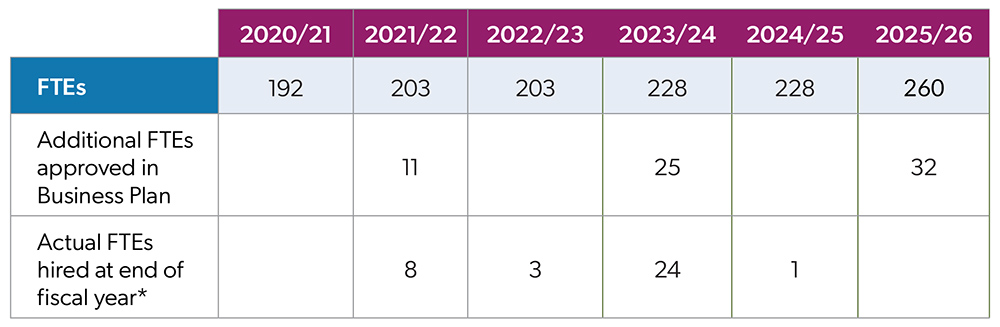
The Ontario Energy Board (OEB) plans a 22% increase in its 2025/26 budget with the addition of 32 employees, its biggest hiring surge in at least five years.
The board cited “the increased volume and complexity” of its job in announcing the hirings, which would increase OEB’s staff by 14% to 260 full-time equivalents.
“We are building an organization that can enable government policy and be the regulator Ontario needs during the energy transition,” OEB said in its Business Plan for 2025/26 through 2027/28, which outlines $70.3 million in spending for the current fiscal year (beginning April 1) and preliminary budgets for the following two years.
The board said the $12.5 million budget increase was needed to respond to the Ministry of Energy and Mines’ 2024 vision statement and the ministry’s Dec. 19, 2024, Letter of Direction, which outlined the province’s strategy for responding to an expected 75% increase in electric demand by 2050.
“These additional resources will enable the OEB to deliver on its mandate, which, when coupled with the minister’s letter, requires taking on additional deliverables at a time when the organization is at full capacity with existing commitments and adjudicative work,” the board said.
“Resources will be applied across the organization to meet the highest-priority needs at any point in time, balancing adjudicative support and policy development, and matrixing resources depending on expertise, topic and timeline,” it added.
Three initiatives each will receive six new FTEs:
Advancing the Energy Transition: ensuring regulated entities plan across fuel types; considering how to apply the “beneficiary pays” principle; and streamlining approvals for electric connections and “priority” pipeline projects.
Driving System Modernization: developing local market opportunities for distributed energy resources, such as distribution system operators; implementing performance-based rate regulation for electric distribution companies; supporting Indigenous participation; and ensuring cost-effective integration of innovative business models.
Sustaining Resources: adding legal, public affairs, finance and human resources staff to support OEB’s expanded operational requirements and strategic priorities. OEB said those functions “have not kept pace with recent growth across the organization.”
The board plans five new staffers to boost DERs, including providing incentives for implementing non-wires solutions, publishing capacity maps for distribution and transmission systems, and reducing barriers for new energy efficiency programs.
The Ontario Energy Board plans to hire 32 new employees in 2025/26, the biggest contributor to a 22% budget increase for the year. | Ontario Energy Board
In total, the salaries and benefits budget is increasing by 19% to $50.4 million.
Because they will have staggered start dates, the 32 new hires will cost $4.15 million in 2025/26 and $6.2 million annually thereafter.
The budget also includes $1.8 million for salary increases for existing staff and $1.2 million for short-term contract staff needed to “backfill” for subject-matter experts shifted under the Business Operations Optimization and Systems Transformation (BOOST), a new platform for data and workflow management across OEB processes.
The plan pointedly reiterates the board’s belief that “diversity, equity and inclusion (DEI) is not just an ideal but also our competitive business advantage, a defining characteristic of our culture and an essential organizational strategy.”
The new hires will allow OEB to “provide strategic and prudent oversight of Ontario’s energy sector through initiatives that support broader government priorities such as planning for growth, keeping costs down, enabling energy system modernization and streamlining solutions that will make Ontario an energy superpower,” the board said.
“How the OEB’s planned key projects presented in the plan have changed and will be prioritized post-IEP (and directive) remain to be seen,” he added.
The big spending increase caught the attention of Martin Benum, former director of regulatory affairs for London Hydro.
“The OEB is supposed to regulate industry costs, not grow into another bloated cost-recovery machine itself,” Benum said in response to Hrab’s posting. “Is the OEB still focused on consumer protection and efficiency, or are we watching another cost monster take shape here in Ontario?”
Capital Spending Trending Down
While the board is increasing spending on personnel, it expects capital spending (business systems, infrastructure and end-user computing) to drop slightly, from $474,000 in 2025/26 to $451,000 in 2027/28.
“With more resources available as services, the OEB’s IT capital budget is expected to be stable in the coming period with some spending moving to the IT operating budget,” it explained.
Priorities
The board’s priorities for the coming year include simplifying the connection processes for DERs, incentivizing electric distribution companies to use third-party DERs as non-wires alternatives and a benefit-cost analysis framework for addressing system needs.
OEB also is considering changes to its rate design to accommodate electric vehicles and battery storage, following up on its analysis of the impact of delivery costs on EV charging facilities. “The OEB is also planning to consider reforms to rate design for resources providing grid services and other emerging technologies,” it added.
Also on the schedule for the board is a ruling on Enbridge’s 2026-2030 electric demand-side management application, which includes a residential program that would be delivered through a “one-window” approach in conjunction with IESO. OEB said it expects to rule on the case this fall.
ERCOT’s board selection committee has chosen two new independent directors, restoring the Board of Directors’ full complement of seats after several departures earlier in 2025.
The grid operator said Houston’s Christopher Krummel and Austin’s Kathleen McAllister will fill the remaining vacancies on the 12-person board. The selections were announced and became effective Sept. 3.
Christopher Krummel | Centuri Holdings
Krummel has more than 30 years of financial executive experience in the energy and construction industries. He is a founding partner of Krummel, Ellis & Weekley Advisory, which provides sell-side transaction advisory services to energy focused clients, and previously served as McDermott International’s CFO.
He has a bachelor’s degree in business administration from Creighton University and a master’s in business administration from The Wharton School of the University of Pennsylvania.
McAllister has more than 15 years of experience in corporate governance as a CEO, CFO and board director. She currently serves on the boards for Black Hills Corp. and Höegh LNG Partners after spending years in executive roles with offshore driller contractor Transocean Partners.
Kathleen McAllister | NACD
McAllister holds a bachelor’s degree in accounting from the University of Houston and is a certified public accountant.
Board Chair Bill Flores welcomed the newest members to the board, saying in a press release, “Their background, knowledge and expertise will continue to support ERCOT’s strategic objectives of maintaining a dynamic, reliable and resilient electric grid.”
Two independent directors resigned from the board earlier in 2025 to pursue “new opportunities” in the ERCOT market. That left the 12-person board three short of full membership. Industry insider Bill Mohl was selected in July to fill one of the vacancies. (See ERCOT Adds Industry Vet to Board of Directors.)
The ERCOT board is subject to oversight by the Public Utility Commission and the Texas Legislature. By law, all board members must be Texas residents.
The board’s selection committee was created by state law in 2021. It is composed of three appointed members, with the governor, lieutenant governor and the speaker of the Texas House of Representatives each selecting a representative.
The California Public Utilities Commission (CPUC) has approved guidelines for utilities to use to design dynamic electricity rates, with one commissioner asking for more research on whether implementing such rates will leave some customers further behind financially.
The decision applies to Pacific Gas and Electric, Southern California Edison and San Diego Gas & Electric, which must propose dynamic rates in their general rate cases for approval by the CPUC.
And it comes just weeks after publicly owned utilities Sacramento Municipal Utility District and the Los Angeles Department of Water and Power outlined their challenges with implementing the practice in reports submitted with the California Energy Commission. (See Calif. Utilities Move Cautiously on Dynamic Pricing.) The dynamic rate design idea comes from the CEC’s load-management standards.
“This is an exciting proposed decision and it really marks another step … to support California’s long-term goals: grid reliability, electrification and affordability,” CPUC President Alice Reynolds said at the commission’s Aug. 28 voting meeting, during which the decision was approved.
Reynolds said the decision addresses key demand flexibility — or dynamic rate — design elements: marginal energy costs based on CAISO’s hourly load; day-ahead prices at default load aggregation points; marginal generation capacity costs; marginal distribution capacity costs; marginal transmission costs; non-marginal costs; and line-loss factors.
“Demand flexibility is one of the most important things we are doing as a state and will help provide additional resources that we can use,” Commissioner Darcie Houck said at the meeting. “I know a lot of time, effort and thought has gone into this decision.”
The goal of dynamic rates is to “motivate customers to shift electricity consumption away from high-demand periods, when polluting, peaking plants run and electricity is most expensive,” Commissioner John Reynolds added at the meeting. “Dynamic rates promise to achieve this by providing accurate price signals that reflect actual grid consumptions.”
However, as California moves from the approved guidelines to implementing these new rates, it is important to evaluate their effect on different types of customers, he said.
It may prove true that factors like income, whether a customer owns their home, or a customer’s climate zone could “substantially impact their ability to shift energy usage to lower-cost hours,” he said.
“We should evaluate these rate design changes to understand these consequences,” he said. “This is an equity concern that I think we need to attend to.”
In the decision, the commission said community choice aggregators (CCAs) should be able to either design their own dynamic rate or use their associated IOU’s dynamic rate. IOUs should describe how they will collaborate with CCAs on dynamic rates and programs, the commission said.
Marginal vs. Fixed Costs
In the decision, the commission said IOUs’ dynamic rates must include a marginal generation capacity cost (MGCC), which is the cost to procure and maintain sufficient generation capacity to reliably serve an incremental unit of electric demand at all times, including during peak demand and ramping periods.
The MGCC price “must account for costs associated with both peak and flexible capacity needs during periods of grid stress,” the commission wrote. An IOU’s proposal must include a price component that recovers an IOU’s MGCC revenues “to ensure that generation capacity costs are appropriately reflected in DF rates.”
“I expect the marginal costs on our grid to be much lower than our current electric retail rates,” John Reynolds said at the meeting.
The reason for that is that California’s electric system has many fixed costs, he said.
“For example, using more electricity does not really change the amount of money needed to trim vegetation to reduce wildfire risk,” he said.
Historically, the state recovers these fixed costs in the electricity rate, making that rate higher than the marginal costs of energy.
However, the modest fixed charge that the state already adopted still “does not fully cover our fixed costs of the system,” John Reynolds said.
“There will be debate about which costs are actually marginal and which are fixed, and that’s healthy, and we will need policy decisions resolving that debate,” he said.
“As we make policy decisions evaluating the nature of marginal costs, I expect that truly reflecting marginal costs in hourly prices will be lower rates and higher fixed charges,” he added. “These will be revenue neutral … and should actually lead to a lower overall cost grid.”
But fully moving to hourly marginal pricing will mean customers who can shift their usage will “have greater opportunities for bill savings than customers with inefficient appliances and leaking homes that don’t stay cool on hot days,” he said.
The large IOUs should use CAISO’s locational marginal prices at default load aggregation points in CAISO’s day-ahead market, CPUC staff said in the decision. This approach provides customers with a degree of rate certainty because electricity prices in the day-ahead market at default load aggregation point prices represent a majority of load-serving entities’ actual energy purchase costs, staff said.
Another offshore wind project is facing a potentially crippling threat from the Trump administration.
In an Aug. 29 filing in federal court in Washington, D.C., the Department of the Interior said it intends to reconsider its approval of the construction and operations plan for SouthCoast Wind off the New England coast (1:25-cv-00906).
Interior said the same thing in an Aug. 22 filing in federal court in Delaware about the US Wind projects off the Maryland coast (1:25-cv-00152).
Both cases involve attempts by wind power opponents to overturn Interior’s approval of the projects. Interior argued in its motions that since it plans to reconsider its approval, the cases should be paused, as they might soon become moot.
On Sept. 1, SouthCoast replied with a motion opposing Interior’s request:
“Federal defendants’ failure to show good cause is further exemplified by their lack of diligence in moving this litigation forward, which is indicative of a pattern of unreasonable delays designed to further the political agenda of the current administration,” SouthCoast’s attorneys wrote.
“This delay and the forthcoming request for remand are simply pretext for the unabashed desire of the president to eliminate all offshore wind projects from existence regardless of their impacts.”
Eleven offshore wind projects have been approved in U.S. waters:
South Fork Wind (completed);
Ocean Wind (canceled by developer);
Coastal Virginia, Empire, Revolution, Sunrise and Vineyard 1 (under construction); and
Atlantic Shores, New England Wind, South Coast and US Wind (advanced development.)
While many projects date back to the first Trump administration, all the records of decision came during the Biden administration. There were no rejections.
Interior’s Bureau of Ocean Energy Management announced SouthCoast’s record of decision Dec. 20 and approved its construction and approval plan Jan. 17 — the last business day before President Donald Trump returned to office.
On the campaign trail, Trump had vowed to halt construction of offshore wind generation, and he and his administration have taken extensive steps to accomplish that since he returned to office Jan. 20.
Along with many actions to block future development, a few moves have targeted existing projects:
EPA revoked an air permit for Atlantic Shores, blocking whatever chance it had of starting construction.
Revolution, which is 80% complete, is sidelined by a recent stop-work order.
Empire was the target of a stop-work order that lasted several weeks this spring.
And now SouthCoast and US Wind’s MarWin and Momentum are facing potential reversals of their construction and operations permits.
Numerous other projects at earlier stages of development are on indefinite pause, due either to hostile federal policies or spooked investors.
AUSTIN, Texas — The dust has settled in Texas after another biennial legislative session that installed guardrails for data centers and other large loads and avoided stiff penalties on the clean energy sector. At the same time, ERCOT stakeholders still are digesting the massive federal budget reconciliation bill signed into law in July.
Both pieces of legislation weighed heavily on the minds of panelists during Infocast’s annual Texas Clean Energy Summit Aug. 26-28.
The summit’s opening panel took on Texas’ Senate Bill 6, which governs the planning, interconnection and operation of large loads and generation resources in ERCOT. The bill directs the state’s Public Utility Commission to set rules that address cost-sharing and interconnection standards for new large load customers (defined as any load 75 MW or greater). These loads will be required to contribute to utilities’ costs to connect them to the grid.
The legislation also requires electric cooperatives and municipally owned utilities that have not adopted retail choice to pass through reasonable interconnection costs for large loads.
Ned Bonskowski, vice president of Texas regulatory affairs for Vistra, pointed out that SB 6 didn’t occur in a vacuum.
“It wasn’t like on the first day, the Legislature said, ‘Let there be Senate Bill 6,’ and then that was the first energy policy that we had in the state,” he said. “There’s a long continuum of statutory and regulatory policies that it has to fit in, and that goes way back beyond Senate Bill 6. I honestly think that about 75 to 85% of what you see in Senate Bill 6 was already happening or was going to happen anyway, so it’s really codifying in statute, putting some guardrails that the Legislature said they learned how they wanted to be implemented.”
“Load growth, triggered largely by data centers, is creating a lot of anxiety in different markets and we’re seeing different approaches to how to manage that pending issue,” Samantha Robertson, director of global strategy at cryptocurrency miner Bitdeer, said. “In Texas, it’s codified in statute, but we’ve seen it in other jurisdictions where [transmission and distribution providers] are dealing with it differently in their specific service territory or it’s happening at the RTO level. Not only do we have a lot of tools, but we’re in a market where finding innovative approaches and looking at problems in a completely new way is possible based on how the market is designed.”
Caitlin Smith, policy lead for storage developer Jupiter Power, called for load forecasts that are accurate and believable. Load forecasts help transmission planning, she said, but the market also needs to know what is coming in order to serve resource adequacy.
“We’ve had what we all recognize as these kind of very bloated load forecasts. I think we will see that what comes out of this law is hopefully a more accurate load forecast,” Smith said. “Load being the signal that you need more generation, but my understanding what may be different about the data center loads and the AI loads is they’re not price responsive. That creates a tricky situation when you’re thinking about these things, too, right?”
PUC Reviewing 4CP Program
High on the PUC’s priority list is a review of ERCOT’s 4CP program, which assesses transmission charges for the following year based on the grid’s overall — or coincident — peak demand during four 15-minute intervals, one from each summer month. The Texas grid’s increased reliance on solar power has shifted tight conditions from the load peak to the net load peak at the same time as more flexible crypto miners and data centers are connected to the system.
That has caught the attention of lawmakers, who directed the PUC to review 4CP within the context of SB6. The review must be completed by the end of 2026.
“[4CP] has long been a subject of discussion and debate. It certainly will have an impact on incentives for loads and for the market,” Bonskowski said.
Michael Macias, vice president of operations for Electric Transmission Texas, a joint venture between American Electric Power and Berkshire Hathaway Energy subsidiaries, urged his panel’s listeners to engage themselves in the stakeholder process.
“I think it’s clear that 4CP is on the table for a revision. What’s not clear is how that’s going to be implemented,” Macias said. “What’s also clear is that we know that in order to support the substantial growth that we’re seeing in our time, we’re going to have to spend tens of billions of dollars. If we’re going to build the system up to bring the new load in, then we need to make sure that we’re putting protections in place for everybody, for the folks that are investing in that infrastructure, folks that are using that infrastructure, and then for everybody else that wasn’t planning on having to pay for 760 pipelines around the state.”
Robertson said the conversation needs to include how costs are allocated to large loads.
“I think it’s largely the expectation that AI or high-performance computing data centers wouldn’t necessarily participate in 4CP, so their demand would be whatever their load contribution is during the coincident peaks,” she said. “I think another question that SB6 is asking is how transmission costs are allocated. … That’s something that is going to go back to addressing utility business models. And again, I think it also goes back to the fact that if you want to be interconnected to the grid very quickly and you’re willing to pay for it, maybe you can shoulder 100% of the cost. So, I think that’s a bigger question that isn’t necessarily addressed by 4CP or 8CP or 12CP or whatever it ends up being.”
Managing Large Load Forecasts
Kristi Hobbs, ERCOT’s vice president of system planning and weatherization, keynoted the summit’s second day with a discussion of — what else? — large loads and their effect on the market.
She said ERCOT’s regional transmission planning studies look six years into the future because “we know it takes time to build transmission on the system.”
As part of ERCOT’s latest regional plan, staff asked transmission service providers how much load they were expecting to hook up to their systems. They told staff they expected more than 218 GW of demand.
“Anyone in this room believe that we’re going to hit 218 GW of demand in six years?” Hobbs asked.
A few hands shot up.
“Anybody believe we won’t?” she asked.
More hands were raised.
“Yeah, we were a little bit uncertain about that as well,” she said. “If we would have taken the entire forecast that we received from the transmission service providers, it would have been 85,000 MW of demand from data center loads. That’s more than the entire United States.”
ERCOT is currently tracking about 188 GW of large loads seeking interconnection, compared with 63 GW in December 2024. The grid operator has reviewed and approved planning studies for more than 19 GW of large loads over the past two years. Almost 7 GW have been approved to energize.
A report released in August by Enverus Intelligence Research said load projections from ERCOT and PJM widely differ from the company’s models.
“ERCOT’s and PJM’s estimates imply that each of the next five years, their regions alone would absorb more than 100% of U.S. annual data center capital spending, an assumption we believe is unrealistic,” according to Enverus senior analyst Kevin Kang.
“We know a lot is coming in Texas, but we need to be careful that we’re balancing the cost to consumers with the transmission build for those that will actually be here,” Hobbs said. “They’re very motivated, they’ve got contracts … and they’re wanting to move forward. They come motivated.
“We also have some that come, and I feel like they’re just fishing,” she added. “They put in a request over here, they put a request over there, and they see which utility bites. Whichever one bites first, they’re going to go with that, and then they let the other one just fade off.”
Clean Energy Still Faces Uncertainty
With the federal budget reconciliation bill hamstringing the development of clean energy, the only resource that can quickly and cheaply be brought to market, the sector is grappling with an uncertain future. The bill took away tax credits from wind and solar projects unless they were able to begin construction by July 4, 2026 — or be in service by Dec. 31, 2027, if they did not meet the July 4 deadline.
Clean energy advocacy group E2 said companies have canceled or scaled back more than $22 billion in projects since the start of 2025, including $6.7 billion in investments in June alone.
“It is going to be impactful long-term and in the immediate, too,” said Doug Pietrucha, senior principal with Advanced Energy United. “Realistically, those resources needed to have steel in the ground in the next 10 months to have any ability to take advantage of the remaining tax opportunities that exist for them. So really, the quickest turnaround for those resources is creating a huge decision-point bottleneck for those developers at the moment. There are a lot of projects that are on the bubble.”
Pietrucha noted that batteries are eligible for credits into the 2030s, as long as they maintain Foreign Entity of Concern compliance.
“Certainly, storage has the capacity to do procurement in a way that will permit them to qualify into the future, but the reality of navigating how to do it and actually getting your hands on components that are going to keep you compliant is a whole ballgame in itself,” he said.
“We’re on pause right now, there’s so many moving pieces,” energy storage consultant Katherine Meik said. “It’s not just about the tariffs. Sometimes, it’s about equipment availability. I think a lot needs to be defined. We’ll start seeing some of those answers, but we need to get through the tariff wars first and then we have to figure out who can manufacture and where it’s coming from.”
Asked how ERCOT is dealing with the uncertainty, Hobbs said SB6’s directive to standardize the information required to be included in load forecasts will help. Large load customers must disclose whether they are pursuing similar interconnection requests elsewhere in Texas that could affect the planning and timing of their requests.
“We’re working with the utilities who have the relationships with the customers making the load request to better understand the level of certainty,” she told RTO Insider. “I think we have more certainty on those developments in the shorter term and then it’s getting the best information on the longer-term [loads].”
Developers: Chaos is Good
That uncertainty is not necessarily a problem, agreed a panel discussing the future of the Texas grid, which leads all other states in clean energy installations.
Former ERCOT staffer Nemica Kadel, now with Lightsource BP, advocated for a hybrid solution where everyone contributes to the cost of building out the grid because “we’re all working towards a stable grid.”
“[Cost allocation] has always been a heated topic, especially in Texas, where it’s a socialized cost. There’s questions of who gets to hold the bag right now,” Kadel said. “The way it is, all the ratepayers are paying for it. There’s also a lot of demand, and I know that the policymakers are working on trying to come up with the optimal solution.”
“I’ve always been told that power development is no place for the faint of heart,” moderator Dino Barajas, with the Baker Botts law firm, said. “If you have a weak stomach, you’re probably in the wrong industry, because everything changes on the dime.”
“Every chaos is an opportunity, right?” Kadel responded.
“I love the chaos, just simply because we do have chaos and people have to be talking about it. People talking about it is a good way to get improvements,” said Alex Shattuck, director of grid transformation for Energy Systems Integration Group.
As an example, he used the technical aspects of recent regulatory changes for clean energy being critical facts for eight years.
“We’re just now getting there and putting them into place because people are finally talking,” Shattuck said. “The conversations they’re having give [the regulatory space] momentum to actually get improvements and enhancements to regulatory procedures done.”
“The chaos is 100% a good thing,” OTC Global Holdings’ Campbell Faulkner said. “We finally went from the power industry being rather boring to being interesting again.”
After more than a year of preliminary proceedings, parties filed their first briefs Aug. 30 in Appalachian Voices v. FERC, in which the 4th U.S. Circuit Court of Appeals is reviewing the commission’s Order 1920 (24-1650).
Parties from all sides of the argument weighed in. Environmentalists and developers argued the transmission order did not go far enough. States and utilities argued FERC exceeded its authority. And one brief seeks to avoid the reimposition of a federal right of first refusal (ROFR). A response from FERC is not due until early 2026. The court will take other briefs later in February.
A group of more than 30 utilities that includes American Electric Power, Dominion Energy, Duke Energy, Exelon and Xcel Energy Services argued FERC exceeded its authority by forcing them to file cost-allocation proposals they might disagree with.
“FERC compels public utilities to include and promote state-designed utility tariff provisions, including those with which utilities disagree, which FERC would then be free to adopt even though the utility’s proposal was just and reasonable (the ‘inclusion requirement’),” the utilities said. “FERC also requires public utilities to consult with states before exercising their statutory right to amend their long-term transmission cost-allocation, and to explain why they reject contrary state proposals (the ‘consultation requirement’). This violates both the FPA [Federal Power Act] and the First Amendment.”
In the initial version of Order 1920, FERC declined to make utilities file state agreement approaches against utilities’ wishes, but in Order 1920-A, it reversed course and allowed “state entities to infringe on transmission providers’ filing rights.”
The filings come under Section 205 of the FPA, which is supposed to be reserved for utilities that cannot be forced to include proposals from states or other third parties. FERC said it would consider state agreement approaches on par with utilities’ own cost-allocation proposals, even though it is supposed to accept utilities’ Section 205 filings if they are in a broad zone of just and reasonable rates.
“FERC cannot circumvent statutory limitations by creating a rule that trumps the FPA’s plain meaning and confers on state entities filing rights that Congress withheld,” the utilities said.
Even when FERC sets a rate under Section 206 of the FPA, the utility keeps its right to respond and propose its own preferred rate under Section 205, the utilities said.
“Section 206 does not authorize FERC to override utilities’ Section 205 rights,” they added. “When remedying a rate that it finds no longer just and reasonable under Section 206, FERC must stay within the statutory limits of its power, just as in any other remedial context.”
Another brief arguing for rehearing was filed by the American Forest and Paper Association, Industrial Energy Consumers of America, National Rural Electric Cooperative Association, New England States Committee on Electricity, Ohio Consumer’s Counsel and others that faulted FERC for failing to adopt cost-management and customer-protection proposals.
“Order 1920 arbitrarily and capriciously facilitates an escalation in transmission rates without implementing any cost controls and cost-containment mechanisms to ensure rates remain just and reasonable,” the groups said. “FERC’s rejection of its initial proposal to eliminate certain transmission rate incentives for long-term regional projects violated FPA Section 206’s requirement that FERC must remedy unjust and unreasonable rates and practices.”
That includes a financial incentive that allows utilities to charge consumers 100% of prudently incurred costs before projects go into service, or even if they never go into service. FERC also failed to address ideas of an independent transmission monitor to ensure fair plans, leaving that for another docket where it has no requirement to act.
Order 1920 also shifts the costs of interconnecting generators from developers themselves to consumers, who will pay for those lines under the regional transmission planning process, the organizations said.
Their brief also urged the court to find that electric cooperatives can participate in the cost-allocation process with states. In much of the country, cooperative boards establish their consumers’ rates independently of any state regulator.
States including the attorneys general of Texas and Utah, the Arizona Corporation Commission, the Louisiana PSC, the Mississippi PSC, the Ohio PUC’s Federal Energy Advocate and others argued FERC goes too far and is trying to encourage a shift to renewable energy with Order 1920.
“It effectively transforms the transmission planning process into a tool to subsidize transmission facilities that support a specific set of favored generation resources,” they said.
Order 1920 requires transmission providers to use seven categories of factors to develop planning scenarios that lead to the construction of favored technologies. The factors include state or local policy, including decarbonization and renewable energy targets.
“The effect of this process is to socialize costs of transmission,” the state opponents said. “If a city passes an ordinance requiring that all its energy must be solar (without regard to the cost), the transmission provider for the entire region must now account for that policy in its planning and thus build the infrastructure necessary to support the city’s power generation goals. The transmission providers cannot disregard the policy as unreasonable.”
States that favor traditional methods of power generation are required to subsidize the development of the infrastructure required to support states and localities that favor other methods of generation, they added.
Appalachian Voices, Invenergy, Environmental Defense Fund, Natural Resources Defense Council, Sierra Club and others filed a brief that FERC did not go far enough and that Order 1920 will not fix the “broken” transmission grid that has been neglected by is owners and operators for decades.
“The existing regional grid has experienced catastrophic and deadly failures during extreme weather events,” the environmentalists and Invenergy said. “It lacks the infrastructure necessary to adapt to acute changes to electricity supply and demand. And cheaper, cleaner resources wait years to connect to the grid while aging, uneconomic plants are unable to retire, costing consumers billions of dollars every year.”
FERC has passed other transmission reforms over the decades where it was clear what the industry had to do, they argued. But when it paired “a choose-your-own-compliance adventure” with a general set of planning principles then nothing changed.
“This is unsurprising; incumbent transmission owners tasked with transmission planning and development have financial incentives to avoid the most cost-effective projects, since truly efficient regional transmission introduces competition and reduces profits for them and their affiliated generating resources,” the environmentalists and Invenergy said.
They argued that FERC was wrong to let transmission owners ignore benefits like access to cheaper generation, deferred generation investments and increased competition from the planning process. It also failed to consider alternatives such as new transmission technologies and storage, or merchant transmission lines, in the planning process.
The final brief came from industry competition proponents such as Advanced Energy United, Electricity Transmission Competition Coalition, LS Power and others. They argued FERC should not have reimposed a federal ROFR for “right-sized” projects.
Order 1000 had eliminated federal ROFRs, but Order 1920 would reimpose them for projects that come out of local planning processes but would produce more benefits if the need addressed a larger, regionally planned project.
The rule is the first time FERC has imposed a ROFR on its own. The old federal ROFRs were put in place by incumbent transmission owners themselves and filed with FERC under Section 205 of the FPA. It proposed the new one because in earlier rounds of reforms, many incumbent transmission owners were replacing aging infrastructure on their own, avoiding regional planning processes.
FERC reasoned that allowing a ROFR for right-sized projects would subject more transmission to regional planning. Competition proponents argued the lack of planning for such lines was a calculated effort from utilities to counteract Order 1000’s attempt to use competitive market forces.
“Order 1920 takes a drastic step in the opposite direction — creating a ROFR from whole cloth and mandating its use in FERC-jurisdictional tariffs — on the flawed theory that the power to find a practice unlawful under the FPA necessarily entails the power to mandate that practice,” AEU, ETCC and LS Power said.
“Although FERC’s motivation to incentivize regional transmission investment may be well-intentioned, its chosen method is both misguided and unlawful. Giving incumbent transmission owners a monopoly right to build tomorrow’s regional grid free from competition is a Faustian bargain. For the incumbent utilities, that deal is too good to be true. For consumers, it is a financial nightmare.”
Four Western utility executives participating in a webinar hosted by the Energy Bar Association presented their reasoning for why they ultimately chose either SPP’s Markets+ or CAISO’s Extended-Day-Ahead Market (EDAM), with some eyeing the creation of a full regional transmission organization in the future.
Representatives from Portland General Electric, Bonneville Power Administration, Public Service Company of New Mexico and Salt River Project participated in the Aug. 28 webinar about the development of wholesale markets in the West.
PGE and PNM have committed to joining EDAM, which is scheduled to go live in spring 2026, and are integrating processes with the day-ahead market alternative.
The utilities’ choices boiled down to, among other things, customer affordability and reliability.
Pam Sporborg, director of transmission and market strategy at PGE, pointed to production cost models showing EDAM would provide greater economic benefits than Markets+. The CAISO markets’ contiguous footprint also “offers us good resource diversity, helping to balance many different geographic regions.”
“Being in a separate market from that would create huge operational challenges,” said Kelsey Martinez, director of regional markets and transmission strategy at PNM.
Although PNM’s decision to join EDAM means there will be market seams with SRP, Arizona Public Service and El Paso Electric, seams with California would be too costly, Martinez said. However, “we do want to ultimately have the option to be on a path to an RTO.”
“I think it needs to definitely remain optional,” she added. “Given our resource diversity with California and our wind shape and the future of our system, we see the benefits of having California footprints in an RTO eventually, and realizing more and more incremental benefits that way. So, we do think that’s an important option for us in the future.”
Sporborg, meanwhile, said the West likely will see an “incremental advancement” that captures the benefits of an RTO in a way unique to the region.
Sporborg is co-chair of the West-Wide Governance Pathways Initiative Launch Committee. The Launch Committee, consisting of members from several Western states, was formed with the task of establishing an independent RO to oversee CAISO’s WEIM and EDAM.
The Pathways model can help capture the “benefits that we see in the RTO environment, but in a uniquely Western way that is developed ground up from the stakeholders and really targets the specific benefit that we’re looking for within the overall market construct in a way that we can hopefully avoid some of the pitfalls and stagnation that we see in some of the Eastern markets,” Sporborg said.
‘Primary Platform’
Meanwhile, BPA and SRP chose to join Markets+ based on a few other benefits, the utilities’ representatives said during the webinar.
Specifically, resource adequacy requirements, an independent governance model and the greenhouse gas accounting mechanism were some of the factors that led BPA to join Markets+ in May following a lengthy public process, said Nita Zimmerman, acting vice president of bulk marketing at the agency. (See BPA Chooses Markets+ over EDAM.)
“We expect day-ahead markets to be the primary platform for wholesale electricity transitions in the West, especially with some states requiring utilities to transition to RTOs,” Zimmerman said. “And based on our experience as a later entrant to the Western [Energy Imbalance Market], BPA believes that early [day-ahead market] adoption … will better meet customer and stakeholder objectives, because the first years of a market greatly influence development and maturation of the market design.”
For SRP, an important aspect was “having a pathway to an RTO,” said Josh Robertson, director of energy market strategy at SRP.
“That’s really the next logical step here,” Robertson said. “I think we are adding some complexity by doing a day-ahead market and not an RTO, and we’re potentially leaving some things on a table. There are issues with moving to an RTO, surely, but we want to make sure that there’s a pathway to doing that.”
Markets+ has a viable path to a full-fledged RTO, given its independent board and governance structure, Robertson said.
“We did not see that path very viable with the CAISO market,” he added.
ALBANY — At a recent Budget and Priorities Working Group meeting, NYISO presented its final recommendations for 2026, which will define where the ISO puts its market design resources. The storage-as-transmission project, while on the budget, faces an uncertain future.
While the project will be on the budget for 2026, NYISO does not consider the project to be “continuing.” This designation means a project was approved in a prior year and has progressed to a late stage of project development and is picked up automatically in the following prioritization cycle.
“We’re going to add storage as transmission to be included into the budget,” said Kevin Pytel, director of product and project management for NYISO, at the Aug. 25 BPWG. “This does create resource constraints for us, adding this in. We do not have all the resources necessary to complete this project.”
That means the ISO does not think it has the money and staffing hours to complete the project as budgeted but also does not want to abandon it. That leaves storage as transmission in the unusual position of waiting for other projects to meet milestones early and under budget so resources can be shifted to it.
The storage as transmission project would allow energy storage systems to act as regulated transmission, making them eligible for cost-of-service rate recovery and to be considered as transmission solutions in ISO planning processes. Assets developed under the “storage as transmission” designation would not be dispatched by the wholesale market beyond what would be necessary for them to remain ready to inject or withdraw from the grid.
Pytel said that due to resource constraints, storage as transmission would not receive a continuing status even though it has hit a development milestone of “functional requirement specifications” that ordinarily would grant it that status. In the NYISO project development cycle, some project development milestones like “development complete” automatically continue into the next year. Pytel said if other projects come in under budget, then storage as transmission would receive extra money and work hours.
“But when we come back and talk about project prioritization in April or May of next year, we will not have a strong handle on whether or not we’re really marching toward the deliverable,” Pytel said. “I can confidently say that when we come back … we would not consider this as continuing.”
Pytel added it’s unlikely NYISO staff would be able to work on storage as transmission by Q1 of 2026.
“I am extremely concerned about what I am hearing,” said Kevin Lang, a lawyer representing the City of New York. “You have a project, but it’s not clear what work you’re actually going to do on it or when you might be doing the work.”
Lang said this is troubling because the ISO hadn’t really committed to work on the project and it wasn’t clear whether or when resources would open up to make it possible.
“The NYISO is acting as a barrier to technology and that is wholly inconsistent with your mission and its wholly inconsistent with open markets,” Lang said. He asked that the ISO provide a list of the other projects ahead of storage as transmission so market participants could weigh in on whether the projects at the front of the line were prioritized appropriately.
Pytel said those other projects were discussed in the last BPWG when the ISO had presented stakeholder scoring. Storage as transmission received modest scores in the stakeholder survey. Twenty-five stakeholders supported the project, with most of them in the public power/environmental sector and end-use consumer. Some generators and transmission owners also supported the project. It came in 12th out of 28 projects by weighted score.
Tony Abate, representing the New York Power Authority, said he saw things differently. He credited the ISO for its flexibility and for being generally progressive on including new resources. He didn’t think the ISO was putting up a barrier to an imminent storage application that would benefit ratepayers.
Chris Hall, representing the New York State Energy Research and Development Authority, thanked Pytel for not dropping the project completely and leaving some way for it to be finished. He said that while the current proposal was limiting, it could serve as a platform to leverage future use cases.
Other Business
The ISO presented an update on how its budget forecasts from 2024 compared to actual spending for 2025. So far, the ISO generally is on target with a $3.8 million over-collection. NYISO forecasts that the over-collection will continue through the end of 2025, totaling $7.2 million. Additionally, NYSIO collected $1.4 million more than expected due to interconnection study deposit cash balances.
At the same time, NYISO predicts an under-spend of about $4.6 million due to lower-than-expected professional fees and higher-than-expected “miscellaneous revenues.”
Patrick Kelly, NYISO’s controller and assistant treasurer, said that was in large part due to savings seen in consulting. Some of the savings is due to the cancellation of the Public Power Transmission Need project, which would have served offshore wind. (See NYISO Cancels Offshore Transmission Studies.) Kelly anticipates $1.4 million in labor savings due to the PPTN cancellation.
Kelly said that as of June, NYISO anticipates an excess of $11 million between over-collections and under-spends.
The Tennessee Valley Authority is taking another step to boost next-generation nuclear technology, collaborating to site up to 6 GW of generation within its seven-state footprint.
TVA announced the “landmark” deal with ENTRA1 Energy on Sept. 2, calling it the largest ever of its kind. The two plan to develop new nuclear plants using the small modular reactor NuScale Power expects to deploy by 2030.
ENTRA1 holds the commercialization rights to NuScale’s products and services. It presents itself as a one-stop shop for development, financing and management of NuScale’s SMRs, with multiple options for development, management and operation.
The new agreement calls for ENTRA1 to develop and own the power plants and sell the output to TVA under future power purchase agreements. They called it an important step to promote advanced nuclear technology in the U.S.
Accelerating nuclear deployment has been a stated priority for President Donald Trump; TVA’s rate of progress on nuclear development has been a target of Republican criticism.
TVA said in a news release that it “stands at the forefront of America’s advancements in nuclear energy — and its bold partnerships and national leadership continue to power the nation’s nuclear renaissance.”
CEO Don Moul said: “TVA is leading the nation in pursuing new nuclear technologies, and no utility in the U.S. is working harder or faster than TVA.”
TVA in its news release said the ENTRA1 deal “aligns with the administration’s energy dominance agenda and focus on America’s energy security. The partners are identifying opportunities to work with other federal agencies and explore potential sites with new nuclear generation and joint gas-fired capabilities.”
Other recent nuclear updates by the nation’s largest public power supplier include:
On Aug. 18, TVA and Kairos Power announced the first-ever PPA by a U.S. utility for electricity from an advanced GEN IV reactor. (See Kairos Power, TVA Announce Nuclear PPA.)
And on April 23, TVA said it and a coalition of industry and state leaders had reapplied for funding under the U.S. Department of Energy’s $800 million Generation III+ Small Modular Reactor Program.
NuScale, meanwhile, is part of the crowded U.S. SMR field. It was the first and so far only company to receive Nuclear Regulatory Commission approval for its reactor module design, then obtained a second NRC approval in May on an uprated design that boosts output from 50 MW to 77 MW.
That has not translated into many announced deals, however.
“Help me help you.” The famous line from the movie Jerry Maguire captures the dynamic facing competitive power markets today.
RTOs have made meaningful progress in clearing interconnection backlogs. PJM alone has processed more than 140 GW of projects since 2023, with 46 GW already holding signed interconnection service agreements. Across MISO, ERCOT, CAISO and other regions, reforms are moving projects through the queue faster and giving developers greater clarity.
So, what’s standing in the way?
Though progress on legislative action has stalled, permitting reform remains a vital step forward — one where policymakers can make a meaningful difference. As Congress reconvenes this September, this critical issue is back on the table.
That said, while significant, permitting is just one element of a broader landscape of uncertainty that all participants in the power sector must work to resolve.
Progress in Interconnection, But Projects Still Stalled
Todd Snitchler | EPSA
Competitive markets have long delivered reliability, efficiency and innovation at lower cost than monopoly procurement. By requiring independent power producers to bear investment risk — rather than captive ratepayers — they drive efficiency and discipline, while shielding consumers from the costs of stranded or uneconomic assets.
That structure is working. RTOs/ISOs have improved their interconnection processes, and developers continue to pursue projects across technologies even as auction schedules change and regulatory proceedings inject uncertainty.
Yet interconnection progress alone does not guarantee timely deployment. The challenge now is converting cleared projects into operating megawatts amid heightened uncertainty — a task that demands policy clarity, durable rules and practical coordination beyond the control of market operators alone.
“Developers stand ready with billions in private capital — but uncertainty stalls projects.”
A Key Hurdle: Permitting and Siting
Projects that clear the interconnection queue remain delayed by regulatory hurdles across markets (PJM and MISO, in particular):
Federal, state and local permitting delays that stretch timelines for years.
Local opposition and litigation that block projects even after contracts are signed.
Policy interventions that prematurely retire resources before replacements are online.
These barriers block development of resources that already have been cleared by RTOs. PJM’s Reliability Resource Initiative identified 9,300 MW of near-term projects that could be online by 2030, but many hinge on permitting timelines beyond the grid operator’s control. Similar stories are playing out in MISO, CAISO and ERCOT. Markets cannot build around these hurdles.
Importantly, streamlining these processes does not mean lowering environmental standards. A more efficient, predictable and transparent review can strengthen outcomes — creating clear timelines, improving interagency coordination and delivering legally durable decisions. Predictable processes are essential to keep investment flowing into renewables, storage and dispatchable resources alike.
“Permitting reform is not about shortcuts — it’s about certainty.”
Financing, Supply Chains and Policy Uncertainty Add Layers of Risk
With that said, permitting is one major barrier, but not the only one. Developers also must navigate:
Financing uncertainty: Competitive suppliers invest without guaranteed cost recovery; shifting rules and political interventions raise risk premiums and complicate financing.
Supply chain delays: Global shortages and trade policies affect delivery of transformers, turbines, panels and other critical equipment, driving up costs and timelines.
Load forecasting questions: Rapid growth from data centers, electrification and manufacturing challenges traditional forecasting, making it harder to underwrite long-lived investments.
Tariff and trade policy volatility: Changing tariffs or exemptions can materially alter project economics late in the process.
These hurdles affect resource developers and business models of all kinds, whether they be utilities or independent power producers, or located in vertically integrated and restructured regions alike.
Policymakers cannot control every factor. But they can reduce risk where it matters most — by providing certainty in permitting and market rules, improving coordination among agencies and reinforcing confidence in competitive markets so private capital can move.
The Wrong Focus: Political Attacks on Markets
Even as interconnection reforms advance, some governors and utility boards are focusing on the wrong target. Investigations aimed at second‑guessing auction outcomes, calls for price caps or efforts to tilt the field back toward monopoly procurement may be politically tempting in the short term, but they don’t solve the deployment challenge — and they risk making it worse.
Price caps, in particular, distort the very signals that attract investment. When policymakers override market outcomes, the message to investors is that politics trumps market discipline. The predictable result is reduced investment, weaker reliability and higher long‑term costs. The better approach is to fix the obstacles to building — not to mute the signals that bring private capital to the table.
“Markets deliver innovation and efficiency. Politics delivers uncertainty.”
The Risk of Backsliding
Frustration with delays has prompted some to argue for a return to the vertically integrated utility model. That would be a mistake. While monopoly procurement can appear to offer certainty, history shows it often produces inefficiency, cost overruns and stranded risks borne by consumers. Competitive markets discipline investment, reward performance and foster innovation across technologies. The alternative is not better outcomes — it is higher costs and slower progress.
EPSA’s Balanced Approach to Reform
EPSA supports permitting reform that modernizes NEPA and related statutes to make reviews efficient, predictable and fair — striking “an appropriate balance between environmental protection and building essential infrastructure.” That balance includes:
Definitive timelines for reviews and litigation: Endless procedural delays increase costs and weaken reliability.
Better coordination across agencies: Projects should not be subject to duplicative or conflicting requirements.
Certainty for investors: In competitive markets, developers take on significant risk without guaranteed cost recovery. Clear, durable rules are essential to attract investment.
Inclusive benefits: All resource types — renewables, storage and dispatchable generation — face permitting barriers.
Reform should apply fairly across technologies to ensure a balanced and reliable grid.
EPSA’s position makes clear: Permitting reform is not about shortcuts. It is about building a transparent, efficient and accountable system that both protects the environment and enables timely development of critical energy infrastructure.
“The alternative to competitive markets isn’t better outcomes — it’s higher costs and stranded assets.”
The Path Forward: Certainty, Not Shortcuts
The interconnection backlog is easing, but deployment still lags because multiple external hurdles converge at once. Policymakers can’t solve every problem — nor should they try — but they can reduce uncertainty where only they can: by ensuring clear, consistent, enforceable permitting processes; resisting political interventions that distort market signals; and supporting coordination that aligns siting, environmental review and reliability needs.
Do that, and private capital will do the rest. Competitive markets have proven they deliver innovation, efficiency and reliability when the rules are clear. Now they need partners to help clear the path. As Jerry Maguire put it: “Help me help you.”
Todd Snitchler is president and CEO of the Electric Power Supply Association, which represents competitive power suppliers who own and operate around 200 GW of capacity from electricity resources of all types in markets throughout the U.S.