FERC has replied to a request for clarification from NERC on its directive that the ERO revise the recently approved reliability standard requiring utilities to implement internal network security monitoring (INSM) at some grid-connected cyber systems.
FERC provided NERC the information it requested while denying a request from several trade organizations for a technical conference to provide further clarity (RM24-7).
The commission approved CIP-015-1 (Cybersecurity — INSM) on June 26, 2025; the standard requires utilities to implement INSM for all high-impact grid-connected cyber systems with or without external routable connectivity (ERC), as well as medium-impact systems with ERC. (See FERC Approves NERC’s Proposed INSM Standard.) FERC directed the standard’s development in response to the SolarWinds hack of 2020, in which malicious actors infiltrated the update channel of a common network management tool to push malicious code to customers worldwide.
Along with its approval of the new standard, FERC directed NERC to make further changes, due 12 months after the effective date of the final rule, requiring that utilities extend the implementation of INSM to electronic access control or monitoring systems (EACMS) and physical access control systems (PACS) outside their electronic security perimeter, the electronic border around their internal networks.
However, NERC later filed a request for clarification seeking to “eliminate ambiguity regarding the intended scope of the commission’s directive.” (See NERC Requests Clarity on FERC’s INSM Order.) At issue was the term “CIP-networked environment,” which FERC had used in an earlier notice of proposed rule-making (calling on the ERO to protect “all trust zones of the CIP-networked environment”) without defining it.
FERC said in its order approving CIP-015-1 that the CIP-networked environment “does not cover all of a responsible entity’s network” but does include “the systems within the [ESP] and network connections among and between [EACMS] and [PACS] external to the [ESP].”
NERC asked the commission to explain whether the term refers only to communication paths between CIP devices, or if it means “all communications on the network segment.” It also requested that FERC specify whether communication between PACS and non-PACS controllers are part of the CIP-networked environment.
The request for a technical conference came from the American Public Power Association, Edison Electric Institute, and the National Rural Electric Cooperative Association, which sought to confirm that FERC’s order “does not require monitoring of network traffic between non-CIP assets and intermediate systems that are classified as EACMS.”
In its Aug. 21 filing, FERC explained that the term “is not intended to capture non-CIP assets” and that the assets specified by NERC — non-CIP cyber assets, non-PACS controllers and non-EACMS firewalls — are all out of scope. This means that “for shared network segments located outside the electronic security perimeter containing both CIP (i.e., EACMS or PACS) and non-CIP assets (e.g., corporate devices), only the east-west traffic for access monitoring of EACMS and PACS is within the scope of the term CIP-networked environment.”
Regarding NERC’s second question, FERC confirmed that because non-PACS controllers are not CIP assets, “CIP-networked environment” therefore does not include “communication between PACS and non-PACS controllers.” On the other hand, communication between PACS and PACS controllers is in scope because such communication “is considered internal traffic of the PACS.”
In light of its clarification, FERC determined that its order “is sufficiently clear on how NERC should implement [FERC’s] directives” and that a technical conference is not required. However, the commission said NERC could hold its own conference if the ERO and industry stakeholders consider it appropriate.
Nearly four months after the launch of Ontario’s nodal market, IESO officials say they are shifting from correcting implementation problems to seeking improvements to ensure the new model meets the goals of increasing market efficiency, transparency and competition.
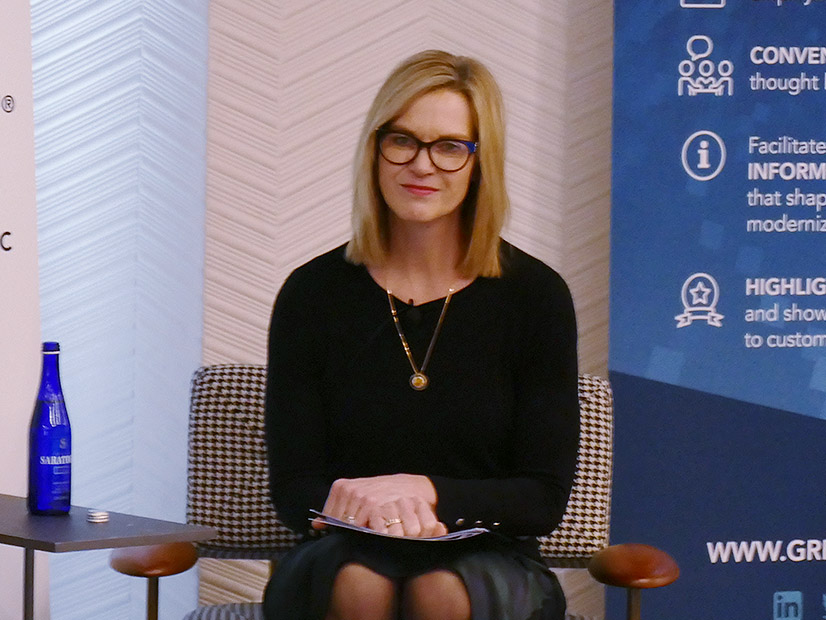
“We’re getting … pretty close to what I would call more of a steady state … where we’ll be able to start to move from … addressing the day-to-day issues that come up for things that didn’t quite get implemented exactly as planned, to [looking at] the longer term,” Candice Trickey, director of Market Renewal Plan readiness, said in a briefing Aug. 21, the first in a promised quarterly series of updates. “How are things progressing? Are we seeing the things we wanted to see? … And where we aren’t, what do we need to [do to improve] that?”
Despite some implementation problems, IESO said the market has been working well, with prices strongly correlated to demand.
Data Points
Some data points as the market nears the four-month mark:
Nearly 30 traders have registered to transact in the virtual market, which allows them to submit hourly bids and offers in nine zones. Problems completing traders’ authorizations delayed the launch of the virtual market from May 8 to May 13. One large consumer has registered as a price-responsive load. Other organizations have begun the process of registering for the two new participation types.
All required participants have registered reference levels under market power mitigation rules, with some refining their values based on their experience in the market. Reference levels include energy and operating reserve prices and resources’ energy ramp rates and lead times. The Market Power Mitigation Working Group has reduced its meeting frequency to monthly, with “no significant issues” identified.
IESO said it has been issuing settlement statements and invoices within the required timelines, although increased processing times have resulted in invoices being issued later in the day than preferred by participants, an issue the ISO is working to address. The ISO created a Settlements Notifications webpage to advise participants of updates.
Participant inquiries have increased under the new market. IESO said its Customer Relations unit has answered 80% of inquiries within two business days, although more complex questions have taken “much longer.” The ISO said 40% of market participants responded to its final market readiness survey, with nearly 90% saying IESO’s Customer Relations or Marketplace Training were “very” or “somewhat” effective. About 63% of respondents reported they generally are “comfortable operating,” and 35% said that “non-critical” operations still are incorporating changes. Only a few organizations reported they were “struggling to operate effectively,” IESO said.
‘Defects’
As expected, Notices of Disagreement have increased since the market launch. The ISO has confirmed its initial statements in two-thirds of cases and attributed one-third to defects that have been corrected. The grid operator is working through a backlog of disagreements.
Most of the defects affected small groups of participants, such as price responsive loads and resources eligible for generator offer guarantees — non-quick-start resources that commit to economically scheduled hourly generation commitments in advance of real-time (RT) dispatch.
Candice Trickey, director of Market Renewal Plan readiness | IESO
But one defect, caused by a calculation error regarding residual uplifts, had a widespread effect. Although the two-settlement energy settlement amounts were calculated correctly, the day-ahead and real-time residual uplifts were calculated incorrectly and distributed to loads and exporters, resulting in adjustments to four uplift charge types. The ISO issued a notice Aug. 12 identifying the issue, the affected charge types and how resettlement will be completed.
Trickey said the rate of new defects in market systems has fallen from the first few weeks and that most were addressed with interim “workarounds” to avoid market effects.
One of the workarounds involved the five-minute interval Ontario Demand values reported in real time, which were overstated in some “limited circumstances.” IESO’s workaround “effectively adjusted forecast demand to largely mitigate this defect,” it said.
The ISO said some defects had no effect because workarounds were implemented, while others affected market outcomes briefly and required it to administer prices or correct schedules before settlement.
More complex defects required “extensive assessment” to determine if there was a material effect and could not be completed prior to settlement.
Real-time prices have been more volatile than the day-ahead market, with prices converging when actual conditions matched forecasts, and diverging when there were large load forecast errors or unexpected outages. | IESO
Thus far, the ISO said, two of those assessed had material effects necessitating the issuance of dispatch scheduling errors (DSEs): an incorrect calculation of the external congestion and net interchange scheduling limit price components for May 1-4; and an incorrect limit considered in the DAM for the ONT-PQAT interface on May 6. DSEs are issued when problems are discovered after settlements are issued; they allow the ISO to provide compensation to harmed parties but do not change prices.
Another five issues requiring extensive assessment are outstanding; the ISO said it likely will take another three to six months to determine whether these had material effects requiring DSEs.
Market Results
IESO officials said market results generally have been in line with expectations.
The market began during the “freshet,” the annual influx of water from spring rainfall and melting snow. Many hydropower projects must exit the operating reserve market and operate as “must-run” generators in spring because they have to flow the excess water through their turbines. (See Operating Reserve Prices Surge in Ontario.)
Joseph Ricasio, a member of IESO’s control room team | IESO
Summer brought its own challenges, Joseph Ricasio, a member of IESO’s control room team, said during the webinar. Hot weather sent the province’s demand soaring above its 2024 peak of 23,852 MW on seven occasions, with peaks as high as 24,862 MW. “I don’t remember the last time we received a lot of successive heat waves,” he said.
Between June 23 and 24, Ontario shifted from a net exporter during peak hours — as strong wind generation allowed it to ship energy to New York and Michigan — to a net importer as wind diminished.
It was a net importer on July 14-16 due to economic conditions and on July 27-29 as two large generators were “forced offline.”
“The generation and transmission performed very well this summer,” Ricasio said. “One advantage [of] being a net exporter is that it gives us a lever to address any adequacy concerns, and that’s because if it’s needed, we can curtail those exports.”
Despite the challenges, Ricasio said, the financially binding DAM has improved IESO’s ability to commit adequate generation for the next day. Some Level 1 Emergency Energy Alerts — a notice that all available generation resources are committed — have been identified based on day-ahead results, IESO said. “This gives advance notice to your neighbors that we may need their help,” Ricasio said.
‘Non-intuitive’ Results
Trickey said numerous participants have questioned “non-intuitive or unusual” market results. Some identified defects, while others were a result of the challenging summer temperatures and the new market’s multi-interval optimization.
“In an LMP market, the [offer] price is certainly an important determinant. But because we’re looking at optimizing over many, many intervals, [there can be] a difference in what the scheduling algorithm and the pricing algorithm are looking at,” she said. “So, you might see an offer close to the margin that appears uneconomic that gets scheduled.”
Director of Markets Darren Matsugu | IESO
Director of Markets Darren Matsugu said the market had produced prices “reflective of system conditions and efficient resource schedules” with real-time and day-ahead prices converging when actual conditions matched forecasts, and diverging when there were deviations in real time due to large load forecast errors or unexpected outages. Although real-time prices were more volatile than day-ahead, more than 95% of load was met by day-ahead schedules, minimizing the price effect on consumers, the ISO said.
“Moving from the mild temperatures in May — where we saw … seasonally low demands and abundant supply — into what’s turned out to be a very hot summer, we’ve seen an associated increase in entry market prices, which is exactly what we would expect,” Matsugu said.
“We also observed higher natural gas prices over the summer, and as gas is often the marginal resource during these two periods, that also has upward pressure on market clearing prices,” he added.
Prices have consistently separated between the north, where bottled hydro supply can suppress prices, and the transmission-constrained south.
“This past May when demand was relatively low and we had substantial baseload generation available, we had very few intermediary peaking resources that were already online and available to increase output immediately,” he added. “But what we have seen is demand has increased over the summer, and more and more of those resources are being committed ahead of real time, either in day-ahead or in pre-dispatch. This increases the amount of incremental flexibility that can be dispatched on the system, if required.”
Prices have consistently separated between the north, where bottled hydro supply can suppress prices, and the transmission-constrained south. | IESO
An average of 80 to 90% percent of non-quick start gas generators dispatched in real time — units that need one to six hours to start up and synchronize with the grid — were scheduled in the DAM over the first three months, providing grid operators and market participants “a clearer view and financial certainty for the next day’s operations while also leaving room to adjust to forecast uncertainty and outages in real time,” the ISO said.
Challenges in Scheduling of Pseudo Units
While the experience generally has been positive so far, “it isn’t perfect,” Ricasio said, citing IESO’s difficulties with pseudo unit (PSU) configurations, which model the mechanical interdependencies of combustion turbines and steam turbines.
Under the Renewed Market, PSU modelling is applied for DAM, pre-dispatch and RT timeframes for commitment, scheduling and dispatch.
IESO notified affected generators of workarounds to address the issues and said it is working on permanent fixes.
No Major Changes Expected
Matsugu said the market thus far has worked as designed to reduce out-of-market payments and increase efficiency.
“I do expect that over time, there’ll be some fine tuning that may be eventually required on these things, as is to be expected with any market — and particularly given the significance of the change that we’ve introduced with Market Renewal,” he said. “But at this point, there are no major design issues that require immediate fixes, just something that we’ll continue to pay close attention to.”
Matsugu cautioned that IESO had only two seasons of experience with the new market rules, saying it will gain valuable knowledge in the coming fall and winter.
“It is premature, I think, to draw too much based upon the still very short time frame that we’ve been operating,” he said. “We are still working toward … a steady state, where we can see the market performance under a diverse set of outcomes and conditions. [And] the participants themselves are still establishing their own competitive bid and offer strategies.”
Participants’ Questions
ISO officials answered several questions from stakeholders during the Aug. 21 presentation. Aaron Lampe, of Workbench Energy, asked about the effect of the market on pre-dispatch prices.
Matsugu said comparing PD prices before and after May 1 is “really comparing apples to oranges [because] in pre-market, our pre-dispatch was doing a one-hour optimization and not looking out across the balance of the day.”
“The only thing in common between pre-market pre-dispatch and our current pre-dispatch is really just what it’s called,” he added.
Rob Coulbeck, of Red Jar Energy Partners, said the ISO’s pre-dispatch three-hour look ahead was restrictive and asked if it could add another hour for import and export transactions that don’t clear in the DAM.
“I think that probably falls in the bucket of future design enhancements,” responded Matsugu. “There’s probably a whole bunch of different things that we can start to consider once we’re satisfied that the current market is performing.”
CAISO staff on Aug. 21 showed how the grid operator plans to implement certain parts of its Extended Day-Ahead Market (EDAM) next year, with stakeholders asking for more time to comment on what they said crossed into potential policy revisions.
CAISO began the workshop by discussing changes to intertie scheduling processes. In the ISO’s current day-ahead market, intertie schedules occur at an intertie scheduling point, George Angelidis, CAISO executive principal of power systems and market technology, said at the workshop.
But under EDAM, intertie schedules will be taken at a Generation Aggregation Point (GAP) in the corresponding source or sink balancing authority area (BAA), Angelidis said. This change will increase the accuracy of power flow on the grid and improve power flow congestion, and more closely aligns with actual flow by reducing phantom congestion, Angelidis said.
CAISO broke down the GAPs into three types: a Default Generation Aggregation Point (DGAP), a Custom Generation Aggregation Point (CGAP) and a Generic Generation Aggregation Point (GGAP). Each type is used to determine intertie participation categories.
Under EDAM, there will be “specific GAPs for balancing authority areas that are the source or the sink of the energy for the import or the export,” Angelidis said.
“We want to have more accuracy in the power flow calculations and market solutions,” Angelidis said. “In the current market, at the intertie scheduling point … there is no resource actually at that location, so modeling energy of the import or the export at that location is inaccurate.”
CAISO is therefore moving the intertie scheduling location under EDAM to “somewhere where it is more reasonably representative of the energy being generated or consumed,” Angelidis said.
“Of course, accurate market solutions for power flow translate to accurate congestion management and also accurate locational marginal prices,” Angelidis said.
Some stakeholders at the workshop said they were concerned that some of the implementation processes presented by CAISO were in fact policy-related issues, which should be discussed further in other workshops with comment periods.
“We need some form of formal comment period,” said Dan Williams, principal adviser with The Energy Authority. “Being someone who has been involved with this initiative since 2018, I was under the understanding from the EDAM design and discussions during that time that EDAM implementation was primarily about the CAISO BA and its interaction with the EDAM BAs.”
Williams said he thought CAISO’s interties, other bilateral intermarket activity in the West and the EIM were “not going to be fundamentally impacted in the way that it is to me being described here.”
“There is, for me, a large impact here to the market in general and contracting that is a lot for folks to absorb in one workshop,” Williams added.
CAISO also discussed how it plans to implement congestion revenue rights and settlements under EDAM. CAISO is looking to phase in its implementation of its CRR model, which could improve the accuracy of the model, said James Lynn, CAISO principal.
When EDAM begins, CRRs will not be paid based on constraints where the CAISO BAA does not receive congestion revenue from integrated forward market flow on that constraint, Lynn said.
Texas regulators have selected the first four projects eligible for more than $240 million in grants outside the ERCOT region as part of the state’s Texas Energy Fund.
The Public Utility Commission approved staff’s recommendation during its Aug. 21 open meeting. It gave Executive Director Connie Corona authority to approve the applications and enter into grant agreements, contingent upon a final review (58492).
The four projects under the TEF’s Outside ERCOT Grant Program (OEGP) include two from North Plains Electric Cooperative (NPEC) and one from Southwestern Electric Power Co. SWEPCO’s $200 million proposal to replace 700 miles of aging copper wire and utility poles in northeastern Texas hits the program’s cap.
The other approved projects are:
$20.4 million to NPEC for a 115-kV transmission loop in five northeastern Texas counties.
$1.9 million to the cooperative to expand its Ochiltree Interchange, increasing service capacity in its northeastern and Panhandle regions.
$17.7 million to El Paso Electric to deploy a continuous online monitoring project that will provide real-time analytics to improve generation availability and operational resilience.
“While it’s critically important to add more power to the electric grids that serve Texas, we must also do everything we can to enhance and strengthen the systems we have in place, and that’s what these four projects will do,” PUC Chair Thomas Gleeson said in a statement.
The Outside ERCOT program is one of four under the TEF. It has been allotted $1 billion by Texas lawmakers. To be eligible for awards, projects must modernize infrastructure, improve weatherization, make reliability and resiliency improvements, or address vegetation management.
PUC staff said the program has received more than a dozen applications, representing almost 50 separate projects and totaling $1.5 billion, since it was launched in May. An additional 35 applications have been started but not yet submitted.
Grants are contingent on OEGP funding availability, mutual agreement to the terms and conditions in their respective grant agreement, and their adherence to the terms and conditions set forth in their respective grant agreements. The PUC will enter into grant agreements with applicants for selected eligible projects until the program’s funds are exhausted.
The commission already has granted two loans under the TEF’s centerpiece, the in-ERCOT program created to build dispatchable generation. The program is allocated half of the TEF’s $10 billion funds. (See NRG Energy Secures $216M Loan from TEF.)
CenterPoint Resiliency Plan Approved
The PUC approved a modified version of CenterPoint Energy’s $3.18 billion system resiliency plan, directing the utility to defer $217 million in cost recovery until 2029 for several resiliency measures related to strategic undergrounding, distribution pole replacements and vegetation management (57579).
CenterPoint originally proposed a $5.75 billion resiliency plan. However, it reached a settlement with commission staff, the Office of Public Utility Counsel, several Houston-area cities and other intervenors that reduced the plan’s costs.
A new state law requires Texas utilities to file annual resiliency plans. CenterPoint drew anger from residents and politicians last year after Hurricane Beryl left 2.2 million of its customers without power.
The commission also:
Approved an amended rule that removes the exemption currently preventing a generation company controlling less than 5% of ERCOT’s total installed capacity from being considered to have market power (58379).
Agreed with staff’s recommendation to hold two workshops Sept. 2. The morning workshop will involve a rulemaking for net metering arrangements for large loads co-located with an existing generation resource. The afternoon workshop will take on a rulemaking that establishes large-load forecasting criteria.
The Louisiana Public Service Commission voted two months earlier than initially planned to approve 2.3 GW in new Entergy gas plants to supply a new, $10 billion Meta data center.
The PSC voted 4-1 to allow Entergy to build three gas generators to power the Meta facility at a cost of $3.2 billion, drawing boos from the audience at the Aug. 20 meeting. (See Entergy La. Confirms Meta Data Center Behind 3 Proposed Gas Plants.) Entergy requested the early vote.
Larry Hand, Entergy Louisiana’s vice president of regulatory and public affairs, said the electric service agreement for the next 15 years ensures Meta will pay to cover the new generation costs, mitigating impacts on other customers.
“Entergy’s goal, and I believe I can safely speak for Meta, was not to come to Louisiana and cause costs to be shifted to other customers,” Hand said. He said while Entergy took pains to strike the most sensible deal it could, there nonetheless would be risks associated with the project.
“It’s a 15-year deal, so we can’t predict everything,” he said.
Hand estimated that net ratepayer impacts will be “plus or minus a dollar” per month. He also said if Meta doesn’t renew the contract after the first 15 years, then the MISO South region will have “a gift” of half-paid-for, relatively new gas plants among the region’s other aging thermal plants in 2041.
According to the contract, should Meta exit the contract early, the generating assets would become wholly owned by Entergy. Louisiana PSC staff said while Meta’s abandonment of the project is a remote possibility, Meta likely would have paid for the most expensive start-up years of the project by the time it leaves.
Hand said it was necessary for Entergy to circumvent commission procedure — forgoing conducting a request for bids on the plants — and self-build the generation to meet Meta’s aggressive timeline. He said opening an RFP would have added a second year to the project.
Entergy Louisiana ratepayers are set to cover an additional $550 million in transmission costs that are necessary to connect the data center’s generation to the grid.
Hand acknowledged not all who protested the deal agreed with the final, settled version of the contract. Louisiana PSC staff, Entergy, Sierra Club and the Southern Renewable Energy Association signed off on the settlement deal.
The finalized deal contains more consumer protection, including a provision that Meta’s minimum bill payments would cover 100% of the costs of the trio of generating units, including cost overruns. Meta also agreed to fund development of 1.5 GW of solar generation under the state’s Geaux Zero program and to provide up to $1 million per year for Entergy’s Power to Care, which is a bill assistance program for low-income, elderly and disabled Entergy Louisiana customers.
Meta, which has a goal to be carbon neutral by 2030 both in operations and suppliers, also expressed a willingness in a separate corporate sustainability rider to help fund carbon capture and sequestration at Entergy’s existing Lake Charles Power Station.
Entergy plans to submit the gas plants to MISO’s newly approved expedited interconnection queue. Hand said it wasn’t efficient to try to build the generation behind the meter, noting that the data center likely would need twice as much generation as planned to run at a more than 99.9% load factor behind the meter.
The data center is slated for a 2,250-acre state-owned site known as Franklin Farms. Two of the new gas plants will be named after Franklin Farms.
Commissioner Eric Skrmetta called the deal groundbreaking because Entergy found a way not to burden the public with new generation builds. He said the contract “sets a new standard to develop power resources to the advantage of our ratepayers.”
Davante Lewis — who provided the sole “no” vote — said he liked the contract’s strong consumer protection and Meta’s assistance with solar expansion but said he ultimately struggled with Entergy’s claim that it needed to bypass a competitive bid process and self-build generation.
“The truth is there are a lot of things that I just cannot verify at this moment,” Lewis said. “I cannot say with enough certainty that this deal and its power agreement serves the greater good, has the public in interest, with the least-cost revenue.”
Lewis said he hoped that future deals with data center hyperscalers contain competitive bidding, battery storage, possibly flexible load provisions and “a full suite of front-end customer protections.”
Commissioner Foster Campbell, whose northeast Louisiana district will host the plants, said the development was something his community was “waiting a long, long time for.” Campbell said he had been “pulling for jobs” in those poverty-stricken parishes for more than 50 years. Campbell said he was supporting the project despite being a Democrat. He explained that it’s easier to be against everything than support something.
“This is something we drastically need in North Louisiana; it’s a shot in the arm,” he said, noting the area was hemorrhaging residents to Dallas, Houston, Baton Rouge and New Orleans.
Campbell also said there’s no such thing as a “bulletproof” contract.
Residents at the meeting voiced concerns ranging from Meta’s potentially massive water use, the lack of permanent jobs created by the facility and doubts that Entergy wouldn’t raise rates because of the project. A few said they considered the project speculative because no one knows how AI would function in 15 years. Multiple residents asked the commission to consider delaying their vote.
Logan Burke, executive director of the Alliance for Affordable Energy, told the commission there are many people living in Louisiana who “cannot handle another dollar on their bill.” She said she was concerned the contract could shift costs and risks onto ratepayers. Burke said ratepayers would foot maintenance costs of the plants, which are poised to deepen the state’s overdependence on gas.
The Union of Concerned Scientists said the vote was rushed. The organization said the project would further tax Louisiana’s grid, which is considered unreliable when compared to other states because of its shortage of transmission capacity, an overreliance on methane gas and the state’s commonplace extreme weather.
“Observers inside and outside the state have undoubtedly taken notice of this pattern of fast-tracking utility proposals with very little public notice and transparency for the residents most impacted,” UCS energy analyst Paul Arbaje said in a statement.
Entergy Sticks by Gas Choice
At the Aug. 19 Midcontinent Energy Summit in Indianapolis, Kurt Allen, director of industrial accounts at Entergy, said the utility is trying to build generation “as fast as they want it.”
Allen said developing renewable energy to meet large load customers remains difficult for Entergy.
“The price is not really coming down on those. There’s a challenge there, and I think it’s going to be a challenge for the next several years,” Allen said. He said it’s tough to convince large customers to pay the resulting prices from Entergy’s requests for proposals on renewable energy. He also expressed doubt over Entergy’s ability to install carbon-capture technology.
Allen said the Meta project is labor-intensive and getting the three generating units and associated transmission built fast enough for Meta’s timeline will be challenging. He said Meta representatives commended Entergy on its swiftness in assembling the deal.
Despite the Meta’s Louisiana plans relying on natural gas, Allen predicted decarbonization likely will be driven by hyperscalers that have the money and the will.
Allen declined to answer an audience question on whether Entergy is thinking about how to bring down the costs of network upgrades so it’s more cost-effective for renewables to connect in MISO South.
At the same event, Entergy’s Wyatt Ellertson said the utility believes natural gas generation is the most reasonable solution for high-load factor customers.
The Trump administration has slapped Ørsted with a stop-work order on Revolution Wind, a 704-MW project off the New England coast that is 80% complete.
The Aug. 22 order by the Bureau of Ocean Energy Management cites national security interests and potential interference with reasonable uses of territorial waters.
It is the latest move by the administration to thwart renewables development, and one of the harshest.
President Donald Trump delivered a pro-fossil, anti-renewable message during his campaign but reserved a particular contempt for “windmills.” Hours after his inauguration Jan. 20, he delivered on his rhetoric, directing a halt to future offshore wind leasing and a review of existing offshore wind permits.
Acting BOEM Director Matthew Giacona cited that Jan. 20 memorandum in his letter to Ørsted North America on Aug. 22. He forbade further activity on the Offshore Continental Shelf until BOEM completed a review.
Ørsted said later Aug. 22 it would comply with the order and is evaluating all options in a range of scenarios, including legal action.
It said the multibillion-dollar project was 80% complete, with 100% of turbine foundations and 45 of 65 of turbines installed. It had been targeting start of commercial operation in the second half of 2026; the 704-MW facility would send emissions-free electricity to Connecticut and Rhode Island.
During an Aug. 11 conference call with financial analysts, CEO Rasmus Errboe was asked if he was certain the Trump administration would not try to block Revolution or Ørsted’s other active project, the 924-MW Sunrise Wind, which is targeted for completion in 2027.
The move against Empire, a project that was fully permitted after years of review, sent shock waves through the renewables industry. There was widespread speculation that it was an attempt to twist the arm of New York’s governor to allow permitting of two natural gas pipeline projects the state previously had rejected, as New York is counting on Empire (and Sunrise) as part of its decarbonization strategy. (See BOEM Lifts Stop-work Order on Empire Wind.)
But the Empire stop-work order never really was explained, other than a vague mention of flawed science and rushed approval. Journalists who requested a copy of a study that purportedly justified the move were repeatedly rejected, then were provided a fully redacted copy four months later.
Errboe cited the Empire stop-work order as a turning point — it immediately made Ørsted’s attempts to land a financial partner for Sunrise untenable, causing Ørsted to announce a need to raise $9.3 billion, causing its stock value to plunge. (See Ørsted to Raise $9.3B, Self-finance Sunrise Wind.)
The company said in a news release Aug. 22 it will in due course update the markets on the potential impact of this latest setback.
Giacona in his letter said BOEM is seeking to address “concerns related to the protection of national security interests” and “interference with reasonable use” of the offshore waters.
He did not elaborate, but both points speak to some of the many policy moves the Trump administration has taken to stop wind power development:
The Department of Commerce on Aug. 13 initiated an investigation to determine the effects on national security of imports of wind turbines and their parts and components.
Late Aug. 22, the National Ocean Industries Association decried this latest attack: “Revolution Wind is already under construction and nearly complete, representing years of planning, billions in private investment and significant progress for America’s offshore energy supply chain. Any pause or uncertainty at this stage could ripple across jobs, contracts and communities already benefiting from the project.”
The Oceantic Network called it an illegal move that threatened American jobs and energy dominance: “This dramatic action further erodes investor confidence in the U.S. market across all industries and undermines progress on shared national priorities — shipyard revitalization, steel and port investments, and energy dominance. In fact, halting work on Revolution Wind will drive up energy costs for consumers, idle Gulf Coast vessel operators that have invested hundreds of millions of dollars in new or retrofitted vessels and jeopardize the livelihoods of union workers.”
SPP stakeholders have approved a revised version of the grid operator’s fast-track study to integrate high-impact large loads (HILLs) during a special virtual meeting of the Markets and Operations Policy Committee.
MOPC members resoundingly shot down the proposal during their July quarterly meeting, giving it only 53.7% approval. They said the fast-track study policy was a rushed process outside of the normal stakeholder structure and didn’t give them enough time to review the revision request (RR696).
Since then, staff have stripped out conditional high-impact large load service (CHILLS) and the design associated with dispatch, study and charges for the service from its original proposal. It also removed one of three paths for high-impact large load generation assessment (HILLGA).
The changes met with success. MOPC members complimented staff on the revisions and then gave the measure 95.7% approval. The transmission owner and transmission user sectors each had one dissenting vote, with 15 total abstentions.
“We’re reviewing an improved product compared to what we discussed in July, so appreciate all the time and effort to get here today,” Southern Power’s Chase Smith said during the meeting.
“I know … there was a desire for members just to have a little bit more time to get more comfortable,” SPP COO Antoine Lucas said. “Today, we’ll do what we can to close out that effort and be able to move this forward to the next stage.”
SPP’s Board of Directors delayed consideration of RR696 during its August meeting to allow a follow-up session for MOPC to discuss the issue further. (See SPP Board Sets Aside 765-kV Costs, Large Load Policy.)
The board and the RTO’s state regulators now will take up the HILL proposal. SPP has scheduled an education session for the board, its Members Committee and the Regional State Committee for Sept. 3. The board then will hold a call Sept. 4 to consider HILLs and Southwestern Public Service’s out-of-bandwidth 765-kV project, which also was set aside by the directors.
MOPC approved a design focused on HILLs and HILLGA paths as revised by staff’s latest comments, filed Aug. 14. Approval is contingent upon SPP modifying the tariff to reinstate a 60-day study under Attachment AQ, which governs upgrades or other changes to delivery point facilities.
HILL studies will remain on a 90-day timeline. Changes include a revised HILL definition that clarifies its transmission service study process and its independence from non-conforming load.
A HILL is defined as a new commercial or industrial load or an increase to existing load at a single site, connected through one or more shared interconnection or delivery points. Load can be either 10 MW or more if connected to the system at a voltage level less than or equal to 69 kV, or 50 MW or more if connected at a voltage level greater than 69 kV.
SPP says its HILL proposal will result in more robust study analysis, with large loads and their support generation studied together. It still includes load forecasts and ride-through requirements, with two HILLGA paths: a common bus or a local area.
Costs will be allocated to the cost-causers:
HILLs using a delivery point assessment will have their upgrades base-plan funded.
Upgrades from HILLs using a provisional load process will be directly assigned until the customer acquires firm service for new generation.
Upgrades from HILLs bringing supporting generation to a local area will be directly assigned to the generation customer.
The CHILLS policy will be taken up during the MOPC, RSC and board meetings in October and November. Staff will hold education sessions before then with various working groups and the RSC.
The Western Resource Adequacy Program (WRAP) Day-Ahead Market (DAM) Task Force is finalizing a concept paper that outlines proposed principles for the program under the West’s new market landscape.
The task force held its fifth meeting Aug. 21 to continue discussions on how to update or optimize WRAP’s Operations Program to make it compatible with the soon-to-be-launched SPP Markets+ and CAISO Extended Day-Ahead Market (EDAM). WRAP was designed before the two markets completed their designs. (See WRAP Task Force Explores Optimization Under Day-ahead Markets.)
The task force has until Sept. 10 to present the concept paper to WRAP’s Resource Adequacy Participants Committee (RAPC) to provide an update on the topics and proposals the group is considering.
After submittal, the RAPC can provide advisory endorsement or recommendations on how the group should proceed. The RAPC will provide formal input after a final proposal has been presented, according to Michael O’Brien, WPP’s senior policy engagement manager for the WRAP.
“Even though we have participants and task force members committed to different markets, they are collaborating on drafting mutually beneficial changes to the operations program, so this task force is a big opportunity to make improvements that everyone can agree on,” O’Brien said in an email to RTO Insider.
“We seem to have consensus that we’re headed in the right direction,” O’Brien added. “We’ve identified the right topics — like holdback, energy deployment, settlements and energy delivery failures, processes that require fine-tuning to deliver the best results in the day-ahead market environment. We are having robust discussions. The concept paper is a work in progress, and we’re getting valuable input on both direction and technical details.”
Under the program’s forward-showing requirement, participants must demonstrate they have secured their share of regional capacity needed for the upcoming season. Once WRAP enters its binding phase, participants with surplus must help those with a deficit in the hours of highest need.
Much of the discussion on Aug. 21 concerned which entity should be responsible for energy delivery failure charges. The group agreed that surplus participants will retain responsibility for energy delivery failures within and between market-based operational subregions.
Rebecca Sexton, director of reliability programs at WPP, said during the meeting that WRAP only assigns the obligation and provides the penalty incentive to deliver. The participants will figure out how to meet their obligations through their respective markets.
“We have really tried to be very careful about drawing the line … it’s the obligation of the participant that we put the whole [responsibility] back on, but however it is that you get that energy there, that’s kind of out of scope of WRAP,” Sexton said.
WRAP’s binding phase includes penalties for participants that enter a binding season with capacity deficiencies compared with their forward showing of resources promised for that season.
In 2024, the binding phase was postponed by one year at the request of participants, who said they were facing challenges including supply chain issues, faster-than-expected load growth and extreme weather events that would make it difficult for them to secure enough resources to avoid penalties. The binding phase is now expected to start in summer 2027. (See WRAP Members Vote to Delay ‘Binding’ Phase to Summer 2027.)
A final proposal from the task force could take several months. The proposal must also undergo a review and governance process with implementation slated for 2026, according to O’Brien.
As the world faces “unpredictable and chaotic times,” Midwest Reliability Organization Board Chair Dana Born reminded directors of the ERO’s role in ensuring stability of vital electric services.
Addressing MRO’s quarterly Board of Directors meeting Aug. 21, Born mentioned some of the dramatic events that have occurred since their previous meeting, such as the blackout on the Iberian peninsula that left the entire population of Spain and Portugal without power for up to 18 hours. (See Lauby Says U.S. ‘On the Right Track’ After Iberian Blackout.) However, she told attendees to keep their minds on the future and look for solutions, rather than pining for an imagined better past.
“At recent NERC meetings … I put little stars in my book [every] time people said that we really have made great progress. We have to remind ourselves of that, because there is so much work to do ahead,” Born said. “The real question is not how do we go back, but how do we move forward with clarity, conviction and a sense of purpose — our ‘why,’ and the significance of what it is that we do every day, who we are and why we are.”
CEO Sara Patrick echoed Born’s advice, noting multiple examples of collaboration across the ERO Enterprise. These included NERC’s Modernize Standards Processes and Procedures Task Force, whose proposal for using artificial intelligence to streamline the standards development process “supports both the MRO and ERO strategies to leverage advanced technologies to solve complex problems.” (See NERC Task Force Members Share Standards Modernization Progress.)
Patrick also held up the regional entity’s work on developing new action plans for risks identified as “extreme” or “high” in its annual Regional Risk Assessment and efforts to establish a data analytics function at MRO as examples of a collaborative approach making long-term progress.
“The ability to collaborate effectively and strategically is essential for achieving sustained success,” Patrick said. “MRO’s role within the ERO Enterprise positions us to provide expert analysis and inform key decision-makers on how local policy decisions can affect reliability of the entire system.”
Directors Agree to New Conduct Standards
Thomas Graham, chair of the Governance and Personnel Committee, brought the meeting’s sole action item, a vote on revisions to MRO’s antitrust policy and standards of conduct. According to Graham, the updates were part of “an ERO-wide effort … to harmonize the MRO policies with [those] of NERC and all the other” REs.
Among the changes in the new policy are expansion of prohibited activities, to include:
discussing or entering agreements among competitors regarding prices, product design or other matters;
use of sensitive information like pricing or terms in discussions with current and potential vendors;
discussions or agreements not to compete for, hire or poach employees;
discussions involving wages or benefits for current or future employees with participants outside MRO; and
agreements or discussions thereof not to seek or bid for work, grants or funds.
In addition, several existing entries on the prohibited activities list were updated to provide more clarity, such as the addition of language specifying that current and future pricing information is not to be discussed by MRO participants. Language on permitted collaboration between REs and NERC also was added, and the antitrust compliance reminder read at the MRO’s meetings was updated too. The new policy was approved without objection.
Later in the meeting, Tasha Ward, MRO’s director of enforcement and senior counsel, presented the RE’s semiannual report on its compliance monitoring and enforcement program (CMEP). Ward observed that MRO has seen a steady drop in incoming noncompliances annually over the past four years, with 169 violations reported to date in 2025 after 341 in 2022, 279 in 2023 and 261 in 2024.
A growing percentage of violations have been submitted via self-reports and self-logs rather than compliance audit, indicating that “entities are looking at their programs and actually submitting the issues that they find … for review by the MRO team,” Ward said. She also pointed out that a majority of open noncompliance cases in MRO’s inventory are less than a year old and only 21% are more than two years old, indicating an improvement in efficiency of noncompliance processing.
MRO’s next board meeting is scheduled for Dec. 4, 2025.
INDIANAPOLIS — The tone of Infocast’s 2025 Midcontinent Energy Summit was noticeably apprehensive compared with last year, owing to political and regulatory uncertainty, load growth ambiguity, fluctuating tariffs and a pending complaint against MISO’s long-range transmission plan.
MISO Senior Vice President Todd Hillman opened the Aug. 19-20 event in Indianapolis by recognizing the unpredictability wrought by ever-changing tariffs, growing data center demand, a rollback of environmental rules and even the surprise move of a Republican president appointing a Democrat to lead FERC.
“We’re not sure what ‘new normal’ is. We’re trying to figure that out,” Hillman said, speaking for MISO’s staff.
Hillman said MISO is trying to “get out of the way” in the rush to bring new data centers online. He noted the footprint could experience load growth of 60% in the next 10-15 years. Currently, almost half the transmission project requests the RTO receives are marked for expedited study treatment and are often meant to serve growing load, he said.
“They’re coming, and they’re coming fast and furious,” Hillman said. “The dog has truly caught the bus.”
“We’ll see how that plays out,” he said, offering no other comment.
Hillman said he wouldn’t guess at upcoming actions from the White House.
“Unless we have a cocktail break in the morning, I’m not going to go there,” Hillman joked.
He similarly refused to take a stab at potential next moves from Congress.
“Again, not enough beer in the bar,” he joked.
However, after being asked by the audience, Hillman said President Donald Trump’s One Big Beautiful Bill Act is likely to impact the 171 GW of generation interconnection requests MISO fielded in 2022. The record-breaking surge of applicants was almost exclusively composed of renewable energy and battery storage projects.
“I don’t know yet, but anecdotally, I think it will be significant,” Hillman said of the impact.
Hillman also promised MISO “will get better” and create more viable market participation rules for energy storage.
The RTO’s generator interconnection queue totals about 300 GW. Another 59 GW of projects have approvals to interconnect but are experiencing construction delays.
DOE Intervention and Load Growth
Brad Pope, director of legal and regulatory affairs at the Organization of MISO States, said the DOE’s involvement in fossil fuel plant retirements is “certainly a new element we’re grappling with.”
Pope pointed out that J.H. Campbell’s retirement was comprehensively examined before it was announced. He added that the $29 million bill the plant accumulated over its first 38 days of extended operations makes customer affordability a challenge.
“This isn’t just something that’s a local impact,” Pope said. He noted FERC’s decision that the cost of keeping the plant online be spread across all MISO Midwest participants means other states have no control over incurring costs.
However, Pope said “there’s a whole host” of new technologies, including HVDC lines and grid-enhancing technologies, and new procedures — including MISO’s expedited queue lane — that state regulators are also fitting into the RTO’s tapestry.
Illinois Commerce Commissioner Stacey Paradis said Illinois is concerned about how OBBBA could affect the goals of the state’s Climate and Equitable Jobs Act (CEJA). She said that so far, Illinois is lagging in reaching its 40% renewable target by 2030, and the state may open a new long-term procurement plan to secure more solar. Paradis added that the federal pullback of incentives for clean energy should make the next few years “interesting.”
Paradis noted that DOE hasn’t yet moved to keep plants on in Illinois and derail CEJA’s mandate that coal and gas generating units achieve zero emissions or close by the end of 2045 at the latest.
Paradis said non-disclosure agreements from data center developers are a stumbling block to efficient planning for regulators, utilities and RTOs. She said it’s a safe bet that if a data center is engaging Illinois about accommodating its load, chances are it’s also holding conversations with Wisconsin, Indiana, Michigan or even Missouri.
In some cases, non-refundable deposits of a few million dollars aren’t enough to deter developers from simultaneously courting multiple locations for a single project, she said.
“For some of them, that’s not even pennies on the dollar,” Paradis said. “We don’t want to overbuild. We don’t want to burden our customers with billions. We need to figure out what’s real.”
Indiana Utility Regulatory Commissioner Sarah Freeman said load growth projections have come into sharper focus compared with 18-24 months ago.
“They’re still not on a level to which I would risk the pocketbooks of my ratepayers, my fellow Hoosiers,” Freeman said. “The speed at which everything is moving does increase the risk of stranded assets.”
“Utility commissioners are risk managers,” Pope said, adding that the “truth is somewhere in the middle” for recent load forecasts.
‘Chaos’
Other panelists said OBBBA has introduced unprecedented uncertainty in the developer space.
“It’s chaos right now,” EDF Renewables Senior Director of Transmission Policy Temujin Roach said of today’s political climate. “We need to know what the hurdles are going to be. … You’re going to have to step back from the [federal government] and the executive branch as much as you can and work with the states.”
Roach advised renewable developers to employ that tactic for the three-year remainder of the current presidential administration, or however long it lasts.
He said generation developers are in a new environment where they must be more circumspect when submitting projects for interconnection study.
“We have to have quality and confidence in our projects. You can’t do the ‘spray and pray’ process we did for a while,” Roach said. “Are we still going to lose some projects? Sure.”
Roach said MISO’s 59 GW of incomplete generation is often “thrown in developers’ faces.” He acknowledged that developers weren’t as disciplined a few years ago and said interconnection procedures were likely too lenient to discourage speculation.
Roach noted also that the industry must do all it possibly can to increase use of energy storage, demand response and grid-enhancing technologies. He said grid planners cannot continue with no end in sight to prescribe billions of dollars of lines. At some point, he said, consumers will be unable to shoulder the costs.
“We’re going to have to explain how we’re being efficient with billions and billions of dollars,” he said.
Developers Back MISO Long-range Tx
However, Roach said the energy industry throughout the Midwest is relying on MISO’s $22 billion second package of long-range transmission lines to manage load growth and accommodate future generation plans. He said there comes a point where stakeholders should consider the transmission portfolio finished and move forward, referring to the recent five-state complaint at FERC. (See Five Republican States File FERC Complaint to Undercut $22B MISO Long-range Tx Plan.)
“It just turns into a death spiral of restudies. If we keep looking backwards and keep restudying, we’ll never move forward. Hopefully, FERC sees it that way,” Roach said. He added that stakeholders can always advocate for changes on the next MISO planning exercise.
“Yes, transmission is useful. I have no other comment. Ask me again in a year,” Robert Frank, a utility financial analyst at the North Dakota Public Service Commission, said dryly.
The North Dakota commission spearheaded the complaint against MISO’s second long-term portfolio.
Multiple developers said MISO’s long-range transmission planning makes the footprint more attractive for project development.
Anthony Doering, a senior director of interconnection and transmission at independent power developer MN8, said generation developers are working their hardest to bring the most viable projects forward. But developers are reliant on MISO, regulators and transmission companies to get the long-range transmission built on time, he said.
David Ticknor, senior interconnection engineer at RES Group, said MISO’s second long-range transmission portfolio is poised to support load additions, fleet change and reliability. He said it’s difficult to quantify reliability benefits of transmission, but MISO did a commendable job in its benefits analysis.
“I think it’s one of the coolest transmission buildouts we’ve seen in a long time,” Ticknor said.
However, Ticknor said his company is keeping a “keen eye” on the recently filed complaint from the five states against the portfolio.
“The cost allocation point is what it always comes down to,” he said, adding that MISO did a good job of planning despite not being able to solve all issues on the grid with a single transmission package.
Doering advised RTOs not to “cost-allocate the generators for your backbone transmission projects.” He said it’s difficult to get companies to sign on to power purchase agreements when potential generation projects are expected to entirely cover the cost of large transmission, with costs not commensurate with use.
“The need [for transmission] is already established. We don’t need to punish generators. We need to allocate the marginal impact of their use of the facility,” Doering said.
Ruchi Singh, vice president of interconnection and transmission at Brookfield’s Urban Grid, said if MISO planned transmission to increase capacity along the Midwest-South transfer constraint, it would open several possibilities to generation developers.
Swift Current Energy senior vice president Jim Marett said MISO is the easiest RTO to interconnect into today. He said although it’s slow and expensive, the MISO queue doesn’t experience the “sudden stops” that occur in other RTOs.
Development Becomes Trickier
“Development hasn’t been easy in the past year or so,” conceded Erik Ejups, director of power marketing at EDF Renewables. He said it’s become easy for a “small opposition group” to have an outsized impact on a solar project’s chances.
Foss and Co.’s Dawn Lima said OBBBA has set off a growing perceived risk from investors, who now request grandfathered projects whose construction started in 2024 and will be complete around 2026 or 2027.
Marett said there are enough renewable projects in the beginning stages or that will kick off physical construction before Sept. 2 (a federal deadline for wind and solar projects that plan to use the 5% safe harbor rule for claiming tax credits) to keep developers busy for the next few years and act as a de facto grace period for absent incentives. But he said growing capex costs will likely eat into developers’ margins. Fortunately, Marett said, data centers seem to have an appetite for new generation, even if it’s more expensive.
“What we’ve noticed is that an upgrade cost that would have gotten a project thrown out of the pipeline in 2017, we’re now ecstatic about. It’s a little bit more of a high-stakes poker game,” he said.
Conductor Solar CEO Marc Palmer said solar, storage and distributed energy resources “particularly got a gut punch” with the federal phaseout of incentives.
Palmer predicted that the remainder of 2025 and 2026 will contain strong construction trends, with a dip over 2027, followed by a recovery as costs of the assets naturally drop.
“We expect that to start bouncing back in time without any additional policy changes,” Palmer said. “We think the next 10 years are going to [see a] transition to value-driven growth, which is going to lead to a healthier market overall.”
Nick Panko, vice president of tax compliance firm CFO Services, said he expects the “emotional response” to the bill to wane.
“Every four years, you’re used to the swing,” agreed Brad Tyson, a vice president at Santander. Tyson said recent IRS guidance that laid out the transition in tax credits was a “small win” for renewable developers. He said some developers who braced for a tight, two-year shift breathed a sigh of relief when they found there would be a pathway to four-year safe harbor provisions. (See IRS Guidance on Wind and Solar Credits Not as Bad as Feared.)
Under OBBBA, wind and solar projects can qualify for the phased-out clean energy production tax credit and clean energy investment tax credit if they are placed in service by the end of 2027 or begin construction before July 4, 2026.
Panko said by the 2027 deadline, the U.S. will then gear up for another tax policy shift under a new presidential administration.
Cons Before Pros
John Davies, CEO of the eponymous public persuasion firm Davies, said this moment embodies the Chinese curse — not a proverb, he stressed — “May you live in interesting times.” He said for many, it’s challenging and for some, it’s a crisis.
“We look at this time as an opportunity for good companies, good players to make advances,” Davies said.
Davies said renewable projects, which often enjoy massive public support, fail because companies neglect to engage properly with the public. Davies said it may seem counterintuitive, but project developers should acknowledge the cons of a project before publicizing the pros to build credibility.
“If you can acknowledge, then contrast, you’re going to win every time,” he said.
Davies said currently, wind developers have the biggest perception problem, with more negative online articles available than positive.
“They have given up the web,” Davies said.
Davies said the people who have a “not in my backyard” attitude are either rational, irrational, or fearful of unknowns of the infrastructure or potentially being disrespected.
“They decide to be crazy because that’s what their political party tells them to do,” Davies said of the irrational types. He advised companies to listen to communities, perform outreach and cultivate relationships.
Davies advised against developers creating a social media page for projects, saying it’s a surefire way to create a hot spot for protesters. He joked that Mark Zuckerberg’s office contains a graveyard of renewable energy projects.
Brian Ross, vice president of renewable energy at Great Plains Institute, said every community should consider itself a “host” community for clean energy. He said the clear delineation that once existed between host communities and strictly consumer areas is evaporating. Every community contains the potential for solar energy, he said.
Ross said GPI is conducting campaigns where the nonprofit approaches municipalities to “soften the ground” and ask residents what they want from inevitable renewable projects versus what they dislike about them.
“Once you get them talking about what they want, the objections start to diminish,” Ross said. He said community members begin to associate projects with funding for local programs rather than usurping farmland.
Ross said developers might have to contend with lingering mistrust because developers previously publicized a project in a community, then vanished without explanation when upgrade costs jumped too high. He said those kinds of gaps are common in a “capitalistic landscape.”
Ross also said GPI as a rule doesn’t mention that a particular project will help alleviate climate change unless the community already has established climate goals. He said many communities view the “clean energy economy as thrust upon them.”
Hillman said, at the end of the day, the industry’s end goal is reliability. He said industry players need to have “elevated debates” in an era of “I’m right, you’re wrong.”
“Use phrases like, ‘Tell me more;’ ‘What’s your perspective?’ Or ‘While I don’t quite see it that way, I can understand where you’re coming from,’” Hillman urged.