ERCOT has told its market participants that the Texas attorney general’s office has served the grid operator with a civil investigation demand (CID) in connection with an ongoing investigation.
The CID seeks market and operations data that includes protected information and ERCOT critical energy infrastructure information necessary for the AG’s office to “evaluate potential violations of applicable law,” the grid operator said in an Oct. 22 market notice.
ERCOT said it will immediately disclose the requested information “as required by applicable law.” It assured market participants that it will “take steps to maintain confidentiality” by labeling confidential information and relying on statutory information protection requirements.
In an emailed statement, ERCOT said it would not comment on pending legal matters.
This is not the first time AG Ken Paxton’s office has issued a CID to ERCOT. His office launched investigations into the grid operator and several other entities that he said “grossly mishandled” the grid during the disastrous Winter Storm Uri in 2021.
“We will get to the bottom of this power failure, and I will tirelessly pursue justice for Texans,” Paxton said at the time.
The AG’s office did not respond to questions about the current CID or results of the 2021 investigations. It also hasn’t posted a news release about the new investigation.
RTO Insider contacted several market participants. None of them were aware of the investigation.
One theory is Paxton is conducting a “fishing expedition” to bolster his U.S. Senate campaign with some positive news.
The investigation could be linked to a recent lawsuit the Public Utility Commission filed in June against Paxton. The PUC was seeking to block the release of data on cryptocurrency miners, saying public disclosure could lead to acts of terrorism against the facilities.
A 2023 state law required cryptocurrency loads greater than 75 MW to register with the PUC by February 2025. The PUC rebuffed several media outlets when they asked for data on the registrations; the outlets then appealed to the AG’s office.
According to The Texas Tribune, the AG’s office in May sided with the media outlets. An assistant said the PUC “failed to demonstrate” the requested information was specific enough to aid terrorists.
Like ERCOT, the PUC said it would not comment on “pending legal matters.”
Puget Sound Energy announced a partnership with Norwegian tech company Heimdall Power to install monitoring devices on 100 miles of transmission lines, stating the technology will help optimize the capacity of existing equipment.
PSE and Heimdall Power have installed 75 monitoring devices called “Neurons” on the utility’s transmission lines in western Washington under a dynamic line rating (DLR) pilot project that will run through summer 2026. The sensors can help increase grid capacity and power delivery for PSE’s 1.2 million customers by collecting real-time data on electrical current, line temperature, sag, wind speed and weather conditions, according to an Oct. 22 news release.
“This is an exciting first step for PSE to understand and capture the value of dynamic line ratings,” Alex Brotherston, principal engineer on PSE’s grid modernization team, told RTO Insider in an email. “With load growth, rising costs, aging infrastructure and long project timelines, it is critical that we leverage this kind of technology to increase the safety and efficiency of our grid.”
The pilot project “will allow us to observe the real-time conditions around our system and, when conditions are right, transfer more power through existing lines,” Brotherston said. “This in turn can ease congestion and give our operators more flexibility to respond to market or system constraints.”
Citing numbers from the U.S. Department of Energy, Brotherston said DLR can increase transmission capacity by 10% to 30%. PSE conducted a preliminary study using historical weather data, which showed that the utility’s pilot lines could see a capacity increase of up to 50% under the right conditions, Brotherston added.
Heimdall installed the DLR devices using both autonomous drones and traditional installation methods, according to the news release.
The partners said this is the largest deployment of DLR sensors in the U.S. and they will provide a continuous data stream, allowing PSE to increase transmission capacity “based on actual operating conditions rather than conservative estimates.”
Brotherston said the sensors can provide insights on line conditions during extreme weather scenarios, which can assist PSE in understanding how much power each line can safely handle.
“This allows us to proactively adjust load ahead of adverse conditions or avoid overloading lines during emergency rerouting,” Brotherston added.
PSE also hopes the devices can assist in incorporating more renewable energy on the grid.
“When we are armed with more knowledge about the capacity of our lines, we can more strategically route power around our system, which gives us the necessary flexibility to site new renewable energy sources, or more efficiently utilize the renewables already on the system,” Brotherston said. “In the future, this could look like a wind farm being able to generate at full power instead of being constrained by the capacity of the transmission system, or fewer infrastructure upgrades required to site a new solar facility.”
PSE declined to disclose the financial details for the pilot project, saying sharing costs could affect future contracts “as we move toward full-scale implementation or work with vendors on similar future projects.”
PSE said the pilot project is part of the utility’s efforts to modernize the grid and enhance resilience on its network. The utility will test the technology through summer 2026, then analyze the data to determine how to implement dynamic line ratings using the devices.
ISO-NE presented a high-level overview of how it plans to account for resource deliverability in its updated capacity accreditation framework at the NEPOOL Reliability Committee on Oct. 22.
Resource deliverability calculations are intended to reflect system constraints that limit a resource’s output during key periods.
“Final capacity accreditation values must consider resource megawatts and the capability of the transmission system to deliver megawatts from resources to the load,” said Alex Rost, director of transmission services at ISO-NE.
He noted that the capacity auction reform (CAR) project will not change the process of determining deliverability through the interconnection process.
However, the new accreditation process will need to update how it accounts for deliverability, which will be used as a model input instead of an “ex-post adjustment,” Rost said.
“The ISO proposes to account for resource deliverability in accreditation calculations through an ex-ante adjustment to the size of a resource to be modeled in the RAA [resource adequacy assessment],” said Marianne Perben, director of planning services at ISO-NE.
ISO-NE proposes to rely on a scaling factor to account for deliverability limits, which would equal the lower value of either 1.0 or the ratio of deliverability value to “dependable capability,” Perben said.
Dependable capability “is an audit-based value reflecting a resource’s expected energy contribution under high load conditions,” Perben said. “The greater a resource’s deliverability value is above its DCap value, the more likely it will be able to provide its capacity to the system without transmission limitations.”
Each resource’s DCap value will be calculated based on its median performance during peak hours, which ISO-NE plans to define as the top 500 load hours from the relevant season from the prior year.
The value will be calculated for all resources except “demand capacity resources participating with energy efficiency measures,” said Jennifer Engelson, supervisor of resource qualification at ISO-NE. She added that energy efficiency resources “report a single seasonal performance estimate and therefore, hourly performance values are not available.”
The PJM Board of Managers has directed staff to proceed with a Quadrennial Review design that reworks the capacity auction price curve and sets the reference resource as a combustion turbine for all zones. (See PJM MIC Endorses 2 Quadrennial Review Proposals.)
“The board believes this proposal strikes the appropriate balance of reliability and cost implications,” it said in an announcement posted Oct. 22. It also noted that the proposal, jointly sponsored by PJM staff and Pennsylvania Public Utility Commission Vice Chair Kimberly Barrow, was the only one to be supported by the Markets and Reliability Committee.
Six proposals were considered by the Market Implementation Committee over the past year, with two being endorsed in September. The PJM/Barrow proposal received 75% sector-weighted support at the MRC. PJM spokesperson Jeff Shields told RTO Insider that staff intend to file the proposal within the next few weeks.
The proposal aims to improve the stability of the variable resource requirement (VRR) curve by reducing reliance on multipliers of the cost of new entry (CONE) parameter; the curve defines the clearing price to be procured in a Base Residual Auction (BRA) and at what cost.
It would shift the design of the VRR curve to set the maximum price at the larger of either 20% of the gross CONE, or 115% gross CONE minus 75% of the net energy and ancillary services offset. The formula establishes a floor meant to prevent high energy market revenues lowering the maximum capacity price to zero. The curve approved by the commission in 2023 set the maximum at the greater of gross CONE or 1.75 times net CONE, which subtracts the EAS offset from gross CONE. (See FERC Approves PJM Quadrennial Review.)
The midpoint on the curve would procure 101.5% of the reliability requirement at half of the maximum price, which is also meant to improve the stability of the curve. The midpoint for the prior curve was set at 75% of net CONE and 101.5% of the reliability requirement.
The curve would reach zero at 106% of the reliability requirement, shifting further to the right from the 104.5% anchor used in the previous curve shape.
During the Sept. 25 MRC meeting, PJM’s Skyler Marzewski said there is little difference in the maximum price when the curve is based on a combined cycle reference resource, the RTO’s preference, and a CT. The maximum would fall between $483/MW-day of unforced capacity in CONE Area 3 and $785/MW-day for ComEd. Some areas would see a lower maximum using a CC reference resource, such as a $463/MW-day maximum for CONE Area 3, while it would be higher in ComEd at $841/MW-day.
PJM’s original proposal sought to use a four-hour battery electric storage system as the reference resource in the ComEd region and a CC in all other CONE areas. Marzewski said a curve based on storage for ComEd would reflect environmental restrictions in Illinois that would reduce the lifespan of new gas generation. Instituting a CC for the other regions would reflect development trends in the region, with several CCs in the interconnection queue. (See “Stakeholders Divided on Reference Technology,” PJM Stakeholders Discuss Quadrennial Review Proposals.)
PJM had intended to shift to a CC in the last Quadrennial Review but backtracked when it determined that high estimated energy prices could cause capacity prices to fall to zero, along with disruptions to other parameters based on the reference resource. (See FERC OKs Changes to PJM Capacity Market to Cushion Consumer Impacts.)
PJM’s proposal adopted Barrow’s recommendation to use the 67th percentile of the net EAS offset for each CONE area, which Marzewski said is meant to reflect that developers will seek to maximize their potential revenues when siting projects.
ISO-NE has identified nine projects to include in an interim asset condition review process starting in October, which will proceed as the RTO works to stand up internal condition review capabilities by the start of 2027.
The asset condition reviewer is “envisioned to provide an independent review and opinion of asset condition projects submitted for review by the TOs [transmission owners],” Al McBride, ISO-NE vice president of system planning, told the ISO-NE Planning Advisory Committee (PAC) on Oct. 23.
ISO-NE agreed to take on the role following pressure from states and consumer advocates, who have expressed concern about a lack of oversight and transparency on spending by transmission owners to upgrade existing assets. Asset condition spending has increased significantly in recent years, which transmission owners say is due to escalating costs associated with maintaining aging grid infrastructure. (See ISO-NE Open to Asset Condition Review Role amid Rising Costs.)
The RTO has emphasized that it will not take on a regulatory role or comment on the prudence of investments; asset condition spending is under FERC jurisdiction and is processed through formula rate procedures.
The new role, McBride said, “would inform states, stakeholders and PAC attendees” with “holistic information and much more insight on these projects.”
While ISO-NE will not comment on “the question of whether the costs of any given asset condition project are prudent,” it plans to offer opinions on whether transmission owners have adequately demonstrated project needs, and whether they adequately evaluated alternatives.
ISO-NE is seeking feedback on the proposal by Nov. 21 on the objectives of the role, governance structures, criteria for project review, stakeholder involvement and how reviews would fit in with transmission planning processes.
Asked whether ISO-NE plans to employ a cost threshold for reviewing projects, McBride said, “at this point, we expect that there would be a threshold, but that has not been decided, and we’re open to feedback.”
Several stakeholders said they are eager to get into discussions about how the new role could inform efforts to right-size transmission projects.
“Those discussions will come, but they will come in the right order, which we think is after we’ve had some time to establish the asset condition reviewer itself,” McBride said.
ISO-NE plans to rely on consultants to evaluate projects prior to the official rollout of the new asset condition reviewer role. It has selected nine proposed projects to review during this interim period:
Eversource’s rebuild of Line 1670/1771 in Connecticut, estimated to cost more than $120 million.
Eversource’s rebuilds in the West Medway/West Walpole Corridor in Massachusetts, estimated to cost more than $75 million.
Eversource’s underground cable modernization plan in the Boston area, a multiphase project the New England States Committee on Electricity has estimated will cost in the range of $8 billion to $9 billion.
Avangrid’s cable replacements on a line in southern Connecticut, estimated to cost more than $100 million.
Rhode Island Energy’s rebuild of Line 332, estimated to cost more than $75 million.
National Grid’s rebuild of Line 323 in eastern Massachusetts, estimated to cost more than $75 million.
National Grid’s partial rebuild of Line 394/397 in northeastern Massachusetts, estimated to cost more than $100 million.
VELCO’s partial rebuild of Line F206 in Vermont and New Hampshire, estimated to cost more than $50 million.
VELCO’s Highgate converter replacement, estimated to cost more than $500 million.
“The ISO is targeting a three-month review period for each project, except for the underground cable modernization plan,” McBride said. “These interim projects would be reviewed between early November 2025 and the end of 2026, as the TOs bring those selected projects forward to present and discuss at the PAC.”
ISO-NE has asked for comments on the interim project list by Nov. 7.
Asset Condition Project Presentations
Also at the PAC meeting, several representatives of transmission owners discussed asset condition project proposals.
From Eversource, Chris Soderman presented a $143 million project to fully rebuild a 115-kV line in central Connecticut. He said a full rebuild, instead of targeted structure replacements, would address the immediate needs along with “future asset condition needs by replacing structures that are deteriorating and likely to require replacement in the near future.”
The project is included in the interim review list presented by ISO-NE at the meeting.
Soderman said the project is needed to address “multiple structure concerns including foundation damage, structure deterioration and rust.”
Of the 83 structures on the affected lines, Eversource estimated about half require planned replacement or emergency replacement. He said the condition of the other structures warrants consideration of replacement “in conjunction with other structure replacements.”
Soderman added that, without a full rebuild, the company likely would have to return to the PAC with a follow-up project “within two or three years” to replace the remaining structures.
Eversource plans to bring the proposal for a follow-up presentation at the PAC in the second quarter of 2026, with construction scheduled to begin in early 2027.
Multiple PAC members expressed concern about the high per-mile costs of the project, and Sheila Keane of the New England States Committee on Electricity (NESCOE) asked for more granular information on cost drivers for the project.
Rafael Panos of National Grid presented a cost update on a transformer replacement project in Bridgewater, Mass. The project includes replacing a transformer, refurbishing a transformer, replacing multiple circuit breakers and upgrading associated equipment. The project cost has increased from the 2022 estimate of about $26 million to nearly $38 million. The higher cost estimate is driven by inflation, escalation and a longer construction duration, Panos said.
Fabio Dallorto, lead engineer for transmission planning at ISO-NE, presented an update to the asset condition database.
He said transmission owners have added 21 new projects totaling $228 million since the last update in June. (See New England Transmission Owners Add $95M to Asset Condition List.) He added that 12 projects totaling $443 million have been placed in service since the last update.
Copperweld Shield Wire Replacements
Dave Burnham of Eversource discussed the company’s strategy for replacing Copperweld shield wire in its service territory. He said the company has found Copperweld shield wire to have a failure rate about six times higher than other types of shield wire.
“Copperweld shield wire was once an industry standard but has been prone to failure, and it is increasingly difficult to obtain replacement equipment,” he said.
“Since 2018, Eversource’s primary strategy to address Copperweld shield wire concerns has been to replace Copperweld shield wire in conjunction with projects that also address other asset condition needs,” Burnham said. “Eversource estimates that most Copperweld shield wire will be removed by 2030.”
Eversource’s practice is to replace copper wire with Alumoweld and optical ground wire (OPGW).
“In most cases, OPGW is preferrable to Alumoweld because it has similar costs and provides additional telecommunications capabilities,” Burnham said.
He noted that Eversource mistakenly presented incorrect data on Copperweld shield wire in 11 asset condition presentations to the PAC between 2021 and 2023.
“These presentations incorrectly provided results from testing of copper conductor and [extra-high strength] steel shield wire performed in 2018,” Burnham said. “Test results from Copperweld shield wire performed in 2022 showed failure of tensile elongation test, not rated breaking strength test, corrosion or signs of overheating.”
Keane of NESCOE said it is “concerning that we were presented incorrect evidence to support a certain approach,” and expressed her hope “that this is the type of thing that an asset condition reviewer will be looking at.”
Speakers at the American Council on Renewable Energy’s annual Grid Forum weren’t afraid to use strong words on the ineffectiveness of the U.S. permitting system but were bullish that it’s fixable.
The permitting environment in the U.S. is so “inhospitable” that it results in “dark matter” — beneficial transmission lines that don’t come into existence because weary developers don’t bother to attempt them, Daniel Palken, of philanthropy organization Arnold Ventures, said at ACORE’s annual meetup Oct. 23 in Washington, D.C.
Palken read from the “Simple Sabotage Field Manual” drafted by the U.S. Office of Strategic Services (the predecessor agency to the Central Intelligence Agency), which was distributed to Europeans in German-occupied territories during World War II to disrupt the Nazis.
The manual details “innumerable simple acts which the ordinary individual citizen-saboteur can perform,” it reads. It describes how adopting a “noncooperative attitude” can lead to damage indirectly. “A noncooperative attitude may involve nothing more than creating an unpleasant situation among one’s fellow workers, engaging in bickerings, or displaying surliness and stupidity.”
Palken said these simple acts include:
never permitting shortcuts that could expedite decisions;
making longwinded speeches littered with anecdotes and patriotism;
referring matters to intentionally large committees for further study and consideration;
bringing up irrelevant issues in discussion;
haggling over precise wording in minutes and resolutions;
attempting to relitigate matters decided upon in previous meetings;
frequently advising caution and warning against haste;
second-guessing decisions and questioning whether the committee held jurisdiction in the first place.
“It should be obvious to anybody in this room that is a very sound description of the transmission planning process, the process by which transmission lines are paid for and cost allocated, and then the process by which they are finally permitted and built in this country,” Palken said.
“We’re, in short, sabotaging ourselves and our ability to build the large-scale infrastructure that we need.”
Elizabeth Horner, of law firm ArentFox Schiff, said part of the challenge of federal efforts to streamline transmission permitting is that jurisdiction is spread across multiple House and Senate committees, FERC and the Department of Energy.
Horner said Republicans and Democrats should come to an agreement on their respective “end goals” of permitting reform, which often are the same, though messaging to their constituents is different.
Despite the ongoing federal government shutdown and Capitol Hill staffers not being paid, closed-door discussions and drafts still are being circulated to make inroads on permitting improvements, she said.
“Do not treat the shutdown as a reason to stop advocacy,” Horner told the audience. Horner said she’s hopeful that Congress could pass a bill in 2026 that would build on the past five years of incremental permitting changes.
Palken agreed, saying the shutdown is “immaterial” to the momentum around transmission permitting changes.
Senator Optimistic on Permitting Improvements
U.S. Sen. Shelley Moore Capito (R-W.Va.), chair of the Environment and Public Works Committee, said the committee still is at work to try to make permitting “faster, fairer and less expensive.”
“We’ve only really nibbled around the edges,” Capito said of previous congressional efforts to streamline permitting. She noted the stops and starts of legislation trying to cut red tape, with the unsuccessful START Act and RESTART Act and the currently on-pause SPEED Act (H.R.4776) in the House of Representatives.
“If there’s skepticism in the room as to whether we can make it again this year, I certainly understand that,” she said. “You might be rolling your eyes, like, ‘does she really think this can happen?’ I am an optimist. I always think everything can happen; everything good can happen.”
But Capito told the audience not to expect a detailed timetable from her on bill passage and admitted that she thought “we were going to reopen the government three weeks ago.”
ACORE CEO Ray Long (left) and Sen. Shelley Moore Capito (R-W.Va.) | ACORE
Capito said permitting laws must be fair to “every type of project” and listed solar, wind, geothermal, gas pipelines, coal and nuclear. She said project developers should have confidence they can move forward and “not have to look over your shoulder” in the fears that a new presidential administration could terminate projects.
“We’ve seen that happen on both sides,” Capito said. She added the government needs to “prevent the swings” of scrapping the Keystone XL pipeline under President Joe Biden and then discarding “Sen. [Sheldon] Whitehouse’s” (D-R.I.) offshore wind farms under President Donald Trump. She said any new law needs “specific, locked-down permitting language” to cut out loopholes that are openings to getting projects canceled.
Capito also called for tight timelines on judicial review, so projects aren’t caught in a “circular firing squad” of litigation.
U.S. Rep. Gabe Evans (R-Colo.) — a co-sponsor of the SPEED Act — said permitting reform will be a “massive” undertaking requiring buy-in from five congressional committees involved in permitting.
He said simpler permitting is desperately needed, comparing China’s recent installment of 500 GW on its grid to the U.S.’ current, 1,100-GW system.
“If we can’t build things in the United States, we are going to get our butts kicked by our foreign competitors, and so permitting reform is absolutely critical to be able to speed up that timeline,” Evans said.
Evans said 80% of permits ultimately are issued as-is for big infrastructure projects requiring environmental reviews that have been bogged down in years of litigation.
FERC Chair David Rosner joked he would give a “safe-place, sitting-government-official” answer to whether he believed permitting improvements are necessary: “I will be really delighted to implement any bill that Congress passes and the president signs.
“But with the FERC hat off, as an American citizen, I will say I think it takes too long to build all sorts of infrastructure in this country,” Rosner said. “I think it’s really obvious, and I’m very hopeful we can find bipartisan, durable solutions to that.”
Transmission the ‘Biggest Antidote’ to Load Growth
ACORE CEO Ray Long said the country’s outdated permitting process takes up to 17 years to approve major transmission lines and four to five years for other critical energy infrastructure.
“That delay is more than a bureaucratic frustration. It’s a roadblock to affordability, reliability and national competitiveness,” Long said.
Long said the U.S. cannot power the 21st century with a permitting system designed for the “1970s and before.” He cited Grid Strategies’ December 2023 report concluding the U.S. power grid could require an additional 120 GW of new capacity by 2030, the equivalent of adding the capacity for 12 New York Cities.
Long said the energy industry needs to “think big and act quickly” to accommodate the artificial intelligence boom, new factories and clean energy.
“Everyone in this room understands that every mile of new transmission powers jobs, innovation, prosperity. It strengthens communities, connects technologies and helps ensure that American remains a global leader in energy, in manufacturing,” Long said.
Palken said since FERC issued Order 1000 in 2011, zero new interregional transmission lines have been completed, and most areas of the country have failed to select transmission lines through regional planning processes. Though MISO has had some success in planning regional transmission lines, the RTO essentially ignores half its footprint (the South region) and has no plans to better connect its Midwest and South regions, he said.
Transmission is the “biggest antidote” to unprecedented load growth, Palken said.
“Forty-nine states right now are convulsing, trying to figure out how to accommodate roughly 3% load growth. One state — roughly — has been doing 2 to 3% load growth for the last decade while keeping rates completely steady, in inflation-adjusted terms, while beating all the blue states at their own clean energy deployment goals. This state is of course Texas,” he said.
Palken said Texas features a better interconnection process than in other regions, easier siting laws and more straightforward permitting, in addition to transmission planned through its Competitive Renewable Energy Zones. Though Texas mostly isn’t beholden to FERC or the National Environmental Policy Act, Palken said ERCOT is an “instructive” example for Congress.
IESO is seeking to reduce risks in its procurement of long lead-time (LLT) resources by reserving the right to reject proposals that are too expensive and allowing the ISO and generation developers to cancel deals in the first few years.
IESO created the LLT procurement in response to stakeholder feedback that energy storage resources such as compressed air and pumped hydro require longer planning cycles than the four-year lead times for resources offering in the pending Long Term 2 (LT2) procurement.
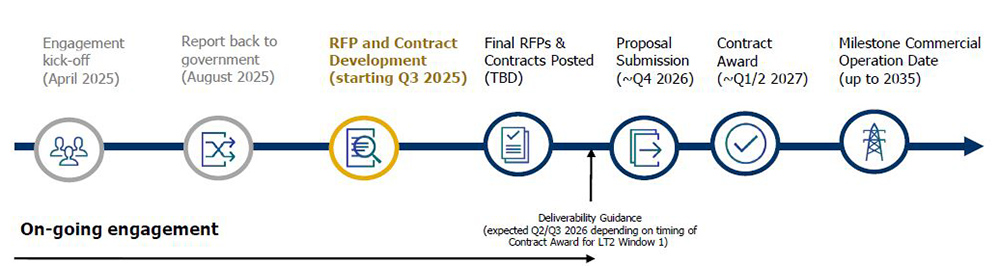
The ISO plans to seek 600 to 800 MW of capacity and up to 1 TWh of energy from resources requiring at least five years of lead time in a solicitation expected about Q4 2026. The first drafts of the capacity contract and request for proposal (RFP) were posted Oct. 20.
“It’s possible that there will be future [procurement] windows,” IESO’s Danielle D’Souza said in an engagement session Oct. 21, the fourth stakeholder meeting on the procurement. “I think that will depend on outcomes of this single procurement window, and … subject to [the Ministry of Energy and Mines’] direction.”
D’Souza said the ISO has not yet closed debate on any design issues in the procurement. “However, we do intend very soon to begin closing design elements” to focus on unresolved issues, she said.
Reserve Price
IESO proposes to use reserve prices — a confidential price threshold — to ensure it doesn’t pay too much for energy or capacity in the solicitation.
The ISO said the thresholds will be based on inputs including prices in the first window of the LT2 procurement and any differences in the obligations between LT2 and LLT resources.
Akira Yamamoto, director of regulatory and market policy for TransAlta, said he understood why IESO wouldn’t want to disclose the reserve prices but said it should provide guidance to help developers understand whether they should participate in the procurement.
“If you publish that methodology, that would actually give some insights without giving that true value. I think you need to give some indication to [whether your project has] no chance of actually getting procured,” he said. “Essentially, the ISO giving some indication that ‘Don’t waste your time if you’re too expensive.’”
Termination Provision
The ISO also proposes a termination option that could be exercised by IESO or the project developer in the first two or three years after the contract date.
If IESO exercises termination, it would return the developer’s completion and performance security ($20,000/MW of maximum contract capacity with a minimum of $350,000 and a maximum of $15 million) along with a fixed payment to cover a portion of development costs. If the developer chooses to terminate, IESO would retain a portion of the completion and security and there would be no payment for development costs.
If neither party terminates, the full completion and performance security of $35,000/MW would take effect.
Yamamoto questioned why IESO wouldn’t cover all of the development costs if it initiates the cancellation.
“I just think that that makes this a pretty unattractive type of procurement to be involved in if [IESO] changes their mind on the project and decides not to pay you for the cost that you’re actually incurring,” he said.
Dave Barreca, IESO’s supervisor of resource acquisition, said IESO is attempting to address “pitfalls that have been seen previously with similar arrangements in older procurements.”
“[We] absolutely recognize that that could be an issue,” he acknowledged, saying IESO wants a policy “that can work for developers, while … limiting the liability [to IESO] and the difficulty of assessing … costs that have been spent to date.”
Eligibility
IESO plans to use a 40-year contract for both energy and capacity procurements.
The capacity stream will be open to new electricity storage facilities of at least 50 MW — up from 1 MW in the LT2(c-1) RFP — that are able to deliver their contract capacity for at least eight hours and use an eligible long-duration energy storage (LDES) technology. The facility must begin commercial operations between five and eight years after the contract date.
100 MW Cap on Class 2 LDES Technologies
The draft RFP identifies as eligible “Class I” LDES technologies compressed air energy storage and pumped hydro storage, based on their technology readiness.
Two newer technologies were defined as “Class II” LDES technologies and will be limited to a maximum procurement of 100 MW:
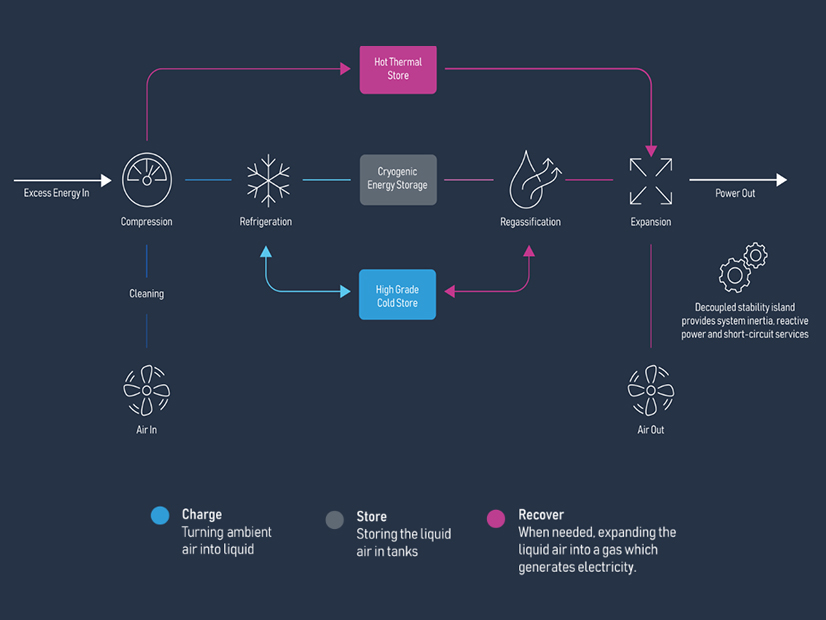
liquid air energy storage, which uses electricity to compress air until it becomes a liquid, saving the released thermal energy in a high-grade thermal store; and
pumped thermal energy storage, which converts electricity into heat, which is stored as thermal energy and later converted back into electricity through reversible thermodynamic cycles.
Liquid air energy storage uses electricity to compress air until it becomes a liquid, saving the thermal energy in a high-grade thermal store. | Highview Power
IESO said the 100-MW cap would “limit the risks related to procuring less proven technologies and encourage participation from a diverse set of eligible LDES technologies.”
The ISO also may require an independent engineering report detailing “project scope, permitting path, supply chain constraints/lead times, etc.”
The proposed 100-MW maximum is included — not in addition to — in the total capacity stream target of 600 to 800 MW. It is not a set-aside, meaning only the most cost-effective proposals will be chosen.
D’Souza said the 50-MW minimum size for eligibility reflected “projects around that size that are currently working towards commercial operation.”
“If … stakeholders think that projects less than that size should be considered, we’re happy to hear it,” she added. “But that threshold was … set based on our expectation of what is possible, and [to incentivize] projects of a commercial scale rather than a pilot scale.”
Hydro Refurbishments Under Consideration
Although the LLT RFP is intended for new build resources, IESO continues to consider whether hydro redevelopments should be eligible to participate.
The ISO said stakeholders told it that replacement equipment no longer is available for hydro facilities built in the early 1900s and that long-term contracts would be needed to make hydro rebuilds economic.
Regulation-Ready Resources
To help manage the increasing penetration of variable generation resources and industrial facilities with fluctuating loads, IESO also is considering requiring that LLT resources be equipped to provide regulation services.
“IESO is forecasting an increased need for regulation services in the future; both hydroelectric and LDES are ideal candidate technologies to provide regulation services,” IESO said in a presentation.
IESO would require only that LLT resources be “regulation ready” — a minimum ramp rate of 5 MW/min and the ability to follow regulation signals every four seconds or less. Regulation services would be procured and paid for separately.
The requirement would apply to all capacity resources and hydro resources that can provide a 20-MW range (±10 MW regulation) above their minimum loading point.
Mid-term Outage
In response to feedback following its Sept. 16 engagement session, IESO said it would consider allowing resource owners a “mid-term extended outage” of up to 12 months after the 20th anniversary of the contract — up from the six-month outage initially proposed. (See IESO Ups Capacity Target for Long Lead-Time Resources.)
IESO said the mid-term extended outage would allow suppliers to complete “small-scale work that may be required to allow the facility to continue to operate and is not intended to be a period over which major refurbishment work is completed.”
Must-Offer Obligations
As in the LT2(c-1) contract, LLT suppliers will be required to offer their facility’s output into the day-ahead market. But IESO proposes to expand the definition of “qualifying hours” for long lead-time resources to include weekends and holidays in addition to the 7 a.m. to 11 p.m. business day definition for the first LT2 capacity contract.
Timeline for IESO’s long lead-time procurement | IESO
IESO also is considering a must-offer requirement for LLT capacity resources in the real-time market “to better align with operational needs.”
“We have seen some periods of need outside of the hours that are included in the qualifying hours,” D’Souza said. “Given that these are going to be 40-year contracts, we are looking to ensure that we’re getting the most benefit and flexibility out of these resources.”
IESO asked for feedback on how the expanded qualifying hours, and RT must-offer obligations, would affect the cost and operations of proposed projects.
Barreca said IESO is trying to address uncertainty about how system conditions will be in 40 years. “We recognize that none of these will likely be cost-free, and so we want to be able to — as always — take your feedback on these and make an informed decision as to whether the benefits that we may see from them would be worth the cost.”
“Our intuition is that expanding qualifying hours would not be such a huge burden, although maybe there’s some middle ground in there between what we have written on the slides here and what” suppliers want, he added. “The real-time offer is a bit more of an open question, in terms of both what the costs might be and what the benefits might be.”
Contract Length
IESO rejected requests that it consider contracts longer than 40 years. Some stakeholders said the 40-year term didn’t reflect compressed air and pumped storage mechanical components that have an expected life of more than 60 years.
Stakeholders also asked IESO to use an “open book process” regarding long-term debt for LDES that would allow price adjustments at the midpoint of their proposed 60-year contract term.
IESO said it is not considering a term longer than 40 years. “Proponents should consider expected costs (including those related to long term debt) over the contract term when establishing proposal prices,” it said.
IESO asked stakeholders to submit written feedback to engagement@ieso.ca by Nov. 4.
Under the scenarios considered in NYISO’s consumer impact analysis for the Winter Reliability Capacity Enhancements project, installed capacity procurement costs would drop by 15 to 45% depending on locality.
“Overall, the market design proposal is likely to improve market efficiency,” Nicole Bouchez, senior principal economist and consumer interest liaison for NYISO, said at the Installed Capacity Working Group meeting Oct. 14. “Seasonal minimum ICAP requirements more accurately represent future system needs.”
The study assumed the proposed market design changes for the winter reliability project were implemented. Those changes included: seasonal unforced capacity deliverability rights/external capacity deliverability rights with a must-offer component; distinct winter/summer minimum ICAP requirements; and removal of the seasonal adjustments in the seasonal ICAP demand curve.
Scenario 1 assumed the Champlain Hudson Power Express (CHPE) was not in service and that the Gowanus and Narrows generators were not retired. Scenario 2 assumed CHPE was active only in the summer and Gowanus and Narrows were retired.
In Scenario 1, ICAP market procurements fell statewide by 15%, with some variation among the different zones. In Scenario 2, procurements overall fell by 45% but increased locally on Long Island from $32.48 million to $36.15 million during the study year.
Sensitivities were conducted to look at expected imports and exports. Maximizing net imports to their historical heights decreased procurement costs. Maximizing net exports increased procurement costs but still provided overall savings to consumers.
Bouchez said the seasonal market design likely would improve market transparency and provide better price signals for both market exit and entrance. No environmental impacts were identified, but the new market design may increase the potential profitability of new technologies (like batteries) entering the market.
The ICAP Working Group also discussed the tariff and manual revisions for the winter reliability project. The target implementation for the tariff changes is May 2027, with a filing at FERC in the first quarter of 2026.
Doreen Saia, chair of Greenberg Traurig’s energy and natural resources practice, expressed concern that NYISO is lumping substantive tariff and manual edits with administrative ones.
“The NYISO cannot keep bunching together what appear to be ministerial ‘nothing to see here’ changes and then lop on something that does matter and is important and package it together,” she said. “Market participants are running to keep up with you.”
Another stakeholder agreed, saying stakeholders want to talk through the issues before the manual or tariff language is put in front of a committee.
These comments were in response to NYISO’s inclusion of revised manual rules that apply to generators that are placed into an ineligible forced outage. The ISO highlighted several sections of the manual that it thought needed clarification and presented revisions.
Mike Cadwalader of Atlantic Economics also pointed out that the manual revisions did not come with a sample case to illustrate how the rules functioned.
A research team in San Diego says it has developed a new method for recycling lithium-ion batteries in California as electric vehicle and energy storage sales boom across the world.
University of California, San Diego researchers demonstrated how to deactivate, dismantle and separate used battery components to recover more than 90% of cathode and anode active materials. The recycled materials were then tested and found to operate comparably to new battery materials, the researchers said in an Oct. 20 report to the California Energy Commission.
More than 22 million pounds of lithium-ion batteries will be ready for recycling in California in 2027. Without sustainable management, the rapid consumption of batteries “risks resource shortages and price volatility for critical materials like lithium, cobalt and nickel — key contributors to battery costs,” researchers said in the report.
Recycling and recovery of these valuable materials, which can make up 45 to 60% of battery manufacturing costs, are “essential to lowering production expenses and reducing the lifecycle environmental hazards posed by improper disposal,” the report says.
In their experiment, researchers created a direct recycling method to physically separate and recover cathode and anode battery materials. They de-energized 25 pounds of lithium-ion battery cells with more than 1,000 ampere-hours of total capacity. The battery cells contained different chemistries, types, ages and sources, such as from EVs and electronic devices.
The direct recycling method is one of three primary battery recycling methods, the other two being pyrometallurgical recycling and hydrometallurgical recycling.
Pyrometallurgical recycling requires high-temperature smelting that uses large amounts of energy and generates significant pollutants, while hydrometallurgical recycling requires strong acids and oxidants, leading to “extensive treatment to address environmental and safety concerns,” the report says.
Direct recycling could save up to $17 million and reduce energy consumption by up to 1,285 GWh by 2030, compared to pyrometallurgical and hydrometallurgical recycling, the report says.
After proving their direct recycling approach worked, researchers increased the volume of batteries in each batch from 100 g to 5 kg.
California currently does not have a large-scale lithium battery recycling facility. As they grow old and fizzle out, used battery volumes will continue to increase, and the costs of transporting them out of the state will become too burdensome and expensive, the report says.
Battery manufacturers and automakers could leverage an in-state recycling pathway to “enhance efficiency, minimize waste and support the broader electrification of the automotive industry,” the report says.
The results of the project could help future research teams or companies build a 100-kg scale recycling facility. Doing so could be the next step toward building a commercial facility in the state, the report says. UC San Diego researchers have been allocated $10 million by the Department of Energy to continue to increase the scale of the direct recycling method.
NERC Chief Engineer Mark Lauby told attendees at FERC’s annual Reliability Technical Conference that resource adequacy remains a top priority as the industry anticipates rapid demand growth from data centers and other large loads.
Lauby highlighted some of NERC’s work on the large loads issue, including a Level 2 alert sent to industry in September with guidance on “what you need to be thinking about when you’re interconnecting the load, what … kind of data you should be collecting, what kind of studies you should be creating [and] what kind of interconnection standards you should be considering.”
During the Oct. 21 panel, Lauby also brought up the work of NERC’s Large Loads Task Force, which recently submitted a paper on Characteristics and Risks of Emerging Large Loads for comment from the ERO’s Reliability and Security Technical Committee. Lauby said that when the paper is completed later in 2025, it will form the basis of a reliability guideline along with the responses to NERC’s Level 2 alert. That guideline will, in turn, be “the basis for any kind of standards” regarding registering such loads.
“We believe that we can register large loads because of [their] impact to reliable operation of the [grid],” Lauby said. “Obviously, we’ll use judgment on that. It’ll be risk-based, and we’ll work with [the Large Loads Task Force] to write the standards we’re talking about today — for example, communications during events, when you’re going to come off [and] come on, [and] how do you manage the inverter-based resources?”
Lauby’s fellow panelist, Dominion Power Vice President Matt Gardner, said he was “very pleased to see how the industry has come together” on the LLTF. He said the work of the task force has raised Dominion’s awareness of the issues involved; for example, the company incorporated the LLTF’s data center questionnaire and provisions on ride-through protection into its facility interconnection requirements.
Gardner added that another “extremely important” topic discussed by the LLTF concerns implementing high-quality monitoring of the new large loads’ behavior to provide situational awareness and to help create accurate models for planning purposes. This is needed to help grid planners comprehend the unique risks posed by these new arrivals.
“We’ve had large loads on the system forever: paper mills, steel mills, chip [fabricators], you name it,” Gardner said. “But this type of large load is different in terms of how it can behave in somewhat of a synchronized fashion, and in how the internals change over as well.”
FERC Commissioner Lindsay See picked up on this, observing that “large loads are not created equal.” She asked panelists to go into more detail on the various types of large loads and the reliability risks they can present.
Lauby agreed that “size certainly is not the whole thing” and mentioned several issues that can separate one kind of large load from another, such as their behavior during system events and sensitivity to voltage and frequency changes.
Jennifer Curran, senior vice president for planning and operations at MISO, advocated for a risk-based approach that recognizes that the level and type of risk presented by a load depends on a number of factors beyond its size, such as where it is on the grid and how resilient the grid is.
QTS Data Centers Vice President for Energy and Sustainability Travis Wright agreed that the location of a load matters, stating that “the term that resonated with me was ‘material impact.’”
Chris Matos, strategic negotiator for energy markets at Google, also expressed support for a risk-based strategy but urged the commission and ERO not to place overly onerous reporting requirements that restrict companies’ freedom of movement.
“The question has become, for [RTOs], how much administrative work or burden is that below a certain level as well, and do we recreate the log jams that we’re feeling today?” Matos said. “So, I do think a risk-based approach is necessary, and it should do the best that it can, but exact accuracy may not be as important, provided we also think about revisiting that [assessment] over time.”