NERC has asked FERC to clarify the data it wants to see in biennial informational filings on the ERO’s most recently approved cold weather standard, as well as whether the commission expects NERC to continue submitting the filings FERC ordered with previous versions of the standard (RD25-7).
FERC approved EOP-012-3 (Extreme cold weather preparedness and operations) at its September open meeting. (See NERC Cold Weather Standard Gains FERC Approval.) NERC developed the standard in response to the commission’s directive ordering changes to the predecessor standard EOP-012-2. That standard itself was a revision to EOP-012-1, which FERC approved in 2023 while identifying numerous needed improvements.
Commissioners did not demand further changes to EOP-012-3 but did direct the ERO to submit follow-up filings every other year, beginning no later than October 2026 and ending in October 2034. The filings stem from the standard’s allowance for generator cold weather constraints — situations in which a generator owner may declare that a specific freeze-protection measure would result in a net loss of reliability on the grid — and must include:
The number of cold weather constraint declarations submitted to each regional entity.
The number of declarations approved, and their aggregate megavolt-amperes.
A summary of the rationales provided for approved declarations.
NERC also must submit a narrative analysis in the filing addressing:
Whether reliability coordinators, transmission operators and balancing authorities are notified in a timely fashion of constraint declarations and extensions to corrective action plans (CAPs).
The reliability impact of allowing 36 months to correct freeze-related issues, rather than a shorter time frame.
Whether compliance enforcement authorities interpret and apply the constraint declarations approval process.
Whether constraint declaration criteria are adequately defined and understood by registered entities.
The reliability impact of cold weather constraint declarations and CAP extensions.
In an Oct. 17 filing, NERC said it shared “the commission’s desire to ensure that … EOP-012-3 is advancing generator cold weather preparedness for extreme cold weather conditions,” but expressed uncertainty about two elements of the order.
The first was FERC’s directive that NERC report the aggregate megavolt-amperes for approved constraint declarations. NERC acknowledged that its Rules of Procedure mention megavolt-amperes in the criteria for placing entities on the ERO’s Compliance Registry but observed that it analyzes generating units based only on their real power in megawatts. NERC also pointed out that EOP-012-3 does not reference megavolt-amperes.
To clear up this confusion, NERC requested that FERC clarify whether it must report by megavolt-amperes only, or if reporting the aggregate megawatts of approved constraints would suffice. If the commission insists on megavolt-amperes, NERC requested that commissioners specify why they chose this approach “so that NERC may better understand the basis for such a collection.”
NERC’s other request applied to the annual filings FERC directed in its approval order for EOP-012-1, which were to include a range of information on cold weather constraints and corrective action plans. Observing “significant overlap in some aspects of the information” to be collected in each order, NERC asked whether it could consolidate both reports into the biennial filing ordered for EOP-012-3, and whether this consolidated filing still would sunset in 2034.
VALLEY FORGE, Pa. — Several stakeholders presented proposals for how PJM could address accelerating load growth as the Critical Issue Fast Path (CIFP) process on large load growth wraps up its second phase.
Many of the design components revolved around requiring large loads to bring their own generation (BYOG); pathways for fast-tracked interconnection studies for new resources; allocating capacity and interconnection costs to large consumers; and queues to delay them from coming online until there is sufficient capacity to serve them.
The RTO opened a poll on the proposals following the Oct. 14 meeting to gauge support before moving on to the third phase of the CIFP process, in which the design components will be combined into holistic packages. Manager of Stakeholder Process and Engagement Michele Greening said Phase 3 packages should be designed to resolve all issues identified in the Board of Managers’ letter initiating the CIFP. The first of the Phase 3 meetings is scheduled for Oct. 24.
Eolian BIGPAL Proposal
The bilateral integration of generation portfolios and load (BIGPAL) proposal from Eolian would allow planned large loads to procure their capacity from adjacent resources coming online at the same time.
The resources would qualify for a 90-day interconnection study process and not participate in the capacity market; be assigned capacity interconnection rights (CIRs); or be derated by PJM’s effective load-carrying capability accreditation framework.
While the proposal’s definition of “adjacent” is not yet set, Eolian said siting the resource electrically near the load would reduce the need for transmission upgrades and allow it to perform under emergency conditions. While a performance assessment interval (PAI) is active, the BIGPAL configuration would be required to reduce its net load to zero. Load flexibility would serve as a backstop to resource performance.
The risk of the resource underperforming during a PAI would be shared by the parties to the contract, with penalties if there is a net draw off the grid.
The adjacent resource would be able to participate in PJM’s energy market and would be available to security-constrained economic dispatch. Brattle Group consultant Andrew Levitt, who helped prepare the proposal, said it would make sense for BIGPAL resources to operate as normal PJM resources when PAI risk is low and prioritize being available to serve the adjacent load when an emergency appears likely.
Brattle modeled how BIGPAL would perform in the 2030 delivery year, using PJM’s load and expected resource mix and two RTO scenarios: 6 GW of new unforced capacity and 8 GW of retirements, and 12 GW of new capacity and no deactivations. The firm developed a moderate weather scenario built off 2018 and a more severe weather year based on 2022. The model assumed 25 GW of BIGPAL load paired with 20 GW of storage and 5 GW of gas generation.
The analysis found there would be no load shed in a moderate weather year in the scenario where deactivations outpace new entry and 16 hours of load shed in a severe weather year.
Bruce Campbell, principal of Campbell Energy Advisors, said he’s concerned about any proposals that would create new forms of curtailable load that would be dispatched after demand response customers. Coming out of a summer with a high amount of pre-emergency load management deployments, he said participant fatigue may be a concern going forward with the prospect of substantially more dispatch as reserves shrink. He noted that “fatigue” can mean simply that customers are losing money with each hour of dispatch.
Glatz and Silverman Present Alternative NCBL Design
Abraham Silverman, research scholar at Johns Hopkins University, and Suzanne Glatz, principal of Glatz Energy Consulting, presented several design components intended to minimize the impact large loads would have on existing consumers.
They proposed a bifurcated capacity market in which the first round of the auction would set a clearing price for native and non-large load, followed by a second round clearing large loads and any generation that had not already cleared. The price for the second round of the auction would be inclusive of make-whole payments for resources that cleared in the first round, ensuring that all resources receive the same capacity price.
Building on PJM’s mandatory non-capacity backed load (NCBL) proposal, they recommended a variant that would subject large loads to curtailment in delivery years when the capacity market cleared above the midpoint on the variable resource requirement curve. Curtailments would fall ahead of all DR customers in the stack of emergency procedures. While mandatory NCBL is no longer PJM’s preferred solution, it remains a design component stakeholders can include in their packages.
Load-serving entities would be able to avoid being assigned NCBL allocations by ensuring that large loads can offset 80% of their peak load for at least four hours, 10 times a year. Glatz said this would create an incentive to participate in BYOG models.
NCBL load would be required to pay half of the capacity clearing price each delivery year to capture the benefits it receives from non-firm service when there are no curtailments.
The initiation of the CIFP process would be considered the cutoff point for any NCBL requirement, with existing load exempt.
Another component would exclude large loads from PJM’s forecast unless the relevant utility attests that all distribution and transmission upgrades needed to interconnect the load will be complete before the delivery year; the large load attests that it’s not planning similar new service requests that might result in the project being canceled or modified; and the customer provides evidence of commercial maturity, such as “take-or-pay” agreements for transmission service. If an NCBL model similar to PJM’s initial proposal were to be implemented, participating large loads also would be excluded from the forecast.
NRDC Supportive of NCBL
The Natural Resources Defense Council recommended an NCBL construct in which large loads would not receive firm service unless they were paired with new capacity or resources that did not clear in the capacity market.
Large loads could gain firm service by committing to participate in DR or price-responsive demand programs, or contracting with other consumers to participate on their behalf.
The proposal aims to recognize the jurisdictional questions around PJM defining particular consumers as being subject to NCBL and leaving implementation to the states. The RTO would determine the amount of NCBL needed across its footprint and distribute that figure across locational deliverability areas (LDAs); from there, states and utilities would determine how to assign that to customers.
The proposal would designate curtailment as either the final energy emergency alert Level 1 action or the initiator for Level 2. This would lead to it being instituted either prior to or concurrent with the start of scarcity pricing.
Few planned resources expected to come online in time to participate in the 2026/27 Base Residual Auction (BRA) have submitted offers, which is creating a false tightening in the market, according to the NRDC. Reducing the risk of participation could mitigate that, including by PJM making a commitment that it will not seek to reinstate the minimum offer price rule in place before 2018. (See 3rd Circuit Rejects Challenges to PJM MOPR, Affirms Authority over FERC Deadlocks.)
The NRDC conducted analysis on the cost of the load growth and reliability gap that PJM predicts, finding that consumers would pay $163 billion in capacity costs between the 2027/28 and 2032/33 BRAs. Data centers would pay a small amount of those increased capacity costs, and most of the revenue would flow to existing supply, which the NRDC found would create a scenario where 81% of the $163 billion are “deadweight” payments that existing consumers pay to existing supply.
Monitor Recommends Load Interconnection Queue
The Independent Market Monitor proposed creating an interconnection queue for large new data center loads in which they would be interconnected only when any required transmission upgrades are complete and there is enough capacity and energy to serve them reliably.
Large loads would be eligible to bypass the queue via an expedited interconnection process if the loads brought new generation (BYONG). The new generation would have to be deliverable to the grid, deliverable to the new load, and capable of matching the amount of time the load will be online. Monitor Joe Bowring gave the example of intermittent resources combined with storage, or thermal generation, both qualifying for the duration component.
Participation in DR would not fall under the BYONG model, as Bowring argued it does not match the duration of the load and is not equivalent to bringing new generation capacity online.
Bowring said the proposals to treat large new data center loads as on the demand side would have them interrupted only after existing demand-side resources are interrupted and only if there is a reliability emergency. That treatment would impose significantly increased interruptions on existing demand-side customers and risks those customers leaving the program, he argued. It also would increase the occurrence of scarcity pricing in the energy market, which imposes higher energy costs on all customers.
“Demand side is not generation,” Bowring said in an email to RTO Insider. “If the large new data center loads are going to enter without capacity, they should be interrupted whenever existing capacity is needed by the customers that pay for it.”
Bowring said if PJM is not capable of serving a new load, the RTO should not be obligated to allow it to interconnect. He said the premise of all the other CIFP proposals is that PJM must interconnect large new data center loads when there is not enough capacity to serve them reliably.
“That premise is not correct,” he said. “Allowing the interconnection of large new data center loads without matching capacity imposes costs and risks on all other customers, increasing prices and the risk of blackouts for other customers. That is not consistent with PJM’s stated objective of putting reliability first.”
It also increases the demand for energy without increasing the supply of energy, increasing energy costs for all customers by an estimated $2 billion to $3 billion per year, Bowring said.
Pointing to Part A of the Monitor’s report on the 2026/27 BRA, Bowring said data center load growth has caused capacity costs to increase by $16.6 billion over just the past two auctions — costs that should not be shifted to existing consumers, he said.
Vistra Seeks Penalties for Utilities Short on Capacity
Vistra proposed instituting penalties for utilities that do not cover their own capacity needs with the aim of incentivizing bilateral contracts that take strain off the capacity market.
The proposal includes variants for triggering penalties if the load forecast for a capacity auction signals it may be tight, during emergency procedures or a combination. Assessing the penalties in advance carries the advantage of providing more incentive to get contracts in place before the auction, while implementing them during emergencies creates more flexibility on the amount of risk a utility is willing to accept. Several penalty rates also were presented for each option.
Operational penalties would create incentives for utilities to offer load flexibility products to customers to mitigate the risk the utility might not have enough capacity in place, while planning-based penalties would create more incentives to contract with DR providers.
EKPC Recommends Requirements for Self-supply
The East Kentucky Power Cooperative proposed “significant” penalties for LSEs that enter a BRA without enough owned or contracted supply to cover its capacity obligation. The penalties would be assessed against all deficient LSEs within an LDA if an auction does not procure enough supply for that zone.
Large loads would be required to identify the LSE that will serve them before they are included in the load forecast as a large load adjustment (LLA), which feeds into the amount of load to be served in a given BRA; if an LSE is not identified, it could be treated as being served by the default provider. That is intended to serve as a “reality check” that the load is likely to come into service in that delivery year and reduce duplicative LLA requests. State involvement in the load forecasting process could further advance the reality check. Large loads would be defined as a site with load exceeding 50 MW.
The penalties would be distributed to LSEs that had procured enough capacity for that delivery year as compensation for the price pressure and load shed risk they faced. State regulators would be encouraged to create retail rate structures that allocate penalties to large loads and reduce the impact on existing consumers.
NOVEC Proposes Changes to NCBL
NOVEC proposed modifications to PJM’s NCBL proposal that would remove the load from the capacity market and place its curtailment as the penultimate step in the RTO’s emergency procedures, after all other DR products and just before load shed.
If an EDC or LSE cannot assign enough NCBL to meet PJM’s allocation for its region, it would be assessed a daily deficiency penalty for the amount it is short, which would be refunded to other utilities. If NCBL load does not curtail, it could be subject to FERC and NERC compliance and financial penalties.
NOVEC’s Rory D. Sweeney said that if NCBL is to be implemented, it should be structured as a permanent late-stage emergency procedure.
Maryland OPC Focuses on Load Forecast and BYOC
The Maryland Office of People’s Counsel recommended changes to PJM’s load forecast process, a bring your own capacity (BYOC) model, a large load-specific DR product and assigning more load shed obligation to regions with large loads not backed by new capacity.
The proposal would have PJM develop scenarios accounting for the uncertainty around LLAs coming online when it develops its load forecast, with the modeling tied to the advanced nature of the capacity market and Regional Transmission Expansion Plan (RTEP). The amount of load included in the forecast for each utility could be reduced if they do not establish a tariff for large loads or a dedicated oversight process for their interconnection that includes project milestones and financial commitments.
The BYOC element requires new large loads to either bring enough capacity to meet their own needs or offer the equivalent of their peak load into a load-offset demand response (LODR) product — a temporary program designed for large loads to net to zero either by curtailing or activating behind-the-meter generation. The capacity would have to be deliverable to the load and come online at the same time.
Mainspring Seeks Changes to EIT
Mainspring Energy presented several changes to PJM’s proposals, including shifting the focus of its expedited interconnection track (EIT) to prioritize resources that can be built quickly, rather than prioritizing the size.
The EIT model presented on Oct. 1 would create a 10-month interconnection study process for projects at least 500 MW and capable of being in service within three years.
The revised eligibility requirements would allow projects above 50 MW to participate, including projects to uprate or repower existing generation. It also would make state sponsorship of projects voluntary, removing a requirement PJM said was intended to reduce the risk that a project would be expedited through its queue only to become mired in state siting and permitting processes.
Director of Wholesale Market Development Brian Kauffman said the majority of data centers are on the scale of 50 MW and could be served by comparably sized resources.
It also recommended that PJM include a voluntary NCBL model in its package and for states to develop non-firm or flexible service models for retail load. Kauffman said speed-to-market is the priority for data center developers, who might be willing to accept less firm service in exchange for faster interconnection.
Pa. and Va. Governors Offer Perspectives
Presenting on behalf of Pennsylvania Gov. Josh Shapiro and Virginia Gov. Glenn Youngkin, Pennsylvania Deputy Secretary of Policy Jacob Finkel overviewed their perspective that efforts to streamline the entry of new supply and minimize the impact to residential and commercial ratepayers should be prioritized.
Models that offer a carrot rather than a stick are preferred, particularly those with voluntary short-term flexibility paired with incentives for long-term resource development, Finkel said.
The governors support Eolian’s BIGPAL proposal as a way of reducing delays in getting generation built, though more market design changes would be needed to ensure proper incentives are in place, Finkel said. Load forecast changes would also be welcome, but he noted that would not change the supply and demand challenges PJM faces.
Before he became President Trump’s energy secretary, Chris Wright was CEO of Liberty Energy, a natural gas fracking company, and an avid proselytizer for fossil fuels as the foundation of modern lifestyles, prosperity and security in the U.S. and in emerging nations striving for Western standards of living.
Wright’s typical pitch in Liberty YouTube videos links global progress, from fighting poverty to lowering infant mortality rates, to two key factors: the spread of human liberty and democratic government and “the surge in plentiful, affordable energy from oil, gas and coal.”
Wright’s recent efforts to claw back legally obligated federal funding for clean energy projects ─ many in Democratic-led states ─ speak volumes about his commitment to liberty and democratic government.
His arguments for fossil fuels are at least historically accurate: The social, technological and economic advances made possible by the Industrial Revolution in the 19th and 20th centuries were powered by fossil fuels. But, as much as Wright discounts it, the world is in the midst of a major energy transition, from petrotech to electrotech, which the vast majority of countries ─ with the notable exception of the U.S. ─ are pursuing to promote innovation and economic growth and provide a more efficient, affordable and secure future.
K Kaufmann
This reframing of the energy transition is laid out in The Electrotech Revolution, an extremely detailed, well-documented and provocative report from Ember, a London-based energy think tank.
Rejecting the business-as-usual paradigm of “fossil fuels gradualists” versus “net-zero advocates,” co-authors Daan Walter, Sam Butler-Sloss and Kingsmill Bond stake out electrotech as a third way, focused on “exponential energy technologies revolutionizing how we generate, connect and use electrons … such as solar, wind, batteries and digital solutions.”
This electrotech revolution is “driven by physics, economics and geopolitics,” they write. “After all, the arc of energy history bends toward solutions that are leaner, cheaper and more secure.”
The 112-page report is packed with charts, facts and figures that at every turn demolish Wright’s arguments for grounding U.S. energy abundance and dominance ─ and the welfare of the country’s 342 million citizens ─ in fossil fuels. It depoliticizes the debate and should be required reading for every federal and state policy maker, regulator, electric industry executive and anyone else concerned or just curious about the future of our electric power system.
Chris Wright is a smart, well-informed person, so I am going to presume he knows everything that is in the Ember report but is willfully ignoring and denying the reality of the electrotech transition to advance the political and financial interests of the Trump administration and the U.S. fossil fuel industry.
A handful of charts from the report show why Wright is so wrong. He and Trump may be able to slow the clean energy transition in the U.S, but the electrotech narrative is undeniable and will win out.
Already, China is leading the transition, and emerging economies are leapfrogging over fossil fuels, the report says. What side of history do we want to be on?
The Inefficiency of Fossil Fuels
The Ember report starts with some eye-opening basics. First, the physics: Fossil fuels are an incredibly inefficient way to produce electricity.
One exajoule, or EJ, is about 278 terawatt-hours of power, so the amount of energy and money we lose burning fossil fuels is simply ridiculous. The figures here, and throughout the report, are global, unless otherwise noted.
Further, the report shows, what most of us really care about is not the primary energy (basic fuels like coal and gas) or final energy (the gasoline and electricity delivered to consumers). Our day-to-day lives depend on useful energy that produces heat and hot water for our homes, plus steel and other goods (energy services) that create economic value (GDP).
Renewable energy and associated clean technologies ─ like electric vehicles and heat pumps ─ are two to four times more efficient than fossil fuels for generating electricity, powering our transportation and heating our homes.
At a time of rising electric bills, efficiency and cost savings are top priorities for consumers, businesses and the policy makers and regulators besieged by frustrated and increasingly desperate people, facing critical decisions about which bills to pay first.
The question here is simple: Which side of the laws of physics do we want to be on? We should be planning and building out our electric power system accordingly.
Peaking out
Wright and others often argue that the need for fossil fuels will continue to grow, given the demand for reliable, affordable energy from Europe, China, India and emerging economies.
| Ember using data from IEA WEB
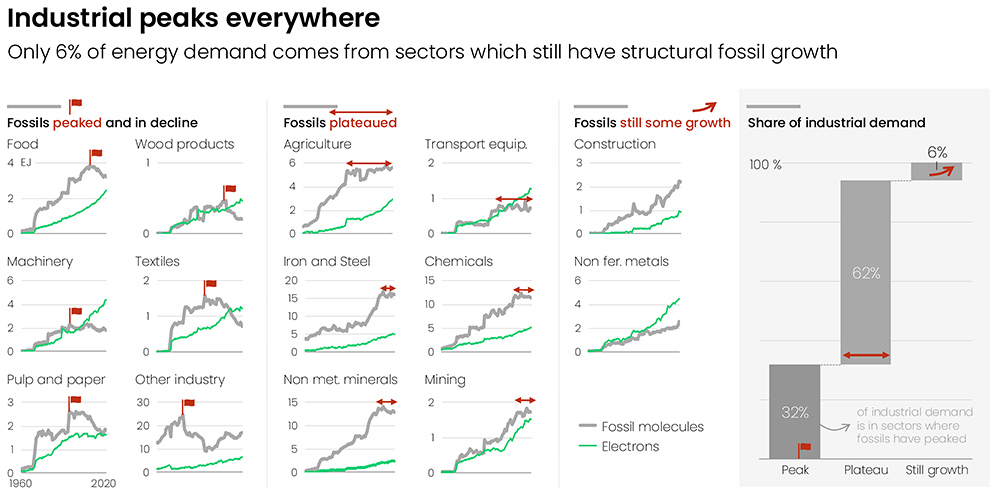
Wrong again. The Ember report tracks how fossil fuel use has peaked or at least plateaued across various industries worldwide. Pulp and paper and textiles peaked decades ago, while even mining, chemicals and transportation have plateaued. Only construction and non-iron metals, accounting for 6% of industrial demand, are still on a growth curve.
Nearly half of the world is past peak fossil fuel demand for electricity generation, Ember says. China almost single-handedly has been responsible for any growth in global demand for fossil fuels over the past eight years, but even there, Ember finds evidence that the country is moving toward a plateau.
Slashing Fossil Fuel Imports
At least one point in Wright’s argument rings true: Many countries remain dependent on imported fossil fuels ─ 50, in fact, where imported oil, gas and coal account for 50% or more of the primary fuels they use to produce electricity and gasoline.
At the same time, the report notes, almost every country in the world has sufficient sources of renewable energy ─ wind, solar, hydro ─ to meet their existing energy demand, in many cases at least 10 times over. A good three-quarters of Africa is classified as “superabundant,” meaning these countries could meet their existing demand 1,000 times over with their renewable resources.
| Ember using data from IEA WEB and World Bank
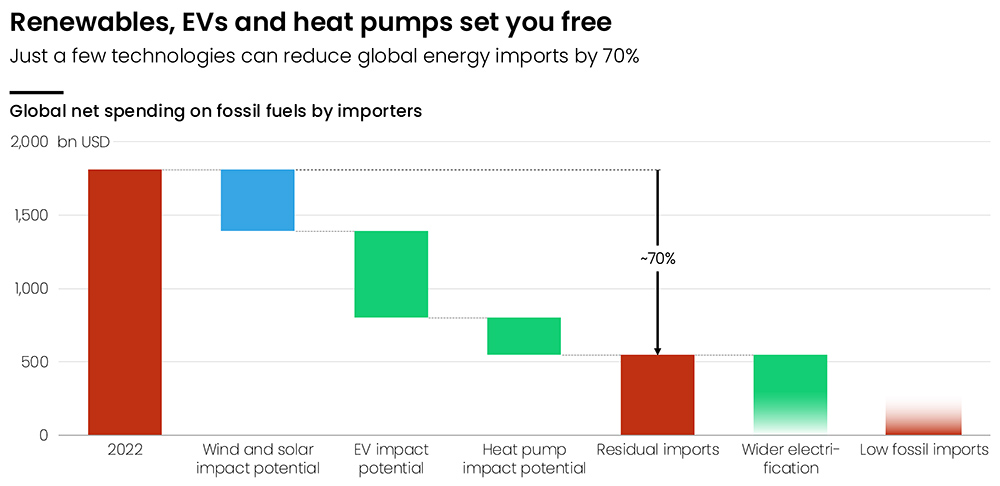
At the same time, the hundreds of billions of dollars spent on importing fossil fuels could be slashed 70% with three existing technologies: renewables in the form of wind and solar, electric vehicles and heat pumps. Wider electrification could shrink fossil fuel imports even further.
While the U.S. is a net exporter of fossil fuels ─ exporting more than we import ─ the country still imports more than 8.4 million barrels of crude oil per day, primarily from Canada. Those imports now come with Trump’s 10% tariff; all the more reason to switch from petro- to electrotech.
Emerging Markets Leapfrog
One of Wright’s more compelling arguments for fossil fuels centers on energy poverty ─ the 666 million people around the world who live without electricity, 85% of whom live in Sub-Saharan Africa, according to a recent report from the World Bank.
At least, he makes it sound compelling, with fossil-fueled electricity bringing modern, Western lifestyles to emerging economies.
But fossil-fueled power plants require extensive supply chains and supporting infrastructure ─ pipelines, transmission systems ─ which means they may not be the best way to provide power to remote villages in Africa, or anywhere else for that matter. The World Bank notes that “new technologies and business models for decentralized renewable energy (DRE) ─ such as solar home systems and solar mini grids ─ offer flexible solutions for these areas.”
| Ember using data from IEA
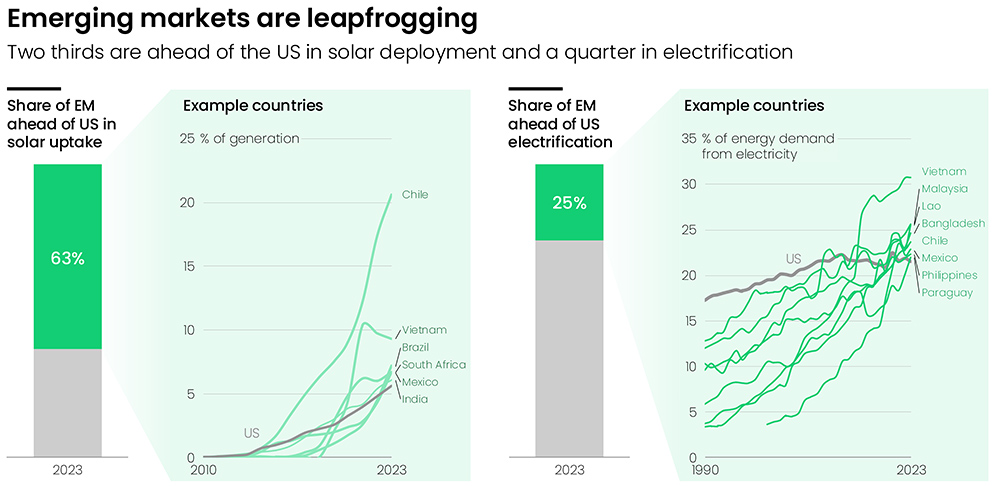
Which may be why, according to the Ember report, many emerging economies in Latin America, Africa and Southeast Asia are adopting solar and electrifying faster than the U.S., leapfrogging fossil fuels to build their economies on clean energy.
As noted in the chart above, 63% of emerging economies ─ from Chile to Vietnam to South Africa ─ are ahead of the U.S. in solar adoption, while 25% ─ including Laos, Malaysia and Bangladesh ─ are ahead in electrification.
Those numbers are, at least in part, being driven by direct cleantech investment from China ─ more than $100 billion in emerging economies since 2023, Ember says. China dominates global markets in solar, storage and electric vehicles, while the U.S. under Trump is increasingly isolated by high tariffs and falling further behind in clean energy manufacturing and deployment.
Bumps Ahead
While the physics and economics for electrotech are pretty convincing, Ember knows the real world is rarely as science- and fact-driven as we would like it to be.
| Ember using data from IEA and Segment Y via New York Times
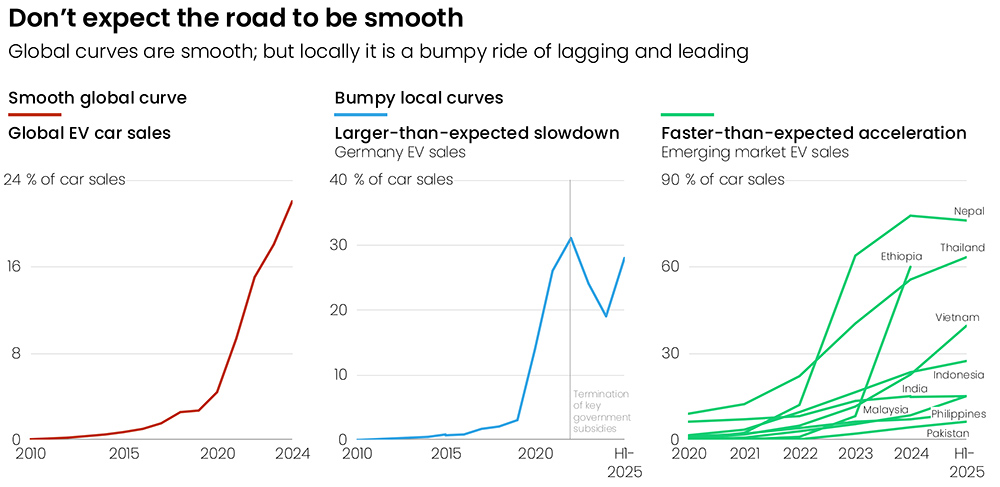
The electrotech transition will be uneven across political and economic landscapes, as seen in Ember’s analysis of EV sales globally, in Germany and emerging economies. Where markets have been dependent on government subsidies ─ in Germany and the U.S. ─ we are going to see some dips and slowdowns, followed by resets and renewed gains.
But such bumps are being offset by faster-than-expected EV adoption in emerging economies, again likely due to China’s high-quality but relatively cheap EVs. You know the ground is shifting when 60% or more of new car sales in Nepal and Ethiopia are electric, driving that steep upward curve in global EV sales.
Certainly, the way forward in the U.S. will be even bumpier with Wright and others in the Trump administration putting as many obstacles as possible in the way of renewables and other clean technologies while setting the country on a path to continuing petrotech dependence and ever-rising electric bills.
One example: On Oct. 16, Wright announced a $1.6 billion loan guarantee to a subsidiary of American Electric Power for transmission upgrades in Indiana, Michigan, Ohio, Oklahoma and West Virginia. According to figures from the Energy Information Administration, all five of these states generate two-thirds or more of their electric power from natural gas and coal. Coal makes up 91% of West Virginia’s generation mix.
Among 321 Department of Energy grants and other awards Wright canceled Oct. 2, 26 were from the Grid Deployment Office.
But one thing neither Trump nor Wright seems to be taking into account ─ all the DOE employees they have let go are now on the ground, starting new businesses and nonprofits, leading corporate, state and local government efforts to decarbonize their power supplies and pushing electrotech innovation and investment forward. They’re ready to ride out the bumps and are not giving up.
Like the Ember report, they know that responding to demand growth in the U.S. and ensuring access to electricity worldwide should not be about politics. Yes, electrotech will cut greenhouse gas emissions, but it is laser-focused on providing the best, cheapest and most dynamic and flexible technology to power our increasingly digital world.
Secretary Wright, come the revolution, what side of history do you want to be on?
Livewire Columnist K Kaufmann has been writing about clean energy for 20 years. She now writes the E/lectrify newsletter.
The North Carolina Utilities Commission held hearings over several days examining how utilities plan to reliably serve large loads including data centers and adapt to the changes they’re bringing to the industry.
“We are experiencing a lot of growth in the Carolinas, and that is not restricted just to large loads; it’s across residential, commercial, industrial and manufacturing sectors,” Jonathan Byrd, managing director of rate design for Duke Energy, told the commission Oct. 15. “And that said, we certainly acknowledge that these large loads present unique challenges and opportunities. The growth we’re seeing reflects the state’s favorable business environment, which includes constructive energy policies and affordable and reliable electricity.”
Duke updates its rules as the new load paradigm has become apparent, and fine-tuning is going to continue as it gains experience serving new customers, he added.
The utility, which serves most of the state, has received inquiries from 420 projects totaling 46 GW in total possible demand. Of those projects, 128 are data centers representing 37 GW of demand, said Andrew Tate, Duke’s managing director of economic development.
“We acknowledge that only a fraction of these will ever progress to actually receive service,” Tate said. “We receive new project inquiries every week, and every week we have projects that advance to either terminate or loss, or successful outcome.”
Large load projects can be a challenge for utility planners, but they bring major economic benefits, including jobs and tax revenues for communities that sometimes have been overlooked in past economic expansions, he added.
“The large load customers that we work with daily value certainty in generation resources, as opposed to the uncertainty that can exist in some markets when it’s uncertain who’s building the generation,” Tate said. “Our customers expect us to provide the load to serve their needs.”
While on-site backup generation is common, Duke has seen relatively few large load customers interested in co-location, and that usually relates to speed-to-market concerns when they want to locate in an area with transmission constraints, he added.
Duke has arrangements with the new large load customers that are designed to hold existing customers harmless while helping the sites get online in the name of economic development, said Alex Castle, the utility’s deputy general counsel.
“Protecting existing customers remains our central priority, but we’re always conscious of the balance that’s required to ensure that the risks and accountability that we’re asking new large load customers to carry are reasonable,” Castle said. “We intend to check and adjust over time in order to refine our approach to right-size these financial and operational requirements.”
Duke starts by studying the project’s impact on its grid and resource adequacy, which are laid out in a “letter agreement” that the prospective load has 30 days to sign once issued. That signals an intent to proceed and comes with preliminary financial commitments. That is followed by an electric service agreement (ESA) that must be signed within 120 days and lays out the long-term conditions for service, Castle said.
Dominion’s Experience with Data Center Alley
The NCUC also heard testimony from Dominion Energy, which has long-term experience with data centers, as its Virginia utility serves the largest market for them in the world.
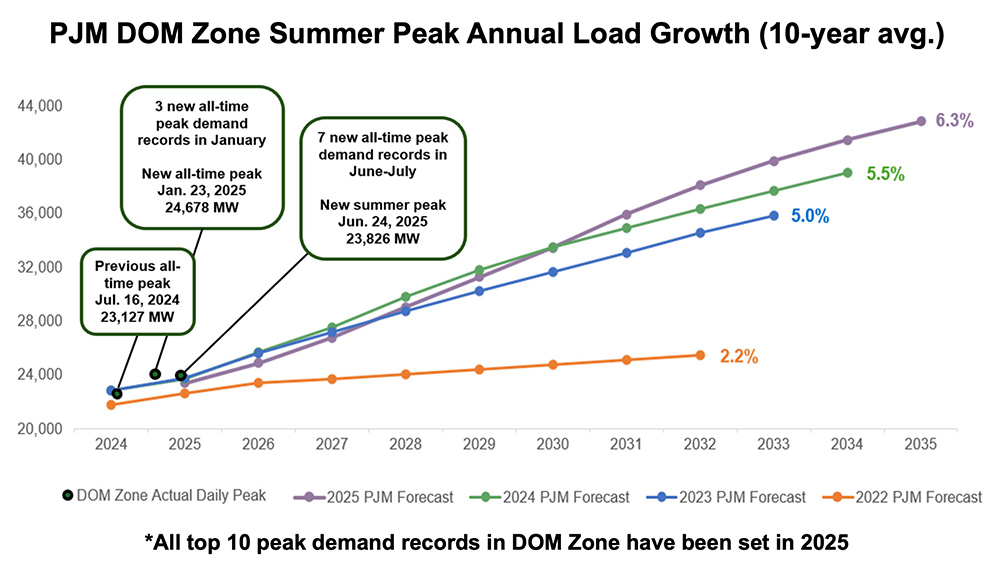
Data centers make up 25% of the utility’s total demand, which is expected to rise to 50% in 2035, said Vice President of Regulatory Affairs Scott Gaskill.
Dominion has set up an internal “Data Center Practice” to help manage its service of the key customer group, said its director, Stan Blackwell.
“If you add up the next five large U.S. markets — add them together — they’re not as big as our Virginia market,” Blackwell said. “In fact, it’s [just] Loudoun County. It’s about 30 square miles. It’s the largest market in the world.”
Just seven customers make up 72% of that market, and Dominion is able to base its forecast around their future growth individually, while putting the other 28% in an eighth category for forecasting. The main market in Loudoun runs an average of about a 90% capacity factor, and curtail-ability of that load is limited. It serves as a constant baseline of demand while small customers drive the peaks, Blackwell said.
A chart Dominion showed laying out the growth in demand forecasts in recent years and recent peak demand days | Dominion Energy
Dominion is seeing data centers expand beyond Loudoun, which is the wealthiest county per capita in the nation with expensive land. The new wave of data centers built to train artificial intelligence is leading to more sites being located in cheaper areas of Virginia.
“In AI, there’s kind of two modes of it, if you will,” Blackwell said. “One is, you train a model. So, your data center cycles up and down to train a model. Once it’s trained, you take it out of that [and] put it in what’s called an inference data center, and that’s the one that runs like a chainsaw. So, once you have a model train, it runs all the time. You don’t tend to want to curtail that, because that’s what customers access.”
The utility has so much experience with data centers that it is able to build statistical models based on past experience to forecast future demand from the sector.
“We do it statistically by our largest customers and look at their past behavior and then make an assessment whether that will continue in the future,” Blackwell said. “And we haven’t seen a change in the behavior over the whole time period: 2013 to today.”
Dominion has a pending proposal at the Virginia State Corporation Commission to set up a new large load tariff that will separate out the customer class, offering data centers and others transparency while ensuring fair cost allocation, Blackwell said. (See Citing Inflation and Load Growth, Dominion Asks Virginia for Higher Rates.)
Are Large Load Tariffs Necessary?
Neither Dominion nor Duke were in favor of setting up similar large load tariffs for North Carolina, but NCUC public staff urged commissioners to get ahead of the issue and start working on constructs for both companies now.
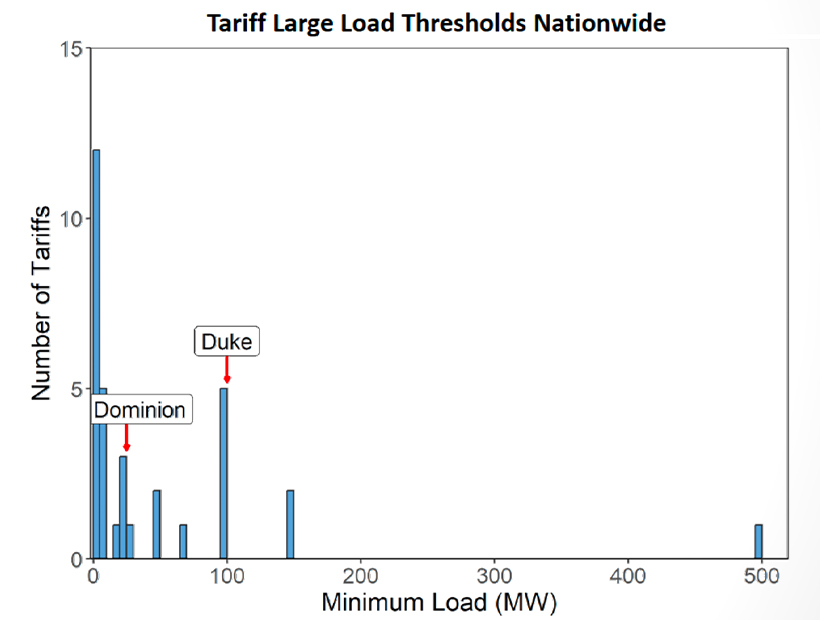
The suggestion comes after staff reviewed 44 tariffs from 28 states, said Dustin Metz, NCUC engineer for public staff.
“Large load has driven electric system growth, but with fewer larger customers than in the past, high-load-factor customers have unique operating characteristics and occupy a different role than traditional large general service or traditional industrial customers,” Metz said. “With careful rate design, reasonable ratepayer protections will allow parties to prosper, support economic development and ensure risks are mitigated.”
Even if large customers do everything right, they still face economic risks that could lead to their early retirement, which risks stranded costs falling to others, said Patrick Fahey, public utilities regulatory analyst for the North Carolina Department of Commerce.
Commissioner Karen Kemerait noted that the utilities do not want specific large load tariffs in North Carolina, arguing their current rate structures allocate costs fairly for any new load, and asked staff members for their response.
“If we decide to do nothing in terms of a new tariff in the next three years, the large load is already going to be here,” Metz said. “They’re going to be under a different tariff design.”
Staff want the commission to start working on large load tariffs now so that they are in place once the new loads start to make a major impact on North Carolina, he added.
NCUC Public Staff’s chart showing the megawatts of demand where different states’ large load tariffs kick in | NCUC Public Staff
“There is this variability in load forecasting that others have touched on — who will and won’t show up — and how that will change even in a relatively short time period means that the earlier we can get ahead of this and establish something that helps set guidelines as to what the large load customers can come in to expect,” Fahey said. “And that gets into potential improvements in forecasting and a better understanding from that customer’s perspective, especially if they’re cross-shopping against different states.”
Lucas Fykes, policy director of the Data Center Coalition, said in testimony Oct. 14 that his group has been involved in the development of large load tariffs around the country, and many start to kick in for customers with demands of 50 to 100 MW, though on the lower end that can start to impact major industrial sites – not just data centers. The main issue is that no group of customers is singled out and that cost allocations are fair to the large loads, he said.
“Certainty is very important for planning and operational purposes,” Fykes said. “We are leaning in as an organization, and many of our members are individually leaning in, in support of taking traditional terms that were usually in ESAs and putting those into tariff requirements that are fair and equitable.”
Large load tariffs vary by utility and states because the facts on the ground are different, but Daymark Energy Advisors consultant Jeffrey Bower (a witness for the Environmental Defense Fund) said some best practices have become apparent.
“Customers don’t want to invest unless they are clear about what their obligations are long term,” Bower said. “Utilities don’t want to invest in new infrastructure unless they’re clear that the customers are going to be there and are going to be contributing meaningfully to the cost of that infrastructure.”
Contract terms need to be shared with prospective customers early in the process, and defined rate classes that acknowledge their specific needs are important for certainty. Termination fees are another important part of the toolkit.
“The next principle, which has been discussed a bit, is the equitable cost allocation,” Bower said. “And so that’s a fundamental principle around cost causation and allocation, which protects existing customers, creates fair rates for new customers and aligns the incentives for efficient utilization of grid resources.”
“Just last week, AEP announced that since enacting the tariff, its pipeline of data centers had fallen from 30 GW down to 13 GW,” Bower said. “And so, this is clearly a big impact of the tariff design. It’s up for debate whether this drop signifies a reduction in economic development, or if it’s a decrease in speculative interconnection requests.”
The Role of Flexibility in Meeting Demand
With speed to market and the industry’s ability to meet demand that is projected to grow faster than new, firm capacity can come online, demand flexibility from data centers has been discussed as a way to square that circle.
“Our goals for this were to support regulators and stakeholders in identifying strategies and tactics to accommodate this load growth without compromising the reliability, affordability or progress on decarbonization,” Norris said.
The study is based on examining the 22 largest balancing authorities in the country, which account for 95% of its total demand for electricity.
“Current expectations are that AI-specialized data centers will represent the single largest share of U.S. electricity load growth over the next five to seven years, and could represent up to 44% through 2028 alone,” Norris said.
Coupled with the need to maintain reserve margins, the highest forecasts indicate national peak load growth of 180 GW by 2030 alone. Norris said that easily could rise from 700 GW today to 850 GW in the next decade, which would exceed the supply chains for new gas turbines.
“We don’t know exactly how many turbines will be available,” he added. “The current estimate suggests 60 to 80 GW by 2030. Mitsubishi says that they are ramping up production.”
An example from the Duke University data center report showing how little demand flexibility is needed to unlock spare capacity | Duke University
Battery storage can help; solar still is economical; and eventually small modular reactors or other new technologies will become available.
“We’re going to have to get creative with other solutions,” Norris said. “And so that’s why, for us, there’s an emphasis here on bringing the demand side into the equation more, so that we can utilize the existing grid that we’ve already paid for.”
In the Southeast, the bulk power system has an average and median load factor of about 53%, and it is stretched to the limit only on the coldest winter mornings and late afternoons on the hottest days of summer.
“We’re talking in the range of 50 to 200 hours per year that we’re building the system out to,” Norris said.
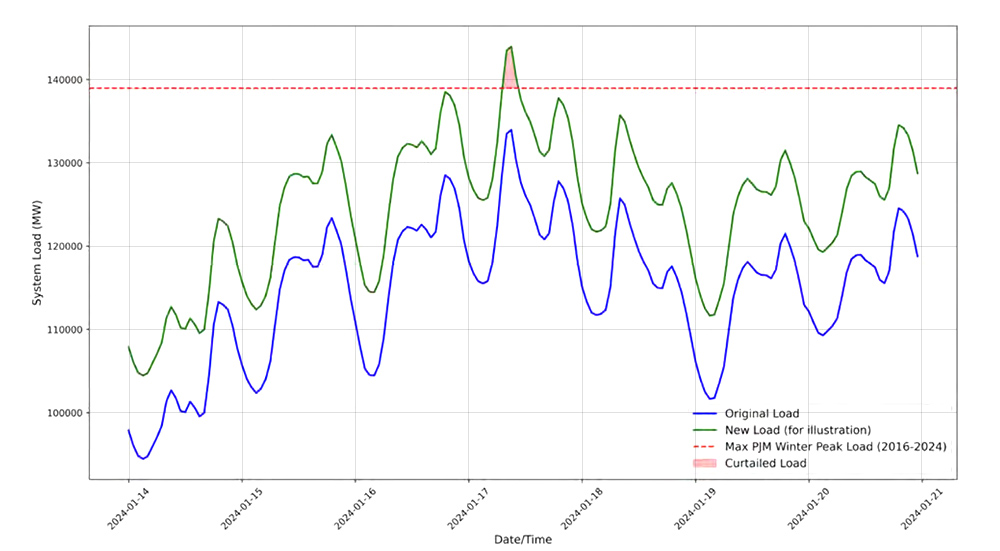
His study found that just 1% of demand flexibility from data centers could unlock 126 GW of capacity around the country; 0.5% could unlock 98 GW; and 0.25% for 76 GW. Duke’s system in North Carolina could add 4.1 GW of new demand with 0.5% flexibility from data centers.
Data centers can achieve flexibility through on-site resources such as batteries or backup generation, shifting computing load to other facilities in regions not affected by peak demands, or curtailing their activity in response to price signals.
NCUC Chair William Brawley asked whether computing would shift offshore if that policy was adopted nationally.
“There could be the possibility, perhaps, on the non-national security things, where that might actually be somewhere in Asia. Is that not a potential unintended consequence of this policy?” he asked.
That kind of spatial flexibility is an advanced capability for the tech firms building out data centers, and it has not been tested at scale, Norris said.
“It may be worth noting that it’s the policy of this administration to encourage data center development abroad, including in the Middle East, and there’s been major deals announced in terms of chip sales and exports of U.S.-manufactured gas turbines to the Saudis to support data center development there,” he added.
Norris said he is a big believer that winning the “AI race” is important and leveraging grid flexibility here could help.
“We can’t build infrastructure as fast as the Chinese, and so I view this kind of system optimization and using technology to get more out of the grid we already have, or whatever we’re building towards, is actually a critical source of national competitiveness because we’re just going to have constraints on how much we can build very quickly,” Norris said.
FERC sided with San Francisco in the city’s dispute with PG&E over cost allocation provisions in a wholesale distribution contract, finding PG&E improperly required the city to bear the cost of system upgrades instead of allocating costs among all beneficiaries.
The Oct. 16 order affirms an administrative law judge’s previous finding and directs PG&E to revise its wholesale distribution tariff within 60 days and issue refunds to its wholesale distribution customers (ER20-2878).
FERC found that under the company’s cost allocation provisions, the City and County of San Francisco would shoulder the entire cost of upgrades to distribution systems and facilities even though the utility’s retail customers also benefited from those improvements. That scenario results in a violation of FERC’s cost causation principles.
PG&E spokesperson Jennifer Robison told RTO Insider that the utility appreciates FERC’s “thoughtful review of our filing.”
“Our goal in updating PG&E’s wholesale distribution tariff was to simplify and standardize wholesale distribution service to eliminate legacy preferential treatment and to ensure that all PG&E customers are treated fairly and equally,” Robison said. “We designed the updated tariff proposal to help achieve FERC’s goal of ensuring reasonable rates, terms and conditions. We understand the City and County of San Francisco’s concerns and have been working with them on a mutually agreeable resolution.”
The underlying case concerns PG&E’s wholesale distribution tariff, which governs how wholesale distribution customers, such as San Francisco, accesses the company’s services. Wholesale customers use PG&E facilities to access the CAISO-controlled grid to make wholesale sales and purchases, according to the order.
PG&E updated the wholesale distribution tariff’s terms and conditions in 2020 and transitioned to a formula rate. San Francisco protested the update, arguing that PG&E proposed definitions of “upgrades” and “direct assignment facilities” were discriminatory.
The case has taken several twists and turns since 2020, including settlement discussions. The Oct. 16 order deals with two remaining issues:
whether PG&E’s treatment of the costs of upgrades to the distribution system under the wholesale distribution tariff is just and reasonable and not unduly discriminatory or preferential.
whether PG&E’s treatment of the costs of direct assignment facilities — facilities that are used by only a single wholesale customer — under the tariff is just and reasonable and not unduly discriminatory or preferential.
In agreeing with the administrative law judge, FERC said “PG&E’s proposed treatment of the cost of upgrades violates the commission’s cost causation and comparability principles and is therefore unjust and unreasonable.”
“Specifically, we agree that under the definition of upgrades in the [wholesale distribution tariff], PG&E’s retail customers may benefit from the use of the upgrades,” the order stated. “Thus, consistent with the commission’s cost causation principle, the costs of upgrades must be allocated among customers that benefit from the upgrade rather than directly assigned to the wholesale distribution customer that requested the upgrade.”
On the issue of the costs of direct assignment facilities, FERC sided with the administrative judge’s reasoning that because those facilities “solely benefit the requesting wholesale distribution customer” it is “therefore inappropriate to roll in installation costs for direct assignment facilities to the wholesale distribution revenue requirement or otherwise assign those costs to retail or other wholesale customers.”
However, PG&E failed to show that it treats retail customers’ facilities on the same basis and that wholesale customers end up shouldering some of the costs for retail facilities, according to the order.
“The presiding judge found that for PG&E’s retail customers, PG&E does not assign itself the full costs of retail distribution line extensions,” the commission wrote. “Instead, the costs of those retail customer-driven facilities are rolled into the wholesale distribution revenue requirement and allocated to wholesale distribution customers using the load ratio share methodology,” the commission wrote.
“We affirm the presiding judge’s determination that PG&E’s proposed definition of direct assignment facilities in the [wholesale distribution tariff] does not comply with the commission’s comparability principle and is unjust and unreasonable and unduly discriminatory or preferential,” the order stated. “Additionally, we direct PG&E to submit a compliance filing revising the [wholesale distribution tariff] in accordance with the initial decision and this order, make refunds, and submit a refund report.”
A virtual power plant program with an indeterminate future set a record in 2025 for the capacity the plant contributed to California’s electricity grid.
The California Energy Commission’s VPP program has seen a big increase in available capacity since the end of the 2024 season, CEC analyst Brian Vollbrecht said at an Oct. 15 workshop.
About 38,000 customers participated in the program in 2024, providing about 288 MW to the grid. In August, the program’s capacity exceeded 400 MW.
The VPP program is part of the demand side grid support (DSGS) program, which is within the state’s strategic energy reliability reserve. The reserve provides electricity supply and load reduction and has a goal of 7,000 MW by 2030.
The DSGS program has four options. Most of the workshop focused on VPP Option 3, which rewards battery owners who provide capacity to the grid during energy emergency alerts or when market day-ahead prices go above $200/MWh. Option 3 participants provide this capacity during extreme weather and grid events from May to October.
No residential resources with durations beyond two hours participated in the VPP, and nearly half of the VPP capacity was in the Pacific Gas and Electric region, with the rest in the Southern California Edison region and the San Diego Gas & Electric region.
At the workshop, Robert Castaneda, board president of the Low-Income Oversight Board of the California Public Utilities Commission, asked if the CEC had a socio-demographic breakdown of VPP participants.
Vollbrecht said that this type of data was not a part of the analysis “this time around.”
“But if you have questions about that, feel free to follow up with us,” Vollbrecht said.
DSGS’s funding has experienced “various shifts since its inception due to state fiscal pressures,” Deana Carrillo, director of the CEC’s Reliability, Renewable Energy and Decarbonization Incentives Division, said at the workshop.
“And I recognize that this is challenging for private industry that is participating in the program, because while we’re attesting approaches to grow demand and incorporating the lessons learned, there’s also a need for consistency and a glide path to inform your business models,” she said.
There are, however, “active, ongoing discussions about the program’s budget,” Carrillo added.
“Staff is having conversations with leadership to identify stable funding beyond 2026 and continue the program’s growth into test concepts,” she said.
In total, DSGS’s budget is $109.5 million, with about $30 million remaining at the end of 2025, CEC program manager Payam Narvand said at the workshop.
CEC staff proposes continuing the DSGS program into the 2026 program season. Any changes to the program will be informed by a public engagement process and approved at a CEC business meeting, Narvand added.
Data center-fueled demand growth continues to soar while reserve margins continue to shrink. Meanwhile, the timelines for building load versus building generation and transmission are wildly out of sync.
Large loads can stand up in one to two years or less when co-located with generation, while new generation interconnection routinely takes years, and major transmission lines average about a decade from conception to energization.
Because data centers can be developed significantly faster than the generation and transmission required to serve them, NERC has flagged the speed and scale of data center buildout as a near-term reliability challenge. Large loads also pose risks to long-term planning, operations, grid stability, balancing, power quality, forecasting, modeling and grid security.
In light of the rising operational and resource adequacy risks, federal agencies, regional organizations, power system operators and utilities are scrambling to analyze and address the impacts related to emerging large loads.
The Department of Energy (DOE) has launched the Speed to Power initiative to accelerate the large-scale generation and transmission additions needed to support data center buildout and the AI race. FERC has held technical conferences and written letters around these issues, while NERC and other regional reliability organizations have created task forces and studied the risks of these emerging large loads.
ERCOT, SPP and PJM are paving the way with large load interconnection and participation initiatives.
Just How Big is Large Load Growth?
U.S. data center electricity use rose from 58 TWh in 2014 to 176 TWh in 2023 and is estimated to reach 325-580 TWh by 2028. That translates into roughly 6.7 to 12% of U.S. electricity by 2028 (up from about 4.4% in 2023), according to DOE, underscoring how quickly this new class of demand is growing.
Growth is highly geographic, with PJM, the Western Interconnection and ERCOT leading the way due to the major data center hot spots in Virginia, Texas and the Northwest.
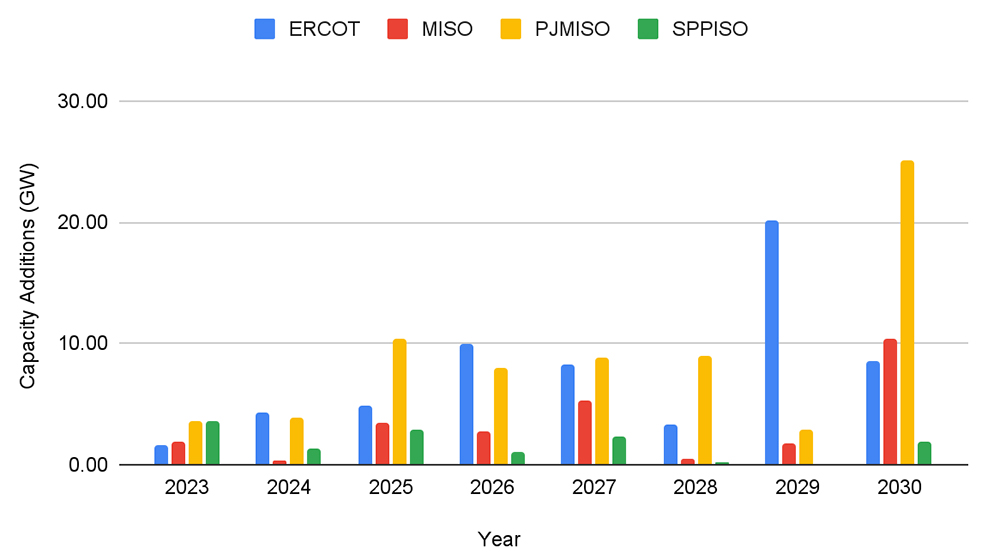
Since 2020, PJM has added about 26.5 GW and ERCOT about 13.2 GW of load‑center capacity, with more in the queue but significant uncertainty on what actually will be built. SPP also has positioned itself to capture a meaningful slice of data center growth. (See this for more information on current and future data center hot spots.)
ERCOT and PJM’s load capacity additions are projected to skyrocket in the coming years, but it’s still uncertain how much load will get built out.
Characteristics and Risks of Large Loads
Large loads today differ from conventional commercial loads. Large loads can be either large individual consumers or collections of smaller loads that create significant demand and strain on the power grid. Most talked about are data centers, including AI hyperscale data centers, but NERC categorizes large loads as follows:
Data centers: These include traditional data centers, AI training facilities, AI inference facilities and cryptocurrency mining facilities.
Industrial load: This includes semiconductor and electronics manufacturing, mining and mineral processing, oil and gas production, metals and heavy manufacturing, and chemical and petrochemical processing.
Hydrogen production (electrolyzer) facilities.
Aggregate loads: These are primarily EV charging centers and electrified heating and cooling. Large loads are being built quickly, at large unit sizes, in tight geographic clusters. Many of them, particularly data centers, can shift their computational demand rapidly in response to changing energy pricing, emission intensity and currency pricing.
Compared to traditional electricity load growth, today’s large loads are far more location-constrained (e.g., loads need available grid capacity, access to robust fiber optic networks and water access or a suitable climate for cost-effective cooling). They’re also far more schedule‑driven by corporate road maps and much less interruptible than conventional commercial load.
high-priority risks: long-term planning for resource adequacy, operations of balancing and reserves, and grid stability.
medium-priority risks: short‑ and long-term demand forecasting, real‑time coordination, transmission adequacy, frequency stability, cybersecurity, manual load‑shed obligations and automatic under-frequency load shed programs.
low-priority risks: power quality (harmonics, voltage fluctuations) and system restoration following load shedding events.
Consequently, large loads are characterized not only by their MW capacity but also by their behaviors that pose grid reliability risks. The consensus defines large load capacity as greater than 75 MW, but voltage level, local system strength and relative size to the area matter as much as raw MW. Their behaviors include ramp rates, ride‑through behavior, power‑electronics content, voltage sensitivity, predictability and internal segmentation.
Existing ISO Large Load Constructs
Before September 2025, ERCOT and NYISO were the only ISOs to have requirements for large load interconnection and preliminary definitions and programs for large loads. In 2022, NERC modified its requirements and measures for facility interconnection studies (FAC-002-4), but it didn’t have any megawatt threshold or special process for large loads.
NPRR1234 updated ERCOT’s definition of a large load to be one or more facilities at a single site with an aggregate peak demand greater than 75 MW behind one or more common points of interconnection or service delivery points. NPRR1234 also formalized interconnection and modeling standards for large loads, set standards for loads of more than 25 MW, set requirements for a reactive power study requirement for resource entities adding more than 20 MW of load at a site with existing generation, and established a standardized large load interconnection study. The study is conducted by the transmission service provider with ERCOT review and is described in PGRR115.
In NYISO, interconnection studies are required for loads greater than 10 MW at more than 115 kV or greater than 80 MW at more than 115 kV. Smaller projects are handled entirely by the applicable transmission operator’s interconnection procedures.
Federal Activity
Demand growth outpacing the grid buildout, alongside several executive orders relating to energy dominance and AI, have led DOE to launch the Speed to Power initiative.
The initiative kicked off Sept. 18, 2025, with a request for information. It aims to accelerate large-scale additions of generation and transmission so the U.S. “has the power needed to win the global artificial intelligence race” and can continue to serve fast-growing loads.
The RFI seeks details on infrastructure projects that would quickly enable 3 to 20 GW of incremental load, such as new interregional transmission of at least 1,000 MVA, reconductoring of existing lines of at least 500 MVA, restarts of retired thermal plants using existing interconnections and construction of new generation portfolios. MVA measures the apparent power in an AC transmission system, essentially the combined voltage and current capacity a line or transformer can handle. The RFI also asks how DOE should best deploy existing tools and funding programs.
RFI responses are due Nov. 21, 2025.
Texas Senate Bill 6, PUCT and ERCOT Action
ERCOT is seeing some of the largest forecast load growth from data centers, with 138 GW of large loads expected on its grid by 2030.
To address the reliability concerns this raises, the Texas state government pushed the envelope with its Senate Bill 6, which passed on June 20, 2025. It directs the Public Utility Commission of Texas to adopt large‑load interconnection standards for new or expanded large loads greater than 75 MW at a single site in ERCOT, along with study fees ($100,000 minimum initial interconnection fee), site control, uniform financial commitment rules, grid infrastructure cost allocation and a requirement to disclose to utilities any duplicate interconnection requests in Texas.
SB6 also directs the PUCT to develop one mandatory and one voluntary demand management program. The mandatory program requires protocols to curtail large loads of greater than 75 MW that are interconnected after Dec. 31, 2025, during firm load shed (with some exceptions for critical load).
The voluntary program, the Large Load Demand Management Service, requires ERCOT to competitively procure demand reductions from loads greater than 75 MW in advance of anticipated emergency conditions.
The PUCT projects for SB 6 are PUCT filings 58317 and 58479.
SPP recognizes how much uncertainty there is with the load of the future and subsequently has designed a three-phase project that aims to set SPP up for success in all likely electricity load growth scenarios. SPP’s three future large load services are:
a high-impact large load generation interconnection assessment (HILLGA)
a conditional high-impact large load service (CHILLS)
a price adaptive load (PAL) service.
The new services aim to reduce interconnection times with a 90-day study-and-approval process for HILLGA and CHILLS, provide flexibility for connection or operation of large loads within system limits and reduce transmission upgrade cost uncertainty. This will offer a clear path to interconnection agreements while maintaining SPP’s reliability standards and transparency in cost allocation.
The first phase of the project began with SPP’s revision request (RR696), which was approved by SPP’s Board of Directors on Sept. 16. It defines high-impact large loads (HILLs) and introduces a generation-supported HILLGA. A HILL is a non-conforming load facility interconnected to the grid that can pose reliability risks.
Actual and projected large load capacity additions by ISO | Yes Energy using Yes Energy’s Infrastructure Insights data
The HILLGA service offers HILLs two paths for studying and interconnecting associated generation: the common bus path and the local area path.
The common bus path is for HILLs with supporting generation behind the same point of interconnection as the HILL, where generation won’t be injected into the grid.
The local area path is a five-year service term for HILL-supporting generation that’s within two buses. With the local area path, energy flows on the grid are limited by the HILL’s needs and system capacity.
RR696 initially had designs for a third HILLGA path, deliverability area and for a CHILLS. They were removed from RR696 following feedback from stakeholders, who wanted more time to review and revise the deliverability area and CHILLS designs. The CHILLS service was introduced later with RR720, which was voted on and failed to pass in SPP’s Market Working Group meeting Sept. 23-24. This will delay SPP’s timeline, which initially sought to vote on RR720 in the Oct. 14-15 MOPC meeting.
The CHILLS will be a new curtailable transmission service available to HILLs that don’t have sufficient transmission capacity or generation to serve all their energy requirements. The portion of a HILL’s energy needs that can’t be served on a firm basis will be acquired on a conditional basis, so CHILLS is interruptible as needed to maintain reliability.
Conditional HILLs don’t need to be supported by generation, but they are required to transition to firm service by the end of the term. In a notable change from its old design in RR696, conditional HILLs must begin the process of establishing firm service within the first year. The CHILLS term now is up to seven years long, increased from five years.
SPP also has discussed a price adaptive load service for any load willing to take price‑responsive withdrawal based on real‑time pricing. SPP aims to create the revision request by January 2026 and get it approved in April 2026. This timeline may be delayed due to the recent failure to pass RR720 in the September Market Working Group.
SPP’s load-centric interconnection lane compresses the study cycle by pairing load with proximate generation and using conditional service while enduring solutions catch up.
While Texas’ SB 6 is the most comprehensive legislative package to date specifically aimed at large loads, SPP is leading the way among ISOs and RTOs with its large load interconnection lanes.
PJM’s Critical Issue Fast Path for Large Load Additions
This initiative was motivated by PJM’s high capacity prices and looming resource adequacy crisis. PJM’s independent market monitor, Monitoring Analytics, found in its analysis of PJM’s 2026/27 capacity auction that data center load growth was the primary reason for high capacity prices. Nearly 100% of the offered supply was committed in the auction, and data center load drove a $7.2 billion, or 82.1%, increase in capacity market revenues.
PJM’s 2025 long-term load forecast showed PJM still may face unmet demand even if everything is built in the generation interconnection queue.
PJM is targeting a FERC filing by December 2025 and aims to implement in time for the 2028/29 capacity auction.
The CIFP for large load additions is evaluating criteria for large‑load interconnection and coordination with load-serving entities/electric distribution companies (critical for data centers). It’s also addressing alignment of large loads connecting to the power grid with the obligation to also provide some generation capacity to contribute to ensuring resource adequacy in the grid, rather than relying on others to do so.
PJM’s Stage 1 meeting was held Sept. 15, and the initial proposal centered around three large load interconnection options: BYOG (“bring your own generation”) credits for load that arranges new supply, demand response pathways and a transitional non‑capacity‑backed load (NCBL) service that lets incremental large loads connect quickly but assigns them a lower curtailment priority during emergencies if capacity is short.
After listening to stakeholder feedback, PJM’s current proposal has three components:
Price-responsive demand (PRD) and demand response: PJM removed the mandatory NCBL concept and instead will use existing DR and modified PRD products to facilitate a process similar to voluntary NCBL. PJM proposes replacing the dynamic retail rate requirements seen in PRD with an energy market offer price. Load could elect not to take on a capacity obligation, requiring it to reduce demand during stressed system conditions rather than pay for capacity.
Load forecasting enhancements: These include allowing state commissions to review and provide feedback on large load adjustments prior to finalizing load forecasts, and add a duplication check in load analysis subcommittee submissions. Each annual large load adjustment submission must inquire and report whether customer interconnection requests are duplicative (inside/outside PJM) and quantify the duplicated megawatts.
Expedited Interconnection Track (EIT): Introduce a 10-month EIT for “sponsored” generation that operates outside and in parallel to the PJM cycle process (the standard generation interconnection process). The EIT would be limited in volume and have strict entry requirements to minimize impact on PJM’s cycle process.
Alternative approaches for procuring new resources on a longer-term basis still are in discussion and may be included in the CIFP for large load additions. PJM also mentioned that the manual load shed allocation mechanism needs to be reviewed following the conclusion of this CIFP.
Conclusion
Unprecedented data center-driven demand growth requires unique solutions to address the rising resource adequacy and grid operations risks. There is a timing gap with large loads arriving in months to a few years, while new generation and transmission take far longer.
Besides being large, these loads ramp quickly, are electronics-heavy and location-constrained, and can be price-adaptive, so treating them like conventional commercial growth will miss real reliability and planning risks.
ERCOT, SPP and PJM are leading the charge, creating large load-specific programs to speed up the interconnection and offer unique participation models for large loads and the necessary accompanying supply and transmission capacity.
The path forward includes standardized definitions and studies across ISOs/RTOs, improved participation models and forecasting for high-impact large loads, price-responsive operation, improved time-to-connect, conditional service, curtailment performance and progress to firm capacity.
Tim Hough is a market analyst on the market monitoring team at Yes Energy. RTO Insider is a wholly owned subsidiary of Yes Energy.
State regulators approved an accounting order for Public Service Company of New Mexico’s participation in CAISO’s Extended Day-Ahead Market, in a case that rekindled the debate over which day-ahead market PNM should choose.
The New Mexico Public Regulation Commission voted 3-0 on Oct. 16 to approve the order, which allows PNM to create a regulatory asset for its EDAM costs. That means PNM will track its EDAM costs separately from other expenses and later seek to recover the costs in a rate case.
PNM estimated its EDAM implementation costs will be $11.1 million in capital costs, $3.1 million in one-time operations and maintenance expenses, and $1.4 million to $1.6 million a year in ongoing costs from 2028 to 2030.
PNM’s request for an accounting order sparked filings from those who supported the request and those who believe the company should have chosen SPP’s Markets+ instead of EDAM.
“To me, it’s kind of nuts that this case became a referendum on market choice, or parties tried to make it so,” Commissioner Pat O’Connell said before the vote.
O’Connell said keeping EDAM expenses in a separate account would make it easier to later inspect the costs and compare them to benefits of market participation.
The commission found that it is “reasonable” for PNM to “expend costs in joining EDAM.” The prudency of the expenditures will be evaluated during a future rate case, when the amount of spending is known.
The commission didn’t authorize PNM to include carrying charges in its regulatory asset, saying that doing so would constitute “ratemaking treatment in advance.”
Parties have until Nov. 17 to file a motion for rehearing.
Regional Market Proceeding
In a Sept. 11 filing, Tri-State Generation and Transmission Association asked the commission to deny PNM’s application. Tri-State pointed to PNM’s 2018 request for an accounting order for the costs of joining CAISO’s Western Energy Imbalance Market. In that case, the commission granted the order without making a reasonableness determination.
Commission Chair Gabriel Aguilera said PNM’s new request was unique because it followed a lengthy commission proceeding that examined the potential benefits of regional market participation by the state’s investor-owned utilities. The proceeding included a series of workshops where studies on projected benefits of market participation were presented. Utilities and stakeholders weighed in with numerous filings.
Utilities were not required to obtain commission approval for their day-ahead market participation. But the commission issued a set of guiding principles in November 2024 intended to guide the utilities’ market decisions. (See NM PRC Issues ‘Guiding Principles’ for Electricity Market Participation.)
“PNM’s decision to join EDAM is not a decision that was made quickly or without thorough consideration,” the commission said in its order. Rather, it is a result of “the time, effort and investigation put in by multiple entities that participated in [the docket].”
EDAM Decision Questioned
In its filing, PNM pointed to a Brattle Group study that projected benefits from joining EDAM would be $20 million a year vs. $8 million a year for joining Markets+. PNM said the difference in benefits was a key factor in its decision to choose EDAM.
Tri-State argued that the $20 million and $8 million figures are based on PNM and El Paso Electric participating in the same market. But El Paso Electric has announced its intention to participate in Markets+, while PNM is going with EDAM. (See El Paso Electric to Join SPP’s Markets+ in 2028.)
Tri-State said the benefit difference “is not actually driven by the adjusted production cost but is instead driven by different expectations of congestion revenues and bilateral trading revenue.” A presentation on the findings in August 2024 did not say “with any level of certainty how likely these benefits are to materialize,” Tri-State added.
Tri-State said that key considerations from the commission’s guiding principles — including greenhouse gas tracking, fair governance, seams management and market design — favor PNM’s participation in Markets+ or SPP’s RTO rather than EDAM.
PNM countered by saying its choice of EDAM was a discretionary action.
“PNM’s decision to join the EDAM is not properly before the commission in this proceeding; it is a decision PNM made 10 months ago and informed the commission of at that time,” PNM wrote in a reply to Tri-State.
Western Resource Advocates (WRA) also weighed in on PNM’s accounting order request, saying PNM had acknowledged the commission’s guiding principles for choosing a day-ahead market and presented “a reliable cost-benefit analysis study performed by the Brattle Group.”
WRA recommended the commission approve PNM’s request for an accounting order with the addition of certain reporting requirements before and after it enters EDAM.
The commission’s order directs PNM to provide updates on any “substantive changes to the market” and to file quarterly reports after its EDAM participation begins. The reports will detail cost savings to customers, transmission availability and use, renewable resource curtailment, resource planning impacts and market performance during extreme weather, among other issues.
After two years, PNM must file the reports annually.
The NYISO Operating Committee voted to approve the ISO’s draft Comprehensive Reliability Plan (CRP), though environmental groups and the Market Monitoring Unit voiced concerns with the wide range of predictions, the lack of identification of needed market changes and the potentially growing disconnect between other planning studies.
An early draft of the CRP, issued Oct. 7, called for “several thousand megawatts of new dispatchable generation by the 2030s,” based on a broad range of possible scenarios for load growth and supply. (See NYISO Reliability Plan Calls for ‘New Dispatchable Generation’.)
The newest draft, which will go before the Management Committee on Oct. 29, accounts for the third-quarter Short-Term Assessment of Reliability (STAR) and its identification of an immediate reliability need for New York City. (See related story, NYISO Again Identifies Reliability Need for NYC.) It was approved over the opposition of the Natural Resources Defense Council.
“The way this is all being presented in this reliability report is going to create great levels of alarm and confusion,” NRDC’s Chris Casey said at the committee’s meeting Oct. 16. “The technical experts understand it’s informational, but I don’t think it’s going to be interpreted that way.”
In a newly added sentence to the draft, the ISO acknowledges that, “as demonstrated by the study-by-study fluctuation in the system conditions and associated risks, the NYISO’s current approach in evaluating the reliability of the system is no longer sufficient for future planning studies.”
Casey argued that while the CRP talked up the importance of a strong market to meet reliability needs, parts of the report gave the impression that markets will not be able to solve the need. Some of the recommendations would exacerbate the disconnect between reliability studies and the Installed Reserve Margin on which prices are based, he said.
“Your point is really well taken,” said Ross Altman, senior manager of reliability planning for NYISO. “We need to discuss with stakeholders which specific range of forecasts or any of these factors we should consider an actionable reliability determination. What we are trying to say strongly is that it shouldn’t just be based on one. Combine that with the narrowing margins, and we are on a knife’s edge with every analysis we do.”
Much of the committee’s discussion centered on how to quantify reliability risks on the grid and how this would interact with existing planning processes.
“I definitely share some of the concerns that were shared by previous commenters,” said Pallas LeeVanSchaick, vice president at Potomac Economics, the grid operator’s MMU. He said NYISO’s analysis acknowledges a broad range of supply and demand outcomes but treats them as “random events.”
“The reality is the role of the market is to help moderate excess supply or insufficient supply,” LeeVanSchaick said. “The reality is when you look at the risks of aging generation and lack of supply, by far the biggest factors for those outcomes are not the age of the resources but a mix of environmental policies and market incentives for maintaining the generation and repairing significant failures.”
Liam Baker, senior vice president of regulatory affairs at Alpha Generation, weighed in as “the owner of the largest aging fleet.”
“When these things break … they break in such a manner that they need to be completely rebuilt,” Baker said. “The replacement parts we use nowadays are bespoke. We are … cannibalizing our existing fleet. … We are literally cannibalizing Gowanus 1 and 4 to keep Gowanus 2 and 3 and Narrows 1 and 2 running.”
Baker said NYISO was “wise” to highlight aging generation, but he wanted to make sure the ISO and other stakeholders understood how dire the situation was: Replacement parts for the plants often have to be custom made — or even purchased on eBay.
Matt Schwall, director of regulatory affairs for Alpha Generation, said this point was “critical.” The retirement dates for Gowanus and Narrows, which drove the reliability needs findings in the Q3 STAR, were not based solely on environmental rules, he said.
“We are proposing to retire these units because they are no longer economic to operate,” Schwall said. “There are other things driving generator retirements other than being unable to comply with state regulations.”
[EDITOR’S NOTE: A previous version of this story’s headline incorrectly said that $3.8 billion had been trimmed.]
LITTLE ROCK, Ark. — It took six votes during more than four hours of discussion — over the course of two days of meetings — before SPP stakeholders endorsed the 2025 10-year transmission plan and some of its proposed 765-kV lines, trimming about $2.5 billion in costs from the portfolio.
Members of the Markets and Operations Policy Committee on Oct. 13 first rejected their own proposal to defer the three southern legs of a proposed 765-kV overlay that would have shaved $3.83 billion in costs off the portfolio. They then shot down a motion to endorse the plan and the assessment report as modified by two stakeholder groups.
Neither motion received more than 57.5% approval, far short of MOPC’s 66.7% threshold.
After a night’s rest, SPP staff regrouped Oct. 14 during MOPC’s second day with three new proposals. They asked members to endorse:
the 2025 Integrated Transmission Planning assessment report as having been completed according to the tariff;
construction permits for the report’s 345-kV projects and three 765-kV reliability projects on the eastern and western legs of the RTO’s southern extra-high-voltage overlay; and
permits for the three 765-kV economic projects looping the overlay’s two legs together. The Crawfish Draw-Minco-Seminole-Anthem segments total about 515 miles and are estimated to cost $3.83 billion.
Referring the previous days’ voting “failures,” Casey Cathey, SPP vice president of engineering, asked MOPC for a “more clear and granular” direction for the Board of Directors to better prepare it for its consideration of the ITP when it meets in November.
SPP’s southern 765-kV backbone, including the Seminole-Anthem project | SPP
Staff have been studying about $18 billion in transmission projects as part of the 2025 assessment. The grid operator has proposed deferring $7 billion in 765-kV projects, reducing the portfolio to $11.16 billion for up to 50 construction permits to meet reliability and short-term needs. It has projected benefit-cost ratios of between 10:1 and 15:1. (See SPP Wants to Defer $7B in 765-kV Projects to 2026.)
Cathey reiterated the RTO’s cost-control measures and outlined several recent and in-flight tariff changes that improve the SPP’s cost-estimate process. He said the 2025 ITP’s 765-kV economic projects will have more control measures and conditions, including alignment with the 2026 ITP 765-kV overlay.
The grid operator was stung recently when cost estimates for its first 765 project, Southwest Public Service’s 345-mile Potter-Crossroads-Phantom transmission line that was part of the 2024 ITP, more than doubled from $1.69 billion to $3.62 billion. It took several more months of meetings for SPP to secure the project’s approval after SPS staff refined the RTO’s project projections. (See SPP Board Approves 765-kV Project’s Increased Cost.)
“We just went through that with the Potter-to-Crossroads-to-Phantom facility, so everybody has kind of a clear understanding of how that might work,” Cathey said, calling it a “good example” of SPP’s existing cost-control measures. “That project obviously came in higher for a number of reasons, but it also helped from benefits, cost-ratio and reliability needs perspective.”
MOPC members provided the “granular” feedback with their concerns on affordability, cost allocations, inequitable benefits and uncertainty about moving too fast or whether load growth slows. They questioned staff about the lack of analysis in the two motions to approve transmission projects and raised concerns about reliability concerns when 765-kV projects are set aside.
NextEra Energy Resources’ Jeff Wells objected to voting on separate construction permits rather than the entire portfolio.
“It was designed as a whole. It was studied as a whole, a complete portfolio. It works in concert,” he said. “Piecemealing it apart, simply because maybe we don’t like the designation, potentially, of reliability or economic [projects] … when you piecemeal that, you run the risk of losing the benefit that the portfolio has as a whole.”
“SPP has a really tremendous opportunity for growth with the industrial and technological developments that we’re seeing in this country; load growth as a result is also predicted to be tremendous,” said Jennifer Solomon, also with NextEra. “If we don’t build this portfolio as a whole, the development may not come, because what we’re seeing is that there may not be room for it. MISO, ERCOT and PJM are all moving aggressively forward with 765-kV lines just to keep up with the loads that they’re seeing.”
MOPC easily endorsed the first two motions. However, the motion to endorse the three 765-kV economic lines fell woefully short at 43.8% approval.
As staff mulled next steps, Director Steve Wright weighed in. He pushed for compromise among stakeholders and called for a better understanding of mitigating risks with large transmission facilities.
“One of the things that’s been ingrained in me in the three years on the board is it’s a hallmark of the board that we really want a high level of consensus,” he said. “We don’t have it here. The question is, what’s going to happen over the next couple of weeks? I really hope the Members Committee vote [an advisory ballot that precedes board votes] will not be the same vote as what we just had, because that just basically punts the issue to the board and is something that clearly there’s not much agreement around.”
American Electric Power’s Richard Ross echoed Wright in calling for a separate vote on the Seminole-Anthem portion of the 765-kV southern loop in the utility’s eastern Oklahoma service territory. The project is fast becoming a reliability project, Ross said, with 2.5 GW of load added to transmission service agreements after the 2025 ITP models were locked.
“That further solidifies that this will be a reliability project in the 2026 ITP,” Cathey said.
“I don’t want us to get away from this meeting without addressing that issue and mitigating the risk that we delay beginning work on that project as soon as possible,” Ross said, “begging” for one more vote “so that that message is clear to the board that we as a group agreed on moving forward with that particular project.”
MOPC endorsed the project’s approval and its projected $1.2 billion price tag, giving it 72.5% approval. Transmission owners voted 11-6 in favor, with one abstention, while transmission users approved the motion 45-11, with eight abstentions.
The committee’s actions reduce the 2025 ITP’s costs to $8.7 billion, SPP said. That still exceeds the record 2024 assessment, which approved permits for more than $7.6 billion in projects. (See SPP Stakeholders Endorse Record $7.65B Tx Plan.)
SPP COO Antoine Lucas promised staff will provide more information on cost-containment measures and risk mitigation as staff takes the ITP before state commissioners and the board, saying he understood the concerns being expressed. He said staff will continue to evaluate the $7 billion in deferred projects as load forecasts continue to evolve.
“This [2025 ITP] comes in the context of increasing strain on the existing transmission network,” he said. “The challenges that we’ve had to interconnect new generation and load without the need for tremendous new upgrade costs is a pretty good signal that the transmission system is at its limits. What we see every day in our [markets] is increasing levels of congestion, another very clear metric of very limited and — in some areas and cases — insufficient transmission.”
Staff have scheduled an education session for the Regional State Committee on Oct. 24. The state commissioners do not have any say over the ITP, but Cathey said the RTO will use the session to support any regulatory concerns or necessary additional policy.
The board will take up the package during its Nov. 4 quarterly meeting in Little Rock.