New analyses report record growth for the global renewable energy sector in 2025 and project continued expansion through the end of the decade.
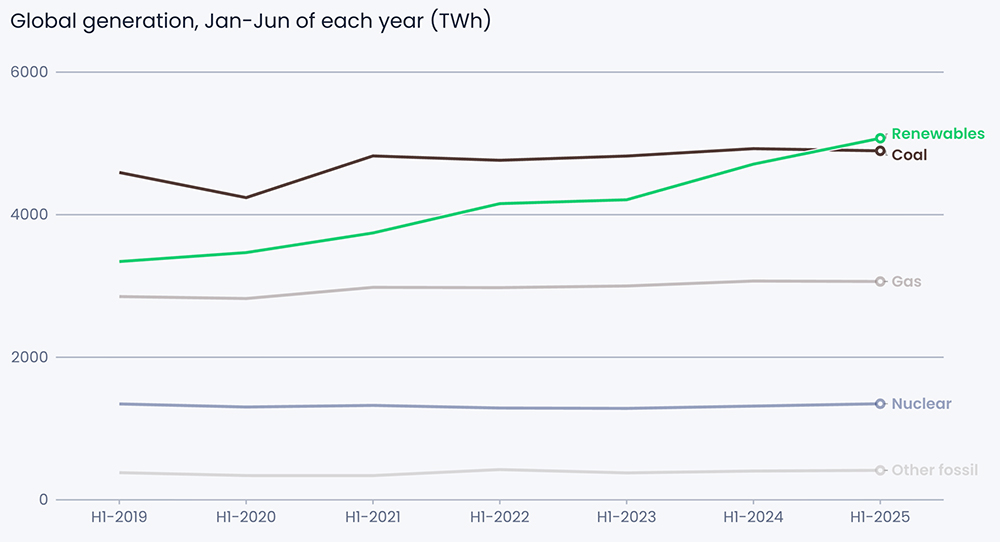
Energy think tank Ember reported that solar and wind capacity additions outstripped demand growth in the first half of 2025 and that renewables produced more electricity than coal for the first time.
The International Energy Agency predicted that installed renewable capacity would more than double by 2030 despite supply chain, financing and grid integration headwinds. But IEA lowered its five-year growth forecast for two of the largest markets — the U.S. and China — because of their shifts in policy.
Ember issued its “Global Electricity Mid-Year Insights 2025” report Oct. 7. The U.K.-based think tank, which seeks to accelerate the clean energy transition, said its report is based on monthly electricity data from 88 countries accounting for 93% of global demand.
Global electricity demand grew only 2.6% (369 TWh) in the first half of the year, but solar generation increased 31% (306 TWh) and wind 7.7% (97 TWh).
In total, renewable output grew to 5,072 TWh, or 34.3% of global electricity, while coal decreased fractionally to 4,986 TWh, or 33.1% of the worldwide total.
But first-half results varied, Ember reported, with some countries or regions diverging significantly from the global trend.
Worldwide renewable power generation exceeded coal-fired generation for the first time in the first half of 2025. | Ember
China, the EU, India and the U.S. are home to about 45% of the world’s population but use 63% of its electricity. Fossil fuel generation deceased in China and India but increased in the EU and U.S. China retained its position as the global leader in clean energy growth, accounting for 55 and 82% of new solar and wind capacity, respectively, plus 73% of new nuclear.
The picture was different in the U.S., with solar and wind additions meeting only 65% of the country’s demand increase. This and higher natural gas prices caused a shift toward coal generation, which increased 17% (51 TWh).
“Globally, renewables growth met all the increase in electricity demand,” Ember said. “That certainly wasn’t the case in the U.S.”
IEA is expecting more of this trend in the years to come. “The report’s outlook for global renewable capacity growth is revised downward slightly compared with last year, mainly due to policy changes in the United States and in China,” it said in its Oct. 7 announcement of “Renewables 2025.”
“The early phaseout of federal tax incentives along with other regulatory changes in the United States lowered our growth expectations for renewables in the U.S. market by almost 50% compared with last year’s forecast. China’s shift from fixed tariffs to auctions is impacting project economics, resulting in a reduction in our forecast for renewables’ growth in the Chinese market.”
Beyond the policy changes in the U.S. and Chinese markets, IEA sees other headwinds for much of the world:
Supply chains remain concentrated in China.
Offshore wind delays and cancellations continue.
Major manufacturers of solar and wind components have reported large losses.
The rise of variable renewables has been accompanied in some places by a rise in curtailments and negative prices; demand-side flexibility and dispatchable power plants will be increasingly necessary.
But IEA revised its growth projections upward in some regions because of supportive new policies, faster permitting and proliferation of rooftop solar, particularly in India, Europe and most developing or emerging economies.
With this balance, IEA is projecting 4,600 GW of new renewable capacity to be installed by 2030, 80% of it solar. This would be 2.6 times the capacity in 2022, but it would fall short of the pledge to triple capacity at 2023’s COP28 in the United Arab Emirates. IEA also maps out an accelerated scenario of more supportive polices, under which 2030 capacity would reach 2.8 times 2022 levels.
In its “Renewables 2024” report a year ago, IEA predicted 5,500 GW of new renewable energy by 2030, bringing the worldwide capacity to 2.7 times its 2022 level.
2024 set a record for renewables deployment — 685 GW — and IEA is predicting 2025 will set another record: more than 750 MW under its main scenario, or 840 GW under its accelerated scenario.
FERC approved Tri-State Generation and Transmission’s request to update a program designed to allow its member utilities more flexibility in how they procure power, finding the proposed revisions will help members tackle large new loads from data centers.
Specifically, FERC approved revisions to Tri-State’s Bring Your Own Resource (BYOR) program in an Oct. 6 order (ER25-3109).
The company launched the BYOR program in 2024 to provide members with increased flexibility to build or contract their own energy projects, according to a news release.
The initial BYOR tariff allowed utilities to procure up to 40% of their power from sources other than Tri-State based on the wholesale power supplier’s 2022 system peak period.
However, the company argued in the FERC filing that “relying on a single year historical test period had the potential consequence of relying on low outlier data, because utility member peak demand fluctuates over time; and therefore, using a single historical year test period risks BYOR allocations being set at unfairly low levels.”
Under the new tariff, the amount of power utilities may procure from other sources than Tri-State remains at 40% but is now based on the utility member’s highest monthly Tri-State Peak Period/Member Coincident Peak value over a three-year historical period, rather than Tri-State’s 2022 system peak, according to the order.
“We find that the revised BYOR tariff is just and reasonable and not unduly discriminatory or preferential,” FERC’s order stated. “We agree with Tri-State and its utility members that the proposed revisions to the BYOR tariff will provide Tri-State’s utility members with additional flexibility in procuring power resources for their retail ratepayers and provide them with the benefits the BYOR tariff was originally developed to provide.”
FERC also approved increased flexibility to BYOR funding mechanisms and cost savings associated with DERs as well as other “minor improvements,” according to the order.
The tariff revisions also provide members with energy project development rights related to new large loads — specifically those exceeding 45 MW — being developed in their service territories, “in direct response to the forecasted proliferation of large data center and industrial [high-impact loads] across the country,” according to the order.
“[W]e find that the proposed revisions to expand the BYOR tariff to allow utility members to contract for, or build, their own generation resources to serve specific HILs will help Tri-State’s utility members serve HILs being developed in their service areas, and we agree with Tri-State that tying Tri-State’s obligation to procure power for its utility members from a HIL BYOR project to the operation of the HIL that the HIL BYOR project was designated to serve mitigates risks related to over-procurement of power,” FERC wrote.
The FERC order comes shortly after Tri-State filed an application for approval of a new tariff designed to manage the heavy volume of data center load expected to materialize in its member utilities’ service territories over the next decade. (See Tri-State Seeks FERC Approval for Data Center Load Tariff.)
The Los Angeles Department of Water and Power (LADWP) has agreed to pay a $350,000 penalty to the U.S. Treasury, FERC said in an Oct. 2 filing alleging that the utility withheld information from WECC and provided false information to the regional entity during a 2020 compliance audit (IN25-11).
FERC’s Office of Enforcement and Regulatory Accounting wrote in the filing that LADWP neither admitted to nor denied the accusations but agreed to pay the penalty and other compliance obligations, including submitting annual compliance monitoring reports for at least two years.
The case involved the infringement of NERC’s Rules of Procedure as they stood at the time, specifically sections 401.3 and 403.10. Section 401.3 required utilities to “provide to NERC and the applicable [RE] such information as is necessary to monitor compliance with the reliability standards,” while 403.10 directed registered entities to “submit timely and accurate information when requested by the [RE] or NERC.”
LADWP provides electricity and water services to the city of Los Angeles, with a generation, transmission and distribution system that extends across California, Arizona, New Mexico, Nevada and Oregon. The utility’s generation system has a total nameplate capacity of more than 8 GW.
According to FERC, the alleged violation arose from an incident in October 2018 when LADWP granted a third-party consultant access to some cyber assets for a test, the details of which were not discussed in the commission’s filing. NERC’s reliability standards required that LADWP perform quarterly reviews to ensure only authorized individuals access their cyber systems. However, LADWP’s review for the fourth quarter of 2018 did not include any information about this testing event and consequently never was finalized.
WECC later issued a data request during a routine audit for the utility in 2020 that LADWP failed to satisfy because to do so would require sending the incomplete quarterly review. Instead, LADWP told the RE it could not locate the material and later indicated the quarterly review for that period had never been done at all.
According to the filing, LADWP developed this response with a third-party audit consultant, which warned the utility that “the language … could be perceived as hiding information or not being completely forthcoming with WECC.” FERC wrote that members of LADWP’s management responsible for compliance and risk management knew about the testing event, its omission from the quarterly review and the false responses submitted to WECC’s request.
After an internal investigation, LADWP self-reported this sequence of events to WECC in 2023. FERC noted that during its own subsequent investigation, the utility “fully cooperated with” OERA.
OERA concluded that LADWP violated 401.3 and 403.10 by withholding information from NERC and WECC, emphasizing that this finding did not include any potential violations of NERC’s reliability standards associated with the 2018 testing event or discovered in the 2020 WECC audit.
OERA also called the audit consultant’s role in the violations “problematic,” because it provided the language for the utility’s false response to WECC’s information request and acknowledged that the information was not accurate. The consultant thereby “involved itself in the submission of false, inaccurate and misleading information … and the concealment of relevant information,” behavior that “was inconsistent with the obligation of third-party consulting firms to advise … only truthful, accurate and complete responses.”
Monitoring Report Required
In addition to the financial penalty, which is to be paid within 10 days of the effective date of the agreement, LADWP also agreed to submit an annual compliance monitoring report to OERA for at least the next two years. The first report is to be filed no later than 60 days after one year following the effective date, with the second to be filed a year after the first. OERA may determine that a third report is needed based on the first two.
Each report must include:
Any known violations subject to FERC’s jurisdiction during the prior year, along with any mitigation actions taken.
Any compliance measures and procedures instituted or modified by LADWP related to its participation in FERC-jurisdictional markets.
All commission-related compliance training administered by LADWP during the prior year.
Additional mitigation and compliance measures performed with WECC related to any standard violations implicated by the 2018 testing event and the 2020 WECC audit.
LADWP also must submit an affidavit with each report, executed by an officer of the utility, that states the report is true and accurate.
In a statement to ERO Insider, LADWP staff said they have “worked proactively with FERC, NERC and WECC to resolve any non-compliances associated with the responses” to the 2020 WECC audit. They noted the utility appointed Joanne Martin as chief risk and compliance officer this year “to lead and strengthen [LADWP’s] regulatory compliance procedures and practice.”
“LADWP leadership and the board have, at all intervals, encouraged complete cooperation with federal investigators and have worked to improve compliance functions,” staff said. “LADWP takes seriously its ongoing compliance obligations to FERC, NERC [and] WECC and will continue to work to demonstrate its commitment to compliance moving forward.”
Eight businesses and advocacy groups are suing EPA, seeking to reverse its termination of Solar for All.
The program was an effort to expand lower-income Americans’ access to small-scale solar power generation; $7 billion was allocated to 60 recipients in 2024.
Administrator Lee Zeldin announced Aug. 7 that EPA no longer would implement Solar for All, saying it was part of the $27 billion Greenhouse Gas Reduction Fund (GGRF), the allocation for which was rescinded July 4 as part of the One Big Beautiful Bill Act.
The plaintiffs counter in their complaint that Congress did not repeal the Solar for All program retroactively and that it rescinded only the unobligated balances of the GGRF; the $7 billion for Solar for All was obligated, they state, and the termination violated the law in multiple ways.
The complaint, filed Oct. 6 in U.S. District Court in Rhode Island (1:25-cv-00510), asks the court to find that EPA’s action was illegal and to reinstate the program.
The Southern Environmental Law Center is among the organizations bringing the litigation to federal court. Senior attorney Nick Torrey framed the case as a matter of economic justice: “Families all over the country were counting on energy bill relief that disappeared overnight when the administration unlawfully terminated Solar for All. This popular program was poised to bring more solar to our communities; provide jobs for the small businesses installing those projects; and help families get cheap, clean power.”
As he said EPA would stop implementing Solar for All, Zeldin invoked the metaphor of the Biden administration throwing gold bars off the Titanic. The GGRF was wasteful and rife with documented instances of self-dealing, conflicts of interest, unqualified recipients and reduced oversight, Zeldin charged, while Solar for All entailed dilution of grant money due to the multiple pass-through layers.
The Clean Energy States Alliance said in a news release that EPA itself previously estimated that 900,000 households would benefit from the program; CESA’s own analysis placed participants’ utility bill savings at up to 70% for 20 years.
“This lawsuit is a welcome step,” said CESA Deputy Director Vero Bourg-Meyer. “We hope that EPA reverses course so that Solar for All grantees can all return to work, delivering savings to American households.”
The complaint names EPA and Zeldin as defendants. The eight plaintiffs are potential beneficiaries of Solar for All; they include a labor organization, a homeowner, nonprofits focused on energy affordability, and solar consultants and installers.
All the plaintiff organizations claim significant harm from cancellation of Solar for All.Two are based in Rhode Island.
The complaint states that EPA based its termination of Solar for All solely on Section 60002 of the One Big Beautiful Bill Act, which reads: “This section repeals and rescinds unobligated funds for the Greenhouse Gas Reduction Fund, which provides financial and technical assistance to states and other eligible recipients to help enable low-income and disadvantaged communities carry out activities to reduce greenhouse gas emissions.”
The complaint states that this wording is not ambiguous, does not apply retroactively and does not extinguish prior liabilities. It states that the vast majority of funding was fully obligated by Sept. 30, 2024, the statutory deadline set in the Inflation Reduction Act of 2022, under which Solar for All was created.
TORONTO — The Ontario government’s efforts to align IESO and the Ontario Energy Board to make the province an energy “superpower” were the dominant theme at the 2025 Ontario Energy Conference on Sept. 29.
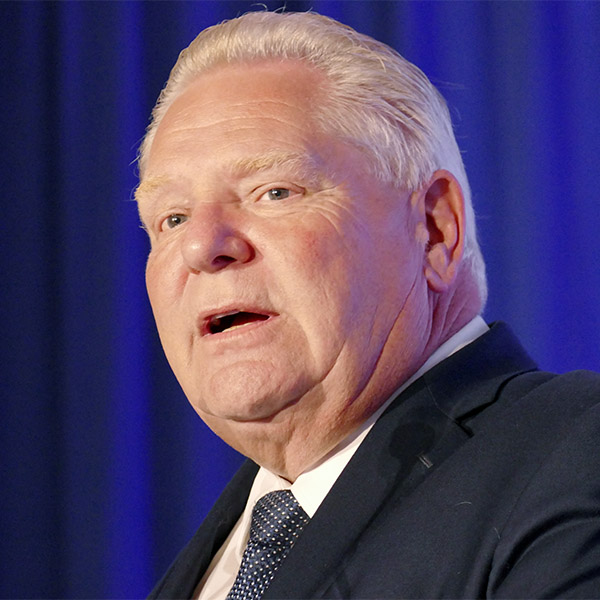
Premier Doug Ford, the first speaker at the conference, received a standing ovation after laying out his plan for using the province’s energy sector to “build the strongest economy in the G7.”
Ford’s ambitions were spelled out in the Ministry of Energy and Mines’ Integrated Energy Plan (IEP) in June, which called for expanding nuclear power and natural gas and making economic development a core mission of both IESO and the OEB. (See Ontario Integrated Energy Plan Boosts Gas, Nukes.)
The conference, sponsored by the Ontario Energy Association and the Association of Power Producers of Ontario (APPrO), attracted more than 450 attendees to the Marriott Downtown at CF Toronto Eaton Centre.
Outside the hotel, members of the Ontario Clean Air Alliance protested the government’s support for gas-fired generation, calling for the province to instead triple wind and solar generation. They were joined by members of the Toronto East Residents for Renewable Energy, who rallied against a proposal to expand Ontario Power Generation’s Portlands Gas Plant by 50 MW from its current 550 MW. They said the plant should be shuttered by 2030.
Inside the hotel, however, there was no overt opposition to the government’s plan, although some speakers acknowledged the likelihood of rate increases and warned of the risks of building new nuclear generation.
IESO CEO Lesley Gallinger referred to the ministry’s “bold and pragmatic vision.”
“Economic growth, supporting population growth, supporting sovereignty and supporting First Nations reconciliation. I mean, this is a grand slam home run if we do this right,” enthused Harry Taylor, CFO and interim CEO for Hydro One.
In addition to a “relatively well-managed” transmission system and successful generation procurements, “for the first time in decades, we have also a vision,” said Robert Reinmuller, Hydro One’s vice president for transmission system planning and large accounts.
A.J. Goulding, president of London Economics International (LEI), gave the strongest critique of the IEP in his keynote address, raising questions about bullish load forecasts, the nuclear investment and the risk of policies being reversed after a change in government. (See related story, Goulding Hasn’t Drunk the ‘Energy Dominance’ Kool-Aid.)
Province and Federal Government Aligned on Nuclear Expansion
Ford called for making Ontario “more competitive, more resilient and more self-reliant” to “build the strongest economy in the G7.” Central to that vision, Ford said, was its “massive potential as an energy superpower.”
The IEP developed by Energy Minister Stephen Lecce calls for the construction of four small modular reactors totaling 1,200 MW and the addition of up to 4,800 MW of nuclear capacity at the Bruce Nuclear Generating Station.
“I love the guy,” Ford said of Lecce. “I talk to him every single day, four or five times.”
Ford, a member of the Progressive Conservative Party, praised Liberal Party Prime Minister Mark Carney, who identified four SMRs planned at Ontario’s Darlington nuclear power plant as one of the “nation-building” projects he said are needed to bolster the country’s economy in response to U.S. President Donald Trump’s escalating tariffs. (See Ontario Environmentalists Slam New Nuclear Units.)
“He’s all in on large-scale nuclear [and] on the SMRs,” Ford said. “He understands it. He gets it.”
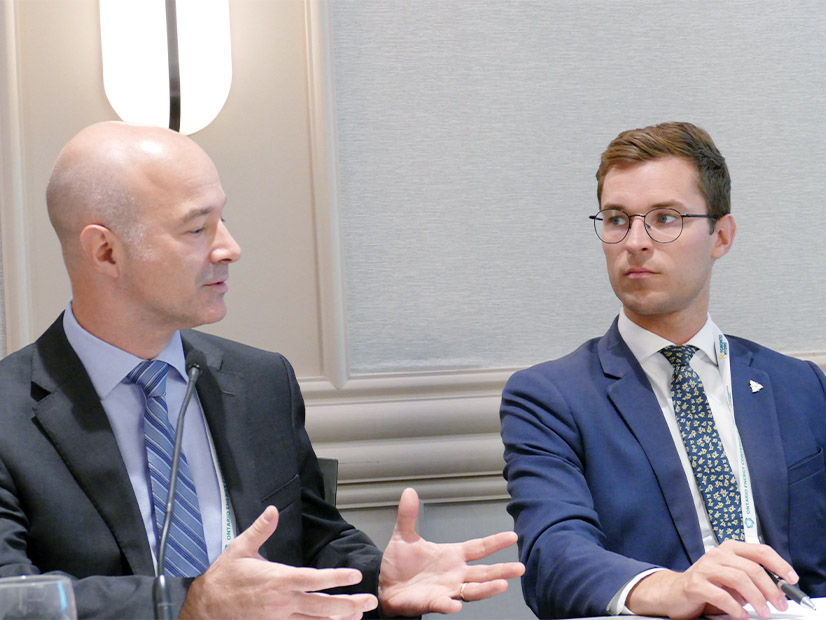
That comity was apparent later in a panel discussion featuring André Bernier, director general of Natural Resources Canada, the federal government agency responsible for energy and minerals, and Sam Oosterhoff, the province’s associate minister of energy-intensive industries.
“I think we might be in danger, minister, of finishing each other’s sentences,” Bernier told Oosterhoff.
Later, in a keynote speech at the conference’s evening gala, Lecce noted that though the provincial and federal governments are headed by different political parties, “we are on the same team in this moment. We’re fighting for a similar cause. We have to stand up for our country, safeguard our workers against [the] great level of risk from the U.S., in China and Iraq.
“I like what I hear from the feds … moving with speed … nation building, regulatory reform, ending duplication [of environmental reviews, things] so important to the province’s and the country’s economy. But we now need them to do those things. We need an impact assessment law that does not take five years to assess projects [that] in the European Union can be done in 12 or 18 months. We need the feds to end duplication on critical projects.”
Lecce also called for federal support to help meet the “massive, massive financial challenge” for needed infrastructure.
“We need a commitment on investment tax credits and the clean energy credits. … All of this [is] really important if we want to provide stability to the sector, which is why we’ve asked for a 50% commitment for the feds to help us derisk those investments and … protect ratepayers.”
Ontario Energy Minister Stephen Lecce (left) and Carla Nell, IESO’s executive VP of corporate relations, engagement and strategy (right), with IESO colleagues Saiyma Monnan and Jamie Jang. | Minister Stephen Lecce
Lecce called it a “moment of pride” that Canada will build the first grid-scale SMR in the Group of Seven, “before the Brits or the French or the Japanese or the Americans.”
“We need to get into the business of net new [nuclear],” Lecce said. “We can’t just refurbish. We can’t tweak. I think that incrementalism is really of the past. … There is no path to decarbonization; there’s no path to economic growth; there’s no path to … a domestic policy of jobs if we don’t invest in new nuclear, embracing Canadian technology.”
Numerous speakers cited the importance of distributed energy resources and demand response in helping meet a projected 75% increase in electricity demand by 2050.
Sheikh Nahyaan, executive vice president and chief operating officer for Toronto Hydro, said his company is “using non-wires solutions in a really meaningful way.” It is seeking to acquire about 30 MW this year.
“We’re trying to forecast what’s going to happen in 10 or 15 years,” said Philippe Dunsky, president of Dunsky Energy + Climate Advisors. “DERs are really a risk mitigator — in addition to a cost reducer — for that uncertainty.”
Market Design’s ‘Stress Test’
IESO’s Gallinger said summer 2025 was a “stress test” for the grid operator’s new market design, which launched May 1.
“It was a remarkable season for our system,” Gallinger said. After a 2024 summer peak of 23,852 MW, multiple heat waves pushed the region past the 2024 peak seven times in 2025.
The summer “put in sharp focus the value and the strengths of Ontario’s diverse supply mix, using our all-of-the-above approach to keep the system reliable, including new resources like the [250-MW/1,000-MWh] Oneida Energy Storage project that came online in May,” Gallinger said. “We also saw important contributions from demand response. Peak Perks adjusted more than 270,000 thermostats to achieve an average load reduction of more than 200 MW in what has become the largest virtual power plant built in Canada.
“Commercial and industrial customers also provided significant reductions through the Industrial Conservation Initiative and the capacity auction. In total, consumers lowered demand by up to 7% over the peak periods.”
Delivering on Promises, Controlling Costs of Transition
Numerous speakers talked about the challenge of winning public support for infrastructure investments that will be needed to meet growing demand.
“Don’t kid ourselves about how much money this buildout — of essentially doubling the size of our electricity system — [will cost],” Oosterhoff said. “It’s hundreds and hundreds of billions of dollars. You know, last year, I think the number I saw for generation and for transmission was $400 billion. I’m sure by now it’s higher. … That is a lot of money that people, ratepayers [and] taxpayers will have to pay.”
But, he added, not building to meet need “is going to cost more than action. And the economic costs of not having that capacity for the next Volkswagen plant or the next LG plant, or the next tech company … is something that we have to be very upfront with people about.”
Hydro One’s Taylor said utilities will have to execute “almost flawlessly.” He said First Nations partnerships would be essential to building transmission across tribal lands.
And he said innovation is essential. “If we are still doing building … the way we did 10 years ago, even five years ago, we’re taking too long [and] it’s costing too much,” he said. “We’ve got to find a way to bring innovation to everything that we do so that we can tighten time frames and reduce capital expenditures.”
Customers and policymakers are not the only ones who will be watching how utilities deliver, he said, noting that some of his company’s largest investors are from Australia, Asia and Europe. “How do we compete across the globe for scarce capital?” he asked.
Hydro One’s Reinmuller called for more certainty for investors’ cost recovery and quicker decision-making.
“A lot of the things that [will be proposed from IESO’s] bulk regional planning this year, we probably knew some of the answers two, three years ago,” he said.
Natural Resources Canada’s Bernier acknowledged that “when I think of the discipline of getting projects approved and built, getting through regulatory barriers … our recent track record is maybe not all the way we want it to be.” He praised the nuclear refurbishments in Ontario, saying they “have done a great job [keeping the] projects on budget.”
Moderating a panel on “Coordinated Integrated Planning for Growth,” Dunsky asked whether a drive for increased coordination and agreement on common assumptions could concentrate risk. “In other words, if we’re wrong, we’re all working together, right?
“We are talk[ing] about launching a very complicated, exhaustive, coordinated process involving essentially the entire village,” he continued. “How do we avoid this process becoming a kumbaya that slows us down instead of an alignment that speeds us up?”
Toronto Hydro’s Nahyaan said having multiple parties at the table creates transparency and ensures multiple perspectives.
“It reduces the risk of being wrong, because you’re now having multiple parties and interested groups … keeping you on your toes in terms of making sure that you are remaining agile.”
LEI’s Goulding weighed in on the question in his keynote speech. “Focused, time-limited consultation will lead to better plans,” he said. “Risk management requires process. The worst mistakes I have made in my career have come from failure to consult and be deliberate, exacerbated by a belief in my own invincibility.”
Municipalities Warming to Energy Development
Spencer Sandor, senior adviser for the Association of Municipalities of Ontario (AMO), said his organization is helping its members evaluate potential energy projects’ impacts and benefits.
“The average municipality has only six full-time employees, so that would be a clerk, a treasurer an administrative staff, and probably three guys driving the snowplow or a road grader, depending on what season it is,” he said.
Over the past two years, AMO, IESO, the province and organizations including the Ontario Energy Association have helped municipalities develop resources, such as a procurement tool kit, a guide “to help both municipalities and developers understand how to talk the same language to each other,” he said.
At AMO’s annual conference in August, Sandor said, representatives from multiple municipalities approached the IESO booth “saying, ‘How do I get one of these projects?’”
Sandor said municipalities are looking for impartial sources of information to address their concerns. “If, say, it’s a battery storage project, they are inevitably going to say, ‘Is this thing going to catch fire?’
“There’s kind of two responses to that question. One is, ‘Don’t worry, it won’t catch fire, trust me.’ And the other one is … ‘You’re right, they have caught fire in the past. The technology has evolved. … Here are several resources from the Fire Chiefs Association, from the Energy Storage Association, from Hydro One, that talk about how the technology has improved, and more importantly, what we can do as a fire service to respond to that.’
“I’ll give you one guess which one of those answers is more likely to get a municipal support resolution.”
During IESO’s first long-term solicitation, “the story that was being told [was that] these municipalities are saying ‘no,’” Sandor said.
“Coming out of that process, IESO was still able to get contracts for more capacity than they targeted,” he said. “Now that municipalities do have more expertise, the dialogs are a lot more constructive.”
Gas not Going Away
Minister Lecce cited the province’s Natural Gas Policy Statement, calling it “the ultimate insurance program” for the power sector.
Lecce said the Ontario grid will reach a target of 99% non-emitting generation by 2050, largely through more hydro and nuclear power.
“Renewables will play a critical role in this space. … But we’re not going to … negate the role of having [gas] on the option lists. That is just ideological insanity, and that’s the type of policy, frankly, that led to Ontario having the highest energy cost on the continent.”
A year or two ago, “the world’s messaging was, ‘We’re getting out of fossil fuels,’” said Brian Johnson, general manager and senior vice president of Enbridge.
On the coldest day this year, he said, the gas system produced 4.9 times the energy of all other sources combined. “So, I think we’re getting, hopefully, back to some practicality.”
Elexicon at the ‘Tip of the Spear’
Amanda Klein, CEO of electric distribution company Elexicon Energy, said customer demand growth in the Greater Toronto Area East is “nothing short of bananas,” with a projected customer increase of nearly 20%.
“That’s a whole SkyDome full of new customers for a utility that fills about five SkyDomes today,” she said, referring to the Toronto Blue Jays’ stadium (now called the Rogers Centre).
While other utilities are projecting peak demand by 2060, “we’re going to have most of that happening in the next decade, rather than the next 25 years,” she said.
“So what I see at Elexicon is that we’re going to be, for the industry, really the tip of the spear in terms of population and economic growth in Ontario that we’re seeing.
“We’ve got a capital program that’s doubled in recent years. It’s about to double again.”
The Minnesota Public Utilities Commission approved the $6.2 billion sale of Allete to BlackRock’s Global Infrastructure Partners and the Canada Pension Plan Investment Board in a unanimous decision Oct. 3.
All five commissioners agreed that the transaction, which would make Allete a private company, is in the public interest (E-015/PA-24-198). Allete — which owns Minnesota Power; Allete Clean Energy; and Superior Water, Light and Power — said in 2024 that the buyout is necessary to fund the fleet transition necessary to hit clean energy targets. (See Canada Pension Board, Global Infrastructure Partners to Buy Allete.)
The Minnesota PUC will issue a written order later in 2025. It gave Minnesota Power until Jan. 15, 2026, to file an alternative resource plan that reflects its new owners’ commitments.
During deliberations at the commission’s Oct. 3 meeting, Assistant Attorney General Richard Dornfeld said provisions to the deal negotiated in summer allowed it to cross the threshold of the public interest.
GIP and CPPIB agreed to several settlement provisions, including $50 million in rate credits for customers; another $50 million in clean energy funding for future resources that cannot be recovered in rates; $10 million in home efficiency improvements for low-income customers; up to $3.5 million in residential customer arrearage forgiveness; a reduction in return on equity from 9.78% to 9.65%, with a future cap of 9.78% through Dec. 31, 2030; a pledge to maintain local employment levels and seek local staffing on future projects; an agreement to participate in audits conducted by the Minnesota Department of Commerce; and penalties for noncompliance with commitments.
Additionally, GIP and CPPIB have guaranteed Allete will have access to capital to fund its five-year transmission and renewable energy plans. Allete is set to retain its Duluth, Minn., headquarters and be governed by a majority independent board of directors, with multiple seats reserved for residents of Minnesota and Wisconsin.
Minnesota regulators addressed Minnesota Power’s new ties to BlackRock before their vote. BlackRock, the world’s largest asset manager at more than $12 trillion in accounts, acquired GIP in a $12.5 billion deal in 2024. Consumer advocacy groups are apprehensive that GIP, motivated by profit, would raise rates.
The sale is the latest in a trend of private equity snapping up public utilities. GIP is reportedly exploring the purchase of AES. Blackstone Infrastructure, on the other hand, announced intentions to close on TXNM Energy, the parent of the Public Service Co. of New Mexico and Texas-New Mexico Power, for $11.5 billion.
Commissioners Tell Firms to Build Trust
All five commissioners said they had reservations about the sale but were assuaged by the firms’ additional promises.
Vice Chair Joseph Sullivan said that while he didn’t know what would happen in the long term, the near- and medium-term benefits of the transaction are undeniable over Minnesota Power’s status quo. He said the sale likely would “take a very significant bite” out of the utility’s next rate case.
Sullivan advised Minnesota Power and its new owners to build credibility with its ratepayers and those who opposed the sale.
“If you don’t build that credibility, that will redound unfavorably to everybody, including this commission,” Sullivan said. “My hope is you take that seriously. … In the world right now, in this country, there’s a significant amount of uncertainty and concern, and I think for a lot of people in northern Minnesota right now, a lot of people in the state, they’re probably saying, ‘Well, just another crappy thing that’s happened today.’”
Sullivan told GIP and CPPIB to leverage the current doubt surrounding the sale, calling “trust the currency of the realm.”
Commissioner Audrey Partridge said she was pessimistic about the motivations of private equity and examined the deal assuming “the absolute worst” of GIP and CPPIB. Partridge said in every scenario she tested, she could not see a way that the investors would simultaneously profit while harming the utility and its customers.
“I cannot remark on the character of these investors before us, but I was unable to maintain my cynicism as I went through the exercise of applying these commitments to all of the possible scenarios raised in the docket of how they might take advantage of customers and our communities,” Partridge said.
PUC Chair Katie Sieben said Minnesota Power needs “massive investment,” not only because of the state’s 100% carbon-free energy mandate by 2040, but because many resources in the utility’s fleet are aging out and need investment.
The Citizens Utility Board of Minnesota said in a statement following the decision that it continued to agree with an administrative law judge who reviewed evidence in docket in July and concluded that risks of an earlier version of the deal “outweigh the possible benefits.”
“Though we disagree with the commission’s decision, we genuinely hope they are correct in their assessment. We also appreciate the commission’s efforts to impose conditions that help mitigate risk of harm to ratepayers,” CUB said. Regardless of Minnesota Power’s owners, the organization would continue to advocate for ratepayers, it said.
The Sierra Club predicted the sale would “pad private equity investors’ pockets.”
“BlackRock and predatory private equity firms have long proven that their mission will always be to relentlessly pursue profit, no matter the harm it causes to communities,” said Jenna Yeakle, with the Sierra Club’s Beyond Coal campaign.
Before the approval, Minnesota environmentalist advocacy group CURE had said, “Short-term and illusory commitments do not mitigate taking this utility into the shadows of private equity management and cannot fully remedy the harms to transparency, reliability, affordability and public confidence that will flow from an approval of this deal.”
‘Valuable’ Pushback
Commissioner Hwikwon Ham said overall, the PUC had to balance Allete’s continued risk exposure to the financial market and its industrial customers’ susceptibility to business cycles against the potential risk of partners’ misbehavior. He said GIP and the CPPIB offered a higher probability of providing Minnesota Power with more stable equity.
Ham urged all the opposing parties in the docket to stay vigilant and participate in Minnesota Power’s upcoming rate cases, resource planning and other financial filings.
“You guys develop the record; bring it to us. If there’s any misbehavior, we can deal with it. So, a lot of those risks can be managed through our regulatory process,” Ham said. He also asked stakeholders not to hold preconceived notions that the new ownership will be bad.
Ham noted a potential abuse of affiliated interests but said he believes existing U.S. Securities and Exchange Commission regulations are adequate to manage BlackRock.
“I started with very strong skepticism in this transaction,” Ham said. He thanked opposing parties and ratepayers for their arguments and said he was surprised by the firms’ flexibility to agree to new provisions.
Ham also advised GIP and CPPIB against making “Minnesota Power ratepayers mad.”
Commissioner John Tuma likewise said he was uneasy about what the deal would mean for Minnesota’s regulatory compact and that the concerns around affiliated interests are “real.” However, he said if the deal grows Minnesota Power as promised, it would be a win for ratepayers.
“This is a new, different way of doing it, as opposed to, say, some of the other mergers we’ve seen in the past,” Tuma said. He said the “pushback” from CUB was valuable and asked it to continue to serve as a watchdog.
“It’s a new path; there’s a lot more bramble-clearing to be done. And we want you to help clear that bramble so we can cut a new path,” Tuma said.
GIP founding partner Jonathan Bram told the commission the company’s fiduciary duty means it would not disadvantage Allete to benefit another company under BlackRock’s umbrella.
“Trust … is our stock in trade, and establishing that trust, maintaining that trust, is paramount to how we will … manage this. It is essential,” Bram said.
Bram also said the SEC and “international equivalents” regulate what GIP does, even before the BlackRock acquisition.
Andrew Alley, CPPIB’s head of infrastructure for North America, said the board could face “significant ramifications” if it tried to benefit one account at the expense of another.
“By our research, no other utility acquisition in America is generating this amount of value per customer, which we estimate to be approximately $200 million,” Jennifer Cady, Allete vice president of public policy and external affairs, told the commission before the vote. “None of these financial benefits exist without this transaction.”
Sieben said she was proud of the work the firms, environmental groups, labor unions and other stakeholders did to hammer out the final terms of the transaction.
“I think it’s pretty clear that because of the collective work of the agency, of us, our staff, the process we’ve engaged in a public and legal manner, we have made the petition better, and it will be to the betterment of Minnesota Power customers,” Sieben said.
PORTLAND, Ore. — FERC Commissioners Judy Chang and Lindsay See endorsed a recent letter by Chair David Rosner on the sharing of best practices around load forecasting in light of growing demand driven by data centers.
The commissioners discussed the letter in separate panels during the fall joint meeting of the Committee on Regional Electric Power Cooperation and Western Interconnection Regional Advisory Body (CREPC-WIRAB) on Oct. 2.
Both commissioners view the rapid growth of data centers as an opportunity for the U.S. economy but argued that development must be coupled with efficient planning and investments. Collaboration between state and federal authorities is key, they said.
“We have to work well with the states and the RTOs for this,” See said. “This is an area where we do not have all of the authority, even primary authority … a lot of it is more of a regional and state issue. But we do have an important role. We have to work well together. I think load forecasting and transparency … is one of the biggest challenges in front of us.”
See pointed to Rosner’s letter on Sept. 18, in which he asked all six jurisdictional ISOs and RTOs for information on best practices around load forecasting in light of growing demand driven by data centers and other sources. (See FERC Focusing on Large Loads, Clearing the Decks Under Rosner.)
The letter raises questions FERC and regulators across the country “keep hearing over and over … how do we know that load is real? When is it coming? Where is it coming from?”
“There are real dangers to both overbuilding and underbuilding, and trying to figure out how do we deal with that kind of uncertainty and load forecasting, I think, is one of the most important issues in front of us,” See added.
The industry is considering several alternatives to dealing with forecasting uncertainties, including requiring more collateral to ensure the viability of projects, See said. This is an idea discussed by, for example, the Bonneville Power Administration as it plans to overhaul its interconnection process. (See Utilities Back Some BPA Transmission Updates, Hesitate on Others.)
“I think that there’s a lot of really important solutions that are being discussed,” See said. She noted FERC may not always be able to mandate those solutions, but the agency can facilitate information sharing between entities and function as a “central repository to help encourage that conversation. I think that’s critical.”
In a separate panel at the CREPC-WIRAB conference, Chang also discussed the letter. She said forecasting is made more difficult when load projections can each produce different results, and that the “uncertainty span is huge.”
Chang noted that data center developers are shopping around for good deals, which can further complicate load forecasting. For example, a developer could discuss a project with Arizona utilities while simultaneously having conversations with utilities in Iowa, “and you wouldn’t know that,” Chang said.
“I think it takes some time for us to actually see the trends and to see how much load materializes,” Chang said. “I think the goal of that letter is to really encourage RTOs — and it starts with RTOs — to kind of say, ‘how are you looking at these uncertainties? Are there sort of best practices, are there ways that can be shared across regions?’”
FERC’s role, Chang said, is to “lay the rules of the road” and clarify regulations on how to efficiently build out the infrastructure needed to meet the challenges.
“This is a new challenge,” Chang said. “I don’t think it’s the first time we have large loads, but I think it is the first time we have these very large loads, localized in certain areas and with a fast pace.”
See and Chang both emphasized transparency, with See saying that information sharing between regions around calculating reserve margins and emergency protocols “is really important as we’re having this broader conversation.”
Chang also said that the challenge is to build enough resources when costs are high and labor and material supply chains are constrained.
“I think it is important to make sure that the signals are aligned with the needs to make sure that we are very clear and transparent about how the resource adequacy criteria are set,” Chang said.
TORONTO — The Ontario Energy Board will retain its independence in adjudications even as it embraces the province’s directive for it to consider economic development in policymaking, the board’s new chief executive said during a speech at the Ontario Energy Conference on Sept. 29.
The OEB “is independent from, but aligned with, government,” said Carolyn Calwell, who was appointed CEO of the board Sept. 8. “Our adjudicated decision-making is, and will remain, independent, but our policy development isn’t necessarily so and, I would suggest, was never meant to be.”
The OEB operates under the Ministry of Energy and Mines’ annual letter of direction, which the ministry supplemented in June with its first-ever Integrated Energy Plan (IEP). The IEP contained multiple directives to the OEB and IESO. (See Ontario Energy Plan Gives IESO Long ‘To Do’ List.)
“The new model encourages people from across the OEB to work more closely together, breaking silos. It connects policy and adjudication,” Calwell said. “It enables a better understanding of how different initiatives work together to achieve larger outcomes.”
In his own speech, A.J. Goulding, president of London Economics International, said he trusts OEB and IESO to apply the economic growth criteria “thoughtfully.” (See related story, Goulding Hasn’t Drunk the ‘Energy Dominance’ Kool-Aid.)
“Directives should be used only as a last resort,” he said.
Bill 40
The IEP prompted Bill 40, pending before the legislature, which would enshrine economic development as a central goal of the OEB and IESO. It also would give the board’s CEO new authority to issue policies on procedures for hearings and determinations.
“Let me be clear: The OEB has always worked to support Ontario’s economy and its people,” Calwell said. “But the passage of Bill 40 would make economic growth part of the balance in our regulation of electricity. [It] is a critical priority, and a necessity for a secure Ontario, considering geopolitics today.”
She cited the government’s November 2023 directive to support new housing development. “Our team worked diligently last year to develop recommendations … related to getting houses built faster. It represented the OEB’s best, independent and evidence-based advice. The government accepted our advice and moved to implementation. And as of a week ago, the capacity allocation model [for assigning infrastructure costs among developers, ratepayers and distribution companies] is in full force and effect.”
Keeping the Planes in the Air
Calwell praised her staff for “keeping the planes in the air even as we change their major components.”
“Coordination with the IESO is already at an all-time high … thanks to [IESO CEO] Lesley Gallinger and her team,” Calwell said. “And given our joint work on enabling the Integrated Energy Plan, this integration, I think, will only increase over the fall.”
In March 2023, the OEB said it would consider a “margin on payments” for distributed energy resources owned by customers or third parties, but the program “was too open ended” and infrequently used, Calwell said. After considering further consultation or a generic hearing to consider alternatives, she decided to exercise her authority under the Ontario Energy Board Act to amend or create codes.
“So as CEO, I’m working toward amending the Distribution System Code to establish a margin on payment incentive,” she said.
“Amending the code is faster than another working group or a generic hearing, and it provides certainty for utilities. And by using a streamlined notice and comment process, we’re moving quickly to address this well defined opportunity. We’re creating a fair and predictable regulatory framework while we’re being flexible and ensuring prudence. And it’s a move that allows us to advance [at] the speed the energy sector needs,” she added. “More efficiency, less red tape — this is one element of the OEB Integrated Energy Plan implementation directive. There are 18 others.”
4 Workstreams
Calwell said the OEB is responding to the ministry’s directives through four “workstreams”:
Expanding DERs through new business models: The OEB launched a benefit-cost analysis framework and non-wires alternative guidelines last year to provide regulatory toolkits for distributors who want to adopt DERs. By the end of the year, the board plans to issue an Ontario-wide capacity map, issue new code amendments to promote DER connections and submit its distribution system operator roadmap to the minister.
Planning: The OEB is reviewing regional planning processes, the role of DERs in planning, scenario modeling and facilitating information sharing between the electricity and natural gas sectors. “Our goal is to build a common set of assumptions that help utilities effectively plan for an integrated energy future,” Calwell said. The OEB and IESO will soon be issuing a discussion paper to prepare for an integrated planning forum next year.
Utility remuneration: The OEB is benchmarking utility costs as a follow-up to its “Distribution Sector Resilience and Responsiveness” report to the ministry. “It’s a foundation for advancing performance-based regulation, including incentives,” she said. “The goal is to ensure the right data to support the next generation investment and ratemaking in Ontario.”
Streamlining procedures for connecting to gas and electric lines: “This work is critical to driving Ontario’s growing economy,” she said. “We’ll allow homes to be built and occupied sooner, [and] businesses to ramp up more quickly so they can create jobs and economic opportunities.”
Southern California faces an above-normal chance of a significant wildfire in the coming months, less than one year after a set of deadly fires burned thousands of acres and structures in the Los Angeles region.
“Southern California is now under moderate to severe drought, with just one little area of extreme drought over the lower desert,” Jeff Fuentes, assistant chief of the California Department of Forestry and Fire Protection (Cal Fire), said in an Oct. 2 winter readiness workshop hosted by CAISO’s RC West. “Santa Ana wind events will warm atmospheric conditions and drive above normal fire potential during October through December.”
The South Coast region of Southern California shows the highest fire potential in the state because precipitation likely will be well below normal there from now through January, Fuentes said.
About 10 months ago, a group of massive wildfires ignited in Southern California, including the Eaton Fire, which burned about 14,000 acres, resulting in 19 deaths and 22 missing people, and destroyed more than 9,000 structures.
Rainstorms are expected in the region in late December or early January 2026. After these storms, “we get back to normal fire potential statewide,” Fuentes said.
“[But] this doesn’t mean the wildfire season is over. All it takes is some dry events, some dry conditions and offshore winds … to kind of create those dangerous fire conditions,” Fuentes added.
So far this year, more than 7,000 fires in the state have burned about 500,000 acres — a slight increase in fires compared with 2024. About 1,000 more fires this year have ignited compared with the five-year average.
Water Outlook
As for precipitation, California ended the 2024/25 water year at about 91% of the normal precipitation level, said Jessica Stewart, CAISO senior energy meteorologist. California’s water year runs from Oct. 1 to Sept. 30.
For the new water year, there is about a 71% chance of La Niña through fall and about a 54% chance through February. The stronger the La Niña signal, the lower the chance California has to see above-average snowfall, Stewart said.
La Niña events historically have resulted in “more dry than wet years, but research also suggests that even as the climate grows hotter and drier overall, the precipitation that California does receive will arrive in stronger storms, increasing the risk from flooding,” the California Department of Water Resources (CDWR) said in a Sept. 30 press release.
“There is no such thing as a normal water year in California,” CDWR Director Karla Nemeth said in the release. “Just in the past two winters, deceptively average rain and snowfall totals statewide masked the extremely dry conditions in Southern California that contributed to devastating fires as well as flood events across the state from powerful atmospheric river events.”
In the coming months, the precipitation forecast is below average from the San Francisco Bay Area to the southern border of California, Stewart said. However, the ongoing drought in California and the West worsened between 2024 and 2025. Extreme flooding is a critical concern this year due to a warmer atmosphere, which causes an increased amount of moisture and more powerful storms, DWR said in the release.
A U.S. district court judge in Massachusetts has granted NextEra Energy’s motion to dismiss claims the company violated federal and state antitrust laws in its efforts to block the New England Clean Energy Connect (NECEC) transmission project.
In a September ruling on an Avangrid lawsuit alleging that NextEra undertook an “anticompetitive scheme” to block the NECEC line, District Judge Mark Mastroianni found that Avangrid failed to prove NextEra exercised monopoly power.
NECEC is an under-construction 1,200-MW transmission line connecting Québec and New England. The project, which was selected in a 2018 procurement by Massachusetts, is intended to facilitate large-scale baseload imports of power into ISO-NE.
Avangrid’s lawsuit, issued in November 2024, alleges NextEra “has reaped hundreds of millions” from its efforts to stop or delay the NECEC line. Avangrid wrote that it has suffered at least $350 million in damages. (See Avangrid Sues NextEra over ‘Scorched-earth Scheme’ to Stop NECEC.)
NextEra, which owns more than 2,700 MW of generation capacity in New England — including the Seabrook Station nuclear plant in New Hampshire — opposed NECEC in regulatory proceedings in Maine and Massachusetts, funded a pair of ballot initiatives in Maine to block the project, and clashed with Avangrid over the upgrade of a near-capacity breaker at Seabrook that was required to interconnect NECEC.
The company’s opposition to NECEC appears to have successfully delayed its development for multiple years. While the referenda on the line ultimately were struck down in court and NextEra-funded political groups were fined for multiple campaign finance violations, the second referendum caused a two-year pause in construction on the line.
Avangrid initially expected to complete the project in late 2022; it remains in the late stages of construction.
NextEra filed a motion to dismiss Avangrid’s lawsuit in January, arguing that “all of the federal and state antitrust claims should be dismissed for the failure to properly plead monopoly power in a relevant market.”
In his Sept. 22 ruling, Mastroianni found that Avangrid failed to demonstrate that NextEra had monopoly power in New England.
“Avangrid has not identified NextEra’s percentage of market share in the relevant markets or even alleged, more generally, that NextEra possessed a predominant share” of ISO-NE’s markets, Mastroianni wrote.
“While Avangrid has alleged interconnection of NECEC was likely to lower NextEra’s revenue in the relevant markets, there are no facts from which the court could plausibly conclude NextEra was able to set above-market prices in marketplaces operated by ISO-NE,” he added.
Regarding Avangrid’s claim that NextEra resisted replacing the breaker at Seabrook to prevent new participants from entering the market, Mastroianni wrote that “a bottleneck that limits entry into the relevant market, on its own, is insufficient evidence of monopoly power.” (See D.C. Circuit Affirms FERC Ruling on Seabrook Circuit Breaker Dispute.)
“There must also be a basis for finding the defendant can ‘profitably set prices well above its costs’ or would gain such power through the challenged conduct,” he added.
“In the absence of sufficient allegations to support a finding that NextEra was able to charge supracompetitive prices within the relevant markets, or was likely to become able to do so if it could delay or prevent NECEC from entering those markets, the court cannot find NextEra’s multipronged campaign to delay or derail NECEC violated Section 2 of the Sherman Act,” Mastroianni concluded.
He wrote that the court intends to issue a separate order on other claims made by Avangrid alleging unjust enrichment, intentional interference with a contract and unfair business practices.