Mass. Delays Next OSW Solicitation Due to Federal Uncertainty

The Massachusetts Department of Energy Resources (DOER) will delay its next offshore wind solicitation until “at least 2026” due to uncertainty around federal permitting, tax credits, tariffs and other investment risks that threaten to derail the state’s ambitions for offshore development. 

The fate of Massachusetts’ previous procurement, which selected 2,678 MW from three project bids, remains unclear. (See Multistate Offshore Wind Solicitation Lands 2,878 MW for Mass., RI.) The state repeatedly has pushed back the timeline for finalizing contracts for these projects, with negotiations now slated to wrap up by the end of 2025. New England Wind 2, one of the selected projects, already has backed out of the negotiations.  

“Massachusetts remains committed to an all-of-the-above approach to energy, including offshore wind,” said DOER spokesperson Lauren Diggin in a statement following the announcement. She added that the state plans to “develop a more flexible offshore wind procurement schedule so ratepayers can secure the best deals.” 

The state began preparations for its next offshore wind solicitation in late 2024 and requested public comments on the procurement in May 2025. The DOER noted in an Aug. 7 memo that “commenters overwhelmingly recommended” waiting until at least 2026 to issue the next request for proposals (RFP) because of the uncertainty around federal policy and the ongoing negotiations for the previous solicitation.  

The Trump administration has undertaken a multipronged assault on the U.S. offshore wind industry, halting leasing and permitting, rescinding designated wind energy areas, signing into law the expedited phase-out of federal tax credits, and recently launching an effort to overhaul all regulations related to wind generation. (See Dept. of Interior Launches Overhaul of OSW Regs.) 

Offshore wind companies have reported significant financing challenges stemming from the Trump administration’s actions; Ørsted recently said it has been unable to reach a financing deal for up to $9.33 billion needed to finish construction on its Sunrise Wind project. (See Ørsted to Raise $9.3B, Self-finance Sunrise Wind.)  

The company said potential investors were spooked by the Trump administration’s stop-work order on Equinor’s Empire Wind project. While Ørsted plans to raise money from existing shareholders to complete Sunrise Wind, the company and its investors remain in the dark as to whether the Trump administration will move to halt construction on Sunrise Wind or other in-progress projects.  

In comments submitted to Massachusetts for its next procurement, Ørsted urged state regulators to focus on reducing risks to developers associated with changing federal regulations and macroeconomic conditions. It advocated for increased flexibility around commercial operation dates, longer price indexation timelines, inflation and interest rate adjustment mechanisms, and “provisions around force majeure for events beyond developer and state-level control.” 

“These measures would help to counter complexities in the political and regulatory climate and macroeconomic conditions that have significant impacts on the long development timelines and high capital intensity unique to offshore wind projects,” Ørsted wrote. 

Ocean Winds, the developer of SouthCoast Wind, one of the projects selected in the previous solicitation, wrote that the state should “focus on reducing the uncontrollable risks that would otherwise be assumed by developers,” and said these risks will translate into higher power purchase agreement prices if not addressed in the RFP.  

The company also recommended that the state “wait for greater macroeconomic and political stability before releasing its next RFP,” and said uncertainty around interest rates, material and labor costs, and federal tax credits “[creates] significant financial risk and [undermines] confidence in long-term project viability, making it difficult for OW to proceed with a bid into the next Massachusetts auction.” 

Vineyard Offshore wrote it “strongly recommends that Massachusetts consider material modifications to its form PPA contracts to address significant federal permitting, tariff and tax credit policy risks.” 

The offshore wind developer also recommended “moving away from pre-published contracts to high-level term sheets that provide the necessary contractual information to inform bid price level but otherwise provide flexibility to negotiate durable contracts aligned with current market risks.” 

Offshore wind development risks are not limited to the actions of the Trump administration. SouthCoast Wind and Commonwealth Wind (now New England Wind) both backed out of contracts during the Biden administration, part of an industry-wide wave of cancellations caused by rising costs from inflation, high interest rates and supply chain constraints.  

‘Crucial’ for GHG Targets

The significant issues experienced in back-to-back offshore wind procurements underscores the significant challenges Massachusetts faces in scaling up the industry. 

The state is counting on offshore wind to be a key component of its decarbonization strategy, and in 2022 set a goal of procuring 5,600 MW of offshore wind by mid-2027. The state has only the 804-MW Vineyard Wind project under contract, which is slated to come online around the end of 2025. 

Meanwhile, ISO-NE has said repeatedly the reliability benefits of offshore wind resources, and continued long-term struggles of the offshore wind industry could create significant resource adequacy challenges for New England by the mid-2030s if power demand increases at the rate ISO-NE anticipates. 

The Conservation Law Foundation said the DOER should seek to procure enough power to meet the state’s 5,600-MW goal in the next RFP and that offshore wind development “is crucial for keeping Massachusetts on track to meet its binding greenhouse gas emissions reduction targets.” 
WIRES Report Includes Survey on Industry’s Views of Advanced Tx Tech

WIRES Group has released a report looking into advanced transmission technologies (ATTs) and how they can help cost-effectively expand the transmission grid.

Prepared by London Economics International, the report includes a survey of 20 WIRES members, including transmission owners and technology providers, on their experiences with ATTs and best practices. It refers to “ATTs and innovative practices” collectively as “ATT+.”

“Transmission capacity will need to expand in order to support economic development and meet the rapid increase in electricity demand, while also maintaining system reliability and resiliency in the face of more frequent extreme weather events across the country,” the report said. “ATT+ can help TOs address various needs in certain situations and should be thought of as one of the tools in the toolbox to complement and supplement traditional transmission system capital investments.”

The definition of an ATT can vary depending on who is using the term and can include grid-enhancing technologies (GETs) and advanced conductors. But the paper considered a broad range of technologies that it put in three categories: siting and design, construction, and operations.

Siting and design ATTs include artificial intelligence-powered software that can speed up permitting; compact line designs that use less space for high-voltage transmission; and innovative approaches to expediting permitting processes.

For construction, the report looks into exoskeletons that add additional circuits above existing lines, helicrane construction that can install equipment in hard-to-reach areas, and modular tower raising systems that can lift up transmission towers without de-energizing lines.

The operations side of ATTs involves the most diverse range of technologies and is broken down into three subsections. Hardware components include advanced conductors, advanced flexible transformers and digital substations. GETs include dynamic line ratings, advanced power flow controllers and topology optimization.

Compact lines use new designs for towers that take up less space. The report cites a design used by American Electric Power from BOLD Transmission in Indiana in 2019. The towers were shorter and narrower, allowing for smaller easements, cutting costs and helping to minimize impacts on neighborhoods. It also allowed for more capacity than traditional designs.

Modular tower raising uses hydraulics that are mounted on the inside body of an existing transmission line, which can raise the tower to allow new framing to be installed without de-energization. Ampjack’s Tower Raising system has completed more than 750 tower raises, the report said.

Transmission asset inspections and maintenance typically are conducted by engineers climbing up pylons or using helicopters, but drones and robotics can do the same work for less money, especially in areas that are hard to reach. Using drones and robots for such work is safer, cuts down time and can enable more data collection on asset conditions.

The survey asked 13 TOs and seven technology providers about the benefits of ATTs. The top responses were improved system utilization and performance, expanded transmission capacity, improved reliability, improved resilience, and expanded interconnection of new load and generation. ATTs also can lower costs for customers by minimizing the need for capital investments and cutting operating costs, they said.

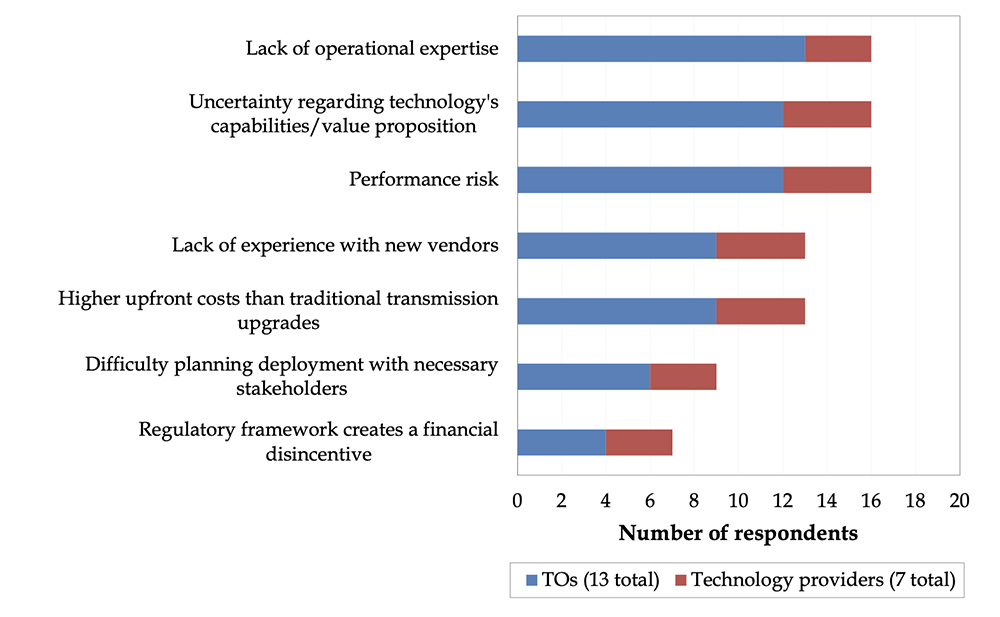
The survey asked what is holding companies back from deploying ATTs. The top answers were a lack of operational expertise, uncertainty about the technology’s capabilities and value proposition, and performance risks. Some firms listed the regulatory framework’s disincentives, but it was the lowest-ranked answer.

What WIRES Group members view as the main obstacles to rolling out ATTs | London Economics International

“Preference for technologies with low uncertainty (and therefore known benefits and costs) is not unique to the electric transmission sector,” the report said. It cited the diffusion of innovations theory by sociologist Everett Rogers, which was focused on the field of communications and posits that widespread adoption of new technologies occurs only as uncertainty decreases.

“LEI observed similar themes throughout interviews with technology providers and TOs,” the report said. “Regulators, system planners and TOs, by the nature of their priorities (where providing reliable electricity service at reasonable cost is paramount), tend to prefer technologies with proven track records over new technologies that are not yet commercially available or widely deployed under various real-world conditions due to uncertainty around performance under unexpected future operational conditions, and also potential ambiguity in future benefits and costs.”

The current regulatory structure in many regions tends to focus on nearer-term planning horizons of five to 10 years, which can lead to incomplete cost-benefit analyses for some ATTs that put more weight on near-term benefits. That is not helped by uncertainty around longer-term projections of benefits, which can make regulators overly cautious about using them, the report said.

Some opponents of transmission investments have argued that utilities are biased against ATTs because their earnings are lower than spending on wholly new infrastructure.

“It is inaccurate and overly simplified to claim that TOs do not benefit financially from ATTs that impact operating costs because of the cost-of-service environment,” the paper said. “In fact, regardless of whether a TO operates under stated rates or transmission formula rates, there is often some regulatory lag inherent in a cost-of-service environment, so TOs can reap some financial benefit from operating cost savings. Furthermore, the financial incentives and business factors that drive investment and operating decisions of TOs are much more complex because of the multiple objectives that TOs need to meet (reliability, policy and overall cost minimization) and constraints they face in their regulatory and business environments.”

Still, aligning financial incentives and implementing regulatory mechanisms that can level the playing field between operating versus capital investment-oriented ATTs, and between ATTs and traditional investments, would make cost impacts more transparent and encourage focusing more on the benefits side of the equation, the report said. That would lead to greater use of the technologies, it argued.

Members Say MISO RA Better off Under Seasonal Capacity Auctions, Sloped Curve

MISO members largely agreed that MISO’s new capacity auction structure — featuring individual seasonal auctions and a sloped demand curve — is better for the health of the system.

MISO’s Advisory Committee said the 2025/26 Planning Resource Auction (PRA) results from April likely show that future auctions would spur more actions to sustain reliability. The Aug. 13 talk via teleconference was part of the committee’s “current issue” series.

Wisconsin Public Service Commissioner Marcus Hawkins said the auction is “paying dividends and supporting reliability in a major way.”

“I think we’re seeing those signals play out to retirement decisions,” Hawkins said.

MISO’s 2025/26 auction cleared at a record-breaking $666.50/MW-day for the summer season as members claimed 1.9% above the 7.9% summer planning reserve margin requirement. The padding in cleared reserves occurred even as MISO experienced a steady decline in spare capacity.

MISO’s 2025/26 surplus was 2.6 GW, a drop of 43% compared to the 4.6-GW surplus of summer 2024 and much lower than summer 2023’s 6.5-GW excess. More than 90% of load was secured before the voluntary auction. (See MISO Summer Capacity Prices Shoot to $666.50 in 2025/26 Auction.)

The 2025/26 auction was the second to feature offers divided by seasons and the first to ditch MISO’s vertical demand curve, which foreclosed the option for additional capacity beyond the reserve margin to hold value.

John Wolfram, representing MISO transmission owners, said the narrowing summertime capacity stores evidenced by the auction should send good signals to members for “firm capacity resource development” and generation retirement delays.

Sharon Segner, senior vice president for competitive transmission developer LS Power, agreed that MISO’s system tightness today means that developers and stakeholders must ensure that “what is planned for the system gets online in time.”

But Sam Lukens, of the Illinois Office of the Attorney General, said the premium put on capacity is due largely to expected large loads from data centers and raises the question of whether consumers should bear the added costs.

Lukens said MISO should consider holding meetings to discuss whether consumers should be shielded from the costs of added demand on the system. He said the cost-causers should pay for the demand they introduce on the system.

“I still think the PRA is a short-term signal,” Lukens said. “There needs to be more discussion about how these large load forecasts are influencing consumers. In Illinois, consumers are really feeling the impact of the PRA.”

Attorney Jim Dauphinais, representing multiple industrial end-use customers, said the auction results and prices “properly” sent “a signal that capacity supplies are diminishing.” However, he said MISO’s preliminary public auction data communicated a significant shortfall, which thankfully didn’t pan out.

“We think the preliminary PRA data needs to be looked at more carefully,” Dauphinais suggested. He said more accurate data would give members better indication on how to prepare.

MISO Could Replace Up to 3 Board Members by Year End

MISO might replace up to three members on its board of directors as they reach term limits at the end of 2025.  

Board members Todd Raba, H.B. “Trip” Doggett and Barbara Krumsiek are to conclude their third and final terms at the end of 2025. Though they’re term-limited, all have expressed interest in serving a maximum fourth term that is allowable through a special waiver of MISO’s rules. (See Extensions Likely for MISO’s Term-limited Board Members.)  

MISO’s Nominating Committee has said it may decide to use the waiver provision for one or two directors to retain members’ expertise and prevent too much board turnover from one year to the next.  

During an Aug. 13 MISO Advisory Committee teleconference, Nominating Committee member Brian Drumm, of ITC, said Chicago-based search firm Russell Reynolds Associates in the spring presented 20 external board candidates. The Nominating Committee first narrowed that slate down to seven external candidates to be considered alongside the three incumbent directors. Drumm said that after interviewing the three incumbents and seven external candidates in July, the Nominating Committee has assembled a slate of two director candidates for each of the three open Board positions. He declined to comment during the meeting on whether the Nominating Committee is recommending any waivers at all.

Drumm said some MISO members have opposed use of the waiver or have said one to two waivers are necessary to avoid excessive board member attrition. Drumm said MISO’s potential use of waivers and names of outside candidates remain confidential. He said stakeholders would learn more during MISO Board Week in mid-September in Detroit.  

MISO Board Chair Raba said in June that MISO’s Nominating Committee had a lot of work ahead of it to make decisions on who might stay to serve a fourth and final three-year term and how many fresh faces could earn a spot on the board.  

The Nominating Committee is charged with vetting and selecting MISO Board of Director candidates, who are put to a vote of membership. The committee’s members change annually, and the committee is composed of three MISO board members and two MISO stakeholders, one of whom typically is from a state public service commission. This year, directors Bob Lurie, Jeff Lemmer and Nancy Lange sit on the Nominating Committee alongside Drumm and Illinois regulator Michael Carrigan.  

Elections for MISO’s Board of Directors are held in the fall, with the Nominating Committee advancing one candidate per open seat. MISO members vote electronically on whether they support the candidate. MISO’s board elections require candidates to earn a majority of votes in support among membership. MISO members can vote for or against or abstain from selecting any of the candidates. The elections require a minimum 25% participation rate among the voting-eligible members of MISO’s 197 members to achieve a quorum. 

Trump Officially Names Rosner, a Democratic Appointee, FERC Chair

President Donald Trump made it official Aug. 13, naming David Rosner as the new chair of FERC several workdays after former Chair Mark Christie resigned. 

“I am honored to serve as chairman and excited to continue working with my colleagues on the commission and FERC’s extraordinary staff to enable reliable, affordable and abundant energy for all Americans,” Rosner said in a statement. “Energy lights our homes, powers our businesses, and we need it more than ever to grow the innovative industries of the future.” 

Trump picking a Democratic nominee to run the agency over a well-qualified Republican, Commissioner Lindsay See, was a surprise. (See FERC Independence Likely Coming to an End with Christie’s Exit.) 

But the position could be interim, as two nominees from the president are awaiting Senate confirmation sometime after that body returns from a summer break. Laura Swett is widely reported to be in line for the chair. Like Rosner before he was elevated to the commission, she is a former FERC staffer — having worked for former Chair Kevin McIntyre and former Commissioner Bernard McNamee. 

Rosner has been a commissioner since June 2024 and brings two decades of experience to the job across energy technologies, market design and energy policy issues. He was an energy industry analyst for FERC and spent two years on detail to the Senate Energy and Natural Resources Committee, where former Sen. Joe Manchin (I-W.Va.) became a big supporter for his nomination as commissioner. 

Before coming to FERC, Rosner was a senior policy adviser for the Department of Energy’s Office of Energy Policy and Systems Analysis and was an associate director at the Bipartisan Policy Center’s energy project. 

Rosner earned master’s degrees in economics and public policy from American University and a bachelor’s in economics from Tufts University. He lives in the D.C. area with his family. 

NERC was quick to congratulate Rosner. 

“Chairman Rosner has been a strong voice supporting abundant and reliable electricity to serve the nation’​s growing energy needs,” the ERO said. “We look forward to continued work with Chairman Rosner on advancing the reliability and security of the electric grid.​” 

Other congratulations came through on social media, with McNamee posting on X that Rosner “will do a great job.” 

WIRES Group Executive Director Larry Gasteiger posted congratulations on X, saying the trade group “looks forward to working with you and your colleagues on getting the energy infrastructure built to meet the nation’s growing needs.” 

Coal power trade group America’s Power welcomed Rosner being named chair with a statement from CEO Michelle Bloodworth. 

“Chairman Rosner is an experienced policymaker with the skills, knowledge and open mindedness necessary to assure that FERC continues its work to improve the reliability of our nation’s electricity grid,” she said.

Meanwhile, the environmental group Friends of the Earth said that “a close review of Rosner’s work reveals a disturbing pattern of dirty energy advocacy.”

“Rosner has promoted the gas and the fossil fuel industry for years and is far too biased to hold this position,” said Raena Garcia, senior climate campaigner at Friends of the Earth. “Democrats who care about the climate should reject him out of hand.”

BPA Supported by Trade Orgs in Suit over Day-ahead Market Decision

Trade organizations for utilities and large energy consumers seek to intervene in the lawsuit filed in the 9th Circuit Court of Appeals challenging the Bonneville Power Administration’s decision to join SPP’s Markets+ instead of CAISO’s Extended Day-Ahead Market (EDAM).

SPP, Public Power Council (PPC), Alliance of Western Energy Consumers (AWEC), Pacific Northwest Generating Cooperative (PNGC) and Northwest Requirements Utilities (NRU) all filed motions to intervene in late July and early August, citing their members’ “interest” in the lawsuit. (See BPA Sued in 9th Circuit over Day-ahead Market Decision.)

PPC represents the Northwest’s extensive network of publicly owned utilities that make up BPA’s base of “preference” customers. The organization has been a strong supporter of BPA’s day-ahead market decision, saying in its motion to intervene that the case could impact BPA’s transmission services and PPC members.

“PPC intervening in the case is an absolute reflection that a strong majority of Northwest public power supports BPA’s decision and the extensive public process they ran to arrive at the Markets+ outcome,” PPC Executive Director Scott Simms said in an email to RTO Insider.

Simms reiterated arguments that supporters of Markets+ have highlighted throughout BPA’s day-ahead market process, such as the market option’s governance approach and “overall design.” (See BPA Selects SPP Markets+ in Draft Policy.)

“As for the significance of the case, it’s interesting to see just how political the day-ahead markets space has become — evidenced by the named plaintiffs in this case,” Simms added.

The dispute stems from a lawsuit filed on July 10 by NW Energy Coalition, Idaho Conservation League, Montana Environmental Information Center, Oregon Citizens’ Utility Board and the Sierra Club.

Represented by Earthjustice, the group asked the court to review and vacate BPA’s day-ahead market decision. They allege BPA did not consider the environmental impacts and failed to properly assess the purported benefits of CAISO’s EDAM.

According to the suit, the agency now risks increasing costs for customers by not joining EDAM, which the group says has a larger market footprint than Markets+. Additionally, the group claims BPA ignored its obligations to prioritize conservation and renewable power.

The suit brings claims under the National Environmental Policy Act, the Pacific Northwest Electric Power Planning and Conservation Act and the Administrative Procedure Act.

“The participation of these intervenors in the case highlights the importance of this decision by Bonneville, which will have a major impact on the cost of electric power in the Pacific Northwest,” Jaimini Parekh, senior attorney with Earthjustice, said in an email. “That is why we have challenged Bonneville’s decision. State agencies in Washington and Oregon found that had Bonneville made a different decision, and joined EDAM, it could have saved ratepayers billions of dollars.”

‘As Disappointing as it is Unsurprising’

More parties could join the case, as the deadline for intervening is early September. Still, those who have filed petitions so far have done so in support of BPA.

For example, SPP said the plaintiffs’ suit challenges the agency’s decision “to pursue participation in SPP’s Markets+ instead of an alternative day-ahead market preferred by petitioners.”

SPP, which is the operator for Markets+, added that it has “significant interest” in the suit, noting that BPA’s participation “will significantly impact the scope and operation of Markets+.”

NRU, whose 58 utility members buy power from BPA on a preferential basis, has similarly supported the agency in its decision-making process and filed a motion to intervene to defend BPA, NRU Executive Director Zabyn Towner told RTO Insider.

“The fact that a few outside interests are taking legal action to try to force BPA to pursue a day-ahead markets policy that is consistent with their own stated goals is as disappointing as it is unsurprising,” Towner said. “NRU takes serious issue with the plaintiffs’ stated grounds for their challenge and joined the case with the intent to zealously defend BPA, its ability to make decisions in the best interests of public power and the resulting decision to pursue participation in SPP’s Markets+ day-ahead market.”

Bill Gaines, executive director of AWEC, also said Markets+ is preferable for the Pacific Northwest region because of the day-ahead market’s design and because of “governance shortcomings in the CAISO EDAM market that the California legislature has been unwilling to remedy.”

Much of the success of EDAM hinges on a bill in the California legislature that would allow CAISO to relinquish market governance to an independent “regional organization” being established by the West-Wide Governance Pathways Initiative. The bill has been delayed after 21 organizations pulled their support following amendments they found concerning. (See Newsom Reiterates Support for Western Regional Market Push.)

Richard Stover, chief legal officer at PNGC, said BPA’s decision “is very important to PNGC as we enter into new long-term contracts with BPA. On behalf of our members, PNGC intervened to protect its long-term interests and that of its members.”

When asked for a response, BPA said it doesn’t comment on active litigation.

Nexamp Complains of Unfair IC Cost Increases by National Grid

Community solar developer Nexamp has filed a complaint against National Grid with the New York Public Service Commission accusing the utility of unfair price increases and violating state interconnection process agreements (25-E-0469).

The Boston-based company contested about $3.6 million in additional interconnection costs for 14 projects that it says is a 52% increase over what it originally was quoted by the utility. It asked the PSC to “scrutinize” National Grid’s interconnection practices and policies, alleging widespread impacts across all developers.

“Nexamp anticipates receiving similarly egregious and improper final reconciliation invoices for 41 additional Nexamp-owned solar projects in various stages of development with National Grid,” it said in its complaint, filed Aug. 7.

The company said the cost increases were driven by National Grid’s reliance on external contractors that caused final labor costs to “more than double” over the original estimates. It also said the utility had an “egregious disregard” for the PSC regulations, setting a 60-day deadline for issuing reconciliation invoices.

The projects range from 2.3 to 5 MW, totaling more than 61 MW of solar capacity, and took about three to five years to develop. Most received permission to operate (PTO) in late 2024.

“The projects were all in National Grid’s queue for multiple years prior to PTO, raising legitimate concerns about National Grid’s inability (or neglect) to manage its queue in a manner that would have avoided (or at the very least mitigated) the need to mobilize external contractors at the scale and expense that National Grid claims here,” the company said.

The company also complained that National Grid was using stale material cost data and potentially double charging for taxes.

Nexamp did not respond to a request for comment. A National Grid spokesperson said they would not comment on a pending regulatory complaint. 

Nexamp calls itself the largest community solar developer in the U.S., operating 1 GW of projects nationwide and 400 MW of solar and storage in New York. The company says it has 250 MW of assets under development.

Advanced Nuclear Fast-track Effort Gets First 11 Projects

The U.S. Department of Energy has chosen 11 advanced nuclear projects as the first tranche of its Nuclear Reactor Pilot Program. 

The program was formed in June, a month after President Donald Trump issued a series of executive orders in an attempt to spur a U.S. nuclear renaissance. One of the orders gave the DOE a direct role in facilitating testing of next-generation nuclear power generation technology. (See Trump Orders Nuclear Regulatory Acceleration, Streamlining.) 

DOE said Aug. 12 that it will work with the 10 companies on their 11 projects with the goal of constructing, operating and achieving criticality with at least three reactors by July 4, 2026, on sites outside national laboratories. 

It is a new pathway toward fast-tracking commercial licensing. Trump directed this streamlining in his executive orders, saying over-regulation was stifling progress and was unnecessary, given the nuclear industry’s safety record.  

Skeptics countered that nuclear energy is safe because it is well-regulated, and worried about the effects of speeding the regulatory process on new reactor designs. 

And there are many, many new designs in various stages of development: The Nuclear Energy Agency in July updated its Small Modular Reactor (SMR) Dashboard, analyzing no fewer than 74 SMR designs in progress worldwide. The greatest number of designers —27 — have their headquarters in the United States. 

DOE alluded to this in its Aug. 12 news release, writing: “The diversity of applications received shows the remarkable breadth of innovation and ingenuity in American reactor developers.” 

DOE chose two designs from Oklo for the pilot program and one each from Aalo, Antares Nuclear, Atomic Alchemy, Deep Fission, Last Energy, Natura Resources, Radiant Industries, Terrestrial Energy and Valar Atomics. 

Participation in the pilot program will give them a fast-tracked approach to future commercial licensing. It also may help unlock private funding. Each company is responsible for all costs for designing, manufacturing, constructing, operating and decommissioning their test reactors. 

When it announced the pilot program June 18, DOE said it builds on existing efforts to demonstrate advanced reactors on DOE sites through microreactor test beds and other projects led by the Department of Defense or private industry. It is not, however, designed to demonstrate suitability of reactors for commercial purposes. 

One of the companies that won designation for the pilot program, Aalo, said in an Aug. 12 news release that a key part of the pilot program is cutting red tape. 

Participating companies will be assigned a DOE concierge team to cut through governmental red tape, so that, for example, a developer would wait just days for a sign-off authorization that previously might have taken weeks or months to secure. 

“This is a pivotal moment for advanced nuclear, and we’re proud to be at the forefront,” CEO Matt Loszak wrote. 

The Roster

The companies chosen for the pilot program show the diversity of the advanced nuclear sector as it scrambles to develop safe, affordable, workable and scalable reactor designs and fuel supply chains: 

    • Aalo is developing a sodium-cooled, uranium-dioxide-fueled experimental reactor that will form the basis of its Aalo Pod, a highly modular 50-MWe reactor targeted at the data center industry. 
    • Antares is developing a kilowatt-scale reactor for special purposes including underwater and outer space use. 
    • Deep Fission proposes to build 15-MWe SMRs one mile underground. 
    • Last Energy is developing a 20-MWe micro modular nuclear power plant; the company was in the news earlier in 2025 with a plan to place 30 of them behind the meter at a Texas data center. 
    • Natura Resources is advancing a liquid-fueled, molten salt-cooled reactor that could have multiple end uses beyond power generation, including desalination and hydrogen or steel production. 
    • Oklo is updating existing technology to design liquid metal-cooled fast reactors. 
    • Atomic Alchemy, which Oklo acquired earlier in 2025, is developing a radioisotope supply chain. 
    • Radiant is pursuing mass-produced microreactors that can be transported via truck like a shipping container; this month it announced an agreement to deliver its 1-MW Kaleidos to the Department of Defense in 2028. 
    • Valar Atomics is building a 100-kW TRISO-fueled high-temperature gas reactor — in the Philippines, because of the regulatory burden that the company says the Nuclear Regulatory Commission would place on the effort if carried out in the U.S. 

Valar was in the news earlier in 2025 when it joined a group of states and startup companies in a lawsuit arguing that the NRC should regulate the existing fleet of gigawatt-scale reactors and leave regulation of SMRs to states, because SMRs’ small size is accompanied by small potential risk. 

“Should our suit succeed, Valar Atomics and our colleagues in this industry will provide abundant energy for all mankind,” wrote CEO Isaiah Taylor, the self-taught engineer who founded Valar. 

Calif. Energy Officials Ponder Interconnection Timelines, Load Uncertainty

California energy officials are recognizing the need to work together to prioritize a long list of transmission and distribution interconnection projects as the state’s load growth accelerates due to expected data center development. 

At an Aug. 11 joint agency workshop, representatives from the California Energy Commission, California Public Utilities Commission, CAISO and other entities discussed how to accelerate interconnection timelines in the Golden State, with conversations focusing on the various types of new load coming online and bringing out-of-state wind power to California’s borders. 

“In a big, complicated state like California … it’s really great to have this platform to do some level setting,” CEC Commissioner Andrew McAllister said at the workshop. 

“I’ve really learned to appreciate the complexity of our roles,” CEC Vice Chair Siva Gunda added. “One of the things we’re dealing with across demand forecasts, whether it’s distribution planning or integrated resource planning, is the uncertainty — the vast uncertainty — in demand, because of electrification, climate impacts and new loads that may come [or] may not come.” 

Gunda asked Neil Millar, CAISO vice president of infrastructure and operations planning, to explain how the ISO is thinking about protecting electricity rates while at the same time future-proofing investments in energy infrastructure and resources. 

“I think the most important part [of this effort] is about the sensitivity work that goes into considering options,” Millar said. “And part of that includes picking options that are always a good first step and not necessarily always … going for the fences with a transmission project.” 

Instead, agencies could focus on picking scalable options because, once a project is a few years down the path, there’s “always a risk that the load growth softens,” Millar said.  

“Then you’re not dependent on some next step in order to achieve the actual benefit of the plan,” Millar said. “Our focus has normally been to try to achieve the required in-service data, monitor the load growth, and make adjustments if necessary, but also to [consider] the sequencing of transmission projects.” 

Load forecasts in California and the West have been escalating, which increases energy resource and transmission requirements in the region, Millar said during his presentation. CAISO is dealing with new types of loads, such as those caused by data centers in particular, he said. 

CAISO’s 2025/26 transmission planning process continues to rely on accessing out-of-state resources, particularly wind, Millar said. These out-of-state wind resources will need more attention over the coming years to bring them to California, he added.  

Millar specifically highlighted 12 major transmission projects — each from CAISO’s transmission plans from 2018 to 2025 — that are under development. However, about 12.9 GW of renewable resources could be delayed due to transmission delays, Brian Biering, counsel for American Clean Power, California (ACP), said in a presentation at the workshop. As of April, the region has about 28.4 GW total of new renewable generation and storage resources with signed interconnection agreements, he said. 

To help solve these delays, ACP recommended energy officials consider requiring an independent transmission construction monitor (ITCM) that would increase the transparency and enhance staff understanding of transmission construction for projects above 1,000 MW. The ITCM should be able to request data directly from transmission owners and report directly to the CPUC and CAISO, Biering said. 

Investor-owned utilities in California have 715 transmission projects under development that have planned in-service dates between 2025 and 2033 and an expected cost of $1 million or greater, said Molly Sterkel, interim director of electricity supply, planning and costs at CPUC. Of those 715 projects, CAISO has approved 140, while 575 are non-approved, Sterkel said. 

California needs 100 GW of new resources by 2040, said Danielle Mills, CAISO principal of infrastructure policy development. The ISO has “more than sufficient resources in the queue to meet those needs,” Mills said. 

“In fact, we still worry sometimes … that we have too many projects in the queue that are lingering, that we need to find some alternative pathway for, either withdrawal or transitioning those resources to some other type of resource,” Mills said.  

DOE Environmental Review of Grain Belt Express Devalues Line’s Carbon-cutting Ability

Drafted during a different presidential administration, the Grain Belt Express’ final environmental impact statement downplays the potential environmental benefits of the line.

The Trump administration’s U.S. Department of Energy Loan Program Office released the final review days after withdrawing a $4.9-billion conditional loan commitment for the 800-mile HVDC line. (See DOE Pulls $4.9B in Funding for Grain Belt Express.) Line owner Invenergy has vowed to move ahead with the project.

While the final impact statement finds the same adverse impacts to soil, vegetation, land, recreation and water and points to mitigation on Invenergy’s part, the completed document also diminishes the emissions that Grain Belt could avoid or reduce from 2.8 to 3.1 million tons to just 175,000 metric tons annually. The 175,000-ton figure is based solely on a 3% percent transmission efficiency improvement that the line, at a capacity of 2,500 MW, would foster through decreased line losses.

The DOE erased a draft finding that an alternative scenario where Grain Belt is not built “would not support” the Biden administration’s circa-2021 target to cut greenhouse gas emissions anywhere from 50-52% from 2005 levels by 2030. The department also excised sections of the more than 440-page report that assumed the line would help new renewable energy projects access the grid, potentially avoiding up to a cumulative 5.15 million tons of greenhouse gases annually while supporting 3 GW of new renewable generation capacity.

Instead, the DOE emphasized that Grain Belt cannot discriminate between coal, natural gas or renewable resources when deciding whose power to transmit. It said it expected the line to carry “diverse power mixes,” including existing baseload and dispatchable energy facilities.

“Following publication of the draft [environmental impact statement] in January 2025, a number of policies were enacted that facilitate the development of baseload and dispatchable energy. It is too soon to foresee the impact that these policies may have on market conditions and demands for certain types of energy in the vicinity of the project,” the DOE said.

The agency deleted a previous finding that there would be a “significant cost barrier for any new or existing coal generation projects to tie into the project” and struck a note that no new natural gas generation projects are planned to be built near the point of injection. It also nixed an explanation that HVDC technology doesn’t “easily allow” for new connections along the line without building intermediate converter stations, “which requires significant modifications to the overall design as well as notable increased costs.”

The DOE edited out a scenario in the draft report where the agency assumed the line wasn’t built because it refused to provide federal financial support to Invenergy.

The department also deleted more than 20 pages on environmental justice considerations, since environmental justice factors now are outside the scope of the environmental review under the National Environmental Policy Act, pursuant to President Donald Trump’s executive orders. It scrapped all mentions of the DOE’s discontinued Climate and Economic Justice Screening Tool that helped track effects on disadvantaged communities.

Grain Belt’s draft environmental impact statement paid special attention as to whether minority and low-income communities would experience about the same construction disruption as wealthier counterparts. The DOE in early 2025 concluded in the draft document that the line wouldn’t disproportionally burden low-income populations.

The DOE eliminated instances of “climate change” from the final report and deleted sentences pondering the potential for more intense weather to affect Grain Belt facilities once built. It also removed references to EPA’s 2022 finding that human-driven greenhouse gas emissions are the “leading cause of the Earth’s rapidly changing climate.”