Aaron Markham, NYISO vice president of operations, presented the 2025-2026 Winter Capacity Assessment and Winter Preparedness forecasts to the Operating Committee on Nov. 13.
The ISO found that 29,893 MW of resources are available to meet a forecasted peak demand of 24,200 MW. The peak last winter was on Jan. 22, 2025, at 23,521 MW. Under more extreme forecast conditions, capacity margins could be as tight as 993 MW, assuming only firm fuel. Roughly 2,100 MW of power is available this winter through emergency operating procedures.
Markham also presented the Operations Report for October. Peak load was 20,278 MW on Oct. 6 around 6 p.m. Wind set an all-time record of 2,389 MW generated on Oct. 31, while solar peaked at 4,502 MW on Oct. 1. Several transmission facilities associated with Smart Path Connect came on service incrementally throughout the month.
The committee passed a motion updating the Reliability Analysis Data Manual to clarify certain sections and include data requirements for recently adopted rules.
Business Issues Committee
The Business Issues Committee on Nov. 12 voted to recommend that the Management Committee approve the Winter Reliability Capacity Enhancements tariff revisions.
The changes would, among other things, split the capacity market into seasons with separate requirements. (See NYISO: Winter Reliability Proposal to Increase Market Efficiency.) The motion passed over opposition from NRG Energy and Hydro-Quebec. The New York Utility Intervention Unit, the New York Energy Research and Development Authority, and Danske Commodities abstained.
Matt Schwall of AlphaGen was elected as the committee’s vice chair.
The corporate incentive goals are structured as penalties to a pooled “incentive payout” awarded at the end of the year. The draft goals for 2026 include maintaining the continuity of the bulk power system in compliance with NERC and NYISO operating procedures; maintaining ERO and state reliability standards; the day-ahead market schedule being posted 100% of the time; and not creating market problems with material adverse impacts greater than $100 million in a calendar year.
NYISO also included a “quality goal” of posting the Gold Book by April 30, 2026, and the Reliability Needs Assessment by Dec. 31, 2026. “Strategic goals” include deploying the software required to incorporate the Champlain Hudson Power Express; updating the ISO’s reliability planning process; and completing the additional system deliverability upgrade studies in time to inform interconnection customers in the transition cluster study and avoid termination of the study.
EDITOR’S NOTE: CAISO’s EDAM will go live in May 2026 for PacifiCorp and in the fall of 2026 for Portland General Electric.The original version of this story incorrectly reported the go live date for PGE.
TEMPE, Ariz. — This is the easy part, says Scott Miller, executive director of the Western Interconnection’s competitive market advocate, Western Power Trading Forum.
Indeed. Members of SPP’s Markets+ Participant Executive Committee unanimously endorsed every proposed tariff and protocol revision, with the occasional abstention here or there, during their Nov. 13 meeting. They agreed — again, unanimously — to retain the stakeholder group’s leadership for additional two-year terms during the day-ahead market’s implementation phase.
Nary was a discouraging word heard.
“We’re getting to the nub of things, but people are understanding them and digesting them,” Miller told RTO Insider after the meeting. “They’re getting used to the process, and this is obviously a lot of detail that people were dealing with. It still is a collegial group. It’s come a long way since it first started two years ago.”
Miller has seen these conversations and debates before. He said he saw firsthand the difficulties CAISO ran into as it drafted and filed its implementation tariff for its Extended Day-Ahead Market.
“There will obviously be harder issues as they get closer to the go-live date,” he said. “When you start getting into implementing tariffs and things like that, that’s where difficulties and disagreements and things pop up that people didn’t realize were there. I think we’ll find some things that will surprise us when the implementation tariffs for Markets+ get filed.”
Miller speaks from experience: He helped lead PJM’s market development in the early 2000s and later spent nine years at FERC advising commissioners and staff on electric and natural gas markets.
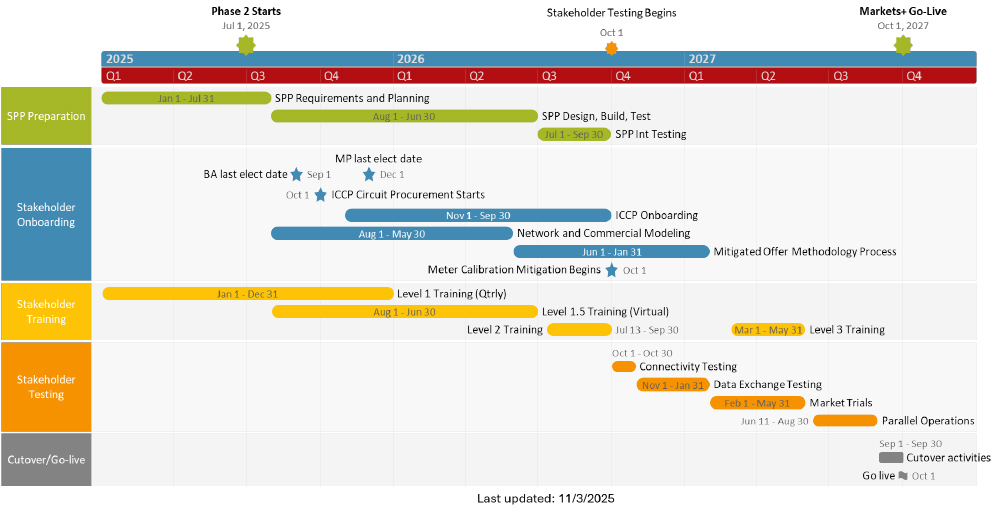
He said he’s not concerned about Markets+’ sometimes-languid pace of development. With a targeted go-live date of Oct. 1, 2027, SPP already is at least 16 months behind CAISO’s EDAM. That market is to go live in May 2026 for PacifiCorp and in the fall for Portland General Electric, with others following in later months.
“It’s a considered pace,” Miller said, noting that Western entities have never dealt with tariffs and organized markets until recently.
“The differences between market participants will begin to show themselves once you get into actual market operations, but for now, everybody’s pulling on the same oar,” he said. “People are taking things very seriously. Protocols associated with tariffs require a lot of attention.”
One complication is that SPP and CAISO are both relying on the West’s 37 existing balancing authorities, rather than a consolidating BA as grid operators normally do. Transmission operations will remain with their control areas, and SPP will clear units, but the BAs will still be responsible for dispatch.
“For reasons that still escape me, you’re taking a step toward something like an RTO but making it very complex by the fact that you maintain balancing areas and tariffs that don’t exist in RTOs,” Miller said. “It’s a step toward an RTO, but it’s much more complex than an RTO.”
MPEC members were unable to agree on whether to hire an external market design adviser and tabled the issue a second time. It will remain tabled until “interested parties” submit a proposal with specific issues for the committee’s consideration.
An SPP survey of MPEC’s 41 members found only minimal support, 17-16, to engage an external consultant or adviser during the market implementation’s early stages, given its “new design approach.” Those voting against the proposal said they saw little benefit for the expense.
Western Resource Advocates (WRA) proposed the position in 2023, and SPP began working on a plan and structure for the adviser in early 2024 before it was tabled the first time later that year. Staff have suggested the position report to SPP.
WRA saw the position as possibly filling a market monitoring role, but SPP in September brought on Tim Vigil to lead the 16-person Markets+ Market Monitoring Unit that will identify market design flaws and ensure compliance with market rules. Vigil was previously chief member relations and strategy officer for the Pacific Northwest Generating Cooperative and also spent time with the Western Area Power Administration. (See SPP Names Director to Lead Markets+ Monitoring.)
Vigil stressed the MMU’s independence in introducing himself to the MPEC.
“The independence allows us to be objective [and] impartial while we’re monitoring the market, investigating potential problems and protecting the market to ensure workable competition,” he said. “It just puts us in a place to accomplish these things without any undue influence.
“The MMU is committed to be transparent … with FERC, SPP and all the stakeholders that are sitting here today,” Vigil added. “Our obligation is to inform FERC of any proposed tariff changes with something that we identify that we’d like to see. We’re not trying to surprise anybody.”
The Markets+ MMU will be separate from the SPP MMU. The Western monitor will increase the MMU’s total staff from 23 to 38.
Readiness Activities Progressing
Kevin Morelock, an SPP Markets+ program manager, said stakeholders’ decision to run the market in the Pacific Time Zone has created issues as the grid operator tries to save on infrastructure costs.
The RTO’s Integrated Marketplace in the Eastern Interconnection uses the Central Time Zone for its operating day procedures.
“It’s causing some complexity with our design and being able to operate both in a CT time zone for the RTO and Integrated Marketplace and then PT for Markets+,” he said, citing the challenge of modeling both markets at the same time and the boundaries between monthly releases.
Still, Morelock said the program implementation’s design phase is on track. Staff have refined the timeline, work plan and operating time zone effects to downstream SPP systems, and an internal strike team has been assembled to mitigate issues and risks.
Chief among the risks are staffing and registration delays, Morelock said. The grid operator had hired 42 of 47 full-time-equivalent employees through September. It expects hiring to pick up in January and eventually reach a target of 206 FTEs in June 2027.
The RTO has completed 52 of 60 market registrations for BAs and non-BA transmission providers. Entities desiring to register as market participants face a Dec. 1 deadline, but Morelock said staff may adjust the schedule to ensure it doesn’t miss embedded entities or transmission customers of the BAs or transmission providers.
The Markets+ Phase 2 schedule | SPP
“We’re really continuing to ask MPs to come forward and declare their interest in joining Markets+ for those entities that are transmission customers or embedded entities,” he told MPEC.
The program is operating under its budget through September, Morelock said, and is on pace to meet its forecast $149.7 million total. That includes almost $10 million in financing charges.
The Markets+ Design Working Group is leading a holistic review of the protocols — including checking for alignment with the Markets+ tariff, improving readability and adding late changes — working with stakeholders first. The group plans to bring the finished product to a Dec. 18 MPEC conference call for its approval.
MSC to Gear up Involvement
Idaho Public Utilities Commissioner John R. Hammond Jr. stood in for Arizona Corporation Commission Vice Chair Nick Myers, chair of the Markets+ State Committee, and told MPEC members that state commissioners will participate in and monitor the stakeholder groups as the market’s development phase moves forward.
Much of the MSC’s focus will be on the tariff’s development, implementation effort, revision request process, seams issues and interchange transactions, he said.
Hammond, the MSC’s vice chair, said the increasing load growth across all states has been “truly amazing.”
“There are commonalities between all the jurisdictions, and there are differences,” he said. “Working together, we can really make a big difference for this country.”
The Western Interstate Energy Board’s (WIEB) staff, which provide independent staffing for the MSC and offer analysis on the market’s development and operations, told MPEC the committee’s 2026 budget will increase when it aligns with the standard fiscal cycle.
Lisa Brohaugh, WIEB’s director of finance and administration, said the MSC’s budget will grow to $437,923, up 12.4% from the 2025 budget of $389,680, which covered just nine months. Brohaugh noted that the previous budget of contractual expenses covered the last nine months of 2025.
The Interim Markets+ Independent Panel, composed of three SPP independent directors, will consider the budget when it next meets. SPP will then allocate the budget’s costs to Markets+ participants.
Trolese, Walter to Again Lead MPEC
MPEC members accepted staff’s nominations of The Energy Agency’s Laura Trolese and Arizona Public Service’s Kent Walter to serve additional two-year terms as the committee’s chair and vice chair, respectively.
“Their leadership has been excellent so far,” SPP’s Kelli Schermerhorn said.
The MPEC will also retain the leadership of its four key working groups after the incumbent chairs were all nominated for additional terms: Nick Detmer (Markets+ Design WG) and Joe Taylor (Markets+ Transmission WG), both with Xcel Energy subsidiary Public Service Company of Colorado; Tuuli Hakala (Markets+ Seam WG), Chelan County Public Utility District; and Libby Kirby (Markets+ Operations & Reliability WG), Bonneville Power Administration.
MPEC’s approval of the consent agenda added Chelan PUD’s Peter Graf to a vacant public power seat on the MORWG; Tri-State Generation and Transmission Association’s Kyle Cunningham to an open public power seat on the MSWG; and Black Hills Energy’s Raena Orr to an available investor-owned utility seat on the MDWG.
The consent agenda also included a scope change for the MORWG, clarifying its responsibility to provide guidance on reliability functions and not just balancing authorities.
SPP Schedules Seams Symposium
SPP has scheduled a Western Seams Symposium for Feb. 26 that follows the MPEC’s next in-person meeting.
The final details are still being worked out, but staff have invited representatives from other grid operators as part of a broader regional discussion of the boundaries between entities.
SPP has touted its seams management experience with its MISO and ERCOT neighbors as preparing it for Western operations, where the markets have been placed on top of the seams between BAs and transmission providers. (See SPP’s Experience with Seams Could Help Markets+.)
The symposium will be held at the Salt River Project’s PERA Training & Conference Center in Tempe. In-person registration closes Feb. 19.
On Oct. 23, U.S. Secretary of Energy Chris Wright orderedFERC to initiate a new rulemaking proceeding in order to “ensure efficient, timely and non-discriminatory load interconnections” for large loads exceeding 20 MW.
In his letter to FERC, Wright observed that, “Historically, the commission has not exerted jurisdiction over load interconnections.” However, Wright added, “It is my view that the interconnection of large loads directly to the interstate transmission system to access the transmission system and the electricity transmitted over it falls squarely within the commission’s jurisdiction.”
Wright then ordered FERC to consider a proposed rule, with action to occur no later than April 30, 2026, and attached an Advance Notice of Proposed Rulemaking (ANOPR) entitled, “Ensuring the Timely and Orderly Interconnection of Large Loads.”
The ANOPR suggested numerous changes to the status quo that would accelerate future interconnections, cut study times and reduce associated interconnection costs. Among other aspects, the proposed DOE approach would enable customers to file joint, co-located load and generation interconnection requests directly to FERC.
An Argument for Arrogating This Power to the Feds
This initiative constitutes an entirely new approach to load interconnections, which historically have been regulated by individual states. In asserting an expanded legal ambit for FERC in this arena, the ANOPR makes several arguments:
Large load interconnections constitute a “critical component of open access transmission service.” They are similar in nature to generator interconnections and thus need “minimum terms and conditions to ensure non-discriminatory transmission service.”
FERC already oversees wholesale electricity rates and owns the mandate to ensure that wholesale rates are just and reasonable. This mandate should be extended to large loads and data centers.
FERC also exercises jurisdiction over transmission in interstate commerce. Since large loads generally interconnect directly to high-voltage transmission, they should be regulated by FERC.
States’ regulatory authority is not affected or limited, since the ANOPR does not affect retail sales or the siting of power plants.
Proposed issues addressed include the speed of interconnection studies, treatment of hybrids (large loads with on-site generation) and net power flows at or near the same point of interconnection, and the flexibility of operations and capability of being curtailable.
The ANOPR also suggests that load and hybrid facilities should be treated similarly to assets in supply interconnection queues — paying standardized deposits for studies, risking penalties for withdrawals from the queue, and being subject to readiness requirements.
The States Push Back
Not surprisingly, state regulators quickly made their concerns known. In its Nov. 11 meeting, the National Association of Regulatory Utility Commissioners (NARUC) adopted a resolution urging FERC “to preserve and affirm states’ retail regulatory authority under the Federal Power Act, ensure that large load interconnections do not compromise grid reliability or impose undue costs on retail customers, and respect state tools for promoting system flexibility and equitable cost allocation.” (See Regulators Urge FERC to Honor State Authority over Large Load Interconnections and State Regulators Ponder Federal Role in Large Load Interconnections.)
Among topics NARUC raised were a fear that FERC might assert its authority over retail end-use sales, a concern that large infrastructure investments to serve loads might unduly burden other ratepayers, and the recognition that “at least 20 states have approved or have pending large load tariffs or similar measures, which may include financial commitments, curtailment protocols and minimum contract terms to allow for the rapid interconnection of large loads without compromising grid reliability or unduly burdening existing retail customers.”
In other words, they already were addressing the problem.
‘Bright Line’ Separating Powers Has Been Fading in Recent Years
State regulators raise some valid points, especially concerning the affirmation of regulatory responsibilities that were clarified by the 1935 passage of the Federal Power Act. That law gave federal regulators authority over interstate electricity commerce, created the Federal Power Commission (the precursor to today’s FERC) and established a “bright line” separating regulatory powers of state and federal authorities.
However, if recent history is any guide, NARUC may not have much success in opposing or even influencing this new DOE effort, as recent FERC orders and related legal decisions have succeeded in greatly blurring the formerly bright line, with state regulatory oversight increasingly diminished as a consequence.
That dynamic began with the restructuring of power markets in numerous states during the 1990s, with FERC Order 888 (1996) that established open access to transmission while introducing the concept of ISOs, and Order 2000 (1999) that created larger regional transmission operators.
FERC Order 719 (2008), in addressing demand response, further helped fray the strength of state regulators, requiring grid operators to accept demand response bids into wholesale markets, though 719 did not establish a framework for compensation. This order signaled an explicit federal regulatory reach across the bulk power into the state-regulated distribution system for the first time.
That incursion was further strengthened by FERC Order 745 (2011), which directed that “demand response resource must be compensated for the service it provides to the energy market at the market price for energy.” This was the first time that assets in the distribution system were incorporated into federal oversight, but states had the critical right to opt out, thus maintaining an important regulatory prerogative.
FERC Order 841 (2018), focusing on energy storage, went a step beyond that initial movement into the states’ realm. It specifically addressed storage resources behind the meter in the utility distribution system. Most critically, it did not allow individual states to opt out. Unsurprisingly, Order 841 did not sit well with state regulators, who saw this as an overreach into their jurisdiction.
NARUC filed suit in an attempt to overturn Order 841 but eventually lost in the D.C. Circuit of the U.S. Court of Appeals. That appellate court ruling indicated that since the activity of these storage assets affected wholesale markets, FERC authority should prevail.
FERC Order 2222 (2020) went a step further down this path, allowing all types of customer-sited assets to be aggregated and to participate in wholesale markets. In this instance, NARUC, the Edison Electric Institute and other parties sought a rehearing but were denied.
What’s Next
Comments on the ANOPR are due Nov. 21, and there certainly will be many provided, as the size of the prize at stake is enormous: interconnection requests in the many hundreds of gigawatts (even excluding Texas with its more than 200 GW of interconnection not subject to FERC oversight), capital expenditures worth hundreds of billions of dollars and outsized potential effects on ratepayers.
With two newly minted appointees and a new chair, FERC will have its work cut out for it. The current fragmented approach of interconnection management has quickly become an unruly Tower of Babel. Demand forecasting is imprecise and inconsistent, and one can point to inflationary pressures (estimated in the billions of dollars in PJM alone) that already have resulted from this lack of precision.
Today, each utility and grid operator is developing its own processes and procedures, in the face of loads that are simply unprecedented in scale, and few — if any — approaches are consistent with one another.
State regulators’ toes may be stepped on once again, and the regulatory bright line further blurred. But given the size of what is at stake, that pain may prove to be necessary, bringing some standardization, clarity and consistency to the very complex and interwoven system-of-systems that is our U.S. power grid.
Around the Corner columnist Peter Kelly-Detwiler of NorthBridge Energy Partners is an industry expert in the complex interaction between power markets and evolving technologies on both sides of the meter.
For every $1 billion in transmission investments that is delayed, consumers lose between $150 million and $370 million in net benefits per year of delay, according to a study by Grid Strategies released Nov. 12.
“That’s a pretty impactful amount when it comes to this debate around affordability, and it speaks for the need to get more transmission built faster in order to lessen the impact on consumers,” WIRES Executive Director Larry Gasteiger said in an interview Nov. 14. WIRES commissioned the study.
The losses come from lower reliability, diminished access to lower-cost generation and the lack of efficiency from new transmission lines, the report says.
Grid Strategies analyzed eight regional transmission portfolios from ERCOT, MISO, NYISO and SPP. It extracted total reliability and economic benefits identified in each portfolio and converted them to annualized benefits and calculated annualized costs from the transmission planners’ assumptions.
Transmission projects face delays from factors including siting and permitting and other regulatory delays, Gasteiger said.
“There are supply chain issues that have developed, particularly over the last five to six years, where it just takes longer to get the items needed in order to build transmission,” Gasteiger said. “There’s been a lot of regulatory uncertainty, frankly, around transmission, in terms of what the rate of return is going to be, what the incentives are for transmission, and there’s no question that that ultimately impacts the timing on getting transmission built.”
When transmission owners do not know what the regulatory framework is going to be, that causes risks, which in turn leads to delays, he added.
A little regulatory uncertainty is baked into the system, and the industry is facing some as FERC undergoes a leadership shuffle now.
“We’re waiting to see how this new commission handles issues around affordability,” Gasteiger said. “And I think one of the factors that has to come into play is that building out more transmission can have some serious positive impacts associated with consumers, such as gaining access to cheaper, more affordable power sources, generation sources, better reliability and things of that nature.”
New Chair Laura Swett has participated in a cost allocation order already, denying a complaint from the Kentucky Public Service Commission and allowing American Electric Power’s tariff to spread the costs of supplemental projects in PJM across all its utilities in the market. (See FERC Rejects Kentucky Complaint Against AEP’s Tx Cost Allocation.)
One major issue the new commission will have to deal with is Order 1920 implementation, as the regions file their compliance filings with the planning and cost allocation reforms passed by FERC during the previous administration.
“It’s going to be interesting to see whether the commission affords a lot of flexibility in the regions, or do they want to try and use a much more standardized approach?” Gasteiger said. “I don’t know. I can’t predict where they will come out on that, but in a way, you almost have the feeling like that some of the issues that were dealt with in 1920 have been eclipsed to some extent, by focus on things like the ANOPR that just came out from DOE.”
The Advance Notice of Proposed Rulemaking asks FERC to assert jurisdiction over the interconnection of large loads, which are driving significant demand growth, often in regions that had seen effectively no real growth for decades.
“With load growth, the more customers you have signing on to the system, the more you can spread the costs out among those customers, so that winds up having the ability to kind of reduce costs generally, because you have more people paying for it,” Gasteiger said. “There are a lot of issues around getting access to cheaper power for all of those resources. And the administration’s made clear it is focused on the effort to help integrate AI and data centers, and the only way you’re really going to be able to do that is to have more transmission built as well.”
The report spends time discussing load growth, which it says has led to a growing consensus around the need for new large-scale transmission investment. FERC’s 2024 State of the Markets Report said that 1,000 miles of new lines were placed into service over the last year because of higher demand, an amount second only to projects aimed at reliability, it noted.
That trend is going to continue based on projects in the works, as NERC summarized in its 2024 Long-Term Reliability Assessment.
“The 2024 LRTA reports there are 28,275 miles of transmission (>100 kV) planned or under construction through 2034,” according to the Grid Strategies report. “This estimate is almost 10,000 miles higher than the 2023 LTRA 10-year projections and is well above the average of 18,900 miles over the past five years of NERC’s LTRA reporting.”
MISO said all four recommendations in the Independent Market Monitor’s 2024 State of the Market Report likely are viable. The quartet of recommendations from IMM David Patton involve transmission congestion, the Midwest-South transmission link, market-to-market coordination and price settlements after grid devastation.
At a Nov. 13 Market Subcommittee meeting, Director of Market Design Zhaoxia Xie said MISO is working on the pricing recommendation and has made plans to address the other three.
Xie said MISO agrees with the Monitor that it should improve its criteria for pricing when an extreme event forces portions of the grid offline.
Patton recommended that MISO tweak portions of its “forced-off asset” declaration, namely its constraint management and dead bus criteria, to trigger the settlement style.
MISO’s forced-off asset event declaration sets real-time prices equal to day-ahead prices for offline facilities. MISO created the new settlement practice in 2024 for generators physically disconnected from the grid during extensive transmission outages triggered by extreme events. It’s designed to prevent generation from excessive penalties or undeserved windfalls. (See FERC OKs MISO Settlement Rules for Widespread Tx Outages.)
Patton said even though 2024’s Hurricane Beryl forced transmission offline that disconnected most loads in the Southeast Texas Load Pocket, the storm failed to qualify as a forced-off asset event.
Patton said MISO defines its revenue inadequacy criteria too narrowly to have activated the pricing. Patton said to address the issue, MISO should add price volatility make-whole payment criteria to the revenue inadequacy criteria when making the call on forced-off asset declarations.
Xie said MISO would include price volatility make-whole payment criteria in the financial criteria for declaring a forced-off asset event. The change would require only a minor tariff edit, she said.
Squeezing More out of Midwest-South Constraint
Xie said MISO agrees it should look into more effectively using its Midwest-South transfer constraint. However, she said MISO needs to first evaluate the issue and the effects of rolling out the IMM’s suggestion.
Patton proposed that MISO maximize its Midwest-to-South transmission limit by being less circumspect with the space it reserves for unforeseen flows.
MISO actively derates its Midwest-South transfer constraint to keep flows in either direction below the contractual limit. It also reserves space for unmodeled flows over the constraint that can violate the limit.
Patton said MISO’s cautiousness has caused the transfer’s use to be just 84% of what’s contractually allowed. He said MISO should work in extra, lower-value steps to the transmission limit’s demand curve and raise its energy-plus-short-term reserve limit to the highest-penalty step on the transfer to use the transmission more. Patton said a more detailed curve and relaxed limits could increase the path’s use when the value of transfers is high.
M2M Improvements
Xie said “efforts are underway” to review MISO’s and its neighbors’ criteria for assigning and managing market-to-market flows.
Patton advised MISO to stop accepting SPP’s requests that constraints be designated for market-to-market coordination unless MISO is sure it can help ease the constraint.
Xie said MISO could suggest revisions or create new rules for when monitoring roles change on a flowgate or to better define effective control conditions. Xie said MISO would engage SPP especially on potential changes.
“This is a part of our continual coordination with our neighbors to manage transfers through market-to-market flowgates as well as requests for relief,” Xie said.
Patton said MISO in some cases has accepted an M2M designation for flowgates from SPP even when it cannot deliver economic respite. He was among the first to alert stakeholders that MISO could offer little relief for a MISO-SPP flowgate in North Dakota strained by a new cryptocurrency mining facility. The situation in 2023 spurred complaints from the MISO side and a FERC refusal to refund about $40 million in congestion costs. (See FERC Again Declines Changes, Refunds on Crypto-burdened MISO-SPP Flowgate.)
Seasonal or Monthly FTR Auctions
Finally, MISO said it would consider the IMM’s proposal that MISO shift most of its transmission capability to seasonal and monthly financial transmission rights auctions and auction revenue rights.
Patton has said the move would lead to more participation and liquidity in near-term auctions; reduce the risk of overselling; and improve price convergence, where FTR prices better reflect actual system conditions and values of the congestion hedges.
The IMM has said buyers often overpay for counterflow in seasonal and monthly FTR auctions with low participation, and incremental capacity is underpriced. He also has said low participation in FTR auctions by holders of ARRs suggests sluggish competition. Compounding matters, Patton said transmission owners report outages to MISO too late, which can lead to the overselling of FTRs.
“MISO agrees there’s some value to moving to seasonal auctions from annual auctions and even monthly auctions,” Xie said. She added that more frequent auctions would have more accurate modeling assumptions and more up-to-date outage information.
Xie said the IMM’s counsel would be considered under MISO’s larger work to improve its ARR/FTR Market.
MISO has become increasingly concerned over its congestion-hedging market’s underfunding in recent years. It has said there’s a growing discrepancy between awarded ARRs and the footprint’s actual congestion patterns. As a result, load-serving entities hold a historically smaller share of FTRs, and the ARRs’ congestion value has fallen. (See MISO FTR Underfunding Hits $60M in Spring, Improvements Coming in 2025.)
The RTO is in the exploration phase of solutions but said it wants to bolster FTR market performance and participation, improve model accuracy, ensure funding and better link the day-ahead market to the FTR market.
Below is a summary of the agenda items scheduled to be brought to a vote at the PJM Markets and Reliability Committee and Members Committee meetings Nov. 20. Each item is listed by agenda number, description and projected time of discussion, followed by a summary of the issue and links to prior coverage in RTO Insider.
RTO Insider will be covering the discussions and votes. See next week’s newsletter for a full report.
Markets and Reliability Committee
Consent Agenda (9:05-9:10)
As part of its consent agenda, the committee will be asked to:
B. endorse proposed revisions to Manual 3: Transmission Operations drafted through the document’s periodic review. The changes aim to clarify the load drop rating requirement for Bulk Electric System facilities.
C. endorse proposed revisions to Manual 39: Nuclear Plant Interface Coordination proposed as part of the document’s periodic review. The language seeks to align with NERC’s NUC-001: Nuclear Plant Interface Coordination standard.
D. endorse and approve revisions to PJM’s tariff, Reliability Assurance Agreement and Operating Agreement as proposed by the Governing Document Enhancement & Clarification Subcommittee. The changes reflect those to the tariff approved by FERC and remove outdated language. (See “1st Read on GDECS Tariff Revisions,” PJM MRC/MC Briefs: Oct. 23, 2025.)
Endorsements (9:10-9:40)
1. Load Management and PRD Event Performance (9:10-9:40)
PJM’s Pete Langbein will present a problem statement and issue charge for stakeholders to consider how load management and price-responsive demand performance can be improved.
Members Committee
Consent Agenda (11:05-11:10)
As part of its consent agenda, the committee will be asked to:
B. endorse proposed tariff and OA revisions to revise how wind and solar resources are dispatched in the real-time market clearing engines. (See “Renewable Dispatch Proposal Endorsed,” PJM MRC/MC Briefs: Oct. 23, 2025.)
ISO-NEoutlined its planned approach for accounting for resources’ gas supply limitations in its new capacity accreditation framework at the NEPOOL Markets Committee meeting Nov. 13.
The incorporation of regional gas constraints into the RTO’s accreditation process is an important part of the RTO’s capacity auction reform (CAR) project, as the current accreditation process does not account for these limitations.
Gas resources make up the largest group of generators in the region, accounting for 55% of generation in 2024 and 44% of capacity awards in the most recent forward capacity auction. Changes to the accreditation methodology for gas-only resources could have significant implications for overall capacity prices in the region, capacity revenues available to gas-only resources and incentives for gas generators to sign firm fuel contracts.
Under the CAR accreditation framework, ISO-NE plans to deploy a gas capacity demand curve reflecting “the diminishing reliability impact of non-firm capacity due to the system-wide gas constraint.”
Steven Otto, manager of economic analysis at ISO-NE, said the downward-sloping gas capacity demand curve would be “analogous to the existing export-constrained capacity demand curve design.”
In the winter, when gas resources face limited access to gas, the resources would be compensated at a lower price than other capacity resources, he said.
“In conjunction with the simultaneous clearing of the system-wide demand curve, the intersection of the gas capacity supply and demand curves determines how much non-firm gas-only CSO [capacity supply obligation] will be awarded and how much less that CSO will be paid,” Otto said.
Gas generation backed by firm fuel arrangements would earn the full capacity price paid to all other resources and would decrease the estimated amount of gas available to resources without firm contracts.
This approach differs from the marginal-reliability-impact approach ISO-NE plans to take for other resource limitations.
The RTO’s basic accreditation approach is intended to quantify each resource’s ability to reduce the amount of expected unserved energy during forecasted periods of energy shortfall. Factors such as outage rate, intermittency or fuel storage capabilities would be reflected in the amount of capacity that resources are allowed to sell in the market.
The gas constraint would be calculated separately from the accreditation values assigned to gas resources. ISO-NE plans to use an accreditation methodology similar to that of other non-energy limited thermal resources. Accreditation values would be based largely on resources’ forced outage rates and maximum capabilities, Otto said.
ISO-NE will rely on modeling by the Analysis Group to estimate how much gas is available to all resources. Todd Schatzki, principal at the Analysis Group, presented the firm’s methodology for modeling gas availability.
The consulting firm plans to calculate total pipeline gas availability based on the 50 highest-inflow days since 2021, which marks the last time there was a significant increase in pipeline capacity into the region.
To estimate available supply from LNG terminals, Analysis Group will use an economic model that accounts for weather and temporal variables, which incorporate effects related to the day of the week and time of the year.
Schatzki noted that decisions about LNG releases are dictated by opportunity costs, because LNG terminals typically have a fixed amount of seasonal supply to sell over the course of the winter season.
“Total winter sendout from LNG terminals varies annually based largely on pre-season contractual commitments and to a lesser degree in-season spot cargoes,” he noted, adding that total seasonal LNG procurements affect the amount of gas available from LNG injections on a given day.
While it is difficult to predict total seasonal LNG supply, it is “important to control for annual variation in total LNG sendout,” he said.
To calculate how much of the total LNG and pipeline gas supply is available to generators, Analysis Group will subtract daily non-generator gas demand. It will calculate non-generator gas demand based on a regression model that includes similar weather and temporal variables as are used for the LNG supply calculation.
For ISO-NE resource adequacy analyses, Analysis Group will account for uncertainty in its forecast of total gas supply by calculating the total amount of gas available to generators using 24 simulated load winters. For each winter, the firm will “develop 10 profiles of available gas electric supply representing distribution of uncertainty in estimated available electric supply,” Schatzki said.
Also at the MC meeting, Otto presented ISO-NE’s proposed accreditation framework for energy limited resources, a category that includes oil, jet fuel, kerosene and dual fuel generators.
ISO-NE would determine energy limited status for these resources “seasonally based on their usable fuel inventory levels over the last three seasons,” he said, adding that resources unable to run at their maximum capability for 24 straight hours would be considered limited.
“ISO estimates suggest less than 900 MW of the region’s roughly 12,000 MW of oil, jet fuel, kerosene or dual fuel resources will be considered energy limited in the winter and around 500 MW will be modeled as energy limited in the summer,” he said.
The main accreditation factors for these resources would be maximum capability, forced outage rate and daily energy limit.
Fuel inventory evaluations would be based on an average of the median seasonal inventory levels over the past three years. The RTO plans to allow certain exemptions or special treatment for newly commercial resources or resources that experienced extended forced outages that affected their fuel inventory levels in past winters.
Pennsylvania has withdrawn from the Regional Greenhouse Gas Initiative as part of an overdue budget compromise signed by Gov. Josh Shapiro.
The commonwealth’s participation in the initiative never was established fully, as legal issues delayed implementation. Previous Gov. Tom Wolf signed an executive order putting Pennsylvania on a path to joining RGGI. But the plans were stymied by a lawsuit arguing that legislative approval would be required.
Commonwealth Court Judge Michael Wojcik issued an injunction in 2022, and the case remains before the Supreme Court of Pennsylvania. (See Court Blocks Pennsylvania from Joining RGGI.)
House Minority Leader Jesse Topper (R) criticized RGGI as the most significant issue holding back economic growth.
“Being a part of the Regional Greenhouse Gas Initiative is truly what was keeping energy development out of Pennsylvania, as we were losing jobs to West Virginia and Ohio,” he said in floor comments Nov. 12. “After today, that specter will be gone, and I believe this is a moment we can look to in time that we will say Pennsylvania started to meet its full potential when it came to developing energy.”
Rep. Greg Vitali (D) voted against the budget compromise because of the RGGI rider, saying climate change is one of the most significant long-term threats to the planet. Given the divided legislature, he said climate change bills have little chance of passing.
“RGGI is a tried-and-true program, it is market-based, it has been in effect since 2009. … Since that time, there has been a 46% decline in carbon emissions from the power facilities in those (participating) states and there has been a $9 million investment in clean energy projects for those states,” he said, citing statistics from RGGI. “It’s very disappointing that our governor does not support RGGI, and that is why it is on the chopping block today.”
Environmental groups criticized the agreement. PennFuture called it a “stunning betrayal” of the environment and an initiative that could have brought hundreds of millions of dollars to the state to lower energy bills and promote clean energy.
“Pennsylvania was on the goal line of making meaningful progress toward cleaner air, lower energy costs and reduced pollution,” PennFuture CEO Patrick McDonnell said in a statement. “Instead of finishing the drive, the governor and house Democrats didn’t just fumble the ball, they picked it up and ran it into the opponents’ end zone.”
NRDC Policy Director for Pennsylvania Robert Routh said the state’s participation would have been significant given the scale of its carbon dioxide emissions, which amount to roughly all of the other states participating in RGGI combined. He cited EPA figures finding Pennsylvania fossil fuel generation released just under 78 million tons of carbon dioxide in 2024.
Shapiro proposed an alternative cap-and-trade market limited to the state as part of his Pennsylvania Climate Emissions Reduction Act (PACER) bill. It failed to advance in the 2024 legislative session and was reintroduced in 2025. Given how heavily the language leans on the framework the Pennsylvania Public Utility Commission established for participating in RGGI, Routh said PACER likely would need rewriting to be implemented on its own.
If the state had a binding carbon cap-and-trade price on emissions from power plants, Routh said it would have enabled historic investment opportunities to strengthen local economies and battle climate change effects. He estimated the auction for the third quarter of 2025 would have created as much as $300 million in revenue for the state. The impact could have been even more significant, as data center load growth is expected to accelerate.
“RGGI would have been an incredibly effective tool at both keeping pollution and cost down in the face of anticipated large load growth,” he said.
Advanced Energy United Director of Wholesale Markets Jon Gordon said high capacity prices in PJM likely will spur development in Pennsylvania regardless of its participation in RGGI. The largest barrier for renewables is the amount of time it takes to get through the RTO’s interconnection process.
“As a practical matter, Pennsylvania participation in RGGI has been tied up in court for years, so this shouldn’t have a meaningful impact on project development, particularly given PJM’s high capacity prices, which reflect a significant supply shortfall relative to surging demand for energy,” he told RTO Insider. “With the ‘Lightning Plan,’ Gov. Shapiro has proposed legislation that would help get these projects built faster by speeding deployment and reducing barriers to clean energy investment. Pennsylvania should seize that opportunity.”
Virginia’s beleaguered participation in RGGI is a mirror image of Pennsylvania’s. It joined the initiative legislatively in 2020 and participated in auctions until 2023, when Gov. Glenn Youngkin (R) sought to withdraw through executive order. In November 2024, a judge found Youngkin’s action unlawful, stating that the authority to withdraw was held by lawmakers. That ruling was frozen temporarily in March 2025 when the administration appealed.
Compromise Includes Review of Utility Load Forecasting
The Pennsylvania budget legislation includes a section granting the Public Utility Commission “the ability to investigate methodologies, data and assumptions used by utilities when developing load forecasts submitted to PJM.”
PJM has encouraged state regulators to take a more proactive role in reviewing utilities’ load forecasts, particularly large load adjustments (LLAs), which often include data center projects not captured in the standard economic modeling. PJM’s Critical Issue Fast Path proposal, one of a dozen to be voted on Nov. 19, would add a review to its load forecast process for state commissions to review LLAs.
Routh said there has been a sharp increase in efforts to address the effect large load growth is having on constituents’ bills, with the accuracy of forecasts central to ensuring consumers don’t pay for transmission and capacity that will go unused. He said the language on reviewing utility forecasts rapidly moved from legislative committees into the budget legislation.
SEATTLE — A new report from the National Association of Regulatory Utility Commissioners offers state regulators an extensive set of recommendations intended to address risks stemming from the ever evolving interdependence of the natural gas and electric sectors in the U.S.
The release of the 40-page paper by NARUC’s Gas-Electric Alignment for Reliability (GEAR) Task Force was a showpiece at the organization’s annual meeting. The report highlights an issue that has dogged the two industries for over a decade: how to get them to better coordinate their actions to maintain grid reliability.
But progress has been halting, as NARUC Executive Director Tony Clark indicated at the start of a Nov. 11 panel discussion at the meeting.
“Ronald Reagan said the closest thing to eternal life on this earth was a government program, but I’m not so sure. For regulatory offices, the closest thing to eternal life is the gas-electric conversation,” Clark said.
The report’s authors, which included state regulators and executives from gas and electric companies, wrote that “the goal of GEAR was to provide a venue for key regulatory and industry stakeholders to discuss and develop solutions to the reliability problems caused by the misalignment of the gas and electric industries.”
They compared “achieving the highest level of reliability” to obtaining an insurance policy.
“It must be planned and purchased ahead of time; you hope you never need it; and if it is not used, it will invariably look expensive,” they wrote. “It is important for regulators and industry experts to help the public understand that those characteristics do not mean the cost to assure reliability are not prudent investments.”
The report draws on source materials and presentations by a wide swath of energy organizations, such as the North American Energy Standards Board, NERC and its regional entities, FERC, RTOs/ISOs, the Electric Power Supply Association and the Interstate Natural Gas Association of America, as well as BP.
The report outlines nine recommendations for state officials:
the creation of a voluntary, ongoing Natural Gas Readiness Forum intended to improve natural gas “value chain reliability via the promotion of communication, peer-to-peer connections, situational awareness and education among its participants.” The task force advised that the American Gas Association lead this effort.
support for federal permitting changes to encourage the construction of new natural gas pipeline infrastructure.
have states and organized power markets examine ways to increase investment in and development of “storage of all types” to support the grid in times of high demand.
encourage regulators to contact their RTOs/ISOs and utilities and review NERC information regarding load shedding practices, and evaluate whether changes are needed given the current electricity consumption landscape.
ensure greater liquidity and transparency in natural gas markets around winter weekends, when trading is limited.
“in lieu of direct winterization regulations for natural gas production,” examine the “need and feasibility of a market-driven process” that allows utilities and generators to recover costs for premiums they pay for improved winter performance.
encourage state regulators and policymakers to support “market-based solutions” to incentivize gas procurement and “provide economic certainty, consistent with recommendations to improve natural gas unit scheduling and dispatch.”
consider development of “robust” demand response programs to shift energy use during periods of high demand or system stress.
support or adopt measures “that facilitate more timely and frequent use of interstate capacity release or asset management arrangements” by utilities.
“The GEAR Task Force expects the alignment of the gas and electric systems to remain an ongoing challenge for NARUC, its members and industry in the years and decades to come,” the report says. “These recommendations should serve as a backdrop and ongoing point of discussion to assist regulatory agencies and their partners in serving the needs of the natural gas system, the electric grid and utility customers.”
‘An Education’
During the Nov. 11 panel, Clark asked GEAR participants what state regulators should take away from the report.
Georgia Public Service Commissioner, GEAR Chair and outgoing NARUC President Tricia Pridemore said her state already allows electric utilities to roll firm gas transportation and storage costs into their rate base.
“It’s just a part of our customer expectations and how we operate,” Pridemore said. “Developing a path within your state to do the same provides liability assurances and insurance that’s not matched, and that is a path that I think regulators, who fully understand the systems more than our friends in the legislature do, should be communicating now.”
Kansas Corporation Commissioner Dwight Keen said he thinks state governments should take a role in ensuring that the gas and electric industries “provide continuity of attention to the nuances, the methods and the means by which we continually re-evaluate and reassess … the kinds of techniques we can use to really enhance reliability going forward.”
Rhode Island Public Utilities Commissioner Ron Gerwatowski expressed regret that the report contained many recommendations his agency doesn’t have the authority to implement, but he appreciated that it provides “an education.”
“There’s a lot of information that’s confirming things, some of which we know already, but other things that are new,” Gerwatowski said, adding that the report gives regulators additional information to bring into federal proceedings or conversations at RTOs, allowing them to “act as advocates to try to move things along” when gas and electric entities come into conflict.
Arizona Corporation Commissioner Lea Marquez Peterson said the effort offered “a clear realization how different every state is. In Arizona, we don’t have natural gas supply; we’re dependent on neighbors and distribution lines that come through our state.” She said developing the report revealed the level of interdependence among states on gas issues.
Michigan Public Service Commissioner Dan Scripps recommended that fellow regulators take time to understand their utilities’ load shed procedures because it’s “way, way too late” once a state is in an emergency.
Scripps advised also that regulators in organized electricity markets work with RTOs “around scheduling and dispatch as well as the incentives for things like out-of-market support for natural gas purchases.”
Iowa Utilities Commissioner Josh Byrnes said the report is “a script” for having conversations with utilities.
“Sometimes I struggle with what can we do as regulators when it comes to some of these topics — like, some of them feel like they’re beyond our scope, [or] sometimes it feels like it’s more federal level, or it’s just like, where do I fit into the conversation?” Byrnes said. “So I feel like this report is going to help me to start those conversations and try to find that purpose moving forward as a regulator in this issue.”
As entities explore alternatives to the Western Resource Adequacy Program (WRAP), a new Brattle Group study examines the impact on planning reserve margins of an RA program encompassing expected participants in CAISO’s Extended Day-Ahead Market.
Brattle prepared the report for the Balancing Authority of Northern California, Idaho Power, the Los Angeles Department of Water and Power, NV Energy, PacifiCorp, Portland General Electric (PGE), Public Service Company of New Mexico (PNM), the Sacramento Municipal Utility District and Seattle City Light.
Those nine entities form a “non-CAISO EDAM” footprint that is the focus of the study. Some of the entities have signed agreements to join EDAM, while others are awaiting regulatory approval to do so or have said they are leaning toward EDAM.
The study simulated winter 2027/28 and summer 2028 planning reserve margins for an RA program covering the non-CAISO EDAM footprint, compared with footprints for WRAP’s Northwest and Southwest subregions.
For summer, Brattle found the PRM was similar among the three footprints, with each falling between 14 and 15%. The authors said summer reliability risks are comparable for the three footprints.
More variability was seen in winter PRMs: from almost 17% for WRAP’s Northwest region to nearly 12% for WRAP’s Southwest region and about 9% for the non-CAISO EDAM region. The authors attributed the non-CAISO EDAM footprint’s lower PRM to higher regional resource diversity.
“The non-CAISO EDAM footprint offers significant resource adequacy benefits, on par with and possibly exceeding the resource adequacy benefit of the current WRAP footprint,” the report authors said.
Planning reserve margin volatility was one concern utilities cited in deciding whether to commit to Western Power Pool’s WRAP or to withdraw from the program.
Many of those that committed to WRAP plan to join SPP’s Markets+, which requires WRAP participation. But there were exceptions: Idaho Power has committed to WRAP despite saying it is leaning toward EDAM.
NV Energy, PGE and PNM are expected to join EDAM; each announced their withdrawal from WRAP. And in October, NV Energy representatives revealed that talks are underway regarding an alternative resource adequacy program. (See EDAM Participants Exploring Potential New Western RA Program.)
Western Power Pool (WPP) wasn’t involved in the study and hasn’t fully reviewed the results, according to WPP Chief Strategy Officer Rebecca Sexton.
“In our initial review, the study seems to support WRAP’s foundational premise that there is significant benefit to customers from participation in a broad, WRAP-wide footprint,” Sexton said in an email.
Sexton noted that participants representing more than 58 GW of Northwest and Southwest load and a broad mix of resource types have committed to WRAP. She said WPP would welcome proposals based on the study’s findings that would enable study sponsors to participate in WRAP.
Brattle modeled loads and resources for the different footprints for winter 2027/28 and summer 2028.
Looking at planning reserve margins on a monthly basis, Brattle found that PRMs for the WRAP footprints were lower than that of the non-CAISO EDAM footprint in June, and were similar or lower in July. But PRM for non-CAISO EDAM was the lowest among the three footprints in August, which along with July is considered a high-risk month.
For the winter months, the non-CAISO EDAM footprint had the lowest PRM among the three footprints in November, December, January, February and March.
The Brattle study used WRAP’s methodology to look at zonal resource adequacy needs and resource capacity accreditations. Brattle also recommended fine-tuning the WRAP methodology by including transmission limits within the footprints, temperature-dependent thermal outage rates, and improved hydro and weather modeling.
Adding these enhancements to the WRAP methodology “would likely reveal additional risks and yield a more complete assessment of regional RA needs,” the report said.