SPP Celebrates Novel Consolidated Planning Process

KANSAS CITY — SPP’s Board of Directors has approved a tariff change establishing an integrated, three-year transmission planning cycle that represents a “watershed” moment and a “first-in-the-country” mechanism, RTO officials said. 

The board endorsed the proposal during its quarterly meeting Aug. 5 following a unanimous advisory vote by the Members Committee. The vote added to previous unanimous endorsements from state regulators, the Markets and Operations Policy Committee and five other stakeholder groups. 

The Consolidated Planning Process (CPP) replaces SPP’s current sequential planning and generator interconnection studies that have resulted in clogged queues and an average of six-year wait times before resources go into service. (See SPP ‘Blazes Trail’ with Consolidated Planning Process.) 

The new process comprises a long-term 20-year study and an annual 10-year assessment, aligning system modeling, planning assumptions and cost allocation across load and generation needs. The CPP-10 includes a GI capability study, a GI decision point and a regional transmission assessment that recommends projects for construction. The CPP-20 establishes a 20-year regional vision. 

The CPP also establishes a general contribution funding mechanism, called GRID-C, for upgrades that serve both load and generation, enabling shared cost responsibilities and fewer restudies. 

SPP says the streamlined framework improves cost certainty for stakeholders and promotes equitable cost sharing. Casey Cathey, the grid operator’s vice president of engineering, said the CPP will lead to faster integration of generation and remove “huge challenges” from the current three-phase study process. 

“If you show up and you pay your GRID-C, you’re committed,” Cathey said. “Within seven months on an annual basis, we’ll get to a [generator interconnection agreement], and you may move forward with your build. This is a critical area for modernizing the grid. This is quite innovative across the nation, if not the entire world. We’re blending generator interconnection processes and transmission planning processes in a very elegant solution for providing cost certainty.” 

Cathey may not be wrong about the “elegant solution.” 

“This will be the only RTO that can really offer upfront cost certainty to interconnection customers, which is so incredible for those in the development of assets,” Pine Gate Renewables’ Brett White said. 

The cost-sharing framework assigns GI costs based on transmission usage, projected accreditation needs, the CPP-20 portfolio and future generation.  

The CPP effort grew out of the Strategic and Creative Re-engineering of Integrated Planning Team (SCRIPT) formed in the last decade to improve SPP’s transmission planning. That led to a task force that continued the work, meeting more than 200 times over three and half years to put together the process. 

Independent Director Steve Wright recalled that the project already was under way when he joined the board in 2023. 

“It is a really big national problem that people new to the industry look at what’s going on here and how long it takes us to figure out interconnections,” he said. “This process is Byzantine and not meeting the moment, because we need electricity. … [The board] was seeing all things going on across the country and saying, ‘What’s going on here is truly creative and can be a national model.’ And here we are at this moment, when it’s actually happened … it’s going to create a model that people can either use or measure against in terms of what are they doing to be able to make this work.” 

Vice Chair Ray Hepper, a Maine resident, said the CPP was a “first-in-the-country” innovation, one that has attracted notice in various corners of the country. 

“I know a lot of people in New England, and they’ll call me and ask, ‘What’s going on?’” he said. “Everybody else is watching. This is a really remarkable feat.” 

EDP Renewables’ David Mindham, apologizing for his “fluffy comments,” added his kudos for CPP. He said it is unlike anything EDP has found in the other RTOs it participates in. 

“It’s very seldom that a process truly comes together, where every interested party sits in a room for years at a time and works through everybody’s issues and … comes to consensus on something. That just doesn’t happen,” Mindham said. “This is probably the first example of a process that I can really think of that was consensus-driven that really balanced stakeholder interests. I think we got an amazing product. I think there could be challenges in implementation. … But if we keep up the same sort of collaboration and atmosphere with that creating this, I think we’ll move through those equally as well.” 
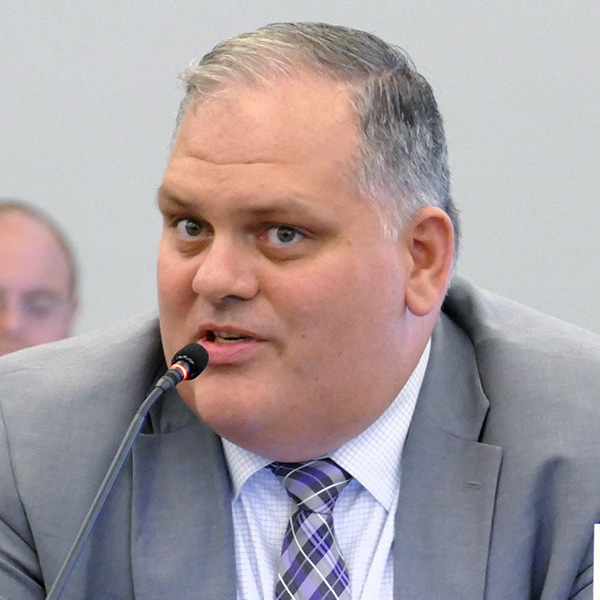
David Mindham, EDP Renewables | © RTO Insider LLC

SPP plans to file the tariff change with FERC by October and will request an effective date of March 1, 2026. Full implementation will begin in 2027, with the first CPP portfolios studied being delivered in 2028. Transitional work will bridge the gap between the CPP framework and the current study process for the 2026 and 2027 assessments. 

“We still have a lot of work to do,” Cathey said. “We have to clean up the backlog. We have to get through and complete the next [study cluster]. We have a lot of individual processes and tools.” 

At the same time, SPP staff are staging internal software to be ready to implement CPP and as part of a recently announced partnership with digital provider Hitachi. The companies have agreed to develop an AI-based solution that the grid operator says will reduce processing times in the GI study process by at least 80%. (See SPP, Hitachi Partner to Use AI in Clearing GI Queue.) 

NRG Energy Secures $216M Loan from TEF

NRG Energy has closed on a $216 million loan from the Texas Energy Fund that will help it build 456 MW of gas-fired capacity at an existing power plant, the company said in a press release.

The funding will go toward the construction of two new natural gas units at NRG’s TH Wharton power plant in the Houston area, the fifth-largest metropolitan area in the U.S. The company said the units will deliver power to the constrained load zone by summer 2026.

“Demand for electricity across Texas is surging and we’re working quickly to supply new dispatchable natural gas generation to the grid,” said Robert Gaudette, president of NRG Business and Wholesale Operations, in an Aug. 4 statement.

The loan is just the second issued by the Public Utility Commission since the fund’s inception in 2024. The first went to the Kerrville Public Utility Board earlier in 2025. (See First Texas Energy Fund Loan Goes to Kerrville Utility.)

The 20-year loan, executed with the Public Utility Commission, will cover up to 60% of the projected $360 million cost, not to exceed $216 million, at a 3% interest rate through July 2045. The project must meet minimum performance standards, as outlined in the program’s rules.

The two units already are under construction.

NRG has two more projects with another 1 GW of capacity that are progressing through the TEF’s due diligence process. The PUC is reviewing 15 other applications for the TEF’s in-ERCOT program, representing an additional 8.4 GW of capacity. The program, designed to add about 10 GW of gas-fired generation to the Texas grid, was approved by voters in 2023.

Two companies recently withdrew their projects from consideration by the fund, which is administered by the PUC.

LS Power said in June that it pulled a 527-MW project out of due diligence “due to numerous factors” and is no longer pursuing funds from the TEF program. In July, Hunt Energy Network told the PUC that it was withdrawing another due-diligence project because it “does not align with the requirements and conditions of the TEF loan in a cost-effective manner.”

Six projects have been withdrawn by applicants or rejected by the PUC in 2025. (See 2 More Projects Fall out of TEF Loan Program.)

Interior Reverses Approval of Lava Ridge Wind Project

The Department of the Interior is moving to cancel the Lava Ridge Wind Project, a gigawatt-scale wind farm proposed on thousands of acres of federal land in Idaho. 

The proposal had long been the target of criticism within the state. President Donald Trump ordered all development halted in a Day One memorandum Jan. 20 so Interior could review the record of decision issued six weeks earlier.  

On Aug. 6, Interior announced the review had uncovered crucial legal deficiencies in the “reckless” and “thoughtless” approval issued under lame-duck President Joe Biden. 

“This decisive action defends the American taxpayer, safeguards our land and averts what would have been one of the largest, most irresponsible wind projects in the nation,” Interior Secretary Doug Burgum said. 

Lava Ridge developer Magic Valley Wind and its corporate parent, LS Power, did not respond to requests for comment for this report. 

Interior’s decision is the latest in a series of directives and policy actions by Trump and his cabinet agencies to thwart renewable energy development, one of Biden’s signature initiatives. (See Feds Pile on More Barriers to Wind and Solar and Trump Administration Takes Another Swing at Wind Power.) 

Trump instead is seeking to maximize fossil fuel use. A reminder of this came later Aug. 6, when Interior announced it had advanced the first expedited coal lease under provisions of the One Big Beautiful Bill Act. A day earlier, Interior announced it had approved the second-largest coal mine expansion since Trump returned to office — a move intended to enable extraction of 33 million tons of coal at a Montana mine. 

Lava Ridge was proposed in 2021 with up to 400 wind turbines disturbing 9,114 acres. During the Bureau of Land Management review process, it was reduced to 231 turbines and 992 acres disturbed, with the overall footprint reduced to 38,535 acres. BLM issued a favorable record of decision Dec. 5, 2024. 

Nameplate capacity was to be at least 1,000 MW, which would nearly double the roughly 1,100 MW of wind power installed statewide in 2024. Idaho’s largest existing wind farm in 2024 was rated at only 160 MW, according to the U.S. Energy Information Administration. 

Residents and elected leaders of the solidly Republican state mounted a vocal campaign against the plan on the grounds that it would be ugly; would be too close to the Minidoka National Historic Site, where civilian Americans of Japanese descent were held during World War II; and would send its electricity to California. 

Idaho’s congressional delegation and governor, Republicans all, had fought the Lava Ridge proposal all the way through to BLM approval and then continued after. On Aug. 6, they took a victory lap. 

“I made a promise to Idahoans that I would not rest until the Lava Ridge Wind Energy Project was terminated,” U.S. Sen. Jim Risch said. “Today, President Trump and I delivered on that promise.” 

On X, Gov. Brad Little praised Trump and Burgum: “On behalf of all Idahoans — thank you for your leadership.” 

BLM said in December it had worked to reduce the impacts of the original proposal on wildlife, cultural resources, local aviation, ranchers who use public land and adjacent private landowners.  

Minidoka, where more than 13,000 Japanese Americans were interned, had become a bit of a rallying point for opponents, as alternate iterations of the Lava Ridge plan would have put turbines much closer than the nine miles in the final version. 

Turbines already spin southeast and southwest of the concentration camp site — most of Idaho’s existing wind energy generation is in the Snake River Valley. 

California Impact?

It is unclear what impact the cancellation of Lava Ridge will have on California’s ambitious plans to reduce its electricity emissions, which include extensively tapping output from wind resources in the inland West. As part of that effort, the California Public Utilities Commission’s (CPUC) integrated resource planning portfolio calls for the state to procure more than 1,000 MW of wind generation from Idaho. 

Unclear also is the effect on another LS Power project, the Southwest Intertie Project-North (SWIP-North), a 285-mile, 500-kV transmission line being developed in northern Nevada by the company’s Great Basin Transmission subsidiary. 

Last year, the CAISO Board of Governors finalized approval of a proposal to include SWIP-North as a CAISO participating transmission owner (PTO) after ISO planners determined the project would be the only line completed in time to help deliver Idaho wind to California’s load-serving entities by 2027. 

While development of SWIP-North has not been tied to any single generation project, most of Lava Ridge’s output was expected to be exported on the southbound segment of the line. In response to past stakeholder concerns about the line’s dependence on Lava Ridge, CAISO pointed out that “CPUC portfolios for out-of-state wind resources in Idaho are based upon generic wind resources and not specific to any one specific facility such as Lava Ridge.” 

Sources have told RTO Insider that the CAISO PTO designation for SWIP-North likely influenced Idaho Power’s leaning in favor of joining the CAISO Extended Day-Ahead Market (EDAM) rather than SPP’s Markets+. But even with the Lava Ridge cancellation, Idaho Power’s interest in SWIP-N would appear to be secure, given that the utility plans to use the line to import power from the Southwest and not for exports. 

“The SWIP-North project is the final segment of the larger SWIP project, which began decades ago. The urgency of completing the project has grown as growing energy demand across the Western United States strains the grid,” Idaho Power said on its website. 

MISO, SPP Still on Hunt for Joint Transmission Under CSP

MISO and SPP appear undaunted in their pursuit of a beneficial interregional project after FERC’s rejection of exemptions to their joint study rules. 

The grid operators announced they still are in search of projects that improve resilience, reliability and transfer capability under their joint Coordinated System Plan (CSP) study process. They also said they are weighing proposing more benefit metrics to FERC to justify projects. 

The RTOs originally set out to perform a different type of CSP this year with more in-depth modeling on a 10-year horizon and a wider variety of benefits they said would have cast a wider net for projects. However, FERC in July denied their requested temporary exemptions. The commission said a limited waiver of requirements was not the best vehicle for changes to the study. (See FERC Denies MISO, SPP Waiver of Joint Study Process.)  

Now the RTOs say they are considering submitting a filing to FERC under Federal Power Act Section 205 to include more types of benefits in business cases for joint projects. They said drawing on more and different benefits is in line with FERC Order 1920, which laid out seven categories of transmission benefits. 

MISO and SPP’s joint operating agreement currently limits them to using only the value of avoided regional projects to measure the reliability and public policy benefits of interregional projects stemming from the CSP. 

The two grid operators have said measuring the reliability value of a project solely on its ability to avoid regional projects constricts their planners from analyzing projects’ usefulness in other areas, like expanded interregional transfer capability or fortification against weather extremes. 

During an interregional planning meeting Aug. 6, SPP Manager of Interregional Strategy and Engagement Clint Savoy said the RTOs would have more details on how the two might expand their benefit definitions under the CSP during the next joint meeting Oct. 24. 

“It’s something that we’re constantly talking about … how to approach changes we want to make to the process itself,” Savoy told MISO and SPP stakeholders. 

The RTOs also said that because FERC rejected the waiver, they will add 15-year-out modeling scenarios to this year’s CSP.

The JOA requires MISO and SPP, when conducting a CSP, to use multiyear modeling, which the RTOs interpret to mean using multiple model years, such as five, 10 or 15 years out. They initially wanted to model several different 2034 scenarios to land on transmission needs instead of studying the system at different points in time. 

MISO Interregional Planning Adviser Ashleigh Moore said 15-year models are in progress and would be complete in October or November. 

Moore said that if transmission needs prove to be “drastically different” with the addition of the 15-year-out modeling, the RTOs might open a second window for stakeholders to propose transmission solutions. MISO and SPP are accepting transmission project ideas for the CSP through Sept. 5 under their first submission window. 

The RTOs still are aiming for a “robust and comprehensive interregional planning process,” she said.  

SPP engineer Spencer Magby said the RTOs will model an extreme temperature scenario that will serve as a sensitivity to the study. However, the modeling would extend only to extremely low winter temperatures, not blistering high summer temperatures. 

Southern Renewable Energy Association Transmission Director Andy Kowalczyk said MISO and SPP probably should model systems stressed by summertime, especially given the springtime instances of load shedding in Louisiana for both RTOs. (See MISO Says Public Communication Needs Work After NOLA Load Shed.) 

MISO and SPP planning engineers said they might consider hot weather modeling additions. 

Missouri Public Service Commission Chief Utility Economist Adam McKinnie asked MISO and SPP to share data on their existing transfer limits so stakeholders can have a better idea of how projects could expand transfer capability. Engineers said they would consider the request. 

MISO and SPP said they would share draft transmission projects in October and prepare to make project recommendations in December. As for cost allocations of the projects, the RTOs plan to hold discussions on a cost-sharing design late in 2025 and over 2026. 

MISO and SPP’s CSP process never has produced a viable interregional project. Their Joint Targeted Interconnection Queue study, on the other hand, has culminated in $1.7 billion in projects to be funded by the interconnecting generation that benefit from the lines. 

MISO and SPP also aim to submit a proposal to FERC in 2026 to institute the smaller, congestion-relieving Targeted Market Efficiency Projects, with a similar process to MISO and PJM’s TMEP studies. 

NEPGA Seeks Relief for ‘Improper’ Pay-for-Performance Costs in ISO-NE

The New England Power Generators Association (NEPGA) is seeking immediate action from FERC to address what it calls “serious flaws” in the design of ISO-NE’s Pay-for-Performance (PFP) mechanism, which the group says caused capacity resources to face $51 million in “improper charges” incurred during a capacity shortfall event June 24. 

In a complaint filed with FERC in late June, NEPGA wrote that resources with capacity supply obligations (CSOs) were required to provide power above their obligations and that capacity resources that performed during the event were charged millions to make up for the under-collection of penalties on resources that failed to perform (EL25-106). 

The association argued that imposing expensive PFP charges on resources that fulfill their capacity supply obligations undermines performance incentives and could dissuade resources from participating in future capacity auctions. 

ISO-NE’s PFP mechanism is intended to incentivize resource performance during capacity shortfall events. Resources that provide more than their CSO receive PFP credits, while resources that receive less than their obligation face PFP charges. Resources that lack CSOs can also receive payments by providing power during shortfall events.  

The system is intended to insulate ratepayers from the direct effects of charges and credits, with the charges for under-performers directly correlating with the payments to over-performers. To prevent resources from facing excessive penalties due to an outage, the PFP mechanism includes stop-loss provisions capping the total cost of penalties a capacity resource can incur each month. 

ISO-NE’s PFP rules have undergone multiple changes in recent years, and on June 1, the RTO increased the PFP rate from $5,455/MWh to $9,337/MW-hour. 

NEPGA wrote in its complaint that the PFP balancing ratio — which sets the portion of each CSO that resources are required to meet in an event — surpassed 1.0 on June 24 due to higher-than-expected load that exceeded the amount of obligated capacity. (See Extreme Heat Triggers Capacity Deficiency in New England.) 

The association noted that the balancing ratio averaged 1.031 over the three-hour emergency period June 24. NEPGA said this rate would have cost a perfectly performing 500-MW resource nearly $500,000 over the three-hour period and estimated the elevated balancing ratio “caused $25 million in improper charges to capacity resources” during the event. 

“Even suppliers that had delivered 100% of their promised supply obligation now faced charges under ISO-NE’s rules and a large number of resources reached their monthly stop-limit,” NEPGA wrote.  

Quoting from the movie “This Is Spinal Tap, NEPGA stressed that “generators cannot give 110%. It is as certain as amplifiers not being capable of ‘one louder’ even if ‘these go to 11.’”

NEPGA also wrote that the RTO’s stop-loss rules led to the significant under-collection of PFP payments, which was charged to capacity resources which had not hit the stop-loss limit.  

“Capacity resources that did not reach their monthly stop-loss limit were charged an additional $26 million to make up the negative net surplus of capacity performance payments,” NEPGA said. It noted the PFP balancing fund also included $9 million in excess revenue caused by reserve shortages, which partly offset the under-collection of charges, reducing the balancing fund’s deficit to $17 million. 

When accounting for the offsetting costs, “the ISO-NE tariff charged capacity resources — including fully performing capacity resources — to recover this $42 million to provide maximum $9,337/MWh bonuses to resources performing above their capacity supply obligation,” the association wrote.  

‘Careful Evaluation’

To address the issue, NEPGA proposed to “cap the balancing ratio at 1.0 and split the bonus pool that gets collected to pay over-performers, with no post-hoc secondary charges imposed on capacity supply obligation holders to make up for any under-collection.” 

NEPGA wrote that these changes would mirror the PFP rules at PJM and noted that FERC in 2015 required PJM to impose a cap on its balancing ratio. 

The proposed changes would “adjust bonus payments to performing resources while still sending very strong financial incentives to perform during emergencies,” NEPGA wrote, adding that the changes would “ensure that the capacity market sends incentives to take on a capacity supply obligation.”  

NEPGA requested that FERC “set an immediate refund effective date” on the date of the complaint, noting that similar issues could occur before the end of the summer.  

In a filed response to NEPGA’s complaint, ISO-NE opposed NEPGA’s request for fast-track processing of the complaint, arguing the association failed to justify the need for immediate action. The RTO wrote that the complaint raises “complex questions” about the design of the PFP mechanism that are not well suited for fast-track processing. 

The RTO did not substantively comment on NEPGA’s proposed remedies, but wrote it is “misleading” to say the issues could be easily and quickly resolved by the proposed changes. 

“PJM’s version of pay-for-performance differs from New England’s version in important ways,” ISO-NE wrote, noting that PJM uses separate PFP rates for payments and charges, while ISO-NE uses a single rate. 

“A single performance payment rate that provides the same marginal incentive to perform is central to [ISO-NE’s] two-settlement, pay-for-performance market design,” ISO-NE wrote. “Transitioning to separate payment rates requires careful evaluation to ensure that it does not produce gaming opportunities.” 

ISO-NE also asked FERC to extend the deadline for responses to the complaint from Aug. 14 to Aug. 21, which the commission granted Aug. 5. The RTO said the extension is necessary to “provide the commission with a clearer indication of the full range of issues that are implicated.” 

Duke Highlights Legislative Wins in Q2 Earnings Call

Duke Energy reported earnings of $1.25/share for the second quarter, and CEO Harry Sideris told analysts Aug. 5 the company also came out ahead with state and federal legislation.

With Republicans in control of both houses, the North Carolina legislature overrode a veto from Gov. Josh Stein (D) on July 29 and made the Power Bill Reduction Act (SB266) law, which cuts the state’s greenhouse gas emission-reduction commitments.

“As we ramp up generation investments to meet accelerating load growth, this legislation allows for annual recovery of financing costs for new baseload generation, supporting our credit profile and minimizing costs to customers,” Sideris said.

Stein’s veto statement argued that the bill would lead to higher costs for customers, as Duke and other load-serving entities have to burn more expensive fuel to generate power in the coming decades.

“Recent independent analysis of Senate Bill 266 shows that this bill could cost North Carolina ratepayers up to $23 billion through 2050 due to higher fuel costs,” Stein said. “This bill not only makes everyone’s utility bills more expensive, but it also shifts the cost of electricity from large industrial users onto the backs of regular people — families will pay more so that industry pays less. Additionally, this bill walks back our state’s commitment to reduce carbon emissions, sending the wrong signal to businesses that want to be a part of our clean energy economy.”

The law eliminates a requirement for Duke and other generators to cut emissions by 70% from 2005 levels by 2030. Sideris highlighted language that authorizes Duke to recover generation investments using construction work in progress (CWIP) adders, meaning it can collect money from ratepayers when plants are being built.

But Sideris said the law will make the state more attractive for growth and help Duke meet the higher demand that comes with new customers, including new data center investment of $10 billion by Amazon Web Services.

“It gives us some credit help with CWIP being able to recover annually,” he added. “But … our plan is still along the same lines as the all-of-the-above [approach] that we filed in the multiple [requests for proposals] that we’ve done. We’ll be … really looking at all resources that can support the growth that we’re seeing in North Carolina, and this bill just helps us manage that but also manage the customer affordability portion.”

On the company’s previous earnings call, Sideris was critical of a draft of the One Big Beautiful Bill Act that would have stripped tax credits for nuclear plants, but that language did not make it into the final law. (See Budget Bills Would End Energy Tax Credits Early, Claw Back Other Funding.)

“On the federal side, the preservation of nuclear production tax credits in the final budget reconciliation bill was a significant win for our customers,” Sideris said. “Only well-run, cost-efficient reactors are eligible to receive the credit. Our 11-GW nuclear fleet is the largest regulated fleet in the nation and earned $500 million of PTCs last year.”

In Ohio, Duke counts the enactment of House Bill 15 as a victory because it eliminates the electric security plans, which had governed utilities there for more than a decade, Sideris said. (See Ohio Governor Signs Utility Law Aimed at Enhancing Competition.)

In Florida, Duke announced a deal with Brookfield Asset Management, which will acquire a 19.7% share of Duke Energy Florida for $6 billion that will support a $4 billion increase in the utility’s five-year capital plan.

Duke is also preparing some regulatory filings that will seek to combine its utilities in the Carolinas, which have maintained some separation since the company bought Progress Energy more than a decade ago. It plans to file requests with FERC and both the North Carolina and South Carolina commissions this month.

In addition to large customers, the Carolinas are seeing demand grow as more people move there, and the company has plans to build 8 GW of new dispatchable supply by 2031 at all of its utilities, including 1 GW of uprates at existing plants and new generators, Sideris said.

“With turbines secured under our framework agreement with GE Vernova and gas supply contracted, we are confident in meeting the in-service timelines we have laid out for these new units,” Sideris said.

While uprates at existing nuclear plants are a firm part of its plan, Sideris said Duke would not commit to building new units until the risks, supply chains and workforces are addressed for both traditional and small modular reactors.

“We’re also going to have to have overrun protection from the federal government or others to be able to protect our customers and our investors from any overruns on these projects,” Sideris said. “And then lastly, we’re going to have to have a means to make sure that we’re protecting the balance sheet as we’re building these facilities. So, until we get those items resolved, we’re still looking at solar, gas, and upgrading and getting everything that we can out of our current assets.”

Google Strikes Demand Response Deals with I&M, TVA

Google has reached agreements with Indiana Michigan Power (I&M) and the Tennessee Valley Authority to reduce power use by its data centers during critical periods. 

The company said Aug. 4 that it has been working to bring demand flexibility to its data center fleet but the new demand response agreements are the first time it is targeting machine-learning workloads to accomplish this. 

In a demonstration project with Omaha Public Power District, Google reduced the power demands of its machine-learning workloads during three grid events in 2024. This set the stage for similar efforts in other regions. 

The rise of data centers, with their 24/7 demand for large amounts of electricity, has left the electricity sector and policymakers excited about the lucrative potential they represent and anxious about the challenge of realizing that potential: There appears not to be enough capacity to meet the highest projections of peak demand and no way to add capacity quickly and inexpensively. 

A Duke University study released earlier in 2025 addressed this quandary by looking at the kind of arrangement Google is announcing with the two utilities: temporary curtailment of load. 

As much as 126 GW of new demand could be handled with existing generation, the authors concluded, if data centers cut their energy use by as little as 1% during peak periods. (See US Grid Has Flexible ‘Headroom’ for Data Center Demand Growth.) 

Google said it is working to develop this ability to reduce or shift power demand during certain hours and certain times of the year. 

Along with the benefits to the grid and to grid operators, DR has the advantage of speeding up the interconnection process and bridging the gap to long-term clean energy solutions, Google said. 

The company said its first such efforts involved shifting non-urgent computing tasks such as processing videos for YouTube, and it sees significant further opportunity through development of DR for machine-learning workloads. This will let it grow artificial intelligence capabilities even in regions where generation and transmission are constrained, it said. 

Google said demand flexibility will be possible only in certain locations in these early stages and faces a finite potential, given the high level of reliability the company needs for some of its services. It expects DR to be part of a portfolio of solutions that includes new generation and transmission. 

Contract Details

I&M submitted the Google contract to the Indiana Utility Regulatory Commission on July 30 (46276). 

It pertains to Google’s new data center in Fort Wayne and is similar to programs currently available to the utility’s residential and commercial/industrial customers, I&M President Steve Baker said in a news release. Google announced the $2 billion Fort Wayne project in April 2024; I&M energized it seven months later. 

“Google’s ability to leverage load flexibility will be a highly valuable tool to meet their future energy needs,” Baker said. 

It would also help I&M. The utility said that if the IURC approves the contract, “this agreement will reduce I&M’s long-term generation requirements and financial commitments to benefit all I&M customers.” 

In its petition to the IURC, I&M said the contract has two key aspects: a clean capacity agreement by which Google will transfer to I&M long-term accredited capacity from clean energy resources that the utility will use to meet a portion of its state retail capacity obligations as part of its PJM fixed resource requirement plan, and “a custom demand response offering” to reduce I&M’s peak load in times of high demand, thereby reducing the utility’s capacity obligation and transmission requirements to serve its customers.  

Because the clean capacity agreement will be used to meet its load obligation for all Indiana customers, I&M proposes to recover associated costs in the same way it recovers capacity-related purchase costs: through its Resource Adequacy Rider. It also proposes to recover through the rider any demand response credits provided to Google. 

Two days after I&M submitted the petition, the Citizens Action Coalition of Indiana petitioned to intervene, citing the potential impact on rates charged to residential customers and services provided to them. 

Home Batteries Provide 535 MW to CAISO Grid on VPP Test Day

An aggregation of more than 100,000 residential batteries provided an average 535 MW of support to California’s electricity grid during a July 29 test to prepare for the hot summer period ahead. 

The sea of home batteries formed a virtual power plant, comprising a group of customer-owned battery storage systems that are typically paired with solar panels. Local utilities, CAISO, the California Energy Commission and other energy companies, such as Sunrun, released charge from the fleet of batteries onto the grid for two hours, from 7 p.m. to 9 p.m. 

The VPP visibly reduced CAISO’s net load during those peak demand hours, said representatives of The Brattle Group, which studied the results of the test. 

“Performance was consistent across the event, without major fluctuations or any attrition,” said Ryan Hledik, a Brattle principal. “Residential batteries — and other sources of distributed flexibility — can serve CAISO’s net peak, reduce the need to invest in new generation capacity, and relieve strain on the system associated with the evening load ramp.” 

Most of the 535 MW would not have been available had the test not been initiated, according to Brattle. 

“On peak days, using VPPs to serve CAISO’s net peak could reduce the need to invest in new generation capacity and/or relieve strain on the system associated with the evening load ramp,” Brattle said, adding that would help address challenges with California’s “duck curve.” 

“Optimized VPP program design and coordination with the system operator could further maximize the value of the battery output to the system,” Brattle noted. 

Pacific Gas and Electric customers made up about 50% of test participants, Southern California Edison about 38%, and San Diego Gas & Electric about 12%. 

Most of the batteries in the test are part of the CEC’s Demand Side Grid Support (DSGS) program, which rewards customers who support the electric grid during extreme events. Rewards include payment for demonstrated capacity at varying monthly rates based on VPP capacity and duration, according to the CEC. 

As of October 2024, the DSGS program had 515 MW of capacity and more than 265,000 participants. The program, which began in 2022, operates from May to October and is intended to help reduce the risk of rotating power outages during peak demand months. In 2024, the DSGS program turned on its VPP system 16 times. 

The test on July 29 was not the first of its kind this summer: On June 24, Sunrun participated in a similar event in which its power resources provided 325 MW to the grid from 7 to 9 p.m, according to Sunrun. Participating Sunrun customers can receive up to $150 per battery per dispatching season, while Sunrun is paid for dispatching the batteries, the company said.

The CEC on Aug. 14 is holding a workshop on the performance of the DSGS program in 2024, specifically on VPP performance. 

PSEG Sees Data Centers Surge amid Rising Demand Forecasts

The Public Service Enterprise Group is waiting for New Jersey to address the region’s predicted energy shortage as the utility sees a dramatic rise in potential demand from data centers, said CEO Ralph LaRossa.

Developer inquiries for large load projects seeking new service connections jumped by 47% between March and June to 9,400 MW, LaRossa said Aug. 5 during the company’s second-quarter earnings conference call.

There’s growing concern in New Jersey and in other states that the PJM region is facing a chronic future energy shortage. Rapid demand growth is happening while aging fossil fuel plants are closing faster than new generators, mostly renewable energy, can open.

“The resource adequacy challenges in New Jersey and across the entire 13-state PJM region are becoming more acute,” LaRossa said. “Recent reports reflect an increasing amount of new large load applications that are quickly eroding existing reserve margins. Within the confines of PJM, it’s hard to see the path to new generation through existing market signals, which may require the consideration of a new approach to procuring capacity and resource planning.”

Underscoring the seriousness of the situation, LaRossa said the utility hit a peak load of 10,229 MW during the three-day heat wave in June, the highest level since 2013. New Jersey, a net importer of power, imported about half its energy during the heat wave, LaRossa said. But while the state in the past could rely on energy imports from other PJM members that generate excess power, such as Pennsylvania, that “convenient option is quickly being absorbed by rapid growth of native load in those states,” he said.

Much of the new demand is for large-load projects, mainly data centers used for artificial intelligence and other projects. LaRossa said about 90% of the 9,400 MW in large load projects — which include mature applications, feasibility studies and initial leads — comes from planned data centers. He said he expects 10 to 20% of the total to be completed eventually.

One of the projects included in the large load figure is a data center that AI cloud computing company CoreWeave plans to build on a 107-acre campus in Kenilworth, N.J., LaRossa said. CoreWeave announced on Aug. 4 it has completed the land purchase.

Capacity Auction Concerns

The earnings call was PSEG’s first since PJM completed its capacity auction and announced on July 22 the outcome price of $329.17/MW-day (UCAP) RTO-wide for delivery year 2026/27. The price would have been $388.57/MW-day without a price cap put in place by PJM in agreement with Pennsylvania Gov. Josh Shapiro (D). He filed suit seeking changes in the system after the auction in 2024 raised prices about tenfold to $269.92/MW-day, the result of load growth, generation deactivations and changes to risk modeling that shrank reserve margins. (See PJM Capacity Prices Hit $329/MW-day Price Cap.)

The dramatic hike in the last capacity auction triggered widespread concern among officials in New Jersey and other states for its impact on ratepayers. The average electricity bill in New Jersey increased by 20% on June 1.

LaRossa said the company anticipates “a near flat impact on customer electric bills” from the recent auction when it is factored into the state’s Basic Generation Service rates that will take effect June 1, 2026.

In the longer term, one measure that would help the state increase its generating capacity is a bill, A5439, that would allow electric public utilities to own and operate electric generation facilities, LaRossa said.

“In New Jersey, policymakers have begun to actively weigh the priorities of economic growth with system reliability and affordability and the state’s environmental policies,” he said.

PSEG is pushing the state to address some key issues, he said: “What are the forecasts they’re looking for? What are the reliability outcomes they’re targeting? What are the affordability targets they have? And then finally, the environmental policy goals. When you put those four pieces together, we think we’ll be able to find the right answer and solution for the state.”

However, he said PJM’s capacity process, especially its governance, needs reform, echoing concerns expressed by other critics of the RTO.

“We’ve been very vocal about that for many years,” he said. “We don’t think that it is attracting additional generation. … The facts are that there has not been any new base load generation built in New Jersey for quite some time.”

“The governance at PJM doesn’t allow for a lot of the things that people are talking about to just be unilaterally implemented,” he said, citing the example that for state governors to get involved in the process, PJM members must give a vote of approval. “This governance process is the core problem.”

Nuclear Advances

LaRossa said PSEG is taking steps to enhance its nuclear power generation, noting that an enhancement project at the Hope Creek Generating Station nuclear facility operated by the company in Salem, N.J., will add 200 MW. He characterized the enhancement, which is expected to go online between 2027 and 2029, as “the size of a small modular creator of incremental, carbon-free, dispatchable power.”

He said the company also will benefit from the recent federal funding bill, which continued the production tax credits for nuclear facilities and extended depreciation rules that will help PSEG’s nuclear fleet.

PSEG’s second-quarter results for 2025 grew from $434 million ($0.87/share) in 2024 to $585 million ($1.17/share). Non-GAAP operating earnings for the quarter were $384 million ($0.77/share) in Q2 2025, compared with $313 million ($0.63/share) in the same period last year.

U.S. Peak Electricity Demand Sets Back-to-back Records

Peak electricity demand in the 48 contiguous states set records twice in the last week of July, reaching 758,053 MW and 759,180 MW over one-hour periods July 28 and 29. 

The U.S. Energy Information Administration announced the developments Aug. 5 and attributed it to a heat wave coming amid the continuing growth of power demand. 

The previous record was 745,020 MW, recorded July 15, 2024. 

There is disagreement about how much and how quickly U.S. electric demand will increase, but there is wide consensus that growth will occur, due to transportation and building electrification, reshoring of manufacturing and rise of energy-intensive artificial intelligence data centers. 

The EIA’s forecast calls for electricity demand to grow by an annual rate of just over 2% in 2025 and 2026. 

This is a marked change from much of the century so far, EIA said, noting that average annual increase in demand was only 0.1% from 2005 to 2020 and just 0.8% between 2020 and 2024. 

The back-to-back demand records at the end of July 2025 came as much of the nation was within a heat dome, subjecting tens of millions of Americans to very high temperatures and causing their air conditioners to consume more electricity. 

Preliminary data from EIA’s Hourly Grid Monitor indicates the new all-time peak, 759,180 MW, was reached about 6 p.m. Eastern time July 29. 

The Grid Monitor indicates that in the 60-minute period: 

    • The highest demand was in the Mid-Atlantic (154,380 MWh), Midwest (129,574 MWh) and Texas (81,572 MWh). 
    • The major energy sources meeting this demand were natural gas (348,891 MWh), coal (133,711 MWh), nuclear (95,287 MWh) and solar (88,389 MWh). 
    • Two other renewables were far behind — hydropower was near its peak output for the day at 39,392 MWh, while wind turbines produced only 25,772 MWh, down 57% from their peak output for the day, reached 16 hours earlier. 
    • The U.S. imported 5,883 MWh from Canada and exported 230 MWh to Mexico. 

Daily demand peaks began to subside after July 29, preliminary data shows, dropping to 631,287 MWh from 6-7 p.m. Aug. 1.  

Over the weekend, the peaks dipped further to 588,925 and 600,233 MWh. They bounced back to 645,449 MWh as the work week began Aug. 4.