Dominion Reports Continued Demand Growth, CVOW 60% Complete

Dominion Energy reported earnings of $760 million for the second quarter as executives reported continued growth in data center developments in its territory and continued progress on its Coastal Virginia Offshore Wind (CVOW) project. 

“We’re continuing to see strong sales in our service areas, driven by continued data center expansion and economic growth,” CFO Steven Ridge told analysts on an Aug. 1 earnings call. “Notably, nine of our top 10 all-time peak days in Virginia have occurred this year, including six in the last six weeks, and our all-time peak in South Carolina was set just a few days ago.” 

Dominion will release its standard disclosures on data centers later in 2025, which will show continued growth in its contract backlog. Interest in new data centers is as robust as the utility has ever seen, Ridge said. 

The CVOW project is 60% complete, is poised to begin delivering electricity to customers in January 2026 and will be completed later in 2026, CEO Robert Blue said on the call. Construction has continued steadily since the first quarter earnings call, despite tariff uncertainty. (See Coastal Virginia Offshore Wind Sees Costs Increase from Trump Tariffs.) 

“It represents the fastest and most economical way to deliver almost 3 GW of electricity to Virginia’s grid to support America’s AI and cyber pre-eminence in the largest data center market in the world, support U.S. shipbuilding including Huntington Ingalls (the largest naval ship building company in the United States and one of our largest customers), and support some of the country’s largest and most important military and defense installations,” Blue said. 

The project has widespread support among political and economic interests in Virginia and has been fully permitted and approved by federal and state agencies, he added. 

As of the call, Dominion had installed 134 out of 176 monopiles and in July set a record for installing 26 in a month. There are just 42 left and three months of the installation season remaining. Most of the monopiles already have been delivered to the staging area for the project in Portsmouth, Va., with two more barge loads of deliveries needed. 

“Commissioning of the first offshore substation, which was installed on March 10, is now complete,” Blue said. “The remaining two offshore substations are 99% and 70% complete, respectively, and on track to be delivered this fall, with installation to be completed by Q1 2026, as planned.” 

Siemens Gamesa is producing turbines for the project with sections for 58 full towers completed and 12 already delivered to Portsmouth. Unlike the monopiles, turbines can be installed at any point during the year, Blue said. 

The Jones Act-compliant vessel, Charybdis, is nearing completion, with a few final tests required before it can start sea trials that will last a couple of weeks. Once those trials are over, it will take 10 days to get to Virginia from Brownsville, Texas.

“We will install our first turbine in September, which is in line with our original schedule,” Blue said. “We had expected the vessel to complete sea trials last month, which would have enabled us to begin turbine installation ahead of schedule. However, the electric cable terminations that connect much of the ship’s internal communication technology simply took longer to complete than expected. That work has now been complete for several days.” 

The vessel is being delivered a little behind schedule, but its completion in the coming weeks will be a major milestone for CVOW, Blue said. 

Tariffs are impacting CVOW, which is being built with imported material from the E.U. and Mexico. 

“We estimate that the total impact of tariffs as they exist today, through project completion at the end of 2026, would be $506 million,” Blue said. “This is slightly lower relative to our disclosure last quarter, despite a doubling of the steel tariff due to both working with vendors to identify cost mitigation strategies as well as completing our analysis of the final trade regulations and appendices.” 

That number could grow as the Trump administration reportedly is considering 5% higher tariffs for both the EU and Mexico, which would raise project costs by an additional $134 million, though Blue cautioned that was just an estimate and tariffs might not go up at all. 
ERCOT Technical Advisory Committee Briefs: July 30, 2025

Real-time Co-optimization Project Sailing Through Market Trials

ERCOT says all systems are go — or more specifically, green — and early market trials have been successful as the Real-time Co-optimization plus Batteries (RTC+B) project barrels to its Dec. 5 go-live date. 

Matt Mereness, RTC+B’s project manager, told the Technical Advisory Committee on July 30 that market trials conducted in May and June were successful. Every resource was able to establish connectivity with ERCOT systems and submit at least one bid, and qualified scheduling entities added 99.5% of about 26,000 telemetry points to the current model. 

“Thank you for helping get everything green,” Mereness said as he shared data from the trials. 

The market trials are continuing in July and August, where the focus is on initial real-time market execution and verifying QSEs’ ability to follow ERCOT frequency signals. In September, the optional day-ahead market begins along with a required live-production test to ensure effective frequency dispatch and control. 

“Not perfect, but hey, this was Week 1,” Mereness said. “This is what we expected. ERCOT wasn’t perfect either.” 

The RTC+B initiative began last decade but was delayed by 2021’s Winter Storm Uri. The program will allow the market to optimize ancillary services and energy simultaneously in real time, with the goals of reducing overall costs and making it easier to dispatch energy resources more efficiently. 

NPRRs to be Categorized

The committee’s leadership has scheduled an Aug. 25 workshop to prioritize existing protocol changes and those still being developed. ERCOT’s Keith Collins, vice president of commercial operations, asked for the workshop to balance delivering RTC on time while also addressing legislative directives from the most recent session and the existing backlog. 

Collins suggested dividing Nodal Protocol revision requests (NPRRs) into tiers, with the top tier classified as those that are critical. Other NPRRs would be designated as “what’s that next batch?” 

“When you have these really complicated processes, whether it’s RTC or maybe it’s [fuel] firming … if we keep kind of piling stuff on, we’re going to end up right back where we are,” Collins said. “What we’ve got to do is solve the current problem, and then we’ll work on the other things.” 

Members discussed whether to hold the workshop annually or quarterly. Collins said the pace of workshops has yet to be determined. 

“We’ve got to manage what’s coming into the reservoir and what’s going out of the reservoir,” he said. “If we do an effective job in an orderly way, we’ll sort of move through the backlog and then the stream just flows normally and we don’t have to worry about this anymore. It’s just the backlog is, as noted, large, and it could be years.” 

Garza, Reid Join TAC

TAC welcomed two new members to its consumer segment: former Independent Market Monitor Beth Garza and Air Liquide’s Mike Reid, who will represent the residential consumer and industrial segments, respectively. Garza replaces Eric Goff, who runs Goff Policy, while Reid replaces LyondellBasell’s Eric Schubert. 

Garza led the IMM for more than five years before leaving the position in 2019. She has been a senior fellow with the R Street Institute since 2020. 

‘Penny’ 0.01-MW Bids

Committee members agreed to place all four NPRRs up for consideration on the combination ballot, which is essentially a consent agenda. The NPRRs were all unopposed at the Protocol Revision Subcommittee, responsible for reviewing and recommending protocol changes. 

Members did discuss NPRR1289, which would provide an option pricing report that would be posted following each congestion revenue rights (CRR) auction. The report would contain shadow prices for all biddable source-sink paths for each month within each time-of-use for the auction period. It also establishes a minimum CRR bid of 1 MW. 

“Today, people can use a 10th of a megawatt for price discovery or as a very small investment. So, that’s No. 1: getting rid of a lot of small noise on the quantities, and that is something that does take a system change,” Mereness said. “People have said one of the reasons for the 10th-of-a-megawatt penny bids is so they know the value of a path, and so this report that we need to develop is a source-sink pairing for all options.” 

“At the end of the day, this is a moving target. I’ve said we’re going to be right back here,” said Seth Cochran, with energy trader Vitol. “We need a total state change with our computational power, or we need to figure out other things that we can do.” 

Members agreed to have the Congestion Management Working Group continue to monitor the issue and discuss implementation details. 

The combination ballot included three other NPRRs, three revisions to the Settlement Metering Operating Guide (SMOGRRs), and single changes to the Retail Market (RMGRR) and Planning (PGRR) guides and to the Verifiable Cost Manual (VCMRR) that, if approved by the Board of Directors, will: 

    • NPRR1277: revise the minimum current exposure and estimate aggregate liability (EAL) formulas, improving the efficacy of existing credit formulas that measure credit exposures in the ERCOT market. The EAL formula revisions include applying the real-time forward adjustment factor against the respective days’ real-time liability estimated (RTLE) and then taking the max over the lookback period; and introducing seasonal variability in the lookback period as it is applied for RTLE. 
    • NPRR1281: strengthen the relationship between the settlement of firm fuel supply service (FFSS) and operations by clarifying its hourly rolling equivalent availability factor language to ensure the accurate calculation of the FFSS standby fee. 
    • NPRR1288: simplify the CRR auction by removing the ability to transact in multiple month strips that create optimization issues for ERCOT. 
    • RMGRR183: incorporate various updates that have been implemented as part of previous project improvements to transmission and/or distribution service providers’ Competitive Retailer Information Portal self-service tool. TDSPs will be able to assign weather moratoriums by county name instead of service territory. 
    • PGRR120: prevent generators from interconnecting to the ERCOT grid if they would be radial to a series capacitor under N-1 conditions. 
    • SMOGRR032: incorporate the Other Binding Document “TDSP Access to EPS Metering Facility Notification Form” to standardize the approval process. 
    • SMOGRR033: incorporate the Other Binding Document “TDSP Cutover Form for EPS Metering Points” to standardize the approval process. 
    • SMOGRR034: remove obsolete gray-box language associated with NPRR1020 (Allow Some Integrated Energy Storage Designs to Calculate Internal Loads). 
    • VCMRR044: set the variable O&M in the mitigated offer cap for hydro generation resources to the real-time systemwide offer cap and the incremental heat rate value to zero. 

Demand Growth Accelerating in the Northeast, Eversource Says

The pace of load growth has picked up across Eversource Energy’s service territories in the Northeast, the company said during its second-quarter earnings call Aug. 1.

CEO Joe Nolan said demand increased by 2% during the quarter, “nearly double the rate observed during the same period last year.”

“As anticipated, electric demand continues to rise, both in the near term and throughout our 10-year forecast horizon,” Nolan said. “In several regions, demand is expected to outpace existing infrastructure capacity, underscoring the critical need for strategic upgrades and new development.”

Nolan said heating and transportation electrification is “further fueling this upward trend” and said the growing demand reinforces the company’s planned investments in grid infrastructure. He highlighted a 10% increase in Eversource’s five-year investment plan, which the company announced in February. (See Eversource to Boost Grid Investments by $1.9B After Exiting Wind, Water.)

Load growth in Eversource’s service territories is reflective of broader trends across the region: After years of relatively flat load because of energy-efficiency programs and behind-the-meter solar, demand in New England has begun to trend upward. ISO-NE experienced its highest peak load since 2013 in June and is forecasting accelerating load growth over the coming years. (See Extreme Heat Triggers Capacity Deficiency in New England.)

Nolan discussed several of the company’s major investments and regulatory proceedings, including investments in advanced metering infrastructure (AMI); a “first-of-its-kind” underground substation in Cambridge, Mass.; construction of an onshore substation for Revolution Wind; and regulatory proceedings in Connecticut and New Hampshire.

He said construction of the AMI communication network in western Massachusetts is “substantially complete” and that Eversource has started construction on its communication network in eastern Massachusetts. He said the company expects the overall deployment of AMI in the state to take about three years.

Construction on the onshore substation for Revolution Wind is “progressing well,” Nolan said, adding that it should be “substantially complete this month.”

He noted that Ørsted said in May that construction on Revolution Wind was about 75% complete. Ørsted said the project should be placed in service in the second half of 2026 and that delays associated with the onshore substation pushed back the overall in-service date for the project. (See Ørsted Remains Committed to U.S. Offshore Wind Projects.)

Nolan also applauded a recent rate case ruling by the New Hampshire Public Utilities Commission, which he called a “constructive decision” that “largely supports our investments on grid modernization, system reliability and necessary infrastructure.”

The PUC authorized an 8.2% distribution rate increase and a $6 hike in the monthly fixed residential customer charge. It also approved a performance-based ratemaking process allowing formula-based increases to rates through 2029.

Nolan praised the “very favorable” regulatory climate in New Hampshire and called the rate case “an example for other jurisdictions.”

But the PUC’s ruling has drawn criticism from New Hampshire Gov. Kelly Ayotte (R) and Consumer Advocate Donald Kreis, who both expressed concern about consumer cost increases stemming from the decision.

“Eversource distribution rates are going up by 24% — well ahead of inflation — at exactly the same time energy charges are also skyrocketing,” Kreis wrote in response to the decision. “What an awful time to be a New Hampshire electric user, especially if your utility is Eversource.”

In Connecticut, where Eversource has frequently butted heads with top utility regulator Marissa Gillett, Nolan said the company continues to have “concerns with certain core components” of the draft decision issued in July in the state Public Utilities Regulatory Authority’s docket on performance-based regulation.

Vistra to Pay $38M to Settle Decade-old MISO Capacity Market Manipulation Case

Vistra has agreed to pay $38 million to wind down a long-running FERC inquiry into whether it manipulated prices in MISO’s 2015/16 capacity auction. 

Vistra, Dynegy at the time of the alleged manipulation, said it’s ready to pay MISO $38 million, which MISO will distribute to net buyers of Zone 4 capacity in downstate Illinois in the 2015/16 auction and to customers of Ameren Illinois that paid the capacity charge resulting from the auction (ER25-3069).  

Vistra settled with complainants Public Citizen, the Illinois Attorney General, Southwestern Electric Cooperative, Illinois Municipal Electric Agency and the Illinois Industrial Energy Consumers. The agreement was struck first at a May 15 in-person settlement conference.  

FERC in 2024 directed hearing and settlement procedures after its Office of Enforcement in 2022 concluded Dynegy took actions to make sure one of its resources set the $150/MW-day clearing price for Southern Illinois to raise profits. (See FERC Staff Finds Dynegy Manipulated 2015 MISO Capacity Auction.) Vistra purchased Dynegy in 2018.  

In 2024, Vistra tried unsuccessfully to get FERC to back down on some of the findings from its staff. (See Dynegy Unsuccessful in Rehearing Requests of 2015 MISO Capacity Auction Manipulation Case.)  

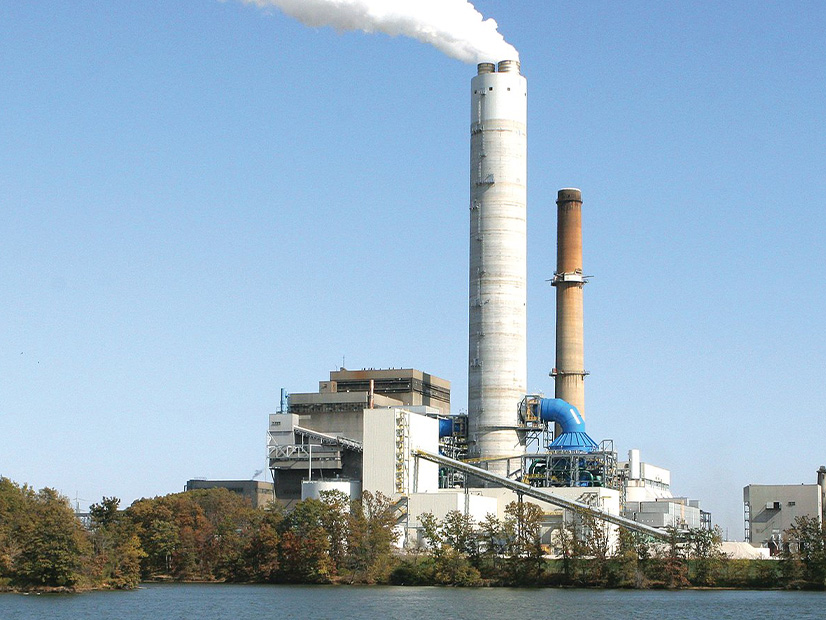
Vistra Energy’s Coffeen Power Station in downstate Illinois retired in 2019 | Vistra Energy

The company asked FERC to issue an order approving the settlement agreement on or before Aug. 29. The settlement amount is not subject to additional interest, considering the 10 years that have passed since MISO held the auction.  

“While this figure was determined on a black-box basis, negotiations among the settling parties concerned issues such as the passage of time since Dynegy’s alleged actions, the time-value of money and the commission’s regulations regarding interest, demonstrating the importance to certain of the settling parties of speedy approval of the settlement and disbursement of the settlement amount,” Vistra said of negotiations in its Aug. 1 filing.  

The settlement is a fraction of the $429 million in refunds the Illinois Office of the Attorney General at one point claimed were due to Illinois ratepayers. 

The settlement would release Vistra from all claims of market manipulation and attempts to exercise market power in the Zone 4 auction for the 2015/16 MISO planning year and settle all challenges relating to the clearing price. Vistra said it likewise would withdraw all its appeals stemming from the lengthy case.  

Vistra continues to deny all allegations concerning Dynegy’s conduct.  

New Report: Battery Storage Pivotal for MISO Savings

A new report shows the MISO footprint could ring up $27 billion in additional system costs through 2050 if it and members miss the boat on developing new gigawatts of battery storage.  

The report, from Austin, Texas-based Aurora Energy Research and commissioned by American Clean Power Association, concluded that without a widespread deployment of battery storage in the Midwest, MISO risks higher costs, less robust reliability and a more drawn-out transition to clean energy. 

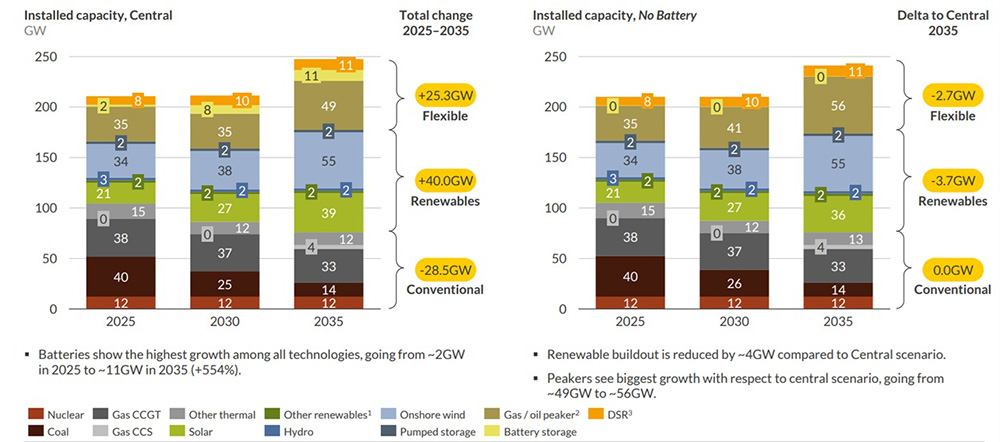
Aurora said an 11-GW deployment of new battery storage in the Midwest and Central U.S. by 2035 could save consumers several billion dollars in energy costs and fortify reliable operations.  

Aurora’s modeling showed that without battery storage, MISO’s peak energy prices would climb $159/MWh higher during the times of highest demand by 2035, leading to an excess of $4.5 billion spent over 10 years. It estimated MISO would rely heavily on gas peaker plants to meet a 130-GW demand by then, adding an additional $493 million in energy prices and raising the average cost of peaker-generated electricity by $1.75/MWh. The report concluded more storage resources could slash evening energy price spikes by more than 60% between now and 2035.  

Aurora used a “no battery” scenario for comparison purposes, where it anticipated that only 250 MW worth of battery storage is online in the footprint by 2027, followed by a standstill in battery development thereafter. The research firm assumed natural gas prices would rise to about the $5/MMBtu mark by 2035. It also assumed the extension of production and investment tax credits and introduction of an investment tax credit for battery storage.  

Aurora said the more than $4.5 billion that batteries could save in energy costs by 2035 could reach more than $25 billion by 2050. It said its long-term modeling showed $27 billion in savings versus the no battery scenario, with savings originating from lowered wholesale prices on peak and smaller system costs through the flexibility that batteries can provide. 

Aurora’s two study scenarios through 2035, comparing an 11-GW battery storage buildout in MISO to a ‘no battery’ case. Batteries are shaded in yellow on the bar charts. | Aurora Energy Research

Without more battery assistance soon, the report projected that MISO’s wind and solar generation could be 8 TWh lower by 2035. Aurora anticipated a spike in the RTO’s ancillary service costs, with regulating reserve prices potentially increasing 179%.  

MISO has nearly 1 GW of storage online and registered and has about 70 GW of battery capacity in its generator interconnection queue. More than 25 GW of proposed battery storage projects lined up to connect to the system in 2024 alone. Historically, only about 20% of generation proposals ever make it to interconnection agreements in MISO.  

The planning scenario that MISO based its nearly $22 billion long-range transmission portfolio on in 2024 assumed 20 GW of new four-hour lithium-ion batteries by 2024.  

“There are hundreds of energy storage projects in the MISO project queue, working through their lengthy interconnection and permitting process. These projects represent billions of dollars in economic investment, thousands of jobs and billions of dollars in energy cost savings,” the American Clean Power Association said, urging policymakers to act now to help deploy projects.  

“As power demand surges, battery storage is one of the fastest and most effective ways to strengthen reliability and lower electricity bills,” Noah Roberts, American Clean Power’s vice president of energy storage, said in a press release. “Grid batteries deliver massive cost savings for families and businesses, while ensuring that the grid delivers power when it’s needed most. With more than $25 billion in energy savings at stake, this is a generational opportunity for the Midwest to secure a more reliable and affordable energy future.” 

At a July 30 MISO stakeholder workshop to discuss reliability, Clean Grid Alliance’s David Sapper said he hoped MISO could “do better in terms of fostering” battery storage.  

Five Republican States File FERC Complaint to Undercut $22B MISO Long-range Tx Plan

Five state public service commissions have banded together to request that FERC order a recasting of MISO’s long-range transmission projects, arguing the projects aren’t as beneficial as MISO has advertised.  

The public service commissions of Arkansas, Louisiana, Mississippi, Montana and North Dakota registered a July 31 complaint. The states, calling themselves the “Concerned Commissions,” said MISO and its Board of Directors violated the MISO tariff when they recommended and approved the second, nearly $22 billion long-range transmission portfolio in late 2024 (EL25-109).  

The five asked FERC to conclude that MISO and its board erred by advancing transmission projects that will cost more than they’re worth, order MISO to reclassify the projects so they’re not regionally cost-shared and direct the RTO to file all future business cases supporting long-range transmission portfolios.  

The state commissions said MISO’s “miscalculation of benefits and a defective business case” convinced its Board of Directors to approve the plan. (See MISO Board Endorses $21.8B Long-range Transmission Plan.) 

The state commissioners argued that MISO’s collection of long-range transmission projects cannot provide benefits “equal to or in excess of forecasted costs” and should thus be reclassified, likely with a different cost allocation method. They said MISO currently has no authority to direct the projects’ construction because the projects don’t meet a required 1:1 benefit-cost ratio. 

The states said other MISO states are free to pay for the projects per the MISO tariff if they need them for decarbonization targets or renewable energy goals.  

MISO estimates the benefit-to-cost ratio of the portfolio to be between 1.8:1 and 3.5:1 over the first 20 service years of the projects, owing to production costs, improved reliability, avoided construction of new capacity and environmental benefits. The grid operator’s planners have emphasized that the benefit values are intentionally conservative. (See $21.8B Long-range Tx Plan Goes to Membership Vote; MISO Resolute, IMM Protesting.) 

However, some states and MISO’s Independent Market Monitor have disputed MISO’s benefit estimates and said they’re overinflated. IMM David Patton appraised the value of the portfolio closer to a 0.3:1 benefit-to-cost ratio and advocated for a condensed portfolio. He repeatedly said the 20-year future MISO relied on to recommend the portfolio of mostly 765-kV lines is impractical and doesn’t represent the resource mix that will be built. (See MISO IMM Makes Closing Arguments Against $21.8B Long-range Tx Plan.)  

MISO and its IMM’s disagreements over the second long-range portfolio culminated in a FERC case itself, where FERC decided that MISO’s Market Monitor was allowed to stray from markets to inspect the value of the RTO’s transmission planning — and get paid for it. (See FERC Sides with Market Monitor over MISO in Compensation Dispute.)  

The five state commissions said MISO ignored its IMM’s guidance while adjusting the benefit metrics it used in its first, $10 billion long-range portfolio in 2022 in an attempt to make the second round of projects look more valuable than it will be.  

Like MISO’s IMM, the states said MISO didn’t give enough thought to the concept that without a backbone network of 765-kV lines, members would build different generating units closer to their load at lower costs compared to the transmission expenses. MISO should not assume that its members would build the same remote generation with or without the portfolio, they said.  

The states also echoed the Monitor’s view that MISO should not have assumed it would have instances of load-shedding at the $3,500-$10,000/MWh value of lost load if it didn’t recommend the lines. They said state officials undoubtedly would take action to mend reliability before it reached that point.  

Finally, the states said it was inappropriate for MISO to use a social cost of carbon to justify transmission investment and said they do not share MISO’s estimation.  

The states argued that if MISO eliminated its overstated benefit estimates of a reliability upsurge and avoided capacity costs and decarbonization, the value of the portfolio would fall to $15.7 billion, far from MISO’s low-end estimate of $51.7 billion. They said with a more realistic view of benefits, the second long-range transmission portfolio would not be able to cover its construction costs.  

The group of states told FERC they are not relying on the $22 billion worth of projects to meet resource adequacy requirements or clean energy goals. Three of the MISO states — Arkansas, Louisiana and Mississippi — are in MISO South and not affected by the second long-range portfolio, whose projects are all in and cost shared among MISO Midwest.  

“These states and their utilities have or are building new generation, either close to load or where existing transmission can provide delivery to load, that is consistent with their integrated resource plans or similar state processes,” the states said, adding that they don’t have use for the additional transfer capability the projects will offer, nor “any interest in subsidizing … costs to advance the clean energy and decarbonization goals of other states in MISO.”  

MISO South Involvement May Presage Cost Allocation Battle

While Arkansas, Louisiana and Mississippi are not included in the cost allocation for the long-range transmission portfolio so far, the complaint could have implications for future long-range transmission projects prescribed for MISO South.  

MISO limited its 100% postage stamp allocation (based on a load ratio share) for the first two long-range transmission portfolios to MISO Midwest, where the projects will be built.  

MISO South won’t be the focus of long-range transmission planning until 2026, when MISO officials said they would begin drawing up early plans. MISO initially pledged to explore the development of a separate cost allocation for the South region, which it says has different priorities, and then insisted that its postage stamp remains the most appropriate mechanism for splitting up transmission costs. (See Clean Energy Orgs Push Entergy Players to Consider Broader Cost Allocation.) 

MISO South regulators appear to be behind a recent push for the Organization of MISO States to take a stab at proposing a new cost allocation for MISO’s long-range projects. If efforts prove unsuccessful, the postage stamp design could become a backstop. (See State Regulators Weigh Drafting Alternative to MISO Tx Cost Allocation.)  

MISO South never has been the site of construction for a regionally cost-shared transmission project. MISO has said it could spend up to $100 billion across its long-range transmission portfolios. To date, it has designated $33 billion only in MISO Midwest. Multiple nonprofits and consumer advocates alongside former FERC Commissioner John Norris have called on MISO to start assembling a long-range plan for MISO South. (See MISO Says Public Communication Needs Work After NOLA Load Shed.)  

At a July 30 MISO stakeholder workshop to discuss reliability, MISO transmission planning lead Laura Rauch said she “would still be very comfortable testifying” to the benefits of the nearly $22 billion long-range transmission plan, even with the rollback of federal incentives for clean energy. 

Newsom Reiterates Support for Western Regional Market Push

California Gov. Gavin Newsom reiterated support for the proposed bill that would allow CAISO to relinquish market governance to an independent “regional organization” (RO), saying during a July 31 press conference that the legislation can reduce electricity costs and improve reliability.

In a LinkedIn post, the California Community Choice Association (CalCCA) said the governor expressed his support for SB 540 during a press conference. The governor’s office confirmed with RTO Insider that Newsom supports the efforts but noted that it “may not be SB 540 itself — could be a different vehicle.”

Newsom commented on regionalization efforts during the press conference, saying “this is a very significant legislative effort that can actually impact the cost of electricity in this state, improve our reliability, mitigate the impacts on our access to supply, particularly during extreme heat events.”

Newsom said the effort is about California’s ability to maintain its authority to set its own “low-carbon green growth goals,” and referenced amendments aimed at limiting the federal government’s ability to intervene in those.

The governor praised the coalition behind the bill, saying it “is really with few precedents. I’m not aware of a more diverse and large coalition I’ve seen on an issue of energy in some time.” Backers of the bill include the state’s labor unions and publicly owned utilities, groups that strongly opposed previous efforts to “regionalize” CAISO, as well as CalCCA.

“I am supportive, directionally, and I look forward to the final product … that lands on my desk subject to final review of any amendments that will be made over the course of the next few weeks,” Newsom said.

Newsom previously signaled his support for efforts to expand California’s involvement in regional electricity markets. When RTO Insider asked the offices of Newsom and Assembly Speaker Robert Rivas (D) about the potential for other strategies that don’t include SB 540, including adding the bill’s provisions to another proposed piece of legislation, both declined to comment.

However, a source in the governor’s office told RTO Insider that the administration will not take the lead on the bill but will defer to the legislature.

SB 540, which passed in the California Senate in June, was set for a first hearing in the Assembly’s Utilities and Energy Committee on July 16 but was delayed until after the legislature’s summer break at the request of the bill’s author, Sen. Josh Becker (D). (See Calif. Pathways Bill Delayed After Orgs Withdraw Support, While Newsom Signals Backing for Effort.)

The delay came after 21 organizations pulled their support for the bill following an amendment that would establish a new Regional Energy Market Oversight Council responsible for ensuring CAISO’s participation in the regional energy market “serves the interests of the state.” The new council would be authorized to mandate withdrawal if those interests are compromised.

The coalition requested lawmakers remove the amendment, stating “the language in this section mandates the withdrawal of California entities from the market without exception or discretion, which is unacceptable.”

SB 540 is a result of the work of the West-Wide Governance Pathways Initiative, an effort to create an independent RO to govern CAISO’s Western Energy Imbalance Market and the soon-to-be-launched Extended Day-Ahead Market (EDAM). The effort aims to assuage concerns that the ISO — whose Board of Governors are appointed by California’s governor — would act primarily in the state’s interest.

Robert Mullin contributed to this story.

N.Y. Makes Case for Extending Nuclear Subsidies to 2049

The New York Department of Public Service proposes the state extend its subsidy program for its commercial nuclear facilities from 2029 to 2049 to help ensure the operators of America’s two oldest reactors seek to relicense them. 

The move was not a surprise: Nuclear generation has less-than-unanimous support in the Democratic-led state, but there is wide recognition that the four operating reactors are a critical part of New York’s effort to reduce carbon emissions and an important part of the energy portfolio. 

The Public Service Commission took steps May 15 to reinvigorate New York’s lagging progress on its clean energy initiatives (Case 15-E-0302), including a neutrally worded directive to the DPS staff to evaluate how a continuation of the nuclear Zero Emission Credit program might be structured. (See N.Y. Moves to Boost Lagging Clean Energy Development.) 

The staff submitted the ZEC report July 31. It recognizes the economic and environmental importance of the existing nuclear fleet and recommends continuing the ZEC program with the same formula methodology and general structure, though with some revisions and potential for early termination, should the parameters on which it’s based change significantly. A public comment period will open for the report. 

From the 2017/18 budget year through 2023/24, $3.69 billion in ratepayer-funded ZECs have been paid to nuclear operators. The program terminates at the end of the 2028/29 budget year; the staff proposal would extend it to 2048/49. 

Constellation Energy’s Ginna, FitzPatrick and Nine Mile 1 and 2 reactors provided 22.2% of the electricity produced in New York in 2023 and nearly half its emissions-free electricity. Comparable fossil-fired generation would emit about 15 million tons of carbon per year. 

The long-running state plan to bring large amounts of emissions-free wind and solar online has been progressing slowly and is facing significant new challenges under the Trump administration. 

Further, these renewables are intermittent and highly variable — particularly solar, which drops to single-digit capacity factors in New York’s cloudy winters. By contrast, the four nuclear reactors have capacity factors in the mid 90% range. 

They also are expensive to operate. Then-owners Entergy and Exelon made plans to shut down FitzPatrick and Ginna in the mid-2010s because they were not economical, and Nine Mile was facing the same pressures, the report notes. This was the impetus for the ZEC program. 

Another issue facing New York’s fleet is its age. The reactors have been in service for an average of 50 years, and Nine Mile Unit 1, which entered commercial service in December 1969, has the distinction of being the nation’s oldest operating reactor. 

Its license, already renewed once, will expire in August 2029, and Constellation has an August 2026 deadline to apply for a second renewal. Ginna’s license expires in September 2029. It is the nation’s second-oldest operating reactor, and the deadline to seek relicensing is September 2026. 

The decision to invest in such facilities or continue their operation typically relies on certainty that the investment will be recouped, whether through public subsidies or private power purchase agreements. The 2049 sunset date in the new ZEC proposal is timed to the potentially extended operating life of Nine Mile 1 and Ginna. 

The authors of the DPS staff proposal concluded by saying: “Staff recognizes the complexity in extending a 20-year forward-looking program that both protects and provides the best value to ratepayers while ensuring the continued operation of necessary zero-emission nuclear resources. Staff believes this proposal effectively balances the interests of ratepayers and ensures the Upstate nuclear facilities pursue a subsequent license renewal.” 

Constellation and New York in January said they are collaborating to seek funding for early permitting for one or more advanced nuclear reactors that would be co-located with Nine Mile. 

In June, Constellation applauded Gov. Kathy Hochul (D) on her announcement that the state would seek to add at least 1 GW of advanced nuclear capacity to the grid. (See N.Y. Pursuing Development of 1-GW Advanced Nuclear Facility.) 

“It is yet another recognition of nuclear energy’s critical role in achieving the nation’s leading clean energy goals,” Constellation said. “We look forward to working with the governor and state leaders to ensure nuclear energy continues to power economic growth and a clean, affordable and reliable energy future for New York.” 

Southern Expects Large Load Growth to Continue

Southern Co. CEO Chris Womack said during the company’s quarterly earnings call July 31 that “the economy in the Southeast” remains well positioned to support continued load growth. 

Net income for the second quarter came to $880 million ($0.80/share), down from $1.2 billion ($1.10/share) in the second quarter of 2024. Year-to-date net income was $2.2 billion ($2.01/share), down from $2.3 billion ($2.13/share) in the same period in 2024. 

Operating revenue for the quarter stood at $7 billion, up from $6.5 billion for the second quarter of 2024; year-to-date operating revenue also grew, from $13.1 billion to $14.7 billion. Operating expenses for the quarter were $5.2 billion, up from $4.5 billion, and year-to-date were $11 billion, up from $9.5 billion. 

CFO Dan Tucker, attending his last earnings call before his retirement, said adjusted earnings per share for the quarter came to 92 cents, 18 cents lower than the same period last year but 7 cents above the company’s estimate. Tucker said, “Increased earnings from investments in our state regulated utilities, along with higher usage and customer growth,” contributed 6 cents year over year compared to 2024. 

Weather-normal retail electricity sales were up 3% “across all customer classes” for the quarter compared to the same period last year, Tucker continued. Residential sales grew 2.8% thanks to both “the addition of over 15,000 new electric customers … and higher overall use per customer.” 

Commercial and industrial sales grew 3.5% and 2.8% respectively, which Tucker attributed to growth in data center usage, which was up 13% from last year. Transportation and primary metals were both up 6% as well, and paper was up 16%. 

Womack mentioned the data center sector as one where expansion is expected to continue in the Southeast, along with the aerospace and automotive industries. In all, he pointed to nearly $2 billion of capital investments announced during the second quarter across Southern’s service areas. 

He also said Southern is working to position itself for this expansion, pointing to an agreement reached in May between Georgia Power and the Georgia Public Service Commission to extend the utility’s 2022 alternate rate plan through 2028. He said this move would preclude the need for a 2025 base rate case filing and keep the “base rate stable and predictable over the next three years … with the exception of any future recovery of storm-related costs.” 

“Overall, this outcome demonstrates our commitment to capturing the benefits of this robust projected economic growth and prioritizing customer affordability,” Womack continued. “We believe this outcome, which preserves the existing regulatory framework in Georgia, benefits all stakeholders. Our vertically integrated market and constructive, orderly regulatory processes continue to help ensure we have the critical resources necessary to reliably and affordably serve our growing states.” 

Tucker’s successor as CFO, David Poroch, also joined the call to discuss the company’s capital investment plan, which earlier in 2025 was announced to total $63 billion over the next four years. (See Strong Southeast Economy Bolstered Southern Co. Growth in 2024.)  

Poroch said the total planned investment has grown to $76 billion, $10 billion of which is associated with planned resource additions of at least 6 GW that Georgia Power filed with the PSC earlier in 2025; $2 billion is attributed to modernization and updates to the existing fleet; and $1 billion for repowering three wind facilities, expected to be completed by the first half of 2027. 

Southern is projecting adjusted earnings per share of $1.50 for the third quarter of 2025, and $4.20 to $4.30 for the full year. 

SPP’s Rew to Retire After 35 Years in Operations

SPP’s longest-tenured employee, Senior Vice President of Operations Bruce Rew, will retire in December after 35 years with the grid operator.

Rew will be replaced by C.J. Brown, who will become vice president of operations on Oct. 1. SPP said the overlapping months will ensure a smooth transition.

“We can’t begin to thank Bruce adequately for his three-plus decades of service to SPP,” COO Antoine Lucas said in a press release. “He’s incredibly valued and well respected across the board for his leadership and dedication. For years, he’s driven successful development of innovative services and projects for our members.”

Rew joined SPP in 1990 after graduating from college and serving in the U.S. Air Force on a nuclear missile launch crew. He was one of the 14 staffers on hand — they are memorialized in a photo displayed inside its Little Rock, Ark., headquarters — when the organization officially became an RTO in 1994.

Bruce Rew | © RTO Insider 

During his time with SPP, Rew helped the Regional State Committee develop a process for allocating transmission costs regionwide, drafted tariff language allowing customers to fund transmission projects, and implemented the grid operator’s first energy management and tariff-billing system.

“I retire with gratitude for the more than 35 years working together with SPP members,” Rew said. “The services SPP provide have changed dramatically over that time, but the power of relationships has remained a constant driving force for our region.”

The position oversees SPP’s regional operations center, from where staff coordinate the operation of the bulk power system across a 14-state region. The operations organization includes engineering, business support and real-time grid operator functions.

Lucas said the SPP “will remain in excellent hands” with Brown, who currently serves as senior director of system operations policy and performance support. The 19-year veteran has managed the RTO’s grid operations through some of the most challenging conditions in the region’s history. He has helped navigate three winter storms since 2021 and summer seasons with historically high temperatures and electricity use.

“It’s a true honor to be selected to step into the VP of operations role and follow Bruce, who has been a pillar at SPP,” Brown said.

He will report to Lucas after having reported to Rew for eight years.