FERC Approves NPCC’s $102K Penalty Against ORU

Consolidated Edison subsidiary Orange and Rockland Utilities (ORU) will pay $102,000 to the Northeast Power Coordinating Council for violations of NERC reliability standards as the result of a settlement approved by FERC. 

NERC submitted the settlement to FERC on June 30 in its monthly spreadsheet Notice of Penalty; it was the only settlement for the month. The commission said in a July 30 filing that it would not further review the settlement, leaving the penalty intact (NP25-12).  

ORU, with its subsidiary Rockland Electric, serves about 300,000 electric customers in New York and New Jersey. Two of the three violations in the settlement involved both companies and covered a period of almost 17 years, from 2007 to 2024. They all stemmed from NERC’s FAC family of facility ratings standards. 

The utility reported to NPCC on Oct. 9, 2020, that it had discovered potential violations of FAC-008-1 (Facility ratings methodology) and FAC-008-3 (Facility ratings), along with FAC-014-2 (Establish and communicate system operating limits). Because ORU and Rockland are in coordinated oversight with each other, the first two issues applied to both companies. 

For the FAC-008-1 violation, ORU said that its facility ratings methodology (FRM) “failed to include consideration for operating limitations, such as a topology change.” ORU conducted an extent-of-condition assessment and found no additional issues; however, when NPCC and ReliabilityFirst later completed a joint self-certification review in March 2023, they found that ORU and Rockland had failed to include several topics in the FRM, including: 

    • using a wind speed assumption that does not match ORU’s existing FRM; 
    • a mismatch of ambient temperatures used to establish normal, long-term emergency and short-term emergency ratings of copper tubular bus sections; 
    • insufficient summer and winter ambient temperature information; and 
    • a mismatch of substation configuration data. 

Regarding the infringement of FAC-008-3, ORU and Rockland determined from an internal compliance review that 17 facilities had ratings that were inconsistent with the FRM: four 345/138-kV transformers and 13 138-kV transmission lines. The changes resulted in derates of up to 40%, though 75% of the derates were less than 13%, and increased ratings of up to 17%. As for the FAC-014-2 violation, ORU reported that the system operating limits of 14 facilities had been incorrectly calculated during 64 breaker outages. 

All of the violations posed a moderate risk, according to NPCC, and no harm is known to have occurred. To mitigate the infringements, ORU and Rockland have updated their main FRM document with language addressing the use of operating limits when calculating facility ratings, provided training to responsible staff on FAC-008 compliance and created a new spreadsheet to organize ratings data.  

The utilities also revised all applicable facility ratings, implemented a new process checklist to be completed prior to energizing grid additions and modifications, and created a requirement for annual validation of all changes to or affecting facilities within the previous 12 months. 

Because ORU and Rockland are in RF’s footprint as well as NPCC’s, the REs will split the penalty payment based on relative net energy for load, with RF receiving $59,177. 
Trump Officials Talk Regulatory Rollbacks at NARUC Meeting

BOSTON — The Trump administration’s proposed rescission of EPA’s 2009 endangerment finding classifying greenhouse gases as pollutants would be the “largest deregulatory action in the history of the country,” EPA Administrator Lee Zeldin said July 30.

Speaking at the Summer Policy Summit of the National Association of Regulatory Utility Commissioners, Zeldin touted the Trump administration’s “energy dominance agenda” and said deregulating the fossil fuel industry will help the U.S. compete with China and serve growing demand from artificial intelligence.

EPA’s endangerment finding is the legal basis of a range of federal regulations targeting climate-warming emissions, and its elimination could have major effects on emission-reduction efforts throughout the country. The agency issued the endangerment finding under the Obama administration after the Supreme Court ruled in 2007 that it has the authority under the Clean Air Act to regulate GHGs. (See related story, EPA Proposes Rescission of Endangerment Finding that Underpins All GHG Rules.)

Zeldin said the Obama administration took a “creative approach” when issuing the endangerment finding and said the finding has been undercut by recent Supreme Court cases, including the elimination of the Chevron doctrine, which gave deference to agencies in their interpretations of laws.

“We’re living in a bit of a different world in 2025 than 2009 because of all the Supreme Court cases,” Zeldin said. “The Supreme Court has made it pretty clear that agencies like the EPA shouldn’t just be filling in any vague language in the statute.”

Deregulating the oil, gas and coal industries will be essential “if you want to make America the AI capital world [and] if you want to unleash energy dominance,” Zeldin said.

He argued that regulatory rollbacks will help the country’s economy and national security, and added that “if you care about our environment, it improves our environment, because in the United States, we tap into our energy supply so much better than so many other countries do.”

In June, the administration proposed to repeal GHG emissions standards for new power plants and Biden-era updates to the Mercury and Air Toxic Standards. (See EPA Proposes Repealing Limits on Power Plant Greenhouse Gas Emissions.)

“We will actually have more deregulation in one year at EPA than the entire federal governments, across all agencies, across entire presidencies, primarily because of the stuff that was done in 2023 and 2024,” Zeldin added.

The Trump administration’s actions to deregulate the fossil fuel industry have drawn strong criticism from climate scientists and activists. Emissions from fossil fuel combustion are one of the core drivers of human-caused climate change.

Other Trump administration officials speaking at the NARUC event also emphasized the importance of bringing new generation and transmission infrastructure online to meet AI demand.

Peter Lake, senior director of power at the National Energy Dominance Council, said the U.S. is facing “an inflection point in the history of industrial technologies,” adding that “we’ve all heard about the amazing things that AI can do — the incredible benefits to health care; technology; communication; picking wine at dinner; … optimizing shopping for my girlfriend.”

Nick Elliot, director of the Grid Deployment Office at the Department of Energy, said the U.S. needs to rapidly scale up the development of gas resources to balance the system as load grows, adding that supply chain backlogs must be addressed to achieve this buildout.

He said DOE’s recent changes to National Environmental Policy Act procedures should help reduce development timelines throughout the U.S.

“We are looking specifically to try and streamline regulation as much as we can, to give developers as much visibility on timelines and process to get things online,” Elliot said.

Deputy Energy Secretary James Danly said market reforms are needed to incentivize new resources to come online at the necessary rate to meet anticipated demand. He noted that the PJM capacity auction clearing at the price cap earlier in the month indicates prices “probably should have been higher” and criticized “subsidy regimes that warp the price signals” and hurt development. (See PJM Capacity Prices Hit $329/MW-day Price Cap.)

He expressed optimism about the changes to federal tax credits made by the One Big Beautiful Bill Act, calling the bill “an important part of getting energy policy correct.” (See U.S. Clean Energy Sector Faces Cuts and Limitations.)

The Trump administration believes “very much in the free market,” Danly said. He added that “capitalism is the engine by which America achieves great things, and this is the way we’re going to meet the needs that industries have for electricity, for gas [and] for energy of all types.”

Colo. PUC Approves PSCo’s Markets+ Participation

The Colorado Public Utilities Commission voted July 30 to allow Public Service Company of Colorado to join SPP’s Markets+ day-ahead market, with commissioners split on whether the move is a step toward or away from full RTO participation. 

Commission Chair Eric Blank and Commissioner Tom Plant voted in favor of PSCo’s participation in Markets+; Commissioner Megan Gilman was opposed. The decision is the latest step in the development of the West’s two competing day-ahead markets: Markets+ and CAISO’s Extended Day-Ahead Market (EDAM). 

And the vote might not be the final word on the matter: At least one group — Advanced Energy United — said it plans to ask the commission to reconsider its decision. 

The vote follows a commission debate July 23 on the Markets+ issue. Blank made the case for allowing PSCo to join Markets+, while the other two commissioners voiced concerns. (See Colorado Commissioners Spar Over PSCo’s Markets+ Choice.) 

During the July 30 hearing, Blank argued that joining Markets+ is a step on a “continuum” moving toward full RTO participation. 

“Whether we get to a full RTO or not, as additional market services become available along the continuum, the benefits of the market increase more toward the higher end, potentially into the hundreds of millions of dollars per year of savings,” Blank said. 

He sees benefits arising mainly from better integration of Colorado’s two balancing authorities, through steps such as optimizing dispatch and unit commitment between them. PSCo operates one of the state’s balancing authorities and the Western Area Power Administration (WAPA) runs the other. WAPA’s Rocky Mountain Region plans to join SPP’s RTO West. (See WAPA, Basin Electric Commit to SPP’s RTO West.) 

Blank previously pointed to benefits related to resource adequacy, greenhouse gas accounting and wholesale market price transparency. 

Gilman said she expects PSCo to request a waiver allowing it to sidestep a state requirement to join an RTO by Jan. 1, 2030. And with the costs of joining Markets+ projected to exceed financial benefits until after 2030, Gilman said the company will be able to use those figures as an argument against joining an RTO. 

“Instead of appearing like a rational continuum or plan to progress, this appears to in some ways work against the goal of moving to a full RTO,” she said. 

Plant said after reviewing the issue for the past week, he agreed with Blank that a day-ahead market offers benefits as an interim step toward RTO participation. He highlighted the “transparency benefits of wholesale pricing, consistency of a market structure, [and] the benefits of efficiency of joining the two BAs.” 

PSCo Pleased

PSCo, an Xcel Energy subsidiary, filed its request to join Markets+ in February. (See PSCo Seeks to Join SPP’s Markets+.) 

The commission on July 30 also approved the company’s request to recover Markets+ associated costs through the electric commodity adjustment tariff. 

Xcel Energy spokesperson Michelle Aguayo said the company was pleased with the decision. 

“This milestone follows years of working with [SPP], other utilities throughout the West and interested stakeholders to build a market that provides for the efficient dispatch and commitment of our resources, helping integrate larger amounts of renewable energy to our fleet, and improve efficiency and reliability while reducing customer costs,” Aguayo said in an email to RTO Insider. 

The company plans to execute agreements to help fund and implement Markets+ “shortly” and join the market in 2027. SPP has set a deadline of Sept. 1, 2025, for balancing authorities to join Markets+ in time to participate when it goes live Oct. 1, 2027. 

Hurdles Ahead?

Others were disappointed by the commission’s vote. 

“Joining a smaller, more balkanized market undermines the very affordability and reliability of clean energy resources that the region depends on, and rushing into this decision, Colorado risks hitching its wagon to the wrong horse,” Brian Turner, regulatory director at Advanced Energy United (AEU), said in a statement.  

Other Markets+ trading partners are far from Xcel’s neighbors, Turner said, and instead of delivering benefits, the participation will just create more seams. 

Turner said PSCo’s proposal was approved without the required legal analysis. AEU plans to file an application for reconsideration within 20 days of a final decision being issued.  

FERC Affirms Use of RTO Adder for CAISO Tx Developer

FERC has affirmed the ability of an independent transmission developer to include an RTO adder in its CAISO formula rate, rebuffing a request by the California Public Utilities Commission to reject the company’s use of the incentive.

But the federal regulator still declined to sign off on the increased rate proposed by NextEra Energy subsidiary Horizon West, instead referring the issue to settlement judge procedures to determine the reasonableness of the company’s return on equity (ROE) calculation.

“Based on our preliminary analysis, we find that Horizon West’s proposed rates may yield substantially excessive revenues, and thus suspend them for five months,” the commission wrote in its July 29 order (ER25-2395).

CAISO in 2024 selected Horizon West to build, own and operate two competitively bid 500-kV transmission projects included in the ISO’s 2022/23 planning process: the Imperial Valley-North of SONGS line and the Ironwood (formerly North Gila-Imperial Valley #2) line, intended to help California tap low-cost renewable resources in the Desert Southwest.

In its filing with FERC, Horizon West requested authorization to increase the base ROE in its formula rate from 9.7% to 11.98%, resulting in a total ROE of 12.48%, including a previously approved 50-basis point RTO participation adder, arguing the rate fell within a “composite zone of reasonableness” ranging between 8.81% and 13.56%.

The company also sought permission to update its formula rate template with a prior period adjustment to its true-up mechanism and authorization to replicate its transmission owner tariff — including the formula rate — for any affiliates or subsidiaries it creates in the future to develop CAISO transmission projects.

To support its case for the ROE increase, Horizon cited the expert testimony of Adrien McKenzie, a chartered financial analyst, who contended the proposed ROE would ensure the company could fund its 500-kV projects in light of increasing long-term capital costs stemming from increased interest rates.

“Horizon West asserts that its ROE must be reflective of the upward shift in investor risk perception and required rates of return for long-term capital to maintain Horizon West’s financial integrity and ability to attract capital,” FERC noted in its order.

McKenzie’s testimony also pointed to the growing investment risk for projects located in California, largely because of the state’s “inverse condemnation” law, which holds utilities strictly liable for costs and damages stemming from wildfires sparked by their equipment.

Protests

Horizon’s request prompted a flurry of protests.

The California Department of Water Resources (CDWR) and Northern California Power Agency (NCPA) contended the proposed ROE is excessive compared with other California utilities, saying no transmission owner has been granted an ROE at that level in nearly 20 years.

Other protestors argued that McKenzie “improperly” placed Horizon’s ROE at the high end of the middle third of the range of reasonableness despite FERC precedent putting average-risk utilities in the middle of that range.

The CPUC and the Six Cities group of Southern California publicly owned utilities contested whether the proxy group of utilities McKenzie relied on to calculate Horizon’s ROE “is comparable in terms of risk, capital structure and regulatory framework,” according to the order.

The CPUC also argued Horizon’s claim that it faces increased wildfire risk “is unsubstantiated due to the fact that it owns new transmission assets spanning limited areas and benefits from longstanding wildfire mitigation efforts in California,” FERC noted.

The order pointed out that CDWR and NCPA also raised concerns “that it is ratepayers rather than shareholders that will bear wildfire-related financial risks through insurance and regulatory cost recovery mechanisms, and that it would be imprudent for ratepayers to compensate shareholders for such risk.”

In its ruling, FERC said its “preliminary analysis” indicated Horizon’s proposed rates “may yield substantially excessive revenues” and found the filing “raises issues of material fact that cannot be resolved based on the record before us and that are more appropriately addressed in the hearing and settlement judge procedures.”

The commission likewise found that Horizon’s proposed revisions to its formula rate template “raise issues of material fact that cannot be resolved based on the record before us” and should be addressed in the settlement judge procedures.

Regarding the company’s request to replicate the formula for future affiliates, the commission said: “We find that there is no reason to open a new proceeding to re-litigate the justness and reasonableness of a formula rate that is identical to the one being accepted in the instant filing.

“We clarify, however, that the Horizon West affiliates or subsidiaries will each be subject to the resultant ROE that is determined through the hearing and settlement judge procedures ordered above, or any subsequent ROE that is ordered by the commission.”

Participation in CAISO Voluntary

But the commission outright rejected the CPUC’s argument that Horizon West should be ineligible for an RTO adder because the company’s participation in CAISO is involuntary due to its contractual obligation to turn over operational control of its transmission facilities to the ISO under its approved project sponsor agreement.

“Horizon West was formed ‘to develop, construct, finance, own, operate and maintain electric transmission facilities in the CAISO region,’” the commission wrote. “Horizon West thus voluntarily chose to pursue transmission projects within CAISO. Turning over operational control of its transmission facilities to CAISO once constructed is part and parcel of that process.”

The commission noted it has “previously granted RTO adders to entities seeking to participate in Order No. 1000-compliant competitive solicitations conducted as part of RTO/ISO regional transmission planning processes — which necessarily entails turning over functional control of facilities to the RTO/ISO — and CPUC does not provide a convincing rationale for us to depart from this precedent.”

FERC pointed out that, unlike Pacific Gas and Electric, San Diego Gas & Electric and Southern California Edison, which have been denied use of the RTO adder because California law requires them to participate in CAISO, “Horizon West is not required by state statute to join” the ISO.

Trump Administration Takes Another Swing at Wind Power

The Trump administration is erecting another set of hurdles to onshore and offshore wind energy development and operations. 

The Department of the Interior on July 29 announced a four-pronged review that continues the president’s efforts to restrict some types of renewable energy, a darling of the previous administration and a rival to the fossil fuel sectors that he has embraced so firmly. 

Interior Secretary Doug Burgum’s Order No. 3437 has a title — “Ending Preferential Treatment for Unreliable, Foreign Controlled Energy Sources in Department Decision-Making” — that touches on multiple themes the administration has emphasized. 

It breaks down into four measures: 

    • Ending the Biden administration’s policy support (or “preferential treatment”) for intermittent (aka “unreliable”) energy sources such as wind and solar, which, despite growth of a domestic supply chain in the Biden years, still rely heavily on components manufactured in other countries, some of them considered rivals to the United States. 
    • Restoring the congressional mandate to consider all uses of public land and water by considering withdrawal of land with high wind energy potential to be sure grazing, recreation and other uses have balanced access. Also, Interior will terminate offshore Wind Energy Area designations made in the Biden administration. 
    • Strengthen stakeholder engagement for offshore wind development, particularly from tribes, the fishing industry and coastal communities. Offshore wind would have a disproportionate impact on these three constituencies, the order states. (It does not mention that these three groups consistently are among the strongest opponents of offshore wind.) 
    • Conducting a careful review of avian mortality associated with development of wind energy projects in migratory flight paths to determine if such bird kills qualify as incidental takings under the Migratory Bird Treaty Act. Interior then will determine the best way to permit such development, identify violations of statutes and assess penalties. 

Trump ran on a platform of support for fossil fuel and opposition to solar and wind — especially offshore wind. 

He has delivered on his campaign message, starting with a Day One directive limiting the offshore wind sector. (See Critics Slam Trump’s Freeze on New OSW Leases.) The reconciliation bill he pushed through Congress and signed July 4 directs the rapid phaseout of tax credits for wind and solar. (See U.S. Clean Energy Sector Faces Cuts and Limitations.) 

Trump’s July 7 executive order ratcheted up the bill language, directing his cabinet agencies to carry out its provisions as quickly and firmly as possible. (See Trump Executive Order Targets Renewable Energy Tax Credits.) 

A July 15 directive within the Department of Interior imposes byzantine requirements on any and all substantive review of wind, solar and supporting infrastructure on federal land, with successive approval required by two high-level deputies and then Burgum himself. (See Interior Dept. Places Solar, Wind Under Close Review.) 

Meanwhile, Interior has moved to a crisis mode on favored technologies such oil, gas, coal and uranium, aiming to wrap environmental reviews in as few as 14 days. 

This has led renewable energy and environmental advocates to conclude that the Trump administration is not “leveling the playing field” for the energy sector, as Burgum says in his July 29 news release, but instead tilting it toward fossil fuels — exactly the opposite of what fossil fuel advocates say the Biden administration did. 

The Trump administration makes no secret of its intent to swing the pendulum back. Burgum’s order states: “The previous administration’s destructive and ideological policies not only severely impacted our nation’s supply of reliable energy infrastructure and dispatchable energy but also made our nation increasingly reliant on foreign-controlled energy equipment.” 

Offshore wind trade group Oceantic Network criticized the “unprecedented requirements” being placed on wind projects. 

“The Department of Interior’s latest directives continue a false narrative on an established American industry that will prevent an important source of baseload power generation from reaching the grid when ratepayers are already feeling the effects of rising electricity prices,” it said in a July 30 news release. “Crippling affordable and reliable wind energy makes no economic sense and undermines the administration’s ‘all-of-the-above’ energy strategy. We urge the department to adopt policies which put all sources of American energy on an even playing field.” 

Ameren Argues Exclusive Rights to MISO Illinois Competitive Tx Projects

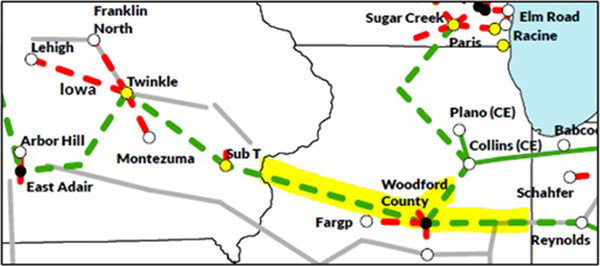
Ameren Illinois argued to FERC that it should have dibs on sections of two competitive long-range transmission projects worth almost $2 billion from MISO’s second portfolio, claiming that Illinois’ “first-in-the-field” doctrine is tantamount to a right-of-first-refusal law.  

The utility told FERC that MISO is wrong to open the Illinois portions of two long-range transmission projects (the Woodford County–Illinois/Indiana State Line 765-kV line and substation project and the Sub T–Iowa/Illinois State Line–Woodford County 765-kV line project) to competitive bidding (EL25-105).

Ameren said Illinois’ “first-in-the-field” doctrine essentially grants it a right of first refusal to build, own and operate segments of the projects located in its service territory. FERC should instruct MISO to re-classify the projects, reverse its request for proposals and assign responsibility for some of the two lines to Ameren, it said in its petition for a declaratory order.  

“Despite Illinois’ ‘first-in-the-field’ doctrine and Ameren Illinois’ rights thereunder, due to uncertainty regarding whether Illinois qualifies as a state granting a right of first refusal, MISO improperly included the projects in its competitive developer selection process,” Ameren explained to FERC.  

MISO began soliciting proposals from qualified developers for the $984.6 million Woodford County line July 25. Proposals are due Jan. 6. 

MISO plans to begin accepting proposals for evaluation on the $940.1 million Sub T-Iowa/Illinois State Line–Woodford County 765-kV project Aug. 8 with a Jan. 20 deadline. The two lines are part of MISO’s second, nearly $22 billion long-range transmission portfolio. 

The highlighted sections of the MISO long-range transmission projects that Ameren argues it should have rights to. | MISO and Ameren

Ameren characterized portions of the pair of projects as “Ameren Illinois segments” that “will interconnect with Ameren Illinois’ existing facilities and provide electric services to, and otherwise significantly affect, Ameren Illinois’ existing wholesale and retail customers.” The company said the projects will lower prices for its customers, reduce overloads, alleviate congestion, allow new generation to interconnect and expand export capability.  

Ameren acknowledged that judicial precedent enforces the doctrine and it’s not a codified statute.  

The doctrine states that, where “additional or extended service is required in the interest of the public and a utility in the field makes known its willingness and ability to furnish the required service,” there is no justification in “granting a certificate of convenience and necessity to a competing utility until the utility in the field has had an opportunity to demonstrate its ability to give the required service.” 

It also says parties must demonstrate that the established utility is providing poor service or is unable to “provide adequate facilities” before one utility is allowed to “take the business of another already in the field.”  

The doctrine reasons that the “method of regulating public utilities in Illinois is based upon the theory of regulated monopoly rather than competition.” 

Ameren said it “clearly” meets the three-part threshold of the doctrine: It’s an existing public utility, it’s willing to head up the projects, and there’s no reason it’s unable to do so. It said FERC didn’t need to interpret state law to grant its petition. 

Six states in MISO (Indiana, Michigan, Minnesota, Mississippi, North Dakota and South Dakota) have enacted explicit ROFR laws that are in effect. MISO does not include Illinois on its list of states with ROFR laws.  

Other Long-range Projects in Competitive Stages

In addition to the Illinois segments, MISO has a full dance card in 2025 for overseeing competitive projects included in the second long-range transmission portfolio.  

MISO announced July 30 that it selected Republic Transmission to lead construction of the Reid Extra High Voltage Indiana/Kentucky State Line 345-kV project. The project was the first up for bids from the collection. 

MISO has two more projects open for bidding: the Wisconsin Southeast 345-kV project and the Bell Center-Columbia-Sugar Creek-Illinois/Wisconsin State Line 765-kV project. The grid operator is staggering its selection processes to make its competitive developer process more manageable.  

Through the end of the year, MISO plans to release two more requests for proposals for 765-kV projects from the portfolio: The Marshalltown-Lehigh-Sub T–Montezuma–East Adair project Nov. 25 and the East Adair–Minnesota/Iowa State Line–Arbor Hill–York Avenue project Dec. 11.  

Clean Hydrogen Future Dimming Nationwide

Clean hydrogen is losing momentum in the U.S. because of higher costs, new tariffs and policy uncertainty, BloombergNEF analyst Payal Kaur said at a California Energy Commission workshop on firm zero-carbon resources July 29.

The U.S. has approved tax credits and grants for hydrogen production, but it’s taking longer for those incentives to come to fruition, Kaur said. There also has not been much progress in creating pipelines and storage for clean hydrogen, she said.

“It’s harder to get final investment decisions for these projects because of the uncertainty in the policy environment and lack of demand,” Kaur said.

Kaur said she expects the One Big Beautiful Bill Act to boost the production of blue hydrogen — splitting hydrogen from methane and capturing the carbon — but that the law “takes a jab at green hydrogen” — split from water using renewable energy.

President Donald Trump’s tariffs could also increase the cost to produce green hydrogen in the U.S. by 14%, Kaur said.

“Having tariffs is going to increase your levelized cost of green hydrogen. You’ll see additional costs in your electrolyzer equipment, solar and wind equipment, and other factors,” Kaur said.

The U.S. has announced plans to supply about 15 million metric tons of clean hydrogen per year, amounting to 1.2% of global supply, Kaur said. About 11.7 MMT will be blue and 3.8 MMT green. Currently, blue hydrogen is about 50% cheaper to produce than green, Kaur said.

In California, officials have announced plans to build infrastructure to produce about 1.1 MMT of green hydrogen per year, the fourth most out of all states. Louisiana has announced the most green hydrogen production, about 4.5 MMT per year.

The dim outlook for hydrogen fuel also applies to California’s transportation sector, where the price of hydrogen increased from about $15/kg in 2022 to more than $35/kg in 2024. (See Report: Hydrogen Transportation Future Down Significantly in California.)

Data Center Power Requests

At the CEC’s workshop, commissioners also heard from city and energy company representatives about the state’s integrated energy policy report, specifically how data centers are impacting future procurement plans.

Mandip Samra, general manager of Burbank Water and Power, told commissioners that data center developers are suddenly interested in building projects in the city because of its reliable, low-cost supply of electricity.

The utility did not include data centers in its load forecasts in 2023, but since then, “we’ve had a lot of data centers come to us because Burbank has a lot of reliability. We’re actually one of the highest reliability areas in the state and top 5% in the nation,” Samra said.

Sustainability was ranked last in importance in surveys submitted from stakeholder groups to the utility, Samra said.

Kent Leacock, senior director of public affairs for Mainspring Energy, told commissioners that his company is working with a rural community in the Midwest to help bring a new data center online there. The project is in development and is a combination of providing immediate power and allowing for data center load growth in the region.

The rural community could not meet the load demand of the new data center, so it decided to hire Mainspring to supply about 30 MW, Leacock said. The company builds linear generators, which supply power by releasing electrons out of copper coils.

“As you are all probably aware, with data centers, time is of the essence,” Leacock said. “You’re falling behind if you’re a month behind energizing your data center.”

MISO Prepares for More Projects than Study Slots in 1st Queue Express Lane

MISO expects to exceed its quarterly project maximum when it begins accepting the first generation project proposals under its interconnection queue express lane.

The grid operator will officially open its new, expedited queue study process to hopefuls at 8 a.m. EDT on Aug. 6. It will accept generation proposals through Aug. 11.

“We’re suspecting we get more than 10 in the first cycle,” MISO Director of Resource Utilization Andy Witmeier said at a July 29 Entergy Regional State Committee meeting.

Witmeier said excess project submissions would roll over into the next quarterly study window. MISO is limited to studying 10 projects per quarter under the expedited treatment FERC approved July 21. (See FERC Approves MISO Interconnection Queue Fast Lane.)

MISO plans to study no more than 68 projects, at a pace of 10 per quarter, until the process sunsets on Aug. 31, 2027. It pledged to begin studying the first batch by Sept. 2. MISO plans to open a second application window in early November and kick off studies in early December.

MISO said in an emailed statement that the process is “only intended for highly certain projects that respond to a specific resource adequacy or reliability need.” In response to criticism that the fast lane will favor load-serving entities’ projects, MISO has stressed that independent power producers need only a legally binding agreement with an off-taker to compete for the limited slots. (See CGA Says New MISO Info Guide on Queue Fast Lane Shows Plan is Unfair.)

To qualify for the expedited studies, projects are required to address “a specific load addition or resource adequacy deficiency and be commercially operable within three to six years” of submission. MISO said interconnection service for projects will be capped at 150% of the identified need and must be situated in the project’s local resource zone. Relevant regulatory authorities must certify there’s a resource adequacy or reliability need for each project.

MISO CEO John Bear has said the “temporary mechanism allows us to address urgent needs while preserving state authority for resource adequacy and maintaining transparency and fairness.”

NYPA Lines up More Potential Renewable Projects

The New York Power Authority has stepped up its renewable energy development efforts, offering a draft revision of its strategic plan that would more than double proposals to 6.8 GW.

The move is seen as timely, given the new hurdles to renewable energy being erected by the federal government since NYPA started down this path.

NYPA in 2023 gained new authority to develop renewable energy alone or in partnership with the private sector. A year later, it offered an initial tranche of 40 proposals totaling 3.5 GW, with the caveat that, as with most proposed renewables, there likely would be a significant attrition rate.

The final plan adopted in January contained 37 proposals rated at 3 GW, three of which have since been withdrawn from consideration because they were on an incompatible timetable.

On July 29, NYPA announced a second tranche of proposals totaling 3.8 GW.

These range from large wind and solar farms to a half-gigawatt compressed air storage cavern to dozens of storage facilities of a few megawatts each in New York City, where energy resources are most tightly stretched.

In a news release, NYPA President Justin Driscoll cited New York’s strong vision for a clean energy future but also acknowledged the escalating challenges facing it.

“There has never been a more critical time for NYPA to move expeditiously as we contend with expiring federal tax credits and associated increased competition for equipment and installers,” he said. “NYPA is committed to building a diverse portfolio of clean energy projects.”

NYPA has a long history of energy development, notably the major hydroelectric facilities that provide nearly half of the state’s emissions-free electricity.

But public power advocates had long sought a larger role for NYPA, in hopes that as a state entity it could accomplish what the private sector was failing to do: bring large amounts of new renewables online. In 2023, they succeeded in their lobbying efforts for the Build Public Renewables Act.

But in 2024, they were sorely disappointed that NYPA came out of the gate with a 3.5-GW plan rather than the bold 15-GW vision they had hoped for. NYPA said it wanted to move prudently and preserve the strong bond rating that would help it finance these efforts.

Public Power NY cheered the new gigawatts implied in the July 29 update of the strategic plan and especially welcomed the attention to the New York City area.

They also raised their goal to more than 15 GW, saying in a news release:

“New Yorkers stood up in record numbers to demand New York lead the way on building publicly owned, union-built renewable energy, and we’re winning. The rapid addition of 4 more GW of public renewables shows NYPA can build even more than the 15 GW necessary for us to meet the state’s climate goals, including 5 GW downstate.”

No Price Tag for Compressed Air Project

NYPA is facing a potentially busy few years. Along with the renewables mandate, Gov. Kathy Hochul in June directed it to lead development of at least 1 GW of advanced nuclear generation.

NYPA has attracted private sector interest in its renewables role. To date, 94 developers and investors have been pre-qualified to collaborate on generation projects, and the window for potential partners remains open through Sept. 30.

This latest tranche of renewables consists of three wind farms, 17 solar arrays and 156 energy storage systems.

NYPA and Orenda would co-develop 140 of the energy storage facilities. Almost all would be in New York City’s four outer boroughs, with the rest in the next county north. Some already have interconnection agreements.

Along with the standard battery energy storage systems, photovoltaic panels and wind towers proposed to be erected by the dozens or millions, there is one outlier among the projects: Hydrostor and NYPA would team up on a 500-MW compressed air storage facility in the northern town of Croghan and aim to bring it online in late 2031.

The draft revision of the strategic plan offers no price tag on the venture and gives no indication what level of risk would be attached to such a venture.

However, Hydrostor’s 500-MW/4,000-MWh Willow Rock compressed air energy storage proposal in California gives some hint about the price range: It received a $1.76 billion federal loan guarantee in the last days of the Biden administration.

One thing that will not be on the final renewables list is a nuclear reactor, even though NYPA is charged with seeing one built. Nuclear is not classified as a renewable energy technology.

Every proposal that does make it into the plan still must clear the full due diligence process, NYPA writes:

“The power authority is committed to building as much renewable energy as we prudently can. The inclusion of a project within this updated strategic plan, however, does not guarantee that NYPA will proceed with that project.”

Pathways Initiative Clarifies Near-term Division of Labor with CAISO

The West-Wide Governance Pathways Initiative will run its stakeholder processes separately from CAISO’s until the effort’s “regional organization” (RO) is formally launched in 2028, even in areas of overlapping interest, an official said in a July 28 update. 

Pathways Launch Committee Co-Chair Kathleen Staks provided the update and associated slides via email after the group’s July 25 monthly online meeting was repeatedly “Zoom-bombed” by someone making offensive remarks, forcing the organizers to shut it down. 

Key among the topics that were to be discussed: how Pathways and CAISO will proceed over the next couple years as they engage in parallel stakeholder initiatives covering similar subjects. 

“We have received several questions about whether and if so, how, the various stakeholder processes underway may overlap and how stakeholders are supposed to engage,” wrote Staks, the executive director of Western Freedom. “It is important to note that … CAISO will continue to run its own stakeholder processes for the WEIM [Western Energy Imbalance Market] and EDAM [Extended Day-Ahead Market] and any other initiatives until the RO is fully functional and the tariff changes are in place that give the RO authority over the WEIM and EDAM ([around] January 2028).” 

Staks said the Western Energy Markets (WEM) Regional Issues Forum (RIF), the WEIM’s key stakeholder body, will continue with its work, including evaluating recommendations coming out of Pathways’ final “Step 2” proposal. (See Pathways Initiative Approves ‘Step 2’ Plan, Wins $1M in Federal Funding.) 

“For the RO implementation work, the Launch Committee will continue to manage the stakeholder process the same way it has since the beginning of the Pathways Initiative — through public meetings and written comment opportunities,” she wrote. “This work includes development of the corporate documents, organizational policies and procedures, including the scope of work of the Office of Public Participation and job descriptions for key RO roles, and refinement of the RO stakeholder process.” 

Once it is seated and selected, the RO’s “initial” board of directors will be making final decisions on those, while the Launch Committee likely will continue to manage related stakeholder processes until launch of the RO, she said. The committee hopes to seat the board by July 2026 and no later than January 2027, Staks said during the group’s May meeting. (See Pathways Initiative Seeks $7.1M to Fund RO.) 

In her update, Staks also clarified that the membership of the RO board’s Nominating Committee will reflect new sectors described in the Pathways proposal, and not those in the RIF, despite some overlap. 

“Each sector will need to organize itself to participate in the RO Nominating Committee process separate from the past/current engagement in the RIF or the CAISO-WEM Nominating Committee,” she wrote. 

Staks noted that CAISO will be running the stakeholder process for the tariff revisions needed to implement the Pathways proposal, given that it’s the ISO’s tariff that will be changing. 

Additionally, she wrote, the RO’s Stakeholder Representatives Committee (SRC) is unlikely to be “fully functional” until the RO is operating. 

“Having the right staff in place at the RO to manage the independent stakeholder process will be a priority for the RO, but the timing will depend on funding through the RO implementation phase,” she said. 

Staks recommended that sectors begin organizing to select their Nominating Committee representatives by this fall and to participate in RO stakeholder work ahead of formation of the SRC. 

Nominating Committee Revisions

The Launch Committee has revised the appendix of the Pathways final proposal related to the Nominating Committee, following recommendations from the Bonneville Power Administration and California Large Energy Consumers Association, Staks said. 

“In response to these comments, the Launch Committee made some significant changes to streamline and better organize the document and make it less prescriptive. In several places, there was language removed because the Launch Committee determined that it would be better to leave procedural details to the sectors and Nominating Committee to ensure flexibility and independence,” she wrote. 

The revisions remove the ability of the RO’s corporate secretary to appoint sector representatives to the Nominating Committee, clarify that the WEM Body of State Regulators representative is a voting member of the committee while the RO board representative is a non-voting member and specify that Launch Committee alternates will not vote on the initial board slate, among other changes. 

Updated Timelines

A chart in the slide presentation shows the Pathways Formation Committee has updated timelines for “key” deliverables, including extending the time allotted for developing corporate documents and defining the scope of the work of the Office of Public Participation. 

The chart also shows that Pathways will begin its Phase 2 fundraising in August. The group, which has estimated a $7.1 million budget for all three of its phases, hit a financing snare early in 2025 when the Trump administration paused nearly $1 million in funding as part of a larger spending freeze on projects previously promised support by the Biden administration. 

Online Meeting Restrictions

In response to the Zoom-bombing July 25, the Launch Committee will enact more restrictive practices for its online public meetings, including preventing participants from turning on cameras or microphones until they make a request using the “raise hand” feature. Staks said the committee also is considering disabling the chat feature because other entities have reported problems with “inappropriate content” being shared through that function as well. 

“These features do limit the ease of participation, but after our experience on Friday, we feel implementing these changes will prevent this situation from occurring again but still leave room for participation,” she said.