MISO Skirts Max Gen Emergency in July Heat

MISO issued a slew of warning notices and operating instructions — especially in its South region — to help deal with oppressive July heat, forced generation outages and strained transmission.

But the grid operator managed to avoid calling a maximum generation emergency on July 29, although it circulated a maximum generation warning that was in effect from 3 p.m. to 10 p.m. ET.

MISO declared two maximum generation alerts for July 28 and 29 for its entire footprint and a transmission advisory for the South region on July 29 because of limited transfer capability. MISO debuted transmission advisory notifications following load shed in greater New Orleans on May 25 that could be traced to transmission insufficiency, not a lack of capacity. (See MISO Debates What-ifs, Vows Improvements in Front of La. PSC After Load Shed.)

“Today is probably the fifth day or so of a streak of hot weather across most of the Eastern Interconnect,” MISO Senior Director of Reliability Coordination John Harmon said during a July 29 meeting of the Entergy Regional State Committee (ERSC), held a few hours after MISO issued the maximum generation warning. Harmon said MISO and other grid operators were conducting a flurry of analyses and collaborative actions to cope with the heat.

He said an Arkansas transmission line was forced offline late on July 28, impacting MISO’s ability to move power in the South, which prompted the transmission advisory. He also noted MISO’s July 29 demand forecast was higher than originally anticipated.

At the time, Harmon said MISO would act as it saw fit to combat risk.

Public Utility Commission of Texas economist Werner Roth said he appreciated the addition of MISO’s transmission position warnings, noting he’d rather have more notices from the RTO than too few.

MISO prepped for a possible 126-GW peak demand on July 28 but ultimately served nearly 121 GW. In the moment, the RTO said it was contending with forced generation outages and a loss of its import interchange schedules in addition to heat-driven demand.

At one point on July 29, MISO forecast a nearly 124-GW peak and said it had about 130 GW in committed capacity on peak. It reported more than 9 GW in imports near its 121.5-GW peak.

MISO spokesperson Brandon Morris said neighboring grid operators dialed back exports on July 29 because of the widespread heat.

“However, the MISO grid remains stable at this time, and we will continue to work with our member utilities to navigate this prolonged heat wave impacting almost half of the country,” Morris said in an email to RTO Insider at about 4 p.m. ET, when real-time demand passed 120 GW.

‘Very Resilient’

The RTO enacted conservative operations instructions four days in advance for July 28-29, when the extreme heat was expected to pose the most risk.

Additionally, MISO declared a severe weather alert for those days in its Midwest region as it prepared for thunderstorms with winds up to 75 mph and possible tornadoes.

The grid operator has called a string of capacity advisories and conservative operations throughout July, making 17 separate capacity advisories and three conservative operations calls. All told, MISO published 47 notifications to caution members, update them or cancel instructions and alerts.

MISO initiated a series of capacity advisories for MISO South on July 10, 14-17 and 21-24 due to significant forced generation outages. By July 23, the advisory extended to the entire footprint as the grid operator contended with more widespread hot weather and offline generation.

The RTO also instituted conservative operations July 21-25 for the entire footprint due to soaring temperatures.

Meanwhile, MISO rounded out June with a 120-GW peak on June 23 during its sole maximum generation emergency declaration of the summer. (See MISO Declares Max Gen Emergency in Heat Wave.)

MISO Independent Market Monitor Carrie Milton said MISO “successfully managed the situation” without resorting to relying on operating reserves despite the emergency declaration. She added that other grid operators were forced to dispatch and nearly exhaust their operating reserves.

Milton said MISO’s handling of the challenges borne by the heat is further evidence that it doesn’t deserve the high-risk status it was assigned in NERC’s revised Long-Term Reliability Assessment. (See IMM: NERC Reliability Assessment Still Overstating MISO Risk.)

“MISO showed itself to be very resilient,” Milton said at the ERSC meeting.

Beyond the maximum generation event, load averaged 83.7 GW over June, the highest in the past four years. The day before the emergency, solar output peaked for the month at 13.1 GW.

Real-time prices in June rose to an average of $42/MWh, compared with the $28/MWh average in the two previous Junes. Daily generation outages also were up in June, averaging 51 GW — far from June 2024’s 35-GW average.

DOE Lifts Run Hour Restrictions on Maryland Generator

The U.S. Department of Energy has issued an emergency order to lift annual run-hour restrictions on the H.A. Wagner Generating Station Unit 4 located outside of Baltimore to address a shortage of generation in PJM. 

The 397-MW generator is limited to operating at a maximum of 438 hours when operating on oil fuel by a consent order that Raven Power, a Talen Energy subsidiary, entered with the Maryland Department of the Environment (MDE). In a July 21 request for the emergency order, PJM stated that the unit had 80 hours remaining before hitting the limit. 

The RTO anticipates a need to run the unit throughout the year, particularly when temperatures exceed 82 degrees and loads rise above 151 GW, or to mitigate the impact of transmission or generation outages. In particular, the request stated that if a heat wave similar to the high temperatures seen in late June were to occur again, Wagner would exhaust its remaining run hours. (See PJM Reviews June Heat Wave.) 

“This order reduces the threat of power outages during peak demand conditions for millions of Americans,” U.S. Secretary of Energy Chris Wright said in an announcement of the order. 

The July 28 emergency order allows the unit to be dispatched beyond the run-hour limit when PJM determines the unit is needed to meet demand during a maximum generation alert or transmission security emergency. It is effective for 90 days, which is the maximum allowed under DOE’s Federal Power Act (FPA) Section 202(c) authority. 

The unit’s operation would continue to follow emissions limits. If Wagner is operated “in reliance on this order,” PJM is required to notify the DOE and provide a summary of the hours exceeding the operating limit. 

“The inability to run Wagner Unit 4 could result in adverse reliability impacts to service in the Baltimore Gas and Electric (BG&E) territory, and within PJM’s service territory more broadly,” the emergency order states. “For the remainder of 2025, PJM anticipates the continued need to schedule Wagner Unit 4 in order to maintain reliable system operations during projected peak demand and/or increased flows on transmission facilities that are required to serve the BG&E zone.” 

In its request, PJM wrote that it has been dispatching Wagner Unit 4 more often in 2025 than the year prior, including during the winter storm that set a new seasonal peak on Jan. 22 and for 100 hours during the five-day heat wave in June. PJM wrote that it was told by the MDE that the consent order could not be modified without changes to the larger state implementation plan, which would not be possible before the end of the year. The plan limited Wagner’s run hours in order to meet the one-hour sulfur dioxide national ambient air quality standards. 

Wagner and the co-located 1,289-MW Brandon Shores generator are operating on reliability-must-run (RMR) agreements with PJM to keep the units operational between their desired June 1 deactivation date and May 31, 2029. (See FERC Approves $180M Annually for RMR Deals with Brandon Shores and Wagner Plants.) 

The DOE also has used Section 202(c) emergency orders to delay the deactivation of two generators in PJM and MISO: Consumers Energy’s 1,560-MW J.H. Campbell coal plant in West Olive, Mich., and Constellation’s 760-MW Eddystone Units 3 and 4 near Philadelphia. Those orders focused on broader resource adequacy shortfalls the RTOs have discussed. (See DOE Orders PJM, Constellation to Keep 760-MW Eddystone Generators Online.) 

NRDC Director of RTO Advocacy Casey Roberts said PJM was urged by organizations like the Sierra Club to consider alternatives to an RMR agreement for Brandon Shores and Wagner, including the feasibility of battery storage at the site. The situation shows that relying on inflexible fossil generation vulnerable to issues with environmental standards and permits is not a good solution, she said. PJM’s Deactivation Enhancement Senior Task Force is in the early stages of considering alternatives to retaining deactivating resources on RMR agreements, she added. 

While avoiding RMRs outright would provide a more long-term solution, Roberts said PJM also has not been clear enough on the operational alternatives it may have to avoid dispatching Wagner above its maximum run hours, such as how Wagner would be dispatched relative to demand response. 

Roberts said Section 202(c) orders have been sought by PJM in the past to allow resources to exceed environmental permits during acute needs, including allowing units to exceed run hours during Winter Storm Elliott. The Wagner order is more theoretical in the needs it aims to resolve, she said. Unlike the Campbell and Eddystone orders — which she said were based on sweeping resource adequacy claims — the Wagner order is more rooted in an evidentiary basis, but there remains insufficient detail on how the generator may be deployed.  

“PJM is not being very transparent about the circumstances in which it is dispatching Wagner, or Eddystone for that matter,” she said.

In response to Roberts’ comments, PJM spokesperson Jeff Shields said the RTO sought an order from the Secretary of Energy to allow the H.A. Wagner generator to continue operating beyond its run-time limitation to preserve grid reliability in specific circumstances over the next 90 days. PJM will dispatch Wagner Unit 4, a 397-MW fuel-oil generator in the BG&E territory, only under limited emergency conditions, Shields said. He emphasized that Wagner 4 already is operating under a FERC-approved RMR agreement to operate beyond its intended deactivation date through 2029.

EPA Proposes Rescission of Endangerment Finding that Underpins All GHG Rules

EPA is proposing to rescind its 2009 endangerment finding, which qualifies greenhouse gases as pollutants and has been used by Democratic presidential administrations to regulate emissions from power plants and other sources.

The rescission, if finalized, would repeal regulations on greenhouse gas emissions from all motor vehicles and engines, the agency said. “However, EPA intends to retain, without modification, regulations necessary for criteria pollutant and air toxic measurement and standards, Corporate Average Fuel Economy testing and associated fuel economy labeling requirements,” it said.

“With this proposal, the Trump EPA is proposing to end 16 years of uncertainty for automakers and American consumers,” EPA Administrator Lee Zeldin said in a statement. “In our work so far, many stakeholders have told me that the Obama and Biden EPAs twisted the law, ignored precedent and warped science to achieve their preferred ends and stick American families with hundreds of billions of dollars in hidden taxes every single year.”

The endangerment finding came from the Supreme Court’s decision in 2007’s Massachusetts v. EPA, in which the court sided with the state when it sued the agency to regulate GHGs under the Clean Air Act. Prior to the ruling, carbon dioxide was not considered a pollutant under the law.

EPA’s latest proposal calls the endangerment finding “unprecedented,” saying it interpreted the CAA as authorizing the regulation of domestic emissions from new motor vehicles and engines based on global climate change concerns “rather than air pollution that endangers public health or welfare through local or regional exposure.” The agency has already proposed repealing the Biden administration’s attempt to regulate power plant greenhouse gas emissions. (See EPA Proposes Repealing Limits on Power Plant Greenhouse Gas Emissions.)

The proposal also says the Supreme Court “did not require the agency to find that GHGs are subject to regulation under CAA Section 202(a) and does not support our implementation of the statute since 2009.”

The agency says the proposal would save $54 billion annually by repealing all of the GHG standards.

Recent Supreme Court decisions like West Virginia v. EPA — which found the agency could not regulate power plant emissions through generation-shifting mechanisms, as was proposed by the Obama administration in its Clean Power Plan — and Loper Bright v. Raimondo — which ended the doctrine of deference to agencies in statute interpretations, known as Chevron deference — provided the basis for EPA’s proposal.

But the courts have upheld Massachusetts in the 18 years since it was issued, National Wildlife Federation Director for Legal Advocacy Jim Murphy said on a call with reporters.

“I think that EPA is on very shaky ground here, on both the science and the law,” Murphy said. “It would remove the obligation for EPA to take action to curb greenhouse gasses, and that’s just not efforts like the Clean Power Plan or other attempts to regulate emissions from power plants, but it could affect things like methane emissions from oil and gas production and a whole host of other efforts that EPA has taken.”

The move is certainly going to be challenged in court, assuming EPA concludes its rulemaking and finalizes its proposal, and Murphy said he hoped it would be overturned.

The Department of Energy was involved in the EPA action, producing a report called “A Critical Review of Impacts on Greenhouse Gas Emissions on the U.S. Climate” that reviewed literature and government data on the climate impacts of greenhouse gas emissions.

“The rise of human flourishing over the past two centuries is a story worth celebrating. Yet we are told — relentlessly — that the very energy systems that enabled this progress now pose an existential threat,” Energy Secretary Chris Wright said in a statement. “Climate change is real, and it deserves attention. But it is not the greatest threat facing humanity. As someone who values data, I know that improving the human condition depends on expanding access to reliable, affordable energy.”

The House Sustainable Energy & Environment Coalition, a group of Democratic representatives who support climate policies, criticized EPA in a statement, saying the scientific consensus is overwhelming.

“Climate change is already wreaking havoc across America,” the SEEC said. “By ignoring the overwhelming scientific consensus, contradicting the clear statutory language in the Clean Air Act and overriding repeated Supreme Court rulings, EPA has revealed today just how far it will go to be every polluter’s ally.”

Posting on X, LS Power CEO Paul Segal argued that EPA’s effort to withdraw the endangerment finding should not matter to his sector.

“I don’t think this matters for the power generation industry,” Segal said. “Investors need to expect political volatility (We’re living it!) and plan for the worst case — whatever that might be for the investment you are making.”

Union of Concerned Scientists President Gretchen Goldman said the administration is using the “kitchen sink approach” to avoid complying with the law.

“But getting around the Clean Air Act won’t be easy,” she said. “The science establishing climate harms to human health was unequivocally clear back in 2009, and more than 15 years later, the evidence has only accumulated. Communities across the nation are having to cope with deadly heat waves, accelerating sea level rise, worsening wildfires and floods, increased heavy rainfall, and more intense and damaging storms. Burning fossil fuels has made the climate increasingly unstable and dangerous for people.”

Stakeholder Forum: PJM Is Flailing, but There’s a Solution

By Brad Viator and Alison Williams

These days, partisan alignment on public policy issues is as rare as a vegetarian in southeastern Texas.

Alison Williams

But in early July, nine governors, Republicans and Democrats alike, sent a letter to the PJM Board of Managers, whose energy market is responsible for shockingly high rate increases across 13 states and D.C. The governors say that “market participants, consumers and the states” that participate in PJM are having a “crisis in confidence” in the beleaguered grid operator. PJM likely has never been the recipient of such organized, cross-party discontent in its 100-year history.

Brad Viator

At the heart of the PJM problem is the inability of the grid operator to bring new generation online quickly enough to match skyrocketing demand for electricity. This shortfall is manifesting directly into exorbitant energy costs. The crisis of timely and affordable generation is largely attributable to a combination of factors: decreased supply because of coal and gas plant retirements, and increased demand because of electrification and data center expansion.

The governors wrote that PJM’s response to this capacity challenge “has been typified by halting, inconsistent steps and rising internal conflicts within the stakeholder community.” According to a report from Reuters, “new projects totaling about 46 GW — enough capacity to power 40 million homes — have been cleared in recent years,” but they are not being built because of PJM’s painful bureaucratic delays and market-based shortcomings.

Just how bad is PJM’s current electricity shortfall? Consider the recent capacity auction that closed July 22. (See PJM Capacity Prices Hit $329/MW-day Price Cap.) Electricity prices soared to $329.17/MW-day — and were it not for a measly price cap orchestrated by Pennsylvania Gov. Josh Shapiro (D) earlier this year, the auction price would have reached $389/MW-day. (See FERC Approves PJM-Pa. Agreement on Capacity Price Cap, Floor.) One could argue that the cap worked in practice if not in principle; the capped price still represents a 22% jump over last’s auction price and a whopping 1,100% more than the clearing price two years ago. (See PJM Capacity Prices Spike 10-fold in 2025/26 Auction.)

And let’s not lose sight of who’s paying the price — customers. The New York Times on July 23 referenced the president and chief executive of multistate electric utility Exelon, saying that “some of his customers in Maryland, for example, could pay an additional $1 to $4.50/month as a result of the auction, depending on their location.”

Fundamentally, the PJM market is broken. Higher prices are supposed to signal energy producers to bring new capacity online. But because of PJM’s deep dysfunction, new generation is not showing up, even at exorbitant prices. Yet, PJM’s capacity auction press release essentially is a humble brag that their market is functioning.

In reality, though, capacity inside PJM is about the same as it was in 2024. More alarmingly, the auction cleared its reliability requirement by the slimmest of slim margins at 139 MW over the required threshold to have a functional market. That translates to a miniscule buffer of 0.001% of the capacity total of 134,311 MW. In other words, the market was a stone’s throw away from collapse.

Everyone knows we need more electricity. It’s painfully clear PJM is not capable of responding to increased demand.

But is there a better path forward that would make the PJM markets more reliable at creating new capacity? The answer is yes.

PJM needs to look to the southeastern U.S., where states like Georgia and Louisiana are attracting new data centers by adding capacity quickly and cost-effectively. This is not occurring by happenstance but rather through sensible planning between regulated utilities and their state regulators in public service commissions, who are being mindful of costs, growth and timing. While PJM cannot become a state regulator, it can plan like one by streamlining its processes and reforming poor functions to bring new capacity in a way that balances reliability and affordability — something utilities in vertically integrated markets never lose sight of.

Further, if PJM behaved more like a PSC and prioritized proper planning and adequate power availability, this would also help solve another of the grid operator’s most pressing challenges: the interconnection queue consisting mostly of non-dispatchable renewable energy that is unlikely to materialize because of a stack of challenges, including tariffs, supply chain problems, sunsetting tax credits and the same exact megawatts of renewables existing in other interconnection queues.

If PJM actually planned to strategically locate dispatchable generation, such as natural gas, it could make some of the renewables projects more viable by allowing those two sources to operate hand-in-glove to ensure stable energy day and night.

One thing is clear: PJM cannot afford to continue to take a passive approach to capacity. The grid operator must be decisive, act quickly and be willing to make hard choices about the future of the region’s energy supply. PJM also must be prejudicial in its decisions — identifying and prioritizing the energy sources it believes are real and shovel-ready commitments and then locating them in optimal places to ensure those sources are developed and brought online efficiently.

Finally, as a first step to reforming PJM, the nine governors are urging the RTO to appoint two new members to open seats on its board through a transparent process with input from those state executives. The letter states: “They must be individuals who understand the concerns of ratepayers facing rising costs.” (See State Governors Seeking Ability to Nominate 2 Members to PJM Board.)

Adding two new board members is a good first step. But it is an insufficient change to PJM’s underlying structural flaws. PJM must revise its mentality to act more like a PSC and focus on building new, dispatchable generation capacity — such as natural gas — that can both stand on its own and aid in renewables deployment. If utility regulation can work in the Southeast to build new capacity, there is no reason PJM, with its massive footprint, can’t do the same through smarter planning.

Brad Viator and Alison Williams are energy consultants at B Strategic Solutions.

DTE Expects to Need Gigawatts of Capacity for Data Centers

DTE Energy reported it is in various stages of discussion to supply as much as 7 GW to new data centers and is on track to reach agreement on the first project by the end of 2025.

The news came with the Michigan utility’s second-quarter earnings report July 29, which also contained an update on the outlook for continued renewables development.

DTE President Joi Harris fielded most of the questions during an earnings call with financial analysts. CEO Jerry Norcia, whom she will succeed in September, filled in more details.

Harris said data center developers have shown interest in Michigan because there is excess generation capacity and because the state enacted tax incentives to attract them.

She noted that DTE previously had reached framework agreements for 2.1 GW of data center load but said some negotiations are now further along.

DTE will not count one of these potential large customers as part of its pipeline until it has secured land or has strong prospects of doing so and has a pathway to zoning approval.

The utility is in advanced discussions with developers who would present more than 3 GW of new demand; each has secured land, zoning approval and some degree of community support. It is in continuing discussions with developers representing 4 GW of new demand who have not progressed as far with their site planning but are on track with it.

Harris said DTE hopes to seal the first agreement — 1 GW for a hyperscaler’s project — before 2026: “Our intention is to have a really good indicator by the third quarter and have a final deal in hand by the end of the year.”

The utility has more than 1 GW of capacity available and plans to add 1 GW of storage to match the data center’s demand watt for watt, Harris said. This would come from a combination of power purchase agreements and self-build, she said, and the cost is estimated at $1 billion.

Further data center buildouts would require additional storage capacity, she said, as well as new baseload generation — such as carbon capture-ready combined cycle gas plants.

Meanwhile, DTE continues to plan coal retirements, so it plans to add new capacity beyond whatever the data centers need.

“We’re already in the MISO queue for at least one plant and potentially two, and that’s to serve our existing load,” Harris said.

DTE still plans to meet some of that demand with renewables — even as the Trump administration works to make renewables harder and more expensive to build. It has 2,500 MW of renewables in service now and plans to add 900 MW a year for the next five years.

Based on the longstanding definition of “safe harbor” and the provisions for safe-harboring in the reconciliation bill, DTE does think it can bring its projects to completion and still claim the Biden-era tax credits.

“Just as a reminder, we have to build these assets. It is required under the law,” Harris said, apparently referring to the state mandate of 50% clean energy by 2030 and 100% by 2040.

The 900 MW of annual renewable capacity is expected to have a large component of solar and storage, though some consideration is being given to repowering existing wind turbines. The economics of solar are better than wind at this point, and community acceptance of solar has proved greater than for wind.

Analysts asked for greater specificity regarding the infrastructure changes implied by the announcements, and whether DTE needs to pull forward its 2026 Integrated Resource Plan. But the details are fluid.

Harris said DTE’s next IRP will provide more insight on anticipated load growth and strategies to meet that demand, but there is no need to accelerate the timetable.

“So we don’t intend to pull forward the IRP,” she said. “What we intend to do is serve the load near term with our existing riders and tariffs and then move toward building out larger assets based on the results of the IRP.”

DTE reported operating earnings of $283 million or $1.36/share in the second quarter of 2025, down from $296 million or $1.43/share in the second quarter of 2024.

The company reaffirmed its guidance for 2025 operating earnings of $7.09 to $7.23/share. Its stock price closed 0.2% lower July 29.

SPP ERAS GI Requests to Begin in September

With FERC approval of SPP’s expedited resource adequacy study (ERAS) process now in hand, SPP has notified stakeholders that the one-time study’s submission window for fast-track reviews will open Sept. 2. 

In a July 28 email to load-responsible entities, generator interconnection customers and other stakeholders, SPP said it has targeted March 20, 2026, to execute GI agreements. It said the target date is subject to study progress and the timely completion of all process steps. 

The ERAS submission window will close Oct. 2. At that time, the RTO will notify applicants of any deficiencies in their requests and allow them to address the issues during a certain time period. 

The study itself will begin Oct. 17, subject to execution of required agreements. Staff will work with applicants on agreement execution, study cost deposits, procedural requirements and other steps as the process continues. 

Ceiling capacity values — the maximum amount each LRE can select for inclusion in the ERAS — will be posted to their respective resource adequacy folders by Aug. 1. 

SPP proposed the one-time ERAS study outside of its normal planning process to help LREs meet their resource adequacy (RA) requirements for 2030. It said the study was necessary because there is a 16.7-GW aggregate gap between resource adequacy requirements and capacity. 

FERC agreed with a July 21 order approving the ERAS process. It found that SPP has “existing authority” under its tariff to evaluate and maintain resource adequacy and to manage its interconnection queue to provide sufficient generation to meet RA requirements. It agreed with SPP that ERAS requests will receive a GIA “significantly sooner” than those processed through the RTO’s normal study process. (See FERC Approves SPP’s ERAS Process, Accreditation.) 

MISO Revising Transmission Futures After Repeal of Tax Credits

The federal government’s rollback of incentives for renewable energy has thrown a wrench into MISO’s work to develop four new transmission planning scenarios. 

Laura Rauch, MISO executive director of transmission planning, said that because of the One Big Beautiful Bill Act, signed into law July 4, the RTO will extend its timeline for establishing its four 20-year transmission planning futures. 

Rauch said MISO will remove all investment and production tax credits for wind and solar generation in its equation for the future scenarios to match the sweeping federal law. She said the deletion is set to affect the futures’ generation expansion assumptions, though MISO does not yet know to what degree. 

“We plan on having that answer at the end of the year,” Rauch said during a July 29 meeting of the Entergy Regional State Committee. She added that state and member goals would now become the major driver of renewable energy expansion in the RTO’s territory. 

“My expectation is that it will affect renewable expansion, but you still will have demand driven by the member goals and relative economics,” Rauch told MISO South regulatory staffs. 

Rauch said MISO’s work on its futures until now can be considered “informational” and provide insight into how renewable expansion might have played out had the federal incentives survived. 

Despite the pause to rework its futures, Rauch said MISO’s billions of dollars’ worth of past long-range transmission planning still holds up as beneficial and useful because it was based primarily on member plans and comparatively low load increases. (See MISO Board Endorses $21.8B Long-range Transmission Plan.) Rauch said she is not “seeing any risk” that generation construction would slow given rising demand and the fact that members’ carbon-reduction goals remain unchanged. 

“We have not seen a big change in our members’ goals with the One Big Beautiful Bill Act,” Rauch said. 

MISO’s futures include “Lower Load Growth,” “Stated Policy” and “Higher Load Growth” scenarios. The next iteration also will feature a “Supply Shift” future in which the RTO predicts the capacity landscape if the supply chain situation does not improve and continues to weigh down construction. 

The RTO originally planned to finalize its futures sometime in late fall. (See MISO Aims for 4 New Tx Planning Futures in 9 Months.)  

MISO’s fourth future had contemplated a throttled build rate, which it already warned may cause “tension” with members’ resource planning and carbon-cutting goals. Christina Drake, MISO director of economic, interregional and policy planning, previously said stakeholders could think of the fourth future as the “in-law suite” on a house, with the core three futures being the house itself. (See MISO Forming 4th Tx Planning Scenario Based on Supply Chain Barriers.)  

MISO will host upcoming futures workshops with stakeholders Aug. 29, Sept. 24 and Oct. 29. 

Clean Energy Project Cancellations Accelerate in U.S.

An effort to quantify growth of the clean energy sector has evolved into a tally of its contraction during the second term of President Donald Trump.

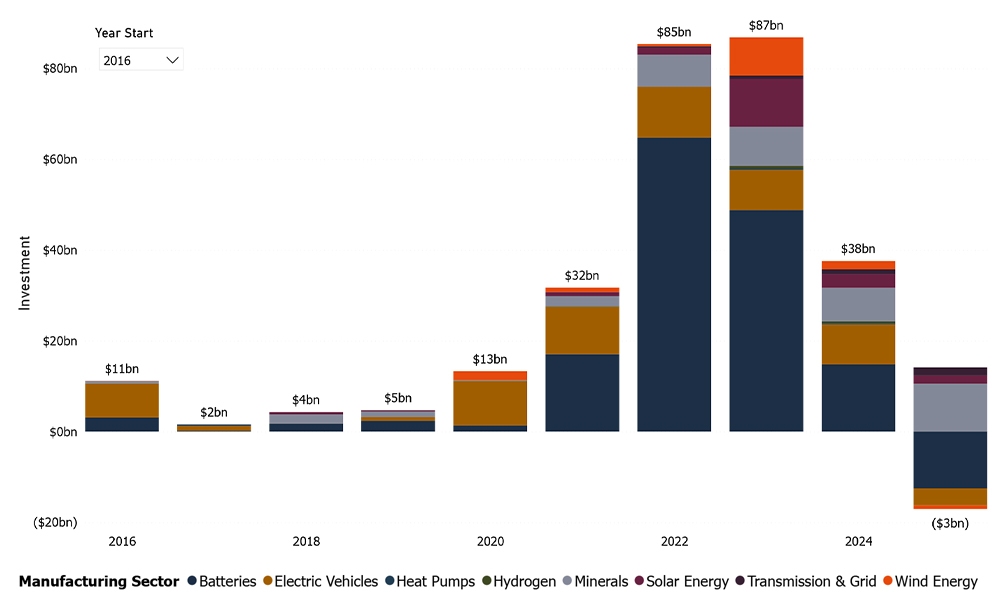
Announced cancellations, closures and cutbacks in new manufacturing and clean energy projects in the first half of 2025 were valued at $22.1 billion by the business policy group E2.

This was more than triple the $7.2 billion in new investments announced in the same time frame.

E2 based its analysis on projects recorded by it and the Clean Economy Tracker. It said $6.7 billion worth of pullbacks were reported in June alone, as Congress was finalizing a reconciliation bill containing many of Trump’s priorities, including cancellation of subsidies for clean energy and emissions-free transportation.

Major automakers’ moves to cut back investments in electric vehicle production accounted for much of the June total, E2 said. In one of the most glaringly literal shifts, GM announced June 10 it would build gas-powered SUVs and pickup trucks at the Orion, Mich., plant where it had planned to invest $4 billion in EV production.

E2 noted these numbers are not sterile statistics but jobs and economic activity that are being lost or never will be created.

“By effectively ending clean energy incentives, Congress is turning its back on thousands of American workers and dozens of communities that were ready to build our energy future and strengthen America’s competitiveness,” E2 Communications Director Michael Timberlake said in a July 24 news release.

The investment announcements tallied by E2 and the Clean Economy Tracker show a correlation to 2022 passage of the Inflation Reduction Act, with its slew of promised tax credits, and the federal elections of 2024, which handed federal policymaking power to a Republican trifecta opposed to such credits.

Announced investment totals (minus later cancellations) were $43.5 billion in 2022, $64.3 billion in 2023 and $18.3 billion in 2024.

From Jan. 1, 2022, to June 30, 2025, this totaled $133.3 billion invested in 402 projects with 122,952 jobs expected to be created.

The value of announced project cutbacks was $744 million in 2023, $2 billion in 2024 and $22.1 billion so far in 2025. That consists of 58 projects with 26,187 jobs eliminated or not created.

A chart shows the sharp decline of investments in clean energy projects in late 2024 and the first half of 2025. | Clean Economy Tracker

Clean energy advocates had hoped that hometown interests would cause defections in the Republican ranks and derail the efforts to revoke the tax credits — Republican-controlled congressional districts are home to 62% of projects announced, 72% of expected job creation and 81% of planned investments.

But the Republican majority held firm, though apparently with some moderation to the most severe cutbacks proposed during intra-party negotiations. President Trump signed the reconciliation bill into law on July 4.

What’s Next?

Looking ahead, analysts see continued project cancellations amid the wholesale federal policy shift to fossil fuels, particularly for wind and solar power, which have been singled out for rapid loss of tax credits.

FTI Consulting predicted the impact will be significant.

“We conservatively estimate that more than 320 proposed wind and solar projects with a total capacity of over 100 GW would no longer be economically viable, making it significantly harder, if not impossible, to attract capital and meet key development milestones,” the Washington, D.C., consulting firm wrote July 16.

This sets up ripple effects in the grid, FTI wrote, as it removes planned capacity additions at a time of growing demand. Wholesale power prices and renewable energy certificate prices are likely to rise as a result, it said.

FTI’s update also notes that the reconciliation bill is likely to have a chilling effect on green hydrogen development.

But more broadly, beyond the wording of the bill, there is the concerning prospect that the Trump administration may use an all-of-the-above approach — including permitting reforms, restrictions on ownership and operational guidelines — to maximize disruption to the clean energy transition.

In mid-2025, momentum remains from the Biden administration.

Wood Mackenzie and the American Clean Power Association on July 28 released their U.S. Wind Energy Monitor report, which shows rising construction activity in the wind power sector.

The first quarter of 2025 saw 2.1 GW of installations, more than double the year-ago pace. Full-year construction is projected to be 8.1 GW, compared with 5.2 GW in 2024 and 7.0 GW in 2023.

But this still would be down from 17.5 GW, 13.9 GW and 11.6 GW in 2020-2022.

Further, a barometer of future activity is trending downward: wind turbine orders were 50% lower in the first half of 2025 than year-ago levels, reaching their lowest level since 2020 — a decline ACP attributed to tariffs and policy uncertainty.

“Market volatility will prompt a short-term decrease in onshore additions,” Leila Garcia da Fonseca, director of research at Wood Mackenzie, said in a news release. “A quarter-over-quarter net reduction of roughly 430 MW in the U.S. onshore wind outlook from 2025-2029 reflects growing uncertainty for currently under-development projects, mainly driven by ongoing permitting challenges, tariff risk and now a sunset of tax credits.”

Tax Credit Phaseout Threatens Projects, Jobs in New England

The expedited phaseout of federal tax incentives for renewables threatens projects and jobs across the clean energy industry in New England and is likely to trigger a mad dash of developers and states pushing projects forward to meet the deadlines set by the One Big Beautiful Bill Act (OBBBA).

The law, which was signed by President Donald Trump on July 4, made a particular target of wind and solar resources and drew heavy criticism from climate and labor groups across the country. (See U.S. Clean Energy Sector Faces Cuts and Limitations.) It and its associated executive actions already appear to have triggered job losses in New England and threaten to cause the stagnation or contraction of the region’s growing clean energy industry and workforce.

“We are going to see, in all likelihood, projects stranded,” said Harry Godfrey, managing director at Advanced Energy United. “It’s bad for workers; it’s bad for consumers; it’s bad for American competitiveness.”

For clean energy developers, the OBBBA contains two key aspects. First, it significantly accelerates the phaseout of the investment and production tax credits (ITC and PTC) for wind and solar projects. To be eligible for the credits under the new rules, projects must begin construction by July 5, 2026, or, if they miss the construction deadline, must be placed in service by the end of 2027.

The law also requires strict foreign entity of concern (FEOC) restrictions, intended to prevent credits from going to companies owned or controlled by entities tied to China, North Korea, Iran or Russia, or to companies that source a certain portion of their equipment from these countries.

The projects likely to be most vulnerable to the phaseout, Godfrey said, are large-scale wind and solar projects that are two to three years away from beginning construction and could not feasibly expedite development to receive the tax credits.

For these projects, “the assumptions around the credits are baked into the project financing … and all of a sudden you have to go back and revise that,” Godfrey said.

Godfrey said the placed-in-service deadlines established in the law will create major investment risks for projects aiming to meet the deadlines because factors largely outside the control of the developer — such as permitting, interconnection or legal challenges — all could cause a project to miss a deadline.

“A placed-in-service deadline really becomes an effective project killer,” he said.

Offshore Wind

In Massachusetts, the biggest effects of the Trump administration may be on the offshore wind industry.

Lawmakers and clean energy advocates in the state have long envisioned offshore wind as an essential resource for meeting growing power demand and decarbonizing the economy. ISO-NE has emphasized the importance of offshore wind to maintaining reliability and resource adequacy.

However, while Revolution Wind and Vineyard Wind are fully contracted, under construction and set to come online over the next two years barring unforeseen obstacles, the region’s second wave of projects faces a highly uncertain future.

New England Wind 1 and SouthCoast Wind, which both received their final federal permitting approvals under the Biden administration and were selected in a 2024 multistate solicitation, have seen repeated delays to their contract negotiations because of federal policy uncertainty. (See New England OSW Contracts Delayed Again.)

“The OBBBA essentially shoots a 30% hole through the financing of solar and wind projects, and that’s not possible to make up from state incentives,” said Amy Boyd Rabin, vice president of policy at the Environmental League of Massachusetts. “It is a significant blow to renewable energy and significantly undoes a lot of the work that prior administrations had done to level the playing field with all the subsidies and incentives we give fossil fuels.”

Offshore wind developers have indicated they are closely awaiting guidance from the Treasury Department on the start-of-construction rules and will need a significant degree of federal policy certainty to proceed with the second wave of projects in the region.

Elizabeth Mahony, commissioner of the Massachusetts Department of Energy Resources, said the “biggest challenge we’re seeing at the federal landscape is the Day 1 executive orders on permitting,” adding that “not having a clear picture on permitting is a significant challenge.”

The Trump administration has not shied away from targeting fully permitted projects, as Trump’s Day 1 order directed a review of existing wind energy leases. In April the administration halted construction on the fully permitted Empire Wind 1 project, which is under contract with New York. The administration ultimately lifted the halt in May, reportedly in exchange for concessions from New York regarding new gas infrastructure into the state. (See BOEM Lifts Stop-work Order on Empire Wind.)

Asked whether Massachusetts would consider a similar hypothetical deal to lift federal permitting barriers to offshore wind in exchange for state concessions around natural gas infrastructure, Mahony said the state is “focused on what we can control, and that’s solar, storage and wind programs that we have actively going in Massachusetts.”

“The governor has repeatedly said that we are an all-of-the-above-solution state,” Mahony added.

Offshore wind project cancellations or major delays will have a major impact on the state’s clean energy workforce. The construction of Vineyard Wind has created about 1,000 union jobs, and the Massachusetts Clean Energy Center forecasted in 2023 that offshore wind would be the fastest growing subsector of the clean energy workforce by 2030.

“We see offshore wind as a really big opportunity,” said Ryan Murphy, executive director of Climate Jobs Massachusetts, a labor union coalition group. “It would be a significant loss if those projects don’t go forward during the Trump administration.”

The administration already appears to have caused job losses in the region. In February, in the wake of Trump’s executive order halting permitting approvals for offshore wind, the developer Vineyard Offshore cut 50 jobs.

“For the projects that we know are planned for Massachusetts that are either on hold or have been canceled, we estimate more than 5,000 construction jobs would not go forward if those projects don’t go forward,” Murphy said.

Along with immediate impacts on local communities, businesses and working families, “what that means is that unions — without commitments to jobs — are not able to train as many workers in the meantime to get them ready for future clean energy projects,” Murphy said.

He added that while most of the skills taught by unions are transferable to a range of other infrastructure and energy projects, “the fact is, if you take away thousands of construction jobs, you don’t necessarily have a one-to-one replacement or thousands of other construction jobs that those workers can go and do.”

Solar Development

The looming expiration of the PTC and ITC also poses a major threat to the solar industry in New England.

The ITC, which was expanded and extended by the Biden administration, has been the “foundation of clean energy development in this country for 20 years,” said Jessica Robertson, director of policy and business development in New England for New Leaf Energy.

Looking at New Leaf’s project pipeline under existing conditions, projects that would be able to survive without the ITC are “very few and far between,” said Robertson, who added she’s optimistic the company took the necessary steps to meet start-of-construction deadlines for its projects prior to the passage of the OBBBA. That should help protect its project pipeline in the near term.

But project eligibility for tax credits likely will depend on the stringency of the guidance issued by the Treasury, and whether the administration seeks to apply the changes retroactively to investments that were made to safe harbor projects prior to the law’s enactment.

In an executive order issued after signing the bill, Trump directed the treasury secretary to issue new guidance “to ensure that policies concerning the ‘beginning of construction’ are not circumvented, including by preventing the artificial acceleration or manipulation of eligibility and by restricting the use of broad safe harbors.” (See Trump Executive Order Targets Renewable Energy Tax Credits.)

At the state level, Robertson expressed hope that recent policy changes, particularly in Massachusetts, will help reduce development costs associated with interconnection and permitting, and may even help some projects meet the tax credit expiration deadlines set by the law.

The Massachusetts legislature passed major siting and permitting reform legislation in late 2024, limiting the permitting approval timeline to 12 months for small clean energy projects and 15 months for large projects, and allowing developers to appeal local permit rejections to the state Energy Facilities Siting Board. (See Mass. Clean Energy Permitting, Gas Reform Bill Back on Track.)

The state also has established a framework for covering the upfront costs of distribution-level interconnection upgrades in the rate base and has required more proactive planning in the utility Electric Sector Modernization Plans. (See Mass. DPU Approves 1st Round of Utility Grid Modernization Plans.)

Massachusetts also issued in June an emergency update to its Solar Massachusetts Renewable Target program, a key state policy for supporting solar development. The changes are intended to allow the program to reflect annual changes in the cost of building solar and help the state respond to changing federal policy.

But states can do only so much to fill the gaps left by the loss of federal tax credits. New Leaf announced in July the layoff of about a fifth of its workforce, citing the need to “reduce its cost structure in preparation for a market without the federal ITC.”

Robertson said the company’s utility-scale projects that cannot meet the in-service deadlines will be most affected by the tax credit changes and said New Leaf is “exploring our options for those projects.”

Storage Development

While the OBBBA made relatively minor changes to the ITC deadlines for energy storage, development likely will face significant impacts from the FEOC changes.

“There’s significant opportunity for folks to focus on storage, or pair their projects with storage, to retain some of the ITC for that portion of the project,” said Sean Burke, director of policy at BlueWave Energy. “However, the foreign entity of concern provisions in the One Big Beautiful Bill are complex and novel for the industry to deal with, and I think it’s going to take some time for us to all figure out how those work.”

Compared to wind and solar, Burke said storage developers are required to source a higher percentage of their components from non-FEOC suppliers, with this percentage set to increase over time.

These requirements will depend in part on how the Treasury implements the bill’s FEOC restrictions. Trump’s July 7 executive order directed the department to act on the FEOC restrictions within 45 days of the law’s enactment.

Ultimately, the ITC remains “vitally important” for storage development, Burke said, adding that the “biggest challenge at this point” for storage developers is uncertainty around FEOC guidance, and “whether that will make it more challenging for projects to meet those requirements than was envisioned in the legislation.”

Storage development has been a major focus in New England in recent years, and the Massachusetts legislature in 2024 directed the procurement of 5,000 MW of storage by mid-2030, which must include significant amounts of long-duration storage. (See Mass. Clean Energy Permitting, Gas Reform Bill Back on Track.)

Burke said states procuring storage “need to be aware of the changing landscape around foreign entity of concern” and must be diligent about supplier claims of compliance with FEOC guidelines “because the rules are so complex that claims may not bear out in reality, and that would impact the viability of the bid.”


PJM MRC/MC Briefs: July 23, 2025

Markets and Reliability Committee

Stakeholders Endorse SATA Issue Charge

VALLEY FORGE, Pa. — The PJM Markets and Reliability Committee endorsed by acclamation an issue charge by Constellation Energy focused on how storage as a transmission asset (SATA) could be implemented in the RTO.  

Constellation’s language built on a PJM issue charge and sought to add consideration of potential market impacts when a SATA unit responds to a constraint. It added key work activities to identify the transmission use case for SATA, identify and address market impacts, develop rules for prioritizing SATA dispatch over market-based resources and consider rules to mitigate price impacts. (See “Stakeholders Bring Alternative SATA Issue Charges, Endorsement Delayed,” PJM MRC/MC Briefs: June 18, 2025.) 

An additional issue charge was offered by Exelon, which its director of RTO relations and strategy, Alex Stern, said was distinguished from Constellation’s proposal by including a deeper exploration of overlapping benefits that SATA could have in planning and operations. Stern withdrew the utility’s proposal and threw his support behind Constellation’s offering. 

All of the issue charges shared a six- to nine-month timeline and assigned the work to the Operating Committee. 

PPL’s Robin Lafayette, co-sponsor of the Exelon proposal, said there has been a lot of education and discussion on SATA over the years and, while he does not want to shortchange generation owners’ concerns about market impacts, by ensuring the rules will be clearly defined, there can be progress on developing proposals. 

“We need to get this out of the issue charge space and get this to the place where we can get some practical progress on storage. We see this as one tool in the toolbox” to address the transmission needs PJM is forecasting, he said. 

Vistra’s Erik Heinle said the company wants to ensure storage has the capability to serve as a market asset in PJM, while avoiding the possibility for rate-based storage to cause negative impacts to resources participating in the markets. 

Independent Market Monitor Joe Bowring said it’s essential that transmission owners not own assets that are directly competing with market resources, a possibility he said could arise from PJM’s language. He said that’s especially true as some utilities state they support going back to cost of service. 

PJM’s Dave Anders said staff support considering a ruleset for dual-use storage providing both market and transmission services, but doing both at once would be “exceptionally time consuming,” and there is a preference for ensuring the transmission solution is fully thought through first. 

Stakeholders originally considered the subject about five years ago before deferring the subject in February 2021. PJM revived the topic earlier in 2025, leading to a series of educational sessions at the OC. 

Balancing Operating Reserve Revisions Endorsed

Stakeholders endorsed a proposal to rework the calculation of uplift credits and deviation charges to look at how resources follow dispatch instructions over time. (See “Stakeholders Narrowly Endorse Uplift Changes,” PJM MIC Briefs: April 2, 2025.) 

The new tracking ramp-limited megawatt desired (TRLD) metric would look at the difference between what a resource’s output would be had it followed its economic basepoints versus its actual output for each five-minute interval. The current metrics are limited to considering output during each interval, which can lead to resources facing little to no deviation charges, or collecting uplift, while keeping their output flat contrary to PJM instructions. 

PJM Senior Director of Market Settlements Lisa Morelli said the proposal also includes changes to the balancing operating reserve (BOR) calculation intended to simplify the calculation and limit make-whole payments to the amount of uplift that would be owed if a resource owner followed instructions. The proposed formula would determine a unit’s BOR credit to be the lesser of its real-time output or TRLD value. The start and end points for uplift eligibility would be revised to align with when a market seller’s commitment began and to run through either the end of that commitment or the unit’s minimum run time. 

The proposal includes a phased rollout, where simulated settlement results would be presented to market participants a year before the changes are fully implemented. It was jointly sponsored by PJM and the Monitor at the Market Implementation Committee, where it was endorsed with 53.3% support. 

Heinle said there are concerns about the proposal, but the soft launch is a good idea to provide market participants an opportunity to adjust to the changes and so any unintended consequences can be addressed. 

Reworked Dual-fuel Definition Endorsed

The committee endorsed by acclamation a quick-fix proposal to revise the definition of dual-fuel gas generation to include resources where the alternate fuel is stored off-site but connected with “a firm pipeline that is solely dedicated to the market seller’s resource(s).” 

The quick-fix process allows an issue charge to be voted on concurrent with a proposed solution. 

While stakeholders workshopped the precise Reliability Assurance Agreement revisions included in the proposal during the July 23 meeting to avoid it applying to configurations where there would not be a firm supply of the alternative fuel, there was widespread support for the changes. 

Bowring said the proposal illustrates the difficulties of trying to pursue changes in a quick-fix space and suggested deferring another meeting to allow the language to be tightened. He said there is not underlying disagreement with the language brought by Dominion Energy, but rather with its precision. 

Members Committee

PJM Presents Capacity Market Feedback Poll

PJM Executive Vice President of Market Services and Strategy Stu Bresler presented the results of a poll querying stakeholders on what changes to the capacity market they believe should be prioritized. 

When asked if any additional items should be added to the scope of the Quadrennial Review of the capacity market, 105 respondents said no additional issues should be considered, followed by “other components” with 74 votes and a prompt auction design with 58. When considering what should be tackled alongside how large load additions (LLAs) are incorporated into PJM’s load forecasts, there was wide support for enabling greater participation for demand response and load flexibility. Outside of the Quadrennial Review and LLA issues, 161 stakeholders said a sub-annual market design should be a priority. 

Bresler said the RTO is considering an expedited stakeholder process to reckon with large loads, which are a significant contributor to a capacity shortfall PJM is forecasting around the 2029/30 delivery year, along with generation deactivations outpacing new entry. 

“We need to get a handle on these large load adjustments and do it quickly,” he said. 

The next step will be updating PJM’s market design project road map to add high-priority items, with the aim of having those changes ready to present to the MIC on Aug. 8. 

PJM Board of Managers Chair David Mills said the RTO barely cleared the reliability requirement in the 2026/27 Base Residual Auction, the results of which were posted on July 22, and unconstrainted, dramatic load growth is expected for the next few auctions. (See PJM Capacity Prices Hit $329/MW-day Price Cap.) 

Load forecasting must be a priority, he said, along with any improvements that can be made to the 2028/29 BRA given that will see the sunsetting of a settlement between PJM and Pennsylvania to temporarily lower the maximum capacity clearing price and establish a price floor. Mills questioned if there is time within the stakeholder process to take on additional issues that don’t move those needles. 

Mills also said he worries that there has not been an adequate discussion with PJM states about the political consequences that could result from the RTO requiring data centers to bring their own generation, including the possible impact on job creation. Pushing for large load to self-serve a portion of their load was one of the solutions PJM discussed during a resource adequacy technical conference held by FERC. (See RA Technical Conference Comments Urge a Variety of Market Reforms.)  

While semiconductor and water availability could prove to be constraining factors on data center growth, the clock is ticking, and stakeholders must move quickly, Mills said. “The demand impact of the data centers is going to completely outrun any gains we get.” 

Board member Margaret Loebl said one lens to view how PJM should prioritize addressing resource adequacy over the coming years is by identifying the subjects that present the greatest risk to ratepayers and the RTO’s mission. 

Once stakeholders figure out prioritization, board member Vickie VanZandt said, there will need to be a lot of speed with which solutions are pursued. There may need to be a “best evaluation and a leap of faith because we are out of time.” 

Gregory Poulos, executive director of the Consumer Advocates of the PJM States, said load growth is outstripping not only the available resources in the RTO, but also the amount of new entry that is expected. He said the bring-your-own-generation concept needs to be a core focus to ensure resource adequacy. He also faulted the PJM board for siding with members who supported delaying the implementation of a wider availability window for DR resources for the 2026/27 BRA, which he said would have improved reliability and added supply when it is needed. 

Bill Fields, deputy of the Maryland Office of People’s Counsel, said part of the discussion has to involve how to integrate data centers without burdening consumers. Acknowledging there is some rising data center growth in Western Maryland, he said by and large the state has done well at keeping its load flat. Nonetheless, it is seeing rising prices because of load growth in other regions. He said state legislators are growing increasingly frustrated with PJM’s messages and skeptical of the benefits of remaining part of the RTO. 

Paul Sotkiewicz, president of E-Cubed Policy Associates, said much of the tightening of supply and demand is from political interference and years of low prices causing premature resource retirements. Now that prices are coming back up, he said there is a growing backlash. 

“Markets can work if we allow them to work. If we continue fiddling with them … they’re not going to work,” he said. 

Old Dominion Electric Cooperative’s Mike Cocco said creative solutions will be needed, such as requiring interruptible service for some large load customers. There is also a growing concern about PJM’s effective load-carrying capability causing a paper shortage on top of a real capacity shortfall. 

While there is a need to recognize correlated outages, Cocco also said PJM’s recent efforts to provide transparency show that much of the modeled risk comes from two events: the 2014 polar vortex and Winter Storm Elliott. PJM has made market and operational changes, such as the conservative operations protocol, since those events that have not been reflected in how the RTO values system risks, he said.