FERC-State Collaborative Examines RTO/ISO Governance Issues

FERC and state regulators examined issues around ISO/RTO governance during a July 27 meeting of the Federal-State Current Issues Collaborative in Boston, with members from PJM pushing for the biggest changes on that front.

The issue has come to life in PJM as part of a focus on affordability and resource adequacy issues, which recently have led some stakeholders to call for states to get the ability to appoint RTO board members. (See State Governors Seeking Ability to Nominate 2 Members to PJM Board.)

Pennsylvania PUC Vice Chair Kimberly Barrow said it would be impossible to tackle RA issues facing PJM and other markets absent reforms.

“We cannot come up with a durable — and I do emphasize durable — solution for it unless we change, fix [and] adapt the governance structures in the RTOs,” Barrow said.

PJM’s governance structure, and other rules, were developed when the RTO was long on generation, but that situation is not going to return anytime soon.

“Governance rules cannot be orthodoxy,” Barrow said. “They have to adapt to reality. And the RTO, frankly, has to adapt to the changes in the states that form the RTO in the first place.”

Barrow supports the existence of RTOs, saying they lead to efficiencies and bring down costs for customers, but she thinks their rules could be simplified and become more responsive to their member states.

Governance is important in PJM with the very different positions among its states, which either can be net exporters or importers of power and operate under varying economic and environmental regulations, Barrow said.

“Currently, today, the states are outgunned,” Barrow said. “We are outspent. We’re outmatched when it comes to being heard at the RTO.”

That could be fixed if the states were given a better role or the board was given more independence from the stakeholders, she added.

‘Nothing Ever Gets Taken Away’

The time required to monitor all the activities in RTO/ISO processes can prove daunting, said Michigan Public Service Commissioner Katherine Peretick, whose state sits largely in MISO but has some territory in PJM.

“It’s really time-consuming and it’s really complicated, and it’s changing,” she added. “The rules change, the format of everything changes. More things get added. Nothing ever gets taken away. And it’s really difficult to keep up with this from the state level. The well-funded organizations that are members of these RTOs have lots of money to spend on participating in these — they can hire additional people.”

But state regulators have limited budgets and cannot devote as much effort to the stakeholder process as the industry, she said.

FERC Chair Mark Christie agreed that states generally are outgunned in RTO processes and noted how hard it is for their staffs to follow every issue going through the stakeholder process. And while that proved impossible for state commission staffs in PJM, they developed a solution.

“We set up OPSI, the Organization of PJM States, early on,” Christie said. “And most importantly, we were able to get a tariff change to fund dedicated staff for OPSI.”

Without OPSI staff getting paid to monitor the stakeholder process, state regulators would be hard pressed to keep up with the RTO, he added.

FERC has been responsive to state concerns, and that has contributed to PJM listening as well, Ohio Commissioner Dennis Deters said.

“We need to take a hard look at governance,” Deters said. “The PJM structure with a large membership, where you’ve got supermajority rules that drive a lot of the major decision-making should be of great concern to all states, but specifically, states like Pennsylvania and Ohio, which have given the resource adequacy keys to their RTO.”

Deters said the decision-making process in PJM can be opaque and has been reactive, and many of the RTO’s responses to RA problems have been temporary.

Taking Away the Mystery

And while PJM commissioners complimented some recent changes in ISO-NE, which has worked more closely with states in recent years, New England regulators want to see more changes.

“On resource adequacy, it’s really important that the states work closely and build a strong relationship with ISO-New England to make sure that if there are problems that are identified, that analysis is shared with the states in a timely way, in a consistent way, so that the states can take appropriate action,” said Maine PUC Chair Philip Bartlett. “I think we’re making some positive moves on this front. ISO-New England has really started doing a lot more robust analysis.”

Maine is trying to develop onshore wind resources in the northern part of the state, which lacks transmission, with plans to connect 1,200 MW. Bartlett said it would make sense for the ISO to do long-term planning, which could identify a larger need for wind from northern Maine, allowing state commissioners to work on developing transmission to bring up to 3,000 MW to the ISO’s markets.

Another change that could benefit New England: a more open and transparent stakeholder process, which currently is conducted by NEPOOL. Bartlett said it would be helpful for the organization to open its meetings to the public.

“This seems like an important way to help build trust and confidence in the work that’s happening,” Bartlett said. “Anytime we can let people in and sort of peek behind the curtain, I think it takes away some of the mystery or the concern about decisions being made in a back room, and they can really see the complexity of the issues we’re dealing with and the thoughtfulness that I think all the stakeholders in the region engage in to try to tackle those problems.”

PJM Stakeholders Support Sub-annual Capacity Issue Charge

VALLEY FORGE, Pa. — The PJM Markets and Reliability Committee endorsed an issue charge to hire a consultant to investigate the pros and cons of a sub-annual capacity market and what designs stakeholders feel would be feasible. The committee supported the proposal with 56.6% sector-weighted support, with end-use customers and transmission owners strongly in support and all others opposed. 

Brought by Pennsylvania Gov. Josh Shapiro (D), the issue charge argues the annual auction is “suboptimal” and shifting to a sub-annual model can deliver affordable reliability in the face of projected resource constraints. The state’s Deputy Secretary of Policy Jacob Finkel said a sub-annual design also would allow for greater alignment between the capacity market and system risks as the risk drivers in summer and winter diverge. 

Finkel said the governor’s office heard concerns shared by stakeholders that the original issue charge would have moved too quickly with the goal of filing a sub-annual design in the first quarter of 2026 for implementation in the 2029/30 Base Residual Auction (BRA). The document was revised further during the July 23 MRC meeting to clarify that it is focused on the consultant’s work of preparing a report to be completed by the end of 2025. Drafting and voting on actual changes to PJM governing documents could follow with subsequent issue charges, but would not be part of the initial work, Finkel said. Language also was added to have the report include an addendum detailing comments provided by stakeholders. 

Vistra’s Erik Heinle said he appreciates that stakeholder concerns were addressed by the revisions and suggested the consultant work with stakeholders to identify priorities for a seasonal design, such as how it could function, desired design components and what concerns exist. Such an approach proved effective in identifying changes to the financial transmission rights market after the GreenHat scandal. (See FERC OKs GreenHat Settlements.)

“It’s already a stronger issue charge from what we saw last month,” he said. 

PJM Board of Managers Chair David Mills said he is agnostic about the proposal but appreciates that it takes a light touch and would outsource some work to a consultant, rather than putting additional workload on staff already working double and triple duty. Having a consultant study the possible benefits of a sub-annual design could be valuable before stakeholders engage in what could be a multiyear process, he said. 

Prioritizing staff and stakeholder efforts will become increasingly important, Mills said, with the potential for any new generation coming online in upcoming capacity auctions to be consumed by accelerating load growth. 

Gregory Poulos, executive director of the Consumer Advocates of the PJM States, said the advocates wish to pursue a sub-annual design with a lot of urgency, particularly with a settlement to lower the maximum capacity price and establish a price floor set to expire with the 2027/28 BRA. He said the issue may lend itself to an expedited process. 

“There cannot be enough urgency put on this,” he said. 

Independent Market Monitor Joe Bowring said he hopes the language around a sub-annual design is intentional to include solutions beyond a seasonal design, such as an hourly market design. The Monitor made such a proposal during the 2023 Critical Issue Fast Path (CIFP) process. Finkel responded that the issue charge is explicit in exploring sub-annual, rather than just seasonal, solutions. (See “Independent Market Monitor Adds Detail to Hourly Approach,” PJM Completes CIFP Presentation; Stakeholders Present Alternatives.) 

Bowring also said PJM’s seasonal proposal would result in a doubling of offer caps and likely would result in much higher prices. 

Paul Sotkiewicz, president of E-Cubed Policy Associates, said when other RTOs sought to make similar changes to their capacity markets, they engaged in yearslong processes, whereas the issue charge would be considerably rushed.  

Finkel said shifting the goal of the issue charge to a report on the feasibility and potential of a sub-annual design, rather than actual market changes, was intended to address concerns that the proposed process may have been faster than is feasible within the PJM stakeholder process. He added that there has been considerable stakeholder effort spent on discussing the subject since the capacity market first was implemented. 

Carl Johnson, representing the PJM Public Power Coalition, said he doesn’t believe the consultant can do the work detailed in the issue charge by December. He argued that a more granular market design alone wouldn’t be effective without a holistic look at the volatility of the effective load-carrying capability model and the changing nature of the load forecast and the forecast’s timing. 

NERC Requests Clarity on FERC’s INSM Order

FERC’s June order approving NERC’s internal network security monitoring reliability standards has prompted another request for clarification from the ERO, which seeks to “eliminate ambiguity regarding the intended scope of the commission’s directive” (RM24-7).

NERC’s July 25 filing was a response to the commission’s Order 907 issued June 26, which approved CIP-015-1 (Cybersecurity-INSM). The standard requires utilities to implement INSM for all high-impact grid-connected cyber systems with or without external routable connectivity (ERC), as well as medium-impact systems with ERC. It was meant as a precaution against events like the SolarWinds hack of 2020, in which hackers used a common network management tool to push malicious code to customers worldwide. (See FERC Approves NERC’s Proposed INSM Standard.)

In a response to a Notice of Proposed Rulemaking in November 2024, NERC had requested clarification on the term “CIP [critical infrastructure protection]-networked environment,” a term FERC used in the NOPR, calling on the ERO to protect “all trust zones of the CIP-networked environment,” but did not define.

FERC said in Order 907 that the term “does not cover all of a responsible entity’s network.” But it does include “the systems within the electronic security perimeter [the electronic border around an internal network] and network connections among and between electronic access control or monitoring systems (EACMS) and physical access control systems (PACS) external to the [ESP].”

Having established this definition, FERC directed NERC to update the standard to “extend INSM implementation to EACMS and PACS” outside of the ESP, giving the ERO 12 months from the effective date of the order (meaning Sept. 1, 2026)  to file the modified standard. However, NERC claimed in its most recent filing that it still needed clarification to understand the scope of the order “and facilitate a timely development process.”

First, the ERO asked FERC to explain whether “only the communication paths between the CIP devices” are included in the term, or whether it applies to “all communications on the network segment.” Referring to a graphic the commission included in its order, NERC noted that “non-CIP cyber assets outside” of the ESP are not included, contrary to the text of the order, which includes “network segments that are connected to EACMS and PACS outside” of the ESP. NERC said clarification on this point is needed in order to address the commission’s directive.

Second, the ERO requested that FERC specify whether communication between PACS and non-PACS controllers are part of the CIP-networked environment. NERC observed that Order 907 refers to “communication between PACS and controllers and communications to and from EACMS used solely for electronic access monitoring,” without providing clarity on whether non-PACS controllers are included.

“Addressing these questions about the [order’s] intended scope … will provide the [standard] drafting team a clear direction, thus promoting a timely development process that develops revisions that are responsive to the commission’s intent,” NERC said.

CIP-015-1 is set to take effect 60 days from the publication of Order 907 in the Federal Register, or Sept. 2.

NYISO Presents Informational CAFs for Non-firm Generators

NYISO has provided a glimpse into the possible capacity accreditation factors for gas generator units that have not guaranteed a supply of fuel for the winter capability period. 

The informational capacity accreditation factors (iCAFs) — so called by the ISO because they are “for informational purposes only, utilizing information available at the time of calculation” — for non-firm generators in New York City and Long Island are 91.4 and 97.98%, respectively. 

Speaking to the Installed Capacity Working Group on July 22, Pallavi Jain, manager of NYISO’s capacity accreditation program, said these relatively high figures were driven by the number of dual-fuel units in those areas. 

For the upstate, western and northern New York, the non-firm iCAFs were rated at 88.85%. This confused several stakeholders who had assumed that because the fuel constraints assumptions in the state’s installed reserve margin do not apply outside of New York City, the city’s suburbs and Long Island, the figures for upstate would be much closer to 100%.  

Doreen Saia, chair of the natural resource practice at Greenberg Traurig, pointed out that the tariff language FERC approved the week before does not allow for generators in those areas to opt “firm” at all because they are assumed to be firm. (See FERC Accepts NYISO’s Firm Fuel Tariff Revisions.) 

NYISO also presented an update to its proposed changes for capacity market parameters ahead of the Champlain Hudson Power Express’ entry to the market. (See NYISO Proposes ICAP Changes for New Entry Ahead of CHPE.) 

The ISO would run two IRM studies: one assuming the new resource (in this case CHPE) is in service, one assuming it is not. This would create two sets of transmission security limit (TSL) floors, locational capacity requirements, capacity accreditation factors, system translation factors, unforced capacity demand curve parameters and load-serving entity minimum capacity requirements. 

Stakeholders had asked that the ISO not use two sets of ICAP market parameters if the resource in question does not enter into the ICAP market during peak summer months. NYISO now proposes revising the ICAP parameters only if the resource enters the market prior to November. If the resource doesn’t enter the market during the summer period (which ends Nov. 1), the ISO would keep the market parameters from the summer in place for the entire capability year. 

The advance notice timing remained unchanged after stakeholders requested that the ISO consider incorporating more flexibility into the process. 

PJM Stakeholders Reject 2027/28 Capacity Auction Parameters

VALLEY FORGE, Pa. —Stakeholders rejected the installed reserve margin (IRM) and forecast pool requirement (FPR) values recommended by PJM staff, with some opposed arguing that the inputs remain nebulous.

The July 23 Markets and Reliability vote received 65% sector-weighted support, just short of the two-thirds threshold; a second vote at the Members Committee also failed with 63% sector-weighted support.

The proposal would increase the IRM to 20% for the 2027/28 Base Residual Auction (BRA), up from 19.1% in the auction prior, while the FPR would increase from 0.9170 to 0.9260. PJM’s Josh Bruno said both are increasing due to PJM’s risk modeling skewing more heavily toward the winter. (See “Stakeholders Discuss Revised IRM and FPR Values for 3rd Incremental Auction,” PJM PC/TEAC Briefs: Jan. 7, 2025.)

Paul Sotkiewicz, president of E-Cubed Policy Associates representing J-Power USA, said the effective load-carrying capability modeling behind resource accreditation and risk modeling is poorly understood by market participants, and its results are unreproducible.

“This is a black box — people still don’t understand how anything is put together, and you can’t run a market … by doing this as a black box. So, we really need to consider taking our time and really hearing out what needs to be done here,” he said.

Exelon’s Alex Stern noted that few of the 500 eligible voting members voted on the proposal, with the final MC vote reflecting 45 ballots cast in favor, 25 cast in opposition and 15 abstentions.

Bruno said 198 GW of installed capacity is expected to be available, up 4.6 GW, equating to 163 GW of solved load, a 2.5 GW increase. The increase comes from transmission headroom being allocated to existing resources through transitional capacity interconnection rights, new wind and solar resources, and increased demand response accreditation driven by the resource’s availability window being expanded. (See “PJM Announces Transitional Headroom Allocations,” PJM PC/TEAC Briefs: May 9, 2023 and PJM Stakeholders Endorse More Detailed Demand Response Modeling.)

Most resource classes would see their accreditation remain within three percentage points of their ratings for the 2026/27 BRA. Demand response, however, saw its rating increase 23 points, and storage resources of all durations saw their ratings increase between six and nine points.

Much of the increased winter risk is due to the steady pace of anticipated data center growth. Because winter falls toward the end of the delivery year, Bruno said more large loads are expected to have come online by that time.

James Wilson, PJM | © RTO Insider  

Rebecca Stadelmeyer, of Gabel Associates, said there is a disconnect between the load forecast and the delivery year and raised the request to all companies conducting their analysis now to take a more granular look at data center milestones and ensure the online months align more accurately.

James Wilson, a consultant for several consumer advocates, said data center growth and its relation to seasonal risk is a short-term phenomenon PJM should prevent from causing distortions to the investment signals sent by the capacity market. He acknowledged that capacity auctions print one-year price points but argued that should not be incongruent with the goal of guiding long-term investment.

Greg Poulos, CAPS | © RTO Insider  

Greg Poulos, executive director of the Consumer Advocates of the PJM States, said most of the advocates planned to vote against the proposal due to endorsement being sought on the same day as the values were brought for a first read. That left little time, he said, to review and ask questions, particularly about the cost impacts of the increase to the reserve margin. He also questioned whether it is appropriate for PJM to increase the IRM given the tightening supply and demand in recent auctions. Raising the prospect that not doing so could result in more frequent DR deployments, he argued that curtailment service providers are being paid to be available and not using them undermines their value.

Susan Bruce, representing the PJM Industrial Customer Coalition, said consumers and DR participants have gotten a lot of questions about the parameters presented for the 2027/28 auction just a day after the results for the 2026/27 auction were posted. She said it’s unfortunate the membership is being asked to make decisions on a topic so dependent on the results of the 2026/27 BRA with so little time to consider the implications.

New York Issues 1st RFP for Energy Storage

New York Gov. Kathy Hochul announced the first of three solicitations for bulk energy storage July 28 as part of the state’s goal of deploying 6 GW by 2030.   

Each solicitation aims to procure 1 GW of energy storage. The awarded projects must have an in-service date of Dec. 31, 2030. 

The New York State Energy Research and Development Authority is administering the request for proposals through its Bulk Energy Storage Program. The procurement is technology-neutral, but projects with durations of less than eight hours must use technologies that previously have been commercially deployed and interconnected, though not necessarily within the state. 

Projects over eight hours must score an 8 or higher on NYSERDA’s “technology readiness level” scoring system, indicating that demonstration-scale projects or technologies near commercialization are eligible to apply. They also must submit a plan that includes a “reasonable pathway” to securing an interconnection agreement. 

NYSERDA will compensate project owners with Index Storage Credits, each representing 1 MWh of energy storage capacity that is operational and available to discharge. Projects will be credited and compensated based on the operational capacity they achieve each month over the course of 15- to 25-year contracts. 

No ISCs will be paid out for a project until it is permitted, installed and operating. The projects also must pass a peer review process and quality assurance inspections.  

NYSERDA-supported energy storage projects will be contractually obligated to meet new safety codes adopted recently into the Uniform Code by the State Fire Prevention and Building Code Council. The codes do not go into effect until next year, but NYSERDA already has adopted them into all of its storage programs. Each project also must submit a safety and security plan. 

“Battery energy storage is key to keeping New York’s electrical grid reliable, storing power for when it’s needed most, especially during peak demand and extreme weather,” New York City Fire Department Commissioner Thomas Von Essen and other former fire officials said in a press release released the same day as Hochul’s announcement. “With proper oversight, clear protocols and continued training for emergency responders, battery energy storage can and should be safely integrated into our communities.” 

The state seeks a minimum of 35% of the procured capacity to be deployed in New York City, its upstate suburbs and Long Island, with 30% in the city. 

Developers have the option to submit an analysis of whether their projects will provide “electricity system value”: how they impact the grid in terms of current reliability, future reliability, renewable integration, renewable curtailment and peaker plant displacement.  

Project developers also need to conduct an analysis of their sites for flood risk, sea-level rise and extreme weather. If a climate risk is identified, the developer needs to address reliability and performance in the face of climate hazards. 

“Today’s action is another example of New York’s ongoing commitment to strengthening our grid, ensuring the state continues to have a more affordable and reliable electricity system now and well into the future,” Hochul said. 

“Energy storage will provide many benefits to a modern power grid, including the ability to fully harness our most cost-effective energy solutions in wind and solar,” Alliance for Clean Energy New York Executive Director Marguerite Wells said in a statement. “We thank Gov. Hochul for putting ratepayers first by prioritizing this safe and important technology.” 

ERCOT Adds Industry Vet to Board of Directors

ERCOT said July 28 that its Board Selection Committee has tabbed industry veteran Bill Mohl to fill one of three independent director vacancies. 

Mohl has 40 years of energy industry and risk management experience in electric and gas utilities, commodity trading, merchant generation, wholesale markets, electric power service companies and gas processing operations in public and private companies. He retired after 15 years with Entergy in 2017, having helped wind down the company’s ownership of merchant nuclear plants.  

Mohl also has spent time at Xcel Energy’s Public Service Company of Colorado. He currently is executive chairman of Shermco Industries, an electrical testing organization, and president of WMM Enterprises. 

He holds a master’s degree in business administration and a bachelor’s degree in science from Regis University in Denver. Mohl also completed a nuclear operations board of directors course from Goizueta Director’s Institute at Emory University. 

Bill Mohl | Analysis Group

“As the electric grid evolves to meet rapid growth and change, Bill’s extensive expertise and leadership in the energy sector will support ERCOT’s commitment to delivering industry-leading grid reliability and fostering efficient market operations,” Board Chair Bill Flores said in a statement. 

Two independent director vacancies remain after the recent resignations of Alex Hernandez and Sig Cornelius to pursue “new opportunities” in the ERCOT market. (See “Board Loses 2 More Directors,” ERCOT Board of Directors Briefs: June 23-24, 2025.) 

The 12-person board, with eight independent directors, governs ERCOT and is subject to oversight by the Public Utility Commission and the Texas Legislature. By law, all board members must be Texas residents. 

The board’s selection committee was created by state law in 2021. It is composed of three members appointed by the governor, lieutenant governor or the speaker of the Texas House of Representatives. 

Opponents Take DOE to Court over J.H. Campbell Retirement Delay

The fight over the U.S. Department of Energy’s order requiring Consumer Energy’s J.H. Campbell power plant to keep running past its planned retirement in May is in the courts now that opponents have filed lawsuits. 

Michigan Attorney General Dana Nessel and nine organizations, including Earthjustice and Sierra Club, filed separate lawsuits July 24 at the D.C. Circuit Court of Appeals after DOE failed to respond to rehearing requests filed at the agency. (See Order to Keep Campbell Plant Running Challenged at DOE and FERC.) 

“This unprecedented order by the Department of Energy declares an emergency without evidence, completely ignores state and federal regulators that approved the plant’s retirement, and will potentially put enormous costs onto utility customers who receive no real benefit,” Nessel said in a statement. “I will continue to fight to protect Michigan customers from unreasonable costs imposed by the federal government.”  

The retirement of the plant has been planned for years, first proposed by Consumers in 2021 and approved by the Michigan Public Service Commission in 2022. The utility had procured replacement capacity and expected its closure would save consumers nearly $600 million, the attorney general said. 

“The Trump administration’s extension of the J.H. Campbell plant has already harmed local Michigan communities and now could raise energy costs for millions of Americans across the Midwest,” Sierra Club Senior Attorney Greg Wannier said in a statement. “We are more than halfway through the so-called ‘energy emergency’ the administration invented to justify its unlawful order, and as expected, the grid has not needed Campbell around to provide reliable power, even during last month’s extreme heat.” 

The filings are preliminary and ask the court to open a case on the issue, with more substantive briefs coming after that happens. 

The petition from Nessel argues that the case is another example of the Trump administration declaring a false emergency as a pretext for advancing its policy agenda outside the means of its normal authority. DOE’s initial order will continue to run through August, but Nessel said it could be extended. 

In the past, DOE has used its authority to keep plants running under the Federal Power Act’s Section 202(c) only when it received a request from the utility running the plant or a local governmental body. Those past orders also were in response to concrete emergencies and subject to limits, so they kept the plants running no longer than needed to address the situation, Nessel’s petition argued. 

“It was the reasoned judgment of the utility, state regulators, the Michigan AG and a wide array of ratepayer and environmental interests in Michigan that this old jalopy of a power plant should be retired,” Earthjustice attorney Shannon Fisk said in a statement. “While the administration might not like that fact, a fabricated energy emergency does not give them the authority to saddle Michiganders with the costs and pollution of a coal plant that the utility has already replaced with other resources. The only energy emergency is the one being created by this unprecedented power grab by federal authorities.” 

Around the Corner: Insufficient Data Center Load Forecasting Likely a Big Part of PJM’s Problem

Mid-Atlantic grid operator PJM has had a rough couple of weeks. On July 16, it received an open letter penned by nine bipartisan governors of the 13-state region it serves, citing a “crisis of confidence from market participants, consumers and the states.” Admonishing PJM for its “multiyear inability to efficiently connect new resources to its grid and engage in long-term transmission planning,” the governors called for fundamental changes and new leadership.

From Bad to Worse: The July Capacity Auction. That was bad enough. But then things got worse, with the release of record high results from the Base Residual Auction for capacity addressing the 2026/27 delivery year.

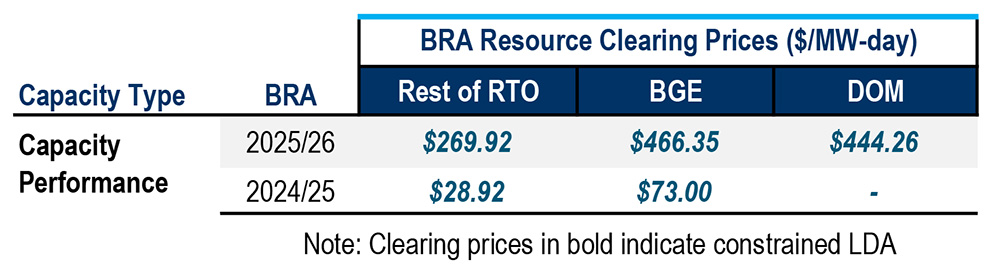
Last year’s auction results already had caused an uproar, as the clearing price for most of PJM was set at $269.92/MW-day, up dramatically from $28.92/MW-day the prior year. Baltimore Gas and Electric and Dominion fared even worse, at $466.35/MW-day and $444.26/MW-day. Total costs paid for capacity by all energy consumers soared from $2.2 billion to $14.7 billion in just one year.


Comparison of BRA clearing prices by delivery year by LDA | PJM

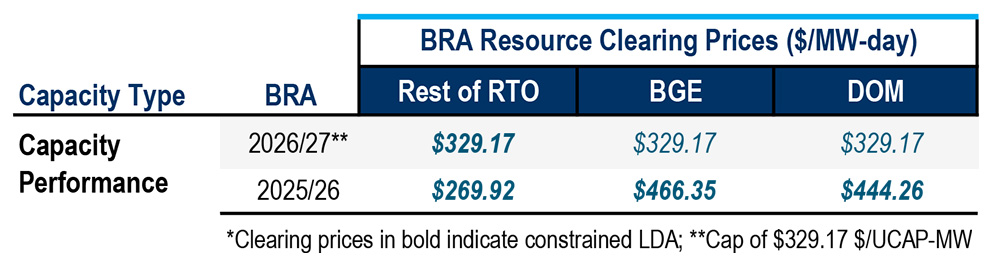
In response and in an attempt to limit future costs to customers, Pennsylvania Gov. Josh Shapiro (D) negotiated a floor and cap with PJM — eventually blessed by FERC — that would create a price band between $177.24/MW-day and $329.17/MW-day for the following two delivery years. (See FERC Approves PJM-Pa. Agreement on Capacity Price Cap, Floor.)

Many feared the July 2025 auction would hit the new cap, and it did just that, pegging out in all delivery zones at the same price (good news only for BG&E and Dominion) of $329.17/MW-day. Total estimated cost to load increased as well, from $14.7 billion to $16.1 billion. (See PJM Capacity Prices Hit $329/MW-day Price Cap.)


Comparison of BRA clearing prices by delivery year by LDA | PJM

Without the cap, it could have been worse. PJM noted in its BRA report that an uncapped simulated auction likely would have cleared at over $388/MW-day. Capacity prices now may be costing customers up to 25% or more of their total bill, raising the questions, “How did we get here?” and “What does this imply for future energy costs?”

The answers to those questions are not simple (though some politicians will try to paint them that way), but they generally come down to the balance between expected supply and forecasted demand.

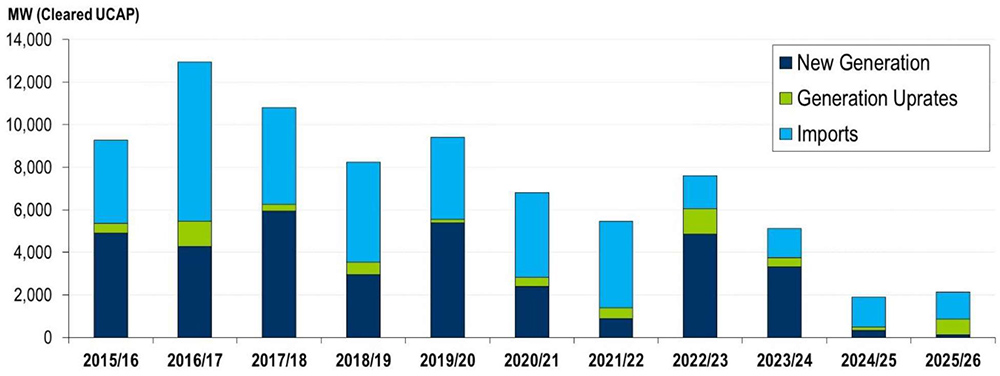
Supply: An Increasingly Bleak Scenario. Among major issues affecting supply, in 2024 PJM revised the way it accredited generation resources for their ability to provide capacity during critical peak periods. Nearly every type of resource in PJM’s portfolio took a significant hit.

For example, every nameplate MW of gas combined-cycle capacity was reduced from 96% to 79%, while that for simple-cycle peakers fell from 90% to 62%. Solar and storage capacity contributions also were revised downward considerably, and even nuclear and coal units were de-rated (from 99% to 95% and from 88% to 75%, respectively). Meanwhile, little additional capacity has been added to the grid recently, with much of that from renewables. Add to that the retirement of several coal units, and dispatchable supply capacity has not kept pace with demand.

Cleared MWs (UCAP) by new generation/uprates/imports by delivery year | PJM

Forecasted Rapid Demand Growth: An Unexpected Surprise. The perfect recipe for creating more pricing pressure when supply is limited is to add large amounts of potential new demand, and the addition of data center load does just that. These facilities are large (often well over 100 MW), disconnected from the general macroeconomic environment, and extraordinarily difficult to forecast, especially when the majority of current interconnection requests to utilities may never actually be served with power. Existing and forecasted data center load clearly had the potential for a significant impact on the past two auction results. The question is, how much?

In fact, it likely may have resulted in billions of dollars of unnecessary costs to consumers. PJM’s Independent Market Monitor (IMM) ran alternative scenarios earlier this year to evaluate this issue and concluded, “data center load growth is the primary reason for recent and expected capacity market conditions, including total forecast load growth, the tight supply and demand balance, and high prices.”

The IMM attributed $9.3 billion of the $14.7 billion from last year’s auction to data centers, noting, “the inclusion of forecasted data center load increased total revenues by $7,742,157 or 115 percent.” (emphasis added). The IMM further commented, “the role of data center load does not mean that PJM would not have eventually reached a point where supply and demand were tight, but that trajectory was relatively slow and would have resulted in more time to permit market reactions to address the balance of supply and demand.”

Phantom loads and poor forecasting are likely to create a political firestorm. What the IMM report implies is that if that forecasted future data load is incorrect, then everybody else ends up paying for a mirage that does not exist. That leads immediately to the more obvious multibillion-dollar question: “How accurate is PJM at forecasting data center loads?”

An analysis of how PJM arrives at its forecast is not very comforting. The grid operator arrives at its number by taking very imprecise utility forecasts that are based on interconnection requests from data center developers and speculators who buy land and place interconnection requests with the eventual goal of selling the projects.

Both types of entities place multiple applications with utilities in multiple states. Their behavior is similar to that of generation asset developers prior to FERC Order 2023 (which required them to put more financial skin in the game, with required deposits and penalties for withdrawing from interconnection queues).

Many developers placed multiple chips on the board, knowing that if one project succeeded, they eventually would withdraw the others. This resulted in highly inflationary supply numbers. In fact, Lawrence Berkeley Laboratory’s 2024 analysis of interconnection delays reported that for supply assets seeking interconnection between 2000 and 2018, only 19% actually flowed power by the end of 2023.

The data center dynamic is similar enough that some lawmakers and regulators are catching on. For example, recently passed Texas legislation SB 6 requires developers of large loads to disclose whether they are seeking similar requests for service elsewhere in Texas (note, that’s only in Texas).

It’s difficult to say how much inflated load actually exists, but one report characterizes this approach of developing multiple requests as a “low barrier, low cost, low risk strategy” employed by developers to access power wherever they can get it. That report also quoted a former Google senior director as saying the numbers could result in “five to 10 times more interconnection requests than data centers actually being built.”

Despite this inflationary dynamic, PJM’s 2025 large load forecast only minimally reduced the numbers supplied to it by the utilities in its service territory. While the problem already shows up in the capacity auctions for 2025/26 and 2026/27, this lack of rigor gets worse in the out years when projected data center growth skyrockets.

Not surprisingly, some consumers are worried, especially the more sophisticated and large users with the most to lose. A May 30 open letter to FERC from a number of large industrial groups urges the commission to “initiate an independent examination of current load forecasting practices and potential improvements to those practices.” That letter cites “the uncertainty and lack of transparency surrounding current load forecasting practices across the country,” and the impact it can have on costs.

What’s Next? The latest auction signals tough sledding for consumers, with little end in sight. Given the magnitude of the costs related to potentially inaccurate demand forecasts, combined with the red-hot politics surrounding the global race to dominate artificial intelligence, it’s not hard to imagine PJM’s capacity auction results becoming intensely and increasingly politicized.

The action to address this issue is to employ far more rigor in the forecasting process at the utility level (while ensuring that each utility uses similar processes) and employ a higher level of rigor within PJM’s forecasting approach. The second is to do everything possible to accelerate deployment of new capacity in the system.

However, with the next auction less than six months away, don’t expect the cavalry to arrive anytime soon. They haven’t even saddled up their horses.

Around the Corner columnist Peter Kelly-Detwiler of NorthBridge Energy Partners is an industry expert in the complex interaction between power markets and evolving technologies on both sides of the meter.

Equinor Takes $1B Impairment on U.S. Offshore Wind

Equinor is taking a nearly $1 billion impairment on its U.S. offshore wind development efforts and is blaming the Trump administration’s anti-wind power crusade for the impact.

A federal stop-work order on the Empire Wind 1 project cost Equinor millions, but that is not the only factor in the impairment, nor even the largest.

The company began building an offshore wind hub in New York City in 2024 to serve Empire Wind 1, the future Empire Wind 2 and other developers’ operations in the New York Bight. The assumption was that the over-$850 million price tag would be amortized across multiple future offshore wind projects, yielding cost-saving synergies in the process.

Now, Equinor said, there may not be any future projects.

This, combined with rising tariffs, the shelving of Empire Wind 2 and the delays on Empire Wind 1, led to a $955 million impairment announced July 23 as part of the second-quarter financials for the Norwegian oil and gas producer.

“The main driver for this is the changes in regulations for future offshore wind projects in the U.S.,” Chief Financial Officer Torgrim Reitan said during a conference call with analysts.

“Part of the impairment is related to the undeveloped Phase 2 of Empire Wind. However, the largest portion is related to the South Brooklyn Marine Terminal. The development of the terminal assumed future projects that would use it. This is now unlikely with the current framework conditions, and this new reality is reflected in the updated book value for Empire Wind 1 and the South Brooklyn Marine Terminal.”

The new U.S. policy framework will lead to a lower lifetime rate of return on Empire Wind 1, Reitan said, but continuing with construction was determined to be the best way to protect shareholders.

Even with the U.S. losses factored in, the company still expects a double-digit return on its offshore wind portfolio as a whole, he added.

Equinor was formed in 1972 as Statoil, a state-owned oil company. Norway still owns a majority stake in the company, which in 2018 was renamed Equinor.

It still is a major fossil fuel producer, with $104 billion in 2024 revenue from operations in more than 20 countries, including the United States. In the first half of 2025, it reported $2.2 billion in revenue and $694 million in net income on its U.S. exploration and production activity.

However, Equinor has set a goal of being a leader in the clean energy transition and becoming a net-zero company by 2050. One of the ways it plans on doing this is by leveraging its offshore fossil fuel expertise to become a global offshore wind developer.

It has had varying degrees of success with that.

In the United States, it holds seabed leases off the New York, Delaware and California coasts, each with about 2 GW of wind power potential.

Nothing is likely to be built in the Delaware and California lease areas any time soon.

But Empire 1 and 2 were early movers. They won offtake contracts from New York in 2019 and 2022 and obtained full federal approval in early 2024.

In early 2024, Equinor placed Empire 2 on hiatus due to market conditions. But it pressed ahead with Empire 1, making the final investment decision on the $7 billion project just weeks before Trump returned to office. Subsequent events have shown offshore wind developers were justified in their worries about Trump 2.0.