CPUC OKs New PG&E Rule to Speed Tx Connections for AI Data Centers, Others

The California Public Utilities Commission (CPUC) on July 24 partially approved a new rule that will make it easier for artificial intelligence data centers and other large customers such as EV charging stations to complete transmission connection projects in Pacific Gas and Electric’s territory.

PG&E in November 2024 applied to the CPUC for approval of the new retail tariff, Electric Rule 30, saying it had received 40 transmission connection applications since 2023. These new applications have increased PG&E’s retail customer transmission interconnection demand by more than 3,000%, utility representatives said.

“Given the unprecedented number of pending transmission-level service connection applications received between 2023 and 2024 that are awaiting negotiations with PG&E for retail service at transmission-level interconnection, it is reasonable to consider an interim implementation of Electric Rule 30,” the CPUC said in its decision, which temporarily approves the rule for transmission customers willing to foot the costs for needed upgrades ahead of a final decision by the agency (24-11-007).

The rule will allow transmission customers who provide advance payments and voluntarily commit to prefunding up to 100% of their needed network upgrades to bypass previously required procedures, speeding up their interconnection times.

In its application to the CPUC, PG&E contended that, without the new tariff, it must engage in lengthy one-on-one negotiations with those customers, often leading to “non-typical/exceptional” case filings that require the time and resources of the utility, the customer, the commission and other stakeholders.

The CPUC historically has required PG&E to complete an advice letter and case filing process for large transmission connection projects.

PG&E said the new rule would eliminate those negotiations, standardize the process and provide faster service for large load customers, while providing rate benefits and lower monthly bills for existing customers.

“This decision allows for interim implementation [of Electric Rule 30] for transmission-level customers who provide advance or actual cost payments and voluntarily prefund up to 100% of specific transmission network upgrades,” CPUC Administrative Law Judge Manisha Lakhanpal said in a June proposed decision recommending the agency approve the rule. “The decision requires new transmission-level customers seeking retail services to be responsible for the initial costs of all transmission facilities, rather than those costs being borne by ratepayers.”

The new rule applies to large transmission customers sized 50-230 kV and the following types of transmission facilities:

    • Type 1: Transmission Service Facilities
    • Type 2: Transmission Interconnection Upgrades
    • Type 3: Transmission Interconnection Network Upgrades
    • Type 4: Transmission Network Upgrades

Eligible transmission customers must provide advances and cost payments for Type 1-3 facilities and a 100% pre-funded loan for Type 4 facilities, the decision says.

The decision deferred PG&E’s request for refunds on Type 1-3 facilities; repayment of pre-funded loans and interest provisions; and repayment of loans for Type 4 facilities. A decision on these matters will be included in the CPUC’s final decision.

PG&E had said if the CPUC denied its application, pending connection applications regarding service requests would not be directly affected.

Cal Advocates, The Utility Reform Network (TURN) and the Joint Community Choice Aggregation group opposed the decision, saying PG&E’s proposal is “unjustified, premature and rushes the procedure without fully evaluating the impact on ratepayers.”

PG&E shareholders, rather than ratepayers, should be responsible for Electric Rule 30 costs because PG&E has not substantiated prospective benefits, Cal Advocates, a public agency, said about the decision.

TURN said the massive size of the data center load “increases the likelihood of causing or accelerating the need for expensive transmission system upgrades, which would be recovered primarily from other customers under PG&E’s proposal.” About 70% of the transmission-level service connection applications are data center load, the decision says.

The CPUC rebuffed the consumer groups’ concerns but agreed the cost implications of the new Electric Rule 30 are unknown.

Robert Mullin contributed to this article.

IESO Seeks to Fill Growing Regulation Needs

IESO will seek to fill its growing need for regulation services through competitive bids but will resort to bilateral procurements if there is insufficient interest, officials told stakeholders July 24.

IESO’s most recent Annual Planning Outlook found the ISO will need 30 MW of additional regulation as soon as next year — with needs growing to 100 MW by 2029 — as a result of expected increases in industrial loads such as electric arc furnaces.

Regulation is one of several capabilities IESO uses to keep its supply and demand in balance, including inertial response, the stored kinetic energy of rotating equipment tapped immediately following a system event; primary frequency response, the automatic adjustment of energy output by generators within seconds of an event; and operating reserves, which the ISO calls on within 10 minutes or 30 minutes of an event.

Regulation resources respond to IESO instructions within five minutes of an event, after primary frequency response and before operating reserves.

Requirements

Generators providing regulation must be dispatchable, able to follow automatic generation control signals every two seconds or less and have an energy ramp rate of at least 50% of the offered regulation capacity per minute. A resource offering 20 MW of regulation, for example, would be required to move at least 10 MW/minute to reach its setpoint. IESO proposes a minimum regulation capacity of ±10 MW.

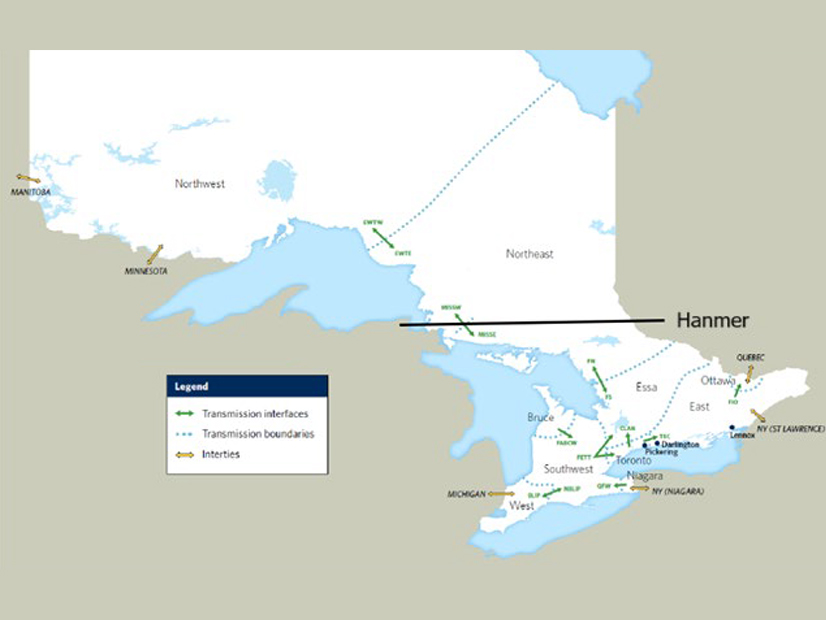
The ISO is seeking regulation only from facilities located south of Hanmer because severe weather in the Northwest zone and transmission congestion in the Northeast can restrict generation.

The ISO is only seeking regulation from facilities located south of Hanmer because severe weather in the Northwest zone and transmission congestion in the Northeast can restrict generation. | IESO

Storage currently is not eligible to provide regulation, but the capability will be added in future market rules under IESO’s Enabling Resources Program, the ISO said. (See IESO Seeks Feedback on Revised Storage Model.)

In addition, IESO’s dispatch scheduling software is unable to simultaneously schedule operating reserve (OR) from a resource providing regulation. As a result, resources providing regulation will receive real-time OR lost opportunity costs to make them whole for the OR revenue they would have received.

Because regulation is a reliability service, IESO does not need a government directive to procure it. The ISO could enter bilateral negotiations with facilities meeting technical requirements, or seek competitive bids, said Natalia Perdomo, an adviser in IESO’s market and system adequacy team.

“The ISO’s preference is a competitive procurement, as we believe it can provide better value for the ratepayer,” she said. “However, if there isn’t enough interest, the ISO can engage in bilateral negotiations.”

Next Steps

The ISO asked for written feedback by Aug. 8 via engagement@ieso.ca. It expects to decide on its procurement mechanism in the fourth quarter.

“If we do an RFP, the hope is that it would commence in 2026,” IESO’s Dina Shoukri said in response to a question about the timing and duration of the procurement.

“[The] duration of the contract, that is something we would have to determine,” she added. “A lot of the answers to those questions are going to be informed by the feedback we get. So, once we understand availability, readiness to deliver, how much is out there, it will help to inform the answers to those questions.”

IESO Sees Improved ‘Trust’ Ratings in Survey

IESO is gaining ground in its “trust” ratings, ISO officials say.

The ISO’s 2024 stakeholder and community engagement survey saw “across the board improvement” over 2023, Marko Cirovic, director of sector engagement, told the Strategic Advisory Committee at its July 16 meeting.

“Every key metric in the survey improved versus the previous year,” Cirovic said. “Notably, 82% of stakeholders and communities said that our engagements met or exceeded expectations. This is a 6% increase from last year. This is not only the highest score in six years, but it is also the largest year-over-year gain since we started tracking this measure. And this really tells me one thing: Our efforts to listen, to learn and to collaborate are resonating across the sector.”

IESO solicited responses from individuals who participated in engagements and conferences such as the First Nations Energy Symposium, along with those who worked on initiatives such as procurements and system planning. Respondents included distribution and transmission companies, generators and storage facilities, large consumers, municipal officials and Indigenous communities.

IESO described the results in a memo and appendix but declined RTO Insider’s request to release the full survey results.

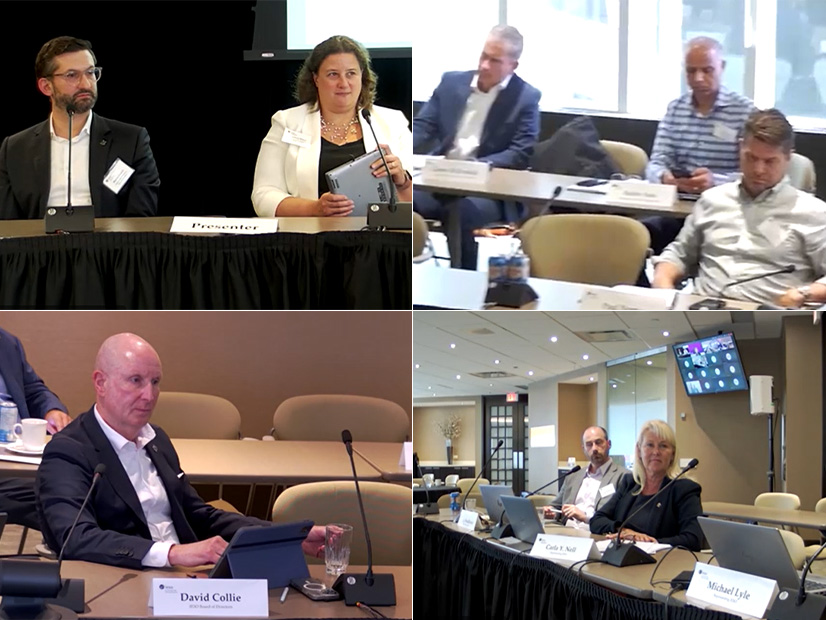
Among those attending the Strategic Advisory Committee meeting July 16 in Toronto were Marko Cirovic, IESO director of sector engagement (top left); IESO Board Member David Collie (bottom left) and Carla Nell, IESO executive VP of corporate relations, engagement and strategy (lower right). | IESO

The only negative cited in the ISO’s presentation of survey results: “Confidence in the IESO slightly decreased this year, with about one-quarter (26%) of respondents indicating that they would speak highly of the organization in comparison to one-third (34%) in 2023.”

The ISO noted that the 2024 question was updated from six answer options to four.

10-Point Scale

Some questions, including those measuring the trust respondents have in the ISO’s ability to deliver on its three core strategies, used a 10-point rating scale, with 1 being very negative and 10 being most positive.

Asked “how much do you trust the IESO” to “drive and guide the sector,” 73% ranked the ISO between 6 and 10, up 10 percentage points from 2023.

The ISO also reported gains in trust for “ensuring system reliability while supporting cost-effectiveness,” with 78% giving “top 5” ratings, up from 70%, and 65% giving top 5 ratings for trust in the ISO’s ability to “drive business transformation,” up from 55% in 2023.

Shifting Priorities

Cirovic said the survey also indicated a shift in respondents’ priorities.

“In 2023, sustainability was top of mind. In 2024, the focus has moved to future planning [cited by 51% of respondents], to affordability [also cited by 51% of respondents] and to reliability [cited by 46%],” Cirovic said. “This signals a growing emphasis on long-term resilience and growth.”

Sustainability/clean energy ranked as the third most pressing issue in 2023, following planning/design for the future and cost/price/affordability, respectively.

Factors Influencing Trust

The ISO said the five factors with the greatest influence on respondents’ trust in the IESO are: (1) transparency/information sharing; (2) long-term planning; (3) a track record of performance delivering reliable, affordable, sustainable electricity; (4) knowledgeable staff; and (5) communication and listening.

“There was also a positive correlation between the number of interactions with the IESO and respondents’ trust in the organization,” Cirovic said.

Almost nine in 10 respondents (89%) engaged with the IESO over the past year: 39% had between five and 25 interactions; 36% engaged fewer than five times; and 14% more than 25 times.

What’s Next?

The 2025 engagement survey will open in August. Respondents can opt in at engagement@ieso.ca.

BPA Customers to See Increased Power, Transmission Rates

Bonneville Power Administration customers’ power rates will increase by about 8 to 9% over the next three years, while transmission rates will jump by an average of nearly 20%, the agency said July 24.  

The agency published the rates in its final record of decision (ROD) for the BP-26 rate period covering the 2026/28 interval, which BPA says will be a one-time deviation from its typical two-year interval for rate-setting. 

“Lower than initially anticipated, the final rates for fiscal years 2026, 2027 and 2028 follow more than a decade of holding increases at or below the rate of inflation — an accomplishment that stands out among the rising rates of regional utilities during the same period,” the agency said in a statement announcing the decision. 

“We appreciate the incredible collaboration with our ratepayers across an array of power-, transmission- and tariff-related matters,” BPA Administrator John Hairston said in the statement. “We’ve developed a bedrock of support for the programs, projects and initiatives we’re implementing as Bonneville continues to meet the power and transmission needs of our utility customers, and to provide reliable, affordable and safe electricity to Northwest communities.” 

BPA’s power rate schedule consists of multiple categories of primary rates for federal energy sales, which include the: 

    • Priority Firm power rate, or “Tier 1,” which applies to firm power sales to BPA’s public body, cooperative and federal agency customers; 
    • Industrial Firm power rate, which is applicable to firm power sales to direct service industrial customers; and 
    • New Resource Firm power rate, which applies to firm sales to investor-owned utilities and public customers serving new large loads. 

Tier 1 “non-slice” contracts represent most of BPA’s power sales. “Non-slice” refers to a type of contract in which the customer is guaranteed a specified volume of energy regardless of conditions on the hydro system; in contrast, total volumes delivered to “slice” customers can vary based on availability.   

In its statement, BPA said the “average effective increase” for Priority Firm Tier 1 power rate will be 8.9%, compared with an initial proposed increase of 9.8%, while transmission rates will increase by an average of 19.9%. 

An appendix in the ROD provides greater detail, saying BPA staff will work to deliver a Tier 1 “non-slice” effective power rate no higher than $38.59/MWh, representing an increase of about 8.3% above current rates.  

For other categories, the appendix says, BPA “commits to produce rates no higher than $0.5/MWh above” the “indicative rates” of $37.96/MWh for Priority Firm Tier 1, $45.92/MWh for Industrial Firm and $111.99/MWh for New Resource Firm.    

“These rates will also enable the advancement of critical initiatives to meet our customers’ needs and support national priorities for more abundant, reliable and secure energy,” Hairston said in a preface to the final decision. “From implementing new long-term power sales contracts to pursuing day-ahead market participation and advancing major power and transmission investments, the work we accomplish over the next three years will be critical to the long-term success of BPA, our customers and the region we serve.” 

FERC Approves IBR Ride-through Standards

FERC on July 24 approved two new reliability standards establishing frequency and voltage ride-through requirements for inverter-based resources, completing the second milestone in the commission’s Order 901 (RM25-3).

The standards will take effect the first day of the first calendar quarter 12 months after the effective date of the commission’s approval order.

In its order, the commission largely followed its December 2024 Notice of Proposed Rulemaking. (See FERC Approves NERC Assessment, Seeks Comment on IBR Standards.)

That NOPR proposed approving PRC-024-4 (Frequency and voltage protection settings for synchronous generators, type 1 and type 2 wind resources, and synchronous condensers) and PRC-029-1 (Frequency and voltage ride-through requirements for IBRs), while also requiring NERC to submit two informational filings on exemptions to ride-through requirements for legacy IBRs.

Most comments on the NOPR supported approving the two standards, along with NERC’s proposed definition of the term “ride-through.” However, some stakeholders expressed concern that PRC-029-1 could cause projects to be delayed or even canceled. Ørsted Wind Power asked FERC to remand the standard for further development because “developing projects may be abandoned, decreasing generation when reserve margins are already tight.”

The Louisiana Public Service Commission also drew attention to the standard’s proposed exemption period, which would give owners of legacy IBRs — resources that are already in operation when the standard goes into effect — 12 months after the effective date of the standard to request an exemption to the voltage and frequency ride-through requirements. The PSC said this measure “impermissibly favors legacy IBR owners at the expense of [grid] reliability.”

Several comments mentioned the exemption process, with both Ørsted and Dominion Energy saying the developers ignored “extensive comments during the standard development process” raising issue with a perceived lack of consideration for projects in active development that cannot satisfy the standard’s ride-through requirements.

However, NERC replied that it followed all its rules for soliciting industry feedback, even after the Board of Trustees invoked its authority to accelerate the development process. (See “Board Invokes Standards Authority to Meet IBR Deadline,” NERC Board of Trustees/MRC Briefs: Aug. 15, 2024.) The ERO said the “standard was narrowly developed to avoid undue negative effects on competition beyond what is necessary for reliability.”

Invenergy, Ørsted and two clean energy associations also asked FERC to have NERC update the standard to implement another exemption for HVDC-connected IBRs with choppers — used in offshore wind projects to protect converters by dissipating excess power during grid faults. The commenters said IBRs with choppers cannot meet a 10-second ride-through window mandated in PRC-029-1 because the “chopper’s thermal limit requires tripping the HVDC system to prevent overheating and thermal damage beyond two seconds.”

Additional Exemptions?

In its filing, FERC said there was not enough information for it to determine whether additional exemptions are needed. The commission therefore directed NERC to determine “whether and … how to account for” the ability of chopper-equipped IBRs to comply with the ride-though provisions of the standard, as well as whether the “lead time between adopting IBR design specifications and placing the IBR in service” merits an exemption as well. NERC must submit its determination, along with any proposed changes to PRC-029-1, within 12 months of the order’s effective date.

Also due in 12 months are modifications to the standard addressing commenters’ concerns that “owners of legacy IBRs may not be able to secure the necessary documentation from … manufacturers” to identify the specific component of the IBR causing limitations.

The ERO will also have to submit an informational filing 18 months after the conclusion of the exemption process — 30 months after the effective date of the standard — to “assess the reliability impacts of the exemptions.” In this the commission was persuaded by NERC’s response to the NOPR, which proposed requiring two filings, 12 and 24 months after the effective date. FERC said NERC would need “more than 12 months to compile the data requested in the first filing, and a filing at 24 months will not be timely and may include redundant information.”

The filing must assess the reliability impacts of the exemptions for each interconnection and each reliability coordinator area, for the following data:

    • Total number of IBRs for which generator owners are subject to compliance with the standard and their aggregated MW capacity;
    • Total number of IBRs for which GOs requested exemptions and their MW capacity;
    • Total number of IBRs, and MW capacity, for which GOs were granted exemptions;
    • Total number of granted exemptions, and MW capacity, by exemption type (voltage and/or frequency); and
    • Total number of granted exemptions, and MW capacity, by IBR type (wind, solar, battery energy storage system or fuel cell)

At the commission’s meeting, Commissioner David Rosner thanked NERC staff for their efforts developing the standards, calling them “critically important work for the commission.”

“There’s nothing more appropriate than solving tomorrow’s problems today, before they become problems tomorrow, and that’s what we’re doing here on these standards,” Rosner said. “I [also] want to encourage vigilance here. I think we’re making progress on frequency ride-through, but there’s more to do.”

“What’s the next thing? What’s this commission, 10 years from now, going to look back to and think, ‘Hey, that was a good idea’?” he continued. “I think one of those things, perhaps, [is] asking [IBRs] to do more on their grid-forming capabilities. So I look forward to them working with their stakeholders [and] finding the right engineering solutions to these problems as they think through standards going forward.”

State Governors Seeking Ability to Nominate 2 Members to PJM Board

PJM member states are seeking the ability to nominate two candidates to the RTO’s Board of Managers as they grow increasingly vocal about their dissatisfaction with the affordability and reliability of the grid.

During the Members Committee meeting July 23, Virginia Energy Director Glenn Davis read a statement from nine state governors calling the status quo unsustainable and arguing PJM must take concerted, rapid action, including a new vision for how the RTO interacts with the states.

To that end, the governors called for a permanent process for the states to nominate candidates to fill two of the seats on the nine-member board. Candidates are selected by the Nominating Committee (NC), which is composed of representatives from each of PJM’s five membership sectors and three from the Board of Managers. Nominees are approved by the MC.

The statement was signed by the governors of Delaware, Illinois, Kentucky, Maryland, Michigan, New Jersey, Pennsylvania, Tennessee and Virginia. They argued there should be a formal role recognizing the shared responsibility of PJM and its member states to ensure affordable and reliable electric service.

That could take the form of a new organization where representatives of governors’ offices publicly meet with RTO leadership and stakeholders, they wrote. Such an association would allow the states to better understand the political and economic ramifications of data center load, and it would provide PJM with more intimate knowledge about the policymaking and discussions occurring in statehouses, they argued.

The governors had requested a meeting with the NC to recommend two candidates to fill open seats on the board and speak to their merits in a letter to the board July 16. They argued there is a crisis of confidence in the grid operator’s leadership that requires the appointment of “distinguished, widely respected individuals.” The governors said they have several candidates in mind.

“At a time of rapidly rising load growth, PJM’s multiyear inability to efficiently connect new resources to its grid and to engage in effective long-term transmission planning has deprived our states of thousands of jobs and billions of dollars in investment that may flow to other regions,” the governors wrote. “Now these deficiencies threaten the bedrock reliability and affordability our consumers expect and deserve. We are deeply concerned that PJM’s response has been typified by halting, inconsistent steps and rising internal conflicts within the stakeholder community that have recently culminated in the abrupt termination of two longstanding members of the Board of Managers and the imminent departure of the CEO.”

The NC responded with its own letter declining to meet with the states, stating that it felt that a wider conversation open to all the RTO’s stakeholders would be more beneficial. The committee also said PJM’s Code of Conduct prohibits it from considering candidates who had not submitted applications to the independent consultant retained for the candidate search, Korn Ferry.

The board also responded, inviting the states to attend the July 23 MC meeting and outlining PJM’s efforts to operate markets capable of delivering reliability at least cost while navigating an “explosion of demand growth” and generation deactivations, some of which have been prompted by state policies.

The nine governors (along with those of the other four states in PJM: Indiana, North Carolina, Ohio and West Virginia) are also planning to hold a technical conference to publicly discuss “organizational and market reforms at PJM, and to establish an active participatory role for member states and jurisdictions.” The conference is scheduled for Sept. 23 at the National Constitution Center in Philadelphia. Ohio Gov. Mike DeWine supported the nomination proposal in his own letter.

PJM and Stakeholder Responses

PJM Senior Vice President of Governmental and Member Services Asim Haque said staff have been very engaged with state executives and legislators. He said one of the most controversial decisions PJM has recently made was entering into a settlement with Pennsylvania Gov. Josh Shapiro to lower the maximum capacity clearing price and establish a price floor. (See FERC Approves PJM-Pa. Agreement on Capacity Price Cap, Floor.)

“Expect for that engagement to continue, and should you form a formal organization, we would support that as well,” he said.

He added that PJM already spends a great deal of time working with the Organization of PJM States Inc. (OPSI), though he said that does not mean the RTO could not engage with another organization representing state interests.

CEO Manu Asthana said the states have a major role in PJM, and their priorities deserve careful attention.

“I think we should build upon the excellent participation and voices of the states we already have at OPSI,” he said.

Jacob Finkel, Shapiro’s deputy secretary of policy, said the governors have a desire to play a more active role in PJM decision-making than the more responsive position OPSI has often been forced to take.

Paul Sotkiewicz, president of E-Cubed Policy Associates and former PJM chief economist, said he believes the notion that states should have a role in selecting board membership comes dangerously close to violating PJM’s independence, adding that RTOs are not a creature of the states, but rather of the federal government.

Sotkiewicz questioned whether states seeking greater engagement with PJM are prepared to take ownership and responsibility for RTO decisions and their consequences.

Finkel said the final decision over board appointments would remain with the PJM Members Committee, and the governors are not seeking anything that would run afoul of FERC Order 2000. Rather, they want to avoid PJM coming to state capitols and explaining that its markets are not functioning properly or interfacing well with state policies by having the states play a role in getting the market design right in the first place.

Board Chair David Mills said he doesn’t believe PJM has come to the states to say it has bungled market design, but out of a desire to collaborate. Those efforts can be undermined, however, when state officials discredit the RTO or make threats to withdraw, which can harm investor confidence, he said.

‘Mark Twain’ Summer Weather Eases CAISO’s Grid Operations

Below-average temperatures in California this summer have reduced demand and made electric grid operations uneventful so far, with the state reaching 40,000 MW of demand for the first time in July, CAISO CEO Elliot Mainzer said during a July 23 meeting of the ISO’s Board of Governors. 

Conditions have been favorable for grid operations across CAISO’s footprint: average temperatures in June were near normal, while temperatures in the first part of July were below normal, Mainzer said. 

“To [board] Chair [Severin] Borenstein, I say we are about halfway through 2025 and your attire today is indicative to a certain degree of the type of summer we are having in the Bay Area … a Mark Twain summer,” referring to the famous quote often misattributed to the author: “The coldest winter I ever spent was a summer in San Francisco.”  

In general, CAISO has avoided any major disruptions this year, but the region has August and September to go — the months that tend to offer the greatest grid challenges, Mainzer added. 

Although electricity demand has been lower than average, this year’s wildfire season is well ahead of last year’s pace in both frequency and severity, Mainzer said.  

As of July 1, 3,938 wildfires had occurred in California, compared to 3,339 over the same time last year. Acres burned is up substantially too: 182,497 acres this year so far compared to 76,152 last year. The five-year average for this time of the year is about 46,000 acres. 

California is set to meet electricity demand this summer under normal conditions, but in a worst-case scenario, the state could need to use more than 2,600 MW of contingency resources, according to a CAISO report in May. Wildfires outside the state could reduce import capacity by as much as 4,000 MW, the report says. 

AI Pilot Program Begins

Mainzer said also that CAISO is implementing an AI pilot program — called Genie — to support control room operations. The program will specifically help with facility maintenance requests and act as a “co-pilot” tool to enhance efficiency, Gopakumar Gopinathan, CAISO senior adviser of power systems technology, said in an email to RTO Insider. 

Genie can detect anomalies in maintenance requests and identify which transmission paths may be affected under certain scenarios. The AI program relies on historical data, operating procedures and related information sources to deliver clear, context-rich insights to operators, Gopinathan said. 

Genie is not meant to replace human decision-making tasks, Gopinathan said. 

“While the AI prototype can identify anomalies in maintenance requests, extract operational insights, and recommend next steps, all decisions remain under the direct oversight and authority of CAISO operators,” he said. 

Genie is being developed with Open Access Technology International (OATI) as part of CAISO’s control center modernization efforts and is not, at this time, implemented in a real-time environment, he said. 

“For now, the AI remains in testing mode, and no recommendations generated by the AI are being used in live operations,” Gopinathan told RTO Insider. “If the pilot meets performance expectations, this technology is expected to significantly enhance the support available to system operators, particularly in tasks that are repetitive and time consuming.” 

When asked if Genie will be used to help control room operators make real-time decisions about electricity flow on the grid, Gopinathan said the AI currently does not perform this task. 

FERC Approves SPP’s ERAS Process, Accreditation

SPP is celebrating several recent FERC orders that have strengthened its resource adequacy framework and will secure a “reliable energy future” for its region. 

The orders came in a flurry of filings related to resource performance and a one-time, accelerated pathway for new resources to help meet reliability needs through 2030. 

On July 18, FERC approved the RTO’s performance-based accreditation (PBA) and effective load-carrying capability (ELCC) methodologies (ER24-1317). Three days later, the commission approved SPP’s proposed Expedited Resource Adequacy Study (ERAS) that allows load-responsible entities to nominate qualified projects for fast-track reviews (ER25-2296). The ERAS approval is conditional upon the grid operator making a compliance filing within 30 days. 

FERC also issued orders allowing SPP and MISO to include ERAS projects in their Joint Targeted Interconnection Queue (JTIQ). 

SPP said the regulatory milestones are “pivotal steps” toward achieving the forward-looking RA posture it has championed in recent years. 

“FERC’s approval of these two cornerstone initiatives affirms SPP’s vision and the collaborative spirit of our members, regulators and stakeholders,” CEO Lanny Nickell said in a statement. “The ELCC and PBA methodologies provide a modern, fair and transparent approach to accrediting resources, and the ERAS process empowers our region to respond quickly to rapidly growing demand.” 

In making its ERAS filing in May, SPP said its region “is on the precipice of a resource adequacy crisis” and that it expects available capacity to drop below the balancing authority’s reserve margins by 2027. It said the region might run out of capacity to meet peak demand in 2030, as the footprint’s forecast demand has increased significantly. Data centers’ large loads and other technologies have further accelerated increased demand, the RTO said. 

SPP said it expects to grant generator interconnection agreements by the end of March 2026. 

Eight governors from SPP states jointly filed in support of the ERAS proposal, and several regulatory commissions intervened. LREs said that ERAS complements, rather than supplants, the grid operator’s reliability laws and processes because it offers an interconnection timetable that can accommodate resources that stem from competitive procurements already mandated by state law. 

However, public interest groups and clean energy developers opposed the proposal, as they did when it went through the grid operator’s stakeholder process. They argued that ERAS amounts to queue jumping, bypasses open access to the RTO and violates the FERC’s principle of nondiscriminatory access to the grid. (See SPP Board OKs 1-time Study for LREs’ Gen Needs.) 

“This is an affront to open access and a major and significant problem for those exploring whether or not to invest in SPP,” the Advanced Power Alliance’s Steve Gaw said during the Board of Directors’ consideration of the proposal. 

FERC instead found that SPP has “existing authority” under its tariff to evaluate and maintain resource adequacy and to manage its interconnection queue to provide sufficient generation to meet RA requirements. It agreed with SPP that ERAS requests will receive a GIA “significantly sooner” than those processed through the RTO’s normal study process. 

“As SPP explains, the one-time, limited ERAS proposal will allow SPP to accelerate the study of interconnection requests that are uniquely ‘shovel ready’ and that have been identified to meet an LRE’s near-term resource adequacy needs,” the commission said. “The ERAS proposal will enable resources to meet projected near-term resource adequacy needs more quickly than could be accomplished under SPP’s current interconnection [study] process.” 

FERC on July 21 also approved MISO’s second attempt to create a fast track for certain reliability-related projects in the queue. It had rejected an earlier version in May. (See related story, FERC Approves MISO Interconnection Queue Fast Lane.) 

The American Clean Power Association said both ERAS orders are a “dangerous misstep” that ignore “widely acknowledged market realities while signing off on the potential for major disruption for projects that have gone through the proper processes to be connected to the grid.” 

“The fastest-growing sources of energy — solar, wind and energy storage technologies — are the ones ready to deploy to help keep costs lower and power reliable … across both territories,” ACP’s Carrie Zalewski, vice president of markets and transmission, said in an email. “Maintaining reliable and affordable power requires a diversified grid and predictable measures to bring new resources online.” 

Zalewski said the organization is committed to advancing its shared goal and responsibility “to ensure these approved requests do not set a precedent that will cause lasting damage.” 

She said states with higher amounts of clean energy have seen an increase in reliability and lower electricity prices on average. Zalewski cited the 2025 polar vortex — when prices rose only 20% in Texas and California but more than 135% in MISO — and SPP’s performance during a summer 2024 heat wave as examples. 

The fast-track process is expected to mostly produce gas-powered resources, according to the Sierra Club. It noted several states in the RTOs’ footprints have recently passed laws that allow utilities to increase rates to finance new gas-burning power plants years before they provide a service. 

“FERC’s decisions make it possible for gas plants to cut in line at the expense of thousands of clean energy projects that have been waiting for years to interconnect, projects that are well qualified to meet MISO’s and SPP’s energy needs,” senior attorney Greg Wannier said in a statement. 

SPP currently has more than 30 GW of thermal generation in its queue, or about 19% of the total. 

ELCC, PBA Methodology Approved

SPP said FERC’s approval of its modern accreditation methods for wind, solar and storage and a PBA for traditional resources affirms its “new, data-driven approach to resource accreditation.”  

The RTO said it will be able to more accurately measure each generators’ reliability and ensure they are dispatched and compensated for their “real-world performance.” 

“This gives utilities and grid operators better tools to plan for and maintain a reliable grid,” SPP said. 

Commissioners David Rosner and Judy Chang filed a joint concurrence, noting “numerous” parties raised several methodological concerns with SPP’s proposal. 

“However, despite the concerns, commenters nonetheless appear to universally recognize that SPP’s proposal is an improvement over the status quo,” they wrote. “Given the growing urgency of the resource adequacy challenge in SPP, we are persuaded that the commission should accept this just and reasonable improvement.” 

SPP filed the tariff change in February 2024. The commission accepted the ELCC and PBA revisions, suspending both and consolidating them for paper hearings. That gave parties a chance to renew or modify their arguments after the grid operator added a fuel-assurance incentive to its PBA methodology. (See FERC Approves SPP Price Formation Rules; Needs More Time on Resource Accreditation.) 

FERC rejected SPP’s first attempt to add ELCC (the amount of incremental load a resource can dependably and reliably serve during peak hours) in 2023. (See SPP Markets and Operations Policy Committee Briefs: Oct. 16-17, 2023.) 

JTIQ to Use ERAS

The commission also issued separate letter orders July 21 allowing SPP and MISO to include ERAS projects and coordinate their study in the RTOs’ JTIQ initiative (ER25-2297, ER25-2461). 

FERC found the proposed revisions to the joint operating agreement to be just and reasonable, saying they clarify how an affected-system coordination process built for multiphase cluster studies will apply to ERAS interconnection requests. The commissions also said the proposed revisions ensure that ERAS requests meeting JTIQ criteria will be included in the initiative’s portfolio. 

The grid operators filed their identical JOA changes in May. The JTIQ framework enables MISO and SPP to develop a portfolio of “backbone network upgrades” to facilitate the interconnection of large amounts of generation near their joint seam. The framework includes a process for determining which requests from the RTOs’ interconnection studies will participate in the JTIQ by identifying groups of eligible requests. 

The SPP order is effective July 22 and the MISO order Aug. 6. 

HVDC Interconnection OK’d

FERC also accepted in another letter order SPP’s tariff revision outlining the planning process for evaluating the interconnection of HVDC facilities to its transmission system, effective July 23 (ER25-2309). 

The commission said SPP’s proposal set a general process for evaluating requests to interconnect HVDC facilities, including defining applicable terms, identifying relevant entities and their responsibilities, describing study processes for evaluating an HVDC request, and assigning responsibility for study deposits and costs.  

It said the tariff revisions increase transparency into the HVDC interconnection planning process, with implementation details “further specified in the SPP planning criteria and related operational documents.” FERC also found the revisions allocate responsibility for the interconnection study’s costs to the HVDC customer. 

NRC Moves Palisades Nuclear Plant Closer to Restart

The Nuclear Regulatory Commission has greenlit the retired Palisades Nuclear Plant’s transition back to an operating license.

The July 24 approval is a key milestone on the path to an unprecedented goal — bringing a reactor that had been in line for decommissioning back online and into full service.

It allows Holtec International to receive new fuel at the site and formally transition licensed operators to on-shift status, and it moves the facility closer to a full restart, which Holtec hopes to achieve in the fourth quarter of 2025.

Holtec on July 1 informed the NRC that it was ready to transition to the Power Operations Licensing Basis.

The NRC said July 24 it had determined the application complied with regulations, that the facility would operate in conformity with regulations and that operation would not be detrimental to public safety, health and security (Docket No. 50-255).

“This is a proud and historic moment for our team, for Michigan, and for the United States,” Holtec International President Kelly Trice said later in the day. “The NRC’s approval to transition Palisades back to an operating license represents an unprecedented milestone in U.S. nuclear energy.”

Activists opposed to nuclear energy in general — and to the restart of the aged Palisades plant in particular — had the opposite reaction.

Kevin Kamps of Beyond Nuclear said: “The zombie reactor restart scheme is unneeded, insanely expensive for the public and extremely high risk for health, safety, security and the environment.”

The NRC’s July 24 decision is not the end of the matter, he added: “We will exhaust all administrative remedies at NRC and then appeal to the federal courts. Our fight against this dangerous nuclear experiment on the Great Lakes shoreline is not over.”

Further regulatory approvals are needed, but Holtec is making steady progress, with the Trump administration continuing support extended by the Biden administration and ordering the NRC to streamline and speed its review processes.

Holtec plans to follow the Palisades restart with construction of small modular reactors and other advanced nuclear facilities in Michigan and elsewhere.

A wave of reactor retirements swept the industry as facilities aged and their expensive electricity became uncompetitive. Holtec bought three of these retired facilities, then purchased Palisades from Entergy in mid-2022, shortly after it ceased operation.

Subsidiary Holtec Decommissioning International would hold the license and be the prime decommissioning contractor.

But with major changes to the energy market on the horizon, Holtec soon decided to instead undertake a restart of the 800-MW plant, first licensed in 1971.

The effort gained momentum in 2023 as Wolverine Power Cooperative signed a power purchase agreement for up to two-thirds of the plant’s output.

Approximately 600 full-time nuclear workers are on site as the restart effort nears the finish line, along with roughly 1,000 trades workers, vendors and suppliers, Holtec said July 17.

The restart effort was unprecedented at the outset but no longer is unique.

There are only two other retired U.S. reactors believed to be candidates for restart.

Constellation Energy is spending $1.6 billion to bring the circa-1974 Three Mile Island Unit 1 back online by 2027. The reactor ceased operation in September 2019 for economic reasons and is being brought back for economic reasons: Microsoft wants its steady carbon-free power for its data centers and is willing to bear the costs.

NextEra Energy shut down its circa-1974 Duane Arnold nuclear plant in 2020 after storm damage but expressed interest to the NRC in early 2025 about a potential restart. CEO John Ketchum said recently that engineering studies are progressing favorably, and the company is talking to potential buyers for the electricity it would produce, should it restart.

Colorado Commissioners Spar Over PSCo’s Markets+ Choice

The Colorado Public Utilities Commission will soon decide whether to allow Public Service Company of Colorado (PSCo) to join SPP’s Markets+, but commissioners on July 23 had differing views on whether the move would be in the public interest. 

A decision is now expected during the commission’s July 30 meeting. In addition to seeking CPUC approval to join Markets+, the utility is also asking to recover costs associated with joining Markets+ through the electric commodity adjustment tariff. 

Markets+ has been in a heated battle for participants with CAISO’s Extended Day-Ahead Market (EDAM). 

During the July 23 meeting, commission Chair Eric Blank said he’d vote to approve PSCo’s application. He sees the company’s participation in Markets+ as a way to integrate Colorado’s two balancing authorities, run by PSCo and the Western Area Power Administration (WAPA). WAPA’s Rocky Mountain Region intends to join SPP’s RTO West. (See WAPA, Basin Electric Commit to SPP’s RTO West.) 

Blank also sees value in joining Markets+ related to resource adequacy, greenhouse gas accounting and wholesale market price transparency. Those benefits don’t necessarily show up in production cost modeling used to assess the day-ahead market, he said. 

“I can’t support denying the application and doing nothing,” Blank said. “In my view, we just need to keep the funding in place and to keep pushing the two Colorado balancing authorities together on the operational side as best we can.” 

Commissioner Megan Gilman said she was concerned that the benefits of joining Markets+ wouldn’t outweigh the costs. Cumulative net costs are expected to be around $30 million by 2031, she said. 

Blank argued that the amount was small relative to the utility’s overall spending in areas such as wildfire mitigation, distribution system upgrades and capital expenditures. 

“Why are you relying on a couple million dollars here versus there given the bigger issues at stake here?” he said. 

But Gilman didn’t seem convinced. 

“This decision should stand on its own,” she said. “If we’re entering a market, it should be because it provides net benefits to Colorado consumers. And I’m just not seeing that represented appropriately in the evidentiary record.” 

In terms of resource adequacy, Markets+ will require participants to join Western Power Pool’s Western Resource Adequacy Program (WRAP). Gilman said PSCo could choose to join WRAP without joining Markets+. 

“In evaluating the resource adequacy concerns, I’m not sure where that leads to Markets+ being the only solution and it certainly is an expensive solution,” she said. 

RTO Implications

Looming over the discussion was Senate Bill 72 of 2021, which requires electric utilities that own and control transmission facilities to join an organized wholesale market by 2030. The bill defines an organized wholesale market as an RTO or ISO. 

Commissioner Tom Plant said projections show that through 2042, the expected benefits of joining Markets+ would exceed costs by about $17 million. But from now until 2030, when utilities are required to join an RTO, “that doesn’t come out positive,” Plant said. 

There are expenses that must be paid whether or not PSCo stays in Markets+, he said, along with around $13 million for software that might not be transferable to a different market. 

“Direct cost benefits between now and when we are supposed to join an organized wholesale market seem to be clearly under water,” he said. 

Complicating matters is that PSCo could file a petition for a waiver from the RTO requirement as allowed under SB 72 — a move some commissioners are expecting. 

“If we — you — deny this petition [to join Markets+], I just think work on integrating the two balancing authorities in Colorado ends,” Blank said to his fellow commissioners. 

Governance, GHG Accounting

PSCo, an Xcel Energy subsidiary, filed its request to join Markets+ in February. (See PSCo Seeks to Join SPP’s Markets+.)  

PSCo is seeking recovery of about $2 million in Phase 1 costs through the electric commodity adjustment tariff. Cost recovery would also include Phase 2 expenses, consisting of about $14 million in administrative fees during the first five years of market operations and about $13 million to $15 million for technology upgrades. 

The CPUC held an evidentiary hearing on the matter on May 27-28. 

PSCo said it was drawn to Markets+ because of its independent governance, GHG emissions tracking and accounting system, and benefits “overall and in relation to costs relative to the other markets studied, including EDAM.”  

But a study commissioned by the Environmental Defense Fund said PSCo would receive millions of dollars more in annual benefits from participating in EDAM rather than Markets+. (See Study Finds PSCo Would Gain More in EDAM than Markets+.)