DETROIT — MISO’s Board of Directors has asked the RTO’s Independent Market Monitor to better explain its $10.6 million 2026 budget before it agrees to the amount.
During Board Week, members of the board’s Markets Committee said they wanted greater detail on a $5.9 million budget item the Monitor proposed for “base monitoring and data management tasks.”
Monitor David Patton said “base monitoring” includes screening MISO market activity, data management, reviewing market outcomes and operations, producing reports, and coordination with the RTO. However, he did not allocate specific costs for each of the responsibilities.
Patton said the tasks take up a large share of the monitoring budget because that is his primary responsibility.
Director Robert Lurie said he would not accept a similar level of vagueness in MISO’s proposed budgets. Director Theresa Wise similarly asked for more “visibility” into the budget.
Director H.B. “Trip” Doggett encouraged Patton to “polish it up” and bring the budget back to a nonpublic meeting with the board in October. The board and the Monitor then could present the final product during the next Board Week in December.
Hawkins said the IMM’s budget increase in 2026 appears lower than the national rate of inflation. He asked board members to share the results of their nonpublic meeting in October at the next Board Week in early December.
Over 2024, the Monitor operated with a nearly $10.2 million budget.
DETROIT — MISO said the summer of 2025 was the most demanding since 2012, though the RTO steered the grid with only a single maximum generation event.
“This summer was one of the most challenging in a decade,” Executive Director of System Operations Jessica Lucas told the Markets Committee of the MISO Board of Directors on Sept. 16.
Lucas said heat and humidity across the footprint were consistently high and that load exceeded 100 GW or higher for more than 750 hours over the summer, a number not seen since 2012 and nearly triple that of 2024.
The summer heat triggered more than 40 Energy Emergency Alerts across the Eastern Interconnection, but in MISO, “we only had one escalation” to an emergency, Lucas said.
MISO experienced a “sharp increase in outages” over the summer, Lucas said. The RTO reported 46 GW in average daily generation outages, compared to summer 2024’s 31-GW average, culminating in a 48% increase year over year. Lucas said members reported “equipment failure” as the leading cause of outages.
“It’s perhaps too early to call this a trend, but it’s an important data point to monitor to see if this extends into the fall,” Lucas said.
At a MISO board meeting Sept. 18, CEO John Bear said summer 2025 was “exceptionally demanding” and “signals a new normal for grid stress.”
The RTO encountered two rough patches in late June and again in late July. Lucas said that from June 21 to 24, the footprint contended with high demand, low wind output and high outages, leading to a maximum generation emergency on June 23. (See MISO Declares Max Gen Emergency in Heat Wave.)
Independent Market Monitor David Patton said he was impressed MISO avoided an emergency declaration on June 24 when virtually every other control area entered emergency procedures.
“What we saw this summer actually bears out what I’ve been saying: that ‘MISO is the most reliable RTO’ — at least among the ones that we monitor,” Patton said and again criticized NERC’s “high-risk” rating for the RTO.
The RTO kept up a near-daily cadence of capacity advisories for MISO South into September. The grid operator repeatedly said either forced outages, limited transfer capability or a combination of both were the culprits.
“You might have noticed we’ve been leveraging our capacity advisories more frequently,” Lucas said.
Stakeholders can construe the repeat advisories as an “indicator” of heightened reliability risks in MISO South, she said, but the RTO wants to communicate “so it doesn’t feel like anyone is caught by surprise” if it needs to institute emergency actions to deal with transmission or capacity issues.
Lucas also said MISO is developing a “set of criteria or methodology to step out of emergency declarations.” She said determining when gird conditions no longer require emergency actions and terminating declarations is a complicated decision that has operating ramifications.
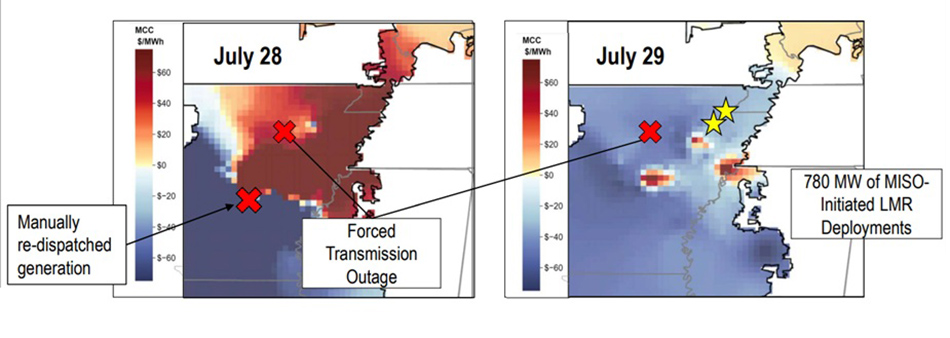
The MISO IMM’s depiction of the 500-kV transmission outage July 28-29 | Potomac Economics
Amid the late July heat wave, MISO reported it unexpectedly lost a 500-kV line in MISO South on July 28-29, leading it to order a local transmission emergency and 780 MW of long-lead load-modifying resources to dial back demand.
Data from Yes Energy show Entergy Arkansas’ 500-kV Keo-West Memphis transmission line from Little Rock, Ark., to Memphis, Tenn., was offline July 28-29.
Lucas said MISO issued six declarations July 29 to manage the situation.
Patton said MISO’s LMR use means it is learning to use demand response to manage transmission emergencies in addition to capacity emergencies. He also said MISO incurred only about $8 million in uplift charges over the summer because of sharper resource commitments and operating decisions.
“That’s like nothing,” Patton said. “My guess is that PJM is going to be in the hundreds of millions. …This pattern is really impressive.”
Finally, MISO set an all-time solar peak of 14.1 GW on Aug. 3. The new record was double the solar output MISO achieved in summer 2024.
Patton said the larger solar fleet has brought ramping challenges that are growing with the solar fleet. He said cumulative evening net load ramp demand “has grown sharply” from about 1 GW in 2023 to nearly 6 GW in 2025 and asked MISO to continue to keep an eye on its increasing requirements. Evening ramping needs also occur later on summer nights, Patton said, with the largest need moving from 4 p.m. ET to 6 p.m. because of solar tapering down.
RTO Insider is a wholly owned subsidiary of Yes Energy.
PORTLAND, Ore. — When former SPP COO Carl Monroe hands out his business card these days, it reads, “Carl Monroe, Principal, Munro Advisors.”
“Munro?” Is that a misspelling?
“It’s the traditional way of spelling Monroe. They were Irish,” Monroe says of his ancestors. “‘Munro’ means they’re from the River Roe in Northern Ireland.”
The Munros were also “tenacious fighters” during the 1400s and into the 1600s, centuries punctuated by the Hundred Years’ War, King Henry VIII’s reign, the English Civil War and the beginning of the Jacobite Risings.
“They fought so ferociously that the Scots hired them as mercenaries to fight all the Scottish clans,” Monroe says. “Eventually, they got enough esteem that they are one of the clans that are considered [part of] Scotland, or Scotch-Irish.”
The Munros were so highly respected that the Scots gifted them land for their own castle, Monroe says.
When the story is related to an SPP stakeholder, who had just greeted Monroe on the sidelines of an industry conference, he says, “Had I known that he was so lethal, I would have given him a wider berth.”
Of course, unlike his ancestors, Monroe is anything but “lethal.”
A veteran of more than 45 years in the industry that first included stints with Ameren and Entergy, Monroe spent 15 of his final 22 years with SPP as its COO. That made him responsible for grid operations across the RTO’s 14-state balancing authority area, a footprint that grew from eight states during his tenure with the addition of Nebraska’s public power entities and the Integrated System in the Dakotas.
Independent transmission developer Grid United, for whom Monroe now serves as one of three members of its Advisory Board, credits him for being “instrumental” in expanding SPP’s footprint by 20% and adding $1.5 billion of transactions in the real-time energy market.
“Carl has helped to shepherd us through tremendous change and growth. We just wouldn’t be where we are today without his leadership,” SPP CEO Nick Brown said when Monroe announced his retirement in 2019. (See SPP COO Monroe to Retire in Early 2020.)
The footprint is expanding once again. The RTO’s expansion into the Western Interconnection will be live in April 2026. In 2027, SPP Markets+, a day-ahead service offering that includes real-time commitment and dispatch, will begin operations. It will replace the grid operator’s Western Energy Imbalance Service market, which it has administered on a contract basis since 2021.
SPP has also been serving as a reliability coordinator for primarily future Markets+ participants since 2019, and it was chosen by CAISO and five utilities nearly 10 years ago to administer the Western Interconnection Unscheduled Flow Mitigation Plan, which manages the use of certain controllable devices to mitigate congestion along transmission lines. The RTO was also selected as the program operator for the Western Power Pool’s six-year-old Western Resource Adequacy Program (WRAP).
Much of that is credited toward the “instrumental” Monroe and his outreach for more than a decade to Western Interconnection entities. He led SPP’s effort to add the Mountain West Transmission Group, a Front Range initiative that fell apart after Xcel Energy subsidiary Public Service Company of Colorado pulled out and led to a broader Western Market Exploratory Group that studied the benefits of a regional market. Years later, PSCo is one of seven entities joining Markets+ after Colorado regulators ordered the state’s utilities to join regional markets.
Jack Moore, an SPP IT engineer involved in the Markets+ development effort, spoke recently during a stakeholder meeting here. He prefaced his comments by remembering his first visit to Portland in 2010, when he accompanied Monroe to talk with the Bonneville Power Administration about “an energy market in the West.”
“So, 15 years later, here we are,” Moore said.
“That was one of the things Carl was always doing, just seeing whether there was a way that SPP could meet potential stakeholder needs,” said Jim Gonzalez, SPP’s director of seams and Western services. “As we hear opportunities for help, facilitating and collaborating, that’s one of the things SPP has always really been open to. If we have neighbors and there seem to be needs, can we help meet those needs?”
“That’s a lot of it,” Monroe says by way of agreement. He described a “paradigm shift” that has taken place with wholesale markets and the West’s growing understanding of their benefits.
“That’s why you’re seeing a lot of the development of markets out there. I think you’re starting to see that paradigm shift about having a real real-time [market] and a wholesale market that actually provides more benefits to them than trying to hold onto control of those things,” he says.
“It really gives them a way to mitigate some of the risks. … That’s why you see a whole lot of interest, but there’s some underpinnings that at least we stumbled through in the East,” Monroe adds, listing tariffs, balancing authorities, resource adequacy and “those types of things” that grid operators do. “It just means that a group of utilities can decide how to do those things together in a way that provides a benefit to the whole that is greater than the benefit each of them can provide individually.”
As an example, he points to the WRAP and utilities that got together “with SPP’s help” to understand how they could work together in a resource adequacy program.
“I was an adviser for some of that too,” he says. “Together, they could rely on each other’s resource adequacy more and ensuring that each party was upholding their portion that they had to rely on.”
“In nearly 15 years as a director at SPP, I’ve met no one with greater knowledge of markets and operations or with such ability to collaboratively address complex issues,” SPP Board of Directors Chair Larry Altenbaumer said of Monroe when he announced his retirement.
His decision just happened to coincide with the COVID-19 pandemic, making him something of a forgotten figure. He was asked what he intended to do with his spare time and whether he would go into consulting.
“I didn’t know the difference between retirement or COVID. Everybody just went home to work,” he says. “I spent some time with SPP near the end working with the West trying to help them out, first of all, just to understand what it means to work together and what benefits you get out of it, [and] beyond that, what SPP could do for them. Of course, you’re seeing some of that play out today.”
SPP gave him a contract to “do one little thing,” but when he was finished with the project, he was free to work with others. With his somewhat eponymous consulting firm, Monroe helps clients with bulk power system operations, reliability standards, wholesale energy markets, strategic planning, FERC tariffs and other issues.
“I don’t want to do things that are not interesting to me, but this industry is really interesting,” he says. “The transition that it’s going through … it’s just been fascinating to watch the industry and what the industry needs to do, but at the same time, how it’s needed within the country and what reliability means to the country itself as critical infrastructure. …
“There are things I know that I can help people with,” Monroe adds. “There were a few people that called and wanted some help and just understand SPP and our wholesale markets and stuff like that. So that’s been a lot of fun.”
Besides his work with Grid United and its HVDC projects, Monroe also has consulted with solar and hybrid storage in both interconnections.
“Some are looking at markets, and some are looking at coordinating their activities together with others for optimized operations,” he says. “But the most interesting thing, [which] gets me my 49th state to do work in, is an RTO for Alaska.”
Monroe graduated from Auburn University with a degree in electrical engineering. While at SPP, he decorated his office with a black-and-white photo from his time on The Plains. The image shows Elvis Presley’s 1974 performance on campus at the Memorial Coliseum. Monroe would direct visitors to the AV booth in the background, from where he was responsible for lighting The King.
He joined SPP from Entergy, originally being hired to manage the RTO’s growing IT department. He was elected as an officer and promoted to executive vice president and COO in 2004, where he oversaw operations, the power system’s long-term forecasting and planning, and interregional coordination.
“I believe his personal efforts, contributions and leadership were critical to the tremendous development and success of the Southwest Power Pool,” said longtime member Mike Wise, with Golden Spread Electric Cooperative.
“I’ll do what I can to help people,” Monroe says. “If I can’t help you, I’ll tell you I can’t help you. That’s fine. I’m enjoying what I do, whether I do anything or not.”
Nothing to do? Given Monroe’s history, that’s a little hard to believe.
As decarbonization policy and the growth of intermittent renewable power in New England drives increasing needs for clean balancing resources, a developer in Maine is evaluating whether pumped storage hydropower — one of the oldest generation technologies still used in the region — could play an increased role in the grid of the future.
The history of pumped storage dates back about 100 years in New England. The Rocky River facility, which remains in operation today in western Connecticut, was the first of its kind in the U.S. when it came online in 1929. It was built to help balance the variable production profile of run-of-river hydropower.
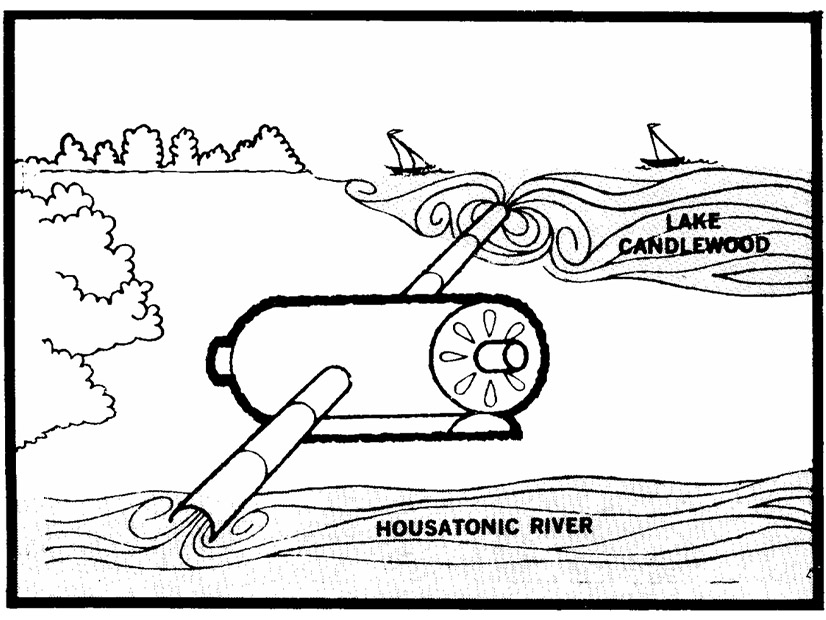
The facility is based on a simple concept: During periods of low-cost power, two 3.5-MW reversible pump turbines push water from the river to a large reservoir at a higher elevation. When power demand peaks, water flows downhill to produce power through the two turbines and a larger conventional generator.
In the 1960s and 1970s, the proliferation of nuclear power in New England spurred the development of two significantly larger pumped storage facilities in Western Massachusetts.
Northfield Mountain, which has 1,168 MW of qualified capacity with ISO-NE, and the Bear Swamp Generating Station, which has 662 MW of capacity, were built by utilities to help match the production profile of the nuclear resources with demand, allowing the nuclear plants to stay online at a constant level. The pumped storage facilities charged during low-demand periods at night and discharged during peak load periods in the day.
The facilities are open-loop systems, pumping water from rivers to elevated reservoirs. They use large reversible pump turbines that are about 30% less efficient when pumping water uphill than when generating.
In the 50 years since the two plants came online, all but two nuclear plants in New England have been decommissioned, but Northfield Mountain and Bear Swamp remain in service.
“The economics of the projects really haven’t changed. You’re still looking for that price arbitrage: We’re going to try to pump when prices are low, and we’re going to turn around and generate when prices are higher,” said Justin Trudell, CEO of FirstLight Power, which owns and operates the Rocky River and Northfield Mountain facilities. Trudell previously worked at Brookfield Renewable, which co-owns Bear Swamp.
To recover the costs of pumping water, “you’ve got to at least make up that 30-ish-percent loss of efficiency in that price arbitrage; that would set your baseline,” Trudell said.
He added that, over the past decade, the steady increase of solar generation has caused the typical temporal pattern of pumping and discharging to shift.
“On sunny days, especially in the summer, we’re seeing deep troughs in pricing midday when you have this glut of solar online,” Trudell said. “We’re seeing a lot more opportunities now where we’re actually pumping during the day, and we’re generally generating during the evening peak.”
With the growth of intermittent renewables poised to continue in New England because of clean energy policies, increasing power demand and the challenges of fossil development in the region, states are looking to procure significant amounts of new storage capacity.
Connecticut has set a goal of deploying 1,000 MW of storage by 2030, while Massachusetts in 2024 passed legislation aiming to procure 5,000 MW of energy storage by mid-2030, broken into mid-duration, long-duration and multiday categories.
Western Maine Energy Storage, a company backed by construction corporation Cianbro, is investigating whether new pumped storage facilities could help meet this storage need, and in July it submitted a preliminary permit application for a 400- to 500-MW project in Dixfield (P-15410).
The proposed reservoir system effectively would function as a closed-loop system, featuring two 100-acre reservoirs at different elevations.
The upper reservoir of the Northfield Mountain pumped storage facility | FirstLight
This design may help the project avoid some of the environmental challenges associated with open-loop pumped storage facilities connected to river systems. Northfield Mountain and Bear Swamp are involved in extended relicensing proceedings with FERC and have drawn criticism and opposition from environmental groups over impacts on downstream ecosystems.
Western Maine spokesperson Tom Brennan said the project is enhanced by the increasing arbitrage opportunities brought by renewable production in the region. He highlighted Maine’s goal of achieving 100% clean power by 2040.
“If we’re going to do that, we’re going to need storage,” Brennan said.
He said the company has been evaluating potential sites for a pumped storage project “for many years,” adding that “Maine is, in many ways, ideal because of the topography variation.”
“It’s because of that topographic variation and access to a significant and appropriate transmission line that has us focused in on Dixfield,” he said.
Unique Characteristics
Compared to lithium-ion batteries, pumped storage resources typically have a longer duration, though they rarely discharge to the point of depletion. Northfield Mountain has a duration of nearly eight hours, while Bear Swamp has a duration of about 4.5 hours.
Both facilities also tout their ability to ramp up from no output to full output within about 10 minutes.
“We’re faster[-ramping] than gas, and we’re longer-duration than most batteries,” FirstLight’s Trudell said. “We’re in this sweet spot of being able to provide more of a service for a longer period of time than some of these other technologies.”
Trudell said Northfield Mountain relies primarily on revenues from the ISO-NE wholesale markets and often is held in reserve by the RTO as a first contingency. He emphasized the reliability benefits of the facility’s ability to quickly ramp up or down as needed.
As ISO-NE works to overhaul its methodology for accrediting resources in its capacity market, storage owners have pushed for the RTO to account for ramp-up time in its accreditation methodology, and the storage industry is closely following the accreditation project to see how the changes could affect future capacity market revenues. (See ISO-NE Kicks off Talks on Accreditation, Seasonal Capacity Changes.)
State revenues generally are not a major revenue source for existing pumped storage resources; while Massachusetts’ Clean Peak Energy Standard does not exclude pumped storage resources from generating Clean Peak Energy Certificates, resources that came online prior to 2019 are not eligible. Bear Swamp, which underwent an upgrade after this deadline, has qualified about 88 MW of its capacity in the program.
In July, Massachusetts issued a procurement of 1,500 MW of mid-duration storage, seeking to buy environmental attributes including Clean Peak certificates. (See Massachusetts Seeks 1,500 MW of Mid-duration Energy Storage.) Bear Swamp bid its full 88 MW of Clean Peak-qualified capacity for the procurement on Sept. 10.
‘Who’s Going to Buy the Power?’
By nature, pumped storage projects are capital intensive, and any new facility likely would need a significant amount of revenue certainty for investors to commit to a project.
“The question is offtake, and you’ve got to get offtake before you get financing,” Trudell said. “We know how to license, from the federal side, a new pumped storage project. The problem is: Who’s going to buy the power?”
Connor Nelson, manager of regulatory affairs and markets at the National Hydropower Association, noted there has been no new pumped storage built in the U.S. in about 30 years, in part because of these barriers.
1980 illustration of the Rocky River pumped storage system | The American Society of Mechanical Engineers
“What you have is a long-lead-time, capital-intensive resource,” Nelson said. “You need patient capital, patient investment, and you need, in a lot of cases, some sort of long-term capacity contract or a strong market signal that can assure developers and investors that this is going to be worth it in the long run.”
However, he stressed that there is an “ever increasing need for long-duration energy storage” and that the “prospects for pumped hydro are as good as they’ve ever been, in part because there’s a lot of good federal incentives right now.”
He noted that the recent federal reconciliation bill did not strip incentives for pumped storage resources, and developers that begin construction by 2033 could get “upwards of 30% of that investment back in the form of a tax credit or direct pay if you’re a utility.”
Western Maine’s Brennan declined to comment on the type of contracts or revenue certainty the company would need to move forward on the Dixfield project.
“We are so early in the process,” Brennan said. “I am very short on details at this point; the design details will be in the works for some time to come.”
Members of NERC’s Standards Committee approved a set of waivers that could see comment and ballot rounds for several high-priority standards projects reduced to as few as five days during their quarterly in-person meeting, held at Duke Energy headquarters in Charlotte, N.C., on Sept. 17.
The waivers apply to Project 2020-06 (Verifications of models and data for generators), Project 2021-01 (System model validation with inverter-based resources) and Project 2022-02 (Uniform modeling framework for IBRs). All three projects relate to Milestone 3 of FERC Order 901, which directed NERC to develop requirements for modeling of inverter-based resources and submit them to the commission by Nov. 4. (See FERC Orders Reliability Rules for Inverter-Based Resources.)
In light of this tight schedule, the committee already agreed at its April meeting to shorten the initial comment and ballot periods for the projects from the customary 45 calendar days to as few as 25, and to shorten their final ballot periods from 10 to five days. (See NERC Standards Committee Approves IBR Posting.) All three projects conducted their initial ballot periods earlier in 2025, but none reached the required threshold for approval.
Committee Chair Todd Bennett, of Associated Electric Cooperative Inc., reminded members that the waiver request was meant to give the standard drafting team the “flexibility” to reduce the ballot time, acknowledging that the committee had “begun to use waivers a bit more often” in recent years to deal with the growing number of high-priority work items. While attendees generally were supportive of the option, several raised concerns that their implementation could cause problems.
“The concern for some people with a five-day comment period is that you’re almost guaranteed to include a weekend in there, which takes that five days down to three,” said Keith Jonassen of ISO-NE. “The only thing I would want to see is [the projects not] be posted on a Thursday or Friday to encompass that weekend.”
NERC Director of Standards Development Jamie Calderon said the ERO was aware of this possibility and is actively looking for posting dates for the affected projects that would start early in the week. While nothing has been decided yet, she said the next comment period could begin Sept. 22.
Similarly, Maggy Powell of Amazon Web Services warned NERC that extra effort may be needed to make sure stakeholders are aware of the limited time to weigh in on the standards.
“When you shorten it, you do run the risk of it failing, because if people don’t have the time to review it, they vote ‘no,’ or it just gets missed,” Powell said. “So I guess my suggestion is to really drive all the communication as much as possible … so that people have a chance of being aware when it’s coming.”
Calderon acknowledged Powell’s recommendation and said NERC will remind potential voters to take part in the ballot round.
Additional Standards Actions
Members acted on another high-priority item at the meeting, voting to authorize modifying the recently approved standards on internal network security monitoring (INSM) at certain grid-connected cyber systems as directed by FERC.
The commission approved CIP-015-1 (Cybersecurity – INSM) on June 26; the standard requires utilities to implement INSM for all high-impact grid-connected cyber systems with or without external routable connectivity (ERC), as well as medium-impact systems with ERC. FERC also directed NERC to make further changes, due in September 2026, that would extend the implementation of INSM to electronic access control or monitoring systems and physical access control systems outside the electronic borders around their internal networks.
The committee’s authorization follows its acceptance of a standard authorization request and approval of a drafting team for the project, and a 30-day informal comment period for the SAR.
Also approved at the meeting was a 45-day formal comment and ballot period for proposed standard FAC-002-5 (Facility interconnection studies). (See page 46 of the committee’s meeting agenda.) The new standard would “require [transmission planners] and [planning coordinators] to collect electromagnetic transient (EMT) models from applicable entities and conduct EMT studies where necessary, ensure accurate models are provided and verified prior to commercial operation, and clarify requirements on applicable entities providing accurate models.”
One of the final standards items on the agenda saw the committee appoint seven members, including the chair and vice chair, to the drafting team for Project 2025-01 (Canadian-specific revisions to EOP-012-3), which is intended to address potential compliance difficulties that NERC’s cold weather standard could have for Canadian entities.
Members also agreed to authorize posting for a 45-day comment and ballot period a new standard that would require industry to perform energy reliability assessments for the near and long terms. The standard is unnamed; NERC Manager of Standards Development Alison Oswald told attendees the drafting team felt its subject matter could warrant creating “a new family of standards” on which stakeholders will be asked their opinions during the comment period.
Chair, Vice Chair and Member Elections
Committee members approved AECI’s Bennett for another two-year term as chair, with current Vice Chair Troy Brumfield, of American Transmission Co., also retaining his seat for another two years. Their next terms will run from Jan. 1, 2026, through Dec. 31, 2027.
Members were reminded of the upcoming elections for committee membership that will run Oct. 22-31. Members serve staggered two-year terms beginning Jan. 1 of each year; those whose terms will expire Dec. 31 are:
Segment 4: Transmission-dependent utilities — Marty Hostler, Northern California Power Agency
Segment 5: Electric generators — Terri Pyle, Oklahoma Gas & Electric
Segment 6: Electricity brokers, aggregators and marketers — Richard Vendetti, NextEra Energy
Segment 7: Large electricity end users — AWS’ Powell
Segment 8: Small electricity users — Robert Blohm, Keen Resources
Segment 9: Federal, state and provincial regulatory or other government entities — Paul MacDonald, New Brunswick Energy and Utilities Board
Segment 10: Regional entities — Dave Krueger, SERC Reliability
All of the currently serving members are eligible for re-election; in addition, stakeholders may nominate additional candidates from Sept. 22 to Oct. 13.
Along with those whose terms are expiring, Segment 1 (Transmission owners) is vacant, and Segment 5 will hold a special election to replace Josh Hale of Southern Power, who has moved to another role within the utility. He resigned from the committee at the end of the meeting.
The Department of Homeland Security’s Cybersecurity and Infrastructure Security Agency (CISA) has released its vision for the future of the 26-year-old Common Vulnerabilities and Exposures (CVE) Program, pledging financial support and stability for the framework as it transitions from a “growth” to a “quality” focus.
Begun in 1999 as a research project at MITRE, the CVE Program has been sponsored by DHS since 2003 and by CISA since the agency’s establishment in 2018. Users have access to “a common lexicon of real, exploitable vulnerabilities,” CISA Executive Assistant Director for Cybersecurity Nick Andersen said in a blog post. Since its inception, the program has enrolled more than 460 partners across 40 countries.
The period until now represents the program’s “growth” era, CISA staff said in the CVE Quality for a Cyber Secure Future document, released Sept. 10. The document’s authors called the program “one of the world’s most enduring and trusted cybersecurity public goods” that “has contributed to exponential growth in the cybersecurity community’s capacity to identify, define and catalog hundreds of thousands of vulnerabilities.”
“If you’re a cybersecurity practitioner, you already rely on the CVE Program — whether you realize it or not,” Andersen said.
However, the future of the program was called into question earlier in 2025 when MITRE reportedly informed program managers that the federal government’s contract for the corporation to maintain the CVE program had been cut and the program would have to shut down by April 16.
Matt Hartman, CISA’s then-acting executive assistant director for cybersecurity, said in a release that the problem was “a contract administration issue” and that CISA had stepped in to resolve the issue before the contract lapse. But Andersen acknowledged in his Sept. 10 post that “significant debate” about the program’s future had occurred in recent months amid reporting that federal funding for the program was in jeopardy.
Andersen laid claim for CISA to “the mandate, mission and momentum to lead [the CVE Program] into the future,” saying the agency’s accountability to the American people made it a crucial independent voice in the program’s decision-making. CISA staff echoed this argument in their document, saying that alternate arrangements like privatization had been considered but found wanting.
“Privatizing the CVE Program would dilute its value as a public good,” CISA staff wrote. “The incentive structure in the software industry creates tension for private industry, who often face a difficult choice: promote transparency to downstream users through vulnerability disclosure or minimize the disclosure of vulnerabilities to avoid potential economic or reputational harm. These built-in conflicts could have a detrimental impact on program transparency.”
The authors also said alternate stewardship models might lack stability, leaving the program open to “undue financial pressures or contribution-driven influence.” As a result, they said CISA needs to take a more active role in the management of the CVE Program.
Staff identified several areas in addition to funding through which CISA can support the program. The first is for the agency to use its connections with its international counterparts, academic institutions, security researchers, operational technology developers and operators, and others to grant them more representation in the program that can “yield valuable insights and innovations.”
CISA also will support infrastructure modernization and the implementation of services including automation to improve services, while incorporating community feedback into road map decisions to expand transparency and communication. Data quality is another area for investment, with plans “to find creative ways to achieve quality, improve the CVE schema and forge ahead with innovative solutions,” the authors wrote.
“CISA is reaffirming our leadership role and seizing the opportunity to modernize the CVE Program, solidifying it as the cornerstone of global cybersecurity defense,” Andersen said. “In collaboration with the global cybersecurity community, CISA is committed to delivering a well-governed, trusted and responsive CVE Program aimed to enhance the quality of vulnerability data and global cybersecurity resilience.”
DETROIT — MISO’s generator interconnection queue has fallen to 215 GW as developers cut back on projects in response to the federal phaseout of renewable energy tax incentives, RTO leadership said Sept. 16 during Board Week.
The queue currently contains 1,127 projects at 215 GW. That’s down from more than 300 GW earlier in 2025.
“We’re starting to see significant withdrawals,” MISO Vice President of System Planning Aubrey Johnson told the System Planning Committee of the Board of Directors.
Johnson said projects that entered the queue in 2023 would be hard-pressed to be online in time to meet a 2028 phaseout of federal tax incentives. He said developers are making decisions to trim projects based on the changing economics.
MISO’s tariff expects that generation projects can scale the regular interconnection queue within 373 days; however, the actual average timeline is 1,511 days. The RTO is working to get to a 365-day completion rate with the help of automated studies from tech startup company Pearl Street Technologies. (See MISO: New Software Effective, Faster than Previous Queue Study Process.)
Johnson said resource changes are showing up in the next set of members’ integrated resource plans. Currently, MISO’s 2023 cycle is down to 102 GW from the 123 GW of projects that entered.
“We expect to see significantly more withdrawals in the 2023 cycle,” Johnson said.
Meanwhile, 75 GW are all that remains of MISO’s jumbo, 171-GW 2022 cycle, and 38 GW still are standing from MISO’s 77-GW 2021 cycle.
MISO said it processed 100 generator interconnection agreements totaling 17 GW from November 2024 to August 2025. Historically, only about 20% of generation proposals ever make it to interconnection agreements. The RTO expects to add 10.9 GW in nameplate capacity (6.2 GW on an accredited basis) over the rest of 2025.
Johnson said the clampdown on MISO’s penalty-free withdrawals for projects in the queue also could play a supporting role in the project drop-offs.
Executive Director of Transmission Planning Laura Rauch said that although MISO members are tweaking the near-term resource plans they previously communicated, their emissions targets and renewable energy goals remain unchanged in the long term. She said there’s an “acceptance that it will take longer to get to the endpoint, but no changes in those endpoints as of yet.”
Finally, Johnson said the first 10 generation projects MISO selected for its first interconnection queue fast lane all seem viable, and MISO would begin official studies within days. Half of the first class admitted into MISO’s interconnection queue fast lane are natural gas units and account for 4.3 of the 5.3-GW lot. (See MISO Selects 10 Gen Proposals at 5.3 GW in 1st Expedited Queue Class.)
“We showed only one constraint, and the network upgrades look like they’re going to be in the couple hundred-thousand-dollar range,” Johnson said of transmission needed to accommodate the new generation. He credited MISO’s previous long-range transmission planning for making expedited generator interconnections possible.
DETROIT — MISO will start evaluating its South region for long-term transmission needs in 2026, beginning with Louisiana and possibly a lighter touch than used in the Midwest, the RTO announced before its Board of Directors on Sept. 16.
RTO planners told the board’s System Planning Committee they will approach the South with a “collaborative, investigative approach” and an eye on reliability and load growth.
MISO South never has had a successful, regionally cost-shared transmission project. MISO’s approximately $32 billion of long-range transmission projects approved over two portfolios in 2022 and 2024 have been confined to its Midwest region.
“We strongly suspect that while MISO South long-range planning will rely on the same tariff framework, it will have different viewpoints and different requirements,” Executive Director of Transmission Planning Laura Rauch told the committee.
MISO plans to start with modeling and what it calls the “South Load Pocket Risk Assessment” to inform planning. The RTO said it will use its updated, 20-year transmission planning futures in South planning once it’s done reformulating them. The transmission futures are due to be completed in early 2026. (See MISO Seeking Realistic Gen Buildout for Tx Planning Futures.)
Rauch said MISO will focus first on Louisiana’s needs “knowing that there are challenges” with load pockets and large load additions in the state. She said the RTO would develop a detailed scope of work for the South with stakeholders.
MISO said the load pocket assessment would estimate the risk of load shedding, with an initial focus on the Downstream of Gypsy load pocket in southeastern Louisiana, where load shedding occurred in late May.
Louisiana Public Service Commissioner Davante Lewis has said the Memorial Day weekend load shed event in New Orleans demonstrates the state needs more transmission capacity in and around the Downstream of Gypsy load pocket, which predates Entergy’s inclusion into MISO. (See MISO Debates What-ifs, Vows Improvements in Front of La. PSC After Load Shed.)
MISO South contains four major load pockets: Western, in East Texas; West of the Atchafalaya Basin, in East Texas and southwestern Louisiana; and Amite South and Downstream of Gypsy, in southeastern Louisiana.
Rauch said MISO’s early modeling could uncover issues where generation solutions — not new transmission — would be more appropriate. She said the RTO aims for solutions that South members “could pick up on and run with.”
MISO also said it plans to discontinue use of the word “tranche” to refer to the series of long-term portfolios. “Tranche 1” and “Tranche 2” referred to the first, $10.4 billion long-range portfolio and the second, $21.8 billion portfolio, respectively.
The Alliance for Affordable Energy’s Yvonne Cappel-Vickery said she hoped the phaseout of the word doesn’t mean that MISO South long-range planning would be “less robust” than in the Midwest.
At a Sept. 17 meeting of the Advisory Committee, Wisconsin Public Service Commissioner Marcus Hawkins asked when MISO might address its Midwest-South transfer constraint. The RTO originally said it would concentrate on the constraint in a fourth long-range transmission portfolio.
“Today, there certainly is some congestion on the North-South boundary,” said Jennifer Curran, senior vice president of planning and operations. But she added that as issues evolve in MISO, adding capacity on the constraint has decreased in urgency.
“I don’t think it’s a near-term priority economically or for reliability. But certainly, we will keep an eye on it.”
PJM has revised elements of its proposal to create a non-capacity backed load (NCBL) product for large loads as the Critical Issue Fast Path (CIFP) embarks on determining how to address the reliability challenges posed by accelerating data center load growth. (See PJM Board Initiates CIFP Addressing RA, Large Loads.)
The proposal would create a new form of interconnection service in which customers would not receive, or pay, for capacity in a set delivery year, and the amount of load procured in the corresponding capacity auctions would diminish accordingly. It would be triggered in delivery years where forecasted supply for a Base Residual Auction (BRA) is less than the reliability requirement. In nearly 200 pages of comments submitted to PJM in response to its initial proposal, many stakeholders argued it would undermine investment signals for new generation and lead data center developers to look to other regions. They also said PJM proposed a solution without taking the time to fully understand the scope of the issue.
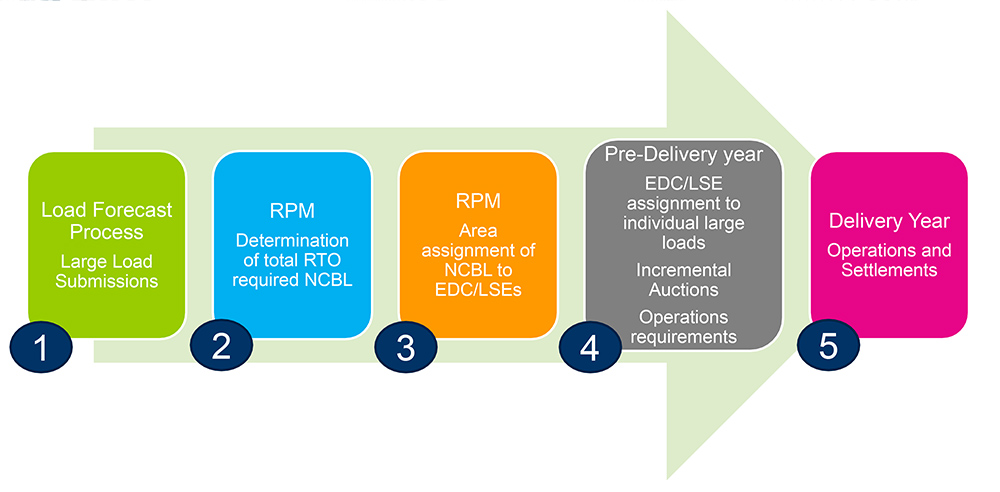
The core change PJM made to the proposal is how large load customers might receive a mandatory NCBL designation. Under the version of the proposal PJM presented at a CIFP meeting Sept. 15, the RTO would calculate the amount of NCBL that would be needed across its footprint and allocate a share of that to electric distribution companies and load-serving entities based on the amount of planned, unbuilt large loads expected to come into service in their service area during a delivery year in which a shortfall has been identified. It would then fall to each EDC and LSE to determine how to assign their NCBL allotment to customers.
When first presented, the proposal had a voluntary pathway for customers to request NCBL status when PJM determined there might be a capacity shortfall in an auction, followed by the RTO making mandatory NCBL assignments if the deficiency persisted. Much of the criticism in the subsequent comments argued that PJM lacks jurisdiction to assert how retail customers receive service.
PJM’s approach to determining how much NCBL would be distributed to each zone would exclude existing load and planned large loads that intend to participate in demand response or bring-your-own-generation (BYOG) programs. Because the final NCBL designation would be left to retail service providers, however, Senior Director of Market Operations Tim Horger said it is possible that EDCs and LSEs, with direction from state regulators, could opt to include large loads already in operation or planning to enroll in DR or BYOG.
Horger told RTO Insider in an email that if a planned large load’s DR or BYOG participation does not cover its expected load, the remainder would be added to the NCBL area calculation.
Data center representatives said the proposal appears to force customers to take flexible or inferior service unless they enroll in BYOG or DR, and even then there would be no certainty that they could entirely mitigate the risk of being required to take NCBL service. That uncertainty around who is subject to the proposal would impact the prospect of making investments in PJM for those in need of large amounts of energy, they said.
Horger said concern that large loads could face unreliable service would be present even if PJM does nothing because of the heightened risk of manual load shedding being needed. The proposal would at least provide customers with savings on capacity and possibly more advance notice on when they would need to curtail in real time. He characterized NCBL as changing the prioritization of the load-shedding procedures.
Denise Foster Cronin, vice president of federal and RTO regulatory affairs for the East Kentucky Power Cooperative, said the proposal could result in scenarios where retail service providers bilaterally contract capacity for expected large customers, only for that load to be subject to NCBL and pulled out of the capacity market, while the self-supplied generation would remain on the supply side of the ledger. She argued that would effectively offer that paid-for capacity to other customers participating in BRAs.
“Additionally, despite having secured capacity to meet the totality of the load obligation, PJM would require its assessed amount of NCBL to be curtailed prior to emergencies. Since we are one of the transmission owners that PJM will require to execute the NCBL curtailment, that presents us with a Hobson’s choice, as none of our load should be curtailed,” Cronin told RTO Insider.
Responding to stakeholder inquiries on whether the NCBL proposal is being envisioned as a permanent addition to PJM’s capacity market or a temporary measure, Horger said it’s viewed as a way to bridge a gap across a reliability shortfall expected to last a few years. While a firm retirement for the product has not been included, he said the RTO is open to including a trigger to eliminate the process, such as after the reliability requirement has been cleared for a certain number of years.
PJM Associate General Counsel Mark Stanisz said the CIFP discussion demonstrates that the proposal impacts wholesale rates and supports the position that it falls under federal jurisdiction. He said PJM states have chosen to rely on the RTO’s markets and the courts have routinely determined that FERC and the Federal Power Act have jurisdiction over the rates, practices and mechanics behind RTO capacity constructs. He added that the federal energy policy ecosystem is rapidly evolving, with several executive orders since the start of 2025 and an artificial intelligence action plan in place.
PJM presented its non-capacity backed load proposal, which would create a new product for curtailable load that would be exempted from capacity payments. | PJM
In a statement responding to the proposal, the Natural Resources Defense Council recommended an approach requiring all new large loads to procure their own generation to avoid disruptions to the capacity market from individual customers. It argued that the proposal would leave data center load in the capacity market, causing customers to pay significantly higher costs and push data centers to install inefficient backup generation to cover periods where they are curtailed.
“PJM is creating rules for how to manage the reliability risk, essentially by proposing to shut off new data centers during any hour of the year when there is insufficient electricity. While this approach would preserve reliability in a draconian way, it will do little to protect residents from rising bills and require highly polluting backup generators to run many more hours each year,” the NRDC wrote.
Additional Package Details
PJM presented additional information on how it envisions the proposal being implemented, including specifying that NCBL curtailments would fall before pre-emergency load management deployments in the stack of emergency procedures.
Customers assigned NCBL status would be exempt from capacity payments by removing their load from the corresponding zone’s forecast peak load when determining how much capacity must be procured in each zone. The relevant EDC or LSE would be responsible for reducing its obligation peak load to reflect the reduced capacity requirement. PJM would shift the resource requirement and variable resource requirement curve, which determines the amount of capacity procured in a BRA, to reflect the RTO-wide NCBL designation.
The definition of a large load would be set at 50 MW, with a case-by-case review for including smaller customers.
PJM staff acknowledged many areas of the proposal require further refining, including what would happen if a customer or retail service provider failed to curtail NCBL.
PJM Broaches Alternative Proposals
PJM presented additional concepts that could develop into alternative CIFP proposals, including an alternate NCBL with only voluntary participation.
Eliminating the mandatory designation would grant states and retail service providers more ability to balance reliability risk against costs on their own, the RTO said. If participation is low, that could mean higher risk of manual load shedding, however.
Ongoing discussions around expanding provisional interconnection service could also be shifted from the Planning Committee to the CIFP. The changes being considered aim to identify resources that could enter partial operations before their full transmission network upgrades have been complete, making more energy available to dispatchers during emergency conditions. (See PJM Stakeholders Endorse Expansion of Provisional Interconnection Service.)
Another concept would require planned large loads to bid into capacity auctions for the year in which they intend to enter service, with a cost commitment that would hold even if they do not come online. Doing so would improve the certainty of the load forecast. Bids would be submitted either through the customer’s retail service provider, or the customer could become its own LSE, though PJM said both present jurisdictional quandaries. The proposal could be paired with a voluntary NCBL model, though the risk of manual load shed could still be high if many customers do not opt to participate.
The changes could be limited to how shed load is allocated, or they could be paired with other proposals, though PJM cautioned that if no other market design changes are made, the auction could repeatedly clear short of the reliability requirement, triggering the Reliability Pricing Model backstop auction.
An expedited interconnection option could create a parallel queue for a select number of resources with strict eligibility requirements, including being operational within three years. PJM’s Jason Shoemaker said it could deliver interconnection agreements in 10 months with minimal impacts to the overall queue. Because implementation would fall after the completion of Transition Cycles 1 and 2, he said there would be no disruption to projects already in the queue.
PJM could also develop more transparency for planned generation and large loads and assist in identifying opportunities to create partnerships between the two.
RA Scenarios Highlight Capacity Shortfall in 2030
PJM Senior Manager of Policy Initiatives Susan McGill presented five scenarios looking at how different levels of supply growth could impact a capacity deficiency PJM has projected in 2030. Each built off the 2025 Load Forecast, which estimated that net energy load growth will increase by about 4.8% annually over the following decade.
The first scenario assumed new resources would come on at the historically slow rate, bringing 6.6 GW of unforced capacity online, while policy-driven deactivations would take 8.1 GW of supply offline. Paired with 22.9 GW of load growth, that would result in a 24.1-GW UCAP deficiency.
The direst scenario assumed a 25% faster rate in resources interconnecting, offset by 29.2 GW of load growth from requests to co-locate load with new resources, resulting in a 24.7-GW shortfall.
Removing the co-located load requests and holding generation deactivations flat would result in a 10.4-GW shortfall, while adding the highest DR participation seen in the last five years to the equation would add 3.3 GW of supply and shrink the gap to 7.1 GW.
The final scenario assumed additional load flexibility would participate, resulting in the market clearing with no surplus.
Wide-ranging Comments Submitted on CIFP
Dozens of organizations and individuals submitted comments to PJM, many of which debated the merits of the NCBL proposal or urged the RTO to extend its focus to load forecasting, DR and the interconnection queue.
The governors of Pennsylvania, New Jersey, Maryland and Illinois jointly wrote that a CIFP process is needed to address rising load growth and correspondingly high capacity prices while stating that the impact of the NCBL proposal is difficult to model and could carry unintended consequences. If it were to be implemented, they recommended limiting it to the 2028/29 and following auction.
“An explicitly temporary and more broadly applicable NCBL methodology that is mandatory for only the next two BRA performance periods … could provide a partial and short-term solution. However, we feel strongly that this temporary solution must be accompanied by additional measures that address more fundamental issues and will not risk artificially perpetuating extremely high capacity prices through a potentially flawed trigger mechanism,” they wrote.
They said the CIFP scope should explore overhauling load forecasting, creating incentives for large loads to bring their own generation, using regional transmission planning to create new interconnection opportunities and speeding the interconnection of energy-only resources.
Exelon said the original iteration of PJM’s proposal would infringe on state jurisdiction and create a compliance trap for utilities stuck between the RTO imposing civil penalties if they fail to curtail NCBL customers and state regulators that might object to that curtailment.
“The proposal establishes a new category of retail service for certain large loads whereby those customers would receive service on an interruptible basis subject to curtailment in emergencies and would be exempted from paying capacity charges. This is not simply a tweak to PJM’s wholesale market rules; it is the creation of a novel form of retail electric service, with specified terms and conditions set on a regionwide basis by PJM,” the utility wrote.
Rather than rushing to a solution without understanding the problem, Exelon said that PJM should more thoroughly study the resource adequacy threats and hold education on the load shed risk in the Mid-Atlantic.
“Ultimately, we owe it to our customers, current and future, and our state policymakers and regulators to begin informing them of the real and increasing possibility of load shedding in the not-to-distant future, even as we continue efforts to build both the transmission and generation needed to address and mitigate that risk,” Exelon said. “Doing so may also result in additional creative solutions that would further mitigate and address this risk. Without being informed of the imminent need, we may lack the collective alignment amongst policymakers, regulators and operators to more aggressively tackle these issues.”
Advanced Energy United argued that PJM should focus its efforts on a BYOG pathway, which it said is likely the only way for significant amounts of supply to interconnect in time to make an impact, and address the load forecast to avoid mismatching transmission and generation development against load growth.
United argued the proposal would suppress capacity prices and hold back new investment in a manner that would make it hard to backtrack from.
The Digital Power Network said data centers lend themselves to load flexibility, which is underutilized because of outdated programming and inaccurate modeling of load-shedding events. Rules around when data centers could be curtailed must be clear and transparent, but PJM’s proposal would leave them in the dark, it argued.
“Flexible digital loads should be incentivized to participate in resource adequacy initiatives rather than be excluded from them. A framework that encourages voluntary participation through programs such as demand response while rewarding flexibility would strengthen adequacy and preserve reliability,” it wrote.
Ontario environmental groups panned the Canadian government’s inclusion of small modular reactors (SMRs) on its list of infrastructure projects to receive fast-track regulatory treatment, saying renewables would be a far cheaper way to expand generation capacity.
Prime Minister Mark Carney on Sept. 11 identified four SMRs planned at Ontario’s Darlington nuclear power plant as one of five “nation building” projects he said are needed to bolster the country’s economy in response to U.S. President Donald Trump’s escalating tariffs.
Speaking at a union training facility in Edmonton, Carney called Trump’s actions “not a transition [but] a rupture.”
“They are closing markets, disrupting supply chains, halting investments and pushing up unemployment. Canadians are over the shock, but we must always remember the lessons,” said Carney, who took office in March. “From now on, Canada’s new government starts by asking ourselves, for major projects, ‘how?’ How can we do it bigger? How can we do it faster?”
The Canadian and Ontario governments have leapt ahead of other regions in embracing SMRs, touting their zero emissions and economic development potential. But environmentalists say the province would be better served by building more renewables and storage to fill electricity demand projected to grow by 75% by 2050.
“Ontario risks being left behind by failing to embrace the faster, cheaper, cleaner alternatives already powering economies around the world,” Ontario Green Party Leader Mike Schreiner said in response to Carney’s announcement. “Right now we could create good-paying jobs using Ontario steel to build steel racking for solar and wind turbines and generate low-cost power.”
Tim Gray, executive director of Environmental Defence, and Jack Gibbons, chair of the Ontario Clean Air Alliance, were also critical.
Gibbons cited a recent analysis by IESO that he said showed that renewables and storage can meet the province’s peaking and baseload demands at a far lower cost than SMRs.
Wind and solar power, combined with four-, six-, eight- and 10-hour lithium-ion batteries can meet up to 99.98% of the province’s peaking electricity needs and up to 99.9% of its baseload needs under all weather scenarios, the alliance said in a briefing note. “Demand response resources and/or our existing gas-fired power plants could meet our remaining electricity needs,” it added.
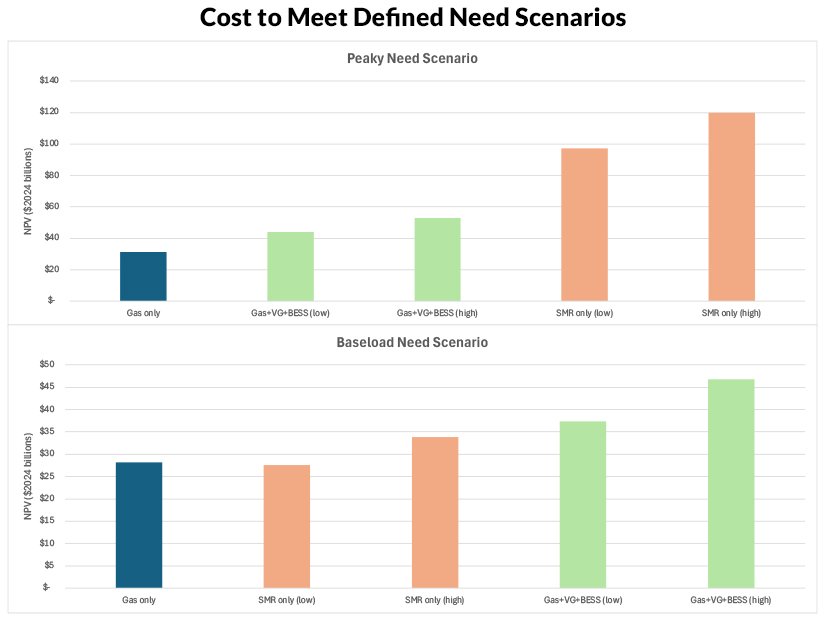
It concluded that a hybrid portfolio plus natural gas was the least-cost resource option to meet the 5.1-TWh Peaky Need Scenario, with a cost of $25 billion to $34 billion (net present value in 2024 Canadian dollars), depending on the weather year used. The gas-only option was estimated at $31 billion in seven of the 10 weather years. The Peaky Need Scenario is based on production cost modeling for the 2025 Annual Planning Outlook without capacity expansion, which resulted in unserved energy of about 5.1 TWh in the medium term and a peak need of about 7,300 MW.
The Peaky Need Scenario is based on production cost modeling for the 2025 Annual Planning Outlook without capacity expansion, which resulted in unserved energy of about 5.1 TWh in the medium term and a peak need of about 7,300 MW. The Baseload Need Scenario assumes the addition of 2,000 MW of capacity, akin to a baseload generation facility, or 11,300 to 15,000 MW of installed capacity for the hybrid resource portfolio. | IESO
The analysis found dispatchable resources were the best solution for the Baseload Need Scenario. “Both SMR-only and gas-only resource options have similar cost profiles when acting as a baseload generator,” it said. The SMR-only option ranged from $27.6 billion to $33.8 billion, with the gas-only option estimated at $28 billion. The renewables-BESS option ranged from $37 billion to $47 billion depending on the weather year, a levelized cost of energy range of $140 to $175/MWh.
The Baseload Need Scenario assumes the addition of 2,000 MW of capacity, akin to a baseload generation facility, or 11,300 to 15,000 MW of installed capacity for the hybrid resource portfolio.
Hybrid Premium ‘Smaller than Expected’
To capture the geographic and temporal ranges in wind speed and solar intensity, IESO’s report considered 13 potential wind sites and 10 potential solar sites across 10 different weather years, assuming no transmission constraints.
“The premium on installed capacity and costs of hybrid resource portfolio solutions required to achieve load served up to 99.98% was smaller than expected,” IESO said in the report. “As performance of VG and BESS technologies improves and costs continue to decline, a non-emitting, hybrid resource portfolio, in theory, shows significant promise. It can provide both baseload and peak nuclear generation.”
‘Excess Generation’ Impact
The IESO analysis noted that wind and solar generation often need to be “overbuilt” to meet system adequacy needs and said that the value of the excess energy should “be considered in any planning study when comparing resource portfolios to meet a specific need.”
The energy that would be curtailed as a result of the overbuild “could potentially provide tens of billions of dollars in system value” by displacing higher-cost resources, IESO said.
Canadian Prime Minister Mark Carney announces Ontario’s small modular reactors will receive fast-track regulatory treatment. | CPAC
The Clean Air Alliance said that when the excess wind and solar energy is included ($17.8 billion in baseload scenarios, $28.4 billion in peaking scenarios), those sources and energy storage can meet peaking needs at a cost of $15.7 billion to $24.5 billion versus $97.1 billion to $120 billion for SMRs. Baseload electricity needs would be $19.5 billion to $29 billion for renewables and storage versus $27.6 billion to $33.8 billion for SMRs.
Questioning SMR Assumptions
The Alliance said IESO’s analysis understated the cost difference because of overly optimistic assumptions regarding SMRs:
IESO’s capital cost estimates for new SMRs ($11,804 to $16,711/kW in 2024 Canadian dollars) are 25 to 50% lower than the cost of Plant Vogtle Units 3 and 4 in Georgia, which went into service in 2023 and 2024, respectively ($22,628/kW).
IESO assumed the SMRs will have annual capacity utilization factors of 90.9%, well above the historical rates of Ontario’s Pickering (71.4%) and Darlington Nuclear Stations (78.6%).
Although Ontario Power Generation is spending $12.8 billion to refurbish Darlington Nuclear Station after 26 years of service, IESO assumes the SMRs will operate for 60 years without major refurbishments.
IESO’s report used the U.S. National Renewable Energy Laboratory’s 2024 Electricity Annual Technology Baseline for the low end of the cost range and the Tennessee Valley Authority’s 2025 Integrated Resource Plan’s estimate of an “nth-of-a kind” light-water SMR for the high end.
OPG did not respond to a request for comment.
Not a Recommendation
IESO cautioned that its paper was a modeling exercise and did not consider any “resource build limits” such as supply chain issues that would impact the feasibility of building the resulting resource portfolios.
“It should be emphasized that this document is not a plan, nor does it constitute a recommendation or endorsement of any resource, resource portfolio or technology.”
It also noted that to provide “high temporal granularity,” its modeling used deterministic, hourly profiles that did not fully capture the dispatchability (e.g., gas turbines) and storage capability (e.g., hydroelectric reservoirs) of existing resources.
“The study also shows that Ontario would need to build more than five times the baseload need in total capacity in the hybrid scenario, and even then may still not be able to meet the full need,” IESO said in response to questions from RTO Insider.
The ISO also noted that the paper did not consider the land use implications of the alternate portfolios. “A buildout of that scale would have considerable development and transmission costs that have not been factored into the paper.”
Nonetheless, the ISO said the role of renewables and storage will increase, noting that it recently completed the largest battery storage procurement ever in Canada, and that renewables are eligible in its second long-term energy and capacity procurement. (See IESO Officials Deny Favoring Gas Resources in Upcoming Procurement.)
“Ultimately, Ontario’s electricity grid benefits from a diverse supply mix that includes wind, solar, hydro, natural gas, nuclear and energy storage to keep the lights on,” IESO said. “These different resources have different characteristics and responses to weather, and maintaining a diverse supply mix means we always have resources to draw on that are right for the moment.”
The ISO said it plans to seek feedback on the study and rerun the simulation based on updated need profiles.
Ontario Pols Tout Economic Development Potential of New Nuclear
Ontario Premier Doug Ford in May approved OPG’s plan to start construction on the first of four SMRs.
The initial 300-MW SMR, targeted for commercial operation in 2030, would be the first grid-scale SMR in the Group of Seven countries. OPG says building all four SMRs, a total of 1,200 MW, will cost $20.9 billion. (See Ontario Greenlights OPG to Build Small Modular Reactor.)
The Ontario government also is supporting the addition of up to 4,800 MW of additional nuclear capacity at the Bruce Nuclear Generating Station.
In a high electrification scenario, IESO says, the province could need up to 17,800 MW of new nuclear generation in addition to its current 12,000 MW, which generates more than half of the province’s electricity.
Canadian Prime Minister Mark Carney (center) and President Donald Trump (right), at a G7 meeting on June 16. | Prime Minister Mark Carney (Photo: Lars Hagberg)
Carney said the SMR in Clarington will “sustain” 3,700 jobs annually, including 18,000 during construction.
Officials also see their leadership on SMRs having additional economic impact, citing agreements to work with Saskatchewan, New Brunswick and Alberta on the technology.
“We are already seeing results,” Clarington Mayor Adrian Foster told the Toronto Star. “Today, we have a Dutch delegation in town. [Other countries] are coming to see the SMRs. The world is paying attention to what is happening right here, right now.”
Major Projects Office
In addition to the Ontario SMRs, Carney’s five “nation building” projects include one to double the export capacity of the LNG Canada facility in Kitimat, B.C.; an expansion of the Contrecoeur Terminal at the Port of Montreal; a copper mine in Saskatchewan; and the expansion of the Red Chris copper and gold mine in northwestern British Columbia.
Carney said the office also will help other, less advanced projects, including the 60-GW Wind West Atlantic Energy Project off Nova Scotia and the Pathways carbon capture project in Alberta.
Environmental Defence’s Gray panned Carney’s selection of the Kitimat LNG facility and the mining projects.
“The federal government promised Canadians that nation building projects would align with our climate goals. This announcement, which begins with the expansion of LNG Canada that will increase climate pollution, is completely inconsistent with this commitment and will threaten Canada’s ability to meet its climate pollution-reduction targets,” Gray said.
He called the carbon capture and storage project “deeply flawed and regressive.”
“Carbon capture and storage has a decadeslong record of failure, delivering only a fraction of promised production emission reductions while locking Canada into higher overall oil emissions and draining public funds,” he said.