FERC Chair Mark Christie presided over his final open meeting July 24, as he plans to step down in the coming weeks after completing work on several orders.
President Donald Trump nominated Laura Swett of Vinson & Elkins to replace Christie as chair. Christie’s term ended June 30, but he is allowed to stay until the end of the year as long as his replacement has not been confirmed. (See Trump Replacing FERC Chair Christie with Laura Swett.)
Christie started his career in public service in 1994, when newly elected Virginia Gov. George Allen made him a member of his cabinet. He joined the Virginia State Corporation Commission in 2004, where he served 17 years until he was appointed to FERC by Trump during the president’s first term.
“After 31 years, it’s coming to an end,” Christie said. “When I look back at my experience, it’s been a hell of a ride. It really has. I’ve had tremendous opportunities to serve the public, to be in public office, where you get a chance to do good things. And let me just say this, nobody accomplishes anything alone. Whatever you accomplish, others are part of it.”
Christie praised the commissioners he served with during his tenure at FERC and his staff, and thanked Allen and Trump.
He also reminisced about what he learned throughout his career. He recalled that during the first major rate case he presided over as an SCC commissioner, he noticed how packed the room was and mentioned the number of people present to the chair.
“He said that room wasn’t packed with people,” Christie said. “That room was packed with lawyers and lobbyists for every interest group that has money riding on what we do. He said, ‘The people who pay the bills for what we do and what we’re going to do in this rate case, those people are not in that room. So don’t you ever forget the people who are not in that room.’”
The second Trump administration has embraced the “unitary executive” legal theory, which holds that the president can fire members of independent regulatory agencies at will. Asked about it, Christie pointed back to a lesson he learned early at the SCC: that regulators need to worry about the consumers who foot the bill of their decisions.
“There’s really no one but us here to be thinking about them and thinking about how what we do affects them,” Christie said. “And I hope that everybody who ever sits on this commission always remembers those people’s wishes — the millions of people who pay the bills, struggle and worry about whether their lights come on or not.”
The SCC is much different from FERC in that it is an agency with its independence recognized in the Virginia Constitution, whereas the federal commission is statutory — created by the Department of Energy Organization Act of 1977 — and is more subject to changes in its legal foundation, Christie said.
Asked about his biggest accomplishment at FERC, Christie pointed to the regular letters he has been writing ever since Trump’s so-called Department of Government Efficiency sent an email to all federal employees asking them to explain five things they did in the past week.
“When you read those letters, it’s just remarkable what we do around here; it’s just remarkable. I think it’s hard to say what we’re most proud of, but being chair, I’m very proud of what we got done,” he added. “And those letters really detail the important things we got done every week, every day.”
Those familiar with Christie’s dissents on many orders over the years will not be surprised to hear his major regret: that he was not able to cut back on transmission incentives, which he calls “FERC candy.”
More specifically, he pointed to a Notice of Proposed Rulemaking that he voted out with former Chair Rich Glick and former Commissioner Allison Clements that would have limited the adder utilities can charge for joining an RTO to just three years and required their choice to join to be voluntary (not required by their state). It never moved forward from the NOPR stage, even through his own time as chair.
“That is something that I regret, that I couldn’t get three votes for that,” Christie said. “But it just shows … FERC is constantly lobbied, alright? Constantly lobbied. And again, the people paying the bills are not here lobbying or represented. They’re just not.”
All three commissioners praised Christie, and each of them noted that he reached out to them just after they had been nominated to offer his congratulations and advice.
“A lot of FERC chairs have talked about making FERC boring again, and you, I think, really have achieved that,” Commissioner David Rosner said. “We’ve done a lot of complicated orders. We’ve done a lot of important work. … The level of consensus is high, and I call that boring, but also the energy nerd here also finds this all very exciting.”
IESO opened stakeholder discussions on new rules for storage facilities and hybrid resources that will introduce a single bi-directional resource model and enable the provision of regulation service.
The initiative, part of the ISO’s Enabling Resources Program (ERP), initially will focus on electricity storage and hybrid generation-storage resources, with a later “stream” to develop rules for aggregations of distributed energy resources (DERs).
“It’s an important step for preparing Ontario for the required resources needed to meet the system needs that have been identified through the ISO’s [Annual Planning Outlook],” David Short, senior director for the ERP, said during a kickoff presentation July 24. “More and more storage resources [are] being installed and operating, and at a scale that really requires us to develop the design of a good participation model to fully allow them to participate in meeting those system needs.”
“We are hot off the heels of Market Renewal, and ERP is the next high-priority capital project for the ISO,” said Maral Kassabian, senior manager of ERP implementation. “Its objective is to more fully enable resources to participate in the ISO markets, to enhance market efficiency and support the safe and reliable operation of Ontario’s bulk power system.”
The “Phase 1” rules, which IESO hopes to have in place as soon as 2027, will build on the interim storage model from 2018 and the co-located model implemented in 2023.
It will replace the current two-resource model — which separates the withdrawal portion of the resource as a load and the injection portion as a generator — with a single resource model with a continuous offer curve. When withdrawing, the resource will operate as a “negative generator,” and when injecting, it will be a “positive generator,” as in other jurisdictions, IESO said.
The new rules will apply to single-site, dispatchable battery storage greater than 1 MW that is connected to transmission or distribution. Other types of storage technologies will be considered in a subsequent phase.
Included in the proposal is a new parameter, the initial state of charge (SoC), measured in MWh, that market participants will submit for the day-ahead market.
The new rules will apply to the recent Long-Term 1 (LT1) and Expedited Long-Term (ELT) storage procurements, as well as Northland Power’s 250 MW/1,000 MWh Oneida Energy Storage. (See IESO Purchasing 3,000 MW of Energy and Capacity.) Oneida began operating in May, more than doubling Ontario’s energy storage capacity.
Storage facilities with existing contracts with IESO will continue participating as they currently do in the markets until their contracts expire.
Storage as Operating Reserves
The rules will seek to co-optimize storage’s provision of both energy and operating reserves (OR).
The ISO is considering allowing storage to contribute to OR by injecting energy, stopping its withdrawals from the grid or “branching” from withdrawal to injection. (See Operating Reserve Prices Surge in Ontario.)
The new rules would allow storage resources to submit up to five price-quantity pairs hourly for each class of operating reserve (10-minute synchronized reserve, 10-minute non-synchronized reserve and 30-minute non-synchronized reserve).
Under current rules, a resource that offered a maximum price-quantity injection of 200 MW and a maximum withdrawal of -200 MW would not be able to offer more than the 200 MW as OR. Under the proposed branching rules, the resource could provide a maximum of 400 MW.
IESO is proposing a 100 MW/minute static energy ramp rate to “leverage the fast-ramping capability of storage upon dispatch but also limit operational concerns from extreme ramping on system balancing.”
Cycling Daily Energy Limit
The ISO is considering a new parameter, the cycling daily energy limit (CycleDEL), for use in both day-ahead and pre-dispatch calculations. It will be based on the current MaxDEL, the maximum amount of energy a storage resource can inject daily.
CycleDEL will be the number of daily cycles submitted by the market participant at registration multiplied by the operating range of the battery (the difference between the maximum SoC and minimum SoC).
Storage operators would be allowed to increase the limits they offer at registration but not reduce them.
“I do like the idea of having a registered value and then the ability to change it during … real time,” said Noralyn Vasquez, of Atura Power.
She noted that batteries’ warranties have limits on cycling. “In addition, the more you cycle the facility, it does degrade the Megapacks,” she added.
“Having these limits in the day-ahead [market] allows us to mitigate any buyback risk if we’re getting scheduled more often in the DAM relative to what we really can do in the real time,” she added. “So, it’s a good feature.”
Feedback Sought
The ISO requested feedback by Aug. 21 on a range of topics, including telemetry requirements and derates of resources.
IESO plans a second meeting on the storage rules in October with a design memo on optimization in the fourth quarter.
A new Western Resource Adequacy Program task force has been charged with revising the WRAP tariff to clarify that participants can rely on a specific category of CAISO transmission service to count remote resources toward their “forward showing” requirements under the program.
While CAISO and California’s non-CAISO utilities, already subject to a state-run RA program, are not participating in the WRAP, California’s grid is likely to function as the key “wheel-through” corridor for RA sharing among the WRAP’s Northwest and Desert Southwest participants due to the shortage of alternate routes.
Creation of the CAISO TX Task Force came at the suggestion of Salt River Project (SRP), which last year raised the concern that CAISO’s description of its own firm transmission product as “high-priority wheeling-through” is not recognized anywhere in the tariff of the WRAP, a reliability program administered by the Western Power Pool (WPP) and operated by SPP.
That means the tariff does not explicitly equate CAISO’s firmest offering of transmission service with NERC’s Priority 6 or 7 transmission service levels, the minimum level of service the WRAP requires for a participant to count a distant resource toward its RA obligation.
“This creates ambiguity as to whether CAISO high-priority wheeling-through qualifies as firm transmission under WRAP. This creates uncertainty for participants relying on CAISO high-priority wheeling-through transmission to satisfy WRAP requirements,” SRP wrote in a tariff change request form included in WRAP’s 2025 Work Plan, which was developed by the WRAP Program Review Committee and approved by the WPP’s Board of Directors in June.
“Without clear recognition, participants may experience compliance risks despite securing the highest available firm transmission from CAISO,” SRP wrote.
SRP’s proposed solution: to introduce tariff language “that provides clarity on what qualifies as qualifying transmission to evaluate transmission products that do not explicitly use NERC Priority rating.”
The utility said the change should resolve “uncertainty around transmission compliance” and give participants “confidence that high-priority transmission products that do not use a NERC Priority rating will satisfy WRAP requirements, which will streamline compliance.”
Speaking during a July 23 meeting to kick off the effort, Maya McNichol, a WPP policy and engagement manager, said WPP considers the CAISO TX Task Force to be an “easy” initiative that should be concluded after three or four meetings over two months.
“The goal here is to ensure … that WRAP participants can use CAISO high-priority wheeling-through transmission as part of qualifying transmission when doing all of the WRAP things that require transmission,” McNichol said.
She said the WPP thinks the best approach would be to add a new “WRAP qualifying transmission” definition to the tariff that includes a reference to CAISO’s “high-priority” service, then substitute that definition for any relevant references to “firm transmission” or “forward showing transmission requirement” throughout the WRAP tariff and business process manual.
At the meeting, task force members elected Jerret Fischer, SRP senior market operations strategy analyst, as the group’s chair.
In an attempt to stimulate the deployment of artificial intelligence and related infrastructure, the Trump administration has released an action plan and announced the development of data centers on federal land.
The U.S. Department of Energy has chosen four sites around the country to host data centers and related energy infrastructure: the Idaho National Laboratory; Oak Ridge Reservation; Paducah Gaseous Diffusion Plant; and the Savannah River Site.
“By leveraging DOE land assets for the deployment of AI and energy infrastructure, we are taking a bold step to accelerate the next Manhattan Project — ensuring U.S. AI and energy leadership,” Energy Secretary Chris Wright said in a July 24 statement. “These sites are uniquely positioned to host data centers as well as power generation to bolster grid reliability, strengthen our national security and reduce energy costs.”
DOE said it plans to work with data center developers, energy companies and the public in consultation with states, local governments and federally recognized tribes to advance the initiative. Solicitations for proposals to develop the sites will be released in the coming months, and DOE could pick winning proposals by the end of 2025. The department is considering other federal sites for data center developments as well.
The idea to use federal lands for data centers was included in the White House’s AI Action Plan, which was released on July 23. It also contains some broad recommendations for updates in electricity policy.
“The power grid is the lifeblood of the modern economy and a cornerstone of national security, but it is facing a confluence of challenges that demand strategic foresight and decisive action,” the plan said. “Escalating demand driven by electrification and the technological advancements of AI are increasing pressures on the grid. The United States must develop a comprehensive strategy to enhance and expand the power grid designed not just to weather these challenges, but to ensure the grid’s continued strength and capacity for future growth.”
The plan calls for stabilizing “the grid of today as much as possible,” or stopping premature power plant retirements. The existing power grid also can be optimized.
“The United States must explore solutions like advanced grid management technologies and upgrades to power lines that can increase the amount of electricity transmitted along existing routes,” the plan said. “Furthermore, the United States should investigate new and novel ways for large power consumers to manage their power consumption during critical grid periods to enhance reliability and unlock additional power on the system.”
New, reliable, dispatchable power plants need to be connected, the plan said. And the industry should roll out next-generation technologies such as enhanced geothermal, nuclear fission and nuclear fusion.
The plan calls for reforming “power markets to align financial incentives with the goal of grid stability, ensuring that investment in power generation reflects the system’s needs.”
The WATT Coalition and AMP Coalition released a joint statement saying that advanced transmission technologies and grid-enhancing technologies can help in the effort to connect data centers to the grid.
“The Department of Energy found that these technologies together could unlock capacity for more than 100 GW of new power, enough to meet a significant portion of the new load projected over the next 5-8 years,” they said. “These advanced transmission technologies represent a critical near-term pillar for modernizing the grid and meeting the growing power needs of the U.S. while new large-scale transmission lines are built.”
National Electrical Manufacturers Association CEO Debra Phillips called the action plan a welcome development for the industry it represents.
“The plan underscores the criticality of a modernized and resilient power grid, determining that the United States must explore solutions like advanced grid management technologies,” Phillips said. “Electrical manufacturers are at the forefront of this transformation — deploying reconductoring solutions, digital substations and data center strategies that optimize grid capacity and enhance reliability.”
In the wake of the New York Public Service Commission’s decision to cease planning its offshore wind underwater transmission network, NYISO has followed suit, tossing two years of planning studies. (See NY Steps Back From OSW, Halts Offshore Tx Planning Process.)
At the Transmission Planning Advisory Subcommittee’s meeting July 23, NYISO’s Jason Frasier thanked developers, ISO staff and stakeholders for their work and participation in the Public Policy Transmission Need process, initiated by the Department of Public Service in June 2023. NYISO revealed the bids in its solicitation in June 2024 and was targeting a selection by the Board of Directors in the second quarter of this year. (See NYISO Reveals Bids in NYC Offshore Transmission Solicitation.)
Frasier said that the ISO will now solicit feedback from stakeholders on the PPTN process for potential improvements.
Howard Fromer of Bayonne Energy Center asked whether developers would be reimbursed or compensated for their participation. Frasier said there was no mechanism in the tariff for developers to get compensated for a PPTN that was not finished.
Other stakeholders asked whether projects in the interconnection queue that were being built with the assumption of the PPTN would also be canceled automatically. Frasier indicated that those developers would need to withdraw or revise their projects. Absent a withdrawal notice, they would remain active.
A representative from Earthjustice asked whether any of NYISO’s studies of the benefits of offshore transmission would be retained or released. Frasier said that no benefit evaluation would be completed or released beyond what the ISO had already done.
U.S. investor-owned electric companies invested $178 billion in 2024 and are projected to invest more than $1.1 trillion through 2029, their trade organization reported.
The Edison Electric Institute said July 23 in its annual Financial Review that this level of capital expenditure exceeds every other U.S. business sector and places electric companies at the forefront of a transformational time for the economy.
2024 was the 13th straight record-setting year for investment, EEI said. In just the past decade, annual capital outlay has jumped from $104 billion to $178.2 billion. The largest single jump was from $147.7 billion in 2022 to $168 billion in 2023.
The 2024 financials indicate the scale of the industry. The report shows that collectively, U.S. investor-owned electric companies had:
$403.5 billion in 2024 operating income, down 0.1% from 2023;
$54.6 billion in net income, up 4.5%;
$34 billion in dividends paid on common stock, up 5.8%;
$1.57 trillion in property, facilities and equipment, up 5.5 %; and
$2.18 trillion in total assets, up 5.1%.
The industry’s average credit rating remained at BBB+ for the 11th year in a row, EIA said, and 94% of EEI Index companies increased their dividend. At 62.2%, the dividend payout ratio is the highest of any U.S. business sector, EEI said.
On the regulatory front, 81 rate reviews were filed in 2024 and 78 decided; average awarded return on equity was 9.73%, up from 9.58% a year earlier. The 2024 ROE broke down to 9.84% for vertically integrated companies and 9.53% for distribution-only companies.
The data covers 38 investor-owned electric companies whose stock is publicly traded on major U.S. stock exchanges, plus five companies that provide regulated electric service in the United States but are not listed on the U.S. exchanges.
Stock prices for the 38 EEI Index companies ended 2024 19.1% higher, placing them well ahead of the Dow Jones Industrial Average, well short of the S&P 500, and far short of the Nasdaq. Interest rate changes in the fourth quarter stunted the EEI Index’s full-year performance.
The index companies had a combined $1.02 trillion market capitalization at the end of 2024, with NextEra Energy the leader at $147.2 billion, Southern Co. a distant second at $90.3 billion and Unitil bringing up the rear at $900 million.
In a news release, EEI President Drew Maloney looked beyond the numbers to the significance of the financials: “America’s electric companies are leading in this unique and critical moment for our nation. As demand for electricity continues to grow, we remain committed to making the investments needed to strengthen America’s energy security while ensuring that our customers receive reliable, affordable energy.”
EEI said these companies support more than 7 million jobs nationwide and account for 5% of the U.S. GDP.
FERC has approved a set of amendments to the Northeast Power Coordinating Council’s bylaws that aim to broaden the regional entity’s purpose, modify membership eligibility and voting rights of members and the Board of Directors, and update its organizational structure.
NERC and NPCC filed the amendments in February, asserting they raised no reliability issues and “continue to satisfy the five governance criteria” for NPCC’s bylaws in the RE’s delegation agreement. Those criteria are that the RE:
be governed by an independent or hybrid board;
assure independence in its rules from power system owners and operators;
let its membership be open with no more than a nominal fee;
ensure no sector exercises dominance over its actions; and
provide the public with reasonable notice and opportunity for comment.
FERC approved the changes in a July 21 filing (RR25-2).
The amendments apply throughout the RE’s bylaws, starting with Article II, where the requirement that NPCC’s principal office be located in Manhattan has been removed; now the office may be located anywhere within the NPCC geographic region. Additional language will allow the principal office to remain in its established location if that area is removed from the NPCC footprint.
In Article III, the language detailing NPCC’s purpose has been updated to widen the type of agreements the RE can enter with Canadian provincial authorities. Previously it included only memoranda of understanding. The article now also says NPCC may use any “lawful activity necessary or appropriate to achieve” its electric reliability mission.
Article IV has been updated to remove “the ability of a natural person to be an NPCC member” and require member applicants to “have a material interest in the reliable operation of the Northeastern” electric grid. NERC and NPCC said these changes would improve the handling of sensitive information discussed at member meetings by ensuring that anyone present at such meetings is a member of an organization with its own governance and accountability policies.
In addition, single end use customers no longer can be members of NPCC, in line with the requirement that a member not be a natural person, and other REs also cannot be members because “it is not necessary.” NERC said none of these changes will affect any existing members “because there are no natural persons, single end use customers or [REs] that are currently members of NPCC.”
The organizational changes in Article V specify that NPCC’s president also is the CEO and clarify the duties of the office. Language also has been modified in Article V to allow board vacancies to be filled by a simple majority vote of directors present at a meeting. This change ties into the modifications in Article VI that permit up to five independent directors, including the board chair; previously, two of the 16 directors were required to be independent, in addition to the chair. The chair’s term also has been lengthened from two to five years, with a maximum of two terms.
NPCC simplified the board’s quorum requirements to allow a quorum to exist with at least 50% of the directors present, including at least two independent directors. Previously, attaining quorum required at least one independent director and at least half of stakeholder directors in each of at least 60% of the sectors, meaning that quorum could be reached with as few as six directors present or denied with up to 10 directors present, depending on their sectors. The change will eliminate this ambiguity.
Voting requirements also have been changed to allow motions to pass based on a majority vote of directors present at a meeting, rather than the previous two-thirds sector-weighted majority. This update also is meant to simplify voting, particularly in light of the planned expansion of independent directors.
Similarly, members’ voting rights have been updated to allow a quorum with at least 50% of members present instead of half of members in at least 60% of stakeholder voting sectors. Motions also may pass based on a majority vote of members present, rather than a two-thirds sector-weighted majority.
The amendments also will change the names of three board committees. The Corporate Governance and Nominating Committee will become the Governance and Nominating Committee, the Management Development and Compensation Committee will become the Compensation Committee, and the Pension Committee will become the Retirement Plan Investment Committee.
Finally, NPCC added new provisions to Article XVIII, which covers dissolution of the RE, to state that a two-thirds affirmative majority vote of members is required to terminate NPCC as a corporation. The distribution of assets upon dissolution has been modified to reflect NPCC’s new status as a 501(c)(3) organization.
SPP’s Strategic Planning Committee unanimously endorsed RTO staff’s comprehensive approach to accelerate transmission capability, directing them and SPP’s working groups to prioritize the development of policies for all short-, mid- and long-term initiatives.
Time is running short, Casey Cathey, SPP vice president of engineering, said during the July 17 meeting. Staff are producing solutions for the 2025 Integrated Transmission Planning assessment, which will be shared with stakeholders in October.
The ITP portfolio is expected to be another large one, possibly double that of the record 2024 assessment. That one produced 89 projects expected to cost $7.65 billion. (See SPP Stakeholders Endorse Record $7.65B Tx Plan.)
“We still have some work to do to solidify and optimize that total final portfolio, but we’re still looking at a multibillion-dollar portfolio,” Cathey told the SPC. “It may be in the realm of $15 billion. And so there is a notion that anything that we can do between now and November, we should probably do, recognizing that expedited revision requests and all of the things moving so fast this year has been problematic.”
Noted teen philosopher Ferris Bueller said, “Life moves pretty fast. If you don’t stop and look around once in a while, you could miss it.”
But Cathey can’t afford to stop and look around.
“We have to accelerate everything. We need to accelerate load. We need to accelerate generation. And so today’s topic is accelerating all things transmission,” he said.
Cathey said while SPP has added about $1 billion in transmission annually over the last decade, the evolving generation mix and growing reliability needs demand a faster and more targeted response.
Staff have proposed a multiphase strategy that speeds up transmission capability by: accelerating issuance of notifications to construct and timelines for selecting transmission owners under the competitive process; increasing deployment of near-term solutions; improving the efficiency of project completions; and addressing a diverse range of stakeholder perspectives.
Gaining and obtaining the SPC’s endorsement and guidance was the first step.
Christy Walsh, with the Natural Resources Defense Council, said she loved the focus on capacity.
“We need to build more transmission. We need more. We need to upgrade the biggest existing system as much as we can,” she said. “We keep hearing it’s going to take three to five years to build transmission. But we’re also hearing we need capacity now for the new loads and whatnot. If we can squeeze more capacity out of the existing system … we should be doing that now while we’re waiting the optimistic three to five years for the new transmission, and that’s three to five years on top of the planning process.”
Cathey agreed, saying staff are evaluating internal procedural barriers and coordinating with state and federal agencies to streamline permitting and construction efforts. The upcoming work will incorporate the strategies into long-range planning efforts and potentially shape future policy proposals.
Forecasting Mitigation Process OK’d
The committee unanimously endorsed its Load Forecasting Task Force’s proposed strategy to mitigate forecast risk in the SPP footprint and its impact on system planning.
The team has proposed improving consistency between forecasts used for resource adequacy and transmission planning purposes to address growing concern about under-forecasting load due to rapid economic growth, electrification trends and data center expansions. It says traditional forecasting methods may not fully capture emerging demand risks.
Oklahoma Gas & Electric’s Brad Cochran, the task force’s chair, said the group has been meeting for a year. During that time, it had several conversations with other grid operators about their practices.
“What we were finding through discussions is there’s variability and timing of when entities are completing their forecasts and when they’re updating them,” he said. “We’ve talked extensively … about large loads and how fast they’re coming. Those forecasts change and those numbers change often, so aligning those two so you have similar information in both of these planning processes is a big deal.”
The team recommended continuing to use separate load-responsible entity forecasts for RA and Integrated Transmission Planning (ITP) but require an update to the ITP forecast during the RA submittal window. It also advocated that SPP assess whether to develop in-house forecasting expertise, but not conduct forecasts for individual LREs.
“Because of the diverse footprint of SPP and the diverse membership at this time, the task force didn’t think that it makes sense for SPP to develop these forecasts for all 60-plus LREs,” Cochran said.
He suggested SPP have some level of expertise and knowledge to give it “the ability to kind of build and evolve over time and look at these forecasts and communication.”
STRP Task Force Created
The SPC agreed to form a task force to help develop guidelines and a framework for reforming the process for considering short-term reliability projects (STRPs).
Irene Dimitry, an independent member of SPP’s Board of Directors, will chair the task force, which will report to the SPC. The effort comes after several attempts by staff resulted in a framework that she said was “too prescriptive.”
“Given our role as independent board members, we need the ability to each apply our own judgment in making decisions about what’s best for SPP and its members and all the customers that we serve,” she said.
SPP CEO Lanny Nickell said the focus for the task force should be, “How do we make it faster?” It has a January 2026 deadline for delivering meaningful plans to the SPC.
“Ultimately, we need to do whatever is needed to produce reliability upgrades, to produce economic value and optimize all of that to consumers in the region,” he said. “We just need to make sure we recognize the fact that speed is of the essence, particularly if there’s a reliability need that’s been addressed by any upgrade.”
SPP’s tariff defines STRPs as upgrades that meet the criteria for competitive projects but are needed in three years or less to address “identified reliability violations.” In that case, STRPs are not considered competitive upgrades under the tariff and are awarded to the incumbent transmission owner.
SPC Increases Membership
The Corporate Governance Committee approved 11 nominations to the SPC, raising the committee’s sector membership to match that of the 23-person Members Committee. The nominations result from an April change to the bylaws. The SPP board will vote on the nominations during its August meeting.
The new members are:
Nick Abraham, ITC Great Plains; Rebecca Atkins, Missouri Joint Municipal EUC; Jarred Cooley, SPS/Xcel Energy; Mark Foreman, Tenaska Power Services; Steve Gaw, Advanced Power Alliance; Christopher Matos, Google; Kevin Noblet, Kansas Electric Power Cooperative; Robert Pick, Nebraska Public Power District; Sarah Ruen, Tri-State Generation & Transmission; Emily Shuart, OG&E; Christy Walsh, Natural Resources Defense Council.
The return of electricity demand growth is a reality embraced by both political parties, but a Senate Energy and Natural Resources Committee hearing on July 23 highlighted their differences on how to address it.
“Here’s the real problem: We have spent much of the last 20 years shutting down the generation that can actually meet that demand,” committee Chair Mike Lee (R-Utah) said. “Coal plants retire, nuclear blocked, natural gas tied up in endless litigation; and we replaced a lot of that capacity with wind, solar and batteries, resources that by design don’t work all the time.”
The growth being driven by artificial intelligence and data centers, electrification and resurging domestic manufacturing will require changes to how energy infrastructure is permitted and built, Ranking Member Martin Heinrich (D-N.M.) said.
“No single business or technical workaround can substitute for a coordinated, modern, responsive grid,” Heinrich said. “Fortunately, we sit on the committee that can help make that happen. The urgency isn’t just about maintaining our edge in AI innovation; it’s about affordability.”
The recently passed reconciliation bill cut tax credits for the kind of energy resources that can be most quickly deployed — solar and wind, which Heinrich said would raise nationwide annual energy costs by $16 billion by 2030 and $33 billion by 2035.
“And the president’s tariffs are driving up equipment costs, raising the cost of all energy generation resources — all of them,” he added. “This is leading directly to Americans spending more on their utility bills.”
Lee pushed back on criticism about Republicans using reconciliation and relying on party-line votes to cut renewables subsidies in the recently passed “One Big Beautiful Bill Act,” reversing policies Democrats had enacted three years earlier using the same legislative tactic.
“The Inflation Reduction Act turbocharged subsidies for wind and solar,” Lee said. “And those subsidies are distorting energy investment, because the subsidies can offset more than 50% of the project’s costs — a significant amount that ends up being borne by the U.S. government and the U.S. taxpayer.”
On top of that, he added, those intermittent resources need to be balanced with energy storage or natural gas peaker plants, which add to the costs.
Huntsman Corp. CEO Peter Huntsman agreed, pinning the blame for the decline in its chemical industry on its net-zero policies.
“I’ve experienced this firsthand as our company has laid off thousands of employees in Europe,” Huntsman said. “Facilities that were globally competitive just a few years ago have been closed and are no longer operating due to ruinous and unrealistic net-zero and decarbonization policies and the failed ideas that you can power a modern economy without developing oil and gas resources.”
No AI Leadership Without Power
Jeff Tench, executive vice president at Vantage Data Centers, offered the perspective of his industry, saying that, just five years ago, a data center with 30 MW of power demand would’ve been considered “large.” Now, 100 MW is a starting point, and some customers are asking for 1 GW or more for data centers used to support artificial intelligence, he said.
“We cannot get the amount of electricity we need in the time frame to build our data centers,” Tench said. “Without electrical power, it is not possible to build digital infrastructure — the infrastructure that supports AI data centers. Transmission lines and generation facilities must scale rapidly if the U.S. is to remain the global leader in AI innovation. We are asking for your leadership to drive a more modernized policy framework that reflects today’s growth, aligns with investment timelines and ensures that the power system is ready when and where it is needed.”
Interconnection timelines for new generation and new large loads are too slow, the transmission grid needs to be upgraded to support the new demands, and permitting must be improved to ensure the U.S. can lead in AI development, he added.
“The United States is looking at an AI era that is not coming, but is here,” Tench said. “We have the capital, we have the customers and the talent, but we will not lead if we cannot power it.”
Power demand growth is sudden and challenging to meet, and it is contributing to affordability issues around the country, said Rob Gramlich, president of Grid Strategies. While acknowledging the need for more generation, Gramlich focused on transmission first because the federal government has more authority over its development.
“It has the highest impact,” Gramlich said. “It’s the great integrator of all resources. It may seem like it’s a renewable energy piece of infrastructure, but that’s just because over the last five years, that’s all anybody was trying to connect to the grid.
“Right now, we’re seeing a lot of other things trying to connect to the grid, including Jeff’s data centers and data centers around the country, other large loads, manufacturing and other types of generation. And whether it’s nuclear, [carbon capture and sequestration], other types of generation — guess what? It’s going to face that same constrained grid.”
Building new lines can take time, but grid-enhancing technologies and advanced conductors can be deployed more rapidly to get more out of existing infrastructure, Gramlich said. The industry also should keep considering building larger 765-kV lines, which are cheaper compared with building multiple lines to meet the same need, Gramlich said.
“We do need firm power to meet peak loads,” Gramlich said. “Resources provide varying levels of contributions to meeting peak loads. Nuclear has the highest contribution at 95%, but we’re not able to get much more very soon. Gas CTs, at least according to PJM, are around 60% in terms of their ability to serve peak loads. Combined cycle is a little higher in the 70s. Offshore wind is actually 69%.
“And so none of these resources are perfect, but the point is, when you put them all together on the integrated grid, that’s how you get nearly 100% reliability of the power system.”
As it updates its energy plan to reflect new challenges to decarbonization, New York is contemplating what until recently seemed improbable, or even unthinkable: new fossil-fired generation.
The state Energy Planning Board voted July 23 to publish the draft 2025 update of the state Energy Plan after 10 months of deliberations. A series of hearings across the state is scheduled to gather input on the draft.
Further updates and revisions to the draft are expected as it approaches finalization toward the end of this year and the effects of federal policy changes become clear.
The board’s chair — Doreen Harris, CEO of the New York State Energy Research and Development Authority — told RTO Insider that the huge shifts in federal policy over the past six months created uncertainty to a degree that required the board to present a range of scenarios in the draft. She said federal actions over just the past few weeks may have rendered some of those scenarios overly optimistic.
The Trump administration is actively moving to thwart energy efficiency and clean energy initiatives such as those New York has worked more than a decade to build. Meanwhile, the recently enacted reconciliation bill, the One Big Beautiful Bill Act, eliminates federal subsidies that states were counting on to incentivize renewables development and shifts billions of dollars in federal spending obligations to state governments, thus limiting whatever inclination states had to subsidize renewables on their own.
As such, New York is contemplating strategy shifts on multiple fronts with the draft update.
Ambition vs. Results
New York has had mixed results in expanding its renewables portfolio and shrinking its carbon footprint.
The Climate Leadership and Community Protection Act — New York’s landmark 2019 climate law — mandates 70% renewable energy and a 40% reduction in greenhouse gas emissions, as well as 100% zero-emission energy by 2040.
But officials have acknowledged the state is likely to miss the two 2030 goals, possibly by a wide margin: GHG emissions were down only 9.3% as of 2022, and renewables accounted for only 27% in 2023.
The draft update acknowledges the challenges facing the 2040 zero-emissions energy goal as well. Given the 23% increase in peak demand and 26% increase in annual demand expected by 2040, the draft emphasizes the importance of not falling further behind on generation capacity.
One scenario envisions current-day nuclear and hydro assets continuing to play a key role in the state grid in 2040, joined by 35 GW of solar; 9 GW each of storage, onshore wind and offshore wind; and 16 GW of green hydrogen combustion.
Any of those targets could be a challenge in the current environment, but hydrogen stands out as a leap of faith.
The draft immediately acknowledges the technical challenges of generating huge quantities of hydrogen in an ecologically and economically sound manner. And it acknowledges that hydrogen or other “clean firm” technologies critical to this planning process are not yet scalable.
So the draft looks at fossil fuel as indispensable for some time to come. Natural gas and petroleum will be diminished but still important energy resources in New York in 2040, the draft says, and fossil generation will remain essential to grid reliability.
But a quarter of the state’s combustion generation capacity will be at retirement age as soon as 2028, so the state will need to be strategic about the pace of combustion unit retirements, the draft warns, and will need to consider whether new or repowered fossil-fuel generation is necessary.
Harris said the state’s energy planning process has been faced with moving variables since President Donald Trump began his second term, and she said some of the scenarios laid out in the draft plan are based on factors and assumptions that recently became outdated.
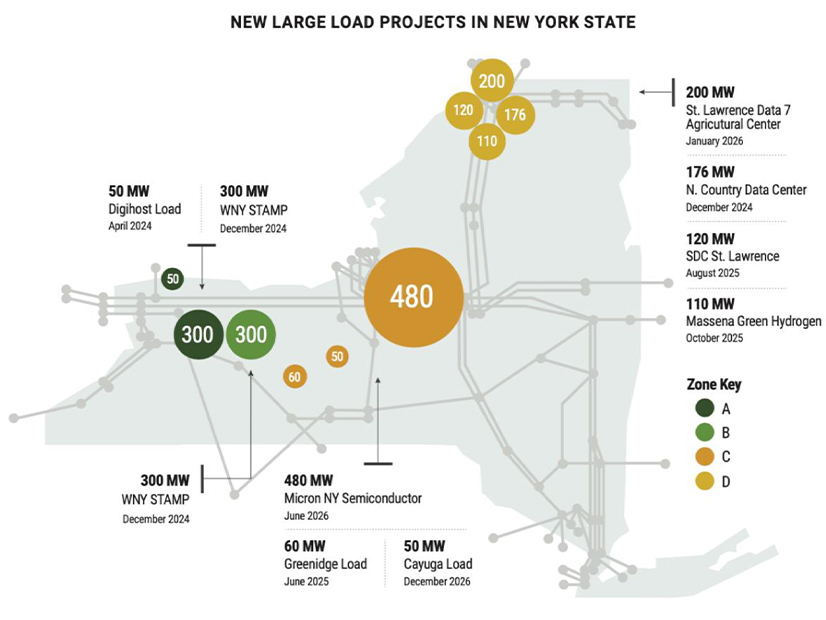
New York is working to meet rising electricity demand presented by new large loads and decarbonization efforts. | New York state Energy Planning Board
“If anything, the reconciliation bill may have rendered even that planning case a bit optimistic from the perspective of renewable deployment in particular,” she said.
NYSERDA’s senior vice president for policy, analysis and research, Carl Mas, said the language in the draft about new fossil generation is intentionally broad because there is such a broad range of possible outcomes as New York navigates state and federal economic and policy factors.
But there are scenarios under which the state — which had sought to phase out fossil fuel generation in the 2030s —would instead seek construction of new fossil generation or retrofits to make older facilities cleaner and more efficient.
“With the load growth that we’re seeing, we feel like we have to remain flexible,” Mas said. “There’s extreme amounts of uncertainty, but we have a very old fleet, and we have a growing load and substantial new headwinds that we didn’t have five or six years ago.”
This does not alter the state’s commitment to renewables and decarbonization, Harris and Mas said. It recognizes that the plan for carrying out that commitment may need to be modified to maintain reliability.
Tough Decisions
New York has a number of hard choices to make with its energy portfolio, and the draft update of the plan lays out some of the potential decision-making pathways in a rapidly evolving landscape. But it will not make the decisions easier.
Renewables advocates have been unhappy about the state ratcheting back initiatives that have become untenable or expensive, and about the slow pace at which the New York Power Authority is starting its role as a renewables developer. Any move to authorize major new fossil infrastructure is likely to go over just as badly.
Meanwhile, New York must decide whether to continue to subsidize the nuclear power plants that supply 22% of the state’s total electricity and 42% of its emissions-free electricity. Over the past seven fiscal years, this zero-emission credit program has consumed $3.73 billion gathered from surcharges on electric bills.
The draft plan highlights the importance of the ZEC program, but it also states bluntly that “it is not feasible to continue increasing the number and scale of programs that electric ratepayers need to fund.”
Another challenge: New York’s renewable energy pipeline — partly rebuilt after mass cancellations in 2023 — faces a new round of cancellations because of the impending end of federal tax credits under the reconciliation bill.
“We have literally seen the federal government’s action result in tens of billions of dollars of impact on New Yorkers with respect to clean energy deployment costs,” Harris said.
There is a wave of collateral damage beyond the tax credits, she said, as the industries and workforce that were growing in the clean energy sector retract and retreat.
Harris added, though, that renewable energy is not expected to halt; the question is how much it will slow.
“So this energy plan is taking into account the realities of having those tools impacted,” Harris said.
Simultaneous Goals
The draft plan’s summary alone stretches 80 pages and reminds the reader why governmental processes sometimes move so slowly: It is filled with parallel and secondary goals that rope in a massive cast of stakeholders and competing interests.
The draft suggests that as New York is reducing its carbon footprint and keeping its grid reliable, it should upgrade one of the oldest housing stocks in the U.S.; move to 100% zero-emission vehicle sales; reduce negative impacts on disadvantaged communities and actively steer positive impacts toward them; bolster organized labor; help poorer New Yorkers cut their energy costs; craft a more cohesive energy planning process; support research and development; build at least 1 GW of nuclear capacity; develop the energy workforce; lead the country in battery energy storage safety; maintain reliable gas transmission networks that can meet peak demand; consider wholesale electricity market reforms; and integrate renewables into the land-planning practices of often oppositional local governments.
And it wants to do all of this affordably.
“These are all goals that the state can meet without sacrificing one for another,” the draft says.
It estimates that some of the scenarios would raise energy costs more than 35% by 2040. That is expected to be offset to some extent by lower health care costs and other societal benefits, but it would be a lot of money on top of already high rates. Heavy investment is needed under any scenario because of the age of existing transmission and generation infrastructure and the increased demands expected to be placed on them.
But any embrace of new or rebuilt natural gas-fired generation would be a bitter pill to swallow for clean energy advocates.
Marguerite Wells, executive director of the Alliance for Clean Energy New York, avoided the words “natural gas” in a statement but made the trade group’s priority clear: “Electric demand is rising, and legacy generating sources are aging. It’s patently obvious that renewable sources are going to be the fastest and lowest-cost method of bringing new power onto the grid.”
ACE NY looks forward to commenting on the draft, she said, and working with the state to identify the inefficiencies and road blocks that are delaying renewables.
State policy not long ago favored natural gas as the preferred alternative to coal and oil.
The 2015 update of the State Energy Plan discussed New York’s ambitions for, and early steps with, renewables. But it also said, “Economic, operational and environmental advantages make natural gas the current fuel of choice for new and replacement generation in New York.”
The 2019 climate law canceled that line of thought. But there was always going to be an off-ramp in case the vision did not come together as hoped.
In the 2022 Scoping Plan it prepared for the law, the state Climate Action Council said, “The effectiveness of programs and policies should be continually evaluated and changed if renewable energy is not being deployed at the pace necessary to achieve the requirements on time.”
The July 23 vote to publish the draft set in advance the process for such a potential change.
Jackie Bray, commissioner of the Division of Homeland Security and Emergency Services and a member of the Energy Planning Board, said she was glad alternate scenarios were included in the draft in case the preferred scenario becomes impossible.
There can be a tendency in this type of planning process, she said, for well-meaning leaders to continually add objectives to a blueprint on the assumption that there is time over the next decade to figure out how to reach those objectives.
“Make sure that we are being realistic about what we can deliver and what we must deliver,” Bray urged listeners.