FERC has granted Great Basin Transmission’s request for incentives and a transmission owner tariff for its Southwest Intertie Project-North line — rejecting arguments that the project no longer makes sense with the cancellation of the Lava Ridge wind farm.
In an Oct. 31 order (ER25-2025), FERC accepted Great Basin’s proposed transmission owner tariff and formula rate for the project, also known as SWIP-North.
SWIP-North is a 285-mile, 500-kV line being developed by LS Power subsidiary Great Basin Transmission at an estimated cost of $1 billion. It will run from eastern Nevada near Ely to Idaho Power’s Midpoint Substation near Twin Falls, providing a bi-directional energy pathway between the Desert Southwest and the Pacific Northwest.
Great Basin’s transmission owner tariff includes the terms and conditions to participate as a Participating Transmission Owner (PTO) in CAISO. The PTO model allows lines outside of California to join the ISO while avoiding financial risks. (See CAISO Wins FERC Approval for Subscriber-funded Tx Plan.)
Great Basin said its tariff is consistent with other PTO tariffs on file at FERC, including those of affiliates DesertLink and LS Power Grid California.
FERC also granted Great Basin’s request for several transmission-development incentives.
The abandoned plant incentive will allow the company to recover its costs if the project is abandoned due to events beyond its control.
In addition, the commission granted Great Basin’s request for a regulatory asset incentive, which allows deferred recovery of prudently incurred pre-commercial costs through the creation of a regulatory asset. And FERC approved an RTO adder for SWIP-North, which will take effect when Great Basin joins CAISO and turns over operational control of the transmission line.
FERC Chair Laura Swett and Commissioner David LaCerte did not participate in the decision.
Reducing Congestion Costs
FERC’s approval of the abandoned-plant and regulatory-asset incentives is a reversal from the commission’s previous denial of Great Basin’s request. (See FERC Denies LS Power’s Bid for SWIP-N Incentives.)
In a Feb. 20 order, the commission found that the company failed to meet the criteria of FERC Order 679, which requires transmission incentive applicants to show that a project will ensure reliability or reduce costs associated with transmission congestion.
The incentive request was denied without prejudice. In its new request, filed April 23, Great Basin supplied an economic study by Hitachi Energy that showed annual congestion costs for the California-Oregon Intertie Corridor (COI corridor) would drop by about $38.6 million a year, to $156.7 million, with SWIP-North in place.
In addition, Great Basin argued, SWIP-North would give Idaho Power access to the Desert Southwest market, improving reliability during extreme cold weather events. By alleviating congestion constraints between the Pacific Northwest and Desert Southwest, the project would reduce the cost of delivered power, the company said.
And CAISO identified reliability benefits of the project, including resource diversity and the addition of a parallel path with the COI Corridor. Those could be important factors during wildfires or extreme weather.
A group called Stop Lava Ridge argued that recent policy changes reduce the chances of the development of the 1,000 MW of Idaho wind that Great Basin relies on in its application. The group noted the Department of the Interior’s cancellation Aug. 5 of the 1,000-MW Lava Ridge wind project. (See Interior Reverses Approval of Lava Ridge Wind Project.)
But Great Basin responded that SWIP-North’s congestion relief benefits are not tied to Lava Ridge wind.
“Whether the source is from nuclear generation, gas generation, hydro generation, geothermal generation or other nonwind resources, and regardless of the state of origin (i.e., Idaho, Oregon, Wyoming, Washington, etc.) of such generation, the addition of SWIP-North would still provide COI congestion relief benefits,” Jinxiang Zhu of Hitachi Energy said in a filing.
In fact, SWIP-North would relieve even more congestion without Idaho wind generation, Zhu said, reducing congestion costs by $47.2 million and further reducing the number of COI corridor congestion hours.
The NYISO Management Committee voted to approve the ISO’s 2025-2034 Comprehensive Reliability Plan, though stakeholders and the Market Monitoring Unit again voiced concerns with how it is structuring its planning.
The Natural Resources Defense Council voted against the plan at the committee’s meeting Oct. 29, while Energy Spectrum, the New York Utility Intervention Unit, Multiple Intervenors and New York City abstained.
The biennial CRP looks ahead 10 years to plan for long-term reliability. The latest plan did not identify a specific actionable reliability need but said that “New York’s electrical system faces an era of profound reliability challenges” and called for several thousand megawatts of additional dispatchable generation. (See NYISO Reliability Plan Calls for ‘New Dispatchable Generation’.)
It calls for looking at a wider range of scenarios for transmission planning and relying less on emergency measures for maintaining resource adequacy. Ross Altman, senior manager of reliability planning for NYISO, said implementing the plan could require manual and tariff changes.
“You want to consider a range of potential forecasts coupled with your ability to go ahead and procure through solicitation resources to meet whatever potential gap is in necessary resources,” said Howard Fromer, director of regulatory affairs for Bayonne Energy Center. “What do you propose to do about aligning our markets so that they are going out and procuring resources that are consistent with your reliability needs through your planning process?”
“I don’t have anything for you today because this is the beginning of the road,” Altman said. “What we actually plan for requires additional conversations in the next months.”
Altman said staff took Fromer’s point very seriously and that aligning markets with reliability planning was something the ISO was actively working on.
“My expectation is that you would want to conduct the [upcoming] Reliability Needs Assessment [RNA] with the new structure,” said Doreen Saia, chair of the energy and natural resources practice for Greenberg Traurig. She said this would require very fast action from NYISO and its stakeholder committees and asked the ISO to create a public schedule quickly. “Transparency is important. Notice is important.”
Zach Smith, NYISO vice president of system and resource planning, thanked Saia for pointing this out but cautioned that the ISO was not sure that tariff revisions were needed. If they were, the ISO would need to be mindful of the tight timeline to get revisions filed before the next RNA.
“I want to push back on the idea that we can commence the RNA without understanding how NYISO is going to determine actionable reliability,” the NRDC’s Chris Casey said. “The assumption that the ISO is planning to use different scenarios gets colored differently if those scenarios are informational versus actionable.”
“I actually fully agree with you,” Altman replied. He said the broad range of scenarios the ISO had previously shown was intended to illustrate what it had to account for. “The actual implementation of that, and the assumptions that will go into the RNA, will be very detailed.”
Casey pointed to a graph in the CRP that showed the state hitting a 4,000-MW shortfall and compared it to a more detailed slice of the same data. He said the ISO was overemphasizing the worst-case scenarios and that those scenarios did not have a sufficient basis to justify centering them.
Altman said these weren’t actually the worst cases and that staff actually excluded several outliers that assumed nuclear plants would not get relicensed. As the process continued, stakeholder feedback would be used to “find the balance.”
A representative from Earthjustice said that amid all the discussion of schedules and changes to the markets, they had not heard any evidence from NYISO that the changes it was presenting were necessary. They asked if the ISO had called in independent consultants to look at the changes to the reliability planning process to see if they made sense.
“I would strongly encourage the consideration of this before there’s this dramatic shift in the way the markets are planned and the way that reliability planning occurs,” they said.
The MMU said it was concerned that there is a growing gap between planning and the markets.
“We’ve been seeing that open up in the past couple of years, and I think it’s a concern because it’s going to provide the wrong incentive,” said Pallas LeeVanSchaick, vice president of Potomac Economics. He said that gap undermines the market’s ability to maintain reliability. It could also result in the ISO keeping more capacity than is needed to meet the needs of the system.
The CRP now goes before the Board of Directors, which is expected to pass it before the end of November. Discussions over the proposed planning process changes would then begin in December.
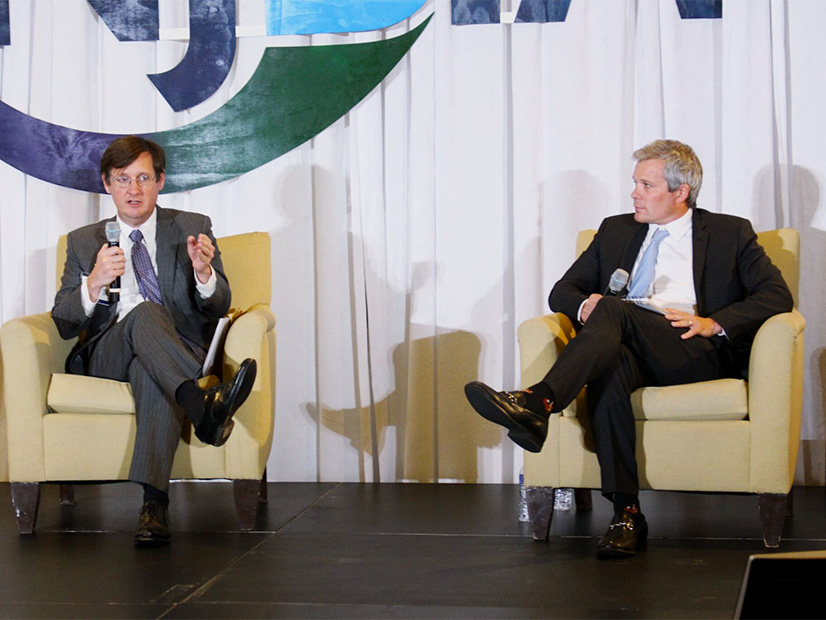
FRANKLIN TOWNSHIP, N.J. — New Jersey will need to overcome a raft of permitting, funding and policy issues as it seeks to remake its energy strategy to confront the sudden, data center-fueled rise in energy demand on the horizon, speakers told an energy forum organized by the state’s largest business group.
Perhaps the most urgent need is a clear-eyed look, coupled with some tough decisions, at what energy sources the state is going to pursue, keynote speaker Zenon Christodoulou, a commissioner on the Board of Public Utilities, said at the New Jersey Business & Industry Association’s annual Energy and Environmental Policy Forum, held Oct. 28-29.
As the state emerges from a vigorous, Democratic-led pursuit of offshore wind, Christodoulou warned against accepting the “agnostic” view of energy in which all sources are valid, commonly described as the “all of the above” approach.
“I know it sounds impartial and democratic,” but the word “agnostic” also “conveys a sense of ignorance and lack of knowledge,” and the state needs a more defined strategy, he said.
“We need to take some educated guesses here,” he said. “We need to find the best-of-the-above approach, not an old approach. And while we’re at it, maybe we can look at some below-the-surface approaches, like geothermal and hydrogen.”
The conference took place amid the final stages of the gubernatorial election to pick the successor to Gov. Phil Murphy (D), who aggressively pursued a clean energy strategy, the largest part of which — 11 GW of offshore wind — has largely stalled under unfavorable economic conditions and President Donald Trump’s opposition.
Energy issues have taken center stage in the state in large part from a predicted electricity shortfall and the impact on ratepayers. New Jersey ratepayers’ average electric bill rose 20% in June.
As one of the 13 states served by PJM, New Jersey faces a dramatic surge in demand, mainly because of the expected development of heavy electricity-using data centers. Analysts say the expected shortfall was also triggered by rapid closures of aging fossil fuel plants as new plants, mainly clean, have come online more slowly.
Importer or Exporter?
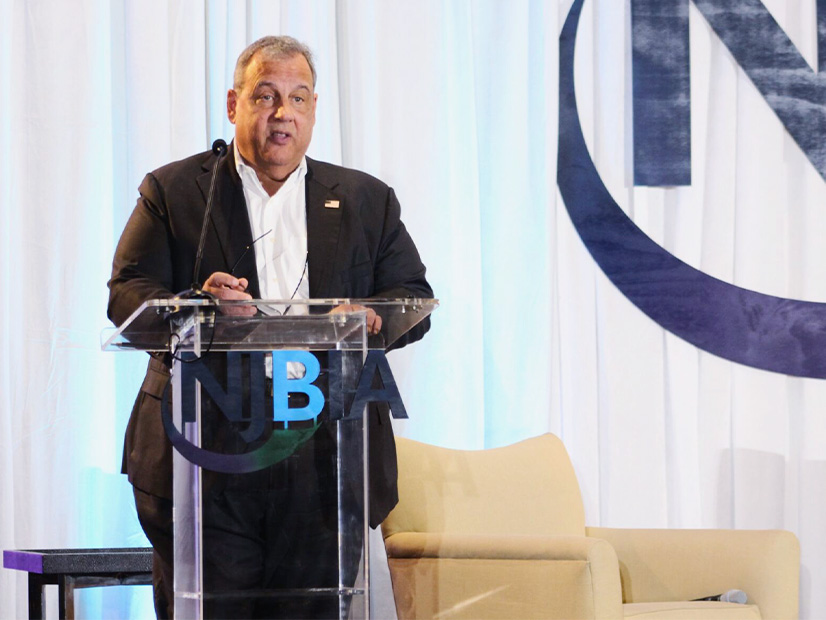
Former Gov. Chris Christie (R), a keynote speaker at the forum, said the state generated enough electricity that it was exporting power when he handed the reins to Murphy. He blamed the incumbent’s “hyper focus” on clean energy for the state’s current predicament and its swing to become an energy importer, rather than being self-sufficient.
“What he’s done is deter any baseload generation, and that begins the part of the problem,” Christie said. He added that the next governor will have to “bite the bullet” and develop natural gas plants.
“Their first step, in my view, if they asked [me], would be to sit down with utilities and say, ‘What do we need to do to get you to open two or three new natural gas generation plants as quickly as possible?’” he said.
But Brian O. Lipman, director of the New Jersey Division of Rate Counsel, told a panel on rates that the state has been a net importer of electricity since 1990, and that’s not a problem.
“We’re not an exporting state,” he said. “The whole point of PJM is that we could bring in cheaper electricity from other states. Generation is expensive to build, and it’s cheaper to build it, quite frankly, in Pennsylvania, in the middle of nowhere, than it is anywhere in New Jersey.
“We can talk about whether we should be an importer, and how much we should be, whether it’s economic to build in New Jersey at this time,” he said. “But the reality is, when it’s economic to build outside the state and bring electricity in, that’s what we should be doing.”
If New Jersey wants to generate its own power, then it needs to streamline and speed up the permitting process, he said. “We can do things with permitting where we can override the NIMBY issues that a lot of these projects are going to have,” he said.
He suggested the state could protect itself from bearing the burden and infrastructure costs of excessive data center demand by requiring such facilities to bring their own generation sources. But he also expressed caution.
“If you legislate too much, the data center is just going to go to another state,” he said. “And if the data center goes to Pennsylvania, we still have the same demand issues that we would have if they were in New Jersey. We just aren’t going to get any of the economic benefits that we would get if they were built in New Jersey.”
Backing Nuclear
With wind and solar largely an afterthought at the forum, the panelists more frequently focused on nuclear and gas to resolve the state’s looming power shortage.
Erick A. Ford, president of the New Jersey Energy Policy Coalition, which advocates for a “balanced” energy strategy, said the state is “uniquely positioned” to lead the move into nuclear, with an experienced workforce and a history of managing nuclear plants, including Public Service Enterprise Group’s three existing facilities in Salem and the now-defunct Oyster Creek plant.
Speakers on a panel titled “Nuclear Power – Is it in NJ’s Future?” cited several recent announcements that suggest nuclear power is increasingly viable. They included the U.S. government’s announcement on the same date as the conference that it had forged a partnership with the Canadian owners of Westinghouse Electric to spend at least $80 billion on nuclear reactors. In a separate announcement, NextEra Energy said it plans to restart the 50-year-old Duane Arnold Energy Center. (See related stories, U.S., Westinghouse Partner for $80B in Nuclear Construction and NextEra, Google Announce Nuclear Collaboration.)
New Jersey is home to a 50-acre technology center in Camden, run by Holtec International, which is restarting Michigan’s Palisades nuclear plant and plans to build two small modular reactors beside it. (See Holtec Announces SMR Plans at Palisades Nuclear Plant.)
The company also is decommissioning the Oyster Creek facility. Holtec CEO Krishna Singh told New Jersey legislators in August that the company is looking at whether four of its SMR-300 reactors could be sited in Oyster Creek, generating 1,300 MW of power.
Feasibility Challenges
Whether New Jersey is a contender for future reactors is unclear. The U.S. Nuclear Regulatory Commission in 2016 issued PSEG an early site permit for the Salem site that currently houses the three reactors it operates, but the company has yet to announce any plans for the site.
To host other facilities, the state would have to meet the needs of developers or their clients.
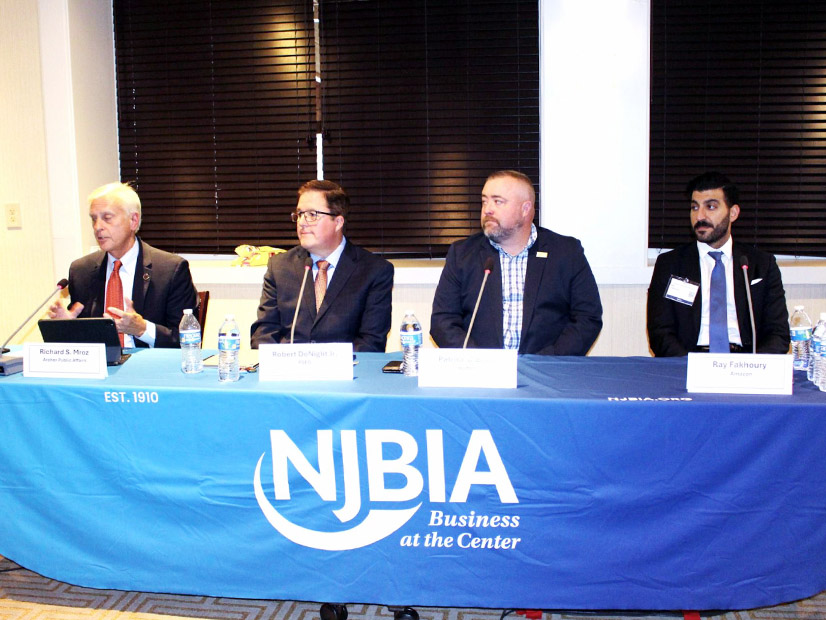
Ray Fakhoury, energy policy manager for Amazon Web Services, told the forum that nuclear projects will be critical to the company’s Net Zero by 2040 plan. Amazon on Oct. 16 outlined plans to build up to 12 SMRs and generate 5 GW of nuclear power by 2039.
In looking for sites to put a data center served by a nuclear project, the company’s first priority is access to a transmission line to “create the promise that there will be future growth opportunities to that potential area,” he said.
“The challenge is a one-off facility might not be so useful for Amazon because we can’t capture those economies of scale,” he said. In addition, having a site with a pre-application submitted, “early site works being done and permitting kind of being set forward are all really critical to building, and all of that is wrapped up in this nice bundle of policy certainty.”
Other challenges to developing nuclear sites in the state will be finding trained workers and overcoming the lack of a supply chain. On top of those challenges is the fact that nuclear plants take longer and cost more to build than other generating sources and so can’t meet the state’s urgent shorter-term needs.
Yet the NRC has reduced the 5-mile emergency management zone perimeter for nuclear plants, shrinking the footprint needed, which is helpful to densely populated states such as New Jersey. And nuclear plants last much longer than other plants.
Robert DeNight, vice president of nuclear engineering for PSEG, told the forum that the company may seek to extend the life of its three nuclear plants beyond 80 years, well beyond the operating license extensions it requested from the NRC last year. (See PSEG Plans for 80-year Nuclear Generation in NJ.)
“After we get 80 years, we’ll assess from a material standpoint and see if 100 years makes sense,” DeKnight said.
Patrick O’Brien, director of government affairs for Holtec, said, “The reality is you’re going to replace a wind and solar farm two or three times before you get to the end of a nuclear plant.”
“We’re running on average 95% of the time,” he said. “So there’s a lot of benefits there for long-term usage; a lot of energy density on a small piece of property.”
But any project will require investor confidence that it can be completed. And that has been sorely damaged by the Trump administration’s efforts to terminate offshore wind projects heading for completion, forum speakers said.
“The No. 1 concern is, how do I know three years, four years from now, my project will be safe?” said Matthew Leggett, an energy specialist at law firm K&L Gates. “Whether it’s an oil-and-gas project, a solar project, a wind project, any other kind of project — any multiyear, large, energy infrastructure investment has a question mark because of that uncertainty that’s been created.”
Timothy Fox, managing director at ClearView Energy Partners, added, “Project developers and especially the financiers behind those projects are going to be wary of investing in a capital-intensive industry with such demonstrable high election risk. Because can you really get a project through permitting and fully built in four years?”
AUSTIN, Texas — Reports of the energy storage industry’s demise are greatly exaggerated, experts said during the American Clean Power Association’s annual Energy Storage Summit.
Laura Beane, chair of ACP’s board and CEO of Vestas North America, welcomed attendees to Texas, a state “now increasingly at the forefront of the energy storage future.” She recalled her comments from ACP’s CLEANPOWER conference, held May 19-22 in Phoenix, where she laid out the challenges facing the industry.
“The noise, the shifting policy landscape, the disinformation, the conflicting narratives,” Beane told an estimated 750 attendees during the Oct. 27-29 conference’s opener. “Yes, there’s still a lot of noise. There are regulatory hurdles; there’s a tremendous amount of uncertainty, and we’re working hard every day to cut through that noise, but our job, individually and collectively, every day, is to also drown out the noise.
“When we cut away the distractions, what do we see? We see an industry that, like most mature industries, is driven by demand and supply, and right now, we are standing on the edge of the greatest energy expansion this country has ever seen,” she added. “Energy storage has truly come of age. It’s no longer a concept on the horizon. It’s here. It’s real; it’s essential. It’s technology that no longer relies on positive narratives or temporary incentives. It’s not tethered to the noise and the distraction. It’s standing on its own, driven by market demand, technological innovation and the undeniable need for flexibility and reliability in our grid, and the data certainly backs this up.”
A recent report from BloombergNEF bears this out. (See BNEF Sees Short-term Pain, Longer-term Rebound for Renewables.) The report says the U.S. is expected to add 204 GW over the next decade, a sharp increase from the 31 GW installed through 2024. The projections are 25% higher than those BNEF shared after the One Big Beautiful Bill Act, which slammed wind and solar energy, was signed into law in July.
BNEF’s Isshu Kikuma, one of the report’s authors and a summit panelist, said storage is faring better than renewables because the full value of its tax credits is good through 2033. The credits drop to 75% in 2034 and 50% in 2035.
ACP CEO Jason Grumet followed Beane on the stage and compared storage to a good neighbor or friend.
“Storage is the friend who shows up on moving day with a truck and snacks. Storage is the person who picks you up at the airport at 11:30 at night. Storage is the kid with the color-coded binder with all the deadlines for their college application,” he said. “We are warm. We are relatable.
“But look, 99% of Americans and virtually all policymakers do not know much about storage,” Grumet went on. “We live in a moment where electrons and molecules are seen to have political affiliation, but storage so far is kind of like hanging out in that kind of quiet, independent voice.”
But there are risks for the industry, both foreign and domestic, he said.
“The supply chain is a huge challenge for us. The concentration of critical mineral processing in China is an economic risk,” Grumet said. “The most imminent risk we face domestically is not technology; it’s political uncertainty. We can generate the electrons; we can get power to the people if we allow the market to function. Building massive infrastructure requires a decade of political stability. What we are finding is that in four years, you can mess up the existing pipeline of technology, but you can’t build the next one, and so we have to figure out how to avoid having ideology collide with energy fundamentals.”
Storage Proves Value in ERCOT
ERCOT CEO Pablo Vegas sat down with Grumet for a fireside chat and said that despite meeting near-record summer demand with a fuel mix that includes energy storage and renewables and their resulting low prices, managing the Texas grid is not easy.
“We are special — I will start with that — but it’s a challenge every day. It’s a challenge because things are constantly changing,” Vegas told Grumet.
When he was named ERCOT’s CEO in 2022, he said, there was less than 2 GW of storage on the system. “It has doubled every single year that I have been here,” he said, noting the grid operator’s installed storage capacity has now grown to 15 GW. The interconnection queue includes an additional 178 GW of standalone and co-located storage.
“I think batteries are really in the first or second inning there,” Vegas said. “It’s at scale. It’s really become a part of the energy equation, a really important part of it. But it’s early in the process, and I think there’s a huge future ahead of it … as long as we don’t get in the way and trip it along the way.”
He said the biggest risk facing storage is “policy, ideology and differing agendas that don’t embrace the growth environment of the state.”
Texas Public Utility Commission Chair Thomas Gleeson said he runs into the same political headwinds. He said the joke in his office is that when he testifies in legislative hearings, “it seems like the Democrats on the committee agreed with me more than the than the Republicans.”
“I believe batteries are a dispatchable technology,” Gleeson said. “We need more gas plants in the state. I think it would be hard to deny that. But I would say often when posed the question, ‘What do you do with unreliable, intermittent resources?’ And I was quick to tell folks, ‘I don’t believe that they’re unreliable.’ They’re variable, which causes its own kind of challenge. But gas plants break.
“The goal, again, is to have such an expansive portfolio that they all work well together in balance,” Gleeson said. “And so, I do view batteries as dispatchable. I think everyone should.”
Robb: Batteries Help Grid Reliability
NERC CEO Jim Robb agreed with Gleeson, saying his organization has been “really clear” on storage’s reliability contributions to the grid.
Storage “mitigates the variability that you’re always going to have with wind and solar production. Clouds fly over, wind stops for a few minutes, so it helps deal with those issues,” he said.
Robb said the bigger issue comes during the late afternoons, when solar production begins to ramp down. ERCOT credits storage in Texas for compensating for the loss of solar in the evening hours. The grid operator has now gone two summers without serious reliability concerns. (See Texas RE: ESRs to Boost ERCOT During Summer.)
“When the solar drops off, you need something to fire up really, really quickly,” Robb said. “We’re seeing solar playing a really big role in moderating those ramps, which is good for the fossil fleet to be able to operate in a more rational way. They’re still getting stressed, but it’s not as bad as it would be, and it really plays a very nice moderation.”
That makes the case for pairing storage with solar facilities, he said.
“We see enormous benefits from having battery storage combined with [solar],” he said. “You look at California, you look at Texas, in particular. Texas is probably the most interesting market because it’s isolated whereas California is integrated with the rest of the West.”
Nickell Sees Storage’s Growth in SPP
While Texas and California are awash with solar and storage facilities, SPP isn’t. ERCOT’s neighbor had 172 MW of accredited summer battery storage capacity in 2025 and 548 MW of operational solar as of June 2025.
However, the RTO’s interconnection queue lists 48.4 GW and 34.6 GW of storage and solar capacity requests, respectively. That accounts for almost two-thirds of the queue’s requested capacity.
“We see a lot of interest. We’re not seeing a lot of it get built yet,” SPP CEO Lanny Nickell said. “What we’ve heard when we talk to a lot of our customers, developers and the market is that markets in California and in Texas are more lucrative. And the reason for that is because, not only are the prices on average higher in those markets … but also, particularly for storage in those markets, there’s a lot more volatility. You want to be able to charge when prices are low, and you want to be able to discharge when prices are high, and when that gap exists almost on a daily basis, that’s attractive.”
Nickell is buoyed when he looks at the requests for storage and solar in the generator interconnection queue. “We know solar is coming, and we think solar will bring more storage … over the next two [to] four years,” he said.
Nickell was asked why that is. Does it have anything to do with the glut of storage in the CAISO and ERCOT markets?
“I do think that will cause more storage to be looking at SPP because those markets are starting to fill up and there’s not as much more opportunity now compared to what there used to be,” Nickell said.
SPP filed a proposed tariff change with FERC in October following the board’s approval of a high-impact large-load service proposal that Nickell said would make the footprint much more attractive to those loads. (See “Large Load Integration OK’d,” SPP Board Approves 765-kV Project’s Increased Cost.)
“What [the proposal] does is allow these large loads to connect immediately as long as they’re willing to be conditional,” he said. “‘Conditional’ simply means if you’ve got your own generation, you’re going to probably have to start it up as opposed to actually curtail your consumption of energy. They don’t want to do that very long, so they’re going to be looking for backup sources of energy to help augment their energy supply. That’s going to be a tremendous advantage that storage is going to have in that kind of a market.”
FERC Chairs Like Batteries’ Value
Former FERC Chairs Rich Glick and Willie Phillips appeared together as a two-person panel and reminded the audience that reliability remains the No. 1 challenge for any leader of the commission.
“We didn’t experience the great load growth that we’re now talking about today,” Glick said. “It’s amazing to me, like night and day from when I was at the commission until today, [that California and Texas] added a significant amount of storage that’s helped keep prices down, but it also helped keep the lights on during some very, very difficult weather conditions. Obviously, storage provides some of the essential reliability services and does it in a very quick way, much quicker than some other technologies.”
Phillips said that when he succeeded Glick as FERC’s chair, he found that meetings with industry executives consumed much of his day.
“It helped highlight just how much demand forecasts were beginning to change. I started hearing from CEO after CEO, leader after leader, that they were having a doubling of the expected demand for energy coming on to their system, depending on the particular region,” he said. “That crystallized for me … that if we don’t get this moment right, there could be some reliability, some resource adequacy, some type of crisis that we face.”
Glick and Phillips also agreed accreditation and other methodologies to determine capacity levels have been beneficial for storage resources.
“Storage came out pretty well, because with storage, there’s obviously a reliability aspect to storage and it provides, depending on how you measure, some argument that there’s significant capacity attributes,” Glick said.
Calling for grid operators to treat paired resources as a single flexible unit, Phillips said, “If you can get to that, you can get to the accreditation, you can get to the reliability value better. We’re asking [our system] to do something that it simply wasn’t designed to do. Going forward, we can’t continue to use the same rules that were in place 50, 60 years ago.
“If we’re going to have a modern grid for our modern 21st century economy,” he added, “transmission is the backbone of our economy. I think the grid of the future is going to include resources like hybrid resources … because you have to do it. You have to do it in the near term because there’s so much pressure on our system. It’s being tested in ways that have never been tested.”
The policy changes and financial signals of the One Big Beautiful Bill Act will slow the addition of solar, storage and wind capacity, but only for a few years, BloombergNEF predicts.
BNEF in its second-half 2025 “U.S. Clean Energy Market Outlook” concludes that OBBBA’s cutback of incentives along with ongoing tariff fluctuations have slowed renewables development in 2025 and pushed back final investment decisions in the short term.
But longer-term momentum remains strong because the demand for power is growing and there is a strong economic argument for meeting that need with renewables.
BNEF places the inflection point around 2028.
It expects a short upward jump in capacity additions in 2026 as developers rush to start projects in time to qualify for tax credits, then a sharp drop-off into 2028. After 2028, wind, storage and solar additions will resume their steady growth, the report predicts.
BNEF issued the second-half report Oct. 31. From 2025 through 2035, it predicts:
432 GW of utility-scale solar capacity will be added, 25% less than predicted in the first-half 2025 report.
74 GW of onshore wind will come online, 46% less than in the first-half report.
204 GW/862 GWh of battery storage capacity will be added, 6% more than in the previous report.
Zero offshore wind capacity will be added from 2029 through 2035.
BNEF reports that that while OBBBA has reshaped U.S. energy policy, some of the upward and downward pressures on clean energy deployment that predate OBBBA (such as demand growth, corporate procurement, permitting delays and interconnection delays) will continue to influence investment decisions and timelines.
OBBBA’s exact impact on renewables remains to be seen. Since it was signed into law July 4, the clean energy market has responded by rapidly safe harboring projects and adjusting supply chains.
In its initial post-OBBBA forecast, BNEF expected a 26% decline in 2025-2035 wind, solar and storage installation. The new report cuts that down to 21% due to a faster and fuller ramp-up of battery factories that comply with new requirements; a project pipeline that is larger than previously thought; and further guidance issued on the details of OBBBA’s changes.
But the view forward is far from clear. BNEF lists numerous moving pieces that could further influence the U.S. clean power buildout, including:
permit revocations and stop-work orders issued by the Trump administration;
the as yet unknown enforcement stance the IRS will take on clean power tax credits;
the lack of clarity on rules surrounding foreign entities of concern;
the Trump administration’s overt support for coal and gas power plants;
rising construction costs and labor shortages;
the slow pace of construction of the primary alternatives to solar and wind, gas turbine and nuclear reactors; and
falling interest rates.
Costs already are rising, BNEF said: Utility-scale photovoltaic capital expenditures are 2 to 5% higher in 2025 than 2024 and onshore wind is 3 to 17% higher, depending on the region. Project contingency budgets are being set higher amid this uncertainty, further increasing capex.
Tariffs, meanwhile, raise the U.S. clean energy sector to a new level of volatility and uncertainty. As the authors point out: “U.S. tariffs on clean energy equipment have varied tremendously since President Trump took office.”
The growth of a U.S. manufacturing base that could reduce the impact of these tariffs also has been stunted by the policy gyrations of the past nine months.
BNEF reported that investments totaling more than $90 billion have been announced in the domestic solar and battery manufacturing supply chains since passage in 2022 of the Inflation Reduction Act and its generous tax credits.
“While investment climbed steadily each quarter since the passage of the IRA legislation, the threat of the IRA’s repeal and the ensuing passage of the OBBBA caused new investment announcements to grind to a halt this year,” the authors write. “During the second and third quarters of 2025, no new investments were announced for any of the solar and battery supply chain segments.”
And that creates a ripple effect.
The authors write that “[t]he introduction of tariffs has further complicated matters: A lack of factories to make upstream components is keeping proposed downstream manufacturing facilities dependent on imports, which are subject to these higher tariffs.”
CAISO’s Board of Governors approved two proposals intended to improve how the ISO calculates resource adequacy values and tracks RA supply.
Some stakeholders asked the ISO to delay implementing the proposals while the California Public Utilities Commission works on similar RA updates.
The approved RA proposals are part of CAISO’s Resource Adequacy Modeling and Program Design initiative, which began in 2023 to reform RA rules, requirements and processes. The ISO board approved both proposals at its Oct. 30 general session.
The first proposal — known as Track 1 — updates CAISO’s default qualifying capacity (QC) and planning reserve margin calculation methods. Under existing practice, energy capacity portfolios must meet the industry standard reliability statistics of a 0.1 loss of load expectation, which is equal to one loss-of-load event every 10 years.
The new QC calculation method more accurately reflects the “reliability contribution of each resource type” and is “well suited to account for the ISO balancing authority area’s diverse resource mix, historical reliability risks and anticipated future trends,” CAISO Vice President of Market Design and Analysis Anna McKenna said in an Oct. 22 memo.
Under the new method, wind and solar resource QCs will be calculated using a resource’s average effective load-carrying capability (ELCC) during net peak periods. ELCC shows the reliability contribution of a resource as a percentage of its maximum capacity. Under CAISO’s existing rules, wind and solar QCs are calculated based on a resource’s average monthly historic performance from noon to 6 p.m. over three years.
For nuclear, dispatchable thermal and hydroelectric resources, the new QC calculation will be based on an unforced capacity approach, which calculates QC using historic forced outage rates during the at-risk hours for the system over the past three years. The previous QC method for these resources was based on “net dependable capacity” defined by NERC‘s Generating Availability Data System information (GADS).
The CPUC is also developing its own UCAP design for storage and thermal resource QC purposes, CAISO staff said in a document. CAISO management “remains committed to collaboration and will seek opportunities to align inputs and assumptions where appropriate,” the ISO said.
The Alliance for Retail Energy Markets (AreM) wants CAISO to wait one year to implement the Track 1 proposal to allow coordination between the CPUC and the ISO, AreM representatives said in the document.
The new QC and PRM methods apply only where Local Regulatory Authorities (LRAs) have not established their own methods for CAISO’s RA program. Currently, when an LRA has not defined its own QC and PRM criteria, CAISO applies a default PRM of 15% and a default QC, McKenna said in her memo.
CAISO’s Department of Market Monitoring (DMM) supported the Track 1 proposal but cautioned that the new QC method does not change certain aspects of existing RA calculation methods. Those methods can still “lead to capacity accounting differences across LRAs,” DMM Executive Director Eric Hildebrandt said in an Oct. 22 memo.
There are also “several unaddressed issues” that need to be revisited for default values and modeling processes, Hildebrandt said. These include the seasonality of default values and unforced capacity, the resource adequacy availability incentive mechanism and the capacity procurement mechanism, he said in the memo.
RA Data Requirements
The second RA program change, Track 3, updates RA reporting policies to require all RA-eligible capacity in CAISO’s territory to submit annual and monthly reports.
The revision will improve grid reliability by giving the ISO a “more complete view of the status of all RA-eligible capacity and identifying capacity that may be available for backstop procurement,” McKenna said in an Oct. 22 memo.
In addition to strengthening reliability, the increased data visibility can “improve policy and modeling for the CAISO system,” Hildebrandt said.
“Additional visibility into RA resources internal to the CAISO balancing authority area would improve a systemwide understanding of recent trends in the capacity procurement mechanism and competitive solicitation process,” Hildebrandt said.
WEIM Q3 Benefits
Separately, the Western Energy Imbalance Market produced about $412 million in benefits for market participants in Q3 2025. WEIM has produced about $7.82 billion since beginning operations in 2014.
NV Energy received the most of all participants — about $104 million for the quarter.
“These numbers are another reminder of the tremendous economic and reliability value of the Western Energy Imbalance Market,” CAISO CEO Elliot Mainzer said in a press release. “Now, more than ever, we should be looking for ways to come together to preserve and enhance these benefits for Western electricity ratepayers.”
The West-Wide Governance Pathways Initiative’s Launch Committee will hire an executive staffing firm and is considering funding sources as it advances to the next phases of building the independent organization that will govern CAISO’s energy markets.
The committee is seeking $7 million to $8 million in start-up costs for the Regional Organization for Western Energy (ROWE). The money will cover costs from 2026 to 2027, Jim Shetler, general manager of the Balancing Authority of Northern California, said at Pathways’ monthly stakeholder meeting Oct. 31.
“We’re in the process of refining and making sure we covered the necessary costs,” Shetler said. “We currently are looking at three main tranches of funding.”
The funding alternatives include stakeholder contributions, grants and debt financing.
Pathways received a commitment under former President Joe Biden’s administration to underwrite the committee’s efforts to establish ROWE to oversee CAISO’s Western Energy Imbalance Market (WEIM) and Extended Day-Ahead Market (EDAM). (See Feds Pause $1M Pathways Initiative Funding, Group Leader Says.)
However, Shetler said, “it’s rather doubtful that we will get that federal grant.”
“We are starting to outreach to other entities, to look at private sector entities who may be willing to provide grant funds for this effort, and [we] have had some initial conversations around that,” Shetler added.
On Oct. 29, the Launch Committee issued a request for proposals to pay $420,000 for an executive staffing firm to assist in seating ROWE’s independent board and hiring of initial key staff.
The RFP notes that because of “funding limitations,” the committee is considering two options for support: basic support, including assisting in scheduling candidate interviews and preparing agendas; or routine support, which would include tasks such as vetting potential candidates and coordinating interviews.
The independent board will initially have five members, with two additional members to be added after tariff changes are approved by FERC.
“The board selection process will begin in January, so the nominating committee will begin to really meet in earnest the beginning of next year. The goal is to find five board members to be seated by or around July of 2026,” said Kathleen Staks, executive director of Western Freedom and co-chair of the Launch Committee.
California Gov. Gavin Newsom signed AB 825 into law on Sept. 19, allowing CAISO and investor-owned utilities to participate in ROWE. (See Newsom Signs Calif. Pathways Bill into Law.)
One goal in establishing the organization was to remove what some see as a barrier to wider participation in CAISO-run markets by ensuring they are not governed solely by officials and stakeholders in California. Another goal is to continue to “add additional market services that are voluntary for any Western stakeholders who want them,” Staks said.
“So being able to go from just overseeing the EIM and EDAM to adding additional services as Western stakeholders demand them is a really critical function,” Staks said. “This is not just independent governance over these energy markets. It is independent governance over all of the functions and offerings that go beyond that.”
Northern Indiana Public Service Co.’s leadership plan to test their new GenCo spinoff business with a $6 billion to $7 billion grid investment from a large, yet unnamed customer.
NIPSCO secured approval in September from the Indiana Utility Regulatory Commission (IURC) to launch its business model dedicated to building generation quickly to serve data centers and other large loads.
Lloyd Yates, CEO of parent company NiSource, said NIPSCO in September struck its first GenCo agreement with a “large, investment-grade data center customer” that would require two 1,300-MW GE Vernova natural gas turbines, 400 MW of new battery storage and transmission upgrades in northern Indiana.
NIPSCO’s contract with the customer stipulates an initial 15-year term. The utility plans to start constructing generation in 2027 and be able to meet the project’s full demand by 2032.
Yates said GenCo’s first, potential $7 billion investment will allow $1 billion in savings to flow back to existing customers. He said NiSource has “capitalized on emerging data center opportunities” in Indiana.
“The IURC’s approval of GenCo unlocks a unique business model designed to protect existing customers, serve new customers with speed and flexibility and maintain the financial integrity of NIPSCO,” Yates told shareholders at an Oct. 29 earnings call. “The GenCo strategy goes beyond simply providing power. It establishes a framework that strengthens our system, supports local communities and drives long-term sustainable growth for all stakeholders,”
NiSource reported $1.27 billion ($0.19/share) in revenue for the third quarter of 2025.
Yates emphasized NiSource is committed to keeping energy costs “reasonable and predictable” for the rest of its ratepayers.
NiSource Executive Vice President Michael Luhrs said NiSource plans to submit a special contract agreement to the IURC for review before the end of 2025. He said the utility expects a decision in the first half of 2026.
GenCo is exempt from many regulatory reviews typically required to build new generation in Indiana. Instead of the usual public proceeding, IURC would review the proposed contracts and power purchase agreements between NIPSCO and large loads on a case-by-case basis.
Multiple groups argue GenCo’s framework is flawed and is ripe for misconduct.
Clean Grid Alliance said GenCo would enjoy regulatory shortcuts while essentially maintaining the status of an unregulated independent power producer backed by a regulated monopoly. That one-sidedness would distort market competition and also could impede the clean energy transition, the nonprofit argued. It asked why NIPSCO didn’t simply create a new pricing tariff for data center load.
Watchdog group Citizens Action Coalition similarly argued GenCo would benefit shareholders over the public. It also said GenCo’s setup can’t fully isolate large-load investments because if the spinoff business were to lose money, it could affect NiSource’s credit rating.
The Citizens Action Coalition and the Indiana Office of Utility Consumer Counselor have alerted the IURC they plan to appeal its authorization of GenCo.
NIPSCO continues to claim GenCo will sequester investments stemming from large loads from being rolled into its rate base.
On the earnings call, Luhrs said NiSource is limited in the details it can share and called the deal a “breakthrough infrastructure agreement.”
Luhrs said the agreement will require consistent capacity payments of the customer, the “pass-through treatment of certain costs” and termination protections to mitigate risks posed by an early exit of the customer. He said NIPSCO’s proposed generation project and transmission upgrades were “carefully structured” to prioritize affordability “so that growth does not come at the expense of existing customers.”
Luhrs stressed that the contract ensures NIPSCO retail customers won’t be responsible for the infrastructure costs associated with serving the large load. He added NIPSCO would complete the project with “minimal interruption” to existing operations.
“We continue to see strong momentum from large-load customers,” Luhrs said, indicating GenCo will attract more customers.
Minutes after announcing the gas generation additions under GenCo, Yates said NIPSCO remains committed to the energy transition and would close its R.M. Schahfer and Michigan City coal plants by the end of 2025 and at the end of 2028, respectively. NIPSCO has announced plans to build a $644 million natural gas peaker plant at the Schahfer site to supply more demand tied to data center growth.
MISO members debated how their system could change under the weight of large load additions and scheduled a future discussion in front of the RTO’s board of directors.
MISO Advisory Committee members considered the co-location of large loads at generating facilities at their Oct. 28 teleconference and planned a discussion slot on large loads at the Dec. 10 meeting to be held in front of the MISO Board of Directors.
Union of Concerned Scientists’ Sam Gomberg said there’s a “timing mismatch” between the rapid development of data centers and the slower-moving processes to “responsibly” get generation and transmission online. On top of that, Gomberg said vacillating federal policy is worsening uncertainty in planning for rising demand.
“People know they should be running, but they’re not exactly sure which direction to be running in,” Gomberg said.
Clean Grid Alliance Executive Director Beth Soholt said in MISO, load forecasts, generation planning, interconnection queues and transmission planning “aren’t totally synced up.” Soholt added there’s an “opaqueness” regarding how much large load customers are required to pay, with each state outlining its own cost responsibilities.
Illinois Commerce Commissioner Michael Carrigan joked that no one can get through a day without debating “AI, data centers, shifting load or increasing load from manufacturing.” He said he’s particularly concerned about an undersized grid expansion.
“We’re going to grow into practically anything you build,” Carrigan said.
But Kavita Maini, representing MISO industrial customers, asked what would happen to all newly built generation if AI processing became more efficient and didn’t need as much generation as anticipated.
“In my head, that’s one of the biggest challenges,” Maini said.
Maini said large loads should cover the costs they incur. Gomberg agreed he was concerned consumers could end up financing grid upgrades through increased power bills.
“The minute we start talking about subsidies and discounts, the whole system becomes inefficient,” Maini said.
Wisconsin Public Service Commissioner Marcus Hawkins said the timing of when cost recovery begins on large loads is vital because existing customers typically are the only ones paying leading up to energizing the large load facility.
Gomberg said it’s probably worth it for MISO to expand participation rules for energy storage and hybrid resources to get online quickly and reliably handle new load. He said storage can absorb or transmit power in a “matter of milliseconds” to keep load and energy balanced.
Gomberg and Soholt said it’s probably time to dust off NextEra Energy’s 2024 proposal that MISO create a dedicated study and registration process for new generation contingent on large loads. (See “NextEra Makes 2nd Overture for Bundled Studies,” MISO Previews Future Projects to Improve System Planning.)
Soholt called for more consolidated planning across MISO in general that ties together load estimates, annual and long-term transmission planning, and the interconnection queue and associated fast lane.
“We still have very siloed planning,” Soholt said.
Gomberg said he is “very curious” what happens when concentrated large loads cause congestion issues on the MISO system. Xcel Energy’s Susan Rossi, representing MISO Transmission Owners, said she likewise has questions around the potential for added reliability costs and uplift payments that could be induced by large loads.
John Wolfram, also representing MISO TOs, said he wondered what ensues when a co-located power plant goes offline but the large load it was built to serve tries to keep humming. Wolfram said that kind of “post-contingency thinking” could be helpful.
NextEra’s Erin Murphy said members’ conversations are especially germane since the Department of Energy recently directed FERC to initiate a rulemaking to speed up the interconnection of large load additions, including data centers and manufacturing facilities. Also, FERC in 2024 initiated proceedings to explore the upshots of co-locating large loads near generating facilities (AD24-11).
Here’s something you don’t see every day: a state asking communities to raise their hand and explain why they should be the site of a next-generation nuclear reactor.
The New York Power Authority has begun to sound out developers on how they would go about building a gigawatt or more of advanced nuclear generating capacity and sound out communities on why they would be the right place to do it.
The requests for information NYPA issued Oct. 30 will not result in a contract award or siting designation, but they will help shape the process by which those decisions are made.
Faced with the prospect of increasing power demand in New York state, the statutory requirement to reduce emissions and the slow pace of renewable energy development, Gov. Kathy Hochul (D) in June ordered NYPA to develop at least 1 GW of advanced nuclear capacity. (See N.Y. Pursuing Development of 1-GW Advanced Nuclear Facility.)
Caveats: It must be sited in a community that welcomes it and must be developed in partnership with the private sector.
So NYPA is looking for a site and is trying to line up potential private-sector partners with a track record of developing, constructing, operating and/or servicing nuclear energy facilities.
It defines advanced nuclear as large-scale or small modular reactors employing Gen III+ or Gen IV technologies. Microreactors are not under consideration.
NYPA requires that the project start construction before 2033 and enter operation by 2040.
NYPA is steering clear of first-of-a-kind projects, which can carry elevated risk of delay, technical hurdles and cost overrun, but it is not being strict about this — it asks merely that the first concrete have been poured for at least one similar project somewhere else in North America by early 2030.
Host Community
The host communities RFI defines “community” as anything from a village to a county to a multicounty region.
New York City, Long Island and all but one Hudson Valley county are excluded from consideration — NYPA is looking toward the less densely populated parts of upstate, and away from the crowded downstate areas where many viewed the now-closed Indian Point nuclear plant unfavorably.
NYPA seeks a site that has a clear path toward construction of nuclear generation, is large enough, has water access, is protected from hazards and has demonstrated support from key stakeholders within the community.
Respondents should describe their community’s high-level vision for nuclear and how it would advance the community’s goals.
NYPA wants to know about factors including the area workforce and workforce development programs; local supply chain; supportive institutions such as labor unions and community leaders; infrastructure; power-intensive industries the community hosts or is trying to attract; framework for local approvals; and development incentives that would attract and retain nuclear supply chain businesses.
Also important are details such as interconnection potential, transportation access suitable for heavy cargo, environmental issues and any efforts taken to gauge popular support.
Interest has been expressed already. Officials in Oswego County, home to three of the state’s four operating commercial reactors, say additional reactors would be a nice fit there. Many in the lakeside city of Dunkirk, which suffered economically with the shutdown of NRG Energy’s coal-fired power plant, are lobbying for that site to host the state’s next reactor.
Development Partner
In the RFI issued to developers, NYPA seeks details about the technology they would use, siting considerations, cost and timeline assumptions, and potential ownership/partnership structures they see with NYPA.
And of course NYPA is looking for a demonstrated credible path to adding at least 1 GW of fission generation to New York’s grid as soon as possible.
NYPA asks respondents what experience they have with nuclear or other large-scale capital project construction and operation, details about those projects, their track record in securing state and federal funding, partnerships they would develop, what manufacturer and technology they would use in New York, supply chain considerations, fuel and waste management, design modularity and anticipated challenges.
NYPA also wants to know which site the respondents would propose for their project or know how they would identify a site if they have not already.
And it asks some questions that point to the central challenges of nuclear power development: describe your licensing strategy; provide your anticipated timeline up to commercial operation date; detail high-level levelized cost of electricity and overnight costs assumption; and give a directional level of maturity on those cost and time estimates, and on the assumptions underlying them.
Then there are the questions of equity, which New York retains as a guiding principle: Discuss your approach to workforce development; highlight your partnerships with labor unions and community organizations; and describe how your strategy supports job quality, equitable access for workers from disadvantaged communities and a skilled regional workforce.
The response deadline for both RFIs is Dec. 11. Participation is not a prerequisite for consideration in the future solicitation process.
Underlying Need
New York is likely to miss its statutory goal of 70% renewable energy in 2030, perhaps by a wide margin. As of 2023, its power mix was only 23.2% renewables, and increasing that percentage is only going to get more difficult during Trump 2.0.
Meanwhile, the existing fossil generation is aging, and new fossil generation may be needed to replace it if emissions-free resources cannot be brought online in time. So the state has embraced nuclear as a firm resource to complement intermittent wind and solar.
New York’s four commercial reactors are a crucial piece of the state energy portfolio, providing 22.2% of the electricity generated in the state in 2023 and nearly half of its emissions-free electricity. Despite their age, they are running at a capacity factor in the mid-90% range.
They have received $3.69 billion in the first seven years of New York’s zero emissions credit program, begun in 2017 to prevent their retirement for economic reasons.
The state is considering extending the ZEC program to 2049 to prevent retirement of the three oldest reactors, which began operating in 1960, 1970 and 1975 and are coming up on license renewals. (See N.Y. Makes Case for Extending Nuclear Subsidies to 2049.)
All four reactors are owned by Constellation Energy. In January, New York state joined Constellation in a proposal for a federal grant to support Constellation’s early site permit request for one or more advanced nuclear reactors to be co-located with two of the existing reactors in Oswego County.