NextEra Energy Puts Brave Face on Renewables’ Prospects

The nation’s largest renewable energy developer continues to present renewables as a bridge to the grid of the future and fashion itself as an “all-of-the-above” company in an optimal position to build that bridge.

But NextEra Energy’s July 23 financial report came on the heels of potentially major roadblocks for wind and solar development being erected by the federal government.

The company’s stock price took a hit in trading later in the day, despite solid second-quarter financials with year-over-year growth in revenue, earnings and order backlog.

Component company NextEra Energy Resources added more than 1 GW of commitments from hyperscalers to its backlog during the quarter, raising its total existing and planned service for data center and technology customers to more than 10.5 GW.

Its overall backlog is nearly 30 GW, the majority of it wind and solar generation, which is in a race to start or finish construction in time to qualify for sunsetting federal tax credits.

Tariffs, executive orders and agency rulemaking add uncertainty to the company’s strategizing, NextEra CEO John Ketchum said during a conference call with financial analysts.

“While there are risks to be managed, we believe there also are significant opportunities, given the steps we’ve taken to prepare for this moment, as we expect a natural pull forward of demand,” he said. “We are in a constant state of construction.”

No company is immune to all risks, Ketchum said, but NextEra has proved repeatedly it can navigate challenges.

He repeated a variation of the message that the renewables sector began broadcasting the day after Election Day 2024: America needs us.

That message seems not to have resonated with enough decision makers, given the details of the One Big Beautiful Bill Act that target wind and solar development.

But the company views OBBBA as a rule change, not a sunset or a cliff. “Tough, but constructive,” Ketchum called it.

“We are firmly aligned with the administration’s goal to unleash American energy dominance, and to do so, we need all of the electrons we can get on the grid. There’s truly no time to wait,” Ketchum said.

“As I’ve said many times, we’re going to need all forms of energy to meet this moment. New gas and nuclear are on the way and will be critical to meeting demand over the long term. Renewables and storage can bridge the gap and will play an important role in an all-of-the-above future.”

Ketchum said the leadership believes NextEra has begun construction of enough projects to reach its development expectations through 2029. They cannot, however, make any guarantees.

He added that if smaller companies not as well prepared as NextEra are unable to move forward in this environment, there would be opportunity for NextEra to pick up their projects and move them to completion.

Turning to the Duane Arnold nuclear plant in Iowa, Ketchum said engineering studies and site reviews are progressing favorably, and there are conversations with customers about offtake of the power it would produce if restarted.

NextEra Energy reported second-quarter 2025 earnings per share of $1.05 on revenue of $6.7 billion and net income of $2.03 billion, up from 96 cents, $6.07 billion and $1.62 billion in the same period of 2024.

Its stock price dropped 6.1% in trading July 23 to close at $72.82, near the middle of its 52-week range.

FERC Approves Constellation Purchase of Calpine with Conditions

FERC approved Constellation Energy’s $26.6 billion purchase of Calpine, creating an IPP with nearly 60 GW of generation around the country (EC25-43). 

In an order issued after the markets closed July 23, the commission found the deal, with divestment commitments and a settlement on bidding behavior with PJM’s Independent Market Monitor, is in the public interest. 

While Constellation is the surviving firm in the deal, Calpine’s main owners — ECP and AI Holdings — each still will control less than 10% of the new firm, which is below FERC’s standard for a controlling interest in a utility. 

The mitigation plan includes selling off 3,546 MW of generation, all of it located in PJM, that comes from the 1,134-MW natural gas combined cycle Bethlehem Energy Center, the 569-MW dual-fuel combined cycle York Energy Center Unit 1, the 1,136-MW dual-fuel combined cycle Hay Road Energy Center and the 707-MW simple cycle gas-fired Edge Moor Energy Center. 

The two firms have overlapping generation in ISO/RTOs around the country, but PJM is their biggest shared market, where, after consummation, Constellation will control 26.4 GW, or 14.9%, of its installed capacity. In some submarkets to the RTO, absent the mitigation plan, the merger would have given Constellation enough market power to fail standard screens, FERC said. 

Constellation and the IMM signed a deal July 3 where the firm agreed to some post-merger behavioral commitments to deal with the monitor’s concerns over its impact on market power. The deal is based on one that Constellation entered into with the IMM before the merger and extends behavioral commitments on its generation out to the 2035/36 capacity delivery year. 

The deal prevents the firm from selling any of 3,546 MW of generation to be divested to Dominion Energy and American Electric Power, or their subsidiaries. The IMM could disagree on other deals, including seeking restrictions at FERC, but Constellation would be able to oppose those arguments. 

The IMM settlement includes commitments for Constellation to bid into the capacity and energy markets at specific prices and requires notice for retirements. It also limits Constellation’s ability to enter into co-location deals with large loads such as data centers. 

“For a period of one year from the execution of this settlement agreement, Constellation agrees not to enter into any co-location arrangements under which the capacity serving the load delists, until and only if the commission issues an order, regulations or policy statement subsequent to the date of this agreement authorizing such a configuration,” it said. “For the avoidance of doubt, nothing in this agreement restricts the ability of Constellation or the [PJM] IMM to advocate for any particular co-location configuration or restriction on such configurations.” 

FERC found the mitigation plan appropriately addresses market power concerns brought up by Constellation’s acquisition of Calpine. 

“We accept Constellation Energy’s commitment to abide by the terms of the Constellation-PJM IMM agreements, and we condition our authorization of the proposed transaction on that commitment,” FERC said. 

The deal addresses market power concerns that the IMM and other intervenors made in the case, extending bidding rules Constellation already must follow in PJM to its newly acquired units and for an additional four years from the previous deal. Any changes to that deal before May 2036 would have to come before FERC to get approved, as the regulator is basing the deal’s approval on the commitments made there. 

Pennsylvania’s Consumer Advocate asked FERC to weigh the impact of the merger on the state’s competitive market and the default service auctions for customers who stay with the utility. FERC has said it would examine retail market impacts, but only if a state commission asks it to do so, and the PUC did not in this case. 

FERC also was unpersuaded by protesters’ arguments that it needed to examine the impact of ECP continuing to own less than 10% of the firm after the merger. Staying below that mark creates a rebuttable presumption that an entity lacks control. 

“ECP and AI Holdings will each hold less than 10% of the voting equity interests in Constellation and will not have any right to appoint a board member to the boards of Constellation or any of its subsidiaries,” FERC said. “Furthermore, applicants represent that there is no contract that gives ECP influence on the decision-making of Constellation or its public utility subsidiaries after consummation of the proposed transaction.” 

Battery Storage Revenue Average Trending Down in California

California’s fastest-growing energy resource — battery storage — is earning less net revenue per unit with each passing year, while capacity is expected to continue to boom in the Golden State.

Battery storage net revenue dropped from an average of $102/kW-year in 2022 to $78/kW-year in 2023, to $53/kW-year in 2024, indicating a “trend,” CAISO’s Department of Market Monitoring (DMM) said in a July 15 memo, which was included in reports provided to the July 22 general session of the Western Energy Markets Governing Body.

Lower peak energy prices are the primary cause of the revenue decline, and revenue from ancillary services also has continued to decrease significantly as the volume of battery capacity has increased, the DMM said.

Even so, an additional 14,000 MW of battery storage capacity is planned to be online by 2030, pushing CAISO’s total to about 28,000 MW by that year. Battery storage capacity has gone from 500 MW in 2020 to close to 14,000 MW as of June.

Nearby states also are going bonkers over batteries: Arizona plans to install more than 5,000 MW of additional battery storage capacity by 2028, while Nevada is looking to add about 2,500 MW by that year. In total, more than 19,000 MW is planned to be installed in Western Energy Imbalance Market (WEIM) states by 2028, DMM Executive Director Eric Hildebrandt said in the memo. Much of the battery capacity in other WEIM states is being installed to meet the renewable energy requirements of load-serving entities in California, Hildebrandt said.

The DMM recommended CAISO revise its bid cost recovery rules for batteries because the current rules “significantly decrease the incentive for batteries to bid in a manner that ensures their capacity is usually fully available during the most critical peak net load hours,” Hildebrandt said in the memo.

“In addition to increasing bid cost recovery payments and related gaming opportunities, this can result in batteries being discharged prior to the peak net load hours, when battery capacity is needed most,” Hildebrandt said.

In 2024, battery storage facilities in CAISO’s region received about $18 million in real-time bid cost recovery payments, representing 11% of total bid cost recovery payments and 4% of batteries’ total net market revenues.

Batteries tend to contract less than their maximum power capacity for resource adequacy purposes. This means batteries theoretically could provide more power than their RA value, Hildebrandt added.

During the five highest load days of 2024, battery storage resources provided significant RA capacity. However, RA storage capacity can drop in the later peak net load hours — when batteries are critical for system reliability — due to insufficient state-of-charge, Hildebrandt said.

In 2024, batteries supplied about 9% of CAISO’s energy during peak net load hours, while battery charging represented about 15% of CAISO’s load during mid-day hours, according to the memo. Battery charging helped reduce the need to curtail or export surplus solar energy at very low prices, the memo said.

CAISO will rely heavily on battery storage facilities to meet peak demand this summer, state energy officials said in May. A surplus of at least 5,500 MW is projected to be available to California during peak demand under normal conditions and 1,368 MW under extreme conditions, the officials said.

ISO-NE Analysis Details Benefits of Demand Flexibility

Increased demand flexibility could significantly reduce production costs, capital costs and transmission costs in New England by better aligning load with generation and reducing peak loads, ISO-NE said at the Planning Advisory Committee’s meeting July 23. 

Presenting additional results from its 2024 Economic Study, ISO-NE said demand flexibility could reduce production costs by 10 to 15% in 2050. The RTO found that capital cost savings would “increase linearly with increasing demand-side flexibility” by reducing reliance on “expensive resources that are only needed for short durations.” 

Demand flexibility would also provide emissions benefits by reducing load during the most carbon-intensive peak periods and would reduce the need for energy storage by limiting the imbalances between energy production and demand, ISO-NE found. 

As a caveat to its findings, the RTO noted that the demand flexibility modeling assumes “perfect foresight and total control over flexible load” and therefore may inflate savings projections. 

The study is intended to quantify the economic and environmental effects of state and federal energy policies and “evaluate competitive solutions to alleviate identified system efficiency needs.” (See “2024 Economic Study,” ISO-NE Details Evaluation Models for Transmission Solicitation; “Additional Economic Study Results,” ISO-NE Planning Advisory Committee Briefs: March 19, 2025; and ISO-NE Finds Advanced PV Panels Could Reduce Decarbonization Costs.) 

ISO-NE has previously forecast significant transmission savings associated with demand flexibility; it estimated in 2023 that the region could save up to $9 billion in transmission costs by reducing its forecast 57-GW peak load for 2050 to 51 GW. (See ISO-NE Prices Transmission Upgrades Needed by 2050: up to $26B.) 

Also at the PAC meeting, ISO-NE discussed a sensitivity analysis from the Economic Study reducing the capital cost assumptions for small modular nuclear reactors (SMRs). The RTO’s baseline assumptions for the study relied on conservative SMR cost projections from the National Renewable Energy Laboratory. 

“The lower cost assumptions for SMRs shifted [their] buildout from 2039 to the mid-2030s and reduced the buildout of other non-emitting resources,” said Kim Quach of ISO-NE. She noted that lower SMR costs also lowered reliance on peaker generation and largely eliminated the need for 100-hour battery storage. 

The RTO also discussed a model sensitivity reducing the emission-reduction requirements. It found that requiring only 75% decarbonization by 2050 would cut total costs by about 50% relative to the base case. The lower costs stemmed from decreased reliance on the most expensive clean resources needed to achieve deep decarbonization, including SMRs. 

While scaling back the long-term decarbonization of the power sector could significantly reduce electricity costs, it would make it extremely difficult for states to meet their climate targets and reach net-zero emissions by 2050. Rhode Island has set a goal of meeting 100% of its power demand with clean energy by 2030, while Massachusetts has estimated it will need to cut power sector emissions by 93% by 2050 relative to 1990 levels to reach its net-zero goal. 

The Intergovernmental Panel on Climate Change (IPCC) estimates that global emissions must decline significantly in the coming years and reach net zero by 2050 to limit warming to 1.5 degrees Celsius. Passing this warming threshold will intensify extreme weather events and have widespread negative impacts on human health, food and water supplies, and economic growth, according to the IPCC. 

Resource Outlook Study

ISO-NE anticipates minimal shortfall risks over the next decade, with the loss-of-load expectation falling below the one-in-10 reliability criteria for each year, ISO-NE’s Donald Poulin said in presenting the RTO’s 10-year resource outlook study. 

He noted that forecasted shortfall risks increase as the decade progresses because of growing load and the assumption of a stagnant resource mix. 

Asset-condition Projects

Chris Soderman of Eversource Energy presented a $24 million asset-condition project to replace 48 wood structures with steel structures on a 115-kV line in southern New Hampshire.  

The company has identified damage and deterioration on 25 structures and will replace additional “Category B” structures facing flooding, uplift issues or are in “close proximity” with more deteriorated structures, Soderman said. 

Under the transmission owners’ standardized PAC presentation guidelines, Category B refers to structures with moderate deterioration that may be replaced “in conjunction with other structure replacements.” 

Soderman also presented a $6 million project in New Hampshire to replace 15 wood structures on a separate 115-kV line. He said six of the structures have deteriorated to the point of needing replacement, while nine structures are categorized as Category B proximity structures. 

Connecticut Needs Study

ISO-NE also discussed a revision to its Connecticut 2034 Needs Assessment.  

Following an update to correct errors in the load distribution in Rhode Island, ISO-NE has reduced the extent of thermal overloads it forecasts for Connecticut in 2028 and 2034, along with the number of buses with low-voltage violations it forecasts for 2028. 

The revisions did not affect the number of high-voltage violations identified by the RTO, which are associated with minimum loads. 

The RTO plans to publish the draft assessment “in the near future” and aims to release the final version in August. It intends to begin work on the Connecticut 2034 Solutions Study in the third quarter of this year, focusing on short-term needs. 

GE Vernova’s Gas Power Equipment Surge Continues

GE Vernova’s gas power and electrification businesses continue to surge amid growing power demand.

The company on July 23 reported second-quarter financials that exceeded projections and offered an optimistic message that sent its stock price soaring to all-time highs.

CEO Scott Strazik said GE Vernova’s backlog for gas-fired turbines grew from 50 GW of orders and manufacturing slot reservations to 55 GW in the second quarter, and he expects to end the year at 60 GW. The longer-term expectation is 80 to 100 GW of backlog.

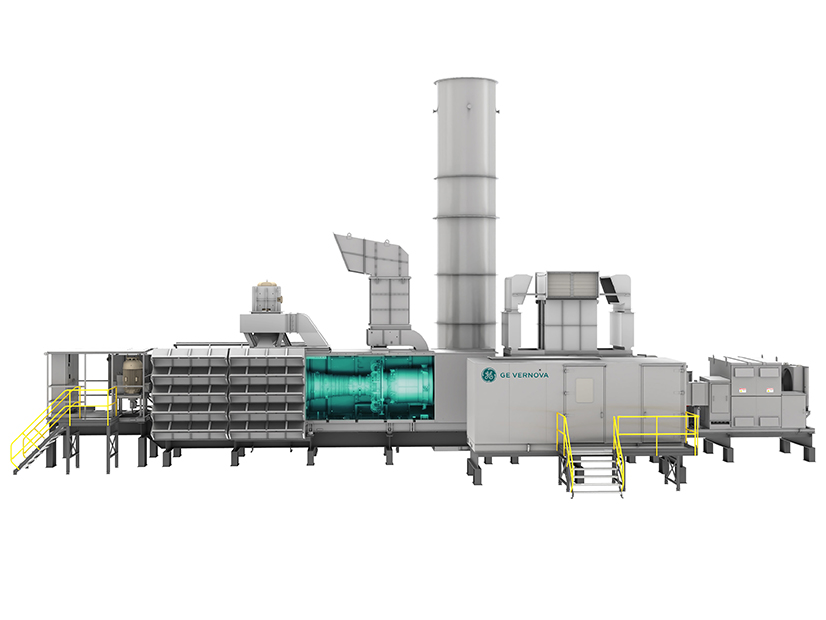
The company’s large heavy-duty gas turbines are in high demand, but there also is growing demand for its small aeroderivative gas turbine packages that leave the factory 95% preassembled.

Just a day earlier, GE announced it would sell 29 of these smaller units rated at 34 MW each — nearly 1 GW in total — to Crusoe for its AI data centers.

This technology — essentially a modified jet engine with emissions controls — is quick to deploy, quick to start up and can provide a bridge solution when the interconnection queue is moving more slowly than the customer wants to. Eventually, the aeroderivative turbines can become backup power sources for a facility or connect to the grid, Strazik said.

GE Vernova and Crusoe announced a deal for 29 of these LM2500XPRESS aeroderivative gas turbines to provide nearly 1 GW of power to data centers. | GE Vernova

GE Vernova also has its name on a massive installed generation fleet built by General Electric and is seeing strong growth in its service business, Strazik said.

“Our services backlog also grew approximately $1 billion in the second quarter,” he said. The company has been incrementally increasing its pricing on new equipment orders and will be doing so with its service business.

During an earnings call July 23, an analyst asked what effect sharp changes in federal energy policy are having on GE Vernova.

The reconciliation bill was finalized only a few weeks ago, Strazik said, so it is early to draw conclusions. However, GE Vernova has seen accelerated interest — but not yet orders — for grid equipment supporting wind and solar generation, he said. That is near- to mid-term interest, he said, which would match with the impending end of federal tax credits for wind and solar energy development.

“There also is very clear market sentiment that into the next decade, there’s going to be a need for more gas,” Strazik said. “I would say our pipeline of activity for gas demand is only growing, but it’s growing at even more healthy levels for ’29 deliveries, ’30, ’31 — periods of time where, maybe prior to the bill being signed, some of our traditional customers may have been intending more wind or solar.”

GE Vernova’s second-quarter results surpassed projections, pushing first-half 2025 revenue, earnings, free cash flow and backlog higher than year-ago levels. The company has increased its projections for the second half of 2025.

The price of GEV stock soared throughout the trading day, closing 14.6% higher than July 22 and 349.3% higher than on the close of its first day of trading in April 2024.

Also with its second-quarter financial results, GE said:

    • Steam power service orders jumped on efforts to upgrade existing nuclear reactors and extend their operation.
    • Even larger growth was seen in hydropower, again due to upgrades.
    • Progress continues on development of the 300-MW small modular reactor that is the first SMR being built in North America; more customer announcements are expected in the second half.
    • Demand for synchronous condensers, a longstanding but minor line for the company, is expected to grow with the need for grid-stabilizing technology, Strazik said. “We see this as a credible $5 billion market opportunity a year.”
    • Onshore orders in North America drove an increase in revenue for the wind business, offset by continued losses offshore; it may approach the break-even point in the second half.
    • The electrification business saw a $2 billion increase in backlog, driven by switchgear and transformers.

DOE Pulls $4.9B in Funding for Grain Belt Express

The Department of Energy says it has terminated its $4.9 billion conditional loan commitment for the long-delayed Grain Belt Express project, saying it is “not critical” for the federal government to support the project.

“After a thorough review of the project’s financials, DOE found that the conditions necessary to issue the guarantee are unlikely to be met,” the DOE said in a July 23 press release.

DOE said the Loan Programs Office’s loan guarantee, issued by the Biden administration in November 2024, was one of many conditional commitments “rushed out the door” shortly after the 2024 election.

A project spokesperson said the developers are disappointed with the withdrawn LPO loan guarantee, noting that the Grain Belt Express “will be America’s largest power pipeline.”

“A privately financed Grain Belt Express transmission superhighway will advance President Trump’s agenda of American energy and technology dominance while delivering billions of dollars in energy cost savings, strengthening grid reliability and resiliency, and creating thousands of American jobs,” the spokesperson said in an email to RTO Insider.

Rob Gramlich, Grid Strategies’ president, said the decision was “confusing,” given the administration’s focus on the need for energy to power artificial intelligence data centers.

“We really need interregional transmission and [DOE] Secretary [Chris] Wright and now the White House, through their AI plan, say transmission is important,” he told RTO Insider.

The DOE said it is conducting a review of every applicant and borrower, including the nearly $100 billion in closed loans and conditional commitments the LPO made between Election Day 2024 and Inauguration Day 2025.

DOE’s action is the latest hurdle facing the Grain Belt Express, an 800-mile HVDC project that has been under development since 2010. The project’s developer, Invenergy, says the $11 billion merchant transmission line would be capable of moving 5 GW of mostly clean energy from Kansas across Missouri and Indiana and into Illinois.

The news was celebrated by U.S. Sen. Josh Hawley (R-Mo.), who has called the project a “boondoggle” and twice sent letters to the DOE urging the agency to cancel the loan guarantee. Hawley took credit for the cancellation, charging that the project “has taken the land of numerous Missouri farmers across eight counties while padding [Invenergy’s] corporate profits.” (See Grain Belt Funding Appears on Shaky Ground with DOE; Invenergy Firm on Value.)

| Josh Hawley via X

The project has been approved by regulators in all four states involved. The Missouri Public Service Commission found the project would save the state’s customers as much as $18 billion, Invenergy has said. The company noted municipal utilities in 39 communities have contracts with it for power delivery and contractually guaranteed cost savings.

However, the project has faced opposition from Missouri landowners, who are opposed to a for-profit, private entity using eminent domain. Missouri Attorney General Andrew Bailey has criticized Grain Belt Express for filing nearly 50 eminent domain lawsuits against Missouri landowners. He opened a consumer protection investigation into the project in June. (See Missouri AG Opens Inquiry into Grain Belt Express.)

Bailey issued a statement saying his office has “won a battle in the war for Missouri landowners” in what he termed an “unconstitutional land grab.”

“If Invenergy still intends to force this project on unwilling landowners, we will continue to fight every step of the way,” he threatened.

The project’s developers filed a lawsuit against Bailey July 16, arguing that he does not have the authority to investigate Grain Belt Express or to interfere with the Missouri PSC’s final order.

Invenergy says the $11 billion project would provide $52 billion in energy cost savings over 15 years, create 5,500 jobs and power up to 50 data centers.

A 2022 economic analysis conducted for Invenergy found that the project would result in $20 billion in total investment and create more than 20,000 temporary jobs and more than 400 permanent jobs in Illinois, Kansas and Missouri.

Invenergy says the Grain Belt Express would move a “diverse mix of energy” from Kansas to Indiana. The project would save money and strengthen reliability for 29 states and D.C., and more than 40% of Americans, it said.

The project would create links between the SPP, MISO, Associated Electric Cooperative Inc. and PJM grids.

Grain Belt Express has been under development since 2010, when the now-defunct Clean Line Energy first proposed the transmission line. After years of regulatory, legal and political hurdles, Clean Line sold the project to Invenergy. (See Invenergy Renewing Push for Grain Belt Express.)

Grain Belt Express announced nearly $1.7 billion in combined contractor awards to Quanta Services and Kiewit Energy Group.

FERC Approves MISO Interconnection Queue Fast Lane

FERC on July 21 approved a controversial MISO proposal to create a fast lane for certain reliability-related projects in the RTO’s interconnection queue — just two months after rebuffing an earlier version of the plan (ER25-2454).

The commission in May rejected the first iteration of the Expedited Resource Addition Study (ERAS) proposal, which was designed to speed up interconnection of resources that state regulators have identified as necessary to ensure resource adequacy in areas under their oversight.

In its May decision, the commission found the original ERAS plan lacked clarity around standards for identifying true RA projects and that — absent a cap on potential applicants — the expedited process was at risk of becoming bogged down with too many proposed projects. (See FERC Rejects MISO’s Interconnection Queue Fast Lane.)

Responding to those concerns, MISO quickly developed a revised proposal that caps the ERAS fast lane at 68 project requests and includes a provision requiring the RTO’s relevant electric retail regulatory authorities (RERRAs) to verify in writing that a project will either address an RA risk or help load-serving entities meet previously unexpected load growth.

Of the 68 slots, MISO proposed that a maximum of 10 would be carved out to accommodate requests from independent power producers that have agreements with entities other than LSEs, while eight will be dedicated to requests for resources intended to serve retail-choice load.

The RTO also proposed to cap the number of expedited studies to just 10 per quarter and limit transmission service requests to 150% of the need identified by a RERRA. It also made clear the ERAS process would be a temporary fixture, concluding at the earlier of either August 2027 or when the queue is cleared.

While MISO’s rapid turnaround on the revision earned support from the RTO’s vertically integrated utilities, it provoked protests from independent power producers and clean energy groups, who argued the newer plan still retained “many of the shortcomings” of the earlier version while introducing additional legal concerns. They also argued it still offered “preferential access to thermal resources at the expense of renewable resources.” (See MISO’s Queue Fast Lane, Take 2, Nets Déjà vu Arguments.)

Michigan’s Public Service Commission also opposed the plan, arguing it lacked “sufficient enforcement of shovel readiness and project completion” and that a provision to cap the megawatt value of expedited projects at 150% of an identified RA need might exclude meaningful participation by developers of renewable energy projects, which have lower capacity factors than thermal projects.

In its comments to FERC, Invenergy argued the new proposal still vested RERRAs with “nearly unbounded discretion to select projects, without any objective criteria to judge whether such projects are capable of satisfying MISO’s resource adequacy needs.”

But the revised plan had strong backing among MISO’s utilities, among them Alliant Energy, Ameren, Big Rivers Electric, Consumers Energy, DTE Energy, Northern Indiana Public Service Co. and Ottertail Power.

‘One-time Design’ Weighs Heavily

FERC’s July 21 order found the eligibility requirements set out in the revised proposal were adequate to “deter speculative interconnection requests from entering the ERAS process and minimize disruption” to resources already sitting in the definitive planning phase of MISO’s existing interconnection process.

“We find that MISO’s revised ERAS proposal sufficiently addresses these concerns identified in the May 2025 order by capping the number and size of ERAS projects, strengthening the RERRA verification requirement, [and] requiring ERAS interconnection requests to be located in the same local resource zone as the resource adequacy or reliability need that it will address,” the commission wrote.

“Additionally, we note that the limited, one-time design of the process weighed significantly on our decision here,” it added.

The commission also found that MISO had “strengthened” the “notification” requirement in the initial ERAS plan “to better ensure that RERRAs affirmatively verify interconnection requests will address specific resource adequacy needs that are not otherwise being addressed.”

The commission said it was “reasonable and appropriate” for MISO to allow RERRAs to select the ERAS projects and “implement their own processes for making such determinations, as this approach strikes a reasonable balance between state authority over resource procurement and commission authority over generation interconnecting to the interstate transmission system. Accordingly, we find that it is not necessary for MISO to establish scoring criteria or a ranking process for proposed ERAS projects, as protesters suggest.”

The commission rejected the argument by IPPs that the proposal intrudes on the commission’s exclusive Federal Power Act jurisdiction over the transmission service terms and conditions set out in MISO’s tariff.

To support their argument, the IPPs cited the U.S. Supreme Court’s Hughes v. Talen Energy Marketing decision, which held that the Maryland Public Service Commission’s authority over generating facilities did not allow it to “exercise control over the terms and conditions of interconnection service.”

“We find that the revised ERAS proposal is permissible under Talen because RERRA participation in the ERAS process would be wholly pursuant to a commission-jurisdictional process (i.e., the generator interconnection process), proposed by MISO and approved by the commission — not by state authorities — and under which a [generator interconnection procedure] is on file with the commission and any future revisions would be subject to commission approval,” FERC wrote.

The commission also rejected the contention that the proposal violates the “filed rate” doctrine because it allows states — through their RERRAs — to set the criteria for determining a resource’s participation in ERAS without subjecting that criteria to FERC approval.

“NextEra and MISO IPPs argue that the revised ERAS proposal violates the filed-rate doctrine because it allows RERRAs to establish criteria that would not be on file with the commission and that would determine whether or not an interconnection request is eligible for ERAS. We disagree. We find that the revised ERAS proposal does not present a filed-rate doctrine concern because it provides adequate notice of the ERAS eligibility requirements, including the RERRA verification requirement,” the commission wrote.

MISO intends to kick off the first ERAS process on Sept. 2.

Report Details Cost Savings of Heat Pump Rates for Mass. Consumers

Strong winter discounts on electricity delivery rates are needed to more fairly charge Massachusetts homes with heat pumps for their share of grid costs, according to a new report commissioned by a coalition of environmental groups. 

Written by climate policy think tank Switchbox, the report estimates that heat pump owners are being overcharged by an average of 23% during the heating season and finds that seasonal discounts could make electrified heating cheaper than natural gas heating for most residential consumers. It also finds that heat pump rates could help address significant cost barriers to heat pump adoption in the state. 

“Heat pump customers are subsidizing everybody else, and that’s why they’re being overcharged,” Juan-Pablo Velez, one of the authors of the report, said during a webinar July 22. 

Because New England has a summer-peaking power system, incremental demand during the heating season generally does not add to the cost of the grid, he said. However, volumetric delivery charges incurred during the winter frequently cause heat pump owners to pay more than their fair share of system costs, Velez said. “There is plenty of capacity to go before we run out of room with the existing [winter] capacity,” he said.  

ISO-NE forecasts the region transitioning from summer-peaking to a winter-peaking system by the mid-2030s, largely because of heating electrification. The timing of the shift likely will depend on the pace of heat pump adoption. 

The Massachusetts Department of Public Utilities already has directed the state’s investor-owned utilities to adopt specific heat pump rates. However, advocates for heating electrification argue that these rates do not fully address the issue of overcharging heat pump owners and have urged the DPU to direct the utilities to roll out steeper discounts aimed at more closely calibrating delivery costs with the grid impacts of electrified heating. 

In December, an interagency working group recommended that the DPU require the utilities to establish more aggressive winter heat pump discounts. (See Mass. Electricity Rates Working Group Issues Recommendations.) 

Under this updated discount, houses with heat pumps would pay roughly the same delivery costs as those heated by gas during the heating season. Supply costs would not be affected by the discount, and heat pumps still would pay for their full supply costs throughout the year. 

Kyle Murray, director of state program implementation at the Acadia Center, emphasized that heat pump rates do not represent a “handout to heat pump owners.” 

“Even though heat pump owners are using more energy than their non-heat pump counterparts, they’re not actually causing more stress on the system,” Murray said. “Heat pump rates just simply represent fairness in ratemaking.” 

The DPU in March opened an investigation into requiring new heat pump rates following the 2025/26 heating season (DPU 25-08). In comments in the proceeding, the Massachusetts Department of Energy Resources supported the working group’s proposed rate, writing that the lower, DPU-approved heat pump rate “would provide approximately one-third to one-half the savings each winter-heating season as compared to the [working group’s] proposed heat pump rates.” 

The Switchbox report found that “across all homes in Massachusetts, the median electric bill for heat pump customers would decrease by 12% under the DPU’s 1.0 rates and by 23% under DOER’s proposed 2.0 rates.” 

Under default rates, about 55% of customers switching to a heat pump would see an increase in their annual energy costs, the report found. Adopting the DPU-approved heat pump rate would improve this cost comparison, reducing annual energy costs for about 64% of customers that make the switch, the report notes. 

Unsurprisingly, the report found that the higher discount rate supported by the DOER would bring the greatest savings for heat pump owners and estimated that 82% of Massachusetts households converting to heat pumps would save money under the rate. 

Massachusetts has set aggressive targets for heat pump deployment and will need to significantly accelerate adoption in the coming years to meet its climate targets. The state estimated in early 2025 it will need to double its rate of heat pump conversions between 2025 and 2030 to meet its deployment goals. 

Seasonal heat pump rates likely will be a short-term solution for the state as its utilities work to deploy advanced metering infrastructure, speakers at the webinar noted. 

“In about three or four years, everybody in Massachusetts should have an advanced meter,” which will require a new set of rate structures, said Larry Chretien of the Green Energy Consumers Alliance. He added that while seasonal heat pump rates may be a relatively short-term solution, they are an important tool for eliminating excessive cost burdens on heat pump owners over the next few years. 

WRA Data Center Report Proposes Mandatory Clean Transition Tariffs

With data centers contributing to “staggering load growth” for Western utilities, a new report suggests that more utilities adopt clean transition tariffs for data centers or even make the tariffs mandatory for certain large customers.

The proposal is one in a set of recommendations from Western Resource Advocates, which released its report, “Data Center Impacts in the West,” on July 22.

The report examines seven of the eight largest utilities in the Interior West: Public Service Company of Colorado, Public Service Company of New Mexico, NV Energy, PacifiCorp, Arizona Public Service, Salt River Project and Tucson Electric Power. These utilities are seeing a surge in large-load interconnection requests, and data centers are the largest factor in their load growth, the report says.

“Data centers are driving staggering increases in electricity demand,” WRA says in its report.

And the surge in demand is a threat to climate progress, unless it can be met with clean energy resources, according to WRA. That’s where clean transition tariffs can play a role.

“If properly designed, these tariffs can enable data centers to do more than just mitigate their climate impacts with conventional clean resources like solar, wind and battery storage; they can help drive innovation by scaling new clean technologies,” the report says.

The report notes that companies such as Google, Meta and Amazon have corporate climate and clean energy goals — along with “expansive financial resources.” Under a clean transition tariff, a utility may develop new, clean resources on behalf of a large-load customer, with the large customer paying any premium cost of the clean resource.

For example, Nevada regulators in March approved NV Energy’s clean transition tariff, a framework developed in partnership with Google. NV Energy added to its integrated resource plan an enhanced geothermal energy project from Fervo Energy that will help power Google’s northern Nevada data center. Without Google’s involvement, the utility would not have included the project because of its cost. (See Nevada Regulators Give Nod to NV Energy Clean Transition Tariff.)

WRA said clean transition tariff structures should be developed before a data center asks for interconnection and clean resources, because fast interconnection typically is a priority for the centers.

Only zero-carbon resources should be eligible for the tariff, the report says. One approach for finding resources would be for the utility to issue a request for proposals based on its completed IRP, select resources to serve customer loads and then make any resources not selected available to customers under its tariff. Utilities also could solicit bids for resources under their tariffs between IRP cycles.

Regulators should encourage utilities to develop clean transition tariffs, WRA says, and they could even consider making them mandatory for larger loads or those that are steady around the clock.

Surging Demand

The seven utilities’ energy demands are projected to be 32% higher in 2030 and 55% higher in 2035, compared to 2025 levels, representing a compound annual growth rate of 4.5%. Those figures are significantly higher than what utilities predicted just a few years ago.

The growth rate also is higher than the rates projected by WECC (2.1%) and Grid Strategies (2.4%), which looked at regional and national trends, respectively.

The difference among the forecasts could mean that utilities in the WRA study are overestimating their load growth, the report says, or that they are “burgeoning hubs” for data centers with concentrated load growth.

As for peak demand, the utilities now expect a peak of 9,500 MW in 2030, 19% higher than in 2025, and 16,900 MW in 2035. The projected compound annual growth in peak demand is 2.9%.

The WRA report makes other recommendations for utilities and regulators, including:

    • establishing best practices and requirements for utility load forecasting;
    • revising IRP processes to better accommodate the rapid and uncertain nature of data center growth;
    • allowing data centers to install behind-the-meter clean resources and storage systems; and
    • developing interconnection standards that allow for load interruption in exchange for faster interconnection.

NextEra Energizes 2nd Competitive Project in SPP

NextEra Energy Transmission (NEET) has completed the second of its three competitive projects in SPP’s footprint, the 92-mile, 345-kV Wolf Creek-Blackberry project in Kansas and Missouri.

NEET Southwest, a NextEra subsidiary, confirmed in an email to RTO Insider that the project was energized on July 16. It said the project was completed “within budget” and nearly five months ahead of SPP’s required in-service date.

The project was awarded to NEET Southwest in October 2021. The developer’s bid came in at $85 million, far below the high proposal of $151 million. (See “Expert Panel Awards Competitive Project to NextEra Energy Transmission,” SPP Board of Directors/Members Committee Briefs: Oct. 26, 2021.)

Matt Pawlowski, NEET’s vice president of development, celebrated the announcement during the July 17 Strategic Planning Committee meeting.

Interrupting himself mid-comment, Pawlowski said, “Did I mention that we energized Wolf Creek to Blackberry a couple days ago? I’m sorry, I think I forgot to mention that earlier. Did I? Did I mention that yet? No? OK.”

In January, NEET Southwest also energized the Minco-Pleasant Valley-Draper project, a 48-mile, 345-kV transmission line in Oklahoma. NEET submitted a winning bid of $55 million for the project, which was awarded in 2022. (See “Directors Approve RTO’s 4th Competitive Project Under Order 1000,” SPP Board of Directors/Markets Committee Briefs: April 26, 2022.)

The projects are the only two of five approved by SPP under FERC Order 1000 that have been completed.

SPP also has awarded NEET Southwest Crossroads-Hobbs-Roadrunner, a 137-mile, 345-kV project in Southwestern Public Service Co.’s service territory in Texas and New Mexico. NEET’s $291 million bid was higher than incumbent SPS’ $220 million proposal, but the former offered a one-year construction timeline. (See SPP Awards NextEra 3rd Competitive Project.)

The project is scheduled to be completed by mid-2026.