The power industry can meet growing demand in a timely and cost-effective way by deploying commercially available new technologies to increase the use of the existing grid and proactively planning for new infrastructure, a new report from the Clean Air Task Force said.
The “Optimizing Grid Infrastructure and Proactive Planning to Support Load Growth and Public Policy Goals” report, prepared for CATF by The Brattle Group, highlights how to deal with demand growth from data centers, reshoring manufacturing and electrification.
“By mobilizing demand-side flexibility, increasing the utilization of the existing grid and recognizing uncertain future needs through proactive planning, utilities and other grid operators can serve new loads while mitigating cost increases, thereby avoiding large bill increases for existing retail customers and protecting them from future risks,” the report said.
“Combining more efficient capital utilization with more proactive planning thus offers a win-win proposition that protects customers, serves new loads more quickly, benefits utilities and grid operators, and supports a wide range of public policy goals for clean energy and economic development,” it said.
Demand growth has come back at a time of stressed supply chains, compounded by long interconnection queues and other factors contributing to a slowdown in the speed and scale of deploying new resources, CATF Electricity Director Kasparas Spokas said in an interview.
“We hope this report serves as a little bit of a menu of options of underutilized, but effectively no-regrets solutions that policymakers can evaluate and assess and hopefully adopt to both grow load while minimizing emissions and cost as much as possible,” Spokas added. “And so, the goal really here was to highlight … some of the near-term, no-regrets solutions that even if demand, which is highly uncertain, were not to materialize, would still be beneficial for ratepayers.”
The paper offers actionable recommendations for grid planners, but it does not cover the full scope of potential reforms that could be needed under the new demand paradigm, such as changes to wholesale power markets or technology innovations that might become commercially viable.
The pressure from demand is most acute with large loads such as hyperscale data centers and advanced manufacturing facilities because they often require access to vast amounts of reliable electricity and can start operating in a few years, while installing new infrastructure can take decades.
Some of the quicker ways to help manage that rapid demand growth include use of demand-side resources, grid-enhancing technologies and advanced transmission technologies, as well as taking advantage of upsizing opportunities when power lines are refurbished and facilitating interregional trade, the report said.
“Regulators and advocates just have to be very disciplined about requiring planners to effectively evaluate some of these [virtual power plant] demand-side solutions and advanced transmission solutions before committing to new buildout,” Spokas said.
‘Political Feasibility’
Policymakers also should establish and expand efficiency and bill assistance programs for low-income customers and extend demand-side management to those customer classes. Another option is to establish rules that ensure customers with large loads don’t end up imposing stranded costs and financial risks on other customers, the report said.
“I think that there’s a lot of very acute and near-term political pressure that policymakers and legislators and others are feeling with regard to increases in customer prices for electricity, increases in utility bills,” Nicole Pavia, CATF’s director for clean energy infrastructure, said in an interview.
“We think that the political feasibility of implementing a broad suite of solutions kind of depends on gaining and maintaining political will for the energy transition,” Pavia said. “A lot of that has to do with how consumers feel about rates and if affordability is top of mind. And, so, we think some of the measures around affordability can help reduce the political pressure in terms of the increasing rates and utility bills.”
Transmitting energy more efficiently, speeding up queues and addressing affordability concerns will help, but the power system eventually will need new generation and transmission. Those investments can be assisted by facilitating customer-sponsored generation investments and procurements, and collocating generation and load in “energy parks.”
Planning and procurement process should pick the flexible, least-regrets solutions and, where needed, attract new investments in a timely manner. Load forecasts can be improved, clean energy development can be sped up by picking zones that can be connected proactively with transmission and deliberately planning the distribution system to more cost-effectively manage load growth.
The return of demand growth also has increased interest in developing new natural gas-fired power plants around the country.
“There are a lot of low-cost, no-regrets solutions that need to be considered before you get to the point of building a new gas plant,” Spokas said. “Once you get to that point as well, you need to consider the life of that asset.”
Spokas thinks there’s “a lot of talk” about future gas-fired plants being built as “hydrogen-ready” without much consideration about the investments needed to make them so.
“Where will the hydrogen come from? What will be the cost? So, I just think we all need to be very disciplined about what it takes to get to the point of saying, yes, a new gas plant is the solution,” he said.
Members Shoot down Staff’s Proposal for Integrating High-impact Large Loads
LITTLE ROCK, Ark. — The SPP Markets and Operations Policy Committee resoundingly rejected a proposed tariff change to integrate large loads, pushing back against what some say is a rushed process outside of the normal stakeholder structure.
The committee’s decision during its July 15-16 meeting won’t stop the revision request (RR696) from going before the Board of Directors during its next quarterly meeting Aug. 5. The board in April directed SPP staff to deliver a draft proposal during the meeting that helps integrate large loads, and that includes the “requisite stakeholder engagement.” (See “Cupparo Issues ‘Executive Order,’” SPP Board OKs 1-time Study for LREs’ Gen Needs.)
The measure failed with only 53.7% approval. The Transmission Owner segment voted 11-5 for the measure, while Transmission Users voted 24-38. There were 12 abstentions.
“As SPP members continue to receive or — really, in the case of some members — actually submit large load requests to us, we’ve needed to develop an effective policy that allows our members to be both responsive and competitive in the pursuit of these loads,” COO Antoine Lucas said in setting up the discussion, which ate up much of the meeting’s two days.
“The large load policy is essential to responsibly allow this new industrial-scale electricity demand such as AI, data centers, advanced manufacturing and even energy-intensive production processes to integrate and operate,” he added.
SPP slide showing growth of data centers in recent years | SPP
SPP says its 2025 Integrated Transmission Planning assessment includes about 10 GW of large loads, with an average size of 235 MW. The 2026 ITP includes more than 20 GW of large loads.
The grid operator’s solution addresses gaps in current planning processes that have resulted in long wait times for projects, a lack of flexibility for limited connection or operation of load with system limits and cost uncertainty for transmission upgrades.
The proposal is built around 90-day studies that allow faster load connection with certain reliability-driven conditions. The policy defines several large-load types or services, including:
high-impact large loads (HILLs): any commercial or industrial individual load facility or aggregation of facilities at a single site, connected through one or more shared points of interconnection or points of delivery that can pose reliability risks to the grid. HILLs are nonconforming loads of either 69 kV or below with a peak demand of 10 MW or greater, or greater than 69 kV with a peak demand of 50 MW or more.
conditional high-impact large load (CHILLs): the portion of a HILL that is receiving conditional high-impact large load service (CHILLS). This is intended for any HILL specifications that cannot reliably be served on a firm basis by existing designated resources or the current transmission system. CHILLs can exist at the same delivery point as firm load.
CHILLS: a new transmission service available to HILLs to transfer energy to designated points of delivery to serve a transmission or network customer’s CHILL. The service will be available for yearly periods ranging from one to five years.
“HILLs, CHILLs and thrills,” cracked one wag at the table.
“A big principle in this is to have a path to firm service and balanced reliability,” said Casey Cathey, SPP’s vice president of engineering. “Our solution is to be the fastest connection study in the United States. We’ve looked at all of our fellow ISOs and RTOs. We work with them at least quarterly and share best practices. We also looked at Southern Co. We looked at a number of different areas that are challenged with similar challenges. … We want to provide transmission customers all the options necessary in the toolbox.” (See SPP Embraces Need for Speed to Meet Change Head-on.)
SPP said the rules for large load’s cost allocation are consistent with the existing tariff and aim to minimize cost shifts from HILLs and CHILLs to other customers, aligning costs with those causing the upgrades. Those costs are directly assigned to the large-load customer until it secures firm service and is potentially eligible for base plan funding.
CHILLS is billed on reserved capacity megawatts. If curtailed, charges adjust to the curtailed megawatts.
In opening the second day of discussion on large loads, CEO Lanny Nickell expressed the need for speed and stakeholder input. To bolster his case, he said a person could draw circles around any 14 contiguous states in the country — as he did — and they would find more data centers in that region than in SPP’s 14-state service territory.
Quoting ChatGPT, Nickell said the lost opportunity of a more-than-$1 billion capital investment for a 100-MW load amounts to more than the $1 billion: It also results in $200 million to $500 million lost construction and ongoing jobs, $50 million to $150 million of lost tax revenue over 10 years and $25 million to $75 million of lost grid and system value.
“That’s the pure evidence. That’s the pure data,” he said. “That’s not something I really want to go to the governor and say, ‘You know what? Because we couldn’t get this done in a timely fashion, you just lost another 100 MW.’
“It was made clear to me several months ago [by members’ leadership] that this is an opportunity that we have to take advantage of, and if we don’t, it’s not only hundreds of millions to billions of dollars of lost opportunity if we don’t take advantage of this. It turns into a threat to our long-term existence. So that’s why we’re doing this, and that’s why this is urgent, and that’s why we’re doing it as fast as we can, but we still are trying to do it in a way that considers as much input as we can possibly get. We want every piece of input that we can get.”
Over two days, including a half-day education session on large loads, SPP got that input.
“My background has always been in operations, and I have extreme concerns about the reliability impacts of large loads. I don’t think we’ve thought of all the potential issues that can come from bringing these large loads on,” NextEra Energy’s Jeff Wells said, calling for more time. “I’m not saying we need three months. I’m not saying we need six months, but we need time to go to our experts in SPP that aren’t SPP employees. … We need to get their feedback, and we need to make sure that we’ve addressed all those concerns.”
The Advanced Power Alliance’s Steve Gaw said SPP has not followed its stakeholder process. Members, some constrained by a lack of internal resources, have struggled to keep up as the policy and revision requests are developed at the same time.
“There’s a reason why we need to prioritize things,” he said. “There are lots of investment dollars that have been lost because of road blocks to getting generation interconnected over the last several years. We would not have the same kinds of problems in having resources to match this load if we had done some additional work to prioritize things in that fashion as well.”
Gaw also complained about the little time stakeholders have had to comment on the proposal’s “500-plus pages that were dropped on us” in late June.
Noting that additional comments to the board on the tariff change are limited to two pages, Western Farmers Electric Cooperative’s Matt Caves asked whether the directive could be reciprocal.
“Can SPP reduce this RR to, say, 100 pages?” he asked, drawing chuckles from staff and stakeholders.
Olivia Hough, a regulatory strategist with City Utilities of Springfield in Missouri and MOPC’s vice chair, said the utility has formed a task force to go over the “voluminous” document.
“It’s a lot to go through, and I understand that everyone maybe can’t read every single line item of it,” she said. “In whole, we want to see this move forward. We don’t want to miss out on the opportunity, and we think that the economic development potential and the challenge is worth it. I appreciate SPP’s commitment to putting this together at the same time that all the utilities are trying to develop their own frameworks.”
“This is what SPS has been asking for: help to serve loads,” Southwestern Public Service’s Jarred Cooley said. “We really see that this is something that needs to be done. … We get the opportunity to get in front of FERC, get that feedback, figure out maybe what changes we need to make in the next iteration, and continue to push forward.”
SPP’s Market Monitoring Unit also weighed in, saying that despite a “high level” of engagement with the RTO, it still has concerns that the proposal introduces risk to the market and other participants. It recommended risks be mitigated before any implementation and said it may identify additional risks and make further recommendations in the future.
MOPC passed a motion to hold a special workshop and further consider RR696 no later than the end of September. The motion passed with 69.9% approval.
COO Lucas emailed MOPC’s membership on July 18, laying out the several channels open to stakeholders who want to continue shaping the proposal before it goes to the board. SPP followed the email with a survey that members can use to share their concerns and recommended solutions.
Members can also provide “high-level, strategic feedback” directly to the board. The feedback, using a template to ensure consistency and focus, is due July 28, the same date the grid operator is keeping the comment period open for RR696. Several working groups will each review the proposal during their scheduled meetings before Aug. 5.
“Your continued participation in this process is valued and vital,” Lucas wrote. “You have our continued commitment to incorporate our stakeholders’ diverse perspectives as thoughtfully and equitably as possible. With your help, we aim to bring a proposal to the board that reflects both the urgency of this issue and the collective wisdom of our stakeholders.”
Seams Cost Allocation Rejected
MOPC also rejected a proposed tariff change RR681 that would provide a cost-allocation mechanism for projects that don’t qualify as interregional projects and where SPP shares cost with one or more neighbors. The measure received only 54.9% approval.
Aaron Shipley, the RTO’s senior interregional coordinator, said the proposal would make the process of building future jointly funded projects more efficient. He said it would be helpful to have the tariff change in place as SPP moves forward with the RTO’s Western expansion.
“We would expect to receive efficiency in our processes by having this cost-allocation tariff mechanism already approved and thus eliminating individual at-the end-of-the-process cost-allocation debates that we have all been through before and provide significant risk at the end of a project and process,” he said. “This is something we’ve heard support from both stakeholders and regulators all the way from the beginning of this effort.”
SPP’s membership first raised the issue in 2014, and it was later readdressed and confirmed through the Strategic and Creative Re-engineering of Integrated Planning Team’s (SCRIPT) work in 2020-2021. The RTO’s state regulators in October 2024 endorsed a seams policy white paper and directed staff to move forward with a recommendation to seek FERC approval.
Stakeholders pushed back against RR681 over concerns the seams projects would be subject to the grid operator’s competitive process screening. They wondered whether staff would be able to take on the number of new planning processes feeding into the process.
“I’m not opposed to following this kind of process in general,” American Electric Power’s Richard Ross said. “I’m opposed to just automating it so that it’s just there all the time. I think there may be some serious instances where we do things in one area that really don’t have greater benefits across the region, and so they ought to be allocated more. I do hope you will share with me that we ought to take a closer look at these on an individual basis.”
Three RRs Endorsed
Members endorsed three other revision requests with varying levels of approval.
RR693 received 76.5% approval, with SPS the only transmission owner of 17 to vote against it. The first phase of Surplus Plus and its suite of initiatives designed to accelerate the addition of new generation, the measure would quickly add shovel-ready incremental capacity at existing generating sites. The process would end when the Consolidated Planning Process begins in 2026. (See SPP ‘Blazes Trail’ with Consolidated Planning Process.)
Under the proposal, priority requests would be queued higher than study clusters that haven’t started. The process would be conducted on an accelerated time frame, not subject to waiting for open seasons or processing as part of a cluster or from needs driven by other requests.
Assuming FERC approval in October, the first requests would be submitted for a 90-day system impact study, with the first GI agreements issued by April 1.
RR693 was an outgrowth of discussions at the Resource and Energy Adequacy Leadership (REAL) Team, said Steve Purdy, SPP’s technical director of engineering policy.
“It is another tool in the toolkit for customers to be able to add new generation to the system, in addition to all of the existing processes that customers have available to them,” he said. “It’s a new process that will allow a customer to make a request and submit that outside of the DISIS [definitive interconnection system impact study] window.”
RR689, which passed with 95.8% approval, was opposed only by four members of the Transmission Users segment. The proposal would reject market participant bids in the transmission congestion rights (TCR) market when sourcing from an electrically equivalent settlement location (EESL) to another settlement location on the system, or when the participant adds another bid from a settlement location back into the original EESL group that sinks at a different settlement location than the source.
“We saw some concerning TCR bidding strategies in the TCR market,” said Micha Bailey, SPP’s manager of congestion hedging. “[EESLs] don’t have to be co-located, but electrically equivalent settlement locations basically have what we like to call unconstrained flow between them. So, you can basically get an infinite amount of TCR awards.”
The MMU’s Raleigh Mohr said the Monitor was supportive of the measure.
“Essentially, the message is this behavior is bad. FERC has ruled in other markets and in our market that this behavior is manipulative. We wanted to make sure that at this full representation body, that everyone heard that message,” he said.
A motion to include comments from The Energy Authority (TEA), speaking for six market participants, failed with only 35.8% approval. TEA recommended restricting implementation to auction revenue rights (ARRs) submitted for self-conversion to TCRs and not applying the restrictions to settling ARRs.
“Our general principle is if a gaming opportunity exists and it can be closed, then it should be closed,” Mohr said, arguing against TEA’s comments.
RR676 came within a percentage point of unanimous approval, receiving its only opposing vote from NG Renewables Energy Marketing. The measure creates a process for studying electric storage resource loads subject to SPP’s generator interconnection process and ensure compliance with FERC Orders 845 and 2023 and NERC reliability standard FAC-002-2.
“Today, our studies assess them for injection as a resource,” Evergy’s Derek Brown said. “One of the reasons for the enhancement is to better assess the impacts of these electric storage resources.”
The RTO currently has 179 active storage projects, totaling 31 GW, in the queue.
“We just think this is a crucial step forward for ensuring reliability and compliance of ESRs within the SPP transmission system,” Eolian’s Kyle Martinez said. “This is generation that can come online [and] provide ancillary service products off of the market.”
DR Policy Endorsed
MOPC endorsed SPP’s demand response and load-responsible entity peak-demand assessment policy proposals, designed to help ensure realistic forecasts that reflect the effect of flexible load.
Members amended the original motion to direct staff to prepare an RR based on the DR policy framework and conduct stakeholder reviews in conjunction with the LRE peak-demand assessment’s policy and RR.
Assuming their eventual approval, SPP plans to file both tariff changes together at FERC in early 2026 because of the “interdependency” between the two. A joint filing would provide a single, transparent foundation for resource adequacy and tariff evolution, staff said.
The DR framework includes various metrics, criteria and thresholds for both reliability and market-registered DR to reduce consumption during tight grid conditions.
MOPC endorsed RR692 by more than 91% approval after it was pulled from the consent agenda over timing concerns.
The change allows multiple Phase 1 restudy iterations within the DISIS process in the face of growing interconnection clusters. The 2024-001 cluster has 380 requests totaling more than 100 GW of capacity, almost double the size of the previous largest cluster.
“We’re seeing large amounts of dropouts between phases. Customers are being asked to make decisions about moving to the GIA portion of the DISIS analysis before we really have an understanding of what customers are going to remain when we’re through the entire process,” SPP’s Natasha Henderson said. “What’s proposed here is that we add additional Phase 1 studies. For instance, if 30% of the projects drop out in Phase 1, we would repeat Phase 1 again if we’re going to Phase 2, which adds stability to the mix.”
The measure received 91% approval from members.
The consent agenda included eight other revision requests that, if approved by the board, would:
RR675: modify the local market power test for resources in a nonbinding frequently constrained area.
RR677: add language that was inadvertently omitted from the settlement calculations changes approved in RR628 (Price Formation) that checks whether a resource is below its day-ahead market position.
RR678: remove outdated references to quick-start resources, which have been replaced by fast-start resources, from the protocols because of updates in registration parameters.
RR679: revise the ITP manual to remove conflicting language and references to the Model Development Procedure Manual’s new process. The new method allows for more data points to be included in calculating the number used for renewable resource dispatch, resulting in increased accuracy and confidence in the base reliability model.
RR680: establish the incremental market efficiency use (IMEU) mechanism to provide revenue that offsets the increased operational costs of the West DC ties because of more frequent market-directed dispatches under the five-minute market.
RR683: clarify and align governing document language with actual operational practices for notifying market participants during emergency conditions, including cleanup edits and new language allowing operations to issue notifications as soon as practical when emergencies are anticipated.
RR685: update the Integrated Marketplace rules to allow SPP’s Western balancing authority area to join the Western Power Pool’s Reserve Sharing Group, lowering ancillary service costs and strengthening system reliability.
RR691: revert tariff language back to its correct verbiage regarding changes for the RTO’s Western expansion.
FERC on July 18 rejected a petition from MISO seeking approval to not pay its Independent Market Monitor, Potomac Economics, for monitoring its transmission planning process (EL25-80).
MISO’s petition argued that the IMM’s review of its recent long-range transmission plans exceeds the scope of the Monitor’s authority and has contributed to recent cost overruns compared with the IMM’s contract.
IMM David Patton has argued that MISO’s tariff unambiguously authorizes him to monitor transmission plans, which have clear impacts on the wholesale markets. (See MISO IMM Contends He Should Have Role in Tx Oversight.)
RTO tariffs give rise to and define the scope of an IMM’s authority, and FERC and the courts consistently have found Monitors are limited to the authority laid out for them there and in agreements they sign with grid operators. In interpreting the MISO tariff, FERC had to address whether it unambiguously addresses the issue at hand — and the commission found that it does.
As the order pointed out, section 53.1 of the MISO tariff says the IMM can review any RTO actions that affect any of its markets and services.
“We also find that MISO’s transmission planning is an action that affects its markets and services, and that section 53.1.e unambiguously authorizes the IMM to review and analyze the competitive or other market impacts of MISO’s transmission planning,” FERC said.
FERC said it found no conflict in letting the IMM monitor transmission plans while MISO retains the sole authority to conduct transmission planning. The tariff does not let the IMM engage in transmission planning but simply authorizes him to review its impact on the market.
“We see no conflict between our finding here and the fact that the costs of transmission planning and of market monitoring are recovered under separate schedules to the tariff,” FERC said. “The cost recovery of transmission planning under Schedule 10 of the tariff is not relevant to the instant proceeding.”
FERC also rejected MISO’s argument that siding with Patton would be the same as amending the tariff absent a filing under Section 205 of the Federal Power Act.
And while MISO transmission owners had argued the case could risk the IMM involvement in any business area within the ISO, FERC found the tariff requires that the Monitor watch only issues that “affect the competitiveness, economic efficiency and proper operations of the markets and services.”
FERC also said that because no party had asked it to review any specific activities undertaken by the IMM, it was in no position to determine whether specific activities in the proceeding should have been billed to MISO. The commission encouraged the parties to work collaboratively on resolving such disputes.
‘Recognized and Applauded’
The order drew a pair of concurrences — one from Chair Mark Christie and another from Commissioner David Rosner.
“That transmission planning affects RTO markets is factually undeniable and thus makes this order an easy legal call,” Christie said.
Growing calls for expanding transmission are coming as consumers are facing rising bills, driven in large part by the rising costs of that infrastructure.
“Despite the understandable concern and publicity over capacity market auction results in MISO and PJM over the past year, transmission costs are the single biggest driver of skyrocketing monthly power bills and have been for years,” Christie said. “Transmission costs are driven not by the price of fuels such as natural gas, coal or oil, which change literally hourly and are set in global markets, but by capital expenses (capex), which are a result of intentional planning and intentional policy decisions, in this case by the management of MISO.”
The latest long-range plan comes with a price tag of $21.8 billion along with additional costs such as financing and return on equity that will be passed on to consumers.
“So, to his credit, MISO’s IMM has stepped up and provided a critique of the assumptions and calculations used by MISO to develop and attempt to justify this latest costly tranche of transmission projects,” Christie said. “Since the transmission planning that produced this tranche obviously affects the rates consumers pay, this is exactly what the MISO IMM and any market monitor should do.”
Christie also noted that state regulators and consumer advocates defended the IMM in the proceeding, which he said was in line with his experience with PJM during his time as a Virginia regulator.
“The role of an IMM requires courage and a willingness to put his job on the line by bringing to light uncomfortable (for some) facts and drawing conclusions about those facts that he is prepared to defend forthrightly,” Christie wrote. “The MISO IMM has done so here and he should be recognized and applauded.”
Rosner wrote separately that it’s important that a Monitor and its RTO should have a good working relationship, and ideally MISO and Patton should have settled the dispute on their own.
“In a situation like this one, which is essentially a contractual dispute, the best outcomes are achieved when the parties reach agreement among themselves — not when the commission is asked to interpret decades-old language,” Rosner said. “When parties ask the commission to answer a ‘yes or no’ question, they forfeit the opportunity to reach a compromise solution that results in better outcomes for everyone involved.”
He also noted that nothing in the order should be read as a requiring an independent transmission monitor, a concept discussed in Order 1920 that the commission could not reach consensus on.
As new solar and wind developments face hurdles due to changes in federal policy, the projects are also encountering growing resistance at the local level, according to speakers at a webinar.
“In most of the United States, it’s very local government — counties or townships — that have the authority to decide whether these large-scale clean energy projects can move forward or not,” said Dahvi Wilson, founder and president of consulting firm Siting Clean. “And increasingly, they are saying no.”
Wilson was one of four panelists at a July 17 webinar on obstacles to energy infrastructure. The event was hosted by Resources for the Future, a nonprofit research institution.
At the heart of the local resistance is the feeling that utility-scale solar and wind projects are transforming rural landscapes, giving them an industrialized feel, Wilson said. But the opposition to projects frequently expands to arguments that “often aren’t legitimate,” Wilson said, such as claims that the projects will have health impacts, hurt property values or are part of the “green new scam.”
Another factor in the growing local resistance is the transmission system’s limited capacity, Wilson said. As a result, clean energy developers are flocking to places where they can get on the grid.
“It leads to a ton of pressure on those places,” she said. “Suddenly, the resistance to this kind of development increases.”
Mapping Restrictions
Panelist Robinson Meyer, founding executive editor of Heatmap News, said that following enactment of the federal budget reconciliation bill, called the One Big Beautiful Bill Act (OBBBA), clean energy adversaries increasingly will focus their efforts at the local level.
“That is where the big fights are coming for slowing down clean energy production,” Meyer said.
Heatmap News surveyed counties across the country and found that 605 counties — accounting for about 17% of the land area of the continental U.S. — restrict solar or wind development in some way. The restrictions might be in the form of an outright ban, development requirements such as setbacks that make it nearly impossible to build, or moratoria that can be slapped on at will.
Meyer said areas such as the Southwest have had a “relief valve” for building renewable projects on federal land, where county rules don’t apply. But now even that relief valve is under fire from the Trump administration.
Under a new directive from the Department of the Interior, all decisions concerning wind and solar energy facilities must be reviewed by Interior Secretary Doug Burgum, including leases, rights-of-way, construction and operation plans, grants, consultations and biological opinions. Critics called the order a “shadow ban” on clean energy projects. (See Interior Dept. Places Solar, Wind Under Close Review.)
Some states, such as New York and Michigan, are addressing local resistance to solar and wind projects by adopting mechanisms to override the opposition.
“State preemptions of these rules can be quite effective,” said Meyer, who noted there are more clean energy projects on the Michigan side of the Michigan-Ohio state line than on the Ohio side.
Tax Credit Clock Ticking
With the enactment of OBBBA, solar and wind developers now face a tight timeline for starting and finishing projects in order to qualify for sunsetting tax credits.
Investment and production tax credits no longer will be available for solar and wind facilities placed in service after Dec. 31, 2027 — unless construction starts by July 6, 2026, in which case the deadline for placing the project in service is extended. The dates are subject to Treasury Department guidance; an update to the guidance is expected by Aug. 18.
The tight tax-credit timeline means opponents need only to delay a project to derail it, Wilson said.
“They don’t even have to kill the project,” she said. “They have to delay them maybe a year, to knock them out of being qualified.”
Webinar panelist Rich Powell, CEO of the Clean Energy Buyers Association, said there could be a rush for developers to “commence construction” of solar or wind projects to meet the tax credit deadline. That might entail starting work on a new transformer or road, or meeting a spending threshold by buying solar panels, turbines or batteries.
“Which is painful from the buyer’s perspective, because that’s going to mean prices go up for all of these things … as people sort of rush to do that,” Powell said.
Panelist Allison Clements, a former FERC commissioner and now a partner at ASG, a consultant to the data center, cloud and real estate development industries, called the administration’s actions “economically irrational.”
“I couldn’t have guessed in my most creative moment some of these things they’re doing to slow things down. [Saying] ‘I really hate this color of electron versus that color of electron,’” Clements said.
But Clements said given the “durable demand” expected over the next five to seven years due in part to computing needs and electrification, she still expects projects to proceed.
“Things will just be increasingly messy but continue to go forward,” she said.
NERC is seeking comments from industry stakeholders on potential changes to the ERO’s standards development process found in an upcoming white paper, members of the task force that wrote the document said in a webinar July 21.
The draft white paper is a key product of NERC’s Modernization of Standards Processes and Procedures Task Force (MSPPTF), launched by the ERO’s Board of Trustees at its February meeting. (See “Task Force to Examine Standards Process,” NERC Leaders Highlight Canada-US Collaboration.) It will be released July 22, with a public comment period to open the same day and close Aug. 27.
NERC’s board decided to stand up the task force after growing concern that the ERO’s standards process was too deliberative to keep pace with the rapidly changing reliability risk landscape. The board’s use of its authority in 2024 under Section 321 of NERC’s Rules of Procedure to accelerate the pace of two standards projects that seemed unlikely to meet a FERC deadline brought more attention to these issues.
“The industry is at an inflection point due to the rapid evolution in reliability risks, such as plant retirement, more variable generation and … extraordinary load growth,” MSPPTF Chair Greg Ford, CEO of Georgia System Operations, told webinar attendees. “While previous incremental enhancements have marginally improved our efficiency, the task force believes that a more transformational change to the NERC standard development process will certainly improve NERC’s ability to address these risks in a timely manner.”
Ford said that NERC’s data showed the development of a standard takes on average about three years, with about 20% of that time spent developing an initial standard authorization request (SAR) into a final version that a standard development team can work on. The next stage of development, going from the SAR to submitting a first draft standard for industry ballot, takes about 50% of development time on average, and the remainder is spent refining the draft standard based on industry feedback until it meets final approval.
Recognizing these stages, the white paper’s authors divided their proposed changes by the phase of development to which they apply. The initiation phase begins when a request to develop a standard is submitted and ends when the request is approved to begin drafting; standard development begins when the request is approved and ends when a first draft is proposed; and balloting begins when a proposed standard is ready for industry to vote and ends when the standard is either approved or returned to drafting.
Two of the white paper’s proposals will pertain to the initiation stage, Southern’s Todd Lucas said, calling them “options that we can use as a starting point … and get to a draft recommendation later this fall based on the input we get.”
Both options are intended to address the fact that “there are multiple ways [today] for a [SAR] to get initiated” by establishing a single process to identify and vet candidates for development. The first would involve a biannual review process, involving an open submission period and industry conference focused on prioritizing submissions. The other would be to centralize all submissions through NERC’s Reliability and Security Technical Committee.
Another three proposals, introduced by Ford, apply to the development phase, with the goal of getting “off the blank page … much sooner.” One way to do this, Ford said, is to use artificial intelligence more extensively, at least for low- or medium-priority projects, in tandem with a standing body of subject matter experts maintained by NERC.
“Not every standard that goes through this process may need a drafting team,” Ford said. “We can run [low- and medium-priority] projects through this process using subject matter experts, as well as this AI tool. We’ll run that through comment periods from the industry, we will convene technical conferences throughout this stage so that we can keep industry in tune … and we’ll be able to put together a package that we can communicate and get comments from the industry.”
An alternative to this proposal is to outsource standards drafting to a third-party contractor. In this scenario NERC still would oversee the contracting and drafting processes, and it still would go out for industry comment as normal. The third proposal would see the current process remain in place, but with tweaks for greater efficiency, possibly using AI tools.
For the third phase of development, balloting, MISO’s Todd Hillman listed three potential ideas. The first would involve replacing NERC’s current system of ballot pools formed from industry volunteers for each candidate standard, representing “somewhere in the neighborhood of 470 potential votes,” with a standing ballot body composed of about 24 members. These members still would represent the ERO’s industry sectors, but with a smaller, dedicated membership the authors hope that participation in each balloting process could be higher.
Another option would be to adopt an approach similar to FERC’s rulemaking process, which would replace the stakeholder balloting with a “notice and comment approach.” Under this model, NERC would post a draft standard for comments with questions to guide feedback. NERC then would analyze any comments received, update the draft based on the feedback, and then move forward to the board rather than calling for votes from industry. Finally, the third proposal under the balloting section would keep the existing system, with incremental changes.
NERC and the regional entities plan to hold industry outreach events during the comment period, with Q&A sessions the week of Aug. 4. Based on feedback, the MSPPTF will create formal recommendations with the goal of submitting them to the board at its February 2026 meeting.
A new study warns that the United States is not building anywhere near enough high-voltage transmission to support the anticipated needs of the evolving economy.
Americans for a Clean Energy Grid and Grid Strategies said July 21 that just 322 miles of lines rated at 345 kV or greater were completed in 2024, the third-lowest total among the past 15 years.
This creates potential stress for critical sectors whose electricity needs are growing, they said, such as artificial intelligence, computer chip fabrication and advanced manufacturing.
“We’re seeing a serious mismatch between where we are and where we need to be,” Christina Hayes, executive director of Americans for a Clean Energy Grid, said in announcing the report.
The two organizations called for ambitious multi-regional transmission planning as well as permitting reform.
“We know that thousands of miles of transmission can be built each year because in 2013 we did it, with California, Texas, the Southwest Power Pool and Midcontinent Independent System Operator all building hundreds of miles,” Grid Strategies President Rob Gramlich said in a news release.
The 2.1x model would imply an addition of roughly 5,000 miles a year, the ACEG/GS report states. The only year in the study period that approached this was 2013, when approximately 4,000 miles of 345-kV and 500-kV lines were completed.
As an added benefit, the report noted, high-voltage lines are more cost-effective per megawatt and enhance resource adequacy by allowing capacity sharing across regional boundaries at times of grid stress.
The ACEG/GS report notes that significantly more miles of natural gas pipelines than high-voltage transmission have been built in the past five years, and notes that no siting authority for power lines exists that is comparable to FERC’s authority to site interstate gas lines.
Looking ahead, the report cites NERC data indicating 7,098 miles of lines greater than 345 kV under construction or planned through 2032 nationwide. And multiple regions are beginning to plan new 765-kV lines as higher-capacity corridors that move energy efficiently over long distances.
The ACEG/GS report concludes with the assertion that federal leadership in adopting the requirements of FERC Order 1920 now must be matched, and strongly, by regional implementation.
“Planners should treat Order No. 1920 as a floor, not a ceiling, building on its foundation for ambitious, proactive and multi-value regional transmission planning and cost allocation,” the authors wrote. “In parallel, permitting reforms, targeted funding and state-federal collaboration can help ensure that projects move from planning phases to steel in the ground.”
The pace of undermining the statutory authority of the Nuclear Regulatory Commission to serve as the cornerstone of nuclear safety in the United States and across the world is accelerating.
The recent directive by Department of Government Efficiency (DOGE) staff member Adam Blake to NRC staff to “rubber stamp” Department of Energy (DOE) and Department of Defense (DOD) nuclear projects highlights how far and fundamentally these cracks have advanced in the pillars of nuclear safety culture within the federal government.
There is a saying: “Nuclear power is not inherently unsafe, but nuclear power is inherently unforgiving.” The implication is clear: Inattention to safety details has significant consequences. These concerns led Congress to wisely separate the original Atomic Energy Commission (AEC) into two agencies with constructive tensions. One is the DOE, which studies and promotes multiple forms of energy, including nuclear power. The other is the NRC, with the function of nuclear safety above all else.
During the 70-plus-year experiment with nuclear power, “defense in depth” safety margins have prevented nuclear accidents from the mundane to the catastrophic. Yet we have also seen numerous near misses, such as Browns Ferry (1975) and Three Mile Island (1979), and tragic failures at Chernobyl (1986) and Fukushima (2011).
With the advent of lower-cost hydraulically fractured fossil gas burned in combined cycle turbines and low-cost renewable wind, solar and storage, nuclear power no longer is a low-cost provider. New nuclear projects also failed to stay on budget and on schedule.
Stephen A. Smith
The past three nuclear reactors to come online, all in the nuclear-friendly southeastern U.S., highlight the failures. TVA’s Watts Bar 2 was over 40 years behind schedule and cost $6.1 billion, while Georgia Power’s Vogtle 3 and 4 were seven years delayed and $21 billion over budget. While thoughtful utility managers have moved away from nuclear power to embrace less risky, more predictable, and less complex energy solutions, nuclear zealots have sought to blame “over-regulation” and “government bureaucracy” for problems inherent in nuclear technology itself.
Over the past decade, the NRC has become the favorite whipping boy of zealots beholden to a stagnant industry. Industry lobbyists have persistently chipped away at the structural pillars of safety and independence at the NRC while justifying the restructuring — i.e., weakening — of the NRC as needed for nuclear power’s survival.
The Nuclear Energy Innovation Capabilities Act (NEICA) of 2017, Nuclear Energy Innovation and Modernization Act (NEIMA) of 2019, and Accelerating Deployment of Versatile, Advanced Nuclear for Clean Energy Act (ADVANCE Act) of 2024 have all been the hammers and chisels in the legislative toolbox. These moved with bipartisan support, further eroding safety and the NRC’s independence.
The ADVANCE Act proved particularly damaging, as it required the NRC to alter its mission statement to ensure licensing “does not unnecessarily limit the benefits of civilian use of radioactive materials and nuclear energy technology to society.” This represents a fundamental departure from the agency’s safety-first mandate, introducing promotional language that echoes the very conflicts of interest that led to the AEC’s dissolution in 1974.
Former NRC commissioners have sounded the alarm about these dangerous trends. “An independent regulator is one who is free from industry and political influence,” warned Allison Macfarlane, who served as NRC chair under President Obama. “Once you insert the White House into the process, you don’t have an independent regulator anymore.” Three former NRC chairs jointly warned that recent changes “serve to weaken protections for those who work in or live near reactors.”
The irony is profound: Just as the nuclear industry seeks to expand deployment of advanced reactor designs — technologies that are largely unproven and require more rigorous safety review, not less — the regulatory framework is being systematically weakened. These new reactor designs, from small modular reactors to advanced fast reactors, represent significant departures from existing light-water reactor technology. They require intensive safety analysis precisely because they lack the decades of operational experience that inform current safety protocols.
This regulatory erosion threatens to undermine the very public confidence the nuclear industry desperately needs to expand. Edwin Lyman of the Union of Concerned Scientists warned that the Trump administration’s approach could “take talent and resources away from oversight and inspections and put them into licensing,” calling the strategy “totally misdirected.”
The potential consequences extend beyond U.S. borders, as former NRC officials noted: “If it becomes clear that the NRC has been forced to cut corners on safety and operate less transparently, U.S. reactor vendors will be hurt” internationally, since “a design licensed in the United States now carries a stamp of approval that can facilitate licensing elsewhere.”
As an unbridled Trump returned to the White House pontificating about a “golden era” and “energy dominance in America,” the die was cast for the NRC. DOGE staff infested the NRC and DOE, Trump’s May nuclear executive orders solidified the collapse of the NRC’s safety role and independence, and Adam Blake’s “rubber stamp” comment was just the silent part said out loud. The structural pillars that have protected Americans from nuclear accidents for five decades are cracking under the weight of industry pressure and political interference.
The ultimate tragedy is that weakening safety oversight precisely when unproven reactor technologies need the most rigorous review sets the stage for the kind of serious accident that could devastate public confidence in nuclear power for generations — the very outcome the industry claims to want to avoid.
Below is a summary of the agenda items scheduled to be brought to a vote at the PJM Markets and Reliability and Members committee meetings on July 23. Each item is listed by agenda number, description and projected time of discussion, followed by a summary of the issue and links to prior coverage in RTO Insider.
RTO Insider will be covering the discussions and votes. See next week’s newsletter for a full report.
Markets and Reliability Committee
Consent Agenda (8:35-8:40)
The committee will be asked to endorse a consent agenda that includes:
C. proposed revisions to Manual 10: Pre-Scheduling Operations, Manual 11: Energy & Ancillary Services Market Operations, Manual 14D: Generator Operational Requirements, Manual 21B: PJM Rules and Procedures for Determination of Generating Capability, Manual 27: Open Access Transmission Tariff Accounting and Manual 28: Operating Agreement Accounting to conform with the third phase of PJM’s market rules for hybrid resources. This phase aims to make clarifications to the rules developed in the earlier stages and further develop rules for non-inverter-based hybrids, such as gas and storage.
D. proposed revisions to Manual 14C: Generation & Transmission Interconnection Facility Construction, drafted through the document’s periodic review. The changes would add detail to the milestone requirements for generation interconnection agreements and interconnection service agreements.
E. proposed revisions to Manual 18: PJM Capacity Market to conform with several rule changes approved by FERC (ER25-682, ER25-785, ER24-2995 and ER25-1357). The package includes codifying how PJM will model the output of some resources operating on reliability-must-run agreements as capacity; maintaining a combustion turbine as the reference resource; establishing a uniform Capacity Performance penalty rate; removing a categorical exemption allowing intermittent, storage and hybrid resources to avoid submitting capacity offers; eliminating the energy efficiency addback; and instituting a capacity price floor and lowering the maximum price for the next two capacity auctions. (See FERC OKs Changes to PJM Capacity Market to Cushion Consumer Impacts.)
Endorsements (8:40-11:25)
2. Operating Reserves Clarification (8:40-9:05)
PJM’s Lisa Morelli will review a joint proposal from the RTO and Independent Market Monitor to rework how uplift credits and deviation charges are calculated in an effort to encourage resources to follow dispatch instructions. It includes the creation of a new tracking ramp-limited megawatt desired (TRLD) metric designed to follow how resources respond to instructions over time, rather than being limited to five-minute intervals. (See “Stakeholders Narrowly Endorse Uplift Changes,” PJM MIC Briefs: April 2, 2025.)
The committee will be asked to endorse the proposal and corresponding tariff and Operating Agreement revisions.
3. Manual 14H: New Service Requests Cycle Process Revisions (9:05-9:30)
PJM’s Michelle Farhat will review revisions to Manual 14H: New Service Requests Cycle Process to conform with a FERC-approved settlement between the RTO and several developers seeking changes to the site-control requirements for new resources (ER25-1544, EL25-22). The RTO is also seeking to rework the site control needed for each project milestone to clarify when parcels can be added or removed. (See PJM Presents Settlement on Site Control Requirements.)
The committee will be asked to endorse the proposed manual revisions upon first read.
4. 2027/2028 Base Residual Auction, Installed Reserve Margin and Forecast Pool Requirement (9:30-9:55)
PJM’s Josh Bruno will present the RTO’s recommended forecast pool requirement and installed reserve margin. Both values would increase for the 2027/28 Base Residual Auction over the previous auction.
The committee will be asked to endorse the values upon first read. Same-day endorsement will be sought at the MC.
The committee will be asked to approve the issue charge.
6. Dual-fuel Capacity Definitions (10:20-10:45)
Dominion Energy’s James Davis will review a proposed problem statement, issue charge and proposal to revise the definition of dual-fuel capacity contained in the Reliability Assurance Agreement (RAA) to include dedicated fuel sources that are not strictly “on-site.” (See “Dominion Presents Proposal to Change Dual-fuel Definition,” PJM MRC/MC Briefs: June 18, 2025.)
The committee will be asked to approve the issue charge and endorse the proposed solution and corresponding RAA revisions. The proposal is being advanced under the quick-fix process, which allows an issue charge to be voted on concurrently with a proposed solution.
A. PJM will review a proposed problem statement and issue charge exploring how storage as a transmission asset (SATA) could be operationally implemented.
B. Juliet Anderson of Constellation Energy will present an alternative issue charge that includes more consideration of the potential market impacts of SATA.
C. Alex Stern of Exelon will present an alternative issue charge to consider both market impacts and the use cases SATA could address.
The committee will be asked to approve one of the issue charges. (See “Stakeholders Bring Alternative SATA Issue Charges, Endorsement Delayed,” PJM MRC/MC Briefs: June 18, 2025.)
Members Committee
Consent Agenda (3:05-3:10)
The committee will be asked to endorse a consent agenda that includes:
B. proposed revisions to PJM’s tariff, RAA and OA as endorsed by the Governing Documents Enhancements and Clarifications Subcommittee. The changes include removing outdated references and codifying the second phase of PJM’s rules for hybrid resources.
Endorsements (3:10-3:40)
1. Nominating Committee Elections (3:10-3:20)
PJM’s Michele Greening will present the sector nominees for the 2025-2026 Nominating Committee. The proposed candidates are:
Generation Owner: Josh Ghosh, Constellation
Transmission Owner: Alex Stern, Exelon
Electric Distributor: Kevin Zemanek, Buckeye Power
Other Supplier: Noha Sidhom, Viribus Fund
End Use Customer: Susan Bruce, PJM Industrial Customer Coalition
The committee will be asked to elect the sector representatives upon first read.
2. 2027/2028 Base Residual Auction, Installed Reserve Margin and Forecast Pool Requirement (3:20-3:40)
Bruno will review the recommended IRM and FPR values for the 2027/28 BRA.
The committee will be asked to endorse the values on first read.
Canada’s utilities are encouraged by the country’s new government but say legislation to fast-track high-priority infrastructure projects does not address needs for permitting relief and more flexible clean energy targets and investment tax credits.
The Building Canada Act (Bill C-5), approved in June, gives the federal government the ability to override some laws, regulations and environmental assessments for projects designated as in the national interest. The bill has sparked opposition and litigation from Indigenous groups.
“I think the view generally is C-5 sends a good message, but it does not address any of the fundamental issues that need to be addressed,” Francis Bradley, CEO of trade group Electricity Canada, said during a presentation at IESO’s Strategic Advisory Committee meeting July 16. Electricity Canada, formerly the Canadian Electricity Association, represents 42 generation, transmission and distribution companies in Canada’s 10 provinces and three territories.
C-5 is expected to fast-track permitting for 10 to 12 projects.
“If your project is not on that list, what happens?” Bradley asked. “We have not addressed any of the fundamental challenges that we have with getting infrastructure built in the country. So, we haven’t addressed the Clean Electricity Regulations [CERs]; we haven’t addressed the Fisheries Act; we haven’t addressed the Impact Assessment Act.”
‘Concierge’ Approach
Julia Muggeridge, Electricity Canada’s vice president of communications and sustainability, recalled a meeting with the new Major Projects Office — the hub of a “one project, one review” model to eliminate duplication between federal and provincial governments — shortly after the April 28 federal elections.
“It was a very positive meeting. … They said that there’s going to be this concierge approach to [C-5] projects, but then there’s going to be the second tranche of projects that will have less of a white-gloved approach, but they’ll also be given their own process. We haven’t seen that yet, but it was something that was introduced to us.”
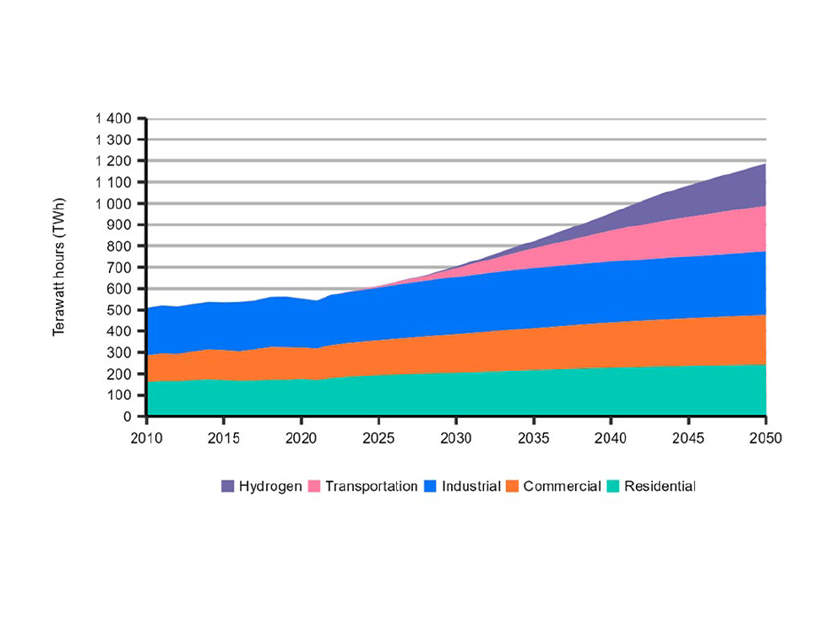
Canada’s annual electricity demand is projected to at least double to 1,200 TWh by 2050. | Electricity Canada
Muggeridge said some of her group’s members are concerned over the speed with which the bill was approved and the lack of consultation with them in advance. “But I believe that’s being rectified throughout the month of July. We’re hoping for positive conversations over the next two weeks, but that’s generally what I’ve been hearing from members who are excited and looking at how they can ensure their projects are on this list of 10 to 12.”
Indigenous leaders, however, were not mollified by a meeting with Prime Minister Mark Carney on July 17, saying consulting First Nations after the legislation had passed was disrespectful.
The 2025 priorities that Electricity Canada will be presenting to the government in August will “look a lot like they did in 2024,” with an emphasis on improving the country’s competitiveness, Muggeridge said.
“It is too difficult to build in Canada,” she said. In “the latest ranking with the [Organization for Economic Cooperation and Development], we were like 64th for permitting in the world.”
The group says CERs’ goal of an emissions-free electric grid by 2035 will harm affordability and reliability, with impacts most acute in Alberta, Saskatchewan, Ontario, Nova Scotia and New Brunswick.
It also is seeking to change investment tax credits to include intra-provincial transmission and revise the definition of eligible small modular nuclear reactors; extend timelines for full value credits from 2030 to 2035; and eliminate the requirement that provinces and territories commit to a net-zero grid by 2035.
‘Startup Vibe’
Muggeridge said the new government has “a bit of a startup vibe.”
“This happened with [Prime Minister Justin] Trudeau in 2015 … an excitement and an urgency. Ministries are being staffed with new young folks that are excited to meet with Electricity Canada. We’re delighted with the engagement that we’ve had with the new government so far.”
Bradley agreed. “Clearly, the tone is different. … Seven or eight months ago, nobody around the Cabinet table would even engage in a conversation about some of these topics. Now, those conversations are at least taking place. … Whether or not it actually results in in making it easier to get good projects moving forward remains to be seen.
“What we need more than anything else is … certainty so that those investments can happen,” he added. “We’d like to remind people that we’re not talking about investments that have a three-year lifespan or a five-year lifespan. We’re talking about investments that that need to be able to stand up to the test of time for 20, 30, 40 years. These are generational investments that are required.”
13 Systems
Bradley said Canada’s electric regulations also are a challenge. “There is not that one electricity system in this country. There are 13 systems. And each of those systems — each province and territory — has constitutional authority over its own electricity regulation. And provincial autonomy often leads to resistance against federal initiatives, including, for example, net-zero targets or national infrastructure projects. In some jurisdictions, it’s principally Crown-owned companies. In other jurisdictions, it’s investor-owned companies. There’s a different level of market access and market maturity.
“I will often hear from folks in the western Canadian context, talking about the interconnection between [British Columbia] and Alberta,” he continued. “Why would one build more interconnection between these two jurisdictions when the current interconnection are not being maximized? Well, the current interconnection is not being maximized because there’s a mismatch between the markets.”
A new task force is examining how the Western Power Pool’s Western Resource Adequacy Program (WRAP) can continue to operate efficiently under the new multimarket environment emerging in the West.
The WRAP Day-Ahead Market (DAM) Task Force held its second meeting July 17 and discussed some of the thorny issues that lie ahead for the resource adequacy program as CAISO and SPP prepare to launch their respective day-ahead markets. The group’s members include entities like Bonneville Power Administration, Idaho Power, Portland General Electric and Powerex.
The purpose is to present a proposal aimed at enhancing WRAP’s Operations Program to make it compatible with both SPP’s Markets+ and CAISO’s Extended Day-Ahead Market (EDAM). The task force is focusing on market optimization and changes to transmission requirements in WRAP’s Southwest Region. (See WRAP Members Align on Key Issues to Prioritize.)
Representatives from participant organizations will chair the task force and formulate the proposal.
“WRAP was designed to work alongside all markets, as well as for participants who do not join a market,” Michael O’Brien, WPP’s senior policy engagement manager for the WRAP, told RTO Insider. “Much of WRAP’s design was created before EDAM and Markets+ existed, though. This task force will look at if and how WRAP should be optimized to work alongside the markets. It’s a chance to re-examine WRAP’s Operations Program through the lens of the day-ahead markets to potentially identify any efficiencies and opportunities, such as taking advantage of market optimizations and internal connectivity.”
Attendees of the July 17 meeting discussed issues such as data sharing between WRAP and market operators, handling holdback requirements, energy deployment and delivery, serving load in different markets and settlement pricing, among other potential challenges.
The group will meet throughout the summer and fall to create a formal proposal that will go out for public comment and review by program committees.
“If approved, the proposal could result in changes to business practice manuals or a potential FERC filing to make changes to the WRAP tariff,” according to O’Brien. “While the task force will look at WRAP through the lens of the day-ahead markets, the scope of the task force is limited to modifications of WRAP only.”
WPP launched the WRAP in response to industry concerns about resource adequacy in the West.
Under the program’s forward-showing requirement, participants must demonstrate that they have secured their share of regional capacity needed for the upcoming season. Once WRAP enters its binding phase, participants with surplus must help those with a deficit in the hours of highest need.
The binding phase also includes penalties for participants that enter a binding season with capacity deficiencies compared with their forward showing of resources promised for that season.
In 2024, the binding phase was postponed by one year at the request of participants, who said they were facing challenges including supply chain issues, faster-than-expected load growth and extreme weather events that would make it difficult for them to secure enough resources and avoid penalties. The binding phase is now expected to start in summer 2027. (See WRAP Members Vote to Delay ‘Binding’ Phase to Summer 2027.)