Cooper Vetoes NC Bill Prohibiting Bans on Natural Gas Hookups

North Carolina Gov. Roy Cooper on Thursday vetoed a bill that would have prohibited the state’s cities and counties from banning natural gas hookups in residential construction.

To date, similar bills — heavily supported by the natural gas industry — have been passed in 20 states and are pending in four more. These “pre-emptive bills” have all been enacted in the past two years in response to ordinances or building codes now adopted in 50 cities in California to promote home electrification and reduce carbon emissions by banning natural gas hookups in new construction, according to S&P Global.

In a statement released with the veto announcement, Cooper said, “This legislation undermines North Carolina’s transition to a clean energy economy that is already bringing in thousands of good paying jobs. It also wrongly strips local authority and hampers public access to information about critical infrastructure that impacts the health and wellbeing of North Carolinians.”

The governor has been pushing for the state to cut its emissions by 70% over 2005 levels by 2030, a goal codified in a new law, HB 951, which he signed in October. According to a 2019 greenhouse gas inventory produced by the North Carolina Department of Environmental Quality, residential emissions then accounted for 3.5% of the statewide total.

The vetoed bill, HB 220, would stipulate that cities and counties in the state cannot “adopt an ordinance that prohibits, or has the effect of prohibiting, the connection, reconnection, modification or expansion of an energy service based upon the type or source of energy to be delivered to an individual or any other person as the end user of the energy service.”

The specific sources of energy that cannot be prohibited are defined in the bill as “natural gas, renewable gas, hydrogen, liquefied petroleum gas, renewable liquefied petroleum gas or other liquid petroleum products.”

To date, no North Carolina cities or counties have passed or proposed such bans, which led some Democratic lawmakers to question the need for the bill when it was introduced earlier this year. Defending the pre-emptive action, Rep. Dean Arp (R), a bill sponsor, said, “Energy policy is a state issue,” and a bill protecting consumer choice “absolutely clarifies that before it becomes a problem.” (See Gas Industry Brings Fight Against Building Electrification to NC.)

In a statement released following Cooper’s veto, Arp said the bill was intended to leave “household decisions like whether or not to have a gas stove in their home to consumers themselves. The heavy hand of government has no place in the personal decisions North Carolinians make for their households.”

House Speaker Tim Moore (R) also criticized the veto, characterizing it as an act of “partisanship over common sense.”

To override a veto, a three-fifths majority is needed in each chamber of the General Assembly: 30 votes in the Senate and 72 in the House of Representatives. There are 28 Republicans in the Senate and 69 in the House.

‘It’s not About Today’

Maggie Shober, research director at the Southern Alliance for Clean Energy, praised Cooper for “standing up for local control of how to make our buildings safer and cleaner. These ban-the-gas-ban bills have been pushed by special interests across the country, with little thought to the customers that will be forced to pay for expanding fossil fuel infrastructure in their neighborhoods while the science has been clear: To avert the worst of climate change, we need to reduce, not expand, our use of fossil fuels.”

According to the U.S. Energy Information Administration, about one in four North Carolina homes are heated with natural gas. EIA also ranks the state as one of 10 in the U.S. with the lowest per capita use of natural gas, although natural gas consumption there has quadrupled in the past decade, mostly from its use in electricity generation.

But the debate here and in other states has centered on the economics and emissions of natural gas versus electricity.

The American Gas Association does not take positions on state policies, such as pre-emptive laws prohibiting bans on natural gas hookups, but spokesperson Jake Rubin argued that natural gas is both a cheaper, cleaner and more reliable fuel for home heating and cooking.

“A natural gas home has fewer CO2 emissions than a home that uses electricity for its various applications … because of the efficiency of the delivery infrastructure,” Rubin said. “It takes a lot more energy to get electricity to a home than it does to get natural gas to a home.”

And because “most of electricity is made using either coal or natural gas,” he said, a home using natural gas for space and water heating and cooking will have lower emissions than an all-electric home.

But Ram Narayanamurthy, program manager for buildings at the Electric Power Research Institute, said that calculations of an electrified home’s emissions will depend on the generation mix of the utility providing the electricity. And, he noted, many utilities are now committing to decarbonizing their power supplies.

“We find that in places like California, the generation mix they have today, all-electric homes [produce] about 40% less emissions than a mixed-fuel home,” he said. “In a place like Texas, it’s closer to neutral.

“The fact is that as you set the goals for going zero carbon, as the electricity gets cleaner, the grid gets cleaner and cleaner,” he said. “The trend is that your all-electric home is going to have far less emissions. It’s not about today, but if you look at 2030, the generation that’s in 2030, that all-electric home that you build today is going to be a lot cleaner.”

Which Will be Cheaper, Cleaner?

In New Jersey, the latest state to consider a pre-emptive prohibition on bans on natural gas hookups, gas advocates are also pointing to the future potential for low-carbon fuels as a reason to maintain gas pipelines.

At a recent hearing in the New Jersey Senate, Robert Pohlman, managing director of innovation and strategic initiatives at New Jersey Natural Gas, said that ratepayers had invested $17 billion to create the infrastructure through which natural gas is supplied to their homes. That infrastructure could be used to bring alternative fuels, such as hydrogen or renewable natural gas, to consumers, but it would be discarded if buildings transitioned to electricity. (See NJ Legislators Back Alternatives to Electric Heat.)

“The state must not close itself off from the future benefits of investment, innovation and competition happening around low-carbon fuels today,” Pohlman said.

But whether natural gas or electricity is cleaner and cheaper for North Carolina consumers will depend, again, on the local generation mix and rates. EIA ranks North Carolina in the top 10 for overall electricity consumption and the top five for residential electricity sales.

Duke Energy, the state’s largest utility, has committed to cutting its carbon emissions by 50% by 2030 and achieving net-zero emissions by 2050. However, the utility’s integrated resource plan, still pending before the North Carolina Utilities Commission, anticipates adding thousands of megawatts of natural gas generation through 2035.

The utility’s rates will also likely increase in coming years. Under HB 951, Duke will be able to file multiyear rate plans, under which it will only have to file a full rate case once every three years, rather than yearly as it does now. It will be able to raise rates up to 4% per year in between without the approval of the NCUC.

Con Ed Submits Proposal for New Jersey Offshore Transmission

A subsidiary of New York-based utility Consolidated Edison (NYSE:ED) has submitted a proposal for a 2.4-GW transmission “backbone” to the New Jersey Board of Public Utilities (BPU) to bring offshore wind-generated electricity to the PJM grid.

The proposal submitted by Con Edison Transmission would create Clean Link New Jersey, a high-voltage network of multiple undersea transmission cables.

“The offshore mesh-style network is flexible and modular to allow various offshore wind projects to plug in as they become ready to generate,” the company said in a Dec. 6 statement outlining the project. A description of the proposal posted on the PJM website states that an undersea “power corridor” through which cables will run “provides the opportunity to better manage costs and improve grid stability, while significantly reducing permitting and environmental impacts.”

Con Ed submitted the proposal under the competitive solicitation by the BPU and PJM for new transmission and grid upgrades to handle the 7,500 MW of offshore wind energy that the state expects to bring online by 2035. (See New Jersey Seeks OSW Transmission Ideas.)

The organizations issued the solicitation under FERC Order 1000’s state agreement approach, under which the BPU requested that PJM integrate the state’s offshore wind goals into the RTO’s Regional Transmission Expansion Plan process. About 80 documents are posted on the PJM webpage that lists proposals submitted under the solicitation. (See PJM, NJ Staff Brief Stakeholders on State Agreement Approach.)

Proposals were accepted until September, and PJM officials are now reviewing them. The BPU expects to begin evaluating them early next year and will decide which ones fit their needs in the third or fourth quarter.

First NJ Venture

New Jersey has so far approved three offshore wind projects in two phases totaling 3,758 MW, about half the state’s target. Danish developer Ørsted’s Ocean Wind, an 1,100-MW project, won the first solicitation in 2019, and in June the state awarded the developer a second project, its 1,148-MW Ocean Wind II, in the second solicitation. The BPU also backed Atlantic Shores, a 1,510-MW project developed by a joint venture between EDF Renewables North America and Shell New Energies US.

Con Edison Transmission’s project is the subsidiary’s first venture into New Jersey, although another subsidiary of Con Ed, Orange and Rockland Utilities, serves customers in Northern New Jersey, company spokeswoman Anne Marie Corbalis said. The release said Con Edison Transmission is “developing a portfolio of transmission projects delivering renewable energy to customers.”

The Clean Link New Jersey proposal includes plans for a 27-mile fiber optic undersea cable and 23 miles of onshore cable, and the project will be capable of handling energy from multiple projects, according to the proposal. The project consists of eight transmission components, including substations onshore and offshore, transmission lines and a 500-foot-wide right of way, which will together cost $2.75 billion, according to the proposal.

Public Service Enterprise Group (NYSE:PEG) announced in October that it has submitted several projects to the BPU/PJM solicitation in partnership with Ørsted, collectively known as Coastal Wind Link. The company declined to provide details of its submissions. Proposals listed on the PJM website under PSEG’s name only include one to conduct a series of upgrades to the Central Jersey grid system.

The list of projects on the site submitted under Coastal Wind Link includes a 92-mile offshore transmission line that will come ashore at the Raritan River and then run 6 miles onshore, mainly on public rights of way, to a converter station in Sewaren, in Middlesex County, at a cost of $848 million. Another proposal would create a converter platform in the South Hudson offshore area planned for the two Ørsted developments that will receive AC power from the wind farms, convert it to HVDC and move it to the shore, with a cost of the various components of $1 billion.

Coastal Wind Link’s proposals would “provide a reliable, resilient and cost-effective infrastructure to the state,” the company said in a statement. The proposals “encompass individual and networked solutions and would ensure that New Jersey has a clear path to connect to the offshore wind energy coming online during the next decade while minimizing environmental impacts along New Jersey’s coastline,” the statement said.

Biden Appoints California PUC Commissioner to Head EPA Region 9

EPA said Thursday that President Biden intends to name California Public Utilities Commissioner Martha Guzman Aceves to run the region of the agency that includes California, Arizona, Nevada and Hawaii, implementing the administration’s environmental agenda in the far West.

Guzman Aceves has served for five years on the CPUC. She worked previously as former Gov. Jerry Brown’s deputy legislative affairs secretary and for the California Rural Legal Assistance Foundation and the United Farm Workers. Much of her focus at the commission has been on providing clean energy to underserved communities and preventing disconnections of basic utilities.

Martha Guzman Aceves (CPUC) FI.jpgCPUC Commissioner Martha Guzman Aceves | CPUC

“Given Martha’s extensive background in successfully delivering access to underserved communities, I am confident she is an excellent choice to lead our Region 9 team,” EPA Administrator Michael Regan said in a statement. “Martha is an experienced leader that values economic justice and will represent the best interests of the residents in the region.”

Guzman Aceves said she was “honored to be appointed by President Biden to serve as administrator of EPA Region 9 under the leadership of Administrator Regan. And I am grateful for the opportunity to work with the resilient staff at Region 9 as we tackle the chronic and emerging environmental issues in our communities.”

The move continues a series of transitions at the CPUC, an agency tasked with ensuring resource adequacy, preventing utilities from igniting wildfires and shepherding the state through its transition to 100% clean energy by 2045.

CPUC President Marybel Batjer announced in September that that she planned to step down at the end of the year with five years left in her seven-year term. Gov. Gavin Newsom in late November named his senior energy adviser, Alice Reynolds, as the commission’s next president. (See California PUC President to Step Down and Calif. Governor Names Next CPUC President.)

In December 2020, Newsom named then-CPUC Commissioner Liane Randolph as chair of the California Air Resources Board, which oversees vehicle emissions and other types of air pollution. Randolph replaced retiring Chair Mary Nichols, whom Biden reportedly was considering to head EPA at the time. Instead, he appointed Regan, then head of North Carolina’s Department of Environmental Quality. (See EPA Nominee Regan Receives Bipartisan Support.)

EPA on Thursday also announced the appointments of Earthea Nance and Meg McCollister as administrators of its regions 6 and 7, respectively. Nance is an environmental engineer and an associate professor of urban planning and environmental policy at Texas Southern University; Region 6 covers Arkansas, Louisiana, New Mexico, Oklahoma and Texas. McCollister is an independent consultant based in Kansas City, Mo., where she serves “as an adviser and strategic thinker in areas including environmental, health and social improvement initiatives, as well as communication strategies,” according to EPA. Region 7 covers Iowa, Kansas, Missouri and Nebraska.

FERC Rejects SEEM Opponents’ Rehearing Requests

Another door has been closed to opponents of the Southeast Energy Exchange Market (SEEM), after FERC on Friday ruled that their request for a rehearing on the market was submitted too late to be heard (ER21-1111, et al.).

The opponents — an ad hoc alliance of environmental and clean energy organizations calling themselves the Public Interest Organizations (PIOs), and a separate group referred to as the Clean Energy Coalition (CEC) — filed their rehearing requests Nov. 12. (See SEEM Opponents File Rehearing Requests.) In its Friday order, FERC declined to engage with these criticisms on the grounds that the opponents should have submitted their requests by Nov. 10.

Both groups also submitted alternative requests in the event FERC denied rehearing. The PIOs asked for their objections to SEEM to be the subject of a “paper hearing with a technical conference before briefing,” while the CEC asked the commission to provide “clarification and confirmation on the role and function of the SEEM proposal and the platform that will enable transactions.”

However, FERC rejected these requests as well. Because the PIOs’ rehearing request was untimely, the commission said the issues raised therein could not be set for a paper hearing. Regarding the CEC’s request, FERC said that “in the absence of an order” relating to SEEM, “there is nothing to be clarified.”

Because the commission was split 2-2, SEEM was automatically approved “by operation of law” Oct. 12. Hence, there was no actual order from the commission. (See SEEM to Move Ahead, Minus FERC Approval.)

According to the Federal Power Act, any parties “aggrieved” by a FERC order may apply for rehearing within 30 days of its issuance. But because FERC did not issue a formal order in the proceeding, the PIOs and CEC recognized Oct. 13 — when FERC announced that the agreement had taken effect — as the date of FERC’s “order.” Under this logic, the deadline for submitting the rehearing request was Nov. 12, making their filings timely.

By contrast, SEEM’s supporters, in a Nov. 30 filing, argued that the “date of issuance” is not when the commission announces a decision, but when it issues an order — or, in this case, fails to do so. (See SEEM Members Seek to Quash Rehearing Requests.) Because Oct. 11 was the deadline for FERC to issue an order, members said that rehearing requests must be filed 30 days after this date, meaning that any requests filed after Nov. 10 were out of time.

FERC did not cite either filing in Friday’s order, but the commission acknowledged that it “has not previously explained … the proper calculation of the deadline for rehearing requests following the failure of the commission to act.” Its subsequent clarification echoes the opinion of SEEM members, with FERC stating that the date of its “order” in this case was Oct. 11 and that the 30-day clock for rehearing requests “starts running on the day after the last day that the commission could have taken action,” meaning the deadline was Nov. 10.

When FERC deadlocked on the original SEEM proposal, Chair Richard Glick and Commissioner Allison Clements — both Democrats — opposed the agreement, while Republican Commissioners James Danly and Mark Christie approved of it. The commission’s filing on Friday did not mention the views of specific commissioners, though it did say that Commissioner Willie Phillips, the newest member who was confirmed by the Senate on Nov. 16, did not participate. (See Senate Confirms FERC Nominee Willie Phillips.)

SEEM Moving Toward 2022 Launch

Because the SEEM agreement took effect in October, FERC has approved revisions to four of the participating utilities’ tariffs implementing the special transmission service used to deliver the market’s energy transactions. (See FERC Accepts Key Tariff Revisions to SEEM.) Members have also submitted further changes to the commission that would implement a series of “transparency enhancements” to the market. The changes were proposed in June in response to FERC’s first deficiency letter, but the commission was not able to mandate their inclusion in the SEEM agreement because it did not issue an order. (See SEEM Members Offer Rule Changes.)

SEEM members also announced on Friday that they had chosen technology solutions company Hartigen to build and deploy the market’s technology platform. The selection of Hartigen follows a request for proposals issued in March. In a press release, members said they plan to have the new market online by the third quarter of 2022.

Implementation Underway for NWPP’s Western RA Market

The Northwest Power Pool (NWPP) last week took its first steps in implementing its Western Resource Adequacy Program (WRAP), opening the door for participants to submit resource data for a “nonbinding” phase of the capacity market, which the organization says will serve as a “beta test” for a final program design.

The data from the 26 “Stage 1” participants are needed to model “forward showings” of resource adequacy and availability for the WRAP’s winter 2022 season commencing next November. In the future, participants will be required to provide their forward showings seven months in advance of the summer (June-September) and winter (November-March) compliance periods.

NWPP developed the WRAP to help Western balancing authorities cope with potential generation shortages during critical hours as the region confronts the retirement of increasing numbers of thermal generators and its growing reliance on variable renewable resources such as wind and solar.

The WRAP is intended to increase visibility into existing RA conditions in the West, addressing concerns among industry stakeholders and state regulators that load-serving entities are unknowingly relying on the same capacity resources without realizing it, threatening system reliability during periods of scarcity. The program is designed to provide participants a framework in which to access capacity resources when a participant is experiencing an extreme event.

“An extreme event could be when a participant’s load is in excess of their [forward showing] forecast or resources (generation and transmission) are experiencing unexpected outages; this portion of the program unlocks the footprint’s load and resource diversity,” NWPP explained in a “detailed design” document released last July. “The program seeks to achieve a balance between planning in a reasonably conservative manner but also to provide flexibility in order to protect customers from unreasonable costs.” 

In developing the WRAP, NWPP distinguished among various forms of RA — such as flexibility, energy and capacity — and decided to initially focus on a capacity-based program “with a demonstration of [resource] deliverability.”

The WRAP will kick off next winter with a nonbinding, no-penalty phase, denoted as Stage 1 in the NWPP timeline. The absence of enforcement and penalties shields the program from FERC oversight, giving members additional time to iron out wrinkles and finalize its design.

The binding Stage 2 program will introduce a requirement that participants demonstrate to the RA program administrator that they have sufficient resources to meet required metrics for a compliance season seven months ahead of the operational timeline or face a penalty based on the cost of new gas peaking plant.

The 26 Stage 1 participants represent more than 65,000 MW of winter peak load and nearly 67,000 MW of summer peak load within the Western Interconnection.

“This group is diving into the remaining program design questions, including a task force dedicated to a second transmission hub that would allow participants in the southwest region to more readily access program diversity; one considering specific contract terms that would be necessary to ensure an enhanced WSPP Schedule C agreement would count as qualified capacity; and others considering other outstanding issues,” NWPP said in a statement last week.

“We are very excited about the interest and commitment to the WRAP we’ve seen from former NWPP members and new participants alike. The level of excitement for the program’s forward program speaks to the determination and dedication of the participants,” NWPP CEO Frank Afranji said.

NWPP also noted last week that the move to implement the WRAP officially kicks off its working relationship with SPP, which has been retained to administer the program. (See SPP to Operation NWPP’s Resource Adequacy Program.)

“SPP has begun providing program operation services, including facilitating the collection of participants’ data to perform modeling for the upcoming seasons,” NWPP said.

“As we reach this significant milestone in the WRAP’s implementation, SPP is grateful for the relationships we’ve built and the opportunity to work with such a collaborative and diverse group of entities,” SPP CEO Barbara Sugg said. “This resource adequacy program will play an important part in the reliability of the Western grid, and it’s exciting to see new participants joining the effort.”

WRAP Stage 1 participants include Arizona Public Service, Avangrid, Avista, Black Hills Energy, Basin Electric Power Cooperative, Bonneville Power Administration, Calpine, Chelan PUD, Clatskanie PUD, Douglas PUD, Eugene Water and Electric Board, Grant PUD, Idaho Power, NorthWestern Energy, NV Energy, PacifiCorp, Portland General Electric, Powerex, Puget Sound Energy, Seattle City Light, Snohomish PUD, Shell Energy, Salt River Project, Tacoma Power, Turlock Irrigation District and The Energy Authority, which is representing seven Washington and Oregon publicly owned utilities.

Texas RE Briefs: Dec. 8, 2021

The Texas Reliability Entity highlighted its involvement in a joint NERCFERC inquiry into the February winter storm that nearly collapsed the ERCOT grid but warned its Board of Directors that next year could be more challenging.

“Still, there’s so much to do to ensure such an event never happens again,” Board Chair Milton Lee said. “We must hold ourselves accountable to develop future strategies, implement them, and ensure we monitor and update them for future improvements.”

NERC and FERC released their joint report in November, highlighting the failure of electric and gas utilities to adequately prepare for Winter Storm Uri’s frigid temperatures. The event caused more than 23 GW of manual firm load shed as generators and their supply lines froze. (See FERC, NERC Release Final Texas Storm Report.)

Texas RE staff were among the nearly 50 subject matter experts who helped prepare the report. Their final report included 28 recommendations that covered both industries and went beyond NERC reliability standards revisions to address cold weather, which were approved in August 2021.

“This report recognizes that folks at the RTO and ISO level coordinated very well and made the best of the situation by bringing in [power] supplies from their neighbors,” said Mark Henry, Texas RE’s director of reliability services and registration.

Henry said the RE staff’s next task is a deeper dive into the unavailability of ERCOT’s black start units during Winter Storm Uri.

The board approved the Nominating Committee’s recommendation that Lee again serve as its chair in 2022 and that Crystal Ashby serve as vice-chair.

The directors also approved Joseph Younger’s selection as Texas RE’s COO.

The Member Representatives Committee met before the board meeting and approved a work plan for NERC Project SAR-012: Revisions to the Standards Development Process. The work plan lays out the steps for revising a Regional Standard in accordance with Texas RE’s standards development process document.

Annual Membership Meeting

Texas RE CEO Jim Albright said staff is “leaning in” to a NERC audit next year, the result of a FERC order that applies to all six regional entities.

“We’re ready to show our work and be involved,” he said during the organization’s short annual membership meeting.

Albright said staff’s full return to the workplace is still “in flux,” given the coronavirus’ stubborn presence and the mutating variants. A target date has been set for Jan. 10, but staff will be limited to two days a week.

“We’ll be very cautious about bringing employees back to the office,” he said.

Resuming onsite stakeholder engagement will be a “challenge,” Albright said. He said the organization will focus on “comprehensively engaging” with stakeholders on all extreme events, not just those related to the winter.

Staff said Texas RE’s membership re-elected Lee to serve another three-year term as independent director. Lee’s term will expire Dec. 31, 2024.

The membership also elected three new MRC members: Acciona Energy USA Global’s George Brown and Vistra’s Kristopher Butler as the generation sector’s representatives, and Denton Municipal Electric’s Cameron Molsbee as the municipal alternate.

Lee honored Oncor Electric’s Liz Jones for her service as the MRC’s vice chair. Jones remains on the committee, which will elect its 2022 chair and vice-chair in January.

Texas RE added six new members in 2021, pushing its membership roll to 116. Five of those new members were in the generation sector, thanks to the continued growth of the state’s renewable energy.

MISO Board of Directors Briefs: Dec. 9, 2021

MISO Pulls off 1st Face-to-face Meetings Since Start of Pandemic

ORLANDO, Fla. — MISO Board Week meeting marked MISO’s first plunge into in-person gatherings in nearly two years.

“Isn’t it great to be back in person?” CEO John Bear said in opening the Board of Directors’ meeting Thursday, held at Loews’ Sapphire Falls Resort, near Universal Orlando. “I was excited to put my tie on this morning.”

Organization of MISO States President Julie Fedorchak thanked MISO for “forging ahead” with an in-person meeting. She said the RTO showed it can be done in a “safe and pragmatic way.”

“There’s nothing quite like face-to-face communication,” Fedorchak said.

Board Week drew about 90 stakeholder attendees. MISO also offered a virtual attendance option.

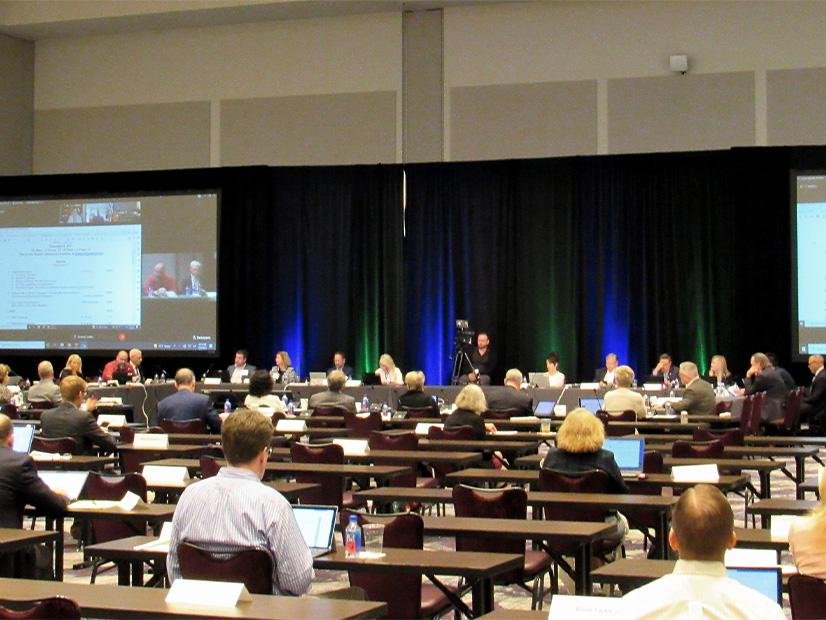
MISO Board Week 2021-12-08 (RTO Insider LLC) Alt FI.jpgSocially distanced attendees at MISO Board Week | © RTO Insider LLC

MISO is charting a return to in-person meetings at its offices in Carmel, Ind.; Eagan, Minn.; and Little Rock, Ark., in late January.

The grid operator plans to reduce meetings of its major stakeholder committees from monthly to eight times per year and rotate which meet in-person, to limit virus exposure. Some stakeholders have misgivings that MISO can accomplish all its market and reliability aims and related FERC filings with just eight meetings per year, four of them in a virtual format. (See MISO Modifies Stakeholder Meeting Schedule.)

Robert Kuzman, MISO’s head of stakeholder relations, called the plan “a good start to get back in person as safely as we can.”

“This is a partnership. We intend to be as efficient as we can while still working through out goals,” Kuzman told the Advisory Committee on Wednesday.

Members asked if MISO would enact vaccination requirements for stakeholders wanting to enter a conference room.

Chief Customer Officer Todd Hillman said MISO is still navigating which requirements in-person meeting attendees must follow.

“Given the 15-state footprint, we’re trying to do right by all,” Hillman said.

Hillman said this week’s event will serve as the “litmus test” for MISO’s on-site meetings. So far, he said, MISO envisions socially distanced attendees, with tables spread apart.

MISO: New Market Platform Running by 2025

MISO said it remains on track for a late 2024 completion for its market platform replacement.

The RTO this year launched its new, one-stop system modeling tool and new market user interface, the nonpublic site market participants use to submit energy bids and offers. It believes it can complete the conversion by late 2024.

MISO is using Siemens smart grid technology to support its new model manager. It plans to cut over to a new method of member data submittal by March and retire its old method of data collection thereafter.

Chief Digital Officer Todd Ramey said MISO will retire both its legacy modeling system and old market user interface in 2022.

Next year, the RTO will work to debut an energy storage participation model on its vintage market platform. It previously said it couldn’t both roll out energy storage offers and focus on the platform replacement. Now it must introduce the storage participation model on both its old and new market platforms. (See MISO: No Choice but to Double Up on 841 Compliance.)

Late next year, MISO anticipates that it will receive its new day-ahead market clearing engine from General Electric.

This year marked the fourth full year of the ongoing swap of the grid operator’s old and rigid platform for a new modular one that can host more complex market offerings.

Board Approves Budget Shaped in part by COVID-19

MISO’s Board of Directors has greenlit a $376.1 million total budget for 2022.

The budget includes a $282.3 million base operating expenses, $37 million in project investments and $56.8 million in other operating expenses.

The 2022 budget is 1% lower than last year’s. MISO executives said pandemic impacts continue to influence budgeting. The RTO originally estimated that it would be largely free of pandemic irregularities in summer 2021.

Like other companies, MISO is contending with cybersecurity issues, supply chain issues, inflation and a tight labor market. CFO Melissa Brown said in fall that MISO was waiting on about $4 million in physical goods, including laptops, tables and new wallboards for the control room, that had yet to be delivered.

Brown also expects that MISO’s higher-than-expected employee vacancy rate will persist into 2022.

She said compared to pre-pandemic levels, MISO is earning a much lower interest rate on its cash, money it usually uses to offset some expenses.

Increasingly severe weather events are also upping spending. Executives said they spent about $2 million over 2021 to answer state- and federal-level questions about MISO’s decision-making and operations during extreme weather events.

Year to date, MISO is $5 million underbudget from its $226 million base operating allotment.

MISO Director Barbara Krumsiek thanked the RTO’s financial team for balancing a budget despite an “extraordinary number of variables.”

MISO Members Weigh Potentially Rough Winter

ORLANDO, Fla. — MISO members this week offered a few tips on how the footprint can weather a tough winter, a day after the RTO elevated the risk level.

The grid operator warned that it’s in for a bumpier season, considering fresh concerns around coal and natural gas fuel assurance and security. (See related story, MISO Sounds Alarm on Potential Winter Fuel Scarcity.)

Todd Hillman 2021-12-07 (RTO Insider LLC) FI.jpgTodd Hillman, MISO | © RTO Insider LLC

“For this winter in particular, we know [awareness around] fuel assurance has been heightened,” MISO Chief Customer Officer Todd Hillman said, noting a doubling of natural gas prices since last year and concerns around coal stockpiles and deliveries.

The U.S. Energy Information Administration recently reported that coal production has sunk to a level not seen since 1978.

Speaking at an Advisory Committee meeting Wednesday as part of MISO Board Week, Hillman said the RTO’s planning futures point to an increased reliance on natural gas going forward.

“In MISO’s view, the number of recent outages is unacceptable,” Hillman said, calling up gas generation performance during mid-February’s arctic blast. (See MISO Underscores Need for RA Action in Winter Storm Review.) “This winter, are we better prepared, or more just bracing for impact?”

MISO’s current generation fleet contains about 80 GW worth of natural gas capacity, 80% of that without firm fuel service. During the February winter storm, the gas fleet experienced a more than 30% forced outage rate.

“Every time we see a weather event that we think is unsurpassed, Mother Nature says, ‘Here, hold my beer,’” MISO President Clair Moeller quipped.

Madison Gas and Electric’s Megan Wisersky said it’s not cost effective for most gas generation operators to secure firm transport.

Stakeholders pointed out that NERC’s new cold weather standards aren’t set to come into effect until April 2023.

“We have a potential reliability situation in front of us that can’t wait,” Cleco Cajun’s Tia Elliott said.

MISO Director Todd Raba asked what the RTO could immediately do to assuage conditions this winter. “There might not be an answer; that’s OK,” he said after a beat of silence.

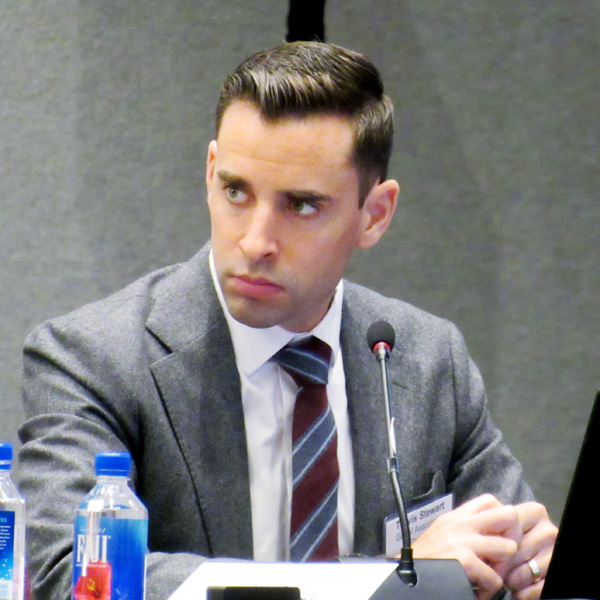
Travis Stewart 2021-12-07 (RTO Insider LLC) FI.jpgTravis Stewart, COMPP | © RTO Insider LLC

“Other than meditation and prayer,” Hillman jokingly added, prompting stakeholders for suggestions.

Coalition of Midwest Power Producers representative Travis Stewart said MISO could reach out to generators with long lead times to make commitments days in advance.

“We might end up with some uplift, but that’s the cost of reliability. It’s a tough situation, and I think MISO’s markets do an excellent job,” Stewart said.

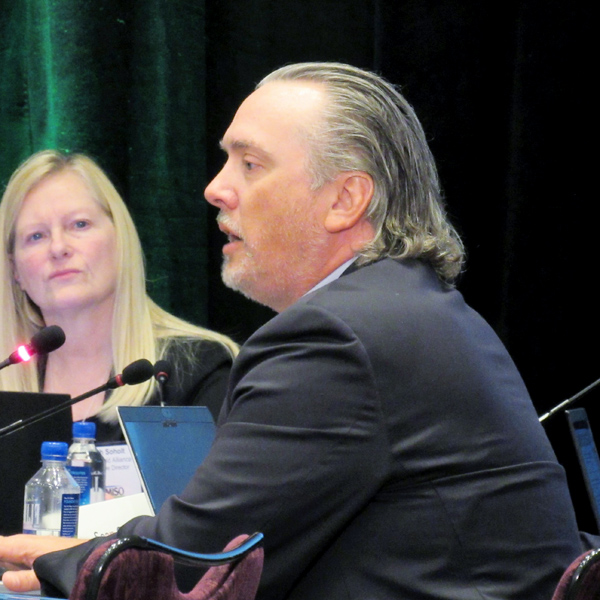
Clean Grid Alliance’s Beth Soholt said regulators should issue more conservation pleas through television and radio. “It may help us through a shortage or critical time. … I think it just heightens that we’re both going to need the demand side and the supply side,” she said.

“I think we spend so much time taking care of customers that we don’t realize that they have a responsibility to the system. And I think that’s a positive,” Indiana Utility Regulatory Commissioner Sarah Freeman agreed.

But Wisersky said “constant public appeals” might diminish MISO members’ credibility. She also said critical loads like hospitals should obtain on-site backup generation, given the new reality of intermittent generation coupled with knockout weather events.

Beth Soholt John Orr 2021-12-07 (RTO Insider LLC) FI.jpgCGA’s Beth Soholt and Exelon’s John Orr | © RTO Insider LLC

“If we’re honest with our customers, we can’t 100% guarantee that we’re going to be there all the time,” Wisersky said.

Exelon’s John Orr said MISO could address the public about its largely behind-the-scenes work.

“The public gets very little information. … MISO can provide some of this understanding,” he said, noting that the RTO can explain its role and decision-making process and actions taken like rolling blackouts.

Freeman also said the impending introduction of MISO’s seasonal capacity auction and availability-based capacity accreditation will deliver some hard truths on the readiness of MISO’s fleet.

“Like it or not, it will send a signal to generators on how they’re going to be compensated,” she said.

Stakeholders also said MISO should look to generation other than natural gas.

Soholt said that though gas plants are necessary to reliability, she questioned how much natural gas generation the U.S. should build on its way to decarbonization. She said the MISO footprint could use electric storage and more transmission projects to move power around during winter storms.

“How much is in our carbon checkbook to keep building natural gas?” Soholt said. “Natural gas is part of the puzzle, but it’s not the whole answer.”

Consumers Energy’s Kevin Van Oirschot pointed out that several of MISO’s market-based solutions meant to aid reliability are waiting on the new market platform, which will be better able to handle energy storage, distributed energy participation and more demand-side management.

MISO Wraps Annual Transmission Package

ORLANDO, Fla. — MISO said it’s making headway on three transmission planning initiatives, including its 2021 Transmission Expansion Plan (MTEP), long-range transmission portfolio and a joint study with SPP intended to build transmission that can bring more generation online.

On Thursday, the Board of Directors greenlighted 335 new projects worth $3 billion, about a 20% reduction from 2020’s transmission package. (See MISO Tx Expansion Plans Proceeds to Board Vote.)

Aubrey Johnson, MISO’s executive director of system planning, has said the decrease is largely driven by Central planning region transmission owners submitting fewer projects this year. He said projects are scattered evenly across the footprint except for the West region, which continues to experience fewer projects.

“There’s not really any sexy in this [MTEP] … but this is foundational work that needs to be done,” director Mark Johnson said during the board’s meeting.

MISO says that $28.2 billion worth of transmission facilities have gone into service since the first MTEP cycle in 2003. Another $12 billion in projects will be in service by 2024.

Johnson said the billions in upcoming projects illustrate how long it takes to get transmission built. He also said projects from as far back as the 2008 and 2010 MTEPs have yet to be energized.

“Our team is going back to understand better what is going on with these projects,” Johnson said during a Tuesday System Planning Committee (SPC) of the board. He said most projects have been delayed because of budget or design changes.

This year, some members asked that MISO include transmission’s ability to withstand climate change or support clean energy goals in future MTEP planning.

The Environmental Sector asked staff to create “a more inclusive and holistic” transmission planning process that will support the fuel mix transition from fossil plants to renewable resources.

WPPI Energy asked for transfer analyses to SPP and the Tennessee Valley Authority and requested the RTO consider better connections between southern Illinois and southern Indiana.

Johnson has said MISO already considers extreme weather events in planning and it will dial up those efforts.

“We’re trying to expand that further to drive operational insights,” he told the board’s SPC in September.

WPPI Energy’s Steve Leovy said then that MISO can “reasonably expect” repeats of polar vortices that carry load-shed risk. He said he was worried the grid operator’s planning wasn’t doing enough to prevent a repeat of reliability breakdowns during cold snaps.

Midwest Bent for Long-range Projects

MISO Vice President of System Planning Jennifer Curran said staff is still putting together business cases and reliability and engineering analyses for the dozen or so Midwestern projects that could be recommended in the first cycle of long-range transmission projects.

Curran said the RTO is focused on the footprint’s Midwestern portion first because that region is undergoing a much more aggressive clean energy transition than MISO South.

“The needs are much more imminent. In some cases, they are here today,” Curran told the SPC Tuesday. “We operate and plan as one RTO while addressing the need for speed in the North and Central regions.”

She said the regions remain fairly independent of one another partially because of the transmission constraint between the two. Curran acknowledged that MISO could recommend a long-range project to expand its North-South transmission interface, unifying the RTO and widening its benefits spread.

“It’s a little bit chicken and egg,” she said.

Nancy Lange 2021-12-06 (RTO Insider LLC) FI.jpgNancy Lange, MISO director | © RTO Insider LLC

Director Nancy Lange asked how MISO can be sure that project benefits will be contained to the subregion bearing its costs.

“It’s taken me a while to wrap my head around that,” Lange said.

Curran said while there may be some transmission benefits enjoyed by MISO South from the Midwest, they’re inconsequential.

MISO President Clair Moeller said the North-South subregional limit’s energy flow has less transfer capability than the connection between Minnesota and Wisconsin.

“It’s a severe constraint,” he said.

Clean Grid Alliance’s Beth Soholt urged the grid operator to propose projects in a timely manner, noting that utilities and state commissioners are relying on new transmission to make new resource decisions and meet decarbonization goals.

“We were looking forward to seeing [the first] tranche in December,” she said.

MISO originally planned to recommend long-range projects this month as part of MTEP 21. Now, it says it will present a list of projects for approval to the board in June. Though six months tardy, those projects will still be considered under MTEP 21’s banner.

Joint Interconnection Solutions at $2B

SPP and MISO are finalizing a nearly $2 billion portfolio of 345-kV interregional projects that could resolve most constraints along their seam.

The proposals are the result of the grid operators’ joint targeted interconnection queue study, designed to ease their crowded interconnection queues.

MISO still must discern how the projects would interact with any proposed projects under its long-range transmission plan.

MISO executives predicted disagreements over a cost allocation that could assign bills for both generation and load. SPP’s Antoine Lucas said costs could be recovered from new generators as they exit either of the RTOs’ interconnection queues. (See MISO, SPP: Economics Secondary in Joint IC Planning.)

The seams neighbors plan to hold cost-allocation talks on the projects next year. The RTOs have said they would bring projects to their respective boards for approval once they decide on cost allocation.

“I recognize we still have a lot of work to do … but this will hopefully benefit those along the MISO-SPP seam,” Johnson said.

PJM MRC/MC Preview: Dec. 15, 2021

Below is a summary of the issues scheduled to be brought to a vote at the PJM Markets and Reliability Committee and Members Committee meetings on Wednesday. Each item is listed by agenda number, description and projected time of discussion, followed by a summary of the issue and links to prior coverage in RTO Insider.

RTO Insider will be covering the discussions and votes. See next Tuesday’s newsletter for a full report.

Markets and Reliability Committee

Consent Agenda (9:05-9:10)

B. Stakeholders will be asked to endorse proposed revisions to Manual 6: Financial Transmission Rights, conforming to the joint PJM-stakeholder proposal addressing auction revenue rights (ARRs) and financial transmission rights endorsed at the October MRC. The changes were initiated after the GreenHat Energy default in 2018, including a six-month review by an independent consultant and work done at the ARR/FTR Market Task Force. (See Stakeholders Endorse PJM ARR/FTR Market Changes.)

C. Members will be asked to endorse proposed revisions to Manual 10: Pre-Scheduling Operations resulting from a periodic review. The revisions were endorsed at the November Operating Committee meeting. (See “Manual Changes Endorsed,” PJM Operating Committee Briefs: Nov. 4, 2021.)

D. The committee will be asked to endorse proposed Manual 14B revisions resulting from a biennial review. The revisions include the addition of a new section that features details around the incorporation of end-of-life (EOL) needs in the Regional Transmission Expansion Plan, which were part of the tariff attachment M-3 discussions. (See “Manual Endorsements,” PJM PC/TEAC Briefs: Nov. 2, 2021.)

E. Stakeholders will be asked to endorse proposed revisions to Manual 14D: Generator Operational Requirements resulting from a periodic review. The updates featured the addition of several new sections, including one describing eDART modeling requirements. (See “Manual Changes Endorsed,” PJM Operating Committee Briefs: Nov. 4, 2021.)

F. Members will be asked to endorse proposed revisions to attachment DD of the tariff endorsed by the Governing Document Enhancement and Clarification Subcommittee. The revision includes removing section 6.2(c) of the attachment because FERC affirmed PJM’s position that this section of the tariff is no longer applicable and encouraged the RTO to remove this provision as part of its next tariff clean-up filing.

Endorsements (9:10-10:10)

1. Undefined Regulation Mileage Ratio Calculation (9:10-9:30)

The committee will be asked to approve the proposed issue charge to create a new senior task force to re-evaluate the current regulation market design. The issue charge was first presented at the November MRC meeting. (See “Undefined Regulation Mileage Ratio Calculation,” PJM MRC/MC Briefs: Nov. 17, 2021.)

If the MRC approves the issue charge creating the task force, another vote will be taken on the short-term proposals from PJM and the Independent Market Monitor addressing the undefined regulation mileage ratio calculation. Both proposals failed a vote at the October MRC. (See “Regulation Mileage Ratio Fails,” PJM MRC/MC Briefs: Oct. 20, 2021.)

2. Solar-Battery Hybrid Resources (9:30-9:50)

Stakeholders will be asked to endorse the proposed solution and corresponding tariff and Operating Agreement revisions to address market participation by solar-battery hybrid resources. PJM conducted a prefiling meeting with FERC staff in September, and the commission made suggestions to reconfigure the language to increase its chances for approval. (See “Solar-battery Hybrid Resources,” PJM MRC/MC Briefs: Nov. 17, 2021.)

3. Synchronous Reserve Deployment Stakeholder Initiative (9:50-10:10)

The committee will be asked to endorse the proposed solution and corresponding tariff and OA revisions addressing synchronous reserve deployment during a spin event. The proposal was developed from discussions in the Synchronized Reserve Deployment Task Force (SRDTF). (See “Synchronous Reserve Deployment Stakeholder Initiative,” PJM MRC/MC Briefs: Nov. 17, 2021.)

Members Committee

Endorsements (1:30-1:45)

1. Elections (1:30-1:45)

Stakeholders will vote on the proposed sector representatives for the 2021/22 Finance Committee and the 2022 sector whips. The new Finance Committee members include: Susan Bruce, PJM Industrial Customer Coalition (End-use Customer); Jeff Whitehead, Eastern Generation (Generation Owner); Bruce Bleiweis, DC Energy (Other Supplier) and; Alex Stern, PSEG Services (Transmission Owner).

The 2022 sector whips include: Adrien Ford, Old Dominion Electric Cooperative (Electric Distributor); Greg Poulos, Consumer Advocates of the PJM States (End-use Customer); Michael Borgatti, Gabel Associates (Generation Owner); Brian Kauffman, Enel N.A. (Other Supplier); and Sharon Midgley, Exelon (Transmission Owner).