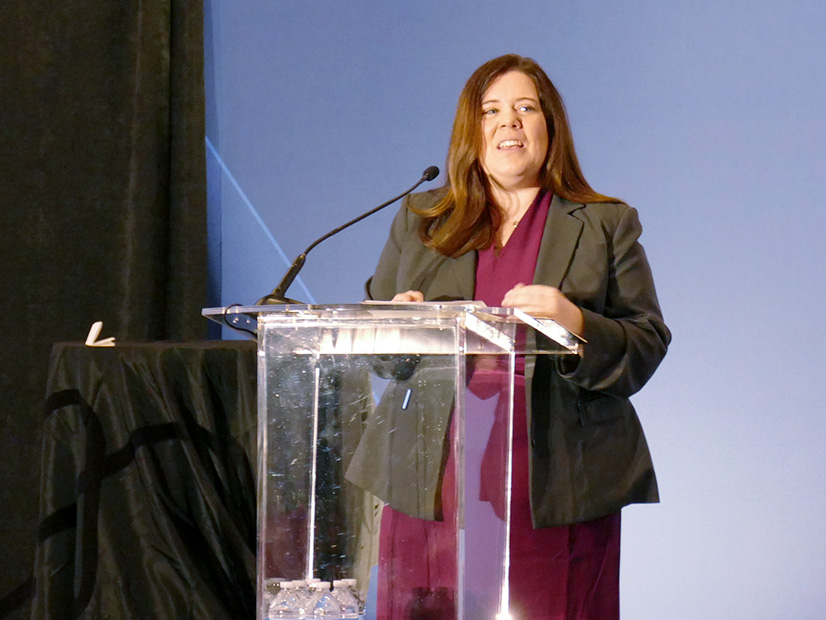
At its monthly open meeting Sept. 18, FERC approved the latest version of NERC’s cold weather preparedness standard while ordering follow-up informational filings on progress with its adoption.
In a press conference after the meeting, Chair David Rosner said that grid reliability remains “job No. 1” for the commission and that he was “really pleased” that FERC was able to advance the cold weather standard and other reliability items on the agenda. (See FERC Tackles Cybersecurity in Multiple Orders.)
NERC submitted EOP-012-3 (Extreme cold weather preparedness and operations) on April 10 in response to the commission’s directive that it develop “targeted modifications” to its predecessor, EOP-012-2 (RD25-7). FERC had called for the ERO to clarify the term “generator cold weather constraint” (situations in which a generator owner may declare that a specific freeze protection measure would result in a net loss of reliability on the grid) and ensure that the ERO confirms the validity of each constraint, along with clarifying requirements around corrective action plans.
In the new standard, NERC proposed a new, clearer definition for generator cold weather constraints that removed ambiguous references to “cost,” “reasonable cost,” “unreasonable cost” and “good business practices.” An attachment to the standard provides examples of acceptable constraint declarations, such as a case in which “the cost of retrofitting a generating unit would be unduly burdensome such that it would retire prematurely or cancel plans to finish the development of a new generating unit.”
The standard also introduces the concept of a compliance abeyance period for the requirement that GOs calculate the extreme low temperature for their generating units, a move intended to allow some flexibility in the initial application of this requirement. During the abeyance period NERC will “monitor the implementation of this requirement and identify, as appropriate, any revisions to the extreme cold weather temperature formula,” FERC said.
The commission indicated it would approve the standard without any of the modifications called for by the Union of Concerned Scientists, which claimed the cold weather constraint language remained too subjective. (See NERC Replies to UCS’ Cold Weather Standard Criticism.) FERC said the standard was “consistent with commission guidance to provide a limited set of defined circumstances” in which constraints could be granted.
However, the commission did direct the ERO to collect and submit to FERC informational filings every two years, starting no later than October 2026 and ending in October 2034. The filings must include:
the number of cold weather constraint declarations submitted to each regional entity;
the number of declarations approved, and their aggregate megavolt-amperes; and
a summary of the rationales provided for approved declarations.
NERC must also submit a narrative analysis in the filing addressing:
whether reliability coordinators, transmission operators and balancing authorities are notified in a timely fashion of constraint declarations and extensions to corrective action plans (CAPs);
the reliability impact of allowing 36 months to correct freeze-related issues, rather than a shorter time frame;
whether compliance enforcement authorities interpret and apply the constraint declarations approval process;
whether constraint declaration criteria are adequately defined and understood by registered entities; and
the reliability impact of cold weather constraint declarations and CAP extensions.
The standard will take effect Oct. 1. This is a departure from NERC’s request that the standard take effect either that date or three months after regulatory approval, whichever is later. That plan would have resulted in an effective date in December, but FERC said that the earlier date would allow the standard to be in effect before the upcoming winter.
The commission also observed that “industry was involved in NERC’s standard development process and was made aware of pending changes,” meaning the new requirements should not be a surprise for registered entities.
The Texas Reliability Entity’s Member Representatives Committee agreed to send a proposed regional reliability standard before industry stakeholders for a 45-day comment and ballot period at its open meeting Sept. 17.
The comment period for BAL-001-TRE-3 (Primary frequency response in the ERCOT region) is expected to run from Sept. 22 to Nov. 6, with the ballot period occurring in the last 15 days. (See page 19 in the committee’s agenda.) The standard drafting team will meet to discuss comments within 30 days of the end of the comment period.
If the standard fails to receive enough votes from industry, a second comment and ballot period will be held in 2026. If the standard passes, a final ballot will be conducted, after which it will be presented to the Texas RE Board of Directors for approval. From there it would go to NERC, and then to FERC.
BAL-001-TRE was created in 2013 after NERC requested, and FERC granted, a waiver of BAL-001-0 (Real power balancing control performance) for ERCOT on the grounds that one of its requirements was not “feasible under ERCOT’s competitive balancing energy market” and that the grid operator could not create inadvertent flows or time errors in other control areas.
The new version of the standard adds language clarifying that it applies to battery energy storage systems (BESS) and performance requirements for BESS, along with generating facilities, and sets maximum governor deadband settings for generating units that are not qualified to provide operating reserves and have obtained approval from the balancing authority to widen settings. It also updates the compliance monitoring period and circumstances under which the compliance history for the standard may be reset by the compliance enforcement authority.
At the board meeting following the MRC’s, Texas RE Chief Engineer Mark Henry reviewed the region’s performance during the summer. While the hot and dry summer that was predicted did not develop “to the expected degree,” demand continued to increase, with renewable and storage resources setting records; battery discharge during the summer months so far has totaled 7 GW, while solar generation totaled 29 GW.
Henry also confirmed that demand from large loads, particularly data centers and artificial intelligence operations, continues to grow, with load expected to more than double from 18 GW to 37 GW between 2025 and 2026, and again to 83 GW in 2027. He referred to NERC’s Large Loads Action Plan, which envisions the Reliability and Security Technical Committee’s Large Loads Task Force developing recommendations through mid-2026 alongside NERC-led collaborative industry sessions and collaboration with large loads efforts in ERCOT and other areas.
Finally, Henry discussed NERC’s Level 3 alert on inverter-based resources, which the ERO sent to industry on May 20. The alert laid out essential actions for IBR performance and modeling with responses from registered entities required by Aug. 18. Answers were mixed; more than half of utilities said they lack internal processes to confirm the dynamic performance of IBRs following system events, but more than 75% said they do have internal processes to update transmission entities about changes to IBRs that can alter performance.
In two Notices of Proposed Rulemaking issued at its open meeting Sept. 18, FERC proposed to approve 11 new Critical Infrastructure Protection (CIP) standards intended to allow utilities to use virtualization technology, along with a further modification to one of those standards that would improve cybersecurity at low-impact grid-connected cyber systems.
NERC submitted the virtualization updates in July 2024 (RM24-8). (See NERC Sends Virtualization Standards to FERC.) Along with four new and 18 revised definitions for the NERC Glossary of Terms, the filing touched almost every entry in the library of CIP standards:
CIP-002-7 (Cybersecurity – BES cyber system categorization);
Virtualization constitutes “the process of creating virtual, as opposed to physical, versions of computer hardware to minimize the amount of physical hardware resources required to perform various functions,” according to the National Institute of Standards and Technology. NERC said in its filing that the current versions of these standards are “designed around the concept that devices have a one-to-one relationship between software and hardware,” which prevents entities from taking advantage of security advances made possible by virtualization techniques.
In the NOPR, the commissioners wrote they “support NERC’s efforts to … accommodate virtualization and other nascent technologies” and that the new standards should “allow responsible entities to [adapt] to emerging risks with forward-looking security models.” They emphasized the revisions would allow, but not require, utilities to adopt these technologies.
However, commissioners questioned NERC’s proposal to replace the phrase “where technically feasible” with “per system capability.” While the ERO said this change would ease the “administrative burdens” of reviewing technical feasibility exceptions, FERC expressed concern it “would eliminate transparency … by introducing a self-implementing exceptions process with no reporting obligations.”
In light of these concerns, the commission asked for comments in three areas: first, whether there stillis a need to maintain a technical feasibility exception program and what administrative burdens are associated with the current program; second, if the proposed changes would result in entities seeking new exceptions using the “per system capability” language; and third, alternative approaches that would meet the streamlining goals while also allowing effective oversight.
Low-impact Cyber System Concerns
In the other NOPR, FERC sought comments on its proposal to approve CIP-003-11 (Cybersecurity — security management controls), which NERC submitted Dec. 20, 2024 (RM25-8).
The update to CIP-003-10 is intended to address the risk of a coordinated attack using low-impact cyber systems, which constitute most of the systems within the grid. They are considered to pose less of a risk to reliability than high- or medium-impact systems and thereforeare subject to fewer CIP requirements than other systems. However, after the SolarWinds Orion cyberattack of 2020, in which hackers infiltrated the update channel of a popular network management tool and sent malicious code to users around the world, NERC began an investigation into the potential threat posed by a coordinated attack against multiple low-impact systems.
In the proposed standard, NERC staff said it would require utilities to add controls to authenticate remote users, protect authentication information in transit and detect malicious communications to or between low-impact cyber systems with external routable connectivity. These changes still would allow entities “the flexibility as to where the [authentication] control is implemented based on their architecture,” the authors said.
FERC’s NOPR called for comments on developments in the cybersecurity environment since the SolarWinds attack, such as the China-linked Volt Typhoon group that has been accused of embedding itself in the information technology networks of U.S. critical organizations for at least five years. The commission asked whether such actors, who infiltrate a protected network and then move laterally into others, could pose a threat to grid reliability, and whether FERC should direct NERC to perform a study or develop a white paper on the issue.
Comments on the NOPRs are due 60 days after they’re published in the Federal Register.
Supply Chain Standards Due in 18 Months
FERC also directed NERC to develop standards addressing entities’ supply chain risk management (SCRM) plans (RM24-4).
The order also ended a related inquiry regarding reliability risks posed by grid-connected cyber equipment originating overseas, particularly equipment manufactured by Huawei and ZTE (RM20-19).
The final rule “largely adopts” a NOPR issued in 2024 in which FERC identified “multiple gaps” in NERC’s existing SCRM standards. Those standards did not specify when or how entities should identify and assess supply chain risks or require entities to respond to supply chain risks through their SCRM plans, the commission said.
The new standards will have to address “the sufficiency of responsible entities’ SCRM plans related to the identification of and response to supply chain risks,” as well as whether the SCRM standards will apply to protected cyber assets (PCAs). PCAs are defined as “one or more cyber assets connected using a routable protocol within or on an electronic security perimeter [ESP] that is not part of the highest-impact [grid] cyber system within the same” ESP.
One element not included from the NOPR was a directive to require utilities to validate data received from vendors. Instead, FERC encouraged entities to do so voluntarily “as appropriate.”
The final rule directed NERC to submit the required standards within 18 months of the date of issuance.
DETROIT — MISO is poised to retain two of its term-limited board members in 2026 while adding an executive from a federal power marketing agency.
MISO announced its slate of candidates for three available board seats: board incumbents Todd Raba and Barbara Krumsiek; and Joel Cook, Bonneville Power Administration’s former chief operating officer and senior vice president of transmission services.
Cook left Bonneville in February when he took up the federal Office of Personnel Management’s buyout offer.
Longtime board members Raba, Krumsiek and H.B. “Trip” Doggett are wrapping their third and final three-year terms at the end of 2025. Though they’re term-limited, all expressed interest in serving a maximum fourth term that is allowable through a special waiver of MISO’s rules. (See MISO Could Replace Up to 3 Board Members by Year End.)
Director Jeff Lemmer said MISO decided to use a waiver of normal board rules only after it weighed the need for fresh faces on the board while recognizing “the value of continuity,” as MISO has “several major initiatives in flight.”
Board Chair Raba thanked Doggett, the board’s only departing member, for his nine-year service to the MISO board.
Illinois Commerce Commissioner Michael Carrigan, who served as one of the two stakeholders on MISO’s Nominating Committee this year, said the committee had to consider that effectively, one-third of the independent board could have turned over. MISO’s board is composed of nine independent directors, along with MISO CEO John Bear.
The Nominating Committee ultimately interviewed seven external candidates in addition to the existing three board members and made recommendations to MISO.
The Nominating Committee is charged with vetting and advancing potential board members, who are put to a vote of membership. The committee’s members change annually, and they are composed of three MISO board members and two MISO stakeholders, one of whom typically is from a state public service commission. This year, directors Lemmer, Bob Lurie and Nancy Lange sat on the Nominating Committee alongside Carrigan and ITC’s Brian Drumm.
MISO membership will vote in late September through the end of October on the candidates. In MISO, members vote electronically on whether they support a potential board member. MISO’s board elections require candidates to earn a majority of votes in support among membership. MISO members can vote for, against or abstain from selecting any of the candidates. Candidates typically earn enough favorable votes to be installed.
To establish a quorum, 25% of MISO membership (39 members this year) must vote.
MISO will announce election results sometime in November.
A controversial natural gas pipeline proposal got a boost as the New York Public Service Commission approved the long-term plan for the state’s largest gas delivery system.
In reviewing the proposal by National Grid’s three New York gas utilities, the PSC found a reliability need for the Northeast Supply Enhancement (NESE) project proposed by The Williams Cos. and authorized National Grid to include NESE in its planning.
On its face, the move runs contrary to the state’s statutory requirements to reduce greenhouse gas emissions — a significant component of which comes from combustion of natural gas in buildings and power plants.
More than 3,800 comments were submitted to the PSC in Case 24-G-0248, almost all of them in opposition to the National Grid plan, many of those for environmental reasons.
But New York’s decarbonization efforts are running far behind the schedule envisioned in its landmark Climate Leadership and Community Protection Act. With the Trump administration actively opposing renewable energy development, the state may need to rely on natural gas more heavily and much longer than its leaders and policymakers had hoped.
One of the guideposts for the PSC has been the potentially disastrous nature of a natural gas outage. Restoring service requires utility technicians to visit every customer twice — with police and locksmiths in tow for locations where the customer is not present. National Grid has 2.5 million gas customers in the state, and a widespread outage could take weeks or months to resolve.
“Widespread gas outages are a real possibility today given the narrow margin between available gas supply and demand,” PSC Chair Rory Christian said in a news release. “The gas planning activities we require National Grid to undertake today will ensure that National Grid continues to provide safe, adequate and reliable service while striving to meet the state’s greenhouse gas emissions reduction targets.”
Surrounded by Controversy
Transco, a Williams company, made its initial NESE pre-filing to FERC in 2016, then in 2017 formally sought to extend its existing gas network to increase supply to the New York City/Long Island region (CP17-101-007).
FERC authorized NESE in 2019. But state regulators denied key permits and Williams eventually shelved the concept.
On April 16, 2025, the Department of the Interior slapped a stop-work order on Empire Wind, an important part of New York’s decarbonization strategy. The move now is seen widely as an attempt to coerce New York into approving NESE as well as the Constitution Pipeline, another pipeline extension proposal the state had stopped.
When Interior lifted the stop-work order May 19, Interior Secretary Doug Burgum implied a quid-pro-quo for NESE and Constitution. Publicly, Gov. Kathy Hochul (D) said only that the state would give full consideration to energy proposals that complied with state law.
Ten days later, Transco petitioned FERC to reissue its 2019 authorization of construction and operation of NESE. FERC granted the request Aug. 28.
The PSC’s 6-1 approval Sept. 18 of National Grid’s long-term gas system plan sets a path for offtake from NESE, if it is built. Other New York and New Jersey regulatory agencies are continuing their review of the proposal.
The Next Steps
Requirements in the PSC’s lengthy order include reporting on necessary improvements to demand forecasting, non-pipe alternatives, cost mitigation and electrification.
The three utilities — The Brooklyn Union Gas Co., KeySpan Gas East Corp. and Niagara Mohawk Power Corp. — also must report on how they will optimize supply if NESE is built and how they will address reliability if it is not.
The PSC’s order reflects the quandary that faces New York and Hochul. The state already has some of the most expensive electricity in the nation and must simultaneously harden, expand and decarbonize its aging energy systems. None of these were ever going to be easy or cheap, and by varying degrees they are getting harder and more expensive.
National Grid said it expects NESE to increase natural gas costs and decrease electricity costs for ratepayers, due to construction costs and lower wholesale electricity prices.
Democrats control all levels of state government, but not all Democrats are in lockstep on the energy transition and its costs. Hochul has been pushing back some of the decarbonization initiatives in an effort to keep electricity affordable, drawing criticism from some other Democrats and traditional allies.
The PSC’s decision to let National Grid factor NESE into its planning was a hard truth for climate and clean power advocates who once hoped the concept was dead.
Public Power NY referred to NESE as the “Hochul-Trump pipeline” and said: “The biggest step backward for New York’s climate in at least a decade is just the latest in Hochul’s multiyear assault on our air and lungs.”
Food & Water Watch New York said: “This foolish plan would put everyday New Yorkers on the hook to pay for a filthy, climate-killing fracked gas pipeline that isn’t wanted or needed.”
Leading up to the PSC vote, more than 3,700 opposing comments were submitted by individual New Yorkers and entities ranging from the Sierra Club to the City of New York to the Institute for Energy Economics and Financial Analysis to the Jewish Climate Action Network.
But there also have been voices of support for NESE.
The Plumbing Foundation City of New York called it a critical investment in the state’s energy infrastructure.
IBEW Local Union 1049 pointed to the jobs that would be created by the project.
The Independent Power Producers of New York said NESE is “critically needed to maintain the reliability of the natural gas system in New York to serve Grid’s downstate customers and to augment gas supply to enhance the reliability of the electric markets in the downstate region.”
IPPNY also reminded the PSC of something it is very aware of: Recent federal policy changes complicate the state’s efforts to replace natural gas with renewables.
Eight New England transmission companies must provide the Maine Office of Public Advocate with more information on asset condition projects placed in service in 2022, FERC has ruled.
The ruling partly granted a formal challenge by the OPA alleging the eight transmission companies, including subsidiaries of Eversource Energy, National Grid, Avangrid and PPL, along with Vermont Transco, “refused to answer questions regarding investment policies and practices related to prudence of these investments” (ER20-2054).
Commissioner Judy Chang wrote in a concurrence that the Sept. 18 order “should serve as a call to action for transmission owners across the country to provide greater transparency regarding their transmission investments.”
Asset condition spending has been a major focus for New England consumer advocates in recent years as costs associated with upgrades to existing transmission infrastructure have skyrocketed.
Although there is broad consensus that significant investments are needed to maintain and upgrade the region’s aging grid, state representatives and consumer advocates have expressed concern about a lack of transparency and oversight over these investments. ISO-NE recently agreed to take on a non-regulatory role in reviewing asset condition project proposals. (See ISO-NE Open to Asset Condition Review Role amid Rising Costs.)
The OPA’s formal challenge stems from a series of questions the office submitted to the companies in September 2023 seeking information on how the companies evaluated asset condition needs, considered solutions and alternatives, and determined when to proceed with projects.
The OPA wrote in its challenge that the transmission companies violated the formula rate protocols by failing to adequately respond to the information request.
Consumer advocates from Massachusetts, Connecticut, New Hampshire and Rhode Island supported the OPA’s challenge and emphasized the importance of information requests for providing consumers with the information needed to evaluate — and potentially challenge — the prudence of transmission investments.
The consumer advocates encouraged FERC to “interpret the [formula rate protocols] liberally and to issue a decision in this matter that fosters open and transparent exchange of information that will allow interested parties to evaluate and determine whether formula rate costs are reasonable and were prudently incurred.”
In a joint response to the OPA’s challenge, the transmission companies argued that the OPA filing does not meet the requirements for a formal challenge, that the OPA’s challenge is based on many “inaccurate or false” claims and that the companies “did provide responses and supporting documentation in response to Maine OPA’s information and document requests, in addition to objecting to certain questions.”
The companies asked FERC to reject the challenge, writing that “failure to do so would invite needless litigation and divert resources away from the ongoing New England stakeholder process on transparency enhancements to the transmission regional planning process for asset condition projects.”
In its ruling, FERC directed the companies to provide more information in response to several of the OPA’s requests, while finding some of the requests to be outside the scope of the companies’ requirements under the protocols.
“We find that most of Maine OPA’s questions clearly set forth the request for information in a manner such that identified NETOs [New England transmission owners] could make a good faith effort to answer those questions as required by the protocols,” FERC wrote.
The commission found the OPA’s requests for the identities of individuals involved in asset condition decisions and those seeking an undefined number of documents to be outside the scope of the companies’ requirements.
FERC also found that, to varying degrees, the companies adequately responded to some of the questions, including the request that the companies describe their procedures for evaluating project alternatives.
However, FERC ruled that the companies did not adequately explain how they ensure projects are not placed in service before they are needed.
The commission also found that subsidiaries or Eversource, National Grid and Avangrid failed to make a “good faith effort” to document their procedures for evaluating asset condition needs or disclose whether any employee or consultant “recommended against proceeding with a particular asset condition project.”
“This refusal to provide information that is reasonably necessary to determine the prudence of actual costs and expenditures included in the 2023 Annual Update could preclude Maine OPA from ever raising a prudence challenge by denying it the information required to raise serious doubt,” FERC wrote.
It directed the transmission companies to provide more information correcting the deficient answers within 30 days.
In her concurrence, Commissioner Chang emphasized the importance of transparency regarding transmission investments, along with stakeholders’ “fundamental right to transmission planning and investment information through existing formula rate protocols.”
“At a time of sharply rising customer bills and increasing concern about the prudence of transmission planning decisions, transmission owners have an obligation to address those concerns and help customers, state regulators and stakeholders better understand how their money is being spent,” Chang said.
She advocated for more standardization disclosures around transmission investments throughout the country and encouraged stakeholders to collaborate to develop these structures.
“If further action by the commission is needed to ensure customers have access to information needed to assess the prudence of transmission owners’ investments, I encourage parties to bring the issue to the commission, as Maine OPA has done in this case,” Chang wrote.
California Gov. Gavin Newsom has signed into law the bill that will allow CAISO to transition the governance of its markets to an independent “regional organization,” along with five other bills related to energy and emissions.
AB 825 implements the West-Wide Governance Pathways Initiative’s “Step 2” plan to create a regional organization to oversee CAISO’s Western Energy Imbalance Market and soon-to-be-launched Extended Day-Ahead Market — and authorize the ISO and California’s investor-owned utilities to participate in the RO. (See Pathways Bill Passes Calif. Legislature in Lopsided Votes.)
Speaking during a Sept. 19 signing ceremony at the California Academy of Sciences in San Francisco, Newsom said the law will generate almost $1 billion in financial benefits, expand clean energy exports and address reliability.
Referring to previous failed efforts to pass legislation to regionalize CAISO into a Western RTO, the governor said, “We’ve worked on that for over a decade.”
“We’re getting it done here today,” Newsom said. “So, finding a balanced approach, setting forth strategies to achieve audacious goals that simply no other large-scale jurisdiction in the world can lay claim to, and do it in a way that reduces the burden on ratepayers and taxpayers at the same time.”
Supporters of the bill were quick to thank Newsom and the California Legislature after the governor approved the measure.
“Gov. Newsom’s signing of Assembly Bill 825 is a landmark achievement for the future of energy collaboration and innovation across the western United States,” CAISO said in a statement. “He, along with the California Legislature and the broad coalition of supporters, have recognized the importance of making this crucial next step toward independent governance of Western electricity markets. Now that AB 825 is signed into law, the ISO will work closely with partners across California and the rest of the region to ensure a more reliable and affordable bulk electric system for the benefit of consumers throughout the West.”
Advanced Energy United highlighted the many stakeholders involved in drafting the legislation.
“This legislation is the culmination of nearly a decade of work to create a more flexible, reliable and affordable energy future for the West,” said Leah Rubin Shen, managing director at Advanced Energy United. “AB 825 paves the way for an independently governed energy market that will deliver a more reliable grid, broader deployment of clean energy resources and more affordable energy for consumers across the region.”
Speaking during the signing ceremony, Katelyn Roedner Sutter, California state director at the Environmental Defense Fund, said, “By expanding today’s energy markets, we expand access to clean electricity and lay a strong foundation for the growth of clean energy and jobs.”
A broad coalition was responsible for getting AB 825 passed, Sen. Josh Becker, the bill’s chief sponsor, told RTO Insider at New York Climate Week.
“This was an unparalleled coalition that we built this year: Environmental Defense Fund, NRDC, Environmental Voter [Project],” Becker said. “This year the Sierra Club supported it — they always opposed it in the past; labor, who always opposed in the past, came on board because of some of the protections built in, and companies and the Chamber of Commerce. People who usually don’t agree on anything, agreed on this. There was still a lot of opposition, but that coalition helped us get it done.”
Becker said there are three positive outcomes of the bill: lower costs, improved reliability, and an expanded grid.
“The Brattle Group and California Energy Commission has projected it’ll be between $800 million and a billion dollars of savings a year to California directly.” Becker said being able to cite the economic benefits of the Western Energy Imbalance Market for 10 years supported the case for the bill: “That’s delivered over $7 billion of economic benefits, $2.2 billion directly to California.”
Second, he said the changes brought about by the bill should improve everyday reliability and decrease reliance on the most polluting peaker plants. The result: a 53% reduction in greenhouse gas emissions in California. “Right now, we spend billions of dollars keeping natural gas peaker plants available to run a few hours a year; literally, a few hours a year. We’re going to be able to use some of these highly polluting assets a little less frequently in California.”
Finally, the expanded grid provides reliability through major weather events: “Especially in the era of climate change, you need a grid bigger than any one weather event. As [California Energy] Commissioner Siva Gunda always says, if we have a massive heat wave, as we did on Sept. 6, 2022, being able to trade with our neighbors can increase reliability.”
In addition to AB 825, Newsom signed into law a measure aimed at extending California’s cap-and-trade program through 2045. The revenues of the program will go toward funding, among other things, California’s high-speed rail project.
Other measures signed include efforts to stabilize gas prices, funding for air quality monitoring programs and the continuation of studies related to California’s greenhouse gas targets.
The governor also approved SB 254, a law that will create a “transmission accelerator” to develop low-cost public financing programs for certain transmission projects. The legislation also establishes an $18 billion “continuation account” for the state’s wildfire fund to cover investor-owned utilities’ wildfire liabilities. Contributions to the fund will be split between ratepayers and shareholders. (See Calif. Lawmakers Pass Bill to Accelerate Transmission Development.)
CAISO is finalizing a set of changes to its resource adequacy program, with plans to vote on three proposals at an upcoming Board of Governors meeting, possibly as early as October.
The proposed RA program revisions are part of CAISO’s RA Modeling and Program Design initiative that began in August 2023.
The first proposal, “Track 1: Modeling and Default Rules,” which was published Aug. 25 and presented to stakeholders at a Sept. 17 workshop, updates certain requirements within CAISO’s qualifying capacity (QC) methodology and planning reserve margin (PRM) process.
The proposal provides a default set of RA rules for local regulatory authorities (LRAs) — that is, publicly owned utilities — that have not established their own methodologies and processes. These RA rules also can be adopted voluntarily by any LRA within the CAISO balancing authority area, the proposal says.
CAISO is specifically looking to replace a “longstanding” default PRM requirement of 15% with a new margin that would be determined periodically based on loss of load expectation (LOLE) studies. The new PRM process would ensure a market participant’s energy resource portfolio meets the industry-standard reliability benchmark of 0.1 LOLE when an LRA does not provide a QC methodology, the proposal says.
Stakeholders involved in the initiative questioned whether existing RA programs or CAISO’s default RA rules for LRAs meet a 0.1 LOLE requirement.
Some LRAs said they rely on CAISO’s default RA rules when developing their own requirements, but these rules have not been revisited or “significantly updated since they were established approximately 20 years ago,” CAISO said in the proposal.
In Sept. 12 comments to CAISO, representatives from the Alliance for Retail Energy Markets (AReM) said the group remains concerned about the differences between the CPUC and CAISO’s modeling and market design requirements.
“While AReM recognizes that other LRAs are seeking single monthly default QC values in contrast to the California Public Utility Commission’s slice-of-day paradigm, which adopts 24 hourly values for each resource each month, it is important all LRAs avoid using divergent methodologies,” AReM said. “Unless CAISO can show its proposed methodology results in consistent outcomes with slice-of-day, it should not adopt its Track 1 proposal.”
AReM also asked CAISO to provide greater clarity on how battery durations will be counted in CAISO’s default QC counting rules.
“CAISO’s proposal would, seemingly, lump all battery capacity together, including eight-hour batteries and four-hour batteries even though the CPUC has ordered LSEs under its jurisdiction to procure eight-hour duration storage resources and the CPUC’s slice-of-day methodology assigns greater value to longer-duration battery resources,” AReM said.
Track 2 Proposal
In the second proposal, published Aug. 26, CAISO pitched the formation of a new energy resource substitution “pool.” The pool would allow a scheduling coordinator (SC) to signal when they need to procure substitute capacity because their energy resources are offline due to a planned outage. The substitution pool would also allow an SC to indicate when it is able to offer substitute capacity for other SCs.
Under current rules, CAISO requires an SC with a resource undergoing a planned outage to provide substitute capacity for that resource. However, securing substitute capacity can be difficult due to “mismatches between contract terms and outage durations, as well as inefficiencies in the bilateral procurement process,” CAISO staff said in the proposal.
Additionally, multiple SCs “hold back RA capacity for outage substitution for a partial-month outage. This practice drives artificial tightness in the RA bilateral market,” staff said.
The cost to procure replacement capacity can be greater than the cost to pay a non-availability penalty under CAISO’s Resource Adequacy Availability Incentive Mechanism, staff added. This has led to forced outage rates going higher than those predicted by CAISO and the California Energy Commission.
The pooling approach would improve price certainty because buyers would be able to choose offers aligned with their willingness to pay.
It also would increase visibility into available supply, “giving buyers greater control over their choices and providing direct contact information for sellers.” Benefits of the proposal include “enhance[d] flexibility, transparency and efficiency in managing planned outages,” the proposal says.
On the other hand, SCs that have scheduled, immovable planned outages might want to continue arranging for substitute capacity outside of the proposed substitute pool process, the proposal says. Sellers also might face uncertainty depending on competing bids and might change their offer structure after seeing other postings in a pool, staff said.
Stakeholders such as the California Community Choice Association and the California Department of Water Resources supported the proposed pooling method.
The Track 2 proposal should be presented only to the CAISO Board of Governors for a decision because the initiative “falls outside the scope of authority of the Western Energy Markets Governing Body,” ISO staff said in the proposal.
Track 3A Proposal
The initiative’s “Track 3A: Resource Visibility” proposal is meant to improve CAISO’s visibility into what resources are available for procurement through the ISO’s backstop measures.
Better visibility into the status of RA-eligible capacity not shown as RA will “help the ISO conduct existing backstop processes more effectively and understand how any emerging trends should be incorporated into backstop program design,” staff said in the proposal.
Backstop procurement helps CAISO find additional energy for the grid when there is a shortage of RA or if conditions require the grid to procure more energy than that supplied by the RA program, staff said.
Part of the problem has been that the number of bids into CAISO’s Capacity Procurement Mechanism (CPM) has dropped significantly over the past five years. CPM is within CAISO’s Competitive Solicitation Process (CSP), which is the primary process for identifying capacity available for CPM designation.
“Conducting efficient and effective backstop procurement requires understanding what capacity is still available after accounting for all RA-shown resources,” CAISO staff said in the proposal. “The CSP is designed to provide this understanding.”
In addition to reliability improvements, the increased visibility under Track 3A can “improve policy and modeling for the CAISO system,” representatives with the CAISO Department of Market Monitoring (DMM) said in Sept. 16 comments on the initiative.
“Additional visibility into RA resources internal to the CAISO balancing authority area would improve a system-wide understanding of recent trends in the CPM and CSP, and potential improvements to the CPM,” DMM said.
The Track 3A proposal specifically includes new annual and monthly reporting requirements for all RA-eligible capacity in CAISO that is not shown as RA, the proposal says. Implementing these reporting requirements could make it easier to see what resources are open for procurement within CAISO’s backstop procurement program.
The proposal designates five categories of supply: supply that is sold outside the CAISO BAA; supply not shown due to being reserved for substitution; supply not shown due to potential unavailability; supply contracted to a CAISO LSE but not shown; and supply not contracted.
The new reporting requirements would apply to SCs that have RA capacity and are located inside the CAISO BAA that appears on the ISO’s Net Qualifying Capacity list, the proposal says. Reporting will be part of CAISO’s existing annual and monthly supply plan timeline requirements.
FERC held its monthly open meeting Sept. 18 amid something of an interregnum period as it awaits two nominees to fill empty seats, with Chair David Rosner saying one of his goals during his tenure is to clear out old proceedings.
“We’ve been focused on methodically clearing out longstanding proceedings that, in some cases, have been pending before the commission for years,” Rosner said. “Several of these are on the agenda today.”
One such longstanding item FERC recently terminated was a Notice of Inquiry that Chair Kevin McIntyre launched in 2018 looking into how the commission could update how it approves natural gas infrastructure, Commissioner Lindsay See noted during the open meeting (PL18-1). McIntyre died in office before the proceeding wrapped up, but it was picked up by Chair Richard Glick, who wanted FERC to address greenhouse emissions from gas infrastructure, a policy that sunk his renomination. (See Glick’s FERC Tenure in Peril as Manchin Balks at Renomination Hearing.)
“The draft statement was getting in the way of this goal of regulatory certainty by introducing potential confusion and giving avenues for legal vulnerability,” See said.
FERC issued an order terminating the proceeding on Sept. 12, two weeks after Energy Secretary Chris Wright wrote to the commission asking it to axe the fallow docket.
The commission also moved on more current issues, with Rosner releasing a letter he sent to all six jurisdictional ISOs and RTOs asking them for information on best practices around load forecasting in light of growing demand driven by data centers and other sources.
“At a time when utilities forecast hundreds or thousands of megawatts of growth, improving forecasts by even a few percentage points in the right direction — up or down — can impact billions of dollars in investments and customer bills,” Rosner said in the letter. “Put simply, we cannot efficiently plan the electric generation and transmission needed to serve new customers if we don’t forecast how much energy they will need as accurately as possible.”
Rosner posed several questions in the letter, including asking grid operators how they, regional utilities and state regulators in their territories obtain information that verifies when and whether prospective large loads will reach commercial operations. He also asked how consistently large loads are screened before being included in forecasts.
Another question is how grid operators forecast the actual consumption of large loads compared to their requested level of interconnection service. FERC also asked how the RTOs coordinate with each other and utilities at the regional or interregional levels to share best practices on large load forecasting and ensure requests are not double counted.
Ultimately, the customers creating the load growth are at the retail level, which means they are regulated by states that play key roles in feeding information up to the ISO/RTO forecasts. Rosner said he was interested only in what the organized markets under FERC’s jurisdiction can do.
“I’m very interested in doing things that are purely within their ability to control,” Rosner said. “We’re not asking any state to do anything different. We’re asking the RTOs to say, ‘Hey, what are your best practices,’ just to make sure we’re accurate, because being either high or low means that we’re not planning for an efficient set of infrastructure to meet the challenge.”
While Rosner said he views reliability as FERC’s most important job, he also is focused on enabling economic growth by ensuring abundant supplies of energy.
“I’m really excited about infrastructure,” Rosner said. “I think we need to build, build, build. America needs every electron on every molecule of every type we can get, and we need more infrastructure to move it.”
Reliable and affordable energy is not just a prerequisite for residents and businesses; it is vital to winning the race for artificial intelligence, he said.
When it comes to AI and the related growth in demand from data centers, FERC has had a pending case on issues around co-locating loads at existing power plants since November 2024, when See and former Commissioner (and later Chair) Mark Christie voted against allowing Amazon Web Services to use more of a Talen Energy nuclear plant’s capacity in such a deal. (See FERC Rejects Expansion of Co-located Data Center at Susquehanna Nuclear Plant.)
“We also have our open matter when it comes to co-located load,” See said. “I just want to highlight that FERC is not the only player when it comes to the many questions in these areas.”
See said she is excited to see what policies around large loads come out of states and the grid operators but that it is important that FERC deal with those issues before it, and the co-location proceeding can be brought to a close soon.
“This is a top priority,” Rosner said. “It’s also a very complicated topic. My colleagues and I have been working hard on this. I’m really excited about co-location and everything in between, and getting the rules of the road in place so that we can unlock all these new technologies, get them on the grid and get data centers built.”
The co-location proceeding is pending and contested, meaning commissioners are limited in what they can say publicly under ex parte rules, but Rosner said that FERC was working to adjudicate the record and move something forward.
Load growth is very much top of mind for the industry, and Commissioner Judy Chang noted that the new proposals to help manage it are going to be filed with FERC in the near future.
“I anticipate we will receive more filings in these coming months from utilities and RTOs proposing reforms or changes in how they integrate new resources, integrate those resources with load, or how they integrate those resources with their existing or new transmission planning processes, and really how to handle these large loads on the system,” Chang said. “I’m committed to learning more about these large loads so that I can do my job effectively.”
As solar development companies race to meet the deadlines by which they can secure federal investment tax credits (ITCs) before the program expires, developers see a better-than-expected short-term outlook but a grim long term.
Developers say guidelines issued by the Trump administration in August open the window to potentially completing more projects than they expected. In particular, the designation of a four-year period for certain residential and commercial projects to be completed if construction starts before July 2026 will enable more projects to obtain the tax credits, developers say. The credits, for 30% of the cost, are considered a major element toward making a solar project economically viable.
The One Big Beautiful Bill Act, enacted July 4, eliminated the ITC for residential projects that are not in service by Dec. 31. However, guidelines released in mid-August surprised developers by adding some lenience: Commercial projects and some leased residential projects must either be completed by the end of 2027, or, if they begin construction before July 5, 2026, they have four years to be completed.
Fred DeSanti, executive director of the New Jersey Solar Energy Coalition, said the organization was “reasonably pleased” with the guidelines, saying they give developers “some time to continue to get some work done.”
“So we’re under kind of a burning platform to get as many projects going as soon as possible,” he said, adding that utilities will be under “enormous pressure” to meet the demand in connections.
Annika Colston — president of New York City-based AC Power, which has three New Jersey projects in development and is looking for more to complete before the deadline — said recent weeks have “been a bit of a roller coaster.”
The House of Representatives’ version of the bill, which included a tax on the production of solar and wind power that was not passed by the Senate, was “shocking,” she said, but the release of the guidelines meant the “ultimate outcome felt manageable.”
Uncertain Future
But the removal of the tax credit has thrown a cloud of uncertainty over the long-term strength of New Jersey’s now two-decade-old solar sector, raising questions about whether it can even meet the state’s past capacity goals, let alone the far more expansive current predictions of future needs.
The ITC’s demise comes just as state officials are looking to make solar a key element in the effort to boost in-state electricity generation to meet the dramatic surge in demand expected over the next decade, mainly from the development of data centers.
Officials frequently say that solar projects are the quickest new resources able to interconnect and would provide cheap energy for the energy-importing state, especially now that the state’s offshore wind sector is largely dormant. But developers say the economic viability of many projects will be questionable without the ITC. Some developers see potential support from the rising cost of electricity in the region, the state’s vibrant community solar sector, its new storage incentive program and perhaps another, smaller ITC to help buttress the sector. But they don’t see those making up for the loss of the full credit.
DeSanti said its demise will put “a lot of cost pressure” on companies and hurt the large-scale solar sector the most.
“You’re talking about huge investments — tens of millions of dollars,” he said. “Nobody’s going to put that kind of money on the table without some assurances that they’re going to get the 30% ITC.”
Smaller projects “are going to be limping along,” he said. “They’re going to be a lot tighter, and the market’s going to be shrinking from what it is. … I think we’re going to see a lot of the smaller guys go under from the pressure. The bigger companies, the established companies, I think they’ll be OK.”
Ray Cantor, a lobbyist on environmental issues for the New Jersey Business and Industry Association, said that with solar contributing only about 6% of the state’s electricity use, the sector has plenty of room to grow.
But “while it is part of energy future, it’s not the answer to our long-term capacity needs,” he said. “Solar is part of the solution. It is not the way to get out of our deficit of capacity.”
Colston said she still is optimistic that New Jersey’s established solar sector will help it fare better than states with a shorter history to fall back on, and hopes the four-year completion deadline will give federal legislators time to plan for a new tax credit. She noted that the ITC, which has existed in different forms for more than two decades, had been 20% at one point.
“Projects are viable at a lower ITC, assuming we don’t have outrageous tariffs,” said Colston, whose company develops solar on landfills. “There needs to be some relief somewhere.”
Community Solar Boost
The turbulence comes as New Jersey is far from achieving Gov. Phil Murphy’s goal of having 12.2 GW of solar by 2030 and 32 GW by 2050.
As of July, the state had an installed capacity of 5.2 GW, according to the latest figures from the New Jersey Board of Public Utilities. About 80% is behind the meter, 3.5% is community solar and 16% is utility-scale, but those proportions are changing. Community solar accounts for about 53% of the development pipeline, and 30% is grid supply.
State officials see community solar as a key element of the state’s future generation, and Murphy provided a boost on Aug. 22 by signing a law authorizing the BPU to allocate 3,000 MW of capacity by 2029, or whenever the limit is reached. The state currently allocates 150 MW a year, although a one-time measure increased it to 250 MW in 2025.
Strong demand for community solar allocation in two pilot solicitations and three in the permanent program have produced 119 completed projects and another 435 in the pipeline, BPU figures show. The agency in April said the state’s four utilities reported they had received 1,120 community solar interconnection applications totaling about 1,800 MW of power.
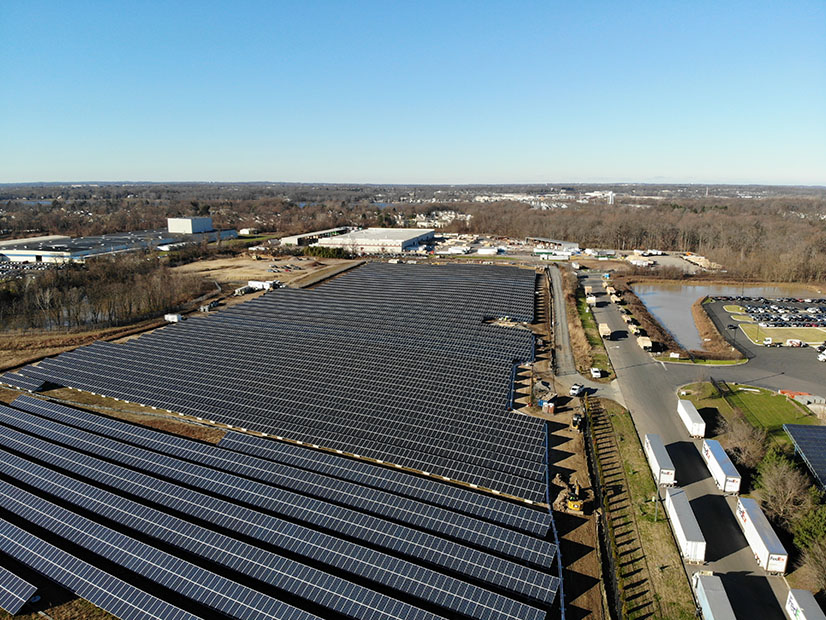
A solar project developed by AC Power on a landfill in Delanco, N.J. | AC Power
Some developers also hope a new law facilitating the development of storage will help meet the electricity demand surge while supporting the solar sector. The law, also signed by Murphy in August, aims to stimulate the development of “transmission-scale energy storage systems,” defined as those with a capacity of at least 5 MW that are connected to PJM. (See N.J. Boosts Storage, Community Solar Program Capacity.)
Some storage projects also retain the federal tax credit. DeSanti said the storage incentives could help make solar more attractive and cushion the blow from the ITC’s disappearance.
“It gives you another source of revenue,” he said. “Because if your battery is charged under the program, if the utility needs power, you can actually sell the power out of the battery.”
The state’s rising electricity rates also could support solar. The average electricity bill rose by 20% on June 1, driven in large part by record-high PJM capacity auction prices in July 2024, which the RTO says were pushed up by forecasts showing that future demand will far exceed the expected supply. Analysts expect auction prices, along with rates, to continue to rise.
“There’s no end in sight for the price of energy going up,” DeSanti said. “As that occurs, it’s going to push more and more people to say, ‘I’ve got to get out from under these utility bills.’ Once you get a deal on solar, you’re basically insulating yourself from those increases completely.”
Accelerating Solar Submissions
For developers, those benefits are distant and uncertain, and their task at hand is to get as many projects planned, and applications submitted, before the credits expire.
Sawyer Morgan, a project manager in the BPU’s clean energy division, said the agency has seen an “acceleration in the number of applications.”
“We currently have 1.4 GW of projects in the pipeline and expect many more projects to join, even in the next year or so, that will be able to qualify for the federal tax credits,” he said.
“Given that most projects in New Jersey are relatively small, we’re hopeful that a lot of projects will be able to meet these milestones and still qualify for the ITC,” he added. “As more homeowners are aware that the residential tax credit ends at the end of the current year, there’s going to be a ton of interest for the residential direct-owned projects to complete construction as soon as possible.”
Still, agency staff are “very concerned that after the expiration of the ITC, there will be a slowdown in the solar industry,” driven in part by developers who “pull forward” projects to get them inside the deadline, he said.
“There’s certainly likely to be a slowdown in installations,” which the BPU is looking to counter, he said. “We anticipate looking at reviewing programs to see what the appropriate mechanisms will be that help drive down costs through streamlining interconnection and other requirements, other costs that are involved in this other installation process or looking at the incentives that the board provides.”
Brian O. Lipman, executive director for the New Jersey Division of Rate Counsel, said that while solar has a “significant role” in the state’s future energy portfolio, it should “no longer plan an active role in incentivizing solar.”
“The solar market has matured greatly,” he said. “New Jersey ratepayers already pay more than those in any other state for solar subsidies. We no longer need, nor can our electric ratepayers afford to pay, such high subsidies that directly impact residential and business electric bills. Even with the loss of federal subsidies, solar in New Jersey should be able to stand on its own.”