FERC Opens Door for PJM to Refile RTEP Protocol Proposal

FERC has opened the door for PJM to resubmit a previously rejected proposal to shift its Regional Transmission Expansion Plan (RTEP) protocol from its Operating Agreement to its tariff, while dismissing a rehearing request for a connected proposal by the RTO’s transmission owners (ER24-2336).  

PJM’s RTEP protocol proposal had been linked with another proposal by several transmission owners to revise the RTO’s Consolidated Transmission Owners Agreement (CTOA), including adding “overlap provisions” that would have required PJM to consult with TOs before proceeding with a regional project that would address the same need as a local, supplemental project proposed by a TO.  

The TO proposal also would have established a conflict mediation process for instances when a TO contended that an action by the PJM Members Committee conflicts with the CTOA.  

PJM and the transmission owners had asked the commission to consider both filings as one proposal, arguing that one could not be approved without the other. 

But in a December 2024 order rejecting the proposals, the commission found the CTOA changes would impinge on PJM’s independence by providing TOs with an exclusive opportunity to affect filings PJM is able to submit under Section 205 of the Federal Power Act. (See FERC Rejects PJM and Transmission Owners’ CTOA Proposals.) 

At the same time, FERC also rejected PJM’s proposal to shift the RTEP protocol to the tariff because of its tie with the CTOA revisions, while also finding that PJM had not made the case that keeping the planning protocols in the OA renders the RTO’s governing documents unjust and unreasonable. 

The July 14 rehearing order again rejected the CTOA revisions, saying they would grant TOs too much influence over PJM’s decision making on planning, extend Mobile-Sierra protections to the revised language and place “substantive transmission planning rules in the CTOA.” 

“The CTOA amendments go beyond changes to enable this transfer and also would restrict PJM’s ability to make independent FPA Section 205 filings that PJM TOs believe contravene the CTOA, add substantive transmission planning rules to the CTOA, and grant the Mobile-Sierra public interest standard presumption to several CTOA provisions,” the commission wrote. “Thus, the broad cumulative effect of the integrated package of filings would be to shift the ability to influence PJM’s FPA Section 205 filings from a diffuse right shared by the Members Committee representing diverse interests to a concentrated right possessed by a single class of stakeholders, the PJM TOs. Moreover, PJM TOs’ new rights would be housed in the CTOA and granted Mobile-Sierra protections, which would raise the bar for any future changes.” 

However, the commission withdrew its determination that PJM’s proposal had not met the FPA Section 206 burden of showing that the OA is unjust and unreasonable with the inclusion of the RTEP protocol, instead dismissing the proposal as moot given the rejection of the intertwined CTOA revisions. 

“We emphasize that our dismissal of the PJM complaint here does not preclude a future filing proposing to move the RTEP protocol from the OA to the tariff. The PJM board has the authority to petition the commission under FPA Section 206 to modify any provision or schedule of the OA that the PJM board believes to be unjust, unreasonable or unduly discriminatory,” the commission wrote. 

‘Resounding Victory’

Ari Peskoe, director of Harvard’s Electricity Law Initiative, said the rehearing order protects PJM’s independence and creates an uphill battle for TOs appealing the commission’s determination. 

“The rehearing order cements a resounding victory for the region’s consumers,” Peskoe told RTO Insider in an email. “The utilities’ proposed CTOA would have compromised PJM’s independence by letting the utilities interfere with PJM’s decision-making processes, particularly about transmission planning. That’s why state regulators, consumer advocates, generators and public power lined up against the CTOA. Because FERC reiterated three separate and independent reasons for finding the utilities’ CTOA deficient, the utilities will have a nearly impossible task in trying to convince the D.C. Circuit to reverse FERC’s order.” 

Peskoe also argued the CTOA revisions were not legally necessary for PJM to transfer the RTEP protocol to the tariff and the RTO can pursue the changes on their own merits. 

“With FERC’s modification, PJM is now free to try again — on its own — to move the regional transmission planning provisions from the operating agreement to the tariff. However, rather than filing a complaint, PJM should try to work with its members to see if there’s a deal on governance that might be acceptable to a majority of its members and to state regulators,” he said. 

PJM did not respond to a request for comment on whether it plans to refile the proposal or thinks that would require a fresh consultation with its membership. 

Alex Stern, Exelon director of RTO relations and strategy, said the utility expects PJM and member TOs to continue working to find solutions to ensure the grid keeps up with accelerating load growth. Defending PJM’s proposal to transfer the RTEP protocol during a May 2024 Members Committee meeting, he said TOs would be giving up stakeholder process veto rights over planning as part of the proposal in an effort to ensure PJM has the authority it needs to plan projects that can facilitate the clean energy transition while meeting reliability challenges. (See Members Vote Against Granting PJM Filing Rights over Planning.) 

“We are still reviewing the order, and there is still an appeal pending,” Stern said. “The CTOA is the foundation of the relationship between the transmission owners and PJM. Both are bound by this agreement and mutual responsibilities to work with one another. Nothing in FERC’s order changes that. We expect the TOs and PJM will continue to discuss ways to ensure PJM has the necessary tools to plan transmission to support load growth, including AI needs, and the evolving grid.” 
$92B in Power, Data Center Infrastructure Planned in Pa.

New technology and energy facilities are planned for Pennsylvania at a cost of more than $90 billion, including multiple power plants and data centers, possibly co-located.

President Donald Trump, cabinet secretaries, the state’s junior U.S. senator and leaders of industry-leading firms in both sectors announced the projects July 15 at the Pennsylvania Energy & Innovation Summit in Pittsburgh.

The vision they laid out breaks down to $56 billion in new energy infrastructure and $36 billion in new data centers. Trump and most of the other speakers framed the announcement as progress toward — and evidence of — the energy dominance the nation must have as it pursues its new Golden Age.

“Get ready, lots of jobs, lots of success, really, a beautiful thing, it’s going to be beautiful to behold,” Trump said.

He called EPA Administrator Lee Zeldin “the most important man on the dais” for his role in easing the regulations and limitations that could slow progress toward that goal.

U.S. Sen. Dave McCormick (R), hosting the event at Carnegie Mellon University, said he believed people will look back at the day as a seminal moment in the history of the state and perhaps even the nation.

Trump, McCormick and many others continued the narrative that vast amounts of power are key to dominating the artificial intelligence sector, which in turn is key to the United States’ future leadership role in the world.

Neither Trump nor any of the speakers who followed him indicated where the new generation equipment would be sourced for all these projects. It is widely reported to be in short supply with a long waiting list for new machinery.

Projects announced or mentioned at the event include:

    • Blackstone plans to invest more than $25 billion in Pennsylvania’s digital and energy infrastructure; subsidiary QTS already has acquired multiple data center sites in the northeast area of the state and will seek partners for the buildout. An additional $60 billion of in-state investment is expected to result.
    • PPL has formed a joint venture with Blackstone to invest in new gas-fired power plants.
    • Transmission operator FirstEnergy plans to spend $15 billion on infrastructure, personnel and processes to upgrade the grid in Pennsylvania through 2029.
    • Google, which plans $25 billion in data center construction and AI infrastructure across the PJM footprint in the next two years, announced a framework agreement with Brookfield Asset Management to deliver up to 3 GW of hydropower across the United States — the first deal of its kind — starting with two Pennsylvania facilities rated at 670 MW.
    • Google also plans to expand a previous grant to train new electricians in Pennsylvania and says it will offer free AI training to every small business in the state.
    • AI hyperscaler CoreWeave says it will commit more than $6 billion to equip a new data center in Lancaster and will be the tenant of the site.
    • Constellation Energy, which is investing $1.6 billion to restart the former Three Mile Island Unit 1 near Harrisburg, plans to perform 340 MW of uprates on its Limerick Clean Energy Center, Trump said, though Constellation itself said that work depends on securing customer commitments for the increased output.
    • Westinghouse Electric, headquartered in suburban Pittsburgh, plans to collaborate with Google Cloud to use AI tools to enhance and streamline construction and operation of nuclear plants. Westinghouse in June announced it is working to start construction of 10 new reactors — a $75 billion proposition — nationwide by 2030.
    • As announced in April, data centers and the nation’s largest gas-fired power plant are planned for construction where Pennsylvania’s largest coal-fired plant once stood, in Homer City, at a cost of $15 billion.

As he cheered the Homer City project, Trump lamented that he could not follow through on his campaign trail promise to save the coal plant there.

But he reminded the summit audience that the rule within his administration is that coal can be referenced only as “beautiful coal.”

The gesture seems not to have infused the U.S. energy sector with the same level of enthusiasm so far — no one has announced construction of a new coal plant, only delays on retirements of existing facilities.

However, the president’s cheerleading for coal resonates with many in Pennsylvania, once the nation’s leading coal producer and still the third-highest coal-producing state.

The Keystone State is a fossil powerhouse, in fact: It was the birthplace of the modern petroleum industry and, thanks to hydrofracking technology and a massive shale formation, it is now the No. 2 natural gas producer in the nation.

It’s also the second-highest state for electricity generation and is home to the second-most productive nuclear fleet.

Any of those technologies would be fine to power a data center boom in Pennsylvania, Trump allowed, then added a dig at one of his favorite targets: wind turbines.

“They’ll be powered by maybe nuclear, maybe gas, maybe coal … they won’t be powered by wind because it doesn’t work.”

No worries: Pennsylvania is far down in the ranks of wind-powered states, cranking out only 2.7% as much as nation-leading Texas in 2023.

To round out the picture, Pennsylvania has the fourth-highest amount of carbon dioxide emissions, behind the much more populous Texas, California and Florida.

IESO Capacity Market Rule Changes Advance

IESO’s Technical Panel approved measures to reduce unfulfilled capacity commitments and began discussion of proposed changes for how the ISO breaks ties in its annual auctions. 

At its July 15 meeting, the panel approved by a voice vote rule changes to reduce unfulfilled capacity commitments by making it easier for participants to transfer their obligations and harder to buy them out. The vote recommends the IESO Board of Directors approve the changes at its meeting in August. 

Resources selected in the annual capacity auction are expected to participate in the energy market or they can buy out or transfer their obligations. But some resources fail to fulfill their obligations for reasons including not completing the registration requirements. (See IESO Seeks to Shore up Capacity Market.) 

Unfulfilled obligations reduce “the capacity available to the IESO and distorts auction clearing price signals,” the ISO says.  

Under the changes, suppliers who fail to complete the registration process no longer would have the option of simply forfeiting their deposits and would be required to buy out their obligations. In addition, the buyout charge will increase from 30 to 50% of the obligation value. 

The revisions also would remove the requirement that obligations can be transferred between resources only with the same attributes.  

Tie-break Rules

The TP also discussed a revised method for breaking capacity auction ties that the ISO has promised in time for the 2025 contest in November.  

A tie-break occurs when two or more participants offer the same price for the last available quantity of capacity in a zone. 

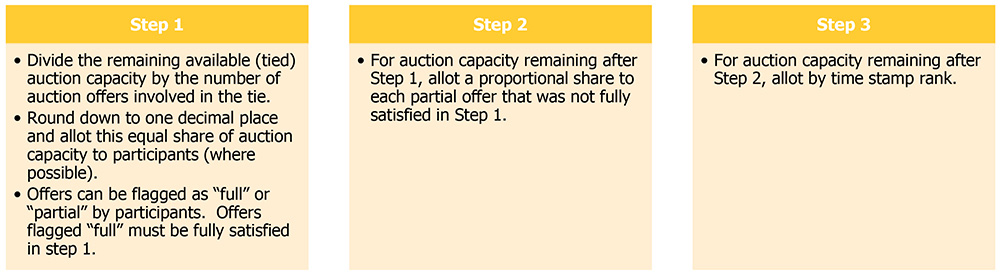
Under current rules, the ISO uses time stamps to select the bid submitted first, a method stakeholders have complained is inequitable. The new rules would create a multistep process IESO said will be fairer. (See IESO Eyes New Tie-break Rules for November Capacity Auction.) 

The initial design proposed last September was to proportionally allocate capacity based on the offer amounts, said IESO Capacity Auction Supervisor Laura Zubyck.  

Proposed three-step capacity auction tie-break process | IESO

“The feedback that we received from stakeholders was that there’s a risk in that design that participants could inflate their offer amount in order to try to clear the largest amount possible,” she said. 

As a result, the ISO revised the rules to award an equal share in the first step and apply a proportional allocation in step two, based on what’s left over from step one. 

Zubyck said stakeholders have been “unanimous” that the proposed change is an improvement. 

Michael Pohlod, director of energy markets for Voltus, a virtual power plant operator and DER platform, praised the ISO’s movement on the issue, calling it a “a major concern.”  

But Forrest Pengra, director of strategic initiatives for Seguin Township, noted that the final solutions are not proportional to offers, citing one example in which one supplier would clear 100% of its offer, while two others receive 64 and 48% of theirs. “That, to me, doesn’t seem as an equitable distribution,” he said. 

“You’re not wrong in terms of how it’s distributed,” Zubyck responded. But she said the original plan to proportionally allocate in the first step based on the offer amounts created “the risk of offers being manipulated” to increase the amount cleared.  

Pohlod said the original proposal created a “game theory problem.”  

“You have people wind up clearing more than they wanted because they thought other people were going to offer more proportionately. And this way … creates the right incentive.” 

Zubyck also said stakeholders sought a way to discourage the creation of multiple subsidiary organizations in order to clear more capacity through the tie-break. 

From left, Forrest Pengra, director of strategic initiatives for Seguin Township; Michael Pohlod, director of energy markets for Voltus; and IESO Capacity Auction Supervisor Laura Zubyck discuss revised capacity tie-break rules. | IESO

“We acknowledge this could be a risk: The tie-break methodology does not prevent somebody from creating a subsidiary organization,” she said. “However, it’s one that we can’t address solely through the tie-break methodology. It has larger impacts in the auction that … will be considered more broadly as part of our future enhancement discussions.” 

The Technical Panel is scheduled to vote to post the changes in September, with board approval anticipated in October. The Nov. 26-27 auction will seek capacity for the periods beginning May 1 and Nov. 1, 2026, with results posted Dec. 4. 

No ‘Misalignment’ Seen

In response to questions raised at the Technical Panel’s May meeting by Vladislav Urukov of Ontario Power Generation, IESO officials said they had reviewed the Technical Panel’s Terms of Reference (ToR) and Chapter 3, Section 4.3 of the market rules for consistency.  

Urukov had asked whether provisions for amending market rules were consistent with the “deemed warrants consideration” provision in Section 3.2.1 of the ToR. 

“The deeming provision, although not explicit in the market rules, is supported by the IESO Board’s authority pursuant to market rule S.4.3.6, whereby the IESO Board has authority to direct whether an amendment submission warrants or does not warrant consideration,” IESO’s Paula Lukan wrote in a memo to the TP. “The approval of the ToR in 2017 by the IESO Board, and in particular the inclusion of the deeming provision, constitutes the direction of the IESO Board that all IESO-driven engagements warrant consideration, thereby streamlining the process for most market rule amendments.” 

Lukan said IESO will look more broadly at Section 4 of the market rules to clarify the rule amendment process as part of its initiative to review market rules and manuals not directly affected by the Market Renewal Program. 

“We conducted a review, and while we did not find any misalignment between the rules and the terms of reference, we did identify a number of instances where the market rules could benefit from greater clarity,” said Lukan, who noted that the section hasn’t been updated since Ontario‘s market opening. 

“As a result, for example, it does make reference to consultations and not to stakeholder engagement.” 

“Are we saying that there’ll be no substantive changes to the rules, just clarification that does not in any way change the rules themselves?” Urukov asked. 

“I think that’s right,” Lukan responded. “We did recognize … in some instances it did create a little bit of confusion, but we’re confident that there aren’t any contradictions. It’s just there is an opportunity to clarify the language. So, no substantive changes that we’ve identified so far. It’s really just bringing them up to date, making the language a little simpler. During the [Market Renewal Program] process, this section did not get updated, so there’s definitely opportunity there to make some improvement.” 

FERC Accepts NYISO’s Firm Fuel Tariff Revisions

FERC has approved NYISO’s tariff revisions that change the mechanism by which generators opt in to the “firm fuel” capacity accreditation resource class, enable modeling improvements related to natural gas constraints and update the bidding requirements for capacity suppliers (ER25-2245, ER25-2257). 

The proposal was the subject of months of discussions between NYISO, stakeholders and the Market Monitoring Unit. (See Firm Fuel Proposal Continues to Confuse NYISO Stakeholders.) The Board of Directors approved the revisions in May. 

The revisions, effective July 16, are aimed at shoring up winter fuel as the New York grid transitions into a winter-peaking system. The ISO and the New York State Reliability Council are concerned the downstate gas turbine fleet will find itself competing with home heating for fuel during peak periods. 

Suppliers will have until Aug. 1 each capability year to opt into the firm fuel capacity accreditation resource class. For the first capability year under the new paradigm, 2026/27, NYISO requested — and FERC approved — a slightly later deadline of Nov. 1 for generators to elect as firm to give market participants time to adjust to the changes. 

Generators opting firm must have fuel supply, transportation and replenishment strategies in place by Dec. 1 of the capability year through the end of February. They must be able to run for 56 hours over seven consecutive days during the winter period.  

If a generator is unable to secure firm fuel supplies or if something has gone wrong with the fuel supplier, it is required to notify NYISO. Doing so essentially compensates that generator as if it opted as non-firm. Failure to notify NYISO could result in audit and financial sanctions. 

Failure to perform as required could result in audit and financial sanction if the failure was found to be within the plant management’s control. 

NYISO’s tariff revisions were supported by the Independent Power Producers of New York and Ravenswood Operations. They told FERC that proposal will produce “efficient outcomes that reflect the marginal reliability value of conventional generators” and better address winter reliability risks. 

FERC Faces Challenge in Balancing Executive Order and Legal Requirements

FERC is working to comply with an executive order from President Donald Trump requiring a review of all regulations it’s issued under its major governing statutes. The commission’s former general counsel warned it could be a boondoggle if handled incorrectly.

The order directs FERC and other energy agencies to include sunset provisions in its regulations, to the extent permitted by law. That would require FERC to re-examine them periodically or allow them to lapse, said Matt Christiansen, who was general counsel at FERC during the Biden administration and now is a partner at Wilson Sonsini Goodrich & Rosati.

“The CFR [Code of Federal Regulations] that pertains to FERC is like three or four inches thick,” Christiansen said in an interview with RTO Insider. “It’s at least 1,000 pages. So, we’re talking about a lot of regulations that are potentially subject to this order. That means FERC staff has to spend a huge amount of time determining what would stay, what would go, what would happen to the industry and what would need to follow on if certain regulations are removed.”

That includes fundamental rules that regulate the power industry such as allowing wholesale transactions using market-based rates.

“If the market-based regulations just disappear, it’s not clear what would fill that vacuum and what would happen to regulated entities,” he said.

The U.S. Code is more than 60,000 pages and “unelected agency officials” wrote most of the legally binding rules, which often stretch the statutory provisions beyond what Congress enacted, said the executive order called “Zero-Based Regulatory Budgeting to Unleash American Energy.”

“In particular, the previous administration added more pages to the Federal Register than any other in history, with the result that the Code of Federal Regulations now approaches a staggering 200,000 pages,” the order said. “These regulations linger in such volume that serious reexamination seldom occurs. This regime of governance-by-regulator has imposed particularly severe costs on energy production, where innovation is critical. The net result is an energy landscape perpetually trapped in the 1970s.”

Another big challenge to implementing the order is the Administrative Procedure Act (APA), which under Supreme Court precedent requires agencies to use the same procedures to amend a regulation that they used to enact it, said Christiansen.

“FERC uses notice-and-comment rulemaking to amend the CFR, which entails an opportunity to be heard on every aspect of every provision that’s added or removed from the CFR,” he added. “Then FERC, as part of its reasoned decision-making obligations under the Administrative Procedure Act, owes a non-arbitrary, non-capricious response to all those comments, which is a huge amount of work. I don’t think you can just insert a sunset clause and stop enforcing those provisions or [remove] them altogether.”

That’s potentially a huge task for an agency that has lost staff and is dealing with a federal hiring freeze. Christiansen said FERC already was understaffed, compared to its growing responsibilities, under the Biden administration.

“I think adding such a big task as the EO at least seems to contemplate on its face would be really taxing on staff and could complicate FERC efforts to do some of its bread-and-butter statutory requirements,” Christiansen said.

Christiansen said that there are regulations that could be streamlined, but FERC needs to get the process correct so it doesn’t lead to extended litigation. Chair Mark Christie said the same thing in his press conference following the April open meeting just after the order was released.

“I think the idea of a regulatory house cleaning where you look at all your regulations is a very, very good idea,” Christie said. “We’re already in the process of looking at — for example, we’re starting with regulations that were proposed that never got a final vote. They’re sort of like zombie proposals that somebody at one time thought was a good idea. They got them out as a NOPR [Notice of Proposed Rulemaking], but they just sort of have been there for years.”

Christie was describing proposals that never advance to a final rule because of leadership changes or changing priorities of the chair. But when it comes to rules that actually are finalized, the APA needs to be followed.

“You’ve got to follow it. And whatever we do, I want it to be effective. And I want it to stand up in court, because losing in court is not something I like to do,” Christie said in April. “I want to win in court.”

E&E News by POLITICO published a story on the executive order and got hold of a document circulating among commissioners that offers a potential response. However, FERC votes publicly and, especially with a looming leadership change at the agency with a new chair awaiting confirmation, much could change by the White House order’s deadline of Sept. 30.

Executive orders can have short shelf lives depending on who wins the next election. If this one were to stay in place, it would require regular reviews of major FERC rules such as Order 888, which set up the open access transmission rules, and other foundational orders. Those rules have helped to establish the entire market-based regulatory structure that governs most of the power industry.

“There might be pockets of the industry that are OK with big changes, but I think on the whole the industry would prefer stability rather than the upheaval that I think this rule at least contemplates,” Christiansen said. There are strategies that FERC, if so inclined, “could employ to mitigate some of that uncertainty.”

Calif. Electric Reliability Outlook Strong, CEC Report Says

California should have plenty of electricity available to meet demand over the next few years, even during extreme weather events or if new energy resource installations are delayed, the California Energy Commission (CEC) said in a new report.

The positive outlook is a change in flavor after difficulties over the past decade with rolling blackouts, emergency flex alerts, public safety power shutoffs and capacity shortages.

Now, the Golden State is expected to have more than 4,000 MW of surplus capacity this summer under normal conditions, while under an extreme shortage scenario, more than 700 MW of surplus will be available, the California Energy Resource and Reliability Outlook 2025 report says.

In 2024, California set “another record year for resource development — adding more than 6,800 MW of new capacity,” the report says. More of these new resources started operating before the summer season compared with the prior four years, with more than 49% of the added capacity in 2024 operating before the start of summer, which “contributed greatly to supporting grid reliability during the heat waves in July and September” of 2024, the report says.

Much of the credit for the optimistic reliability outlook also goes to eight new transmission projects, including the TransWest Express project, the Greenlink project, the Gateway South and West projects and the Southwest Intertie project. Some of these projects are operating, while others are close to operation or under construction.

Tariff and Import Uncertainties

One reliability unknown going forward, however, is the effect the Trump administration’s recent tariffs could have on electricity infrastructure equipment. The CEC warned new tariffs could have a major impact on electricity resources, such as circuit breakers, transformers, solar panels and battery storage systems. Tariffs on equipment might “significantly reshape market dynamics across the energy sector,” the report says.

“For utilities and renewable energy developers, tariffs can delay project timelines, create uncertainty and increase installation costs, potentially delaying completion dates,” the report says. “The impact varies widely depending on domestic manufacturing capacity — areas with robust local production might see minimal disruptions, while sectors reliant on specialized imported components could experience substantial price increases and supply shortages.”

Over the past two years, California also has become less reliant on imported power. In 2023 and 2024, CAISO requested less imported electricity than in 2021 and 2022 due to the installation of new energy resources — mostly battery storage facilities — in the state.

But even so, California continues to be a net importer of power: It pulls about 29% of its electricity from outside the state, particularly in the evening when electricity demand is highest.

Import availability also is decreasing for California due to tightening supply West-wide, the report says. CAISO has a total import limit of 11,665 MW and 5,500 MW during resource adequacy risk hours.

Beyond 2030, California’s grid can be “quite sensitive to a reduction in the resource build or a reduction in import availability,” according to the report. Even if the state adds all of its planned new resources between 2025 and 2035, the grid nonetheless will remain dependent on its neighbors for resource adequacy, the report says.

MISO Tries to Ward Off DR Fraud with New Testing Regime

MISO has filed with FERC to impose more exacting testing requirements on its demand response resources in an effort to stop fraud in its capacity market.  

The filing seeks to eradicate a standard option for DR owners to submit mock, hypothetical testing of their capabilities instead of demonstrating actual reductions through real power tests. Under the new paradigm, DR owners can proceed with a mock test only if a state authority expressly allows it or if it’s a proven resource that has responded to a MISO call in the past three years and hasn’t changed its specifications. (See Amid Fraud, MISO Plans Stricter Testing of Demand Response.)  

MISO asked for a July 15 effective date in its July 14 filing (ER25-2845). It said making real power tests the norm is necessary to “address instances of fraudulent registration facilitated, in part, by use of the testing waiver currently in the tariff to register resources from which no demand reduction is possible.” MISO plans the testing requirements to be in full force by the 2027/28 planning year.   

The grid operator said it needs confidence that the demand reduction capability that clears in its seasonal capacity auctions corresponds to resource performance in real time. MISO said the stepped-up testing standards should result in improved grid reliability, with “MISO operators having greater confidence in the ability of registered resources to perform when called upon during emergencies.”  

If the rules go through, demand response resource owners must demonstrate they can honor their notification time while dropping demand within the same time-of-day periods that correspond to hours that MISO expects system risk to occur and has picked out ahead of time. The resources must hold their demand reduction for 15 minutes, covering at least two-meter intervals.  

MISO proposed that demand response owners must show a full reduction of all the megawatts they specified in registration during a real power test. MISO said it would allow some resources that experience a weather impact during testing to show a little less than their full stated capability.  

“The test is not a panacea. It is a bare minimum requirement to show us you can drop,” MISO’s Joshua Schabla said at a July 9 Resource Adequacy Subcommittee meeting. “We don’t want the test to barrier to entry. We just want the test to validate that you can do what you say you can do.”  

MISO Independent Market Monitor Carrie Milton said MISO’s new testing requirements are likely to weed out demand response forgeries.  

Milton also said she and monitoring staff continue to review past conduct of demand response and load-modifying resources in MISO. She said there’s likely more instances of manipulation and emphasized IMM David Patton’s past contention that a yet-unconstructed data center was able to clear capacity in MISO’s 2024 capacity auction.  

“If you’re just an empty field, you really can’t conduct a test,” Milton said at the July 10 MISO Market Subcommittee meeting.  

Since 2024, MISO has planned five total FERC filings in response to recent instances of demand response gaming the RTO’s capacity market or coming up short when called upon.  

The RTO already has made three filings: one to introduce a new availability-based capacity accreditation for demand response; another to stop emergency demand response from also registering as an load-modifying resource (LMR) or demand response resource; and another to crack down on bad actors by forbidding demand response owners from double-counting participants, making fraudulent registrations or deliberately inflating their baseline electricity use to exaggerate reductions.  

In addition to the testing clampdown, MISO said a fifth and final filing will put new non-performance penalties in place and allow market participants to replace their LMR capacity after clearing the MISO capacity auction if the resource is rendered unable to respond during a planning year.  

PJM PC/TEAC Briefs: July 8, 2025

Planning Committee

Stakeholders Endorse POI Jurisdiction Changes

The Planning Committee endorsed by acclamation a PJM proposal to rework how it determines the jurisdiction a resource point of interconnection (POI) falls under in an effort to designate more low-voltage facilities as being under state jurisdiction. (See PJM Proposes Changes to Determination of Jurisdiction over Generation.)

The proposal would establish a “bright-line test” where resources interconnecting to facilities below 69 kV would be designated state jurisdictional and required to obtain a wholesale market participation agreement (WMPA). Higher-voltage POIs would be required to receive a generation interconnection agreement (GIA). There also would be a backstop mechanism where jurisdiction could be assigned regardless of voltage depending on how the transmission owner, FERC or relevant electric retail regulatory authority has defined the cost-recovery method.

The current first-use paradigm designates the first resources interconnecting to a distribution facility to participate in PJM’s markets as state jurisdictional and all subsequent interconnections as falling under federal jurisdiction. If the proposal had been implemented when the WMPA pathway was first established, PJM Associate General Counsel Thomas DeVita said about 12 to 15% of projects that received an interconnection service agreement (ISA) or GIA would have gotten a WMPA instead.

During the June 3 first read on the proposal, DeVita said the aim of the proposal is to focus the GIA process on more complicated applications to high-voltage facilities which take a greater number of staff hours to study, while continuing to have visibility into distribution-level interconnections.

PJM Vice President of Planning Jason Connell said system impact studies for a generator pursuing a WMPA are completed by electric distribution companies rather than the RTO and produce a simpler agreement for it to process.

1st Read on ELCC Manual Revisions

PJM’s Josh Bruno presented a first read on revisions to PJM Manual 21B: PJM Rules and Procedures for Determination of Generating Capability to codify FERC’s approval of a proposal the RTO filed to establish two new resource classes for accreditation under the effective load-carrying capability (ELCC) process (ER25-1813). (See PJM Stakeholders Endorse Proposals to Rework ELCC Accreditation.)

The changes add the oil-fired combustion turbine and waste-to-energy steam classes as discrete categories for resource accreditation, starting with the 2027/28 Base Residual Auction. Oil generation was included in the miscellaneous “other unlimited resource” category, while waste-to-energy was modeled under “steam” generation.

Following the March 19 Markets and Reliability Committee meeting, Bruno told RTO Insider that breaking oil combustion turbines out as a separate class allows PJM to better capture the types of correlated outages that tend to affect them and provides the ELCC modeling with more performance data than if each unit was looked at individually.

PJM Recommends Sunsetting Relay Testing Subcommittee

PJM’s Stan Sliwa presented a first read on revisions to the Relay Subcommittee (RS) charter to sunset the Relay Testing Subcommittee and include its activities in the RS. The proposed language also would clarify who is able to participate in the RS, which is limited to members who have signed the Operating Agreement and are transmission or generation owners in PJM.

Transmission Expansion Advisory Committee

Update on 2025 RTEP Window 1

PJM has published an addendum to the problem statement and study files for its 2025 Regional Transmission Expansion Plan Window 1, which opened for developers to submit solution proposals on June 18 with an Aug. 18 deadline.

An additional scenario was added to the 2032 base case modeling the expected bulk transfer if offshore wind developments in New Jersey and Delaware are not completed. Removing that generation from the modeling resulted in overloads on the South Bend-Keystone 500-kV, Keystone-Conemaugh 500-kV, Conemaugh-Juniata 500-kV, Brighton-Doubs 500-kV, Keystone-Juniata 500-kV and Burches Hill-Possum Point 500-kV lines.

Removing the offshore wind also resolved overloads on the Rock Springs-Bramah 500-kV line and Peach Bottom 500-kV bus identified in other scenarios.

PJM’s Wenzheng Qiu said removing the projects increases power flows from west to east and from south to north, which will be considered in evaluating the robustness of projects submitted in Window 1.

PJM also updated the window’s problem statement to reflect that no major regional transfer issues were identified in the 2030 base case. However, several high-voltage overloads were found in the seven-year case.

Staff chose not to include clusters with overloads on the AG1-125-Marysville 765-kV line and the 765-kV corridor between Wilton Center and Marysville due to the lines being limited by equipment. Multiple overloads on the 500-kV network in the Mid-Atlantic Area Council region also were not included as they are not present aside from the scenario removing the offshore wind developments.

PJM did include a pair of overload clusters in the Columbus, Ohio, region where N-1-1 analysis found widespread local system voltage issues expected to worsen with load growth forecast to continue beyond the seven-year horizon.

Overloads on the 138-kV and 115-kV networks ATSI along the East Springfield-Melissa-London corridor were included.

Supplemental Projects

Duke Energy presented a $186 million project to serve a customer planning to bring 800 MW of load to Butler County, Ohio, by 2030. It would proceed in four phases, starting with tapping into the Miami Fort-Woodsdale 345-kV line to provide initial service for about 300 MW of load. The first phase will be paid for by the customer.

Next, Duke will build a 345-kV substation, named Wayne-Madison, at the customer’s location to be looped into the Woodsdale-Miami Fort line. It will be looped in with about one mile of new transmission at a cost of $40 million for the second phase, which is envisioned to be complete by the end of 2028.

The third phase involves building a new Cotton Run substation cutting into the Miami Fort-West Milton 345-kV line and connecting to Wayne-Madison with a new 5.5-mile 345-kV circuit. The third phase is estimated to cost $45 million and to be done by June 2029.

The project will complete with the rebuilding of the 138-kV Port Union-Toddhunter double circuit line to upgrade one side of the line to 345-kV, with corresponding equipment installed at Port Union. This phase is estimated to cost $101 million and be complete by the end of 2030.

FirstEnergy presented a $344 million project to rebuild its 69-mile Sammis-Star 345-kV line due to the towers failing wind and ice load tests. It has 22 wood pole H-frame and 375 steel lattice towers along its length, and a tornado left 13 towers destroyed in a cascading failure. The project is in the conceptual phase with a possible in-service date of May 30, 2031.

The utility presented another three projects to repair lines experiencing degradation and end-of-life issues. A $74 million project would rebuild 14.5 miles of the Niles-Shenango 345-kV line, repairing wood poles and reconductoring. A $53 million project would replace 33 steel towers along the double circuit 345-kV corridor between the Beaver Valley, Hanna and Mansfield substations and reconductor about 13.5 miles. A $21 million project would rebuild elements of the Bayshore-Davis Besse 345-kV line.

Dayton Power and Light presented several needs to serve new customers across Ohio. Some of the load is expected to begin coming online in the next few years, scaling to about 1.6 GW by 2030.

PPL presented a need to serve a customer seeking 230-kV service for 1.5 GW of load near Gouldsboro, Pa. The customer is expected to come online in 2027 drawing 300 MW and scale to its full consumption by 2030.

PSEG presented a $27 million project to reduce network strain on the Newark switching station by installing two 230/13-kV transformers at the nearby McCarter switching station and transferring several circuits to that facility. The project is in the conceptual phase with a possible in-service date in December 2029.

Dominion presented a $54 million project to rebuild three lines nearing the end of their useful life: the 30-mile Chesterfield-Lanexa 115-kV line, 14.6-mile Chesterfield-Chickahominy line and 14.2-mile Chickahominy-Lanexa 230-kV line. The Chesterfield-Lanexa line would be built to 230-kV standards but operate at 115 kV, while the other two lines would remain rated for 230 kV. Equipment at the substations also would be upgraded. The project is in the engineering phase with an expected in-service date of Dec. 31, 2028.

Several stakeholders requested that TOs presenting supplemental projects intended to serve large loads specify whether those consumers have been submitted to PJM as large load adjustments to its annual load forecasts.

GE Vernova to Pay Nantucket $10.5M for OSW Mess

The manufacturer of an offshore wind blade that disintegrated in July 2024 has agreed to pay a Massachusetts beach community $10.5 million. 

The town and county of Nantucket said the agreement with GE Vernova for the Vineyard Wind 1 incident is compensation for costs and losses sustained by the town and local businesses. The settlement was announced almost a year to the day after debris began washing up on beaches during the height of the tourist season. 

It was a landmark failure for the young U.S. offshore wind industry, which already was struggling against cost and logistical hurdles, and it provided new ammunition for offshore wind opponents. 

A year later, the offshore wind sector is on the ropes, facing continued popular opposition and a hostile new presidential administration. The latest potentially harmful move by federal regulators was to inform Maryland officials about errors in the final permit they issued for wind power projects off that state’s coast. 

The July 13, 2024, incident south of Nantucket was a failure that just kept getting worse for Vineyard Wind 1, an 800-MW joint venture of Avangrid and Copenhagen Infrastructure Partners. (See Blade Failure Brings Vineyard Wind 1 to Halt.) 

The project already was behind schedule, and federal regulators slapped lengthy work stoppages and limits on it after. The developers faced a roar of local criticism about the speed and manner in which they publicized the incident and a chorus of told-ya-so attacks from offshore wind foes nationwide. 

GE Vernova’s internal investigation revealed quality control problems at the Quebec factory where subsidiary LM Wind Power built the blade that disintegrated. It determined that multiple blades already installed on Vineyard Wind turbines would need to be removed and replaced at additional cost of time and money. (See GE Vernova Gives Update on Offshore Wind Woes.) 

Nantucket said debris entered the water table, settled on the seabed and washed up on town beaches, necessitating a monthslong cleanup. 

The settlement bars Nantucket from making disparaging remarks about GE Vernova and related parties covered in the lawsuit, although the town can make accurate good-faith comments on the blade incident. 

In its July 11 statement, Nantucket said it “commends GE Vernova for its leadership in reaching this agreement.” 

Nantucket Select Board member Brooke Mohr also kept within the boundaries of the agreement, saying: “Offshore wind may bring benefits, but it also carries risks — to ocean health, to historic landscapes and to the economies of coastal communities like Nantucket, known worldwide as an environmental and cultural treasure.” 

Nantucket now will place the financial settlement in a community claims fund and hire an administrator to review claims. 

Work continues on Vineyard Wind. A July 7 mariners update indicated safety zones around five of the 62 turbine foundations. 

On the very last business day of the Biden administration, the U.S. Bureau of Ocean Energy Management approved a revised construction and operations plan for Vineyard Wind 1 that reflected blade removals. (See Prior to Trump Inauguration, Feds Lift Suspension on Vineyard Wind 1.) 

Three days later, on the very first day of his second term, President Trump issued a directive that chilled some offshore wind development and essentially froze planning on future projects. (See Critics Slam Trump’s Freeze on New OSW Leases.) 

Aside from a stop-work order slapped on Empire Wind 1 for a few weeks, however, work has been allowed to continue on the other projects already under construction — Coastal Virginia Offshore Wind, Revolution Wind and Vineyard Wind 1. 

By contrast, EPA on March 14 placed a hold on the air quality permit issued to New Jersey’s last actively pursued offshore wind project — Atlantic Shores, which still was well short of construction. (See EPA Puts Hold on Atlantic Shores OSW Permit.) Its developers later shelved the plan indefinitely. (See Developer Shelves Atlantic Shores, Seeks to Cancel ORECs.) 

Likewise, US Wind’s Marwin 1 and Momentum Wind are federally permitted but have not started construction off the Maryland coast. 

On July 7, EPA informed the Maryland Department of Environment that the construction permit it issued June 6 to US Wind is deficient and would need to be reissued with clarification that appeals of the permit must be directed to EPA, not to the state, because the state issued the permit under federal authority. 

Failure to rectify the error could result in invalidation of the permit on appeal, EPA wrote. 

On July 11, wind power opponent U.S. Rep. Andy Harris (R) of Maryland applauded the EPA finding, saying: “The EPA has confirmed what many of us knew for years — this project was approved with glaring procedural and legal flaws. The Maryland Department of the Environment had no business directing the public to appeal a federal permit to a state court, and such a decision showed both incompetence and a disregard for public input from my affected constituents in Worcester County.” 

Earthjustice Blasts NYISO ‘Power Trends’ Report to State Officials

ALBANY, N.Y. — Earthjustice claimed that NYISO’s latest annual “Power Trends” report was full of misleading statements that favor new natural gas generation in a letter July 7 to New York state officials, including Gov. Kathy Hochul. 

“The ‘Power Trends’ report is not based on new information or analysis but is rather a summary of prior NYISO reports and analysis, none of which found that fossil-fired generation is necessary for reliability or that repowering aging power plants is beneficial for New York or the grid,” Earthjustice wrote. “Instead, it seems that NYISO is irresponsibly seeking to create a false narrative that New York needs new gas generation, even though there is no evidence to support that claim.” 

The organization noted that NYISO had not made any new finding of a reliability need and called into question its concerns about large load additions, arguing that “many recent reports have noted the uncertainty of those speculative new loads.” 

“NYISO is using reliability as a way to justify more gas infrastructure, even though their own analysis shows no new reliability need exists,” wrote Eric Walker, energy justice senior policy manager for WE ACT for Environmental Justice, who co-signed the letter. “Meanwhile, clean energy projects that could save New Yorkers billions are stuck in NYISO’s interconnection queue. Delaying renewables and expanding gas infrastructure isn’t just bad policy; NYISO’s false narrative puts environmental justice communities further in harm’s way.” 

The report, released June 2, included a section outlining the case for the refurbishment and repowering of old power plants, though it did not favor any particular resource. (See NYISO Makes Case for Repowering in Latest ‘Power Trends’ Report.) 

“We encourage every policymaker to read ‘Power Trends’ for a fact-based assessment of electric system reliability, climate policy advancement and economic development,” Kevin Lanahan, NYISO vice president of external affairs and corporate communications, said in a statement. “‘Power Trends’ suggests that repowering of all aging resource types — renewable and fossil — be examined to determine the opportunity for capacity additions, efficiency and carbon reductions.” 

Rachel Spector, deputy managing attorney for Earthjustice, said the organization had noticed signs of backsliding on New York’s climate law from local officials.  

“We are starting to hear from agency folks the idea that we need to start thinking about repowering gas plants or adding new gas generation,” Spector said. “It seems like it was clearly in response to ‘Power Trends.’” 

Spector said Earthjustice has “real concerns” about New York’s commitment to meeting its clean energy goals and the requirements of the climate law.  

“We don’t want to deny that there are major issues we have to figure out in the coming years with the grid, but there are a lot of things we could be doing, like speeding up renewables,” Spector said. 

The letter, also signed by representatives of the Environmental Defense Fund and Evergreen Action, notes that the report says the interconnection queue contains nearly 350 proposals, with nearly 50,000 MW of proposed clean resources. 

Lanahan cited the Alliance for Clean Energy New York’s support of NYISO’s recent interconnection changes for reducing the wait time in its queue. 

ACE NY Executive Director Marguerite Wells told RTO Insider that the report showed the state is not deploying resources fast enough, and the organization hopes NYISO’s “significant reforms” will save time as the process matures. 

“But it is not enough to reform one process, especially in the wake of federal hostility,” Wells said. “To fully realize the immense benefits that renewable energy projects can bring, we need all state agencies to work together. NYISO has shown that new generating sources are needed in the coming years. Wind and solar power are the resources that can be online in the shortest time.” 

Wells said “red tape” should not force the state to rely on “technologies of the past” when renewables are ready to go. 

Hochul’s office did not respond to a request for comment by press time.
