Calif. Pathways Bill Delayed After Orgs Withdraw Support, While Newsom Signals Backing for Effort

The author behind the bill that would allow CAISO to relinquish market governance to an independent “regional organization” (RO) delayed a hearing scheduled for July 16 after several organizations withdrew support for the proposed legislation.

SB 540, which passed in the California State Senate in June, was set for a first hearing in the State Assembly’s Utilities and Energy Committee but was delayed until after the Legislature’s summer break at the request of the bill’s author, Sen. Josh Becker (D). (See ‘Pathways’ Bill Passes California Senate on 36-0 Vote.)

Meantime, Gov. Gavin Newsom and Assembly Speaker Robert Rivas on July 16 both signaled their support for efforts to expand California’s involvement in regional electricity markets, although spokespersons for each pointed out they were not necessarily backing SB 540.

SB 540 is part of the West-Wide Governance Pathways Initiative, an effort to create an independent RO to govern CAISO’s Western Energy Imbalance Market and the soon-to-be-launched Extended Day-Ahead Market (EDAM). The effort aims to assuage concerns that the ISO — whose Board of Governors are appointed by California’s governor — would act solely in the state’s interest.

“The hearing was delayed with the support of the Senate and Assembly in order to have more time to iron out some details with the bill,” Becker’s press secretary, Charles Lawlor, told RTO Insider. “There is a huge, diverse coalition behind this bill. Conversations are active and ongoing. Our collective work is going to continue over the summer, and our goal is to move the legislation when we’re back in August or September.”

The move comes after 21 organizations, including the Environmental Defense Fund, PacifiCorp, Advanced Energy United, Amazon and Portland General Electric, changed their position to “oppose unless amended” on SB 540.

In a July 11 letter, the coalition said it opposed an amendment creating a new Regional Energy Market Oversight Council responsible for ensuring CAISO’s participation in the regional energy market “serves the interests of the state.” (See Amended ‘Pathways’ Bill Boosts — and Complicates — Calif. Protections.) The new council would be authorized to mandate withdrawal if those interests are compromised.

The coalition requested lawmakers remove the amendment, stating “the language in this section mandates the withdrawal of California entities from the market without exception or discretion, which is unacceptable.”

“Market rules should be established based on facts, evidence and reliable data rather than fear,” it wrote. “Even if withdrawal from the market were to be a prudent action, the mandated 120-day time frame is far too short and exposes California customers to serious reliability concerns, especially during periods of peak demand. Lastly, this language inadvertently asserts new [California Public Utilities Commission] jurisdiction over the state’s publicly owned utilities, which is inappropriate and must be removed.”

The coalition also argued lawmakers should remove revisions to California’s Renewables Portfolio Standard Program and restrictions on a future market. It noted that some entities in Colorado, New Mexico and Idaho are at a crossroads on whether to join EDAM or SPP’s Markets+.

“A smaller market for California means less cost savings, a less reliable grid and more climate-harming emissions,” the coalition wrote.

Leah Rubin Shen, managing director at Advanced Energy United, commended the legislature for delaying the hearing to “ensure a productive path forward that preserves the widely supported core purpose of the bill: to facilitate California’s participation in an expanded Western electricity market that provides robust state policy and consumer protections.”

“The stakes are too high for California to walk away, especially as trading partners across the West weigh their options,” Rubin Shen said. “Our shared vision remains clear: A strong regional electricity market that includes California will benefit the entire West by lowering costs, increasing reliability and delivering clean energy across the region. With continued commitment to passing a workable bill this year, we can achieve this goal.”

Meanwhile, The Utility Reform Network (TURN) has changed its opposition to neutral after the bill was amended to address the organization’s concerns that handing over governance to an RO could lead to increased federal intervention and undermine the state’s clean energy goals. (See California Lawmakers Seek to Trump-proof Pathways Initiative Bill.)

“We need a very enhanced level of protection and guarantees that this entire experiment is voluntary and that the state of California has … full control over whether we would continue to participate over time,” Matthew Freedman, staff attorney at TURN, said in an interview.

“We’re mindful of the [Trump] administration’s threat to force utilities throughout the West to subsidize legacy coal-fired generation that might be at risk of retirement, either under Section 202 of the Federal Power Act, or sent through some other mechanism that they invent,” Freedman added. “We want to make sure that this regional market is not weaponized against California.”

But Katelyn Roedner Sutter, California state director at the Environmental Defense Fund, said in an interview that fears the federal government will get involved are overblown, and that the bill makes clear California’s existing climate or clean electricity policy will not change.

“None of this … is going to impact our renewable portfolio standard. And the same is true for other states. Other states get to uphold their existing policy as well,” Roedner Sutter said.

“Where the real concern seems to come from is our relationship with FERC,” Roedner Sutter noted. “And I think what people who raise that are not understanding is that CAISO [tariff revisions] … already have to go before FERC. That is the case right now; … that relationship does not change in any way with this bill or with California entities being part of a regional electricity market. So, nothing is actually changing about our relationship with FERC.”

In separate statements released July 16, Gov. Newsom and Speaker Rivas both pointed to California’s “opportunity” to improve electric reliability and affordability through increased regional coordination.

“We have the opportunity to expand regional power markets that help drive down energy costs and increase grid reliability — or we can turn our backs on this proven model and opt for higher costs and power outages,” Newsom said. “The answer is clear: California must further enable continued cooperation with Western partners to secure our clean, reliable and affordable energy future. This is our best shot at lowering energy costs. Now the legislature must take action this year and deliver for the people of California.”

“There is an urgent opportunity now — this year — to lower energy costs for California families and businesses, and we can help achieve this by expanding regional collaboration,” Rivas said. “California must continue to lead and step up, or others will. We need to continue to facilitate cooperation with our Western neighbors through a voluntary, regional power market, because that is our best path toward driving-down costs and delivering a sustainable, reliable, affordable energy future for Californians. Let’s get this done now.”

Robert Mullin contributed to this article.
NYISO: LBMPs Spiked in June from Heat Wave

ALBANY, N.Y. — The heat wave at the end of June caused the average locational-based marginal price for the month to increase dramatically, NYISO told the Business Issues Committee on July 16.

The LBMP jumped from $36.99/MWh in May to $58.96/MWh, nearly 49% higher than that of June 2024’s $39.68.

“June 2025’s average year-to-date monthly cost of $77.60/MWh is a 90% increase from $40.78/MWh in June of 2024,” said Zachary T. Smith, newly promoted to NYISO director of market solutions. Smith’s promotion was announced as he began the presentation.

Natural gas prices were slightly lower in June, at $2.27/MMBtu compared to $2.34 in May, but they were up about 30% year-over-year.

Smith said the higher LBMPs were driven by the extreme heat at the end of June. (See NYISO Issues Energy Warning as Heat Wave Boils New York.) The heat caused shortage pricing because of a lack of energy reserves. NYISO had to make emergency purchases from neighboring regions. (See NYISO Details Late June Heat Wave for Reliability Council.)

Given the current and recent weather, NYISO likely would see high prices in July, too, Smith said.

“We’re not done with heat waves,” he said. “We might see [load] of over 30,000 MW today.” During the June heat wave, demand reached over 31,000 MW.

Virginia SCC Orders Changes to Dominion Energy’s IRP Process

The Virginia State Corporation Commission determined in an order issued July 15 that Dominion Energy’s 2024 Integrated Resource Plan was legally sufficient, but it ordered changes to the utility’s future IRPs.

“The commission emphasizes, though, that such acceptance does not express approval in this final order of the magnitude or specifics of Dominion’s future spending plans, the costs of which will significantly impact millions of residential and business customers in the monthly bills they must pay for power,” the SCC said.

State law requires at least 15 years of planning in an IRP, but it gives the regulator flexibility to require more time. Dominion must file plans that look 20 years out, in line with PJM’s 20-year forecast window. That also will help the IRP be better coordinated with the utility’s planning to meet Virginia’s renewable portfolio standard.

The utility also will have to submit at least one scenario where its generation plans are in line with the default carbon targets in the Virginia Clean Economy Act.

In the next IRP, Dominion will have to model increasing its annual build limits for storage and investigate long-duration storage as those technologies become commercially viable. Dominion also must model higher levels of efficiency for 2026 through 2028, which will influence its use of demand-side management.

Its next filing also must include a narrative discussion of its potential use of grid-enhancing technologies and advanced conductors, especially using them to ensure reliability and safeguarding the physical and cybersecurity of the distribution system.

Dominion will be required to keep using PJM’s demand forecast, minus efficiency targets and separating out the load associated with data centers, the order said.

A statement from the utility welcomed the SCC’s thorough review and said it would follow the new requirements for its future IRPs.

“Our customers are using 5% more power each year, and demand is expected to double in 10 years. This is the largest growth in power demand since the years following World War II,” a Dominion spokesperson said in the statement. “We’re focused on serving our customers’ growing needs with reliable, affordable and increasingly clean energy. We’re investing in new power generation from every source, grid upgrades to strengthen reliability and energy efficiency programs to help our customers save.”

Most of the new power generation being developed is from carbon-free resources, including the Coastal Virginia Offshore Wind project. It’s the largest offshore wind project being built in the country, and Dominion has the third largest solar fleet. The growing demand also will require natural gas, because renewables are not always available, the company said.

Clean Virginia, which was an intervenor in the IRP case, welcomed the changes from the SCC but called for further reforms so that monopoly utilities no longer control the planning process.

“This latest order underscores how broken Virginia’s energy planning process is,” said Clean Virginia Deputy Director Dyanna Jaye. “Year after year, Dominion files plans that ignore clean energy requirements, lock in expensive fossil fuel infrastructure and drive up electric bills. By recognizing the harm this process can cause to Virginia families and businesses, the commission has taken a step in the right direction by calling for significant reforms moving forward.”

Dominion said it was focused on keeping rates affordable and delivering value for its customers.

“Our residential rates remain below the national average, and they’re projected to grow by less than 3% a year,” its spokesperson said. “At the same time, we’re delivering more reliable service by burying power lines in the most outage-prone areas. That’s substantially reducing storm-related outages and shortening restoration times for our customers.”

CGA Says New MISO Info Guide on Queue Fast Lane Shows Plan is Unfair

The Clean Grid Alliance claims that new information MISO has released on its interconnection queue fast lane definitively shows the plan would be detrimental to independent power producers and should be rejected by FERC 

The clean energy advocacy group wrote to FERC July 15 that a newly released informational guide from MISO that describes how the express lane would be rolled out if approved proves the plan is unfair (ER25-2454). Clean Grid Alliance said the guide, published July 11, contains a detail that would leave load-serving entities and their affiliates free to scoop up nearly 74% of the project threshold that could be allotted under the express lane.  

MISO in early June refiled its fast-track proposal, this time with a 68-project limit that includes special reservations for retail choice states and independent power producers to advance their generation projects. MISO designated 10 of the 68 project slots for IPPs only. It said the dedicated spaces would discourage LSEs from using a tactic of refusing to enter into agreements with IPPs for the remaining 50 project slots. (See MISO’s Queue Fast Lane, Take 2, Nets Déjà vu Arguments.)  

But CGA said the guide’s “generalized other agreement category” shows that LSEs would get preferential treatment and could shut IPPs’ projects out of the 50-project fast lane if the two don’t have a legally binding agreement according to MISO. MISO said it won’t consider letters of intent, memorandums of understanding or term sheets as adequate for offtake agreements.  

“There might have been some glimmer of hope that the generalized other agreement category would not afford LSEs unfettered veto power. However, that too has now been shut down,” CGA said. “MISO’s recent post puts the nail in the coffin to IPP participation in the 50-project category. LSEs will unequivocally be able to raise a unilateral barrier to IPP participation and say no.”  

CGA said MISO’s definition of legally binding agreements leaves only power purchase or similar offtake agreements and “build-own-transfer” agreements as valid avenues to the lion’s share of the fast lane. The alliance said LSEs “would wield unchecked market power to simply say ‘no’ to an agreement with an IPP, leaving LSEs with exclusive use of the 50 projects as they desire, including self-supply or contracting with an affiliate.”  

CGA told FERC the wording in MISO’s guide attempts to add a late-stage revision to which interconnection requests can enter the fast lane. It also said the seemingly new requirement “follows MISO’s pattern in this docket to continually revise its filed proposal.” The alliance said that by burying the new condition in an information guide, MISO shut out public comment and FERC’s ability to review the proposal in its totality.  

“MISO did not apprise the commission of this legally binding substantive change to the other agreement category,” CGA wrote and again urged FERC to reject the plan.  

At press time, MISO hadn’t responded to RTO Insider’s request for comment on CGA’s claim.  

NYISO Management Committee Liaison Brief: July 15, 2025

ALBANY, N.Y. — The NYISO Board of Directors has approved the right of first refusal for transmission owners’ tariff revisions for economic and reliability projects. The board also approved the PJM joint operating agreement for the Dover phased array regulator substation. (See NYISO Management Committee Briefs: June 30, 2025.) 

In a presentation to stakeholders, Board Chair Joseph Oates ran through a laundry list of items the board covered over two days of management meetings. He reported that the board is pleased with the discussion of the ongoing capacity structure review with market participants. The board also reviewed the preliminary setup of the System and Resource Outlook study, which eventually will involve meetings with stakeholders.  

Oates said the board also reviewed the status of the project prioritization process and had received the results of the 2025 quarterly internal audit. Physical and cybersecurity program updates were reviewed. He also mentioned a “strategic discussion” about short- and long-term demand forecasting. 

Oates did not provide details of these reviews or status updates. Stakeholders did not ask questions.  

FERC Opens Door for PJM to Refile RTEP Protocol Proposal

FERC has opened the door for PJM to resubmit a previously rejected proposal to shift its Regional Transmission Expansion Plan (RTEP) protocol from its Operating Agreement to its tariff, while dismissing a rehearing request for a connected proposal by the RTO’s transmission owners (ER24-2336).  

PJM’s RTEP protocol proposal had been linked with another proposal by several transmission owners to revise the RTO’s Consolidated Transmission Owners Agreement (CTOA), including adding “overlap provisions” that would have required PJM to consult with TOs before proceeding with a regional project that would address the same need as a local, supplemental project proposed by a TO.  

The TO proposal also would have established a conflict mediation process for instances when a TO contended that an action by the PJM Members Committee conflicts with the CTOA.  

PJM and the transmission owners had asked the commission to consider both filings as one proposal, arguing that one could not be approved without the other. 

But in a December 2024 order rejecting the proposals, the commission found the CTOA changes would impinge on PJM’s independence by providing TOs with an exclusive opportunity to affect filings PJM is able to submit under Section 205 of the Federal Power Act. (See FERC Rejects PJM and Transmission Owners’ CTOA Proposals.) 

At the same time, FERC also rejected PJM’s proposal to shift the RTEP protocol to the tariff because of its tie with the CTOA revisions, while also finding that PJM had not made the case that keeping the planning protocols in the OA renders the RTO’s governing documents unjust and unreasonable. 

The July 14 rehearing order again rejected the CTOA revisions, saying they would grant TOs too much influence over PJM’s decision making on planning, extend Mobile-Sierra protections to the revised language and place “substantive transmission planning rules in the CTOA.” 

“The CTOA amendments go beyond changes to enable this transfer and also would restrict PJM’s ability to make independent FPA Section 205 filings that PJM TOs believe contravene the CTOA, add substantive transmission planning rules to the CTOA, and grant the Mobile-Sierra public interest standard presumption to several CTOA provisions,” the commission wrote. “Thus, the broad cumulative effect of the integrated package of filings would be to shift the ability to influence PJM’s FPA Section 205 filings from a diffuse right shared by the Members Committee representing diverse interests to a concentrated right possessed by a single class of stakeholders, the PJM TOs. Moreover, PJM TOs’ new rights would be housed in the CTOA and granted Mobile-Sierra protections, which would raise the bar for any future changes.” 

However, the commission withdrew its determination that PJM’s proposal had not met the FPA Section 206 burden of showing that the OA is unjust and unreasonable with the inclusion of the RTEP protocol, instead dismissing the proposal as moot given the rejection of the intertwined CTOA revisions. 

“We emphasize that our dismissal of the PJM complaint here does not preclude a future filing proposing to move the RTEP protocol from the OA to the tariff. The PJM board has the authority to petition the commission under FPA Section 206 to modify any provision or schedule of the OA that the PJM board believes to be unjust, unreasonable or unduly discriminatory,” the commission wrote. 

‘Resounding Victory’

Ari Peskoe, director of Harvard’s Electricity Law Initiative, said the rehearing order protects PJM’s independence and creates an uphill battle for TOs appealing the commission’s determination. 

“The rehearing order cements a resounding victory for the region’s consumers,” Peskoe told RTO Insider in an email. “The utilities’ proposed CTOA would have compromised PJM’s independence by letting the utilities interfere with PJM’s decision-making processes, particularly about transmission planning. That’s why state regulators, consumer advocates, generators and public power lined up against the CTOA. Because FERC reiterated three separate and independent reasons for finding the utilities’ CTOA deficient, the utilities will have a nearly impossible task in trying to convince the D.C. Circuit to reverse FERC’s order.” 

Peskoe also argued the CTOA revisions were not legally necessary for PJM to transfer the RTEP protocol to the tariff and the RTO can pursue the changes on their own merits. 

“With FERC’s modification, PJM is now free to try again — on its own — to move the regional transmission planning provisions from the operating agreement to the tariff. However, rather than filing a complaint, PJM should try to work with its members to see if there’s a deal on governance that might be acceptable to a majority of its members and to state regulators,” he said. 

PJM did not respond to a request for comment on whether it plans to refile the proposal or thinks that would require a fresh consultation with its membership. 

Alex Stern, Exelon director of RTO relations and strategy, said the utility expects PJM and member TOs to continue working to find solutions to ensure the grid keeps up with accelerating load growth. Defending PJM’s proposal to transfer the RTEP protocol during a May 2024 Members Committee meeting, he said TOs would be giving up stakeholder process veto rights over planning as part of the proposal in an effort to ensure PJM has the authority it needs to plan projects that can facilitate the clean energy transition while meeting reliability challenges. (See Members Vote Against Granting PJM Filing Rights over Planning.) 

“We are still reviewing the order, and there is still an appeal pending,” Stern said. “The CTOA is the foundation of the relationship between the transmission owners and PJM. Both are bound by this agreement and mutual responsibilities to work with one another. Nothing in FERC’s order changes that. We expect the TOs and PJM will continue to discuss ways to ensure PJM has the necessary tools to plan transmission to support load growth, including AI needs, and the evolving grid.” 

$92B in Power, Data Center Infrastructure Planned in Pa.

New technology and energy facilities are planned for Pennsylvania at a cost of more than $90 billion, including multiple power plants and data centers, possibly co-located.

President Donald Trump, cabinet secretaries, the state’s junior U.S. senator and leaders of industry-leading firms in both sectors announced the projects July 15 at the Pennsylvania Energy & Innovation Summit in Pittsburgh.

The vision they laid out breaks down to $56 billion in new energy infrastructure and $36 billion in new data centers. Trump and most of the other speakers framed the announcement as progress toward — and evidence of — the energy dominance the nation must have as it pursues its new Golden Age.

“Get ready, lots of jobs, lots of success, really, a beautiful thing, it’s going to be beautiful to behold,” Trump said.

He called EPA Administrator Lee Zeldin “the most important man on the dais” for his role in easing the regulations and limitations that could slow progress toward that goal.

U.S. Sen. Dave McCormick (R), hosting the event at Carnegie Mellon University, said he believed people will look back at the day as a seminal moment in the history of the state and perhaps even the nation.

Trump, McCormick and many others continued the narrative that vast amounts of power are key to dominating the artificial intelligence sector, which in turn is key to the United States’ future leadership role in the world.

Neither Trump nor any of the speakers who followed him indicated where the new generation equipment would be sourced for all these projects. It is widely reported to be in short supply with a long waiting list for new machinery.

Projects announced or mentioned at the event include:

    • Blackstone plans to invest more than $25 billion in Pennsylvania’s digital and energy infrastructure; subsidiary QTS already has acquired multiple data center sites in the northeast area of the state and will seek partners for the buildout. An additional $60 billion of in-state investment is expected to result.
    • PPL has formed a joint venture with Blackstone to invest in new gas-fired power plants.
    • Transmission operator FirstEnergy plans to spend $15 billion on infrastructure, personnel and processes to upgrade the grid in Pennsylvania through 2029.
    • Google, which plans $25 billion in data center construction and AI infrastructure across the PJM footprint in the next two years, announced a framework agreement with Brookfield Asset Management to deliver up to 3 GW of hydropower across the United States — the first deal of its kind — starting with two Pennsylvania facilities rated at 670 MW.
    • Google also plans to expand a previous grant to train new electricians in Pennsylvania and says it will offer free AI training to every small business in the state.
    • AI hyperscaler CoreWeave says it will commit more than $6 billion to equip a new data center in Lancaster and will be the tenant of the site.
    • Constellation Energy, which is investing $1.6 billion to restart the former Three Mile Island Unit 1 near Harrisburg, plans to perform 340 MW of uprates on its Limerick Clean Energy Center, Trump said, though Constellation itself said that work depends on securing customer commitments for the increased output.
    • Westinghouse Electric, headquartered in suburban Pittsburgh, plans to collaborate with Google Cloud to use AI tools to enhance and streamline construction and operation of nuclear plants. Westinghouse in June announced it is working to start construction of 10 new reactors — a $75 billion proposition — nationwide by 2030.
    • As announced in April, data centers and the nation’s largest gas-fired power plant are planned for construction where Pennsylvania’s largest coal-fired plant once stood, in Homer City, at a cost of $15 billion.

As he cheered the Homer City project, Trump lamented that he could not follow through on his campaign trail promise to save the coal plant there.

But he reminded the summit audience that the rule within his administration is that coal can be referenced only as “beautiful coal.”

The gesture seems not to have infused the U.S. energy sector with the same level of enthusiasm so far — no one has announced construction of a new coal plant, only delays on retirements of existing facilities.

However, the president’s cheerleading for coal resonates with many in Pennsylvania, once the nation’s leading coal producer and still the third-highest coal-producing state.

The Keystone State is a fossil powerhouse, in fact: It was the birthplace of the modern petroleum industry and, thanks to hydrofracking technology and a massive shale formation, it is now the No. 2 natural gas producer in the nation.

It’s also the second-highest state for electricity generation and is home to the second-most productive nuclear fleet.

Any of those technologies would be fine to power a data center boom in Pennsylvania, Trump allowed, then added a dig at one of his favorite targets: wind turbines.

“They’ll be powered by maybe nuclear, maybe gas, maybe coal … they won’t be powered by wind because it doesn’t work.”

No worries: Pennsylvania is far down in the ranks of wind-powered states, cranking out only 2.7% as much as nation-leading Texas in 2023.

To round out the picture, Pennsylvania has the fourth-highest amount of carbon dioxide emissions, behind the much more populous Texas, California and Florida.

IESO Capacity Market Rule Changes Advance

IESO’s Technical Panel approved measures to reduce unfulfilled capacity commitments and began discussion of proposed changes for how the ISO breaks ties in its annual auctions. 

At its July 15 meeting, the panel approved by a voice vote rule changes to reduce unfulfilled capacity commitments by making it easier for participants to transfer their obligations and harder to buy them out. The vote recommends the IESO Board of Directors approve the changes at its meeting in August. 

Resources selected in the annual capacity auction are expected to participate in the energy market or they can buy out or transfer their obligations. But some resources fail to fulfill their obligations for reasons including not completing the registration requirements. (See IESO Seeks to Shore up Capacity Market.) 

Unfulfilled obligations reduce “the capacity available to the IESO and distorts auction clearing price signals,” the ISO says.  

Under the changes, suppliers who fail to complete the registration process no longer would have the option of simply forfeiting their deposits and would be required to buy out their obligations. In addition, the buyout charge will increase from 30 to 50% of the obligation value. 

The revisions also would remove the requirement that obligations can be transferred between resources only with the same attributes.  

Tie-break Rules

The TP also discussed a revised method for breaking capacity auction ties that the ISO has promised in time for the 2025 contest in November.  

A tie-break occurs when two or more participants offer the same price for the last available quantity of capacity in a zone. 

Under current rules, the ISO uses time stamps to select the bid submitted first, a method stakeholders have complained is inequitable. The new rules would create a multistep process IESO said will be fairer. (See IESO Eyes New Tie-break Rules for November Capacity Auction.) 

The initial design proposed last September was to proportionally allocate capacity based on the offer amounts, said IESO Capacity Auction Supervisor Laura Zubyck.  

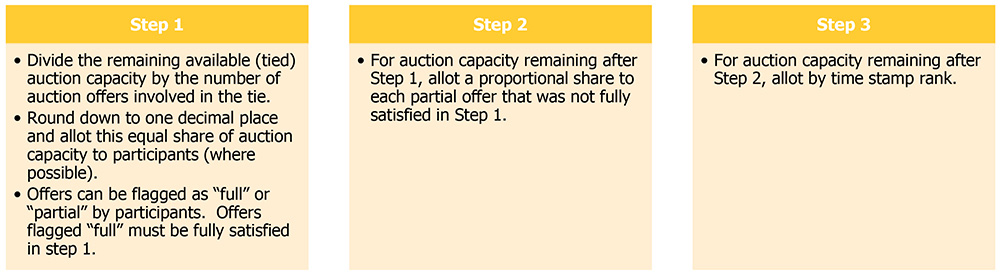
Proposed three-step capacity auction tie-break process | IESO

“The feedback that we received from stakeholders was that there’s a risk in that design that participants could inflate their offer amount in order to try to clear the largest amount possible,” she said. 

As a result, the ISO revised the rules to award an equal share in the first step and apply a proportional allocation in step two, based on what’s left over from step one. 

Zubyck said stakeholders have been “unanimous” that the proposed change is an improvement. 

Michael Pohlod, director of energy markets for Voltus, a virtual power plant operator and DER platform, praised the ISO’s movement on the issue, calling it a “a major concern.”  

But Forrest Pengra, director of strategic initiatives for Seguin Township, noted that the final solutions are not proportional to offers, citing one example in which one supplier would clear 100% of its offer, while two others receive 64 and 48% of theirs. “That, to me, doesn’t seem as an equitable distribution,” he said. 

“You’re not wrong in terms of how it’s distributed,” Zubyck responded. But she said the original plan to proportionally allocate in the first step based on the offer amounts created “the risk of offers being manipulated” to increase the amount cleared.  

Pohlod said the original proposal created a “game theory problem.”  

“You have people wind up clearing more than they wanted because they thought other people were going to offer more proportionately. And this way … creates the right incentive.” 

Zubyck also said stakeholders sought a way to discourage the creation of multiple subsidiary organizations in order to clear more capacity through the tie-break. 

From left, Forrest Pengra, director of strategic initiatives for Seguin Township; Michael Pohlod, director of energy markets for Voltus; and IESO Capacity Auction Supervisor Laura Zubyck discuss revised capacity tie-break rules. | IESO

“We acknowledge this could be a risk: The tie-break methodology does not prevent somebody from creating a subsidiary organization,” she said. “However, it’s one that we can’t address solely through the tie-break methodology. It has larger impacts in the auction that … will be considered more broadly as part of our future enhancement discussions.” 

The Technical Panel is scheduled to vote to post the changes in September, with board approval anticipated in October. The Nov. 26-27 auction will seek capacity for the periods beginning May 1 and Nov. 1, 2026, with results posted Dec. 4. 

No ‘Misalignment’ Seen

In response to questions raised at the Technical Panel’s May meeting by Vladislav Urukov of Ontario Power Generation, IESO officials said they had reviewed the Technical Panel’s Terms of Reference (ToR) and Chapter 3, Section 4.3 of the market rules for consistency.  

Urukov had asked whether provisions for amending market rules were consistent with the “deemed warrants consideration” provision in Section 3.2.1 of the ToR. 

“The deeming provision, although not explicit in the market rules, is supported by the IESO Board’s authority pursuant to market rule S.4.3.6, whereby the IESO Board has authority to direct whether an amendment submission warrants or does not warrant consideration,” IESO’s Paula Lukan wrote in a memo to the TP. “The approval of the ToR in 2017 by the IESO Board, and in particular the inclusion of the deeming provision, constitutes the direction of the IESO Board that all IESO-driven engagements warrant consideration, thereby streamlining the process for most market rule amendments.” 

Lukan said IESO will look more broadly at Section 4 of the market rules to clarify the rule amendment process as part of its initiative to review market rules and manuals not directly affected by the Market Renewal Program. 

“We conducted a review, and while we did not find any misalignment between the rules and the terms of reference, we did identify a number of instances where the market rules could benefit from greater clarity,” said Lukan, who noted that the section hasn’t been updated since Ontario‘s market opening. 

“As a result, for example, it does make reference to consultations and not to stakeholder engagement.” 

“Are we saying that there’ll be no substantive changes to the rules, just clarification that does not in any way change the rules themselves?” Urukov asked. 

“I think that’s right,” Lukan responded. “We did recognize … in some instances it did create a little bit of confusion, but we’re confident that there aren’t any contradictions. It’s just there is an opportunity to clarify the language. So, no substantive changes that we’ve identified so far. It’s really just bringing them up to date, making the language a little simpler. During the [Market Renewal Program] process, this section did not get updated, so there’s definitely opportunity there to make some improvement.” 

FERC Accepts NYISO’s Firm Fuel Tariff Revisions

FERC has approved NYISO’s tariff revisions that change the mechanism by which generators opt in to the “firm fuel” capacity accreditation resource class, enable modeling improvements related to natural gas constraints and update the bidding requirements for capacity suppliers (ER25-2245, ER25-2257). 

The proposal was the subject of months of discussions between NYISO, stakeholders and the Market Monitoring Unit. (See Firm Fuel Proposal Continues to Confuse NYISO Stakeholders.) The Board of Directors approved the revisions in May. 

The revisions, effective July 16, are aimed at shoring up winter fuel as the New York grid transitions into a winter-peaking system. The ISO and the New York State Reliability Council are concerned the downstate gas turbine fleet will find itself competing with home heating for fuel during peak periods. 

Suppliers will have until Aug. 1 each capability year to opt into the firm fuel capacity accreditation resource class. For the first capability year under the new paradigm, 2026/27, NYISO requested — and FERC approved — a slightly later deadline of Nov. 1 for generators to elect as firm to give market participants time to adjust to the changes. 

Generators opting firm must have fuel supply, transportation and replenishment strategies in place by Dec. 1 of the capability year through the end of February. They must be able to run for 56 hours over seven consecutive days during the winter period.  

If a generator is unable to secure firm fuel supplies or if something has gone wrong with the fuel supplier, it is required to notify NYISO. Doing so essentially compensates that generator as if it opted as non-firm. Failure to notify NYISO could result in audit and financial sanctions. 

Failure to perform as required could result in audit and financial sanction if the failure was found to be within the plant management’s control. 

NYISO’s tariff revisions were supported by the Independent Power Producers of New York and Ravenswood Operations. They told FERC that proposal will produce “efficient outcomes that reflect the marginal reliability value of conventional generators” and better address winter reliability risks. 

FERC Faces Challenge in Balancing Executive Order and Legal Requirements

FERC is working to comply with an executive order from President Donald Trump requiring a review of all regulations it’s issued under its major governing statutes. The commission’s former general counsel warned it could be a boondoggle if handled incorrectly.

The order directs FERC and other energy agencies to include sunset provisions in its regulations, to the extent permitted by law. That would require FERC to re-examine them periodically or allow them to lapse, said Matt Christiansen, who was general counsel at FERC during the Biden administration and now is a partner at Wilson Sonsini Goodrich & Rosati.

“The CFR [Code of Federal Regulations] that pertains to FERC is like three or four inches thick,” Christiansen said in an interview with RTO Insider. “It’s at least 1,000 pages. So, we’re talking about a lot of regulations that are potentially subject to this order. That means FERC staff has to spend a huge amount of time determining what would stay, what would go, what would happen to the industry and what would need to follow on if certain regulations are removed.”

That includes fundamental rules that regulate the power industry such as allowing wholesale transactions using market-based rates.

“If the market-based regulations just disappear, it’s not clear what would fill that vacuum and what would happen to regulated entities,” he said.

The U.S. Code is more than 60,000 pages and “unelected agency officials” wrote most of the legally binding rules, which often stretch the statutory provisions beyond what Congress enacted, said the executive order called “Zero-Based Regulatory Budgeting to Unleash American Energy.”

“In particular, the previous administration added more pages to the Federal Register than any other in history, with the result that the Code of Federal Regulations now approaches a staggering 200,000 pages,” the order said. “These regulations linger in such volume that serious reexamination seldom occurs. This regime of governance-by-regulator has imposed particularly severe costs on energy production, where innovation is critical. The net result is an energy landscape perpetually trapped in the 1970s.”

Another big challenge to implementing the order is the Administrative Procedure Act (APA), which under Supreme Court precedent requires agencies to use the same procedures to amend a regulation that they used to enact it, said Christiansen.

“FERC uses notice-and-comment rulemaking to amend the CFR, which entails an opportunity to be heard on every aspect of every provision that’s added or removed from the CFR,” he added. “Then FERC, as part of its reasoned decision-making obligations under the Administrative Procedure Act, owes a non-arbitrary, non-capricious response to all those comments, which is a huge amount of work. I don’t think you can just insert a sunset clause and stop enforcing those provisions or [remove] them altogether.”

That’s potentially a huge task for an agency that has lost staff and is dealing with a federal hiring freeze. Christiansen said FERC already was understaffed, compared to its growing responsibilities, under the Biden administration.

“I think adding such a big task as the EO at least seems to contemplate on its face would be really taxing on staff and could complicate FERC efforts to do some of its bread-and-butter statutory requirements,” Christiansen said.

Christiansen said that there are regulations that could be streamlined, but FERC needs to get the process correct so it doesn’t lead to extended litigation. Chair Mark Christie said the same thing in his press conference following the April open meeting just after the order was released.

“I think the idea of a regulatory house cleaning where you look at all your regulations is a very, very good idea,” Christie said. “We’re already in the process of looking at — for example, we’re starting with regulations that were proposed that never got a final vote. They’re sort of like zombie proposals that somebody at one time thought was a good idea. They got them out as a NOPR [Notice of Proposed Rulemaking], but they just sort of have been there for years.”

Christie was describing proposals that never advance to a final rule because of leadership changes or changing priorities of the chair. But when it comes to rules that actually are finalized, the APA needs to be followed.

“You’ve got to follow it. And whatever we do, I want it to be effective. And I want it to stand up in court, because losing in court is not something I like to do,” Christie said in April. “I want to win in court.”

E&E News by POLITICO published a story on the executive order and got hold of a document circulating among commissioners that offers a potential response. However, FERC votes publicly and, especially with a looming leadership change at the agency with a new chair awaiting confirmation, much could change by the White House order’s deadline of Sept. 30.

Executive orders can have short shelf lives depending on who wins the next election. If this one were to stay in place, it would require regular reviews of major FERC rules such as Order 888, which set up the open access transmission rules, and other foundational orders. Those rules have helped to establish the entire market-based regulatory structure that governs most of the power industry.

“There might be pockets of the industry that are OK with big changes, but I think on the whole the industry would prefer stability rather than the upheaval that I think this rule at least contemplates,” Christiansen said. There are strategies that FERC, if so inclined, “could employ to mitigate some of that uncertainty.”
