Kerry on COP26 Week 2: ‘This Moment is Promising’

After a whirlwind first week at the U.N. Climate Change Conference (COP26) in Glasgow, Scotland, U.S. Special Presidential Envoy for Climate John Kerry was cautiously optimistic about what the delegation could achieve in Week 2.

Bringing the global community together in the “ultimate test of multilateralism” is not easy, he said, but “this moment … is promising.”

“There is a greater sense of urgency at this COP [Conference of Parties]; there’s a greater sense of focus, and I have never in the first few days of any of the COPs I’ve been to counted as many initiatives and as much real money being put on the table,” he said during a press conference Friday.

Coming out of Glasgow at the end of the conference, countries will have “huge follow-on tasks,” but with it they should have “a level of ambition, a statement of goals and the capacity to get where we need to go that we’ve never had before.”

Countries, he said, are cooperating to produce a strong statement on climate goals that can be implemented.

“All of us have seen years of frustration for promises that are made and not kept,” he said. “We understand that, but I believe that what is happening here is far from business as usual.”

Week 1 Status Check

Commitments to reduce emissions and finance a green and resilient transition came at a fast pace during the first week of COP26 through measurable national pledges and public-private initiatives.

Taken together, existing and updated nationally determined contributions (NDCs) and existing and new initiatives would limit global temperature rise to 1.8 degrees Celsius, according to an International Energy Agency analysis released Thursday. Pledges announced prior to COP26, IEA said, would only limit warming to 2.1 C.

Despite the clear progress, IEA estimated that there is still a 70% gap in the emissions reductions needed by 2030 to keep warming to 1.5 C.

National pledges made last week to cut methane emissions could deliver a reduction of 50 million metric tons by 2030, according to Adair Turner, chair of the Energy Transitions Commission. President Biden on Nov. 2 joined other global leaders in leading a global methane reduction effort that is endorsed by 105 nations. (See US, Canada, EU Pledge to Slash Methane Emissions.)

An additional cut of 80 million metric tons is possible by 2030, very little of which is reflected in current NDCs, Turner said. Updated NDCs, as of Friday, could reduce carbon dioxide emissions by 3 metric gigatons (GT), Turner said.

Globally, he added, CO2 emissions need to drop 22 GT by 2030.

A commitment to end deforestation made Nov. 2 by leaders representing 85% of the world’s forests could reduce CO2 emissions by 3.5 GT, according to Turner.

If countries could agree not to build any new coal plants and phase out existing plants by 2030, CO2 emissions could go down by 3.5 GT, but Turner said that doesn’t look possible given commitments made during Week 1 of the conference.

A group of countries got behind a Coal to Clean Power transition statement, but with large countries such as the U.S., India and China not among the signatories, the agreement would only deliver a 0.2-GT reduction by 2030, he said.

While major industry and transport commitments will come in Week 2 of the conference, the Race to Zero framework and auto manufacturer plans would already reduce CO2 emissions for road transportation by 1.5 GT. The U.N.-led Race to Zero campaign started in 2020 to bring together public and private entities to reach net-zero emissions by 2050, with current participants covering 25% of global CO2 emissions.

All NDCs and sectoral commitments on CO2 emissions would deliver a 9-GT reduction of the 22 GT needed, according to Turner. He expects significant CO2 reduction commitments to come in Week 2, including potential progress in the steel, aviation and shipping sectors.

“But we won’t achieve in Glasgow the full 22 GT we need,” he said. “We won’t be able to leave Glasgow saying, ‘Job done; mission accomplished.’”

PNNL: New Climate Pledges Likely to Thwart Worst-case Warming

If fulfilled, the greenhouse gas reduction pledges made just ahead of the UN Conference of the Parties (COP26) “significantly” increase the chance that global warming can be limited to under 2 degrees Celsius by 2100, according to analysis published Thursday in the journal Science.

But the analysis by the Pacific Northwest National Laboratory (PNNL) also makes clear that heavier commitments will be needed to keep warming below catastrophic levels.

“We are so much closer to getting to the 2-degree goal than six years ago when the Paris Agreement was first signed,” analysis co-author Haewon McJeon, a PNNL research scientist said in a statement. “The wave of strengthened climate pledges and net-zero targets significantly increased our chance of staying under 2 degrees Celsius. And we practically ruled out the possibility of the worst climate outcomes of 4 degrees or higher.”

In the same news release, lead author Yang Ou, a postdoctoral researcher at the Joint Global Change Research Institute, said: “We find there’s a roughly one in three chance that we’ll stay under 2 degrees Celsius. But even with increased ambition, we’re still far away from getting down to 1.5 degrees in this century.”

The institute is a partnership between PNNL and the University of Maryland.

“New commitments, technological advances, and the near- and long-term recovery from the pandemic have set us on a different course than what laid before us at the 2015 Paris Agreement,” said co-lead author and PNNL research scientist Gokul Iyer. “But if we adopt more ambitious goals that truly reflect the common but differentiated responsibilities across all parties, that gives us a better than even chance of staying under 2 degrees Celsius.”

“And this highlights the importance of the Glasgow meeting,” Iyer said. “Without periodic and transparent updates, we won’t get the commitments strong enough to meet the temperature goal.”

More than 100 nations have recently made extra pledges to reduce greenhouse gas emissions through their nationally determined commitments (NDC).

PNNL and the University of Maryland concluded that pledges made following the Paris Agreement in 2015 translated into an 8% chance of hitting the 2-degree goal and zero likelihood of holding the global temperature increase to 1.5 degrees. Under the 2015 commitments, the was a 10% chance of global warming increasing by 4 degrees by 2100, the analysis said.

With the latest increased commitments, the analysis concluded the likelihood of limiting global warming to 2 degrees was 34%, with a 1.5% chance of limiting global warming to 1.5 degrees by 2100.

If countries additionally increase their NDCs by 2030, there is a 60% chance of holding global warming to 2 degrees and an 11% chance of hitting the 1.5-degree goal by the end of this century, the researchers said.

Ige, Agencies Update Hawaii Climate Commission

The Hawaii Climate Change Mitigation and Adaptation Commission met last week to recap its progress over the past year, set the stage for the United Nations Conference of the Parties (COP26) and restate Hawaii’s climate goals.

Gov. David Ige opened the meeting to speak about the state’s involvement in COP26, saying that he and a Hawaii delegation will travel to the Glasgow conference to argue three main points: 1) that “islands matter” because they are the “canaries in the coal mine;” 2) that “it’s time for action;” and 3) that “we need to stay below a 1.5 degrees Celsius” rise in the global temperature.

Ige pointed to evidence of Hawaii being at the leading edge of climate risk: “We see the coral bleaching events, we see the rain bombs, the overwhelming flooding, the drought, the wildfires that continue to ravage our community.”

Hawaii “has been on the forefront of this climate challenge for many, many years,” he said, adding that “because other, larger organizations and governments have been timid and unable to take that step forward … We cannot wait for a global solution.”

The governor argued that sequestering carbon will eventually become the most important factor in fighting climate change, telling the commission, “All of you know that net zero is not good enough. It is about going beyond net zero to capture more carbon than we emit.”

Double Crises

Hawaii County Planning Department Director Zendo Kern discussed the financial impact on renters and homeowners from updating building codes for climate change.

“There are two crises that we’re in: We have climate, and we have affordability. The merger of these two together… they don’t jive, on the surface. What we’re doing is we’re increasing the cost of homes through climate adaptation, mitigation, etc. At the same time, we’re saying we need all these homes,” Kern said, adding that the county is projected to be short 13,000 housing units over the next five years.

Kern argued for more a more nuanced building code system that would take coastal impact areas into consideration. “If you’re in a coastal impact area, your code should probably be pretty close to what it is, maybe even ramped up. But if you’re not, what’s wrong with an older style of construction?”

Kern spoke on what he thinks is a lack of data showing that a uniform housing code increases safety, saying, “I don’t think that really exists … What we see is people living in plantation homes, still working great. What we see is people living in single-walled homes, still working great … But if you want to build new, no. You need to bulletproof this thing to the next level.”

Kern said he wants to discuss a tiered system that would allow areas to use more nuanced building codes that allow for more affordable housing construction.

Cleaner Transport

Hawaii Department of Transportation (HDOT) Director Jade Butay reviewed the state’s recent commitment to transitioning its fleet to all electric vehicles via House Bill 552, which requires state agencies to switch all light-duty vehicles to zero-emission by the end of 2035. HDOT is also implementing a pilot program to transition buses to zero-emission on Kauai, Maui and Hawaii island. Butay noted that “a complete conversion to zero-emission buses for the three counties will likely lead to at least a reduction of 15,000 short tons of greenhouse gas production per year.”

Butay also described HDOT’s Climate Adaptation Action Plan, which focuses on reducing road hazards caused by climate change, reducing single-occupancy car rides by supporting public transportation and ride-sharing, and encouraging telework through a pilot program that provides rural communities with broadband internet.

Coal Plant Closure Looms

The Powering Past Coal Task Force, a subdivision of the Hawaii State Energy Office (SEO), gave updates on the shutdown and replacement of Hawaii’s last remaining coal plant, AES Hawaii on Oahu. “We’re now about 10 months away from the retirement and a lot of work has been done, but a lot more needs to happen,” SEO Chief Energy Office Scott Glenn said. (See Hawaii PUC Weighs Oahu Coal Plant Closure Options.)

A few renewable energy projects will still be under construction once the coal plant retires, Glenn pointed out, causing a potential energy shortfall from spring to fall 2023. “There will be a slight decrease in reliability that we are working to address … I’m not talking about necessarily blackouts, but it’s a question of degree in terms of how much reliability we have in terms of the cushion between our normal operating levels and backup power.”

100 Million Trees

The Department of Land and Natural Resources (DLNR) reported on its efforts to “conserve, preserve, and plant” 100 million trees over the next decade.

The work is being done as part of the World Economic Forum’s worldwide “Trillion Trees Initiative” to restore biodiversity and fight climate change through carbon capture.

“We’re doing that primarily through protecting existing forests with watershed fences,” said Natural Resource Planner Leah Laramee. “We’re also conserving private land through legal protections, planting trees to restore existing forests, planting trees to reclaim unused rural lands where forests used to exist, planting trees to advance agroforestry, planting trees in urban areas, and facilitating natural regeneration.”

Other Updates

The University of Hawaii Institute for Sustainability and Resilience presented the state’s views on climate change with respect to equity. Director Makena Coffman said the institute is primarily examining vulnerability, which it defines as adaptive capacity (“the ability to prepare for, respond to, and recover from an event”), sensitivity (“personal factors driving vulnerability”), and enhanced exposure (“environmental factors that mitigate or exacerbate climate impacts”). The institute is gathering and collating data from various local and federal sources, such as the CDC social vulnerability index, to aid in its determinations.

Kauai County Planning Department Director Ka’aina Hull gave an update on the island’s sea level rise (SLR) plans, saying that while planning is still in its preliminary stages, he and his team are going to meet with officials in Boston to discuss that city’s SLR strategy and use the information gained from its plans.

Maui County Senior Planner Jeffrey Dack explained Maui’s plans of strategic retreat, saying that Maui is proposing the county enact a strategic retreat of 40 feet from what they are calling the “erosion hazard line,” meaning areas at risk from coastal erosion once sea level rise has occurred.

PJM MIC Briefs: Nov. 3, 2021

RTO to Propose Review of Regulation Market

Stakeholders at last week’s Market Implementation Committee meeting heard PJM’s plan to win endorsement of a solution to deal with its regulation mileage ratio calculation problem after two proposals failed last month.

Adam Keech, PJM’s vice president of market design and economics, discussed the “logical next steps” of the proposal, which seeks to fix the calculation of the ratio to prevent an undefined condition.

PJM’s performance-based regulation market splits the dispatch signal in two: RegA for slower-moving, longer-running units; and RegD for faster-responding units like batteries that operate for shorter periods. If a signal is “pegged” high or low for an entire operating hour, the corresponding mileage would be zero for that hour. There has been an increased frequency of RegA signal pegging and times the RegA signal is pegged for extended periods, creating a divide-by-zero error in the calculation of the mileage ratio.

The RTO’s proposal, which called for setting the RegA dispatch mileage floor at 0.1 instead of zero, failed in a sector-weighted vote of 2.12 (42.4%) at the October Markets and Reliability Committee meeting, short of the 3.33 (66.6%) threshold for endorsement. A separate proposal from the Independent Market Monitor, which called for a cap of 5.5 instead of 0.1, also failed, receiving a sector-weighted vote of 3.07 (61.4%). (See “Regulation Mileage Ratio Fails,” PJM MRC/MC Briefs: Oct. 20, 2021.)

Keech said PJM heard stakeholders’ desire during the voting process to discuss “more systemic issues” with the regulation market and to examine those issues more closely, so it brought forward a proposal to begin a broader market review. Danielle Croop, senior lead market design specialist at PJM, reviewed the problem statement and issue charge. Keech said they were similar to the ones endorsed and created the former Regulation Market Issues Senior Task Force that last met in 2017.

The key work activities include regulation market education, evaluating the benefits factor curve and proscribed RegA/RegD commitment percentages, and proposing any modifications to the regulation market to address issues raised in the evaluation.

Keech said the review would utilize a new senior task force reporting directly to the MRC. PJM plans on conducting a first read of the problem statement and issue charge at the Nov. 17 MRC meeting.

Once the problem statement and issue charge are approved, Keech said, another vote would take place on the short-term solution proposals from PJM and the Monitor that were not endorsed.

“We could go for a vote of the short-term solutions knowing we have the larger regulation market review that we are going to commence,” Keech said.

Fuel-cost Policy Standards and Penalties

Melissa Pilong of PJM provided a first read of an RTO/Monitor proposal addressing clarifications to fuel-cost policy standards in Manual 15 and Operating Agreement Schedule 2 penalty language developed through the Cost Development Subcommittee.

PJMs-fuel-cost-policy-form-(PJM)-Content.jpgPJM’s fuel cost policy form. | PJM

Pilong said the proposal includes a combination of clarifications and language for more elaboration on PJM’s fuel-cost policies that resulted after the RTO examined the fallout from the February winter storm in Texas and other parts of the South and Midwest.

The proposal calls for market sellers of generation units to verify that all intraday offer triggers are specified in the unit’s fuel-cost policy. Market sellers will also have to verify that weekend or holiday natural gas estimation practices match either the default assumptions in the PJM Fuel Cost Policy Guidelines contained in Manual 15 or specify estimation practices in the unit’s policy.

The Manual 15 updates include changes to the intraday update triggers. In order to opt into intraday offers, Pilong said, market sellers need to have a one-time trigger to update the maximum allowable cost offer.

The committee will be asked to endorse the proposal at its next meeting. PJM is seeking final endorsement by the Members Committee in February and a FERC filing following approval by the Board of Managers.

Manual 6 Revisions

Emmy Messina, senior engineer with the PJM market simulation department, presented a first read of conforming changes to Manual 6 resulting from the endorsement of a proposal to address the RTO’s auction revenue rights and financial transmission rights at the October MRC meeting. (See Stakeholders Endorse PJM ARR/FTR Market Changes.)

Messina said the changes would only impact Manual 6 and include language for bid limits and the network model user guide. They would update section 6.6 to reflect an increase of bid limits from 10,000 to 15,000 per corporate entity, auction round and period in FTR auctions. Section 9.1 would also be updated to direct stakeholders to a new network model user guide on the FTR section of the PJM website to get additional information on the auction.

The committee will be asked to endorse the revisions at its next meeting.

Regulation for Virtual Combined Cycles

Michael Olaleye, senior engineer with PJM’s real-time market operations, provided a first read of a proposal by Vistra to revise to Manual 12 addressing regulation for virtual combined cycle units.

The issue charge was originally endorsed at the May MIC meeting. (See “Virtual Combined Cycle Regulation Issue Charge Endorsed,” PJM MIC Briefs: May 13, 2021.)

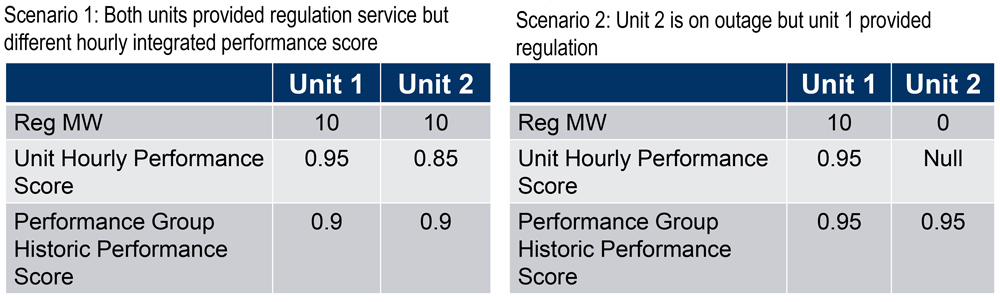
Proposed-performance-group-scoring-using-the-historic-performance-score-calculation-(PJM)-Content.jpgPJM’s examples of proposed performance group scoring using the historic performance score calculation. | PJM

Units that are modeled virtually by PJM can sometimes receive regulation awards from the market clearing engine that vary, Olaleye said, which Vistra has been experiencing with some of its units. When a combined cycle unit is modeled as multiple virtual units, there is a possibility for unbalanced or unequal regulation awards to each unit by the engine.

Vistra’s proposed enhancement to performance group scoring calls for calculating the “hourly” score and extending it to each market resource with an assigned regulation for the given hour. It also calls for PJM to also calculate the “historic” performance score and extend it to each market resource in the performance group.

Olaleye said the enhancements would ensure that all resources of the performance group have the same historic performance score, which should fix the regulation clearing calculation problem in the software.

The committee will be asked to endorse the proposals at its next meeting.

ISO-NE Seeks to Terminate CSO for Conn. Power Plant

ISO-NE put the future of a 650-MW natural gas power plant in eastern Connecticut into potential regulatory doubt when it asked FERC on Thursday to terminate the project’s capacity supply obligation (CSO) in the next 60 days.

In a heavily redacted filing to the commission, ISO-NE said it is exercising its right to seek termination of the CSO for the Killingly Energy Center after consulting with NTE Energy, the Florida-based developer of the project. If FERC accepts the termination, NTE must forfeit any financial assurance associated with the terminated megawatts. Terminated resources also lose their associated CSO and rights to any related payments. It would also make Killingly ineligible for the 16th Forward Capacity Auction in early February 2022.

ISO-NE spokesperson Matt Kakley told RTO Insider that Killingly, which initially secured a CSO in 2019’s FCA 13 for the 2022/23 capacity commitment period, was required to meet several development milestones such as financing, permitting, major equipment orders and commercial operation. Developers facing delays in meeting milestones can find other resources to cover their obligations for up to two years. But if a project is still unable to meet its milestone deadlines after two years, ISO-NE has the right to seek termination of the resource’s CSO through FERC.

“The ISO is exercising this right with regard to the Killingly Energy Center,” Kakley said.

NTE Managing Partner for Development Tim Eves said in a statement to RTO Insider that “while we appreciate all of the work that ISO-NE does, we are disappointed that it has not chosen to come down on our side of this equation.”

“ISO-NE’s determination is based on an incorrect assumption regarding a financing milestone date. Financing for the Killingly Energy Center is imminent, and this filing will only further delay this much needed source of cleaner, more affordable energy,” Eves said. “Killingly is the much needed bridge to the clean energy future, and we will exercise all options available to show FERC that Killingly has not only already commenced its construction schedule but also will be online in time to meet its capacity supply obligation.”

A spokesperson for the Connecticut Department of Energy and Environmental Protection said the agency has long heard “that there have been questions regarding the viability of this project.”

“Clearly, ISO-NE identified things that called into question the project’s ability to reach required project milestones and made their determination to file a resource termination,” the DEEP spokesperson said.

Killingly Opponents React

A divided Connecticut Supreme Court in September upheld a lower court decision to dismiss a complaint from local environmental group Not Another Power Plant that the Connecticut Siting Council acted “improperly” in its decision when it did not account for potential environmental damage from a needed expansion of a pipeline to deliver fuel. The decision was a legal victory for NTE and Eversource Energy (NYSE:ES), the latter of which was expected to rebuild an existing pipeline to deliver gas to the facility. (See Conn. Supreme Court Affirms Lower Court Decision on Power Plant Approval.)

Opponents of the plant welcomed Thursday’s action by ISO-NE.

“People from all over Connecticut have recognized that dirty power generation conflicts with the future we all want and need to avoid the worst impacts of climate change,” Samantha Dynowski, director of Sierra Club’s Connecticut chapter, said in a press release that also captured similar sentiments from other groups opposed to Killingly. “Sierra Club is very hopeful that FERC will accept ISO-NE’s request for termination of the capacity contract for the fracked gas power plant proposed for Killingly and that Connecticut can focus on a clean and climate-friendly future. This is a major step in the right direction for clean air and a livable planet.”

Kate Donnelly, a member of Killingly, Conn.-based No More Dirty Power, said the plant would increase the pollution in a town “with high asthma rates that already houses a fracked gas power plant.”

“Its construction would make it impossible to meet Connecticut’s goals to address the climate crisis, [and] the energy from this plant wouldn’t even be used in our state,” Donnelly said. “For these reasons, people have been fighting construction of the power plant since it was first approved. Even though we were repeatedly told it was a ‘done deal,’ we fought on. With this news, we are hopeful that it is the beginning of the end of the Killingly Energy Center, and we can all focus on meeting our climate goals through energy-efficiency programs and the development of renewable resources.”

Leah Ralls, president of NAACP’s Windham-Willimantic branch, said its membership unanimously passed a resolution opposing the construction of the power plant in April.

“Environmental racism and economic injustice can be defeated when we stand together and work toward development and construction of clean, renewable energy sources,” Ralls said. “Today’s news of ISO-NE’s termination filing for [Killingly] brings us closer to that outcome.”

Northeast RTOs Asked to Run Offshore Transmission Studies

A group of environmentalists and clean energy industry proponents have asked RTOs in the Northeast to conduct an interregional offshore wind transmission study for two distinct regions off the East Coast.

The Clean Energy Advocates presented their proposal at the joint NYISO/PJM/ISO-NE Interregional Planning Stakeholder Advisory Committee (IPSAC) meeting late last month, pushing the need for a study that examines the costs and benefits of an interregional HVDC transmission network for New York and New Jersey, as well as for the line of offshore wind projects running from Massachusetts to North Carolina.

“States are very focused on meeting their internal state goals, and regions are focused on their regions, which is fine, but it doesn’t seem like anyone is talking about this mythical transmission grid … and how all this would work,” Cullen Howe of the Natural Resources Defense Council, part of the group, told RTO Insider.

The group also includes the Sustainable FERC Project, Americans for a Clean Energy Grid, American Clean Power Association, Sierra Club, Advanced Energy Economy, Union of Concerned Scientists and New York Offshore Wind Alliance.

“No one has really kicked the tires on this, so we felt like [IPSAC] was the place that could do it,” Howe said.

Shell Offshore Wind also made a presentation from a developer’s perspective, saying that that the lack of planning is really hindering it, Howe said.

“Timing is a key consideration given that states will proceed with clean energy initiatives before FERC resolves issues in its” Advance Notice of Proposed Rulemaking, Shell said. (See Transmission Industry Hoping for Landmark Order(s) out of FERC ANOPR.)

The Joint ISO/RTO Planning Committee and IPSAC, through the Northeastern ISO/RTO Planning Coordination Protocol, are positioned to provide policymakers with analyses and information in the near term on benefits that may be obtained with enhanced interregional coordination, Shell said.

Federal Backing

Because of the way that interregional projects work generally, it’s hard to get regions to agree on any solution, Howe said.

“Effectively all regions — in this case three regions — would have to agree not just that an interregional solution is the way to go, but exactly what that interregional solution would be, and that often doesn’t happen,” Howe said. “So one of the reasons you don’t see a lot of interregional projects is because … [the parties] often can’t come to an agreement on what a particular solution might look like.”

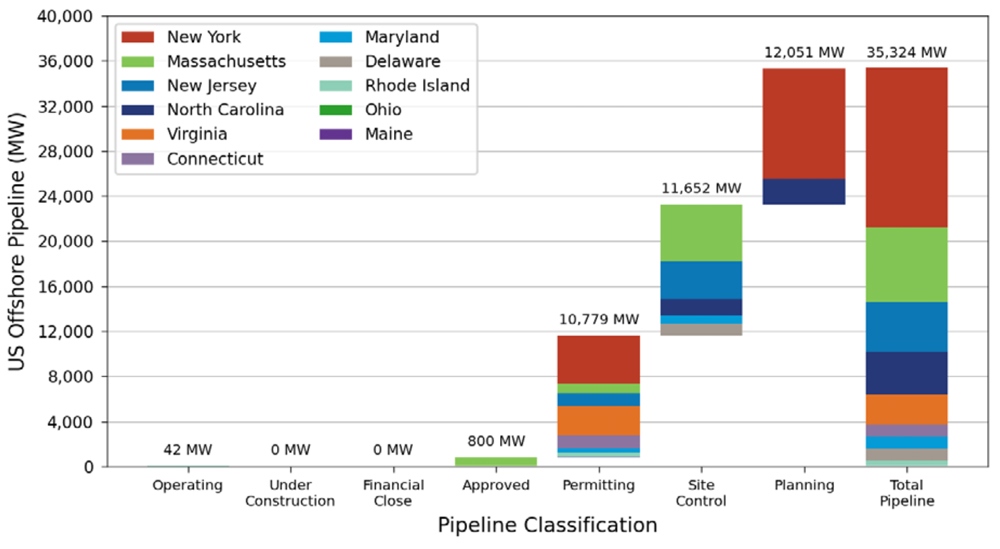
DOE-Offshore-Pipeline-(DOE)-Content.jpgDOE 2021 graph provides the breakdown of development phase by state to meet demand for offshore wind, with projects at various stages. | DOE

The group has a powerful ally in Amanda Lefton, director of the Bureau of Ocean Energy Management. Speaking at a conference in New York last month, Lefton said a planned approach to offshore transmission is going to be critical, and “something that’s been incredibly clear is that we need a strong collaborative effort between states and the federal government.” (See “Powering NYC with Renewables,” New York Writing Ending to Tale of Two Grids.)

The U.S. Department of Energy last month released a report on the gaps that will need to be filled to build enough transmission to interconnect electricity from turbines in the Atlantic to power grids along the East Coast. (See DOE: Atlantic Coast Needs Integrated Transmission Planning for OSW.) The DOE report cited a lack of comprehensive evaluation across all the necessary aspects of transmission planning to support offshore wind energy development at scale.

“Current reactive processes that evaluate individual offshore wind projects may not optimize benefits to support deployment of 30 GW by 2030 and beyond. As a result, comprehensive interregional studies of possible offshore wind transmission options are needed,” the report said.

If RTOs/ISOs are worried about who will pay for the analysis, there is a provision in the Build Back Better bill, passed by the U.S. House of Representatives on Friday, to allocate $100 million for offshore wind planning.

“To do this study right now seems to be a no-brainer because it does seem like you could identify a lot of efficiencies by looking at how [this could] be built out in a way that takes into account limited interconnection points on land, what’s the best way that we can do this, and thinking beyond just one state at a time or even one region at a time,” Howe said.

At some point in the next 20 to 30 years, the U.S. will have a lot of offshore wind projects out in the ocean and operating, he said, so it seems like planners would want to say right now what is the most efficient way to build the needed transmission grid.

The next IPSAC meeting is scheduled for Dec. 4.

Con Edison Q3 Earnings up on Clean Energy Growth

Consolidated Edison (NYSE:ED) on Thursday reported 2021 third-quarter net income of $538 million ($1.52/share), up 9.1% compared with $493 million ($1.47/share) in the same period a year ago, citing strong performance in its Clean Energy Businesses unit.

For the first nine months of 2021, net income for common stock was $1.122 billion ($3.23/share), an increase of 6% compared with $1.058 million ($3.17/share) over 2020.

“Our energy systems delivered world-class reliability this summer. In response to several storm events and heat waves, our team efficiently restored affected customers and are managing the costs of these efforts,” CEO Timothy Cawley said in a statement.

Protecting customers from climate change makes the company’s integrated planning and clean energy investments more critical than ever, he said.

“We continue to lead the transition to a clean energy future, evidenced during the quarter by our solicitation for large energy storage projects, which will allow our customers to maximize the benefits of renewable energy,” Cawley said.

The company reported its Clean Energy Businesses having 3,004 MW of utility-scale renewable energy production projects in service (2,988 MW) or in construction (16 MW), and 72 MW of such projects behind the meter in service (62 MW) or in construction (10 MW). The business unit generated 1,932 kWh of electricity from solar projects for the three months ending Sept. 30, up nearly 16% compared to 1,667 kWh for the same period in 2020.

Rate plans for investor-owned utilities in New York allow them to defer costs resulting from a change in legislation, regulation and related actions that have taken effect during the term of the plans once the costs exceed a specified threshold. The total reserve increases to the allowance for uncollectible accounts from Jan. 1, 2020, through Sept. 30 — reflecting the impact of the COVID-19 pandemic for Consolidated Edison Company of New York (CECONY) electric and gas operations and Orange and Rockland Utilities (O&R) electric and gas operations — were $235 million and $7 million, respectively.

NYISO Looks at Capacity Market Change Cost Impacts

The cost impacts of proposed wholesale capacity market changes topped the agenda of NYISO’s Installed Capacity (ICAP) Market Issues Working Group on Tuesday.

NYISO discussed the methodology used to measure the market impacts of implementing changes to buyer-side mitigation (BSM) rules, while the ISO’s Market Monitor, Potomac Economics, presented an analysis of the effects of capacity accreditation on consumers.

In 2026, capacity market procurement costs would be approximately $5 million below the status quo case using an average accreditation approach, while costs would be $119 million lower using the marginal accreditation approach proposed by the NYISO, Tariq N. Niazi, NYISO senior manager for consumer impact analysis, told the ICAP group.

The ISO is developing a proposal to help keep the capacity market just and reasonable as thousands of megawatts of state-solicited resources come online in New York. The Climate Leadership and Community Protection Act (CLCPA) requires the state to procure large amounts of renewable energy to get to zero-emission electricity by 2040, forcing the wholesale electricity market to adapt.

Several stakeholders forced some new business to the top of the agenda regarding BSM, asking the ISO to explain a request from the Price Responsive Load Working Group for information from demand response (DR) curtailment providers.

The issue stems from NERC and FERC analysis focused on the effect of load-management and load-shed programs on fuel supply infrastructure.

The NERC Standards Committee last month voted to delay approving the draft standard authorization request (SAR) developed in response to a preliminary joint report with FERC on the catastrophic winter storm events in Texas last February until after the final report is published. (See NERC Standards Committee Delays Action on Cold Weather SAR.)

The ISO is working on the issue, Zachary Smith, manager for capacity market design, said. In response to stakeholder interest in DR related to the Comprehensive Mitigation Review, the Analysis Group will be available at the Nov. 8 ICAP Working Group to answer question.

One stakeholder asked whether NYISO considers the study assumptions for DR differently from special case resources, which require a 21-hour notice before dispatch.

“I think we’re looking for false precision in the analysis that we’re doing,” Michael DeSocio, NYISO director of market design, said. “We’re not running an economic expansion analysis here. The analysis is intended to indicate directionally what would happen. The analysis we’ll see from Potomac goes a step further, but again there are limitations on how granular we’re able to get in these analyses.”

Accreditation: Consumer Impact

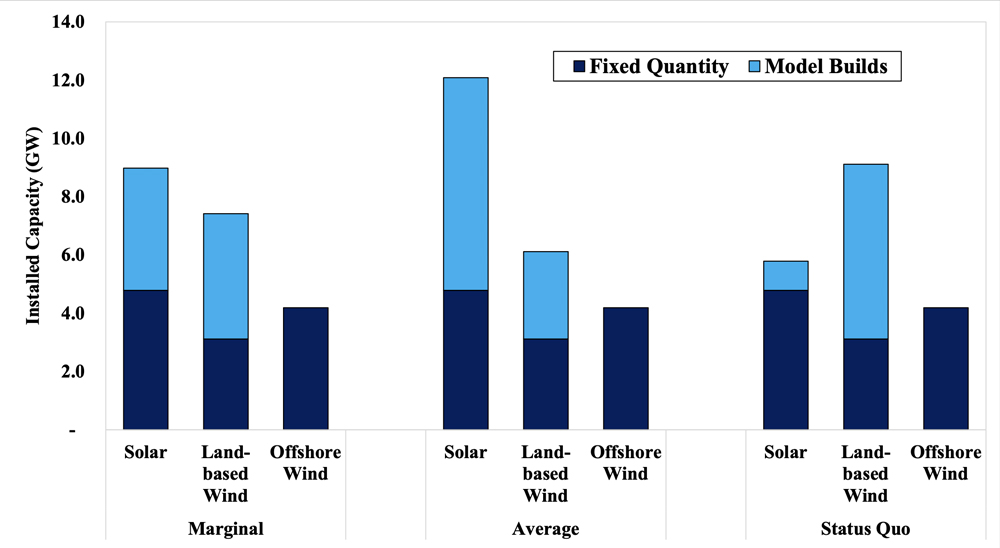
A marginal accreditation approach results in more efficient signals for investment and lower consumer costs than the status quo or an average approach, Joe Coscia of Potomac Economics said.

Intermittent-Renewable-Capacity-(Potomac-Economics)-Content.jpgMarginal accreditation encourages a balanced mix of intermittent.renewables compared to other approaches. | Potomac Economics

Capacity market signals can help guide investment in policy resources at the lowest cost to consumers when renewable energy credits supplement wholesale market revenues, the analysis said.

Efficient accreditation will have more impact as the CLCPA requires larger quantities of investment, and the Monitor supports NYISO’s proposal to apply a marginal accreditation approach to all resources, Coscia said.

“You can’t look at these capacity credit numbers in a vacuum. They are always a product of the resource mix in the case being studied,” he said.

Stakeholders have asked about the period beyond 2030 that Potomac was not able to model explicitly in this study, prompting Coscia to share thoughts on factors that would intuitively tend to affect the results going forward, given the logic of the model.

“All of these things in the context of our model would tend to increase the divergence between accreditation methods going forward,” Coscia said. “Those include larger renewable and storage targets, and the reason would be that with more investment decisions that need to be made, the cost of making inefficient investment decisions is larger.”

Any policy requiring replacement of a larger measure of peaking resources would tend to increase the importance of accreditation, he said.

Consumer savings under a marginal approach would be greater at higher capacity prices because the differences in capacity payments would be magnified, which affects both the incentive effects as well as the total payment differences between methods, Coscia said.

“Higher load growth or changes in load pattern would tend to increase the importance of efficient accreditation, whether that’s just high load going forward or maybe something like a shift towards a winter peaking system,” he said.

Finally, application of enhanced accreditation methods to other technologies such as gas-only units or inflexible units would tend to produce values for those resource types that would decline more under a marginal approach than under an average approach or the status quo, which doesn’t apply any discount to those resources — also increasing the consumer savings under a marginal approach.

“For these reasons we believe that the advantage of marginal accreditation over other methods is likely to increase beyond 2030, and so the numbers that we presented here likely are conservative,” Coscia said.

California PUC Approves More Gas at Aliso Canyon

Concerned about a shortage of natural gas this winter, the California Public Utilities Commission on Thursday made the controversial decision to increase the maximum amount of gas stored at the troubled Aliso Canyon underground facility by more than 7 billion cubic feet.

The unanimous decision came after nearly two hours of public testimony, much of it emotional, from residents who live near the site of one of the worst methane leaks in U.S. history. From October 2015 to February 2016, a ruptured pipe at the SS-25 well spewed more than 100,000 tons of natural gas into the atmosphere, leading to a blowout. The leak was contained after four months and multiple failed attempts.

“My family and I still suffer daily from the physical and mental health effects of the Aliso Canyon blowout,” Dan Labudas, a resident of the adjacent Porter Ranch community, told the commissioners. “Back in 2015, when the leak occurred, we suffered from nosebleeds, stomach aches, headaches, nausea and other physical and mental ailments. The four months it took to seal the leak were some of the most stressful and devastating months for my family and community.”

The ailments Labudas described were common to many residents living near the facility. In late September, SoCalGas and its parent company Sempra Energy agreed to pay $1.8 billion to settle the claims of 35,000 victims of the leak.

Labudas on Thursday urged the CPUC to deny any increase in storage limits and to shut down Southern California Gas Co.’s sprawling underground facility, a main gas supply for the Los Angeles Basin.

The CPUC’s original proposed decision called for increasing Aliso Canyon’s storage limits from 34 billion cubic feet to nearly 69 billion cubic feet. Commissioner Martha Guzman Aceves offered an alternative that would allow an increase to just over 41 billion cubic feet, enough to ensure reliability this winter for ratepayers in Southern California, she said.

The decision is “very limited to the winter interim storage levels,” Guzman Aceves said.

Unpredictable weather and a strained gas supply this year made the measure necessary, she said.

“For a good year-and-a-half now, we have seen the very high fluctuations in our changing climate that many of us thought would be unlikely in the past,” Guzman Aceves said. “The extreme weather events have become more and more likely. The extreme heat in the state and the continued drought has greatly impacted the availability of hydroelectricity and, unfortunately, has created greater short-term dependency on natural gas generation. And of course, in addition to extreme heat, there’s the potential for the other extreme, and that is the cold winter.”

Some public commentors mentioned February’s Texas deep freeze and widespread power outages, Guzman Aceves noted. California was fortunate to be having a warm winter at the time but “if we were to get one of those events again this winter, and California was experiencing cold winter days at the same time as the rest of the West,” it could create reliability concerns and the possibility of curtailments, she said.

The CPUC is in a multi-phase process of studying the effects of closing Aliso Canyon and the alternative resources needed to compensate; the latest in a series of workshops was held Wednesday. Guzman Aceves, the assigned commissioner in the effort, said the CPUC remains committed to decommissioning Aliso Canyon or limiting its role.

“Our decision today helps ensure energy reliability for the Los Angeles Basin this winter in a safe and reliable manner,” she said in a statement following the vote. “We continue to move forward on planning how to reduce or eliminate the use of Aliso Canyon, and to ultimately reduce our reliance entirely on such natural gas infrastructure as we transition to a clean energy economy.”

California’s two Democratic senators, Dianne Feinstein and Alex Padilla, earlier this week called for the permanent closure of Aliso Canyon “to protect the safety of Californians.”

“It is critical that the California Public Utility Commission outline concrete steps to close this facility while ensuring the reliability of our power grid as we continue the transition to cleaner electricity, heating and cooling,” Feinstein and Padilla said in a joint statement.

PJM PC/TEAC Briefs: Nov. 2, 2021

Planning Committee

Winter Weekly Reserve Target Endorsed

PJM stakeholders unanimously endorsed the results of the 2021/22 winter weekly reserve target analysis at Tuesday’s Planning Committee meeting.

Patricio Rocha Garrido, of PJM’s resource adequacy planning department, reviewed the results of the analysis, saying the numbers differed slightly from 2020/21 because of more uncertainty in the modeling. Rocha Garrido first presented the analysis numbers at last month’s PC and Operating Committee meetings. (See “Winter Weekly Reserve Target Update,” PJM Operating Committee Briefs: Oct. 7, 2021.)

Members also unanimously endorsed the analysis at Thursday’s OC meeting.

The targets for December, January and February are 24%, 27% and 21% respectively, compared to 23%, 27% and 23% last year. Rocha Garrido said the December value increased slightly because PJM sees more load uncertainty in the modeling, while February’s decrease is a result of less load uncertainty.

PJM staff use the targets, which are part of the reserve requirement study, to help coordinate planned generator maintenance scheduling over the winter months. Rocha Garrido said the purpose of the targets is to “cover against uncertainties” related to load and forced outages, ensuring that the loss-of-load expectation (LOLE) for winter is “practically at zero.”

The winter weekly reserve target for each month is the highest weekly reserve percentage, rounded up to the next integer value. Rocha Garrido said the targets are only recommendations to PJM’s operations department.

Manual Endorsements

Several manual updates stemming from the biennial cover-to-cover review also won unanimous stakeholder endorsement. The updates were first presented at the October PC meeting. (See “Manual First Reads,” PJM PC/TEAC Briefs: Oct. 5, 2021.)

Michael Herman, of PJM’s transmission planning department, provided a review of Manual 14B: PJM Region Transmission Planning Process Update, including the addition of a new section that features details around the incorporation of end-of-life (EOL) needs in the Regional Transmission Expansion Plan, which were part of the tariff attachment M-3 discussions.

FERC in December rejected a stakeholder proposal to move EOL projects under PJM’s planning authority, siding with transmission owners who argued that it would violate their rights. (See FERC Rejects PJM Stakeholder EOL Proposal.) The commission also accepted the TO sector’s tariff amendments concerning EOL projects in August 2020, rejecting arguments in rehearing requests by more than a dozen load-side stakeholders. (See FERC Accepts PJM TOs’ End-of-life Revisions.)

John Reynolds, of PJM’s resource adequacy planning department, reviewed minor changes to Manual 19: Load Forecasting and Analysis. Reynolds said the most significant change was adding battery storage to the list of forecasted items in the load forecast model overview in Section 3.1, which already includes distributed solar generation, plug-in electric vehicles and historical weather patterns to estimate growth in peak load and energy use.

Joseph Hay, of PJM’s infrastructure coordination department, reviewed the updates to Manual 14F: Competitive Planning Process, saying the changes were necessary to correct the proposal fee structure in the manual to conform to the Operating Agreement.

Hay said the language in Manual 14F was not in agreement with the latest changes to the OA, which states, “All proposals in any RTEP window are subject to a nonrefundable deposit of $5,000, except for project proposals submitted with cost estimates of $5 million or less. In addition to the $5,000 nonrefundable deposit, the proposing entity must pay all actual costs incurred by PJM to evaluate the submitted project proposal.”

The manual changes now go to the Nov. 17 Markets and Reliability Committee meeting for endorsement.

Transmission Expansion Advisory Committee

Generation Deactivation Notification

Phil Yum of PJM provided an update on recent generation deactivation notifications.

PJM has received a “good amount” of deactivation requests in the last month in the PPL transmission zone, he said. Those requests include:

  • Williamsport CT 1 and 2 oil-fired units, with a total of 26.6 MW of generation;
  • West Shore CT 1 and 2 oil-fired units, 28 MW;
  • Lock Haven CT 1 oil-fired unit, 14 MW;
  • Jenkins CT 1 and 2 oil-fired units, 27.6 MW; and
  • Fishbach CT 1 and 2 oil-fired units, 28 MW.

The requested deactivation date for these units is April 1, 2022.

Several other units in the PPL transmission zone have a requested deactivation date of June 1, 2022. Those units include:

  • Martins Creek CT 1, 2 and 3 oil-fired units, 57.3 MW;
  • Harrisburg CT 1, 2 and 3 oil-fired units, 41.1 MW; and
  • Allentown CT 1, 2, 3 and 4 oil-fired units, 56 MW.

Four different units in the Dominion transmission zone were also added to the deactivation list, with a requested date of June 1, 2023. They include:

  • Rockville CT diesel unit, 4 MW;
  • Lanier CT 1 diesel unit, 7 MW;
  • Dinwiddie CT 1 diesel unit, 3 MW; and
  • Weakley CT diesel unit, 7 MW.

A reliability analysis was completed for all units, and no violations were identified.