NEWPORT, R.I. — When a winter storm hit Texas in February, followed by devastatingly low temperatures, it set off an unmitigated catastrophe on its power grid that could have been alleviated by effective grid modernization, said Travis Kavulla, vice president of regulatory affairs for NRG Energy, one of the largest providers in Texas.
It led to a situation of haves and have nots in terms of who was in the dark when more than 20,000 MW of demand went unserved, Kavulla, a former Montana Public Service Commissioner, said during a panel Friday on grid modernization that closed the 73rd New England Conference of Public Utilities Commissioners.
“If people were able to rotate outages 12 hours at a time over the length of the event, I think it’s safe to say that we would not have seen the fatalities that we did; even if it would have been an enormous inconvenience, a huge failure in the industry all the same, but it would not have had the catastrophic consequences on human life.”
Texas is more advanced than New England in the deployment of smart meters, but Kavulla said they were not “operationalized at all” during the February storm. “You can use those smart meters to automatically disconnect customers; that’s functionality that they are deployed for in Texas today.”
Utilities, however, were not in a position to do that and turn them back on instead of “simply dropping entire circuits altogether,” Kavulla added. “What happened was if you got a critical customer on a particular circuit, that circuit could not be shed, and neighboring circuits had to be shed. That led to this have-or-have-not situation.”
NRG gathered 40 years of usage data on 5,000 residential customers in Texas. During the winter storm, these customers did not lose power but used double the electricity than when the temperature was higher than 90 degrees Fahrenheit.
“What happened in Texas was a huge surge in demand. If all the demand has been served in the state of Texas, it would have set an all-time peak record in the winter, but across all years and seasons in a state that often thinks of itself for a good reason as summer-peaking,” Kavulla said. “This demonstrates that if you could cycle electric heat effectively through the deployment of smart thermostats, you would have been able to keep more customers online and keep their homes if not toasty then at least livable.”
Angela Amos, director of market development and regulatory innovation for Uplight, said customers should not have an antagonistic relationship toward their utility or the deployed technology inside their home.
“The way that you can improve that process is to help people understand what options are available to them, what they can install in an affordable way, of course, so that they are pre-emptively prepared to participate before things go wrong,” Amos said.
Theresa Gilbert, vice president of external affairs for software company Utilidata, said that baseline expectations need to be reframed by utilities. Gilbert said the current utility infrastructure was built predominantly using hardware.
“I think we need to look at the dynamic of now what is the combination of hardware and software solutions,” Gilbert said. “There’s a lot we can do in terms of using real-time data to manage that load before you get to a point where you need to upgrade a transformer.”
Kavulla said New England has set up a retail market to drive competitive suppliers to build a commodity and not do a lot of innovation. In contrast, different retail market designs leverage the innovation of the competitive market, he said.
“Candidly, one of the ironies is that I talk to a lot of state regulators about wholesale market design, [but] it sometimes feels like state regulators spend more of their time talking about wholesale market design that they don’t regulate, and not enough time talking about the retail market design over which they have exclusive jurisdiction,” Kavulla said.
U.K. Prime Minister Boris Johnson called on world leaders at the United Nations Climate Conference in Glasgow to phase out gasoline-powered cars by 2035 and end the use of coal-fired power plants by 2040 in the developing world and 2030 in richer economies.
Brianna Fruean, a young climate activist from Samoa, reminded leaders that “climate action can be vastly different from climate justice” and challenged them to summon the “political will to do the right thing, to wield the right words and to follow it up with long overdue action.”
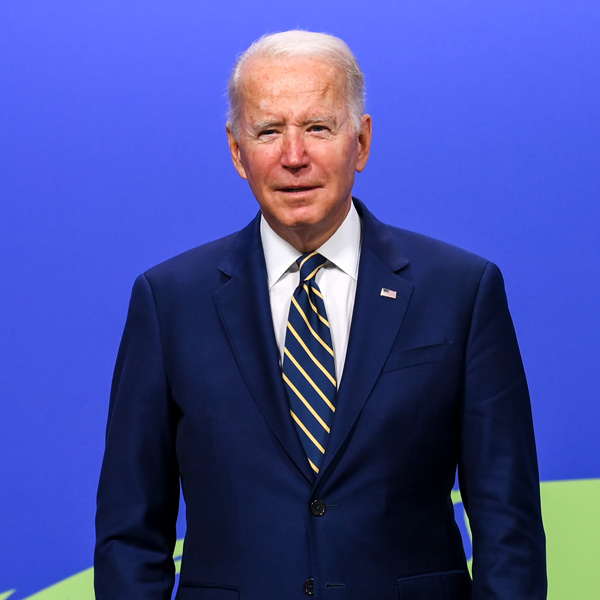
President Joe Biden | COP26
U.S. President Joe Biden announced the launch of the Global Methane Pledge — a U.S.-European Union initiative — to cut methane emissions 30% from 2020 levels by 2030. He also pledged the U.S. to make contributions to climate finance for developing nations and called on others to do the same. “Right now, we’re still falling short. There’s no more time to hang back or sit on the fence or argue amongst ourselves.”
The voices coming out of the World Leaders Summit at the UN 26th Conference of the Participants (COP26) on Monday were uniformly urgent and compelling, raising alarms and rallying the world community to immediate action to limit the earth’s warming to 1.5 degrees Celsius — the goal set by the Paris climate accords at COP21 in 2015.
“The six years since the Paris climate agreement have been the six hottest years on record,” said UN Secretary-General António Guterres, speaking at the summit’s opening plenary. “Recent climate action announcements might give the impression that we are on track to turn things around. This is an illusion.”
The UN’s most recent report on existing pledges to climate action — called “nationally determined contributions” — “still condemn the world to a calamitous 2.7-degree increase,” he said. “If commitments fall short by the end of the COP, countries must revisit their national climate plans and policies not every five years, [but] every year, every moment until keeping to 1.5 degrees is assured, until subsidies to fossil fuels end and until there is a price on carbon and coal is phased out.”
Other speakers at the plenary — a mix of world leaders and young climate activists — laid out major themes and pathways for action coming out of Glasgow.
Echoing Guterres, Britain’s Prince Charles called for a carbon tax and “making carbon capture solutions more economical.” Private sector involvement and investment would also be essential, he said.
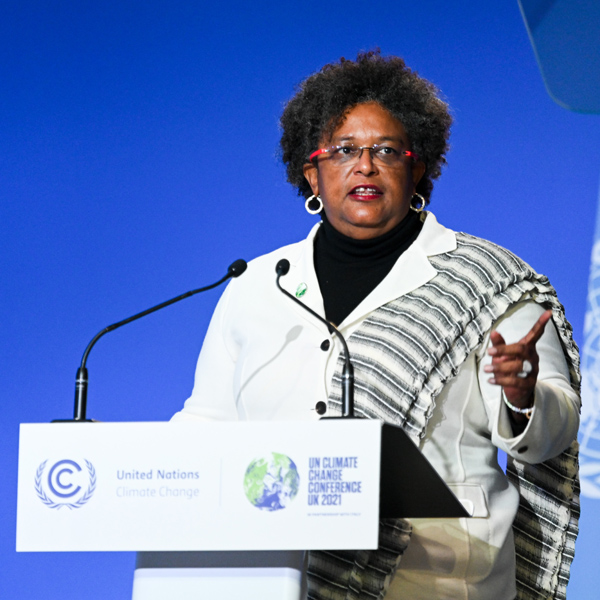
Barbados Prime Minster Mia Mottley | COP26“We need to bring together global industries to map out in very practical terms what it would take to make the transition” from coal to clean energy, he said. “Second … we need to align private investment behind these industry strategies. If we can develop a pipeline of many more sustainable, bankable projects at a sufficient scale, it will attract greater investment.”
Mia Mottley, prime minister of Barbados, pushed Western, developed economies to live up to their Paris commitments to provide $100 billion annually to help developing nations transition to clean energy and split the costs of climate adaption 50/50.
“Failing to provide the critical finance … is measured, my friends, in lives and livelihoods in our communities. This is immoral and unjust,” Mottley said. “Are we really going to leave Scotland without the result and the ambition that is sorely needed to save lives and to save our planet?”
U.S. Commitments
Biden’s moment on the COP26 stage came during the first plenary session in which national leaders made their new nationally determined commitments, citing the climate investments and clean energy tax credits in the still-to-be-passed budget reconciliation package and bipartisan infrastructure bill — and the jobs these measures would create.
He also talked up the U.S.-EU Global Methane Pledge, calling methane reduction a simple and “most effective strategy we have to slow global warming in the near-term.” Seventy nations so far have signed on to reduce their methane emissions 30% by 2030, Biden said, while encouraging others to join.
In addition to the U.S. commitment to cutting greenhouse gas emissions 50 to 52% by 2030, Biden also pledged a new level of support for climate finance and adaptation for developing nations — a proposed $3 billion per year. Biden will work with Congress to begin the payments in 2024, according to the new President’s Emergency Plan for Adaptation and Resilience (PREPARE), released by the White House on Monday.
Biden also announced a new report on U.S. long-term strategies for reaching the country’s 2030 and 2050 climate goals, laying out an approach that provides multiple pathways for achieving a 100% decarbonized grid and net-zero economy. Key components range from grid decarbonization and transportation electrification, to a ramp-up of carbon-removal technologies and cutting energy waste so that new technologies can “use less energy to provide the same or better service. The report envisions a changing balance of the core strategies, depending on market and other variables.
“We’re planning for both a short-term sprint to 2030 that will keep 1.5 degrees Celsius in reach and for a marathon that will take us to the finish line and transform the largest economy in the world into a thriving, innovative, equitable and just clean energy engine,” Biden said. The strategy “reinforces the absolutely critical nature of taking bold action within the decisive decade,” he said.
The Republican reaction to the president’s speech was swift and predictable. In an email statement, Sen. John Barrasso (R-Wyo.), ranking member of the Senate Energy and Natural Resource Committee, said the long-term plan would “kill abundant and affordable U.S. energy sources like oil, natural gas and coal that Americans depend on. The White House’s plan is a recipe for disaster. It will result in skyrocketing power bills, less reliable energy and fewer jobs for the American people.”
‘Things Remain Unchanged or Get Worse’
The urgency of the message at COP26 was echoed in the climate communique coming out of the summit of the world’s 20 largest economies in Rome on Sunday. The G20 countries agreed to limit global warming to 1.5 degrees “with immediate action and mid-term commitments,” Italian Prime Minister Mario Draghi said during the group’s closing press conference Sunday. (See COP26 Opens as G20 Finalizes Climate Communique.)
For the first time, Draghi said, the G20 countries recognized the scientific validity of a 1.5-degree target and indicated that carbon neutrality should be met by 2050. In addition, he said, the G20 agreed to phase out global public funding and support for non-abated coal-fired plants after the end of this year.
But speaking at COP26, Draghi said more is needed — “a quantum leap” in climate action, particularly in climate finance. “We must bring together the public and the private sector in new ways,” he said. “We need first and foremost all multilateral development banks and especially the World Bank [to] co-share with the private sector risk that the private sector alone cannot bear.”
UN Secretary-General António Guterres | COP26
President Juan Orlando Hernández of Honduras, however, remained skeptical that the strong words of G20 leaders would result in the kind of solid financial help his country needs. Between 2014 and 2021, drought in Honduras “generated annual economic losses of $453 million, which is 1.7% of our GDP, which has given rise to food insecurity and nutritional insecurity,” Hernández said.
Still, Honduras is investing about $2 billion per year in climate action, “only 5% of which comes from loans or grants” he said. “And what is most frustrating is to come to these summits and many others and to see things remain either unchanged or get worse.”
“Even with scaled-up global climate action, it will not be possible to avoid and to reduce all loss and damage from the impacts of climate change,” President Uhuru Kenyatta of Kenya said. “By 2030, economic costs of loss and damage in developing countries is expected to be between $290 billion and $580 million throughout Africa as the most vulnerable continent to the impacts of climate change.”
Kenyatta voiced disappointment that the “special needs and circumstance of Africa” were not included in the official COP26 agenda. “With climate impacts increasing, provisions to help the most vulnerable to adapt, including through increased financial support, should be strengthened,” he said.
WASHINGTON — Electric transmission providers are pinning their hopes for long-sought-after changes on FERC’s Advance Notice of Proposed Rulemaking, a sweeping inquiry into the commission’s rules on transmission planning, cost allocation and generator interconnection (RM21-17).
Attendees of transmission trade association WIRES’ Fall Conference on Thursday peppered FERC Commissioner Allison Clements at the Willard InterContinental Washington hotel, just blocks from the White House, with questions about the ongoing proceeding, which drew hundreds of comments last month. (See FERC Tx Inquiry: Consensus on Need for Change, Discord over Solutions.)
The organization also drew four former FERC commissioners to the event to give advice for commission staff working on the proceeding, as well as recount their experiences working on the commission’s landmark transmission orders.
There seemed to be an expectation among panelists and attendees alike that whatever comes out of the ANOPR will be significant.
“You understand the pace of regulatory change,” Clements told attendees in a keynote speech opening the conference. “You understand that this is our bite at the apple. And that’s why I think we do need to go big.” She cited concerns about recent extreme weather events and preventing severe climate change. “It’s really an important moment to think about big ideas, creative ideas, and we’re looking for those in the record. … This is the chance to pivot the ship.”
But what exactly that action is and what form it will take is still guesswork. Many speakers cautioned that it will likely take at least a year before the commission reaches any final rule, as it asked hundreds of questions and received so many comments. It’s also possible that the commission issues several orders, each taking on specific issues, rather than a massive, holistic one, they said.
They also noted that while the ANOPR’s issuance was unanimous among the four sitting commissioners, Republicans James Danly and Mark Christie issued separate concurrences expressing their individual concerns; Clements and Chair Richard Glick issued a joint concurrence. (See FERC Goes Back to the Drawing Board on Tx Planning, Cost Allocation.)
Joseph T. Kelliher, former FERC chair under President George W. Bush, said the proceeding looks more like a Notice of Inquiry at this point than the form of a preliminary proposal that an ANOPR usually takes. “The ANOPR asks [some] extremely high-level, 50,000-foot[-high] questions,” he said. “There are some proposals in there, but because of the concurrences, it’s hard to say that those are commission proposals. … There is much more division among the commissioners than was true for [Order] 890, Order 1000 and Order 2003.”
Kelliher said “the worst possible outcome would be to slap together a NOPR that’s rushed and then issue a final rule that’s also [rushed] under the logic of, ‘Well, we’ll fix it on rehearing.’ That’s an expression at FERC that I hate. … I would hope that they’re not driven by an arbitrary deadline because it’s so much better to spend the time and sweat the details to get out a really good proposed rule, and perhaps the final rule could be issued relatively quickly.”
He and the other former commissioners also advised that FERC focus any proposed rulemakings on specific, solvable problems.
“Keep it focused on concrete things that are squarely within the commission’s jurisdiction and that you have a very good grasp on,” said Tony Clark, a senior adviser for Wilkinson Barker Knauer. “To the degree that orders start to push the bounds of that and get into controversial or nebulous areas, you’re increasing the chances of dissenting votes.”
“The more focused the rulemaking is, the easier it is,” said Suedeen Kelly, a partner with Jenner & Block and co-chair of its energy practice. “This is not a focused rulemaking; however, the less focused it is, the more important it is to go through the rulemaking process — and the harder it is. … This one is going to be a big burden” for staff.
Marc Spitzer, partner with Steptoe & Johnson, counseled being mindful of changed circumstances and unintended consequences. He recalled that Order 1000, issued in 2011, was partially in response to the 2008 elections, in which Democrats won control over both houses of Congress and the White House.
The status quo in 2008, in which transmission was built by vertically integrated utilities within their own jurisdictions in reaction to new generation projects, “worked pretty well,” he said. But Spitzer expected Democrats to pass cap-and-trade legislation, “which would radically change the transmission grid [and] fuel mix. … So that was the problem we were trying to solve with Order 1000. And of course, circumstances change.” The Waxman-Markey Bill, which would have set up such a cap-and-trade system, failed, and many new technologies, notably distributed energy resources, became more prominent as FERC worked on the rule, Spitzer said.
Spitzer, a Republican, also urged the commission to work toward consensus. He noted that he voted for Order 1000 with the majority, breaking with his Republican colleague Phil Moeller, who issued a partial dissent. Spitzer had offered amendments that the majority agreed to work into the order. A former Arizona state legislator and regulator, he said “if you’re going to offer an amendment, you have to vote for the bill. Would you rather get 50% of something, or 100% of nothing?”
Addressing the audience, Kelly said, “If I were your lawyer, what I would say is that you should not only use the comments as a way to effectively advocate your position, but you should go talk to staff, because they’re going to have a lot of comments to read and sift through and create a record around, and it’s going to be hard to get all those into one collective mind, but even harder to decide what are the most important things.”
Back in the Room
Many attendees could be overheard during coffee breaks and meals expressing wonderment over being in the same room again and their fatigue with virtual meetings. For many, it was their first time being at a gathering since the onset of the COVID-19 pandemic early last year, which led to event cancellations, restricted travel and social distancing.
All attendees were required to present either proof of vaccination or a negative COVID test with the past 72 hours. They were also required to wear masks when walking in the hotel’s hallways, and all but a few continued to wear them as they listened to speakers and panelists. But during the post-event lunch, there was a sense of optimism about future in-person events.
“There is no substitute for personal interaction,” Spitzer told moderator Larry Gasteiger, executive director for WIRES. “We’re in an unprecedented time of polarization” in government. “I don’t know if the drivers of the polarization will abate, but the tone and tenor of the discussion is better when you look people in the eye.”
This optimism also led to a bit more humor among panelists than at your average energy conference, especially among the former commissioners.
Kelliher joked that early in his tenure at FERC, Kelly told him the commission needed to work on “the queue,” meaning backlogged generator interconnection queues. He did not know what she was talking about, joking that perhaps she was referencing Q, a mysterious, mischievous alien character in “Star Trek.”
Speaking about the challenges of siting interstate transmission, Spitzer recalled meeting in 2007 with the superintendent of the Gettysburg Battlefield, which lay in the Department of Energy’s recently announced Mid-Atlantic Area National Corridor. The superintendent warned that if a transmission line were built through the battlefield, it would be worse than the carnage from the battle itself.
FirstEnergy (NYSE:FE) is close to a deal with “quality investors” to sell a minority interest in its profitable transmission company, officials said Friday during the company’s third quarter earnings call.
“Currently, we are engaged in a process to sell a minority interest in our transmission holding company, FirstEnergy Transmission,” CFO Jon Taylor told analysts. FET owns American Transmission Systems Inc., Mid-Atlantic Interstate Transmission and Trans-Allegheny Interstate Line.
“The interest is very strong, and preliminary indications are very supportive of our financial plan and targets. But given where we are in the process, we can’t comment any further on the details,” he said.
When pressed later in the call for more detail, Taylor declined to give specifics but described the investors potential buyers as “top-notch quality firms.
“And they’re very supportive of the business plan and very supportive of future transmission opportunities,” he added.
Published reports since the company’s second quarter earnings call in August when the sale of a minority interest came up have estimated FirstEnergy could sell nearly a 20% interest in the transmission company for as much as $2.5 billion.
The company broached the idea in April, telling analysts during the first quarter earnings call that selling a minority interest in one of its subsidiaries — as Duke Energy sold 19.9% interest in its Indiana subsidiary — was something it might consider as a way to raise cash without issuing common equity.
Rating agencies downgraded FirstEnergy credit ratings to “junk status” in November 2020 after some of its subsidiaries borrowed $2 billion from a revolving credit facility.
The company last month completed a reorganization of the credit facility, prompting an S&P rating uptick back to investment status for the corporation’s 10 utilities and three transmission companies. S&P kept a “credit watch” on the companies, however.
“The 2021 credit facilities provide for aggregate commitments of $4.5 billion and are available until October of 2026,” Taylor said.
“While we’re glad to return to investment grade ratings for these companies with all three rating agencies, we remain committed to improving our balance sheet and the overall credit profile at the parent company,” Taylor said.
Key to that is achieving a 13% ratio of funds from operations (FFO) to debt, and the company will do that, he said.
“During the fourth quarter, we expect to provide you with 2022 guidance and a detailed capital plan along with the runway of our FFO to debt target, longer term capital forecasts and targeted rate base and earnings growth rates,” Taylor said.
The Numbers
FirstEnergy reported third quarter earnings of $463 million ($0.85/share) on revenue of $3.1 billion.
In the third quarter of 2020, the company earned $454 million ($0.84/share) on revenue of $3 billion.
Excluding the impact of one-time or special charges or credits, the company earned $0.82/share — exceeding the top end of the company’s guidance. In the third quarter of 2020, operating earnings were $0.84/share.
FirstEnergy updated its full-year 2021 earnings forecast range to $1.17 billion to $1.22 billion ($2.14 to $2.24/share).
The company expects cash from operations for the year of about $2.8 billion. That total includes expenses such as the $230 million fine the company paid the Justice Department in a plea deal to avoid prosecution in the $61 million bribery probe, which the DOJ has continued.
FirstEnergy announced Monday after the close of business that it had agreed to settle a yearslong battle with the Ohio Consumers’ Council, the Northeast Ohio Public Energy Council and eight other consumer and business groups over extra charges levied since 2013.
The company filed a negotiated stipulation settling 10 separate cases pending before the Ohio Public Utilities Commission. The agreement, which must be approved by the commission, calls for FirstEnergy to refund $306 million, some of that in immediate cash refunds.
The deal, supported by the staff analysts at the PUC, calls for FirstEnergy’s Ohio utilities to refund $96 million (which includes interest) related to the utilities’ 2017-2019 annual excessive earnings review.
Residential customers would receive a one-time bill credit of about $27. Commercial and industrial customers would be given a credit of about $2.60/MWh used over six months. The remaining $210 million would be refunded as bill credits from 2022 through 2025.
PSEG is hoping that an eight-year energy tax credit in President Biden’s Build Back Better legislation will support the company’s three nuclear plants while New Jersey’s offshore wind industry — and the utility’s place in it — develops and the sector begins supplying clean energy.
On the utility’s third quarter earnings call on Tuesday, CEO Ralph Izzo said that the company is “hopeful” that Congress will pass the budget reconciliation legislation soon. The bill would provide a production tax credit of $15/MWh, with the value declining over time, he said.
“Moving forward, there needs to be broad recognition at both the state and federal level of the value of nuclear’s zero-carbon attributes, both for the quality of air today and the climate tomorrow,” Izzo told the call. “To avoid backsliding for decades to come, we need to ensure that the long-term viability of New Jersey’s nuclear generation is preserved as we bring more clean energy resources into the mix.”
Biden has struggled to secure the votes for passage of the legislation, a spending package of about $1.75 trillion, in large part because of differences between Democratic moderates and progressives about how big the bill should be and which elements should take priority. A Monday press conference by Sen. Joe Manchin (D-W. Va.) once again put the bill’s passage in doubt, but at Tuesday press conference in Glasgow, Biden said he believes Manchin will sign.
If enacted, the subsidies would support Hope Creek nuclear power plant, which PSEG owns and operates, and the Salem 1 and Salem 2 plants, which the utility operates and co-owns with Exelon. All three plants are located in South Jersey.
The state’s Board of Public Utilities (BPU) in April awarded the company $300 million in subsidies for the three facilities at $10 MWh under the state’s Zero-Emission Certificate (ZEC) program. (See NJ Nukes Awarded $300 Million in ZECs.) Program rules state that if federal subsidies are awarded to the plants, the state subsidies would be reduced, Izzo said.
New Jersey is looking to cut its emissions 80% from 2006 levels by 2050; Izzo said, “There’s widespread recognition that if we’re going to make progress, it’s got to be based upon the existing nuclear fleet still being around.”
Building Offshore Transmission Lines
To advance the state’s uptake of clean energy, Izzo also reported that PSEG recently submitted proposals to PJM and the BPU for several potential transmission solutions to deliver electricity generated by offshore wind projects to the power grid. The company announced last week that it had submitted nine proposals, collectively called Coastal Wind Link, under a competitive solicitation opened by the BPU in April. The solicitation is expected to be concluded late next year. (See New Jersey Seeks OSW Transmission Ideas.)
The proposals include ways to “create a grid out in the ocean” and suggestions on how to tie it to the grid on land in New Jersey, Izzo said. The package also outlines the “upgrades that are needed on land to support this injection of new supply” of energy, Izzo said.
The utility submitted the proposals with Danish offshore wind developer Ørsted, PSEG’s partner in Ocean Wind 1, one of three offshore wind projects approved so far by the BPU. The approved projects total 3,758 MW, and the BPU expects to hold three more solicitations, with a target of deploying 7,500 MW of offshore wind by 2035.
PSEG reported a net loss of $1,564 million ($3.10/share), a year-over-year decline from net income of $575 million ($1.14/share) in the third quarter of 2020. Non-GAAP operating earnings for the second quarter of 2021 were $495 million, ($0.98/share), compared to non-GAAP operating earnings of $488 million ($0.96/share) for the third quarter of 2020.
The loss is the result of a “pre-tax impairment loss” of $2.17 billion that stemmed from the announced sale of the company’s fossil generating fleet, Izzo said. (See PSEG Close to Fossil Asset Sale.)
The U.S. on Tuesday joined the U.K. and 40 other countries at the United Nations Climate Change Conference (COP26) to launch the Glasgow Breakthrough Agenda to advance clean technologies.
“Setting ambitious targets is only half of the equation” to limit global warming, President Joe Biden said during the launch event. “We have to immediately scale up clean technologies that are already commercially available … and it must also be a decisive decade for innovation.”
The U.S. is working to quadruple funding for clean energy research and development over the next four years, and it will “lead a year of action in 2022 to advance clean technologies globally,” he said.
Under the international plan spearheaded by U.K. Prime Minister Boris Johnson, participating countries will focus on breakthroughs in five sectors that cover half of all global greenhouse emissions. Those sectors are power, road transport, steel, hydrogen and agriculture.
As part of the plan, the U.S. will work with the World Economic Forum to accelerate clean companies and products for the First Movers Coalition.
Members of the coalition will buy low-carbon products by 2030 to help develop green supply chains and meet the climate goals, with initial commitments targeting shipping, aviation, steel and trucking.
“We’re attacking the challenge from both ends,” Biden said. “We’re sending the demand signal loud and clear and investing in research and development to expand supply.”
The coalition will start with a group of the world’s largest companies, including Apple and Volvo Group, and it will announce the full list during a launch event in Glasgow on Thursday.
“These companies will be critical partners in pushing for commercially viable alternatives to decarbonize the industrial sectors,” Biden said.
Together with the United Arab Emirates, Biden also announced the official launch of the Agriculture Innovation Mission for Climate (AIM for Climate).
First introduced at Biden’s virtual Leaders Summit on Climate in April, AIM for Climate will enable public-private and cross-sector partnerships in the global agriculture community through 2025. The initiative includes 31 additional countries and 48 non-government partners, according to the U.S. Department of Agriculture.
“We’re going to launch a $4 billion initial investment globally,” Biden said. “The U.S. is planning to mobilize $1 billion of that $4 billion over the next five years.”
Catalyst
European Commission President Ursula von der Leyen endorsed the Breakthrough Agenda during the launch event.
“I am especially glad that on this COP26, finally, we prioritize the importance of innovation, because it’s only through innovation that we’re going to get to our goal of net zero,” she said.
As an example of “concrete action on the ground” in support of the initiative, von der Leyen announced the official launch of the EU Catalyst Partnership with the European Investment Bank and Bill Gates’ catalyst program at Breakthrough Energy.
The partnership, which von der Leyen said is worth 1 billion euros over five years, will finance industry innovation.
“We will scale up critical green technologies and create markets for them,” she said during a press conference Tuesday on the partnership.
The commission committed to the partnership with Breakthrough Energy in June and has worked with the company to have the initiative “up and running for COP26,” she said.
Europe was an obvious choice in Breakthrough Energy’s search for partners committed to “transformative action,” Gates said during the press conference.
Breakthrough Energy is a network of investment vehicles, philanthropic initiatives and policy programs designed to accelerate the clean transition. The company’s catalyst program works to “move the most promising climate technologies from proof of concept to scale as fast as possible,” Gates said.
In September, seven companies agreed to be the first anchor partners for the catalyst program. Those companies are American Airlines, ArcelorMittal, Bank of America, The BlackRock Foundation, Boston Consulting Group, General Motors and Microsoft.
SPP on Monday added Southern Star Central Gas Pipeline as its first pipeline company member in what the RTO says is part of its effort to “strategically align” with fuel resources and improve the coordination between the electric and gas industries.
The RTO said it has had an “effective working” relationship with Southern Star for nearly 10 years, as evidenced by the collaboration between the two during the February winter storm to address fuel supply issues in their shared footprint.
SPP’s comprehensive review of the winter weather event identified gas supply issues as one of the primary reasons for forced generation outages that ultimately led to the grid operator’s first load sheds in its 80-year history. The report included three recommendations related to improving gas-electric coordination. (See SPP, Members Begin Response to February’s Winter Storm.)
“Southern Star has a similar corporate culture to SPP and is very customer-focused,” C.J. Brown, SPP’s director of systems operations, said in a statement. “We have helped educate both organizations’ staff about our respective business, and that has been extremely helpful as we experienced operational issues.”
Southern Star CEO Jimmy Staton said, “We look forward to building strategic initiatives to improve gas-electric harmonization across the country benefiting all stakeholders while finding efficiencies as energy providers.”
The Kentucky-based company will be included in SPP’s large-retail customer segment, increasing the grid operator’s membership total to 107. It owns 5,800 miles of pipelines in Kansas, Oklahoma, Missouri, Wyoming, Colorado, Texas and Nebraska.
Vineyard Wind entered a partnership on Friday with international company Semco Maritime to build a maintenance facility in New Bedford, Mass., as part of the developer’s Commonwealth Wind proposals.
“This partnership builds on the work we’ve done in the city and brings new direct investment and additional good paying, long-term jobs for local residents,” Vineyard Wind CEO Lars Pedersen said in a statement.
Semco also will be the preferred supplier for maintenance of the 800-MW Vineyard Wind I project’s turbine foundations and electrical service platform. Both companies plan to hire 40 local technicians, engineers, managers and administrators.
Although the construction positions for OSW projects are short term, new wind farms have been proposed along the East Coast and will be under ongoing construction for the next couple of decades.
“While our Commonwealth Wind proposal has benefits for people across the state,” Pedersen said, “we know that New Bedford will continue to be a critical hub for the industry for decades to come.”
Vineyard Wind, which is a joint venture of Avangrid (NYSE: AGR) and Copenhagen Infrastructure Partners, said the agreement with Semco is contingent on Massachusetts selecting the Commonwealth Wind project in its latest OSW solicitation. The state expects to announce the winning bidders on Dec. 17.
The developer previously formed several partnerships in New Bedford and Salem contingent on Commonwealth Wind’s approval.
Vineyard Wind estimated it would spend about $200 million on materials and services from Massachusetts suppliers, and the developer partnered with Salem to transform a portion of its harbor into an OSW port.
Workforce Investment
After Vineyard Wind I gained federal approval earlier this year, its developers, along with OSW experts and public officials, descended on New Bedford to plan for the production, assembly and storage of massive turbines.
The developer’s 62-turbine project 15 miles south of Martha’s Vineyard is on track to be the first large-scale OSW farm in the country. Commonwealth Wind, which includes an 800-MW bid and a 1,200-MW bid, is sited directly south of Vineyard Wind I.
With Vineyard Wind I already under construction, Massachusetts will need to train or bring in thousands of workers with welding and electrical skills. More than 12,000 wind turbine technicians will be needed in the next decade, American Clean Power’s 2021 Clean Energy Labor Supply analysis says.
To fill the gap in the workforce, Massachusetts Gov. Charlie Baker filed legislation on Oct. 14 that would allocate $750 million of the state’s American Rescue Plan Act recovery funding to develop the clean energy industry, including job training in OSW. Some of the funding would help higher education and vocational schools create OSW technical training programs.
Workers also need training on how to work safely in a marine environment on the open ocean on turbines towering more than 800 feet.
OSW Training in Schools
State policymakers are trying to attract college-age and high school students to clean energy careers.
Energy and Environmental Affairs Secretary Kathleen Theoharides and Massachusetts Clean Energy Center (Mass CEC) Interim CEO Jennifer Daloisio visited the vocational-technical high school in New Bedford in October to talk about the emerging OSW industry and the opportunity for careers in the field.
Last year, Mass CEC awarded $120,000 in grants to a virtual reality training program, VinciVR, to develop virtual OSW workforce training.
“Companies like Vinci working in partnership with schools like Greater New Bedford Vocational-Technical and our tremendous universities and community colleges will ensure that Massachusetts students are the best educated, best trained and best prepared for the clean energy jobs of the future,” Education Secretary James Peyser said in an Oct. 21 statement.
VinciVR is launching an Offshore Wind Recruiting Package, which converts the OSW training modules into interactive virtual reality experiences geared toward educating high school and middle school students about the scale and operations behind OSW, lowering the barriers to entry in the industry.
“The climate crisis is very daunting, and the OSW industry in the U.S. faces a lot of hurdles spanning the logistics of establishing a strong, union-backed workforce,” VinciVR CEO Eagle Wu said in a statement. “We have to do everything we can to inspire younger generations like mine to get involved and turn a crisis into an opportunity.”
Mass CEC also has an internship program that reimburses renewable energy companies that employ college student interns. In August, the center announced $1.6 million in workforce training funding to help people of color, women and other minorities get OSW workforce training.
The center’s Offshore Wind Workforce Grant program has put $2.2 million in grant funding since 2019 in community colleges, the Massachusetts Maritime Academy and the University of Massachusetts Amherst. Bristol Community College now has an engineering associate degree in OSW technology and an OSW technician certificate.
With shipping company Maersk, the college is leasing a former seafood packing facility in New Bedford to create a National Offshore Wind Institute, which is set to open next year.
The Hawaii Green Infrastructure Authority (HGIA) last week approved a $7.5 million set-aside for a new energy cooperative on Molokai intended to broaden residents’ access to renewable energy.
The funds will be used to underwrite Ho’ahu Energy Cooperative Molokai, a community-owned cooperative that will fund community-based renewable energy projects on the island. The approval will be sent to the state’s Public Utilities Commission for final approval.
“The reason why we wanted to set aside these funds is that GEMS [Green Energy Market Securitization Program] has a limited amount of funds, and unfortunately community solar projects take a long time,” HGIA Executive Director Gwen Yamamoto Lau said during an Oct. 27 meeting of the agency. “It could take a couple of years to get through to the development side, so we want to make sure that the funds are available.”
Lau said that although “community solar projects are not new to the nation,” Ho’ahu is unique in being “one of the few that is community-led and will be community-owned. This is something we really want to make sure happens.”
HGIA pulled the $7.5 million for Ho’ahu from other categories in its budget, including those covering nonprofits ($1.5 million), low- to moderate-income households ($2 million) and multi-family dwellings ($4 million).
“Ho’ahu estimates that the ratepayers that this community solar project will serve will be approximately 60% residential ratepayers and 40% commercial ratepayers,” Lau told NetZero Insider in an email.
Explaining the need for the co-op at last week’s meeting, Ho’ahu President Todd Yamashita said, “If you look at Molokai as a grid right now, there aren’t any grid-scale renewable energy projects that have succeeded so far. … It’s going to be the first one of hopefully many that are absolutely necessary.”
Yamashita said Molokai needs a more accessible initiative like Ho’ahu because “rooftop solar has been saturated for years” and “pretty much every program, not just on Molokai but across Hawaii,” provide barriers to entry, particularly for renters who cannot install solar and homeowners whose rooftops are too old. “The GEMS fund allows us a lot of flexibility and creativity and allows us the confidence to move forward.”
A Washington state board has recommended that Gov. Jay Inslee approve the application for a proposed 80-MW solar project in the center of the state.
The Washington Energy Facility Site Evaluation Council (EFSEC) unanimously made the recommendation with little discussion on Oct. 20 and sent its guidance to Inslee the following day. Inslee has until Dec. 19 to make this decision.
The project by OneEnergy Renewables (OER) of Seattle would be located near the town of Moxee in Yakima County.
“The Council concludes that Goose Prairie Solar will provide the state and the region with important alternative energy supply and will not cause significant unmitigated environmental impacts or substantial negative effect on the broad public interest,” EFSEC’s report to Inslee said.
“I thought [the proposal] was very thorough and well-prepared,” Chair Kathleen Drew said at the group’s meeting Oct. 20. Robert Dengel, the council’s Washington Department of Ecology representative, agreed that approval was “straightforward.”
Goose Prairie’s application states that the 625-acre solar farm would interconnect with the Bonneville Power Administration’s 115-kV Midway-to-Moxee transmission line, which bisects the facility. The document also notes that OER is holding out the option of installing a battery storage system that would not exceed the 80-MW capacity of the project.
The company did not respond to several phone messages from NetZero Insider to discuss the project, including costs and a construction timetable.
If Inslee approves the application, OER must study the environmental impacts to any habitats for sensitive species and provide a mitigation plan, according to paperwork filed with the EFSEC. The council and the Washington Department of Fish and Wildlife would have to approve that plan.
An EFSEC public hearing on the project held March 16 showed no opposition.
Eastern Washington has four solar farms going through permitting, 28 on the drawing board, two under construction, and one in operation, according to state estimates. EFSEC is currently reviewing nine proposed wind and solar projects for the state.



 FirstEnergy (NYSE:FE) is close to a deal with “quality investors” to sell a minority interest in its profitable transmission company, officials said Friday during the company’s third quarter earnings call.