The Senate Energy and Natural Resources Committee on Tuesday unanimously voted to advance D.C. Public Service Commission Chair Willie Phillips’ nomination to FERC to the Senate floor.
Phillips was advanced as part of a slate of five nominees, including Charles Sams to be director of the National Park Service and Brad Crabtree to be assistant secretary of energy for fossil energy and carbon management. The committee held a confirmation hearing for the three Oct. 19. (See Phillips, FERC Get Little Attention at Confirmation Hearing.)
“I believe Mr. Phillips will bring a wealth of expertise in safeguarding reliability and affordability to” FERC, Ranking Member John Barrasso (R-Wyo.) said in praising each of the five nominees Tuesday. “While I don’t necessarily agree with all of their views, I do believe they are well qualified and deserving of support.”
The committee also advanced separately by a 12-8 roll call vote the nomination of Asmeret Berhe to be director of the Department of Energy’s Office of Science, with most Republicans opposed.
If confirmed, Phillips would join Chairman Richard Glick and Commissioner Allison Clements to give Democrats a 3-2 edge on the panel.
Organizations swiftly praised the committee for acting and called on the Senate to confirm Phillips as soon as possible.
“Given the significant transmission and power market reforms necessary to unlock America’s growing renewable energy economy, a full complement of five FERC commissioners is critical for accelerating the clean energy transition,” American Council on Renewable Energy CEO Gregory Wetstone said in a statement.
“We need strong, swift action from FERC to update existing organized market designs and rules, improve competition in regions without organized markets, and support efficient and cost-effective expansion of the transmission grid to harness the full potential of advanced energy technologies,” said Jeff Dennis, managing director and general counsel at Advanced Energy Economy, which represents companies that provide grid-scale and distributed technologies and services.
The Department of Energy wants to cut the cost of lithium-ion batteries by more than half, recharge electric vehicles with a 300-mile range in 15 minutes and boost recycling to provide 40% of the materials needed to manufacture new batteries — all within the next decade. The price of lithium-ion battery packs would be cut from $133/kWh to $60/kWh in DOE’s vision.
Reaching such ambitious goals will require the rapid build-out of a robust and secure lithium battery supply chain in the U.S., which is the impetus behind Li-Bridge, a new public-private alliance the DOE rolled out at a webinar on Friday. Led by the Argonne National Laboratory in Illinois, Li-Bridge is “focused on filling the gaps in the lithium battery supply chain and marks the first collaboration of its kind in the U.S.,” Argonne Director Paul Kearns said.
“Collaborating across many different institutions and sectors will help us quickly identify problems and craft effective solutions,” he said.
Argonne and several other DOE national labs will be the prime movers on the public side of the partnership, while three industry “convener organizations,” representing hundreds of companies and academic and research institutions involved in the battery supply chain, will help mobilize private participation, Kearns said.
The three groups are industry trade association NAATBatt International (originally, the National Alliance for Advanced Transportation Batteries), the New York Battery Energy Storage Technology Consortium (NY-BEST), a state-focused initiative, and New Energy Nexus, an international nonprofit promoting clean energy entrepreneurship.
The task before these public and private stakeholders is daunting but critical. Batteries lie at the convergence of grid decarbonization and transportation electrification, which could open opportunities for “combined supply chains,” said William Acker, executive director of NY-BEST.
“We need a lot of energy storage, both in the form of shorter-duration batteries and longer-duration dispatchable assets,” he said.
The U.S. currently accounts for only 8% of the global manufacturing capacity of lithium-ion cells, according to David Turk, the DOE’s deputy secretary, and is dependent on foreign sources — mostly China and other Asian countries — for the processing of key minerals, like lithium, cobalt and nickel, and the manufacture of cells.
The U.S. has a strong “innovation economy,” Acker said, but “our ability to translate that to manufacturing has always been a challenge,” pointing to NY-BEST members who “have invented technologies and have had to take them overseas to commercialize, to manufacture.
“Component manufacturing is incredibly important — making electrodes, making electrolytes, making the various pieces so that we have the entire supply chain domestically produced here in the United States,” he said.
A 2020 study from NY-BEST reflects the potential market for energy storage across the U.S. It found storage could cost-effectively replace 2,300 MW of fossil-fuel “peaker” plants on Long Island by 2030, based on projections from Lazard’s 2019 Levelized Cost of Storage report. Those peakers currently run at about a 15% capacity year-round, so taking them offline could save consumers an estimated $393 million, the report said.
Another study, co-authored by the New York State Energy Research and Development Authority, projected that New York would need more than 15 GW of storage statewide to achieve a zero-emissions grid by 2040.
Renata Arsenault, a technical expert in battery recycling at Ford (NYSE:F) and president-elect of NAATBatt, envisions a network of Gigafactories producing batteries across the country. “The new energy ecosystem will not look like our old one,” she said. “Innovation and technology will be needed to ensure that the critically needed extraction and refining, battery production and recycling are designed with sustainability front and center.”
Both Arsenault and Julie Blunden, a New Energy Nexus board member, said the current disruptions in the semiconductor supply chain in the auto industry further underline the urgency of standing up a homegrown alternative for lithium batteries.
“When we talk about a secure, robust, equitable domestic supply chain for batteries, what that means is de-risked,” Blunden said. “How do we take the current generation of batteries and the entire supply chain back to the methods of lithium recovering and refining, and convert that to a lower-cost, faster and better supply chain that is de-risked” for stakeholders, including manufacturers and homeowners putting batteries on their houses for resilience, she asked.
The EV-stationary Storage Connection
Li-Bridge is the latest effort in the DOE’s drive to build a U.S. battery supply chain that began during the administration of former President Donald Trump with initiatives such as the Energy Storage Grand Challenge and the formation of the Federal Consortium for Advanced Batteries (FCAB), a cross-agency group.
DOE’s National Blueprint for Lithium Batteries, released in June, sets out key goals for the build-out of a comprehensive supply chain, from securing access to raw and refined materials to recycling. Other priorities include workforce development, along with science, technology, engineering and math (STEM) education to support ongoing innovation. (See DOE Wants US Lithium Battery Supply Chain in Place by 2030.)
The National Blueprint will help “guide our collaboration both within FCAB and Li-Bridge,” said David Howell, acting director of DOE’s Vehicle Technologies Office, who also chairs FCAB. “Li-Bridge will provide that ongoing industry-government interaction to support our activities to stand up the battery supply chain … and it will also be an important forum [for] dialogue across the battery supply chain.”
Backing up the Li-Bridge rollout, DOE on Wednesday announced $209 million in funding for 26 research projects at the national labs, primarily looking at transportation electrification and advances in battery chemistry and materials. The list of grantees includes the Battery500 Consortium, led by the Pacific Northwest National Laboratory, which is working to double the energy density — the amount of energy produced per unit of weight — of lithium-ion batteries.
The current industry standard is around 250 to 265 watt-hours per kilogram. The consortium, which includes GM, along with other national labs and eight universities, is aiming for 500 Wh/kg — a target also being pursued by industry leaders such as Tesla and Panasonic with higher-density 4680 batteries.
The focus on automotive applications is strategic because “that demand is [at] a scale that is so much larger than … stationary storage,” Blunden said. “It’s going to be the transportation sector that has to create that demand. … Stationary storage will benefit from the fact that transportation electrification is accelerating how fast cheaper batteries are going to be at market.”
PJM’s narrowed minimum offer price rule (MOPR), which took effect Sept. 29 after a 2-2 FERC deadlock, is likely headed for an appellate court review.
Vistra, Old Dominion Electric Cooperative, the Electric Power Supply Association and regulators from Ohio and Pennsylvania filed rehearing requests challenging PJM’s “focused” MOPR last week, after FERC Commissioner James Danly issued a statement explaining his opposition to it (ER21-2582).
Danly and fellow Republican Mark Christie opposed the RTO’s proposal, with Danly calling it “irredeemably inconsistent” with the just and reasonable requirement under Section 205 of the Federal Power Act.
FERC Chair Richard Glick and Commissioner Allison Clements, both Democrats, supported PJM’s filing, which limited the MOPR to resources connected to the exercise of buyer-side market power or those receiving state subsidies conditioned on clearing PJM’s capacity auction.
PJM had expanded the MOPR in response to a December 2019 FERC ruling saying it should apply to all new state-subsidized resources to combat price suppression (EL16-49, EL18-178). Then-Chair Neil Chatterjee and fellow Republican Bernard McNamee formed the 2-1 majority. Glick, who dissented, asked PJM to undo the rule after he was named chairman by President Biden in January.
If the 2-2 deadlock on the focused MOPR persists, FERC would be unable to order rehearing. But by requesting a second look, the filing parties have preserved their ability to challenge the rule in federal appellate court.
D.C. Public Service Commissioner Willie L. Phillips, who has been nominated for FERC’s vacant fifth seat, is scheduled for a confirmation vote by the Senate Energy and Natural Resources Committee Nov. 2. But even if Phillips is confirmed in time to vote on the issue, he might be forced to recuse himself because the PSC filed comments supporting PJM’s proposal.
Danly said PJM’s proposal should have been rejected because it eliminated “all mitigation of the price-suppressive effects of state subsidies.” The proposal, filed by the PJM Board of Managers on July 30, became effective “by operation of law” under Section 205 when the commission failed to act on it within 60 days. (See FERC Deadlock Allows Revised PJM MOPR.)
“By allowing this filing to be accepted by operation of law, the commission has abandoned its responsibility to mitigate price suppression by state subsidies, which PJM’s filing characterizes as not involving ‘actual’ market power,” Danly said.
Glick and Clements filed a joint statement on Oct. 19 in support of PJM’s MOPR proposal, saying the commission’s past decision on PJM’s expanded MOPR “created a Byzantine system of administrative pricing — unprecedented in both scope and complexity — that would have imposed on consumers billions of dollars in unjustified costs.” (See ‘Good Riddance’ to Old PJM MOPR, Glick Says.)
Commissioner Mark Christie issued his own statement on the MOPR proposal, saying the expanded MOPR needed “to be replaced or significantly modified” because it was “simply unsustainable” but that the resulting PJM proposal was a “flawed and rushed result of an ‘expedited’ stakeholder process.”
In his comments, Danly said because the scope of the commission’s inquiry is “narrow” when evaluating proposed tariff revisions under Section 205, it is “unnecessary to respond to all of the arguments set forth in my colleagues’ statements.
“My decision not to respond to a particular argument should not be read as acquiescence,” Danly said. “Similarly, litigants seeking rehearing also need not feel compelled to reply to specific arguments presented in the commissioners’ statements. Though required by law, the statements are legally irrelevant. Because there is no commission determination or reasoning in an actual commission order, the arguments that litigants must ‘urge before the commission’ on rehearing to ensure preservation should probably be rooted in first principles, case law, and reference to the contents of PJM’s filing.”
Danly’s Arguments
Danly said he believed the current case was not about whether PJM’s expanded MOPR was just and reasonable, but whether the RTO demonstrated that the focused MOPR was just and reasonable.
Danly also argued that the expanded MOPR was not the “only acceptable means by which to establish the necessary safeguards against the price-suppressive effects of state subsidies that are required to ensure a just and reasonable capacity market.” He said the commission in the past has found various approaches to address price suppression on RTO capacity markets, and the decisions were upheld by the federal courts, citing the 2018 D.C. Circuit Court of Appeals denial of NextEra Energy’s petition to review FERC orders allowing ISO-NE to exempt a limited volume of state-sponsored renewable resources from its MOPR. (See DC Circuit Upholds ISO-NE MOPR Exemption.)
“Those approaches were upheld, in part, because the commission balanced competing interests when evaluating those proposals and determined that the exemptions afforded to state subsidies would not have had a sufficiently significant effect on capacity market prices to require mitigation,” Danly said. “… I am unaware of the commission ever finding it appropriate to grant a blanket exemption to state-supported resources from the buyer-side market power mitigation provisions applied to RTO capacity markets.”
Because PJM’s member states have varying policies regarding their favored generation mix, the focused MOPR “could cause different states to consider leaving PJM,” Danly said.
“The bottom line is this: the focused MOPR will allow state subsidies to suppress capacity prices, depriving needed dispatchable generation of the revenue required to remain in service,” Danly said. “PJM will be unable to discharge its responsibility to ensure resource adequacy as those generators leave the market — reliability will suffer as a result. This cannot be just and reasonable.”
Rehearing Requests
In their joint rehearing request the Pennsylvania Public Utility Commission and the Public Utilities Commission of Ohio said that the “failure” of FERC commissioners to issue “timely statements explaining their positions as to the lawfulness of PJM’s proposal substantially diminishes the rehearing and appeal rights of parties.” The state commissions noted that parties are only given 30 days to file rehearing requests, and any issues not raised in the rehearing requests are waived and cannot be raised on appeal.
The state commissions cited Christie’s statement that the PJM proposal did not create a “market based on the central principle of non-discriminatory competition on a level-playing field,” but instead it created “a rent-seekers’ paradise in which consumers lose” because “the winners and losers are determined by which interest groups’ lobbyists can obtain the biggest subsidies from politicians.”
“Pennsylvania and Ohio do not simply rely on a well-functioning and competitive capacity market in PJM to assist them in meeting their individual resource adequacy obligations — they are entirely dependent on it, having spent the last two decades restructuring the electric industry in their respective states and building a vibrant retail electricity market,” the commissions said.
The Electric Power Supply Association (EPSA) said in its rehearing request that the “one-sided approach taken by PJM” and “embraced” in the joint statement of Glick and Clements was “contrary to law in that it does not reflect the statutorily and constitutionally required ‘balancing of the investor and the consumer interests.’”
EPSA said Glick’s and Clements’ analysis in their comments was “contrary to law” because the Federal Power Act requires the commission to “protect the integrity of the wholesale capacity market and thereby to ensure that this market does not allow subsidizing states to shift the costs of their policy choices onto other states.”
Old Dominion Electric Cooperative argued that PJM’s tariff revisions to accommodate public power in the buyer-side market power provision could be interpreted to cover only some electric cooperatives. ODEC said PJM proposed an accommodation for public power as a self-supply seller, a “new definition” requiring the subject resource be “demonstrated as consistent with or included in the self-supply seller’s long-range resource plan” that is approved by a relevant electric retail regulatory authority (RERRA).
“This provision could be interpreted to exclude certain electric cooperatives, such as those subject to regulation by FERC as opposed to the states,” ODEC said.
Vistra (NYSE:VST) said in its rehearing request that the commission’s acceptance of PJM’s proposal “eliminates any meaningful protections” addressing the exercise of buyer-side market power by the states. Vistra said PJM’s proposal also “fails to provide a minimum degree of clarity” about when the MOPR will be applied to address buyer-side market power.
The commission must act on rehearing to address the fatal infirmities of the revised MOPR,” Vistra said.
The PJM Power Providers Group, which filed a rehearing request on Oct. 5, filed comments last week saying the Glick-Clements statement “is riddled with inaccurate and internally inconsistent claims that fall far short of reasoned decision-making under the Administrative Procedure Act.”
NEWPORT, R.I. — Two years in the making because of a postponement amid the COVID-19 pandemic, the 73rd New England Conference of Public Utilities Commissioners Symposium took place at Gurney’s Newport Resort and Marina in Rhode Island last week.
Here is some of what we heard during the multi-day event.
Extreme Weather, Energy Supply Chain Challenges
Issues in the global energy supply chain have ISO-NE CEO Gordon van Welie worried about the looming winter weather in the region.
“What’s of particular concern this year is the sharp contraction in the global supply chain for [liquified natural gas] — and we know that as a region — we critically depend on imported LNG to offset the constraints that occur on the gas pipelines when things get really cold,” van Welie said during the opening panel on Thursday.
While van Welie was looking ahead to this winter, he mentioned February’s storm and historically low temperatures that plunged Texas into an energy crisis. A polar vortex at the end of December 2017 into early January 2018 was also on van Welie’s mind because there is a similar long-range forecast for the upcoming winter in New England.
“So, with that, and the events that played out in Texas earlier this year, we’re worried about what the implications of that might be,” van Welie said. “In the longer run, we have to get our arms around understanding what these risks are.”
A reliable power system depends on two “critical inputs,” added van Welie: A robust transmission system and energy supply chain. When he looks at the transmission system in New England, van Welie sees “a healthy patient.” However, the energy supply chain, particularly fuel, is a “much more difficult picture.”
“It’s fragile,” van Welie said. “It’s shared by many industries. We know that it gets jammed up in the wintertime, significant frictions and lags, and this is a system that we’re going to depend on for quite a while.”
What happened in Texas provided a “vivid illustration” of “tail risks” — the chances of a loss caused by a rare event, van Welie said. Unfortunately, there is no quick remedy to all of this, he added. Instead, reliability standards and regulatory authority must evolve along with market design.
“We will be proposing expanded ancillary services that will give the operators more tools to manage this variability and uncertainty, but I want to be clear about this, these ancillary services are not going to cover the tail risks, so that’s the conversation we need to have,” van Welie said.
The development of a sustainable marketplace that can create sufficient revenue to provide resource adequacy and reliability is vital, according to Dan Dolan, president of the New England Power Generators Association. To create a sustainable investment market, Dolan said there needs to be better integration of New England states’ decarbonization and clean energy policies. Dolan said he had been a “broken record” about the need for “a multisector, meaningful price on carbon emissions.
“But there are other ways to do it too, and at a certain point, we just need to go and do it,” Dolan said. “Whether that’s carbon pricing, whether that’s a forward clean energy market, or something else, but unless we are able to integrate those policies into the market, we’re going to be stuck in the bifurcated market of essentially a cost-based program for a certain number of resources and merchant exposure on the other.”
Judy Chang, undersecretary of Energy and Climate Solutions in the Massachusetts Executive Office of Energy and Environmental Affairs, said she is not “totally convinced” that there are not enough market signals for the investments.
“There are lots of enhancements that we need, but I’m not convinced that that the generators don’t have enough incentives to make sure that they’re ready when the prices are $900 [per kWh] or $9,000 [per kWh],” Chang said.
She added ISO-NE can consider market improvements to enhance reliability. There is also a need to understand the contribution of each resource to adequacy, she said.
Carbon Pricing Moment
U.S. Sen. Sheldon Whitehouse (D-R.I.) held a fireside chat on Friday where he discussed the revised Build Back Better Act that includes $555 billion in clean energy funding, which he said is “intended to change the direction and trajectory of the energy industry.” (See Biden, Democrats Unveil $1.75T Build Back Better Framework.)
The spending package has been reduced to win the support of Sen. Joe Manchin (D-W.Va.), whose vote is critical in the closely divided upper chamber. Democrats hold 50 seats, making Vice President Kamala Harris the potential tiebreaker.
“We hope that we can create an environment for Sen. Manchin in which he feels comfortable agreeing to something in the way of a carbon price,” Whitehouse said.
Former FERC Chair and Commissioner and current ISO-NE Board of Directors Chair Cheryl LaFleur told Whitehouse that the reconciliation bill seems tailor-made for a pollution tax. But she asked if politics is the art of the possible, what kind of carbon pricing regime can Democrats get?
“It’s a moment here,” LaFleur said.
Whitehouse said 49 senators would vote yes on a carbon price, and there is one undecided in Manchin. Whitehouse said he has assembled an informal carbon price caucus of 22 senators, which according to Whitehouse, makes it “not just a Sheldon project, this is a very serious thing.”
“We’ve developed a bill with the [Biden] administration that they will not oppose, that they will accept if we can get the votes,” Whitehouse said.
House Speaker Nancy Pelosi (D-Calif.) said that if a carbon price can pass the Senate, “she will get the votes in the House,” Whitehouse said.
Glick Talks ‘Hot Topic’ Tx
FERC Chair Richard Glick opened the conference with a keynote speech Thursday that wasted little time hitting the “hot topic” of transmission. Glick said there is “enormous discussion” about the need for substantial amounts of additional transmission capacity to access remotely located zero-emissions resources like offshore wind.
“But even in addition to accessing zero-emissions generation, we also need to build up the transmission grid in large part to address reliability and resilience needs,” Glick said.
In July, FERC issued an Advance Notice of Proposed Rulemaking to reconsider its rules on transmission planning, cost allocation and generator interconnection. Glick said FERC received 5,000 pages of comments on the ANOPR. He said that the goal is to issue a notice of proposed rulemaking early next year and the final rule, “hopefully,” by yearend. (See FERC Tx Inquiry: Consensus on Need for Change, Discord over Solutions.)
Next Year’s Symposium Set
Incoming NECPUC President Matthew Nelson, chair of the Massachusetts Department of Public Utilities, announced that the next NECPUC Symposium is scheduled for May 22-25, 2022, in Brewster, Mass. Vermont, which was supposed to host the event in 2020 before it was postponed, is slated for 2023.
The California Public Utilities Commission on Friday proposed a spate of measures aimed at ensuring grid reliability during the next two summers, when the state faces capacity shortfalls as it transitions from fossil fuels to renewable resources.
The measures include new and expanded demand response programs and additional capacity procurement, including temporary gas generation, to meet demand from the type of extreme heatwaves that struck the West in the summers of 2020 and 2021.
“The proposals are part of the CPUC’s ongoing efforts to help ensure safe and reliable electric service and to respond to Gov. Gavin Newsom’s July 30, 2021 Emergency Proclamation urging all state energy agencies to ensure there is adequate electricity to meet demand,” the commission said in a news release. “A CPUC analysis found that a range of 2,000 to 3,000 MW of new supply- and demand-side resources will help address grid reliability in the most extreme circumstances in 2022 and 2023.”
Rolling blackouts in August 2020 and energy emergencies the past two summers occurred during hot summer evenings as solar ramped down but demand remained high. The CPUC, the California Energy Commission (CEC) and CAISO have been taking steps to brace for next summer under the governor’s order. (See Calif. Governor Proclaims Emergency as Blackouts Loom.)
Since late 2019, the CPUC has directed the state’s investor-owned utilities to collectively procure more than 17 GW of additional capacity, including a June order for 11.5 GW of new resources to come online between 2023 and 2026.
Under a plan issued Friday, the CPUC would direct utilities to procure up to 3,000 MW of demand- and supply-side resources for the next two summers, including up to 1,350 MW each for Pacific Gas and Electric and Southern California Edison and up to 300 MW for San Diego Gas & Electric.
“The proposal also expands existing authorization to procure additional supply-side resources such as storage, imports, and gas plant efficiencies,” the CPUC said.
The proposed decisions fall under three proceedings dealing with summer reliability, energy efficiency, and microgrids and resiliency.
One plan would also allow San Diego Gas & Electric to build four new microgrid projects totaling 160 MW to serve summer demand and would authorize PG&E to install additional temporary gas generating units.
The proposals would create a new demand response program to pay residential customers $2/kWh for reducing consumption at crucial times and would double the current rate to $2/kWh under the state’s Emergency Load Reduction Program.
A proposed smart thermostat program would provide $22.5 million in incentives for customers to adopt thermostats that can automatically reduce usage during peak hours. Dynamic-rate pilot programs would test consumer response to “rates that change rapidly during grid emergencies,” for example by shifting agricultural pumping and electric-vehicle charging to off peak times. Another program would pay consumers based on their energy savings at the meter.
CPUC commissioners plan to consider the measures at their Dec. 2 voting meeting.
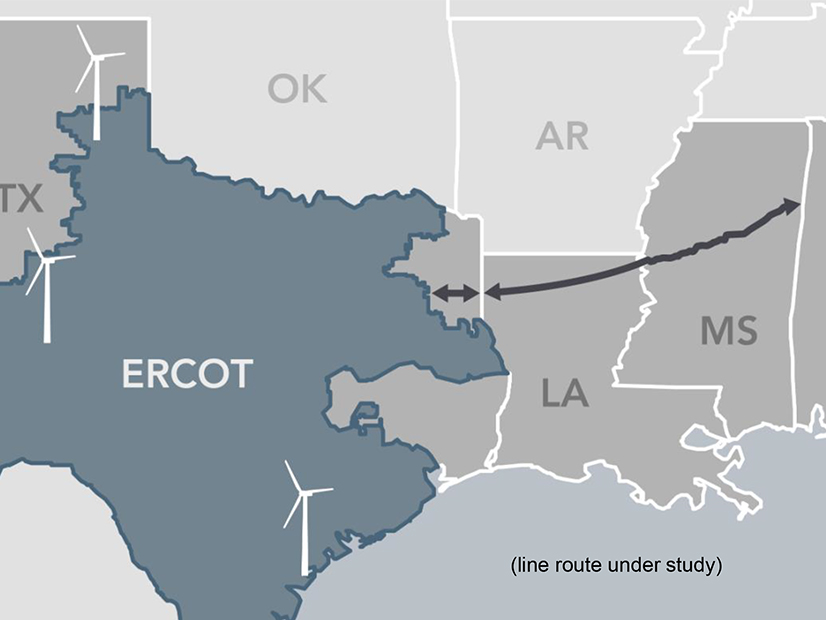
The Southern Cross Transmission (SCT) project, a merchant long-haul HVDC transmission line that would connect ERCOT with systems in the SERC Reliability region, has found new favor among Texas regulators — a development that may speed its completion.
The Public Utility Commission on Thursday directed staff to file a memo asking the proceeding’s parties for suggestions on accelerating the project, which has been under regulatory review for seven years (46304).
The SCT would be capable of carrying 2 GW of power between Texas and SERC over a 400-mile, double-circuit 345-kV line. The project has FERC approval and a waiver from the commission’s jurisdiction. It also has a certificate of convenience and necessity granted by the PUC in 2017 to Garland Power & Light, which owns the project’s western endpoint.
Renewable developer Pattern Energy’s representatives are working with ERCOT to respond to 14 PUC directives to determine whether DC ties should be economically dispatched or subject to a congestion-management plan. Five of the 12 directives have been completed and two others related to status reports are ongoing, the ISO said in its latest filing with the commission.
The Southern Cross Transmission project will run more than 400 miles from East Texas into SERC. | Pattern Energy
“We need to ensure it is crystal clear what ERCOT has to do, what the applicant has to do, what we have to do, and the time frames to get them resolved,” Commissioner Jimmy Glotfelty said during the open meeting.
Glotfelty said that if the private capital being spent is in the public interest, “we should ensure we resolve our issues so the private capital can be spent, or it will go somewhere else.”
“The regulatory responsibility and the ERCOT review are things we can speed up, finalize and be done with,” he said. “We need the parties to come forward and tell us the steps to take to move this forward.”
Mark Bruce, whose Cratylus Advisors consults for the project, said he has been encouraged to hear the commission “raise broader issues applicable to all the ERCOT-connected DC ties, such as ensuring emergency imports are included in ERCOT’s planning process. (See Texas PUC Considers Adding Grid Interconnections.)
The Texas grid has two DC ties with SPP and a third with Mexico, but they are limited to a combined 1.1 GW of capacity and are primarily used for commercial purposes. ERCOT uses the same ties to exchange power with its neighbors during emergency conditions.
“This commission is taking action on all fronts to address the weaknesses revealed by Winter Storm Uri,” Bruce said in an email to RTO Insider. “Southern Cross is an important reliability component of the extreme weather solution package, so it was good to see the PUC commit to completing its review of the SCT project in the near term.”
Prioritizing Dispatchable Generation
Glotfelty and Commissioner Will McAdams agreed to collaborate on developing grandfathering provisions for fully collateralized projects in ERCOT’s generator interconnection queue with notifications to proceed.
The agreement followed a discussion over a McAdams memo calling for transmission service providers [TSPs] to prioritize the interconnection of dispatchable generation at transmission voltages. McAdams said a formal order is not necessary, but interconnections should be prioritized accordingly:
non-inverter-based dispatchable resources;
inverter-based resources (IBRs) or projects co-located with IBRs that can be dispatched for two or more hours;
all other intermittent resources.
McAdams said his memo doesn’t push a resource to the back of the queue or restart a process but calls for policy that “provides guidance to transmission service providers in the event of a real land rush in interconnection interest.”
“Our [TSPs] need guidance from the commission on what is important to take up first,” he said, noting a need to also allow ERCOT staff to determine how a battery in the two-hour dispatch parameter would be used.
PUC Chair Peter Lake and Commissioner Lori Cobos agreed with the need to incent more dispatchable generation in ERCOT, a need also pushed by Gov. Greg Abbott during the summer. “We need to have some signal, some mechanism, so investors will associate intermittent resources with storage,” Lake said.
But as Glotfelty pointed out, “a great dispatchable resource at $12 [per MMBtu] gas is not as valuable as a zero-cost wind resource.” He called for a bigger discussion than one in a memo and two meetings.
“We will need dispatchable resources, I know that, but I’m cognizant of the guy in the interconnection queue who is deploying capital,” Glotfelty said.
“There has to be a line in the sand,” McAdams said. “We have gigawatts of power that are bearing down on our system in the next two years that will have real reliability consequences.”
The commissioners separately granted a good cause exception to ERCOT, allowing the grid operator to deploy emergency response service (ERS) before an energy emergency alert is declared. Current rules limit ERS’ use during emergency events.
“I’d move the deployment up even more,” Lake said. “I don’t want to be asking Texans to turn down lights and their businesses before fully deploying ERS. We need to use the demand response and load resources we’ve paid for before we start asking 25 million people to change the way they run their daily lives.”
Kenan Ögelman, ERCOT’s vice president of commercial operations, said ERS’s earlier deployment can be done quickly, but training operators could add time to its full implementation.
Ögelman also asked that the commissioners provide options for the appropriate balance in its ERS winter budget. The ISO procures $50 million of ERS over four contract periods during the program’s year, which runs from December to November. Over-allocating the winter period could create a shortage in another contract period.
Stakeholders File Input on Market Design
As of Monday, ERCOT stakeholders have filed 49 responses as to commission staff’s Oct. 25 memo seeking input on the PUC’s proposed market design. Stakeholders were given until Nov. 1 to file their responses and are limited to 15 pages, excluding a required executive summary (52373).
The commissioners appear to have landed on a load-serving entity obligation and reforming ERCOT’s operating reserve demand curve (ORDC). The LSE obligation is meant to address resource adequacy concerns by introducing a formal reliability standard and a mechanism to ensure sufficient resources meet this standard. (See Texas PUC Nears Market Redesign’s Finish Line.)
The questions focus on:
whether to separate the ORDC’s “blended curve” into seasonal curves.
modifications that can be made to existing ancillary services to better reflect seasonal variability.
whether ERCOT should develop a discrete fuel-specific reliability product for winter.
alternatives to the LSE obligation that could be used to impose a firming requirement on all generation resources.
The commission will hold another work session on the market redesign Thursday.
PUC Opens Competition Docket
Following up on discussion during its Oct. 7 open meeting, the commission opened a docket to allow non-ERCOT customers to comment on whether they should become part of a competitive market. (See Regulators Debate Competition in Entergy’s Texas Footprint.)
The docket only applies to Entergy Texas, Southwestern Public Service Company and Southwestern Electric Power Company (SWEPCO) customers (52760).
In other actions, the PUC:
assessed a $20,000 administrative fee to SWEPCO for once again exceeding the system average interruption duration index standard for outages in the 2019 reporting year. It was the fifth straight year SWEPCO has exceeded the SAIDI standard (52116); and
approved 2022 energy efficiency cost recovery factors of $63,052,922 for CenterPoint Energy (52194) and $26,921,197 for AEP Texas (52199).
Pacific Gas and Electric (NYSE:PCG) said Monday it expects to incur $1.15 billion in costs from the nearly 1 million-acre Dixie Fire this summer and disclosed for the first time that federal prosecutors subpoenaed records related to the fire, the second-largest wildland blaze in state history.
The disclosures were part of PG&E’s third-quarter filing with the U.S. Securities and Exchange Commission, in which PG&E reported a nearly $1.1 billion loss (-$0.55/share) in the third quarter because of wildfire costs and expenses related to its Chapter 11 bankruptcy reorganization that concluded last year. The company earned $83 million ($0.04/share) a year earlier.
The news pushed PG&E’s already depressed stock price from a high of $11.59/share at 9:30 a.m. to a low of $11.20/share before it recovered to $11.41/share by close of trading Monday. (See PG&E Value Lags as Dixie Fire Rages.)
PG&E, however, said it expects to recover much of the $1.15 billion Dixie Fire loss from its insurance, ratepayers and the state’s wildfire recovery fund created under Assembly Bill 1054 in 2019.
In an earnings call Monday, CEO Patti Poppe expressed optimism that the state’s largest utility is on track to overcome its record of starting devastating wildfires in the past six years by improving its safety practices.
“Every day we are more and more excited about the future we’re creating here at PG&E,” Poppe said. “We can see the difference that’s being made and the value to be unlocked.”
She cited the utility’s “very sophisticated and continually improving PSPS algorithm,” which predicts conditions that warrant de-energizing lines in public safety power shutoffs.
“In fact, when we back-cast our current models to the previous utility-caused fires between 2012 and 2020, we would have prevented 96% of the structure damage had the current model been in place,” Poppe said.
“This year, we also implemented enhanced power line safety settings to address wildfire risks we face from extreme drought conditions,” she said. “In fact, since the end of July through mid-October, we saw a 46% decrease in CPUC-reportable ignitions in high-fire threat districts and an 80% reduction in ignitions on enabled circuits. These enhanced safety settings make our system and our customers safer.”
The enhanced powerline safety settings have caused controversy since PG&E started using its “fast-trip” wildfire prevention devices in late July, cutting power to customers without notice.
California Public Utilities Commission President Marybel Batjer wrote to Poppe on Oct. 25 demanding changes.
“Pacific Gas and Electric Company’s execution and communication of its wildfire mitigation device setting known as Fast Trip has been extremely concerning and requires immediate action to better support customers in the event of an outage,” Batjer wrote. “Since PG&E initiated the fast-trip setting practice on 11,500 miles of lines … it has caused over 500 unplanned power outages impacting over 560,000 customers. These Fast Trip-caused outages occur with no notice and can last hours or days.”
“Though PG&E reports that implementation of fast-trip settings has significantly reduced reportable wildfire ignitions from contact with its power lines, this approach has also significantly increased the frequency and duration of unplanned power outages for its customers, causing confusion and frustration in communities constantly vigilant of wildfire threats.”
Dixie Fire
The cause of the 963,000-acre Dixie Fire remains under investigation by the California Department of Forestry and Fire Protection, which seized PG&E equipment from the presumed ignition point in the Northern California’s rugged Feather River Canyon in July.
In addition, the “Butte County, Plumas County, Shasta County, Lassen County and Tehama County District Attorneys’ Offices are investigating the fire; various other entities, which may include other state and federal law enforcement agencies, may also be investigating the fire,” PG&E said its SEC filing.
“On October 7, 2021, the United States Attorney’s Office for the Eastern District of California served PG&E Corp. and [its utility subsidiary, Pacific Gas and Electric] with a subpoena for the production of documents,” it said. “It is uncertain when any such investigations will be complete.”
PG&E acknowledged in July that a tree falling on one its lines may have started the Dixie Fire northeast of Paradise, a town destroyed by the PG&E-caused Camp Fire in November 2018. (See PG&E Says Its Line May Have Started Dixie Fire.)
On July 13 at 7 a.m., “PG&E’s outage system indicated that Cresta Dam off of Highway 70 in the Feather River Canyon lost power,” the utility said in an incident report filed with the CPUC. “The responding PG&E troubleman observed from a distance what he thought was a blown fuse [on a 12-kV distribution line uphill from him].”
The PG&E worker could not reach the pole until later that afternoon because of a road closure and rugged terrain, PG&E said. Once there, he found two blown fuses and “what appeared to him to be a healthy green tree leaning into the Bucks Creek 1101 12-kV conductor, which was still intact and suspended on the poles. He also observed a fire on the ground near the base of the tree,” PG&E told the CPUC.
The fire destroyed 1,329 structures and killed one person, according to Cal Fire. It burned for more than three months through the Plumas National Forest, Lassen National Forest, Lassen Volcanic National Park, and across five counties before it was declared 100% contained on Oct. 24.
NEWPORT, R.I. — Fortifying and upgrading the natural gas pipeline network could prepare existing infrastructure to transport zero-carbon fuels, but that is an “enormous task,” according to Erin Blanton, a senior research scholar at Columbia University.
It “looks exceedingly likely” that a significant volume of natural gas will flow for the next couple of decades, Blanton said during a panel Thursday about the future of natural gas at the 73rd New England Conference of Public Utilities Commissioners Symposium.
Blanton co-authored a report this spring from Columbia’s Center on Global Policy that said the U.S. must reduce the burning of coal, oil and natural gas to achieve decarbonization targets, which seems intuitive. Investing more in the natural gas pipeline network, however counterintuitive it might appear, could help the U.S. reach net-zero emission goals more quickly and cheaply, the report said.
National Grid, which has gas customers in Massachusetts, Rhode Island and New York, is trying to take innovative approaches to decarbonize its system by 2050. The utility outlined net-zero ambitions in a 10-point plan in October, including decarbonizing its network with renewable natural gas and hydrogen, according to Sheri Givens, vice president of U.S. regulatory and customer strategy at National Grid (NYSE: NGG).
“We’ve actually been injecting renewable natural gas into our system since the 1980s,” Givens said.
National Grid is participating in a hydrogen blending study in conjunction with Stony Brook Institute and the New York State Energy Research and Development Authority to explore the performance and use of its existing gas infrastructure to integrate and store renewable hydrogen.
National Grid, Givens said, is also thinking about different kinds of heating systems.
“Electrification is going to be a key component of future heat,” she said. “We recognize air source heat pumps are going to be needed and necessary to help us meet our decarbonization goals, but there might be opportunities for dual-fuel heating as well, where you have an electric heat pump that has a gas backup to ensure you have that resilient, reliable energy heating source in your home.”
Geothermal alternatives might be part of National Grid’s future solutions as well. For example, Givens said a small-scale project in New York on Long Island that connected 10 homes and a senior community center has been operating since 2017. The utility has several similar proposals pending in Massachusetts and New York.
In addition, Givens said the utility recently conducted a study with the New York City mayor’s office on decarbonization that revealed that 30 to 60% of the building stock in the city could be electrified, which opens the door for alternatives.
“This gives you an idea of some of the policy levers that regulators and lawmakers can push and pull in the coming years,” she said.
Gas utilities face several problems, including decarbonizing gas, which is difficult because it is a fossil fuel, according to Audrey Schulman, co-founder and co-director of the nonprofit Home Energy Efficiency Team (HEET).
“What happens to the gas system is important because millions of people rely on it,” Schulman said. “What we need is a system that safely delivers decarbonized heat at the same or lower cost than gas.”
HEET envisions a GeoGrid — a street-segment loop of shared water pipes with boreholes and thermal loops going to buildings.
“Like Lego blocks, they can gradually grow into a GeoGrid over time,” Schulman said. “It does not take up new land; it’s installed in the street.”
Gas utilities, she said, are perfect for installing this type of system, adding that Eversource Energy (NYSE: ES) could pilot a GeoGrid and has been working toward an initial installation.
“They have the customers, the right-of-way in the street and the expertise of pumping energy through pipes, and they can basically socialize the cost of that energy for all of us and decades into the future,” she said.
Any building connected to the GeoGrid would reduce its emissions by about 60%, according to Schulman. In addition, the installation cost, if done by incumbent utilities, would be spread across decades and deliver “renewable lower-cost energy to all and not just those with money.”
[EDITOR’S NOTE: A previous version of this article incorrectly stated that Southwest Transmission, the designated alternate transmission owner for SPP’s Wolf Creek-Blackberry competitive project, is an affiliate of Xcel Energy. It is affiliated with LS Power.]
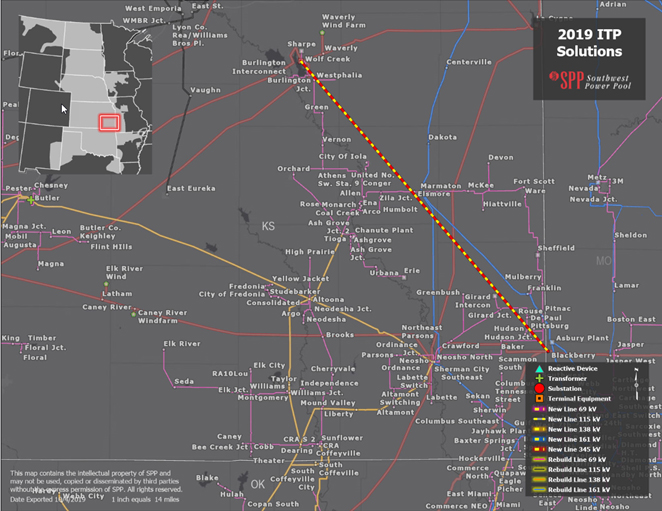
SPP’s Board of Directors last week approved the RTO’s third competitive transmission project under FERC Order 1000, awarding construction of a 94-mile, 345-kV line to NextEra Energy Transmission Southwest.
An industry expert panel (IEP) recommended the competitive transmission company be designated the Wolf Creek-Blackberry project’s transmission owner. The line, from southeast Kansas to the Blackberry substation in Missouri, has an estimated $85 million cost and a 2025 completion date.
Michael Jacobs, a senior energy analyst for the Union of Concerned Scientists, who chaired the IEP, said NextEra’s proposal was “clearly competitive” and “tens of millions of dollars” lower than other bids.
NextEra’s estimated cost was $31 million lower than the next closest proposal of $116 million. SPP received six other proposals from four different entities, with the highest being $151 million.
Michael Jacobs, UCS | SPP
Jacobs said the bid’s designs and materials were not offered in other proposals and its conductors had the highest thermal ratings. NextEra also offered an earlier service date by a year and a guaranteed schedule, he said.
“We looked at how [NextEra’s financial strategies] might be reasonable as opposed to a cost-cutting measure,” Jacobs said. “They took care where they could to both limit the cost to themselves, but also to the consumer.”
The IEP panel gave NextEra’s bid a 1,034.38 score on an 1,100-point scale after analyzing the seven proposals in engineering design, project management and construction, operations, rate analysis, and finance categories.
LS Power’s Southwest Transmission affiliate was approved as the alternate builder. It scored 1,013.92 points with its $121 million proposal, edging out the third-place bid, which scored 1,013.50.
Evergy, Nebraska Public Power District, Oklahoma Gas & Electric and Public Service Co. of Oklahoma abstained from the Members Committee’s votes on the lead and alternate proposals. Evergy said the final report was heavily redacted, making it difficult to support or oppose the IEP’s decision.
SPP issued a request for proposals in September 2020 and the five-person IEP panel was seated shortly thereafter.
The board approved the final report from the Strategic and Creative Reengineering of Integrated Planning Team (SCRIPT) and creation of a task force to coordinate implementation of the report’s recommendations.
The endorsement caps a year-long effort to develop recommendations that improve SPP’s transmission planning and applicable cost-allocation processes, including the RTO’s delayed generator interconnection study process.
The Wolf Creek-Blackberry 345-kV project. | SPP
The SCRIPT report included 35 recommendations and 11 sub-recommendations. Staff has said the consolidated planning process will save $3 million to $4 million annually in administrative costs once it is in place. SPP currently incurs about $28.5 million in annual costs for its planning processes. (See SPP: Consolidating Tx Planning Could Yield Big Savings.)
SPP expects the policies, to be developed and implemented by 2024, to reduce administrative costs, create more equitable cost sharing, increase transmission investment value, facilitate access to new energy markets, create more timely processes, and strengthen reliability and grid resiliency.
The Markets and Operations Policy Committee approved the report but not the recommendations during its meeting earlier in October, citing concerns over project oversight and demands on staff. (See “MOPC Approves SCRIPT Report,” SPP Markets and Operations Policy Committee: Oct. 11-12, 2021.)
SCRIPT’s leadership recommended a Consolidated Planning Process Task Force comprised of members from the stakeholder groups most affected by the consolidated planning process, primarily the Transmission and Economic Studies working groups. The team will include a regulatory liaison from the Regional State Committee to help manage the engineering and cost-allocation work.
The task force will report up to the board and receive guidance from MOPC, the RSC and the Strategic Planning Committee (SPC).
Slight Delay in RTO West Commitment Date
The Western Area Power Administration’s Colorado River Storage Project (CRSP) region has told parties interested in SPP’s RTO West that it needs additional time to update its analysis, Bruce Rew, senior vice president of operations, told directors and stakeholders.
With Colorado Springs Utilities’ late addition to the parties interested in joining SPP West, the CRSP region said it needed more time to complete its Federal Register notice and associated public process. That pushes the initial financial commitment target date of April 15, 2022, back two weeks to April 30, Rew said.
SPP plans to file tariff modifications with FERC in October 2022. It expects approval in early 2023, allowing it to extend its RTO into the West on March 1, 2024.
The board also approved the DC Ties Task Force’s recommended framework to manage DC tie revenue-requirement recovery as part of RTO West. The market efficiency use (MEU) mechanism will compensate DC ties for their market use and be applied to DC-tie market dispatch beyond network and point-to-point use. The group said that would ensure their market use is properly compensated for and does not adversely affect the DC tie’s host zone. (See SPP Strategic Planning Committee Briefs: Oct. 13, 2021.)
Basin Electric Power Cooperative’s Tom Christensen opposed the Members Committee vote, as he did during the SPC meeting, over concerns that the framework doesn’t resolve congestion issues and may hamper full recovery of the annual transmission revenue requirement. OG&E, Oklahoma Municipal Power Authority and Southwestern Public Service Co. abstained from the vote.
“If we go down [MEU’s] path and find it’s not workable, we’ll look for other alternatives,” Rew said, addressing the concerns. “We’ve got to have a product that’s workable. We’ll make adjustments if we run into issues.”
The task force will continue its engagement with RTO West’s interested parties to fully develop the MEU rate. A stakeholder group comprised of market interests and DC tie owners will also be formed to take up the congestion-hedging effort.
Budget Increase Passes
The members (unanimously) and directors approved SPP’s 2022 operating budget of $231.2 million, a 17.7% increase over this year’s budget, driven by an increase in outside services that raised the net revenue requirement from $149.9 million to $176.3 million.
The outside services are primarily related to engineering study costs and for anticipated ongoing litigation associated with the zonal placement process, Attachment Z2 credits, and February’s winter weather event. One winter-related complaint has been filed at FERC with claims totaling $79 million, SPP said.
Travel expenses are also expected to rise with a return to normal operations following the COVID-19 pandemic.
Responding to a question as to whether SPP has enough staff resources at its disposal to process the generator interconnection backlog and handle transmission-planning pieces, CEO Barbara Sugg said the budget is “very well-thought-out, but the landscape changes.”
“We’re moving people around; we’re looking at consultants. We do what we can with what we’ve got,” she said. “If we have to make another ask, we’ll follow the process to do that.”
The board also approved the Diversity, Equity and Inclusion (DEI) Task Force’s 10 recommendations, which included reinforcing talent pipelines through historically Black colleges and universities; community programs and business resource groups; evaluating community giving and volunteer efforts; and designating oversight of a formal DEI program. The RTO was recently named by Arkansas Business magazine as one of the Best Places to Work in Arkansas because of its strong corporate culture and benefits.
3 Directors Ending their Terms
Members re-elected Susan Certoma to the board during their annual meeting but said good-bye to three other directors leaving at the end of the year.
Julian Brix, Graham Edwards and Darcy Ortiz will take with them a combined 21 years of experience on the board, 13 by Brix. His departure leaves Josh Martin (elected in 2003) and Chairman Larry Altenbaumer (2005) as the longest-serving directors.
Director Julian Brix reflects on his 15 years with SPP. | SPP
“This may well be the most important job I’ve done, since I started in the industry 40-plus years ago,” said Brix, who has led a transmission company and two cooperatives. “At some point in time, God comes along and says, ‘Stop,’ and he did this past year. It’s time for me to step down and let others do the work.”
Board vice-chair Edwards, who pre-dated John Bear as MISO’s CEO, had originally intended to seek re-election, but withdrew his nomination after the meeting materials went out. The Advanced Power Alliance’s Steve Gaw credited Edwards with thawing the MISO-SPP relationships and turning it “completely on its head.”
Ortiz is leaving the board after one term of three years, two of which were conducted virtually. As Intel’s vice president of corporate services, she was recently assigned global responsibilities, making it difficult to “do justice to her [dual] responsibilities,” Sugg said.
“They’ve definitely made an imprint on us and made SPP a better place,” Sugg said. A search for new directors is ongoing and will be brought forward as soon as possible, she said.
Members also elected Evergy’s Denise Buffington to the Members Committee, where she will replace former co-worker Kevin Noblet in representing the investor-owned utilities (IOUs). Re-elected to the committee are:
Usha-Maria Turner (Oklahoma Gas & Electric) and Tim Wilson (Liberty Utilities), representing IOUs.
Zac Perkins (Tri-County Electric) and Mike Wise (Golden Spread) for the cooperative segment;
Kevin Smith (Tenaska Power Services) for independent power producers and markets; and
Tom Kent (Nebraska Public Power District) in the state agency segment.
Standalone ESR Accreditation
Renewable energy representatives withdrew from the consent agenda a revision request that would place the first SPP accreditation policy on standalone energy storage resources (ESRs) to ensure further discussion. Recommended by the Supply Adequacy Working Group, RR462 implements a process that includes a methodology for prioritizing and allocating available effective load carrying capability (ELCC) for standalone ESRs that qualify as capacity in SPP’s balancing authority.
Gaw said the changes to the current methodology affect rates, terms and conditions, necessitating their inclusion in SPP’s tariff rather than its business practices or criteria. His written comments also expressed concern about the calculation methodology and how conventional resources are accredited.
“We have continued concern that there is a diminution of the value on renewable resources, storage and hybrid resources, but we’re still not acknowledging traditional resources’ forced outages,” he said. “We’re giving them 100% accreditation while evaluating and scrutinizing other resources. That starts to grant a preference to certain resources inappropriately.”
Enel Green Power’s Betsy Beck said that while she supports the ELCC approach, she wanted the board to recognize there wasn’t full consensus on the measure.
“Some of the underlying assumptions … led to some results that, at best, didn’t make sense and, at worse, weren’t well supported. The results don’t support what we’re seeing in the market for the value of standalone storage,” she said.
Dogwood Energy’s Rob Janssen advocated for moving forward with the measure, given that load-serving entities and the storage developer community have been “pleading with SPP for several years for a clear method” in accrediting capacity. However, he agreed the accreditation methodology will likely need refinement because it deviates from SPP’s ELCC study results for shorter-duration storage facilities and will not adequately compensate developers and LSEs for the resource adequacy value they should provide to the system.
The Members Committee approved the measure as part of the consent agenda. It was opposed by Beck and Gaw, with Janssen and ITC Great Plains’ Brett Leopold abstaining.
The consent agenda listed one other revision request in RR467, a Holistic Integrated Tariff Team recommendation that revises the tariff’s Attachment AQ by reducing the waiting period for preliminary study results of new load additions. The measure adds a rolling submission and response window and directs delivery point network studies be posted once the new or modified load is confirmed.
The consent agenda also included Corporate Governance Committee nominations to the Finance (OG&E’s Brad Cochran) and Human Resource committees (Sunflower Electric’s Stuart Lowry); the Finance Committee’s approval of a change to the virtual reference price’s calculation and extending to 2027 the maturity date of an $80 million credit facility; SPP’s 2020-2021 annual violation relaxation limits (VRLs) analysis and the Western Energy Imbalance Service market’s 2021 VRL analysis; and withdrawals of three construction notifications for 161-kV breakers.
FERC on Friday approved a $265,000 settlement between WECC and the Public Service Company of New Mexico (PNM) (NYSE:PNM) for violating NERC reliability standards, along with settlements carrying no financial penalties filed by ReliabilityFirst with Covanta Delaware and the Texas Reliability Entity with Oncor.
NERC submitted the settlements to the commission on Sept. 30, filing a spreadsheet Notice of Penalty for the agreements in RF and Texas RE (NP21-29) and a separate NOP for the PNM settlement (NP21-30). A separate, nonpublic spreadsheet NOP was filed as well, in accordance with the policy on violations of the Critical Infrastructure Protection (CIP) standards announced by FERC and NERC last year. (See FERC, NERC to End CIP Violation Disclosures.) FERC’s Friday filing indicated that the commission would not review the settlements, leaving the penalties intact.
Self-report, Audit Find Ratings Shortcomings
PNM’s settlement concerned a violation of FAC-008-3 (Facility ratings), specifically requirement R6, which mandates that a registered entity “have facility ratings for its solely and jointly owned facilities that are consistent with the associated facility ratings methodology or documentation for determining its facility ratings.”
WECC first learned of the violation through a self-report submitted by PNM on May 9, 2017, notifying the regional entity of several discrepancies. First, the utility had recorded facility ratings for six of its jointly owned facilities that were different than those of the facilities’ co-owners. PNM also acknowledged several inconsistencies within its own facility ratings spreadsheet relating to conductor MVA or amp ratings, as well as a failure to document the assumptions for calculating such ratings.
In addition, source material such as nameplate ratings or vendor documentation could not be found for multiple facilities. In all, PNM reported improper ratings for 56 transmission facilities: 15 345-kV, four 230-kV and 37 115-kV facilities.
As it happened, WECC was conducting a compliance audit at the time of PNM’s self-report. The RE subsequently discovered seven more ratings discrepancies during the remainder of the audit, bringing the total to 63.
During mitigation activities PNM found that in-line switches “were not adequately represented in its facility ratings,” meaning that the utility did not have source documentation for equipment ratings on all 72 of its 115-kV facilities, as well as four of its 230-kV facilities and 15 345-kV facilities.
WECC attributed the root cause of the violation to a “lack of management clarity” regarding the utility’s change management procedures for documenting facility ratings. The violation began on Jan. 1, 2013, when FAC-008-3 became enforceable and was still ongoing as of the date of filing; remediation and mitigation are expected to be completed by March 3, 2022.
The RE determined that the violation posed a “serious and substantial risk” to bulk power system reliability because without accurate ratings, facilities could have been operated beyond safe and reliable limits. WECC considered this in assessing the monetary penalty, with the length of the violation, PNM’s compliance history — including two prior infringements of FAC-008-3 — and the “difficulty in remediating and mitigating” the issue added as aggravating factors.