SPP MMU Releases Summer Market Reports

SPP’s Market Monitoring Unit (MMU) last week released its quarterly reports for its RTO and Western Energy Imbalance Service markets, saying it is evaluating rule changes in the latter to address limited ramp offerings.

The MMU said in its WEIS report that the lack of offered ramp “presents a significant problem,” and it expressed concern with the fledgling market’s outcomes that resulted in volatile price spikes, including a 174% jump from May to June. WEIS only began operations in February.

While prices scaled back down the following two months, the Monitor said that was not unusual in an energy imbalance-only market. Market participants are not required to offer capacity, few resources are in the market, and limited ramp and capacity is made available. That results in higher-priced resources setting price.

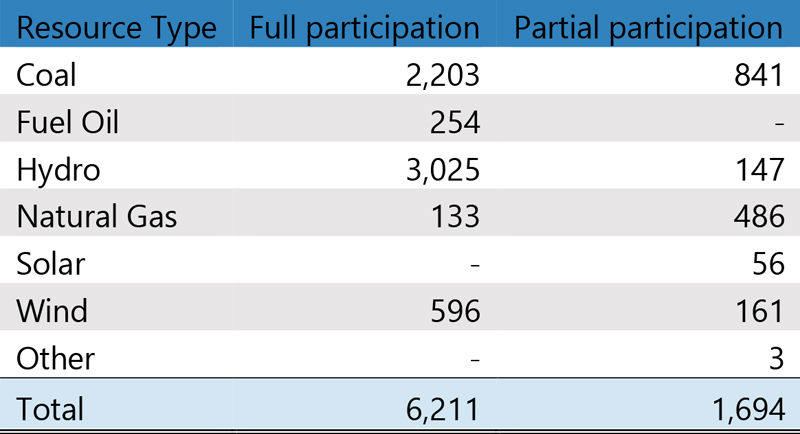
Registered-resource-capacity-(SPP-MMU)-Content.jpgThe WEIS market’s registered resource capacity | SPP MMU

“It is typical for most energy markets to see an increase in prices when demand increases, especially during summer months,” the MMU said. “Price volatility also means that many market participants are hesitant to offer incremental megawatts due to fear of unrecovered costs.”

Demand was up 16% in June and 14% in July. The market has 6.2 GW of capacity from full participation resources and an additional 1.7 GW from partial participation resources.

The Monitor’s RTO market report revealed average day-ahead prices were up 64% when compared to summer 2021, $33.30/MWh from $20.32/MWh. Average real-time prices were $30.68 this summer, a 56% increase from last summer’s $19.69/MWh.

The price increase was driven by natural gas prices, which reached $3.77/MMBtu at the Panhandle Eastern hub. The hub’s prices haven’t been that high since November 2014, with the exception of February during the winter storm. Gas prices were at $1.65/MMBtu during 2020’s summer months.

The MMU said generation outages this summer were comparable to 2019’s, following a one-year decrease in 2020 “due to the lingering effects of deferred maintenance” because of the COVID-19 pandemic.

The Monitor’s staff will hold a webinar Nov. 9 to discuss the RTO report.

FERC Accepts Latest CAISO Storage, DER Rules

FERC last week approved CAISO’s proposed tariff changes resulting from the fourth phase of the ISO’s energy storage and distributed energy resources (ESDER) stakeholder initiative, a five-year effort to promote participation by storage, DERs and demand response in its markets (ER21-2779).

CAISO presented its ESDER Phase 4 changes to stakeholders in August 2020. Following a yearlong vetting process and approval by its Board of Governors, the ISO filed three proposed tariff revisions with FERC on Aug. 27, all of which the commission accepted on Oct. 26. (See CAISO Finalizes ESDER Phase 4 Proposal.)

One change applies market power mitigation to energy storage. Another creates biddable state-of-charge parameters for storage resources, and a third enables DR resources to specify maximum daily run times.

CAISO said it needs time to implement the changes as it makes “substantial software enhancements,” but it expects to do so by Dec. 1.

Energy storage has been exempted from CAISO’s market power mitigation rules so far, but batteries are becoming a vital part of California’s resource mix as it shifts to more renewables. Storage is expected to play a growing role in providing essential power during hot summer evenings as solar wanes but demand remains high, the so-called net peak. (See CAISO Sees ‘Explosive’ Growth in Storage in July.)

CAISO “currently has over 1,000 MW of energy storage resources in its markets and anticipates close to 2,000 MW by the end of the year,” FERC said. “In addition, CAISO states that energy storage resources are operating differently in CAISO markets than they have in the past: Whereas they generally provided regulation to maintain system frequency rather than energy previously, CAISO has observed that energy storage resources have increasingly been charging and discharging in response to energy prices and tend to discharge most of their energy during the net demand peak.”

FERC agreed that the situation called for new oversight. “As energy storage resources play an increasingly significant role on the CAISO system, it is imperative that CAISO ensure competitive participation by these resources and have a mechanism to mitigate any potential exercise of market power,” it said.

The biddable state-of-charge parameters came from storage operators requesting additional means to manage battery participation in the real-time market.

“CAISO explains that while the day-ahead market optimizes resources across the entire operating day, the real-time market dispatches resources based on system supply-and-demand conditions and prices available in a shorter temporal horizon,” FERC said. “CAISO explains that while dispatching an energy storage resource to meet real-time load may be economically efficient in the short term, it can affect the resource’s ability to meet its day-ahead schedule over the remainder of the day.”

DR resources need to be able to specify maximum daily run times so they’re not overused, CAISO said.

“Demand response providers currently do not have any optional master file or bidding parameters that allow them to manage daily run time maximums, and they instead rely on careful bidding and scheduling strategies to avoid being dispatched outside their constraints,” FERC said. “CAISO states that without a maximum daily run parameter, demand response resources may receive too many dispatches in an operating day, preventing them from providing demand response when needed.”

Commenters generally supported the revisions, though CAISO’s Department of Market Monitoring expressed concerns with some elements, including “that demand response resources providing resource adequacy could use the maximum daily run-time parameter to limit resource availability.” It said CAISO should “monitor the effects of implementing these changes” and make changes as needed.

BPA: Building EMS Talent Requires Long-Term Investment

Utilities must invest sustained effort into hiring and training talented energy management system (EMS) engineers or risk being left with critical vacancies, attendees at a NERC online conference heard Thursday.

Speaking to NERC’s Monitoring and Situational Awareness technical conference, Stacen Tyskiewicz, manager of the EMS group at Bonneville Power Administration (BPA), likened the chances of finding a suitable EMS engineer to “buying the winning lottery ticket,” citing the range of skills needed.

EMS engineers are charged with supporting the systems used by utilities to monitor, control and optimize the grid, with responsibilities including analysis, engineering, design, implementation and operations and maintenance. The job also requires an understanding of programming, cybersecurity and other matters that may be required in a rapidly changing environment.

Stacen-Tyskiewicz-(NERC)-Content.jpgStacen Tyskiewicz, Bonneville Power Administration | NERC

“Engineering, programing, cybersecurity operations — all those are … different disciplines entirely. So, we’re looking for this highly specialized job [with a] very small talent pool to choose from,” Tyskiewicz said. “And even if you’re lucky enough to find somebody who knows all of those things, then you’ll most likely have to teach them about your EMS vendor and about any unique requirements of your service territory.”

Even if candidates with the right intersection of skills can be found, working to keep the lights on for millions of customers poses a special set of challenges, and managers can’t tell how a candidate will react to that pressure until they are put in the situation.

“My first time being on the dispatch floor by myself, my mentor was out of town … and I had to go down on the dispatch floor to answer a question,” Tyskiewicz said. “And [my colleague] asked me when something would be ready, and I told him, and he slammed his fist on the desk and screamed, ‘The lights will be out in Seattle by then!’ So that kind of pressure is not something that, in general, electrical engineers or programmers are used to dealing with.”

Short- and Long-term Solutions

With utilities around the country competing for such a scarce resource, how can one entity lure the talent it needs? In the short term, Tyskiewicz advised, there are several strategies that can help.

First, an entity can try to meet its needs with multiple hires instead of trying to get all the needed skills in one employee: for example, by pairing an electrical engineer with a programmer. This solution is more complicated from a payroll perspective and Tyskiewicz admitted she had not tried it herself but said she has heard of it being successful.

Another option is to “pilfer from your [EMS] vendor” by hiring their engineers, though if the vendor finds out a customer is doing this it could strain the relationship. Utilities may also attempt to outsource the problem to an outside consulting firm if a suitable partner can be found. However, this too is usually more expensive than hiring the right talent directly.

Yet another choice is to entice recently retired EMS engineers, or those who are on the verge of retiring, to come back or stay until the entity can build up enough fresh talent. This requires trading on the “dedication [and] devotion to keeping the lights on” that experienced staff will likely have.

Longer-term solutions can include hiring electrical engineers with some of the needed skills and training them on the job; this can be done through outside channels, such as job fairs and industry conferences, or within the organization. Utilities may also try to lighten the workload on existing EMS engineers by removing as much work as possible that can be done by others, allowing them to focus on the areas where they are needed most. Hiring more non-engineers, such as cybersecurity specialists, programmers and technical writers, can help with this.

At BPA, Tyskiewicz said, the most productive solution turned out to be to “grow your own” by establishing a robust EMS staffing strategy with firm support from management. Like every approach, getting executives to buy into the strategy took time and work. But in the end the effort paid off, as BPA’s leaders understood the risks of operating without sufficient EMS engineering talent and the investment needed beyond the initial hire.

Growing a sufficient internal EMS talent pool means establishing strong internal training programs, but even more important is fostering a culture where current professionals with 30 or more years’ experience can pass their knowledge on to the new generation.

“These engineers enjoy their job, they learn, and they just end up collecting a tremendous amount of wisdom,” Tyskiewicz said. “And that wisdom is not something you can put in a flowchart; it’s not something you can put in a document or even in a video recording. You need to have them [ready] for those situations that only pop up but once every five or 10 years. And they’re not going to know how to do that if they don’t have somebody to talk to who’s done it before.”

Biden, Democrats Unveil $1.75T Build Back Better Framework

Hours before he was set to leave the U.S. to go to the U.N.’s 26th Conference of the Parties (COP26) on climate change in Glasgow, Scotland, President Biden rolled out a new framework for a whittled-down budget reconciliation package that includes $555 billion in clean-energy funding.

Weighing in at close to 1,700 pages, the revised Build Back Better Act (H.R. 5376) comes with a $1.75 trillion price tag, half of the $3.5 trillion budget that House Democrats sent to the Senate in August. (See House Democrats Reach Deal, Pass $3.5T Budget Plan.) It is also missing some of the flagship energy provisions Biden and the Democrats had pushed for in the original, most notably the Clean Electricity Performance Program, which would have provided $150 billion in incentives to utilities that hit yearly targets for adding clean energy to the grid.

The announcement from the White House said the revised framework was the result of “input from all sides” and good-faith negotiations with Sen. Joe Manchin (D-W.Va.) and Sen. Kyrsten Sinema (D-Ariz.), the two moderate Democrats whose support will be crucial for getting the package through the Senate. On Monday, Manchin told reporters he was not committed to voting for the package, saying its cost was higher than advertised because of accounting gimmickry.

“President Biden is confident this is a framework that can pass both houses of Congress, and he looks forward to signing it into law,” the White House said in a statement. The president also called on both houses of Congress to pass both the budget reconciliation package and the bipartisan infrastructure bill “as quickly as possible.”

But a hearing on the bill before the House Rules Committee on Thursday afternoon quickly turned adversarial, as Republicans attacked it as a “tax and spend” measure and the hearing itself as a rush job. Rep. Tom Cole (R-Okla.), the committee’s ranking member, said he had found out about the hearing “the same way most did: on Twitter,” and he moved for the session to be adjourned, arguing that the bill had not been analyzed by the Congressional Budget Office.

The motion was quickly voted down, but other Republicans piled on, with Rep. Cathy McMorris Rodgers (R-Wash.), ranking member of the House Energy and Commerce Committee, calling provisions to increase taxes on natural gas a “heat your home tax” and electric vehicle tax credits as “handouts to the rich.”

Rules Committee Chair Jim McGovern (D-Mass.) countered that congressional committees had already spent 165 hours marking up the bill. Thursday’s hearing was a discussion, he said, “about the details of a very important bill. … We can talk about the good and what people have problems with, and there are still opportunities for change.”

Speaking at an afternoon press conference, House Speaker Nancy Pelosi (D-Calif.) also stressed that “we won’t have anything, regardless of whatever input we have in the bill, unless it is agreed to by the Senate. … The text is there for you to review, for you to complain about, for you to add to or subtract from whatever it is, and we’ll see what consensus emerges from that.”

As outlined in a White House overview of the framework, specific clean energy spending includes:

      • $320 billion for 10-year, expanded tax credits for a range of clean energy technologies, including residential and utility-scale solar, storage, transmission, electric vehicles and manufacturing.
      • $105 billion in resilience investments to address extreme weather — hurricanes, droughts and wildfires — and “legacy” pollution in low-income and disadvantaged communities. Part of that money here would go to a Civilian Climate Corps that would provide jobs focused on mitigating the impacts of climate change and maintaining public lands.
      • $110 billion for investments and incentives to develop new clean energy technologies, manufacturing and supply chains.
      • $20 billion for federal clean energy procurement, to incentivize “government to be [the] purchaser of next-gen technologies, including long-duration storage, small modular reactors and clean construction materials.”

The balance of the bill covers health care, education and other social spending, such as six years of funding for universal, free pre-school for all 3- and 4-year-olds, a one-year extension of the expanded child tax credit and a new hearing benefit for Medicare.

The International Stage

Passage of the Build Back Better Act, and the companion bipartisan infrastructure bill, is seen as critical for Biden as he heads to Europe first for the G-20 Summit this weekend in Rome and then COP26, where world leaders will be presenting their carbon-reduction commitments Nov. 1-2. Biden committed earlier this year to reducing the nation’s emissions at a minimum 50% over 2005 levels by 2030. Heading to Glasgow with at least the possibility of the two bills getting to his desk would demonstrate on the international stage that the U.S. is ready to make good on its aggressive goals.

Speaking prior to his departure, Biden fleshed out more of the clean energy spending still in the bill. Funding to replace some of the country’s 480,000 diesel school buses with EVs survived the cut, as did support for a nationwide network of 500,000 EV chargers.

Looking to the global marketplace, Biden said, “We’re going to get off the sidelines on manufacturing solar panels and wind farms and electric vehicles with targeted manufacturing credits. You manufacture, you get a credit for doing it. These will help grow the supply chains in communities too often left behind.”

He also said the bill was “fiscally responsible” and would decrease the federal deficit and reduce inflationary pressures on the economy.

Enthusiastic Endorsement from Progressives

The immediate response from House and Senate Democrats was mostly positive, as were statements of support from industry trade associations.

While Sen. Manchin had yet to comment late Thursday afternoon, Sen. Sinema sent a semi-positive signal via Twitter. “After months of productive, good-faith negotiations with [Biden] and the White House, we have made significant progress on the proposed budget reconciliation package,” she said. “I look forward to getting this done, expanding economic opportunities and helping everyday families get ahead.”

The House Progressive Caucus also looked to be getting behind the cut-down version. In a clip posted to Twitter, Rep. Pramila Jayapal (D-Wash.) said a meeting of the caucus had “enthusiastically endorsed a resolution that approves, in principle, the framework that the president laid out today. We are really proud of the president and of our Progressive Caucus and our progressive allies for getting so many of our big priorities into the framework.”

Rep. Frank Pallone (D-N.J.), chair of the House Energy and Commerce Committee, highlighted the bill’s “new Greenhouse Gas Reduction Fund [that] will accelerate innovation, prioritize the needs of environmental justice communities and ensure the communities we represent are better protected from the rising tide of extreme weather. Rebates for homeowners to electrify and make their houses more efficient, combined with resources to create a 21st century electric grid, will allow us to get more renewable energy online and powering our neighborhoods.”

A statement from Jason Burwen, interim CEO of the Energy Storage Association, focused on the bill’s “investment tax credit for standalone energy storage, [which] is critical to accelerating the pace of storage deployment on the electric grid. Combined with new manufacturing incentives available for batteries and federal procurement of next-generation long-duration storage, the Build Back Better Framework will supercharge efforts to rapidly transition to clean energy while building a robust energy storage supply chain here at home.”

Abigail Ross Hopper, president and CEO of the Solar Energy Industries Association, linked the bill’s clean energy tax credits to job creation. “Solar is a job-creator, and the long-term tax incentives for solar, storage and domestic manufacturing will put us on a path to decarbonize the electric grid, reach the president’s 2035 clean energy target and create hundreds of thousands of quality career opportunities in every community.”

Gregory Wetstone, president and CEO of the American Council on Renewable Energy, spoke to the urgency of passing substantive climate legislation but also raised concerns about the negotiations still to come. “Potential unintended consequences around last-minute additions to otherwise unrelated pieces of the legislation … may work at cross-purposes with the mission-critical climate objectives at the heart of this bill.”

Ditto Cleantech

Comments from the business community were more mixed.

Echoing Republican criticisms, the U.S. Chamber of Commerce was concerned about the Democrats’ push to get the bill passed before the organization had time to review its details. While continuing to support the bipartisan infrastructure bill, Neil Bradley, executive vice president and chief policy officer, said, “It is the height of irresponsibility for Congress to rush through such a large and complicated bill with no clear understanding of the real-world impact of the policies that are being proposed. Congress should slow down and make sure they get the policy right.”

But cleantech businesses said the bill would support the development and commercial deployment of key technologies.

Jon Power, president of CleanCapital, a cleantech investment firm, said the bill’s investments in innovation “will provide businesses, schools, nonprofits and municipalities with affordable renewable energy [and] will rapidly speed up the clean energy transition and unleash significant private sector funds.”

Similarly, Tim Latimer, CEO of geothermal developer Fervo Energy, said the bill’s clean energy provisions “will catalyze widespread buildout of utility-scale geothermal energy and accelerate national progress toward a fully decarbonized electricity sector.”

The bill’s sections on the tax credit for carbon-capture technologies, known as the 45Q credit, got high marks from the Carbon Capture Coalition, in particular its option for direct payment. If enacted with the bipartisan infrastructure bill, “this package would provide the most transformative and far-reaching policy support in the world for economywide deployment of carbon management technologies that are essential to meeting midcentury climate goals,” said Madelyn Morrison, the coalition’s external affairs manager.

FERC’s Christie Promotes State Perspectives at OPSI Conference

As someone who spent close to two decades as a state regulator, FERC Commissioner Mark Christie said he can’t help but look at federal administrative issues through a local lens.

Christie, who joined the commission in January after 17 years with the Virginia State Corporation Commission (SCC), told attendees of the Organization of PJM States Inc.’s (OPSI) virtual annual meeting this week that his tenure as a state regulator and past OPSI president taught him “how much I do not know” about regulatory issues.

No one understands better the challenges, problems and opportunities of utility regulation on a local basis than state commissioners, Christie said, calling it a “practical perspective” that has allowed him to realize each state has different challenges on reliability issues, costs of projects and market development.

Christie said in his keynote address that it’s important as a FERC commissioner to be sensitive to the differences between states and regions of the country.

“Utility regulators in each state know more than I’ll ever know or anybody here at FERC will ever know,” Christie said. “That’s exactly how federalism works.”

Federal vs. Local Control

Harold-Gray-(OPSI)-Content.jpgHarold Gray, OPSI | OPSI

Delaware Public Service Commissioner and current OPSI President Harold Gray asked Christie his impression of the infrastructure legislation pending in Congress and if any new rules and regulations in it could create bigger challenges for FERC.

Christie said the “devil’s always in the details” in understanding the impact of legislation, and he still wasn’t sure how the bill will ultimately pan out. He said his time in Virginia taught him to expect the unexpected when it came to legislation, but that whatever passes must be implemented regardless of whether regulators think it’s a good idea or not.

One idea Christie said he’s “not a fan” of is the concept of the federal bureaucracy overriding state transmission siting. He said there’s been a big push lately among some lawmakers and stakeholders to give the federal government override authority because of a perceived notion that states are standing in the way of building new transmission and developing the grid of the future.

“The state regulators are not the obstacle to siting large regional transmission lines,” Christie said.

As an example, Christie cited the “very controversial” Trans-Allegheny Interstate Line (TrAIL) project, a 165-mile, 500-kV transmission line that crossed Pennsylvania, West Virginia and Virginia beginning in 2008. He said TrAIL remains the largest regional line in PJM’s portfolio.

Christie said he remembers sitting in meetings across Virginia as residents expressed their displeasure with the project, but the developers were ultimately able to make their case for its need.

“Need was proven in the TrAIL case, and it got built,” Christie said. “If you can prove need, I’m optimistic that they will get built. But you’ve got to go into a state regulator and prove that need.”

Christie said he hears rhetoric from Congress members and other interested stakeholders that all it takes is one state official to “kill a vitally needed power line,” but he disagrees: It takes a commission to decide after having a quasi-judicial proceeding where evidence is presented.

Federal siting authority could also prove to be detrimental, creating massive political backlash to the federal government stepping in to decide local issues, he said.

The TrAIL project wasn’t a greenfield line requiring eminent domain, but instead used existing rights of way, and it still created controversy. Greenfield projects approved by a federal agency could prove to be even more controversial, he said.

“You seriously think that there’s not going to be a huge political blowback having a federal official just order something to be built?” Christie asked.

New Jersey Selects 165 MW in Community Solar Projects

New Jersey’s Board of Public Utilities (BPU) selected 105 projects totaling 165 MW in the second phase of its Community Solar Energy Pilot Program Thursday as the agency planned to transition to a permanent program (Docket # QO18060646, QO20080556).

Nine of the second-phase projects will be developed on landfills, one on a brownfield and the remainder on rooftops, the BPU said, announcing the list of winning applicants at its monthly meeting in Trenton. Board members said a key element of the program, aside from reducing carbon emissions, is its goal of proving low- and moderate-income (LMI) communities with the opportunity to support the effort to cut emissions and benefit from reduced energy costs. All the approved projects will allocate 51% of the energy generated to LMI participants.

The 165 MW will be enough to power an estimated 33,000 homes, according to the BPU.

The BPU’s announcement came 10 months after the first of the 45 projects awarded in the program’s first phase started operating. About 20 MW of the 75MW of solar capacity awarded in the first phase is now in operation, and the remainder is in development.

Community solar projects target consumers — whether homeowners or small businesses — who either cannot or do not want to have solar on their roofs. In many instances, developers start enrolling subscribers before they begin building a project or look for a business to be an “anchor” subscriber by committing to buying a certain percentage of the power from the project.

In return for subscribing, consumers receive credits that can reduce their electric bills by 5% to 20%. The solar project operator supplies the electricity generated in the project to a utility company.

BPU President Joseph Fiordaliso said New Jersey is “light years” ahead of other states in the effort to create a community solar program that involves all sectors of the community.

“If we’re going to be successful not only in solar, but in the entire clean energy initiative, we all have to participate, and community solar pinpoints that directly.” He said he expects the program to continue for years.

“There are a lot of places to put solar,” he said, citing the large number of warehouses that sprung up along the New Jersey Turnpike to meet the state’s fast-rising demand for logistics space and warehouses that serve the e-commerce industry.

“New Jersey is the Saudi Arabia of rooftops,” Fiordaliso said.

Strong Industry Response

Community solar developments are a key element of New Jersey Gov. Phil Murphy’s push to have the state reach 100% clean energy by 2050. Murphy wants the state to have 32 GW of solar by 2050, about 34% of the state’s electricity. The 32 GW is about nine times the solar capacity online today. The governor’s aggressive efforts to combat climate change are a key plank of his campaign to be re-elected on Tuesday.

Solar developers, some of whom expressed concern earlier this month at the BPU’s slow pace at handling second phase applications, welcomed the BPU’s announcement.

“Industry stands ready to invest millions of dollars in these projects, which will also create jobs and improve the resiliency and security of the state’s energy grid,” said Leslie Elder, mid-Atlantic regional director for the Coalition for Community Solar Access. “We are thrilled that today’s announcement paves the way for new community solar projects.”

New Jersey is one of about 20 states that have policies encouraging shared renewables, according to the Solar Energy Industries Association (SEIA).  Others include Massachusetts, Nevada, New York, Minnesota, New Mexico, Maine and Maryland. New York said in July that it had allocated $52.5 million for community solar projects that would serve 50,000 people.

In New Jersey, BPU officials cite the heavy oversubscription to the project as a sign of its success. The second phase attracted 412 applicant projects, totaling more than 800 MW, compared to 252 applications in the first phase.

However, the BPU’s slow handling of applications in the second pilot phase drew the ire of some solar developers and their trade associations at the start of the month.

The criticism prompted the BPU to pledge that it would identify the winning submissions by the end of November and pledge to create a permanent program. (See NJ Plans Permanent Community Solar Program).

Those concerns were not mentioned Thursday. Scott Elias, senior manager of state affairs, mid-Atlantic for SEIA, called the BPU’s approval of second phase projects “another positive step in improving access to the benefits of clean electricity for lower income communities and communities of color.”

Streamlining Verification

To a similar end, the board voted Thursday to simplify the requirements for determining whether a customer is low- or moderate-income after developers said they found the process onerous. The agency dropped a requirement that customers applying for LMI benefits provide their tax records.

The new rules allow customers to be considered low- or moderate-income if they live in a census tract with a high proportion of LMI residents and enable customer representatives to suggest to the BPU new ways of verifying resident incomes. Another change will allow residents to verify LMI status through their participation in certain government benefit programs.

Ariane Benrey, program administrator and policy analyst at the BPU, outlined the awards to the board and called the program “a critical component to promoting a more equitable solar market and ensuring that solar is accessible to those who have historically not benefited from access to the state’s vibrant clean energy market.”

The board also voted to abandon a third phase of the pilot program. Instead, the board voted to begin developing a permanent program of 150 MW per year and launch a process to solicit input from stakeholders.

Shaun Keegan, CEO of Solar Landscape, which secured approval for eight projects in the first phase of the program and for forty-five projects in the second phase, said the company is “pleased to build on the success of our existing community solar projects.”

“Together, we are making clean energy history by opening access to solar power to everyone in New Jersey —especially our low- to moderate-income families,” he said, in a statement posted online.

PG&E Proposes Buildout of EV Charging Infrastructure

Pacific Gas and Electric announced plans Thursday to install infrastructure for 16,000 electric vehicle charging ports, including Level 2 and fast chargers, at public locations such as shopping centers and park-and-ride lots, as well as sites convenient for apartment residents.

Under the plan, which still must receive approval from the California Public Utilities Commission, PG&E would install electrical infrastructure to connect parking spaces to the electric grid or offer rebates for the electrical work. In some cases, the company would also install EV chargers.

PG&E would pay for some of or all the work, depending on the type of customer. For example, the utility would cover all costs for certain multifamily housing sites.

The company said that increasing the availability of public charging may boost EV adoption by reassuring drivers that they’ll be able to charge when they’re away from home. It also provides a place to plug in for drivers who don’t have charging at home.

Increasing Adoption

In a press release, PG&E noted that more than 360,000 EVs are registered in its service area, accounting for almost one-fifth of all EVs in the U.S. The company serves Northern and Central California.

“With this proposed program, we believe we can continue doing our part to expand EV charging infrastructure for our customers, which is a critical component of increasing EV adoption,” Aaron August, PG&E’s vice president of business development and customer engagement, said in a statement.

“Reducing vehicle emissions is good for our state and good for the environment,” he added.

PG&E’s proposal also includes measures to help promote equitable EV adoption. Those include gathering community input on where to install chargers and offering grants to community groups that have ideas on how to increase EV adoption.

EV car-share partnerships would be pursued as part of the program, and at least half the infrastructure spending would be earmarked for underserved communities.

Previous Program Completed

PG&E’s proposal would build on its first EV charging infrastructure program, called EV Charge Network, which began in 2018 and was recently completed.

Under that program, PG&E installed 4,827 Level 2 charging ports at 192 locations in 66 cities across its service area, the company announced this month. The cities included Bakersfield, Chico, Fresno, Grass Valley, Red Bluff and San Jose.

In the EV Charge Network program, PG&E paid for and built electrical infrastructure from the grid to the parking space at each site. The company also covered some of or all the cost of the charger for participating customers. The program included 1,859 charging ports in disadvantaged communities.

PG&E is running several other EV-related programs. Those include the EV Fleet program, in which the company will install or help cover the cost of electrical infrastructure for medium- and heavy-duty electric vehicles. The program is aiming for infrastructure at 700 sites by 2024 to support the adoption of 6,500 vehicles.

Another initiative is the EV Fast Charge Program, which aims to install more than 50 DC fast-charging plazas in highway corridors and urban areas.

Four fast chargers were installed this year at a 7-Eleven store in West Sacramento as part of the program.

Potential for Green Hydrogen Hub in the Carolinas

The Carolinas region could become the site of the nation’s first largescale effort to decarbonize industry using hydrogen, both as a fuel for gas turbines and replacing diesel in heavy trucking.

But to do that, existing natural gas pipelines will initially have to move blends of methane and hydrogen, then eventually only hydrogen, an undertaking that will require some reengineering as well as changes in industry safety codes and government regulations — no simple tasks.

The efforts needed to make this happen were the focus of a webinar Thursday organized by the Energy Futures Initiative (EFI), an organization founded by former Energy Secretary Ernest Moniz.

During the event, Moniz, Duke Energy CEO Lynn Good and Vahid Majidi, executive vice president and director of the Savannah River National Laboratory, concluded that the Carolinas’ manufacturing base and high-tech industry could enable it to become a hydrogen “hub,” a new concept replacing the term “cluster” that dominated earlier industrialization when similar industries would gather in a region.

Good endorsed the hub concept as “a great opportunity to get us started.”

“We have a goal of achieving at least 50% carbon reduction by 2030, and net zero by 2050,” Good said. “We have a clear line of sight on how to get to 2030. It’s a matter of retiring existing coal assets; it’s putting in place more solar and battery and wind — existing technologies.

“But as we get beyond 2030, deeper into the 2030s, and begin really tackling that net-zero goal, then we begin looking for new technologies; we began looking for what we would call ‘load following zero carbon technologies.’”

And hydrogen is one of those technologies, which could be “versatile” for the needs of the electric and gas sectors, and also have applications for heavy industry, the military, long haul transportation and “a broad number of sectors that are also going after carbon reduction,” Good said

“And I think about the opportunity we have here in this decade, with supporting policy coming in place, with the [Biden] infrastructure bill, potentially tax credits as well. We could make real progress on technical feasibility and also on tackling cost competitiveness. So that as we get to the 2030s, it becomes a really valuable tool to reach net zero,” she said.

The hub concept originated at the DOE as a way to convert multiple industries rather than fund just one hydrogen concept at a time.

Moniz touted that concept at the start of the discussion.

Pointing out that if the Carolinas were an independent nation, their combined economies would be the 18th largest in the world, Moniz explained the idea as a kind of organic growth stemming from where the region’s industry is today.

“In the United States, a fully functioning market … begins with strategic regional investments to build out hydrogen infrastructure, connecting with existing industrial assets. The region has a history in hydrogen R&D, broad industrial capabilities, and an array of potentially amenable existing infrastructure to enable the growth and formation of a hydrogen hub,” he said.

Majidi said the Carolinas have strong academic research capabilities in addition to the national lab, where 80 hydrogen researchers are working.

“For seven decades, we’ve been working with hydrogen, in the form of tritium. Hydrogen has been ingrained into the DNA of Savannah River National Laboratory.” he said.

Majidi said of the top 100 institutions publishing on hydrogen in the U.S., six are in the Carolinas, including Savannah River National Laboratory, North Carolina State University, the University of South Carolina, Clemson, the University of North Carolina, Chapel Hill and Duke.

“With these organizations [working] together along with industry, we can really develop an ecosystem that feeds the growth of the hydrogen economy,” he said.

Later in the webinar the discussion shifted to the experiences of hydrogen advocates and institutional managers already trying to move regional economies to hydrogen.

The takeaway: be sure to identify hydrogen customers before developing the technologies to make the fuel and deliver it.

Return of In-person ERO Compliance Audits Planned in 2022

Enforcement staff at the regional entities are prepared to return to in-person work in January after a year of remote audits caused by the ongoing COVID-19 pandemic, the ERO Enterprise’s 2022 Compliance Monitoring and Enforcement Program (CMEP) implementation plan (IP), released last week, indicated.

NERC and the regional entities develop the CMEP IP each year to identify “the ERO Enterprise’s high-level priorities for its CMEP activities” and provide “guidance to the employees of the ERO Enterprise involved with monitoring and enforcement.” Risk elements presented in the plan are chosen from a variety of sources, including NERC’s yearly State of Reliability Report and Long-term Reliability Assessment, as well as the biennial ERO Reliability Risk Priorities Report published by NERC’s Reliability Issues Steering Committee.

COVID-19 Enforcement Easing to End

The last two years have been unusual for the ERO Enterprise’s enforcement personnel: in May 2020, amid the surging COVID-19 pandemic, NERC and the REs announced an expansion of the self-logging program. FERC and NERC had already ordered the deferral of certain regulatory activities, including on-site activities by REs such as audits and certifications, in March. (See FERC, NERC Relax Compliance in Light of COVID-19.)

Those relief measures have been extended several times, though NERC announced in May that they would likely end for good at the end of 2021. (See NERC: Latest COVID Relief Extension Likely The Last.)

The authors of the CMEP IP noted that staff at the REs have adapted to the new environment by using “video technology and virtual meeting platforms” to carry out their enforcement duties.

“Throughout the pandemic, the ERO Enterprise recognized the importance of prioritizing the health and safety of personnel and the continued reliability and security of the BPS. We will continue to evaluate the circumstances to determine the need for additional guidance,” the plan said. “When conditions allow, the ERO Enterprise will prioritize monitoring activities and risks that benefit the most from on-site components, including some on-site activities deferred from 2020 and 2021.”

Range of Risks Noted

The priority risk elements included in this year’s implementation plan are:

  • Remote connectivity
  • Supply chain
  • Models impacting long-term and operational planning gaps in program execution
  • Protection system coordination
  • Extreme events

These risks are “not intended to be a representation of just ‘important’ reliability standard requirements,” according to the plan, but rather are meant to emphasize for registered entities where they should direct “collective focus within their operations” to address the biggest challenges to BPS reliability.

Remote connectivity and supply chain carry over from last year’s list, where they were listed as a single item. Their separation in this year’s implementation plan reflects the distinct challenges that have emerged with both.

In the case of remote connectivity, the danger arises from the many utility employees who have chosen or been required to work remotely amid the pandemic, creating the risk that employees may be tricked into giving up their login credentials to malicious individuals or ignore security procedures because of inconvenience. The plan authors urged compliance monitoring staff to “understand how entities manage the risk of remote connectivity and the complexity of the tasks the individuals perform” in order to spot areas where improvement may be needed.

Concerns about supply chain security, particularly in software, have risen over the past year, fueled by high-profile cyberattacks such as the SolarWinds hack in December that may have compromised thousands of companies in the U.S., as well as the ransomware attack on Colonial Pipeline in May. (See Experts Call for Cyber Shift in Response to Colonial Hack.) The CMEP IP noted that both events highlight the risk that similar attacks against electric utilities “collectively … could cause BPS cascading disruptions.”

The third item reflects concern about the lack of useful models for registered entities to use in planning future development, including the “integration and management of system assets.” This is especially important as utilities connect increasing amounts of distributed energy resources, which often behave very differently from traditional generators.

“With the recent and expected increases of both utility-scale solar resources and distributed generation, the causes of a sudden reduction in power output from utility-scale power inverters need to be widely communicated and addressed by the industry,” NERC said. “Entities with increasing inverter-based resources should be aware and address this within their models.”

For the fourth element, gaps in program execution, the authors noted that entities have had to make major changes to their procedures in the last two years because of the pandemic; although most had a contingency plan for pandemics, some of the planned measures had to be adjusted to the actual conditions, meaning that not all changes could be tested prior to their adoption. Enforcement staff were told to pay close attention to utilities’ inspection and maintenance programs, along with facility ratings that could become out of date caused by entities’ lack of care in logging system changes.

The risk in protection system coordination refers to entities’ awareness “of their protection systems and how they would react during extreme events.” In particular, the authors indicated that differences in how neighboring utilities address issues at their borders could present issues.

Finally, the report noted multiple extreme weather events, such as February’s winter storms in Texas and the Midwest and last year’s heat event in California. The authors warned that not only are such disasters becoming more frequent and severe, but “the grid transformation also heightens the effects and complicates mitigation of an extreme event.”

“Extreme events can stress the BPS and expose weaknesses such as poor coordination between neighboring entities in planning or operations,” the CMEP IP said, observing further vulnerabilities that could be exposed in this manner such as lack of proper spares, critical infrastructure interdependencies, and “aging infrastructure coupled with less than adequate maintenance.”

Climate Conservatives: ‘COP26 is Going to Fail’

The global meeting of governments set to begin Sunday in Glasgow, Scotland, to negotiate national carbon dioxide emission limits in the coming years will fail, says a leading conservative thinker, because the carbon limits set by government just won’t work.

“I believe COP26 is going to fail. Climate policy globally is [failing] and is going to continue to fail unless they change their policy paradigm,” said Rod Richardson, co-founder of the Clean Capitalist Leadership Council and president of the Grace Richardson Fund, a North Carolina-based nonprofit dedicated to creating free-market policies to solve issues locked in partisan gridlock.

Speaking during a webinar presented by OurEnergyPolicy, Richardson continued, “I agree with Gretta Thunberg that the leaders are failing, but they are failing because they are using the wrong paradigms. They’re using market-based paradigms that are punishment-based.

“They impose costs on people. They raise prices. They raise inflation. They diminish the number of jobs. They make it so that throughout the economy, [fewer] businesses can succeed because their costs are higher.”

Richardson, a champion of “clean capitalism,” was responding to questions about the meaning of “free market” posed by moderator Edward Morse, managing director and global head of commodity research at Citigroup.

Drew Bond, co-founder and president of C3 Solutions (Conservative Coalition for Climate Solutions) and former chief of staff for the Heritage Foundation, argued that limited government is crucial to a “cleaner” environment.

Citing Heritage’s Index of Economic Freedom, Bond said that “over the course of almost 30 years, you see that countries around the world that are more economically free are actually also more clean. …

“I think there is a misperception that when we talk about free markets, we mean simply no government. That’s not the case. We’re talking about limited government. We’re talking about the appropriate roles for government. Fundamentally, the question is: Can businesses compete unimpeded by the government? When you see that happen around the world, you see tremendous prosperity. You see a great environment,” he concluded.

Katie Tubb, senior policy analyst at Heritage, backed up Bond’s assertions. “Data can tell you a lot of things. The data just bears out that economically free countries can afford to care about the environment. That is the trend that we need to pay attention to.”

Tubb pointed to the shale gas revolution that occurred in the U.S. Driven by small, independent drillers rather than the multinational oil and gas companies, its impact made national headlines beginning in 2009, less than a decade after natural gas prices hit record highs, setting off a national crisis that “basically disappeared,” she said.

The shale revolution has attracted a lot of overseas investment in the U.S., she added. “In the next year or two, we’re going to see three new hydrocarbon fracking plants open up in the United States, in parts of the country that could use some serious economic reinvestment.”

Tubb also pointed to the role that cheap natural gas produced in Pennsylvania — a state in which electricity markets are deregulated — in lowering power prices compared to the national average.

“Natural gas went from an irrelevant source of generation to now over half of the state’s power generation,” she said, a reference to the growth of combined cycle gas turbine plants that easily produced less expensive power than old coal power plants.