MISO’s Independent Market Monitor has expressed lingering dissatisfaction with NERC’s Long-Term Reliability Assessment, even with potentially corrected values.
Monitor David Patton said though NERC would rerun the numbers on its assessment regarding MISO’s risk, it appears MISO will be downgraded only to an “elevated risk” from “high risk,” which he said he still disagrees with.
NERC in June said it would rerun the numbers on expected risk for MISO after the IMM discovered an inconsistency in the assessment. NERC apparently used unforced capacity values for MISO when calculating a margin that it ultimately compared to an installed capacity requirement. (See MISO IMM Blasts NERC Long-term Assessment, Says RTO in Good RA Spot.)
Patton said NERC is likely to call out MISO for elevated risks for a few more summers despite the RTO maintaining an approximate 17% installed capacity requirement that more than covers forced outages during peak summer demand hours.
Patton said he believes reliability assessments chronically undercount MISO’s interfaces, which grants it more access to imports from neighbors “than just about anybody.”
“It has a powerful impact during emergencies,” Patton said during a July 10 Market Subcommittee meeting.
He said even during MISO’s late June emergency declaration in a wide-ranging heat wave, there was “virtually no potential for load loss.” He said MISO’s emergency declaration didn’t escalate into load-modifying resource use and wound down after MISO was able to access the emergency ranges of generation. (See MISO Declares Max Gen Emergency in Heat Wave.)
“If you look at our neighbors, they were all having operating reserve shortages,” unlike MISO, Patton said.
Despite his confidence in MISO, Patton urged the MISO community to keep an eye on “four to five years out” so the footprint continues to enjoy reliable operations. He said MISO nevertheless should “keep an eye on the pace of entry” for new generation and “continue to be flexible” to slow down retirements.
Potential energy suppliers in IESO’s second long-term energy and capacity procurement (LT2) sparred with ISO officials July 10, saying its proposed auction rules favor natural gas generators by insulating them from most of the cost of gas transmission upgrades.
In a webinar, the ISO said it would reimburse gas generators 75% of upgrade costs “to address natural gas transmission cost uncertainty.” The auction rules also provide cost protections for all generators facing increased tariffs and allow gas generators to extend their commercial operation dates because of delays in obtaining gas turbines.
Mike Marcolongo, associate director of Environmental Defence, said the 75% reimbursement was “quite generous.”
“I think that we have done quite a lot for all of the technologies that are that are eligible to participate in our [requests for proposals] over time,” responded Dave Barreca, IESO’s supervisor of resource acquisition. He cited the materials cost index adjustment the ISO has used in previous solicitations to address the fluctuating costs of lithium for battery providers.
Attorney Jake Sadikman — co-chair of Osler, Hoskin & Harcourt’s national energy group, which is working with IESO on the procurement — also cited the “regulatory charge credit,” which reimbursed battery storage for regulatory energy charges, including global adjustment.
Barreca said the ISO decided a 75% reimbursement was “an appropriate value … that would mitigate the risk sufficiently for a gas generator to be able to participate in the RFP while maintaining the incentive for them to mitigate — or, in fact, avoid — the costs.”
Need for New Gas Generation
Brandon Kelly, director of regulatory and market affairs for Northland Power, said the ISO’s approach could result in “inefficient outcomes” if the added cost makes a gas generator more costly than rejected bids.
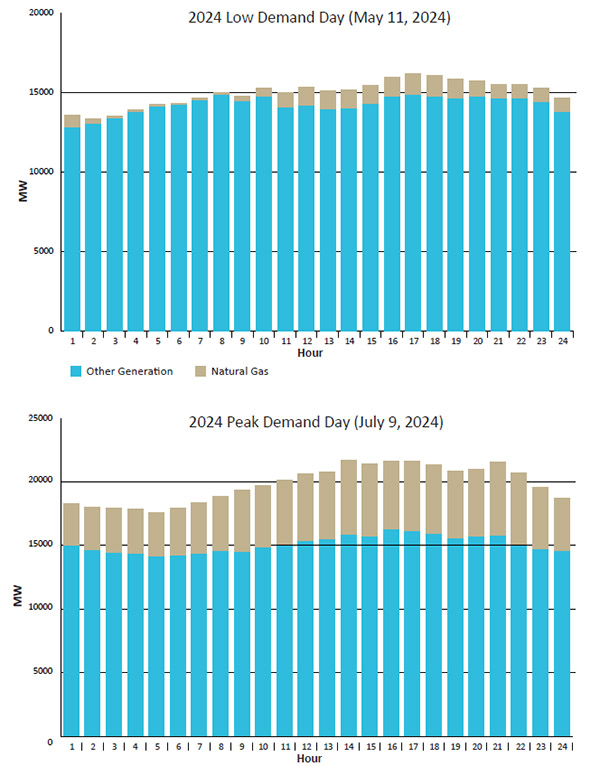
IESO says natural gas generation is essential to reliability on Ontario’s hottest summer days. | IESO
“This is an imperfect outcome,” Barreca acknowledged. “It’s not what we would have necessarily wanted. But this is what we need to ensure that all resources are able to participate.
“We wouldn’t be doing this if we didn’t think that we need some amount of … new natural gas on the system to get us through the transition period over the next few decades,” he added. (See Ontario Integrated Energy Plan Boosts Gas, Nukes.)
“I can recognize that none of this will be perfectly efficient, but that is true for the rest of the RFP. There are a lot of constraints other than cost: on where sites are selected and what ultimately gets chosen. So we are, I think here, doing the best, given the constraints that we have.”
Kelly was unpersuaded. “What you’ve done here is not to … allow these resources to participate; it’s to advantage them, and that’s materially different from the approach you guys have taken elsewhere,” he said. He suggested gas generators instead incorporate a risk premium in their offers.
IESO’s Ben Weir said if the actual gas transmission connection costs ultimately approved by the Ontario Energy Board are less than the risk premium, “ratepayers end up covering that risk-adjusted premium for really no reason.”
Uncertainty over Grid Interconnection Costs
Eric Muller, Ontario director of the Canadian Renewable Energy Association, said there also is great uncertainty on the costs of interconnections with the electricity transmission system. He said the ISO should provide a cost-sharing or true-up mechanism to address those risks.
Barreca said the risks of electric interconnection costs are “materially different” than that for gas because of a new process that will allow Hydro One, the province’s largest transmission operator, to give generators “perhaps not perfect [certainty] but at least enough certainty on those costs that they’ll be able to confidently submit their bids.
“We continue to work hard with our colleagues at Hydro One on this issue and hope to be able to share something with you all in the very near future,” Barreca said.
Officials said IESO will hold an engagement session with Hydro One on July 30 to provide an overview of the process for making new or modified connections to the grid.
Barreca said the ISO was unable to reach such certainty regarding gas distribution costs. “That ultimately just was not possible. And that is a kind of regulatory thing,” he said.
Tremor Temchin, senior vice president of development for Convergent Energy and Power, said the ISO’s requirement that generators provide continuous power for at least eight hours; its “open ended” commercial operation date for delayed turbine deliveries; and the cost sharing on gas distribution all look “like the ISO picking and choosing winners in a procurement that is supposed to be technology agnostic.”
He suggested the ISO run a separate, gas-specific procurement, saying “it’s the only way to keep this fair for other technology types.”
“This is not the ISO trying to tip the scales in favor of one technology or the other merely to enable participation,” Barreca responded. He said the move to an eight-hour minimum duration is “reflective of system needs and evolving system conditions.”
He noted that the ISO has added nearly 3,000 MW of battery storage “in a very short period of time.”
“The capacity value of that four-hour storage diminishes the more that you add without adding more … energy-producing resources,” he said. Nevertheless, he said, the ISO has not sought to derate storage capacity.
“So, I really do not think that we are here trying to tip the scales in one direction or the other. We want to have as balanced and fair a procurement as possible. We very strongly believe in the value of a diverse supply mix, and that includes some of everything.”
14 TWh, 1,600 MW Sought
IESO announced in December that it was seeking up to 14 TWh of annual generation and up to 1,600 MW of capacity resources in its second long-term procurement. The first window seeks 3 TWh of energy and 600 MW of capacity.
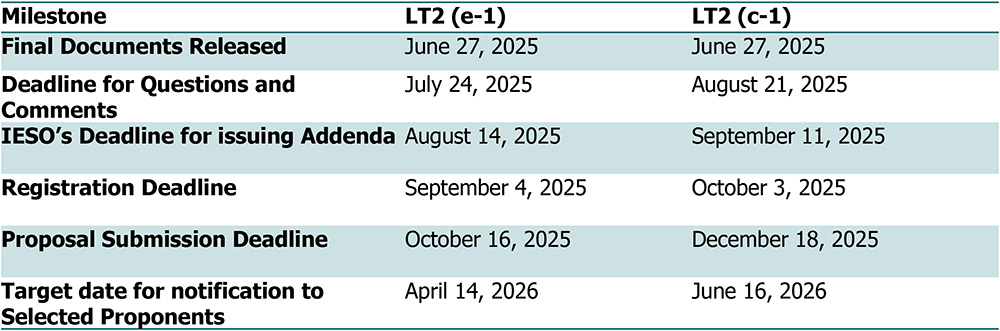
The ISO released final documents June 27 for the first window of LT2 energy and capacity procurements. Energy proposals will be due Oct. 16 and capacity proposals due Dec. 18, with notifications of winners set for April 14, 2026, and June 16, 2026, respectively.
Timelines for the first submission window of IESO’s second long-term energy and capacity procurement (LT2) | IESO
The LT2 documents include updates to some terms to reflect IESO’s May 1 introduction of a financially binding day-ahead market and the elimination of the State of Charge Reduction Factor, a transitional mechanism used to address storage facilities’ need to withdraw real-time market (RTM) offers after depleting energy during RTM obligations. With its new forward market, the day-ahead market no longer includes RTM, eliminating the dual obligation. (See Ontario Introducing Nodal Market May 1.)
The new procurement also gives bidders based in Canada a 2% reduction to their “evaluated proposal price.”
IESO Senior Adviser Nick Topfer said the home-field advantage was added in response to a June 26 directive from the Ministry of Energy and Mines and will be additive — not diluting existing bonuses such as for Indigenous participation.
The new solicitation also will allow bidders to seek price increases if import tariffs imposed after the proposals are submitted “directly” increase capital costs by more than 10%.
The ISO will have 50 days to respond to a “tariff adjustment notice” — down from 100 days, as originally proposed. If it rejects the revised price, the contract will be terminated, and the bidder’s completion and performance security will be returned.
IESO has eliminated from the capacity solicitation a proposal to limit capacity check tests to a maximum of 15 degrees Celsius.
“This decision … was a bit premature and was made hastily by us,” IESO’s Sanjiv Sohal said. “It didn’t wholly consider other articles contained in the contract. So as a result, we’re walking this decision back, and the maximum temperature limit for the winter months in section 15.6 of the contract has not been removed.”
The contract requires the tests be conducted when temperatures do not exceed 35 C in the summer or fall below ‑20 C in the winter.
The Bonneville Power Administration has unveiled its proposals for overhauling its transmission planning, with help from the industry.
BPA in February paused certain transmission planning processes to consider new reforms in light of significant growth in transmission service requests. The agency’s 2025 transmission cluster study includes more than 65 GW of requests, compared with 5.9 GW in 2021. The requests exceed the total regional load predicted for the Pacific Northwest in 2034, according to the agency. (See BPA Halts Some Tx Planning Processes Amid Service Requests.)
During a July 9 workshop, BPA outlined its plan for tackling the queue and ultimately reforming its processes to reach the agency’s vision of reducing the time from transmission request to service to five to six years. (See Industry Sees Challenges as BPA Considers ‘Radical’ Updates to Tx Planning.)
For example, the agency is considering implementing readiness criteria and a new Network Integration Transmission Service initiative where any new forecast increase of 13 MW or more during any year would require participation in commercial planning.
“If you can’t meet the readiness requirements, you leave the queue, and we keep funneling it down until we get to a place where in our long-term firm queue management, we’ve either offered you transmission service on a firm basis, we’ve offered it on a conditional firm basis or some other less than firm,” said Abbey Nulph, manager of transmission commercial planning at BPA.
“Our goal is to make as many offers to those that remain as we can so that folks are getting service, potentially not the long-term firm that everybody wants, but the best that we can without degrading the quality of service for existing rights holders,” Nulph added.
The agency also is contemplating offering interim service and moving toward proactive planning, meaning building ahead of transmission service requests, according to the workshop presentation.
BPA told RTO Insider in a statement that proactive planning “is a 20-year scenario-based power flow, capacity expansion and production cost modeling study, performed with robust stakeholder engagement, that will give BPA the vision to identify the evolving transmission needs within our area.”
“This study will operate on a two- [to] three-year cycle and will feed an evolving transmission expansion and reinforcement project portfolio for which BPA will establish a transparent project selection process,” according to the statement. “The planning scenario will be based on a set of models ranging from capacity expansion to NERC planning standard-based power flow studies.”
The agency received support for its framework from stakeholders participating in the meeting. One representative from the Columbia River PUD said the “proactive planning makes a lot of sense because it gives us the ability to take a holistic view of a community and for you to do the same thing when you make your decisions. It’s not just about a company but really looking at the opportunities and what’s going on in the community.”
However, some also raised concerns about recent staffing cuts at the agency and how the costs associated with the reforms will affect ratepayers.
Fred Heutte, senior policy associate at the Northwest Energy Coalition, said in an interview he supports BPA’s initiative.
“We have a lot more extreme weather. We have a big heat wave coming here next week during a low hydro period,” Heutte said. “We do need more transmission to bring on the … more diverse set of resources so we can keep the grid going. And so I really feel like BPA has put good principles on the table.”
Still, Heutte said BPA must ensure customers have fair access to new transmission rights and that the new readiness criteria are flexible.
“There needs to be a real focus on transparency of how they’re handling transmission requests and sorting them out through this new process that they’re developing,” Heutte said. He added that BPA needs to be “very clear about what their intended outcomes are and work closely with the customers and … with the state commissions.”
During the July 9 workshop, Nulph pointed to these principles, saying the agency will focus on transparency and collaboration and provide insights into how it will “solicit information, which data inputs we use, which scenarios we run, how we select the projects that come out the other end of those studies.”
“We don’t want this to be a BPA plan,” Nulph said. “We want it to be BPA’s plan to satisfy the regional needs.”
MISO’s Independent Market Monitor has released four new market improvement recommendations for MISO concerning transmission congestion, the Midwest-South transmission link, market-to-market coordination and price settlements after grid devastation.
IMM David Patton said the recommendations, provided as part of his annual State of the Market Report, should better position MISO for load growth combined with a renewables-heavy future.
Patton said he wants MISO to maximize its Midwest-to-South transmission limit by being less conservative with the space it reserves for unforeseen flows.
MISO actively derates its Midwest-South transfer constraint to keep flows in either direction below the contractual limit. Unmodeled flows over the constraint can push flows up and violate the limit.
But Patton said MISO’s caution has caused the transfer’s utilization to be just 84% of what’s contractually allowed. He said MISO should work in extra, lower-value steps to the transmission limit’s demand curve and raise its energy-plus-short-term reserve limit to the highest penalty step on the transfer to use the transmission more. He said a more detailed curve and relaxed limits could increase the path’s utilization when the value of transfers is high.
Patton also said the changes could reduce the burden on MISO operators to “constantly monitor and adjust the … limit in the real-time market.”
Think Before You M2M
Patton advised MISO to stop accepting SPP’s requests for constraints to be moved to market-to-market coordination unless it’s “clearly warranted.” He said MISO should accept monitoring responsibility of SPP’s flowgates only if it can provide “significantly more” efficient relief on the constraint than SPP.
Patton said in some cases, MISO has accepted an M2M designation for flowgates from SPP even when it cannot deliver economic respite.
“They end up being a lot more costly in the MISO dispatch than in the SPP dispatch. And that costs MISO customers a lot of money,” Patton said of market-to-market flowgates.
Though he didn’t mention it in his presentation, Patton was among the first to alert stakeholders that MISO could offer little relief for a MISO-SPP flowgate in North Dakota strained by a new cryptocurrency mining facility. The situation in 2023 spurred complaints from the MISO side and a FERC refusal to refund about $40 million in congestion costs. (See FERC Again Declines Changes, Refunds on Crypto-burdened MISO-SPP Flowgate.)
More Frequent FTR Auctions
MISO should move to a primarily monthly or seasonal format for auction revenue rights (ARRs) and financial transmission rights (FTR) auctions, Patton said. He said MISO should shift the bulk of its transmission capability from the existing annual FTR auction to seasonal or monthly auctions.
Patton said more lines joining a more frequent FTR/ARR auction process would limit overselling of FTRs or over-allocating ARRs on constrained lines, especially when MISO isn’t made aware of its transmission owners’ outages.
He said MISO’s transmission owners often report outages too late to be reflected in the annual FTR auction, with the network more accurately modeled in MISO’s less-attended monthly auctions.
But Patton said MISO’s current monthly auctions deliver less net FTR revenues than the value of day-ahead congestion, indicating a lack of participation.
The Market Subcommittee launched a renewed effort to improve the FTR/ARR market at the same July 10 meeting where Patton presented his State of the Market report. MISO’s Tony Hunziker said MISO would dig in at the August meeting, exploring ways to bolster FTR market performance and participation, improve model accuracy, ensure funding and better link the day-ahead market to the FTR market.
More Inclusive Impetus for ‘Forced-off’ Pricing
Finally, Patton said MISO could improve its criteria for pricing when an extreme event forces portions of the grid offline.
Patton said the recommendation applies to MISO’s “forced-off asset” event declaration, which sets real-time prices equal to day-ahead prices. MISO created the new settlement practice in 2024 for generators physically disconnected from the grid during extensive transmission outages triggered by extreme events. It’s designed to prevent generation from receiving excessive penalties or undeserved windfalls. (See FERC OKs MISO Settlement Rules for Widespread Tx Outages.)
Patton said even though 2024’s Hurricane Beryl forced transmission offline that disconnected most loads in the Southeast Texas Load Pocket, the storm failed to qualify as a forced-off asset event. He said MISO should tweak portions of the declaration, namely its constraint management and dead bus criteria, to trigger the settlement style.
Patton said MISO defines its revenue inadequacy criteria too narrowly to have activated the pricing and that to address the issue, MISO should add price volatility make-whole payment criteria to the revenue inadequacy criteria when making the call on forced-off asset declarations. He said MISO also should limit the forced-off asset dead bus criteria to load buses only.
Patton said the two adjustments should “ensure that prices in areas affected by transmission damage during extreme weather events are set at reasonable levels and avoid cost-shifting.”
You Must Decommit
Before wrapping his report, Patton took time to call back to a 2023 recommendation that MISO develop tools to recommend decommitment of resources that have been committed in the day-ahead market.
Patton said in early July, MISO racked up $38 million of congestion because there were two gas turbines committed in the day-ahead market that MISO refused to switch off. He said the transmission constraint in question was in violation for six to seven hours. Patton said that sort of circumstance has a simple fix: turning off one or both of the gas turbines.
However, Patton said “MISO will do virtually anything other than” decommit a resource. Patton said there didn’t appear to be a good reason behind MISO steadfastly refusing to decommit resources. Beyond that, Patton praised MISO’s market performance over 2024.
“In many respects, MISO’s markets are more advanced and well-developed than other RTOs, leading to superior performance,” Patton said.
Patton said MISO’s all-in energy price was an average $31/MWh in 2024, lower than the previous year due to an 8% decrease in natural gas prices. He said there was “little change” in average load from 2023.
MISO will review the Monitor’s report through September and post a public response to the recommendations in October. MISO’s response will include to what extent it agrees with the recommendations and how doable it believes each one is.
A new analysis concludes there will not be enough computer chips produced in the entire world to supply the data centers some sources predict will be built just in the United States.
The report is the latest of many doubts raised about sky-high expectations for data center load growth, and it warns about the huge cost of overbuilding the grid to meet the highest 2030 projections.
The projections are varied, but most are large, and they are driving policy-making discussions.
DOE adopted a midpoint assumption of 50 GW — plus 51 GW of non-data center load growth — to conclude the nation will be unable to meet projected demand “absent decisive intervention” because 104 GW of baseload retirement and only 22 GW of new baseload generation is planned by 2030. (See DOE Reliability Report Argues Changes Required to Avoid Outages Past 2030.)
The DOE report called for rapid and robust reforms, lest adversary nations shape the digital norms and control digital infrastructure.
But others say these are the latest overestimations of a trend and that Big Tech will not need all this electricity.
LEI totaled the projections of data center load growth from RTOs, ISOs and balancing areas covering 77% of U.S. electric load; surveyed global projections for semiconductor chip production and supply; and factored in potential increases in chip energy efficiency and computing capacity.
The interior of Google’s data center in Council Bluffs, Iowa | Google
They concluded that under the implied projection of 57 GW of data center load growth, the U.S. would need to buy 90% of all chips produced worldwide from 2025 through 2030, and said that scenario is unlikely — the U.S. now buys less than 50% of the global chip supply, and other nations are ratcheting up their own data center development.
LEI said these calculations support the anecdotal evidence that data center developers are submitting duplicate requests for grid interconnection in multiple jurisdictions that are being misinterpreted as unique requests.
However, the totals are being treated as real by some policymakers.
President Trump is easing and speeding the regulatory process in response to the national energy emergency he declared on the first day of his second term, in part to “power the next generation of technology” and “remain at the forefront technological innovation.”
This speedup raises environmental and safety questions for some observers, as well as financial worries: If more pipelines, wires and generators are built than data centers need, someone else will have to pay for the resulting overcapacity.
“This report underscores a critical and ongoing concern: Inflated and speculative data center electricity demand forecasts in the Southeast are driving a dramatic and unnecessary overbuild of infrastructure that threatens to lock in fossil fuels, hike energy bills and crowd out more reliable, cost-effective clean energy,” said Megan Gibson, senior attorney at SELC. “Such speculative infrastructure investment creates significant economic risks for ratepayers, who ultimately bear the financial burdens.”
Beyond the fundamental constraint of there not being enough semiconductor chips to supply the highest projections of data center growth, SELC noted, there are limits of powering a fleet of new data centers: There are equipment shortages for new large-scale natural gas-fired plants, nuclear reactors are expensive and slow to build, new-build coal appears unlikely, and wind and solar generation suffered major setbacks in the reconciliation bill Trump signed July 4. (See U.S. Clean Energy Sector Faces Cuts and Limitations.)
Shelley Robbins, the Southern Alliance for Clean Energy’s senior decarbonization manager, said there is immense financial incentive for suppliers and developers to game the system and overestimate demand.
“Data center growth has become a suspiciously convenient justification for pipeline and gas plant projects in the Southeast. Pipeline and utility companies make most of their money by building big things and then charging ratepayers for them,” Robbins said. “The result will be an expensive overbuild if we do not carefully scrutinize the genuine likelihood that data center loads will actually materialize.”
MISO debuted a code of conduct for its stakeholder meetings that forbids rude or callous language, deliberate meeting disruptions or disregarding committee chairs’ instructions.
MISO said that by attending stakeholder meetings, all participants agree to maintain professional conduct, identify themselves and organizational affiliation before speaking, take turns speaking and make sure everyone has the chance to talk, stay on topic according to meeting agendas and minimize distractions caused by electronic devices.
The RTO added that it would not tolerate disruptive or disrespectful behavior, including name-calling or personal attacks; “dismissive, sarcastic or demeaning remarks,” speaking out of turn and repeated interruptions, not following the meeting chair’s direction and “conduct that impedes discussion or intimidates participants.”
MISO said participants’ failure to follow the rules and “repeated or egregious violations” could result in restricted participation or being refused entry into stakeholder activities. The code applies to participants attending meetings virtually or in-person.
In response to RTO Insider’s questions, MISO did not elaborate on whether a specific incident prompted the new rules, if the RTO noticed a pattern of troubling behavior in meetings or whether the rules were in the works for a while.
“MISO values stakeholder input and we want to ensure our stakeholder process reflects that,” spokesperson Brandon Morris said in an emailed statement to RTO Insider.
MISO said reliable operations, competitive wholesale markets and collaborative transmission planning requires “engagement built on a foundation of mutual respect, professionalism and fair debate and dialogue to solve complex regional issues.”
The code states that MISO’s proposals and presentations and reports from staff delivered during meetings are “often works in progress meant to promote discussion, negotiation and consensus-building.” It also said meeting participants are expected to describe the contents of meetings “accurately and contextually” — with the understanding that opinions evolve — when sharing meeting information in news reports, social media posts, blogs or the like.
In a July 9 letter to stakeholders introducing the code, MISO CEO John Bear said he valued stakeholders’ diverse perspectives but said MISO stakeholder forums “also demand professionalism and mutual respect.” He asked the stakeholder community to keep engagement “constructive” and treat fellow stakeholders with courtesy.
“Every comment should further respectful, solution-focused dialogue that fosters trust, encourages collaboration and upholds the high standards we hold at MISO, and you hold as representatives of your organizations,” Bear wrote. “Disagreements are natural in these forums, especially when things are changing so quickly, but we all must remember that our engagement must be grounded in professionalism and respect, which, in turn, encourages fair debate and dialogue.”
FERC Commissioner Judy Chang said atthe WIRES Group Summer Meeting that it’s vital the power industry expands infrastructure to reliably and affordably meet rising demand.
“There is some misalignment in the interconnection process and the transmission planning process and the competitive market,” Chang said July 10 in Woodstock, Vt. “So, without getting into the details of dockets that I cannot discuss here, I do see this moment where there are challenges to the way we traditionally think about open access and competitive access to transmission, and that has created some logjams at the interconnection level.”
Chang said she is not a big fan of temporary fixes and would rather have the overall process improved, maintaining open access and competition so generators interconnecting the grid know the rules of the game.
“All of you in this room are at the front end of that issue, which is, how do we allocate the cost of interconnection-related upgrades?” Chang said. “How do you build them? How do you build them fast enough? How do you interconnect generators fast enough? And of course, the generators have their jobs to do as well.”
Industry and regulators need to come up with enduring solutions before it leads to a backlash, she said, with rising prices leading to a new wave of skepticism of markets and some states considering changing their longstanding market policies.
“I worry about how much states might be willing to compromise the open access and competitive access to transmission and competitive markets by pulling back and finding interim solutions, or by complaining about competitive markets not meeting the challenge of the day,” Chang said.
FERC looks at transmission planning, interconnection and wholesale market issues separately, but they all are related and, taken together, represent a comprehensive way of thinking about the power system, she continued.
“I think we still have a lot of work to do to make sure that we uphold competitive markets, open access to transmission, and make sure that we plan and implement and invest in transmission in an adequate way for the future,” Chang said. “These are the major challenges in front of us. Ultimately, we need to ensure reliable service to all customers while keeping the cost down.”
Transmission planning is key to addressing those challenges, and it comes with its own tensions of ensuring developers have the right access to capital without overburdening consumers’ wallets, she said.
“I’ve worked enough in the transmission sphere of the business to know that while we want to build infrastructure and beneficial infrastructure, if we go overboard, consumers will complain and this whole thing is going to backfire,” Chang said. “So, I’m concerned about that, and I hope you are keeping that in your line of sight as well. We have to be responsible in making sure that we’re building the most beneficial projects.”
Order 1920 provides a good basis for the industry to work through that balancing of interests, ensuring that the right mix of transmission is available to meet rising demand at a reasonable cost, she added.
Consumer groups need to understand why the transmission projects in long-term plans are picked, she argued, and the industry can help accomplish that by being transparent about why the plans were developed and what issues the projects are addressing.
Chang encouraged the transmission side of the industry to be creative and embrace new technologies, which fall under the umbrella of grid-enhancing technologies, and to explain to FERC what they want if they need with implementation.
“Whatever it is that you need, come and talk to us,” Chang said. “But I really see this as not only the future, but the present, right? I think the U.S. needs to lead in technological innovation, and you’re part of that equation. All the transmission companies are part of that equation.”
Chang has been at FERC for slightly more than a year, and she said the commission is busy with pending issues. Its staff members are stretched thin, as some took buyouts from the Trump administration to retire early, and they have not been replaced due to the commission abiding by a federal hiring freeze.
“Under Chair [Mark] Christie’s leadership, we’ve been able to keep working hard,” she said. “And I would say that it seems like that’s actually working out.”
Chang was one of three commissioners to join FERC about a year ago, and she said the group works well together with Christie. They all have different backgrounds and different areas of focus in FERC’s jurisdiction.
“We’ve been able to talk through all of those things,” she added. “When dockets before us are contentious, we take the time to listen to each other. And it’s been really just a great experience working with them.”
ISO-NE continued work with stakeholders on its capacity market overhaul at NEPOOL Markets Committee meetings, giving updates on its proposals for generator retirements, market power mitigation, and resource qualification and reactivation.
Deactivations
ISO-NE has modified its proposed timeline for resource owners to notify the RTO of resource retirements, cutting the notification lead time from two years prior to the capacity commitment period (CCP) to just one year. In the forward capacity market, resource owners historically have been required to submit retirement notices about four years prior to the relevant CCP.
The change came in response to stakeholder feedback that a lengthy lead time for retirement notifications could create risks of premature retirements.
“Some stakeholders wondered whether a shorter, irrevocable notice [would] provide more certainty to the market,” said Kevin Coopey, principal analyst at ISO-NE. He added that Potomac Economics, the RTO’s External Market Monitor, “voiced concerns with a comparatively long notification lead time and the lack of revocability.”
He said a shorter timeline “allows resources to consider as much relevant information as possible, maintaining as much option value as possible, hence improving the probability of efficient deactivation decisions.”
Under the proposal, retirement submissions would be binding, though resource owners would have the option to accelerate retirements.
While some stakeholders have pushed the RTO to allow resource owners to rescind retirement notifications in some circumstances, ISO-NE said revocability could lead to “numerous thorny issues,” including coordination of transmission upgrades triggered by the resource deactivation and the release of capacity for interconnecting resources.
“The shorter notification lead time achieves most of the benefits of allowing revocability while being significantly simpler in scope and execution,” Coopey said.
Bilateral Trading
ISO-NE does not plan to include the development of new bilateral markets or changes to monthly reconfiguration auctions in the capacity auction reform (CAR) project, said Chris Geissler, director of economic analysis at the RTO. He said efforts would require a “considerable body of work that would jeopardize the ability to deliver the core changes” in time for the 2028/29 CCP.
He added that the RTO expects the move to a prompt and seasonal capacity market to create new opportunities for bilateral trading.
Some stakeholders have expressed interest in the development of new ISO-NE-administered voluntary forward markets, along with the introduction of sloped demand curves to monthly reconfiguration auctions to allow different amounts of capacity to be sold for each month.
Geissler said the RTO may consider both initiatives after the CAR project is completed.
At the June meeting, the ISO-NE Internal Market Monitor recommended ISO-NE replace its pivotal supplier test with a “conduct and impact test framework,” making the case that the pivotal supplier test could cause the “over-mitigation of resources” as the balance of supply and demand tightens.
Andrew Copland, economist at ISO-NE, said at the July MC meeting that the RTO still plans to include the pivotal supplier test in its prompt market tariff changes, adding that “developing a new mitigation framework falls outside the scope” of the CAR project.
He said ISO-NE plans to “conduct a more general evaluation of mitigation in the capacity market after completing the CAR project.”
Copland also provided details on the cost workbooks that suppliers are required to submit to show the costs included in their capacity offers and the use of an IMM offer floor price to mitigate buyer-side market power.
Resource Qualification
In a prompt capacity market, ISO-NE plans to hold resource qualification activities “as close as possible to the annual auction and monthly trading activities to increase opportunities for new projects to participate,” said Matt Brewster, senior manager of capacity requirement and qualification at ISO-NE.
For new resources, this will require the RTO to end its practice in the forward capacity market of monitoring the progress of non-commercial projects that have gained capacity supply offers.
Brewster said ISO-NE plans to continue its existing critical path schedule (CPS) monitoring approach until June 30, 2028. After that deadline, ISO-NE would return non-commercial capacity financial assurance for non-commercial resources that cleared in FCA 18 and non-commercial resources that cleared in earlier FCAs if their “CPS milestones are substantially complete.”
It would not return the financial assurance if a resource triggers termination before the deadline or is not meeting its CPS milestones.
Some stakeholders expressed concern that this approach could incentivize non-commercial resources that otherwise would withdraw to refrain from doing so until after the deadline.
For in-service resources, Brewster said ISO-NE still is considering adjustments to the resource audit requirements and how to estimate qualified capacity for resources with limited data on their performance.
The audit requirements in the new auction framework would be based on resource class and intended to determine a resource’s qualified capacity and verify it is in service.
Resource Reactivation
For retired resources, ISO-NE proposes removing the investment requirement for resource reactivation and requiring cost-of-service agreements retaining retiring resources to include “claw back” provisions which would take effect if a resource re-enters the market after its COSA expires.
“In all other ways, a reactivation project would have the same interconnection, qualification and mitigation review treatment as any other new resource for entry and participation in the market,” Brewster said.
Brewster noted that the existing investment requirement may deter re-entry or encourage unnecessary investments to meet the threshold and added that eliminating the investment requirement would “support the potential cost-effective and timely re-entry of previously deactivated resources.”
Meanwhile, requiring claw-back provisions in COSAs would prevent incentives for resources owners to fish for out-of-market resource retentions, Brewster said.
Next Steps
The RTO plans to present tariff changes for its qualification rules, annual auction mechanics, market power mitigation requirements and resource deactivations at the MC in August. It aims to vote on the changes in October and submit the filing to FERC before the end of the year.
The second phase of the CAR project, focused on seasonal auction changes and resource accreditation, will continue throughout 2026.
MISO appears poised to eliminate its Seams Management Working Group (SMWG) after about 15 years.
The Market Subcommittee voted via a simple majority at a July 10 meeting to sunset the group. MISO’s Steering Committee is set to vote at its Aug. 5 meeting to confirm or deny the cancellation.
Group chair Terry Jarrett, of the Missouri Joint Municipal Electric Utility Commission, said topics have dried up since 2023, with “minimal content due to most major seams topics being covered in other forums” and fewer seams data points provided by MISO to the group. Jarrett also noted that transmission planning at the seams has become a more attention-grabbing topic than seams management.
Jarrett said the “participation rate has dwindled over the years” to a dozen or two dozen attendees when other stakeholder committees attract a hundred or more.
Jarrett said from his tracking since 2022, there have been 13 SMWG meetings scheduled, with just two containing substantive discussions. Eight covered only “minimal content and participation” while three either were cancelled or downgraded from meetups into documents that MISO posted to its website for review, he said.
Jarrett added that the group has been lacking a vice chair since late 2022 due to low interest among the stakeholder community.
“There’s really nothing going on for the SMWG to do, and nothing on the horizon,” Jarrett said.
Jarrett said discussions on MISO’s seams issues should be transferred to Market Subcommittee meetings.
“Working groups are intended to be temporary. It is clear that the SMWG has successfully rallied MISO and the stakeholder community around seams coordination. With seams coordination effectively operationalized at MISO, there isn’t much value left for a dedicated seams working group,” Jarrett said.
Jarrett said at the group’s May meeting, he put a possible sunset of the group to a vote. Jarrett said despite a record 46 participants listening in, only eight individuals voted, resulting in a 4-4 stalemate.
MISO Independent Market Monitor Carrie Milton requested that MISO continue to focus on seams topics, including MISO and PJM’s ongoing effort to revise their 2004 freeze date used to determine flow rights and the issue of sharing capacity near the regional transfer limit between MISO Midwest and MISO South, SPP and other parties.
MISO said it no longer will recognize energy efficiency as a capacity resource beginning with the 2026/27 auction. If approved, the action would satisfy a longtime recommendation from the RTO’s Independent Market Monitor.
The grid operator said it needs to address market participants’ double counting of energy efficiency measures before the next capacity auction in April 2026. It plans to make a filing to FERC in early September to enact the ban by December.
Research and Development Manager Geoff Brigham said while MISO will deny energy efficiency entry into the capacity auction, it will continue to allow energy efficiency to be reduced from load-serving entities’ coincident peak load forecasts. Brigham said energy efficiency resources often are part of utilities’ integrated resource planning and are recognized by states.
After FERC proposed a landmark, nearly $1 billion penalty for American Efficient’s apparently bogus programs in PJM and MISO, MISO conducted an audit of all energy efficiency resources offered in the 2025/26 Planning Resource Auction. Brigham said staff found that a “significant portion” of the resources were offered into the auction while already being accounted for in LSEs’ coincident peak load forecast.
MISO’s tariff stipulates that energy efficiency resources cannot qualify to be auctioned off when they’re already reflected in the RTO’s peak load forecast.
The RTO said it confirmed with local distribution companies that “all savings derived from state-mandated energy efficiency programs are included in their coincident peak forecasts.”
Brigham said MISO also found some resources submitted incomplete information that fell short of MISO’s measurement and verification standards.
“MISO is in the process of adjusting each resource’s accreditation and capacity payments,” he said.
Monitor David Patton has long said MISO should consider discontinuing energy efficiency capacity payments. He has said the benefits of energy efficiency exist for customers with or without the benefit of the MISO markets.
At the annual OMS Resource Adequacy Summit in Chicago, Patton said energy efficiency in the capacity markets “has been a bit of a debacle.”
“I think it’s time we follow through,” Patton said again at the March 2025 Board Week in New Orleans, where he referenced PJM’s move to eliminate energy efficiency from its capacity market. He said energy efficiency isn’t a “legitimate” capacity product.
“We really believe that energy efficiency serves no purpose in MISO markets,” fellow Monitor Carrie Milton said at a Jan. 16 Market Subcommittee meeting.