Community Solar/Resiliency Projects Gain Funding, Notice

When the electric grid goes down in Washington, D.C., during the next bad storm, there is at least one apartment building that won’t be completely in the dark.

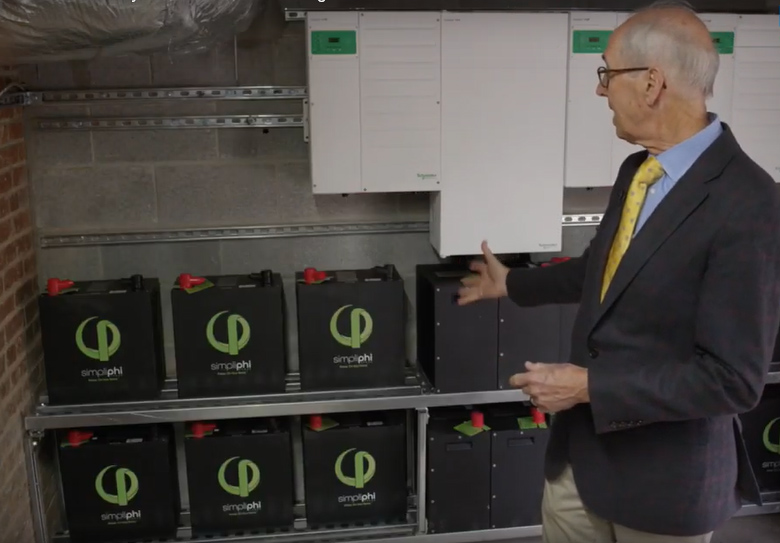
During a recent renovation, Jubilee Housing’s Maycroft Apartments, a 100-year-old low-income housing building in the capital’s Columbia Heights neighborhood, added a 70.2 kW rooftop solar array and battery storage that will power lighting for stairwells and hallways and an on-site “resiliency center” for up to three days. While residents wouldn’t have power in their units, they would be able to use the resiliency center to store medicines that need refrigeration, charge their phones, power their medical devices and watch television. The ability to shelter in place is essential for low-income residents, who cannot afford hotels or may not own cars.

In addition, 100 of Jubilee Housing’s most “rent-burdened” households will be subscribed to a community solar program that will save them $40 to $50 on their monthly electric bills for the next 15 years.

In a webinar about the project, Martin Mellett, vice president of external affairs for Jubilee Housing, the non-profit that manages the building, said a survey found about 60% of Jubilee’s residents have less than $1,000 available for all other expenses even after paying a very reduced rent. “So, a $50 a month credit on their electric bills is a huge difference,” he said. The batteries and related equipment and installation totaled $130,000; the rooftop solar array cost $197,000.
Resiliency-Center-Room-(Pepco)-Content.jpgThe resiliency center in the bottom floor of the Maycroft Apartments in Washington, D.C., allows residents to gather and access electricity during an outage. | Pepco

“We had planned to install solar panels anyway in this project,” Mellett said in an interview with NetZero Insider. But Jubilee and New Partners Community Solar were able to increase the ambition of the project thanks to a $9,000 grant they received in 2018 for a “technoeconomic” feasibility assessment of a solar-plus-storage system. The analysis that resulted helped win a $65,000 grant from the charitable arm of local utility Pepco to support the project — the first large-scale battery installation in D.C., according to Pepco.

Montpelier, Vt.-based Clean Energy Group (CEG), a national nonprofit, provided the initial $9,000 grant through its Technical Assistance Fund. CEG announced last month that its total grants to community organizations had surpassed $1 million since it launched the grant program in 2014. The grants are part of CEG’s Resilient Power Project, created following the widespread outages resulting from Superstorm Sandy, to increase resilience through solar plus storage.

The grants are supporting 86 affordable housing and nonprofit community organizations, representing 93 solar-plus-storage projects in 22 states, the District of Columbia and Puerto Rico, resulting in 30 completed projects to date. Almost one-quarter of TAF grant awards have resulted in completed solar-plus-storage installations; the remainder are still in the pipeline or were not viable because of economic, finance permitting or structural issues.

Grants have gone to a nonprofit mobility services provider in Colorado, affordable housing for farmworkers in California, fire stations in Puerto Rico, and a remote forestry office in New Mexico.

Connecting the Dots

The Department of Energy recently announced it is putting $16 million into such “capacity building” initiatives for low-income communities. Such communities usually lack the experience, expertise and connections to tap into the funding and technical know-how they need to do solar and storage projects.

Herb-Stevens-and-Battery-(Pepco)-Content.jpgHerb Stevens, president of New Partners Community Solar,  demonstrates how the Simpliphi batteries work with the rooftop solar array in a grid emergency. | Pepco

CEG doesn’t develop projects or provide financing but connects community groups it is helping with experts on the technologies. Its role is to “help connect the dots for people, whether that’s a municipality or a community-based organization or affordable housing director,” CEG Vice President Seth Mullendore said in the webinar.

“The point of the fund is to serve low-income or otherwise disadvantaged populations,” CEG Project Director Marriele Mango said in an interview. “We rely on the nonprofit or municipal facility, and try not to be too prescriptive, but when it’s municipal we’re more specific to ensure that [the project takes place] in a disadvantaged area.”

In a typical case, “we talk about the program to our partner organizations, or someone reaches out to us, and we ask if there’s a particular facility they want a battery for,” Mango said. “We ask if there’s someone they’re working with on solar feasibility. If not, we connect them with such a developer on the scope of work and the timeline and check if they’re eligible for the funds. We’re in a supportive role — we ask questions and support the community group.”

CEG asks the community partner for electric bills and load data, Mullendore said. “Sometimes the technical assistance provider can build and work as the developer, but in most cases, we prefer to work with a non-invested, third-party developer that is not tied to one specific vendor. In the post-analysis assessment process, we check in to see if there’s anything we can do to help. We help get the word out, so we can write up a case study or do a webinar, so other folks can learn from their project.”

Common Challenges

Many smaller, grassroots groups lack information about resilience, Mango said. “They may know about solar generally, but don’t know that when the grid is off, solar doesn’t continue to power the building. We educate them on how a battery operates and can support your building.”

Other problems may arise after the grant has been made and the project is being implemented. “Often, on the assessment side, there are changes in the scope, for example to replace an HVAC system, or add EV charging,” Mullendore said. Since many of the projects take place in existing buildings that are being rehabilitated, “there can be very interesting and complicated electrical system problems,” he added. “Permitting standards can vary. On implementation, the biggest problem is funding, how to pay for the systems. So, we have to look at revenue, saving people money. Usually, there’s a funding gap. We don’t have money from foundations, except for the $3 million Kresge Foundation loan guarantee program.”

Another resiliency hub CEG helped set up is on the other side of the country, in Santa Rosa, Calif., home of the California Indian Museum and Cultural Center. The museum awoke to the need to help its community in that way when the area was devastated by the 2017 Tubbs Fire, and museum staff were handing out water to displaced people in the building’s parking lot.

CEG helped the museum find consultants to advise on how to set up the resiliency center, including the permitting and installation, Nicole Lim, executive director of the museum, said in an interview. CEG also worked with the tribal community to advise them on “different types of systems to help them get access to green infrastructure,” she said. “This is in line with our cultural values of environmental stewardship.”

The resiliency center already has served the community during power shutoffs Pacific Gas & Electric has imposed for up to a week to reduce the danger of its transmission lines sparking more wildfires.

Mango said interest in the Technical Assistance Fund has expanded to new parts of the country each year, an indication of the breadth of the climate crisis, “with more places impacted by severe weather and power outages than ever before.”

CEG is hoping to raise funds to award another $1 million over three years. “We had not widely advertised the program before,” Mullendore said. “We have worried about being overwhelmed, because we could probably increase tenfold to meet the demand we’ve seen, which increases every year.”


Panelists: SEEM Can’t Be Southeast’s End Goal

ATLANTA — Participants in the Smart Electric Power Alliance’s Solar and Energy Storage Southeast conference on Monday described the proposed Southeast Energy Exchange Market (SEEM) as an important first step in an ongoing conversation on alternative market structures in the Southeast.

“I certainly don’t think that this is the end of a process,” Chris Demko, associate general counsel for Southern Co., told the “Market Reform in the Southeast” panel. “It is supposed to be a sort of demonstration of innovation that we’re looking to see. If there’s value there [in other regions], how can we import that without all of the headaches?”

SEEM is intended to reduce trading friction across 11 Southeastern states by introducing automation, eliminating transmission rate pancaking, and allowing 15-minute energy transactions. Proponents, who comprise more than a dozen utilities and cooperatives in the Southeast, including Duke Energy and Southern, also claim it will promote the integration of renewable generation resources like wind and solar.


Chris-Demko-Jennifer-Chen-2021-10-11-(RTO-Insider-LLC)-Alt-FI.jpgChris Demko of Southern Co. and Jennifer Chen of CO2efficient | © RTO Insider LLC

These promises have been disputed by some stakeholders, such as the American Council on Renewable Energy (ACORE), which published a report last month suggesting that other models surpassed SEEM’s purported benefits. (See Report: SEEM’s Benefits Beaten by Other Models.) An alliance of environmental groups has repeatedly pressed FERC to reject the proposal in favor of a technical conference on other potential market structures (ER21-1111, et al.), and several North Carolina lawmakers wrote the commission in August supporting this idea. (See NC Legislators Join Call for Southeast Technical Conference.)

Participants in Monday’s panel did not go that far, but several speakers emphasized that SEEM is not the only possible model for improving trading efficiency and promoting the adoption of renewable resources. Jennifer Chen, senior policy counsel at clean energy consultancy CO2efficient, pointed out alternative governance models that ACORE and others have suggested, as well as specific policies found in other regions that might be used in the Southeast.

“There are good practices that we can leverage from each of these regions,” Chen said. “For example … PJM’s tariff itself funds the consumer advocates in PJM states and enables consumer advocates to hire an executive director, hire consults, perform studies, [and] travel to meetings. … There are differences across the regions that we can leverage in terms of best practices for governance.”

Demko emphasized that while other governance models deserve consideration, regulators should not focus on the imperfections of the current proposal and potentially lose the opportunity for at least a partial improvement.

“This is a real option that can be delivered within a year, provided FERC accepts it,” Demko said. “This is something that is real and achievable; it’s not a hypothetical proposal and wouldn’t require scrapping the existing market that is delivering some of the most reliable electricity in the country.”

Joshua Brooks, co-founder and CEO of consultancy Brooksform, suggested that SEEM and other proposed market reorganizations are ultimately “trying to come up with business models that are more closely mapped to the physics of how electricity works,” which could prove useful to market design in general. But the underlying benefit of SEEM or any other structure is the opportunity to push a historically change-averse region toward accepting that new ideas don’t need to be feared.

“It’s the Southeast, right? They are going to have to get familiar with the idea of … just changing something a little bit,” Brooks said. “And what the outcome is may not be technologically related to it at all. I think [SEEM] would be really interesting to look at and study, same with the Southern [energy imbalance market].”

Brooks said he’s seen a “reticence to change” over the 12 years that he’s been engaged in policy regulatory discussions in the region.

“So I think the folks who would make the decision aren’t even looking at it as a technical jump …  [it’s a way to] be familiar with the process and see where they could jump in on the next piece.”

CEC Explores Grid-interactive Efficient Buildings

A “connected community” of 62 grid-interactive efficient homes used 44% less energy than a comparable all-electric community, a Department of Energy official said last week during a California Energy Commission workshop.

And the Reynolds Landing pilot project in Hoover, Ala., will soon be followed by other connected community trials. DOE expects to soon announce funding awards to about 10 additional pilot projects, according to David Nemtzow, director of DOE’s Building Technologies Office.

Nemtzow discussed connected communities during an Oct. 5 workshop on grid-interactive efficient buildings, or GEBs. CEC is hosting a series of workshops as part of the process for developing its 2021 Integrated Energy Policy Report.

Grid-interactive efficient buildings incorporate features such as smart thermostats or water heaters that communicate with the electric grid. Some homes might already have those technologies in place.

But GEBs take the technology a step further, by allowing devices to communicate with each other, with the grid, and with distributed energy resources such as solar systems, electric vehicles and energy storage.

The buildings may reduce energy demand through efficient heating and cooling systems or shed load by dimming lights in response to grid signals. They also may be able to export electricity to the grid.

Building Impacts

With nearly 125 million residential and commercial buildings in the U.S., GEBs potentially have a large role to play in meeting climate goals. Buildings account for about 74% of electricity use in the U.S. and 35% of the nation’s energy-related CO2 emissions, Nemtzow said.

“They are where we spend most of our time; they’re where we breathe most of our air; and they’re where we use most of our energy,” CEC Commissioner Andrew McAllister said during the workshop. “So it’s just of fundamental, human importance in uncountable ways that we try to make our built environment as high-performing as it can be.”

Nemtzow said the benefits of GEBs can be even greater if a group of buildings works together as a connected community, sometimes known as a smart neighborhood. A connected community may be able to achieve economies of scale, take advantage of load diversity to smooth out demand curves, add distributed energy resources and encourage new business models.

“We will not do this on a onesie, twosie basis,” Nemtzow said. “We want the whole to be greater than the sum of the parts.”

Pilot Neighborhood

The 62-home Reynolds Landing project was the first DOE-supported connected community. The homes are highly energy efficient and equipped with variable-capacity heat pumps for heating and cooling and hybrid electric/heat pump water heaters. The appliances are internet connected.

The neighborhood’s centralized microgrid includes solar panels, battery storage and a natural gas-fired backup generator. Nemtzow said the 3,000-square-foot, upscale homes sold for about $400,000 each.

The project was a partnership among DOE, Oak Ridge National Laboratory (ORNL), and Alabama Power and its parent company, Southern Co. ORNL software called Complete System Level Efficient and Interoperable Solution for Microgrid Integrated Controls (CSEISMIC) was used in the project.

The software is intended to optimize use of solar, storage and the generator, and can isolate the microgrid during an outage and supply power to the homes.

Two years after Reynolds Landing opened in 2018, the community was using 44% less energy than a comparable all-electric neighborhood. Power demand during winter peak hours was 34% less, ORNL reported.

DOE partnered again with Southern on a smart neighborhood in Atlanta called Altus at the Quarter. The project includes 46 townhouses equipped with rooftop solar, in-home energy storage, and home automation and energy management. Unlike Reynolds Landing, the Atlanta project does not include a microgrid.

Nemtzow said one of the lessons learned from the Reynolds Landing project was that residents would like to know in advance if the system is going to change the temperature of their rooms or hot water. Often the changes aren’t noticeable, but sometimes they are, Nemtzow said.

Residents had the ability to override the system’s algorithm, and some chose to do so, he added.

Commercial, Residential Projects

For the next round of DOE-supported connected communities, Nemtzow said, the projects will be spread out across the U.S.

Although Nemtzow couldn’t reveal the specific projects until DOE makes an official announcement, he said a variety of building types will be represented, including residential, commercial, mixed use, and university or corporate campuses. Some projects will be new construction while others will be building retrofits.

Nemtzow noted that California is known for its leadership on energy issues but said the federal government would like to engage in friendly competition with the state in a “race to the top.”

“I think [it’s] great that we’re doing it together and we’re all moving in the same direction,” California Public Utilities Commissioner Darcie Houck said.

GEB Barriers

DOE has set a goal of tripling energy efficiency and demand flexibility in residential and commercial buildings by 2030, compared to 2020 levels.

The department’s Building Technologies Office released a report in May titled “A National Roadmap for Grid-Interactive Efficient Buildings.” National adoption of GEBs could result in as much as $200 billion in cost savings for the U.S. electric power system over the next 20 years, the report said.

The report also outlines some of the barriers to widespread adoption of GEBs. Better technology is needed to improve interoperability of the systems, address cybersecurity concerns, and provide greater and more consistent load impacts.

In addition, more workforce training is needed related to GEBs, and consumer awareness must be increased.

MISO Tx Expansion Plans Proceeds to Board Vote

MISO’s Planning Advisory Committee has voted to advance the 2021 MISO Transmission Expansion Plan (MTEP 21) to the RTO’s directors.

The committee’s sectors voted by email through late September. Seven of the 10 sectors voted in support of the transmission package, with the End-Use, Public Consumers and State Regulatory sectors abstained.

The Board of Directors’ System Planning Committee will consider MTEP 21 during an Oct. 25 teleconference before it goes before the full board on Dec. 9.

MTEP 21 includes 339 new projects worth $3.04 billion, a drop from 367 projects totaling almost $3.25 reported by MISO during its September Board Week. This year’s package is also significantly smaller than MTEP 20’s final $4.05 billion spend on 493 projects.

Broken down, substation work accounts for 38% of MTEP 21’s investment, line upgrades take a 36% share, and new lines account for 14%. Remaining costs are spread over transformer work, voltage devices and miscellaneous investments.

“This is very typical for the last couple of cycles,” project manager Sandy Boegeman said.

The package’s most expensive project is an $86-million rebuild of a line in southern Louisiana rated at just 115 kV. The second most expensive is a $71-million new 161-kV line and breaker stations in southern Iowa. Both projects are needed for reliability reasons.

The next eight most expensive projects range from $43 million to $33 million.

Energy consultant Kavita Maini noted that members have an incomplete picture of total MTEP spending because MISO is waiting until early next year to propose higher-voltage, long-range transmission projects that will be added after the fact. (See MISO Targets March Approval for Long-term Tx Projects.)

However, some stakeholders, primarily those from MISO South, have been casting doubt on the need for billions of dollars in long-term transmission projects. (See Tensions Boil over MISO South Attitudes on Long-range Transmission Planning.)

“Right now, we don’t know the MTEP 2021 total cost,” Maini said.

Boegeman said MISO will post an addendum to the MTEP 2021 report when long-range projects are finalized by next March.

Scott Goodwin, an expansion planning engineer, said with MTEP 21 winding down, MISO planners have shifted focus to MTEP 22.

During a Tuesday Planning Subcommittee teleconference, Goodwin said MISO’s expansion planners have already completed an initial review of transmission owners’ MTEP 22 project proposals. MISO will begin holding subregional planning meetings for the portfolio’s projects in January.

Global Hydrogen Conference Reveals Plans to Ship Sunshine

The race to make hydrogen the world’s transportation and industrial fuel in order to reduce carbon dioxide emissions is well underway, judging from the turnout of a global hydrogen conference last week.

Nearly 5,000 people joined an interactive 24-hour virtual global hydrogen conference that began on the evening of Oct. 7 and continued non-stop through late afternoon Oct. 8. In addition to hydrogen, fuel cell development was discussed extensively — for heavy trucking, portable generation and automobiles.

One of the boldest plans unveiled was a pending deal between Australia and Germany to use Australia’s enormous amount of solar power potential to produce hydrogen either from desalinated sea water or fresh water, convert it to ammonia, and then ship it by tanker to Germany through the Port of Rotterdam in the Netherlands.

The two countries have already established a feasibility study to look at the supply chain for delivering large quantities of green hydrogen from Australia to Germany, Philip Green, Australia’s ambassador to Germany, told listeners.

“We call our ambition, ‘shipping the sunshine,’ taking the very large quantities of Australian sunshine, making them available in terms of hydrogen to support the next phase of Germany’s climate change ambitions.

“If you took just 3% of Australia’s land area, and if you only use its solar energy to produce green hydrogen, that would of itself provide more than 10 times Germany’s annual needs for green hydrogen. So the fundamental equation there is that Australia has the capacity to be a big supplier of green hydrogen to Germany, and others,” he said.

Another Australian, Geoff Ward, CEO of the Hazer Group, told the audience that his company is working to commercialize a process that converts methane — in this case biogas produced at wastewater treatment plants — into hydrogen and graphite, a solid form of carbon.  In other words, no carbon dioxide would be emitted in the production of the hydrogen.

The technology was developed at the University of Western Australia and is technically known as methane pyrolysis, using high temperatures in the absence of oxygen and in the presence of a catalyst (in this case powdered iron ore) to break the methane into hydrogen and graphite.

Ward said the process uses about the same amount of energy needed in steam reforming to crack methane into hydrogen and carbon dioxide, but much less energy than what is required for the electrolysis of water. Hazer began pilots in 2017, operating different configurations of project reactors in the company’s preferred “pressurized fluidized bed format.”

“We think this is a really important emerging tool in creating the hydrogen economy. It has a range of potential applications, from very large applications based on natural gas supporting industries like ammonia and petrochemicals, or decarbonization of large-scale gas systems. The other application we see is embedding it with city infrastructure with wastewater treatment plants, or with landfill gas, where we see a strong example of a circular economy,” Ward said.

The company has partnered with a municipal wastewater plant and is now building an adjacent $22 million pyrolysis plant.

‘Missing Link’

Chile is another nation distant from Europe but also interested in supplying hydrogen created with water and low-cost renewable energy. Juan Carlos Jobet, the country’s energy minister, made an effort to bring the point of the very technical conference into perspective.

“I’m convinced that our most important responsibility with future generations is reducing CO2 emissions as fast as we can. This is … the most complex, most important intergenerational fairness issue we’re dealing with.

“Any decisions we make or we don’t make, any efforts we undertake, will impact future generations, our children and grandchildren. So it’s our responsibility to stop this problem as quickly as we can. And if you look at what is generating the emissions that produce climate change, this is very, very clear.”

Green hydrogen is the “missing link” in carbon neutrality plans, Jobet said.

“And this is true all over the world. That’s the reason why the green hydrogen economy is building momentum all over the world,” he said.

Relying on a series of global hydrogen reports from McKinsey and Co., Jobet said Chile in March released a plan proposing to build extensive solar and wind installations and produce some green hydrogen for use at home, but convert most of the output to ammonia and ship it abroad as a source of green energy.

German firms will build the equipment, he said, and the Chilean government hopes to negotiate contracts with customers in the U.S., Japan and other Asian nations.

Long-haul Trucking Opportunity

Fuel cell development and green hydrogen came together during the 24-hour marathon in the remarks of Sanjay Shrestha, energy solutions and chief strategy officer of Plug Power, the U.S. fuel cell maker based in Latham, N.Y.

Founded in 1997 as a joint venture, the company has been a manufacturer of fuel cells, particularly for warehouse forklift trucks. But since its acquisition of an electrolyzer company last year and announcements that it will build additional plants, Plug Power’s redefined mission now includes producing green hydrogen, relying on the same technology in its fuel cells. And Plug Power is seeking partners globally as it expands.

Fuel-cell-powered-fork-lifts-(Plug-Power)-Content.jpgNew York-based Plug Power, a long-time manufacturer of fuel cells that use hydrogen to produce emission-free power for forklifts, is aiming to become a major supplier of hydrogen while negotiating partnerships with companies internationally. | Plug Power

Speaking to those ambitions, Shrestha put it this way: “We have a very strong balance sheet … to execute on a lot of the global strategic initiatives that we have in place. So that we really go from a company that created a first viable commercial market for hydrogen fuel cell industry in forklifts to becoming a global green hydrogen solutions company.”

He said the company’s plans are to have as much as 500 tons of green hydrogen production capacity by 2025 in North America alone. It is also looking to partner with companies in Spain and Portugal.

And the company is planning to build fuel cells capable of powering vehicles. Plug Power has signed a 50-50 partnership with Renault, Shrestha said. “We are going to have a light commercial fuel cell electric vehicle for pilot application in Europe before the end of the year,” he said.

Looking ahead, Shrestha noted that its fuel cells “are very modular in nature.”

“It can …  power all the way from robotic application drones and very small fuel cell units to … commercial vehicles to ground support equipment all the way to trains and aerospace as well as long haul trucking.

“And just to take a step back. If we think about the cost-reduction roadmap for green hydrogen, [and] the amount of the diesel that is consumed by long-haul trucking in North America, we really believe there is a tremendous opportunity here for green hydrogen solutions to help decarbonize the transportation industry in a very meaningful manner,” he said.

Sunita Satyapal, U.S. Department of Energy’s director of hydrogen and fuel cell research, was the first of 30 keynote speakers Thursday evening. She explained the Biden administration’s efforts to lower the cost of clean hydrogen to $1/kg within the decade and its support of efforts to manufacture fuel cells for heavy-duty trucking.

The last speaker was Thomas Stephenson, CEO of Pajarito Powder, a manufacturer of the catalysts at the heart of fuel cell technology.

The conference was organized by Mission Hydrogen, GmbH, a small company in southern Germany describing itself at “the independent partner of the worldwide community.” The event had 17 corporate sponsors.  Nearly 60 companies hosted interactive exhibits during the conference.

Mission Hydrogen announced it will host a global conference in October 2022.

New ERCOT Board Approves Governance Changes

ERCOT’s newly reconstituted Board of Directors met for almost 20 minutes Tuesday morning, enough time to share congratulatory messages and to approve amendments to the grid operator’s bylaws incorporating the state legislation that remade the board in the first place.

“That was painless,” an anonymous stakeholder or staff member said just before the video stream ended.

Board Chair Paul Foster and Director Chris Aguilar were only in the 10th hour of their three-year terms when the board meeting began. They are the first two of eight independent directors who will eventually comprise the 11-person board. (See 2 New ERCOT Directors Named, Replacing Current Board.)

“You’ve been much anticipated, both of you,” interim CEO Brad Jones told them. “ERCOT staff has long wanted this new board in place.”

Revamping ERCOT’s board, which previously consisted of five independent directors and eight market segment representatives, became one of the legislature’s top priorities after February’s winter storm drove the Texas Interconnection to the brink of collapse.

“I know I have a lot to learn, but I’m looking forward to working with all of you,” said Foster, who comes from an oil sector background.

“What brings us here is what we most fear: the small probability of an event that can have catastrophic consequences. That is what we have to prevent,” Aguilar said.

The board will meet later this month to consider voting items that were deferred Tuesday and to ratify the meeting minutes from the board’s previous 18 months of virtual meetings. The Finance and Audit and HR and Governance committees will meet before that while it waits for the other six members to be selected. (See Search Firm Chosen to Find New ERCOT Board Members.)

Jones, Public Utility Commission Chair Peter Lake and the Office of Public Utility Counsel’s Chris Ekoh also sit on the board, with only Ekoh allowed to vote.

Report: CCS Needs $1 Trillion Investment over 30 Years

With 71 carbon capture and storage (CCS) projects added to the Global CCS Institute database in the first nine months of this year, the technology is experiencing an unprecedented surge. But at a total of only 135 facilities in the global pipeline, the CCS sector has a lot of room for growth, according to Jarad Daniels, CEO of the institute.

“If we are to meet our climate targets and achieve climate neutrality, we will need to scale global CCS capacity by a factor of 100 by 2050, requiring around $1 trillion of investment over the next 30 years,” Daniels said Tuesday during the launch webinar for the institute’s Global Status of CCS 2021 report.

The U.S. leads the market in installed facilities, and it will host 36 of the 71 tracked by the institute so far in 2021, according to the report. Regionally, North America leads the world with 16 installed facilities and 60 in development, followed next by Europe, which has three installed facilities and 35 in development.

Key drivers of the global growth are the adoption of ambitious climate targets and the net-zero commitments of more than 100 countries, according to Guloren Turan, general manager of advocacy and communications at the Global CCS Institute.

Those commitments have “kickstarted a cycle, whereby governments around the world are strengthening policy support for CCS, and the private sector, seeing the strengthening business case for CCS … is responding by advancing new projects, developing new business models and entering into strategic partnerships across the value chain,” Turan said during the webinar.

DOE Investment

The U.S. Department of Energy is targeting investments to grow CCS technologies that are “ready to be demonstrated,” Jennifer Wilcox, principal deputy assistant secretary at the department’s Office of Fossil Energy and Carbon Management, said during the event.

Over the last five years, she said, DOE invested $1.2 billion to develop CCS technologies, and the department’s budget request for next year asks for a 60% increase in federal investment in research and development for “carbon capture, reliable storage, and conversion of CO2 and its removal from … the atmosphere.”

The request would provide up to $368 million for fiscal year 2022, she said.

This year, DOE put $75 million into R&D on front-end engineering design studies for carbon capture in the natural gas power sector, according to Wilcox. The department last week announced that of that investment, $45 million went to 12 projects, including a GE Research project in New York to capture CO2 from natural gas combined cycle flue gas and reduce the levelized cost of electricity by 15%.

DOE also has invested $33 million this year to advance direct air capture (DAC) technologies, Wilcox said. Six R&D projects announced in June received $12 million to find ways to increase the amount of CO2 capture in the DAC process.

Capture and Removal

While avoiding CO2 emissions will always be cheaper than removing emissions from the air, Wilcox said, the world has moved beyond the time when that is enough to meet climate goals. Consequently, technologies to capture CO2 at the point of emission and CO2 removal projects are necessary to meet those goals, and DOE is focused on both.

Incentives for carbon capture are already in place in the U.S., but Wilcox says they’re not nearly enough.

The federal 45Q tax credit is currently priced at about $50/ton of CO2, “coupled to dedicated and reliable storage deep underground,” she said. “That’s not a high enough price tag for a lot of the different carbon-capture opportunities that are out there today.”

That price, she said, can work for some projects, such as bioethanol or hydrogen production that have higher concentration CO2 streams. In natural gas power plant streams, however, the concentration is diluted.

“In the U.S., we don’t have a demonstration-scale project on what the actual costs of doing that [for natural gas] would be, and it’s the same with cement … and steel,” she said.

Therefore DOE is concentrating its investments on demonstration-scale projects that can help make the costs of capturing CO2 in those sectors transparent to inform policy, according to Wilcox.

DAC technology has a long way to go to meet the needs of the global community.

“They’re estimating that we need to be able to [remove CO2 from the atmosphere] on the order of gigatons by midcentury,” Wilcox said. “We need to be able to invest in the technologies today so that they are at the scale that we need them to be in order to meet net zero.”

Policy Priorities

The investment of $1 trillion in CCS through 2050 would support the deployment of 2,000 large-scale facilities, or 100 facilities each year, according to the Global CCS’ new report. Those facilities could reduce global emissions by 15%, as defined by modeling by the International Energy Agency, the report said.

To reach that scale, stronger policies are needed to incentivize the private sector and mobilize CCS investment, Turan said.

Top among the policies the institute recommends is for governments to define the role of CCS in their emissions targets and create bankable, long-term value on storage of CO2. In addition, governments need to support the identification and appraisal of storage resources, and develop clear CO2 storage laws and regulations.

“We’re already seeing a lot of these actions being implemented across the world … and it’s starting to show results,” Turan said. “What we need now is more urgency; a lot more urgency.”

Insurance Sector Confronts Climate Change Risks

From wildfire dangers to renewable energy supply-chain issues, the insurance industry is becoming more deeply entangled in the risks stemming from climate change.

Those risks were the theme of a virtual conference hosted last week by the Washington State Office of the Insurance Commissioner.

“We’re looking at impacts on our economy,” Washington Insurance Commissioner Mike Kreidler said Wednesday.

Climate change was responsible for $268 billion worth of economic damage worldwide in 2020, of which 64% is uninsured, said Yoon Kim, head of global client services at Moody’s ESG Solutions.

Kim said that more insurance claims are showing up due to bad weather. Meanwhile, the transition from fossil fuels to renewable energy increases litigation risks due to businesses entering uncharted territory, she said. Renewable energy companies are dealing with new markets, supply chains and energy source locations that differ from fossil fuel energy sources, creating a greater likelihood for business mistakes.

Meanwhile, 60% of new homes on the West Coast have been constructed in the wildland-urban interface, which translates into outlying towns and suburbs growing next to wildfire-prone rural lands, said Amy Snover, director of the Climate Impacts Group at the University of Washington. About 1 million Washington homes lie in this zone.

“Many of these have not adapted themselves to wildfire risks,” Snover said. “This is going to create risks to ordinary people who normally don’t pay attention to climate change.”

Anthony Leiserowitz, head of the Yale University Program on Climate Change Communications, studies how people perceive climate change.

He said a survey of U.S. residents this past spring showed 64% of respondents thought climate change is a problem, while 25% were very worried. Fifty-seven percent thought climate change is caused by humans, while 30% believe it is a purely natural phenomenon.

“For many people, they think of it as a distant problem,” Leiserowitz said.

Conference speakers said the insurance industry is well-suited to get businesses, governments and individuals to take climate change more seriously. “If insurance companies perceive big risks, they won’t want to write policies,” Kreidler said.

The National Association of Insurance Commissioners has created a Climate and Resiliency Task Force to tackle the issue. The group is looking at whether new regulations are needed to deal with insurance claims that can be linked to climate change. It is also studying whether measures should be taken to mitigate potential financial losses due to storms, wildfires and other global warming ripple effects.

New Era for Grid Planning in North Carolina?

After barreling through both houses of the North Carolina General Assembly in a matter of days, the compromise energy bill H951 could transform the role of resource and transmission planning as the state seeks to reduce its carbon emissions by 70% over 2005 levels by 2030.

In addition to setting that ambitious goal, the bill also calls for the state’s utilities to add 2,660 MW of new solar generation, while developing a portfolio of least-cost resources that “maintain or improve upon the adequacy and reliability of the existing grid.”

In other words, thousands of megawatts of Duke Energy’s (NYSE:DUK) coal-fired generation could soon be retired, while solar, storage and offshore wind are added to a grid that, in some places, has already absorbed all the new renewable energy it can take, Duke executives told the North Carolina Utilities Commission (NCUC) at a technical conference on Oct. 6.

Installing any new solar in those “transmission constrained areas will likely incur expensive network upgrades for interconnection,” said Dewey “Sammy” Roberts, Duke’s general manager of transmission planning and operations strategy. “We’re essentially running out of places where grid capability is available that lends itself favorably to locating incremental resources such as solar and storage.”

Costs for system upgrades for the 32 projects currently in Duke’s interconnection queue are estimated at $267 million, he said.

H951 passed the House in a 90-20 vote Thursday after clearing the Senate the day before and is expected to be signed by Gov. Roy Cooper. (See NC Compromise Energy Bill Passes Senate, Heads Back to House.)

Last week’s half-day NCUC session was the third installment of the commission’s examination of Duke’s 2020 integrated resource plan (IRP) and the methodologies it used for determining coal plant retirements, replacement resources and grid planning. While Duke emphasized the need for new “firm,” dispatchable power, preferably sited at retiring coal plants, advocates and other state officials questioned the approach, calling for more holistic, transparent and proactive system planning. (See NCUC Debates Best Path for Duke Coal Retirements.)

Speaking for the Southern Alliance for Clean Energy and the Carolinas Clean Energy Business Association, Jay Caspary of industry consultants Grid Strategies cited a raft of studies that predict the U.S. transmission system will need to grow two- to threefold to decarbonize the grid by President Joe Biden’s goal of 2035.

“We can do this; we just need to kind of think a little bit outside the box,” Caspary said. “What do we expect the resource mix to be? What are the benefits of adding transmission capacity? It’s not just economic benefits. There are probably reliability benefits, security benefits and other benefits that transmission provides just because it is such a flexible resource that provides a lot of optionality for future resource plans.”

Caspary pushed for the use of grid-enhancing technologies (GETs), such as dynamic line ratings, to upgrade existing transmission and distribution lines to make room for some of the 755 GW of solar, wind and storage that the Lawrence Berkeley National Laboratory estimates are sitting in interconnection queues across the country.

Edward Burgess, senior director at consulting firm Strategen, presented the state attorney general’s concerns on the need for more transparency about the $17 billion in transmission investments Duke has told its investors it is planning in the coming years, especially investments related to coal plant retirements. Avoiding those costs “actually wind up delaying the retirement of certain coal plants,” he said, recommending that an independent analysis of Duke’s transmission needs be conducted before its next IRP in 2022.

17% Reserve Margin 

Duke’s North Carolina utilities have submitted IRPs anticipating that a 70% cut in emissions could require more than 16 GW of solar on the grid by 2035, along with 4.4 GW of storage. Duke has two utilities in the state, Duke Energy Carolinas (DEC) and Duke Energy Progress (DEP).

Interconnecting that much new renewable energy will increase the complexity of system planning, Roberts said.

“Storage will need to be studied both discharging energy into the system and absorbing energy from the system,” he said. “A more granular approach [will be needed] to further optimize the integrated resource and grid system. For future IRPs, we’ll likely need to continue to look at alternate pathways of resources for achieving clean energy targets, and that will just add to the modeling complexity with grid resource interaction.”

The utility pointed to its work with the North Carolina Transmission Planning Collaborative, which includes Duke, the state’s municipal utilities and electric co-ops. The group recently completed a study on offshore wind and is working on a single, collaborative transmission plan for DEC and DEP.

At the same time, Duke seemed to take a more conservative and insular approach to transmission planning to avoid too heavy a reliance on “non-firm” — that is renewable — power imports from outside its system. Duke’s IRP envisions replacing coal-fired generation with up to 9,600 MW of natural gas, possibly sited at or near the retiring coal plants to take advantage of existing interconnections and keep costs down, Roberts said.

Based on North Carolina’s winter-peaking system, Duke’s transmission analysis called for a resource adequacy reserve margin of 17%, a figure that includes imports of 2,000 MW of power procured from day-ahead or real-time power markets, said Nick Wintermantel, principal utility and energy consultant at Astrapé Energy. Given that “substantial” level of imports, any further increase in import capacity would need to be firm power, he said.

A further challenge for Duke is that the Southeast is “typically capacity constrained, not transmission constrained, meaning if we increase transmission, we’re likely still not going to be able to get more non-firm imports,” Wintermantel said. “Essentially, it’s cold and gets also cold in TVA, Southern [Company] and the Carolinas; so, it’s typically more capacity constrained.”

Nor should Duke rely on imports from neighboring systems such as the Tennessee Valley Authority or PJM’s regional grid, he said. With Duke having “no control with TVA or PJM [over] their planning processes, it is highly uncertain what [importable power] will be there on that cold morning,” he said.

Getting the Cheapest, Best Resources

While acknowledging Duke’s point on minimizing reliance on imported power, Burgess countered that the February power outages in Texas were partly due to the state’s limited connections to other power systems. “Having greater import and export capability can really be thought of as an insurance policy under this kind of extreme stress,” he said. “Looking at the import and export capability can help to potentially unlock more firm contracts, relying on cheaper resources in other regions than having to build our own.”

Roberts said, “To enable future renewable interconnections may require new regulatory structures as opposed to … upgrading in response to a filed interconnection request, with a customer signing an interconnection agreement.”

Caspary pointed to FERC’s July advanced notice of proposed rulemaking (ANOPR) on transmission planning. (See FERC Goes Back to the Drawing Board on Tx Planning, Cost Allocation.)

The final rule could have “a drastic effect on how we do generation interconnection studies, how we do planning studies, how we define benefit-to-cost analysis, how we try to get more interregional projects completed in advance of the need of the resource mix so that we can actually enable the cheapest and best resources to get into the markets and facilitate the retirement of some of these old, dirtier units that seem to be a challenge for a lot of reasons.”

Modeling Shows Vt. Can Hit Decarbonization Targets Through 2050

Initial modeling of potential decarbonization pathways for Vermont shows that the state can meet 2025, 2030 and 2050 greenhouse gas emission reductions targets set by the 2020 Global Warming Solutions Act (GWSA).

A team of consultants developed the model to support the Vermont Climate Council as it finalizes the pathways and strategies it will include in the state’s Climate Action Plan due Dec. 1, David Hill, managing consultant at Energy Futures Group, said on Oct. 5.

The GWSA mandates GHG emission reductions of 26% below 2005 levels by 2025, and 40% and 80% below 1990 levels by 2030 and 2050, respectively. The model showed the state could exceed the 2025 target and meet the 2030 and 2050 targets, Hill said during the council’s latest meeting.

Exceeding the first target, he added, is all about pace.

“You can’t just barely meet the target in 2025 and then ramp it up to meeting 2030,” he said. “There is what we might call overachievement in 2025, but that is all in the interest of meeting the targets both in 2030 and 2050.”

Emissions would decline from 7.3 million metric tons carbon dioxide equivalent in 2025 to 5.2 million and 1.7 million in 2030 and 2050, respectively, according to the model.

The results, Hill said, are based on the policies and programs that the council’s Cross-sector Mitigation Subcommittee sees as the most feasible for attaining the largest GHG emission reductions in the most cost-effective manner. As the council compiles a draft plan over the next month, it will consider the subcommittee’s policy and program suggestions.

All subcommittee recommendations still must undergo further equity analyses based on the council’s guiding principles for a just transition adopted in August.

When the draft plan is complete, the consultants will plug the plan into the model to analyze the council’s official emission reduction pathway choices. A report on that analysis is due on Nov. 15.

Major Pathways

The cross-sector subcommittee made its preliminary decarbonization pathway recommendations to the full council in July for the transportation, buildings, non-energy and electricity sectors.

Initial modeling considered scenarios that are based on the subcommittee’s draft recommendations, including three major actions for transportation, buildings and electricity. Those actions are to adopt the Transportation and Climate Initiative Program (TCI-P) and a Clean Heat Standard (CHS), as well as increase the current Renewable Energy Standard (RES) to 100%. (See VT Climate Council Puts Clean Heat Standard on the Table.)

Transport

The model showed that the transportation sector could achieve an 88% reduction in emissions by 2050 under the subcommittee’s draft actions.

That result relies on a transition to battery electric vehicles (BEV) along with adoption of biofuel and a reduction of vehicle miles traveled.

The model phases out the sale of new internal combustion engine (ICE) vehicles in the state by 2033, Hill said, but biofuel would be needed for about 90,000 ICE vehicles still operating in 2050. By 2030, he added, Vermont would have 160,000 registered BEVs.

To support those transportation sector changes, the model considers Vermont’s possible participation in a regional cap-and-invest program. TCI-P would position the state to raise the consistent revenues necessary to fund BEV adoption and charging initiatives.

The cross-sector mitigation subcommittee will likely make TCI-P participation a priority pathway for the council’s consideration, according to Gina Campoli, subcommittee member and environmental policy manager at the Vermont Agency of Transportation. Benefits of participation would include a 30% reduction in transportation sector emissions and proceeds of $20 million/year, she said during the meeting.

Buildings

In the buildings sector, the model showed a possible 83% reduction in emissions by 2050 from the subcommittee’s draft actions.

The results cover residential, commercial and industrial subsectors, with most reductions coming from residential and commercial buildings, Hill said. Improved space heating, he added, is the primary driver of reductions.

The model anticipates reductions coming from the adoption of efficient heating systems, such as heat pumps, combined with better building performance and a phaseout of fossil fuels for cooking and water heating.

A fossil-fuel phaseout, under the model, could be accomplished through appliance standards or a CHS.

The subcommittee continues to support the CHS as a priority for the council’s consideration, according to David Farnsworth, subcommittee member and principal at the Regulatory Assistance Project.

A CHS is an equitable option that allows Vermonters to exercise choices in how they transition their heating systems, Farnsworth said during the meeting.

“We would recommend that the Vermont [Public Service Commission] administer the standard, establishing growing annual obligations to achieve thermal load and the necessary reductions to meet GWSA requirements,” he said.

Electricity

Vermont’s current RES has already pushed the state’s electricity related GHG emissions to 83% below 1990 levels, according to a recent report from the Energy Action Network. Recognizing that lowering emissions is not the primary goal for the electricity sector, Hill said, the model demonstrates generation growth and supports a 100% RES.

Generation in the model grows from 6,600 GWh in 2020 to 12.2 GWh in 2050, the bulk of which would come from offshore wind in the ISO-NE system.

With very low emissions, the electricity sector is now positioned as a backbone to decarbonizing the transportation and building sectors, according to Ed McNamara, subcommittee member and director of the Regulated Utility Planning Division at the Vermont Department of Public Service.

The subcommittee, therefore, continues to support its recommendation that the full council consider including a 100% RES after 2030 in the Climate Action Plan, McNamara said.

“We’re not actually recommending a very specific RES design,” he said. “There are a lot of different factors to consider — new versus existing requirements, regional versus in-state requirements, distributed versus large-scale [generation].”

Every choice has significant policy implications for cost-effectiveness and effects on low-income Vermonters, he said, adding that the subcommittee suggests the council “do further research and study on how [the RES] should be designed.”