Welch: Democrats Face Hard Choices on Cuts to Biden’s Budget

The webinar on Tuesday was ostensibly about energy efficiency jobs, but the discussion with Rep. Peter Welch (D-Vt.) inevitably drifted to the current battle over the bipartisan infrastructure bill and the Democrats’ $3.5 trillion budget reconciliation bill now unfolding in Congress.

Welch reported he was one of about 10 lawmakers on a Zoom call with President Joe Biden and Vice President Kamala Harris on Monday, and “he and she were both very realistic. He’s committed to everything in his $3.5 trillion program. But the reality is Sen. [Joe] Manchin thinks that is too expensive, and Sen. [Kyrsten] Sinema thinks that, too,” Welch said. “And we’ve got 48 votes in the Senate without them, so we’ve got to come to some resolution.

“There was a realistic discussion about the urgency of Democrats making the painful choices that we have to,” he said, although no specific programs that might be trimmed were mentioned. “This bill is largely paid for, but on climate initiatives, where the clock is ticking, we’re going to do everything we can as soon as we can, no matter what.”

Welch’s remarks came as Biden and progressives in the House of Representatives were trying to find a compromise figure, as reported in the Washington Post, with Biden suggesting $1.9 trillion to $2.2 trillion and the progressives countering with $2.5 trillion to $2.9 trillion.

Welch was optimistic that energy efficiency measures he has sponsored would survive the hard decision-making to come. One, the bipartisan Hope for Homes Act, would provide incentives for homeowners to make energy-efficient upgrades to their homes, while the Federal Buildings Clean Jobs Act, sponsored with Rep. John Sarbanes (D-Md.), would fund energy-efficient retrofits of government buildings, he said.

“Energy efficiency does three things,” Welch said. “One, it saves money; if you reduce the use of whatever fuel it is, you’re saving money. No. 2, it increases local jobs. … In each of our congressional districts where there are energy efficiency initiatives, it results in good jobs for good people. And third, it reduces carbon emissions.

“What is so tremendous about so many of the energy efficiency initiatives is that they have to be done at a micro level,” he said. “They have to be done in your home; they have to be done in the homes of black and brown citizens. And the more we have folks in the neighborhood participating in the program, the more we have local workers getting the benefits of the buildout, the more successful the program is going to be.”

Home Retrofits and Climate Goals

The problem with energy-efficient jobs, however, is that they are hard to count, said Philip Jordan, vice president of BW Research, which conducts an annual energy efficiency job survey for E2 and E4TheFuture, both clean energy advocacy groups that focus on economic and job growth.

“The Bureau of Labor Statistics doesn’t track energy efficiency as a standalone [category] because much of the work is done across other industry sectors,” Jordan said during the Tuesday webinar, rolling out the results of this year’s survey. “So, these are electricians and plumbing and HVAC and engineers and architects and assemblers.”

Based on interviews with more than 30,000 businesses across the country, the 2021 survey report counted 2.1 million Americans working in energy efficiency, accounting for more jobs than any other sector of the energy industry. The industry took a hit during the first stages of the Covid-19 pandemic, but it has been slowly rebounding, according to the report.

Retrofitting all 111 million U.S. residential units — homes and apartments — built before 2000 could create more than 1 million full-time jobs for 10 years, while saving Americans an estimated $66 billion per year on utility bills, the report says.

Efficiency may also be critical for the U.S. and individual states to meet carbon-reduction goals. The American Council for an Energy Efficient Economy (ACEEE) has estimated that robust energy efficiency measures could get the U.S. halfway to its 2050 climate goals, yet few states have specific energy-efficiency targets. A recent report from the ACEEE found that out of 17 states with 100% clean energy standards, only two — Virginia and Washington State — have specific energy-efficiency goals.

Similarly, while 24 states and Washington, D.C. have set carbon reduction goals, only New York and D.C. have set targets for decreases in energy consumption.  Adoption of such targets could reduce the cost of meeting clean energy standards by managing demand on the grid, accelerate building and transportation electrification and “advance equitable decarbonization strategies” to ensure all consumers benefit from the clean energy transition, the ACEEE report says.
Grid Operators Seek Policy Role, Reliability `Safety Valve’

Grid operators and planners need “a seat at the policymaking table” and a reliability “safety valve” to ensure efficient and reliable integration of renewables, the Eastern Interconnection Planning Collaborative said in a white paper Wednesday.

The EIPC was formed in 2009 under an agreement by 19 planning coordinators from the Eastern and Central U.S. — including MISO, SPP, PJM, ISO-NE and NYISO — with funding from the Department of Energy.

Its new report, titled “Planning the Grid for a Renewable Future,” contains no new data but makes three main recommendations for adapting the Eastern Interconnection to the increase in inverter-based renewables:

  • Enhance policy coordination across the “three-legged stool” of planning, cost allocation and siting: “Enhancing planning alone will do little to manifest the significant transmission needed to achieve a high-renewable future unless policymakers also deal with the issues of who pays for the new transmission … and challenges in siting new transmission, including issues of property rights, land use, and environmental and social justice.”
  • Establish a system of monitoring and course correction as events unfold: Regulators, industry and stakeholders should have the “opportunity to both monitor and correct course in a timely fashion if a particular [policy] path is leading to unnecessarily higher costs, limited choice for customers or negative reliability impacts.”
  • Enhance collaboration: To “ensure that public policy and the physics of the power system work harmoniously together,” EIPC says policymakers considering renewable portfolio standards, carbon dioxide standards, or other energy-related goals should invite system planners and operators to provide input “as to the full-range of planning and operational challenges, costs and trade-offs associated with the proposed set of standards. Understanding the full range of implications can be extremely challenging, which sometimes more high-level analyses used in the legislative process can overlook.”

The paper acknowledged the issues it raised “should not surprise industry leaders.”

But it said that because of the size and diversity of the Eastern Interconnection, “the insights among the planning coordinators through this effort provide a robust view on the lessons learned in planning the transmission grid to support high-renewable systems.”

The report says the growth of wind and solar resources is shifting resource adequacy risks beyond peak load periods, necessitating “more detailed modeling and integrated resource planning.” It also said additional transmission is needed to integrate renewables and meet increased demands for electrification of the transportation and industrial sectors.

To respond, there should be “a seat at the policymaking table for power system operators and planners to articulate the system reliability needs and how they are changing, so that public policy has built-in processes to account for these needs,” EIPC said. “… Grid operators and planners need to be more engaged in the discussions.”

The report said planners need more sophisticated modeling because of the growth of rooftop solar, backup generators, home chargers for electric vehicles, the conversion of gas and oil heating to heat pumps and whole-building battery backups. “As with operations, system planners must have adequate visibility into the locations and level of penetration of distributed energy resources so that the impact on the bulk system can be accurately modeled and controlled.”

In addition to transmission upgrades, integrating renewables may require “non-traditional assessments,” such as electromagnetic transient (EMT) studies to determine the impact of interruptions caused by lightning and system faults.

It praised the “proactive” implementation of IEEE 1547, the standard for interconnection and interoperability of DERs, as an example of “good, enhanced consultation.”  (See State Regulators Endorse IEEE DER Standard.) “State utility commissions must adopt the new requirements if they are to be effective,” it said.

The lack of standardized performance requirements for inverter-based renewables has caused “significant delays” in the interconnection study queues of system planners, it said. “To address this issue, there must be transparency of the control systems by the designers and vendors, so that they can be validated by the resource owners and system planners to ensure system reliability.”

The report predicts energy markets will face increasing challenges in obtaining reliability services such as generator ramping, voltage support, reactive power, frequency response and system inertia that have historically been supplied by legacy synchronous resources at no cost or through regulated rates. “As resources become more diversified, the reliable and efficient delivery of electricity will require the development of additional market products to properly incentivize those ancillary services the grid needs,” it said. “Additionally, falling marginal energy prices due to the increase in renewable resources has already put pressure on existing resources that rely on energy or capacity revenues to remain operational.”

The group said regulators could consider a “reliability safety valve” in any future legislation to address unintended consequences that could impact grid reliability as new policies are implemented.

“The intent of the ‘timeout’ to address an identified reliability problem isn’t to block progress on the intended policy objective,” it said. “Rather, it is designed to ensure a limited surgical opportunity to address particular reliability issues that may arise either during the regulatory process in developing a final rule or during its implementation.”

Previous EIPC reports have examined gas-electric coordination, transmission planning and system inertia. (See Study: Frequency Response OK in Eastern Interconnection.)

In addition to the RTOs, the EIPC includes Associated Electric Cooperative Inc.; Dominion Energy (NYSE:D); Duke Energy (NYSE:DUK); NextEra’s (NYSE:NEE) Florida Power & Light; PPL’s (NYSE:PPL) Louisville Gas & Electric/Kentucky Utilities; South Carolina Public Service Authority (Santee Cooper); Southern Co. (NYSE:SO); and the Tennessee Valley Authority.

Overheard at 2021 ISO-NE Regional System Plan Forum

ISO-NE hosted a virtual public forum on Wednesday to discuss its draft 2021 Regional System Plan (RSP), which generally uses a 10-year planning horizon to estimate the need for energy resources.

However, several studies are underway looking beyond 10 years to assess reliability with a decarbonized grid. Planning is also necessary for a future grid that is prepared to respond to extreme incidents like calamitous weather or cybersecurity events.

Here is some of what we heard during the forum.

Storage, Cybersecurity Keys for King

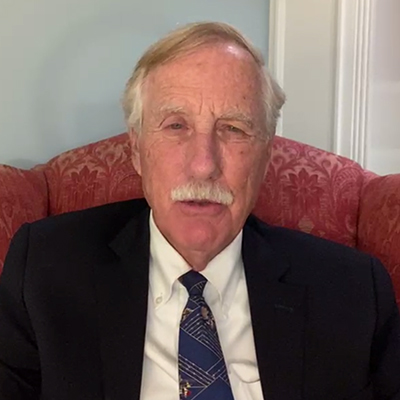
U.S. Sen. Angus King (I-Maine) | ISO-NEBefore he was elected to two terms as Maine’s governor, U.S. Sen. Angus King (I-Maine) worked for the development of hydroelectric and biomass projects and energy conservation in New England with two companies, one of which he owned and sold before entering elected politics.

King said the key to decarbonizing the power grid with 80% of electricity coming from renewables by 2030 is long-duration battery storage.

“I think the single biggest step is storage,” King said. “That’s the thing that is most important and allowing us to go to a decarbonized future.”

King said he does not see a limit to wind and solar technology, which is “improving daily; as their efficiency is going up, their cost is going down dramatically.” Instead, the problem is what fills in the gaps.

“Storage is the real Green New Deal,” King said. “If we can deal with that issue and can come up with the technology for grid-scale, long-duration storage, then we are well on our way to a decarbonized future.”

The grid of the decarbonized future also needs protection from bad cybersecurity actors. King said Russia and China were maliciously working to gain access to New England’s power grid as he spoke at the forum.

“I can guarantee you, right now at this very moment, there’s somebody in Moscow or St. Petersburg or Beijing or Shanghai working on how to penetrate ISO-NE; how to plant malware; how to create the opportunity to get in our data systems, to get in our transformers,” King said. “This is the most significant national security challenge that we face right now. The next 9/11 will be cyber.”

King added that RTOs have done well at “being ahead of this problem,” though they “can’t ever stop.”

“This is a constantly evolving threat,” King said.

As co-chair of the Cyberspace Solarium Commission, King said he had spent the last three years establishing a national cybersecurity strategy.

“I can tell you this is a grave threat, and you’re the target,” King said. “We need to establish a new relationship between the federal government and the private sector because 85% of the targets are in the private sector.”

King said that the natural gas pipeline system is “not adequately protected.” Because more than 60% of New England’s electricity comes from natural gas, King said that if something happens to the pipeline system, “we’re offline.”

Panel Discusses Extreme Events

NERC CEO Jim Robb said during a panel discussion on preparing and responding to extreme events that there have been a “cascading series” of weather incidents that have impacted the power grid. However, the “granddaddy of them all” was in Texas last February when a winter storm caused the ERCOT system’s near collapse and long-term outages.

“These weather events impact not only generation availability and deliverability but also loads,” Robb said. That is the “triple whammy” of not knowing what loads are being served, not having the infrastructure to deliver it and not knowing whether the generation “is going to show up.”

“There’s going to be a new set of tools needed because I think we’ve tortured the ones we used for our grandfather’s electric systems about as far as they can go into the new world,” Robb said.

Bill Magness, the former CEO of ERCOT who was fired in the wake of the storm, said it led to the largest controlled load shed in U.S. history, but “we did keep the system under control.”

“While we had horrendous impacts on human life, on the economy … we were able to hold on to the system, not go into a blackout and come out of it with the system intact,” Magness said.

A big issue, according to Magness, was the freezing up of generation units.

“It was an extreme weather event, but being prepared for those worst cases is critical,” Magness said. “You can have the fuel, but if you don’t have the ability to run the plant, you’re not going anywhere.”

Henderson Remembered

During opening remarks, ISO-NE Director Vickie VanZandt paid tribute to Mike Henderson, the RTO’s former director of regional planning who died May 22, a little more than a year after his retirement. The meeting was dedicated to Henderson.

Much of Henderson’s tenure at ISO-NE focused on the creation and evolution of the RSP.

“Mike was at the heart of the regional and interregional planning process in New England from the late ’90s until his retirement last year,” VanZandt said. “From the first through RSP 19, Mike’s fingerprints were all over each of these reports.”

The RSP process, according to VanZandt, has been recognized by FERC as an example of how a regional planning process should be performed, which was a testament to Henderson’s passion for the project and his work overall, she said.

Study Suggests Texas LSEs Can Provide Reliability

NRG Energy (NYSE:NRG) and Exelon (NASDAQ:EXC) have funded a white paper that proposes an answer to the ERCOT energy-only market’s reliable electricity supply problems by “leverag[ing] the highly competitive retail market.”

The Load Serving Entity Reliability Obligation would directly address resource adequacy concerns by introducing a formal reliability standard and a mechanism to ensure sufficient resources meet this standard. The paper’s authors say the proposal would preserve the market’s competitive and customer choice elements while ensuring there are enough resources able to perform during reliability events.

Written by consulting firm Energy and Environmental Economics (E3) with the help of R Street Institute senior fellow Beth Garza, ERCOT’s former market monitor, the suggested market design is one of dozens of proposals and recommendations supplied to the Public Utility Commission as it works to address flaws laid bare during the February winter storm in its blueprint for a redesigned market (52373).

Beth-Garza-2018-06-21-(RTO-Insider-LLC)-Content.jpgBeth Garza, R Street Institute | © RTO Insider LLC
“This discussion was coming whether we wanted to have it or not,” Beth Garza told RTO Insider. “It’s time for an examination of what we want from the ERCOT energy market. As always, it takes a crisis to force that decision.”

“It offers the best pathway I’ve seen on electric reliability in the state of Texas,” tweeted former Montana regulator Travis Kavulla, now NRG’s vice president of regulatory affairs. “We’re at a seminal moment where Texas decides either to have a centralized or [government]-led procurement for reliability — or where the hard work of reliability is done by the decentralized, competitive retail market that’s flourished in the state.”

Under E3’s proposal, the PUC would determine a formal system reliability standard, such as one day in 10 years, and ERCOT would calculate the required seasonal reserve margin to meet the standard.

The grid operator would then accredit each resource’s reliability value for each season. Intermittent resources and others with dispatch limitations would be accredited according to their expected performance during reliability events. ERCOT would then give a three-year forward assessment of whether it has sufficient accredited resources to satisfy the seasonal reserve margin necessary to meet the reliability standard.

That would trigger the PUC’s LSE Reliability Obligation, with each load-serving entity — retail electric providers, cooperatives and municipalities — assigned a seasonal reliability requirement based on its projected firm load during critical system hours. LSEs serving interruptible loads would receive a reduced reliability requirement. Any LSEs unable to reach their seasonal requirement on a year-ahead forward basis would be assessed a penalty that the grid operator could use to procure accredited resources and correct the deficiency.

Resources accredited with a reliability value and obligated as part of an LSE’s portfolio would be required to offer into the energy market during designated reliability events, with penalties assessed for nonperformance.

“We had to offer enough specificity so that people had a working understanding of what this proposal looks like, but to be careful of not being too prescriptive of what’s being defined,” Garza said. “The ERCOT energy-only market does a lot of things really well. What it doesn’t do, and never will, is provide any certainty for installed capacity. It incents and hopes people will react and respond.”

Garza, who was brought in by NRG and Exelon to provide an independent analysis of ERCOT’s market design and to recommend “practical reforms,” said the paper leans on proposals from the Australian and Albertan markets, the only two similar to the Texas grid. Those markets have also been the subject of restructuring discussions and legislation intended to ensure resource adequacy, the report says.

To reach greater certainty in resource adequacy, Garza said, ERCOT first needs to specify quantities, how they will be measured and who is going to provide the capacity.

“If you need requirements, the best place to put those is on the LSEs,” she said. “We’re acknowledging the competitive retail world here. We will allow those retailers to figure out how to make those obligations in a way that suits the customers’ needs and expectations. That’s what makes this mechanism much more practically attractive than a centrally dispatched market.”

The LSE Reliability Obligation differs from a capacity market in that instead of one entity buying capacity on behalf of everyone else and spreading the costs to them, Garza said, LSEs will “go out and figure out the best way to do that.”

“We would describe [the proposal] as a really good idea,” she said. “It’s not a good idea [that] you can snap your fingers and it’s implemented. Significant processes and mechanisms have to be developed and defined. There are some market power issues that have to be addressed. The PUC has to make those decisions.”

The PUC will review the various recommendations to modify the market and prevent a repeat of February’s near collapse. Several workshops will be held before the final blueprint is released in December.

Massachusetts Legislators Call on DPU to Reconsider Gas Plan

A group of Massachusetts legislators on Monday called on Department of Public Utilities (DPU) Chair Matthew Nelson to revisit the state’s near-term approach to natural gas.

The DPU’s current approach, set out in an October 2020 order, could result in customers paying for stranded assets, including repairs to pipelines, Sen. Cynthia Creem (D) said during a legislative hearing on grid modernization and the future of gas.

“Things are different now,” Creem said, referring to the passage of the state’s comprehensive climate law, signed in March. (See Mass. Governor Signs NextGen Climate Bill.) The legislation authorizes the Secretary of Energy and Environmental Affairs to establish emissions limits for sectors of the state’s economy, including natural gas distribution and service.

“We see problems with natural gas that we didn’t see before,” she said.

The DPU’s order (D.P.U. 20-80) opened a proceeding on the role of natural gas in reaching net-zero emissions by 2050, noting that meeting the goal “may require [local distribution companies] to make significant changes to their planning processes and business models.”

It required LDCs to hire independent consultants to produce reports identifying decarbonization strategies by March 1, 2022.

Nelson said during the hearing that the DPU will use the reports to develop a roadmap to “guide the evolution of the gas distribution industry in alignment with the commonwealth’s climate goals.”

In the meantime, gas utilities in the state are continuing to replace aging pipelines.

But lawmakers are pushing for the DPU to start phasing out natural gas sooner as the state aims to electrify home heating systems to decarbonize buildings. The billions of dollars being spent to replace pipelines could be redirected to energy efficiency or decarbonization programs, Sen. Michael Barrett (D) said during the hearing.

“You could be more proactive at an earlier time, and my hope is you will reconsider that sooner than six months from now,” Creem said during Monday’s session.

Lowering Emissions from Leaking Pipelines

Nelson defended the timeline, saying it is “critical utility companies have a comprehensive plan that is transparent for stakeholders to pick apart.”

The DPU will continue spending money to fix leaking pipelines, Nelson said, noting that although the new climate law makes reducing GHG emissions a primary goal of the DPU, the agency also remains responsible for ensuring safety and reliability.

“The more we can do to reduce emissions, the better,” he said.

A large part of the methane released into the atmosphere is from aging natural gas pipelines. Massachusetts gas companies reported 32,877 leaks in 2018, according to a report from the DPU.

The DPU is also investigating how existing natural gas infrastructure can be used to transport potentially low-carbon alternatives, such as biogas, green hydrogen or geothermal energy.

But these alternatives are not “clean, renewable resources,” depending on how they are produced, Barrett said.

Biogas is typically about two-thirds methane, according to the Environmental Defense Fund.

“Reductions in emissions are happening when replacing existing pipelines with plastic pipes,” Nelson said. As far as their future uses, Nelson said the agency will “see where the research points.”

FERC OKs MISO Hybrid Resource Accreditation Plan

FERC on Tuesday approved MISO’s two-part plan to accredit hybrid resources for participation in capacity auctions.

The commission said MISO’s plan “sufficiently captures the critical characteristics of hybrid resources” (ER21-2620). The ISO considers hybrid resources as renewable generation and energy storage joining the grid at the same interconnection point.

The accreditation will be handled in two parts because MISO currently lacks the operational data it uses to base accreditations on. The grid operator will first rely on the combined value of its existing unforced capacity values for each element of the hybrid resource, up to the resource’s limit of interconnection service. When staff collects enough operational data, the unforced capacity will be determined “based on historical performance, availability and type and volume of interconnection service.”

MISO will collect from hybrid resource owners their top eight daily peak hours per season’s operating history. It said owners must operate their resources as an integrated whole and under one dispatch. Owners of combined resources that intend to dispatch them individually must register the units as co-located resources, not hybrid resources, MISO said.

FERC said the accreditation “identifies and establishes a reasonable accreditation methodology for a unique resource type with distinct operational characteristics.”

“This framework is consistent with how MISO currently initially determines capacity accreditation for wind and solar resources with insufficient operational data and then subsequently bases capacity accreditation on historical performance, availability, and type and volume of interconnection service,” the commission wrote.

To date, only a handful of hybrid projects have successfully connected to the MISO system from the interconnection queue. MISO said this summer that it has 30 hybrid projects and 2.1 GW worth of capacity wending their way through the queue. Most of the projects marry solar and battery storage, the grid operator said.

The RTO’s queue numbers likely underrepresent the number of hybrids that will eventually materialize in the footprint. Staff has said interconnection customers sometimes request two separate applications for the storage and generation components and others request surplus interconnection capability for storage that’s added later. (See MISO Prepares Hybrid Participation Model for Unknown Numbers.)

In public meetings, some MISO stakeholders have said most solar generation built today either has some storage connected to it or contains later plans for storage additions.

Great Plains Institute (GPI) and Clean Grid Alliance have said the RTO should move more quickly to make its markets friendlier to hybrid resources.

GPI conducted an informal survey among 21 member developers of Clean Grid Alliance, finding that many plan to bring hybrid resources online in MISO over the next three years. The Institute said 90% of survey respondents said they were actively pursuing some kind of hybrid project, with 75% expecting to bring a hybrid resource online within three years.

“…[G]rowing interest indicates that we are likely entering a phase of accelerated deployment,” GPI said.

Palo Verde Hydrogen Demo Gets $20M from DOE

The U.S. Department of Energy will provide $20 million in funding for a demonstration project that will produce green hydrogen using power from the Palo Verde nuclear plant in Arizona.

The project is part of DOE’s “Hydrogen Shot” initiative to reduce the cost of green hydrogen to $1/kg by the end of the decade. Current DOE estimates put the cost for the fuel around $5/kg. (See Hydrogen: ‘Holy Grail’ of Rabbit Hole?)

“Developing and deploying clean hydrogen can be a crucial part of the path to achieving a net-zero-carbon future and combatting climate change,” Deputy Energy Secretary David Turk said Tuesday in a statement announcing the project. “Using nuclear power to create hydrogen energy is an illustration of DOE’s commitment to funding a full range of innovative pathways to create affordable, clean hydrogen, to meet DOE’s Hydrogen Shot goal, and to advance our transition to a carbon-free future.”

The project will produce 6 tons of stored hydrogen capable of generating 200 MWh of electricity or being used to make chemicals and other fuels.

Led by PNW Hydrogen, the project will receive $12 million from DOE’s Hydrogen and Fuel Cell Technologies Office and $8 million from the department’s Office of Nuclear Energy (ONE).

PNW is a subsidiary of Pinnacle West Capital (NYSE:PNW), parent of Arizona Public Service, part owner and operator of the Palo Verde Generating Station. In a quarterly report filed with the Securities and Exchange Commission in August, Pinnacle West explained that ONE’s participation aims to improve the long-term competitiveness of the nuclear power industry through the production of hydrogen.

“The project will provide insights about integrating nuclear energy with hydrogen production technologies and inform future clean hydrogen production deployments at scale,” DOE said Thursday.

With a capacity of 3,990 MW, Palo Verde is the largest nuclear plant in the U.S. Because of its location in the desert 50 miles west of Phoenix, far from any major body of water, the facility relies solely on wastewater to cool its reactors.

“Arizona continues to lead the nation in clean hydrogen energy innovation, and today’s Department of Energy investment will help fuel continued progress,” U.S. Sen. Kyrsten Sinema (D-Ariz.) said. “I am committed to supporting state-of-the-art investments to secure our energy future, including by passing the bipartisan Infrastructure Investment and Jobs Act, which provides $9.5 billion for national clean hydrogen hubs, hydrogen manufacturing and recycling programs, and programs to lower the cost of clean hydrogen.”

PNW’s partners in the project include Idaho National Laboratory, National Energy Technology Laboratory, National Renewable Energy Laboratory, OxEon, Electric Power Research Institute, Arizona State University, University of California Irvine, Siemens, Xcel Energy, Energy Harbor and the Los Angeles Department of Water and Power (LADWP).

LADWP plans to convert its jointly owned 1,900-MW coal-fired Intermountain Power Plant in Delta, Utah, into a natural gas-fired facility that will eventually be equipped to burn green hydrogen to generate electricity. The utility plans to produce and store the hydrogen on site.

First Nations Oppose NECEC; Accuse Hydro-Québec of Energy Injustices

Members of the Herring Pond Wampanoag Tribe and the Penobscot Nation last week gave heartfelt explanations for why developers should not build transmission lines to bring Hydro-Québec’s power to New England, saying the utility’s projects have devastated tribal communities.

Lokotah Sanborn, a Penobscot artist and advocate | Maine Youth for Climate Justice.

The hydroelectric power plants in Québec are “projects based on theft and destruction” that halted food supply to communities reliant on the land for hunting and rivers for fish, said Lokotah Sanborn, a Penobscot artist and advocate in Maine.

The severing of the rivers in Québec, the flooding of the forests and the tear of a transmission line through coastal pine barrens in Maine fragments the “spiritual and cultural ties to our homeland,” Melissa Ferretti, chair and president of the Herring Pond Wampanoag Tribe in Massachusetts, said during a webinar co-hosted by Maine Youth for Climate Justice (MYCJ) and the Sierra Club.

Maine residents will vote on a referendum in November that will determine the future of Hydro-Québec and Avangrid’s (NYSE:AGR) proposed New England Clean Energy Connect (NECEC), a $1.2 billion project that would include 145 miles of new transmission in the state. Approval of the ballot measure would put the project before the state legislature, requiring a two-thirds majority in both houses for the project to proceed.

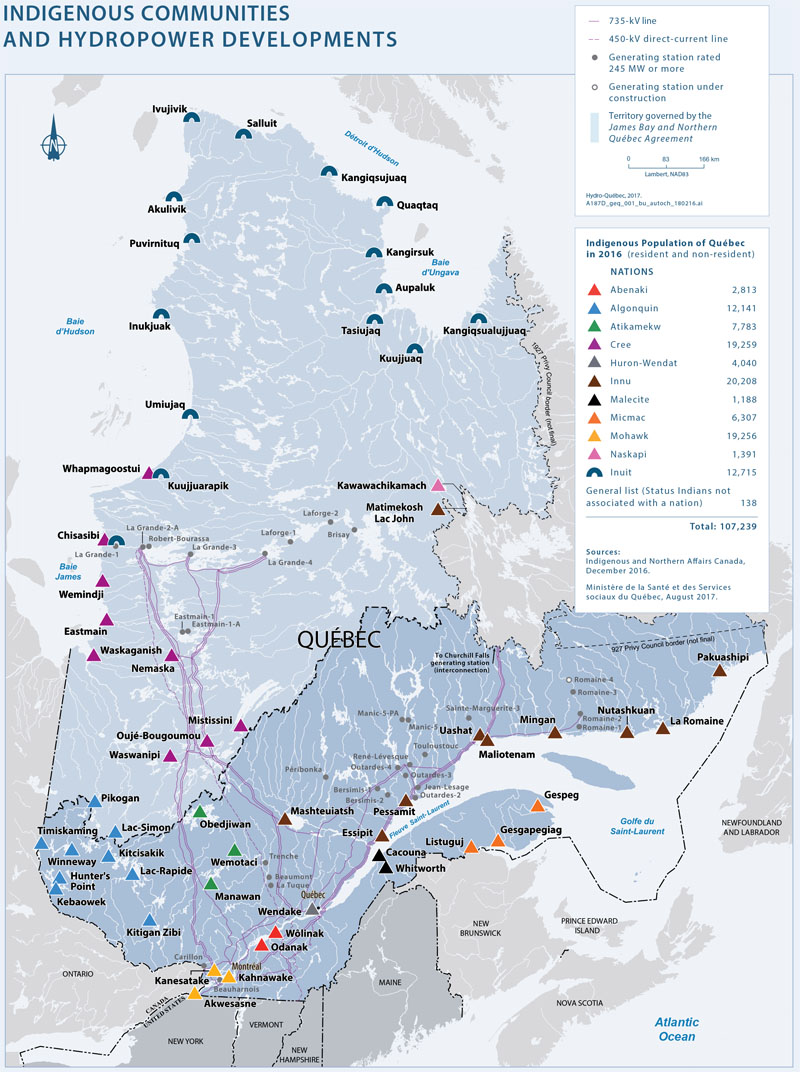
The project also faces potential litigation. A coalition of First Nations in Québec said in July it will file suit if necessary against the provincial government to stop construction of the NECEC line. The Lac Simon, Kitcisakik and Abitiwinni (Anishnabeg Nation), Wemotaci (Atilamekw Nation) and Pessamit (Innu Nation), representing about 7,000 people, claim that more than a third of the dam system providing electricity for the project is on lands the First Nations never ceded to the province.

‘Cultural Genocide’

Hydro-Québec represents half the hydro capacity in Canada and 60% of the country’s power. The company operates more than 60 hydropower generating stations and 28 reservoirs, with 550 dikes and dams across Québec. The utility has flooded 308 million acres of boreal forests since the 1970s to create reservoirs for its dams, according to Hydro-Québec spokesperson Lynn St. Laurent. The James Bay Project, in a region inhabited by Cree and Inuit north of Montreal, covers 68,000 square miles, an area larger than Florida.

Hydro-Québec says the James Bay and Northern Québec Agreement, signed by the governments of Québec and Canada, granted the Cree and Inuit Nations hunting, fishing and trapping rights in the territory, as well as financial compensation for certain services and mitigation measures. But tribes say hunting and fishing in these areas is no longer possible because the hydroelectric projects have shifted the migratory patterns for key game animals and make it difficult for fish to travel up the river to spawn.

Indigenous communities are losing their ability to maintain their culture, Ferretti said during the webinar.

Indigenous-communities-and-hydropower-(Hydro-Quebec)-Content.jpgIndigenous communities and hydropower projects in Quebec | Hydro-Québec
“Indigenous communities are the most likely to be targeted by these energy projects,” she added, recalling the teachings she grew up with, of living off the land and cutting up freshly caught fish for dinner.

“Food in the store is too expensive,” Carlton Richards, a member of the Cree Nation, said in a video to MYCJ. He said the actions of Hydro-Québec and other hydroelectricity companies contribute to the “cultural genocide of Indigenous peoples.”

Lucien Wabanonik, a Lac Simon Anishnabe Nation councilor, wrote in a letter to the Sun Journal of Lewiston, Maine, that the agreements are “the product of coercion into forced agreements with minimal compensation.”

The Innu, whose Nitassinan homeland is the eastern portion of the Québec-Labrador Peninsula, say the water diversion from dikes and dams in the region flooded their hunting land and lowered the water levels of the rivers where they fish.

In July, Hydro-Québec signed an agreement creating a $57.6 million fund to be managed by the Innu of Ekuanitshit “to address Ekuanitshit’s preoccupations” regarding changes made to the Romaine hydro development project. The agreement includes the possibility of awarding direct contracts to Innu businesses related to the Romaine complex.

Last year, the Innu sued Hydro-Québec and Churchill Falls Corp. for $4 billion over the hydro project at Churchill Falls in central Labrador, the second largest hydroelectric underground power station in  Canada, comprising 88 dikes and a 72,000-square-km reservoir. Hydro-Québec purchases more than 5,400 MW of Churchill Falls’ output.

A spokesperson for Hydro-Québec said that the company was limiting its comment on the matter while it is pending before the court. But the company insisted its projects “involve Indigenous representatives during the design stage of a project.” The company has a team of 150 environmental advisers from a “breadth of fields — biologists, anthropologists, sociologists, archeologists, geographers and more — along with 75 community relations advisers dedicated to improving our engagement across the province.”

“Our relationship with First Nations is not perfect,” the spokesperson said. “In certain areas it remains challenging, particularly where communities carry decades-old scars for a variety of reasons.”

New Projects?

In addition to NECEC, which would deliver Hydro-Québec’s power to New England, the utility also plans to send increased power to New York City through two transmission line projects selected last month, including the Champlain Hudson Power Express (CHPE). (See Two Transmission Projects Selected to Bring Low-carbon Power to NYC.)

Although Hydro-Québec says it will not need to build new dams and reservoirs to meet the increased demand from the U.S., “there is heavy concern that construction will begin on another proposed project known as Gull Island” in Labrador, Julian Felvinci, a member of the Maine Sierra Club Grassroots Network, said during the webinar. “That would be an even bigger dam [than Muskrat Falls in Newfoundland-Labrador] size-wise and capacity-wise,” at 232 km of reservoir area.

The North American Megadam Resistance Alliance cited a report conducted for it by NorthBridge Energy Partners that concluded Hydro-Québec’s export commitments would rise from 33.7 TWh to as much as 55.88 TWh as a result of its NECEC and CHPE commitments.

“Hydro-Québec [HQ] cannot meet the requirements for the NECEC and CHPE demand solely from existing generation facilities under the existing status quo conditions (including service of existing export volumes),” the report said. “The surplus generating capability and spillage cited by HQ and politicians as being capable of supporting these exports are highly variable and insufficient. Either HQ will have to back down existing export volumes, or build new hydro facilities, or resort to a combination of both strategies.”

A report by Energyzt Advisors for the Independent Power Producers of New York came to a similar conclusion. “Under average water conditions, the most likely scenario is that Hydro-Québec would simply divert energy from other exports into CHPE. Under dry conditions, Hydro-Québec would have to purchase energy from other markets to meet its contractual obligations,” it said.

Estate of GreenHat’s Kittell Lobbies FERC to End Enforcement Action

The estate of one of the owners of GreenHat Energy moved that FERC drop its enforcement action and investigate two of its employees after it emerged last week that Office of Enforcement lawyers violated regulations related to the electricity market manipulation case (IN18-9).

Lawyers for the estate of Andrew Kittell, one of three owners of GreenHat, made the filing on Tuesday, arguing that a series of emails between Enforcement’s Division of Investigations (DOI) lawyers Thomas Olson and Steven Tabackman were “not only unlawful, but deceptive.” FERC released the emails Friday after Olson, who is part of the litigation staff in the GreenHat proceeding, disclosed them to Enforcement management.

In May, the commission issued a show-cause order to GreenHat and its owners with $229 million in potential civil penalties over the company’s 890 million MWh default of its financial transmission rights portfolio in PJM in 2018. (See GreenHat Energy, Owners Face $229M FERC Fine.)

In a report released as part of the order, Enforcement staff alleged that GreenHat’s owners violated the Federal Power Act and PJM’s tariff and Operating Agreement by engaging in a “manipulative scheme” in the FTR market. The order directed the participants to demonstrate why GreenHat should not be assessed a civil penalty of $179 million and owners John Bartholomew and Kevin Ziegenhorn assessed civil penalties of $25 million each. GreenHat, Bartholomew, Ziegenhorn and the estate of Kittell were also required to explain why they should not have to disgorge $13.1 million in unjust profits, plus interest.

“As we already have shown, the merits case against the estate is fatally flawed,” Kittell’s lawyers said. “Enforcement’s conduct is disturbing. And the only remaining purpose the commission might have for continuing this matter — stripping Andrew Kittell’s widow and two children of their limited remaining assets, when it is this investigation that took Andrew’s life — is a distastefully misguided use of the commission’s enforcement powers.”

In July, the estate told FERC that Kittell, 50, killed himself by jumping off the San Diego-Coronado Bridge in California on Jan. 6. His death had been made public in April when his obituary was published, but the cause of death had been unknown.

FERC Emails

Olson notified the commission that he received emails through his personal Gmail accounts on Sept. 17 and 18 from Tabackman, who was serving as decisional staff in the GreenHat case. The two were discussing a pair of U.S. Supreme Court case decisions that Tabackman believed could strengthen FERC’s case.

Tabackman urged Olson not to reveal where he received the information on the cases, saying, “You never heard that here.”

Olson questioned Tabackman if he sent information on 1940’s U.S. v. Summerlin and 2006’s Marshall v. Marshall with the GreenHat case in mind, “or something else?”

Tabackman responded, “Yes — you should be familiar with them — though you should not mention how you came upon them.”

Olson received another email from Tabackman on Sept. 18, which referenced his work with the decisional team, and he realized the emails “constituted a violation of the commission’s separation-of-functions regulation.”

The regulation does not allow any employee assigned to work on an Enforcement proceeding or assist in a trial “to participate or advise as to the findings, conclusion or decision, except as a witness or counsel in public proceedings.”

FERC on Friday also removed Tabackman as a counsel of record in its federal court case.

Kittell Estate and FERC Response

In its motion Tuesday, the Kittell estate argued that the commission should drop all Enforcement action against it, ban Tabackman and Olson from any future involvement in the investigation and “order other offices within the commission to investigate what happened.”

“Tabackman and Olson both knew at the time they were on opposite sides of the wall,” Kittell’s lawyers said “They used Gmail instead of official FERC email to avoid detection. They used words that confirm deceptive intent.”

The estate also cited its reply in August to the show-cause order, arguing that Enforcement officials made statements that “sought to intentionally deceive the commission about the mathematical fact that the bilateral trades actually reduced the size of the default, thus benefiting PJM stakeholders.”

“Normally a litigant responds when facing allegations that it filed an intentionally deceptive pleading,” Kittell’s lawyers said. “But Enforcement never did, conceding our point. While everyone owes a duty of candor to the commission, that duty is even higher for the commission’s own lawyers. That duty was breached here.”

On Wednesday, litigation staff responded to the motion by the Kittell estate, saying Enforcement “followed proper procedure” through the disclosure of the emails. “This, and not termination of the proceeding or removal of litigation staff members, is the appropriate remedy for this violation,” they said.

NC Compromise Energy Bill Passes Senate, Heads Back to House

A compromise energy bill that could reshape North Carolina’s energy industry passed the state Senate on Wednesday and will now return to the House of Representatives, which passed an earlier version. Approved by a voice vote, H951 authorizes the state’s Utilities Commission to “take all reasonable steps to achieve a 70% reduction” in carbon emissions over 2005 levels by 2030 and net-zero emissions by 2050.

The commission would be responsible for formulating a plan, updated every two years, that would ensure a least-cost, technology-agnostic portfolio of resources to ensure affordability and reliability, Newton told the Agriculture, Energy and Environment Committee. It would also be able to establish performance-based regulation (PBR) that would link utility profits to specific, measurable performance goals, while also decoupling profits from power consumption by residential customers.

Rolled out by Gov. Roy Cooper (D) and a small bipartisan group of lawmakers on Friday, the bill is a slimmed-down and tightened-up version of the original H951 introduced in the House in June. The result of closed-door negotiations between Duke Energy (NYSE:DUK) and Republican lawmakers, the bill was widely criticized for promoting natural gas as a replacement for coal and undercutting the authority of the Utilities Commission, provisions that would benefit Duke and open the door to big rate increases. (See NC Republicans Roll Bill to Close Coal Plants, Add Renewables.)

Cooper praised the revisions as setting “a clean energy course for North Carolina’s future that is better for the economy, better for the environment and better for the pocketbooks of everyday North Carolinians.” It could also significantly improve on his own initial carbon emission reduction goal of 40% by 2025, set in 2018’s Executive Order 80.

“Bipartisanship is at the heart of this bill,” Sen. Paul Newton (R) said on Tuesday, as he shepherded the bill through two Senate committee hearings. “This is a policy bill first and foremost, focused on achieving carbon reductions at least cost and in a way that maintains our grid’s reliability. We know renewables cannot do it alone. … It will take diversification of fuel sources to achieve this goal.”

At the same time, he noted that the bill gives the commission some wiggle room on meeting the emission deadlines if it “determines that reliability or least cost would be compromised by meeting these goals. In other words, we’re giving them room to do the right thing at the right time, even if it means we’ll reduce more carbon at less cost beyond the deadlines in this bill,” Newton said.

Such loopholes raised concerns among some clean energy and environmental advocates, who saw the bill as an improvement on the original but still needing stronger protections for utility customers and a wider range of emission-cutting policies. Maggie Shober, director of utility reform at the Southern Alliance for Clean Energy, pointed to a PBR provision that would give utilities environmental incentives but only based on existing environmental standards, which could result in “utility profit windfalls for doing the bare minimum.”

A statement from the Southern Environmental Law Center called for “provisions to provide bill payment assistance and comprehensive energy-efficiency programs for low-income customers.”

PBR and PURPA

The bill essentially sailed through a one-hour hearing before the Senate Agriculture, Energy and Environment Committee on Tuesday afternoon, followed by an even quicker approval from the Senate Finance Committee. In both instances, lawmakers did raise questions about the bill’s impact on low- and moderate-income customers, which Newton answered with a list of consumer protections.

For example, he said, the bill sets a 4% cap on utility rate increases, allows utilities to offer on-bill financing for residential energy-efficiency improvements and provides for “securitization” of Duke’s retiring coal plants, under which the utility would recover only 50% of a plant’s costs.

“So, we’re protecting customers,” Newton said. “It brings the rates down lower than they would have been to securitize some of this net book value that’s left in these plants that we’re telling them to shut down, even though they have economic life left.”

While recognizing Newton’s efforts, Sen. Don Davis (D), speaking before the vote on Wednesday, made an impassioned plea for lawmakers to do more to protect low-income residents from rate hikes and potential power shut-offs.

“Everyone here that’s been involved in this legislation, I’m begging you that as you vote in support of this bill today … when you press the button today, and when we go out to laud how wonderful this is, that we still have in the back of our minds a commitment of coming back, a true commitment, a genuine commitment of coming back to try to do something to help the least of those amongst us,” Davis said.

Other key provisions in the bill:

      • Solar procurements would be split, with 45% coming from power purchase agreements with third parties and 55% utility-owned. These requirements would also apply to procurements of solar plus storage and any solar “procured in connection with any voluntary customer program.” The bill also calls for competitive procurement of 2,660 MW of renewable energy allocated over a 45-month period.
      • Multiyear rate plans are part of the bill’s PBR provisions, allowing Duke to file a rate case only once every three years, after which it could raise rates up to 4% without Utilities Commission approval. Utilities will have to apply for PBR incentives and multiyear plans, and the commission can approve, modify or reject the applications. The bill includes a list of considerations for PBR approval, including whether a utility’s plan will encourage peak load reduction, energy efficiency and deployment of distributed energy resources, while also reducing energy costs for low-income consumers and supporting equity in contracting.
      • Solar projects originally built under contracts mandated by the federal Public Utility Regulatory Policies Act will have the option of renegotiating and extending their contracts with utilities for another 10 years, albeit at a lower rate. Under PURPA, utilities are required to offer contracts at a standard price to qualified facilities, which in North Carolina were originally sized at 5 MW and below. The state passed a bill (H589) in 2017 that reduced the maximum size of projects down to 1 MW and shortened the contract length from 15 to 10 years.

Rep. John Szoka (R), who was a sponsor of the original House bill, says he supports the revisions, noting that the current bill’s PBR and PURPA provisions are taken from the original.

“What we were trying to do was to continue what we’ve started in 589 to keep a downward pressure on energy costs for the state,” Szoka said in a phone interview with NetZero Insider. The original bill may have been too prescriptive, he said, but it brought out the proposed legislation’s good points and opponents’ objections, “so when it got to the Senate, I believe, it was easier for them to deal directly with the governor and come up with something that was agreeable.”

He expects the bill to pass in the House with a “very good majority.”

“My belief is the lower-cost forms of energy, which today are renewable, will eventually win out,” Szoka said. “It might be one of those deals where solar and modular nuclear end up getting more market share than they would have, had we stayed with a more prescriptive approach.”

Could All-source be Least-cost?

Underlying the bill’s mandate for least-cost resources is an assumption that natural gas will continue to be competitive with the falling costs of solar, wind and storage. Opponents speaking at both hearings on Tuesday warned that renewable procurement would translate to higher electric rates.

However, the Utilities Commission is now studying technology-neutral, all-source procurements that could help accelerate coal retirements in the state and replace that generation with a portfolio of cheaper, cleaner resources optimized to improve system efficiency and savings. Advocates are similarly pushing Duke to adopt all-source procurements in its next integrated resource plan. (See NCUC Debates Best Path for Duke Coal Retirements.)

At a two-day technical conference on Thursday and Friday, Commissioner Dan Clodfelter quizzed Duke executives on the utility’s procurement practices versus an all-source approach.

“As I hear it, you are defining need in a more discreet, ‘componentized’ way and looking at procurements relative to components or elements in that need,” he said. “And what I hear the other party’s advocating for is that we should define what they call ‘total system need,’ and then you should seek procurement of a portfolio of resources that in the aggregate will satisfy that total system need.”