Legislators Say Mass Save is ‘Dragging Feet’ on Clean Energy Goals

Members of the Massachusetts legislature questioned program administrators of Mass Save during a hearing on Wednesday asking why the utility group has fallen far behind state targets for electrification.

“There is a lot of feet dragging, even on the administration goals,” Sen. Marc Pacheco (D) said.

While Mass Save is supposed to transition 100,000 homes to electric heat each year, The Boston Globe reported that the group transitioned only 461 homes last year.

That number is “woefully low,” and “under the control of the electric and gas utilities,” Pacheco said.

Mass Save is a collaborative of Berkshire Gas, Blackstone Gas Company, Cape Light Compact, Columbia Gas of Massachusetts, Eversource Energy (NYSE: ES), Liberty Utilities, National Grid (NYSE: NGG) and Unitil (NYSE: UTL).

The Joint Committee on Telecommunications, Utilities and Energy held the hearing for several bills that the committee is considering, including An Act Instituting a Governance Structure for Mass Save (S.2132).

“From a legislative view, there is no one focused on responsibility” of the role of Mass Save in electrification, reducing greenhouse gas (GHG) emissions and engaging environmental justice communities in participating in its low-cost energy transition programs, Sen. Michael Barrett (D) said during the hearing.

As proposed, the bill would create a Mass Save board of directors that would include at least two experts in the economics of GHG reductions and three residents of state-designated environmental justice communities.

The bill, filed by Barrett earlier this year, is an attempt to hold Mass Save accountable in its new role under the state Climate Act, which is to prioritize GHG emissions reductions and assist in reaching the reduction sublimits imposed on sectors such as buildings, and natural gas specifically, the state senator said.

Mass Save currently operates without a CEO or a board of directors. The Massachusetts Energy Efficiency Advisory Council (EEAC), which includes state, utility and private sector representatives, is responsible for overseeing Mass Save’s work and energy efficiency in the state.

Chris Porter, a nonvoting member of the EEAC representing National Grid, testified Wednesday that the advisory council is aware of the reporting done by the Globe and said it is inaccurate because it does not reflect the number of houses that were partially transitioned from natural gas to heat pumps. Complete transitions, Porter said, involve removing the ability to supply natural gas to the home.

The partial transitions “should not be interpreted as a lack of support” for the state’s climate goals, Porter testified, as Mass Save has “partially” transitioned about 10,000 homes, meeting goals outlined in the current three-year plan for the program.

A draft for the next three-year plan for Mass Save allocates $894 million to electrification for 2022 to 2024, including funding for high-efficiency electric heat pumps, Porter said.

However, Barrett said the current three-year plan Mass Save is operating under took effect the same year the Massachusetts Decarbonization Roadmap development process kicked off, which should have inspired Mass Save to act sooner than it did.

Changes to Mass Save Under New Bill

The proposed Mass Save board would be responsible for tracking and evaluating the program’s role in instituting emission reduction targets under the leadership of an executive director appointed by the board that is not associated with a utility.

According to the bill, the executive director would prepare the annual budget for Mass Save and oversee its coordination with the Department of Public Utilities. The director would also file an annual report to the Secretary of Energy and Environmental Affairs and the legislative Joint Committee on Telecommunications, Utilities and Energy, as well as the Senate and House Committees on Ways and Means.

The report would focus on the cost-effectiveness of the program and its contribution to state GHG reductions.

However, it will take Mass Save along with other programs to achieve the scale needed to decarbonize heating systems in 100,000 buildings each year, said Cammy Peterson, director of clean energy at the Metropolitan Area Planning Council in Boston and a member of the EEAC.

Mass Save “needs to do a much better job reaching people, and we will need to look beyond Mass Save to achieve the scale that we need,” she said.

“Can Mass Save be saved?” Barrett said during the hearing. “We will have to see.”
Maine Submits Fed Lease Application for Floating OSW Research

The state of Maine submitted a lease application on Friday to the U.S. Bureau of Ocean Energy Management for 9,696 acres in federal waters in the Gulf of Maine to build a floating offshore wind research array.

In its application, the state said it plans to install no more than 12 turbines on the site, which is 40 miles from Portland. Cape Small, north of Portland, is the nearest mainland point from the site at 29 miles.

Among the top priorities for the project is evaluating how floating technologies interact with Maine’s billion-dollar fishing industry, of which lobstering is a mainstay.

“Fundamentally, I believe that offshore wind and Maine’s fishing industry can not only coexist but can help us build a stronger economy and a brighter, more sustainable future for Maine people,” Gov. Janet Mills said in a statement.

A consortium will oversee research activities and release open-source results from the project, according to the application. Mills signed a law (LD 1619) in July that established the consortium, which must include three representatives of the state’s lobstering industry, two representatives of the state’s commercial fishing industry and the state’s commissioner of marine resources.

The law also established a moratorium on OSW development in state waters in the Gulf of Maine, where 75% of the state’s lobsters are harvested, according to the application.

“The state of Maine engaged hundreds of individuals, which resulted in selection of a proposed lease area in a location with limited lobster activity and minimal groundfish activity,” the application said.

In June, Mills signed the Act to Encourage Research to Support the Maine Offshore Wind Industry (LD 336), which directs state regulators to enter a long-term contract for a 144-MW floating wind research array. The law allows a state utility to secure the contract with New England Aqua Ventus, the joint venture behind the 11-MW floating wind pilot that will feature the University of Maine’s VolturnUS concrete semi-submersible hull.

The pilot will be sited at UMaine’s deep-water OSW test site 3 miles southwest of Monhegan Island in the Gulf of Maine. The island is 23 miles from the proposed lease site for the research array, which also will feature the VolturnUS hull.

Research activities would take place throughout the planned project development process, which Maine estimated in its application would take eight years. The array, according to the application, is a critical element of the state’s current OSW roadmap initiative.

Maine received $2 million from the U.S. Economic Development Administration to create the roadmap, which will outline the best way to build the state’s OSW potential without harming the fishing industry. The final roadmap is due in December 2022. (See Roadmap Initiative Set to Hone Maine’s OSW Goal.)

Four working groups must deliver initial recommendations for the map to the lead advisory committee by the end of this year.

A fisheries working group met on Wednesday to consider a draft proposal of pre-construction monitoring priorities for the research array for inclusion in the roadmap. The group proposed researchers conduct a survey of the amount and distribution of marine life in and around the lease area. In addition, the group said an oceanographic data buoy on the array location would provide environmental condition data and allow researchers to monitor marine life. Other recommendations included continued seafloor mapping and a survey of existing commercial and recreational fishing activity.

The fisheries working group will meet again in mid-October.

Oregon Adopts Nation’s Strictest Landfill Emissions Rules

Oregon’s Environmental Quality Commission (EQC) last week approved rules that will give the state the most stringent landfill gas emissions standards in the U.S., part of an effort to reduce the release of heat-trapping methane.

The state currently follows EPA standards for landfill gas emissions. The new rules proposed by its Department of Environmental Quality (DEQ) will exceed those standards by expanding the categories of landfills subject to gas emission regulations while lowering the size threshold for facilities covered, among other changes.

According to DEQ estimates, landfills accounted for 37% of Oregon’s carbon dioxide equivalent (CO2e) emissions from stationary sources in 2019, excluding electricity generators. Landfills represented six of the 25 largest sources of greenhouse gas emissions in that category, the agency found. Methane makes up about 40 to 60% of those emissions from landfills.

“If you look at just a 20-year time span, methane’s global warming potential is over 80 times that of carbon dioxide. This shows why landfill gas control is an important element in greenhouse gas emissions reductions,” Heather Kuoppamaki, DEQ senior environmental engineer, told the EQC on Friday.

The DEQ set out to revise Oregon’s landfill gas rules in response to Gov. Kate Brown’s Executive Order 20-04, which last year directed state agencies to use their existing regulatory authority to find ways to reduce the state’s GHG emissions.

In crafting the new rules, Kuoppamaki explained, Oregon looked to California’s regulations — the country’s strictest — as a template. The DEQ found some key differences between the two sets of rules, including the fact that Oregon’s existing rules cover only municipal solid waste landfills, while California’s also include industrial waste landfills. California’s rules also have a much lower threshold for the size of landfills covered: 496,000 tons of waste-in-place versus 2.5 million tons in Oregon.

Kuoppamaki noted also that California has “much tighter” surface emissions monitoring and gas destruction standards, requiring landfills to install gas collection and control systems if they emit methane at concentrations of at least 200 parts per million by volume (ppmv), compared with 500 ppmv for the Oregon/EPA standard. California also requires monitoring equipment to be placed on pathways spaced 25 feet apart, compared with 98 feet in Oregon.

Oregon’s new rules match California’s by adopting the 200-ppmv and 25-foot standards. The DEQ will also expand program coverage to encompass industrial landfills, including construction and demolition waste landfills, which are exempt from oversight under California regulations.

The DEQ’s new rules will additionally surpass California’s by reducing the covered landfill size threshold to more than 200,000 tons of waste-in-place. Landfills under that threshold will be “conditionally” exempt from the rules if they maintain an adequate landfill cover. They will also be required to maintain records verifying the amount of waste-in-place.

Landfills exceeding the 200,000-ton threshold that produce less than 664 metric tons (MT) of methane per year must obtain a “simple” air containment discharge permit (ACDP), requiring them to submit annual reports on the amount and type of waste received and provide updated landfill gas generation reports.

Active and closed landfills that emit at least 664 MT of methane per year must obtain a standard ACDP. “Landfill owners or operators in this category would be required to either conduct surface emission monitoring, or, if surface emission monitoring shows methane emissions greater than 200 ppmv, install and maintain a gas collection and control system, along with continued surface emission monitoring,” the DEQ said.

The DEQ estimates that 15 landfills that were not previously required to have ACDPs will be required to obtain the permits, on top of the 12 in the state that already hold one. Kuoppamaki said it’s “really hard to estimate” which landfills will be required to install collect-and-control systems. After being flagged, landfill owners will have 30 months to complete the systems.

“Most landfill owners are local governments, both city and county, or private businesses,” DEQ said.

New ACDP applications will be due Oct. 1, 2022.

Trucks the Focus of Midwest States’ Collaboration on EVs

LANSING, Mich. — The governors of Michigan, Indiana, Illinois, Wisconsin and Minnesota last week agreed to collaborate to accelerate electric vehicle adoption in the upper Midwest, focusing initially on medium- and heavy-duty vehicles (MHDV).

In a Sept. 30 memorandum of understanding, the governors established the Regional Electric Vehicle Midwest Coalition to “future proof the region’s manufacturing, logistics, and transportation leadership and position the region to realize additional economic opportunity in clean energy manufacturing and deployment.”

The network’s initial focus will be installing a truck charging network on interstate and “regionally significant” commercial corridors to “leverage our existing role as a shipping and logistics hub,” the states said in a press release. “The MOU is meant to competitively position the Midwest for upcoming federal funding opportunities and create a welcoming environment for economic development and innovation around EVs, EV charging infrastructure, battery performance, and other technologies on the cutting edge of the transportation-energy sector convergence,” the agreement said.

The region is home to interstate highways such as I-94 and I-69, which play a key role in truck transport between the U.S., Canada and Mexico.

The five participating states will also “share best practices to inform the standardization of regulatory schemes” for EVs and “to develop a common customer experience across state lines.”

The agreement also calls for working with “historically disadvantaged” communities on electrification workforce development and assuring the availability of charging stations and economic development in all communities.

The states said their initial focus on MHDVs will improve air quality in disadvantaged communities located near freight and shipping facilities and highways.

The Midwest initiative is not the first multistate collaboration on EVs. In 2017, the governors of Arizona, Colorado, Idaho, Montana, Nevada, New Mexico, Utah and Wyoming created REV West, which focused on eliminating range anxiety for EV owners on major highways in those states. As of December 2020, the states reported the addition of more than 100 DC fast-charging stations by the private and public sectors since the MOU’s launch, with at least 75 additional stations in the planning phase.

Jane McCurry, executive director of Clean Fuels Michigan, said the agreement could assure commercial truckers of “cross-boundary cooperation on charging infrastructure. Heavy duty vehicles, really any fleet vehicles, need to know they can charge with confidence, and the rules won’t change from location to location.”

The states hope their collaboration will increase the region’s share of electric vehicle production.

Michigan and Indiana are top automotive production states, and electric truck maker Rivian, whose manufacturing facility is in central Illinois, plans to begin shipping its electric pickups in January 2022. General Motors (NYSE:GM) and Ford (NYSE:F) have committed to electrifying their product line.

“We shouldn’t have to choose between building a cleaner, more equitable state and economic development — and thankfully, vehicle electrification is an area where we can do both,” Wisconsin Gov. Tony Evers (D) said in the release.

The five states agreed to create a task force of senior state leaders to oversee the activities and work to remove barriers to EV charging infrastructure.

The MOU is not legally binding, and any of the states can leave the agreement. The MOU members can add more states to the agreement by a unanimous vote.

ERCOT Mothballed Resources Return to Year-round Ops

ERCOT will soon add an extra 226 MW of capacity to the market with recent announcements that two resources will come out of seasonal mothball status.

Austin Energy told the grid operator on Wednesday that it is returning the wood-fired Nacogdoches Power, the country’s largest biomass plant, to year-round service on Oct. 15. The plant, which the municipal utility acquired from Southern Power in 2019, had been operating on a seasonal basis during the summer.

Last week, Garland’s municipal utility notified ERCOT that it was bringing back a pair of gas-fired units that had been mothballed in 2018. The two units at Garland’s Spencer plant have a total capacity of 118 MW.

ERCOT has said it has enough capacity to meet a fall demand peak of 65 GW by at least 30 GW, but staff told regulators last week that forced or maintenance generator outages continue to approach 10 GW a day. (See ERCOT: Sufficient Capacity to Meet Fall Demand.)

Brad Jones Named to Reliability Council

Texas Gov. Greg Abbott on Tuesday included interim ERCOT CEO Brad Jones among six appointees to the new Texas Energy Reliability Council, which was established by legislation this summer in response to February’s Winter Storm Uri.

The other appointees represent three of Texas’ four largest urban areas: Houston, San Antonio and Austin. They are:

      • Nate Murphy, senior counsel for refiner Valero, San Antonio;
      • George Presses, vice president of fuel and energy for the H.E.B. grocery chain, San Antonio;
      • Edward Stones, global business director for energy and climate change for Dow, Houston;
      • Jon Taylor, corporate vice president of fab (silicon wafers) engineering and public affairs at Samsung Austin Semiconductor, Austin; and
      • Melissa Trevino, assistant vice president for power at Occidental Energy Ventures, Houston.

Senate Bill 3 tasks the council with overseeing the grid’s weatherization and improving communication in the state’s energy and electric industries.

Smart Energy: DERs, Electrification, Wholesale Pricing

Distributed energy resources, electrification and equitable wholesale compensation for both dominated two panels during the virtual North America Smart Energy Week.

Karen Olesky, an economist for Nevada’s Public Utilities Commission, said she’s both riddled with anxiety and invigorated over how quickly new distributed resource technology is being developed.

“It’s very exciting to see vehicle-to-grid charging and the electric company being able to access behind-the meter storage in someone’s home to use it as a demand response unit,” Olesky said during a Sept. 28 panel on electrification. “I think these are great DER technologies, and I love seeing them in pilot programs and proliferate, but I’m also scared about how quickly that technology is changing. Some of these technologies that utilities invest in might end up being obsolete well before the end of their useful lives.”

Olesky said ratepayers could be stuck paying for electric vehicle charging stations that are quickly replaced by newer models. She called the speed of adoption and its implications on long-term resource planning “exciting and kind of terrifying.”

Regulators and utilities are okay to “pivot” on incentive programs when they realize they’re unpopular or ineffective, she said.

Keith Dennis, vice president of the National Rural Electric Cooperative Association, said electrification stands to improve people’s quality of life.

“It wasn’t more than a hundred years ago when people were washing dishes and clothes by hand, and electricity really improved our lives and it can do it again,” he told attendees.

Dennis said electrification can save customers money, lessen environmental impacts, bolster grid reliability and lengthen the lifespan of heavy machinery and construction equipment. He added that he doesn’t want electrification to become politicized.

Oncor Electric Delivery’s David Treichler said the conversion to electrification is one of the most consequential changes the nation will undertake. Electrification will fundamentally change how we “move goods, people, things.”

Flying into the Dallas Fort Worth airport one night, Treichler said he concentrated on a bird’s eye view of the airport’s logistics warehouses. He said when thinking about how to electrify the airport’s freight services, he realized the centers were packed so tightly together that he couldn’t see where new substations could be squeezed in to handle charging.

Treichler said Oncor has developed a green fleet analytics tool that evaluates a customer’s load requirements for electrification and available nearby capacity to gauge the need for new electric facilities.

“The longer you wait to talk to us, the harder it is,” he said, urging companies interested in fleet electrification to act sooner rather than later.

National Grid’s Kristin Munsch said electrification’s growth is uncertain now because the changeover hinges on customer adoption.

“It’s talking about people’s cars, people’s home heating systems,” Munsch said. She said investments need to be made thoughtfully so that all customers can electrify their homes, not just those that can afford it.

“Like everywhere in the country, we’ve got very affluent communities, and we’ve got more challenged communities,” she said.

Panelists during a wholesale pricing session said appropriate compensation is necessary for a more active demand-side market.

“We have a generational problem of how we count it. How do we know what a megawatt is anymore?” OhmConnect’s Cisco DeVries said. “Ultimately, I think we just need to agree on some methodologies, and I think it’s really critical for the wholesale market that we get there quickly.”

“We have historically underestimated the potential of distributed clean energy in terms of serving our wholesale markets,” SunPower’s Suzanne Leta said. “A key question in my mind is: how do we ensure the right policies are in place to enable consumers to offer that value to the wholesale market and get paid for it? That’s really the question we need to focus on answering.”

Leta said the industry often ignores that just 3% of residential customers currently have rooftop solar. She said rooftop solar is poised for a “massive” growth trajectory. “We are just at the tip of iceberg,” she said.

In SunPower’s nationwide surveys, Leta said residents cite concern over outages as the primary reason for installing their own solar and storage.

“This is real-time for consumers, whether it’s an ice storm in Texas, or flooding in Louisiana or a hurricane in New York. … That’s what people are concerned about. Are power outages happening on a much more frequent basis?”

Leta said in addition to wholesale pricing, state commissions and utilities need to think differently about resource procurement. She said commissions’ resource planning is rooted in one-way transactions sourced from fossil fuels or nuclear power.

“That’s just not how our grid works today, and it’s not going to be how it works in the future,” Leta said.

Jill Powers, CAISO’s infrastructure and regulatory policy manager, said dynamic rates and demand-side management will feature more prominently in wholesale pricing.

“The duck curve is about 10 years old, and he’s been progressing quickly,” Powers said, noting that CAISO underestimated rooftop solar’s contributions. She said CAISO contends with oversupply and dramatic ramping needs in any given day.

DeVries commended CAISO for being among the first to allow bids on a 15-minutes basis from aggregated DERs.

“The wholesale market is the place where this transaction takes place,” he said. “It is not a place the customer understands at all. They are never going to understand it. They’re still incredibly confused as to why we might pay them to save energy. That makes no sense [to them].”

He said the aggregator’s role is to simplify and translate DER use into the wholesale market.

“We can’t say to customers, ‘You can’t turn your air conditioning on right now.’ Right? That’s a no-go,” DeVries said. “The utilities have tried that forever. It just doesn’t work.”

Texas Market Taking Winterization Seriously this Time

Kicking off the Texas Reliability Entity’s annual winter weatherization workshop last week, CEO Jim Albright noted a “renewed focus by all of us on winter weather.”

That’s no surprise, given the February winter storm that drove the ERCOT grid to the brink of collapse and led to human and financial suffering across Texas. A joint inquiry by FERC and NERC has since pinpointed a lack of winter weatherization of generator facilities and natural gas infrastructure as the leading cause of the power outages that left some Texans in the dark and cold for almost four days. (See FERC, NERC Share Findings on February Winter Storm.)

State lawmakers and regulators responded to the storm by taking a more aggressive response to weatherization, requiring generators and transmission service providers (TSPs) to comply with mandatory reliability standards for winter weather and imposing financial penalties if they don’t. (See “Weatherization Rule Published,” PUC Workshop Takes First Stab at Market Changes.)

FERC Chair Richard Glick, in discussing the joint inquiry with NERC last month, noted that the two regulators proposed similar requirements after a previous winter event in 2011. However, “that recommendation was watered down to guidelines that few generators followed,” he said.

This time, it will be different, Jeff Billo, ERCOT’s director of forecasting and ancillary services, said during Thursday’s virtual workshop.

“Previously, we really didn’t have any mandatory reliability standards from a weatherization standpoint,” he said, adding that there will be “substantial fines.” Penalties can range as high as $1 million/day.

“Future inspections will be very different than they have been in the past,” Billo said.

The Public Utility Commission’s draft rule directs generators and TSPs to file compliance statements, signed by a senior-level officer, attesting to their actions. ERCOT staff will follow up with on-site inspections. With about 800 resource units to inspect, Billo said ERCOT is taking a “risk-based” approach and will focus on those generators that failed during the winter storm. That will likely include wind farms and solar fields, Billo said.

The grid operator’s staff are currently developing an online compliance form that will be distributed before the Dec. 1 response deadline. ERCOT is required to file a report with the PUC by Dec. 10.

“If we have 800, 900 units to look at, we don’t want [response] emails in formats we’ll have to sort through in eight or 10 days,” Billo said.

ERCOT used to inspect about 80 units a year, Billo said. The increase has forced the grid operator to create a weatherization director’s position and hire additional staff to meet the load. In the meantime, staff will rely on support from contractors to meet a Dec. 24 inspection deadline.

The commission will add temperature requirements to its reliability standards next year, following a detailed weather report due early next year.

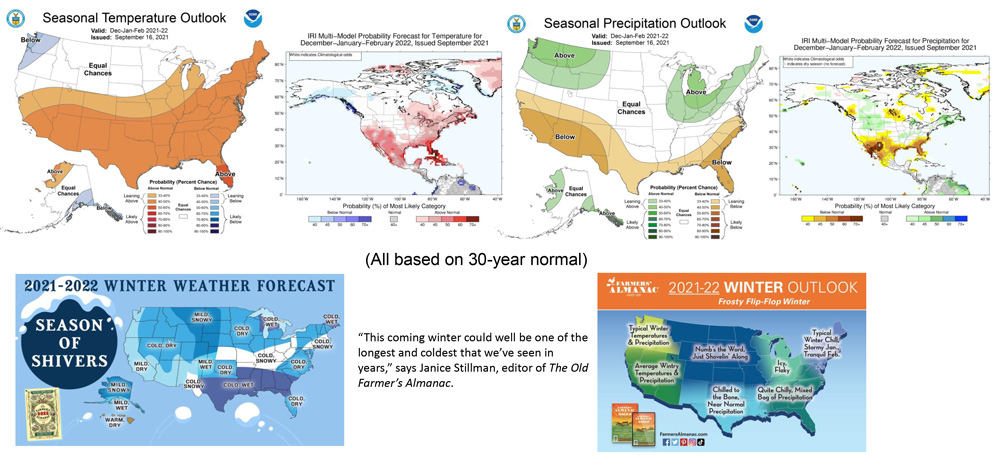
ERCOT meteorologist Chris Coleman told his virtual audience that the La Nina ocean patterns are similar to last year’s and that a majority of forecasts are pointing to a colder-than-normal winter. While much of the cold air may be concentrated in the Midwest, he said, “The potential is there for a polar vortex for ERCOT a time or two.”

Winter is coming, but despite the forecasts, this winter is statistically likely to have less extreme weather than last year. | Texas REColeman said this winter will likely be a dry one, welcome news to those who remember February’s ice and snow. He said his preliminary data indicate the coming season will be similar to the mild winter of 1999-2000, pointing out that extreme winters are historically followed by milder ones.

“Statistically, when you have a cold, extreme winter, at least some, if not more, of those winters were followed by some extreme cold, though not as extreme” as the previous winter, Coleman said.

The meteorologist’s final forecast will be released in November.

Generation Owners Share Tips

Andrew Valencia, Lower Colorado River Authority’s (LCRA) senior vice president of generation and the man who will sign the utility’s compliance statement, was among several market participants and industry experts who shared their insight during the workshop.

He said a power plant is only as good as its weakest link, noting subsystems and major equipment are typically designed for specific minimum temperatures that may or may not be consistent. The highest temperature rating sets the entire plant’s rating, but that can be a moot point when sub-zero temperatures hit.

El Paso Electric’s performance during the winter storm led to a social media meme. | LordOfTheBrohirrim via iFunny.com“There’s no way to test freeze protection until you have cold weather,” Valencia said. “Until you can experience those temperatures, there’s no way to functionally test it.”

He said activating temporary heat sources, frequently checking equipment and adding staff are among hundreds of procedure provisions necessary required to maintain operations.

LCRA begins its winter preparations in the fall with meetings to review written procedures and checklists for each site. Supply inventories and equipment are checked and senior leaders tour each site to verify preparations.

“That’s the best time to work on it. You don’t need the preparation measures, and you have time to work on the protection,” Valencia said.

El Paso Electric’s Kyle Olson said the utility invested $4.5 million in freeze protection systems after losing generation, much of it built before 1980, during the 2011 winter event. The utility also added a gas unit designed to withstand ‑10 degrees Fahrenheit, chose simple cycle turbines over combined cycle, and installed dual-fuel capability on new additions.

The utility wound up meeting demand that was almost 37% above normal. Being part of WECC and separated from ERCOT helped, as one social media meme was quick to notice.

“The heat tracing money paid off,” Olson said, citing $19 million in customer savings during the February storm. “In a city where summer temperatures reach 105 [to] 110, people aren’t constantly thinking about winter protections.”

ERCOT Technical Advisory Committee Briefs: Sept. 29, 2021

Members Endorse Changes from Winter Storm’s Emergency List

ERCOT’s Technical Advisory Committee last week endorsed several protocol revision requests and associated changes related to the use of emergency response service and load-resource participation in non-spinning reserves, a result of members’ work on the committee’s emergency conditions list following the February winter storm.

The committee approved the three ERS-related measures on a single ballot during Wednesday’s meeting, with only Morgan Stanley casting an opposing vote. The independent power marketer was among several from its segment that voted against the measures as they wound their way through the stakeholder process.

The key nodal protocol revision request (NPRR1090) clarifies that ERCOT has the flexibility to declare when exhausted ERS service types will be renewed for some or all of the ERS time periods and extends the deployment limit of weather-sensitive resources.

The measure revises several ERS processes, including modifying and clarifying language related to the beginning and end of contract periods for ERS renewals; removing the limit on the maximum number of deployments per contract period; and revising the cumulative deployment obligation time requirement for weather-sensitive resources.

Staff said NPRR1087 will ensure any critical load in ERS programs can continue to support critical operations if they are deployed by requiring an attestation that the resource is not located behind an electric service identifier (ESI ID) for a critical load. The NPRR also requires a qualified scheduling entity representing an ERS resource to ensure and attest that it is not located behind an ESI ID for a critical load or itself is not the critical load.

The final ERS measure (NPRR1082) changes the testing criteria for ERS load with obligations less than 100 kW co-located with an ERCOT generator.

The TAC also separately approved NPRR1093, which allows ERCOT to explore temporary workarounds for non-controllable load resources to participate in non-spinning reserves and provide additional capacity for the grid operator in the coming winter and summer seasons. The non-controllable resources will be deployed after offline units participating in non-spin.

The change request reinstates protocol requirements that were in place during the nodal market’s first five years and were then subsequently changed to enable controllable load resources to be economically dispatched and to participate in non-spin. It also incorporates market design changes that have been made for the operating reserve demand curve (ORDC) and reliability deployment price adder (RDPA) process when deploying ancillary services from non-controllable load resources.

The measure passed by a 22-6 margin with two abstentions. All four cooperatives and two independent generators opposed the NPRR over concerns that a “resulting flood” of participation in the non-spin market “will artificially suppress” the service’s value. Non-spin can clear as low as 1 cent/MWh, they said, with “bleed-over” effects into the day-ahead and real-time markets.

An earlier proposal to table the change request for a month failed 8-17, with five abstentions. Staff said any delays would close the window for making the additional non-spin available to their operators before next summer.

The measure carries a price tag between $450,000 and $650,000 and will take about a year to complete.

“This is a complex addition to the ancillary service-clearing engine,” explained Kenan Ögelman, ERCOT’s vice president of commercial operation. “That’s why it’s both expensive and time-consuming. But with so many items going on, it’s a matter of reserving resources so they can work on this too.”

The vote on NPRR1082 also included two other binding document revision requests (OBDRRs) and a change to the nodal operating guide (NOGRR):

    • OBDRR032: aligns the non-spinning reserve deployment and recall procedure NPRR1093’s revisions.
    • OBDRR033: matches the methodology for using the ORDC to calculate the RDPA with NPRR1093’s revisions.
    • NOGRR232: squares the guide with NPRR1093’s revisions.

Load Project Threshold Approved

The TAC approved ERCOT’s request to increase the boundary threshold used in load forecasting from 5% to 7.5% for all eight weather zones. Staff said increasing the threshold will provide the transmission service providers (TSPs) more flexibility in handling the fast-growing areas on their systems, but they also noted the Public Utility Commission directed ERCOT to pursue the increase during its Sept. 23 open meeting.

The need has become more acute with large consumers, such as data centers, proposing new facilities with accelerated development timelines in addition to the state’s explosive population growth. According to 2020’s U.S. Census Bureau data, Texas’ 29.4 million residents account for 8.9% of the country’s population, but 32.4% of the total growth between 2019 and 2020.

The Far West zone’s boundary threshold already stands at 7.5%, having been raised in 2018 because of the additional transmission necessary to address oil and gas development in the Permian Basin.

ERCOT compares its load forecast, a top-down system-level approach, with the TSPs’ ground-up projections, aggregated by weather zones. If staff’s projections are higher in a particular zone, ERCOT uses its forecast and distributes load to each substation according to the TSPs’ allocations.

In zones where the TSP forecast is higher than ERCOT’s but below the grid operator’s boundary threshold, the TSP’s projections are used. If the TSP forecast exceeds ERCOT’s boundary threshold, it is reduced to match the ERCOT forecast plus the threshold.

ERCOT’s 2021 regional transmission plan (RTP) found that demand forecasts for six of the weather zones were limited by the boundary threshold. The TSP-developed forecasts for those zones ranged from 6.8 to 11.2% above ERCOT’s projections in the RTP’s final year (2027), resulting in a demand reduction of about 2.8 GW.

“I don’t think we’re in perfect lock-step all the time, but there’s not necessarily a disconnect between the two processes,” said ERCOT’s John Bernecker, manager of transmission planning assessment. “We’re also seeing significant changes in demand-side behavior. That certainly warrants further discussion in investigating why we’re seeing some of these things we see, as well as evaluating how we approach appropriate load-forecast studies.”

“Raising this [threshold] to 7.5% is just hand-waving,” Morgan Stanley’s Clayton Greer said, calling for a subcommittee assignment. “We need to get to the root-cause analysis of what’s happening here.”

Members Endorse $101M Tx Project

Members endorsed staff’s recommendation for a $101.5 million transmission project that addresses reliability and aging infrastructure needs in the Port Lavaca area on the Gulf Coast by placing it on the combination ballot.

Staff reclassified American Electric Power’s (NASDAQ:AEP) original $97.8 million proposal to a Tier 1 project when its review found reliability planning-criteria violations that elevated the project’s costs over a $100 million threshold. Tier 1 projects must be approved by the Board of Directors.

The project involves rebuilding and adding a second 138-kV circuit to 10 miles of an existing line; upgrading 24 miles of 69-kV line to 138 kV or capable; constructing two 138-kV substation and one 138/69-kV substation and installing two 138/69-kV transformers to replace 69-kV facilities; and retiring 20.3 miles of 69-kV line.

About 40 miles of the area’s 69-kV lines date back to 1949 to 1953. AEP expects to complete the project by December 2024.

Slim Combination Ballot Passes

The TAC pulled NOGRR223 off the combination ballot to allow Luminant (NYSE:VST) to vote against it. The measure, which requires phasor measurement recording equipment at existing facilities with an aggregated capacity above 20 MVA at a single site before entering the interconnection queue or change-request process, passed 27-1, with two abstentions.

Luminant said there is no “clear justification” for ERCOT to require phasor measurement unit capability, as most of the burden is on owners with the 20-MVA requirement for new generation resources.

The remainder of the combo ballot included two revisions to the planning guide (PGRR) and a change to the resource registration glossary (RRGRR):

    • PGRR093: reinserts three requirements into the board-approved graybox language for PGRR082 that were inadvertently removed in its revisions.
    • PGRR094: aligns the guide with current practices by grayboxing language requiring project construction start and completion date submittals until system implementation in the resource integration and ongoing operations-integration services system.
    • RRGRR030: removes certain transformer data’s hard coding of voltage levels for certain resource registration information, allowing resources connected to other voltage levels to submit their registration data without receiving validation errors.

FERC Asks Details from CAISO, NYISO on Order 2222 Compliance

FERC on Friday gave CAISO and NYISO 30 days to explain some details of the treatment of distributed energy resource aggregations described in their Order 2222 compliance filings (ER21-2455, ER21-2460).

Most of the commission’s questions to the ISOs concerned the market participation model for DERs and the coordination between the ISO, aggregator and distribution utility, particularly the role of the utility.

The commission asked NYISO to “explain how the DER aggregation rules accommodate the physical and operational characteristics of heterogeneous aggregations and, in particular, heterogeneous aggregations that include mostly one resource type. For example, please explain how NYISO’s DER aggregation rules accommodate the physical and operational characteristics of an aggregation comprised primarily of solar resources with some storage.”

FERC said NYISO outlined the resource adequacy problems that could arise from “modeling an aggregation of solar intermittent power resources as a DER aggregation” and asked “why similar concerns would not arise with a DER aggregation that is composed largely, but not exclusively, of solar resources.”

Continuing in the same vein with CAISO, the commission referred to the ISO’s proposals to require that a DER aggregation have at least one DER capable of injecting energy and to maintain its existing demand response models for homogeneous aggregations that include DR resources only.

“If a heterogeneous aggregation containing injecting resources and distributed curtailment resources fails to inject energy over a certain interval — i.e., if the aggregation only provides demand response to CAISO — would CAISO require the aggregation to register in one of CAISO’s demand response models in order to participate in the CAISO markets?” the commission asked. “If so, please explain when CAISO would require this change in registration and indicate where this process is documented.”

CAISO in September answered its stakeholders in the FERC docket by clarifying several aspects of its compliance filing, but it dismissed many comments as related to issues outside the scope of Order 2222.

“The commission plainly could have ordered RTO/ISOs to collapse their demand response models into a single [DER aggregation] model as NYISO did, but Order No. 2222 did not,” CAISO said. “Instead, it required RTO/ISOs to allow DERs to aggregate with demand response resources as heterogeneous aggregations, the plain language of which requires a mix: both energy-injecting DERs and demand response resources.”

Other comments are based on “improbable hypotheticals involving multiple-use applications” and retail tariffs. DER aggregations and dual wholesale/retail participation are nascent fields, especially when addressed simultaneously, CAISO said.

The New York ISO last month rejected most comments and protests on its treatment of DERs and aggregations, urging FERC to accept its Order 2222-related tariff revisions with minor adjustments. (See NYISO Rejects Most Comments on DER Treatment.)

FERC issued “incredibly detailed” questions to NYISO and CAISO, and the questions “to NYISO are especially interesting, as they get at central issues that will determine if rooftop solar plus storage, [electric vehicles], etc. can participate,” tweeted Jeff Dennis, managing director and general counsel for Advanced Energy Economy.

Role of Distribution Utilities

FERC also asked NYISO to provide the criteria by which distribution utilities would determine whether a DER is capable of participating in an aggregation, including any specific metrics.

“Will the aggregator attestation requirements proposed in NYISO’s answer with respect to double counting be sufficient for distribution utilities and NYISO to determine whether a DER is capable of participating in an aggregation?” the commission asked.

In addition, the commission asked NYISO to explain what showing is required from the distribution utility to support the decision that the resource presents significant risks to the reliable and safe operation of the distribution system, and to explain what the ISO means by “appropriate measures to mitigate reliability and/or safety concerns.”

The commission also wanted to know how NYISO intends for its tariff provisions to satisfy the commission’s requirement to include dispute resolution procedures and what other avenues, if any, are available to aggregators or distribution utilities to resolve disputes.

“For example, what avenues are available to aggregators to dispute a distribution utility’s determination regarding whether a proposed DER is capable of participation in an aggregation and will not pose significant risks to the reliable and safe operation of the distribution system?” the commission asked.

The Tehachapi Energy Storage Project is a lithium-ion battery energy storage system at the Monolith Substation of Southern California Edison in Tehachapi, Calif. | Sandia National LaboratoriesMeanwhile, FERC asked CAISO to explain whether — and if so, how — the ISO allows for voluntary relevant electric retail regulatory authority (RERRA) involvement in coordinating the participation of DER aggregations in its markets.

It also directed CAISO to specify whether RERRAs will have a role in coordinating the participation of DER aggregations in its markets by developing interconnection agreements and rules.

Finally, the commission asked CAISO whether RERRAs would have a role in developing local rules to ensure distribution system safety and reliability, data sharing and/or metering and telemetry requirements; overseeing utility distribution company review of DER participation in DER aggregations; establishing rules for multiuse applications; or resolving disputes between DER aggregators and utility distribution companies over issues such as access to individual DER data.

In its Sept. 3 answer, CAISO said it recognized that resource adequacy eligibility incentivizes resources in its footprint to participate as standalone wholesale resources or DR resources.

“California regulatory authorities, most notably the California Public Utilities Commission, have not adopted qualifying capacity counting rules for [DER aggregations] to provide resource adequacy capacity, which leaves developers without the revenue streams from retail tariffs, capacity contracts or power purchase agreements,” CAISO said.

Long-duration Storage Needed for Decarbonization

Finding ways for long-duration storage to play a greater role in the clean energy transition was a key topic Wednesday at the North America Smart Energy Week summit hosted by the Solar Energy Industries Association and the Smart Electric Power Alliance (SEPA).

“The topic of long-duration storage has been top of mind for many of us in the industry lately, and there does seem to be a growing recognition of the role long-duration energy storage can and should play in the electric grid of the future,” moderator Robert Tucker, SEPA director of industry strategy, said as he introduced the panel.

“Most recently this focus was evidenced by the U.S. Department of Energy’s announced goal to reduce the cost of grid-scale long-duration energy storage by 90% within the decade,” Tucker said. “This goal, which is part of DOE’s Energy Earthshot Initiative, was discussed at its recent Long Duration Storage Shot summit that was held just last week. I attended that summit, which included presentations from members of Congress who all spoke to the importance of energy storage and long-duration energy storage, specifically to achieving our national carbon reduction goals.” (See DOE Targets 90% Cut in Cost of Long-duration Storage.)

Tucker continued the discussion Wednesday with Jaya Bajpai, principal with consultant Gamma Advisory; Erin Childs, senior manager at client advisory firm Strategen; and Frank Jakob, technology manager for energy storage at engineering firm Black & Veatch.

The first question, Tucker said, was how to define long-duration storage. DOE defines it as 10 hours, he said, but should it be defined in longer terms to handle significant power-outages such as Hurricane Ida in New Orleans, last winter’s Texas deep freeze and California’s summer heat storms, all of which typically last days?

Jakob said lithium-ion batteries are limited to four or five hours. Flow batteries are good for intermediate time frames. Pumped hydropower can last 12 hours, but building it is difficult. So newer technologies for long-duration storage will be needed and are starting to be developed, he said.

Bajpai agreed. “What you see now is a tip of the iceberg. There’s a lot more coming,” he said. Utilties understand that two to four hours of battery storage “is just not getting it done.”

Systems with a lot of wind and solar, such as SPP and CAISO, may need storage that can last 10-12 hours; multi-day and multi-week options will come along later this decade or in the early 2030s, he said.

“From a procurement perspective I think you’ll see the hours get longer,” he said.

Incentivizing Storage

Childs said long-duration storage is currently a broad, vague term that covers resources that might last from six hours to 150 hours. Such resources will play very different roles on the grid and need more precise language to describe them, she said. Are they meant to supply power in the evening when the sun goes down in California, or during systemwide crises lasting days or weeks during severe winter or summer weather?

“The overnight versus seasonal is really part of this issue,” she said.


Clockwise from top left: Robert Tucker, SEPA; Erin Childs, Strategen; Jaya Bajpai, Gamma Advisory; Frank Jakob, Black & Veatch | SPI, ESI, and Smart Energy Week

Tucker next asked Childs to give an overview of regulatory and policy issues related to long-duration storage.

Integrated resource planning will be key, she responded. “This is where [public utility] commissions are making decisions about what’s going to be brought onto the grid and the first question is, ‘Is long duration storage even on the list?’”

The California Public Utilities Commission has led the way by ordering investor-owned utilities to procure 1 GW of long-duration storage by 2026, she noted. (See CPUC Orders Additional 11.5 GW but No Gas.)

Bajpai said long-duration storage hasn’t traditionally been part of utilities’ IRP process because it’s expensive and doesn’t necessarily fit conventional supply-and-demand models.

“When you step out of the box of the conventional model, you begin to see that there is actually a much bigger role for flexible, long-duration storage,” he said. “What if I was to give you an 8-, 12- or 16-hour resource that can move power over one, two, three days and that can suddenly flex between applications? That’s something that’s very valuable from a reliability perspective to the utility.”

“I think the biggest issue here is monetizing storage,” Bajpai said. “The reality is that the transition is going to be expensive one way or another … and so I think we need vehicles and instruments that essentially reward long duration storage” as flexible, bidirectional resources, he said.

“The idea that you are compensating folks to be there, to go at a moment’s notice, and to provide a full range of flex options — I think that is powerful, and I think it needs to be compensated,” he said.

‘Time Machines’

Tucker asked the panelists if government policies are more of a roadblock to the adoption of long-duration storage “or is it more about the abilities of the technology that’s available in the marketplace?”

Jakob answered: “The greatest roadblock is the true availability of product in the marketplace that’s been proven [to work].”

Would-be adopters don’t want to be the first to try out an unproven technology, he said.

“I have many clients who want to be first to be third in line to buy new technologies,” Jakob said, prompting smiles from the other panelists.

The largest utilities are likely to be early adopters, he said.

“There are big names in the industry that have been experimenting with all sorts of technologies for decades now, but the run-of-the-mill utilities, those here in the Midwest and in Kansas and Missouri,” aren’t eager to embrace new technologies, he said.

He likened it to the situation 10 years ago when large utilities started to experiment with grid-scale lithium-ion batteries. Now, he said, the bigger utilities will need to experiment with longer-term storage technologies that act as “time machines” for moving energy from when it’s produced to when it’s needed.

Jakob and other panelists cited emerging technologies such using solar mirror arrays to melt aluminum and producing hydrogen from renewable energy. The Los Angeles Department of Water and Power, they noted, is investing in green hydrogen production and storage in the Utah desert. (See NARUC Panel: ‘Green’ Hydrogen Could Lower GHGs.)

“I think we’re going to see a lot more of that because it’s part of the energy storage grand challenge,” Jakob said. “If you want long-duration storage, you need to build a 25 MW or 50 MW 12-hour or 24-hour demonstration unit.”

“There’s going to be major steps with the new driver, that’s now very much in our face, of low-carbon generation,” he said.