Cybersecurity, Climate Change Lead FERC Conference

Stakeholders from across the energy industry met Thursday at FERC’s annual Reliability Technical Conference to discuss the most pressing issues affecting the reliability of the electric grid.

“It’s not an overstatement to say lives [are] literally at stake. All you have to do is look at what happened in Texas this past February … and then more recently in Louisiana in the aftermath of Hurricane Ida,” FERC Chairman Richard Glick said in his opening remarks. “People literally can die when the power goes out, especially for an extended period.”

Slow Pace of Standards Process Criticized

The day’s first panel focused on NERC, with participants debating the adequacy of the organization’s reliability standards to address the “two major threats to grid reliability” that Glick identified: climate change and cybersecurity. While many participants praised NERC and its staff for their efforts to enhance reliability, they warned that the organization’s current approach may need to change to keep up with the evolving threat landscape.

Cheryl LaFleur, Center on Global Energy Policy | FERCThe current standards process “has a built-in bias toward conservatism” because of the influence of “the very industry members who will be … potentially subject to substantial penalties” if the standards are violated, said former FERC Commissioner Cheryl LaFleur, now a senior research scholar and board member at the Center on Global Energy Policy.

“Those entities have a natural fear of enforcement, which can lead to standards attainable by the dreaded lowest common denominator,” LaFleur continued. “And the process favors those who want to move slowly, with numerous opportunities for further study, further discussion, delay, and repeat voting cycles.”

LaFleur offered four suggestions for stakeholders to “meet the urgency of the moment.”

First, NERC should aim to develop standards that focus on risks to be mitigated, rather than requiring specific actions that might become outdated quickly. Second, decisions about focus areas should be based on NERC’s analysis of emerging threats rather than “the commercial interests of specific registered entities,” though those stakeholders deserve a place at the table.

NERC CEO Jim Robb | FERCNext, LaFleur reminded Glick and his colleagues that FERC “should be strongly involved” in the standards process, with commissioners attending meetings of NERC’s Member Representatives Committee and Board of Trustees, using “soft power” to help keep the process moving, and ordering development of standards on specific timelines where necessary. Finally, the commission and NERC should be willing to “take the foot off the enforcement accelerator in the case of new, unproven standards.”

The panel also touched on resource adequacy, with Commissioner Allison Clements asking NERC CEO Jim Robb for his thoughts on the ongoing need for natural gas as a balancing resource. Robb replied that he expects gas to be part of the grid for the foreseeable future, even as utilities, regulators and policy makers work to shift to a system fueled primarily by renewable resources.

Jennifer Sterling, Exelon | FERC“We can all agree that gas is a bridge resource to the future that we want to get to,” Robb said. “The question is, how long is that bridge? We’d love for it to be a creek crossing … but it’s not going to be because of the technology limitations on other flexible resources and the scale at which they would need to be deployed.”

“The thing that concerns me the most going forward is whether we’re reinforcing the gas system adequately in order to provide the balancing that’s needed for the renewable resources that we’re adding,” he added, referring to concerns he has raised in other forums about the suitability of the nation’s natural gas infrastructure to serve the bulk power system during crises like February’s winter storms in Texas. (See Senators Grill Robb, Asthana over Texas Outages.)

Jennifer Sterling, vice president of NERC compliance and security at Exelon, reminded commissioners that regulators should not be the only voice in the conversation, and urged FERC to make sure industry is included.

“I don’t think that the … resource adequacy issue can be solved by NERC and FERC alone, and it certainly cannot be solved just with NERC standards,” Sterling said. “We need a holistic conversation with state regulators and market operators, RTOs, etc. I don’t think that … reliability standards [alone] are going to fix this issue.”

Probabilistic Planning Needed to Account for Extreme Weather

The second panel focused on the recent uptick in extreme weather events, including the February winter storm, the wildfires and heat waves in the West, and the impact of Hurricane Ida.
Peter Brandien, ISO-NE | FERCMuch of the discussion covered old ground, such as the need for better gas-electric coordination and transmission planning. This apparently frustrated Peter Brandien, vice president of system operations and market administration at ISO-NE.

“I feel a sense of urgency,” he said. “I feel like I’m on a train track at the end of the tunnel, and the light is getting bigger and bigger, ready to run me over. We’ve heard a lot of talk here today about ‘we need to do; we need to investigate; we need to spend some time.’ I think we should enhance the standards that require people to perform these types of analyses, identify their risks and have plans to address them. I think the time to be talking and investigating and all these buzzwords that we heard today is past us. I think we actually have to mandate people to do this.”

Brandien said ISO-NE is seeking to develop probabilistic tools, which incorporate elements of randomness, to plan its system, as opposed to deterministic models, which are dependent on initial conditions and static parameters. The need for probabilistic models came up frequently throughout the discussion.

Aubrey Johnson, MISO | FERC“I truly believe that the old methods of deterministic planning are too archaic to address some of the challenges we have going forward,” said Branden Sudduth, vice president of reliability planning and performance analysis at WECC. “We have to be able to adapt to these probabilistic processes. … There are just too many unknowns, too many variables in the equation … not just the changes in how generating resources might behave in the future, but also the changes in seasonal demand that we’re starting to see over the last year or so.”

“What we have to do is provide our operators with the ability to handle greater uncertainty,” said Aubrey Johnson, executive director of system planning and competitive transmission at MISO. “So they don’t need data; they need information upon which to act.”

Mark Hegerle, director of FERC’s Division of Operations and Planning Standards, asked the panel how FERC could drive grid planners toward a probabilistic approach, specifically whether NERC’s mandatory reliability standards were the appropriate method.

Michelle Cathcart, BPA | FERC“I hesitate a little on [using standards] because I think there is still some maturity in those tools that needs to be accomplished before we can reasonably enforce that on the utilities,” said Michelle Cathcart, vice president of transmission system operations at the Bonneville Power Administration. “I can see it in the future, but it may be premature at this point.”

Brandien recalled that he testified before FERC about a decade ago and was asked whether a cold-weather standard was needed. “I didn’t think so at that time because I thought it was … our bread and butter as an industry. We should be able to do it; we didn’t need a standard that required us to do it.”

He noted previous recommendations to reconsider load-shedding procedures and underfrequency protection. “Those were things I didn’t think we needed standards on. But it’s obvious that time and time and time again, we can’t get out of our own way as an industry and repeat these problems. I do think we need standards around things that are critically important.”

Supply Chain Attacks Keep Cyber Experts Awake

Attention shifted to cybersecurity in the third panel, with attendees mainly discussing the implications of supply chain attacks like last year’s compromise of SolarWinds’ Orion network management software. The SolarWinds attack, in which hackers managed to gain access to the platform’s update server and use it to push espionage malware to thousands of users worldwide, sent shockwaves through the security community.

“The competent, savvy defender [used to] say, ‘I’m building my cybersecurity infrastructure [with] the assumption that the adversary is already in it,” said Mark Fabro, president and chief security scientist at technology security firm Lofty Perch. “We’ve actually since migrated to the assumption that the adversary has built the system.”

The idea that software and hardware could be tainted at the source led Glick to ask participants whether a government-issued cybersecurity whitelist or blacklist might be needed, to identify suppliers that utilities should or should not purchase from, respectively. But Manny Cancel, CEO of the Electricity Information Sharing and Analysis Center (E-ISAC), spoke for many when he expressed skepticism about the ability of any such registry to keep pace with the rapidly evolving threat landscape.

“As products change, and their reliance on other third parties [grows], tracking that … gets very difficult to sustain and maintain,” Cancel said. “There may be a place for a whitelist or blacklist; I’m of the opinion that it really is the application of the correct cybersecurity risk mitigation program that you put in place that protects any assets.”

Matthew Halvorsen, strategic program manager for the supply chain and cyber directorate at the National Counterintelligence and Security Center, was more blunt in his assessment of the downsides of such a program.

“There’s a couple of reasons that it’s problematic. First of all, each organization is going to have [its] own risk appetite, so a whitelist or blacklist is not going to affect that,” Halverson said. “Another thing is … it’s out of date 10 minutes after you make the list, and the adversaries know that they’re going to see the list because [it’s] going to be public, so they’ll change their company name, or slap a different label on the product. So it’s really hard to keep up. And then the last problem … is the concept of due process for the companies. … How did I get on the list? How do I get off the list? How do I refute what you’re saying [or] sue because my competitor is on the whitelist and I’m on a blacklist?”

Changing Resource Mix Challenge

The final panel of the day focused on how to maintain grid reliability as the fast-changing resource mix includes more variable generation and inverter-based resources (IBRs) such as wind, solar and storage.

FERC Chairman Richard Glick | FERCGiven some of the issues with inverter-based resources and the differences between them and synchronous generation, Glick asked whether existing NERC standards might need to be modified to maintain reliability.

The industry does not need new standards or technical guidelines, though some of them have to be reinterpreted for the different characteristics of inverters because they’re very different from synchronous machines, said Mark Ahlstrom, vice president for renewable energy policy at NextEra Energy Resources and NextEra Analytics.

“The intent of the standards was clear, so we just have to make sure that that intent is then interpreted in the analogous way for inverters, and it might be implemented quite differently, but they can certainly accomplish all the same things,” Ahlstrom said.

The Institute of Electrical and Electronics Engineers (IEEE) is currently developing the P2800 standard for the interconnection and operability of inverter-based resources, which is going to help address issues like momentary cessation of output as well as other functionalities, said Debbie Lew, associate director at Energy Systems Integration Group, an independent non-profit focused on decarbonization of energy systems.
Mark Ahlstrom, NextEra Energy Resources | FERCThe IEEE P2800 interconnection standards being developed comprise uniform technical requirements for interconnection capability and lifetime performance of inverter-based resources connected to transmission and sub-transmission systems, said Aleksi Paaso, director of distribution planning, smart grid and innovation at ComEd, speaking on behalf of the IEEE.

The new standard “is going to provide some flexibility to transmission owners on how they want to specify requirements, while also providing capability from these resources so that in the future as you need new capabilities you’ll be able to turn those on,” Lew said.

FERC and NERC “need to go further” and adopt modified standards like PRC-24,” said CAISO COO Mark Rothleder.

Lacking a standard entails a risk that there will be individual applications to address some of these reliability matters, and there may be inconsistent applications, Rothleder said.

“I think we’re at a point now in the transition curve that we need some consistent standards that are applicable to the new inverter-based resources, and I think we have enough learning that we’ve achieved to apply those efficiently,” Rothleder said.

Aleksi Paaso, ComEd and IEEE | FERC

FERC’s Clements asked about the use of grid-enhancing technologies such as dynamic line ratings or adjusted ambient ratings in the West, and also inquired about developments in the Western resource adequacy effort.

“I feel like the neighbors of neighbors concept is the reality of the situation,” said Idaho Public Utilities Commissioner Kristine Raper, speaking on behalf of the Western Interconnection Regional Advisory Body. “We had the heat dome, and sharing of the energy from the coast to the inland Northwest states couldn’t occur because everyone was using energy, but transmission lines would assist us further in using neighbors of neighbors’ energy to try and balance that out.”

The Western Resource Adequacy Program provided by the Northwest Power Pool this week secured funding from its participants to move forward with implementing the non-binding phase of the program, NWPP President Frank Afranji said. “This is a monumental accomplishment by the public-spending NWPP representatives.”

“We need to take the comments that we received today, talk amongst ourselves talk with NERC and other stakeholders as well, and get a better sense of what we need to do next,” Glick said in closing. “This important responsibility is not just about making sure rates are just and reasonable … we’re literally talking about people’s lives here and making sure that they have access to what’s an essential resource, which is electricity and natural gas and other energy resources.”
DC’s Solar Markets Expanding in Low-income Neighborhoods

Back in 2012, when D.C. launched its first program to bring solar to its low-income neighborhoods — concentrated in three of its eight wards — most of the rooftop solar, more than 800 installations, were in the upscale Ward 3.

Today, almost 10 years later, one of those low-income wards, Ward 7, has more solar than Ward 3, said Ted Trabue, managing director of the D.C. Sustainable Energy Utility (DCSEU), which manages the current iteration of the district’s low-income solar program, now called Solar for All. About 1,000 low-income, single-family homes have rooftop installations, and by year-end, 6,000 low-income residents will be receiving credits on their utility bills from community solar projects, Trabue told the audience at Tuesday’s inaugural D.C. Clean Energy Summit.

The nation’s capital made headlines in 2018 when it set an ambitious renewable energy target: 100% clean power by 2032. The half-day summit, which was both in-person and virtual, provided an overview of the programs, projects, businesses and jobs that the mandate has helped to create so far, as well as the opportunities and challenges that lie ahead.

DCSEU was established in 2011 specifically to promote energy efficiency and clean power in the district, with 20% of its funds going to projects that benefit low-income residents, a figure recently raised to 30%. An early program it is now looking to expand helps low-income residents replace old fossil fuel-fired heating systems and other appliances with new, more efficient electric ones, Trabue said. To support the district’s new building energy performance standards, the utility also offers a range of training courses for local developers and contractors to expand their skills in green building, energy efficiency and solar.

On the commercial front, New Columbia Solar, a local installer, has grown from the handful of employees who started the company in 2016 to about 100 today, CEO Mike Healy said. The company has developed 25 MW of solar projects in the district, including several Solar for All projects, he said.

Getting D.C., and the U.S., to 100% clean energy will mean accelerating solar deployment and going to “the built environment,” such as roofs and parking structures, Healy said. The district doesn’t “have enough transmission capacity to be able to take power into the [urban] pockets,” he said. “What New Columbia has really tried to focus on is, how do we do that? How do we capture that power that essentially needs to be built in the population center to be able to actually power our city here with solar?”

Volt Energy, a minority-owned solar developer, has expanded its business with a focus on “making sure that young people, and particularly young people of color, are thinking about clean energy as a career path,” co-founder and CEO Gilbert Campbell said. One of the company’s early projects was a 227-kW installation at a D.C. charter school, coupled with a STEM awareness program for students.

Volt is also developing a project with Howard University — Campbell’s alma mater — that he said, will be one of the largest at a historically black college or university. Though not in D.C., a new spinoff, Volt Energy Utility, inked an “environmental justice power purchase” agreement with Microsoft in July to develop 250 MW of solar, with part of the revenue from the project going to fund renewable energy projects in inner city and other disadvantaged communities, Campbell said.

The SREC Paradox

Looking ahead, what was less clear at the summit was exactly how D.C. will get to 100% clean energy in the coming decade. The district’s mandate requires its retail electricity suppliers to increase the amount of clean power they provide by 6.25% a year through 2032, starting from 20% in 2020. The mandate also has a solar carveout, calling for at least 5% of the district’s power to come from solar projects built in the city by 2032, rising to 10% in 2041.

The catch is that the economics of D.C.’s solar market, and the Solar for All program itself, are rooted in a very competitive market for solar renewable energy credits (SRECs), which the majority of the district’s 47 retail electricity providers buy to satisfy their annual clean energy requirements. The current price for D.C.’s SRECs, as listed on the SRECTrade website, is $392, and according to a recent report from the D.C. Public Service Commission, most of the retail suppliers in 2020 bought and submitted close to 2 million SRECs to avoid paying further compliance fees.

Further, PEPCO, the district’s major power supplier, still produces close to 60% of its power from coal and natural gas versus 6% for renewables, with nuclear at about 34%, according to its most recent report on its generation mix. Speaking on a panel on electrification and equity, Calvin Butler, CEO of Exelon Utilities (NASDAQ:EXC), PEPCO’s parent company, focused primarily on the utility’s commitment to electrifying its own fleets and to programs aimed at improving energy efficiency and lowering electric bills for low-income customers.

Exelon and its six utilities have “committed that we will electrify our transportation fleet by 32% in 2025, and 50% by 2030,” Butler said. “But we have to partner with government, commercial and other partners to make sure electrification happens on a broad scale. That means ensuring individual consumers in Washington, D.C., will have access to electric transportation options, including but not limited to public transportation, taxis and ride sharing, as well as charging infrastructure.”

In an email responding to questions from RTO Insider, Ben Armstrong, PEPCO’s director of operations communications, said that the utility’s current energy mix “reflects the overall electricity mix of the region’s power system.”

PEPCO purchases power through a “multiphase competitive bidding process,” Armstrong said. “By 2032, 100% of the power included in these bids must come from renewable sources. Renewable energy credits and solar renewable energy credits will be an important part of meeting these requirements, along with advancing local solar.”

Tommy Wells, director of the D.C. Department of Energy & Environment, acknowledged that the district’s current reliance on RECs would make it possible to get to a 100% carbon-neutral system “tomorrow,” without actually putting new renewable energy projects on the grid.

But Wells believes that D.C.’s REC market is bringing “some additionality to the grid by creating a market or financial incentives for creating more renewables. … We are getting solar deployed in the city because you can make so much money off of it,” he said. “It’s not one-for-one creating additionality of renewables to the grid, but it’s working.”

Regulators Discuss the ‘Boss’ of Energy Goals

In the first panel of the conference on Tuesday, “Who’s the Boss? Navigating the Federal and Regional Context to Meet State Clean Energy Goals,” state regulators and officials were asked what is the driving the transition to clean energy.

PJM CEO Manu Asthana answered that the so-called “bosses” are consumers “voting with their wallets,” state policymakers, FERC in its attempt to be “forward looking” with its rules and NERC as the arbiter to maintain reliability.

“This is a really exciting time for our industry,” Asthana said. “I believe RTOs can be an important tool to help achieve policy objectives.”

New York Public Service Commissioner Diane Burman said the process needs to be about “getting under the hood” on how to achieve renewable goals efficiently and an “uncompromising need” to focus on safety, reliability and resilience.

“States need to be cognizant of the risks of making abrupt decisions that could result in catastrophes like California and Texas have experienced,” Burman said.

Jason Stanek, chairman of the Maryland Public Service Commission, said that what’s driving policy is “every individual, every utility executive, every voter in this country.” He said he deals with individuals who see the cost of investing in updating and upgrading the transmission as being too expensive an endeavor to tackle. Stanek said his regular response is, “What is the alternative?”

“Transmission policy is in desperate need of reform, and it has been for some time,” Stanek said. “I think it’s fair to say that business as usual, whether it be with respect to transmission planning, cost allocation or generator queue reform, is long overdue.”

Conn. Supreme Court Affirms Lower Court Decision on Power Plant Approval

A divided Connecticut Supreme Court on Tuesday upheld a lower court decision to approve a new gas-fired power plant in the northeastern part of the state, dismissing a local environmental group’s complaint that the state’s siting body did not account for potential environmental damage from a needed expansion of a pipeline to deliver fuel.

The decision was a legal victory for NTE Energy, builder and developer of the 650-MW plant proposed for the town of Killingly, and Eversource Energy, which is expected to rebuild an existing pipeline to deliver gas to the facility. 

Killingly-based group Not Another Power Plant contended that the Connecticut Siting Council (CSC) acted “improperly” in its siting decision when it “failed to consider the environmental impact of a gas pipeline that would have to be installed in the future to provide fuel to the facility.” Because the plant cannot operate without the pipeline, CSC should have considered the plant and pipeline concurrently.

Chief Justice Richard Robinson wrote that the lower court “correctly determined” that the CSC did not inappropriately “segment the project” because CSC must consider the environmental impact of the gas pipeline in a future proceeding and “NTE alone would bear the cost and risk if the pipeline is not approved.”

Concurrences and a Dissent

Justice Andrew McDonald wrote that while he concurred with the majority decision, he was not persuaded by its ultimate conclusion that the CSC was precluded “from considering an interdependent facility that does not yet exist when balancing the public benefit that will be provided by a proposed facility against the harm that it will cause to the environment.”

“Applications filed with the [CSC] are unusually technical and remarkably detailed, and the majority does not explain how the [CSC] should evaluate the probable environmental impacts of facilities for which it does not have that detailed information,” McDonald wrote.

McDonald added that, under Connecticut law, “it is improper” to consider nonexistent facilities “that may or may not be the subject of future applications … by completely separate applicants.”

“The majority opinion undermines the legislature’s choice by extending the authority of the council to permit consideration of nonexistent, hypothetical facilities when evaluating a proposed facility,” McDonald said. 

McDonald concluded that “segmentation of applications for interrelated facility projects … are policy decisions for the legislature to make, not this court.”

Justices Steven Ecker and Gregory D’Auria concurred with part of the ruling but also dissented with another portion. They said the lower court decision should be reversed with the direction that the CSC reconsider its approval of NTE’s application and consider the potential environmental impact of the future Eversource gas pipeline. 

Reaction

NTE Managing Partner for Development Tim Eves told RTO Insider the company “has adhered to Connecticut’s stringent development and regulatory process” since it gained certification from the CSC in 2019. 

“The court’s decision reaffirmed the rigorous environmental regulatory review process the facility passed in order to receive CSC certification, and we look forward to supporting Connecticut’s transition to a renewable energy future,” Eves said.

When asked for a reaction to the ruling, a spokesperson for the Department of Energy and Environmental Protection (DEEP) said that the agency issued a final decision on Jan. 20 for the permit to discharge to the sewer, which authorized NTE to submit final construction plans and specifications of the wastewater facility. The permit will be issued after the approval of those plans. DEEP added that the comment period has closed on Eversource’s Water Quality Certification application for the pipeline. DEEP is in the process of reviewing the comments. 

The Connecticut Attorney General’s office, through its spokesperson, said it “defers to the written record.” ISO-NE did not have any comment on the ruling. 

Report: SEEM’s Benefits Beaten by Other Models

A new report released Tuesday by the American Council on Renewable Energy (ACORE) calls the potential of the proposed Southeast Energy Exchange Market (SEEM) into question, asserting that other models surpass the benefits promised by SEEM’s proponents.

The report, titled Maximizing Cost Savings and Emission Reductions: Power Market Options for the Southeast United States, was produced for ACORE by Vibrant Clean Energy (VCE), a developer of software modeling, planning and optimization tools with a focus on solar and wind energy. It reviewed a study comparing four separate scenarios for a future energy market in the footprint of the SEEM proposal:

  • SEEM as planned by its proponents: The utilities and cooperatives participating in SEEM, which include Southern Co. (NYSE:SO), Duke Energy (NYSE:DUK) and the Tennessee Valley Authority, claim that expanding bilateral trading in 11 Southeastern states will reduce trading friction while promoting the integration of renewable resources.
  • An energy imbalance market (EIM) set up to optimize capacity expansion through the least expensive combination of thermal and renewable energy generation, storage and transmission. Balancing authorities are required to meet their planning reserves within their footprints but can use energy transfers between regions for their planning reserve requirements.
  • An RTO in which “every balancing region undergoes optimal capacity expansion, ensuring the footprint as a whole meets their planning reserve requirements on their coincident load.”
  • An RTO with the same assumptions as the previous model, but in which utilities also set a common goal to reduce electricity sector carbon emissions by 98.5% by 2040.

All four scenarios were run over the same time frame, starting in 2020 and ending in 2040. VCE compared the four scenarios on the basis of cost savings, as well as reductions in carbon emissions, using its Weather-Informed energy Systems: for design, operations and markets-Planning (WIS:dom-P) software to model the outcomes.

All Scenarios Outperform SEEM

While all scenarios showed positive results in both categories, changes under SEEM were more modest than any of the others. In VCE’s model, adopting SEEM caused total resource costs to drop from $64.7 billion in 2020 to $53.1 billion in 2040. Meanwhile, carbon emissions in 2040 were 30% below 2020 levels under SEEM; carbon dioxide emissions from the electric sector for the studied period were slightly below 3.4 million metric tons.

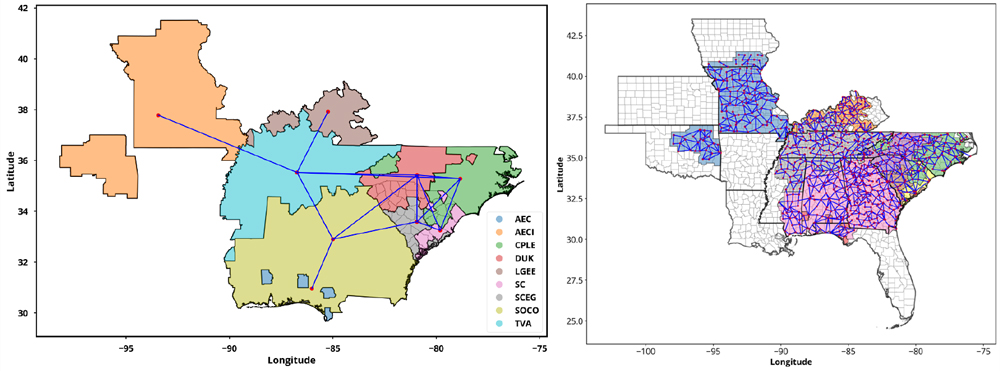
Inter-region bulk transmission and county-level transmission topology for the SEEM region | ACORE

By comparison, all the other scenarios projected significantly more aggressive cost reductions than the SEEM proposal. The EIM performed best in terms of total resource costs, which fell to $42.1 billion by 2040 under VCE’s model. Resource costs for the RTO were around the same level, while the RTO with decarbonization (RTO+Decarb) was just under $50 billion. The RTO showed the greatest cumulative savings with $119 billion saved over 20 years compared to SEEM; EIM saved $111 billion over SEEM; and RTO+Decarb saved $103 billion.

According to VCE, the EIM scenario saw the greatest reduction in resource cost because of performing “optimal capacity expansion and [counting] the energy transfers between the balancing areas towards the planning reserve.” This is despite EIM actually trailing the two RTO scenarios in the first 10 years of the model because it “retires the fossil generation slower than the ‘RTO’ [scenarios] and therefore results in higher system costs.”

Becuase the RTO outperforms the EIM for the first 10 years, it has a slight edge in cumulative savings. The RTO+Decarb scenario displays similar resource cost reductions to the base RTO until 2034, when large investments in variable renewable generation are needed to reach decarbonization goals.

RTO+Decarb Clear Emissions Winner

While the EIM scenario delays full retirement of fossil fuels compared to the RTO scenarios, SEEM does not do so at all: VCE’s model shows more than 100 GW of installed coal and natural gas capacity by 2040 under SEEM, compared to around 70 GW of natural gas for EIM and base RTO — without any coal — and around 20 GW of gas generation under RTO+Decarb. The EIM, RTO and RTO+Decarb scenarios all see significant expansion of renewable generation as well, especially the latter with nearly 400 GW of renewables in 2040, compared to around 200 GW each for the other two.

Investments in storage under the non-SEEM scenarios also dwarf that under SEEM, with about 10,000 MW of storage capacity installed in 2040 under SEEM (about double 2020 levels). By the same year, EIM and RTO have about 90,000 and 100,000 MW of storage capacity installed, respectively, while RTO+Decarb has about 65,000 MW.

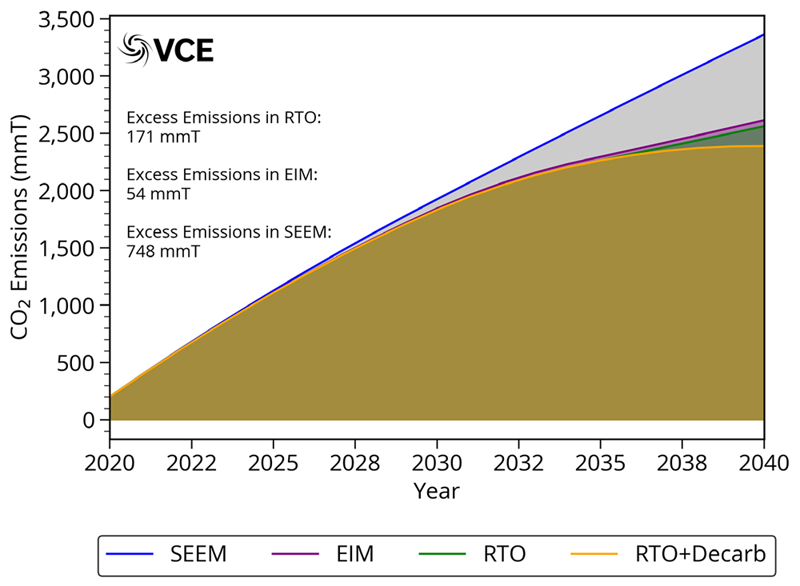
This replacement of fossil fuel generation with renewables and storage means that the non-SEEM scenarios see substantial reductions in emissions over the 20 years of the study. Compared to SEEM’s 3,362 million metric tons (mmT) emitted by 2040, the EIM shows 2,614 mmT emitted over the same time frame and the RTO shows 2,560.Cumulative electric sector carbon emissions in the scenarios modeled | ACORE

The RTO+Decarb scenario shows the greatest reduction in carbon dioxide emissions, as might be expected from its explicit focus on decarbonization. Under this template, cumulative emissions fall to 2,389 mmT, representing the end of virtually all carbon emissions. VCE’s model only accounts for existing techniques for carbon reduction, so new technologies such as carbon sequestration could see the atmospheric carbon reduced even further.

RTO+Decarb is also notable for nearly eliminating all other air pollutants tracked by VCE’s model, including sulfur dioxide, nitrogen oxides, and carbon hexafluoride, all of which are still present in significant amounts by 2040 under SEEM. While the EIM and RTO both see all pollutants except nitrogen oxides reduced to near zero, RTO+Decarb is the only scenario where NOx is also almost completely gone.

ACORE’s report could lend ammunition to critics of SEEM that have warned FERC to exercise skepticism about the promises of the proposal’s supporters (ER21-1111, et al.). Most recently a group of Democratic lawmakers in North Carolina wrote the commission calling for a technical conference to investigate other Southeast market organization proposals, including an RTO or EIM. (See NC Legislators Join Call for Southeast Technical Conference.)

Solar Expansion Faces Escalating Resistance

The historic shift away from carbon-based fuels to clean energy sources such as solar — which the industry now asserts can supply 30% of the nation’s electricity by 2030 — is encountering significant resistance from some unexpected corners.

Whether they’re farmers, Native Americans or residents living in economically depressed neighborhoods, people who will live near utility-scale solar arrays are increasingly opposed.  

The issue received a brief airing Wednesday in a virtual panel during the North American Smart Energy Week sponsored by Solar Energy Industries Association (SEIA) and the Smart Electric Power Alliance. 

“This session on land use is very timely, as we see more solar being developed and installed in more places. We are seeing more and a wider variety of land use conflicts,” said Sean Gallagher, vice president of state and regulatory affairs for SEIA, and moderator of the discussion.

Citing a Department of Energy study, Gallagher said the industry could supply 45% of the nation’s electricity using just 0.5% of the land in the lower 48 states by 2035. He stressed that equity and environmental issues must be considered in the planning process of any new solar development. 

Chris Carr, an attorney focused on infrastructure development at a San Francisco law firm Paul Hastings LLP, said enhanced tribal consultation and environmental justice policies at both federal and state levels are now integral to any solar project developed in California and other Western states. Climate change and the impact of that on protected species are also significant considerations included in winning approval for solar projects, he said. 

NIMBY

Representatives from two solar developers related new “not in my backyard” (NIMBY) issues their companies are encountering. 

Jessica Robertson, director of policy and business development for Borrego Solar Systems, addressed resistance her company has encountered in Massachusetts. 

“Massachusetts has the classic New England problem of really small parcels and small municipalities. They all have different zoning regulations and permitting processes and so that is definitely a challenge. But we also have rampant NIMBY-ism from people who are accustomed to their view being a certain way and they don’t want that to change,” Robertson said.

“And then we also have a very organized conservation movement, which normally I am fully on board with and really want to partner with in many, many ways. But there’s sometimes a really black-and-white view of land use, and the idea of cutting down a single tree in order for solar [development] becomes a nonstarter,” she said. 

Robertson said a new state distributed generation incentive program that factors current land use when calculating a state incentive for a particular project has made solar development much more difficult if not impossible. “I think there’s a need to have a little bit more of a nuanced conversation about costs and benefits,” she concluded.

From a social justice point of view, Robertson reasoned that renewable energy has flipped the scenario from the past when power plants were built in regions distant from neighborhoods where the power would be used.

“I think we need to be upfront about that conversation and acknowledge that certain communities have really borne the brunt of our energy system for a really long time, and it’s time to spread that burden around a little bit more broadly and at the same time recognize that it’s a very different burden and shouldn’t hopefully be quite so big a deal as trying to locate a new coal plant,” she said.

Tyler Kanczuzewski, vice president of sustainability and marketing with Ind.-based Inovateus Solar, said NIMBY-ism and concerns about losing farmland are issues he encounters.

Regarding the first issue, Kanczuzewski said he has encountered rural residents who are accustomed to looking out at farmland with a first cup of coffee and just “don’t want to stare at a big solar array.” That issue is stronger for them than switching some land from farming crops to solar, he said.  But there are real concerns among others about losing farmland.

“I think there is a little bit of uncertainty with some of the farm communities. They’re potentially losing potential crops to solar. They’re farming solar renewable energy instead of crops, and as you can tell, a lot of them are interested, but they’re a little bit insecure about the future.

“But the good thing is that we’re learning that you can do things like [include a] pollinator habitat with the solar arrays and actually improve the soil health,” he said, in reference to planting regional wildflowers and in some cases regional grasses for sheep to graze in between the rows of solar arrays.

The plantings “help with water management, become a habitat for birds, bees and other species, and improve the soil health. And let’s say 20 or 25 years down the road when you decommission that solar array, you can actually have better soil there and you can farm on it again. 

Kanczuzewski said the pollinator habitat movement is “gaining traction” in the Midwest, and particularly in Randolph County, Ind., where Inovateus is based. 

“The county did a solar energy ordinance that includes pollinator friendly provision, so that was exciting for the state of Indiana, and more counties are doing that, I think, across the Midwest,” he said.

Who Benefits?

Colette Pichon Battle, founder and executive director of the Gulf Coast Center for Law & Policy, addressed environmental, equity and social justice involved when solar developers arrive in a neighborhood or region. 

Battle said the development and siting of any industrial project, including a large solar project, comes down to democracy itself. 

The idea of “some people having more gravity and value than others in these decisions is really a question about our democracy,” she said. “We have many processes that are supposed to be rooted in democracy that [instead] are leaning toward those who have privilege and access and the ability to challenge power.” 

Regarding brownfield sites and environmental justice spaces, Battle noted, “We have to be careful that finding the cheapest, most available land does not give to black and brown and poor communities what privileged … communities don’t want.

“The truth is that these things benefit everybody, including the planet, so we need to scale this renewable energy up. For that reason, not because those victims over there really need our help. But because the planet is in trouble and we need to shift our entire infrastructure,” she said.

Battle said she agreed with Robertson’s notion of having “nuanced” conversations, “We have to have those kinds of conversations, and we have to shift this narrative around who’s benefiting.” 

“I think the narrative of the benefit has to be a much more collective one around what the transformation required to address this climate crisis is really calling all of us to do and to bear equally as much as possible.”

Utility CEOs Talk Alignment with Conn. on Climate Change

When Catherine Stempien, CEO of Avangrid Networks (NYSE:AGR), and Eversource Energy (NYSE:ES) CEO Joe Nolan were asked during the Connecticut Power and Energy Society’s “Power Hour” virtual event Thursday about how the state’s two largest utilities can help it reach decarbonization and greenhouse gas reduction goals, each of them took a slightly different path but ultimately had a common thread their respective answers: alignment.

“I would love to be queen of the United States in the transmission and distribution grid and tell people what’s the optimal way to efficiently deploy clean energy, fast and efficiently for the lowest cost,” said Stempien, who leads Avangrid’s largest business unit, with 3.3 million electric and gas customers through eight companies in Maine, Connecticut, New York and Massachusetts. “We’re not doing that in the United States right now. We’re very patchwork.”

Stempien added there needs to be “alignment on where the generation should go and where the grid needs the most work,” whether it is electric vehicle home charging and along transmission corridors, or interconnecting renewable energy sources to the grid. “All of those elements are going to be needed in order to meet the clean energy future.”

For Nolan, alignment on Connecticut’s “very lofty goals” of carbon-free electricity by 2040 and an 80% reduction in GHG by 2050 is essential to him because mending the utility’s relationship with the state has been one of his top priorities since taking charge of the company this spring.

“It’s great to be partners with the state on these initiatives because that’s what’s going to drive the change that we want in terms of a vibrant transmission grid,” Nolan said. “We are investing heavily in our grid to unlock all of these renewable options so that we can reduce congestion and bring about the cleanest kilowatt-hour that’s available to our customers.”

Stempien and Nolan are additionally aligned on climate change in terms of adaptation and mitigation measures necessary in the face of more frequent extreme weather events. They both came into their jobs in the wake of United Illuminating’s and Eversource’s highly criticized responses to Tropical Storm Isaias in August 2020, which also prompted legislative action to hold the utilities more accountable and force more significant preparation.

The “unpredictability” of storms, according to Stempien, reinforces “the need for us to build resilient systems.” That includes examining everything from flood mitigation at substations to moving power lines underground.

“Typically, people always think of underground being a much more expensive alternative, but with the increasing number of storms, depending on where you are, undergrounding may now be, in fact, the better solution because it is avoiding all of these trees coming down,” Stempien said.

Regarding trees, Nolan said Eversource would invest more than $72 million this year on tree trimming and removal, as the “single greatest cause of power outages” in Connecticut is downed trees falling on power lines, which can also block roads and further slow restoration work. Nolan said that Eversource has partnered with several cities and towns in the state on the effort.

“We’re out there helping them take care of any danger trees, but the other thing I think it’s been very helpful to us to demonstrate to them or show a danger tree that’s going to impact a particular line, and what’s on that line,” Nolan said.

He added that the utility is not indiscriminately removing trees.

“We have multiple arborists that could well talk about each of these trees and talk about whether they are healthy or unhealthy; whether this particular branch is going to impact the power line,” Nolan said. “I think the fact that we bring our ‘A’ game when we go to see these towns, they understand what’s at stake.”

Pediatrician Calls for Urgent Action on 100% Clean Energy in Massachusetts

A pediatrician and public health expert is calling on the Massachusetts legislature to hold a hearing as soon as possible on legislation that would require the state to transition to 100% clean electricity by 2035.

The 100% Clean Act (H.3288) would also require the state to transition to 100% clean heating and transportation by 2045.

Pollution and climate change “pose very serious dangers to human health,” but it especially affects kids’ health, Philip Landrigan, director of the Global Public Health Program and Global Pollution Observatory at Boston College, said during a webinar on Tuesday.

The webinar, hosted by Environment Massachusetts, brought together health experts and energy policy experts to discuss the importance of transitioning to 100% clean energy in Massachusetts, instead of achieving net-zero emissions.

“We need to move very rapidly to clean energy,” Landrigan said. Fossil fuel combustion is responsible for 85% of particulate air pollution, and it is a major source of CO2, according to the International Energy Agency.

Pollution caused 9 million premature deaths in 2015 globally — three times more than AIDS, tuberculosis and malaria combined, according to The Lancet Commission on Pollution and Health, a group under the independent weekly medical journal The Lancet, and of which Landrigan is a member.

In 2016, 940,000 deaths in children globally were attributed to pollution, which causes low birth weight, cancer, asthma and neurodevelopmental disorders.

“Health protection and equity need to be the focus as countries move to control pollution and slow climate change,” Landrigan said.

The 100% Clean Act, filed by Rep. Marjorie Decker (D) and Rep. Sean Garballey (D), was referred to the Joint Committee on Telecommunications, Utilities and Energy in March, but it has not yet received a hearing.

100% is ‘Doable’

“We really do have the technology today to reach the goals outlined in the bill,” Sean Burke, a policy associate with the Northeast Clean Energy Council, said during the webinar.

Connecticut committed to zero-carbon electricity by 2040 in an executive order, and Rhode Island committed to 100% renewable energy by 2030.

Advances in long-duration energy storage and ground source heat pumps will allow Massachusetts to achieve 100% clean electricity by 2035 and 100% clean heating by 2045, but the state needs to start capitalizing on these opportunities now, Burke said.

The U.S. has a total solar generation potential of 284 million GWh, and a total wind generation potential of 40 million GWh, said Emma Searson, director of the 100% renewable campaign with Environment Massachusetts.

“The U.S. has the ability to produce 78 times the power from the sun that we used in 2020, and 11 times the power we used from wind in 2020,” Searson said.

The negative health impacts of fossil fuel combustion “underscores the need to make this transition as quickly as possible,” Landrigan said.

Rhode Island Governor Steps up Pace of State Climate Council

Rhode Island Gov. Dan McKee asked the state’s climate council on Thursday to step up the pace of its work to meet the objectives of the Act on Climate, which he signed in April.

The Executive Climate Change Coordinating Council (EC4) will move from quarterly to monthly meetings, and McKee said during the council’s meeting that he is working to ensure that the state’s upcoming budget meets the expanding needs of the council.

The Act on Climate directs EC4 to update the state’s greenhouse gas reduction plan by the end of 2022.

To inform that work, the council will schedule a series of dedicated virtual public listening sessions and other focus group discussions with constituents, EC4 Vice Chair and State Energy Commissioner Nicholas Ucci said during the meeting.

The GHG reduction plan will be “foundational” to the development of a strategic plan for the state that is due by the end of 2025, according to Ucci. EC4 will review other states’ climate plans and connect with Rhode Island’s climate organizations to inform the initial strategic plan framework.

“The mandate for that 2025 plan is extensive,” Ucci said, adding that it’s important for the council to build a public dashboard in the near term for metrics to measure and verify success of the plan.

The dashboard, he said, is more than just a place to calculate emissions.

“We need better insight into what matters most to our people, into our economy, and to work collaboratively to determine how best to measure progress,” he said.

The council also is immediately taking up recommendations from its Advisory Board on climate justice priorities to identify how those priorities will support the strategic plan. The board worked for several months to develop the priorities for the council.

“We cannot be successful in our climate change efforts unless we more fully understand and begin to address inequities facing those in frontline communities,” Ucci said.

Among the climate justice priorities that Advisory Board Chair Sheila Dormody presented during the meeting was a call to build out a staff that can work with frontline communities as the state builds its strategic plan.

“We recognize that we, an all-white board, are not the right people to be telling the state what climate justice priorities should be,” she said.

The board also recommended, among other things, that EC4 build a definitive map of environmental justice areas in the state and define the values and principles that will guide climate justice work.

TCI-P Status

During the council meeting, McKee reiterated his support for the Transportation and Climate Initiative Program (TCI-P), saying that without a “strong commitment” to reducing transportation sector emissions, “the state will have difficulty meeting the reduction mandates that are required in the Act on Climate.”

The Transportation Emissions and Mobile Community Act (S0872A/H6310), which would have codified TCI-P, passed the Senate in June but didn’t make it through the House of Representatives before the end of the legislative session.

Newly appointed EC4 Chair Terry Gray, who is acting director of the Department of Environmental Management, said TCI-P “is still very much active and alive.”

Robust discussions about the program are ongoing with state advocates and legislators, as well as regional stakeholders, he said. TCI-P, he added, is the “only viable and complete program” to address the state’s transportation sector emissions.

“We believe that the program has been developed and built and modeled so that the costs and benefits are well balanced and that there’s a huge opportunity here to make some investments in transportation that will position Rhode Island as a leader in clean transportation,” he said.

NYISO Reviews Mitigation Efforts, Updates Timeline

NYISO on Tuesday presented stakeholders a comprehensive buyer-side mitigation review, provided the final draft of a study on related market impacts and updated the timeline for implementing associated rule changes.

As its resource mix evolves quickly to renewables, the ISO must ensure that it provides the right market incentives and signals to the types of resources needed to keep the lights on, Michael DeSocio, NYISO director of market design, told the Installed Capacity (ICAP) Market Issues Working Group.

“The crux of the capacity accreditation proposal is that we need to step away from a protracted four-year debate on what capacity accreditation factors should be and move towards a more deterministic process based on transparent models and assumptions,” DeSocio said.

The New York State Reliability Council process for establishing the installed reserve margin database should be “the starting point for any [capacity] accreditation studies, and we think we need to be doing those studies annually because, frankly, the changes on the grid aren’t going to wait,” DeSocio said.

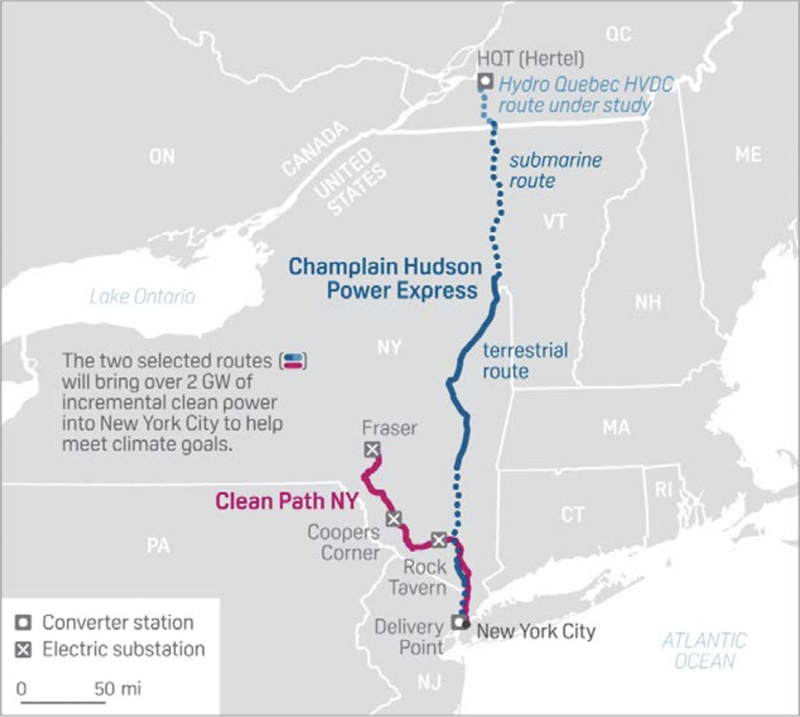
Transmission sensitivity assumptions in the market impacts study include over 2.5 GW on two high voltage direct current (HVDC) transmission lines into New York City. | Analysis GroupNew York’s Climate Leadership and Community Protection Act (CLCPA) requires the state to procure large amounts of renewable energy to get to zero-emission electricity by 2040, and the coming online of so much new generation is already challenging transmission and capacity market planners.

Gov. Kathy Hochul on Sept. 20 announced the state’s solicitation process had chosen the 1,250 MW high voltage direct current (HVDC) Champlain Hudson Power Express project from Quebec to New York City, as well as the 1,300 MW Clean Path New York HVDC project from upstate to the city. Both lines will be buried under the Hudson River for many miles. (See Two Transmission Projects Selected to Bring Low-carbon Power to NYC.)

The transmission sensitivity assumptions in the Analysis Group’s market impacts study include the 2.5 GW these two transmission lines provide New York City.

NYISO in August introduced the Analysis Group study that will model 10-year capacity supply and demand curves and identify the resulting market outcomes to support buyer-side mitigation (BSM) rule revisions. (See NYISO Unveils Draft BSM Study.) The company’s Paul Hibbard will take questions from stakeholders at the Oct. 5 ICAP meeting.

Not So Fast

In July, the ISO presented a proposal to exempt most new renewable installed capacity (ICAP) resources from BSM evaluation.

As proposed, resources required to satisfy the goals specified in the CLCPA will not be subject to review by the ISO under the BSM rules, or otherwise subject to an offer floor. Exempted resources include wind, solar, storage, hydroelectric technologies, geothermal, fuel cells that do not use fossil fuels, and demand response (participating as a special case resource or distributed energy resource).

Several stakeholders asked the ISO to provide adequate time to go over the needed tariff revisions, a review that prolonged a scheduled two-hour presentation to four.

NYISO is pursuing these reforms in time for the Class Year 2021 BSM evaluations and intends to address capacity accreditation in different phases, with the Phase 1 tariff changes for the new framework to be discussed through year-end 2021, and Phase 2 discussion of procedures and details expected to start around January and continue throughout 2022.

Phase 3 will focus on implementation of the capacity accreditation review, and the ISO intends to implement the updated capacity accreditation rules for the Capability Year beginning May 1, 2024. Assessment of financial risk of changes in future revenues will be incorporated into the next Demand Curve Reset process beginning in 2023.

NYISO proposes adopting the recommendation of its Market Monitoring Unit, Potomac Economics, to translate the ICAP reference price into an unforced capacity (UCAP) reference price using the derating factor of the peaking unit underlying the relevant ICAP demand curve, DeSocio said.

Several stakeholders questioned the ISO’s emphasis on providing correct capacity market signals, suggesting that the real market mover is the state and its multibillion dollar contracts for renewable energy.

One stakeholder said that while other market regions have explored mechanisms such as an integrated clean capacity plan or forward clean energy market to help send the correct market signals to align with state policy, NYISO only is offering the capacity accreditation proposal.

Energy market prices create investment signals and operational control signals that incent resource owners to make the right decisions on following dispatch, but also provide incentives on what types of attributes the resource mix should include, Desocio said, prompting the ISO to include a carbon price in the day-ahead and real-time energy market.

“A carbon price would bolster those signals to be clear about times when we are heavily emitting carbon and therefore need a solution at a particular location that will help us avoid emitting that carbon,” DeSocio said. “There is no better way to pinpoint that need other than to put it in a locational based marginal price in the energy market. There’s no more granular way to do it.”

The capacity market is designed to ensure sufficient supply for real-time grid operations to minimize the times the ISO has to rely on involuntary load curtailment, he said.

NYISO plans to submit tariff revisions of the full proposal to the Business Issues Committee and Management Committee in October.

SEIA Issues New US Solar Generation Goal: 30 by 30

The Solar Energy Industries Association issued a new growth target for the industry to mark the first day of its 2021 annual meeting: a rapid and unprecedented growth in solar so that it generates 30% of the nation’s power by 2030, up from 4% currently.

“We know that the economics of clean energy are there … that demand will only continue to grow,” SEIA CEO Abigail Ross Hopper said in opening the general session of the two-day virtual conference. “The timing will make or break our ability to stay on the path that the scientific community tells us is necessary to avoid the worst impacts of the climate crisis.”

To reach that goal, SEIA figures that by 2030, the industry will have to build about 125 GW of new generation annually, up from the 19 GW built in 2020; and reach a total buildout of 850 GW in total generating capacity, or nearly nine times the 95 GW of total capacity in 2020.

The huge investment, much of which would be made possible by the Biden administration’s Build Back Better bill now before Congress, would add more than $120 million to the U.S. economy annually and employ more than 1 million, SEIA argues in a release timed with the conference.

The additional solar would also offset more than 700 million metric tons of CO2 annually, up from 100 million tons in 2020, Hopper said.

“There’s incredible potential for your business to thrive. Make no mistake, public policy is critical,” she said. “As we speak, Congress is debating the details of a combined infrastructure and budget package to invest in America’s future.

“Some of the policies under consideration, including long-term extension of clean energy tax credits, investments in workforce and development and training, and enhancement to our electricity infrastructure would go a long way to ensuring we stay on track to hit our 30-by-30 goal. We cannot let this moment pass.”

Before Hopper’s announcement and the panel discussion that followed, FERC Chairman Richard Glick, National Climate Adviser Gina McCarthy and U.S. Rep. Donald McEachin (D-Va.) made remarks about the importance of solar.

“Whether you work in the clean energy industry or work in the government tackling the energy issues of the day, we’re all very fortunate to be doing so during this very exciting time, as the nation transitions to the clean energy future,” Glick said, adding that demand is driving the move to renewable energy and that market rules must keep up with the transition.

“Over the last several years, the commission has issued major rule-makings focusing on ensuring that energy storage and distributed energy resources, including behind the meter storage, can participate in wholesale markets. But our work isn’t done. For instance, we are looking at both interconnection policies and market rules to determine whether action is necessary to facilitate greater participation of hybrid projects, primarily solar and storage,” he said.

McCarthy reminded listeners that the switch to clean energy is a Biden administration priority. McEachin stressed the importance of a bill he has co-sponsored, the Environmental Justice for All Act, which will require the government to consult with environmental justice communities when proposing energy legislation.

During the panel discussion that followed, panelist Kelly Speakes-Backman, principal deputy assistant secretary for energy efficiency and renewable energy at the Department of Energy, said, “President Biden has made his climate strategy really clear that the U.S. is aiming to achieve a carbon-free power grid by 2035 and a clean energy economy for all Americans with net-zero emissions not later than 2050. These are really bold targets that he has established, really the most ambitious climate strategy that the U.S. has ever seen.”

Another panel that immediately followed grappled in more detail with the problem of aligning transmission, distribution and interconnection with these clean energy goals.

“We need to move a lot faster,” said moderator Ric O’Connell, executive director of GridLab, a national nonprofit that provides technical assistance both to regulators and advocates.

“To meet our clean energy goals, we are going to need to interconnect twice what is already in the queue in the next decade,” he said of major transmission projects that have not yet been approved.

“We’ve got a similar story at the distribution level. So we probably got thousands of projects in state-regulated distribution queues around the country. And look, not all of these are 5-kW behind-the-meter residential solar systems. Many of these are 5 to 20 MW,” he added.

Eric Ciccoretti, attorney-adviser for FERC’s Office of Energy Policy and Innovation, said the commission has just begun work on new interconnection rules, and the Advance Notice of Proposed Rulemaking process of asking for comments and suggesting what might be done typically takes years, particularly if there are appeals.

He said FERC “is seeking to understand whether there are ways to improve transmission planning and interconnection planning. Given the changing resource mix, the commission is focused on the shift from resources located close to population centers … toward resources, including renewable solar and wind, that may be located far from load centers. 

“The commission is focusing on how the changing resource mix can be accommodated to ensure just and reasonable rates while maintaining grid reliability,” he said, stressing that the ANOPR is a priority.

Comments on the ANOPR are due Oct. 12, with reply comments due Nov. 15. Ciccoretti also noted that the commission is holding a technical conference on regional transmission planning, with the focus on the incorporation of long-term forecasts into future transmission, the same day reply comments are due.

Building solar projects aimed at the distribution level is also a problem, said panelist Maggie Clark, director of government affairs at North Carolina-based Pine Gate Renewables.

“You can’t readily get distribution system data in most places, and this is very different from transmission-level information that you can get on either through FERC or through utility filings.

“And that is why a lot of developers choose to go the transmission route because you can understand where it’s easier to site projects where you’re going to have a cleaner, low-cost interconnection to the grid,” she said.

Pine Gate has about 1 GW of operational assets, she said, and another 15 GW under development. The company is active in 15 states but stays away from some states because of problems tracking down reliable information about their local distribution systems.