Senate Hearing on FERC Jurisdiction Focuses on Everything Else

The Senate Energy and Natural Resources Committee gathered all four FERC commissioners to its hearing room in D.C. on Tuesday, ostensibly to discuss the “administration of laws within FERC’s jurisdiction.”
Sen. John Barrasso (R-Wyo.) | Senate ENR CommitteeInstead, much of the two-hour hearing was taken up by Republican members of the committee questioning the two Republican members of the commission about issues outside of FERC’s jurisdiction: state decisions about their resource mixes, energy price surges in Europe and Democrats’ proposed Clean Electricity Performance Program (CEPP).

The ENR hearing was held at the same time Defense Secretary Lloyd Austin and Gen. Mark A. Milley testified before the Senate Armed Services Committee about the U.S. withdrawal from Afghanistan, which seemed to take at least some Democratic attention away from the FERC panel. At one point, it appeared there were no Democrats in the room, as ranking member John Barrasso (R-Wyo.) briefly conducted the hearing, and three Republicans spoke in a row. That meant that, as a Democrat and not the chair, Commissioner Allison Clements was sidelined for most of the hearing.

Still, the event produced some insights into both the individual thinking of the commissioners and the philosophical conflicts between them.


FERC Commissioner Allison Clements | Senate ENR Committee
Among the issues that do fall under FERC’s oversight is permitting of natural gas infrastructure, and Republicans had no shortage of questions about the time it takes the commission to process applications. They criticized the commission for creating uncertainty for natural gas developers because of Democrats’ insistence on assessing the downstream impacts of projects’ greenhouse gas emissions. The issue has been one of the core disputes between Democrats and Republicans on the commission for years, with Republicans maintaining that FERC has no ability to properly assess emissions, while Democrats claim the commission is ignoring court directives to do the assessments.

Sen. James Lankford (R-Okla.) asked how the commission interprets the National Environmental Policy Act (NEPA) in determining whether to conduct an environmental assessment (EA) of a project or the more detailed environmental impact statement (EIS).

FERC Chair Richard Glick said that the D.C. Circuit of Appeals “has admonished the commission on three separate occasions just with regard to our examination of greenhouse gas emissions — [that] we actually didn’t review those emissions; we didn’t review the significance of those emissions — and the court has said all three times, ‘We’re sending this case back to FERC,’ and it causes extra delay” for project developers.
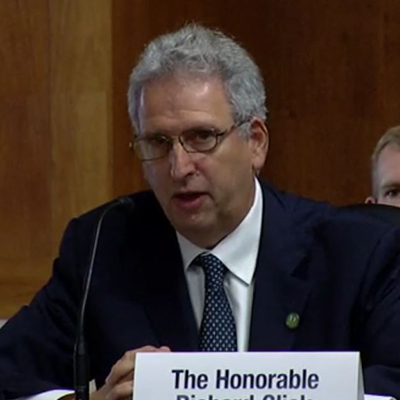
FERC Commissioner James Danly | Senate ENR CommitteeLankford followed up by asking if Glick anticipated that the commission would always do EISes going forward. Glick said that is an issue the commission is considering in its review of its natural gas policy statement. “What I hope will happen” is the commission will determine a threshold amount of emissions, below which it would only do an EA, Glick said.

But Commissioner James Danly said he was “concerned that in some, perhaps, misbegotten desire to ensure that our orders are legally durable,” the commission is taking more time than necessary to conduct an EIS, when only an EA is needed. He said that the D.C. Circuit’s remanding of project approvals is because FERC has not properly explained its decisions, violating the Administrative Procedure Act. “I don’t think it’s necessary to go through the process of conducting EISes that come to the same conclusion as the EAs did. We can handle those” issues within the orders on remand themselves, he said.

FERC Chair Richard Glick | Senate ENR CommitteeLater in the hearing, Glick responded to Danly’s assertion in answering a question from Sen. John Hoeven (R-N.D.). “The problem is that the courts keep on telling us that we keep on getting it wrong. And we’re not expediting things; what we’re doing is delaying things. Because every time we’re supposed to perform an EIS or we prepare an EA, we just ignore climate change altogether. The courts say, ‘you got it wrong,’ and we have to do it all over again. That costs billions of dollars in extra time for these pipeline projects. I think certainty is more important than whether we can do it quickly and do it on the cheap.”

Danly interjected: “There is a difference between an agency failing to properly do a NEPA review, which would be in the EA or the EIS, and from an Administrative Procedure Act standpoint, to properly explain the decision that it made partially informed by that NEPA document. In almost all of the cases in which FERC was in one way or another remanded, those were not because of failures in the NEPA document; they are failures of reasoning under the Administrative Procedure Act. Basically the court is saying, ‘You did not sufficiently explain the reason why you made this choice.’ … So saying that we can fix that problem of APA violations by having different or more robust NEPA review is simply not the reality of the remands we’ve gotten back from the courts.”

Danly: CEPP Like ‘Dropping an H-bomb’ on RTO Markets

Sen. Barrasso focused his questions to Danly and fellow Republican Commissioner Mark Christie on the CEPP. The House Energy and Commerce Committee earlier this month voted to include the CEPP in the $3.5 trillion spending bill currently on the floor of the House of Representatives.

FERC Commissioner Mark Christie | Senate ENR Committee
The $150 billion program would require utilities to increase the amount of clean energy distributed to customers by 4% every year, providing incentives through Department of Energy grants to those that meet the targets and penalizing those that don’t. The fate of the spending bill, let alone the CEPP, is very uncertain, in part because of reluctance over its size from Sen. Joe Manchin (D-W.Va.), chair of the Senate ENR Committee.

Barrasso called it “a scheme.”

“It would use an estimated $150 billion of taxpayer dollars to pay off the largest utilities in the country to deploy Democrats’ favorite energy sources,” he said. “At the same time, it will allow those utilities to charge their customers for new transmission lines to service these facilities. To add insult to injury, Democrats do not plan to debate and consider this legislation through regular order.”

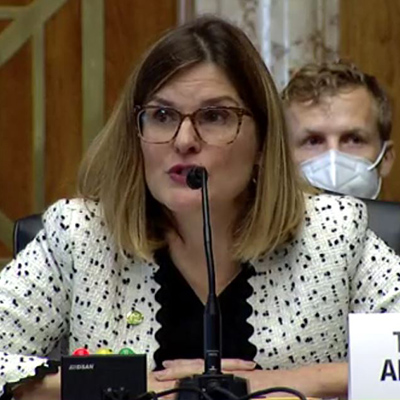
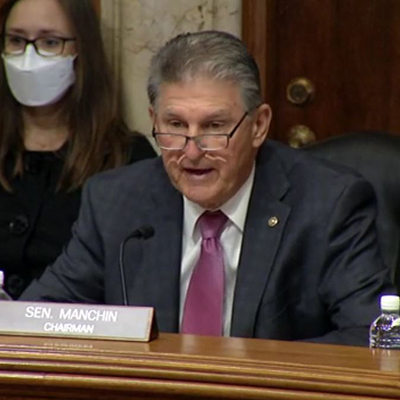
Sen. Joe Manchin (D-W.Va.) | Senate ENR CommitteeHe asked Danly if the program would lead to energy shortages and higher prices.

“I think it is almost inevitable” Danly said. “I typically don’t think it’s my role to comment on the legislation before Congress, but in this case, I want to be responsive to your question. … The text of the bill, as I read it, seems to create an incentive and penalty structure that would absolutely change and frustrate every subtle expectation we have for these slowly developed, incrementally produced markets of ours, effectively dropping an H-bomb into the middle of them. It will effectively end the markets as being anything other than administrative constructs for the purposes of balancing and dispatch.”

Danly later softened his remarks somewhat, saying that, if passed as written, the consequences of the program would be, “one way or another … profound, are going to be disruptive and at the moment they are basically incalculable. And … I don’t want to make this sound like a plea for mercy, [because] though we have no role in implementing any of what’s in that bill, FERC as a practical matter is going to be the forum in which those disputes are adjudicated.”

For his part, Manchin did not bring up the program in his opening remarks or questions, instead focusing on generic issues of reliability and affordability.
California PUC President to Step Down

California Public Utilities Commission President Marybel Batjer said Tuesday she would step down at the end of the year with five years still left in her seven-year term.

Batjer broke the unexpected news in a letter to CPUC staff Tuesday.

“I write to inform you, after much thinking and reflection, that I have decided to conclude my service as president of the CPUC at the end of this year,” Batjer wrote. “This was a difficult decision, as I am so proud of the work we have done together in the face of a changing climate and global pandemic.

“Your deep commitment to our mission to ensure Californians have access to safe, clean and affordable utility services has sustained me during my tenure and makes it very tough to leave,” she told commission staff.

Gov. Gavin Newsom named Batjer, then the state’s government operations secretary, to fill out the term of retiring President Michael Picker in July 2019 and reappointed her to a full term last year.

In her decades of government service, Batjer had established a reputation for shaking up entrenched bureaucracies. She served as former Gov. Arnold Schwarzenegger’s cabinet secretary, and Gov. Jerry Brown named her in 2013 to head the Government Operations Agency, a new entity charged with improving efficiency and accountability in state government. Newsom kept her on in that role and put her in charge of reforming the Department of Motor Vehicles, one of the state’s most inefficient bureaucracies.

When Picker decided to retire, the governor assigned Batjer the job of speeding up the CPUC’s ponderous decision making as it struggled to cope with more wildfires, capacity shortfalls and the crimes and bankruptcy of Pacific Gas and Electric. (See Newsom Names New California PUC President.)

“She is about reorganization. She is about governance,” Newsom said at the time, calling her “one of the best in the business.”

As part of PG&E’s Chapter 11 reorganization, Batjer insisted on and obtained additional oversight of the troubled utility. The new powers included a six-step enforcement process that could eventually end with PG&E’s license being revoked. It is currently in the first step of that process for failing to clear trees from its power lines, resulting in wildfires.

The CPUC has worked to prevent more fires and to rein in the use by investor-owned utilities of public safety power shutoffs under Batjer’s leadership.

The commission also came under fire for failing to anticipate the capacity shortfalls that have plagued the state in the past two years and are expected to continue next summer. The retirement of fossil-fuel plants without sufficient replacements led to rolling blackouts in August 2020 and close calls on subsequent occasions.

The CPUC is charged with ordering procurement by the state’s three big IOUs: PG&E, Southern California Edison and San Diego Gas & Electric

“It’s difficult to understand why the CPUC did not appreciate the gravity of the shortfall sooner and take action to mitigate its impact,” Chris Holden, chairman of the state Assembly’s Utilities and Energy Committee, told Batjer at a hearing in January 2020. (See CPUC President Vows to be ‘Damn Nimble’.)

In response, the CPUC ordered load-serving entities under its jurisdiction to procure large amounts of new capacity including an additional 11.5 GW in June. (See CPUC Orders Additional 11.5 GW but No Gas.)

“Since my appointment, the CPUC has been called upon to translate its rules and processes into timely actions and outcomes to better protect and improve the quality of life for Californians,” Batjer said. “I can say with confidence that we — at all levels of the CPUC — have worked tirelessly to support Californians during these challenging times. This became my mission, and I will leave the CPUC knowing its leadership will continue to uphold this focus and determination.”

During Batjer’s tenure, CPUC commissioners became embroiled in an ugly and very public battle with former executive director, Alice Stebbins, whom they fired for allegedly hiring poorly qualified former colleagues for key positions. Stebbins has continued to criticize the commission in the media and to sue the commission, claiming she was retaliated against for blowing the whistle on $200 million in missing funds. (CPUC Fires Executive Director for Improper Hiring.)

The fight with Stebbins took an especially heavy toll on Batjer, colleagues have said.

Batjer said in her message to staff that she needed a change.

“I have had the privilege of serving four California governors and have given my all to public service for many decades,” she said. “I am now ready for a new challenge and adventure.”

CAISO CEO Elliot Mainzer, who has worked closely with Batjer and their counterparts at the California Energy Commission, said Tuesday, “I have very much appreciated working with President Batjer over the past year. She has brought tremendous leadership, vision, and focus to the CPUC, and I will miss interacting with her on a regular basis. I wish her the very best as she moves on to new challenges and hopefully gets some well-deserved rest.”

New Orleans Seeks FERC Inquiry into Entergy Planning Practices

New Orleans regulators last week requested a FERC investigation into Entergy transmission-planning practices as criticism continues to mount that the utility is hindering transmission development to shield its footprint from competing energy suppliers.

The New Orleans City Council’s utilities committee voted during a Sept. 22 meeting to ask state and federal regulators to examine Entergy’s practices following the post-Hurricane Ida transmission failures.

The council’s resolution, approved unanimously, asks FERC to examine Entergy’s planning for any reliability violations.

“[T]he council … believes that FERC should exercise its regulatory jurisdiction to determine whether [Entergy Louisiana’s] transmission line failures resulted from any violations of applicable FERC or NERC reliability standards … including whether the lines were prudently operated and maintained,” the council wrote.

It asked FERC to determine “whether Entergy’s investment in transmission has allowed adequate access to competition and new technologies to enhance reliability and cost savings for ratepayers.”

The council also asked the Louisiana Public Service Commission to investigate Entergy Louisiana’s reliability planning. It said that, as a city government, it lacks the standing to order an investigation into the eight transmission lines that feed the city. All eight of the lines were knocked out of service by Ida.

“[T]he council pledges its support, encouragement and cooperation in any FERC/NERC effort to protect all of southeast Louisiana from ever facing such catastrophic transmission line failures,” the council said.

City Council President Helena Morena accused Entergy of using “threats and PR spins” when responding to the city’s inquiries about Entergy’s planning decisions.

The council is currently contemplating forcing a change in the city’s electric utility structure. Entergy has said it could either sell its New Orleans unit; merge it with Entergy Louisiana; create a standalone company without the Entergy brand; or allow New Orleans to set up a municipal utility. (See Facing City Council Inquiry, Entergy Says it Could Sell New Orleans Utility Arm.)

“Please stop acting like you are the victim. You are the Goliath. You are a powerful Fortune 500 company with all the resources in the world and record profits last year of $1.4 billion,” Moreno said during the meeting. “We are not the bullies, and we are not trying to run anyone out of town. We just want you to do your job for the ratepayers.”

The city council has charged its utility advisers with conducting its own investigation of Entergy New Orleans’ actions during and after the storm. That inquiry will pay special attention as to why Entergy didn’t immediately activate the blackstart-capable New Orleans Power Station. When Entergy was seeking council approval for the plant in 2018, officials promised the city council that the unit could provide blackstart services following major storms. (See Entergy Touts Restoration; NOLA Leaders Question Lack of Blackstart Service.)

The city council said its utility advisors also will file comments regarding Entergy’s grid performance after Hurricane Ida in FERC’s examination of climate change and extreme weather events’ impact on grid reliability (AD21-13).

Entergy did not respond to RTO Insider’s request for comment.

The company did, however, tout the role of its rebuilt natural gas system in storm restoration, saying it played a “quiet, yet significant role” by supplying the New Orleans Power Station and city generators used for pumping floodwaters. Entergy almost completely rebuilt its gas system after 2005’s Hurricane Katrina.

NOLA Raises Bar for Cost Recovery 

Meanwhile, New Orleans Councilmember Kristin Palmer brokered yet another unanimous resolution last week that says the council will only consider rate increases tied to recovery costs after a “careful evaluation” of the proposed increases.

“We need to be very clear here: Entergy failed the people of New Orleans,” Palmer said in a press release. “It’s inexcusable that our entire city was left in the dark for weeks following Hurricane Ida. People died. Most of them were part of our city’s most vulnerable populations who suffered in the sweltering heat. Asking for the people of New Orleans to pay more for bad service caused by obvious negligence is not going to cut it.”

The resolution dictates that any cost “caused by the failure of power utilities during Hurricane Ida cannot simply be passed onto Entergy’s customers.” It would require Entergy New Orleans to submit to an “open and transparent” review of its actions and plans to prove that the city’s power outage wasn’t a result of utility failures before the council could consider storm recovery rate increases.

“It’s not enough to just wag our finger at Entergy,” Palmer said. “We need to let them know that we aren’t going to stand for avoidable negligence that kills our people. Anyone else in New Orleans who doesn’t do their job doesn’t get paid. The same should go for Entergy.”

The council said that before Hurricane Ida’s landfall, Entergy began seeking $38.5 million from customers to address 2020 power restoration costs related to hurricanes Laura, Delta and Zeta.

“[I]n spite of these substantial investments borne by ratepayers, residents and businesses faced prolonged power outages following Hurricane Ida,” the council said.

Quashing Line Development? 

The recent scrutiny of the Louisiana Entergy system following Hurricane Ida has spurred a reexamination of some of the company’s past planning decisions and whether they were motivated by preservation of the utility’s monopoly.  

In 2016, MISO and Entergy agreed to build a $74 million 230-kV transmission line to ease the Amite South load pocket that includes New Orleans in southern Louisiana. The line would have connected two substations and boosted reliability. Four years later, Entergy canceled the project after it built the nearby $900-million, 950-MW St. Charles combined cycle gas turbine west of New Orleans.

Southern Renewable Energy Association (SREA) Executive Director Simon Mahan said the gas plant’s construction and subsequent cancellation of the line ensured that local cooperatives had no choice but to purchase energy from Entergy.

A similar scenario could be playing out with MISO’s second-ever competitively bid transmission project, the Hartburg-Sabine line in East Texas. Despite MISO awarding construction responsibilities to NextEra Energy in 2018, development of the line has ground to a standstill. (See Uncertainty Deepens for Hartburg-Sabine Project.)

In 2019, Texas passed a right-of-first-refusal law that handed the project to Entergy Texas, the incumbent transmission company. The U.S. Department of Justice opposed Texas’ ROFR law as anti-competitive, and NextEra filed a federal lawsuit. (See NextEra Appeals Court Decision on Texas ROFR Law.)

The Hartburg-Sabine line now languishes in “legal limbo,” according to the SREA, despite MISO’s projections of a 2023 completion estimate. NextEra still lists the project on its website.

Last year, Entergy Texas issued a request for proposals for a 1.2 GW natural gas plant along the line’s route. The $1 billion power plant, expected to be operational by 2025, could supplant the $115 million line.

Entergy has denied that it tries to stall transmission line approvals and said while it works in collaboration with MISO, the RTO ultimately decides on grid expansion. The grid operator has also characterized its transmission planning as a collaborative process between it and its stakeholders.

Other stakeholders have said Entergy and state regulatory consultants deliberately try to slow the RTO’s planning process by raising frequent objections and demanding more studies to back up MISO’s renewable projections. Environmental advocates recently accused Entergy and regulatory consultants of dominating conversations in long-range planning workshops. (See Tensions Boil over MISO South Attitudes on Long-range Transmission Planning.)

Report Projects Arizona Ratepayer Costs for Going Clean

Arizona’s public utilities could use current technology to get to 80% clean electricity while maintaining reliability and cost-effectiveness, according to a consultant’s report prepared for the Arizona Corporation Commission.

But going from 80% to 100% clean energy would be more of a challenge, said the report from Ascend Analytics and Verdant Associates.

“Cost-effectively achieving higher than 80% clean energy while maintaining reliability requires innovation in clean energy technologies, such as green hydrogen, long-duration storage, advanced nuclear, or something else we haven’t thought of yet,” Ascend said in presenting its findings to the commission on Tuesday.

ACC asked for the analysis to see how much customers’ electric bills would change under the commission’s proposed energy rules.

The rules would require the state’s electric utilities to cut carbon emissions 50% by 2032 and 100% by 2070. ACC voted in May to advance the rules, which still must return to the commission for final approval. (See Arizona Regulators Revive Clean Energy Rules.)

80%, 100% Scenarios

Ascend’s analysis looked at the impact of an 80% and a 100% clean energy requirement for electric utilities by 2050, as compared with a “least-cost” case. The least-cost scenario is based on a “traditional approach” to resource acquisition, Ascend said, including natural gas turbines for capacity, a reduction in energy efficiency savings over time and the addition of low-cost renewable energy.

In comparing the 100% clean energy scenario to the least-cost case in 2050, monthly electric bills would be $22 to $24 higher for customers of Arizona Public Service (APS); $8 to $28 higher for customers of Tucson Electric Power Co. (TEP); and $33 to $35 more for customers of UNS Electric (UNSE). Those figures are in 2021 dollars.

Shorter term, the differences are less. In 2035, monthly electric bills in the 100% clean energy scenario would be $9 to $10 higher for APS customers as compared to the least-cost case; zero to $8 more for TEP customers; and $12 to $20 higher for UNSE customers.

According to Ascend, the most significant cost increases in its analysis would occur from 2040 to 2050 in the 100% clean energy scenario, as the utilities moved beyond 80% clean energy.

“This is due to the need to convert natural gas-fired power plants to burn expensive green hydrogen and add longer duration storage (eight to 100 hours) required for capacity and reliability,” Ascend said.

Ascend noted that a recent report from the National Renewable Energy Laboratory (NREL) also found increasing costs as the power system gets closer to 100% clean energy.

“Our results highlight that getting all the way to 100% renewables is really challenging in terms of costs, but because the challenge is nonlinear, getting close to 100% is much easier,” NREL Senior Energy Analyst Wesley Cole said when the report was released.

Ascend also pointed to the difficulty of making longer-term projections.

“As with any very long-range study, results in the distant future must be taken somewhat with a grain of salt,” the consultant said. “We have little information as to what technologies will be available or how exactly the power system will evolve.”

Ratepayers Weigh In

The commission met on Tuesday and Wednesday to review the Ascend report, ask questions and hear public comments.

ACC also held three virtual town hall meetings last week to hear from ratepayers on potential cost impacts of the proposed energy rules.

Many of the town hall speakers said they weren’t concerned about increased electric bills if it meant progress in fighting climate change.

Lynne Jaffe, a retired schoolteacher, said her son grew up in Arizona and loved the state. But now, because of the heat and drought, he won’t consider living there, she said.

“I don’t care if my electricity rates double,” Jaffe said. “I’ll pay for the guy next door if he doesn’t have enough. I want a livable world.”

Commissioners also weighed in at the end of Wednesday’s meeting. Commissioner Sandra Kennedy (D) compared the commission’s decision on the energy rules to the commitment that President John F. Kennedy made in 1961 to send a man to the moon by the end of the decade. The former president set his sights on the goal without knowing how it would be accomplished, she said.

“Building a clean energy economy in Arizona is our challenge, and we must be unwilling to postpone this,” Commissioner Kennedy said. “We don’t yet know exactly how we will most economically get there, but we know the worthiness of this challenge, and we know it can be done.”

But Commissioner Justin Olson (R) said he couldn’t support a proposal that increases customer rates beyond what is just and reasonable. And uncertainty about the future is another reason to reject clean energy mandates, he said.

“That’s precisely why we should not be putting mandates on our utilities for many years into the future,” Olson said. “What we should be telling our utilities is to invest in the resources that are the most cost-effective method of meeting the energy demand of their customers.”

Modern Grid Critical to Resilience Pathway in Vermont Climate Plan

Modernizing Vermont’s power grid will be an essential part of resilience efforts included in the state’s upcoming Climate Action Plan, despite the potential cost to ratepayers.

The state will need to prioritize “upgrades that maybe should or should not fall to ratepayers but should be done anyway to support the eventual common goal of better resilience,” Erica Bornemann, Vermont Climate Council member and director of Vermont Emergency Management, said on Tuesday during a council meeting.

The council’s Rural Resilience and Adaptation Subcommittee presented initial actions to the full council that support the recommended mitigation and adaptation pathways it prepared for the climate plan over the summer. A draft of the council’s plan, which was called for in the 2020 Global Warming Solutions Act, is due in November. The council will adopt its plan on Dec. 1 and continue public engagement to refine its recommendations to the state.

Among the subcommittee’s list of action items on hardening the state’s infrastructure to climate change was a call to find federal or other non-ratepayer funding to “defray costs of utility resilience upgrades that exceed benefits to ratepayers.” Those upgrades, according to the subcommittee, could include solar-plus-storage and microgrid projects; grid capacity upgrades to enable renewable and electrification goals; and emerging non-wires technologies that address system resilience.

“Deployment of foundational technology to support smart grids” also is important for overall resilience, Bornemann said. That support could include updating interconnection standards to enable smart inverter functionality and distributed energy resource interoperability, according to the subcommittee.

The subcommittee will continue to evaluate its list of actions as the council moves to compile the recommendations it is receiving this fall into a draft plan. As part of the evaluation process, the subcommittee must weigh all actions with the council’s guiding principles for a just transition.

Data Needs

As part of its pathway to reduce fossil fuel use in rural communities, businesses and institutions, the subcommittee put forward actions to ensure the state has the data it needs to set best practices for those groups.

Better data will allow the state to expand access to critical programs, such as weatherization for homes, businesses and municipal buildings, according to Catherine Dimitruk, council member and executive director of the Northwest Regional Planning Commission.

The subcommittee said the state should collect existing data for buildings, fleets and utility usage for benchmarking and build out data sets from there. In addition, the state should work with higher education institutions to compile fossil fuel data.

Sequestration

The Agriculture and Ecosystems Subcommittee gave the council some insights Tuesday into actions to support a sequestration pathway it recommended for the plan over the summer.

“There are a number of agricultural practices that we are going to recommend as action items to maintain and increase the level of storage and sequestration in Vermont lands,” said Billy Coster, subcommittee co-chair and director of natural resources planning at the Vermont Agency of Natural Resources.

While the subcommittee hasn’t finalized its action list, it is considering, for example, the integration of trees and grazing livestock, known as silvopasture, to support sequestration. It also is considering the practice of planting rows of trees with companion crops, known as alley cropping, and forest stand improvement, which removes undesirable trees to improve resources for desirable trees.

The subcommittee also is looking at tax incentives to encourage farmers’ forest management practices toward sequestration, as well as market-based solutions that both increase sequestration and provide income streams for landowners, Coster said.

Among the solutions under consideration are compensation options for ecosystem services, which can take the form of direct payments from government agencies for conservation, for example, or conservation easements that are based on tax breaks.

Coming Up

The council will hear on Oct. 5 from its transportation, building and electric sector subcommittees on the actions they are considering for inclusion in the draft action plan this fall.

NJ’s EV Charger Rules Face Scrutiny

New Jersey’s proposal to ramp up the use of electric trucks by stimulating the construction and installation of more medium- and heavy-duty (MHD) charging stations ran into concerns Friday over the way the rules would provide greater assistance for chargers serving the public than those for private fleets.

Two speakers at a New Jersey Board of Public Utilities (BPU) hearing said that given the urgency to cut carbon emissions and the need to rapidly jump-start the uptake of electric vehicles, especially MHD trucks, the state should more equally support all chargers, regardless of whether they serve public or private interests.

New Jersey is looking to jump-start electric truck use by creating a network of chargers geographically distributed around the state, cutting truckers’ range anxiety and addressing fairness and environmental justice concerns. The discussion touched on the sensitive issues of how much government support clean energy projects receive and the benefits that should go to private interests in the projects.

The BPU proposal envisions private developers and investors installing, owning and operating EV service equipment and marketing the sites to customers. Electric distribution companies (EDCs) would be responsible for wiring and providing the backbone infrastructure necessary.

Part of the BPU’s proposal would allow EDCs to prepare the infrastructure for a charger installation and charge ratepayers for doing so if the site is accessible to or serves the public. But the developers of chargers for private fleets would generally have to pick up that cost themselves.

Zachary Kahn, senior policy adviser for Tesla, which is close to putting a heavy-duty truck on the market, said the BPU should adjust the proposal to “support make-ready funding for all medium- and heavy-duty vehicle chargers,” regardless of whether they are in a private depot or accessible to the public.

“Private actors that are investing in medium- and heavy-duty electric trucks are already making a significant financial commitment to reducing emissions from their fleets due to the upfront costs of electrification,” he said. “These entities already have significant skin in the game and should not be punished, or not be dinged, for wanting to put their charging infrastructure in in a nonpublic location.”

He added that because heavy-duty trucks, “by their very nature,” often operate in disadvantaged and urban communities, EDC support for private fleets would still provide a public benefit because those areas suffer some of the worst emission volumes.

Zachary Fabish, an attorney for the Sierra Club, told the board that it was “problematic” to distinguish between publicly and privately accessible chargers. The benefits of electrifying the truck fleet include the improvement in the air quality to area communities, the mitigation of climate change effects and the potentially “downward pressure on rates” as the use of the grid increases, he said.

“None of those things depend on whether or not the fleet or the chargers are public or private,” he said. “From the perspective of maximizing benefits of the public and doing everything we can to electrify as quickly as we can to address not only public health crises, but the very significant climate crisis, the distinction …. just really doesn’t make a lot of sense.”

Slow EV Truck Uptake

The hearing was the last of seven forums held to solicit public input that the BPU will now fashion into a final set of rules on which to vote. With trucking emissions accounting for 40% of the state’s carbon emissions, a sizable portion of which comes from trucks, the BPU’s charger proposal is an important element of Gov. Phil Murphy’s effort to transition the state from diesel vehicles to EVs. Murphy wants the state to reach 100% clean energy by 2050, and the state’s 2019 master plan assumes that 75% of medium-duty trucks and 50% of heavy-duty trucks will be electric by 2050.

So far, however, progress has been slow. The Port of New York and New Jersey, where much of the focus in reducing truck emissions has landed in recent years, has only a dozen or so electric trucks, most of them yard tractors that move containers around inside the port. Truckers say there are few, if any, large EVs traveling the highways.

Truckers in New Jersey, like those around the nation, cite the lack of MHD charging sites as a key obstacle to greater use of electric trucks. Other barriers include the short range of existing electric trucks — only up to about 250 miles — and the high cost of the vehicles. (See Port NY-NJ Cites ‘Hurdles’ to Employing EV Trucks.)

The question of who should fund the installation of chargers, and how, was also a topic of contention at an August hearing on the MHD proposal.

Maura Caroselli, assistant deputy rate counsel, told the board that placing the burden for charger development on ratepayers would unfairly burden low-income residents, who spend a far greater share of their income on utilities. That would hit a sector that already bears the brunt of the emissions, she said.

“Ratepayers in this situation should only bear the costs of the projects where utility expertise is required,” she said. “Charging ratepayers for medium- and heavy-duty EVs through rates is the most regressive way to charge folks.”

The government could provide incentives to partner and build relationships “with companies, such as Amazon; such as Walmart; any large company that’s driving these trucks through overburdened communities every day,” she said. “We should look to collaborate and partner with them to find a solution, because they’ve got the incentive to do it. They probably have the resources to do it.”

At the same hearing, Moises Luque, CEO at transportation company Supreme Green Team, of East Brunswick, N.J. said government incentives are key for small companies such as his.

“The upfront costs of electric vehicles are very, very high,” said Luque, who said is company is transitioning to electric trucks. “For the ones that I was looking at, the cost was about $260,000 per vehicle. For a small business owner, that is a lot of money.

“Secondly, I have to think about charging my electric vehicles,” he added. At present, he added, “I have to rely on public charging stations, which currently are not fit for big commercial vehicles. They’re located in Walmarts and malls and commercial areas, but the spaces are small and not commercial vehicle-friendly.” Setting up his own charging station, he said, would cost as much as $50,000, on top of which he would have to find land on which to put it.

Mandating EV Truck Sales

The hearing Friday also underscored the sensitivity of another Murphy administration policy designed to encourage and accelerate the uptake of MHD electric trucks: a set of rules based on California’s Advanced Clean Truck (ACT) measure. The rules would require manufacturers to meet increasing sales targets for MHD electric trucks in the state after 2025, a strategy that would be achieved through a system of credits and deficits based on the manufacturer’s sales of diesel and electric trucks in the state. (See NJ Outlines Plan to Boost EV Truck Sales.)

Although the ACT and the charger infrastructure rules are unrelated — the ACT was promulgated by the New Jersey Department of Environmental Protection (DEP) — several speakers at the BPU’s hearing cited their impact if they are adopted.

Timothy Blubaugh, executive vice president with the Truck and Engine Manufacturers Association, characterized the effort to introduce electric trucks into the New Jersey market as a three-legged stool that requires support from each leg to work. Those legs are the availability of EV trucks on the market; the willingness of trucking fleets to purchase the vehicles; and sufficient infrastructure to charge or refuel them, he said.

The ACT addresses “only one leg of the stool, and therefore it will not establish the market,” he said. Significant incentives are needed to ensure that fleets see the trucks as financially viable, he said, adding that establishing the infrastructure — the second leg — will be “complicated, expensive and time-intensive.”

“The infrastructure must be installed at terminals where trucks are parked, and it will require new maintenance and operational investments by the fleet,” he said. “Since it may take 24 to 48 months from concept to having a charging station in place, a fleet must have the infrastructure in place before receiving its first exam and plan to expand it before purchasing more.”

The best way to develop the use of EVs is to initially focus on a few “beachhead” sectors, such as parcel delivery and “intra-city pickup and delivery,” in which fleets can profitably operate, he said.

Environmental groups have recently stepped up their efforts to push for the adoption of the ACT. The Natural Resources Defense Council said wrote in an op-ed for NJ Spotlight News that ACT “is one of the best tools we have to address emissions from trucks and buses.” The Sierra Club New Jersey chapter also wrote an op-ed for the site calling on Gov. Murphy to adopt the rules so that “our communities can breathe cleaner air and our state can address our most polluting sector.”

Consumers Offers Rebates for Night EV Charging

Michigan’s largest investor-owned utility is starting a rebate program to encourage electric vehicle owners to charge their vehicles overnight at home.

Consumers Energy (NYSE:CMS) announced the “Bring Your Own Charger” program providing a $10 monthly benefit to electric customers who charge an EV at their residence between 11 p.m. and 6 a.m. using a Level 2 charger or 240-volt charging cable. The incentive — equivalent to 4,600 free miles based on 3 miles/kWh, at $0.078/kWh — will be eligible to all Consumers customers, whether they acquired a charger when they purchased the car or a charger is provided by Consumers.

The benefit will come as a credit on the customer’s monthly bill.

Consumers’ spokesperson Brian Wheeler said it wasn’t clear now how many customers might be eligible for the program, but he hoped in a few years, thousands of customers would take advantage. To date, the company has issued rebates for slightly more than 1,000 public and home charging stations, including 30 fast public chargers. Wheeler said within three years the company hoped to have 200 fast-charging locations and more than 2,000 chargers at homes and businesses.

The announcement came several days after Gov. Gretchen Whitmer (D) announced the state’s plan to create the first wireless charging infrastructure on a public road in the U.S.

The Inductive Vehicle Charging Pilot, a partnership between the Michigan Department of Transportation and the Office of Future Mobility and Electrification, will create an electrified roadway system that allows buses, shuttles and vehicles to charge while driving. Whitmer said MDOT will seek proposals to test and implement the pilot on a one-mile section of state road in Wayne, Oakland or Macomb counties.

Wheeler said Consumers’ announcement was coincidental to the governor’s announcements, as the program had been in the works for a while. The company’s announcement was made during National Drive Electric Week. State legislators currently have proposed bills to add charging stations to public rest areas before them in committees.

Encouraging EV charging in the overnight hours will put less strain on the state’s electric grid, Wheeler said, as most electric use comes during daylight.  Some residences may need to upgrade their electric service, he acknowledged.

NOLA Mayor Calls for Changes in Entergy Grid Planning

New Orleans Mayor LaToya Cantrell appears to be in lockstep with the city council’s desire for a more resilient electric grid following Hurricane Ida’s destruction.

Cantrell, a speaker during Wednesday’s virtual session of North America Smart Energy Week, used the opportunity to call for grid reinforcements, new transmission lines, microgrids and renewable energy. The event was originally slated to be held in New Orleans but was forced into a virtual format by Hurricane Ida.

Cantrell’s comments follow the New Orleans City Council’s recent ask for regulatory investigations into Entergy’s transmission planning and commission of a study of a new utility structure for the city. (See New Orleans Seeks FERC Inquiry into Entergy Planning Practices; Facing City Council Inquiry, Entergy Says it Could Sell New Orleans Utility Arm.)

Cantrell refrained from using Entergy’s name, but she said the 12 hours Ida spent over the city made clear that the grid needs work to prevent future storm-driven outages. She said while the city’s levees and sewerage authority “held the line,” the city’s energy infrastructure did not fare well.

“We saw that our investments in our levees and infrastructure protected the city from flooding,” she said. “At the same time, though, with the entire city losing power, we saw that our electric grid is in need of much, much investment.”

Cantrell called for a transmission buildout and localized renewable resources.

“Our power infrastructure should definitely include a mix of regional transmission and planning and local generation … That’s what we saw and learned firsthand,” she said. “And we must include … renewable energy in the planning so that New Orleans truly can be more resilient and sustainable.”

Cantrell said the city is focused on turning vacant lots into utility-scale solar installations.  She also said the city is installing new, more efficient turbines to serve the city’s Sewerage and Water Board.

She said her administration is focused on establishing a series of microgrids with renewable energy sources across hubs that the city used as disaster shelters.

“I’m looking for power lines to be underground,” she added.

New Orleans has a plan to halve its carbon emissions by 2035 and become carbon neutral by 2050. Entergy has said it wants to achieve net-zero emissions by 2050.

Cantrell’s comments run counter to those of Entergy Louisiana CEO Phillip May. He said transmission reinforcements, solar generation and microgrids would not have withstood Ida any better, nor would they have made for a swifter restoration in New Orleans. (See Entergy Fends Off Calls for Tx, Solar, Microgrid Investment.)

Entergy is also defending itself against accusations that it’s resisting MISO’s efforts to approve billions of dollars in new transmission that could bring competing energy suppliers into its service territory. (See Tensions Boil over MISO South Attitudes on Long-range Transmission Planning.)

Prolonged power outages aside, Cantrell said storm-hardening of other city infrastructure worked as designed during Ida.

“When I think about where we were 16 years ago, we’re nowhere where we were before, so that’s a good thing,” she said, referencing Hurricane Katrina’s 2005 strike.

Cantrell recalled that soon after Katrina, city planners recommended that her Broadmoor neighborhood not be restored and instead be converted into one of several new drainage areas. A neighborhood organization president at the time, she said those plans deepened her community involvement.

“All hell broke loose,” she said. “We absolutely moved into activation, proclaiming that Broadmoor would live and we would not become a drainage park. But we would adapt ourselves to mitigating flooding, embracing green infrastructure, and that’s what we did.”

New Orleans is interested in all forms of innovation to address climate change and achieve a carbon-free future, Cantrell said. She said the city welcomes new ideas in water management, battery development and electric vehicles.

“Come to New Orleans,” she said. “We’re a place to build and test your solutions.”

Mass. to Test Solar in Highway Built Environment

The Massachusetts Department of Transportation (MassDOT) has received $1.23 million in grant funding from the state to develop five solar projects, including a pilot to install solar panels on highway sound barrier walls in Lexington.

“It’s an opportunity to see if it’s a means to develop existing infrastructure and combine it with solar,” Donald Pettey, program manager with MassDOT, told NetZero Insider.

If the setup works, the panels will generate 800 MWh/year, Pettey said.

Solar panels will be mounted on 160 sound barrier wall sections along I-95. According to state officials, the pilot will be the first of its kind in the country.

The funding for pilot comes from the Massachusetts Department of Energy Resource’s Leading by Example program, which provides grants for state entities that help increase the installation of solar photovoltaic systems at state facilities, particularly solar canopies and innovative solar technologies.

“The efforts by the Leading by Example team, MassDOT and other state institutions have resulted in greater solar and EV adoption,” Gov. Charlie Baker said in a statement. The pilot project from MassDOT is assisting the state in its “efforts to meet ambitious net-zero emissions requirements set forth by legislation signed earlier this year.”

The section along I-95 in Lexington was selected for the pilot because the sound barrier was built recently and won’t require an upgrade during the solar project’s lifetime, Pettey said.

Wall sections for the project are also high up with little plant growth in front of them, and they receive a lot of sunlight.

“We don’t want to be cutting down any trees,” Pettey said.

Some conservation groups and farmers in Massachusetts oppose large-scale solar farms planned for forested lands, open space and agricultural fields, but Pettey said it has been cheaper to build ground-mounted solar installations on previously undeveloped land.

However, the state’s Solar Massachusetts Renewable Target incentive program is steering away from ground-mounted solar and providing more credits for projects in underutilized spaces that are already developed, like carports or highways.

With the costs of steel increasing, Pettey said some projects in the built environment would not be possible without grants from the state.

“The cost per watt to install solar canopies is still pretty high,” Pettey said.

Lexington is also a designated environmental justice community. About half of the town’s population falls under that category, according to state data. If effective, the project is a way to bring clean energy to the grid in a town overburdened by pollution, Pettey said.

The agency received $365,000 to build solar canopies at park-and-ride sites in Plymouth, Harwich and New Bedford, and a $520,000 grant for a 773-kW solar canopy at the new Central Massachusetts Transportation Center in Worcester.

FERC Deadlock Allows Revised PJM MOPR

PJMs narrowed minimum offer price rule (MOPR) took effect Wednesday after FERC deadlocked 2-2 on the RTO’s proposal to apply it only to resources connected to the exercise of buyer-side market power or those receiving state subsidies conditioned on clearing the capacity auction.

The proposal, filed by the Board of Managers on July 30, became effective “by operation of law” under Section 205 of the Federal Power Act when the commission failed to act on it within 60 days.

“The commission did not act on PJM’s filing because the commissioners are divided two against two as to the lawfulness of the change,” the commission said in a notice (ER21-2582).

Chairman Richard Glick and Commissioner Allison Clements, Democrats who said PJM’s “expanded” MOPR (MOPR-Ex) was undermining renewable growth, are believed to have supported the PJM filing, with Republicans James Danly and Mark Christie apparently opposed. The commissioners are expected to file statements explaining their positions.

The PJM board backed the “focused MOPR” proposal that was approved by almost 84% of stakeholders in June — the only one of nine proposals voted on to receive majority support. Chair Mark Takahashi said it “accommodates state policy and self-supply business models,” addresses “attempted exercises of buyer-side market power” and creates a “sustainable market design” by “keeping clearing prices consistent with supply and demand fundamentals.”

The vote concluded an 18-month saga that whipsawed PJM and caused the cancellation of the 2020 Base Residual Auction (BRA).

PJM adopted the extended MOPR in response to FERC’s 2-1 ruling in December 2019 saying it should apply to all new state-subsidized resources to combat price suppression in the capacity market (EL16-49, EL18-178). Then-Chair Neil Chatterjee and fellow Republican Bernard McNamee formed the majority, with Glick angrily dissenting. Glick asked PJM to undo the rule after he was named chairman by President Biden in January.


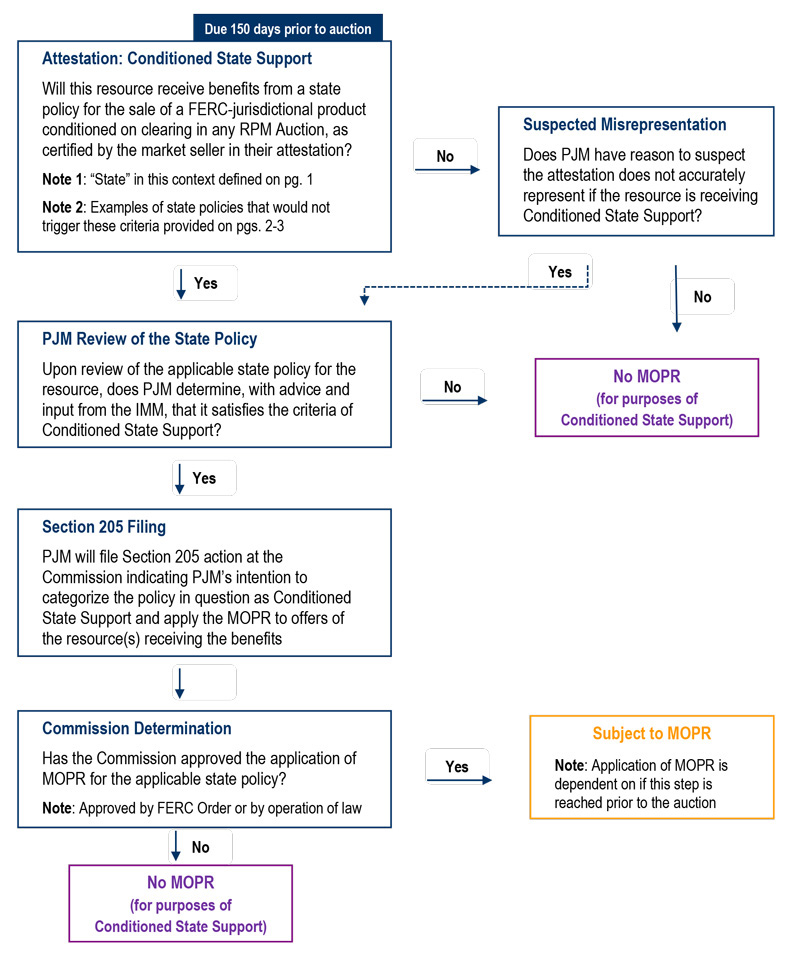
PJM’s proposed procedure for determining whether a market participant is exercising buyer-side market power | PJM

Market participants will be asked to sign attestations declaring they are not exercising market power or receiving state funds tied to clearing in the auction. PJM and the Independent Market Monitor will conduct “fact-specific, case-by-case reviews” if market power is suspected, and referrals will be made to FERC for a final determination.

PJM’s filing was opposed by gas-fired merchant generators as well as some electric cooperatives and state utility regulators. (See Mixed Stakeholder Reception to PJM MOPR Replacement.)

The new rules — which will eliminate both the expanded MOPR and PJM’s prior MOPR, which was limited to new natural gas resources — will be effective for the 2023/24 delivery year BRA scheduled to begin Dec. 1.

PJM has asked FERC to delay the auction by nearly two months to give it time to respond to a commission order on unit-specific offer review thresholds (ER21-2877). (See PJM Proposing 2-Month Capacity Auction Delay.) The Monitor reminded market participants Wednesday that the deadline for submitting market seller offer cap (MSOC) requests and must-offer exception requests for the auction is Oct. 1.

Reaction

Renewable advocates on Wednesday expressed relief over the approval of the new MOPR but regret that they came without an explicit imprimatur from FERC.

“It is disappointing that a majority of the commissioners could not agree on these important principles of federal and state comity and send a strong signal that it is not the place of federal regulators or wholesale market rules to ‘mitigate’ state clean energy policies,” said Jeff Dennis, general counsel of Advanced Energy Economy.

Sean Gallagher, vice president of state and regulatory affairs at the Solar Energy Industries Association, said the focused MOPR is “a vast improvement for the PJM market.”

“As proposed, the MOPR would have undermined PJM’s competitive market and punished states and independent power producers for providing affordable clean energy during annual capacity market auctions. The focused MOPR clears a path forward for IPPs that want to bid into PJM’s Base Residual Auction and acknowledges the right for states to choose affordable and reliable clean energy,” he said. “The focused MOPR also removes unnecessary administrative burdens and project assumptions that favor incumbent generators. The end result is a more efficient capacity market that protects market participants and customers alike.”

“Today is a great day for millions of ratepayers in PJM, America’s largest electricity market, who will be saved from paying more money than they should for clean power,” said Greg Wetstone, CEO of the American Council on Renewable Energy. “The MOPR, as previously designed, was a poorly disguised effort to undermine the success that low-cost renewables have enjoyed in competitive electricity markets nationwide by financially bolstering uneconomic fossil fuel generators. We commend PJM for working to reverse a destructive policy that distorted the market and directly conflicted with state efforts to accelerate the transition to pollution-free renewable power.”

“We’re considering all our options, including requesting rehearing,” said Todd Snitchler, CEO of the Electric Power Supply Association. “Given our strong protest in response to the PJM filing, we will continue to pursue what we think is the better path forward, which would be to reject the as-filed MOPR and allow sufficient time to pursue a more holistic approach to respond to the concerns raised by FERC and the states.”

Fears not Realized

Although MOPR-Ex was in place for the RTO’s 2022/23 BRA in May, predictions that it would inflate prices and block renewables’ entry did not materialize. Rest-of-RTO prices dropped by nearly two-thirds to $50/MW-day, and prices in the Eastern and Southwest Mid-Atlantic Area Council regions fell to their lowest on record. Nuclear generators, natural gas, renewables and energy efficiency increased their market share, while coal saw its contribution shrink. (See Capacity Prices Drop Sharply in PJM Auction.)