NJ Proposes Cutting EV Incentives Amid Big Demand

New Jersey Board of Public Utilities (BPU) wants to halve the size of incentives available to consumers who buy electric vehicles, after the popular program barreled through its second-year budget of $30 million in two months.

The BPU opened the program, known as Charge Up New Jersey on July 6, and then suspended it on Sept. 15 due to the exhaustion of the funds, saying that it would look for new funding to continue offering subsidies. The agency announced on Thursday it would shift $20 million from another fund to continue the program with a new, lower incentive structure, which will be discussed at a public hearing Sept. 30.

The program had been offering incentives of up to $5,000 for EVs with a manufacturer’s suggested retail price of up to $45,000, and up to $2,000 for EVs prices between $45,000 and $55,000. The new incentives will be $2,500 for EVs priced up to $45,000, and $1,000 for those prices between $45,000 and $55,000.

An agency explanation of the revised program rules said that “due to high interest in EVs, staff recommends reducing incentive levels to better allocate the budgeted funds and to increase the longevity of the program.” By cutting the incentives, the program would “ensure equitable access to funding for vehicles accessible to more New Jersey residents and to stretch available funds further,” the document said.

The program awards a $25 incentive for each mile of range that a vehicle can drive solely powered by electricity. Plug-in hybrid electric vehicles (PHEVs) would also be eligible for the $25 incentive for each mile of range, to a maximum of $1,000 under the proposed rules. There was no limit on incentive size at the start of the second phase, although incentives were expected to be relatively small due to the short range of the current crop of PHEVs.

A review of vehicles by NetZero Insider earlier in the year found that that the range of 16 eligible PHEVs listed on the program website was between 17 and 47 miles, which would result in incentives between $425 and $1,175.

By the time it was suspended, the second phase of the program had subsidized the purchase of 9,000 vehicles, the BPU said in a Sept. 14 statement announcing the suspension. It added that “drivers looking to make the switch to electric have enthusiastically embraced” it.

Jim Appleton, president of the New Jersey Coalition of Automotive Retailers (NJCAR), a trade association that represents about 500 car and truck dealers, said Friday the organization supports the program. But he questioned whether now is the right time to put more money into it, given the chip shortage that has hindered car manufacturing, and the possibility of federal money for EVs “on the horizon.”

He said that going “strictly by the numbers,” Charge Up New Jersey has probably been a success. But he said the agency should take time before restarting the program again.

“We really should be looking past the top-line numbers and ask, after two years, was the Charge Up New Jersey program a $60-million success that incentivized consumers to buy EVs they wouldn’t have purchased otherwise,” he said. “Or was it a $60-million give-away” to people who were going to buy an EV anyway?

“NJCAR thinks this would be a really good time to do a thorough analysis of where the money went, how we can better serve consumers that did not participate, and for the BPU and EV stakeholders to review program criteria and administrative functions to improve performance moving forward,” he said.

Searching For “Incentive-essential” Buyers

The Charge Up New Jersey program is part of New Jersey’s effort to get 330,000 registered light-duty EVs in the state by 2025, in line with its goal of using 100% clean energy by 2050. The plan also calls for at least 85% of all new light-duty vehicles sold or leased in New Jersey to be EVs by December 31, 2040.

The first phase of the program, also funded with $30 million, ran from January to December 2020, offering incentives of up to $5,000 for EVs priced up to $55,000. It subsidized the purchase of 7,000 vehicles, which along with the 9,000 subsidized thus far this year, accounts for about 5% of the 330,000 target total.

At the end of 2020, there were 28,869 EVs registered in New Jersey, along with 12,227 PHEVs, for a total of 41,096 vehicles — or about 12.5% of the 2025 target — according to figures from the New Jersey Department of Environmental Protection.

In the first year of the Charge Up program, 93% of recipients received the maximum incentive of $5,000, and 83% of the vehicles purchased were Teslas, according to BPU figures. In response, the BPU revised the structure in the second phase so that the maximum incentive of $5,000 would be available only to vehicles priced $45,000 or below. (See: NJ EV Incentives Target Cheaper Vehicles, Middle-income Buyers.)

BPU officials outlining the reasoning behind the price cap said it was an effort make the incentives “more accessible to middle-income families” and to prioritize “incentive-essential” buyers, or those who would likely not buy an EV without the incentive. Only one Tesla model, the Model 3 — which sells for $39,990, according to the company website — is priced below the $45,000 cut off.

Asked about the impact of the decision to focus the maximum incentives on lower-priced vehicles, and how many Teslas were sold under the second-year incentive structure, Peter Peretzman, spokesman for the BPU, said that at a later date the agency would “fully review Year Two of the program which will give us a complete picture of which vehicles were purchased.”

‘Filtering off’ the Teslas

Speaking before the BPU announced its plan to cut the incentive size, Stanislav Jaracz, president of Central Jersey Electric Auto Association, who spoke at a hearing on the proposed rules in the spring, urged the agency to shrink the incentives.

Jaracz, in a Sept. 16 email to NetZero Insider, said he found it “very surprising” that the fund was exhausted so quickly. He urged the BPU to do a thorough, transparent evaluation of who bought the cars. The rapid exhaustion of the funds reinforced his belief that the incentives should have been smaller, he said.

Incentives of $4,000 for EVs priced up to $40,000, and $2,000 for vehicles in the $40,000 to $50,000 price range would “filter off all Teslas from the $4,000 rebate tier to $2,000 tier,” enabling twice as many drivers to buy an EV, he said.

“With my proposal, the funding would still not last until the end of June 2022, but it would not be exhausted after less than 3 months,” he said.

EVs Reshaping Transportation Landscape

The growing adoption of electric vehicles is changing how consumers look at transportation and forcing automakers and policymakers to think about a multitude of disciplines beyond automotive design, from mining and recycling to emissions and urban planning.

In persuading people to buy an EV, product execution may play a bigger role than whether it’s an electric car or not, so the responsibility is on manufacturers “to surprise customers with the execution,” Ford Motor Company CEO Jim Farley said Thursday. “That seems to be driving the demand, not just electrification.”

Farley made his remarks during a webinar hosted by Columbia University’s Center on Global Energy Policy, appearing with the CGEP’s Director Jason Bordoff and distinguished visiting fellow Mary Nichols, former chairwoman of the California Air Resources Board.

Tipping Point

The moment when the EV market is going to take off is finally here it seems, Farley said.

“The Mustang Mach-E is sold out in the U.S., Europe and China — not just a little sold out, like a year sold out,” Farley said. “Enthusiasm for the product is very high.”

The F-150 is probably the model he watched the closest, he said, being America’s bestselling vehicle overall for 40 years.

“We have 150,000 orders, so it’s actually quite overwhelming right now to see the adoption,” Farley said. “Our market share is 50% of the light duty commercial vehicles in the U.S., so if you’re doing work with a vehicle in the U.S., 50% of them are a Ford. And we are the first one to have an electric van and an electric pickup, and we’re number one in both segments.”

Bi-directional charging has been of interest to Nichols since the Fukushima disaster, when the Japanese used their EVs to keep factories — and their own homes — powered, she said.

Clockwise from top left: Ford Motor Company CEO Jim Farley; CGEP Director Jason Bordoff; and Mary Nichols, CGEP | CGEP

Ford designed its vehicles to be power stations, and the company saw a big increase in demand for that functionality after the blackouts in Texas last winter, Farley said.

“Right now, basically, the vehicle will be able to power your home,” Farley said. “Selling electrons back to the grid could be a big solution to our energy issues and the grid issues for peak demand … but we haven’t worked that out. The solar industry has done it, but it was a really painful process about how to sell electrons back to the grid from personal solar systems. We are just starting that discussion with the Edison Institute and some forward-leaning utilities, like the ones in California.”

States regulate the utility industry, “maybe not as much as some of my fellow regulators would like, but, still, [utilities] don’t make a move without knowing that they’re going to be able to get cost recovery from it, so it doesn’t feel like [net metering for EVs] is at the top of the agenda where it probably needs to be at this point,” Nichols said.

Global Issues

Most global carmakers are investing heavily in the transition to EV production, but some are worried that the switch could hit workers as well as their bottom line.

Trade journal Inside EVs in mid-September reported Toyota CEO Akio Toyoda saying “that going all-EV could cost Japan 5.5 million jobs and 8 million units of lost vehicle output by 2030.”

General Motors announced in June that it will invest $35 billion in EVs and automated driving systems through 2025, and in July, CNBC reported that Stellantis — the merged Fiat Chrysler/PSA Groupe — plans to invest at least $35.5 billion in EVs and supporting technologies over the same time frame.

Farley and Nichols serve as co-chairs of the Commission on the Future of Mobility, which is trying to grapple with some of these questions and includes representatives from groups and businesses interested in mobility.

“We still are having a hard time, even as a group of people with experience and some claims to leadership, framing some of the really big airy questions,” Nichols said. Topics include “the whole freight sector, which also has a big stake — but that puts you in the business of urban planning.”

Automakers currently make money on the after-sales business, but that will go away as EVs require much less maintenance than internal combustion vehicles, Farley said.

“I think the electric vehicle is going to really challenge that assumption that the value is in the vehicle itself, and maybe the after-sales is not a profit endeavor like it has been for us,” Farley said.

Workforce “risk is something I think about every day with this transition,” Nichols said.

The American industry needs creative solutions to bring the supply chain back to the U.S., from batteries to silicon to mining, Farley said. “No one wants a mine in their neighborhood, but we have to mine or else we’re going to be shipping these materials halfway around the world.”

Today in Europe, 90% of vans are diesel and 20% of passenger cars have a plug, so the transition is going a lot slower for commercial vehicles, Farley said. “Commercial vehicles in China are really different, with three-wheelers and that kind of thing. They are actually going to EVs very quickly in China, but I’d say in general commercial vehicles are 10 years behind passenger vehicles.”

Asked what he wants from the government, Farley said, “Customers are really smart; they do the math, so we have to continue to get support from government leaders to put their foot on the scale of the economics and make this work for more customers.”

“That’s exactly what we’ve been hoping for in the state of California,” Nichols said. “We … try to make the case and educate people about electric vehicles and learned that, first of all, the people weren’t aware that they even existed, or that there were any vehicles out there that would meet their particular needs, and I think we’ve finally begun to turn that around.”

PPL Acquires Portion of SOO Green Project

PPL (NYSE:PPL) has acquired a portion of the SOO Green HVDC Link, giving the Pennsylvania-based energy company a role in the controversial transmission project aimed at delivering wind generation from MISO to the PJM market.

Details of the deal announced Monday were limited, but PPL will partner with Direct Connect Development, a Minneapolis-based company developing the $2.5 billion project, which consists a 350-mile, 2,100-MW, 525-kV underground transmission line sited along existing Canadian Pacific rail lines and designed to deliver renewable energy from upper MISO to Illinois and the PJM grid.

SOO Green’s other owners are Copenhagen Infrastructure Partners, Siemens Energy and Jingoli Power. Construction is currently planned to begin in 2023 and take three years to complete.

“SOO Green is very pleased to welcome PPL to the SOO Green team,” said project founder Trey Ward. “As a diversified utility with deep transmission development expertise, PPL will bring unique capabilities to help advance this landmark project.”

Project officials have touted the model of using underground cables co-located with existing rights of way to avoid using eminent domain to advance the transmission route. Officials said installing underground cables will enable faster state permitting by avoiding environmental and visual impacts tied to traditional overhead transmission lines.

PPL COO Gregory Dudkin said his company wanted to “gain insight” into SOO Green’s approach to the project as it ramps up its own clean energy transition. It is “excited to lend” its own experience in transmission development on the project.

“PPL is pleased to support a project focused on transforming how major transmission line projects are built in the U.S.,” Durkin said. “SOO Green’s innovative approach aims to remove key barriers to interregional transmission line construction that will be essential to connecting more largescale renewable energy to the grid.”

Project Challenges

SOO Green has been jostling with PJM over the project, asking FERC to eliminate capacity rules that it says are blocking its project from competing in the market. (See related story, SOO Green Seeks Relief from PJM Rule on External Capacity.)

PJM stakeholders originally approved an issue charge in June 2020 to consider integrating HVDC converters as a new type of capacity resource in the RTO. (See HVDC Initiative Endorsed by PJM Stakeholders.) Work at the HVDC Senior Task Force failed to reach a consensus on the issue. (See “HVDC Senior Task Force Update,” PJM MRC/MC Briefs: March 29, 2021.)

Direct Connect filed a complaint with the commission in June, arguing that PJM’s tariff and Operating Agreement are unjust and unreasonable because the RTO requires merchant transmission facilities to complete a “profoundly delayed generation interconnection process” for studies and integration into the grid (EL21-85). (See SOO Green Seeks Participation in PJM RTEP Process.)

Karl Miller, CEO of Jingoli Power, said SOO Green is a “critical link” in the development of the grid of the future.

“We’re thrilled PPL has recognized the project’s revolutionary model to ease constraints for other regional wind and solar developments that will help make the U.S.’ ambitious clean energy goals possible,” Miller said. “We’re eager to get to work with our new partners.”

Glick, Panel Discuss Critical Role of Tx in Decarbonizing NE

FERC Chair Richard Glick said that when he looks at the interconnection queues across the U.S., it amazes him how clear the direction is in terms of the resource mix: More than 90% of generation are renewable projects, “and that says a lot.”

“I think people realize that if you’re going to have that much intermittent renewable resources, there are some issues that need to be addressed,” Glick said in delivering a keynote at Raab Associates’ 171st New England Electricity Restructuring Roundtable.

Glick said the U.S. needs “a significant build out” of the transmission grid to access renewable resources far from load centers. “It’s an enormous task, not just in terms of finding companies that are willing to invest in these projects and providing the right incentives.” Between siting, permitting, construction and operation, it takes a lot of time. “We need to take that into account.”

Glick acknowledged that FERC has “significant” but not “complete” authority of the grid. However, in dealing with public policy transmission projects, Glick said the current paradigm is not “sufficient.”

In July, FERC announced an Advanced Notice of Proposed Rulemaking (RM21-17) to reconsider its rules on transmission planning, cost allocation and generator interconnection, acknowledging that Order 1000 has failed to provide interregional expansions to deliver increased renewables and meet the challenge of climate change. (See FERC Goes Back to the Drawing Board on Tx Planning, Cost Allocation.)

Glick said cost allocation is “a huge impediment” toward greater investment and development. He also surmised that tens, if not hundreds, of billions of dollars, are needed for transmission, “and people that invest that money are going to want to recover it.”

“That means consumers are going to have to pay for it somewhere, and I think that’s one of the areas from a FERC perspective that I’d like to focus on a little bit more,” Glick said. “How can we make sure that the transmission that is needed — that the investments that are made are truly the most efficient investments — that consumers get the biggest bang for their buck? That’s going to be the dominant issue as we move forward, whether it be at the state level or the federal level.”

Improving Tx Planning, Investment and Siting

Following Glick’s keynote, four panelists from the RTO, state, utility and consultant spaces drilled down deeper on improving transmission planning, investment and siting in New England.

“We are pivoting from a time when we really wanted to use transmission to support markets and economic efficiency — as well as reliability, of course — toward a … new objective function of decarbonization targets,” said Sue Tierney, senior adviser at Analysis Group. “We need robust scenario planning approaches. The states’ energy and electricity requirements need to be at the center of these scenarios. We need to look at multiple pathways [to decarbonization] and analyze transmission needs that come out robustly to support a variety of different scenario pathways.”

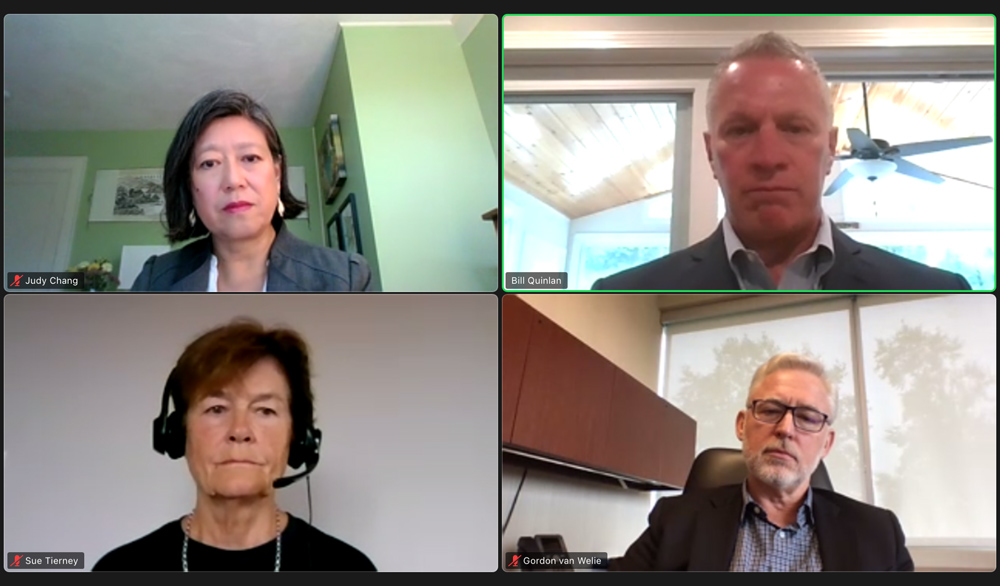
Clockwise from top left: Judy Chang, Massachusetts Executive Office of Energy and Environmental Affairs; Bill Quinlan, Eversource Energy; ISO-NE CEO Gordon van Welie; and Sue Tierney, Analysis Group | Raab Associates

The existing planning process needs improvement, conceded Bill Quinlan, president of transmission and offshore wind projects for Eversource Energy. Still, it did produce “a very reliable, efficient grid for New England.”

“Whether it’s eliminating congestion down in southwest Connecticut, opening up interstate power flows, allowing fossil plants to retire, there’s a lot of goodness that has come out of the reliability-based planning that has taken place over a decade,” Quinlan said. “We do need to open up the planning process and create a new planning framework that allows the region to achieve its clean energy goals.”

Judy Chang, undersecretary of Energy and Climate Solutions in the Massachusetts Executive Office of Energy and Environmental Affairs, said that any new planning processes are not going to be perfect “the first time.”

“It takes several iterations to get it right, not that there is a final answer or anything,” Chang said. “But I think we improve as we do this, so we have to do this quickly, the first time acknowledging that we may not get every scenario right, and every assumption right, or even the stories behind each scenario quite right; or might not have satisfied everybody’s curiosity and input. This is difficult for the [RTO], but we have to strike a balance. We have to take into account the input, but we also have to do it quickly, knowing that we’ll have another chance to come back and refine.”

ISO-NE CEO Gordon van Welie said there is plenty of renewable energy potential in New England, “more than enough to support what we need for decarbonization.”

“I think there are limits to how much consensus we can expect in the stakeholder process. We have to recognize transmission investments tilt the playing field, and so that’s going to limit how much consensus can be achieved in the stakeholder process,” van Welie said. “The most important consensus we need is amongst the New England states because if we don’t get consensus amongst the states, we won’t make progress. I think our history shows that, and so that’s really the vital ingredient to this.”

Historically, when the states are aligned, Quinlan said, “solutions become a reality.”

“Stakeholder engagement, I think that’s key; everyone really does need to have a voice in this, but directionally, I don’t think there’s a big difference of opinion as to what the future should look like,” Quinlan said.

NERC Board Approves Atlanta Office Move

At an abbreviated open meeting on Tuesday, NERC’s Board of Trustees approved a request from management that will allow the organization to go forward with plans to move its Atlanta headquarters.

The meeting had a single agenda item, split into two parts. First, the board authorized NERC management to execute the lease for the new Atlanta office that they have negotiated with the future landlord. Next, the trustees approved an amendment to NERC’s 2022 Business Plan and Budget allowing the organization to draw about $773,000 from its reserves in 2022 to pay for moving to the new office.

NERC’s current lease is set to expire in 2025, but an early termination clause would allow the organization to exit the lease by October of next year. That clause must be exercised by Oct. 31 and will require a payment of up to $2 million this year; earlier this month the organization requested permission from FERC to pay the early termination charge from its Operating Contingency Reserve (OCR). (See NERC Seeks FERC Approval to Fund Office Move.)

CFO Andy Sharp explained that NERC’s moving costs are also to be partly funded from the OCR, with about $64,000 to be spent in 2022 on top of the earlier charge. Another $709,000 will be paid from the Future Obligations Reserve, a fund that Sharp said was set aside by NERC to “subsidize the remaining term of the Atlanta lease.”

The use of the reserves means NERC will not have to change the assessments on regional entities in its 2022 budget, while the ending balance of the OCR in 2022, even with the new expenditures, is projected to be 5.5% of the revised budget. This is well within the policy target range of 3.5 to 7.5%.

NERC has shared few details about its new lease because of ongoing negotiations, but during Tuesday’s board meeting and the open meeting of the Finance and Audit Committee that preceded it, Sharp provided more information about the “attractive financial offer” that the organization received from the new landlord.

In addition to saving $900,000 per year on lease and facility costs, the new landlord has agreed to pay a majority of NERC’s construction, furnishing and move costs. These benefits “will result in a reasonable payback” of the early termination charge and the moving costs.

Along with the financial savings, Sharp highlighted several other advantages of the new location, such as a 40% smaller footprint that will accommodate a reduced staff presence in the office as NERC continues the hybrid work posture it began last year because of the COVID-19 pandemic. The new space also offers amenities such as free employee parking that are not available at NERC’s current office.

With the board having approved both proposals, NERC plans to submit the amended budget to FERC by Thursday. Board Chair Kenneth DeFontes thanked management for working quickly to finalize the new lease and take advantage of the early termination opportunity, saying the deal was “excellent timing.”

“It really coincides extremely well with the plans we’re making for a return to work, post-COVID world, not only in terms of saving costs, but also in terms of how we’re going to restructure the way in which we will use our offices,” DeFontes said. “So it really has been remarkable, and I want to thank the team for their creativity and their opportunistic approach that will [allow] a 30 to 40% reduction in our fixed costs going forward.”

Bonneville Commits to Joining Western EIM

The Western Energy Imbalance Market is poised to make its largest expansion ever next spring after the Bonneville Power Administration said Monday that it will join the market in March.

With 15,000 miles of high-voltage transmission and 31 hydroelectric projects under its control, BPA will be the largest transmission- and hydro-provider in a market that currently includes 14 members with territories spanning much of the Western Interconnection.

“This decision aligns with Bonneville’s strategic plan and opens up an opportunity to increase revenues through additional sales of surplus power and to reduce costs through greater efficiencies,” BPA Administrator John Hairston said in a statement. “As the West moves rapidly to decarbonize the grid, Western EIM participation will help us navigate future challenges and leverage opportunities to benefit our customers and the Northwest.”

BPA’s decision comes three years after the federal power marketing agency began exploring membership in the CAISO-operated WEIM and two years after it signed a nonbinding implementation agreement to begin integrating the ISO’s systems into its operations. (See Bonneville Power Signs Agreement with EIM.)   The agency said Monday that its internal preparations are “on track” and that it has already begun testing with the ISO.

“Bonneville and its public power customers are highly valued partners for the ISO, and we look forward to further strengthening our working relationships,” CAISO Chief Operating Officer Mark Rothleder said.

BPA’s decision, though not a surprise, marks CAISO’s second victory this month in its competition with SPP, which earlier this year launched the Western Energy Imbalance Service (WEIS). A competing real-time market that has already attracted members in the Rocky Mountain region, the WEIS could provide a foothold for a full RTO in the West. In June, Xcel Energy postponed its effort to join the WEIM in order to consider its alternatives with SPP. (See Xcel Delays Joining EIM to Weigh Options.)

But two weeks ago, the Western Area Power Administration’s Desert Southwest Region signed its own implementation agreement with the WEIM, putting the agency on track to join in 2023. (See WAPA Desert Southwest Region to Join Western EIM.) By that time, the WEIM will consist of 22 members representing 84% of the West’s load, CAISO estimates.  

The ISO has taken key steps to seal the deal for BPA’s membership, including revising its tariff to create a new category of default energy bid — a “hydro DEB” — that estimates the opportunity costs for hydro in the WEIM to avoid forcing those resources to make unprofitable trades under certain conditions. (See CAISO Goes 2 for 3 on EIM Hydro Rule Changes.) 

And last month, CAISO’s Board of Governors and the WEIM’s Governing Body both unanimously approved a plan that would delegate more authority to the Governing Body over issues affecting the WEIM, a move widely popular among Northwest utilities and power producers. (See CAISO Agrees to Share More Power with EIM.)

Hairston said Monday that BPA’s WEIM membership could be a steppingstone to other forays into regional markets.

“Western EIM participation is a great introduction to emerging markets in the West. We hope to build on this experience to assess future market-based opportunities,” he said.

BPA is already heading in that direction, having last month proposed to participate in the next non-binding phase of Northwest Power Pool’s Western Resource Adequacy Program (WRAP). Interest in the WRAP has expanded to include utilities currently outside the NWPP’s current coverage area. (See RA Program will Require Restructuring of NWPP.)

And BPA signaled that it would also consider developments taking shape farther east.

“In addition to participating in the Western Resource Adequacy Program, BPA is closely monitoring the potential formation of day-ahead markets in the West,” the agency said. “Both the California ISO and Southwest Power Pool have presented initial concepts that could provide additional opportunities and benefits for BPA and its customers.”

Conn. Regulator Nudges ISO-NE to Share Tx Data to Support OSW

States in New England are relying on offshore wind (OSW) to cut greenhouse gas emissions, but they need to hear from ISO-NE on where transmission upgrades are most needed before they can start harnessing the energy.

“I think [ISO-NE] is best-positioned to be able to provide the states with that kind of planning analysis,” Connecticut Department of Energy and Environmental Protection (DEEP) Commissioner Katie Dykes said at the Environmental Business Council of New England’s Connecticut Offshore Wind Webinar on Friday.

Other onshore renewable energy resources, Dykes said, need to be considered in the transmission planning process for OSW to avoid unintended consequences of congestion or curtailment between resources.

“The [ISO-NE] planning process for transmission has been pretty reactive,” Dykes said, and states are calling for a more proactive approach to building out the grid.

But New England states also need to work with ISO-NE in providing information on what their transmission and climate goals are so the system operator can include them in its planning efforts.

Since 2012, for example, Connecticut’s Integrated Resource Plan (IRP) has assessed supply and demand to formulate recommendations for the state’s electricity needs. The final version of the latest IRP is due later this month, Dykes said. And in Massachusetts, Gov. Charlie Baker’s administration developed a Decarbonization Roadmap to model how the state will reduce emissions at least 85% by 2050, including plans for electrification that require significant transmission updates.

Connecticut and Massachusetts want to plug the IRP and roadmap into ISO-NE’s scenario planning process, Dykes said.

Last year, all six New England states, through their representatives to the New England States Committee on Electricity, signed a vision statement that calls for ISO-NE to make the changes necessary to cost-effectively build the transmission needed to integrate OSW and other renewables.

In July, FERC opened a rulemaking to reconsider its rules on transmission planning, cost allocation and generator interconnection, acknowledging that Order 1000 has failed to provide interregional expansions to deliver increased renewables and meet the challenge of climate change. (See FERC Goes Back to the Drawing Board on Tx Planning, Cost Allocation.)

FERC’s review is important, Dykes said, because New England is “long delayed in reforms to the transmission procurement process.”

To unlock the transmission investment needed to integrate future offshore wind and other renewables, it is “critical that we’ll be able to participate in the process,” Dykes said.

Connecticut currently has about 90% of its electricity load under contract with renewable and zero-carbon resources, including the 704-MW Revolution Wind project between Eversource Energy (NYSE: ES) and Ørsted off the coast of both Connecticut and Rhode Island. The developers expect to place the project in commercial operation by 2025.

In addition, Vineyard Wind’s 804-MW Park City Wind project is located 23 miles off the coast of Massachusetts but will bring renewable energy to the residents of Connecticut.

Prices for OSW are steadily declining, Dykes said. The contract prices for Connecticut’s projects declined 20% from $99.50/MWh to $79.83/MWh, she said.

“These [prices] are a testament to the success of the competitive procurement mechanism Connecticut has been using to invest in OSW, as we provide certainty and finance stability for these projects going forward,” Dykes said. “The next challenge we have to tackle is transmission.”

DOE Targets 90% Cut in Cost of Long-duration Storage

To decarbonize the fast-evolving U.S. grid by 2035, long-duration storage technologies that can provide 10 or more hours of power will have to be developed and deployed by 2030, according to Eric Hsieh, director of grid systems and components at the U.S. Department of Energy.

But hitting that deadline may not be possible because of the long and expensive process new technologies must go through to test and validate their performance, he said.

To allow enough time for manufacturing, permitting, interconnection and construction, “any new technologies would probably need to be ready by 2030” to be operational by 2035, Hsieh said during the DOE’s Long-Duration Storage Shot Summit on Thursday. “So, under any scenario of achieving this goal, there’s less time on the calendar, between now and deployment, than the time these technologies” would normally need for performance testing.

This “information gap” — and the use of artificial intelligence and machine learning to accelerate testing — is now the focus of a consortium of researchers at the DOE’s national laboratories. They have launched a Rapid Operational Validation Initiative (ROVI) to build the tools and datasets that could cut the performance testing process from years to weeks, said Eric Dufek, department manager for energy storage at the Idaho National Laboratory.

The national labs have already developed some AI and machine learning capabilities that might soon “do rapid, accurate and cost-effective performance characterization and provide the quantitative, reliable certainty to everybody that is developing and deploying different assets,” Dufek said during a panel on the initiative.

The need for speed is at the heart of the Long-Duration Storage Shot (LDSS), the second of the DOE’s Earthshots aimed at driving down the costs of certain key energy technologies that will need to be commercialized and deployed at scale to reach President Biden’s 2035 deadline for a 100% clean electric grid. Six to eight “shots” are planned for the initiative, beginning with the Hydrogen Shot, announced in June, which is aimed at cutting the cost of green hydrogen, produced with clean energy, from its current price of $5/kg to $1/kg within a decade.

Launched in July, the LDSS has set an even more ambitious target: cutting the levelized cost of long-duration storage 90% to 5 cents per kWh-cycle for 10 hours of duration or longer, Hsieh said.

That target is based on the 2020 capital costs and levelized cost of storage (LCOS) of lithium-based batteries, Hsieh said. At the same time, “the Storage Shot is technology-neutral and includes all technologies with a pathway to the specified cost and performance targets,” he said.

A wide spectrum of technologies is in the running to fill the long-duration space. Traditional pumped hydro currently accounts for more than 90% of grid-scale storage in the U.S., but other possibilities include liquid air, compressed air, hydrogen, flow batteries and gravity-driven technologies. For example, the California-Swiss startup Energy Vault uses tall towers to store and discharge energy by lifting and lowering 35-ton blocks of concrete.

The sheer number of “potential pathways here offer potential breakthrough avenues and obviously also challenges,” said Jason Burwen, interim CEO of the Energy Storage Association, who believes the DOE’s target is achievable.

“Each technology points you toward different cost problems to tackle,” Burwen said in a phone interview with RTO Insider. “Thermal storage technologies, for example, there’s a lot of promise there because you’re talking about materials and thermal mass, which can scale … probably fairly well at low cost, and then it becomes a matter of solving for the containment vessel associated with those.”

Speaking to RTO Insider on Monday, Yiyi Zhou, clean energy specialist at BloombergNEF, also saw a number of possible candidates for hitting the 5-cent target, including hydrogen, compressed air and aqueous, or liquid air, technologies.

“[The] levelized cost of hydrogen for renewable electricity has the potential to reach below U.S. $1,” Zhou said. “This is the equivalent to about 2.5 cents per kWh.”

But, she cautioned, an LCOS that low might only be applicable in certain markets.

Faster, More Granular, More Complex

Lithium-ion batteries are the dominant technology in residential and grid-scale storage today, allowing for durations of four to six hours and a range of flexible grid support services. But according to a range of policy makers and industry stakeholders at the LDSS summit, increasing levels of renewable energy on the grid will require longer-duration technologies.

“Once you get past 20 to 30% penetration of renewables, the whole system changes. It becomes faster; it becomes much more granular in terms of the information you require. It becomes certainly much more complex,” said Audrey Zibelman, who at the end of 2020 left her position as managing director and CEO of the Australian Energy Market Operator to join X, Google’s Moonshot Factory, as vice president for the electric grid.

“But [what] all that gets down to is that you need a huge amount of flexibility in the system; you need to be able to respond instantaneously to changes,” Zibelman said. “And you need to recognize that as weather [solar and wind] becomes some of your biggest fuels, storage becomes an increasingly critical feature both in managing the grid so that it can take advantage of the free fuel of weather and become much more efficient, as well as resilient, as well as reliable.”

Renewables and electrification of transportation, buildings and other sectors of the economy could result in some states seeing their electric grids shift from summer-peaking to winter-peaking systems, as is already beginning to happen in North Carolina, said Christopher Ayers, executive director of public staff at the North Carolina Utilities Commission.

With the state’s strong solar market pumping out excess power, “we need that energy that is produced in the afternoon in large quantities; we need it at 6, 7 and 8 in the morning on January, February and March mornings,” Ayers said. “Right now, we don’t have the technology that allows us to bridge that gap. Once we have long-duration storage and start integrating [that power] into the system, we can become more cost-effective by also leveraging low-cost energy generation.”

In the remote town of Cordova, Alaska, Clay Koplin, CEO of the Cordova Electric Cooperative, sees long-duration storage as “the holy grail.” Working with the DOE, the town of about 2,200 has been able “to modernize our grid and be very efficient with the resources we have, but [that] just can’t replace the need for storage,” Koplin said.

Long-duration storage would mean the town would be able to store excess solar energy from its long summer days to use during the winter, and eventually run 100% on clean power, Koplin said.

Data: A Two-fold Problem

Beyond cost-cutting, a major challenge for scaling long-duration technologies is validating their performance, a process that often requires a huge amount of data collected over years, said Ben Kaun, program manager for energy storage and distributed generation at the Electric Power Research Institute.

“Utilities are used to very long-life assets,” Kaun said during the panel on ROVI. “Battery energy storage technologies that are available right now typically are guaranteed for 10 to 20 years. That already raises some eyebrows for the stakeholder group. In addition, there’s only been a few years that most of these technologies have in-the-ground experience that we haven’t had the chance to prove out.”

And, with the grid constantly evolving, Kaun said, “This creates a situation where there’s insufficient predictive data about what’s going to happen to these assets in the future.”

Craig Horne, managing director of energy storage at natural gas and solar developer Wellhead Electric Company, agreed. “You really have a two-fold problem where you have a limited amount of data that predicts performance and then a limited amount of insight as to how that performance needs to manifest in order to bring in revenues and provide service to the customers,” he said.

A platform like ROVI would allow developers to “see that no matter how a use case may evolve, that we can get a high degree of confidence that this storage asset would be able to respond appropriately,” Horne said.

Getting the system up and running, however, will mean collecting and sharing performance data — including proprietary information — from a range of industry players, a problem the labs are already working on, Dufek said.

“If something is proprietary and not necessarily something you want the entire world to see, we can also deal with that,” he said. “We can clearly link and coordinate between those two sets so that we continue to evolve the entire system without actually developing or creating the need to develop a specific tool for every single activity.”

PennEast Pipeline Throws in the Towel

Developers of the proposed PennEast Pipeline said Monday they are canceling the natural gas project, conceding defeat in a seven-year battle despite a U.S. Supreme Court ruling supporting their ability to seize properties in New Jersey via eminent domain.

“Although PennEast received a certificate of public convenience and necessity (CPCN) from FERC to construct the proposed pipeline and obtained some required permits, PennEast has not received certain permits, including a water quality certification and other wetlands permits under Section 401 of the Clean Water Act for the New Jersey portion of the Project,” the company said in a statement. “Therefore, the PennEast partners, following extensive evaluation and discussion, recently determined further development of the project no longer is supported. Accordingly, PennEast has ceased all further development of the project.”

The $1.2 billion 120-mile pipeline would have delivered shale gas from Luzerne County in Northeastern Pennsylvania to Transco’s pipeline interconnection in Mercer County, N.J.

Monday’s announcement was foreshadowed when four of the five partners — New Jersey Resources Corp. (NYSE:NJR), South Jersey Industries (NYSE:SJI), Southern Co. (NYSE:SO), and a subsidiary of UGI Corp. (NYSE:UGI) — told investors recently they were writing off about $354 million from their books, representing nearly their entire investment in the project. Enbridge Inc. also was a partner (NYSE:ENB).

Last week, the New Jersey attorney general announced in a federal court filing that PennEast had dropped its bid to condemn 42 parcels in which the state claims a property interest, most of them privately owned land on which the state Jersey has granted conservation easements.

In June, the Supreme Court ruled 5-4 that the Natural Gas Act allows private energy companies to seize “necessary”  land for a project if they have obtained a CPCN from FERC. New Jersey officials responded to the order with a vow to continue their fight against the project.

“I welcome today’s decision by PennEast to cease development on the PennEast Pipeline and am committed to protecting our state’s natural resources and building a clean energy future that works for all New Jerseyans,” Gov. Phil Murphy said in a tweet.

Abigail M. Jones, vice president of legal and policy at PennFuture, said the pipeline would have damaged streams, wetlands and forest habitat while increasing greenhouse gas emissions.

“New Jersey had denied critical environmental permits for the pipeline, which resulted in PennEast proposing to bifurcate its process and build the Pennsylvania-portion in phases to allow for construction to move forward,” she said in a statement. “PennEast’s announcement that they will cease development of the pipeline is great news, especially for the many landowners in Pennsylvania whose properties were threatened by eminent domain and clearcutting for a pipeline to nowhere.”

The Consumer Energy Alliance (CEA), a group backed by oil and gas producers and mining interests, said the cancellation was “a sign that even with a Supreme Court victory under its belt, critical infrastructure in the U.S. faces needless and politically-motivated opposition.”

“Unfortunately, a regulatory process designed to get things built safely and in the public interest has fallen prey to anti-business interests and compliant elected leaders,” said CEA Mid-Atlantic Director Mike Butler.

The Energy Information Administration reported last week that the U.S. benchmark natural gas spot price at the Henry Hub in Louisiana has been at a premium to Northeast natural gas hubs since the third quarter of 2020, “as total Appalachian supply exceeded demand growth and storage levels were above average.

“Although storage levels fell in 2021, other factors, such as record high Gulf Coast LNG exports, winter freeze-offs in Texas and neighboring producing areas, and Appalachian pipeline outages kept the Henry Hub price premium over Northeast hubs higher than 2018-2020 annual averages in 2021,” EIA said.

UN Hosts Energy Dialogue During General Assembly

Nisha Pillai, BBC | United NationsAs world leaders gathered in New York last week for the United Nations General Assembly, presidents and prime ministers mixed with program directors and policy advocates at a conference to shape a unified global response to climate change through renewable energy.

“The conference is a way of bringing together [the 17 U.N. Sustainable Development Goals] on climate action onto the same trajectory,” said BBC World News presenter Nisha Pillai, who moderated a panel on “raising collective ambition.”

“Governments alone cannot do the transformations that are needed to fulfill this and also to get us to the goals of the Paris Agreement by the end of the century,” Pillai
said.Damilola Ogunbiyi, Sustainable Energy for All | United Nations

U.N. Secretary-General António Guterres on Friday convened a “high-level dialogue on energy” concurrent with the General Assembly in order to accelerate action on clean, affordable energy for all, the first gathering of leaders at the U.N. in more than 40 years devoted solely to energy issues.

Emerging economies need to feel like they’re part of the global struggle against climate change, said Damilola Ogunbiyi, special representative of the U.N. Secretary-General for Sustainable Energy for All.

“I always tell people from my own country, Nigeria, that energy is our climate action,” Ogunbiyi said. “Getting rid of 25 million generating sets is part of our climate action, as is giving 90 million people energy access. … But from tomorrow it’s all about how do we translate that ambition on the ground and how do we get a lot more people to deliver it.”

Co-investment Stimulus 


Achim Steiner, UNDP | United Nations

To consider how much the situation has changed in recent years, look at the stimulus packages that have been mobilized in the industrialized world, said Achim Steiner, U.N. Development Program administrator.

“To start with, there is a multiple amount of funding, public finance and policy signals being put in place right now that will accelerate the transition,” Steiner said. “For example, in terms of clean energy the European Green Deal translates into a €60 billion fund that is now being given to the minister of ecological transition in Italy to green Italy’s economy.”

Investment can’t just be made in one part of the world, particularly the part of the world that can afford it, he said.

“This is not a zero-sum game, as $100 billion from the rich world is actually going to leverage trillions of dollars of investment in clean energy in the global South,” Steiner said. “This is the co-investment proposition of our time. Now if we can make that equation work, we can not only achieve SDG 7 [the goal of ensuring universal access to clean, affordable and reliable energy], we can actually surpass it.”

ENGIE CEO Catherine MacGregor | United NationsGlobal energy company ENGIE is committed “to deliver on the decarbonization agenda” both for itself and its industrial clients, whom it helps to decarbonize their operations, ENGIE CEO Catherine MacGregor said. The company aims to be carbon neutral by 2045.

“I think very importantly we have to have shorter-term goals, which allows us to really track progress,” MacGregor said. “We are a private company and the task on us is to really be able to deliver progress, concrete projects.”

The company’s ability to collaborate with other private-sector actors as well as policymakers is important to meet the challenges facing the energy sector, she said.

“As an example of that, hydrogen is a massive potential solution for the hard-to-abate sector, but everything needs to happen in hydrogen — market design, policy, regulation — and here the private sector and government working together is so important,” MacGregor said.

Patricia Espinosa, United Nations Framework Convention on Climate Change | United NationsThe Paris Agreement provides the overall framework for action for the world, but then it also says every country  and every community needs to have a plan and those are the nationally determined contributions (NDC), said Patricia Espinosa, executive secretary of the United Nations Framework Convention on Climate Change (UNFCCC).

Pillai asked about “coherence” between the individual actions and the NDCs. NDCs represent pledges on climate action that seek to limit global warming to well below 2 degrees Celsius — and preferably 1.5 degrees — over pre-industrial levels.

“Ensuring that the individual actions by all stakeholders, especially the private sector, the financial community, of course, and the governments, provide the enabling environment is really the key to going from plans into implementation and reality,” Espinosa said.

Gender Equity

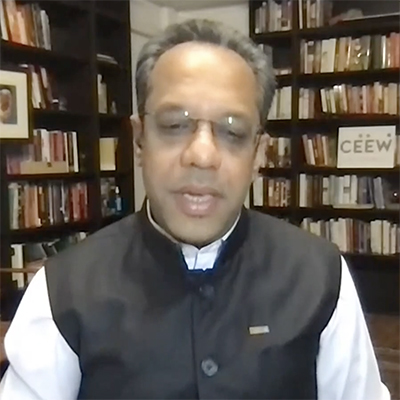
Arunabha Ghosh, Council on Energy, Environment, and Water | United NationsWomen-owned businesses have lower access to investments because they lack collateral and also face conscious and unconscious bias in investment processes, said Arunabha Ghosh, CEO of India’s Council on Energy, Environment, and Water.

“The general energy compact for us, the coalition believes, must be their means to harness and channel the support that women need to grow their businesses and to make them resilient,” Ghosh said. “One way of doing this is by leveraging investments from those interested in returns — not just on economic returns but on gender impacts, on results.”

Sheila Oparaocha, ENERGIA | United NationsThe World Bank is doing a lot of good work in gender equity, and the agreements made at the U.N. also need to be a catalyst to increase investments from both the public and private sectors to intentionally and directly invest in women’s businesses, Ghosh said.

Energy poverty is largely and most severely experienced by poor women globally, said Sheila Oparaocha, international coordinator and program manager for gender equity advocacy group ENERGIA.

“We find whether you are in a developing country, but even in the most economically advanced countries, we still find that women are marginalized from decision making and leadership in the energy sector,” Oparaocha said.