Gov. Baker Creates Commission on Clean Heat in Massachusetts

Massachusetts Gov. Charlie Baker signed an executive order on Monday establishing a governing body to focus on incentivizing residential and commercial building owners to convert to renewable electric heat.

The Commission on Clean Heat will bring together 22 experts and stakeholders in affordable housing, energy efficient building design, heating system technology, healthcare and real estate to advise the administration on strategies and policies to reduce emissions from heating fuels, according to the governor’s office.

“Massachusetts has ambitious climate goals, and we will need to pursue innovative solutions to reduce emissions from our heating fuels, keep costs low, and deliver lasting benefits to our communities,” Lt. Gov. Karyn Polito said in a statement. The commission will “reflect a diversity of expertise that will be crucial in developing the forward-thinking policies we need to achieve our nation-leading emissions reduction targets.”

Legislation proposed in the state earlier this year sets an ambitious target for the state to retrofit and electrify one million homes by 2030, or roughly 100,000 homes per year. The Building Justice with Jobs Act (H.3365) calls for an oversight commission to retrofit buildings and track emissions from the building sector in the state. (See: New Mass. Bill Targets 1M Home Retrofits.)

Filed by Rep. Maria Robinson and Sen. Marc Pacheco, the bill was largely the work of the Massachusetts Green New Deal Coalition of community, environmental and labor leaders, of which the nonprofit 350 Mass is a member.

Cabell Eames, the legislative manager of the Better Future Project under 350 Mass, told NetZero Insider she is apprehensive of the Baker administration’s approach to climate policy.

A top-down approach can leave people behind, and many “don’t have the means to retrofit their homes,” Eames said.

“We have to make this very simple for folks,” Eames added. “If people need to be [temporarily] displaced because of asbestos or mold found during the retrofit process, they should be displaced equitably.”

The executive order also creates a task force to support the work of the commission, made up of members of the executive branch, the Massachusetts Department of Energy Resources and the Executive Office of Housing and Urban Development.

Eames argued there should be a task force that is community-based that serves an oversight role on the decision-making at the executive level.

A community-based approach “starts slower, but once you get the input you can really see it take off,” Eames said of home retrofits.

The Commission on Clean Heat is the first of its kind in the nation, according to state officials, and it is intended to provide specific plans to push the decarbonization of buildings on a larger scale.

Vermont is considering a Clean Heat Standard to reduce emissions from heating and hot water in buildings as part of its pending climate action plan. (See: VT Climate Council Puts Clean Heat Standard on the Table.) And New York is drafting a Carbon Neutral Buildings Roadmap to set targets for reducing emissions in buildings across the state.

Heating and cooling infrastructure in homes and commercial buildings are the second largest source of emissions in Massachusetts after transportation, according to state data.

Energy and Environmental Affairs Secretary Kathleen Theoharides will serve as chair of the new commission and will recommend the commission members for Baker’s approval. By November 2022, the group must submit a set of policy recommendations to the administration that will reduce the use of heating fuels and slash building emissions.
Hydrogen, Funding, Deployment Feature at ZEB Conference

DENVER, Colo. — Adequate funding, deployment challenges and hydrogen-versus-battery electric were hot topics last week at the 2021 International Zero Emission Bus Conference, hosted by the Center for Transportation and the Environment.

The event presented more than 75 speakers to more than 1,000 attendees.

Thursday’s panelists described how each of their organizations has started to transition to zero-emission buses, an effort that has met with overwhelmingly positive response across their industries.

“I think there’s a theme here. Everybody seems to like them,” Ian Redhead, deputy director at Kansas City Airport, said.

Though this has been the case, there continue to be barriers to ZEB adoption, especially when considering funding. While grant programs are available, it can be difficult to qualify and obtain funding through these avenues, Redhead said.

Erik Bigelow, senior engineering consultant for CTE, addressed the particularly challenging task of funding the transition to ZEBs in education.

“Everybody wants kids riding clean electric school buses, but education funding is always a challenge,” he said.

But even with initial funding challenges, it is still worth it for organizations to make the transition, Redhead said.

“When we did our homework, we made a really compelling case about why the electric buses were the way to go long-term. … The technology is not cheap … but long-term when you do the cost-benefit analysis, it definitely warrants the investment,” he said.

Moderator Dan Raudebaugh, executive director at CTE, said the transition will have to move at a much faster pace to reach decarbonization goals. Mass deployment of electric buses will be necessary in the near-term to significantly reduce carbon emissions from the transportation sector, he said.

“We’ve been deploying buses at four, five, six at a time, and to make the next step we’re going to have to start deploying buses at 15, 20, 25 at a time,” Raudebaugh said.

Hydrogen Fuel Cell or Battery Electric?

A question a company must ask before transitioning to electric buses is what kind of technology it needs. While hydrogen fuel cell and battery electric buses are both more efficient and environmentally friendly, they can serve different purposes based on the function of an organization.

Salvador Llamas, chief operating officer at AC Transit said, “Battery electric or fuel cell. Which one’s better? That’s like me trying to pick my favorite child. They’re both the same. They’re both electric drive buses. One is a sprinter; one is a marathon runner. One combs her hair different than the other. This is exactly why AC transit created the Zero Emission Transit Bus Technology Analysis to really get deep into the weeds on the data, the performance metrics, the cost and start to really guide us as an agency whether the technologies that are available are going to be able to meet and fulfill the duty cycles that we commit to our communities.”

AC Transit General Manager Mike Hursh said cost is the biggest barrier to hydrogen.

“If we can’t get hydrogen down below $5/kilogram it’s just not going to compete,” he said. “Once we have market saturation of hydrogen and the price is there, it’s going to be a very on-par competitor to the other zero-emission technologies out there.”

Facilitating the Transition

The panelists agreed that sharing information and industry cooperation would help spark more adoption of ZEBs.

“We can influence the economies of scale when we purchase our equipment together. We can also share best practices [and] lessons learned so we can avoid pitfalls that cost us money,” Llamas said.

Redhead said more investment and research will be key to not only transitioning to electric buses, but to an electric economy.

“The more that people are investing in the technology, the better it is for all of us. We’re talking about buses and so forth, but buses [are] a jumping off [point] to other things, and as long as people start realizing that there are other industries … that are also looking at electric technologies … then we will have more and more options to be able to supply what we want.”

Two Transmission Projects Selected to Bring Low-carbon Power to NYC

New York has selected two transmission line projects to help decarbonize power in New York City, Gov. Kathy Hochul said Monday during the opening ceremony of Climate Week NYC.

The state, she said, chose the Clean Path New York project and the Champlain Hudson Power Express project from among seven submitted to the Clean Energy Standard Tier 4 solicitation issued in January.

“New York’s communities are repeatedly facing serious consequences as a result of the devastation caused by the global climate crisis, and the stakes have never been higher as we deal with the economic and environmental destruction these extreme weather events leave behind,” Hochul said.

The Champlain Hudson line, developed by Transmission Developers Inc. and Hydro-Québec, is an underground and underwater transmission line that would run 339 miles between the Canada-U.S. border and New York City.

“This is a transformative moment for New York City’s fight against climate change,” New York City Mayor Bill de Blasio said in a statement.

The project’s opponents are concerned about the developers’ plan for the line to cut through the Hudson River. The cable would be laid along 200 miles in Lake Champlain and the Hudson River with a machine that uses high-powered water jets to blast away sediment to create a 7-foot-deep trench.

That process, according to the environmental organization Riverkeeper, could churn up legacy contaminants such as polychlorinated biphenyl, which were once used as dielectric and coolant fluids in machines and dumped into the Hudson by General Electric.

“I’m dismayed that New York state found a way to avoid caring for … the river when there are other solutions,” John Lipscomb, Riverkeeper’s patrol boat captain, told NetZero Insider.

New York is “checking the green box without looking at the details, and the details are important,” Lipscomb said. 

Riverkeeper plans to meet with the New York State Energy Research and Development Authority (NYSERDA) next week about the final approval of the line.

Once finalized, NYSERDA will submit the negotiated contracts for the awarded projects to the Public Service Commission for consideration and approval. If the Tier 4 contracts are approved, NYSERDA payments will begin when the line has all required permits and local approvals, is constructed and delivers power to New York City.

Routing and environmental work is underway on the 174-mile Clean Path line, according to a statement from the developers, Forward Power, a joint venture of Invenergy and EnergyRe, and the New York Power Authority. The project route runs from Delaware County, in New York’s Southern Tier economic development region, through the Mid-Hudson region to New York City. A majority of the transmission line will be built on existing rights of ways already used by roads and transmission lines, the developers said.

The proposed Clean Path route, according to the developers’ application, also requires burying the line in the Hudson River.

Full operations are expected to begin in 2025 for Champlain Hudson and 2027 for Clean Path.

Electric Delivery Trucks Coming with or Without Congress

Electrification of U.S. trucking is going to happen whether or not Congress finds a way to help fund and expedite the transition as part of the Biden administration’s effort to address climate change.

While congressional Democrats struggle to keep moderates on board a $3.5 trillion, 10-year budget plan as a companion to the $1 trillion infrastructure bill decarbonizing the U.S. economy, at least one company among the nation’s trucking fleets is preparing to ditch diesel for electrons.

FedEx (NYSE:FDX) is expecting to receive the first order of EV600 electric delivery vans from General Motors’ (NYSE:GM) BrightDrop subsidiary in December, Russell Musgrove, managing director of global vehicles for FedEx Express, said in a recent webinar sponsored by the Environmental Defense Fund and produced by The Hill.

Those trucks, all headed to California where the company has recently completed the installation of 1,000 charging stations, are just the beginning, he said.

FedEx has been interested in electrification for more than a decade — ahead of the developments in technology and manufacturing that has finally made the switch possible — and is eager to switch, Musgrove said. “We’re at the point where we’re ready to scale. The good news is we’re the perfect type of fleet to be able to do that home delivery last mile.”

The company’s goal is to make 50% of local deliveries with electric vehicles by 2025 and 100% by 2030. It is planning to run a fully electric trucking fleet — not just local pickup and deliveries — by 2040. And it expects to have a wide choice of electric trucks to choose from.

“All of the [truck manufacturers] have made the commitment. They’ve finally accepted the reality that electricity is going to disrupt their industry, and that they’re going to invest literally billions of dollars into development of these new products,” Musgrove said.

This has happened globally as well. For example, FedEx is buying electric trucks from a Chinese maker for its delivery fleets there, where government policies have pushed the industry toward electrification.

With congressional negotiations dragging on and no consistent federal policy to support electrification, FedEx has another concern: the strength of the thousands of local electrical distribution systems it will need to use.

IKEA, which is not a delivery service, has worked with electric rental truck services to enable smaller delivery companies to run electric trucks in New York City.

“We’re providing a rental fleet that contractors can have access to on a very short-term basis, a day or week rental, without having to get in involved in a long term financial entanglement,” said Steven Moelk, IKEA’s project implementation manager of zero-emission delivery initiatives.

IKEA plans to “light up” its stores to enable fleet charging, he said, “with the hope that eventually our service providers themselves will get on board.”

Looking ahead, Moelk said he thinks truck makers are poised to begin offering a wide choice of electric trucks.

“I’m very optimistic to see our large domestic automobile manufacturers get into the electric truck market, whether its BrightDrop or the Ford E-Transit [or] a lot of other smaller [original equipment manufacturers], some of whom we’ve partnered with already. I think the technology is good, and we’re moving forward,” he said.

The transition could be accelerated by policy changes at the federal level, said Jimmy O’Dea, deputy director of trucks at CALSTART, an organization of more than 250 companies that lobbies for clean transportation technologies and policies.

There are currently no federal rebates for companies that buy electric trucks even though there have been consumer rebates for hybrids and EVs for some time, O’Dea said. He said that is one of the topics under discussion in the budget reconciliation process.

“There are proposals for electric truck incentives at the federal level, which would be a huge win for this industry to get off the ground,” he said.

Musgrove said the “endgame” from the trucking fleet perspective is “to get the total cost of ownership [of an electric truck, including fuel and maintenance] to be equal to diesel equivalent or gas equivalent.”

“It’s just a very efficient fuel,” he said of electricity. “It’s been around for 100 years. And now it’s back at the forefront … based on changes in battery technologies. It’s a hard sell, but in reality, it’s the right decision for fleets to make from a financial perspective, with a huge benefit.”

NEEP Webinar Explores Deep Energy Efficiency Retrofits

States have identified deep energy efficiency retrofits as essential to implementing a cost-effective climate and energy policy. They can deliver benefits to the grid and homeowners alike through lower energy use, decarbonization, better air quality and home durability, and reduced residential costs.

Despite the seemingly apparent advantages, states have not widely deployed retrofits. As part of its Policy Framework Webinar Series, Northeast Energy Efficiency Partnerships (NEEP) discussed its retrofit implementation guide last week, which examines how states can create accessible programs that incorporate energy and climate goals and develop the clean energy workforce.

“These programs aim to save 50% or more of energy used in the home and include measures such as building shell improvements, insulation and air sealing, and upgrades to high-efficiency heating and cooling and hot-water systems,” said Erin Cosgrove, public policy manager for NEEP.

Other energy efficiency programs offer retrofits, like Home Performance with Energy Star and Weatherization Assistance Program, and include simple building shell measures and replacing individual appliances. However, due to implementation challenges and cost-effectiveness testing, these retrofit programs achieve only 10 to 20% savings, compared to 50% for deep energy efficiency retrofits, Cosgrove said.

“In order to really achieve the 50% savings, it’s important that you include all of these measures,” Cosgrove added.

To execute deep energy efficiency retrofit programs, Cosgrove said policymakers should look at five areas:

  • defining deep energy efficiency retrofit;
  • identifying implementation avenues;
  • leading with equity;
  • supporting workforce and industry growth; and
  • eliminating high upfront costs.

Establishing a single definition for a deep energy efficiency retrofit would ensure stakeholders align toward the same goal, according to NEEP. It would also streamline industry practices, standards and long-term results. The key areas to define are building shell and mechanical system and appliance upgrades.

Everything ZEN

Policymakers need to consider utilities and contractors as program administrators in search of implementation avenues. In the contractor model, programs can offer incentives and provide free training and verification tools so that contractors see tangible business benefits.

The Zero Energy Now (ZEN) pilot program in Vermont uses the contractor model. Green Mountain Power and Building Performance Professionals Association of Vermont tasked local consulting firm Energy Futures Group (EFG) to administer and develop program details, including administrative structure, day-to-day operation, marketing requirements, training requirements, program verification, documentation and reporting responsibilities. EFG also organized and hosted specific pieces of training for the contractors.

The ZEN program originally ran from 2016 to 2017 and, with NEEP’s help, was revived in 2020. Gabrielle Stebbins, senior consultant at EFG, said in a study of 24 of the retrofit homes, there was an average annual fossil fuel and grid-based electric savings of 64% and average annual energy cost savings of $1,861. The average cost of retrofit projects was nearly $55,000 before any offset from incentives and rebates, which averaged a little more than $13,000.

Stebbins said that everyone working in the building retrofit industry knows there are multiple barriers for achieving deep savings, such as high upfront costs and homeowner concern about realizing the ultimate financial and energy savings.

“Unfortunately, somehow we have been pigeon-holed into this world that even though customers will shell out lots of money for their marble kitchen counter, it’s hard for them to dole out lots of money for greater comfort and building, durability, moisture improvements resulting from weatherization and air sealing,” Stebbins said.

Oregon RTO Committee Ponders Paths to Regionalization

A meeting to hash out an upcoming Oregon study on RTO membership took some philosophical twists Monday as discussion turned to how the state’s participation might fit into other developments in the West and whether incrementalism might be the best approach to unifying the region’s grid operations.

In kicking off the first meeting of the state’s RTO Advisory Committee, Adam Schultz, electricity and markets policy lead at the Oregon Department of Energy (ODOE), clarified that the study that Senate Bill 589 requires from the department by year-end is not expected to provide recommendations on whether the state should compel utilities to join an RTO. (See Oregon Study to Examine Benefits, Risks of RTO Participation.)

The objective, according to Schultz, is “to gather and synthesize the range of perspectives on the benefits, costs, opportunities, challenges and risks of RTO formation that exists among a diverse range of Oregon stakeholders to inform the state legislature and other interested parties.”

The Advisory Committee includes representatives from the state’s three investor-owned utilities (Portland General Electric, PacifiCorp and Idaho Power), consumer-owned utilities, independent power producers, the legislature, the governor’s office, organized labor, and environmental and social justice groups.

During Monday’s meeting, committee members from the electricity sector appeared to lean in support of RTO membership, a view that even extended to consumer-owned power providers.

“There’s a lot of talk about RTOs and organized markets across the region. We’re participating in many of those and are excited about the opportunities that it can create,” said Frank Lawson, general manager of the Eugene Water and Electric Board. “I would say that we’re generally favorable of the idea, and we also know that the details matter.”

Robert Echenrode, CEO of Umatilla Electric Cooperative in Eastern Oregon, said his utility’s interest in an RTO stems from its “rather significant load” and the potential for renewable energy growth in the region.

“We’re very interested in both sides of the RTO equation. We anticipate a net benefit,” Echenrode said.

“I’d say our view is that we favor market development, but markets done right,” said Fred Heutte, NW Energy Coalition (NWEC) senior policy associate. “Of course, there’s a lot of different issues and perspectives underneath that cliche.”

Ben Kujala, director of power planning at the Northwest Power and Conservation Council, pointed to the “transformative” energy policies taking shape in the West — particularly in California — that “are really going to change the way” the system and markets work. He wondered how Oregon can best position itself to mitigate any risks that might arise from those changes.

“I think one of the things you always have to keep in mind in any report looking at something like this is … is [the development of an RTO] an incremental change to the current state — or would the current state be better going forward?” Kujala said.

Mike Goetz, general counsel for the Oregon Citizens’ Utility Board, said the study should examine other efforts already underway in the West to inform the possible shape of an RTO. He pointed specifically to the Northwest Power Pool’s (NWPP) Western Resource Adequacy Program effort and CAISO’s proposed extension of its day-ahead market into the Western Energy Imbalance Market (WEIM). (See RA Program will Require Restructuring of NWPP.)

“I know there’s folks out there that kind of see a resource adequacy program and extended day-ahead market as steppingstones towards potentially getting into a more regionalized approach that leverages geographic and resource diversity,” Goetz said. “Maybe taking a step back and looking at what those programs can offer … could set our region up best to form an RTO that really gets the most bang for his buck.”

All-in vs. Incrementalism

An RTO shouldn’t be expected to solve every problem in the region, according to Sarah Edmonds, director of transmission services at Portland General Electric.

“There are some things that make sense to embed in the market, particularly those items that respond best to the economic signals of supply and demand, but there are some more difficult things that have made sense in other places to do out of market,” Edmonds said.

“Whether it’s an RTO or something less than,” she continued, a market solution could potentially complement “foundational RA requirements.” RA information could be then fed into an RTO’s optimization process to provide economic solutions in the day-ahead and real-time time frames.

“So I see it more as not the provider of RA, necessarily, but as maybe a more efficient engine that RA can be connected to,” she said.

Ravi Aggarwal, a manager with the Bonneville Power Administration, said that while multiple studies look at the benefit of a West-wide RTO, none has examined the potential for a market consisting of only Northwest entities.

“I think we need to think about a more staged and incremental approach, if you think that the chances of success are perhaps higher,” Aggrawal said.

Aggarwal said the Northwest’s “three-legged stool” of regional planning, RA and markets is already being served by Northern Grid, NWPP and the WEIM, respectively.

“I think that incremental approach makes you learn from your mistakes and refine it before you go on,” he said. “So all I’m advising is that as you guys are providing input to the legislators, think about ‘all-in’ versus an incremental approach, and look at the pros and cons of it, and see the benefits in doing one versus the other.”

Spencer Gray, executive director of the Northwest & Intermountain Power Producers Coalition, said his members would likely disagree with Aggarwal’s view on strength of the Northwest’s planning platform, contending that it does not go “beyond the plans” of incumbent utilities.

“You might find a diversity of views on what incrementalism means — what is satisfactory incrementalism versus a re-entrenchment of the status quo,” Gray said.

NWEC’s Heutte cautioned that an incremental approach to regionalization might not move quickly enough for Oregon to achieve its decarbonization goals. Under the current structure, the state doesn’t benefit from the “full range of diversity” of Western energy resources, he said. Furthermore, it’s becoming increasingly complicated for grid operators to manage the “expanding list” of storage resources that are becoming more diverse in scale, location, type and performance.

“And to me, that’s the advantage of moving forward to full market. That full market would be able to take the greatest advantage of the resource diversity to decarbonize the system, and to make it more reliable,” Heutte said.

MISO Warns Queue Won’t Stay at 150-GW High

MISO is putting stakeholders on notice that withdrawals are imminent in its record-setting 150-GW interconnection queue.

Speaking at a meeting of the Interconnection Process Working Group on Monday, MISO Manager of Resource Utilization Jesse Phillips said he expects to see up to a quarter of the new entries withdraw projects soon. October marks the first phase of the queue’s three-part definitive planning phase, when interconnection studies are performed and upgrade costs assigned. Phillips said projects will leave the queue before ever making it to the first phase.

“As we know, the queue fluctuates, and this is … a volatile period,” Phillips said.  “We already have seen some withdrawals.”

MISO’s queue is back in the triple digits after the RTO processed the 2021 collection of new generation hopefuls. New proposals pushed the interconnection queue to 980 projects totaling 153 GW, MISO’s largest ever. (See MISO IC Queue Tops 150 GW; Solar Maintains Lead.)

Developers this year submitted 487 applications representing approximately 77 GW; 83% of the proposed new megawatts are renewable.

“Solar requests are the highest fuel requested,” Phillips reported.

MISO said the 2021 applicant group marked the first time that requests for energy storage interconnections outstripped requests for wind generation interconnection. The RTO processed 44 GW worth of solar requests, 12 GW in storage projects and a little more than 9 GW in wind requests.

MISO has not yet set an application deadline for generation project plans for its 2022 queue cycle.

Michigan Enviros Use Report for New Push to Remove Solar Cap

LANSING, Mich. — Environmentalists are urging Michigan lawmakers to end the 1% cap on distributed energy production following a report for the Public Service Commission that concluded there was no economic reason to maintain the limit.

The report, produced by the Regulatory Assistance Project (RAP), was the subject of a Sept. 14 hearing by the state Senate Energy and Technology Committee. Neither the report nor the comments were explicitly directed at persuading lawmakers to pass HB 4236, which would eliminate the cap that has been in place since 2016.

But environmentalists argued the report and hearing proved Michigan’s major utilities have been disingenuous in arguing the cap should continue because they are subsidizing customers with rooftop solar.

Michigan’s law requires utilities to allow distributed energy production up to 1% of their average peak load for the previous five years.  Utilities can, on their own, alter that cap.  DTE Energy (NYSE:DTE) has not yet reached the 1% cap. CMS Energy (NYSE:CMS) has raised its cap to 2%, and the Upper Peninsula Power Co. (where solar usage has proven very popular) raised its cap to 3%. At the end of 2020, Michigan ranked 32nd out of 50 states in megawatts of distributed solar PV at 98.9 MW, according to the U.S. Energy Information Administration.

The RAP report said the inflow/outflow model, which replaced net metering for new DG customers, eliminated “most reasonable arguments about significant cost shifting from participating DER customers to non-participating customers.”

Under the new model, also called instantaneous netting, inflow (power delivered from the distribution system) is charged at the relevant retail rate, while outflow (power delivered to the distribution system) is only credited at the generation portion of the retail rate, excluding transmission costs for most utilities.

“The main argument standing in the way of affordable, reliable clean energy has once again been proven false by the Michigan Public Service Commission,” Michigan League of Conservation Voters deputy director Bob Allison said in a statement after the meeting.

“The utilities say they’re ‘all in’ for clean energy yet have not supported this critical bipartisan solar bill languishing in committee,” Charlotte Jameson, program director for the Michigan Environmental Council, said in a statement.

The draft report, “Smart Rate Design for Distributed Energy Resources,” looks at three “potential pathways” but does not recommend which the state should choose:

      • The “gradual evolution pathway” is described as making modest improvements to the efficiency of pricing for new DG customers, with associated cost allocation improvements and a minimal need for new customer education, process reforms, or administrative burdens.
      • The “advanced residential rate design” is an “aggressive effort to enlist a large segment of residential customers to optimize their usage, storage, and generation patterns” to lower overall system costs while ensuring fair cost recovery through new rate structures.
      • The “customer choice and stability” pathway is “a simple and understandable set of options to customers that are fair to non-participating ratepayers, with stable payment schemes that may lower barriers for both customers and DER companies.”

The report was requested by both the Michigan Senate and PSC members.  The draft was opened to public and legislative comment Sept. 1, with a final version expected to be released in November.

Majority Republicans on the committee expressed disappointment that the report did not provide more specific advice.

Answering questions from lawmakers, Mike Byrne, the PSC’s chief operating officer, said there was no cost shifting from solar customers to non-solar customers.

“There is no need to keep that 1% cap in place,” Byrne told the Senate committee.

Asked in an interview if the 1% cap was needed, PSC Chair Dan Scripps responded, “No, it’s not.”

When the cap was put in place, “it was a way of seeing how it would roll out in Michigan,” Scripps said, “and it was also done at a time when we had net metering.  We don’t have net metering anymore. So from a financial perspective, we don’t believe there are cross subsidies between those with solar and those that don’t.  But perhaps even more importantly, we have a process for adjudicating in our rate cases.  And utilities have made the case that they believe cross subsidies exist and a different way of pricing is needed.  And some of the clean energy advocates have said the inflow/outflow mechanism we’ve approved in a few cases now doesn’t fully reflect the [environmental and consumer] benefits that solar offers.”

Ultimately, the legislature must decide what to do with the cap, Scripps said.

Environmental groups found new ammunition with the report and comments.  Allison said utilities “must acknowledge” they were wrong in claiming there was a subsidy.  Jameson added, “it’s time to scrap this cap.”

Utility officials last week declined to endorse the environmentalists’ conclusions.

A DTE spokesperson noted Friday that the utility has previously said it would negotiate on raising the cap once the subsidy question was answered.

A spokesperson for CMS said the company is reviewing the draft report and will work with the legislature on questions members may have.  Like DTE, CMS said previously it would favor eliminating the cap, if the cost shift issue is addressed.

Rep. Greg Markkanen (R), the sponsor of the bill, said he has heard nothing either from the chair of the House Energy Committee, which is holding HB 4236, or anyone else on moving the bill.  He was glad some groups were issuing a renewed push for the legislation, but there has been no actual movement.

“I’ve even said I would negotiate with the utilities,” he said, “but they still refuse.”

Michigan PSC Tightens Rules on Utility Service Following Blackouts

LANSING, Mich. — The Public Service Commission last week proposed major changes in its rules for restoring electric service after blackouts, responding to a series of summer storms that left thousands across the state without power, sometimes for days.

The proposed rules were issued less than a month after Gov. Gretchen Whitmer (D) and PSC Chair Dan Scripps said electric providers must improve customer service, in part, because climate change increases the likelihood of severe storms such as those that plagued the state in August (R. 460.701- R. 460.752).

Scripps said work on the proposed rules began a few years ago, following an arctic vortex that hit Michigan in 2019. The PSC was “in a pretty good place” in terms of the drafts before the advent of the storms. With the storms, though, officials stepped up their efforts to get them released, Scripps said.

The proposed rules are a major revision of the state’s service quality rules established in 2004.  If approved, the rules are intended to remain in operation until 2030.

Current rules affect utilities; the proposed standards would also cover electric cooperatives.

A new category of operating conditions would be added to the current “normal” and “catastrophic” conditions: a “gray sky condition” in   which between 1% and 10% of customers have weather-related power interruptions.

The current expectation that utilities restore power to 90% of affected customers within 36 hours under catastrophic conditions is unchanged in the new rules. But under the new gray skies category, power must be restored to 90% of the customers within 24 hours.

The draft rules would also specify that utilities must relieve first responders who are guarding downed power lines within three hours of the lines being reported down, or within two hours in a metropolitan area, at least 90% of the time under all conditions. Currently, the rules require relief within six hours, or four hours in a metropolitan area.

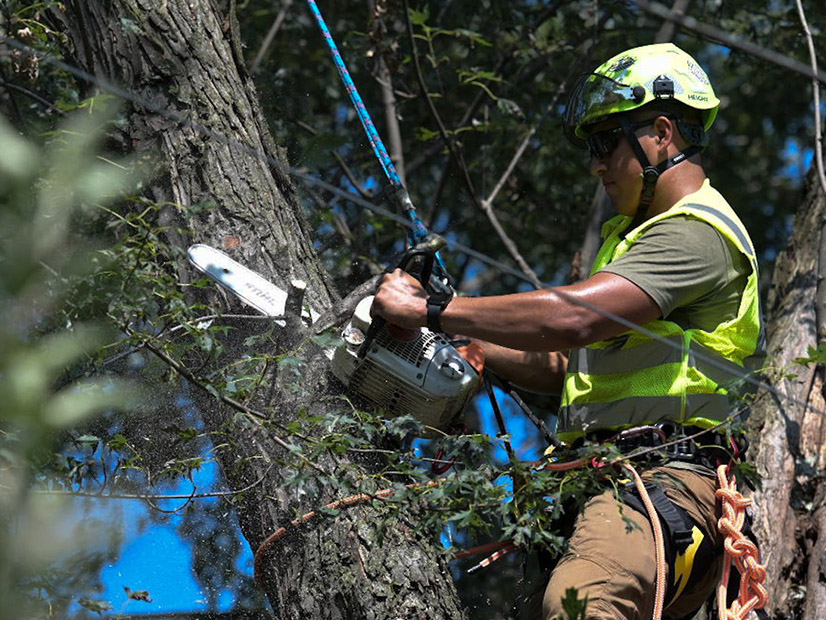
A worker trims branches after August 2021 storms in Harper Woods, Mich.  | DTE EnergyThe draft rules also boost the rate credits some affected customers could get from $25 to $35 plus $2 an hour for every hour over 96 hours a customer was without power.

“I wouldn’t characterize the rules as consensus,” Scripps said in an interview with ERO Insider, predicting complaints from utilities and consumer groups on issues such as the service credits. He said although Michigan’s rules were already strong compared to other states, the new standards would make them stronger.

Many of the new proposed rules are “designed to reflect the realities of how long it takes” to restore power blackouts from weather crises, Scripps said.

Asked if the proposed rules could be seen as criticism of how utilities such as CMS Energy (NYSE:CMS) and DTE Energy (NYSE:DTE) handled their responses to the series of outages following the severe thunderstorms in August, Scripps said, “I think it’s an acknowledgement that we’ve got work to do in our distribution system. The number of outages and particularly the duration of outages when they happened were not where we need to be.

“There’s a fair amount here that I think tightens up our performance standards, and I think that’s important.  It reflects what we’ve seen over the last summer, but it also reflects what we need to do as we start to electrify transportation and add loads to the distribution grid. It can’t be a bottleneck to what customers expect and where we need to be as a state.”

The rules could also encourage further steps to harden the grid, such as improved tree trimming and burying power lines. “That’s our hope,” Scripps said. The PSC is planning a technical conference on utility storm response on Oct. 22 as part of its effort to improve the grid.

Camilo Serna, regulatory vice president for DTE Energy, said the proposed rules were “the beginning of a process that would take months,” and that DTE would be part of that process.

The rules must undergo hearings and then be approved by the legislature’s Joint Committee on Administrative Rules before taking effect.

Amy Bandyk of the Consumers Utility Board of Michigan said the proposed rules are an improvement “but don’t go far enough to address Michigan’s continuing problem with electricity reliability.” She said that customers would not receive credits unless they had been without power for days. “Customers should receive credits for all outages, proportional to the length of the outage to provide them some insurance against the harm of an outage and as an incentive for utilities to improve their performance.”

Partners Behind Vineyard Wind Divvy up Leases

The businesses behind the Vineyard Wind joint venture are restructuring their agreement to allow one party to focus on existing projects and the other to develop an open lease area.

Avangrid (NYSE:AGR) subsidiary Avangrid Renewables and Denmark-based Copenhagen Infrastructure Partners (CIP) said Tuesday that the shift will allow them to “leverage their strengths and expertise to continue to grow the U.S. offshore wind industry.”

While the companies will proceed with development of the 800-MW Vineyard Wind 1 project as a joint venture, Avangrid will have the option to take operational control of the project following construction.

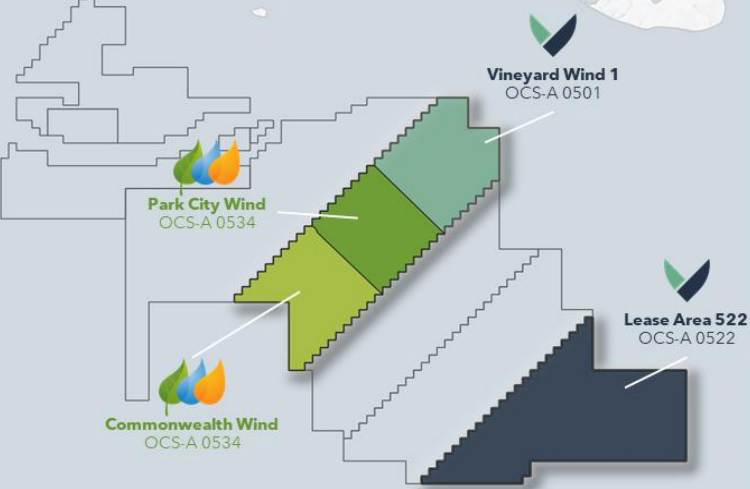
Avangrid also will buy the lease area (OCS-A 0534) with the proposed 804-MW Park City Wind project and the recently announced Commonwealth Wind project bid under Massachusetts’ 83C iii competitive solicitation that opened in May.

Avangrid Renewables will take control of the lease area for the Park City Wind project and the newly proposed Commonwealth Wind project, while Copenhagen Infrastructure Partners will take control of a nearby, undeveloped lease area. | Vineyard WindCIP will take control of a nearby lease area (OCS-A 0522) for development. The 132,000-acre area “has the highest wind speed of any lease area in the Northeast and will be a very competitive site for solicitations from New York to Massachusetts,” Christian Skakkebæk, senior partner in CIP, said in a statement.

The companies estimate that the lease area has 2,500 MW of offshore wind energy potential.

Avangrid will make a net payment of $167.5 million to acquire OCS-A 534 and, in exchange, CIP will acquire OCS-A 522. The companies expect to close the transaction by next spring.

Project Activities

Vineyard Wind 1 recently reached financial close, raising $2.3 billion of senior debt though nine international and U.S. banks, the companies said on Sept. 15. As a result, the companies have begun providing project contractors with notices to proceed with construction activities, they said.

Onshore work is scheduled to begin in the fall in Barnstable, Mass., with offshore work scheduled to begin next year.

The companies also submitted two proposals for their Commonwealth Wind project in the Massachusetts competitive offshore wind solicitation. The proposals offer 800 MW and 1,200 MW of wind energy.

Public versions of the bids are due this Thursday, and the state will publish them on its clean energy solicitation website.