NEPOOL Markets Committee Briefs: Sept. 13-14, 2021

ISO-NE Discontinues Feedback on Certain MOPR Elimination Proposals

ISO-NE plans to discontinue feedback on three stakeholder proposals as part of discussions on eliminating the minimum offer price rule, the RTO said during a two-day meeting of the NEPOOL Markets Committee last week.

In a memo to the committee, Mark Karl, vice president of market development and settlements for ISO-NE, said that while the RTO’s current proposal is focused on removing the MOPR and addressing related market risks, “participants have also raised a notable number of market proposals during the committee discussions.”

“Over the last few months, the ISO has consulted with and provided feedback to each of the sponsors of various conceptual stakeholder proposals,” Karl wrote. “Some proponents have removed their proposals from the MOPR discussions onto separate tracks, while others primarily consist of feedback rather than developed conceptual proposals at this point.”

Karl said it is not the RTO’s intent to “completely dispense” with further discussion of the proposals from FirstLight Power, Energy Market Advisors (EMA) and Jericho Power. But FirstLight’s capacity performance payments (CPP) proposal and EMA’s balancing resource constraint concept appear to be independent of the elimination of the MOPR, according to Karl, and are “complex relative to the time available to finalize the necessary and important design details.”

EMA also presented concepts covering transition mechanisms, and ISO-NE is open to them. Still, the RTO does not support reinstating a price floor mechanism as an alternative to eliminating the MOPR and could not keep that as a part of any transition proposal, Karl said.

Jericho’s demand curve scaling factor proposal and Pay for Performance (PfP) and accreditation modifications also do not appear to hinge on eliminating the MOPR, Karl said. However, the RTO said accreditation would be addressed better when discussing resource capacity accreditation.

Tariff Changes Proposed for E&AS Markets for Order 2222 Compliance 

For distributed energy resource aggregations to participate in the energy and ancillary services markets, ISO-NE is proposing tariff revisions as part of its Order 2222 compliance filing due in early 2022.

Each substantive change to the tariff is linked to one or more of the 11 compliance directives, including:

  • allow DER aggregations to participate directly in RTO/ISO markets and establish aggregators as market participants;
  • register aggregations under one or more participation models that accommodate the physical and operational characteristics of the DER aggregations; and
  • address distribution factors and bidding parameters for DER aggregations.

Because of the structure of its markets, ISO-NE is considering two effective dates for the proposed tariff changes, one for the Forward Capacity Market changes and a second for the remainder of the changes that impact the energy and ancillary services markets. The latter changes are more extensive and impact electric distribution companies and potentially their state regulators.

ISO-NE will send its compliance filing on Feb. 2, 2022, and it will likely take FERC several months to review it and issue an order. The Forward Capacity Auction 17 qualification process will be entirely or primarily completed when an order is given on the compliance filing. As a result, FCM changes could be effective for FCA 18, which will run in February 2024 for the capacity commitment period beginning on June 1, 2027. That would require the FCM portion of the design to be implemented by the start of the FCA 18 qualification process in spring 2023.

The RTO said it is confident that it can achieve that, assuming an order is issued by FERC accepting the proposed FCM design by the end of 2022. Thus, changes to the energy and ancillary services markets could be in place by the fourth quarter of 2026, ahead of the 2027 CCP. State regulators may also need to establish rules, requirements or cost recovery mechanisms associated with EDCs under Order 2222.

Monitor: Spring Wholesale Market Costs Rise

ISO-NE’s spring wholesale market costs totaled $1.49 million, an increase of more than 19% from the previous spring because of higher natural gas prices, the RTO’s Internal Market Monitor said in its quarterly markets report.

Average day-ahead and real-time hub LMPs were $28.69 and $27.89/MWh, respectively, 66% and 58% higher than the same period in 2020, according to IMM Economist Donal O’Sullivan, who presented a summary of the report. Last spring, lower prices resulted from decreased residential and industrial demand during the economic shutdown amid the COVID-19 pandemic.

There also was a special section of the report that reviewed the performance of Competitive Auctions with Sponsored Policy Resources (CASPR) to examine if it is working as designed. CASPR has been in effect for the past three FCAs, though the RTO has seen limited entry into the FCM. To date, only 12 existing resources have entered the auction as eligible to participate in CASPR. Seven of those resources obtained a capacity supply obligation in the primary auction, which they could potentially trade to a new sponsored resource in the substitution auction. Still, only one of those resources (54 MW) successfully retired via CASPR.

Test price mitigation, which is supposed to prevent policy resource subsidies from suppressing the primary auction price, does not appear to have been a determining factor in low participation from existing resources in the substitution auction. Instead, the RTO said in its opinion that the primary driver is low primary prices that reflect a system that currently has a moderate surplus of capacity.
NYISO Business Issues Committee Briefs: Sept. 14, 2021

Weather Data Exemption for Small Solar

The NYISO Business Issues Committee on Tuesday recommended that the ISO’s Management Committee approve tariff revisions to exempt solar generators no larger than 20 MW from certain meteorological data collection and reporting requirements.

Consistent with FERC Order 764, the ISO’s Services Tariff Section 5.8 requires solar resources to collect and maintain certain meteorological data required for energy forecasting, but Order 764 was targeted at large generators, identified as those greater than 20 MW. The order requires solar resources to provide, at a minimum, site-specific meteorological data, including temperature, atmospheric pressure and irradiance.

If approved by the Management Committee and the ISO’s Board of Directors, NYISO will make a Section 205 tariff filing with FERC.

The ISO’s forecast vendor has data necessary to forecast solar energy production for small solar resources consistent with the characteristics and location, and uses a combination of satellite data, weather data and data from NYS Mesonet, a network of 126 weather stations with at least one in all 62 counties in the state.

AS, Reserves and CSR-related Manual Updates

The BIC also approved minor changes to three manuals to reflect changes for both the ancillary services shortage pricing and reserves for resource flexibility projects.

Based on stakeholder feedback, incremental changes were made to the proposed revisions for Section 4.3.4 of the Day-Ahead Scheduling Manual, Section 7.3.6 of the Transmission and Dispatch Operations Manual and sections 6.8.1 and 6.8.2 of the Ancillary Services Manual.

Changes to both the Day-Ahead Scheduling Manual and the Transmission and Dispatch Operations Manual updated the operating reserve demand curve values and clarified the descriptions of the various demand curves.

The BIC also approved revisions to the same three manuals to address implementation of the co-located storage resources (CSR) participation model.

The changes added language to include additional factors, such as scheduling limits, considered by security constrained unit commitment (SCUC) for CSR generators.

FERC in March accepted NYISO rules allowing an energy storage resource to participate in the wholesale markets with wind or solar as a CSR. The ISO currently anticipates that the CSR-related tariff revisions will become effective in the fourth quarter, following testing of needed software changes. (See FERC Approves NYISO Co-located Storage Model.)

Uneconomic Production and Uneconomic Withdrawal

The Business Issues Committee approved, with one vote against and one abstention, changes to the rules governing uneconomic production and uneconomic withdrawal to ensure that mitigation measures appropriately address such situations.

Previous limitations to the rules included: requiring intent on the part of a resource “to cause, and obtain benefits from” uneconomic production or withdrawal, challenges with the conduct test when references are low or negative, and challenges with the impact test being limited to an increase of 200% or $100/MWh.

The new definition of uneconomic production and uneconomic withdrawal uses language from the definition of physical withholding, removes intent from the definition, and is more consistent with economic withholding and physical withholding.

The current threshold for triggering an impact test for uneconomic production or uneconomic withdrawal is: (1) a change of 200% or $100/MWh, whichever is lower, in the hourly Day-Ahead LBMP, real-time LBMP, Day-Ahead congestion component, or real-time congestion component; or (2) an increase of 200%, or 50% for generators in a constrained area, in bid production cost guarantee payments or day-ahead margin assurance payments to a market participant or affiliate.

For purposes of the first trigger, a change is defined as the absolute value of the difference between the prices or congestion components that resulted from the market participant’s uneconomic production or uneconomic withdrawal behavior and those that would have occurred if the market participant had operated in a competitive manner consistent with its reference levels. The new definition requires a minimum change in price of $25/MWh.

The proposed revisions are intended to help ensure the impact test does not generate very tight thresholds when LBMPs or congestion is low.

The Market Administration and Control Area Services Tariff section 23.4.3.3.2 clarifies that the mitigation measure is a penalty calculated as 1) 1.5 times the increase in guarantee payment(s) to the conduct-failing generator for uneconomic production, and 2) 1.5 times the absolute value of the congestion component of the LBMP, times the quantity of megawatts produced by the conduct-failing generator for uneconomic withdrawal.

The tariff provides opportunity for consultation between NYISO and a market participant prior to applying mitigation, and the ISO will consider participant demonstrations that the questioned conduct was consistent with competitive behavior.

Economic Planning Manual Update

The BIC also approved updates to the Economic Planning Process Manual to reflect the enhancements to the Economic Planning Process that were implemented through the revised NYISO tariff approved by FERC earlier this year.  The changes include a process description of the System and Resource Outlook as well as the defined terms for related studies.

The changes update the description and defined terms for the Economic Transmission Project Evaluation (ETPE), formerly, CARIS Phase 2, and for the Requested Economic Planning Study (REPS), formerly the Additional CARIS Study.

FERC in April accepted tariff revisions to the ISO’s economic planning process, effective April 11 (ER21-1074).

“We no longer use the term CARIS, for Congestion Assessment and Resource Integration Study, using instead the System and Resource Outlook to encompass its wider scope,” said Jason Frasier, NYISO manager of economic planning.

The ISO will begin the 2021-2040 System and Resource Outlook kickoff at the Sept. 22 Electric System Planning Working Group (ESPWG), where staff will present the study plan and reference case assumptions, with preliminary results to be presented at the ESPWG in late October or early November.

NYISO Rejects Most Comments on DER Treatment

NYISO last week rejected most comments and protests on its treatment of distributed energy resources and aggregations in its Order 2222 compliance filing, urging FERC to accept the tariff revisions with minor adjustments (ER21-2460).

Certain comments and protests propose “helpful” modifications to the proposed tariff language, the ISO said in its Sept. 14 answer filing, and agreed to make those requested changes.

“With respect to all of the remaining comments and protests, the commission should reject those comments and protests and accept the compliance filing without further modification,” NYISO said. (See NYISO Discusses FERC Order 2222 Compliance.)

State regulators and related agencies, New York Transmission Owners (NYTO), investor-owned utilities, environmental organizations and consumer advocates have all submitted comments in the proceeding.

The ISO’s DER and aggregation market rules treat these new types of resources comparably to other types of resources participating in its wholesale markets, consistent with commission directives, while also ensuring reliability, NYISO said.

NYISO commits to discussing the detailed technical requirements for DER and aggregation participation in the markets, it said, insisting that no additional “periodic updates” are needed beyond the established shared governance process. In addition, the ISO’s market software can integrate these new resources without adversely impacting other market participants or the market.

Defining Small

Regarding the ISO’s “opt-in” to wholesale market participation for customers of utilities delivering 4 million MWh or fewer per year, various parties protested that the threshold should be calculated by distribution utility rather than by load-serving entity (LSE) as proposed in the compliance filing.

NYISO said it does not object to identifying small utilities by distribution utility rather than LSE, “so long as the commission accepts its proposal that the aggregator be responsible for attesting that the RERRA has authorized the customers of that small utility to participate in the wholesale markets as part of an aggregation.”

The ISO’s metering and settlement systems are not designed to measure and calculate energy deliveries by distribution utility and would require time consuming and expensive upgrades to do so, it said.

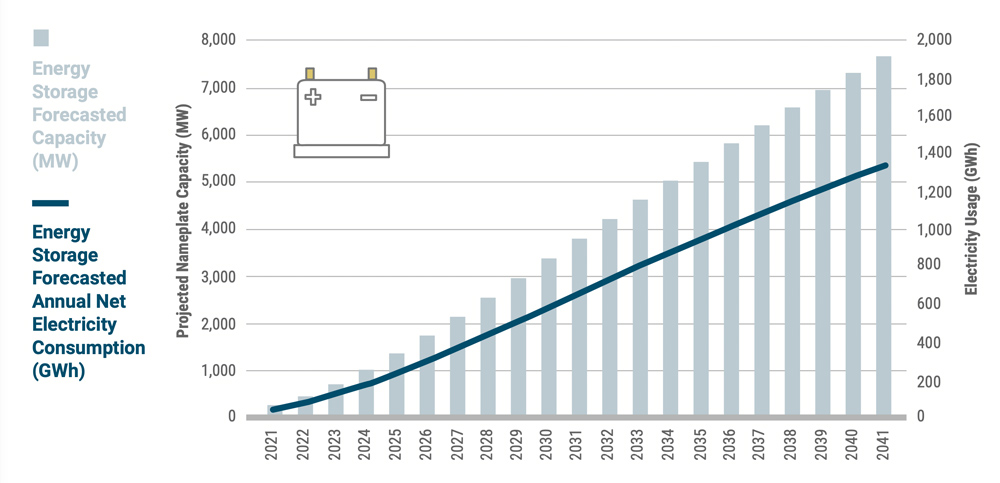
NYTOs’ proposed a tariff revision to more clearly identify the time gap between when the 4 million-MWh calculation can be performed (after Dec. 31) and the date any resulting decision to opt-in or out would take effect (on May 1, at the start of the next new Capability Year).Because of charging and discharging cycles, storage resources represent net load to the grid because they consume more electricity than they inject. | NYISO

NYISO agreed that NYTOs’ proposal to add the words “for the forthcoming Capability Year” to the Market Services tariff is a helpful clarification.

NYISO’s proposed rules on market participation agreements for DER aggregators are “impermissibly vague” because they fail to provide sufficient details about sequencing and the distribution utility’s role and responsibilities in the authorization process, NYTOs said. The group therefore asked the commission to require the ISO to better define the distribution utility’s obligations and to provide a timeline for the various components of the registration and enrollment process.

The ISO said it understands the NYTOs’ concerns and is developing software that will automate the DER and aggregation enrollment process that will provide aggregators with electronic forms to be submitted to the ISO.

Same, or Substantially So

FERC granted RTOs/ISOs regional flexibility with respect to the restrictions each proposes to minimize market impacts caused by the double counting of services by DERs in the markets.

NYISO’s proposed restrictions prevent a DER from enrolling in an aggregation to provide the same megawatts for the same or a substantially similar service in wholesale and retail programs, preventing the DER from being compensated twice for providing a similar service.

Various parties argued that the phrase “same or substantially similar service” is vague because the ISO’s tariffs do not define what constitutes a “substantially similar service.”

NYISO said it agrees that the language results in “unneeded uncertainty about what programs are prohibited,” and that it also agrees with comments indicating that the New York Public Service Commission has taken an active role in specifying when participants in specific retail programs cannot also participate in the wholesale markets.

The ISO said it does not object to removing the phrase “or a substantially similar service” from the tariff requirements so that the requirements only apply to the provision of the “same” service in the wholesale and retail markets.

Several protestors and commenters found unjust and unreasonable NYISO’s telemetry requirement that an aggregator must provide six-second telemetry for its aggregation and the requirement that metering data be submitted by noon the day after the operating day for use in the ISO’s settlement process.

“As explained in Docket No. ER19-2276 and reiterated here … the six-second scan rate applicable to all generators and aggregations is needed to (i) maintain situational awareness of the [New York Control Area] NYCA electric system, (ii) operate the NYISO’s Automatic Generation Control process to maintain load and generation balance, (iii) meet mandatory bulk power system reliability criteria, including criteria unique to New York State, and (iv) respond to emergency conditions,” the ISO said.

NYISO pointed out that it currently uses six-second telemetry signals to meet mandatory reliability criteria required by the New York State Reliability Council.

Energy Efficiency

Clean energy parties and consumer advocates argued that NYISO should be required to permit energy efficiency resources to participate as supply-side DER resources in its capacity market.

NYISO urged the commission to reject the request, saying it should not be required to change the DER rules that the commission accepted previously (ER19-2276).

“Energy efficiency reduces demand. Its impact is accurately accounted for on the demand-side without the need to estimate the expected benefit, or to measure, verify and audit resource performance on a continuing basis,” NYISO said.

While capacity payments could be an additional source of revenue to spur energy efficiency projects, the ISO said it does not see significant reliability or market efficiency benefits in moving energy efficiency from the demand-side to the supply-side.

In its comments, the ISO’s Market Monitoring Unit, Potomac Economics, recommended that the commission refrain from mandating that NYISO implement a supply-side energy efficiency participation framework or initiate stakeholder proceedings to pursue such a framework, as requested by the advocates.

“A mandatory supply side model would likely provide few benefits in terms of encouraging additional economic EE, while creating a host of problems associated with measurement and accreditation, cost shifting, adverse incentives, double compensation, load forecast modeling,” the Monitor said. “Fundamentally, such an approach is unnecessary because customers that adopt EE measures can benefit directly or indirectly from reduced capacity obligations when EE is reflected on the demand side of the market.”

Texas PUC Considers Efficiency, DR as Gen Alternatives

Texas regulators last week convened another workshop to discuss redesigning the ERCOT market, only to have one of the state’s leading energy experts dash their faces with cold water.

Alison Silverstein, former FERC and Texas Public Utility Commission Chair Pat Wood’s right hand, was among those lobbying the commissioners to consider the importance of energy efficiency and demand response in addressing the state’s increasing hunger for electricity and avoiding catastrophes like February’s winter storm.

“Are you feeling lucky?” Silverstein asked the commissioners. “You guys are undertaking the world’s fastest electric market redesign. These are incredibly complicated issues, and no one knows how to do this. You cannot afford to let load keep growing while you wait to see if all of your redesign works and all the pieces fall into place quickly, and load is growing wicked fast in Texas.”

Indeed, the state’s population is expected by some to nearly double to as many as 54.4 million by 2050. The state is already among the fastest growing in the nation and home to five of the nation’s 13 largest cities: Houston, San Antonio, Dallas, Austin and Fort Worth.

And while ERCOT in August had more than 170 GW of capacity under some form of study in its generator interconnection queue, only slightly more than 12 GW of that was the dispatchable generation favored by Gov. Greg Abbott in a July memo to the PUC. (See PUC Debates Answers to ERCOT’s Reliability Issues.)

“Energy efficiency and demand response give you defense in depth; they give you diversity and operational tools; they will help to buffer reliability and reduce the need for all that additional generation and all the folks that want to come spend capital in Texas to show up and get through the interconnection queue,” Silverstein said.

In an aside, she added, “And by the way, you can’t fix that in the next year or two fast enough.”

“Oh, but we can change it,” PUC Chair Peter Lake interjected.

“I know you can,” Silverstein responded, “but the question is, how fast between when you write the regulation and when the cash shows up and the infrastructure is on the ground? And you can’t change that.”

Texas’ energy-efficiency programs have some of the lowest energy-use reduction goals and per capita spending compared to all other states, according to a report released earlier this summer by Silverstein, Wood and four other former PUC commissioners. (See Former PUC Commissioners Weigh in on ERCOT Fixes.)

The report pointed out that the U.S. Department of Energy has indicated that the state could use cost-effective energy efficiency measures to reduce 2030 residential electricity use by 18.5% and total electricity sales by 17%. It advocated for raising utility efficiency program goals to increase both annual kilowatt-hour savings and peak reduction; additional efficiency retrofits for low-income and multifamily housing across Texas; and increasing DR for grid emergencies by requiring utilities to offer customers compensated options and procure resources that can remotely cut at least 10% of each entity’s summer and winter peak load.

“If we redesign the market correctly, do we still need to fund [utility] energy efficiency and demand response programs?” Silverstein said. “Yes, you do, and you cannot afford not to. Energy efficiency and demand response are the least costly resources available, relative to all that [dispatchable] generation and storage.”

She urged the PUC not to place 90% of its “cash bet” on the generation side of the equation. “Cover that bet with even a fraction of that sum in energy efficiency and demand response delivering massive benefits.”

The Sierra Club’s Cyrus Reed pointed to the state’s rule governing energy efficiency, which says “all customers … have a choice of an access to energy efficiency alternatives that allow each customer to reduce energy consumption, peak demand or energy costs.”

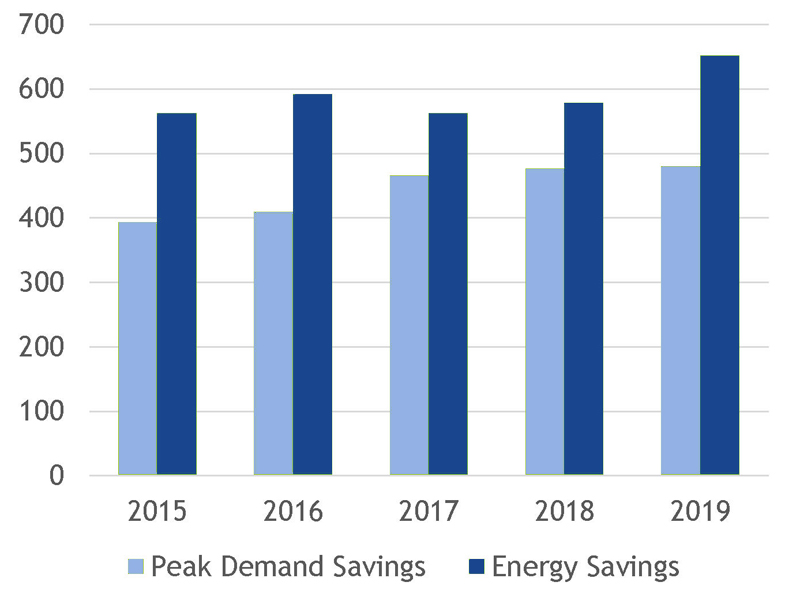
Texas energy efficiency programs have yielded savings but leave room for improvement. | Sierra ClubOther speakers during the workshop encouraged the commissioners to allow third-party aggregation of DR and distributed energy resources. Google’s Aaron Berndt reminded them that they have the authority to increase energy-efficiency and load-management programs and to increase the $50 million cap on emergency response services (ERS), the latter reminder seconded by many comments in the docket (52373).

ERS is one of the only two DR programs ERCOT currently administers. The grid operator also allows load resources, which include six “controllable” resources totaling about 300 MW, to participate in its ancillary services and real-time energy markets.

Kenan Ögelman, ERCOT’s vice president of commercial operation, said he expects that latter population to grow because data centers involved in bitcoin mining and high-tech data management are rapidly moving into the state.

The grid operator procures ERS four times during the year and by selecting qualified loads and generators, including aggregations of loads and generators, to make themselves available during grid emergencies in 10- and 30-minute response times. Commissioner Lori Cobos asked Ögelman whether staff had any lessons learned from ERS’ deployment during the February storm.

Noting ERCOT data that indicate load overperformed by 30 to 35% but that generation was 50 to 55% below its obligation, Ögelman said, “The generation performance jumped out at me. That side did not perform as well as we expected.”

Commissioner Will McAdams filed a memo before the workshop calling for a “more conservative trigger” for deploying ERS resources and to consider increasing the program’s $50 million spending limit. The limit, found in a PUC rule, hasn’t been raised since 2008.

McAdams also suggested developing an emergency pricing program, as directed by the state legislature; improving ERCOT’s adequacy reports and forecasting; and re-evaluating the market’s scarcity pricing mechanism. He suggested potentially decoupling the systemwide offer cap, modifying the operating reserve demand curve and “setting the value of lost load in concert with examining the minimum contingency level.”

The commissioners agreed to take up the issues during its open meeting Thursday.

Critical Gas Infrastructure Rules

Separately, the PUC opened to public comment a rule change requiring critical natural gas facilities to provide customer information to their utility providers and directing the utilities to incorporate the information into their load-shed and restoration planning (52345).

Stakeholders have until Oct. 7 to comment on the proposed rule. If a hearing is requested, it will be held Oct. 12.

The rule is a companion piece to the Texas Railroad Commission’s (RRC) proposed amendment to the Public Utility Regulatory Act specifying the criteria and process by which natural gas providers are designated as critical customers or gas suppliers during an energy emergency. The RRC regulates Texas’ intrastate natural gas industry.

The two agencies have been urged to work closer together in the wake of the February storm, when confusion over critical infrastructure led to some gas facilities being shut down during controlled outages. Chair Lake suggested the two agencies conduct a joint workshop, saying both industries are complex, “and we don’t necessarily speak the same language.”

“This is our quick action to ensure electric utilities have all the information they need from critical natural gas facilities to inform them in future load-shed events,” PUC staffer David Smeltzer said.

MISO Wants Abridged Stakeholder Meeting Schedule

When it emerges from the COVID-19 pandemic, MISO wants to limit its in-person stakeholder committee schedule to eight in-person meeting weeks per year.

The grid operator said it wants to group all stakeholder meetings of its main parent entities into eight separate weeks during the year. That means five full-day meetings will be packed into a single week. MISO hopes to debut the schedule beginning in late January.

MISO defines its main parent entities as the Market Subcommittee, Reliability Subcommittee, Resource Adequacy Subcommittee, Planning Advisory Committee, and Regional Expansion Criteria and Benefits Working Group, which makes cost-allocation decisions.

The committees currently meet monthly in separate weeks dubbed as planning week, markets week and reliability week.

MISO says the new arrangement will cut down on travel plans and registrations. The meeting weeks will be held on-site at either its Carmel, Ind., Eagan, Minn., or Little Rock, Ark., building locations. The weeks will be considered separate from MISO’s board weeks, which are held quarterly at off-site locations.

If a committee wants to add additional meetings in a calendar year, the chairs must schedule a teleconference. Smaller committees like the Planning Subcommittee and the Loss of Load Expectation and the Interconnection Process Working Groups will also meet exclusively virtually.

Todd Hillman, the RTO’s senior vice president and chief customer officer, said MISO also wants to make more use of joint committee meetings. He said staff often deliver the same presentation over multiple stakeholder meetings.

“It keeps our [subject matter experts] on a hamster wheel where they don’t have new things to discuss, but they’re forced to put a presentation together,” Hillman said during a Wednesday Advisory Committee teleconference. “We want to try to get to the meat and potatoes of what we really want to discuss.”

MISO said it will kick off meeting weeks with executive updates. It also said it won’t schedule any stakeholder meetings after the December board week, which typically takes place during the month’s second week. Hillman said the new schedule will avoid meetings scheduled too close to holidays.

The Coalition of MISO Transmission Customers engineer Kevin Murray asked whether MISO would introduce a vaccine mandate before it begins holding in-person meetings.

“It’s one that we’re struggling and juggling with every day,” Hillman said. “We’ve talked about vaccination proof; we’ve talked about masking; we’ve talked about COVID testing; we’ve talked about social distancing and how that’s done with meetings of our size.”

Hillman said MISO will survey stakeholders’ willingness to vaccinate, mask and submit to testing at MISO facilities.

He also said MISO will try to get a feel of its members’ travel budgets and restrictions, which Hillman said are currently “all over the place.”

“If we have eight stakeholders show up, that’s not going to be ideal,” he said.

Some stakeholders said packing executive updates and five all-day meetings during the work week might be a whirlwind, with some referring to the eight weeks as “MISO Superweeks.”

Madison Gas and Electric’s Megan Wisersky worried that a “superweek” could lead to burnout. “No one should underestimate the amount of work this is, especially when a company sends one representative,” she said.

Hillman promised more details on the new schedule soon.

During a Thursday board meeting, CEO John Bear said it’s becoming clear that the COVID-19 virus is something that MISO will have to learn to live with. The grid operator has planned an in-person Board Week in Orlando, Fla., in early December. It will be its first in-person meeting in almost two years.

Bear also said staff was welcomed back to the office Sept. 7 in a hybrid in-person and virtual format, despite the Delta variant’s threat.

“We’ve got a greater than 85% vaccination rate,” he said of MISO’s more than 1,000 employees. The grid operator has not yet enacted a vaccine mandate for staff.

CFO Melissa Brown said the pandemic continues to cause higher-than-expected employee vacancies and delays in building maintenance and outside consulting services. Altogether, COVID-19 is expected to yield a $4 million savings to MISO’s base operating budget, now at $267.7 million.  The COVID reductions are partially offset by an unexpected $1.5 million in legal fees MISO spent after it decided to initiate rolling blackouts during February’s winter storm. (See MISO Begins Cold Snap Examination.)

Stakeholder ID Rules 

The new meeting schedule coincides with new etiquette requirements for stakeholders during meetings.

Members voted in new rules that encourage stakeholders to identify themselves and their companies before they speak in public meetings. The Advisory Committee approved the ruleset by consent on Wednesday

Rules for consultants are a bit more complex. If a consultant is working under a non-disclosure agreement, they must name the MISO sector aligned with the company they represent. Consultants are also expected to announce when they begin speaking whether they represent multiple clients.

To sign in to virtual meetings, stakeholders must also provide their full first and last names.

The instructions will be enshrined in the MISO Stakeholder Governance Guide’s procedures section. The approved language concludes more than a year of debate on the topic. (See MISO Members Greenlight Stakeholder ID Rules.)

Steering Committee Chair Jeff Dodd confirmed that the language will empower committee chairs to stop recognizing stakeholders during meetings if they’ve refused to disclose their name, company or sector affiliation.

Hillman, cueing up the meeting’s next topic, identified himself as working for MISO and “representing all sectors.”

“I’m an Aries, I’m 52 years old and I married my high school sweetheart,” Hillman joked.

Enviros, Industry Urge Oregon’s Swift Adoption of Clean Truck Rules

Oregon should move swiftly to adopt California’s stringent emissions rules for trucks to protect both the health of its residents and economy, testifiers at a public hearing hosted by the state’s Department of Environmental Quality (DEQ) said Thursday.

Oregon last year joined 14 other states and D.C. in signing the Multi-State Zero Emission Medium- and Heavy-Duty Vehicle memorandum of understanding, which pledged participants to have all trucks sold in those jurisdictions be zero-emission by 2050.

To help meet that goal, the DEQ is proposing the state assume California’s standards for greenhouse gas emissions from medium- and heavy-duty vehicles, categories that span large pick-ups and delivery vans (Class 2b-3); “rigid” trucks such as buses, dump trucks and other non-tractor trucks (Class 4-8); and tractor trailers.

As in California, the Advanced Clean Trucks (ACT) rule would set a 2035 target for having zero-emission vehicles constitute 75% of Oregon’s Class 4-8 sales, 55% of Class 2b-3 sales and 40% of tractor trailer sales. The rule would take effect starting with model year 2025.

The DEQ has also proposed the state adopt the California Air Resources Board’s (CARB) Heavy-Duty Low NOx Omnibus Rule, which would steadily reduce NOx and particulate emissions from internal combustion truck engines through 2035. Adoption of the ACT would also significantly reduce those pollutants.

The agency is additionally seeking to update its low-emission vehicle rules to ensure they align with California’s current light-duty vehicle standards.

Oregon statute permits the DEQ to propose the changes, but approval comes down to a vote by the five-member, governor-appointed Environmental Quality Council.

‘We Have the Technology’

Most speakers at Thursday’s hearing promoted approval — even by the end of this year, if possible.

Carrie Nyssen, senior director for advocacy for the American Lung Association in Oregon, encouraged state officials to consider the local health benefits of adopting the stricter standards.

“One of my favorite friends and physicians says the only thing we should ever put into our lungs is clean, fresh air,” she said. “Breathing bad air harms our health, the health of our loved ones and our communities. And children are especially vulnerable to these pollutants.”

Nyssen pointed to the increased risk of heart attack, stroke, lung cancer, asthma and premature death associated with breathing particulates, especially PM2.5, which can enter the lungs and remain in the bloodstream.

The Lung Association’s 2021 State of the Air report found “that far too many of us are living in communities impacted by unhealthy levels of ozone pollution,” she said. “Adopting the Advanced Clean Truck and low NOx omnibus standards is a step in the right direction for improving our lung health and creating a healthier Oregon.”

Sierra Club Oregon Chapter representative Terry Harris took up a similar theme but added an environmental justice angle. Harris recounted that in his time as a lawyer working on environmental issues in Baltimore, Johns Hopkins researchers found that the high cancer rates and health issues in one neighborhood located near a chemical plant were more attributable to the emissions from the trucks traveling to and from the plant than to the pollution from the facility itself.

“The clean truck rule — and the associated NOx rule — is probably the biggest environmental justice regulation that we’ll be able to deploy that will have the biggest impact to local communities in environmental justice and frontline communities,” Harris said.

Brad Reed, campaign manager for Renew Oregon, pointed out that “Black people are exposed to a staggering 54% more air pollution than the average American,” according to a study published in the American Journal of Public Health.

“We have the technology to protect Oregonians living near busy roads, highways and warehouses from this deadly pollution. Zero-emission trucks are affordable, scalable and available,” he said.

Leah Missik, the Washington state transportation policy manager for Climate Solutions, plugged the show of regional unity in adopting the rules, noting that Oregon’s northern neighbor plans to adopt the California regulations by the end of the year. (See Washington Moving to Adopt Calif. Vehicle Emission Rules.)

“I wanted to briefly express how beneficial it would be for Oregon to do the same, creating a clean trucks West Coast,” Missik said, pointed to the existing connections among the economies, transportation corridors and air sheds of the three West Coast states.

“Our states working together and all having the clean trucks rules in place will not only have tremendous benefits for the climate and for our health, but it will make the rule more cost-effective by expanding demand for these clean trucks,” she said.

Noah Howe, manager of transportation at Ceres, said his sustainability nonprofit organizes the Business for Innovative Climate and Energy Policy network, a coalition of about 70 companies advocating for strong climate policies at the federal and state levels. Ceres also runs the Corporate Electric Vehicle Alliance, a collaboration of 24 companies — including Amazon, DHL and IKEA — working to decarbonize their truck fleets.

“Our companies’ investors see climate change as a significant risk and reducing greenhouse gases as an economic opportunity. We strongly support Oregon adopting the Advanced Clean Trucks rule and see this as the first of many steps Oregon should take to reduce transportation emissions,” Howe said.

He said the rule “will drive local innovation and investment in clean technology development and manufacturing,” create jobs, generate long-term savings and company value chains, mitigate climate risk, improve public health and reduce health care costs.

Howe said Ceres’ electric vehicle coalition is growing and that companies are transitioning to EVs because they have lower lifetime costs. “We need strong policies to coordinate industry leaders and stakeholders to increase access to zero-emission vehicles, unlock cost savings and benefits, and drive market transformation at a pace and scale the private sector cannot achieve on its own.”

Contrary View

Tim French, general counsel with the Truck and Engine Manufacturers Association, said the group’s members “fully support a conversion of the commercial trucking fleet to ZEVs and agree that 2045 is a reasonable target date for the broad deployment of ZEV trucks wherever feasible.”

However, French said, Oregon officials should take two “critical steps” to transition those fleets to ZEVs.

The first is to build the charging infrastructure needed to support “widespread deployment” of the new trucks.

“Oregon can and must be a leader in those broad-based efforts, which for trucks will involve longer planning and installation timelines, and significantly larger public investments than for passenger cars,” he said.

The second step: to provide companies with “sustained” financial incentives to offset the higher cost of purchasing ZEV trucks. French suggested that Oregon could “set an example” by requiring state-funded commercial vehicle acquisitions to include a portion of zero-emission and near-zero-emission trucks.

But during Thursday’s meeting, French was the lone voice asking the DEQ to defer adoption of the California truck standards. He advised the agency to wait until more details emerge about President Biden’s “Clean Trucks Plan,” announced in August alongside his administration’s other ZEV goals. (See Biden Executive Order Sets 50% EV Goal by 2030.)

Instead of signing onto California’s standards, which are still in flux with CARB moving to update them next year to include a full ZEV standard, French urged Oregon to take a lead role in advocating for a federal clean truck standard.

“Without that coordinated push for federal standards, there’s a significant risk that trucking fleets in Oregon will simply keep their older, higher-emitting products longer, or we’ll buy out of state,” he said. “The adverse impacts on Oregon’s economy and environment could be significant.”

Besides, French contended, deferring action on the ACT for a year would not jeopardize the proposed 2025 implementation of the rules.

“It is far from legally certain that Oregon can adopt these rules at a later date without a delay in implementation,” Renew Oregon’s Reed countered. “It is a huge risk to suggest this, and one we cannot afford.”

“We know that federal action doesn’t always come as fast as we would like it to, especially in recent history,” said Tim Miller, director of Oregon Business for Climate. “We can’t wait. … This is a crisis.”

City of Corvallis resident Debra Higbee-Sudyka echoed the view of other testifiers when she said the DEQ should adopt the California rules this year.

“We need to take immediate action to reduce greenhouse gases. The future is uncertain for my children and grandchildren — so we need to act now,” she said.

The public has until Sept. 24 to comment on the DEQ’s proposed rule changes.

MISO Backs Divisive Seasonal Capacity Design

MISO said last week it will give stakeholders more time — but not much — to get comfortable with four seasonal capacity auctions and a capacity accreditation rooted in a generating unit’s actual performance during tight conditions.

The grid operator has not determined how many more weeks it may wait before making a FERC filing. Its current goal is to make the filing before October.

“My biggest concern is that if we take more time, it means we’re standing in a safe place. Past performance says we’re not,” MISO CEO John Bear said during Thursday’s Board of Directors meeting. “I do sympathize with the members … and I want to give you more time. But I want to make sure we file with enough time to get this in place for the 2023/24 planning year.”

At present, no one appears happy with MISO’s plan to embark on seasonal capacity auctions. Members have called for more supporting analysis and the Independent Market Monitor has criticized what he calls a too-lenient accreditation.

Bear said intensifying storms, escalating generation outages, and resources not performing to their accredited values means the RTO must change its resource adequacy design. He pointed out that while 2005’s Hurricane Katrine took out about 17,000 poles, Hurricane Ida took down 30,000 poles.

“We’re seeing more than 20% of the fleet unavailable on hot summer days,” he said. “With capacity continuously unavailable, we’re relying on non-firm resources.”

MISO management defended the need for four distinct capacity auctions and reserve targets with a performance-based accreditation after stakeholders overwhelmingly voted two weeks ago to delay the filing into the second quarter of 2022. (See MISO Stakeholders Vote on Seasonal Capacity Auction Delay.)

Richard Doying, the RTO’s executive vice president of market and grid strategy, addressed the vote and said that while stakeholders asked for a slowdown, none fundamentally disagreed with MISO’s proposal.

“What people said is, ‘This is complicated; can we have several more months to talk about it?’” he said during a Tuesday teleconference of the board’s Market Committee. “Unfortunately, I feel that the time for inaction is past us … We’re at the point where the time to file is upon us. We’re taking a directionally correct step.”

Doying said it’s imperative that MISO move away from the current resource-adequacy construct’s assumption that emergency events only occur in summer. He said until summer 2016, emergency declarations were virtually unheard of.

“It was an incredibly rare event in the control room,” he said.

But since mid-2016, MISO has had 39 maximum generation warnings and events, the majority of them outside summer months.  

Doying said the RTO has been mulling a seasonal capacity method longer than some may realize. He said staff discussed the possibility years ago when a combined-cycle generator demonstrated poor availability in the summer but stable availability during the winter.

MISO Executive Director of Market Operations Shawn McFarlane said the grid operator is at the point where it may have a maximum generation event any day of the year during high-outage periods.

Consumers Energy’s Kevin Van Oirschot said MISO should provide an exemption to accreditation reductions when outages are planned sufficiently in advance. The grid operator’s current proposal would reduce unavailable generation’s capacity credits during tight operating hours, even if they’re on a previously scheduled outage.

Van Oirschot said members are struggling to understand how their fleets’ accreditations will be affected under the proposal.

WEC Energy Group’s Chris Plante said the proposal might cause members to submit several planned outage requests and then withdraw all but one to get better odds in landing an outage timeline that isn’t in the predefined risky hours.  

Doying said MISO’s new availability-based accreditation concedes the new reality that emergencies are more unpredictable and likely to materialize at more points during the year.

“It’s much more difficult when none of us know the hour when the emergency will occur,” he said, acknowledging stakeholders’ concerns that the new accreditation makes outage scheduling without reducing accreditation a trickier process.

Travis Stewart, representing the Coalition of Midwest Power Producers, said MISO has yet to articulate how the seasonal capacity and accreditation design will improve the conversion of capacity to energy. He said while MISO offered a proposal to stakeholders several years ago, it didn’t have specific details firmed up until August.  

Stewart also said the seasonal filing doesn’t address winter weatherization of generating units.

“I think the last thing my company wants is to have these debates in front of FERC,” Plante said.

“It is a fair concern that it’s more difficult to predict risk, but that doesn’t mean we shouldn’t try” to anticipate it, Doying said.

The proposal forces staff and members to confront reality, Doying said, and determine sooner whether new resources should be constructed when a local resource zone won’t have enough capacity to cover load. He also said the proposal has undergone a “lengthy stakeholder process.”

Not Far Enough for IMM

MISO IMM David Patton warned the RTO’s executives and the board that he would oppose the filing in front of FERC if it’s filed as-is.

“We’re at a point where we can’t support the filing, but we hope a second iteration of the filing might correct some of these concerns,” Patton said.

He said MISO began with a strong proposal but made several changes that were “diametrically opposed” to its objective of ensuring resource availability. The accreditation component was changed at the behest of members, Patton said, making the proposed accreditation impotent.

The grid operator originally proposed that a resource’s accreditation would hinge solely on availability during “resource adequacy hours,” or the year’s top 5% of hours that staff believes contain reliability risks. The plan now includes unremarkable hours in addition to RA hours and a 24-hour grace period for offline resources during tight condition hours, leading to more lenient accreditations. (See MISO Softens Capacity Accreditation Proposal.)

Patton said a transition to a more intermittent-heavy fleet demands that MISO have a stricter accreditation. “The right answer is not the popular answer,” he said.

Patton said he also opposes MISO’s minimum capacity requirement, where a member must demonstrate that it has procured at least 50% of the capacity required to meet its peak load ahead of MISO’s voluntary capacity auction. He said the rule was unnecessary and should be excluded from the seasonal capacity filing.

Doying characterized the minimum capacity requirement as “guardrails” and said it’s important that MISO’s tariff reflect its members’ obligation to plan. He said the rule wouldn’t impose new requirements on most members, who already must demonstrate that they’ve procured most of their capacity outside of MISO’s auctions. He called it “a stretch for a small number of entities.”

Close Calls in Summer

Punishing heatwaves in MISO’s North and Central regions have led to several emergency procedures this summer. The grid operator declared six maximum generation alerts: June 10, June 28 and 29, July 6, and August 24 and 25. MISO said temperatures in the northern footprint were about five degrees higher than the five-year summertime average.

“Eleven days this summer, we experienced tight periods where it was difficult to serve load,” Jessica Lucas, senior director of reliability coordination, told MISO board members.

The difficulties were reflected in MISO’s $35/MWh real-time average price, substantially higher than 2019’s and 2020’s average $24/MWh summertime price. The 119-GW summer peak on Aug. 24 didn’t top staff’s expectation of a 122 -GW peak.

MISO briefly entered a maximum generation emergency just once, on June 10. Greater than expected load-modifying resource (LMR) commitments and non-firm imports ultimately brought the emergency to heel before the situation could deteriorate. (See “MISO Defends June Emergency Declaration,” MISO Market Subcommittee Briefs: July 8, 2021.)

Patton asked that MISO become “more surgical” in LMR commitments during emergencies, asking specifically that it only ask for the megawatts it needs rather than calling on the entire 11 GW pool of LMR capability.

“Even if we could scale back a moderate amount, we’d become more efficient,” he said.

MISO believes that introducing a 30-minute energy reserve product before 2022 will help clarify when it requires an emergency.

MISO President Clair Moeller said the grid operator is “very much looking forward” to a reserve product that sets prices earlier and may tamp down out-of-market actions and pricing “turbulence” that take place ahead of emergency procedures.

The RTO reported that testing of short-term reserves is going well despite an interruption of some MISO South units during Hurricane Ida.

CARB Seeks to Mitigate GHGs from Extreme Events

California air quality regulators are devising a program to mitigate increased emissions that may occur when the state tries to meet energy demand during heat waves or wildfires.

The California Air Resources Board (CARB) hosted a workshop Thursday evening to discuss the initiative, called the Climate Heat Impact Response Program (CHIRP). The goal is to send a framework for the program to the CARB board for review in November.

CHIRP is the result of an emergency proclamation that Gov. Gavin Newsom issued on July 30, aimed at preventing blackouts during extreme weather in California. (See Calif. Governor Proclaims Emergency as Blackouts Loom.)

The proclamation relaxes certain air quality requirements to allow increased energy production during heat waves — when energy demand surges — or when wildfires disrupt energy transmission.

In California, Senate Bill 100 of 2018 set a target of 100% carbon-free electricity by 2045, and the state is making progress toward that goal.

But “there is insufficient time or supply to install new energy storage or zero-carbon energy projects to address the immediate shortfall of up to 3,500 MW during extreme weather events that is now projected for this summer,” the proclamation said.

California has not had an extreme heat event since the proclamation was issued, according to CARB staff. But the U.S. Department of Energy last week approved CAISO’s request for an emergency order allowing it to run natural gas plants that may exceed federal pollution limits as California heads into peak wildfire season and the ISO seeks to maintain grid stability over the next two months. (See DOE Orders CAISO Emergency Reliability Measures.)

Relaxed Requirements

The governor’s proclamation loosens permitting requirements for backup generators during heat waves, CARB staff said during Thursday’s workshop. Thermal power plants regulated by the California Energy Commission may operate outside of their permitted requirements during the weather events.

And ships at berth may be allowed to use their auxiliary engines, rather than plugging into shore power when at the port.

The restrictions are relaxed when CAISO declares an energy warning or emergency caused by an extreme heat event, a sudden and severe reduction in transmission capacity, or both.

The different methods of meeting energy demand produce varying levels of pollution.

According to CARB estimates, a natural gas thermal power plant produces less than 1% of the nitrogen oxide emissions produced by a backup diesel generator or a ship at berth. A diesel backup generator had the highest emissions of particulate matter among the three sources.

“We know that there are going to be emissions that happen during these [extreme heat] events,” said Michelle Buffington from CARB’s Mobile Source Control Division. “No matter what sources are put online during one of these events, we want to be able to, at least after the fact, mitigate the emissions that have occurred.”

Kevin Hamilton, co-director of the Central California Asthma Collaborative, suggested that the state give residents an early warning when air pollution in their community is expected to spike because of an extreme heat event.

Safe spaces can be created within homes where residents can breathe clean air, he said.

Other workshop participants expressed concern that CARB was taking a reactive approach to the extreme heat events.

Los Angeles resident Rafael Yanez said allowing ships at the ports of Los Angeles and Long Beach to use auxiliary power is “the worst plan that we could possibly have.” He noted that the ships are a major source of air pollution in Southern California.

Instead, Yanez said, the state should look at reducing power consumption among the biggest users. Electric rail service in Southern California could be cut back, as many cars are running with few passengers, he said.

And the fastest way to improve the electric system would be to upgrade aging transmission lines to reduce power losses, Yanez said.

“Look at the transmission lines because many of them are very, very old.”

Reporting Mandates

In addition to a mitigation strategy, CHIRP includes a reporting component.

Utilities must report to CARB each month on the amount of backup generation their customers plan to use during load-reduction periods, as well as an estimated load reduction by zip code for participating customers.

Thermal power plants must report operations above their permitted conditions to CARB, the CEC and air districts.

CARB will work with the CEC and air districts to calculate emissions produced from extra energy generation during extreme heat events. Funding for mitigation projects will be based on the amount of emissions and their location.

CARB staff asked anyone who would like to submit comments on the CHIRP framework to do so by Sept. 30. The program may be contacted at chirp@arb.ca.gov.

Report Details Challenges for Meeting Oregon ZEV Goals

Current trends suggest that Oregon will come up short of its zero-emission vehicle adoption goals over the next decade, but near-term policy developments, expanded buyer incentives and buildout of a reliable charging network could salvage the outcome for 2035, a new report said last week.

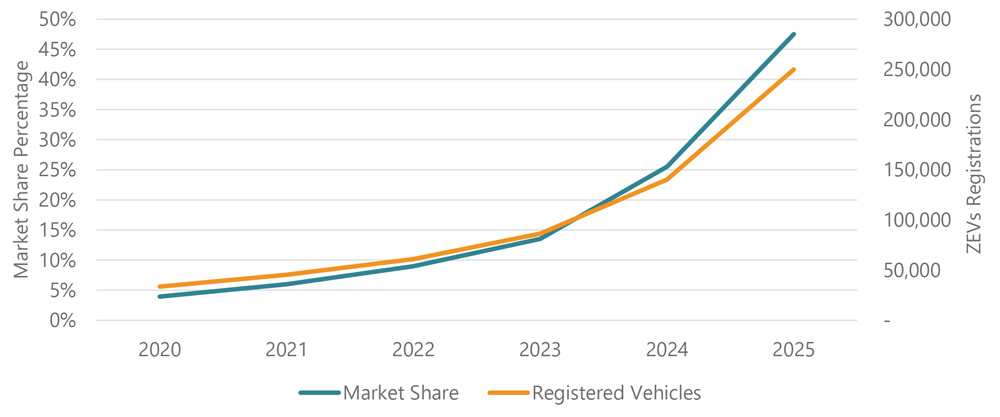
Oregon’s ZEV registrations reached 33,579 in 2020, up 20% from the previous year but well below the state’s target of 50,000, according to the Biennial Zero Emission Vehicle Report released by the state’s Department of Energy (ODOE).

As of June, 38,482 light-duty ZEVs were registered in the state, representing about 1% of all registrations, the report said.

“While ZEVs are increasingly popular, the state did not achieve its 50,000 registered ZEVs by 2020 goal, and it is not on track to achieve the 2025 or 2030 goals,” the report’s authors said. “However, Oregon is well positioned to increase ZEV adoption with policies and programs that support ZEV sales in Oregon, including incentives, to help reduce upfront vehicle costs.”

A 2019 Oregon law outlines the state’s clean vehicle targets, which include:

  • 250,000 registered ZEVs by 2025;
  • at least 25% of registered vehicles and 50% of new vehicles sales be ZEVs by 2030;
  • at least 90% of all vehicles sold annually be ZEVs by 2035.

The ODOE report found that the COVID-19 pandemic likely contributed to the 2020 shortfall but was not the sole factor.

“In early 2019, ZEV adoption was growing quickly, boosted by the first year in sales of the Tesla Model 3. By the end of the year, ZEV growth had slowed as Tesla completed backorders for the vehicle and resumed more normal vehicle production,” the report said.

With the onset of the pandemic last year, vehicle production and sales fell nationwide in April and May because of shutdowns at auto factories and dealerships. Overall new vehicle registrations in Oregon fell by about 23% to 165,770, while new ZEV registrations fell 8% to 6,532, bumping the ZEV market share for new cars from 3.3% to 3.9%.

Additionally, registration numbers for all vehicles last year likely did not reflect the total number of vehicles in the state because of delays in registration while the Department of Motor Vehicles allowed for a grace period during the pandemic.

Near-term Uncertainty

The ODOE report describes the heavy lift required to get the state back on track to meeting its next set of ZEV targets.

“In order to achieve the 2025 goal of 250,000 registered ZEVs, the market share of ZEVs would need to grow from 4% in 2020 to more than 47% in 2025 — more than a tenfold increase,” the report said.

Oregon would need to see a drastic uptick in ZEV market share over the next four years in order for the state to meet its 2025 goal to have 250,000 ZEVs on the road. | Oregon Department of Energy

Furthermore, to reach the target of 25% of registrations by 2030 (equating to about 1 million vehicles), ZEVs would need to comprise 50% of new car sales by 2026, ODOE found.

The required growth curve in Oregon’s ZEV market share “exceeds all recent EV market share forecasts by leading studies and is twice that of the most aggressive curve forecasted by the Electric Power Research Institute, which was included in a recent report from the University of Berkeley.”

Achieving such a steep trajectory of ZEV growth would require Oregon to outpace the country’s leading EV adopter, California, which currently last year had nearly 133,000 ZEVs on the road and an 8.1% ZEV market share. The California Air Resources Board (CARB) has estimated that ZEVs will make up 15.4% of that state’s market share in 2025, compared with the 47% market share Oregon would require to reach 250,000 ZEVs that year, ODOE pointed out.

In May, CARB proposed its Advanced Clean Cars II program, designed to boost California’s ZEV and plug-in hybrid electric vehicle (PHEV) market share to 26% by 2026, 60% by 2030 and 100% by 2035. But even if those growth estimates are applied to Oregon’s projected ZEV market share, the state will come up 100,000 vehicles short of its 2025 goal and 460,000 vehicles short of its 2030 goal, the ODOE report said.

Still, ODOE sees some hope that Oregon could meet its 2035 goal.

“Oregon is too early in the ZEV technology adoption curve to assess progress on the ZEV adoption goal of 90% ZEV market share by 2035. But because the goal is strictly based on market share and not total registrations, there is some qualitative evidence that the goal is achievable. Many vehicle manufacturers have indicated they will be ramping up production of ZEVs and, in some cases, phasing out production of internal combustion vehicles altogether,” the report said.

Furthermore, the report notes, ZEV production and adoption could get a boost after the International Energy Agency in May said that sales of cars with internal combustion engines must be phased out by 2035 for the world to meet net-zero CO2 emissions by 2050 and limit the increase in global temperatures to 1.5 degrees Celsius. (See IEA Paints Daunting Path to Net Zero by 2050.)

State Efforts

Oregon is taking its own steps to encourage the purchase of EVs. During its most recent session, the state legislature increased the amount of money the Department of Environmental Quality can make available through its Charge Ahead rebate program. Low- to moderate-income residents will now be eligible for up to $5,000 in rebates for the purchase of a new or used ZEV, on top of $2,500 in federal rebates.

“Higher upfront costs for EVs and a limited used vehicle market remain barriers to EV adoption for low-income families,” the ODOE report said.

In addition, the state’s Transportation Electrification Infrastructure Needs Assessment (TEINA) Advisory Group this year issued a study containing recommendations for state officials to consider in developing a network of EV charging stations that will encourage ZEV adoption. The wide-ranging report focuses on the needs of various vehicle classes, income levels, housing types and geographic locations. (See Oregon Study Charts Explosive Growth of EV Chargers.)

The ODOE report reiterated some of the findings of the TEINA study and additionally emphasized a set of key elements necessary for a successful public charging network, including open access, multiple payment options, pricing transparency and accessibility for people with disabilities.

“Widespread electric vehicle charging infrastructure is considered essential to the continued adoption of EVs,” ODOE said.

California Earmarks $3.9B for ZEVs Through 2024

California lawmakers devoted a record $2.7 billion toward zero-emission vehicle programs in FY 2021-2022 and $1.2 billion over the next two fiscal years in their session that ended Sept. 10, accelerating the state toward its goals for decarbonizing the transportation sector.

The funding for zero-emission trucks, buses and passenger vehicles was far more than the $1.5 billion that Gov. Gavin Newsom proposed in January. (See Calif. Governor Proposes $1.5 Billion for ZEVs.)

“This is definitely a historic amount for California,” said Miles Muller, an attorney with the Natural Resources Defense Council. “It sets an example for other states and the federal government by saying that if we’re serious about the climate crisis and getting people into electric vehicles, California is dedicating the money to help realize that future.”

The budget plan passed this summer allocated $2 billion for medium- and heavy-duty ZEV incentives and infrastructure, including $1.3 billion over the next three years to deploy 1,000 zero-emission school buses, 1,000 zero-emission transit buses and 1,000 zero-emission drayage trucks.

The state budget includes funding for electric school buses. | Lion Electric

It also included $1.2 billion to promote consumer adoption of zero-emission passenger vehicles.

Programs that promote ZEV ownership among lower-income residents, including incentives under the state’s Clean Cars 4 All program, received $400 million over three years in the budget plan.

The state’s Clean Vehicle Rebate Project (CVRP), which offers rebates of up to $7,000 for the purchase or lease of new ZEVs, was awarded $525 million over three years. The program ran out of money earlier this year, resulting in a long waitlist for rebates.

CVRP funding wasn’t included in Newsom’s January budget proposal, which upset some lawmakers. (See Newsom’s $1.5B ZEV Plan Takes Flak from Democrats.)

Assembly Budget Committee Chairman Phil Ting said in a March hearing that CVRP had put hundreds of thousands of Californians into hybrid and EVs over the past decade and remains the best hope for wide-scale adoption. The 2021-2022 budget fixed the omission by providing $175 million in upfront funding for each of the next three years.

The plan approved in mid-July also put $407 million toward for zero-emission public-transit bus and rail equipment.

“These investments will prioritize projects that directly benefit priority populations and improve air quality in low-income and disadvantaged communities,” a summary of the climate-change portion of the budget said.

Newsom’s January plan proposed funding ZEV programs by securitizing revenues from vehicle registration fees. Lawmakers pushed back against that proposal as the state projected up to $75 billion in surplus revenues this year.

The vast sums in the budget could help the state fulfill former Gov. Jerry Brown’s 2018 target of putting 5 million ZEVs on the road by 2030 and Newsom’s executive order in September 2020 banning sales of new gas-powered passenger vehicles by 2035. The state remains far behind on both goals. (See Can California Meet Its EV Mandates?)

The investments are also being pitched as a spur to the economy. The state is home to 34 ZEV-related manufacturers, including Tesla, and ZEVs became the state’s No. 1 export in 2020, the budget summary said.

“California is committed to develop the zero-emission vehicle market equitably, not only as a foundation tool to protect public health and combat climate change, but as an engine of economic development and job creation,” it said.