Entergy Fends Off Calls for Tx, Solar, Microgrid Investment

Entergy is pushing back against suggestions that sturdier transmission infrastructure and more solar panels or microgrids would have helped the coastal Louisiana grid better endure hurricanes. 

Entergy Louisiana CEO Phillip May said neither transmission reinforcements, solar generation, nor microgrids would have made for a nimbler restoration in New Orleans after Hurricane Ida. The company has been pressured on those points following the total blackout of the city after the hurricane’s strike last month. (See Experts Call for Tx Reinforcements, Microgrids in Gulf System After Ida.)

“The damage to our grid is driven by a storm that was nearly a category five. It is the second strongest storm to ever strike Louisiana,” May said during a Friday press conference. “The reason we have these outages … is because Mother Nature is the undisputed world champion. We can engineer some of the most robust structures, and Mother Nature will simply take those out in storms like this.”

He said Entergy has invested in a hardy system and continues to make infrastructure improvements. 

“However, we have to balance the fact that perhaps a third of our customers are at or below the poverty level,” May said, adding Entergy cannot trade reasonably priced energy for clean and more localized energy. “Ideas like solar panels and microgrids certainly have their place, but we have to ensure they’re affordable,” he said. “In my mind, the notion that we haven’t invested in our grid is just flat wrong. The data refutes it. We are interested in microgrids and in adding solar.” 

May said Entergy will have “enhanced infrastructure” where complete rebuilds are needed, as is the case with the transmission tower that toppled along the Mississippi River.

“But even with that, we know that there will always be a storm that can take out that infrastructure, whether it’s microgrids or the robust infrastructure that we continue to build,” he said. 

In an emailed statement, Entergy said it will step up hardening and resiliency investments as climate impacts become more pronounced.

“While ensuring the resilience of our infrastructure has always been a primary focus, we recognize that we must accelerate our efforts in light of increasingly frequent and severe weather events,” the company said. “We will continue to refine our understanding of where the specific risks attributable to climate change are expected to become more severe in the years and decades ahead and focus our hardening efforts accordingly.”

Entergy pointed out that since 2016, it has completed $12.6 billion in transmission and distribution construction and has recently spent about $1 billion systemwide to upgrade plants and substations so they can better withstand hurricanes.

During a Sept. 9 media call, Entergy New Orleans CEO Deanna Rodriguez praised the new, natural gas-fired New Orleans Power Station, which she said performed “brilliantly” following Hurricane Ida. 

“This is the plant that allowed first light to New Orleans nearly 48 hours after the storm,” Rodriguez said.

Critics have cast doubt on the plant’s black start capabilities, since Entergy opted out of starting the power station without first establishing a transmission link to the Eastern Interconnection. (See Entergy Touts Restoration; NOLA Leaders Question Lack of Blackstart Service.) More than 500,000 customers remained offline amid triple-digit heat indexes in Louisiana the week after Labor Day.

MISO Vice President of System Planning Jennifer Curran said Entergy’s transmission system withstood the storm better than in past hurricanes. She said the utility’s distribution system, however, took a more punishing hit.  

Curran said as of Sept. 15, all major transmission has been restored except for a few towers that were directly in the storm’s path.

“At this point, neither transmission or generation are limiting the restoration of load,” Curran said during a Wednesday System Planning Committee teleconference of the MISO Board of Directors.

But Ida’s fallout may force Entergy to reckon with climate-change activists. They had harsh words for Entergy last week during a press conference hosted by the Gulf Coast Center for Law and Policy (GCCLP).

The group’s executive director, Colette Pichon Battle, said she is a resident of St. Tammany Parish on the north shore of Lake Ponchartrain.

“I’m calling in from Texas because my family, like so many others, is still evacuated from southern Louisiana,” she said.

Pichon Battle said Ida’s landfall on the 16th anniversary of Hurricane Katrina is an “eerie reminder” that climate change is affecting the Gulf of Mexico’s coastal regions now.

“The energy infrastructure is not built to withstand climate change,” she said of the Entergy grid.

Jessica Dandridge, executive director of the Water Collaborative of Greater New Orleans, said she rode out the storm, but was then forced to stay with friends in Mississippi and then Michigan.

Dandridge said the failures of Entergy, a Fortune 500 company with billions in earnings, were unacceptable. She urged others to push utilities on grid resilience and renewable energy, pointing to residential rooftop solar and microgrids.

“We have given everything, all our savings … our homes, our family heirlooms,” she said, saying it was time for the utility to invest in the community.

“We as a nation cannot take the same approach,” said Jennifer Crosslin, with both Southern Communities for a New Deal and GCCLP. “This moment calls for our nation do something it never has really done before.”

Crosslin said climate justice and climate equity have become “hollow promises” from southern leaders.

In 2019, Entergy New Orleans was resistant to the city council’s resilient renewable portfolio standard requiring net-zero emissions by 2040 and 100% clean energy by 2050. It threatened to sue New Orleans if it was forced to prematurely retire generation resources.

“… [A]ny standard adopted in this proceeding that would require [Entergy New Orleans] to retire council-approved resources before the end of their useful lives, or that would penalize [it] for operating those resources in a manner consistent with prior council approvals, would be unenforceable and lead to litigation,” the utility warned in late 2019.

Entergy said New Orleans’ renewable portfolio and climate resilience standard would lead to “needless rate increases” that would cause the “entire regional economy to suffer.”

New Orleans approved the RPS in May after two years of negotiations.
WAPA Desert Southwest Region to Join Western EIM

The Western Area Power Administration’s Desert Southwest Region (DSW) signed an implementation agreement Wednesday to join CAISO’s Western Energy Imbalance Market (WEIM), making it the second WAPA region to seek entry to the market in recent years.

DSW has been working with its customers for two years to “determine the most beneficial course of action for us and for our customers,” WAPA Administrator Tracey LeBeau said in a joint statement with CAISO on Thursday.

“Joining the EIM will support DSW’s ability to economically market and dispatch energy on a timely basis and meet the needs of our customers,” LeBeau said. “We look forward to working with the ISO and our partner utilities to implement the EIM in our balancing authority and take advantage of the many resources and flexibilities the EIM offers.”

WAPA’s Sierra Nevada Region, part of the Balancing Area of Northern California, became an active WEIM participant in April. (See Expansion Takes EIM into LA, New Mexico.) Parts of WAPA’s Upper Great Plains West and Rocky Mountain regions decided to join SPP’s competing Western Energy Imbalance Service (WEIS), which launched in February. (See WAPA, Basin, Tri-State Sign up with SPP EIS.)

The implementation agreement also applies to WAPA’s Western Area Lower Colorado Balancing Authority, which includes generating resources in the Boulder Canyon and Parker-Davis projects (PDP) and the transmission systems of the PDP, Central Arizona Project and the Pacific-Northwest-Pacific Southwest Intertie Project.

DSW sells federal hydroelectric power and provides transmission service to dozens of cities, electric cooperatives, Native American tribes, government agencies and irrigation districts. One of its customers, the Arizona Electric Power Cooperative (AEPCO), includes six distribution cooperatives and five public power entities that serve more than 420,000 residential, agriculture and corporate customers.

“Joining the Western EIM will ensure AEPCO and its members have real-time access to a much larger regional energy market,” Jon Martell, AEPCO executive director of energy services, said in the joint statement.

Other participating BAs include the Central Arizona Water Conservation District, Southwest Public Power Agency and DSW customers in Arizona, Southern California and southern Nevada.

“We are very pleased to welcome the WAPA DSW region and the Arizona Electric Power Cooperative to the Western EIM,” CAISO President and CEO Elliot Mainzer said in the statement. “I appreciate the thoughtfulness that went into their decision and look forward to working together to create additional economic and environmental value for their constituents and the broader EIM community.”

The WEIM now has 15 active participants in 10 Western U.S. states and part of British Columbia. Eight more entities are set to join in 2022 and 2023, potentially encompassing 84% of electric demand in the Western Interconnection. By allowing low-cost energy to be bought and sold in real time across state lines, it has provided more than $1.4 billion in benefits to its members since launching in 2014, according to CAISO.

Vermont Senator Says State Needs Formal Environmental Justice Policy

When the Vermont General Assembly reconvenes its 2021-2022 session in January, Sen. Kesha Ram Hinsdale will continue to push for passage of a state environmental justice policy bill she introduced in the spring.

“We cannot advance the proposals that will come out of the [state’s] Climate Action Plan without having an environmental justice policy framework that has distributive justice, procedural justice and other forms of justice built into it,” Hinsdale said Wednesday during the Energy Action Network’s annual summit.

Hinsdale first introduced an environmental justice bill in Vermont 14 years ago, but the state has not codified an official policy on the issue yet. The state’s 2020 Global Warming Solutions Act (GWSA), which stood up the Vermont Climate Council and tasked it with creating a climate plan, calls for the plan to benefit all residents equitably.

If passed, the new bill (S. 148) would direct state agencies to develop a state mapping tool to measure environmental justice impacts at the local level. The bill, Hinsdale said, is similar to her 2007 bill, but the tools available to the state and legislators have changed for the better.

“The [U.S.] EPA now has a major focus on environmental and climate justice and resilience, and that’s where resources will be funneled,” she said. “EPA told [Vermont leadership] in 2015 that we’re behind in not having an environmental justice policy framework on the books.”

The agency’s environmental justice screening tool, she added, now includes flooding data, which will be helpful for Vermont’s understanding of distressed and environmentally impacted communities. When Tropical Storm Irene hit Vermont 10 years ago, mobile home park residents made up 8% of the state population but 40% of those affected by flooding.

The bill would also create an Advisory Council on Environmental Justice within the Vermont Agency of Natural Resources (ANR), which is also tasked with implementing strategies that will be adopted in the pending Climate Action Plan.

“While I’m sad that we’re not in a different place after 14 years trying to advance environmental justice policy in the state, we have the ANR, Department of Health, Agency of Transportation and other partners at the table to really look at how we advance a meaningful environmental justice policy now,” Hinsdale said.

The legislature referred the bill to the Senate Natural Resources and Energy Committee in April.

Clean Heat

After the General Assembly’s break, Sen. Andrew Perchlik says he will be looking for support for a bill (S. 146) he introduced in April to ban new fossil fuel heating systems in Vermont’s state buildings.

The bill is a “no-brainer,” Perchlik said during the summit.

“We can’t meet our 2030 [emissions] goal, which is in nine years, by installing systems that are going to be designed to burn fossil fuels for 20 years,” he said.

The GWSA requires Vermont to reduce greenhouse gas emissions by 40% below 1990 levels by 2030.

Perchlik said the bill applies to structures under the control of the Department of Buildings and General Services as well as the Department of Forests, Parks and Recreation and the Agency of Transportation. Some state representatives, he added, don’t believe that the legislation is necessary.

“The bill is not unreasonable,” he said. “It acknowledges that there might be times where you have to accept the fossil-fuel system, so it’s not an unbending requirement.”

Upon first reading, the legislature referred the bill to the Senate Institutions Committee.

Speaking during the summit, House Energy and Technology Committee Chair Tim Briglin said his committee is watching the ongoing deliberations in the Vermont Climate Council and the policy ideas “that are bubbling to the surface.”

“One policy that I’m particularly focused on individually is the Clean Heat Standard” (CHS), he said, noting that implementing the standard would not be a “simple policy change.”

Like Vermont’s Renewable Energy Standard, he said, a CHS could be “transformative” for the thermal sector.

The council’s Cross-sector Mitigation Subcommittee recommended in July that the full council adopt a CHS as part of the state’s climate plan due Dec. 1. As proposed by the subcommittee, the CHS would be similar to a renewable standard but apply to fossil-fuel heating providers in Vermont. (See VT Climate Council Puts Clean Heat Standard on the Table.)

Flexible Ramping Grows as Ancillary Service

A FERC technical conference on ancillary services Tuesday focused on the need for flexible ramping products to compensate for shortfalls in forecasted wind and solar output as the variable energy resources play a larger role in organized markets.

“There is broad industry consensus that RTOs and ISOs will need more operational flexibility from resources to reliably serve loads as the resource mix evolves to include more weather dependent variable energy resources, and loads change due to weather dependent distributed energy resources, electrification, and other factors,” FERC staff wrote in their whitepaper framing the panel discussions.

“Responding to these changing system needs involves several RTO/ISO market design considerations, including how to provide appropriate price signals that both reflect operational needs and incent resources to submit energy and ancillary services supply offers that increase the operational flexibility available on the system, and also encourage efficient investment and retirement decisions,” it said.

Organized markets are increasingly focused on serving “net load,” defined generally as load minus wind and solar generation, representing the demand that must be met with dispatchable resources. CAISO and SPP have run into problems meeting net load when demand is high but solar and wind ramp down, the whitepaper noted.

Until an adequate amount of storage is paired with variable resources, RTOs and ISOs will need other types of quick-start ramping products, including those that rely on gas generation, to compensate for unexpected shortfalls, it said. (See Calif. Needs far more Storage to Decarbonize, Panelists Say.)

SPP’s “Wind Burn”

SPP is a poster child for the issue. The grid operator has added 21 GW of wind capacity since its Day 2 market went live in 2014 and has almost 30 GW of capacity on hand. In May, wind energy accounted for 84% of SPP’s generation during one interval and, renewables make up 95% of its interconnection queue, SPP said in written comments.

Achieving “more certainty, and [being] able to respond quickly to the uncertainty and changes in wind output, is and will be a concern in SPP,” said Jodi Woods, manager of the RTO’s Market Monitoring Unit. “Specifically, actual wind generation can deviate significantly from what was forecasted or expected.”

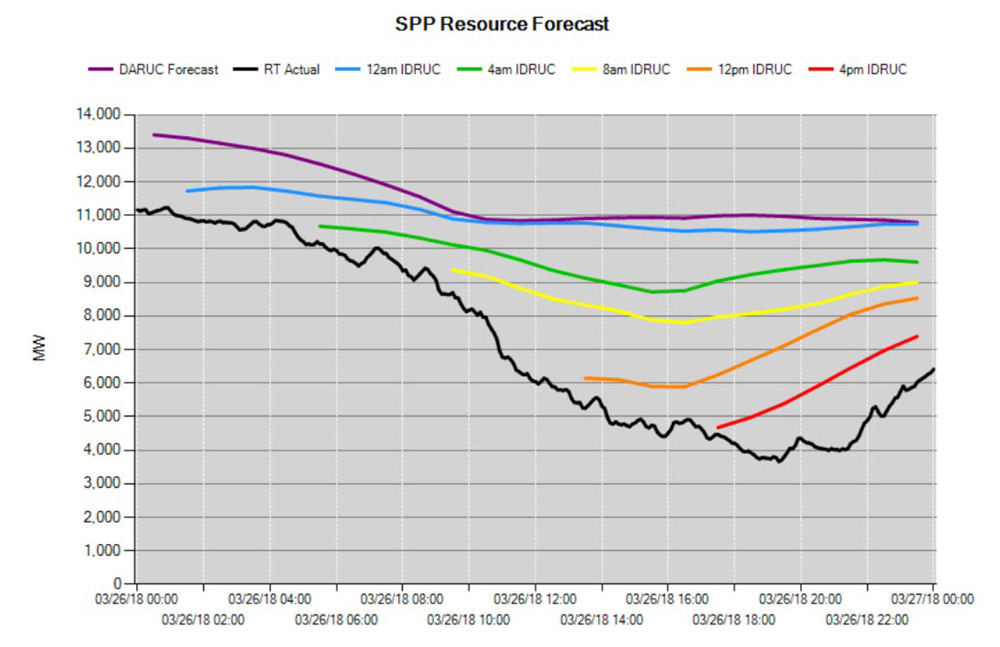
A March 2018 “wind burn” event in SPP committed 54 units out-of-market to replace the unexpected decrease in wind generation and meet reliability needs. | SPP

The RTO experienced what it called a “wind burn” event in March 2018, when the day-ahead forecast for wind output was 7,000 MW above the reliability unit commitment forecast.“During this event … SPP operators committed 54 units out-of-market to replace the unexpected decrease in wind generation and meet reliability needs,” FERC said. “SPP stated that the root cause of the forecast error was the poor performance of meteorological forecasts.”

Woods said that while SPP’s wind forecast errors were off by only about 4.5% last year, that still represents up to 950 MW — the grid operator’s second largest single-resource contingency and larger than its spinning reserve requirement for the last two years.

SPP is using workarounds in some instances but “manual interventions lead to lower prices in the market and do not send the right pricing signals to responding duration,” she said.“Products that compensate for flexibility and ramping are needed,” Woods said. “When the need for flexibility and ramping are not accounted for, the market may use the ramp for energy needs and not save it to meet the flexibility needs of the system,” Woods said.

Quick Ramp Products

SPP and other organized markets with sharp increases in renewables are looking to quick-response solutions.

Ancillary service products in CAISO, MISO and SPP provide short-term ramp capability “to manage the changing system needs … and reduce out-of-market actions by operators,” FERC said. “Although the three ramp products differ, they share several similar features. The ramp products are bi-directional in that they procure and price upward and downward ramp capability as separate products. The ramp products add a constraint (i.e., a ‘ramp constraint’) to the energy and ancillary services market clearing process that simultaneously procures and prices energy, traditional ancillary services, and the ramp products on a co-optimized basis.”

“In all three markets, the ramp product prices are based on the opportunity cost resources incur from providing ramp rather than energy and the other ancillary services,” it said. “In the event the system is economically or physically short of a ramp product, the ramp price is set by an administratively determined demand curve for the ramp product, with separate demand curves for upward or downward ramp capability.”

At NYISO, the “changes to the grid and operational risk require flexible energy security needs,” Director of Market Design Mike DeSocio said. “We will also need resources that can provide energy output for hours and days to allow grid risks such as renewable output falls, system restoration needs, and storm watches. When we think about the need for flexibility, resources that can respond in a few minutes and run for several hours or days at a time, will be invaluable to the grid of the future.”

Rahul Kalaskar, CAISO’s manager of market analysis, said that over the last decade, the ISO has seen increased variability and uncertainty between its day-ahead and real-time markets, driven by a significant increase in variable resources. That has resulted in more real-time imbalances in both directions.

“The day-ahead forecast cannot predict the net load that will materialize throughout the operating day, so any difference that occurs between what is predicted and what occurs results in imbalances,” Kalaskar said. “When there is a risk that imbalances may be too large to address through the real-time market, the ISO will rely on out-of-market actions to address these.”

He said CAISO is currently adding improvements to the existing real-time flexible ramping product and developing a new day-ahead ramping product called an imbalance reserve to make sure there’s sufficient real-time dispatch capability to meet net load imbalances. (See FERC OKs Ramping Product for CAISO, EIM.)

Up Ramp, Down Ramp

MISO expects an increased “future need for flexibility to address short-term market-wide reserve requirements as the mix of different types of resources … continues to evolve, including the replacement of coal-fired power plants with variable energy resources and natural gas power plants,” the FERC whitepaper said.

Wind generation in MISO increased from 1 GW in 2005 to 19 GW in 2019, and solar generation will reach 11 GW in 2032 if MISO’s resource fleet continues to change at its current pace, it said.

In 2014, FERC approved MISO’s proposal to introduce two ramp capability products — up-ramp capability and down-ramp capability, both intended to address short-term variations in net load. MISO’s ramp capability products procure ramp capability within a 10-minute timeframe. (See MISO Quick Capacity Reserves Wait Until 2021.)

“When MISO is unable to meet the system’s ramp requirements, a demand curve with a maximum price of $5/MWh sets the price for the ramp capability products,” FERC said. “However, MISO is currently considering revising the demand curve for the up-ramp capability product to better reflect net load uncertainty and continue to track with this uncertainty as it changes with the evolving resource mix.”

In PJM, uncertainty and the need for quick ramps to address shortfalls is a “major driver,” said Adam Keech, the RTO’s vice president of market design and economics.

“We tend to look at reserves in PJM as a product with many different uses,” Keech said. “When we look at uncertainty, we’re really trying to get that net load uncertainty to inform the reserve requirement because we deploy reserves for a number of different reasons. For us, the most important things coming out of the reserve markets are the ability to commit units quickly and get megawatts onto the system and ramp them up quickly as well.”

NY Adopts Goal for Disadvantaged Communities Under Clean Energy Fund

The New York State Energy Research and Development Authority (NYSERDA) received authorization last week to ensure that the benefits of the state’s $6 billion Clean Energy Fund are in line with the Climate Leadership and Community Protection Act (CLCPA).

The state Public Service Commission approved an order that adopts NYSERDA’s proposal to set a new goal for the fund to deliver 40% of benefits of spending to disadvantaged communities. The order, which followed a review of the fund, also adopts a goal for 35% of NY Green Bank’s post-2019 investments to benefit disadvantaged communities.

“These goals will significantly improve benefits to disadvantaged communities as compared to historic performance and are in compliance with the CLCPA,” Peggie Neville, director of efficiency and innovation at the New York Department of Public Service, said during the PSC’s regular meeting.

The fund covers NYSERDA’s ratepayer-supported initiatives under four portfolios, which include market development, innovation and research, NY Green Bank, and the NY-Sun solar incentives program.

Under the CLCPA, state agencies must ensure that disadvantaged communities receive 40% of resource benefits. The act also stood up the New York Climate Action Council, which has been developing a state scoping plan for release later this year to achieve the state’s climate and energy goals.

The order acknowledged that the commission might need to revisit the fund after the council completes its scoping plan process and called for another fund review in 2023. It also recognized the ongoing work of the Climate Justice Working Group to develop a definition of disadvantaged communities by the end of the year, but the order adopted interim criteria for those communities.

The criteria are “communities located within census block groups that meet the U.S. Housing and Urban Development (HUD) 50% adjusted median income threshold, that are also located within the [Department of Environmental Conservation] Potential Environmental Justice Areas or are located within New York State Opportunity Zones.”

According to the order, NYSERDA will now have to track and report on benefits that include:

      • level of direct investment;
      • energy savings;
      • energy bill savings;
      • measures of economic development, such as workforce training and jobs supported; and
      • air quality improvements directly resulting from clean energy investments in disadvantaged communities.

After the Climate Justice Working Group finalizes its definition of disadvantaged communities, NYSERDA will have 60 days to file a plan, based on stakeholder input, for how it will meet the 40% benefits goal.

NY Green Bank

In the order, the commission approved NYSERDA’s request for a series of financial commitments under the NY Green Bank that target technologies other than solar to help diversify the bank’s activities.

“While NY Green Bank has played an important role in spurring the development of solar PV installations, investments to date have been predominantly in the solar sector,” it said.

The commission authorized additional investments of $150 million for clean energy improvements in affordable housing properties, $100 million for clean transportation businesses in New York and $200 million in energy storage-related investments. NY Green Bank has $1.2 billion of committed investments through 2020, according to the order.

In addition, the bank must update its metrics, evaluation and reporting plan through stakeholder input to ensure its offerings “deliver true benefits to disadvantaged communities.” The bank will have six months to complete the update.

PJM, NJ Staff Brief Stakeholders on State Agreement Approach

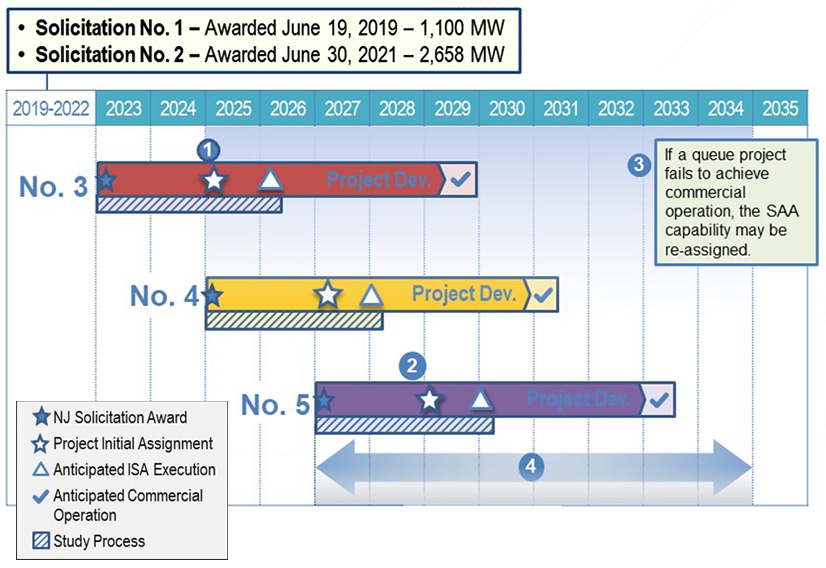
Staff for PJM and the New Jersey Board of Public Utilities on Tuesday gave stakeholders the nitty gritty details on the terms of the transmission projects the state is seeking to develop to facilitate offshore wind projects.

The special session of the RTO’s Planning Committee came ahead of the close Friday of the competitive solicitation window for the transmission projects under the “state agreement approach” (SAA) of FERC Order 1000. Under this process, the New Jersey BPU asked PJM to conduct the solicitation, and the RTO will recommend a proposal, though the board will ultimately select the winning project.

The approach allows states to seek transmission solutions in response to public policy goals: in this case — the first ever, New Jersey’s goal of deploying 7,500 MW of offshore wind by 2035. (See NJ Asks PJM to Seek Bids for OSW Tx.)

As projects are still being submitted, PJM staff did not go over the details of any candidate. Rather, the purpose of the meeting was to inform stakeholders how the winning proposal would link to the new offshore wind projects New Jersey is soliciting.

The BPU has already selected 1,100-MW and 2,658-MW offshore wind projects with their own transmission that won’t be subject to SAA cost allocation. The state is planning three more solicitations about every two years, beginning in the third quarter next year: two 1,200-MW projects and one 1,342-MW.PJM

Suzanne Glatz, director of strategic initiatives and interregional planning at PJM, explained that the RTO would use all transmission capability created by the winning transmission project, under the term “SAA capability,” as an input for performing its feasibility and/or system impact studies for the three new wind facilities.

The BPU would be required to assign the new capability to the new offshore wind projects. But in the event that a selected wind project withdraws from the PJM interconnection queue, the board would be able to reassign the capability to a different offshore wind project, or even a different public policy resource, within two years of the withdrawal. Any unassigned SAA capability would be treated as open access.

Glatz emphasized that though the offshore wind projects would get the first bite of the transmission, they would still need to enter the RTO’s interconnection queue, the same as any other generator.

Gregory Carmean, executive director of the Organization of PJM States Inc., asked if the RTO is assuming that all the transmission upgrades needed to interconnect the new offshore wind would be located in New Jersey.

“I don’t think we have solutions yet, but I think we’ve identified at least one violation that’s outside of New Jersey,” Glatz answered. A New Jersey BPU staff member clarified, however, that any upgrades driven by the state’s public policy needs, even those outside the state, would still be subject to the SAA’s cost allocation.

House Panel OKs Dems’ $3.5T Spending Bill

The House Ways and Means Committee on Wednesday approved the Democrats’ $3.5 trillion spending package, which includes billions for energy efficiency, renewables and electric vehicles.

The committee cleared the Build Back Better Act on a 24-19, party-line vote, sending it on to the Budget Committee. Democrats applauded as the committee completed its four-day markup of the massive bill. “Oh yes!” exclaimed Rep. Linda Sanchez (D-Calif.), when it came her turn to vote.

Committee Chair Richard Neal (D.-Mass.) said the bill includes “substantial investments in the development and deployment of clean energy to do our part in fighting the climate crisis while also creating good, well paying jobs across the country.”

Rep. Don Beyer (D-Va.), co-chair of the Safe Climate Caucus, said the bill “will be the single most important piece of climate legislation we have ever had the chance of passing.”

Ranking member Kevin Brady (R-Texas) countered that the spending package and tax increases would kill jobs and harm small businesses. “Small business owners should dream about passing their success on to future generations,” he tweeted. “Increasing taxes on families and entrepreneurs is why small businesses are fighting against the $3.5 trillion stimulus Congress and the president are considering.”

Democrats hope to pass the package through the reconciliation process to avoid a Republican filibuster in the Senate. But they may need to scale back their ambitions considerably to win the backing of Sens. Joe Manchin (D-W.Va.) and Kyrsten Sinema (D-Ariz.), who have said they would not support such a large spending bill. CNN reported that Manchin arrived at the White House late Wednesday afternoon for a meeting with President Biden, who has been campaigning in support of the bill.

In addition to expanding social safety net programs, the package includes billions in spending on energy, including credits for renewable electricity production and renewable fuels, and incentives for electric and alternative fuel vehicles.

Paula Glover, president of the Alliance to Save Energy, praised its inclusion of several tax credits for energy efficiency, including a change she said “would allow homeowners to budget and plan multiple energy efficiency investments over several years.”

American Clean Power Association CEO Heather Zichal called the vote “another critical step forward for the domestic clean energy economy.”

“The provisions in this legislation will enable the continued rapid deployment of renewable energy projects along with energy storage and transmission upgrades to help our nation address the climate crisis,” she added.

But the Sierra Club lamented that Democrats failed to cut subsidies for the fossil fuel industry and that the bill “maintains the status quo by needlessly incentivizing technologies that will not advance us towards our truly renewable and clean goals, such as credits for municipal solid waste, biomass, carbon capture and utilization, and nuclear facilities.”

Vermont Explores Upstream, Lifecycle Emissions as Supplement to GHG Accounting

The Vermont Climate Council stopped short this week of adopting recommendations for the greenhouse gas accounting to be used for measuring emissions from the mitigation strategies in the state’s pending Climate Action Plan.

Council members want clarity on what the recommendations that stemmed from a review of the state’s existing GHG accounting would mean for how emissions from potential strategies will be analyzed. They did, however, agree to identify a way for Vermont to begin measuring either upstream or lifecycle emissions of in-state energy use and related emissions out of state.

The Vermont 2020 Global Warming Solutions Act determined that measuring lifecycle emissions is important, including emissions that occur outside the boundaries of the state.

Vermont does not currently measure lifecycle or upstream emissions, according to Jared Duval, council member and executive director of the Energy Action Network. And there are no “off-the-shelf” solutions for doing that, he said during the council’s meeting on Tuesday. The council decided to develop a request for information (RFI) on how to conduct those analyses so it can support the Vermont Agency of Natural Resources (ANR) in implementing them.

GHG Inventory Review

The council’s Science and Data Subcommittee worked with consulting firm Energy Futures Group (EFG) over the summer to review Vermont’s current GHG inventory and accounting methods and identify potential ways to enhance or modify them.

In its Aug. 10 report, EFG determined that the current inventory, which is based on gross in-state emissions for seven sectors, is suitable for developing an actionable climate plan. They also made several initial recommendations that the subcommittee asked the council to adopt.

While the report said the current inventory and methods should be maintained, it also identified opportunities to update them, including how the state tracks and reports on net emissions. It also recommended including supplemental information and sensitivity analyses in the existing inventory.

That information should include, for example, biogenic GHG emissions and the global warming potential of GHGs, according to Duval.

Council members did not object to any specific recommendations of the report but hesitated to adopt them without details on accounting for agriculture sector emissions in development by the Agriculture and Ecosystems Subcommittee.

Vermont’s current inventory, according to the report, estimates agriculture emissions based on livestock census data. EFG, however, said it’s better to use a land-based accounting system that addresses land management practices that reduce emissions and assesses opportunities for sequestration from agriculture and forests.

The Ag Subcommittee is working with the University of Vermont to understand the benefits of using that land-based system for the agriculture sector. The council held off adopting the full recommendations of the consultants’ report until the subcommittee can finalize its plan regarding the land-based system.

Upstream, Lifecycle Emissions

The report recommended that Vermont apply upstream emissions estimates as supplemental sensitivities to the current inventory method. An upstream emissions analysis, the report said, looks at all direct emissions of energy use without any geographic considerations. It would, therefore, account for the end use of natural gas and emissions from its production.

Lifecycle emissions, on the other hand, look at a broad set of emissions associated with energy, such as the energy used to manufacture a wind turbine and for transportation during project construction. Complete lifecycle inventories are “complex” the report said, and if Vermont chooses to adopt them, they could divert resources from other practical analyses.

The Science Subcommittee chose to recommend that the council move forward with the RFI to learn more about both accounting methods. For the methods to be useful, Duval said, they need to be updatable, flexible and accessible by the ANR.

The methods “will have to be stewarded and updated over time, not just into the future, but we also want to be able to compare in previous years and have baseline years to see how things have changed,” he said.

Pollinator Friendly Solar Farms May Increase Crop Yields

Saving the bees may not be the focus of many utility-scale solar developers. But a group of Minnesota ecologists say developers should embrace “pollinator-friendly” projects to address the concerns of farmers who may regard solar panels as an invasive technology rather than a value-added crop.

Planting regional wildflowers and native grasses rather than turf grass under solar panels adds carbon to the soil, they say, and can feed bees established on the perimeter of a solar farm. In addition to producing a honey crop, the bees also pollinate nearby crop fields, increasing production, according to early research results. 

The grasses can also serve as forage for periodic sheep grazing that eliminates the need for mowing, significantly reducing the risk of grass fires and eliminating the chance of damage to solar arrays by mowing equipment, advocates say. And the sheep’s hooves prepare the land for new growth, unlike mowing.

Researchers say the practice also reduces erosion and improves groundwater recharge. Small power generation increases have been seen as well, at least in some climates.

The novel approach to solar began in 2010 as an experiment at a National Renewable Energy Laboratory (NREL) in Colorado. Today, agrivoltaics — or “low impact solar” because it usually does not involve stripping off the topsoil during construction — is part of a strategy to make solar more amenable to farmers considering leasing their land.

The Minnesota Agricultural Utilization Research Institute (AURI), a nonprofit created by the state legislature, took a look at the practice in a recent webinar focusing both on the impact of sheep grazing and the creation of what could be a new agricultural business: solar honey. AURI’s mission is “to foster long-term economic benefit for Minnesota through value-added agricultural products.”   

Solar ‘Another Specialty Crop’

Rob Davis, Connexus Energy | Rob Davis Rob Davis, founder of the Center for Pollinators in Energy at Fresh Energy, an independent nonprofit organization based in St. Paul, introduced the panelists and provided context for Minnesota’s foray into pollinator politics. 

“Solar is really just another specialty crop, [and] even by the most ambitious planning and forecasting, [the U.S. will have] something like 9 million acres of solar by 2050. We have 90 million acres of corn in the United States today. Solar is never going to supplant all the corn; never going to supplant all the soybeans. But it will always have an opportunity to be a kind of a nice crop for value-added producers,” said Davis, now spokesman for cooperative Connexus Energy. “The experts we have assembled today each have a different perspective on what is feasible and practical and what benefits their business [and] how they’re embracing these new landscapes.”

Jake Janski, senior ecologist at MNL, a private ecological services company about 30 miles northwest of Minneapolis, said the company incorporated grazing services into its ecosystem management services about five years ago.

“The most successful application that we have found for our grazing program is the use of sheep on these pollinator friendly solar sites,” he said. “We’re working with eight different solar companies on their individual portfolios to implement our grazing program.

Jake Janski, MNL  | MNL“We’re also supporting … local sheep producers around the state that we work with as collaborators to provide access to the forage on our grazing sites while applying our vegetation management standards to enhance the pollinator habitat,” Janski explained during the webinar.

Dustin Vanasse, founder and CEO of Minneapolis-based Bare Honey, has grown the business thanks to pollinator-friendly solar.  

“Coming into 2022, we will have almost 100% of our hives on solar. It’s taken us kind of baby steps to work our way in. We also work with another network of beekeepers and subcontract for their placement of hives on solar farms. This is how we’re developing our expansion,” he said.  In addition to offering honey to consumers, the company sells it to food manufacturers in “40-lb. buckets or 55-gallon drums.” 

Minn. Legislative Action

After a 2014 experiment with wildflowers by Minnesota researchers, the state legislature approved a bill in 2016 encouraging the planting of “flowering meadows” in and around solar developments to combat the alarming decline of honeybee populations, explained Davis.   

The legislation, based on initial efforts of Fresh Energy, Audubon Minnesota, and the Minnesota Corn Growers, led to the development of a standard for vegetation that the PUC can now require on solar sites.

Dustin Vanasse, Bare Honey | Bare HoneyThe Minnesota Public Utilities Commission permits solar projects larger than 50 MW, and if the land in question is agricultural, the commission, with a recommendation from the state Department of Natural Resources, can require solar developers to build a pollinator friendly system, Davis said in an interview. “It’s not a mandate; it’s a case-by-case requirement,” he said, based on an evaluation of the land in question. 

Regulators working with advocates developed a “pollinator habitat assessment” to determine just how pollinator friendly a proposed solar development will be.

The new standards and underlying research have led to a kind of symbiotic relationship between solar technology and agriculture. The payoff is that crops as well as wildflowers and native grasses are more vigorous, the soil less damaged and solar systems less expensive to maintain, advocates say.

Other States

Minnesota’s model has since been adopted by Illinois, Maryland, Michigan, New York, South Carolina and Vermont, according to the Clean Energy State Alliance. Projects in some states have found that building the solar arrays taller, which adds cost to the project, creates a cooler environment and increased production of vegetable crops that do not need full sunlight and benefit from the cooler temperatures and soil that is not dried out by the direct sun.  

The movement has also caught the attention of the Department of Energy, which has created a program, Innovative Site Preparation and Impact Reductions on the Environment (InSPIRE), to help the solar industry, universities and state organizations conduct research. InSPIRE is involved in more than a dozen states, including Minnesota. 

Davis said NREL is doing a study in Minnesota comparing the power output at the inverter level on solar arrays located on vegetated sites versus bare sites. 

The Yale Center for Business issued a preliminary report in 2019 noting that the addition of perennial grasses and flowers to solar fields appeared to create a cooler micro climate, resulting in increased electrical generation from the solar array. The study also noted that the grasses reduced soil erosion and helped with groundwater recharge. 

The University of Arizona has also been researching the impact of food crops under and around solar arrays and has calculated the increase in power generation as well as an increase in soil moisture and plant production.  

“Across the core growing season, PV panels in an agrivoltaic system were about 8.9 degrees C cooler (16 degrees F) in daylight hours,” researcher Greg Barron-Gafford, a professor at the university’s School of Geography, in Tucson, said in an email. “This reduction in temperature can lead to an increase in system performance. Using the system advisor model (SAM) for a traditional and a co-location PV system in Tucson, we calculated that temperature reductions documented here in the growing months of May–July from the colocation system led to a 3% increase in generation over those months, and a 1% increase in generation annually.”

Davis urged farmers who have been approached by solar developers to ask for “regenerative practices” such as pollinator friendly flowers or grazing grasses when solar developers approach them. “Put it in the contract,” he said.

“This idea of pollinator friendly solar is not a restoration of some pre-colonial condition. It’s accepting that solar is happening and is looking for ways to provide meaningful benefits to the soil, to the pollinators and to the ecosystems within that managed context.”

Illinois Senate Passes Landmark Energy Transition Act

By a razor-thin margin the Illinois Senate approved landmark legislation Monday putting the state on a 30-year path to 100% carbon-free electric generation and bailing out two troubled nuclear power plants.

Nearly three years in the making, the controversial Energy Transition Act now goes to Gov. J.B. Pritzker, who said last week that he would sign the nearly 1,000-page bill if lawmakers could get it to his desk.

The Illinois House of Representatives amended and passed an earlier version of the bill on Sept. 9 in an 83-33 vote following angry opposition from Republican members, some of whom noted that the Democrats had ignored their concerns voiced during committee hearings. (See Illinois House Passes Energy Transition Act.)

The Senate approved the legislation 37-17, just one vote more than the two-thirds majority required. The vote came after a string of bitter comments from Republican members, many of them from downstate, who saw the legislation as orientated toward Greater Chicago, likely to seriously damage their communities’ economies and leading to increased electric bills statewide.

During the debate before the vote, GOP members demanded to know exactly how large the increases in monthly electric bills would be, a question that was not easily answered because state legislative analysts had not yet completed calculations. Estimates ranged from a few dollars to $18 for residential bills. Rates for commercial and industrial customers are expected to be much higher, prompting the Illinois Manufacturers Association last week to testify against the bill.

The passage might have been further delayed had Chicago-based Exelon (NASDAQ:EXC) not announced that it would shut and decommission one of its two reactors on Monday at the Byron nuclear plant without subsidies authorized in the legislation.

Exelon had shut Unit 1 of Byron overnight for scheduled refueling, but the company announced weeks ago that it would decommission rather than refuel the reactor if the state had not made a decision on a nuclear subsidy included in the bill — nearly $700 million over the next six years. Exelon announced in August that it would close both Byron and Dresden plants without a state or federal subsidy. Each plant has two reactors. (See Exelon CEO: Looming Nuclear Plant Closures will be ‘Irreversible’.)

The bill sets shutdown targets for all coal and gas power plants in the state over the coming decades, making the nuclear plants key players in a carbon-free future. Exelon operates six nuclear plants in Illinois, five of which include two reactors.

The legislation requires all investor-owned baseload coal-fired power plants and remaining oil peaker turbines to shut down by 2030. The municipally owned Prairie State coal plant, with customers in six states, must reduce its emissions by 45% by 2035 through carbon capture and sequestration and must shut down by 2045, unless it can curtail all of its carbon dioxide emissions. City Water, Light and Power, the Springfield municipal power operation, which heats and lights the State House, will face the same shutdown rule.

Gas turbine plants, even those now under construction, must also close by 2045 under the terms of the bill, although the state would have an option to allow continued operation if they are critically needed: in other words, if the anticipated growth in renewable energy — from 7% currently to 100% by 2045 — cannot be achieved.

The bill also allocates hundred of millions of dollars to expand solar installations, both on a community solar level and homeowner rooftop solar. Electric vehicle purchase rebates of $4,000 are also in the legislation, but only in certain counties where local governments will collect to finance the rebates.

Pritzker, labor supporting the continued operation of the nuclear plants, environmental groups such as the Sierra Club and the National Resources Defense Council, and a number of renewable energy trade groups coalesced over the past year to push for the bill.

In a statement issued Monday afternoon, Pritzker said the passage is “historic.”

“Today, with the Senate passage of SB 2408, the state of Illinois is making history by setting aggressive standards for a 100% clean energy future. After years of debate and discussion, science has prevailed, and we are charting a new future that works to mitigate the impacts of climate change here in Illinois.”

A statement from the Path to 100 Coalition of renewable energy advocates said the passage of the bill “puts Illinois at the forefront of the fight against climate change all while creating tens of thousands of jobs, expanding diversity in the renewable energy industry and providing more than $1 billion in electricity bill savings for consumers.”

“Opening the Illinois market is critical to the growth of energy sources that will clean the air, create jobs and jumpstart the state’s economy,” asserted Abigail Ross Hopper, CEO of the Solar Energy Industries Association. “Illinois is now a national leader in crafting renewable energy solutions.”

Advanced Energy Economy called the bill “the most significant climate and clean energy legislation” in the history of the state.