Neil Chatterjee’s four years at FERC, most of them at the helm, transformed him from playing the partisan game of thrones to advocating for a price on carbon as a way to solve the problem of climate change.
A Republican who worked as an adviser to Sen. Mitch McConnell (R-Ky.) prior to being appointed to FERC by President Donald Trump, Chatterjee maintains he has always thought climate change is a serious problem. But in recent interviews about his time at the commission — including one with RTO Insider last week, he has repeatedly expressed regret about his first stint as chair.
Chatterjee’s term ended June 30, and he resigned Aug. 30 to join law firm Hogan Lovells. President Biden last week announced he intends to nominate D.C. Public Service Commission Chair Willie Phillips to be his successor. (See Biden to Nominate Phillips to FERC.) Chatterjee spoke to RTO Insider on Sept. 7, prior to Biden’s announcement.
“It took me a while to grow into the job,” Chatterjee said. “In my initial days with the commission, I really struggled to make the transition from partisan legislative aide to independent regulator.” That was most publicly visible, he said, when he “admittedly mishandled” a proposal from Energy Secretary Rick Perry in late 2017 to order RTOs and ISOs to compensate generators for their on-site fuel costs. At the time, Chatterjee praised Perry’s “bold leadership” and was supportive of the proposal, as it would have aided struggling coal communities in his native Kentucky.
“That was a serious issue that I injected a political element into; that was a mistake,” he said last week. “I think I got thrown into the deep end of the pool without knowing how to swim. [So] I actually think I grew from that experience.”
After former FERC Chair Kevin McIntyre relinquished his leadership role for health reasons in 2018, Chatterjee said it was McIntyre who was instrumental in that growth. With McIntyre as chair and a full complement of five commissioners, Perry’s proposal was unanimously rejected. Reappointed chair after McIntyre resigned, Chatterjee told reporters that McIntyre “could not be more strenuous in saying that politics could not be allowed to interfere with the work of the commission.” (See Returning Chair Pledges to Protect FERC’s Independence.)
After the experience of the Perry proposal and having learned from McIntyre’s leadership, Chatterjee said he became “a more focused regulator [with] a team around me that would really give me the soundest advice.” He began to increasingly speak out about market-based solutions to climate change, culminating in a policy statement in late 2020 inviting states to introduce carbon pricing in RTOs. (See FERC: Send Us Your Carbon Pricing Plans.)
That move ultimately cost him the chair. Shortly after the Washington Examiner published an article titled “Trump appointee becomes leading climate problem solver,” Trump fired Chatterjee and promoted Commissioner James Danly, who served in the top job until Biden took office and appointed Commissioner Richard Glick. According to Chatterjee, his post-chair tenure “was some of the most fun that I had at the commission. … I no longer had the burdens of the chairmanship to contend with, but I was invested in making sure there was a successful transition to Chairman Glick.”
Carbon Price Advocate
Along with Hogan Lovells, where he will advise clients on energy markets, Chatterjee also joined The Climate Leadership Council and its lobbying unit, Americans for Carbon Dividends. According to the organization, “Chatterjee will draw on his deep experience to help the council refine the details of its comprehensive policy initiative to price carbon emissions and return the revenues to all Americans.”
“I’ve seen firsthand the difficulty of trying to navigate a patchwork of state policies while maintaining market efficiencies,” he said. “I’ve really come to the conclusion that a price on carbon is the most effective way to drive down emissions and bridge this gap between” state policies and markets.
It’s safe to say many economists would agree with him, but the idea has not gained traction in Congress. Chatterjee said he hopes to change that.
“Part of it is looking at what are the alternative options are,” he said. “When compared to alternative solutions that are more onerous and may lead to greater threats to reliability and may not be efficient from a market standpoint, I think you may see some more interest” in a carbon price.
He’s also “cautiously optimistic that we’re pretty close to seeing an RTO or an ISO come to FERC” with a carbon pricing proposal. If approved, “I am of the belief that such an approach would lead to market efficiencies and a reduction in carbon [emissions]. So it’s possible that having that kind of a lab experiment in an RTO or ISO, if it proves to be successful … that could be the type of thing that helps build public support; we could point to an example. … Some have deemed that a ‘baby step.’ … Let’s take the baby step and see what happens.”
NYISO on Thursday presented stakeholders an updated proposal to revise its buyer-side mitigation (BSM) rules, providing new emphasis on addressing capacity accreditation quickly and getting an objective assessment of the proposal’s market investment risk.
The ISO has asked its Market Monitor, Potomac Economics, to think through the various market issues and investment risks related to the plan, Michael DeSocio, NYISO director of market design, told the Installed Capacity (ICAP) Market Issues Working Group.
DeSocio highlighted Analysis Group’s study to support the BSM reforms proposal, saying “the results of that analysis will be important to inform whether or not the capacity market remains sufficient and effective and can be considered just and reasonable.”
NYISO last month introduced the study, which will model 10-year capacity supply and demand curves and identify the resulting market outcomes to support BSM rule revisions. Results will likely be presented later this month, DeSocio said. (See NYISO Unveils Draft BSM Study.)
Policy Resource Exclusion
New York’s Climate Leadership and Community Protection Act (CLCPA) requires the state to procure large amounts of renewable energy to get to zero-emission electricity by 2040; the introduction of so much new generation will challenge transmission and capacity market planners.
In July, the ISO presented a proposal to exempt most new renewable installed capacity (ICAP) resources from BSM evaluation. (See NYISO Proposes Sweeping BSM Exemptions.)
New resources that are required to satisfy the goals specified in the CLCPA will not be subject to review by the ISO under the BSM rules, or otherwise subject to an offer floor. Exempted resources include, but are not limited to wind, solar, storage, hydroelectric technologies (including tidal, ocean and wave generation), geothermal, fuel cells that do not use fossil fuels, and demand response (participating as a special case resource or distributed energy resource).
The proposal represents a two-pronged approach that aims to eliminate BSM risk for CLCPA resources and simplify the currently complex and administratively burdensome BSM process, DeSocio said.
The renewable exemption in its current form would be eliminated, while other existing exemptions, such as competitive entry and self-supply, would remain available to qualifying resources. The current process involving the Part A and Part B offer floor exemption tests would still be performed for resources subject to BSM.
“The set of resources is not fully known that will be meeting those [CLCPA] goals, or at least that seems to be the approach being taken by the state,” DeSocio said. “To the extent that the law is clear about these particular technologies, we’ve tried to accommodate that here.”
In response to a stakeholder question about whether hybrid resources would be exempt from BSM review, DeSocio said NYISO would consider them on a case-by-case basis because a hybrid is a mixture of resource technologies. For example, a co-located storage resource comprised of storage plus either solar or wind would be excluded from BSM review because all three technologies are included in the list.
“We don’t call it out here for two reasons: first, because we don’t have those rules yet, and second, because we’ve understood the ask from stakeholders for the new hybrid model is to also allow accommodation of fossil resources with storage and other resources. So we don’t think we can just make a blanket statement that all hybrid resources would be excluded,” DeSocio said.
Prong Two
The plan’s second prong would include additional resource types that satisfy CLCPA, such as technologies New York has identified as supporting state goals or resources that have contracted with NYSERDA to advance those goals.
The topic touches on the various tiers of renewable energy credits and whether a resource is eligible to receive a contract, DeSocio said.
“In other words, it would qualify to receive a contract through maybe one of the tiers or some other program supporting CLCPA that might be run by New York state, whether NYSERDA or some other agency, but it’s been mainly NYSERDA executing those contracts,” DeSocio said.
Because there could be potential timing issues, the ISO will be looking for the resource to self-certify and provide the ISO evidence that it qualifies under one of the categories. For example, unforced capacity deliverability rights that can demonstrate eligibility for Tier IV RECs would be included under this provision, he said.
One stakeholder said he was curious why the ISO chose to go down the path of painstakingly listing technologies as opposed to a fundamental look at whether the resource is a buyer who can exercise market power. He also wondered whether there are any legal or other downsides to the ISO’s approach.
“We chose this path to provide as much clarity to stakeholders as possible about what it means,” DeSocio said. “The approach that we laid out here we think gives us the greatest chance of surviving challenge either at FERC or in the courts.”
The ISO plans to use the remaining September stakeholder working groups to discuss feedback from Thursdays’ meeting, review examples of the probability distribution Delta Method by consultancy E3, hear the report on capacity market investment risk by Potomac Economics, and discuss possible tariff revisions connected with capacity accreditation, he said.
A new report from think tank OurEnergyPolicy (OEP) identifies reliability as a key priority for legislators, regulators and other stakeholders working to decarbonize the North American bulk power system and prepare for a future of stresses to the grid brought on by climate change.
The Guiding Principles for Sound Energy Policy report, released on Tuesday, is the product of multiple stakeholder meetings hosted by OEP earlier this year; the organization decided to publish the paper to “highlight points of consensus and various points of view by participants of these discussions.”
OEP’s release includes seven guiding principles aimed at policymakers working on the transition to a carbon-free BPS, written to be broad rather than “an exhaustive list of principles [that] would be dilutive and inconsistent with the core objective of this initiative.” Those chosen for inclusion are considered “fundamental [values] … of elemental importance … that should be prioritized in all energy policies.”
Reliability ‘Cannot Be Compromised’
OEP’s list of principles starts with reliability, which the organization says, “cannot be compromised.” Citing the winter storms that racked Texas in February, leaving thousands without power for days and bringing the Texas grid close to collapse, the paper recommends that grid planners make the BPS “reliable and resilient enough” to withstand severe weather and cyberattacks, while also maintaining the ability to recover when disaster does occur.
“The public expects electricity with a flip of a light switch. The energy system must have enough generation capacity, transmission capability and operational flexibility to keep up with the pace of consumer demand and to prepare us for every manner of deliberate and natural threats,” OEP says.
Also included in the list — which OEP emphasized was not ranked in any particular order — were principles such as affordability, equity and inclusion, decarbonization, respect for science, integrated policy and a technology-neutral approach.
By affordability, the report means that all Americans must be able to access the energy they need to participate in society, regardless of their income or economic status. Noting that American consumers “want to know they have the financial means to afford” necessities including electricity, OEP suggests policymakers explore options for keeping energy affordable, such as “market-based approaches to lower technology costs [and] government approaches that can assist lower-income Americans.”
Equity and inclusion refers to identifying communities likely to suffer more negative impacts from climate change and the clean energy transition, and granting those communities a voice in the debate over how to address those impacts. Making the process more inclusive can also help policymakers with the integrated policy principle, which refers to “understanding that our energy systems are interconnected and achieving one goal may affect our ability to achieve others.”
For example, a mandate to convert a vehicle fleet from fossil fuels to electric engines must take into account the carbon impact of the resource used to generate the vehicles’ electricity. Inviting a wide range of voices can help policymakers spot the full implications of their proposals.
The last two principles — respecting sound science and technology neutrality — are also complementary. The first means that policies should “be evidence-based and in harmony with the best scientific studies and data,” while the second stresses that policymakers “avoid picking technology ‘winners and losers’ in the energy sector” by allowing “ideas and technological innovation to compete in a free market.”
“Science and policy must work in tandem to allow for the best possible outcomes, and science-based policy must be rigorously evaluated and held to a high standard,” the report says.
Lawmakers Urge Federal Clean Energy Support
Among those who participated in this year’s meetings were Sen. Lisa Murkowski (R-Alaska) and Congressman Paul Tonko (D-N.Y.), both of whom contributed their own list of guiding principles for members of Congress and stakeholders that were included in OEP’s report.
Murkowski recommended that policymakers:
focus on the future, but make sure goals are achievable;
keep the attributes of energy in mind;
focus on bipartisanship;
follow the regular order process; and
be ready to make reasonable compromises.
Tonko’s recommendations were more specific; among his nine enumerated principles were to “set scientific targets for greenhouse gas neutrality by mid-century” and to “deliver a just and equitable transition” by investing in communities that face the greatest risk of damage from pollution and climate change, while helping workers and communities that depend on traditional energy industries find new methods of support.
In addition, Tonko urged that federal policy be made to complement work already done by state and local governments, businesses and individuals, while not “penalizing entities that have taken early action.”
“Federal climate action must create steady, credible, and politically durable policies, send strong investment signals, and deliver long-term certainty to allow for proper planning and implementation while minimizing compliance costs,” Tonko said.
Washington State Ferries expects to start a multi-year contract to convert from solely diesel fuel engines to hybrid fuel-battery propulsion in October 2022.
The timing of the move depends on how fast the American Bureau of Shipping and U.S Coast Guard approve the redesigned propulsion system for the state’s three largest ferries, and on how long the bidding process and contract negations take.
Washington’s state ferry system — the largest in the U.S. — has 10 vessels that crisscross Puget Sound.
While Washington State Ferries won’t be the first government ferry system to convert to a hybrid fuel-battery operation, it will be the largest in both the size and number of boats. The first three vessels to be converted are the state’s largest, capable of holding 202 vehicles each. They handle two 8.6-mile routes between Seattle on the east side of the sound and Bainbridge Island on the west side, and a third five-mile route between Edmonds on the east side and Kingston on the west.
Entering service in 2019, the nation’s first government-run all-electric ferry can handle 15 cars and crosses the Alabama River between Gee’s Bend and Camden, Alabama.
The first government-owned diesel-electric hybrid ferry is expected to enter service in 2022. It will be able to carry 70 vehicles 2.7 miles between Galveston Island and the Bolivar Peninsula in Texas.
Hybrid fuel-electric ferries have been operating in Norway and northern Europe for years. Washington plans to use the same Siemens technology that Norway does.
“This is not cutting edge, high-risk technology,” Matt von Ruden, Washington State Ferries’ director of vessel engineering and maintenance, told NetZero Insider.
Washington’s move is part of a 2018 executive order by Gov. Jay Inslee to cut greenhouse gas emissions from the state ferries, von Ruden said. The state’s 10 ferries consume 19 million gallons of fuel annually. The state believes that this move will dramatically trim that figure.
When a contract is signed, the contractor will remove two of four diesel engines from each of the three largest ferries and replace the missing engines with batteries capable of storing 5.7 MWh of power. The boats will primarily use battery power, saving the diesel for when extra power is needed for backup purposes or swift maneuvering, von Ruden said. A converted ferry will operate with the same power and speed running on batteries as it currently does with diesel engines.
When a boat is docked to load and unload vehicles, the batteries will be hooked up to a shoreline charging station, which will replenish battery power in 18 minutes.
However, the construction of all the dockside charging stations is not expected to be complete until 2025. “It’s a complex process, and we want to get it right,” von Ruden said.
Removing two engines, doing extensive modifications to a room next to the engine room, and installing the batteries is expected to take five to six months at a cost of $35 million for a single boat, von Ruden said. So far, the state has lined up money to tackle only the three largest ferries. Funding must be found for the remaining seven 144-car ferries.
Washington will have to tackle one ferry at a time because it can only afford to take one vessel out of circulation at a time from its numerous Puget Sound ferry routes, he said. He hopes the first ferry will begin the conversion process in spring 2023 with the work done later that year.
After the first three ferries are converted, modifications on the remaining seven are expected to occur at a rate of one about every six months, if more money becomes available by then, von Ruden said.
During her time at FERC, Cheryl LaFleur said, one thing that surprised her was the feeling of independence.
“I guess, theoretically, President Obama was my boss, but he sure never called,” joked LaFleur, who served as both a commissioner and chair at various times from 2010 to 2019.
Commissioner Allison Clements has been at FERC since December 2020 and was sworn in amid the COVID-19 pandemic. “I started coming into the office despite the fact that the commission isn’t open yet because I felt like I am playing commissioner on Zoom, and I need to go in and see if this card to get me in the door works,” Clements said.
LaFleur and Clements spoke Tuesday at the annual joint event between the Connecticut Power & Energy Society and New England Women in Energy and the Environment, sharing their observations and perspectives during a wide-ranging discussion.
LaFleur, currently on the ISO-NE Board of Directors, said there was “big excitement” last week when President Biden announced his intention to nominate D.C. Public Service Commission Chair Willie Phillips to FERC. Phillips, a Democrat, would fill the seat most recently held by Republican Neil Chatterjee and give the commission a Democratic majority. (See Biden to Nominate Phillips to FERC.)
Phillips is an experienced regulator “used to balancing different perspectives and reaching consensus,” according to LaFleur.
Clements said that with Chatterjee’s departure Aug. 30, “we were already starting to bite our nails a little bit, given the slate of technical conferences and the Advanced Notice of Proposed Rulemaking on transmission planning, cost allocation and generator interconnection (RM21-17). (See FERC Goes Back to the Drawing Board on Tx Planning, Cost Allocation.)
Phillips restoring “a full complement of people who start collaborating with each other … that’s exciting,” Clements said.
The density of technical conferences on the calendar was particularly interesting to LaFleur because the commission is “building records” to tackle various issues. Clements said that before joining FERC, she would not have linked technical conferences to “record building.” However, she added that there have been a high number of them, so much so that her 6-year-old daughter has technical conferences as “part of her vernacular, which cracks me up every time.”
“There is a recognition that we’re going to be at five [commissioners], and there’s a lot of things that need to get done,” Clements said. “Every one of these technical conferences is on a topic that you can spend a lot of time thinking about and prioritizing.”
In terms of regulatory philosophy, LaFleur said that because she had never been a regulator before her appointment to the commission, there was a line to walk between trying to do too much and taking a more measured approach to gain acceptance from the regulated community. LaFleur asked Clements about the tradeoffs between bold action versus incremental steps in the present regulatory landscape.
Clements said there are two “driving facts” that underscore her thinking most of the time. One is the increasing intensity, duration and frequency of extreme weather events wreaking havoc on the power grid, “causing catastrophe for people who are left without power.”
The other fact is climate change is real.
“Now, I should maybe start with that fact since it’s a precursor to the increasing extreme weather events, but we shouldn’t be afraid to think about climate change as a scientific fact that implicates as an input into our decision-making process,” Clements said.
Environmentalists and climate justice advocates on Monday said they support New York’s agricultural and land use policy proposals, but they also offered suggestions for improvement.
The New York Climate Action Council’s (CAC) Climate Justice Working Group (CJWG) provided feedback on policy recommendations from the Agriculture and Forestry Advisory Panel and Land Use and Local Government Panel, two of several informing the 22-member council as it works to complete a scoping plan by year-end to help reach the environmental goals laid out in the state’s Climate Leadership and Community Protection Act (CLCPA). It plans to hold public meetings throughout 2022 before releasing a final plan in 2023.The New York State Climate Action Council met via videoconference September13, 2021 | NYDPS
Among the Land Use panel’s recommendations is the appointment of a “state resilience officer” to oversee “agency hazard mitigation, adaptation, response, resilience and recovery programs.” It also recommended an “adaptation and resilience sub-cabinet to facilitate coordination, dialogue and information exchange.”
Sonal Jessel, WEACT for Environmental Justice | NYDPSCJWG member Sonal Jessel, of WE ACT for Environmental Justice, told the CAC that the resilience officer should “not only just be appointed by the governor but [also] very aware of just transition efforts. We would also like some clarity on where the adaptation and resilience sub-cabinet would reside in government.”
The CJWG also supports the recommendation to create a resilient infrastructure fund through bonding, but it should have a specific carve-out for frontline communities, Jessel said. Unfortunately, poor people and disadvantaged communities (DACs) often get caught by unintended consequences of state policies with good intentions, such as a surcharge on insurance premiums for property affected by climate hazards.
“It’s important around the idea of ‘smart growth’ to make sure that DACs are protected from unintended consequences and ask how we are doing that, such as investing in transit in suburban areas at the expense of high-density areas that still don’t have the adequate transit that they need,” Jessel said.
New York needs to move away from the mindset of “bigger is better,” said Jerrod Bley, energy program director of the Adirondack NYS Agriculture Commissioner Richard Ball | NYDPSNorth Country Association. Move the emphasis away from large-scale farms and end the use of fracked gas and nitrogen fertilizers, whether natural or synthetic, he said.
“Farmers around the country are adopting soil health practices, reducing emissions, sequestering carbon and achieving improved yields,” Bley said. “We are thus more than ready to bring the transition to more diversified, regional ecological production.”
“We’ve got some pretty good things underway here actually,” New York Agriculture and Markets Commissioner Richard Ball said. “When I visit the vegetable grower conference or the fruit conferences, the most packed attendance seminars are those surrounding soil health, and the commonality there that both sides of agriculture have understood and are coming to understand in a bigger way gives me an awful lot of encouragement.”
Reducing Agricultural GHGs
Abigail McHugh-Grifa, Climate Solutions Accelerator | NYDPSOnly 6% of New York dairy farms have milk cow herds of more than 500, but they account for about 56% of New York dairy cows and are responsible for the majority of agricultural methane emissions in the state, said Abigail McHugh-Grifa, executive director of the Climate Solutions Accelerator.
McHugh-Grifa said the council should ensure that state funds are distributed equitably and do not disproportionately benefit the largest agricultural producers, and that the panels’ goal of a 30% reduction in GHG by 2030 is not ambitious enough.
Robert Howarth, Cornell University | NYDPSWatershed protection efforts spurred New York to develop a program of “agriculture environmental management, and that’s the basis for how we look at farms, the basis for how we market New York grown and certified products in the state,” Ball said. “I’d be happy to show you that the small farm participation in that program outweighs all the larger farms in the state by a wide margin, so I think there’s a lot to be optimistic about.”
Robert Howarth, professor of ecology and environmental biology at Cornell University, said that his recent research on the Finger Lakes algal blooms and on groundwater contamination indicates “some cross-messaging and cross-purposes there we need to work out.”
“I agree totally that we could probably use less synthetic nitrogen fertilizer, and it is coming from fracked gas and that’s problematic, which we should look at,” Howarth said. “I also think we need to have a better way of handling manure statewide, and although I understand some of [CJWG’s] concerns about using anaerobic digesters at farm-scale … I think it might be certainly one of the best two options out there.”
Development of hydrogen-fueling stations in California is accelerating, and car manufacturers should consider ramping up production of fuel-cell electric vehicles (FCEV), according to a new report.
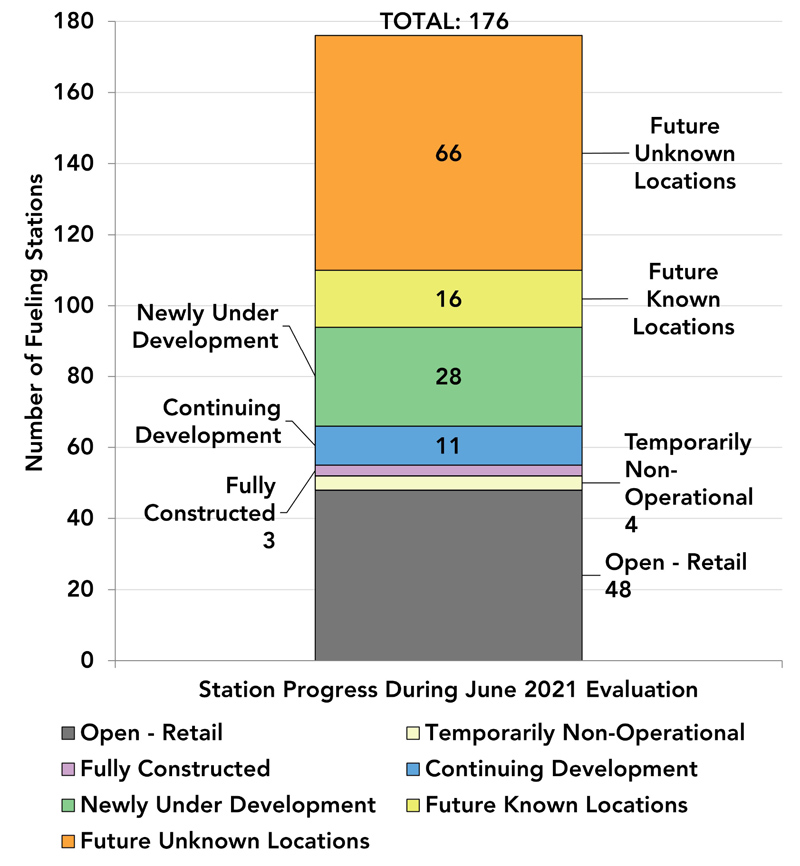
As of late June, California had 48 hydrogen-fueling retail stations open to the public, compared to 42 stations at mid-year 2020, according to the report released Friday by the California Air Resources Board (CARB). Another four stations are closed but expected to reopen, although an exact reopening date isn’t known.
The six-station increase detailed in the new report was an improvement from 2020, when the number of open stations increased by only one.
And CARB expects growth in the number of hydrogen-fueling stations to surge, as station developers take advantage of state grants and private investment increases.
The report notes that a new station that opened in Placentia in May was the first in California without any state grant funding. However, station operator FirstElement is taking advantage of CARB’s hydrogen refueling infrastructure (HRI) credit that is part of the agency’s low-carbon fuel standard.
The HRI provision allows station operators to receive extra LCFS credits based on the difference between station capacity and fuel sales. Sixty-one stations, including some still under development, are participating in the program.
According to CARB, station developers may be building more stations or larger stations, or even reducing fuel prices at the pump, as a result of the HRI program.
200-Station Target
Assembly Bill 8 from 2013 set a target of 100 hydrogen-fueling stations in the state. AB 8 directed the California Energy Commission to fund the development of retail hydrogen-fueling stations until the goal is met. The program is authorized through Jan. 1, 2024.
The California Air Resources Board projects that the state will have 176 hydrogen fueling stations within the next six years. | CARBAn even higher target of 200 hydrogen-fueling stations by 2025 was set in a January 2018 executive order issued by Gov. Jerry Brown. The order also calls for 5 million zero-emission vehicles (ZEVs) in California by 2030.
CEC grants are projected to add up to 94 new stations to California’s hydrogen fueling network, while private funding could add another 23 stations, according to CARB.
Based on all known investments, CARB expects the number of hydrogen-fueling stations to grow to 176 by 2026. The state is projected to meet the 100-station goal in 2023.
California had 7,993 fuel-cell electric vehicles on the road as of April 1, a number projected to grow to 61,100 in 2027. But the expected number of hydrogen-fueling stations in 2027 could accommodate 250,000 FCEVs, according to CARB.
“The current and planned station network provides auto makers an opportunity to deploy as many as four times the FCEVs currently indicated through industry surveys,” CARB said in its report.
FCEV Barriers
The report noted that availability of fuel isn’t the only barrier to FCEV adoption. Other factors include high FCEV prices, high fuel prices, limited model availability and lack of customer awareness.
Another issue is the unreliability of existing stations, CARB said. Stations might shut down temporarily due to supply-chain disruptions or equipment break-downs.
CARB said the situation should get better by early 2022 as hydrogen production and delivery improve.
“Still, station reliability is a concern that will require near-term and long-term solutions to minimize negative experiences for today’s drivers and ensure this does not become a barrier to further FCEV adoption,” CARB said in its report.
Expanding the Network
With the number of hydrogen-fueling stations expected to grow quickly, CARB said station developers should take a closer look at areas outside of the currently planned network. Hydrogen-fueling stations are concentrated in the Los Angeles area, Orange County, San Diego County, Sacramento region, and the San Francisco Bay Area.
Areas worth a closer look for station development include Palm Springs, San Luis Obispo, Monterey, Santa Cruz, and San Joaquin Valley cities such as Bakersfield, Fresno and Stockton. CARB said Northern California cities such as Chico and Eureka, where there’s not yet any hydrogen-fueling infrastructure, might also be good sites for future stations.
“Some [areas] may present opportunities for development immediately after the stations currently under construction are completed,” CARB said. “Others may be more appropriate in later phases of development, but all should be considered seriously.”
The Washington Fish and Wildlife Commission last month unanimously downgraded the status of ferruginous hawks from threatened to endangered.
Climate change and wind turbines were two of several factors contributing to that decision.
Whileferruginous hawksare not listed as a threatened or endangered species by the federal government, they are listed for protection by the state of Washington.
The species has struggled in Washington because of a shrinking prey population, habitat encroachment by expanding agriculture, deaths from wind turbine strikes and wildfire destruction of nesting areas. The ferruginous hawks spend five months a year in the state when they nest from April through the summer; they migrate elsewhere in the Western U.S. for the other seven months.
The birds are among the nation’s largest hawks with average wingspans of 56 inches. They live in grasslands and shrub steppes, which are found extensively in south-central and southeastern Washington. Shrub steppe is a mostly treeless semi-desert filled with sagebrush and a complicated ecosystem at ground level.
The Washington Department of Fish and Wildlife (WDFW) tallied 55 nesting pairs of hawks in 1995 and 32 pairs in 2016, according to an August 2021 department report to the commission. About 60% of the nesting pairs are found in Washington’s Benton and Franklin counties.
The continent’s biggest nesting area is in Alberta, Canada, where ferruginous hawk populations have not been hit as hard.
Washington reviews the status of its sensitive species every five years, and 2021 is when the ferruginous hawks’ routine review was scheduled.
The August report by the WDFW pointed to climate change as one reason to downgrade the hawk population to endangered.
An Audubon computer modeling study concluded that a 1.5-degree Celsius increase in average temperature will trim ferruginous hawk habitats by 18% in the West, including part of southeastern Washington. A 2-degree increase would trim that habitat by 28%, the same modeling showed, while an increase of 3 degrees would translate into a loss of 58% of nesting areas.
Increasing temperatures and uncertainty about trends in rainfall are expected to lead to more grass fires in the shrub steppe habitats favored by the hawks, while harming the birds’ chief prey — ground squirrels, jackrabbits and prairie dogs, the report said. Ferruginous hawks tend to focus on a few specific species, such as ground squirrels, as prey and are reluctant to expand their diets, James Watson, a WDFW researcher, and one of the August report’s authors, told NetZero Insider.
Watson said eight ferruginous hawks have been killed by Washington wind turbines since 2001. A major wind project with 224 turbines has been proposed for shrub-steppe land in Benton County’s Horse Heaven Hills — land frequented by ferruginous hawks.
“Wind turbines are one of many types of fatalities. But they’re not the main reason” for the downgrade, WDFW habitat biologist Michael Ritter said. He noted expansion of agricultural land is a huge factor in the shrinking habitat and in the decision to declare the hawks endangered.
More than half of Washington’s original shrub steppe has been taken over by agriculture, according to the WDFW.
Watson said other states should keep an eye on the factors that led to the wildlife commission’s August decision. “This is a harbinger of things to come in other places,” he said.
Stakeholders endorsed PJM’s proposal to change the undefined regulation mileage ratio calculation after several months of debate over what number to use in the calculation.
PJM’s proposal, which called for setting the RegA dispatch mileage floor at 0.1 instead of zero, was endorsed with 152 votes in favor (64%) at last week’s Market Implementation Committee meeting. In a vote asking if stakeholders supported the PJM proposal over the status quo, the plan was endorsed with 147 votes in favor (67%).
Members had originally delayed adopting the RegA dispatch after a unanimous vote to amend PJM’s issue charge at the July MIC meeting, requesting to remove the suggested “quick fix” process from the proposal and instead handle discussions under an abbreviated consensus-based issues resolution process. (See “Regulation Mileage Ratio Delayed,” PJM MIC Briefs: July 14, 2021.)
PJM originally sought to work the issue through the quick-fix process in Manual 34 and take final votes at the July Operating Committee, Markets and Reliability Committee and Members Committee meetings. But several stakeholders challenged the proposed solution of updating values in the regulation mileage ratio, saying it was too complicated to address through the quick-fix process. (See “Regulation Mileage Ratio First Read,” PJM MRC/MC Briefs: June 23, 2021.)
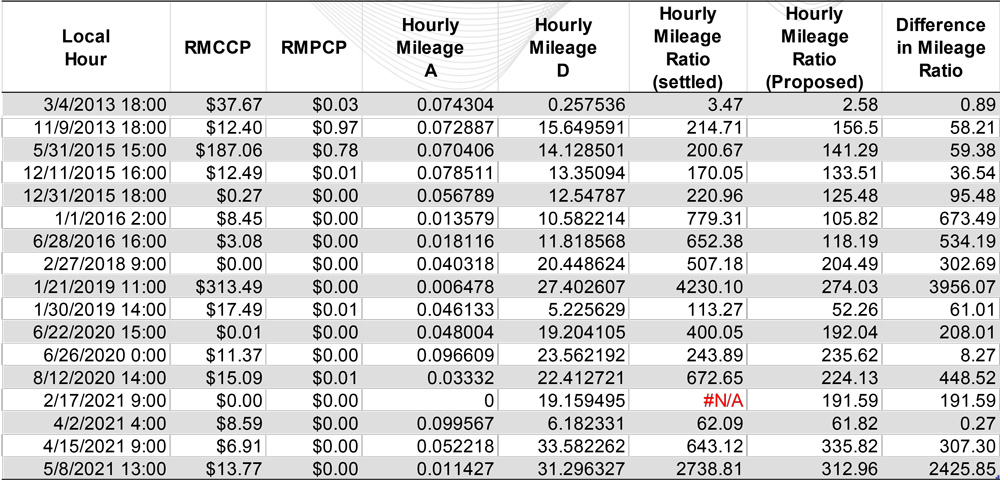
Instances of RegA hourly mileage rates less than 0.1 in PJM since 2013 | PJM
Michael Olaleye, senior engineer with PJM’s real-time market operations, reviewed the RTO’s proposed solution. Olaleye said PJM had not received any additional feedback from stakeholders since the issue was discussed at the August MIC meeting, and no changes had been made to the proposal.
Regulation mileage is the measurement of the amount of movement requested by the regulation control signal that a resource is following; it is calculated for the duration of the operating hour for each regulation control signal. PJM’s performance-based regulation market splits the dispatch signal in two: RegA for slower-moving, longer-running units; and RegD for faster-responding units that operate for shorter periods, including batteries. If a signal is “pegged” high or low for an entire operating hour, the corresponding mileage would be zero for that hour.
Olaleye said PJM has seen an increased frequency of RegA signal pegging and times the RegA signal is pegged for extended periods, highlighting a potential problem in the regulation mileage ratio calculation. The RegA mileage can be set at zero for a given hour and create a divide-by-zero error in the calculation of the mileage ratio.
PJM proposed setting the RegA mileage floor at 0.1 instead of zero, Olaleye said, which would allow for a “valid solution” for the ratio and still maintain market design objectives. He said the change would have no impact on the regulation signal design, operations or regulation market clearing.
Independent Market Monitor Joe Bowring presented a counterproposal, questioning PJM’s use of the 0.1 value. The IMM proposed a cap of 5.5 on the realized mileage ratio in all hours, indicating the cap would eliminate the current undefined mileage ratio result that PJM is attempting to address.
Bowring said the 5.5 cap would reduce but not eliminate the market distortion resulting from the use of mileage ratios when they incorrectly represent regulation output and that the change would affect less than 50% of impacted hours based on data collected by the IMM over the last 15 months.
Stakeholders ultimately rejected the IMM proposal, with 129 members voting against adoption (56%).
Gary Greiner, director of market policy for Public Service Enterprise Group, said the IMM’s proposal was “a lot more comprehensive,” and the solution suggested that there’s a problem with the way that the mileage ratio works. Greiner said it seemed the quick fix path was “not the right path to go down” if the problems are as comprehensive as the IMM’s proposal indicates.
Greiner said the divide-by-zero error could be solved “pretty easily without a lot of impact” by adopting PJM’s 0.1 proposal and come back with a more extensive stakeholder process in the future to address the milage ratio issues brought up by the IMM.
RPM Capacity Transfer Rights Rejected
A proposal by Buckeye Power to address the allocation of capacity transfer rights (CTRs) failed to win stakeholder approval.
Members rejected the proposal worked on for the last six months in the MIC, with only 55 voting in support (28%). Stakeholders originally endorsed Buckeye’s issue charge at the March MIC meeting with 79% support. (See “RPM Issue Charge Endorsed,” PJM MIC Briefs: March 10, 2021.)
Kevin Zemanek, director of system operations for Buckeye Power, reviewed Buckeye’s proposal regarding the allocation of CTRs, saying under the Reliability Pricing Model (RPM), CTRs return to load-serving entities (LSEs) capacity market congestion revenues that occur when there’s a difference between the prices paid by load and market revenue received by cleared resources. CTRs permit LSEs with load inside a constrained locational delivery area (LDA) to receive a credit for the import of capacity from a lower-priced region. (See “RPM Capacity Transfer Rights,” PJM MIC Briefs: Aug. 11, 2021.)
PJM does not have a way to allocate CTRs directly to an LSE with network resources outside a constrained LDA but whose resources have been designed as deliverable on the LSE’s network integration transmission service agreement. Instead, Zemanek said, PJM allocates CTRs pro rata to each LSE serving load in the LDA or zone based on the LSE’s share of the zonal unforced capacity obligation.
Buckeye’s proposal called for first allocating zonal CTRs to LSEs with historic generation resources identified as network resources in a network integration transmission service agreement (NITSA). The allocated CTRs will be “sufficient to meet the LSE’s daily unforced capacity (UCAP) load obligation but shall not exceed the total amount of the LSE’s generation capacity as identified on the LSE’s NITSA.”
Buckeye said the impact of the current rules vary from year to year; it said the rules cost it $10 million in the 2015/16 delivery year and $2.5 million in 2016/17.
The proposal would have recognized generation resources and transmission rights that existed prior to the implementation of RPM but would also terminate upon the retirement of a resource or a change in the designated resource status in the NITSA.
“These are not evergreen and would not last forever,” Zemanek said. “Based on the historical situations, we think this is minimal impact.”
Bowring said the IMM believes it’s inconsistent to use prior contracts to calculate network congestion. The current CTR process “certainly needs to be revisited” in the review of the PJM capacity market, he said, but it wasn’t appropriate to reevaluate it on a “one-off basis” with Buckeye.
“To the extent Buckeye is paid more, others will be paid less,” Bowring said. “And we don’t agree that there’s been any detailed analysis of what the ultimate impact will be.”
Peak Shaving Plan
Ed Rich, senior analyst with PJM’s capacity market operations, provided a first read of the problem statement, issue charge and solution addressing the peak shaving adjustment shortfall calculation in attachment D of Manual 19 through the “quick fix” process.
Rich said the peak shaving performance rating is used to correct the impact of approved peak shaving programs in the load forecast to be consistent with how the programs have performed when required to reduce load.
The current documented calculation for the megawatt shortfall in Manual 19 says, “For each hour of a required peak shaving event, a shortfall value is calculated as the aggregated metered load of all participants minus their aggregated customer baseline (CBL).” Rich said PJM has determined that the calculation is “erroneous” since “taking the difference of the metered load and the customer baseline will only calculate a shortfall value when a resource does not reduce but has a greater metered load than the customer baseline.”
Rich said PJM is proposing to change the shortfall value calculation as the “resource’s total participating megawatt minus the difference of their customer baseline (CBL) minus their metered load adjusted for line losses, capped at zero.”
Rich said the issue found by PJM has caused no incorrect shortfalls to be calculated because no peak shaving plans have been submitted and cleared in a capacity auction since the program was created.
“Instead of taking the average shortfall per event, using the total calculations for the year would be a more accurate representation of their total performance rating,” Rich said.
Bowring said he was a “little surprised” PJM was putting the issue through the quick fix process given that the key work activities and scope include providing background education on the issue. He said the issue could use more stakeholder discussion to grasp the concepts being changed.
Stakeholders unanimously endorsed manual changes regarding the incremental and no-load energy offers.
Tom Hauske of PJM’s performance compliance department reviewed the Manual 15: Cost Development Guidelines revisions regarding the incremental and no-load energy offer developed in the Cost Development Subcommittee (CDS). Hauske first introduced the revisions at the August MIC meeting. (See “Manual 15 Revisions,” PJM MIC Briefs: Aug. 11, 2021.)
“There are a lot of wholesale changes in Manual 15,” Hauske said.
The most significant manual changes came in section 2.3 for the definition of incremental energy cost, Hauske said, which states, “The incremental energy cost is the cost in dollars per MWh of providing an additional MWh from a synchronized unit.” The changes also include methods for market sellers to submit sloped, stepped or block loaded incremental offers into PJM’s Markets Gateway System.
The manual changes will go to the MRC for endorsement.
Energy Scheduling Practices Revisions Endorsed
Members unanimously endorsed revisions to the Regional Transmission and Energy Scheduling Practices document.
Chris Pacella, senior lead analyst in PJM’s transmission service department, provided an overview of the revisions. Pacella said the revisions consisted of three main drivers, including minor clarifications related to process improvements in the 2019 OASIS Refresh project, minor updates as part of a general review, and updates related to the North American Energy Standards Board’s Wholesale Electric Quadrant v3.2 Business Practice Standards that take effect Oct. 27.
PJM is asking FERC to delay the Base Residual Auction for the 2023/24 delivery year by almost two months, citing the commission’s Sept. 2 order revising the RTO’s market seller offer cap (MSOC).
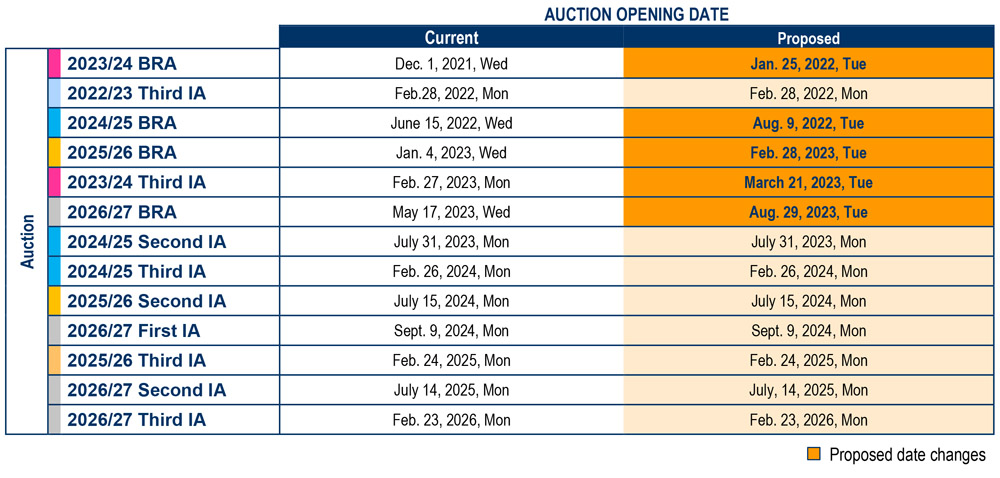
In a compliance filing Friday, PJM recommended delaying the start of the 2023/24 BRA by 55 days, from Dec. 1 until Jan. 25, 2022 and the 2023/24 third incremental auction from Feb. 27, 2023 to March 21, 2023 (ER21-2877). The filing also seeks to change the starts of subsequent Reliability Pricing Model (RPM) auctions, moving the 2024/25 BRA from June 15, 2022 to Aug. 9, 2022; the 2025/26 BRA from Jan. 4, 2023 to Feb. 28, 2023, and the 2026/27 BRA from March 17, 2023 to Aug. 29, 2023.
PJM said changing the dates of the RPM auctions is necessary to maintain the six-and-a-half-month gap between auctions so that market participants “have sufficient time to review the results of each auction before deciding whether to continue offering a resource in the subsequent auction.”PJM’s updated RPM auction schedule through the 2026/27 delivery years. | PJM
The RTO said its request was prompted by FERC’s Sept. 2 order adopting the Independent Market Monitor’s unit-specific avoidable cost rate (ACR) proposal and requiring PJM to revise its tariff (EL19-47, EL19-63, ER21-2444). The Monitor’s proposal followed FERC’s March order requiring PJM to revise the MSOC to prevent sellers from exercising market power in the capacity market. (See FERC Backs PJM IMM on Market Power Claim.)The RTO said the auction delay was necessary to give capacity market sellers and the Monitor a “realistic opportunity” to appeal the RTO’s final decisions on unit-specific offer cap requests resulting from the MSOC rules change.
“PJM does not make the decision to seek a further delay of the already delayed upcoming BRA lightly,” the RTO said in its filing. “PJM strongly believes the three-year forward nature of the capacity auctions is a critically important feature of the Reliability Pricing Model construct and would prefer to expeditiously conduct the upcoming auctions without delay. At the same time, however, given the expected volume of unit-specific requests stemming from the significant change to the MSOC rules, PJM believes that a revised timeframe must be established to allow for an orderly and complete Market Monitor and PJM review of all such requests.
Stakeholder Opinions
PJM received mixed feedback on the proposed delay at last week’s Market Implementation Committee meeting.
Chen Lu of PJM provided an overview of the capacity MSOC order, while Pete Langbein, manager of PJM’s demand side response operations, presented the draft timelines for the pre-auction activities for the upcoming BRA impacted by the order and the timing of the auction.
Langbein said PJM attempted to focus the timeline changes on the pre-auction tasks and activities that were “clear and transparent” to avoid stakeholder confusion. Langbein said the RTO was searching for a way so stakeholders would have a “reasonable amount of time” to finish their activities for the auction.
“The BRA auction and the associated timeline is pretty complicated, and there are a lot of dependencies between the different activities,” Langbein said. “There’s a bit of a dance to make all these different dates work.”
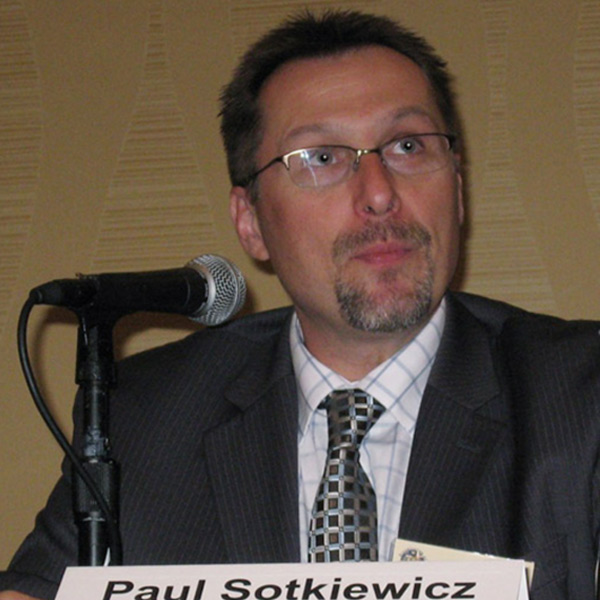
Paul Sotkiewicz of E-Cubed Policy Associates said he thought it would be better for his clients to have PJM compress the timeframe and “keep the auctions moving on time.”
Jason Barker of Exelon said he appreciated PJM’s attempt to balance the “orderly administration of the auction” by proposing a delay. But Barker said Exelon “tilted towards” the idea of keeping the December auction on schedule and that one of the company’s biggest concerns with changing dates was the possibility of having to redo any ACR submittals that had already been submitted.
Market Monitor Joe Bowring said that, without a delay, generation owners would have eight days to complete their ACR filings, which would be “close to impossible” for anyone having to make new ACR submittals.
“We all like to live in a completely certain world with certain deadlines, but that’s not where we are,” Bowring said, adding that PJM is “likely to see some more uncertainty” in the capacity auctions when the minimum offer price rule (MOPR) order is finally decided.
Jim Benchek of FirstEnergy said he would “urge” PJM to file the delayed schedule. Benchek said if a market seller didn’t anticipate having to go through the unit-specific net ACR calculation process, completing the process in eight days is “almost an impossible amount of time.”
“You need to afford market sellers the right amount of time to do things thoroughly and correctly,” Benchek said.
Langbein said no matter what timeline is ultimately approved by FERC, the process is going to be new for many stakeholders and will create a large volume of requests.
“We do not believe this is something administrative that’s going to be easy to do,” Langbein said.
MSOC Order
In March, the commission ordered PJM to revise its MSOC, siding with arguments made in separate complaints filed in 2019 by the IMM and several consumer advocate groups that challenged the RTO’s Capacity Performance (CP) assumptions and arguing the existing rules were allowing sellers to exercise market power.
In August 2018, the Monitor concluded that PJM ratepayers were overcharged by $2.7 billion (41.5%) in the 2018 BRA because of “economic withholding” encouraged by the inflated MSOC. (See IMM: PJM 2018 Capacity Auction was ‘Not Competitive’.)
Unit-specific MSOCs are to be based on avoidable costs and the opportunity cost of taking on a CP obligation, the Monitor said, including expectations of bonus payments or penalties for performance during an emergency. The timespan for measuring performance was changed from PAHs to five-minute performance assessment intervals (PAI) in compliance with FERC Order 825 in 2018.
A PAI is triggered when PJM determines a supply reliability issue exists, providing credits for generators that overperform their capacity commitments and penalties for those who underperform.
The Monitor originally suggested using 60 PAIs or five PAHs — compared with the current 360 PAIs/30 PAHs — in calculating a more appropriate seller cap.
FERC ordered PJM and its stakeholders to determine a suitable replacement rate within 45 days of the filing in March, addressing the “appropriateness of using different values” for penalty PAI and expected PAI in the default CP MSOC calculation and a method for setting each value.
Ultimately the IMM’s unit-specific ACR proposal filed on April 28 won out over three other proposals submitted to the commission.
The unit-specific ACR proposal said offers should be capped at the resource’s unit-specific net ACR, meaning “unit-specific gross ACR minus forward-looking net energy and ancillary service revenues, with the option to use the technology-specific default gross ACRs minus unit-specific forward-looking net energy and ancillary service revenues.” The Monitor said the commission recently accepted technology-specific default gross ACRs in the MOPR proceeding.
The IMM said its proposal would be a “return to the requirements prior to the introduction of CP, when offers were capped at unit-specific net ACR.” The Monitor said it already has experience with calculating unit-specific and default net ACR offer caps in the capacity market, and the process is “manageable from an administrative perspective” as the PJM tariff already includes a formula for the unit-specific gross ACR review.
FERC said the unit-specific ACR proposal was preferable to the three other options presented to the commission because it would “best ensure the capacity market’s overall competitiveness and enable the Market Monitor and PJM to sufficiently review and mitigate offers to prevent the exercise of market power.”
“We recognize that eliminating the default offer cap will likely create more work for the Market Monitor and sellers by requiring the individual review of a higher number of capacity offers,” the commission said in its order. “But we find that such review is reasonable and needed to address potential market power abuse in PJM. The other proposals would result in the review of fewer offers, and potentially not the marginal offer(s), and therefore be less effective at identifying and mitigating the exercise of market power in PJM.”
Commissioner James Danly dissented from the Sept. 2 order, saying it “risks over-mitigation.” Danly said fixing the default offer cap would be a “far better solution than the alternative supported by the majority,” which “jettisons” the offer cap for a “full unit-specific review of all offers above zero.”
Danly said the unit-specific review will give “extraordinarily broad new powers” to the IMM to “second guess” the judgment of market sellers. He said the commission will be the only “check” on the review powers of the Monitor and that FERC “should not be in the business of determining seller offers in advance of auctions.”
“There are problems with the current default offer cap, but unit-specific review of all resources is far too invasive a ‘remedy,’” Danly said. “It should be clear to anyone paying attention that PJM’s market design is becoming increasingly discriminatory against existing generators. It is swift becoming unduly so. And the more we redesign our markets into elaborate cost-justification exercises, the fewer of the benefits promised by markets can be realized.”
PJM Filing
Besides adopting the IMM’s proposal, FERC also accepted a waiver request filed by PJM in July regarding certain pre-auction deadlines in the event a lower value for the replacement default offer cap was established (ER21-2444).
In Friday’s filing, PJM said the potential volume of unit-specific requests stemming from the “significant change to the offer cap rules” necessitates establishing a new timeframe that “allows for orderly and complete IMM and PJM review of all such requests, and the ability for stakeholders to appeal PJM’s final decisions to the FERC prior to executing the auction.”
“There is simply no realistic scenario for PJM and the Market Monitor to review and make final unit-specific offer cap and must-offer determinations more than 60 days prior to the currently scheduled Dec. 1, 2021 BRA,” PJM said in its filing. “This modest delay will allow 60 days for capacity market sellers and the Market Monitor to seek remedies from the commission prior to the commencement of the next BRA. This is necessary and appropriate given PJM’s expectation that many capacity market sellers and/or the Market Monitor will inevitably disagree with the final unit-specific offer cap determinations. Indeed, based on the information currently available to PJM, none of the unit-specific offer caps requested to date under the existing pre-auction deadlines for the 2023/2024 BRA have been accepted by the Market Monitor.”
PJM’s proposal calls for new deadlines for capacity market sellers to submit a must-offer exception request associated with resource deactivations and a unit-specific offer cap, moving the current deadline dates of July 19 and Aug. 3 to Oct. 1. The RTO said the new deadlines provide market sellers three weeks to determine whether to seek a unit-specific offer cap and to prepare necessary supporting documentation.
“Consolidating the deadline for these submissions to the same date will save some time and allow PJM to conduct the upcoming BRA without significant additional delays,” the RTO said.
PJM also proposed to push back the deadline for the IMM to review and propose a recommendation on market sellers’ unit-specific offer cap and/or must-offer exception request associated with resource deactivations to Oct. 31. The RTO said the change will give the Monitor its usual 30-day period from the unit-specific offer cap and must-offer submission deadline to “review and provide its proposed recommendation of various unit-specific offer cap and must-offer exception requests.”
The schedule changes provide market sellers with five days to review the IMM’s recommendation and notify PJM and the Market Monitor whether it agrees with the unit-specific offer cap or must-offer exception associated with resource deactivations proposed by the Market Monitor.
PJM said it proposed to maintain the normal 25-day period for the RTO to make its final determination on disagreements in the unit-specific offer cap and/or must-offer exception requests, setting the date at Nov. 25 instead of Sept. 27.
“Capacity market sellers will all retain the opportunity to offer resources into the RPM auction sufficiently in advance of the delivery year even with this modest delay and resources that clear the auction will continue to receive capacity revenues during the delivery year,” PJM said.