PJM Operating Committee Briefs: Sept. 10, 2021

Manual 14D Endorsed

PJM stakeholders unanimously endorsed manual updates related to behind-the-meter generation (BTMG) business rules on status changes developed in special sessions of the Market Implementation Committee.

Terri Esterly, senior lead engineer in PJM’s markets automation and quality assurance department, reviewed Manual 14D: Generator Operational Requirements updates to appendix A during last week’s Operating Committee meeting. Stakeholders endorsed related changes to Manual 14G at the Aug. 31 Planning Committee meeting. (See “Manual 14G Updates Endorsed,” PJM PC/TEAC Briefs: Aug. 31, 2021.)

Esterly said PJM made no changes to the updates since she first presented the manual changes at the August OC meeting. (See “Manual 14D Updates,” PJM Operating Committee Briefs: Aug. 12, 2021.)

The updates to Manual 14D were intended to address conflicts with the Reliability Pricing Model must-offer requirement and “removal from generation capacity resource status” business rules, Esterly said. Updates included addressing performance obligation impacts, clarifications to business rules regarding load impacts from status changes, and participation in PJM’s load response.

In a section on designating capability as a generation capacity resource and/or an energy resource, PJM added a business rule to make it clear a new service request must be submitted for the designation, Esterly said. Another rule was made to clarify the process to request a change from BTMG status to generation capacity resource status.

In the section on participation in PJM load response, Esterly said the RTO added the process to indicate that a BTMG unit is participating in PJM load response by providing on-site generator data.

The manual updates now go to the Sept. 29 Markets and Reliability Committee meeting for a first read and endorsement at the Oct. 20 MRC meeting.

Manual 01 Changes

A manual attachment created last year in the wake of COVID-19 emergency protocols is set to become permanent and changed to address other emergency situations.

Chris Moran, senior lead analyst with PJM’s NERC compliance team, provided a first read of updates to Manual 01 Attachment F: Control Center and Data Exchange Requirements regarding the RTO’s market operation centers being able to conduct remote operations.

Moran said attachment F of Manual 01 was originally developed and implemented at the start of the COVID-19 pandemic to provide guidance for remote operations “should imminent risk of COVID-19 start to affect staffing” in PJM’s market operation control centers. The temporary attachment, which became effective in April 2020, was set to expire on Dec. 31 of this year.

As the pandemic has progressed, Moran said, it has “become apparent” to PJM that attachment F needs to become a permanent part of Manual 01. Several stakeholders also had suggested making the attachment permanent at a previous OC meeting. (See “COVID-19 Update,” PJM Operating Committee Briefs: June 10, 2021.)

Moran said PJM wanted to make attachment F broader so that it doesn’t simply apply to COVID-19. The language changes include replacing COVID-19 with “exceptional circumstances,” which include severe weather, natural disasters, civil unrest and other pandemic events.

PJM’s definition for exceptional circumstance says, “an event or effect that can be neither anticipated nor controlled, including but not limited to any act of a public enemy, war, insurrection, riot, fire, severe weather, natural disaster, flood, civil unrest, explosion, pandemic or other public health emergency, as reasonably determined by PJM.”

The attachment changes also include updating NERC compliance contact information for PJM.

The OC will vote on the manual changes at its October meeting.

COVID-19 Update

Becky Carroll of PJM provided an update on the RTO’s response to COVID-19, saying staff is reviewing Occupational Health and Safety Administration rules regarding vaccinations recently announced by the Biden administration.

Carroll said PJM is “still evaluating” the new rules that would require vaccinations or a weekly negative COVID-19 test for any company over 100 employees. She said PJM will be communicating more details to its employees and stakeholders following consultation with the RTO’s legal counsel, its epidemiologist and the executive team.

“As we’re thinking about this new rule, we’ll be taking the safety and wellbeing of PJM staff into account, given that’s paramount,” Carroll said.

Some PJM stakeholders have been arguing for several months that the RTO should mandate vaccinations for all its employees. (See “COVID-19 Update,” PJM Operating Committee Briefs: Aug. 12, 2021.)

Ken Foladare of Tangibl Group said he understands that PJM must consult with its legal counsel over the regulations, but he said other large organizations already had mandated vaccines for their employees to come back to the office. Foladare said he found it “disappointing” that PJM had not taken similar measures to mandate vaccines.

Mike Bryson, PJM’s senior vice president of operations, said the RTO “continues to appreciate” the positions of stakeholders. Bryson said PJM CEO Manu Asthana has had discussions with senior leadership of member companies about their stance on vaccinations.

“We continue to evaluate the way our posture has been in the interest of protecting staff that has to come on campus,” Bryson said.

Adrien Ford of Old Dominion Electric Cooperative asked if there has been any change in PJM’s plan to have staff return to the Valley Forge campus given the rising cases of COVID-19. Staff were originally scheduled to start coming back to the campus by Sept. 1.

Carroll said PJM is evaluating the plan to return to campus “on a two-week basis” and have delayed the return until the middle of September. She said staff will receive another update on Sept. 13 to determine if they can return to campus or delay it for another two weeks.

“We are going to continue to evaluate on a two-week cycle,” Carroll said.

Report: Renewable Developers Footing Tx Upgrade Bills

Developers of new wind and solar projects in MISO’s and SPP’s generator interconnection queues are being asked to foot nearly the entire bill when connecting to the grid, while the entire system typically benefits from significant transmission upgrades, according to an ICF Resources report released Thursday by the American Council on Renewable Energy.

ICF, a global consulting services company, said its modeling of recent network upgrades assigned to the RTOs’ new wind and solar projects found that many of these upgrades, if built, would deliver significant benefits to the grid. “The cost allocation fails to consider potential regional economic benefits from these network upgrades,” the authors wrote.

“This report confirms what many people have long believed: that network upgrades required of interconnecting generators often provide broader system benefits, even though the cost of the upgrades falls on the developers,” former FERC Chair Norman Bay, now a partner with Willkie Farr & Gallagher, said during a press event Thursday organized by ACORE.

The report, “Just and Reasonable? Transmission Upgrades Charged to Interconnecting Generators Are Delivering System-Wide Benefits,” says the RTOs’ most recent system impact studies show network upgrade costs in the range of $270 (MISO South) to $448/kW (SPP).

MISO’s most recent definitive planning phase (DPP) study for its generator interconnection queue found nearly $2.5 billion worth of upgrades were needed to interconnect 9.2 GW of generation in MISO South, according to ICF. Similarly, SPP’s most recent definitive interconnection system impact study (DISIS) identified more than $4.6 billion worth of network upgrades to help interconnect 10.4 GW of generation.

The study’s 12 short-listed projects in MISO and SPP. | ACORE“Given the over-subscribed power grid, interconnection customers are being allocated the full cost of adding new lanes to the highway and are increasingly responsible for building new highways,” the authors wrote.

Under current cost allocation rules, project developers in both regions are responsible for paying for nearly all the upgrades’ costs, potentially violating the “beneficiary pays” principle and the Federal Power Act’s “just and reasonable” requirements. Under FERC’s “beneficiary pays” principle, RTOs are required to ensure that transmission costs are assigned at least “roughly commensurate with estimated benefits.”

The costs are assigned directly to generators in SPP. In MISO, generators are responsible for 90% of the cost for upgrades 345 kV and higher, with 10% allocated regionally. Those below the threshold pay 100%.

“At the end of the day, our customers are bearing the costs of the projects that we’re selling to them,” Matt Pawlowski, NextEra Energy’s executive director of business management and regulatory affairs, said Thursday. “If a significant amount of the upgrade costs is borne on us, we’re passing those on to the customer. Whether it’s a corporation or the ultimate end user of a utility, the ratepayers end up paying for that.”

Pawlowski and Caroline Golin, head of energy markets and policy for Google, both called for a change in RTOs’ planning practices, saying they no longer match a system that is flush with renewable energy projects.

“I think we’re being foolish if we don’t recognize we need to massively overhaul our transmission planning system. That starts with a general recognition that we are throwing money out the door by not doing that, and we are harming our community and the [renewable] industry,” Golin said.

Matt Pawlowski, NextEra Energy | SPPRenewable generation interconnection requests have risen exponentially in both MISO and SPP as wind and solar energy prices have continued to decline and states and corporate buyers seek to meet their renewable standards and goals. MISO and SPP have more than 150 GW of active solar, wind and hybrid resources stuck in their interconnection queues across both markets. At the time of the study, 92% of the 79 GW of requests in MISO’s queue and 95% of the 103 GW of requests in SPP’s queue were from those resources.

FERC is considering whether to re-evaluate how grid operators allocate costs for new projects seeking to connect to the grid. In July, the commission opened an Advanced Notice of Proposed Rulemaking (RM21-17) to reconsider its transmission planning, cost allocation and interconnection rules. (See FERC Goes Back to the Drawing Board on Tx Planning, Cost Allocation.)

Bay called the ANOPR “timely.”

“The big tension seems to be between two principles at FERC,” he said. “On the one hand, cost causation, and on the other hand, beneficiary pays. This study shows in many instances, the beneficiary-pays principle in RTO markets is not being fully followed. This, in turn, creates a classic free-rider problem and may result in undue burden being imposed upon developers.”

SPP did not respond to the report by press time. A MISO spokesperson said the RTO is focused on its long-range transmission planning initiative and it has not reviewed the study. The grid operator has repeatedly said the plan will support the changing resource mix. (See MISO Targets March Approval for Long-term Tx Projects.)

Both RTOs are currently engaged in a joint effort to find interregional transmission projects that can help ease their crowded interconnection queues. (See MISO, SPP Offer Idea on Joint Interconnection Tx Allocation.) SPP is also involved in several initiatives to consolidate and improve its own planning process.

ICF worked closely with staff in both regions in developing the assumptions and modeling used in the report, which it produced for ACORE and its Macro Grid Initiative and American Clean Power Association collaborators.

The analysts used “very conservative” assumptions in evaluating the economic benefits of a representative sample of upgrade projects assigned through the MISO and SPP interconnection processes over the last seven years. They screened nearly 230 upgrades spanning four SPP DISIS studies (2014-2017) and 433 network upgrades covering four MISO DPP studies (2016-2020) in shortlisting six network upgrades in each RTO.

Ten of the study’s 12 network upgrades provided positive adjusted production cost benefits.

The study design, including screening process and criteria to shortlist, was shared with both RTOs’ staffs. The final set of shortlisted network upgrades was made after consultation with MISO and SPP.

SPP: Consolidating Tx Planning Could Yield Big Savings

SPP staff and stakeholders last week discussed high-level recommendations for consolidating the RTO’s transmission planning processes, an initiative the RTO says could save $9 million annually by 2030 while also producing a more holistic view of its transmission needs.

“I think there’s even more value to be gained from this,” predicted SPP COO Lanny Nickell, who said a business case that “fleshes that out” is being developed.

“By consolidating the processes and trying to meet all the needs with single study process — whether it’s new generation that want to be interconnected or load growth — we believe there’s a lot of value to be gained by deriving the optimal transmission set … in more equitable fashion than today,” Nickell said.

During an education session Wednesday, Nickell told the Markets and Operations Policy Committee that SPP’s current planning processes cost about $28.5 million annually, but that the new consolidated process is projected to cost $25.5 million during its first three years and $24.7 million in Year 4 and beyond. Savings are expected to reach up to $8.9 million by 2030.

COO Lanny Nickell says consolidated planning process could result in $9 million in annual savings by 2030. | © RTO Insider“That’s just staff savings, accrued as a result of improving the planning process’ efficiency,” Nickell said.

Staff currently spends more than 132,000 hours annually in the planning processes, a number that is projected to drop by nearly 14,000 hours with consolidation. Nickell said it will take two to three years and $7.5 million to implement the consolidated approach.

The Strategic Planning Committee last year created the Strategic and Creative Re-engineering of Integrated Planning Team (SCRIPT) to analyze the RTO’s interconnected planning processes and applicable cost-allocation methods. (See “SPC Takes Look at Tx Planning,” SPP Briefs: Week of Aug. 31, 2020.)

The SCRIPT created six sub-teams, comprised of its members and SPP staff, to focus on consolidation, services, optimization, decision quality, transfers and cost-sharing. They have produced 48 recommendations and sub-recommendations over more than 60 meetings and 11 months. The SCRIPT has provided feedback on the recommendations, which are under review and likely to change.

Nickell said the team is nearing the end of its policy development and plans to share its results and a final version of its draft report during the October governance meetings.

“We do have some work ahead of us,” he said. “There’s going be another group of recommendations that will enable more benefits from having a consolidated process.”

The sub-team working toward an “appropriate consolidation” of SPP’s Integrated Transmission Planning (ITP), generator-interconnection and transmission service studies, is central to SCRIPT’s success. It recommended:

  • creating a common base model set to meet regional planning needs required by SPP’s Tariff and NERC reliability standards;
  • modifying the high-priority study planning assessment requirements to provide additional scope flexibility and allowing it to be performed on an as-needed basis;
  • expanding the model data systems used for collection and review, and developing automation and an intermediary database with links to existing regional planning tools to better correlate input data, processes and study outcomes; and
  • staff and stakeholders work together to evaluate, approve and build out design- and implementation-level processes for one of the two consolidated options for customer optionality, cost-certainty of assigned upgrades, and regulatory planning compliance.

The team’s two-phase approach involves first consolidating ITP, GI, transmission service, NERC transmission planning, and local planned transmission system changes processes. That would be followed by combining system load, sponsored upgrades, and generator retirement processes.

“We are going to be bound by NERC requirements to some degree. We’re going to have to keep some studies on track,” SPP’s Kelsey Allen said.

Allen said staff is considering providing “fast-track” options to quickly connect resources. “We’re hoping to be able to create a lot more efficiency in the processes than we have today, and that comes from the first consolidation,” he said.

Antoine Lucas, SPP’s engineering vice president, said his optimization sub-team recommendation that SPP develop a process to conduct holistic planning needs and solutions assessments complements the consolidation recommendations.

“It gives guidance on the approach and how to do that,” he said. “This really is all about identifying the projects that provide the most value to the overall region, but that also bolster the reliability expectation we have.”

Under the recommendation, staff would assess proposals for addressing market efficiency, public policy needs, and reliability issues for network load service and GI requests. Once the portfolio is established, staff could then conduct an impact analysis of GI requests and applicable transmission service requests impacts and use the results as a component of cost-sharing considerations.

“The fact [is we] don’t know what’s going to come out of the planning process. We do believe we can increase the value of transmission portfolios that are being recommended and approved,” Nickell said.

The Generator Outage Task Force (GOTF) also briefed MOPC during the education session on its work to address outage-scheduling practices and concerns over how to reliably schedule outages given the changing resource mix.

The task force was created after SPP declared a Level 1 energy emergency alert and it called for conservative operations 10 times in 2019. The grid operator attributed six of the 10 operations events to generation outages.

The group is recommending a generation assessment process that includes a long-term horizon (five years) and a short-term view (the next seven days). The assessment’s wind, demand, capacity and outage, and forced unscheduled outages will serve as inputs to determine the number of maintenance outages that can be taken without threatening reliability.

The GOTF is also urging SPP to change the outage/derate reporting threshold from 25 MW to 10 MW and to allow forced outages to have up to seven days of maximum lead time, so that they align with NERC’s generating availability data system.

The recommendations will be finalized during the task force’s next meeting Sept. 24.

Eastern Wash. Solar Projects Endanger Sensitive Habitat

A horde of solar developers want to set up projects in Eastern Washington, but the majority don’t appear to be doing their research early enough on the sensitive shrub steppe habitat that is prime turf for solar farms.

That is what the Habitat Committee of the state’s Fish and Wildlife Commission learned Tuesday.

The lack of attention is important because most of the proposed solar farms in Washington have targeted shrub steppe land east of the Cascade Mountains. Shrub steppe is a mostly treeless semi-desert filled with sagebrush that is home to several species of birds and mammals that are watching their habitats shrink. These include sage grouse, sharp-tailed grouse and pygmy rabbits. 

Wildfires, agricultural fields and expanding cities and towns have chewed into the state’s original 10.4 million acres of shrub steppe, trimming it to 40% of its original size. Solar farms will further encroach on the remaining shrub steppe, Michael Ritter, a Washington Department of Fish and Wildlife (WDFW) habitat biologist told the committee.

Washington has 37 solar farms in operation, being built or on the drawing board, Ritter said. Thirty-five are east of the Cascades in or next to shrub-steppe lands; only two are west of the mountain range.

So far, only one of the eastern solar farms is operational, while two are being constructed and four are going through state permitting processes. Another 28 are on the drawing board, taking care of the homework needed before tackling the permitting processes, Ritter said. It usually takes one to two years of preliminary work before a solar project is ready to be unveiled, he added.

“These projects are already doing a lot of work in the background,” he said. 

WDFW staff and Habitat Committee members voiced concern about solar developers neglecting to investigate sensitive species and habitat issues prior to locking themselves in to specific sites. 

“There is a big public sense that these companies … will get a bit of a free pass [in getting their projects approved],” said committee member Molly Linville, a rancher and farmer in central Washington’s Douglas County. 

Ritter said, “They ask me how to mitigate for the sage grouse. There is no mitigation. You don’t build there. … It’s like they think when they get into the permitting process, it’s going to happen. We may tweak it a little bit, but it’s going to get in. That’s too late. I wish the companies would reach out to us first.”

Linville noted that plans for three solar projects have recently appeared in Douglas County. None are far enough along to apply for permits, and none have researched habitat issues. She found out about them through news reports and the local grapevines. 

Committee members said something must be done to get developers to inquire about sensitive habitat issues early in their brainstorming.

“We shouldn’t be put in the position of having to defend against green energy with our conservation needs. …. It’s a no-win situation,” said committee member Barbara Baker, an Olympia attorney.

The full commission is scheduled to discuss the matter on Sept 17.

Stakeholders Still Seeking Transparency from ISO-NE, NEPOOL

Speaking on a panel at the quarterly meeting of ISO-NE’s Consumer Liaison Group on Thursday, the always outspoken Tyson Slocum, director of Public Citizen’s energy and climate program, did not mince words.

For more than 20 years, ISO-NE and NEPOOL have “essentially privatized public policymaking as private entities” through their respective administrations of the New England electric grid and stakeholder process, Slocum said. “There is inadequate transparency and accountability in these institutions that don’t reflect the public interest nature of what they’re doing.”

The Consumer Liaison Group holds open public forums to help regional consumers understand what is happening at the RTO. Slocum told it that “sweeping” reforms are needed to improve transparency and accountability. Neither ISO-NE Board of Directors nor NEPOOL stakeholder meetings are open to the public.

Opening NEPOOL stakeholder meetings to the interested public, plus recording and transcribing them, would be a start. It should be followed by a responsive ISO-NE board and reorientation of the NEPOOL voting sectors to make it less than “totally utility centric.” Currently, stakeholders are broken into six weighted sectors: Generation, Transmission, Supplier, Alternative Resources, Publicly Owned Entity and End User.

“This has no realistic application to all of the people that are actually impacted by our electricity system,” Slocum said.

Echoing Slocum’s call for changes, Jolette Westbrook, director and senior attorney for energy markets and regulation at the Environmental Defense Fund, said there is one significant barrier for most people needed to be eliminated: the cost of participation. NEPOOL membership fees range from $500 for End Users to $5,000 for Generation, Transmission and Supplier members.

“I’m sorry, we just have to realize that what one entity can afford may not be affordable to others,” Westbrook said.

Rebecca Tepper, chief of the Energy and Telecommunications Division in the Massachusetts Attorney General’s Office, said that although ISO-NE’s budget comes from collecting fees from market participants and ratepayers, “nobody seems to question the fact that we’re spending millions of dollars to have the utilities participate in these proceedings and customers pay for that.”

Tepper noted that governance of ISO-NE was one of the areas that the New England States Committee on Electricity identified in its vision statement in October 2020. In the follow-up report to the region’s governors in June, NESCOE noted that the agendas of ISO-NE board meetings “indicate governance and transparency discussion; however, no process has been convened or proposal advanced” with the states.

“One of the three things that the states had requested is the one that has not made much progress, or at least not to the outside world,” Tepper said. “I think it would be good to see that move forward and have some real dialogue about how the governance process can be more accommodating to people.”

Slocum said that a multistate RTO like ISO-NE faces different governance challenges than single-state grid operators, like CAISO and NYISO. Still, there are lessons to learn, especially with appointments to the board. CAISO had a similar board structure to ISO-NE until the Western energy crisis spurred the California State Legislature to give the governor power to appoint or remove CAISO board members.

“It’s a little more challenging to replicate that in New England, but it’s important to state that [CAISO] is seen as an active partner with the state’s ambitious climate and clean energy goals,” Slocum said.

There is often conflict between New England states’ policy goals and ISO-NE. Slocum said the way to align them is to have a board that is “directly accountable to either the states or to the communities within [the RTO’s] footprint.”

“This theoretical model that the ISOs came up with in the late ’90s to have a dispassionate board that is supposed to be directly responsive to the needs of folks within the ISO footprint has failed,” Slocum said. “We need to have a different governance structure that that has direct lines of accountability because that failure and lack of accountability is what’s driving most of the problems.”

Western EIM Approves ‘Sub-entity’ Participation

The Western Energy Imbalance Market’s Governing Body approved the admission of “sub-entity” participants Wednesday, allowing utilities within the balancing authority area of a main WEIM participant to schedule and settle loads and resources independently.

The decision, which fell under the Governing Body’s primary approval authority in its shared authority with CAISO, was part of CAISO’s efforts to bring Xcel Energy’s Public Service Company of Colorado (PSCo) back to the WEIM.

In December 2019, PSCo said it would join the WEIM along with three utilities in its BAA — Black Hills Colorado Electric, Colorado Springs Utilities (CSU) and Platte River Power Authority — under a joint-dispatch agreement.

But in June, PSCo announced it was putting its WEIM plans on hold after CSU decided instead to join SPP’s Western Energy Imbalance Service (WEIS), with the intention of becoming a full RTO member. (See Xcel Delays Joining EIM to Examine Options.)

CAISO has been working with PSCo to convince it, along with Black Hills and Platte River, to join the WEIM.

Establishing sub-entity scheduling coordinators could bolster that effort, CAISO Vice President of Market Policy and Performance Anna McKenna wrote in her memo to the WEIM Governing Body.

“In addition to being applicable throughout the EIM, the EIM sub-entity category is an important provision for implementing the Public Service of Colorado balancing authority area into the EIM,” McKenna said. “The proposal allows PSCo to preserve the existing commercial arrangements that most of the various utilities in its balancing authority area operate under.”

CAISO’s plan to allow sub-entities “to settle load imbalances directly with the ISO” defines a load zone for each sub-entity. The EIM sub-entities would then submit base schedules for their load directly to the ISO, McKenna wrote.

“Base schedules are the load and supply schedules that reflect EIM participants’ planned operation and are used as the baseline against which imbalance energy is settled in the EIM,” she explained.

“The ISO will model each sub-entity’s load in the market as a customized distributed load aggregation point,” McKenna said. “This will enable the ISO to use existing practices to settle directly with the sub-entity.”

CAISO management proposed, and the Governing Body agreed, that the EIM sub-entities should be limited to those that are electric utilities embedded within an EIM entity balancing authority area that “do not receive long-term wholesale full requirements services from the EIM Entity.”

Eligible sub-entities must own distribution or transmission lines directly connected to the transmission system of the EIM entity “for the purpose of providing regulated electric service to eligible retail or wholesale customers.” They can also be a public utility that owns customer-serving resources, the CAISO plan said.

“Establishment as an EIM sub-entity is subject to the approval of the EIM entity that operates the balancing authority area in which the potential sub-entity is located,” McKenna wrote.

Stakeholders generally supported the plan, though some voiced concerns about introducing complications and confusion into the WEIM’s real-time interstate trading market.

The five members of the Governing Body unanimously endorsed the proposal.

DOE Orders CAISO Emergency Reliability Measures

The U.S. Department of Energy approved CAISO’s request last week for an emergency order allowing it to run natural gas plants that may exceed federal pollution limits as the ISO tries to maintain grid stability in the next two months.

“I hereby determine that an emergency exists in California due to a shortage of electric energy, a shortage of facilities for the generation of electric energy and other causes, and that issuance of this order will meet the emergency and serve the public interest,” Deputy Energy Secretary David Turk wrote in his order.

CAISO applied for the emergency order so that six generators, including aging power plants and new mobile units at existing facilities, can run free of emissions restrictions, starting this week, to provide up to 200 MW of additional supply.

“The CAISO respectfully requests that [Secretary of Energy Jennifer Granholm] issue the requested emergency order by Sept. 10, 2021, or a soon as possible thereafter, authorizing specific electric generating resources located within California to test and operate at their maximum generation output levels when directed to do so by the CAISO, notwithstanding air quality or other permit limitations,” CAISO COO Mark Rothleder wrote to Granholm.

CAISO’s cited reasons include high temperatures in the West, wildfires that threaten the bulk power system, and “drought conditions [that] are greatly affecting the availability of hydroelectric power.”

“Given these circumstances, state officials have identified a need to secure additional generating capacity to meet expected electricity demand and reserve requirements,” Rothleder wrote.

“Despite efforts undertaken by load serving entities and the CAISO to secure additional generating capacity, the CAISO continues to forecast potential supply deficiencies,” he said. “For September, the CAISO continues to forecast a significant supply deficiency to meet planning reserve requirements during evening hours.

“Granting this request for an emergency order and authorizing the operation of additional generating capacity identified in this request when conditions merit is critical to the CAISO maintaining reliability and meeting its load obligations,” he wrote.

Use Only in a Level 2 Emergency

Two of the covered resources — Greenleaf Unit 1 in Sutter County and Roseville Energy Park in Placer County — are working with the state to deploy new generating capacity by mid-September, a crucial time in California when temperatures can rise while hydroelectric generation dwindles. The 30-MW mobile units are part of the California Department of Water Resources’ efforts to add capacity.

“These covered resources will not have completed federal environmental permitting requirements by this date and will not operate unless they are subject to a DOE emergency order,” CAISO said.

The mobile units “are not equipped with best available control technology to control emissions and have not completed permitting processes to obtain their operating permit under Title V of the Clean Air Act,” the ISO said.

Four older units that could be covered by a DOE order are the Midway Sunset Cogeneration Facility Unit in Kern County, the Alamitos Energy Center in Long Beach, the Huntington Beach Energy Project in Orange County, and the Walnut Creek Energy Park in the city of Industry, near Los Angeles.

CAISO “understands that the electric generating units identified in this request have derated their facilities based on conditions set forth in their permits regarding nitrogen oxide emissions, heat output as well as fuel throughput,” the request said. “Accordingly, the CAISO anticipates that the emergency order it is requesting may result in exceedance of National Ambient Air Quality Standards under the Clean Air Act.”

The ISO said it intends to dispatch the units “at levels that exceed their permitted values” as on-call resources in its day-ahead timeframe if it issues a grid alert and will direct the units to operate only if it enters a Level 2 Energy Emergency Alert — “i.e. after the CAISO has initiated the dispatch of reliability demand response resources.”

“In this case, these resources would operate outside of permitted levels only as needed to help mitigate the risks of a system emergency and avoid the need for the CAISO to curtail native load,” Rothleder wrote. “In addition, the CAISO requests authority to dispatch the covered resources during transmission emergencies to reduce or eliminate the need to curtail native load to protect against the next contingency on the electric system.”

The Alamitos and Huntington Beach plants are two of the four once-through cooling plants that the state decided to keep open for reliability despite their harm to sea life. (See OTC Plants to Remain Open, Calif. Water Board Rules.)

Other Efforts

In April, FERC conditionally approved the Midway Sunset plant as the state’s first systemwide reliability-must-run resource. The 248-MW plant, built in an oil field in the 1980s, was scheduled to retire this year. (See CAISO’s 1st System RMR Agreement Set for Hearing.)

CAISO, the California Energy Commission and the California Public Utilities Commission have been working to obey Gov. Gavin Newsom’s July 30 emergency proclamation by connecting resources that can meet projected energy shortfalls this year and next. (Calif. Governor Proclaims Emergency as Blackouts Loom.)

In June, the CPUC ordered load-serving entities to deploy 11.5 GW of new resources to come online from 2023 to 2026, and, in July, CAISO took the rare step of using its capacity procurement mechanism to procure additional generating capacity. (CAISO Issues Urgent Call for More Summer Capacity.)

The Energy Commission voted to issue emergency gas permits in August and on Wednesday approved procedures for expediting battery connections to the grid by next year. (See CEC to Issue Emergency Gas Generation Permits and Calif. to Expedite Battery Licenses.)

Storage the ‘Linchpin’ to 24/7 Carbon-free Power, Corporate Buyers Say

Google has purchased renewable energy equal to its total consumption every year since 2017, yet it’s still a long way from its 2030 goal of using carbon-free energy in all locations and all hours.

Although Google currently purchases renewable energy equivalent to its load, there are hours when its contracted renewables produce more than its data centers and other facilities consume. Conversely, in the middle of the night, it must rely on nuclear- and fossil fuel-generated power when wind and solar production is lower than consumption.

To overcome this “dissonance,” says Mike Della Penna, Google’s technical program manager for energy development,  the company is pursuing improved wind forecasting, enhanced geothermal generation and policy changes to increase competition and eliminate barriers to corporate procurement.

But to get all the way there, the company and other large energy users say, they will need to greatly increase their use of storage.

“Wind and solar [are] great, but it will only get us so far,” Della Penna said during a webinar sponsored by the Energy Storage Association on Thursday. “Hence the need for energy storage technologies.”

Corporate Buyers Seeking Storage

Priya Barua, director of zero-carbon innovation for the Renewable Energy Buyers Alliance (REBA), said 2020 marked a change in the way companies are procuring renewables to ensure decarbonization. “While this change in procurement played out in many ways, the inclusion of storage in corporate procurement contracts was one that really jumped out,” she said. “Since 2010, we’ve seen an 88% reduction in the cost of some storage technologies. And now a decade later, in 2020, five corporate companies announced transactions and included storage totaling nearly half a gigawatt.”

In response to member interest, Barua said REBA will release a primer on using battery energy storage later this month that will include contracting best practices and examples of business use cases. REBA says its 240 members are responsible for 95% of the renewable energy transactions in the U.S.

Including all the units of Google parent Alphabet (NASDAQ:GOOGL), the company’s annual electricity consumption has quadrupled since 2012 to more than 12 TWh in 2019. In 2020, Della Penna said, Google reached 67% carbon-free energy globally on an hourly basis, with five of its 23 data centers operating 90% carbon-free around the clock.

Della Penna said Google believes it can meet its 2030 goal because of the declining costs of storage and renewables, government commitments to reduce electric-sector emissions, and increasingly sophisticated commercial offerings.

In May, Google and AES (NYSE:AES) announced a 10-year, 500-MW supply contract that will provide Google’s data centers in Virginia with 90% carbon-free electricity (CFE) from the PJM grid by 2024.

AES will use its own renewables and those of third-party developers to assemble the 500-MW portfolio, which it said will require about $600 million in investments. The plan envisions storing excess renewable energy during the hours of the strongest solar production and tapping the storage after the sun goes down.

Neeraj Bhat, chief product officer for AES Clean Energy, said AES sought to reduce complexity and market risk in soliciting bids from developers across PJM on Google’s behalf.

“You can model 24/7 CFE in [Microsoft] Excel, and then when you go to the market and talk to real developers with real projects with real challenges, all those nice little assumptions start to really get tested,” he said. “We ended up modeling north of 200 different portfolios [and] ended up [with] about 10 different assets to produce a load-shaped 90% carbon-free energy supply.

“The portfolio that we ended up putting together for Google did include some [run-of-river] hydro as well, which is great,” he added. “Any time you can get a generation source with a different generation profile, that really adds to the CFE output.” To reduce market risk, AES made trades for price hedges, allowing it to offer Google a fixed-price contract.

Storage’s ‘Surgical Nature’

Bhat said the value of storage is its “surgical nature.”

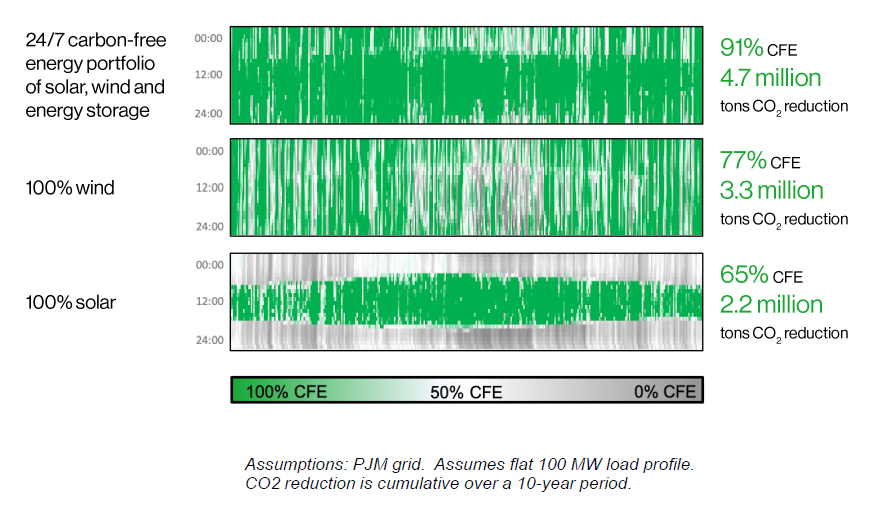
The PJM grid averages 30 to 40% carbon-free energy over a year, Bhat said. That increases to 65% CFE with a solar-only portfolio or 77% for a wind-only portfolio. Adding energy storage to wind and solar increases that to 91%, he said.

The PJM grid averages 30 to 40% carbon-free energy (CFE) over a year. That increases to 65% CFE with a solar-only portfolio or 77% for a wind-only portfolio. Adding energy storage to wind and solar increases that to 91% CFE. | AES

Adding wind to a portfolio can help fill evening hours with CFE, but it’s inefficient. Bhat likens it to Jackson Pollock’s method of painting. “You’re really throwing a lot of megawatt-hours of paint at that canvas, and a lot goes to waste, because you’re not getting exactly where you need to; you’re not getting the pixels that you really need,” he said. “The beauty of energy storage in this picture is that it becomes extremely surgical for taking exactly the hours that you need and pulling that out when you don’t need them and putting them in exactly when you need them. And that’s why we think the linchpin of a grid that is going to be 100% carbon-free is going to be storage.”

Bhat said the carbon reductions provided by storage are not linear. “You really start to dig deeper into those very carbon-intensive hours. And so you get much more carbon reduction when you’re really painting the full canvas rather than kind of cherry picking the solar hours, which, in most grids of the country, are becoming less and less carbon intensive.”

Dispatching for Carbon, not Cost

Reaching 24/7 CFE also requires “hourly load data aggregation: people understanding what their hourly profile is, understanding where they have load flexibility, and the carbon intensity of a particular grid and scenarios in which they can ramp down their own load, and especially carbon-intensive hours,” Bhat said.

Dispatch algorithms must be maximized not for the price of energy, but for the carbon-free content of the supply. “Happily, there’s a lot of correlations between those two,” Bhat said. “It’s not perfect, but it tends to serve in both directions if you’re dispatching the storage facilities appropriately.”

Another tool will be more granular renewable energy credits (RECs), he said. “Renewable energy credits today are effectively a monthly tool. There’s not hourly granularity on when a particular renewable megawatt-hour was generated.”

Tagging RECs by the hour of production allows companies seeking 24/7 CFE to value RECs differently based on when they were produced.

“So if a noon REC is worth $5 or $6[/MWh], maybe a REC [produced] at 8 p.m. is worth $12 or $15,” Bhat explained. “And so all of a sudden, you’re starting to create price signals and incentives for more storage to be deployed into the system.”

Della Penna said not all the regions where Google operates data centers have the market structures that allow the deal it signed with AES for its Virginia facilities.

He said the company is seeking to use the Tennessee Valley Authority’s “robust” corporate renewables procurement program “to solicit for new resources that can help us build up our carbon-free energy profile across the region.”

“We’re equally comfortable — although it’s more work on our side — assembling the CFE portfolio ourselves … and building up a book of resources and” power purchase agreements, he said. “That’s precisely what we’ve done in SPP to date.”

FERC Workshop Participants Differ on GETs Incentives

Participants at FERC’s workshop Friday on performance-based ratemaking approaches universally support grid-enhancing technologies (GETs), but they disagree on how best to foster their adoption by transmission owners and RTOs/ISOs (RM20-10, AD19-19).

A shared savings incentive proposal by the WATT Coalition and Advanced Energy Economy drew praise from tech providers and regulators but doubts from some grid operators and others. (See related story, WATT Coalition Previews GETs Proposal Before FERC Workshop.)

FERC should mandate grid operators to include GETS in their planning processes, said Mitchell Myhre, manager of transmission planning and regulatory affairs for Alliant Energy. “I don’t think this can be an add-on role that is built on top of existing resources.”

GETs are “the direction that the industry must take,” said Judy Chang, undersecretary of energy for the Massachusetts Executive Office of Energy and Environmental Affairs.

The WATT “proposal is shining a spotlight on the fact that grid-enhancing technologies are available but are not being deployed in our current transmission planning and investment framework,” said Katie Dykes, commissioner of Connecticut’s Department of Energy and Environmental Protection.

Not so fast, said Douglas Bowman, SPP lead engineer for research, development and tariff studies.

SPP staff have worked on dynamic line ratings, power flow control and topology optimization projects that they believe provide reliability and economic benefits, but the challenge comes in “getting buy-in” for the new technologies from market participants and stakeholders, Bowman said.

“It’s not that we don’t want these devices on our system,” Bowman said. New technologies have “to go through an approval process before we can implement [them], and we have to ensure that we have that long-term technological resilience that’s wired.”

All new technologies need additional study to ensure that an overlapping installation does not introduce adverse impacts on reliability, said Eric Hsia, manager of applied innovation at PJM.

Carrot or Stick

Without an incentive for GETs, utilities would work on projects for which they’re already incentivized: high-capital projects that would have a lot of benefits, NewGrid CEO Pablo Ruiz said. “It’s almost like having to choose between consumers and shareholders and prioritizing your staff resources.”

GETs are simply another solution in the toolbox, said Jeremiah Doner, MISO director of economic policy and planning.

“We should look at it the same way we look at a new transmission line or substation … how to most effectively address the issue that we’re trying to fix,” Doner said. “Focusing on adjusted production costs … is a very narrow metric that’s just focused on congestion relief around production costs. Flow-control devices address reliable issues [and] could be a deferred, more cost-effective way to address a long-term reliability issue.”

The commission should consider market-based approaches that compensate GETs based on the actual value that they generate in the market, rather than forecasting the benefits they may have, said David Patton, president of Potomac Economics, market monitor for ERCOT, ISO-NE, MISO and NYISO.

At present, no RTO or ISO has “the ability to operate these kinds of devices, so the idea of requiring them to quantify the benefits of that sort of device is definitely a cart-before-the-horse idea,” Patton said. “Tremendous work needs to be done with the planning models, modeling a wider array of conditions than they’ve ever modeled before. The planning models, even right now, don’t do a good job of quantifying the value of, for instance, battery technologies.”

Some GETs offer great benefits on the controllability side, enabling grid operators to direct power flows one way or another, but how can one quantify controllability? asked Yachi Lin, senior manager of transmission planning at NYISO.

“I’m struggling with … how do we quantify that additional benefit on top of that performance?” Lin said.

Planning processes at PJM already allow for GETs “to be offered and to be considered and to compete” in wholesale markets, according to Suzanne Glatz, the RTO’s director of strategic initiatives and interregional planning.

PJM’s concern was that the proposed shared savings incentives would not necessarily be “derived directly from the cost but actually are kind of blurring the lines between markets, value and how that would affect the project cost.” As a result, the planning process could be turned into a forum for discussing ratemaking issues,” Glatz said.

End Game

There are limited alternative approaches, said former FERC Chair Jon Wellinghoff, now head of GridPolicy Consulting. “I’ve thought about this long and hard as to how to get these technologies incorporated into a transmission system in our country that is very inefficient and that needs to have efficiency improved drastically.”

FERC could mandate that RTOs and ISOs incorporate GETs into their planning processes, but experience shows mandates are “not the best way” to get RTOs and ISOs to act as quickly and efficiently as possible, Wellinghoff said.

Planners need to make sure not to let perfect be the enemy of the good, said Hudson Gilmer, CEO and founder of LineVision. “I think there is an imperative to take action on the part of the commission: a legal imperative as well as a climate imperative.”

Congress gave FERC a mandate 16 years ago to incentivize technologies that increase the capacity and efficiency of existing transmission facilities and improve their operations, said Rob Gramlich, executive director of the WATT Coalition. Given the successful deployments of GETs abroad, it is time for FERC to act, he said.

European transmission system owners balked at GETs 10 years ago, but now they clamor for “more and more and more,” said Victor le Maire of Elia, the grid operator for Belgium.

What does FERC see as the end game? asked Steve Leovy, transmission engineer at WPPI Energy. “If we institute shared savings, is that going to go on forever? Or are we doing that during an interim period when we’re expecting something else to develop?”

Look to the commissioners’ statements, said Samin Peirovi, FERC analyst who moderated the all-panelists roundtable to close the day.

“I do not speak for the commission, but I think the questions we hit on in every panel kind of speak to our interest in the shared savings approach and transmission technologies in general,” Peirovi said. “If you talk about a paradigm where eventually we see the level of deployment that’s a little more than status quo, that would be great, but how we get there and how we balance the interest between ratepayers and developers is exactly why we’re having this discussion.”

Delta Surge Prompts WECC to Delay Office Return

With COVID-19 cases steadily rising in Utah, Salt Lake City-based WECC will postpone plans to bring more staff back into its offices and resume in-person meetings, CEO Melanie Frye said last week.

The regional entity’s current policy of allowing staff to return to the office on a voluntary basis will remain in place “until further notice,” Frye told WECC’s Board of Directors on Thursday.

“We continue to be focused on the health and safety of our employees as well as our stakeholders,” she said.

Frye had informed the board in June that WECC was targeting mid-September to implement its “FlexWork” program, designed to provide most employees the flexibility to work from home, while also holding out the requirement that some staff might need to put in “core hours” at the office, including to attend trainings, committee meetings, regulatory audits and board meetings.

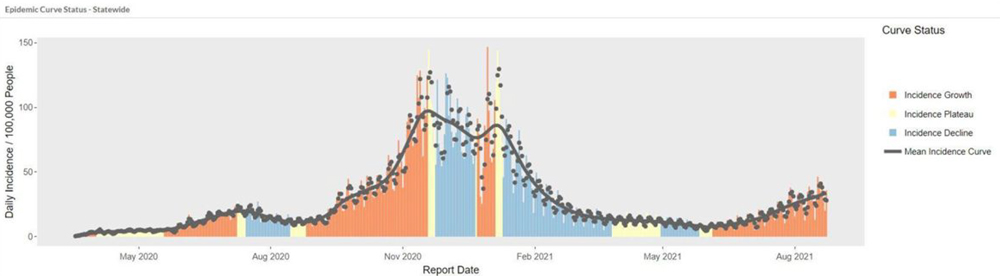
A steady uptick in COVID-19 cases in Utah has prompted WECC to delay its plan to bring more staff back into its offices this month. | WECC

“Under the FlexWork program, an employee’s work schedule will be subject to the overriding WECC requirement that departmental operations, services and commitments will always be maintained to effectively meet our obligations and support our business, colleagues and stakeholders,” WECC said.

But management changed course as Utah’s COVID-19 case counts soared because of the increased transmissibility and virulence of the Delta variant. On Thursday, Frye pointed that Utah was experiencing declining case counts in August 2020, but it saw cases sharply rise last month, despite the widespread availability of vaccines since early in the year.

“We’ve all heard about the Delta variant and the impact that that is having. … We’ll want monitor to see what transpires over the course of the next few months and make decisions for employees as well as work meetings in the new year,” Frye said. WECC will host all meetings online at least through the end of the year, she said.

Frye said about 10% of WECC’s staff — between 10 and 15 employees — are coming into the office on a regular basis as the organization continues to maintain safety protocols in the office and prohibit any full department from being in the office at the same time, “just to make sure that we sort of spread the risk if there were to be an outbreak.”

And while staff choosing to work remotely are “doing so quite successfully,” Frye expressed concern about the long-term implications of that arrangement.

“We’re wanting to make sure that we continue to focus on our culture and our inner workings within the organization, so that will continue to be a challenge and a focus of our management team,” Frye said.