NERC, NIST Update Cybersecurity Mapping

With cybersecurity presenting dynamic and evolving challenges for the bulk power system, a new set of tools aims to help NERC registered entities navigate their increasingly complex job requirements.

Developed by NERC’s Reliability and Security Technical Committee (RSTC) with the National Institute for Standards and Technology (NIST), the tools provide a more convenient reference between the Critical Infrastructure Protection (CIP) reliability standards and NIST’s Framework for Improving Critical Infrastructure Cybersecurity (CSF).

The new Mapping of CIP Standards to NIST Cybersecurity Framework (CSF) document, released last month, was inspired by a recent joint exercise by NERC and NIST to remap the CIP standards’ requirements to the CSF. This exercise came about because of concerns raised by regulated utilities whose leadership wanted to use NIST’s framework but weren’t sure how to integrate it with their compliance activities.

“What we heard at NIST … was that organizations were being encouraged to adopt the [CSF],” Avi Gopstein, program manager at NIST’s Smart Grid and Cyber-physical Systems Program Office, told ERO Insider. “But because that’s a risk management framework rather than a requirements framework, it’s not precisely clear [about] the very specific actions that could conform to the CIP requirements while satisfying the cybersecurity framework subcategories.”

The level of detail involved in both systems made the task of integration highly challenging for an individual entity to undertake on its own. NIST’s framework comprises 108 subcategories, while the CIP standards contain 43 separate requirements. Moreover, both are constantly under adjustment: just last month NERC’s Board of Trustees sent CIP-004-7 (Cyber security — personnel and training) and CIP-011-3 (Cyber security — information protection) to FERC for approval. (See “Standards Actions Approved,” NERC Board of Trustees/MRC Briefs: Aug. 12, 2021.)

NERC and NIST have done similar remapping exercises before; the last was in 2015 and attempted to match version 1.0 of the CSF to the then-current CIP standards. The latest effort builds on that project, incorporating version 1.1 of the CSF adopted in April 2018 and the most recent updates to the CIP family.

Taking the form of a Microsoft Excel spreadsheet, the new mapping tool presents readers with three tabs:

      • NIST CSF 1.1 to CIP v5 — shows the CIP standards that correspond to each subcategory of the CSF, including a row for each unique mapping between a CIP standard and a CSF subcategory. Subcategories may appear in more than one row.
      • CIPv5 to CSF 1.1 XREF — reverses the mapping of the previous tab. CIP standards may span multiple rows if they contain multiple requirements.
      • Pivot — the same information as the second tab, but in a configurable format allowing users to expand or minimize each CIP standard and choose additional information to view, such as function, category and subcategory.

In addition to NERC and NIST, the ERO Enterprise and the RSTC’s Security Working Group provided input on the proposed remapping over the last several months, delivering valuable insights on the way the document could be improved for everyday use.

“Someone in industry would be able to look at this mapping and say, ‘Okay, I am complying to the NERC CIP requirements; how can I mature my compliance, my security and my risk management?’” said Daniel Bogle, NERC’s senior CIP assurance adviser. “This way, they can look at one document and start that ball rolling to mature, not just their compliance program, not just their security program, but also their risk and business maturity overall.”

In light of the rapidly evolving nature of the cybersecurity landscape that entities face, NIST and NERC hope to maintain the mapping on a more active basis than in the past. Unlike previous versions of the mapping tool that incorporated informative references — “practical suggestions for how organizations can achieve the desired outcome of each subcategory” — the guidance for the new mapping tool directs users to NIST’s Online Informative References Program, which provides the same information in a more dynamic fashion.

“This mapping actually leads us to a reference library that is more up to date than a single snapshot in time, [like] through a traditional publication approach,” Gopstein said. “This takes you to the living library, where the relationships are maintained, but the guidance and information can be updated.”


California Wants to Turn More Waste into Gas

California is trying to figure out how to incorporate renewable natural gas into its clean energy mix while diverting millions of tons of methane-emitting organic waste from its landfills.

Renewable natural gas (RNG) — produced from landfills, dairies and dead trees — is disfavored by many environmentalists because of its un-green sources. But RNG is likely to play a larger role in California as the state tries to drastically reduce greenhouse gases and rely on 100% clean energy by 2045.

It can power vehicles, heat homes and run cooktops using existing gas pipelines and household appliances.

Sam-Wade-(CEC)-Content.jpg
Sam Wade, Coalition for Renewable Natural Gas | California Energy Commission

“We’re fine being the bridesmaid and not the bride, but at the end of the day we think we will be utilized in a low-carbon future,” Sam Wade, public policy director for the Coalition for Renewable Natural Gas, told a California Energy Commission workshop on RNG Tuesday. “When you design your policies to move things around and be flexible, we’re a very flexible resource that can be used anywhere conventional gas is used.”

Others made the case that renewable natural gas (RNG) is a way to deal with the huge amounts of methane from the state’s large commercial dairies and landfills, which together produce 75% of methane emissions statewide, according to the California Air Resources Board.

Dairies produce 54% of methane emissions; landfills account for 21%. Wastewater treatment, another source of renewable natural gas, represents about 3% of methane emissions in California.

Senate Bill 1440, adopted in 2018, requires the California Public Utilities Commission to “consider adopting specific biomethane procurement targets or goals for each gas corporation so that each … procures a proportionate share … of biomethane annually.” The state’s two largest gas corporations under CPUC jurisdiction are Southern California Gas and Pacific Gas and Electric.

Karin-Sung-(CEC)-Content.jpg
Karin Sung, CPUC | California Energy Commission

CPUC Senior Energy Analyst Karin Sung said CPUC staff have proposed targets under SB 1440 that would require the gas companies to procure enough biomethane to divert an additional 8 million tons of organic waste by 2025. Most of the waste would be from compost and chipping and grinding of trees and other vegetation.

Under the plan, utilities would have to procure 75.5 million MMBtus of renewable natural gas by 2030 to support the state’s waste diversion goals, Sung said.

The state has well-established programs to help dairies stop methane leaks, and about 154 wastewater treatment plants around the state have biodigesters, so “the biggest slice of the pie here that’s remaining is landfills,” she said.

State law requires landfills to capture or destroy methane, including through burning the gas to break it down, but landfills continue to emit large quantities of methane.

Super Emitters

NASA’s Jet Propulsion Laboratory in Southern California has developed methods to pinpoint and measure methane and carbon dioxide “point sources” from airborne surveys. NASA researchers identified 30 large landfills as producing 40% of the total point-source emissions detected in their survey of more than 300,000 industrial facilities, dairies and landfills.

NASA said the “super emitter” landfills showed huge plumes of methane, a potent greenhouse gas that, like carbon dioxide, traps heat in the atmosphere, “but it does so more efficiently and for a shorter period of time” than CO2, the space agency said.

That’s why the CPUC is targeting landfills for new biodigesters or expanded digester capacity, Sung said.

There are now nine standalone anaerobic digestion plants in California to turn waste into usable gas, eight of which have expansion plans, she said. More than 150 wastewater treatment plants also have digesters that could handle more waste.

The state’s CalRecycles program requires processing 10 million tons of organic waste by 2025. Adding another 8 million tons under the CPUC proposal would mean diverting a total of 18 million tons of waste in the next four years, which is beyond current capacity.

“That’s where we step in,” Sung said.

The CPUC has proposed the state’s four largest investor-owned utilities establish a cost-effectiveness test to “guide procurement decisions through a jointly filed Standard Biomethane Procurement Methodology,” requiring CPUC approval.

Boosting capacity and building new plants will likely require passing costs on to gas ratepayers, so ensuring cost-effectiveness is essential, Sung said. Making sure the digesters can produce gas of pipeline quality is another concern. Reducing the impact of landfills on low-income communities is vital, too, she said.

The digesters could also help the state deal with the vast quantities of dead timber from wildfires and the vegetation from tree-clearing efforts along thousands of miles of power lines, Sung said.

“When you think of woody biomass, it’s more than just the wood itself,” she said. “It also the grasses and invasive species — anything that we can do to help support and prevent additional wildfires.”

The black carbon from those fires, which has far exceeded any other state pollutants in recent years, is another target of GHG reductions, she said.

Entergy Energizes Second Tx Line, Generator

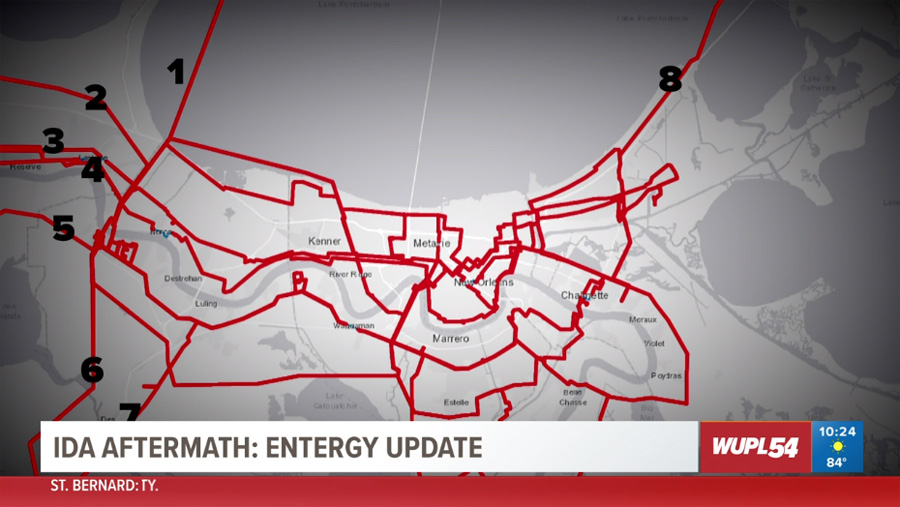
Entergy (NYSE:ETR) officials said Thursday the company has activated two of the eight transmission lines serving the New Orleans area, allowing them to restore power to parts of downtown.

Of the 904,000 Entergy customers who lost power in the state during Hurricane Ida, about 137,000 customers had been restored. Entergy Louisiana had 41 of 168 substations running, while Entergy New Orleans had restored 13, with 14 still out of service.

Including Mississippi, nearly 950,000 Entergy customers lost power, second only to Hurricane Katrina’s 1.1 million. The company said it has restored power to a total of 172,000 customers and expected to complete restoration Thursday in Mississippi.

As of 1 p.m. Thursday, the company said it has counted 10,212 poles, 13,297 spans of wire and 2,223 transformers damaged or destroyed on its distribution systems. For the transmission system, 99 of 222 affected substations and 79 of 209 affected lines had returned to service as of 8 a.m. More than 1,350 miles of transmission lines remained out of service.

8-tx-lines-into-NOLA-(WUPL-54)-Content.jpg
Entergy has reactivated two of the eight transmission lines serving the New Orleans area. | WUPL54

Officials said they will provide estimated restoration times after completing damage assessments by the end of Thursday. The company said Terrebonne and Lafourche parishes were heavily damaged.

“We had a long, long day yesterday, but a good day, and we saw a lot of progress,” Entergy New Orleans CEO Deanna Rodriguez said at a press conference Thursday. “So after turning on power to New Orleans East early Wednesday, we’ve continued to make significant progress in the restoration efforts here in New Orleans and across the state. We expect to complete assessing all damage today. And then we can begin providing estimated restoration times for customers. And we know that’s what everybody wants.”

Entergy Louisiana CEO Phillip May said the “vast majority” of the Baton Rouge area will see service restored by Wednesday.

Entergy’s Ninemile Unit 6, a 553-MW combined cycle plant in Jefferson Parish, was restored to service Thursday, along with the 115-kV Market Street-Michoud transmission line, restoring power to St. Charles Parish and the Little Gypsy power station in Montz, La.

On Wednesday, the utility had begun restoring power to some areas of New Orleans East thanks to a transmission line from Slidell on the northern side of Lake Pontchartrain and the 132-MW New Orleans Power Station, which the utility was using as a switching station to parse power deliveries.

Six other transmission lines serving the city and surrounding parishes remained out of service.

But the utility was able to restore power to parts of New Orleans’ uptown, midtown, central business district, New Orleans East and the Carrollton area.

“We are in close coordination with the city to identify critical locations in need of backup generation to power first responders and community shelters,” Rodriguez said. “As of yesterday, we provided backup generation to seven … cooling shelters and seven New Orleans Fire Department stations across the city.”

May said the utility will continue to focus on restoring power to “critical infrastructure” for “the next day or so … hospitals, sewer intake, municipal pumping systems, those kinds of things.”

He said restoring power to hotels to house the National Guard and 21,000 utility workers in the state — 4,000 of whom are in New Orleans — would also be a priority. However, May said some utility workers may be housed in tents, particularly “as you get into the most devastated part of our state, those lower bayou parishes.”

“We have a very large and capable, highly experienced, logistics team that is focused 24/7 on finding beds, finding food, finding laundry, finding gas,” he continued. “We are essentially moving a large army, and that takes an enormous amount of effort.”

May responded to criticism over how Entergy used the controversial New Orleans Power Station in the restoration. Although the company had promoted the plant, which went into operation last year, for its black start capabilities, May said engineers decided it was more prudent to use it as a “shock absorber” as it began restoring power using the Slidell line.

“Does New Orleans Power Station have the ability to black start? Absolutely. Is that the preferred path? No, it is not,” he said. “Can I start my car up and drive down Interstate 10 with all the debris we see on there with no [spare tires]? Oh, you can absolutely do that. But is that the right thing to do? If you can … load up spares in the back in your trunk and then make that trip, that obviously is the better course of action.”

Officials also acknowledged their power outage maps were not always accurate because of problems with cell and fiber communications.

Meanwhile, Louis Armstrong International Airport said Delta Airlines had begun limited service Wednesday, with Jet Blue expecting to resume operations Friday and Alaska Airlines and American Airlines planning resumption Saturday.

Entergy: ‘Rebuild’ Needed for Worst Ida Damage

Entergy (NYSE:ETR) on Friday announced that most of its Louisiana customers affected by Hurricane Ida will see their power restored by Sept. 9, while cautioning that restoration in the hardest hit areas “will be a rebuild more than a repair.”

In a press conference Friday morning, Entergy Louisiana CEO Phillip May said the utility had returned power to 225,000 customers in Louisiana, of the 904,000 who lost power after the storm. Deanna Rodriguez, CEO of Entergy New Orleans, reported that a third of the eight major transmission lines serving the Greater New Orleans area are back in service, joining the two that the utility had restored earlier in the week. (See Entergy Energizes Second Tx Line, Generator.)

Separately, Entergy Mississippi announced that 4,000 customers in Mississippi remain without power, down from the peak of around 46,000.

About 3,500 of the outages in Mississippi are from Hurricane Ida; the rest are related to thunderstorms on Wednesday. Entergy Mississippi said it expects “the majority of customers affected by both storms” to be restored by Friday night. Some customer outages may take until Saturday to be resolved, and individual cases may take longer depending on the circumstances, the company said.

Damage Assessments Still Unfinished

Entergy listed the following estimated restoration times for Louisiana:

  • Sept. 3: Port Allen (Pointe Coupee, West Baton Rouge and Iberville Parishes); Zachary (East and West Feliciana Parishes);
  • Sept. 4: Central Business District (CBD) of New Orleans;
  • Sept. 6: Baton Rouge Metro (East Baton Rouge Parish);
  • Sept. 7: Gonzales (Gonzales and parts of Ascension Parish); Denham Springs; Chalmette (St. Bernard and upperparts of Plaquemines Parish);
  • Sept. 8: Metairie-Kenner; Westbank (Westbank of Jefferson Parish); Algiers; New Orleans East; Orleans Parish.

The utility stressed that its estimates are general; some communities within these networks will see their power restored earlier than their estimated dates.

Entergy has not managed to estimate restoration times for “the hardest hit areas,” May said, citing “communication issues, access issues [and] vegetation issues.”

About 29% of the damaged areas in Louisiana remain unassessed. Those that remain include communities in the direct path of the storm — coastal areas like Grand Isle and Lafourche Parish, as well as inland parishes such as St. John and St. Charles. These were among the areas that May referred to as requiring a “rebuild” rather than repair.

Distribution Infrastructure Damage ‘Tremendous’

John Hawkins, Entergy Louisiana’s vice president of distribution operations, said Entergy Louisiana and Entergy New Orleans have found damage to 14,364 poles, 16,702 spans of wire and 3,232 transformers on their distribution systems.

“This part of the grid has received tremendous damage from Hurricane Ida, [but] in the coming days, we’re going to start to see a lot more progress,” Hawkins said.

Restoration efforts so far have focused on critical infrastructure such as hospitals, cooling shelters, and water and sewer systems, rather than residential neighborhoods. However, participants in Friday’s call noted that residences may see their power restored if they are on the same circuit as these services.

Rodriguez acknowledged receiving “a lot of questions” about why the CBD and French Quarter, both of which are currently largely unoccupied, are being restored prior to residences. She explained that this was considered necessary because these areas contain hotels that are being used to house many of the 5,000 workers from out of state who are assisting with the restoration efforts in the city. Nearly 26,000 emergency workers are involved in restoration efforts statewide.

“All of these restoration workers have to have places to stay, so the CBD is hosting a lot of these workers,” Rodriguez said. “Unless they have a place to sleep at night, they can’t work their 16-hour days that we’re requiring them to work. So while it seems counterintuitive, it’s a good thing that we have the CBD up.”

Slidell Line Used as ‘Shock Absorber’

Friday’s call did not address the questions about grid planning raised in the immediate aftermath of the storm, which knocked out all eight transmission corridors into Greater New Orleans and plunged the city into a complete blackout. (See Entergy Investigations Certain to Follow Hurricane Ida Restoration.) The area remained without power until Tuesday, when Entergy managed to re-energize a small portion of the city using the 128-MW New Orleans Power Station and a line across Lake Pontchartrain via Slidell.

Asked if the line is “looping power from Cleco,” which is basing its own recovery efforts in Slidell, May acknowledged that the line “does connect to Cleco.” However, he said Entergy’s goal with that line is not to import power from another area but to stabilize the system.

“Ideally, we’re not seeing a lot of power flow either into or out of that line; what we’re doing is using that line as a shock absorber … so if we do have trips, the system can remain intact,” May said. “As we restore more lines, that becomes less and less important because it becomes more robust, more redundant. But that’s what we’re doing right now.”

As of 3 p.m. Friday, Cleco (NYSE:CNL) said it had restored power to nearly 54,000 of the nearly 97,000 customers in St. Tammany Parish who lost electricity.

MISO Delays New Market User Interface

Because of the hurricane’s havoc, MISO announced it held off on the launch of its new market user interface by a week. The nonpublic interface ― where market participants submit bids and offers ― is part of the RTO’s market platform replacement.

MISO IT Senior Director Curtis Reister said MISO will now launch parallel operations of the old interface and the new beginning Sept. 8.

“We very much wanted to start parallel operations, but it didn’t make sense last week,” he told members at a Market Subcommittee meeting on Sept. 2.

The new market user interface test environment has been open for market participant testing since last April. Parallel operations of the old system and the new will last for four months, with MISO retiring the current system Jan. 18.

Amanda Durish Cook contributed to this story.

Green Hydrogen Production at Reasonable Price No Easy Trick

If synthesizing billions of tons of hydrogen from water or natural gas to replace fossil fuels seems like a massive technological undertaking at an enormous cost, that’s because it will be.

Listening to panels of electrochemists and engineers participating in discussions at this week’s Department of Energy “Hydrogen Shot Summit” made that point very clear.

The effort will require developing a new industry from existing niche technologies, many of them unrelated. In contrast to the enthusiasm of DOE officials comparing it to the U.S. drive to land astronauts on the moon within a decade, the engineers and chemists talked of the minutiae that must be dealt with and solved.

Some talked of setting standards, while others noted that the electrolysis technology requires rare minerals and metals that must be mined or pulled from recycling processes, some of which haven’t been developed. They also discussed their efforts to develop new technologies from what now are merely demonstration projects. And they noted that scaling up known technologies to massive operations will likely encounter problems just because of size.

On the positive side, the U.S. is late to the global hydrogen party and will benefit from research already done in Europe or by European companies with operations here, they said.

While not as simple as pushing direct current through water, as might be done in a college chemistry classroom, electrolysis uses components and engineering involved in fuel cell technology, though on an industrial scale.

In other words, researchers competing for the billions of dollars in DOE funding will already have had experience, for example, with polymer electrolyte membranes (PEM) used in fuel cells, assuming Congress approves the bipartisan infrastructure package.

“We’ve got a lot of things … in the R&D docket,” Andrew Park, an engineer with The Chemours Company (NYSE:CC), said when discussing the company’s work with polymers in one of the sessions.

“And we think these new materials that we’re developing are going to be critically enabling as we try to get down to $1/kg of hydrogen. And toward that end, we are leading and or participating in three Department of Energy projects right now in the hydrogen economy space. We’re working with Los Alamos National Lab, [the National Renewable Energy Laboratory] and Lawrence Berkeley [National Laboratory] on developing the next generation of membranes for PEM water electrolysis,” he said.

An industrial-scale electrolyzer can start with a PEM cell or use competing systems. A full-sized electrolyzer includes a number of equally complicated components, from a water purification system, to systems that add chemicals (electrolytes), to outside components that take the moisture out of the hydrogen and purify it before another component collects and stores the gas. All of these systems must be controlled by power electronics. And the machine must be built tough enough to last for many years.

Another complicating issue: Electrolyzers are designed to run continuously, not intermittently, as they might be asked to do if the source of the electricity flowing through them is from wind or solar. In one session, the engineers looked at what might have to be changed to deal with running intermittently.

“There’s just definitely some physical limitations that we have from a desiccant [drying agent], from a bad design perspective. … We just cannot go against the physics unless we evolve in our knowledge,” said Blanca Ramirez, an engineer with Lectrodryer, a Kentucky-based company that specializes in the drying and conditioning of gases and liquids. The company’s first drying system was for natural gas in 1932.

Ramirez also pointed out that standards must be developed for just how pure hydrogen used, for example, as a fuel must be. “What we really need to know is, how pure do you need this? The fact that it can be done [ultra pure] doesn’t mean that it needs to be used.”

Sasha Dass, director of engineering program management at Analog Devices, a multinational semiconductor company, also noted that using an intermittent power supply presents a real problem.

“You have to be able to run continuously in order to get the output that you want and in order to realize the depreciation and amortization of your equipment,” she said. “That is key and, again, coming from semiconductors where your expected uptime is in the 95% range, you can’t afford to turn your equipment off in times of waning sunlight or when the wind dies down.

“We have to design these stacks intelligently in order to run continuously, albeit at a reduced output. … And that’s one of the ideas that we’re trying to vet.”

Illinois Energy Bill with Funding for Exelon’s Nukes Still Stuck

Efforts to pass a comprehensive energy bill putting Illinois on the path to lower carbon emissions while authorizing a $700 million bailout for three of Exelon’s (NASDAQ:EXC) Illinois nuclear plants and more funding to encourage solar development are in limbo.

The nearly 1,000-page H.B. 3666 was to have been passed in a special one-day legislative session Tuesday, just weeks before Exelon’s deadline to close one of its plants. This time the bill included a hard closure date for the coal-fired Prairie State Energy Campus, a 1,600-MW complex located in Southern Illinois that has been a major sticking point in negotiations.

Built and operated by municipal power companies and rural cooperatives in Illinois and several nearby states, the power plant is the largest emitter of carbon dioxide in the state and an impediment to Gov. J.B. Pritzker’s efforts to fight climate change by embracing renewable energy while maintaining the nuclear plants.

Pritzker had agreed to allow Prairie State to run until 2040 if it cut its emissions in half through carbon capture and sequestration, a technology that could cost its owners $4 billion. A previous version of the legislation had Prairie State closing by 2035.

Two of the governor’s key constituents — environmental groups and organized labor — have for months been at loggerheads over the fate of Prairie State and Exelon’s nuclear plants.

The environmentalists want coal plants to close immediately because they contribute to climate change. They want gas turbines plants, some of which are still being built, closed by 2040.

Labor has fought for the jobs at Exelon’s nuclear plants. Employees of Prairie State are not unionized. Gas turbine plants, while a jobs provider during construction, employ 30 to 50 people.

The solar industry, specifically rooftop solar installers, have seen installations dramatically drop off without state-funded incentives to homeowners. The legislation included new funding for those incentives.

After Senate committee clashes Tuesday afternoon over an amendment requiring Prairie State to close in 2040 but without any carbon cleanup requirements in the interim, passage of the bill appeared again to be stymied. But after midnight, and after the House of Representatives had adjourned, the Senate passed the bill with the amendment along party lines.

Lawmakers Wednesday were not sure when another session would be called, given the upcoming Labor Day holiday. The governor’s office was not happy, noting in a statement that Prairie State could continue polluting with no restrictions as the bill now stands.

Exelon did not comment. But the company has said it will shut down Unit 1 of its Byron nuclear plant on Sept. 14 and Unit 2 on Sept. 16.

The company is also planning to close its Dresden plant in November. The three plants employ more than 1,500 workers, many of them highly paid because they are unionized.

The Path to 100 Coalition organized by solar installers issued a statement late Wednesday thanking the Senate for passage of the bill and urging the governor and House to work quickly to resolve the outstanding issues.

“The renewable energy provisions in this legislation would reverse the job losses happening now, and they would make the state the national leader in growing equitable clean energy jobs and fighting climate change,” the group said. “Until this legislation becomes law, the Illinois renewable energy program will remain broken.”

Rhode Island Advocates Say State is Slow to ‘Act on Climate’

Rhode Island’s climate advocacy community says the state is falling short on its first legislative responsibility under the new Act on Climate to update the state’s GHG emission-reduction plan.

Gov. Dan McKee signed the landmark climate bill in April, but “we haven’t seen a lot of action yet; we haven’t seen that planning process started,” Sue AnderBois, climate and energy program manager at The Nature Conservancy – Rhode Island (TNC), said on Wednesday.

The act calls on the Rhode Island Executive Climate Change Coordinating Council (EC4) to submit the updated plan to the legislature in December 2022. In terms of state planning, “that’s basically tomorrow,” AnderBois said during a New England Women in Energy and the Environment (NEWIEE) Rhode Island chapter panel discussion on 2021 legislative activity.

In early July, TNC, along with other climate advocates, sent a memo to the governor urging him to get the planning process started.

The memo, according to AnderBois, also outlined key priorities for the planning process, including focusing on justice and equity through a robust stakeholder process. In addition, the group called for clear development timelines and the allocation of resources necessary for state staff to accomplish the plan.

The Resilient Rhode Island Act established EC4 in 2014, and the council’s advisory board has made some recent progress to identify how the plan will meet the environmental justice requirements of the new climate law. In June, the board considered public recommendations for the organizations that should be included in a review of the state’s environmental justice priorities. Among those organizations were food sovereignty groups, first nations and housing justice groups.

There has only been one EC4 meeting since passage of the climate law, during which members reviewed the new law and heard from the advisory board on climate justice priorities.

McKee held a climate-related public meeting at the end of August as part of a weekly Community Conversations series on a broad range of issues that will shape a vision for the state through 2030.

“I sent a letter [in August] to call on the cabinet members in the state of Rhode Island to design their fiscal year budgets in a way that addresses the state’s goals to be prepared for climate change, to create affordable, sustainable pathways towards a net-zero future,” he said during the meeting. That work, he added, “will take a statewide approach, engaging many different experts and constituents.”

Speaking during the community meeting, Rep. Terri Cortvriend, a sponsor of the Act on Climate, said state and local leadership need to have climate plans in place to take advantage of anticipated funding under the federal budget reconciliation bill.

“Passing the Act on Climate was a big deal in determining our future, but now we need to develop and implement the plans called for in the law, and to that end, I think we need to make sure that the EC4 has the tools and resources that they need to be successful,” Cortvriend said.

Advocates’ Priorities

AnderBois set out TNC’s priorities for the next legislative session during the NEWIEE webinar. Those priorities include establishing an enforceable 100% renewable energy target and passing a law to authorize state participation in the Transportation and Climate Initiative program (TCI-P).

A bill (S0629/H5762) to establish a 100% renewables target for 2030 passed the Senate in June but didn’t make it through the House before the end of the legislative session. The Transportation Emissions and Mobile (TEAM) Community Act (S0872A /H6310), which would codify TCI-P, met a similar fate.

There was speculation at the end of the session that the TEAM Act could be taken up during a special fall session. While dates for the session have not been announced, AnderBois told NetZero Insider that TNC remains hopeful that the bill would be on the legislative agenda if the legislature does hold that session.

Cortvriend said during the Community Conversation event that she looks forward to passing the TEAM Act in the coming session.

“This is an important component of meeting our goals, as transportation is responsible for 36% of greenhouse gas emissions in our state,” she said. “I’m happy to hear that the governor is supportive of this plan, and this will provide another funding stream to help us transform the transportation sector.”

Finding a legislative pathway to encourage responsible solar siting in the state also is on TNC’s priority list for next year.

That pathway would allow the state to aggressively expand clean energy investments while protecting open spaces and forests, AnderBois said.

“Advocates are trying to work with industry and other stakeholders to figure out what we need to do to really design incentives for development to push it to places that would be more ‘preferred,’ like rooftops and former industrial sites,” she said.

NYISO Stakeholders Discuss Resource Adequacy, Capacity Rules

Stakeholders on Monday discussed the methodology behind NYISO’s straw proposal on capacity accreditation as the grid and energy market adapt to an increasingly diverse resource mix.

The Installed Capacity/Market Issues Working Group spent nearly four hours discussing a study on Effective Load Carrying Capability (ELCC) by San Francisco-based consultancy Energy and Environmental Economics (E3).

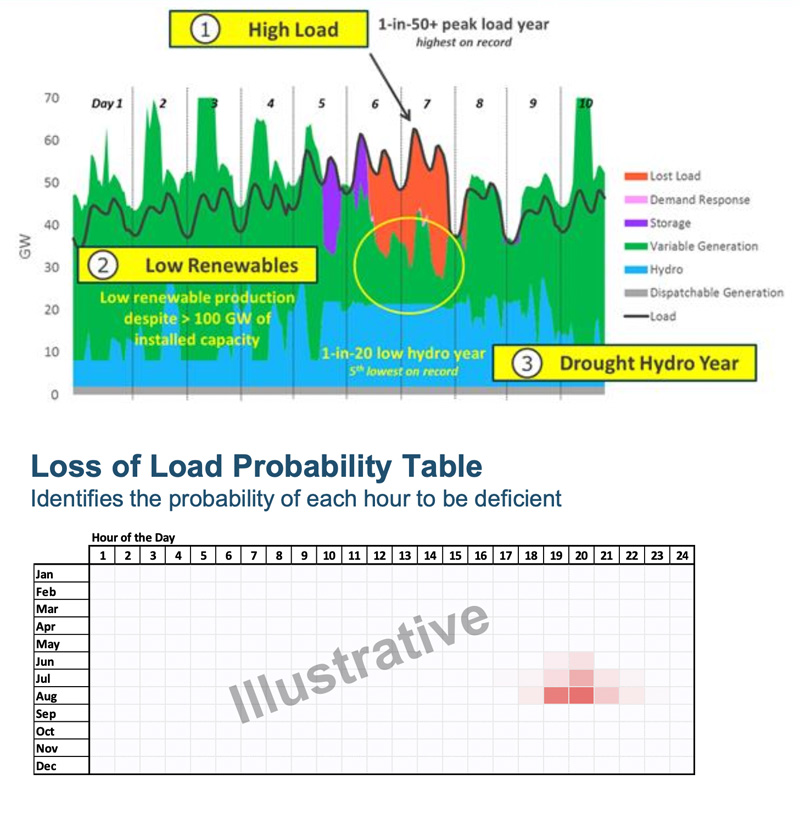
“When we really were building up our resource adequacy capabilities it was a bit of a backwater… not many people knew what loss of load probability [LOLP] was and why most utilities do it,” said E3 senior partner Arne Olson. “But now after what we saw in Texas, I think we’ve seen that even these kinds of extreme events can really happen.” (See ‘Best Market in the World’ Faces Uncertain Future.)

Loss-of-Load-Probability-(E3)-Content.jpg
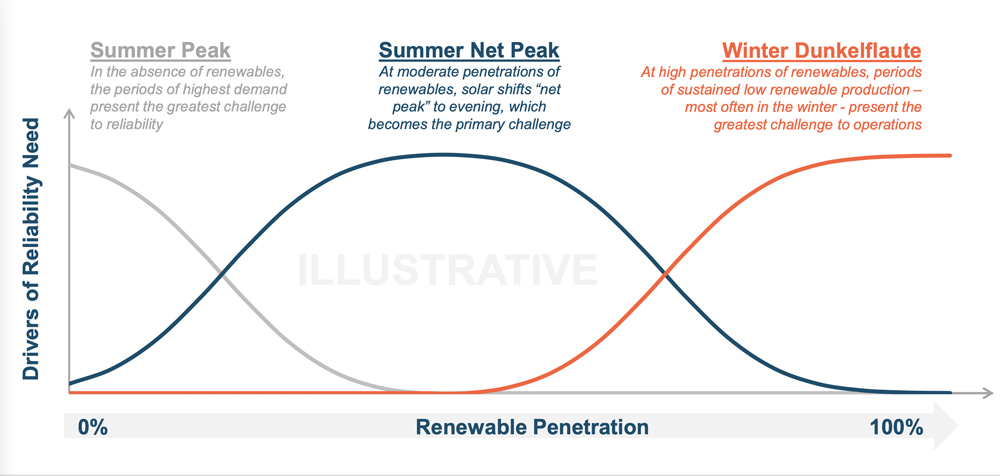
As renewable penetration grows, planning problems shift from traditional need to meet peak demand hours (e.g., summer) to new questions of meeting net demand (e.g., over multiday low renewable events). | E3

Grid planning was relatively straightforward when RTOs only had to add up nameplate capacity to gauge resource adequacy, but now they must consider how the system as a whole is performing and all the interaction among solar, wind, batteries and hydro, Olson said.

“The total amount of effective capacity we have is a complex function of all of the individual generators and all of the ways that they interact throughout the year and during the hours when we might have a loss-of-load event,” Olson said. “So that’s why we have to use a technique like ELCC; it’s a way to help us deal with the changing resource mix.”

The firm last year co-authored a Net Zero New England study for Calpine and has been advising PJM on their capacity accreditation.

FERC rejected PJM’s proposed ELCC revisions in April, but on June 30 accepted a revised proposal minus the “transition mechanism” that the commission had found unjust and unreasonable.   On the same day, PJM proposed a replacement for its extended minimum offer price rule (MOPR-Ex) as a tool for buyer-side mitigation (BSM).  (See Mixed Stakeholder Reception to PJM MOPR Replacement.)

Modeling Basics

ELCC represents a percentage of the “perfect” capacity that a resource provides in meeting a target reliability metric (for example, 0.1 day/year loss of load expectation) and can also be thought of as the incremental load that can be met by an incremental resource throughout the year while maintaining the same target reliability metric.

“A lot of the dynamics that we tried to illustrate here are simplifications of what’s actually happening on the system,” said E3 Director Zach Ming. “The reality is, there is no difference between the diversity benefit or penalty and diminishing returns. Those are the exact same thing.”

Resources that are similar to each other have a negative diversity benefit, which creates the diminishing return, and resources that are different from one another interact positively with each other, he said.

Timing-Shift-(E3)-Content.jpg
Timing Shift: Increasing levels of renewables will cause the timing of reliability challenges to shift to different times of day – and eventually to different times of year. | E3

The ISO’s Market Monitor, Potomac Economics, presented a paper supporting the study’s recommendation to calculate ELCC using a marginal approach. That approach entails using a reliability value of the next incremental supply of a resource type — or combination of resources — measured relative to an existing portfolio of resources, rather than taking the average value of the existing supply of the resource type.

With so many different types of capacity with different availability, it’s useful to have a concept that represents something they all can be compared to, but every type of capacity, including ‘perfect’ capacity, has diminishing returns, said Pallas LeeVanSchaick of Potomac Economics.

“E3 is highlighting that some of the resources have diminishing returns that diminish faster than perfect capacity, so they use perfect capacity as a benchmark for quantifying the diminishing returns of other resources,” LeeVanSchaick said.

Pairing Logic

Several stakeholders expressed concern about pairing the ISO’s efforts on capacity accreditation with buyer-side mitigation, the latter of which they believed could be handled relatively quickly. Tying the two together risks having FERC reject the BSM straw proposal because the commission has accepted ELCC proposals from three other RTOs/ISOs based on the average method of calculation rather than the marginal one.

“We do think that this effort is highly linked to our success with the buyer-side mitigation rule changes, and, in fact, we think there’s some tariff language that we absolutely need to modify if not replace and, in its place, put these rules that we’re talking about,” NYISO Director of Market Design Michael DeSocio said. “To the extent we have all of the rules figured out, we would do that, though I don’t think we will have them figured out because we are trying to move [BSM] forward as quickly as we can.”

DeSocio presented an overview of the PJM MOPR filing and said NYISO has been clear in its reasoning for a case supporting just and reasonable outcomes in the capacity market with large modifications to BSM.

“We do need it demonstrated that the capacity market remains competitive … and [an ELCC approach to capacity accreditation] is a large part of helping us to do that,” he said. “Separating them we don’t think is workable; in fact, we think it’ll be important to be very clear on how we intend at the highest level to treat capacity accreditation going forward so that we can properly perform those analyses and present that information as part of a whole framework.”

NEPOOL Reliability Committee Briefs: Sept. 1, 2021

ISO-NE’s Proposed ICR Shows Decrease for FCA 16

ISO-NE is proposing an installed capacity requirement (ICR) of 32,568 MW for Forward Capacity Auction 16, a 1,585-MW decrease from FCA 15, the RTO told the NEPOOL Reliability Committee on Wednesday.

ICR is the minimum system capacity needed according to the Northeast Power Coordinating Council reliability criteria. ISO-NE’s annual calculations also account for operators’ ability to purchase energy from neighboring balancing authority areas during a capacity deficiency.

The RTO also told the committee that the Maritimes, Hydro-Québec Phase II, Highgate, New York AC and Cross Sound Cable ties would provide a combined 1,830 MW of benefits for FCA 16, a 95-MW increase from FCA 15. Benefits from the Hydro-Québec Phase II (40) and New York AC (29) ties make up 72.6% of the additional megawatts.

ISO-NE said New York modeled behind-the-meter solar using five historical profiles (2015-2019) as opposed to the single historical profile (2006) used for FCA 15, which would have lowered the total tie benefits by 55 MW. The RTO added that using five historical profiles in FCA 16 simulations introduced more load diversity between New England and New York, resulting in higher tie benefits.

New England and New York need less simultaneous emergency assistance with increased load diversity, corresponding with higher tie benefits from Québec and the Maritimes. Hydro-Québec interconnection capability credits (HQICCs) of 923 MW — up from 883 MW last year — resulted in a net ICR of 31,645 MW, a 4.9% decrease from FCA 15. The reserve margin with the HQICCs is 16.2% and 12.9% without them.

The gross cost of new entry for the marginal reliability impact system demand curve cap for FCA 16 is calculated as $12.40/kW-month, with net CONE at $7.468/kW-month.

FCA 16 models the same zones as FCA 15: Northern New England as export-constrained with Maine nested inside, and Southeast New England as import-constrained.

The RC will vote on the ICR-related values on Sept. 21, and the Participants Committee will take up the matter on Oct. 7, ahead of a FERC filing by Nov. 9.

Additional Questions Sought for Survey

ISO-NE seeks to add questions to the winter readiness survey to enhance awareness of potential impacts on generator availability from extreme cold weather and precipitation. According to the RTO’s presentation, the proposed questions would provide additional insight into generator capabilities, which will enhance the energy emergency forecasting and reporting process.

New questions include asking if solar and wind generators about their mechanisms for de-icing and snow removal in addition to any equipment that mitigates the impact of cold weather. In the absence of specific mechanisms and equipment, the follow-up question posed to generators is to describe why they believe those measures to be unnecessary.

The RTO wants to have the additional questions in place before distributing this year’s survey, which it will send Nov. 1.

The RC will vote on the changes Sept. 21, while the PC will consider it Oct. 7.