NYC Directs $24M to Decarbonize Low-income Housing

A new trial program in New York City will cover the cost of electrification projects for affordable housing owners starting this fall, with the aim of making the electric transition more accessible and tangible for older buildings in the city.

The $24 million in funding will help upgrade 1,200 housing units, reaching about 3,000 residents, according to New York Gov. Kathy Hochul’s office.

The New York State Energy Research and Development Authority (NYSERDA) is partnering with the city’s Department of Housing Preservation and Development (HPD) to provide the funding from its $5.3 billion clean energy fund, meaning less administrative work for affordable housing owners who want to retrofit their properties.

Previously, building owners had to seek funding separately from different agencies, slowing electrification progress in the city. Now, funding will go directly to project developers to electrify buildings regulated by the HPD.

NYSERDA also will fund a technical assistance provider position to help program participants and HPD with electrification upgrades.

When building owners apply for clean and renewable energy financing, the new program will provide gap funding to cover the cost of incremental retrofits, such as transitioning fossil fuel-based heating and cooling to electric heat pumps, improving building envelopes and refining hot water distribution.

“For a long time, we’ve seen aging portfolios of affordable housing that are functioning on an aging system,” Terri Belkas-Mitchell, principal of affordable housing developer Xenolith Partners, told NetZero Insider.

In July, Xenolith closed on funding for its new affordable senior housing project, Casa Celina in the Bronx, which just started the construction phase and which the developer plans to be a fully electric building. Many of Xenolith’s projects are in the city, and in Belkas-Mitchell’s experience, electric domestic hot water systems are typically the main hurdle.

Though the pilot funding project is for retrofitting existing buildings, Belkas-Mitchell said that with this additional funding allocation, HPD can begin to encourage a larger shift to electric hot water systems.

“It’s also encouraging to hear the process will be streamlined through HPD,” Belkas-Mitchell said.

It can be challenging for project developers to apply to different agencies with different timelines for funding distribution, but they “need all that money to get in the ground,” she said.

The partnership between NYSERDA and HPD will save developers time and money since they must pay attorneys to review the agreements with the different agencies.

“Through this partnership, we will demonstrate a simplified process for electrifying affordable housing, while developing replicable new retrofit approaches in order to reduce statewide emissions,” NYSERDA President and CEO Doreen Harris said in a statement.

Buildings are one of the largest sources of GHGs in New York City. In 2019, energy used by buildings and other stationary sources, such as natural gas distribution within the city, emitted about 37 million metric tons of carbon dioxide equivalent into the atmosphere, according to city data.

“There’s really widespread interest in the developer community for electrification,” Belkas-Mitchell said, even though electric domestic hot water systems “feel like uncharted waters.”

However, a drop in electricity costs might be necessary to persuade some building owners to make the switch, she said.

Applications for funding will be accepted until the end of 2024, or until funding runs out, according to the governor’s office.

EPA Webinar: Public-private PPAs Growing Fast

The Renewable Energy Buyers Alliance (REBA) reports exponential growth of corporate-scale renewable energy deals in recent years, and the World Resources Institute says the number of public-private power purchase agreements by local government have doubled since 2015.

Holly-Elwood-(EPA)-Content.jpg
Holly Elwood, EPA | EPA

While many cities have made significant progress in procuring renewable electricity to meet their own municipal demand and achieve their communitywide renewable goals, partnerships with anchor corporate community members are going to be critical, said Holly Elwood, senior adviser to EPA’s Environmentally Preferable Purchasing Program, which hosted a webinar Wednesday.

“Companies can’t stop at greening their own electricity use if they want to demonstrate climate leadership,” Elwood said.

Two key metrics to track progress in local government efforts are the number of deals in-house each year and the total number of megawatts that those deals amount to, said Tatsatom Gonçalves, energy research analyst with the World Resources Institute.

2020 was a record-breaking year, with 167 deals being announced, about double the amount of five years earlier. The energy total of 4 GW was three and a half times the amount from 2015, Gonçalves said.

Increasing Engagement

Sarah-Mihalecz-(EPA)-Content.jpg
Sarah Mihalecz, REBA | EPA

And with that growth comes increasing corporate and government engagement in stakeholder processes at RTOs/ISOs across the country, said Sarah Mihalecz, senior director of education and engagement with REBA.

“Customers haven’t necessarily been major players in the design around wholesale electricity markets in the past, but recognizing the importance of these markets to efficiently meet clean energy goals, we’re seeing both corporates and cities engaging more through letters and stakeholder workshops across the country, and we predict that that will continue to increase this year and beyond,” Mihalecz said.

REBA is focused on unlocking the marketplace for a zero-carbon future and aims to catalyze 60 GW of new corporate renewables on the grid by 2025, she said, referring to the organization’s recently updated State of the Market and Deal-Tracker reports.

Commercial real estate is responsible for 16% of emissions and 35% of electricity use in the U.S., so the sector’s involvement is key for a decarbonized future, which helps explain why corporations and municipalities find it useful to collaborate on clean energy programs, Mihalecz said.

Most cities and corporations begin their transition to renewable electricity by tackling internal operations first, only then beginning to look for ways to expand their impact, Elwood said.

Peter-Nierengarten-(EPA)-Content.jpg
Peter Nierengarten, City of Fayetteville | EPA

For example, the city of Fayetteville, Ark., adopted its first energy action plan in 2018, but it soon realized that the 300-kW limit on commercial projects by the state’s Public Service Commission, and the lack of provisions for local governments to benefit from federal tax credits, meant the city needed to find allies to help it lobby in Little Rock, said Fayetteville Environmental Director Peter Nierengarten.

“As the 2019 legislative session began to approach, we started having conversations with several other organizations across the state, including Walmart, Unilever, Audubon Arkansas, the Arkansas County Judges Association, several of the solar companies and then multiple small businesses and nonprofits and other local governments,” Nierengarten said.

Steve-Chriss-(EPA)-Content.jpg
Steve Chriss, Walmart | EPA

The groups used the Arkansas Advanced Energy Association as a convening organization to allow them to collaborate to figure out how to get some legislation passed, he said. They highlighted the disparity that Arkansas had between its No. 11 ranking in terms of solar potential and No. 31 ranking in installed solar. In trying to close that gap, they talked about the job creation potential in commitments from companies like Apple, Amazon, Facebook and, of course, Walmart.

A bipartisan bill passed with overwhelming support; the governor signed it into law in March 2019; and the results “have really been a tidal wave of new solar development in Arkansas, particularly in the nonprofit and government sectors,” Nierengarten said.

Cooperation between cities and corporations translates into the ability to get bigger resources and better economies of scale, said Steve Chriss, director of energy services at Walmart.

Stacy-Miller-(EPA)-Content.jpg
Stacy Miller, City of Minneapolis | EPA

“For Walmart especially I think we’ve got good alignment with cities and other government entities around the need for resource procurement to be the lowest possible cost,” Chriss said. “They’ve got budgets and we’ve got budgets and targets we need to meet … [and] in the utility space, we have a lot of experience on procurement rates and regulatory, and we can use that to help drive opportunities forward.”

If anyone is going to try to sway energy regulation at their state utility commission, don’t forget about integrated resource planning, said Stacy Miller, sustainability program coordinator for the city of Minneapolis.

“Particularly large customers — cities with clean energy goals — have a lot at stake in the outcome of an integrated resource plan,” Miller said. “At least 40 states go through that process, so I would encourage you to look at it.”

Michael-Forrester-(EPA)-Content.jpg
Michael Forrester, City of Cincinnati | EPA

Engaging in the regulatory process is definitely an exercise in patience and flexibility, Nierengarten said. “In my experience one of the biggest internal hurdles was with the finance department, so bringing them into the discussion early and bringing them along through the entire process and making sure they’re comfortable with the various steps was absolutely critical to our success.”

“This is hard and this is complicated,” said Michael Forrester, director of Cincinnati’s Office of Environment and Sustainability. “Your financial department, your lawyers and everyone are not going to know the answer, so ask the questions and just try to build trust and confidence that you will eventually get the answers.”

Largest Standalone Battery Storage System in Northeast Planned for Small Mass. Town

Plus Power, a company based in San Francisco, is proposing to build a 150-MW/300-MWh battery energy storage system south of Boston as traditional fossil fuel plants retire and renewable energy resources grow across the state.

The company filed a petition last week with the Massachusetts Energy Facility Siting Board for approval to build the lithium-ion battery project, called Cranberry Point Energy Storage. It will be the largest bank of standalone batteries in the region and the first of its kind in Massachusetts, according to Plus Power.

The batteries will connect to the ISO-NE transmission system, but they will be a standalone system instead of storing renewable energy generated on site.

Cranberry Point will “decrease future grid congestion in southeast Massachusetts that will be created by new solar generation onshore and the nearby integration of Vineyard Wind and Mayflower Wind offshore wind projects,” Brandon Keefe, general manager of Plus Power, said in a statement to NetZero Insider.

ISO-NE’s forward capacity market auction in February brought a lot of batteries on board for the first time, with 630 MW of new and existing battery storage in total.

Plus Power is responsible for over half of that after winning bids for the Cranberry Point project in Carver, Mass., and a 175-MW/350-MWh system in Gorham, Maine.

The company expects the facilities will be operational by 2024.

Cranberry Point will operate as a generator for ISO-NE instead of delivering energy to end users through a distribution company procurement. It will absorb energy from the grid during times of low demand and release energy into the marketplace at peak hours to avoid outages in case of congestion or a lack of resources.

By storing and saving energy for peak demand hours, the project will help the grid rely less on natural gas or fossil fuel-fired plants. The Cranberry Project represents about 10% of the retiring 1,700-MW Mystic River gas generation units just north of Boston, according to Keefe.

The project is also located near the recently retired Pilgrim nuclear power station in Plymouth, Mass.

“Because the project will help displace non-renewable generating resources while reducing peak demand and system losses and increasing grid reliability, it would also be eligible to contribute to the clean peak standard,” Keefe said.

The Massachusetts Clean Peak Energy Standard program provides incentives to clean energy technologies that supply electricity or reduce demand during seasonal peak periods established by the state Department of Energy Resources.

The battery storage system received approval from the town of Carver’s planning board and conservation commission in 2019 and will help the state meet its goal of deploying 1,000 MWh of energy storage by 2025.

There are several controversial solar projects under development in Carver that would incorporate pole-mounted solar panels over active cranberry bogs to create more space for solar development in the northeast. But there are still questions about how the shade created by the panels will affect crop productivity or the cranberry plants.

But as plans move ahead, Plus Power expects its battery storage project to help incorporate new solar projects into the grid. Construction on the battery system will likely begin in 2023.

Pennsylvania RGGI Regulations Approved by IRRC

Pennsylvania is one step closer to joining the Regional Greenhouse Gas Initiative (RGGI) after a key agency on Wednesday approved regulations for the carbon budget trading program that would limit emissions from the state’s power sector.

In a 3-2 party-line vote, the Pennsylvania Independent Regulatory Review Commission (IRRC) approved the 84-page program presented by the Department of Environmental Protection (DEP) providing provisions for the state to enter RGGI. The state’s Environmental Quality Board (EQB) voted 15-4 in July to back the rules. (See PA Backs Final Rule for RGGI Entrance.)

The Pennsylvania Office of Attorney General now has 30 days to review the legality of the IRRC’s regulations, while the General Assembly has been adopting resolutions to oppose the regulations. (See Pa. Senate Committee Disapproves of RGGI Entry Again.)

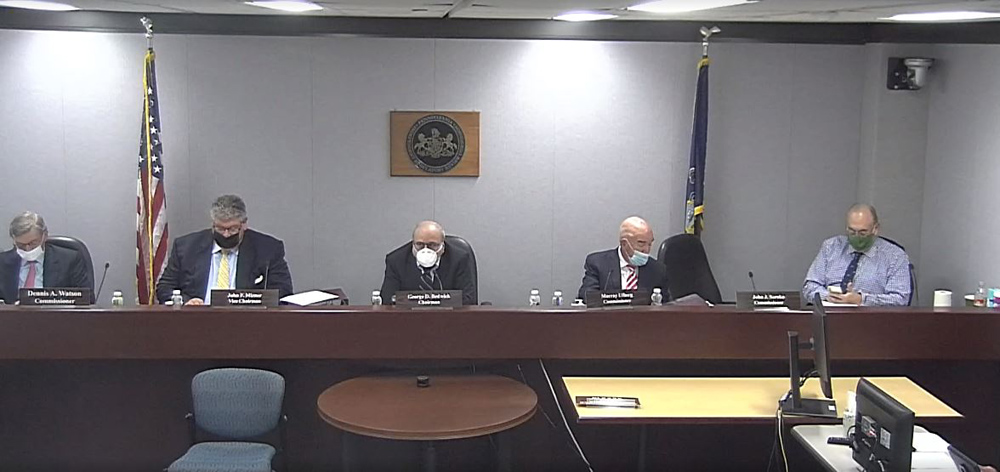
IRRC Chair George Bedwick issued the deciding vote to approve the regulations, saying he understood whatever decision the commission would make will receive criticism. Bedwick said each commissioner is meant to be independent in their thinking and their vote on issues.

PA-IRRC-Commissioners-(Pa-IRRC)-Content.jpg
Commissioners of the Pennsylvania Independent Regulatory Review Commission meet to discuss regulations regarding the Regional Greenhouse Gas Initiative (RGGI). | Pa. IRRC

“What I hope we can all agree on is that we have made every effort to approach the issue with an open mind, and we have in fact conducted this proceeding in an open and fair manner in permitting as much testimony as people wanted to provide us with,” Bedwick said.

The chairman said he was persuaded that Pennsylvania’s Air Pollution Control Act granted the DEP to issue the rulemaking, saying the law provided “broad” authority to adopt rules and regulations to prevent, control and reduce air pollution and to establish fees supporting air pollution controls. He said he examined the intent of the legislation when it was first passed in the 1960s. “Viewing the broad scope of the delegation, I tend to believe they wanted to regulate whatever in the future was determined to be a pollutant.”

Commissioner Murray Ufberg, who also voted in favor, said he was influenced by the “specificity of the analysis” conducted by the DEP. Ufberg said he is concerned about the air quality in Pennsylvania and the amount of CO2 generated by the state, saying he was “shocked” when he learned the totals.

Ufberg said it’s “apparent” that more efforts need to be done to mitigate air pollution in Pennsylvania, and the new regulations would go toward cleaning the environment. He said his decision was also influenced by his childhood growing up in a coal community in the state, saying he has seen the “resiliency” of people in those towns who are willing to do what they need for their families, including retraining in new industries.

“I must be optimistic, as we all should be, that alternative energy opportunities will offset and hopefully greatly exceed the adversity of those losses,” Ufberg said. “Without hope, we’re all in big trouble.”

Vice Chair John Mizner voted against the regulations, saying the issue before the commission was not the need to protect the environment, but the manner in which action is taken. Mizner said the process of drafting the regulations was “flawed,” partially because of COVID-19 pandemic protocols that limited in-person hearings on the regulations.

He also said cited a lack of engagement by Gov. Tom Wolf’s administration with the General Assembly over the regulations and argued that the impact of the policy on the state warranted legislative review.

“The regulatory process should be a collaborative process,” Mizner said. “I don’t believe for this regulation that there’s been sufficient access to the process that I think such a regulation deserves.”

In-person Comments

Dozens of legislators, environmental and economic advisers, trade unions and interested community members made comments to the commission for nearly six hours Wednesday before its vote, laying out both the pros and cons of the program.

Sen. Carolyn Comitta (D), minority chair of the Environmental Resources and Energy Committee, said the natural resources of Pennsylvania are the “common property of all the people, including generations yet to come.” Joining RGGI is a step to ensure the environment is secure, she said.

Sen. Joe Pittman (R), vice chair of the committee and one of the most outspoken legislators opposing RGGI, said the rule was “very personal and very emotional” because of the impact it will have on his constituents. Pittman said more than 6,000 MW of carbon-emitting electricity is generated in his district, and that energy is set to disappear by entering RGGI.

Pittman said the intent of the rule is to tax the emitting of carbon from power plants and redistribute the money for other purposes, a power that only lies with the legislature. He also said Pennsylvania will be the only state in RGGI to enter the compact without the approval of the legislature.

Pittman said he attempted many times to engage the Wolf administration on the impacts of the program on the communities of his constituents after the governor signed his executive order, but he received no response. (See Pennsylvania Governor Signs RGGI Executive Order.)

“From where I sit as an elected member of the Pennsylvania Senate, I can assure you I do not see a weighted benefit versus the enormous costs the constituents I represent will bear,” Pittman said.

One of the most impassioned speakers against the rulemaking was Rep. Pam Snyder (D), who represents parts of western Pennsylvania. Snyder said in her home of Green County, the coal industry makes up four of its top five employers.

Snyder called RGGI an “unfair tax on the fossil fuel industry” that will not impact the effects of climate change on the state. She said RGGI will “artificially and prematurely” shut down coal-fired power plants in the state, impacting energy generation.

“Make no mistake about it, Pennsylvania’s energy grid is not prepared to operate without coal,” Snyder said. “When it’s 100 degrees and air conditioners are running 24/7, it’s coal that gets called upon to supply the energy needed.”

Outside Responses

Following the commission’s vote, Mark Szybist, senior attorney for the Climate and Clean Energy Program at the Natural Resources Defense Council, said it represented the “most important climate action that Pennsylvania has taken in more than a decade.” Szybist said the DEP will now have the ability to move forward with integrating the state into RGGI, but he warned about “hurdles from bad apples” in the legislature.

“Pennsylvanians don’t want their legislators to tie RGGI up with red tape but instead demand an equitable clean energy economy that will bring shared prosperity,” Szybist said.

Analysts from ClearView Energy Partners said Pennsylvania is now poised to be the largest RGGI member state by electric sector CO2 emissions, generation and consumption. The analysts said Pennsylvania’s entrance into RGGI “could further push the clearing price for emissions allowances in RGGI above their record highs.”

ClearView also said several risks still exist for Pennsylvania’s RGGI entrance, including the passage of a bill that would invalidate the DEP’s rulemaking (SB 119), potential legal challenges and the term limit of Gov. Wolf, who will leave office in January 2023.

“If a GOP candidate succeeds him, a new Republican governor would almost surely oppose participation in RGGI and would be more inclined to sign legislation undoing the rule,” ClearView said.

California Energy Commission Looks at Gas for Midterm Reliability

In two workshops Monday, the California Energy Commission examined the role of natural gas in the energy mix through the middle of this decade as the state’s last nuclear plant retires, older gas plants close and the grid relies more heavily on renewables and storage.

In the morning session, CEC commissioners and analysts addressed the question of whether the state needs additional thermal generation, including incremental boosts to existing gas plants, to meet reliability challenges from 2022 to 2026.

The short answer was ‘no’ but with caveats and contingencies.

Hotter summers with strained supply make conditions more difficult to predict, lead Commissioner Siva Gunda said. Last summer’s rolling blackouts and this summer’s near misses are examples, he said.

“As we have seen last year and this year, heat waves and droughts are posing much more substantial impacts on demand and supply,” Gunda said. “This makes a look ahead much more challenging.”

California has experienced problems during Western heat waves in the evening hours, when solar ramped down and imports dried up.

“How do we plan for contingencies in the extreme events that might be significantly beyond [traditional] planning assumptions?” Gunda said. “As most of us know, the critical issue to address in the midterm is really the reliability during the net peak time that offers both ramping and dispatch uncertainties.”

“This workshop is a first step to frame the question and develop a dialogue around this important question in an open, transparent and robust way,” he said.

California Public Utilities Commissioner Clifford Rechtschaffen noted that the CPUC’s decision to order utilities to procure an additional 11.5 GW by mid-decade “teed up” the issue but skipped the question of whether more gas generation might be needed.  (See CPUC Orders Additional 11.5 GW but No Gas.)

“We left open in that ruling whether and to what extent we should authorize procurement from any natural gas resources pending further review, including this analysis from the Energy Commission,” Rechtschaffen said. “So while we’re here today, the work will help inform that decision whether there’s a need for additional procurement for reliability through 2026, and whether any fossil resources should be should be considered.”

No More Gas Needed, Probably

To answer those questions, CEC staff members broke down their analysis into several tracks, said Liz Gill, adviser to Gunda. The first track dealt with a technical analysis evaluating midterm capacity needs and evaluating thermal capacity needs.

Do “incremental thermal resources provide an additional reliability benefit compared to a portfolio of preferred resources [mainly renewables and storage]?” Gill said.

The CEC’s demand forecasts informed the analysis. In the second of Monday’s workshops, CEC staff looked at expected gas demand through 2035. Pacific Gas and Electric and Southern California Gas, the state’s two largest suppliers, each predict a 1% decline in the next 14 years, though extreme weather could alter that forecast, the utilities said.

More importantly, the CEC’s examination considered the expected rollout of thousands of megawatts of battery storage in the coming years.

The state went from having 126 MW of battery capacity last year to 1 GW this summer, CEC staff said. More than 10 GW may eventually be connected to the ISO’s grid.

The CEC looked at the potential problems of that rollout, which has already included delays in the supply chain and booked-up manufacturers.

“And so, [we] asked, what are the potential risks with battery deployment and performance?” Gill said. That evaluation is ongoing.

The CEC’s Mark Kootstra presented the technical analysis, which concluded that summer 2022 remains a problem.

An emergency declaration by Gov. Gavin Newsom earlier this year cited a potential 5,000 MW capacity shortfall next year. (Calif. Governor Proclaims Emergency as Blackouts Loom.)

After that however, the state should be in better shape as more renewables and storage connect to the grid. By the end of 2022, about 5,000 to 6,000 MW of nameplate capacity resources are scheduled to come online, he said.

“Assuming we haven’t had any gas retirements beyond what’s considered in the analysis, the preferred system plan significantly diminishes the concerns for reliability from 2022 through 2026,” he said. The CPUC’s procurement orders “should be sufficient to diminish that reliability concern from 2023 on.”

He warned that unexpected contingencies could arise as they did in last summer’s heat waves and this year when a wildfire derated a major transmission line from the Pacific Northwest. (See CAISO Declares Emergency as Fire Derates Major Tx Lines.)

“We’re not out of the woods,” Kootstra said. “There could still be … contingencies. But I think overall, the planning is in good shape.”

DOE Hydrogen Shot Aims to Build US Supply Chain for Global Markets

The opening session of the Department of Energy’s Hydrogen Shot Summit provided a fast and furious overview of the critical role hydrogen could play in the global energy transition and the current state of the U.S. domestic supply chain, with a focus on the DOE’s goal of cutting the price of green hydrogen to $1/kg by 2030.

John-Kerry-(DOE)-Content.jpg
Special Presidential Envoy John Kerry | DOE

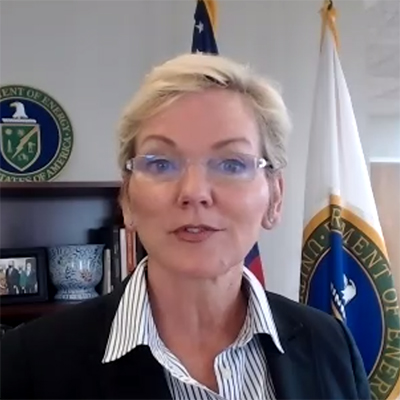
Opening the summit, Energy Secretary Jennifer Granholm framed that target as a vital component of President Biden’s plans to decarbonize the U.S. electric system by 2035 and build out a net-zero economy by 2050.

“If we can lower the cost of clean hydrogen, and I truly mean clean, to $1 for one kilogram at the same time as we eliminate GHG emissions, we will have the means to decarbonize industrial manufacturing, to refuel hydrogen fuel cell trucks, make alternative low-carbon fuel for planes, produce clean ammonia and other chemicals, create longer duration storage, and so much more,” Granholm said.

The packed agenda — featuring keynotes by Special Presidential Envoy John Kerry, Bill Gates and Sen. Joe Manchin (D-W. Va), along with three “lightening round” stakeholder panels — all reinforced Granholm’s main messages.

Key among them: hydrogen can fill the gaps in clean power production that even rapid deployment of solar and wind cannot meet; broad public-private collaboration will be essential to commercialize and scale the technology at a pace that will ensure U.S. competitiveness and leadership in global markets.

Joe-Manchin-(DOE)-Content.jpg
Sen. Joe Manchin (D-W. Va.) | DOE

“More than 90% of all future emissions will come from outside our borders,” Kerry said. “That means that in addition to reducing emissions at home, our ability to tackle the climate crisis will require America to speed the global net-zero transition. The most high-leverage way that we have to do that is through innovation, driving down the cost to critical clean technologies that can be scaled up and deployed around the world.”

Manchin used his time to promote the bipartisan infrastructure package, which includes provisions he authored that will fund the development of green hydrogen processes using renewable energy, nuclear power and natural gas with carbon capture.

“We need to invest in the entire hydrogen value chain to bring down the cost and overcome deployment barriers,” Manchin said, pointing to the $9.5 billion in the infrastructure bill to be used for research, development and demonstration of clean hydrogen. The bill would also advance the creation of hydrogen hubs to “accelerate hydrogen production from all energy sources and facilitate its delivery and use across all sectors of the economy,” he said.

Bill-Gates-(DOE)-Content.jpg
Bill Gates | DOE

But Microsoft founder Bill Gates cautioned that the innovation ahead may not follow any one path.

“There are many different ideas, and we’ll have to try out different things. We’ll have to see how things work as we scale up,” Gates said. Breakthrough Energy Ventures, Gates’s climate investment fund, recently announced a partnership with the DOE that will provide $1.5 billion in funding to support demonstration projects in green hydrogen, as well as sustainable aviation fuel, direct air capture and long-duration storage.

The funding is conditioned on the passage of the bipartisan infrastructure package, but Gates said, “Through blended finance we’ll find a way to decrease the cost of these products and make them available on the market, proving they can be financed and scaled up.”

Gray, Blue and Green 

The way to green hydrogen — powered by renewable energy such as wind, solar or nuclear — must go first through gray and blue hydrogen, produced from natural gas (gray) or natural gas with carbon capture (blue), said Seifi Ghasemi, CEO of Air Products, a global natural gas and natural gas equipment supplier.

With the cost of green hydrogen still at about $5/kg, the more traditional and affordable technologies are a key part of his company’s business, Ghasemi said during a stakeholder panel of hydrogen producers. Air Products is building a green hydrogen project in Saudi Arabia, which will use an estimated 4 GW of solar, wind and storage to produce 650 tons of green hydrogen per day, according to the company’s website.

Daryl-Wilson-(DOE)-Content.jpg
Daryl Wilson, executive director of the Hydrogen Council | DOE

“The reason we did it over there was because it was the fastest location that we could bring those things together,” he said. “The point of all these things we are talking about — bringing the cost down — you can only do that if you actually do it. We had to start somewhere.”

A green hydrogen supply chain is emerging, according to other industry representatives on the panel, with different, transitional technologies. Air Liquide has a hydro-powered facility in Quebec, Canada, and a project in Nevada that will initially produce hydrogen from renewable natural gas — using biogas or landfill gas — to supply hydrogen fuel cell vehicles on the West Coast, said Executive Vice President Michael Graff.

Plug Power, on the other hand, is building out a “green hydrogen ecosystem,” said Chief Strategy Officer Sanjay Shrestha. The company provides electrolyzers to produce green hydrogen and fueling stations for both mobile and stationary applications, according to its website.

Jennifer-Granholm-(DOE)-Content.jpg
Energy Secretary Jennifer Granholm | DOE

Expanding applications for green hydrogen means costs will come down, Shrestha said, which will, in turn, create more demand for green hydrogen. “And how wonderful is it that we are really looking at leveraging low-cost, domestically produced renewable electricity and turning that into your high-value green hydrogen fuel so that you can really go out and displace diesel,” he said.

The claims for blue hydrogen as a low-carbon energy source have raised debate among some clean tech advocates. A recent paper from researchers at Cornell and Stanford universities attacked blue carbon for the “fugitive emissions” that may escape carbon capture technologies, arguing that such emissions could be worse than the greenhouse gases produced by burning gas to heat homes or power industrial processes.

Granholm acknowledged the controversy but said that the Hydrogen Shot will be “all about science. We’re all about zero carbon emissions, and we also clearly need to reduce other pollutants like [nitrogen oxide]. If there are solutions that claim to be clean, but are not, those challenges have to be addressed. We want honest, data-driven answers in our quest for affordable, clean energy.”

Entergy Investigations Certain to Follow Hurricane Ida Restoration

Questions and dissatisfaction are brewing post-Ida over the integrity of Entergy’s New Orleans system and the forethought of its grid planners.

Greater New Orleans is on its second day of complete blackout following Hurricane Ida’s knockout blow. The city is currently islanded because of a “catastrophic transmission failure” that cut all eight transmission corridors into the city, according to Entergy (NYSE:ETR). (See Entergy Won’t Estimate Hurricane Ida Restoration Times.)

“Ida’s historic intensity has brought a tremendous amount of damage across Louisiana and Mississippi. Because of the extent of damage and rebuilding required, we expect recovery to be difficult and challenging, and customers in the hardest-hit areas should expect extended power outages lasting for weeks,” Entergy said in a Tuesday update. It also said thunderstorms today and tomorrow over south Louisiana could further hamper restoration efforts.

New Orleans City Council President Helena Moreno pledged investigations into Entergy once city leaders can shift their focus from restoration.

“For all eight to fail? … I’m just wondering whether this could have been prevented,” she said in an interview with local station WWL-TV.

Moreno said Entergy engineers told her that assessments of the transmission damage alone will take about four days.  

“What I find unfortunate is that so often it takes something like this for changes to be made,” she added.

Entergy admitted that Ida’s damage “eliminated much of the redundancy built into the transmission system.”

Entergy Louisiana CEO Phillip May said the transmission tower that collapsed Sunday night on the banks of the Mississippi River had recently passed inspection.

However, some on Twitter pointed out that the buckled tower was mottled with rust and raised questions about its structural integrity. Entergy did not return a request for comment about the age and condition of the 400-foot tower.

May said the tower was simply no match for the wind speeds despite its “robust” engineering design.

“Those towers, all of those towers, went through Hurricane Katrina without wavering. But this wind event experienced much higher wind fields, more devastating wind to those structures and to our system than even Katrina,” May told WWL-TV.

May said Entergy has been using rate increases prudently to harden the grid against intense storms.

“Every time we build a new line, it’s built to a higher standard. It’s using different engineered structures, things that would be able to withstand, you know, 150-mph winds, that kind of thing. More robust foundations and so forth so they can’t be pushed over by the wind,” he said.

Ida came ashore Sunday with maximum sustained winds of 150 mph, according to the National Hurricane Center.

Entergy said it’s narrowed options down to two for restoring power for essential services in the city: Either generate power inside the islanded city, or re-establish its links to the Eastern Interconnection. It said it could focus crews on getting at least one of the seven standing lines re-energized, or it could generate power within the city using the nearby Ninemile Point natural gas-fired plant and the new gas-fired New Orleans Power Station.

The latter is the plant that Entergy hired paid actors to promote at City Council hearings in 2018. At the time, Entergy touted the plant as useful in any future islanding scenarios.

Moreno said the plants’ contributions would provide more than 600 MW to the city, enough to power essential services, but not enough to restore power to homes.

Entergy New Orleans usually has a summer demand peak of more than 1 GW.

Entergy said either of the options could bring “first light” to New Orleans as early as Wednesday night. It said it preferred restoring at least one transmission link over keeping the city islanded with a limited standalone power supply.

“Under either scenario, New Orleans Power Station and Ninemile Power Station will be extremely valuable and important local sources of generation providing power to customers,” Entergy said in a press release. “Any power to the region will allow the company to begin powering critical infrastructure in the area such as hospitals, nursing homes and first responders in Orleans, Jefferson, St. Bernard and Plaquemines parishes, as well as parts of St. Charles and Terrebonne parishes. Restoration will vary by parish and neighborhood based on local transmission and distribution damage.”

New Orleans has been islanded before, by Hurricane Gustav in 2008. The New Orleans-Baton Rouge area was isolated from the grid for more than 33 hours when 14 transmission circuits tripped offline, requiring resynchronization.

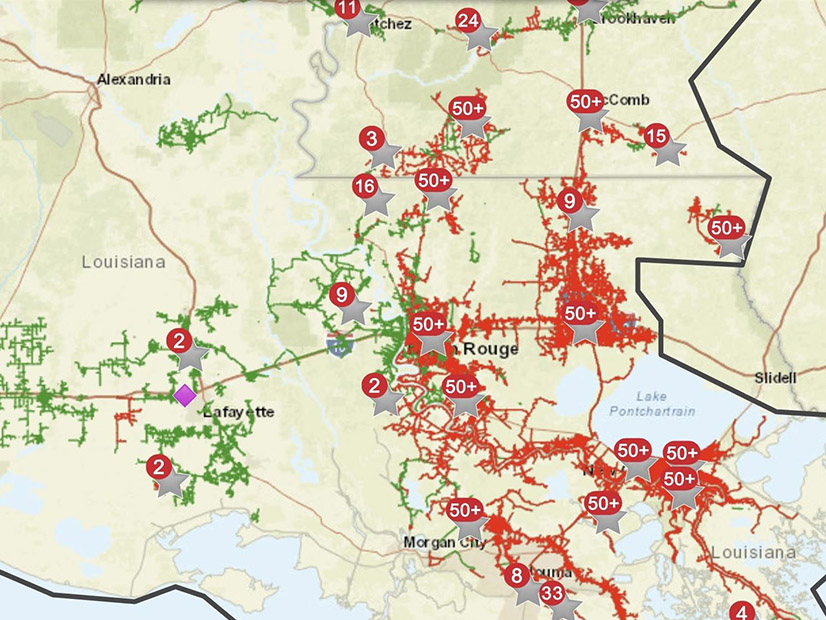
Entergy’s online outage maps remain a mass of red in New Orleans, Baton Rouge and surrounding areas. The company reported 840,000 customers without power in Louisiana, down from a peak of more than 900,000. Entergy said it was able to nearly halve outages in Mississippi to about 25,000 from a peak of 46,000.

Eric Schouest, vice president of governmental affairs for Cleco Power, reported Tuesday that 98% of the company’s 97,000 customers were still without power. He also said that “restoration will be a multiweek event for some customers.”

MISO extended a conservative operations declaration through Thursday that was originally set to expire Tuesday. The declaration covers all of MISO South and asks that utilities cease all maintenance outages and return facilities to service, if possible.

MISO spokesman Brandon Morris said Entergy and other members are sharing damage assessment with RTO operators and engineers.

“Together we will create and implement a restoration plan. This coordination with our impacted members is critical to getting the power flowing again while maintaining stability to prevent the system from collapsing,” Morris said in an emailed statement to RTO Insider.

MISO did not comment on whether Entergy New Orleans had a nonpublic contingency plan in place that contemplated all eight of its transmission lines failing.

“Since the exact extent or nature of a restoration event cannot be predicted, procedures are prepared as general guidelines designed to be flexible in applications and adaptable to anticipated scenarios. While the requirement to submit the plans is public knowledge, the plans themselves are not,” Morris said.

He pointed out that MISO conducts annual power system restoration training with members, which involve drills on restoring their grids from blackout conditions.

The Edison Electric Institute reported that more than 25,000 workers from 32 states and D.C. have mobilized to assist Entergy in restoration. The group warned early on that damage assessment and restoration could take some time.

“In some cases, power restoration will require rebuilding energy infrastructure. Flooding creates a unique and dangerous restoration environment and can delay initial assessment efforts. In the hardest-hit areas, search and rescue and life safety will be the top priority,” EEI wrote as the storm was downgraded to a tropical storm Monday.

Entergy Re-energizes Small Portion of New Orleans

Entergy restored power to a fraction of its customers in New Orleans Wednesday morning, using a transmission line from the northern side of Lake Pontchartrain and a small gas-fired generator.  

The utility, which said it lost all eight transmission lines into the New Orleans area during Hurricane Ida, reported it had returned electricity to approximately 11,500 customers in the New Orleans East area as of noon.

“That number is growing gradually. The power restoration process will be slow and steady in the coming days. At the same time, damage assessments are continuing,” Entergy spokesman Neal Kirby said in an emailed statement to RTO Insider.

Kirby said the limited power supply is being prioritized for “hospitals, first responders, water treatment and other essential community services.” He said crews continue to work “around the clock” to restore what power they can. So far, Entergy has managed to reenergize its Mid-City substation, the Mid-City VA hospital, the New Orleans Fire Department and the city’s 911 operations center, among other buildings.

The limited power is being supplied through the natural gas-fired, 128-MW New Orleans Power Station, brought online a year ago to assist with storm restoration. The station can only furnish about 10% of New Orleans’ peak demand of 1,100 MW. In a Wednesday conference call with reporters, Entergy Louisiana CEO Phillip May said the power is being delivered to New Orleans across Lake Pontchartrain via transmission in Slidell in St. Tammany Parish.

Entergy (NYSE:ETR) called it a “first light” and “a sign of hope” after two days of complete blackout in metro New Orleans. Entergy said yesterday that it preferred re-establishing transmission links to New Orleans rather than it remaining an island and limping along on generation inside the city. (See Entergy Investigations Certain to Follow Hurricane Ida Restoration.)

Greater New Orleans remains largely islanded from the rest of the Eastern Interconnection. (See Entergy Investigations Certain to Follow Hurricane Ida Restoration.)

Entergy said the goal remains to rejoin New Orleans and the surrounding areas with the transmission system. On Tuesday, a crew of about 10 was filmed stretching new cable across Interstate 10 near New Orleans.

May and Entergy New Orleans CEO Deanna Rodriguez said they will add to the New Orleans Station’s output via the Slidell line by also linking the 655-MW Ninemile Point in Jefferson Parish in an attempt to move power west and get more of New Orleans lit. Entergy may eventually be able to create a loop of power that reaches more substations and neighborhoods.  

https://rtowww.com/wp-content/uploads/2023/06/140620231686784836.jpeg
Entergy outage map in New Orleans and Louisiana on Sept. 1 | Entergy

“While initial service can be provided to some customers, the full restoration will still take time given the significant damage across the region. Crews will have to methodically bring back additional transmission lines over time to provide other pathways for power to enter the region, helping to maintain stability of the system throughout the complete restoration process,” the utility said in a Wednesday update.

Entergy warned that its grid remains limited in what it can transport around the city: “With extensive damage to the system across the region, much of the redundancy built into the electric system is limited. This makes it difficult to move power around the region to customers, and limits options to power customers in the event of equipment failure or additional damage to the system.”

In an afternoon update Entergy said that road closures and “other accessibility challenges due to the storm” could delay restoration in other areas of the state. The utility said that as of 1 p.m. it had assessed about 36% of affected infrastructure in its service area, finding 2,095 broken poles, 422 damaged transformers, and 2,351 downed spans of wire.

“Based on historical restoration times, customers in the direct path of a storm as intense as Hurricane Ida could experience outages for more than three weeks,” it said. “While 90% of customers will be restored sooner, customers in the hardest-hit areas should plan for the possibility of experiencing extended power outages.”

Cleco also said it had restored power to some customers, with 85,262 customers in St. Tammany Parish and 797 customers in Washington Parish still without power as of 4 p.m.

New Orleans and other portions of southeast Louisiana face 100-plus heat indexes over the next several days.

The upper portion of Jefferson Parish remains uninhabitable due to floodwaters. Jefferson Parish Emergency Management Director Joe Valiente advised residents to “seek shelter in another state or outside of this area.” He said it would be some time before the upper part of the Parish can “restore the services that are necessary for everyday living.” Jefferson Parish’s Metairie ― which contained a MISO office until 2019 ― sustained considerable damage with widespread roof destruction, he said.  

Valiente told several news outlets that it could take six weeks to restore power in his parish. He characterized the grid as “100% smashed.”

The New Orleans City Council, which regulates Entergy New Orleans, will hold a special meeting at 10 a.m. CT Thursday. The meeting will be “limited to the consideration of emergency storm-related appropriations” since the emergency is still ongoing, the council said.

New Orleans City Council President Helena Moreno has promised inquiries into the complete failure of the Entergy system in the city.

Maryland PSC Seeks to Expand State’s Community Solar Pilot

The Maryland Public Service Commission last week proposed expanding the state’s community solar pilot program by increasing its maximum capacity and broadening the types of sites eligible for development.

The seven-year pilot currently allows about 417 MW of community solar capacity — or about 3.25% of the state’s utilities’ 2015 peak demand. Under the revision, the cap would be raised to 4.5% of the 2015 peak demand, which could add another 167 MW of potential capacity to the program.

But, so far, only about 20 projects totaling 40 MW are online, according to Phillip VanderHeyden, the PSC’s assistant executive director.

Other revisions would add clean-fill sites — essentially former construction sites containing no hazardous materials — to the list of eligible properties and establish a waiver process for co-locating multiple low- and moderate-income (LMI) projects on the same parcel of land.

Commissioner Michael Richard on Aug. 24 said that “sensitivities toward equity have been heightened considerably since 2015,” when the law enabling the program was passed. “We must heed the legislative findings that it is in the public interest to allow low- and moderate-income customers to enjoy all the benefits of solar energy and net metering.”

While approved by the commission, the revisions will not be finalized or go into effect until they are reviewed by the state legislature and go through another round of public comment, according to an email from the PSC.

Still, project developers are enthusiastic about the expanding opportunities the revisions could create. “We’re developing community solar projects across Maryland, and the response from residents has been fantastic,” Kate Colarulli, chief of staff at CleanChoice Energy, wrote in an email to NetZero Insider. “We expect all our projects to be viable and fully subscribed.”

Arcadia, another project developer, offers community solar subscriptions that Vice President and General Manager Joel Gamoran said are “consumer-friendly,” with no credit checks and no long-term contracts. The company “has new capacity available in all [utility service territories] in the state. We’re primarily focused on [Baltimore Gas and Electric] and Pepco, where we have new projects turning on this fall,” he said.

An Expanding Market

Community or shared solar projects provide access to solar for individuals and groups who may not want or be able to put panels on their roofs, such as apartment dwellers or homeowners with heavily shaded roofs. Under Maryland’s community solar regulations, power from projects built in a specific utility’s service territory is shared among a group of “subscribers” who receive a credit on their bill for a portion of the power produced.

Across the U.S., 40 states now have at least one community solar project, and 20, including Maryland, have specific community solar laws. In a November 2020 report from the National Renewable Energy Laboratory, Maryland was identified as one of a handful of states working to expand their programs. The state is “currently not in the top 10 community solar states by capacity but will likely rise in ranking as more projects are accepted and become operational,” the report says.

Originally intended to run for three years, the regulations for the pilot program were finalized in July of 2016, and the program rolled out in 2017. The program was extended to seven years in 2019, and will now run through 2024, with data collected to evaluate its impact on Maryland’s grid.

The program is set up with capacity carve-outs for LMI projects and brownfield projects — about 30% each — with the remaining 40% open. For example, Pepco was originally allocated 50 MW for the first few years of the pilot, with 15 MW each for brownfield and LMI projects and 20 MW in the open category, according to the PSC website.

In addition, developers receive funding from the state to ensure long-term, significant bill discounts for LMI customers who subscribe to a community solar project.

“Everyone who signs up for a community solar project receives energy credits on their electricity bill,” Common Energy CEO Richard Keiser said. “If you are an LMI subscriber, and your share of those credits is $100, then you would keep $25, and Common Energy would invoice you $75 and give that money to the project owner. In this way, every LMI subscriber receives a perpetual 25% discount on the credits.”

The company currently manages seven projects in all four utility territories in Maryland — BG&E, Potomac Edison, Delmarva Power and Pepco — with a total of more than 1,300 subscribers, Keiser said.

Eric LaMora, director of community solar at Nautilus Solar Energy, said his company recently opened a 1.8 MW community solar project in Kingsville, a small town north of Baltimore. The project is serving 293 households, including 157 LMI residents, he said.

Like Common Energy, Nautilus guarantees a 25% discount for LMI subscribers; other customers are guaranteed to save 10% annually, he said.

“All Nautilus projects in Maryland are fully subscribed,” LaMora said. “Continuing the Maryland community solar program and adding capacity and new projects each year will allow Nautilus to offer affordable and equitable solar power to additional Maryland households who would not normally have access to clean energy.”

Oregon Program to Provide $50M for Community Renewables, Resilience

The Oregon Department of Energy (ODOE) is embarking on an effort to distribute $50 million in public funding to support community-based renewable energy efforts — with a specific focus on projects that serve disadvantaged populations and provide grid resilience.

The money was earmarked in House Bill 2021, a sweeping law passed in June that requires the state’s investor-owned utilities to reduce their emissions by 80% by 2030 and serve retail customers with 100% clean energy by 2040, an ambitious timeline matched only by New York. (See West Coast Could be Net Zero by Midcentury.)

The bill stipulates that the funding be used to offset the costs of planning and developing community renewable projects no larger than 20 MW, with priority given to projects benefiting traditionally underserved communities, such as Oregon’s tribes, communities of color, lower-income communities, rural and coastal areas, and communities with limited infrastructure.

“We’re really pleased to be able to take part in a program like this and try to focus some funding into some parts of the state that maybe haven’t normally had it, for projects that are going to make a real difference … in some rural communities across Oregon. It’s an exciting opportunity for us,” Rob Del Mar, ODOE senior policy analyst, said Monday during a meeting of the state’s Energy Advisory Work Group, a stakeholder group that advises the department on budget, planning and policy decisions.

ODOE’s first step will be to “identify and qualify” targeted communities, Del Mar said. Eligibility to apply will be restricted to Oregon’s tribes, counties, municipalities with populations under 500,000 residents, government bodies such as ports and irrigation districts, and consumer-owned utilities (COUs).

“This program is going to be a little different from a lot of the other financial incentive programs that have been in Oregon in that it’s only available to public bodies or partnerships with public bodies,” Del Mar said.

The legislature also intended that about half the funding goes to grants awarded to “community energy resilience projects.”

“These are projects that may include renewable energy plus elements that increase energy resiliency within the community, such as battery storage [or] microgrids,” Del Mar said.

For resilience projects, the program will offer maximum grants up to $100,000 for planning and $1 million for construction, both of which can cover up to 100% of the costs for both phases. The same award amounts will be available to renewable energy-only projects, but the grants can cover no more than 50% of the construction costs for those projects.

“This is not to say that every grant will be providing this level of coverage of the total cost; these are just the statutory limitations,” Del Mar said. “And the grants will be awarded on a competitive basis. Projects that bring some [matching funds] will certainly enable us to spread the funds across more projects, so we’re hoping that we’ll see some of those.”

ODOE will also put performance agreements in place to ensure that projects meet program expectations, he added.

Reaching the Far Corners

The department has already begun work on recruiting an advisory committee to design program rules, establish equity metrics and develop a methodology for identifying qualifying communities. The group might also help to engage in community outreach to solicit projects and support the application review project.

“As the committee is built, we will continue to define roles and responsibilities,” Del Mar said.

According to the statute, committee members must be drawn from the state’s Environmental Justice Task Force; development agency Business Oregon; IOUs and COUs; a federally recognized Oregon tribe; and an organization that represents community renewable energy development. It will also include three members from local government to recognize the interests of cities, counties and special districts, as well as representatives from nongovernmental organizations that serve disadvantaged households and from state and federal emergency management agencies.

Del Mar said ODOE is aiming for a February 2022 deadline to complete program rules, develop related materials and hold community workshops. But many questions remain unanswered.

Key among them: What is the best way to reach potential applicants?

“We’re really looking to get into the far corners of the state and find projects in communities that maybe haven’t normally participated in state programs,” Del Mar said. “What are the needs for capacity building in these rural communities so that they can develop programs and put applications forward?”

The agency hopes to issue its first project opportunity announcements in March and being to take applications shortly thereafter.