Stakeholder Forum: Texas’ Renewable Energy Bubble

By Doug Sheridan

While pundits wrangle over the implications of the One Big Beautiful Bill Act for America’s power sector, Texas has managed to blow itself a renewable‐energy bubble — one spawning so much solar and wind energy that the kind of generation it actually needs sits on the drawing board. 

The culprit? A mix of federal incentives and state policies that turned the state’s grid into a speculative sandbox for developers chasing subsidies rather than serving actual energy demand.  

In recent years, ERCOT has enjoyed a reputation for fast interconnections and friendly regulatory treatments for new generation. This has spurred the rush by renewables developers to use the system to monetize federal investment tax credits (ITCs) for their projects before tax codes change. 

Current law affords investors in qualifying projects a tax credit equal to 30% of the original cost of the project. In reality, the tax breaks are even larger. According to Neil Booth of Orbis Consulting, under current IRS guidance, project developers may immediately “step up” the value of a project’s equipment to a higher value on the basis that the economic value of the equipment is higher once connected to the grid.  

This accounting maneuver and other add-ons mean tax-equity investors can recoup 100% of their investment as soon as 90 days after a project goes live. It doesn’t take a genius to understand how such a siren call of quick returns can incentivize investors to target the one grid on which they can get their projects online as fast as possible — irrespective of whether that grid needs the incremental intermittent power. 

Companies like Meta, Microsoft, Amazon and Google add their own distortions. These hyperscalers sign long-term power-purchase agreements (PPAs) with renewables developers to help brand themselves as “green” operators. On its face, this makes it seem like corporate America is doing its part to decarbonize. In practice, it’s not clear how many hyperscalers are in fact consuming the electrons for which they have contracted. 

Instead, hyperscalers may simply pay for the renewable power per the PPA, then sell it back into ERCOT’s wholesale market. This affords their operations the environmental seal of approval they seek, even though their facilities might be running on gas-fired generation in other states. Meanwhile, the intermittent power from the renewables is being dumped onto the Texas grid without a stable, long-term customer — undermining both supply and demand fundamentals, as well as prices for the dispatchable power needed to balance the system. 

The EIA reports that Texas added a net 29.2 GW of supply from 2022 to 2024. Subsidized solar, wind and battery capacity represented 97.9% of this. More capacity has since been added, and ERCOT now reports 86.8 GW of renewables on its system — for a grid with an all-time demand peak of less than 90 GW. 

NERC has taken note, pegging ERCOT’s on-peak reserve margin at more than 40%. In a rational market, this would slam the brakes on further buildout of renewables. Instead, ERCOT’s interconnection queue shows 374 GW of new renewable and battery projects interested in connecting to the system—more than 10 times all other resource types combined. 

Meanwhile, despite leading the nation in natural gas production, Texas has seen developer interest in newbuild gas-fired generation nearly vanish. The problem is developers can’t pencil out viable projects when first-in-line solar, wind and batteries crush revenue expectations. 

As a result, the new combined-cycle and peaking plants needed to keep the grid stable during peak hours and weather lulls and to back up renewables are effectively locked out of the Texas market. This has left ERCOT’s administrators with little choice but to continue connecting more part-time renewables. 

Texas’ booming population, rising EV adoption and prospective surge in on-grid data center demand all point to the need for more dependable, around-the clock generation. Instead, the state is hardwiring increasing amounts of intermittent energy — and the operational costs and complexities that come with it — into its grid. What’s more, over 40% of its nuclear, coal and gas-fired capacity is 30 years old or older. Aging infrastructure and falling revenues can lead to delayed maintenance and lower investment, putting reliability at risk. 

Unless Texas policymakers change course, the consequences of swelling market distortions will become harder to manage. A grid saturated with financially engineered, subsidy-seeking projects won’t in the long run deliver stable prices or dependable service. Without serious reform, Texas faces a future of inflated rates, reliability challenges and growing dependence on taxpayer-funded interventions. 

It’s time to restore the integrity of ERCOT’s wholesale power market and re-center its grid planning around the kind of dispatchable power that can deliver when Texans need it. Otherwise, this renewables bubble won’t just pop. It will burst — with the state’s energy security caught in the fallout. 

Doug Sheridan is President of EnergyPoint Research in Houston, Texas. 
FERC Rejects Voltus Appeal for Interim MISO Order 2222 Compliance

MISO is free to keep working toward its 2030 goal of fully incorporating aggregators of distributed energy resources into its markets without an interim participation option, FERC ruled in an order on rehearing.  

The commission’s July 10 order denied aggregator Voltus’ request to compel MISO to reinstate a temporary role for aggregators in its markets while it works on full FERC Order 2222 compliance (ER22-1640).  

MISO nixed the provisional step from its first compliance proposal in the spring after the commission said it didn’t fit within the requirements of Order 2222. The RTO planned to use an existing demand response participation category to get aggregators of distributed energy resources participating on a limited basis a few years ahead of its full implementation. (See MISO Discards Interim Participation Option from Order 2222 Plan.)  

FERC disagreed with Voltus’ contention that it got it wrong when refusing the partial participation. The commission said its history of accepting interim models while grid operators work on full compliance with orders and directives on a longer timeline didn’t apply in this case because MISO’s pro tem demand response plan contained elements that didn’t square with Order 2222. 

FERC said its precedent of approving an interim plan for electric storage resources in MISO markets before the RTO complied with Order 841 was fundamentally different because that case dealt with a Section 206 complaint under the Federal Power Act, not Order 841 itself. Voltus cited Indianapolis Power and Light’s (now AES Indiana) 2017 complaint over MISO’s treatment of the utility’s Harding Street Battery Energy Storage System when arguing for rehearing. (See MISO Ordered to Change Storage Rules Following IPL Complaint.)  

FERC said it continues to find MISO’s provisional demand response model lacking, namely its failure to meet Order 2222’s 100-kW minimum size requirement for aggregations. The commission also said it was unpersuaded by Voltus’ claim that it ignored the benefits of a timelier rollout of at least some Order 2222 directives. FERC said it wouldn’t debate a piecemeal implementation further.  

FERC backed MISO’s 2030 effective date for its comprehensive distributed aggregation model and said it was “timely,” irrespective of a partial rollout. The commission once again underscored MISO’s reasoning that its underlying computer systems need work over the next four years before they can support aggregations.  

“MISO stated that the foundational enhancements to its settlement systems are expected to be completed in the middle of 2028,” FERC said. It disagreed with Voltus that MISO didn’t expound on which specific settlement upgrades would be necessary, and said MISO provided detailed timelines that outlined delays and additional work.  

Grain Belt Funding Appears on Shaky Ground with DOE; Invenergy Firm on Value

Invenergy is standing by the value of its $11 billion, 800-mile Grain Belt Express transmission project with a letter to Energy Secretary Chris Wright, who is said to have pledged to block the line.

Grain Belt Express Vice President Jim Shield wrote July 11 that Wright should put aside “unfounded noise” and confirm closing of the Department of Energy’s $4.9 billion in federal loan guarantees as Republican leadership in Missouri targets the line’s federal funding.

U.S. Sen. Josh Hawley (R-Mo.) and Missouri Attorney General Andrew Bailey have taken aim at Grain Belt. Hawley sent a letter insisting that Grain Belt’s conditionally approved DOE loan guarantee be pulled, while Bailey has opened a consumer protection investigation into the nature of the line’s development. (See Missouri AG Opens Inquiry into Grain Belt Express.)

In a July 10 press release, Hawley said he secured a pledge from Wright to “halt” the line.

Hawley said in a follow-up social media post the same day that he had a “great conversation” with President Donald Trump and Wright, who he said pledged to “put a stop” to the project. Hawley called the Grain Belt Express an “elitist land grab harming Missouri farmers and ranchers” and claimed it is set to cost taxpayers billions of dollars.

Hawley has demanded for months that the Trump administration terminate government funding for Grain Belt and has questioned the line’s viability.

“Your department should be taking every possible action to stop this loan — not only to save taxpayers’ money, but also to save generational land from being ripped away from families and hard-working farmers and ranchers in Missouri,” Hawley wrote in the June 25 letter to Wright.

‘Open Season’ on New Infrastructure

Shield said it’s unfortunate Hawley and Bailey “are declaring open season on America’s ability to build needed energy infrastructure” and that Grain Belt is the “target of egregious, politically motivated lawfare.”

He characterized Hawley and Bailey’s “crusade” as “unwarranted and unhinged.”

“Recent false accusations from Sen. Hawley and A.G. Bailey saying that the Grain Belt Express will cost America billions instead of saving us billions, whether mistaken or purposefully declared, are misleading at best,” Shield said.

Shield wrote that Grain Belt is a “critical energy security project” that will deliver reliability and savings and is supported by a broad range of stakeholders.

“It is an open-access line that will deliver all forms of American energy based on customer demand and available market power, enhancing the ability of the largest grid operators to share power, including from generators directed to operate under DOE’s 202(c) authority,” Shield said, in an apparent attempt to appeal to the conservative leadership’s pro-business philosophy.

Shield said the line — capable of delivering four nuclear power plants’ worth of electricity and the second-longest line in U.S. history — would connect four of the country’s grid regions while delivering cost savings and reliability to “29 states and D.C., more than 40% of Americans and 25% of Department of Defense installations.”

Shield said recent questions raised by Bailey were addressed through the Missouri Public Service Commission’s “long and rigorous” regulatory process that began in 2022 and concluded in late April. What’s left is “procedural abuse” to roll back state regulatory approval that wastes public resources and harms the public, Shield wrote.

“The state of Missouri was represented throughout these proceedings, yet A.G. Bailey never intervened or otherwise contested the proceeding. Missouri law and constitutional due process protect the Grain Belt Express’ property interest in its permit granted by the MPSC. No amount of political posturing and unrelenting attacks can change that fact,” Shield said.

He said the timing of the “anti-growth” attacks doesn’t make sense given the country’s booming energy demand and that the line is even more important now than when it was conceived in 2010.

The CEO of Associated Industries of Missouri, a pro-business lobbyist organization, said Grain Belt is an “obvious solution,” given demand growth from new manufacturing and emerging technologies.

“It is nonsensical to try to impede a project that will put Missourians to work constructing infrastructure that delivers affordable and reliable power of all kinds to Missouri businesses while enhancing grid security for America,” CEO Ray McCarty said in a statement.

In a separate press release issued by Invenergy, the company questioned whether America has “lost its will to build.”

“If projects can’t count on certainty even after being approved and reviewed upon appeal, America can’t count on ever getting steel in the ground. America will lose the test of its will to build,” Invenergy said. The company lamented “political actors making last-gasp attempts to reopen existing state approvals or halt a yearslong federal review in its tracks.”

Invenergy noted that states lead on transmission permitting and said Grain Belt already has cleared Kansas, Missouri, Illinois and Indiana’s routing processes. It said it made “every effort” to negotiate with landowners.

“Grain Belt Express has among the strongest set of landowner protections and compensation packages, including a code of conduct and agricultural impact mitigation protocol. In fact, the Kansas Farm Bureau called for these protocols to be made a standard for the industry,” Invenergy said. “Living up to our commitment that eminent domain be used only as an absolute last resort, land has been secured through voluntary agreements in all but a low single digit percentage of cases, a rate equal to or better than the utility industry standard.”

Invenergy says it has completed over 95% of land acquisition for Phase 1, the segment connecting Missouri and Kansas. The phase’s construction is scheduled to start in 2026.

Invenergy added that when it acquired Grain Belt from now-defunct Clean Line Energy in 2020, it invested in a redesign and listened to stakeholders’ concerns, ultimately deciding to make more power deliveries to Missouri. (See Invenergy Announces Grain Belt Express Expansion.)

Texas Public Utility Commission Briefs: July 10, 2025

Regulators Approve SPS, SWEPCO System Resiliency Plans

The Texas Public Utility Commission has approved system resiliency plans for Southwestern Public Service and Southwestern Electric Power Co. (SWEPCO), as it continues to meet a requirement from the 2023 legislative session. 

Both plans were the result of agreements with intervening parties. SPS, an Xcel Energy subsidiary, reached a settlement over its three-year plan with the Office of Public Utility Counsel (OPUC), Alliance of Xcel Municipalities, Texas Industrial Energy Consumers (TIEC), Walmart, the International Brotherhood of Electrical Workers Local Union 602, Golden Spread Electric Cooperative and PUC staff (57463). 

The SPS plan includes distribution overhead hardening, distribution system protection modernization, communication modernization and wildfire mitigation. The utility proposed $538.3 million of investments to be implemented from 2025 to 2028. 

The settlement removed the five lowest benefit-cost ratio projects from the distribution overhead hardening measure, totaling $5.9 million by the agreement. However, the commission agreed to reinstate the projects, saying they also were designed to strengthen overhead infrastructure to prevent, withstand and mitigate wildfire risks. 

In February 2024, downed power lines from a broken SPS utility pole ignited the Smokehouse Creek Fire in the Texas Panhandle. It became the largest wildfire in recorded state history, burning more than 1 million acres before being contained. 

“Given where this is and the recent history in the area, I think adding those measures back in makes sense to me,” PUC Chair Thomas Gleeson said during the commission’s July 10 open meeting. 

Xcel has acknowledged its role in the fire and has settled 151 out of 225 claims filed through a dedicated claims process. 

SWEPCO’s plan was included on the PUC’s consent agenda. The American Electric Power subsidiary reached a unanimous agreement in March with commission staff, OPUC, Cities Advocating Reasonable Deregulation, TIEC and Walmart. The commission modified the plan to remove several “enhanced vegetation management” measures with benefit-to-cost ratios below 1.0, reducing its estimated cost from $88.9 million to $83.7 million (57259). 

The four-year plan also includes distribution feeder and lateral hardening, and increased distribution automation circuit reconfiguration. 

The 2023 Texas Legislature’s House Bill 2555 allows the state’s electric utilities to file resiliency plans for approval with the PUC. The plans must include measures that would “help the utility prevent, withstand, mitigate or more promptly recover from resiliency events, which include extreme weather, wildfires, and cybersecurity or physical security threats.” 

Oncor was the first utility to secure approval of its resiliency plan in November 2024. (See Texas PUC Approves 1st System Resiliency Plan.) 

Wildfire Mitigation Plans

The commission established a July 25 deadline for utilities, municipalities and cooperatives that own transmission and distribution facilities to provide input on PUC rules for wildfire mitigation plans, as required by a new state law (56789). 

“I know it’s a short timeline, but please provide … your input,” Gleeson said. “As you hear us say often up here, the best outcomes happen when we get as full participation as possible, so please avail yourselves of this opportunity to provide input to commissioners.” 

Staff plan to bring a formal proposal for publication to the PUC’s Aug. 21 open meeting. 

Status Quo for FFSS Program

After consulting with the grid operator and its Independent Market Monitor, PUC staff have proposed maintaining the same parameters for ERCOT’s firm fuel supply service (FFSS) program during the winter 2025/26 contract period. That will retain the program’s $54 million budget, $12,240/MW offer and 48-hour deployments (56000). 

The program has procured 3,319 MW and 4,194 MW in its first two years, at a cost of $29.4 million and $42.4 million, respectively. 

Staff plan to gather feedback from ERCOT, the IMM and stakeholders to develop rule language before future contract periods, allowing the commission to consider next phase options before the 2026/27 winter. 

The FFSS program provides additional grid reliability and resilience in the event of fuel disruptions during extreme cold weather, compensating generation resources that meet a higher standard. 

SB6 Workshop July 21

The PUC has scheduled a workshop for July 21 to gather public and stakeholder input as it prepares to implement Senate Bill 6 

The “seminal piece of legislation” from the 2025 biennial session, as Gleeson described it, directs the commission to determine a cost allocation for large loads to ensure they pay their fair share of infrastructure expenses and requires their developers to pay a $100,000 fee for the initial screening studies (58317). 

Gleeson said it will be important to standardize how load is counted for transmission purposes and to focus on the bill’s co-location and net-metering agreements. He urged staff to work with ERCOT staff on transmission and resource adequacy issues. 

D.C. Circuit Declines Review of SPP Cost Allocation

The D.C. Circuit Court of Appeals has denied a review of a FERC decision that allowed SPP to incorporate some Missouri transmission facilities into one of its pricing zones, spreading the costs of the newly integrated infrastructure across the zone’s customer base (23-1133).

The court ruled July 11 that FERC “reasonably applied” the cost-causation principle in approving SPP’s tariff revision to include the annual transmission revenue requirement for the city of Nixa’s facilities in the RTO’s pricing Zone 10. Nixa’s 10 miles of transmission lines and substations are owned by GridLiance High Plains.

Writing for the court, Circuit Judge Justin Walker said the commission determined that the Nixa assets brought “integration, reliability and power transfer benefits to Zone 10 customers” that justified spreading the costs across the transmission zone.

“FERC may analyze costs and benefits at the zonal level rather than the customer level, and FERC reasonably determined that all the zone’s customers will enjoy benefits,” he said. “Because of those zone-wide benefits, it was reasonable for FERC to spread the integration’s costs to all the zone’s customers.”

The appeal was brought forward by the Arkansas city of Paragould’s Light & Water Commission and other parties, several of whom unsuccessfully requested FERC rehear its 2023 order approving SPP’s tariff revision (ER18-99-007). (See “City of Nixa, Mo., Annual Transmission Revenue Requirement,” FERC Briefs: Orders Addressing Arguments Raised on Rehearing.)

The utility objected to FERC’s level of generality in considering benefits, the type of benefits considered and the case’s evidence of benefits. The court rejected each of the objections.

Walker said FERC had no duty to “take such a hyper-granular approach to weighing costs and benefits” and that it “reasonably analyzes costs and benefits at the zonal level” when considering integration of new facilities in the zonal system.

“As a significant customer in Zone 10, Nixa has paid a considerable share of Zone 10 transmission facility costs — a share that includes costs for facilities that primarily serve load to non-Nixa customers,” Wright wrote. “So, even though Nixa itself does not draw direct, quantifiable benefits from these facilities, it has footed part of the bill. In sum, the petitioners want Nixa to keep paying a substantial percentage of the costs of facilities that directly serve non-Nixa areas of Zone 10, while the petitioners themselves pay no part of the facilities that directly serve Nixa.”

The D.C. Circuit found that as it and other circuit courts have held, “benefits justifying a cost shift do not need to be tangible, nor must they be amenable to precise tabulation.” It said it is enough that there is “an articulable and plausible reason to believe” the integration’s benefits are “roughly commensurate” with the integration’s costs.

The court also said the claim that FERC did not have sufficient evidence to conclude that integrating the Nixa assets would provide any benefits to non-Nixa customers faced “a high bar.”

“FERC’s decisions need only be supported by ‘substantial evidence,’ which is ‘more than a scintilla’ but ‘less than a preponderance,’” Walker wrote.

The petitioners argued their case before Walker and fellow Circuit Judges Florence Pan and Cornelia Pillard in April 2024.

Stakeholders Question MISO Plan to Reassign LSEs’ MW Duties Based on Risky Periods

MISO stakeholders are skeptical of the RTO’s proposed new approach to divvying up reliability obligations among load-serving entities based on evolving system risk.

The RTO revealed early in 2025 that it intended to rearrange the reserve margin obligations it parcels out among its LSEs to align with historical load during the most perilous hours on its system. (See MISO Ponders Redistributing LSEs’ MW Obligations Based on Demand During Risky Periods.)

At a July 9 Resource Adequacy Subcommittee meeting, MISO said it would make a few changes from when it announced its plan about six months ago. Now, it plans to use different demand hours that determine the allocation and keep those hours in place for three years at a time in a bid for the allocation to be more stable for LSEs’ resource planning.

MISO assigns its LSEs a portion of its overall planning reserve margin requirement (PRMR). Today, the grid operator divvies up the PRMR based on LSEs’ 50/50 load forecast for MISO’s coincident peak. MISO said because of shifting and growing risks to the system, its reliability requirement should be reallocated among LSEs based on periods that contain the highest reliability risks. MISO previously said there’s a mismatch between LSEs’ obligations and the load LSEs are consuming at the times of greatest need on the system.

MISO Market Design Economist Bill Peters said though MISO needs to change the responsibility of each of the LSEs because risk is shifting, it also needs to respect that LSEs “need stability and a way to plan” with a somewhat stable PRMR allocation year over year.

MISO is reassessing its PRMR allocation partly because it moved to an availability-based capacity accreditation based around risky hours, not peak load. Peters called reallocating the PRMR the “opposite side of the coin” to accreditation.

But MISO no longer proposes to use the same set of annual risky hours that it uses for its capacity accreditation, when resource availability is expected to be less than 25% of operating margin. Instead, it plans to devise what it calls “seasonal expected resource adequacy risk hours” that will be fixed for three years at a time. Peters said those hours still would ensure that LSEs furnish output during the times of greatest need.

MISO staff stressed that the seasonal expected risky hours would be different than MISO’s existing “resource adequacy hours,” or the anticipated risk periods that MISO deems critical for its availability-based resource accreditation.

The seasonal expected risky hours would be derived from an analysis of the past three years of historical resource adequacy hours. Peters said the analysis would examine how the hours are “trending and when are we seeing risk.”

Peters said MISO may consider updating the hours if “substantial changes” occur sooner than the three-year cycle. He said MISO would have to set criteria for what magnitude of change could trigger an update outside of the regular three-year cadence.

Peters said a MISO analysis of five years of data has shown that resource adequacy hours “slowly shift but remain relatively stable” year-over-year, making the three-year option viable.

Stakeholders asked if MISO expects the seasonal resource adequacy hours to change dramatically from one three-year set to the next.

“I expect some different hours in the next three-year iteration,” Peters said, but didn’t venture a guess as to what degree.

Peters said MISO no longer can portion out the PRMR based on a single annual peak demand period, as is done now.

“We have a lot of capacity availability while the sun is shining now,” Peters said. “The model is showing us we have problems when the sun goes down. That’s different than what we’re used to.”

MISO has about 14.5 GW of solar capacity and counting.

“Should your obligation be based on a peak period where the sun is shining and system risk is low? We think not,” Peters said.

Peters said the shared PRMR obligations are emblematic of the interconnected nature of the system and how “your actions affect everyone else.” He said the PRMR allocation exemplifies the Hawaiian word “kākou,” which expresses collective responsibility, or “we’re all in this together.”

Peters said MISO still needs to add historical meter data on demand reductions and behind the meter generation from LSEs to get the full picture of net settled load to provide allocation examples. He said without that information, MISO cannot allocate the PRMR properly.

Some stakeholders said MISO needed to collect that LSE-level data before proposing the new design.

Attorney Jim Dauphinais, representing multiple industrial end-use customers, said he had “serious concerns with the proposal” because it relied on too many hours —upwards of 500 in the summer based on MISO’s illustrative example — and didn’t appear to account for actions LSEs might take in emergencies or near emergency situations to cut back load.

“It seems like almost an overcompensation for the stability issue and dilutes the price signal of trying to keep load off of true loss of load risk hours,” Dauphinais said. He said he feared the proposal would eliminate the incentive to reduce load and warned that load that hasn’t shown up before on the system in certain hours could begin cropping up.

WPPI Energy’s Steve Leovy said MISO didn’t provide enough data to show that the PRMR allocation would give LSEs the steadiness they need to plan. He said he saw “nothing” in MISO’s proposal that would prevent an LSE’s obligation from jumping “four or five percentage points” from one year to the next.

“We’re getting way too ahead of ourselves without knowing what the results of this process would look like,” he said.

MISO’s Davey Lopez said MISO’s proposal is far from final. MISO said it hopes to file a new PRMR allocation for FERC approval sometime in early spring.

Dauphinais said MISO would be better off using an allocation based on demand during a few hours of net peak throughout the year rather than trying to tie the proposal loosely to RA hours.

Minnesota Power’s Tom Butz said MISO should ask itself whether it’s seeking to truly quantify risk or develop a “mechanism of math.”

“The chances of this being stable are really, really low,” Butz said.

MISO is collecting stakeholder opinions on its PRMR allocation blueprint; staff will return to the Resource Adequacy Subcommittee in August for more discussion.

At the April Resource Adequacy Subcommittee meeting, Public Utility Commission of Texas economist Werner Roth said the proposal might introduce “a ton” of complexity for little payoff.

Southern Renewable Group Cautions MISO State Regulators Considering SEEM

The Southern Renewable Energy Association appeared before Entergy’s state regulators to urge them to think twice before considering leaving MISO for the Southeast Energy Exchange Market.  

Simon Mahan, executive director of the SREA, told attendees at a July 11 Entergy Regional State Committee Working Group that SEEM doesn’t appear capable of delivering the savings of MISO or SPP. 

Mahan said SEEM averages 80,000 MWh in monthly transactions. He said while that sounds like a lot, SEEM’s annual amounts are equivalent to a 300- to 500-MW solar farm, with less than 0.1% of all bilateral trades in the Southeast conducted through SEEM.  

Mahan said, “for a region as big as SEEM,” which has more demand than MISO, the numbers are minuscule.  

“So, we’re talking about a very, very small market and very little impact on how the utilities [operate] on a day-to-day basis,” Mahan said. “There are 99.9% more bilateral trades already going on in the Southeast without SEEM.”  

Mahan said SEEM’s estimated $1 million per month in gross savings over 2025 excludes all the parties that need to be paid: Hartigen as market platform provider; Potomac Economics for monitoring; Mahan McGuire Woods for legal fees; and various utility positions dedicated to monitoring the marketplace. 

“The total benefit we’re looking at here is far below the $40 million estimate provided to FERC a few years ago,” Mahan said. “If you join SEEM, you’re going to lose a significant number of benefits.”  

Mahan said while SPP (95 GW of installed capacity) and MISO (198 GW of installed capacity) estimate their total value to members at $2.14 billion and anywhere from $3.1 billion to $3.9 billion, respectively, SEEM (representing 160 GW) appears poised to deliver just $12 million in annual savings.  

By contrast, Mahan said savings conferred to Entergy Louisiana alone for one year of MISO membership are about $79 million/year (La. PSC docket X-36326). Cleco, meanwhile, is primed to save about $112 million from 2025 to 2027, a 13% savings over leaving MISO (La. PSC docket X-36327), Mahan said.  

Entergy associate general counsel Matt Brown confirmed that the $79 million savings take into account the MISO administrative costs. 

Mahan’s presentation comes as one Louisiana regulator wants the South to defect to SEEM.  

Louisiana Public Service Commissioner Eric Skrmetta wrote an opinion piece updated July 9 blasting SPP and MISO for recent blackouts and high-priced leadership while advocating trying out SEEM 

“Under the guise of regional cooperation, SPP and MISO have steadily eroded the authority of state commissions, drained resources from ratepayers, and handed over control to unelected bureaucrats. Executive compensation has soared while customer service has declined. This centralized, unaccountable model is a bad deal for American families and businesses — especially in the South, where traditional energy values and pro-consumer policies matter,” Skrmetta said.

Skrmetta said instead of southern states “being tied to bloated RTOs,” SEEM could offer a “market that reflects the conservative principles of low overhead, local accountability and respect for state sovereignty.” Skrmetta argued that in addition to eliminating a costly RTO bureaucracy, regulators and ratepayers would enjoy more authority under SEEM, which prioritizes “performance, not politics.”  

Skrmetta asked southern utilities to notify MISO and SPP of their intention to leave; he said regulators, governors and utility CEOs should coordinate on transition plans.  

“Defenders of the current system claim SPP and MISO bring ‘market benefits’ and ‘supply diversity.’ But when it mattered most — during storms and heat waves — they failed. What good is diversity if it doesn’t work?” Skrmetta wrote.  

However, Mahan said SEEM audit reports show that offers decline during periods of high demand. The Independent Market Auditor’s report from December 2022 described scarce offers and zero matched trades during record cold and blizzards Dec. 24-26, when members Tennessee Valley Authority and Duke were forced to order rolling blackouts.  

“It is not really working in a way that you can depend on it during extreme weather events,” Mahan said of SEEM.  

Since before the market’s launch in 2022, SEEM’s critics — which include SREA, the Southern Environmental Law Center, the Carolinas Clean Energy Business Association, the Sierra Club and the Southern Alliance for Clean Energy —have argued it would entrench the power of monopoly utilities while providing limited benefits to customers compared to alternatives. (See After One Year, SEEM Still Drawing Criticism.)  

Mahan said SEEM doesn’t offer forecasting, a day-ahead market, locational marginal prices or transmission planning. He added that SEEM doesn’t appear to involve state regulators in decisions or maintain stakeholder groups for transparency.  

Bill Booth, a consultant to the Mississippi Public Service Commission, asked if Mahan’s presentation was meant to dissuade regulators from considering SEEM membership over MISO.  

Mahan said he was there to provide more information about how the SEEM market functions. He added that he preferred a locational marginal pricing setup over a voluntary buy and sell approach led by utilities because the former is much more transparent.  

“It’s not entirely clear how the utilities come up with the prices for the offer or sale of energy,” Mahan said.  

Mahan added that no utility appeared to be arguing that SEEM is lowering retail rates, with no docketed rate case demonstrating any savings.   

Booth insisted that MISO South regulators are just “looking for the lowest cost” and said MISO’s membership rates are expensive.  

Mahan responded that “MISO and SPP provide more value to the ratepayers that can flow through their bills” than SEEM’s lackluster savings for the Southeast.  

SEEM did not respond to RTO Insider’s request for comment on Skrmetta or Mahan’s positions. SEEM’s most recent press releases contain an 800 media hotline that connected to a KOA campground in Greensboro, N.C.  

Mahan noted the dockets over the years from MISO South states that investigated savings estimates and explored alternatives to remaining in MISO. 

“Some of those dockets, I’ve noticed, have become more and more redacted,” Mahan said. He requested regulators consider revealing some of the redacted language.  

Brown said Entergy makes its savings reports public and redacts information only when it would be “harmful to customers’ interests.”  

“That’s why we protect it. It’s not that we have secrets,” Brown said.  

Mahan also recommended the Mississippi PSC open a docket to investigate SEEM member Mississippi Power to get “real world data” on how the utility is engaging with the market and the savings it has experienced.  

PGE Ponders Role of Batteries in Resource Plan Update

Portland General Electric’s need for more resources by 2030 has grown by 16%, according to updated modeling, largely because of a decreased capacity contribution from batteries, particularly in winter.

The figures are in an update to PGE’s 2023 integrated resource plan the utility presented to the Oregon Public Utility Commission (OPUC) on July 8.

Updated modeling led to changes in PGE’s preferred resource portfolio, which includes 4,629 MW of new resources by 2030 compared to 3,984 MW in the 2023 IRP — a 645-MW increase.

While the amount of resources such as wind and non-emitting energy contracts decreased in the updated portfolio, the biggest change was the addition of 881 MW of battery storage.

New modeling in the IRP update found the effective load-carrying capability for four-hour battery storage would be 46% in summer and 22% in winter — compared to roughly 70% in summer and 45% in winter modeled in the 2023 IRP for 100 MW of nameplate capacity.

“The reduced capacity contribution of storage resources, particularly in winter, highlights a critical planning challenge regarding the interaction between storage and energy resources in a system with growing demand and thus energy deficits,” the IRP update states.

Jimmy Lindsay, director of resource planning at PGE, attributed the decreased capacity contribution in part to “a saturation issue,” as the utility is planning “a significant quantity” of four-hour lithium-ion batteries in its portfolio.

But he said another factor is increased load forecasts during the winter, when demand can surge for several days in contrast to shorter peaks in the summer.

“That is an issue that we had anticipated would emerge … that the models weren’t necessarily capturing the challenge around recharging on a multi-day event,” OPUC Chair Letha Tawney said.

The IRP update said it didn’t look at including long-duration storage in the preferred portfolio “due to the lack of commercially proven projects.” Long-duration storage will be explored further in the 2026 IRP.

The presentation was informational only; PGE is not seeking formal acknowledgement of its update from the commission.

Tax Credit Implications

Existing plus new resources in the updated preferred portfolio total about 10,000 MW in 2030, about double the amount of resources in 2026. A large jump in resources is expected in 2029, as resources procured through requests for proposals come online.

Another jump in resources is expected in 2032, when new transmission will support imported power.

In particular, PGE is working with the Confederated Tribes of Warm Springs on a 500-kV upgrade of the 230-kV Bethel-Round Butte line. They secured a $250 million Grid Resilience and Innovation Partnerships program grant from the U.S. Department of Energy that will allow survey work to begin.

Another challenge for PGE is changes in federal policy — and the cost impacts to the utility’s renewable energy transition. The elimination of federal tax credits could increase renewable costs by 30% to 50% or even more, according to the IRP update.

Most recently, tax credits were targeted in an executive order President Donald Trump issued July 7. (See Trump Executive Order Targets Renewable Energy Tax Credits.)

“The change in the federal landscape cannot be underestimated,” said Kristen Sheeran, PGE’s vice president of policy and planning.

Rapid Industrial Growth

The IRP update predicts a 20-year average annual growth rate of 2.8%, an increase from the 1.2% growth rate forecast in the March 2023 IRP. For industrial customers, the 20-year average growth rate now is expected to be 5.2% a year, compared to 3.5% in the 2023 IRP.

“Growth is driven primarily by unprecedented industrial sector expansion, especially in semiconductor manufacturing and data centers,” PGE said in the update.

After the PGE update was released, chipmaker Intel, Oregon’s largest private employer, announced it was laying off almost 2,400 of the 20,000 employees in the state as the company struggles to remain competitive. Intel’s operations in Hillsboro are served by PGE. It’s unclear what effect Intel’s difficulties might have on future load growth.

PGE hit a record summer peak load of 4,498 MW in August 2023 and a record winter peak of 4,113 MW in December 2022.

The IRP update projects a summer peak of about 5,500 MW in 2030 and 8,000 MW in 2044, taking into account electrification of vehicles and buildings. Winter peak is expected to grow to about 4,500 MW in 2030 and 7,000 MW in 2044.

IMM: NERC Reliability Assessment Still Overstating MISO Risk

MISO’s Independent Market Monitor has expressed lingering dissatisfaction with NERC’s Long-Term Reliability Assessment, even with potentially corrected values.  

Monitor David Patton said though NERC would rerun the numbers on its assessment regarding MISO’s risk, it appears MISO will be downgraded only to an “elevated risk” from “high risk,” which he said he still disagrees with.  

NERC in June said it would rerun the numbers on expected risk for MISO after the IMM discovered an inconsistency in the assessment. NERC apparently used unforced capacity values for MISO when calculating a margin that it ultimately compared to an installed capacity requirement. (See MISO IMM Blasts NERC Long-term Assessment, Says RTO in Good RA Spot.)  

Patton said NERC is likely to call out MISO for elevated risks for a few more summers despite the RTO maintaining an approximate 17% installed capacity requirement that more than covers forced outages during peak summer demand hours.  

Patton said he believes reliability assessments chronically undercount MISO’s interfaces, which grants it more access to imports from neighbors “than just about anybody.” 

“It has a powerful impact during emergencies,” Patton said during a July 10 Market Subcommittee meeting.  

He said even during MISO’s late June emergency declaration in a wide-ranging heat wave, there was “virtually no potential for load loss.” He said MISO’s emergency declaration didn’t escalate into load-modifying resource use and wound down after MISO was able to access the emergency ranges of generation. (See MISO Declares Max Gen Emergency in Heat Wave.) 

“If you look at our neighbors, they were all having operating reserve shortages,” unlike MISO, Patton said.  

Despite his confidence in MISO, Patton urged the MISO community to keep an eye on “four to five years out” so the footprint continues to enjoy reliable operations. He said MISO nevertheless should “keep an eye on the pace of entry” for new generation and “continue to be flexible” to slow down retirements.  

IESO Officials Deny Favoring Gas Resources in Upcoming Procurement

Potential energy suppliers in IESO’s second long-term energy and capacity procurement (LT2) sparred with ISO officials July 10, saying its proposed auction rules favor natural gas generators by insulating them from most of the cost of gas transmission upgrades.

In a webinar, the ISO said it would reimburse gas generators 75% of upgrade costs “to address natural gas transmission cost uncertainty.” The auction rules also provide cost protections for all generators facing increased tariffs and allow gas generators to extend their commercial operation dates because of delays in obtaining gas turbines.

Mike Marcolongo, associate director of Environmental Defence, said the 75% reimbursement was “quite generous.”

“I think that we have done quite a lot for all of the technologies that are that are eligible to participate in our [requests for proposals] over time,” responded Dave Barreca, IESO’s supervisor of resource acquisition. He cited the materials cost index adjustment the ISO has used in previous solicitations to address the fluctuating costs of lithium for battery providers.

Attorney Jake Sadikman — co-chair of Osler, Hoskin & Harcourt’s national energy group, which is working with IESO on the procurement — also cited the “regulatory charge credit,” which reimbursed battery storage for regulatory energy charges, including global adjustment.

Barreca said the ISO decided a 75% reimbursement was “an appropriate value … that would mitigate the risk sufficiently for a gas generator to be able to participate in the RFP while maintaining the incentive for them to mitigate — or, in fact, avoid — the costs.”

Need for New Gas Generation

Brandon Kelly, director of regulatory and market affairs for Northland Power, said the ISO’s approach could result in “inefficient outcomes” if the added cost makes a gas generator more costly than rejected bids.

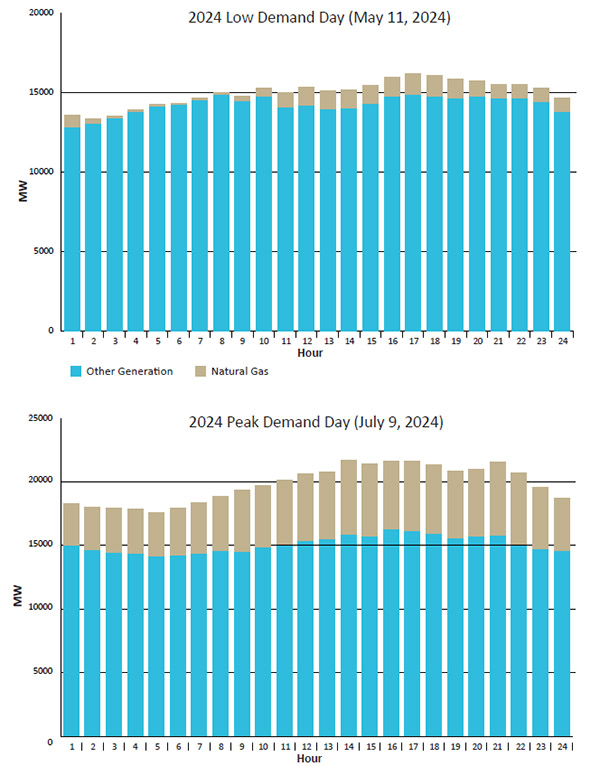
IESO says natural gas generation is essential to reliability on Ontario’s hottest summer days. | IESO

“This is an imperfect outcome,” Barreca acknowledged. “It’s not what we would have necessarily wanted. But this is what we need to ensure that all resources are able to participate.

“We wouldn’t be doing this if we didn’t think that we need some amount of … new natural gas on the system to get us through the transition period over the next few decades,” he added. (See Ontario Integrated Energy Plan Boosts Gas, Nukes.)

“I can recognize that none of this will be perfectly efficient, but that is true for the rest of the RFP. There are a lot of constraints other than cost: on where sites are selected and what ultimately gets chosen. So we are, I think here, doing the best, given the constraints that we have.”

Kelly was unpersuaded. “What you’ve done here is not to … allow these resources to participate; it’s to advantage them, and that’s materially different from the approach you guys have taken elsewhere,” he said. He suggested gas generators instead incorporate a risk premium in their offers.

IESO’s Ben Weir said if the actual gas transmission connection costs ultimately approved by the Ontario Energy Board are less than the risk premium, “ratepayers end up covering that risk-adjusted premium for really no reason.”

Uncertainty over Grid Interconnection Costs

Eric Muller, Ontario director of the Canadian Renewable Energy Association, said there also is great uncertainty on the costs of interconnections with the electricity transmission system. He said the ISO should provide a cost-sharing or true-up mechanism to address those risks.

Barreca said the risks of electric interconnection costs are “materially different” than that for gas because of a new process that will allow Hydro One, the province’s largest transmission operator, to give generators “perhaps not perfect [certainty] but at least enough certainty on those costs that they’ll be able to confidently submit their bids.

“We continue to work hard with our colleagues at Hydro One on this issue and hope to be able to share something with you all in the very near future,” Barreca said.

Officials said IESO will hold an engagement session with Hydro One on July 30 to provide an overview of the process for making new or modified connections to the grid.

Barreca said the ISO was unable to reach such certainty regarding gas distribution costs. “That ultimately just was not possible. And that is a kind of regulatory thing,” he said.

Tremor Temchin, senior vice president of development for Convergent Energy and Power, said the ISO’s requirement that generators provide continuous power for at least eight hours; its “open ended” commercial operation date for delayed turbine deliveries; and the cost sharing on gas distribution all look “like the ISO picking and choosing winners in a procurement that is supposed to be technology agnostic.”

He suggested the ISO run a separate, gas-specific procurement, saying “it’s the only way to keep this fair for other technology types.”

“This is not the ISO trying to tip the scales in favor of one technology or the other merely to enable participation,” Barreca responded. He said the move to an eight-hour minimum duration is “reflective of system needs and evolving system conditions.”

He noted that the ISO has added nearly 3,000 MW of battery storage “in a very short period of time.”

“The capacity value of that four-hour storage diminishes the more that you add without adding more … energy-producing resources,” he said. Nevertheless, he said, the ISO has not sought to derate storage capacity.

“So, I really do not think that we are here trying to tip the scales in one direction or the other. We want to have as balanced and fair a procurement as possible. We very strongly believe in the value of a diverse supply mix, and that includes some of everything.”

14 TWh, 1,600 MW Sought

IESO announced in December that it was seeking up to 14 TWh of annual generation and up to 1,600 MW of capacity resources in its second long-term procurement. The first window seeks 3 TWh of energy and 600 MW of capacity.

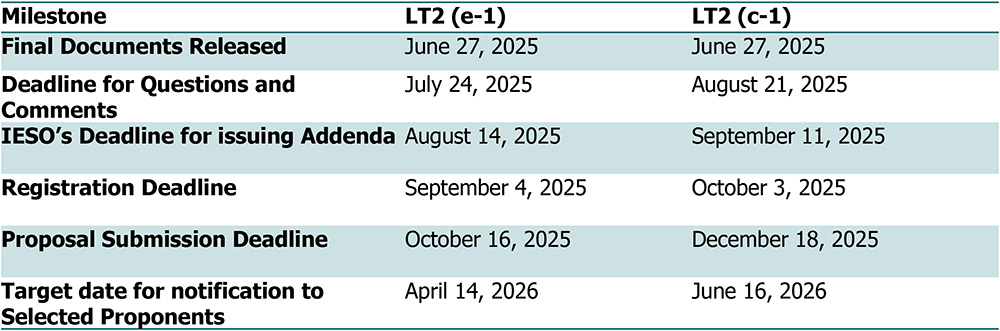
The ISO released final documents June 27 for the first window of LT2 energy and capacity procurements. Energy proposals will be due Oct. 16 and capacity proposals due Dec. 18, with notifications of winners set for April 14, 2026, and June 16, 2026, respectively.

Timelines for the first submission window of IESO’s second long-term energy and capacity procurement (LT2) | IESO

The LT2 documents include updates to some terms to reflect IESO’s May 1 introduction of a financially binding day-ahead market and the elimination of the State of Charge Reduction Factor, a transitional mechanism used to address storage facilities’ need to withdraw real-time market (RTM) offers after depleting energy during RTM obligations. With its new forward market, the day-ahead market no longer includes RTM, eliminating the dual obligation. (See Ontario Introducing Nodal Market May 1.)

The new procurement also gives bidders based in Canada a 2% reduction to their “evaluated proposal price.”

IESO Senior Adviser Nick Topfer said the home-field advantage was added in response to a June 26 directive from the Ministry of Energy and Mines and will be additive — not diluting existing bonuses such as for Indigenous participation.
The new solicitation also will allow bidders to seek price increases if import tariffs imposed after the proposals are submitted “directly” increase capital costs by more than 10%.

The ISO will have 50 days to respond to a “tariff adjustment notice” — down from 100 days, as originally proposed. If it rejects the revised price, the contract will be terminated, and the bidder’s completion and performance security will be returned.

IESO has eliminated from the capacity solicitation a proposal to limit capacity check tests to a maximum of 15 degrees Celsius.

“This decision … was a bit premature and was made hastily by us,” IESO’s Sanjiv Sohal said. “It didn’t wholly consider other articles contained in the contract. So as a result, we’re walking this decision back, and the maximum temperature limit for the winter months in section 15.6 of the contract has not been removed.”

The contract requires the tests be conducted when temperatures do not exceed 35 C in the summer or fall below ‑20 C in the winter.