ERCOT Technical Advisory Committee Briefs: Aug. 27, 2021

Staff Says Conservative Operations to Continue into 2022

ERCOT staff told stakeholders Friday that they plan to continue into next year their conservative operations approach of setting aside additional reserves through ancillary services procurement.

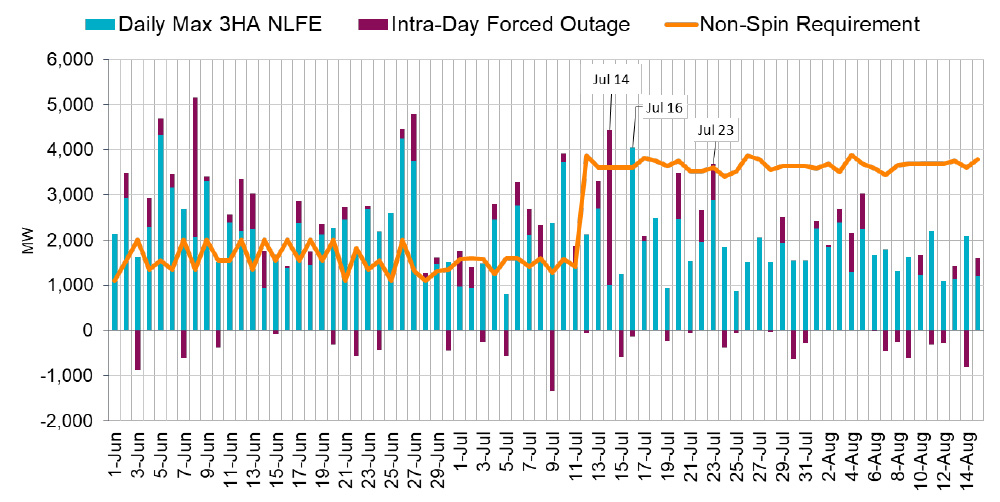
Since July, the grid operator has been setting aside at least 6.5 GW of operating reserves by more than doubling amounts of ancillary services, with the costs uplifted to load. The objective is to prevent a repeat of June’s call for conservation that spooked Texas consumers with long memories of Winter Storm Uri in February. (See ERCOT Stakeholders Sign Off on More Ancillary Services.)

“You will see us procuring more additional reserves than we have in the past. How we go about that is where we’re looking at making changes,” Jeff Billo, director of forecasting and ancillary services, told the Technical Advisory Committee during its regular monthly meeting.

Staff has increased responsive reserve service procurement from 2.3 GW to 2.8 GW during peak load hours on all days and upped non-spinning reserve service to ensure 6.5 GW of ancillary services is maintained for all hours of all days. Starting Sept. 1, the grid operator will add up to 1 GW of non-spin for hours when there’s a higher potential of weather forecast uncertainty, rather than for all 24 hours.

ERCOT normally reports its ancillary service plans for the upcoming calendar year in January. Until then, Billo said, staff will be working on “more precise calculations” for what the grid operator needs and has already begun discussions with stakeholder groups.

“There’s support for being more conservative, but we think there are ways to finetune that,” Reliant Energy Retail Services’ Bill Barnes said.

Based on stakeholder suggestions, ERCOT is looking at changes necessary to allow non-controllable load resources to participate in non-spin services. Stakeholders have also suggested load resources not be excluded from reserve calculations and that staff consider modifying the day-ahead process to eliminate voluntary participation.
Non-Spin-Sufficiency-(ERCOT)-Content.jpg
ERCOT’s use of non-spin ancillary service has increased with the transition to conservative operations. | ERCOT

Members still disagree with the continued use of reliability unit commitment (RUC) and the amount of capacity it commits. Billo noted RUCs have been reduced since the ancillary services changes in July.

“The [Public Utility] Commission has been talking about how to create an efficient market, and we’re happy to work with stakeholders on that,” Billo said.

“I think you’re hearing near-unanimous concern about the RUC part of this process, which has major impacts on reliability and the market,” Barnes said. “You’ve got stakeholder support for part of what you’re doing, but the additional RUC process doesn’t make sense.”

Barnes called ERCOT’s use of RUCs an “outdated perspective,” given the 1 GW of battery storage that has been added to the system.

“Batteries will solve the RUC problem,” he said. “The time of long-lead time, inefficient gas plants to solve our problem is over. I think we’re in a different system.”

“If you look at the amount of batteries currently on the system, we’re not there yet,” Kenan Ögelman, ERCOT’s vice president of commercial operations, responded. “If they were there and we were able to dispatch them across the challenging intervals we see, we wouldn’t have to RUC. That part is a self-correcting issue, but we’re not there yet.”

TAC Structural/Procedural Review

The committee will conduct its annual structural and procedural internal review in September, which should not be confused with interim CEO Brad Jones’ plan to transition to a senior-level group with representatives from each member organization, said TAC Chair Clif Lange, with South Texas Electric Cooperative.

Lange called the review a “self-reflective exercise.” The review could lead to some of the same stakeholder discussion that dominated The TAC’s July meeting with Jones. (See ERCOT Technical Advisory Committee Briefs: July 28, 2021.)

Real-time Co-optimization Group Retired

Members approved staff’s request to retire the Real-time Co-optimization (RTC) Task Force following their last update on the Passport Program, which bundled together RTC and several other high-profile initiatives. Much of that work has been delayed by staff’s focus on implementing numerous upcoming Uri-related changes. (See “Passport Program ‘Uncoupled,’” ERCOT Board of Directors Briefs: Aug. 10, 2021.)

Passport Program director Matt Mereness said the stakeholder group has completed its deliverables, which include establishing policy principles for implemented RTC and drafting seven protocol changes. The market tool clears energy and ancillary services every five minutes in the real-time market, but it is not expected to come online until 2025 at the earliest.

Future status updates on Passport’s projects will be done as part of ERCOT’s regular portfolio management updates.

Southern Cross Directive Passes

TAC unanimously approved the combination ballot, which included added language to the committee’s procedures that formalize remote participation in meetings and NRG Energy’s request for a permanent exemption from ERCOT metering requirements for its coal-fired Limestone Generating Station.

The ballot also included a system change request and single revisions to the nodal operating guide (NOGRR), retail market guide (RMGRR) and the resource registration glossary (RRGRR):

  • NOGRR227: allows for single phase current magnitude/angle data for an interconnected intermittent renewable resource (IRR) over 20 MVA to be taken from either side of the main power transformer where turbines exist on feeders that are aggregated to two or more IRRs.
  • RMGRR167: clarifies current documentation required for a successful submission requesting removal of a switch hold due to a deferred payment plan or tampering.
  • RRGRR031: amends the glossary to accommodate registration of settlement-only energy storage systems to require the same level of registration detail required for energy storage resources under RRGRR023.
  • SCR813: modifies the network model management system to highlight change submissions related to jointly-rated equipment, listing other entities that have also provided ratings. The submitter will be asked to confirm that the requested changes have been coordinated with the associated companies.

TAC endorsed SCR814 separately, with Luminant and Calpine abstaining. The measure introduces a limit on the total number of point-to-point obligation bid intervals that can be submitted into the day-ahead market per counterparty.


PJM Examining Chemical Shortage

PJM is investigating whether the shortage of a mineral used in sequestering emissions from coal units is impacting generation in the RTO.

Mike Bryson, PJM’s senior vice president of operations, told RTO Insider on Thursday that at least two companies came forward in early August to the RTO, saying they were having trouble sourcing some of the chemicals associated with controlling emissions at coal plants. Bryson said the companies specifically cited trona, an evaporite mineral used as a source of sodium carbonate or soda ash, as one of the chemicals they were having difficulty locating.

In an email sent to stakeholders Aug. 18, PJM said the chemical shortages are “causing restrictions to unit output.”

PJM began wondering if any other units were having similar issues with sourcing chemicals, Bryson said, so the RTO released a survey on Aug. 19 to all generating units, asking them to report any problems through the eDART system. The survey is set to remain open for responses through Sept. 10 and is limited to only coal-fired resources and all generation owners.

Bryson said PJM has received a “few responses” to the survey, and the RTO will analyze the data with the Independent Market Monitor and do any reliability assessments.

“We want to try and get a picture of what it looks like for the rest of the fleet that happen to respond,” Bryson said.

Bryson said it’s common for PJM to conduct surveys with its companies, usually sending them out pre-summer or pre-winter to gauge readiness of generation units. He said PJM sent out a survey in the spring after the February winter storm to determine any localized impacts.

Depending on the level of response to the survey, Bryson said, PJM will report out results at a future Operating Committee meeting. He said PJM can’t report on the specific units involved because of confidentiality rules, but it may be able to direct companies having problems with sourcing to other stakeholders.

PJM companies had similar problem in the early days of the COVID-19 pandemic, Bryson said, with stakeholders reaching out and saying they were having problems sourcing different chemicals. He said the RTO had to be careful to stay out of the middle of the sourcing issue because of anticompetitive measures.

Bryson said PJM is currently working with the companies experiencing issues and the Monitor to make sure the shortages aren’t reflected in their bids and to understand any reliability issues. He said different companies use different chemicals to help with reducing sulfur dioxide emissions.

“There’s no near-term reliability issues at all,” Bryson said.

Trona

Trona, the primary source of sodium carbonate in the U.S., is mined in several different parts of the country, including California, Wyoming and Utah. It is used in everything from baking soda and paper to glass and chemical manufacturing. Some coal generation units use it to sequester carbon from flue gas.

In a survey released in June by the U.S. Geological Survey, soda ash production was 966,000 metric tons, a 3% increase compared with the previous month’s production and 58% more than that of June 2020. For the first six months of 2021, soda ash production was 5.84 million metric tons (Mt), 17% more than the revised total for the same period of 2020.

USGS said ending stocks of trona in June decreased to 225,000 tons, 16% less than those in May, as the “demand for soda ash returned to near pre-pandemic levels in recent months and resulted in the large increases in consumption, exports and production reported for the first six months of the year.”

Wyoming, the biggest producer of trona, produced 1.5 Mt in June, 5% more than production in May and 60% more than June 2020. For the first six months of 2021, USGS said, trona production was 8.27 Mt, 6% more than the revised total for the same period of 2020.

Other RTOs

A trona shortage in other RTOs and ISOs around the country doesn’t seem to be happening right now.

Officials at ERCOT said they were not aware of any supply chain issues with trona or any other chemical involved in generation. SPP officials said its operations group is “not aware of any coal units in our footprint experiencing shortages similar” to those being experienced in PJM.

MISO spokesman Brandon Morris said the RTO has “not observed a significant trend in outages among coal plants” from a chemical shortage, and the overall outage rates in the RTO are “comparable with last year.”

RTO Insider reporters Amanda Durish Cook, Tom Kleckner and John Funk contributed to this report.

DC Circuit Upholds FERC Ruling on SPP Z2 Saga

FERC acted correctly in reversing a retroactive waiver it had granted SPP over collecting transmission upgrade costs, the D.C. Circuit Court of Appeals ruled Friday, even as it acknowledged its order granted a “free pass” to some users of the system.

The commission had granted SPP a retroactive waiver of its tariff in 2016 so that it could invoice transmission service customers for Attachment Z2 credit payment obligations for 2008-2016 (ER16-1341). But it reversed course in 2019, saying its original decision was prohibited by the filed-rate doctrine and the rule against retroactive ratemaking. (See FERC Reverses Waiver on SPP’s Z2 Obligations.)

Attachment Z2 promised transmission upgrade sponsors would receive credits from any upgrade users whose service could not be provided “but for” the upgrade. But section I.7.1 of SPP’s tariff also required the RTO to invoice the charges monthly and to make any adjustments within one year. Because of software problems, it took SPP eight years to implement the attachment, during which the RTO did not invoice for the upgrade charges.

FERC issued a voluntary remand of the waiver following a D.C. Circuit ruling in a separate waiver case involving PJM. (See Duke, ODEC Rebuffed on Polar Vortex Gas Refunds.) The commission ordered SPP to refund credit payment obligation amounts dating back to 2008, except for the one-year billing adjustment limit allowed in the tariff.

Oklahoma Gas and Electric (NYSE:OGE), which had funded upgrades to serve wind farms in western Oklahoma, asked the D.C. Circuit to reinstate the waiver, saying SPP had provided notice of the upgrade charges through Attachment Z2, the stakeholder process and notations in its study reports.

But the court ruled that none of those sources provided the formal notice to satisfy the filed-rate doctrine (20-1062, Oklahoma Gas and Electric Company v. FERC).

“Although Attachment Z2 was an addition to the filed rate that set forth the possibility of upgrade charges, it did not provide notice that upgrade users could be charged outside of section I.7.1’s billing requirements,” the court said. “The other two alleged sources of notice — the stakeholder process and SPP’s study reports — cannot provide sufficient notice. Whatever information they might have provided, they were not filed with the commission, and a filing ‘is required for all rate changes.’”

OGE and SPP also contended that FERC’s reversal of the waiver violated the cost-causation principle, which requires “all approved rates [to] reflect to some degree the costs actually caused by the customer who must pay them.”

The court disagreed. “The petitioners have provided no authority, nor have we found any, to suggest that a filed rate, which FERC found to be just and reasonable, can be waived because FERC later determines that its application violates the cost-causation principle. Cost causation is a principle for ratemaking, not an abstract principle that can trump a filed rate,” it said.

It acknowledged that its ruling means “users who benefited from the upgrades received a free pass” during the period for which SPP did not invoice. But, it added, “the filed-rate requirement is stringent and admits of no equitable adjustments by the commission or this court.”

“The outcome here should serve as a cautionary reminder to parties that, if circumstances change, they should take action at the outset, such as by seeking to amend the tariff or requesting prospective waivers from FERC to act in contravention of a filed rate,” the court said.

SPP responded to FERC’s reversal in June 2019 with a compliance filing that proposed a preliminary framework by which the RTO would unwind and resettle credit payment obligations assessed under Attachment Z2 and describing “the necessary assumptions and challenges associated with such unwinding and resettlement.” The commission has yet to act on SPP’s request.

“At this juncture, it is fair to say that there is no end in sight to the long and tortured history of Attachment Z2,” SPP told the commission in a separate application for a partial stay of its order, in which it requested settlement proceedings “to consider the numerous overlapping and interdependent issues pending.”

FERC in 2020 did approve the RTO’s request to replace Attachment Z2’s revenue credits for sponsored transmission upgrades with incremental long-term congestion rights (ER20-1687). (See FERC Approves SPP’s 2nd Go at Dropping Z2 Credits.)

Overheard at IPF: New Jersey Wind Port Construction Just Weeks Away

Construction of the New Jersey Wind Port on the Delaware River in Lower Alloways Creek is about to get underway, according to Tim Sullivan, CEO of the New Jersey Economic Development Authority.

Gov. Phil Murphy “signed a budget this year with $200 million cash for that project, so we will start construction on it within a matter of weeks,” Sullivan said Wednesday during the Business Network for Offshore Wind’s International Partnering Forum (IPF).

The new wind port, he said, represents an opportunity for the state to host multiple manufacturers and developers and “support the marshalling for projects outside New Jersey.”

Sullivan spoke during an IPF session moderated by RTO Insider Editor Rich Heidorn Jr. on how much offshore wind power might be needed to achieve state and federal clean energy goals.

Here are some highlights from the session.

More Wind

In Massachusetts, where a net-zero goal for 2050 is part of state law, with a 50% reduction of emissions required by 2030, 15 GW of offshore wind will be needed by 2050, said Judy Chang, undersecretary of energy for the Executive Office of Energy and Environmental Affairs.

To reach 15 GW, Massachusetts is focusing on developing port infrastructure, growing the supply chain and developing workforce opportunities, she said. The state is in an open bidding process now that will double the state’s procurements for a total of 3.2 GW.

Looking at all New England states, Chang said, the region will need about 30 GW by 2050.

New York has a much bigger appetite than its current 9-GW goal for 2035, according to Doreen Harris, president and CEO of the New York State Energy Research and Development Authority (NYSERDA).

NJ-Wind-Port-Construction-Panel-2021-08-27-(RTO-Insider-LLC)-Alt-FI.jpg
From left, Rich Heidorn Jr., RTO Insider; NYSERDA CEO Doreen Harris and Virginia Economic Development Authority CEO Stephen Moret. | The Business Network for Offshore Wind

“When I think about [9 GW] of offshore wind for New York, I see that as a floor, not a ceiling,” she said.

The state is about halfway to reaching its goal with five projects under development. A comprehensive study of offshore wind potential in the Great Lakes is also underway by NYSERDA. The study will help the state determine whether it should move forward with offshore wind procurements in Lake Ontario and Lake Erie. (See Smaller Turbines, Custom Vessels Define Future of Great Lakes OSW.)

Procurements

A growing interest in renewable energy and environmentally friendly operations by companies could bring a change in how offshore wind energy is purchased.

While the U.S. offshore wind industry is growing on a foundation of state procurements, private power purchase agreements, like those that took off in the solar space, may come as well, according to Stephen Moret, president and CEO of the Virginia Economic Development Partnership.

“It’s only natural that we would see [PPAs] develop in offshore wind, particularly for diversification, but also because there’s a limited amount of renewables, even though it’s growing very quickly,” he said.

In some places, he added, there is more demand than supply for renewable power. That imbalance is going to drive companies to look for direct engagement with offshore wind, he said.

Chang agreed, saying that businesses, private entities or municipalities will begin to act on the availability of choice in clean energy and contract on their own with offshore wind.

All renewables, she added, would benefit from a “significant transformation” of the wholesale electricity market.

“The idea is to have a centralized, wholesale-level clean attributes market so that all clean resources can participate, and the states and the utilities as well as independent entities, businesses and municipalities can be the buyers of those resources,” she said.

Massachusetts representatives, she added, are working with other states, ISO-NE and FERC to envision a clean capacity market and roll it out “in the not-too-distant-future.”

Transmission

The desire to move quickly to invest in and build out offshore wind in the U.S. creates a conundrum, Harris said.

Transmission investments need to move in parallel with generation investments, according to Harris.

“We cannot and will not wait years and years for an optimized transmission grid to be ready for those projects,” she said. “The projects should be built in a way that can accommodate a network of the future.”

That requires a “huge investment,” she added, noting that funding from the federal infrastructure bill could facilitate the investment scale needed for states to achieve their offshore wind goals.

Chang said states are at the beginning of a journey to understanding how to cost-effectively upgrade onshore transmission to interconnect offshore wind projects.

“We are still in a learning process,” she said. “I think we need to be better at coordinating the procurement process and our interconnection process with ISO-NE.”

OSW Tapping Virtual Reality to Aid Workforce Training

RICHMOND, Va. — Europe has about 75,000 technicians trained to work on onshore and offshore wind turbines. The U.S. and Canada have almost as many wind turbines as Europe but only a fraction of the trained technicians at about 13,000, according to Dan Ortega, North American representative for the Global Wind Organisation, a Copenhagen-based nonprofit created by wind turbine manufacturers and operators to standardize training requirements.

Ortega — who described himself as a “matchmaker with those who want the training and those who can provide the training” — said his task is complicated by the cost of building full-scale replicas in which students can perform hands-on training.

Those requirements turned him into an “ambulance chaser,” he joked during a discussion at the Business Network for Offshore Wind’s International Partnering Forum on Wednesday. “Every time somebody dropped a wind turbine component, we were getting on the phone saying, ‘Hey, how broken is it? Can we get it for training?’”

Cynthia Brown, director of turbine maker Siemens Gamesa Renewable Energy’s (BME:SGRE) Wind Academy in Orlando, Fla., understands the challenge. The company has a 2.3-MW and a 3-MW training nacelle — far smaller than the 15-MW turbines it is now manufacturing for offshore use.

And “every two to three years, there’s a new design coming out, right? So having a training on the actual platform [becomes] more difficult,” she said.

Enter virtual reality.

Last October, Siemens Gamesa and virtual reality company Vinci VR won a grant from the Massachusetts Clean Energy Center to develop VR training simulations for offshore wind.

https://rtowww.com/wp-content/uploads/2023/06/140620231686784891.jpeg
The Bureau of Labor Statistics projects employment of wind turbine service technicians will grow 61% from 2019 to 2029. | U.S. Department of Labor

At the IPF conference, Vinci VR demonstrated its software for turbine technicians. It allows students to simulate tightening loose bolts and measuring the air gap in a set of brakes inside a virtual nacelle. It also demonstrated a similar program for port workers, using a virtual crane to lift and move a turbine blade.

Vinci VR CEO Eagle Wu said the training technique is second nature for people like himself who grew up playing video games. “What we found is that a lot of younger trainees … after a couple of minutes of playing around, are actually able to pick it up very quickly.”

The training requires a $300 VR headset plus the software, which Vinci plans to sell for between $10,000 and $30,000, depending on the size of the training provider.

Vinci VR is running beta testing of the software with Siemens Gamesa and the International Brotherhood of Electrical Workers. It plans to expand its software to tasks on crew transfer vessels.

“We basically want to put a wind turbine into every classroom in the U.S.,” Wu said.

Ortega said he’s optimistic that digital solutions will help meet the increasing need for turbine workers. The Bureau of Labor Statistics projects employment of wind turbine service technicians will grow 61% from 2019 to 2029.

Aside from sea survival, the training of technicians for onshore turbines is the same as that for offshore, Ortega said.

Turbine workers’ “skills have to be demonstrated. You cannot, through e-learning, validate somebody’s skills on performing wind turbine rescue or climbing a ladder or, you know, inspecting their harness or something like that. There has to be some physical way of doing this, whether it be videos, virtual reality or [augmented reality],” he said.

“For a lot of training providers, getting access to the equipment that they need to do this training can be somewhat cost-prohibitive, especially if you’re talking community colleges,” he continued. “If you can create a high-fidelity training environment where you can practice the skills, you increase access and training in areas where you may not have had the opportunity before. Additionally, you have the potential of lowering the safety risk, lowering the capital expenses, having a faster setup of a new training center.”

Offshore Wind Advocates Celebrate Federal Support Under Biden

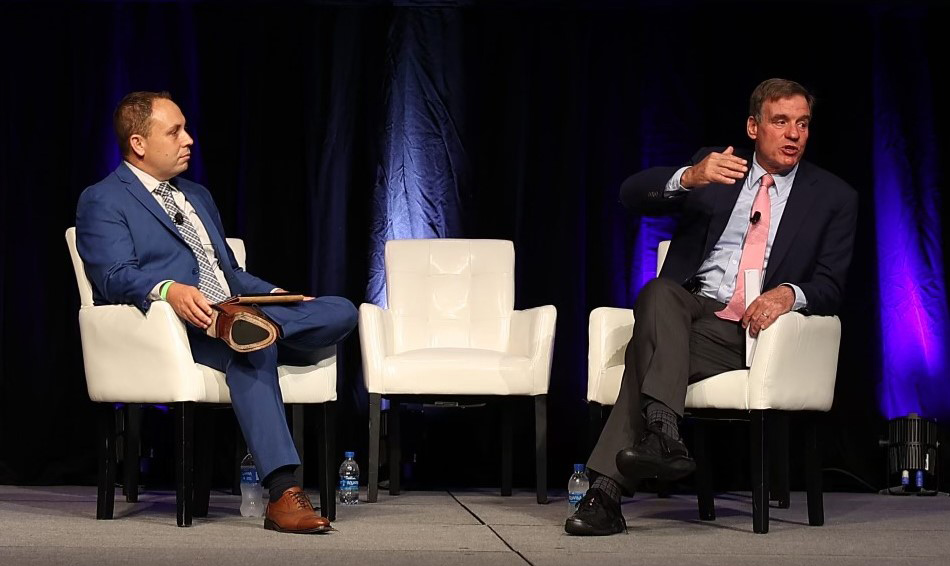
RICHMOND, Va. — Before he was Virginia’s governor or a member of Congress, Sen. Mark Warner (D-Va.) made a fortune as one of the founders of cellular service provider Nextel.

“I feel like offshore wind is about where the wireless industry was in the mid-80s,” Warner told the Business Network for Offshore Wind’s International Partnering Forum (IPF) on Thursday. “The smart folks in wireless — the old Bell operating companies and Wall Street — said it’s going to take 30 years to build out a wireless network in this country, and at the end of that 30 years about 5% of Americans are going to have cell phones. I got rich because they were wrong. I’d like all you guys to get rich.”

About 1,000 wind developers and would-be subcontractors hoping to do just that attended the three-day IPF at the Greater Richmond Convention Center, joined by officials of East Coast states hoping that OSW will be a boon to their economies.

Under President Biden, who set a goal of 30 GW of OSW by 2030, prospects for the industry have brightened considerably, speakers at the conference agreed, even as they acknowledged the need to move even faster to achieve state and federal climate goals.

Mark-Warne-Jason-Cabral-(The-Business-Network-for-Offshore-Wind)-Content.jpg
Sen. Mark Warner (D-Va.), right, speaks with Jason Cabral of Burns & McDonnell at the Business Network for Offshore Wind’s International Partnering Conference. | The Business Network for Offshore Wind

“I don’t think it’s an exaggeration to say this administration is going to be the best partners you’ve ever had in the federal government,” said Energy Secretary Jennifer Granholm, one of several administration officials who joined the conference virtually. “We want to see [this] business booming so we can reach 100% clean electricity by 2035.”

Former President Donald Trump famously fought an offshore wind development near his golf course in Scotland and alleged that wind turbines cause cancer. Renewable advocates accused Trump of trying to thwart the industry after the Interior Department’s Bureau of Ocean Energy Management (BOEM) ordered additional environmental reviews of the Vineyard Wind project in 2019. (See Renewable Backers Decry Vineyard Wind Delay.)

‘Out of the Blocks’

But that’s ancient history, said Deputy Interior Secretary Tommy Beaudreau, who was BOEM director in the Obama administration.

“These are exciting times. It’s only been about eight months, but [BOEM Director] Amanda [Lefton] and her team have come out of the blocks very fast” in support of the industry, Beaudreau said.

Amanda-Lefton-(The-Business-Network-for-Offshore-Wind)-Content.jpg
Amanda Lefton, director of the Bureau of Ocean Energy Management | The Business Network for Offshore Wind

Lefton also spoke via video, ticking off the bureau’s efforts and the industry’s accomplishments in 2021.

In May, BOEM gave final approval for 800-MW Vineyard Wind I, the first commercial-scale offshore wind project in U.S. federal waters. (See BOEM Approves 800-MW Vineyard Wind I.)

It also has begun environmental reviews of six other OSW projects, and Lefton said more are expected to be announced later this year. It plans lease sales for the New York Bight by the end of this year or early 2022 and for off North Carolina and California as soon as next year.

Earlier this month, BOEM published the final environmental impact statement for South Fork Wind, which would be the second commercial-scale OSW project approved in U.S. waters.

“There are important and exciting demands in areas like the … Mid-Atlantic, where we know we need to explore the potential for new lease areas to help Virginia and North Carolina and other states in the area meet their renewable energy goals. We also want to make sure that we’re taking a hard look at places like the Gulf of Maine, where we know there’s tremendous interest by New Hampshire and Massachusetts and Maine to explore the potential … for floating wind,” she said.

“We know that we’re starting with 42 MW of offshore wind currently installed in the United States. … We know that in order for us to get from where we are today to [30 GW by] 2030, there are a lot of challenges, but also with those challenges come incredible opportunities.”

Economic Impacts Being Seen

The first economic impacts of the industry are beginning to be seen, Granholm said, noting Dominion Energy’s plans for an OSW installation vessel being constructed in Texas using steel produced in West Virginia and Alabama. “And then [the vessel is] going to help construct at least two offshore wind projects in the Northeast,” Granholm continued. “So these turbines [are] going to generate both clean energy and economic benefits that will reach America’s heartland even if the wind turbines themselves are offshore on the coasts. Offshore wind is going to bring jobs to communities that have been left behind, like for example, Sunset Park in Brooklyn, where local workers there are going to be assembling wind turbines at a new marine terminal.”

Lefton cited announcements of manufacturing facilities in New Jersey and at a Pennsylvania steel mill to supply monopiles, a foundation manufacturing facility in Rhode Island and a facility to manufacture wind towers and “transition” pieces in New York.

During the conference, the Port of Virginia announced it would lease 72 acres of its Portsmouth Marine Terminal to Dominion for 10 years to support development of the utility’s 2.6-GW Coastal Virginia Offshore Wind (CVOW) project. Wind developer Ørsted agreed last year on an initial 1.7-acre lease at the terminal — with an option to expand to an additional 40 acres — that it will use in staging on CVOW and potentially other projects. (See related story, Dominion Secures 10-Year Va. Port Lease for OSW Staging.)

Ørsted and Eversource Energy, its partner in the South Fork project, also used the conference to announce a contract with Kiewit Offshore Services to construct an offshore substation near Corpus Christi, Texas, with support from teams in Houston and Kansas.

Lefton said BOEM is working to make environmental reviews more efficient, both by improving coordination within the federal government and changing how it conducts outreach.

“We recognize here at BOEM the critical nature of working regionally. And it’s in fact why you’ve seen BOEM over time move away from a state-by-state approach to these regional intergovernmental task forces.”

The Biden administration is using White House interagency meetings to make sure the bureaucracy is unified in support of meeting the 30-GW goal.

“By bringing everyone around the table and identifying challenges and opportunities up front, we’re able to ensure that we have a strong process going forward, where we’re all aligned on a path,” Lefton said.

Sen. Warner praised Lefton for agreeing to tap the expertise of the Army Corps of Engineers to supplement BOEM staff on OSW reviews, calling her “very, very receptive.” But he said regulators should increase their use of modeling and simulation software and artificial intelligence to make reviews faster.

‘Dramatic Change’ in Congress

Warner said he has seen “a pretty dramatic change” among many of his Republican colleagues on climate change in the last year, as episodes of extreme weather have become increasingly frequent.

“It may not have been represented yet in voting changes. But whether you look at the floods in Tennessee, the [tropical storm] in New England, the fires in the West or simply walking outside in [90-degree temperatures] in Richmond in August,” the evidence of climate change is inescapable, Warner said. “We used to get one day or two days like this a year. This has been virtually our entire summer.

“Part of the [political] challenge is almost nomenclature,” he added. “In Hampton Roads we don’t call it climate change as much as we call it sea-level rise. If we can get 80% of the voters to agree on [the existence of] sea-level rise,” policies will change.

Of the $65 billion in the energy title of the bipartisan infrastructure bill approved by the Senate earlier in August, “most of that is climate-related,” Warner said. He cited spending for capping abandoned oil and gas wells, spending on resilience and “seed money” for electric vehicle charging stations.

He also cited $17 billion for port improvements. He said Virginia leaders are “working the Navy right now to both deepen and widen our port and hopefully actually be able to have the ability to bring a container ship in and a Navy carrier out at the same time.”

Republicans also can find common ground with Democrats in ensuring U.S. businesses benefit from decarbonization efforts, Warner said. “The U.S. is going to buy 25,000 new school buses over the next five years. Right now, unless we grow a domestic electric … bus industry, about 90% of those buses are going to be built in China. That makes no sense from a national security standpoint; no sense from a jobs standpoint. So we had broad-based support on that.”

From Tolerance to Empathy: OSW Developers Share Outreach Efforts

RICHMOND, Va. — Rachel Pachter was treated like a rock star at the Business Network for Offshore Wind’s International Partnering Forum here last week. In May, Pachter, chief development officer for Vineyard Wind,  successfully led efforts to win the first federal approval for a commercial-scale offshore wind project.

For Pachter, the victory was two decades in coming: She also was part of the Cape Wind team, whose plan for a wind farm in Nantucket Sound died in 2017 following a 16-year battle with residents concerned about the visual impact and complaints it would pose a threat to offshore navigation, marine life and birds.

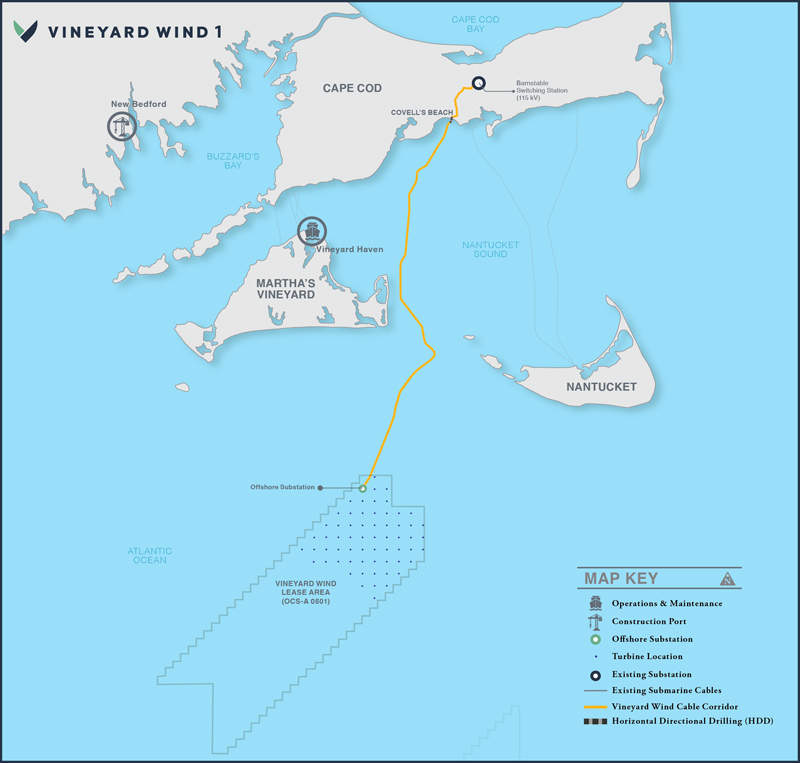
The second time around, Pachter and Vineyard Wind — a joint venture between Copenhagen Infrastructure Partners and Avangrid Renewables (NYSE:AGR) — had an important ally. “The Vineyard Wind project … actually went into a BOEM [Bureau of Ocean Energy Management] auction with a community partnership with a nonprofit on Martha’s Vineyard called Vineyard Power. That community partnership has been key to our success,” Pachter said during a panel discussion moderated by attorney Ted Boling of Perkins Coie.

“We’re very lucky that Martha’s Vineyard is really interested in renewable energy. And we’ve been able to sort of harness that relationship,” she said, adding that the company also developed “an early relationship” with the town of Barnstable, Mass., where the project’s transmission cables will reach land.

“So we’ve built these partnerships, and we’ve tried to make them … about how to move what we need forward with what other folks need to move forward. … That was a huge part of our success: We saw huge support for our projects, as we went through multiple [National Environmental Policy Act] processes … and [through the environmental impact statement]. And that is because we put a ton of effort into that. … We’re not going to get everybody. But we do need people to stand up for these projects, for sure.”

‘Getting Everyone into the Same Space’

“We know how to build offshore wind; there are very few questions left about the technology,” said Kris Ohleth, executive director at the Special Initiative on Offshore Wind, a project of the University of Delaware’s College of Earth, Ocean and Environment. “But getting everyone into the same space, and to that same place of the shared societal benefit that offshore wind can bring, while maintaining existing ocean uses — that for me is paramount as we look at offshore wind through the next decade. Those are the real challenges.”

Vineyard-Wind-(Vineyard-Wind)-Content.jpg
| Vineyard Wind

Pachter stressed the importance of transparency and education in winning over stakeholders.

“People are always calmer when … they have knowledge, right?” she said, comparing it to a patient dealing with a medical issue. “As soon as I explain it to you, you always feel a lot better. It’s the same thing. If somebody explains to you how the grid works … I feel like you are instantly less freaked out. … [Developers must] refine your message [in response to] questions, and … figure out the best way to explain it.”

Patience is required, said Jennifer McCann, director of U.S. Coastal Programs at the University of Rhode Island’s Graduate School of Oceanography. She is also director of extension programs for the Rhode Island Sea Grant College Program, one of 34 Sea Grant programs, which work with the National Oceanic and Atmospheric Administration.

“Our Northeast Sea Grant programs, in particular, have been urged by our stakeholders — by our communities and fishing entities — to play a leadership role in communicating information related to offshore wind, as well as ensuring that their knowledge and questions are [being incorporated] into the process, and also [ensuring] that their questions are being heard and responded to. Even if it might be the 200th time that it’s being asked in a public forum, it’s important to respond just like it’s the first time.”

The Northeast Sea Grant Consortium — Sea Grant programs in Maine, New Hampshire, Massachusetts, Rhode Island, Connecticut and New York — are funding applied research to ensure “that our stakeholders have the best available science and best management practices to engage in efforts related to offshore wind,” McCann said.

Pachter said research being done for OSW environment impact statements and construction and operation plans can generate some goodwill, citing developers’ spending on technology to track whales.

“The North Atlantic right whale is being studied in areas that weren’t studied before; it’s being studied more than it was being studied before,” she said. “One of the real issues with the North Atlantic right whales is knowing where they are. … Knowing where they are would benefit our projects and benefits the species. It benefits the lobster folks who were also struggling a lot with their ability to fish when they don’t know [when] the whales are there.” (See related story, Nantucket Residents File Lawsuit Against BOEM to Protect North Atlantic Right Whale.)

Tradeoffs in the New York Bight

Scott Lundin, head of U.S. permitting and environmental affairs at Equinor Wind US, described his company’s efforts to work with the commercial shipping and fishing industries in the Empire Wind project south of Long Island. Input from the commercial fishing industry and other maritime interests resulted in the removal of more than 900,000 acres from consideration in the New York Bight as well as the development of proposed transit corridors for any future leases. (See Stakeholders Differ on OSW Leases in New York Bight.)

“The Port of New York and New Jersey is extremely important for the economic health of the region, and we need to make sure that Empire Wind is developed in a way that doesn’t disturb [commercial shipping] at all,” Lundin said.

The project’s mitigation also must account for the presence of marine mammals in the New York Bight year-round.

Lundin said the company also is considering an open area at the northwestern end of the lease, where the squid industry operates. “The way that they operate is … they follow the fish … and it can get very chaotic from time to time, depending on how hot the fishing is.”

The idea arose at a workshop with fishermen in Philadelphia a couple years ago. “We explained to them the different types of constraints and considerations that we have to think about when we’re trying to establish [turbine] layouts. We put maps on the wall; we invited people to take markers and draw,” Lundin said. “[We asked them], ‘If you were going to design a layout with those kinds of considerations, how would you put turbines around this triangular shaped development area?’ It was a very engaged workshop.”

That kind of in-person interaction became impossible during the shutdown caused by the COVID-19 pandemic, he lamented.

The pandemic also complicated the work of Lyndie Hice-Dunton, shortly after she became executive director of the Responsible Offshore Science Alliance in February 2020. “I went to the Maine Fisheries Forum, and then we shut down.”

It wasn’t all negative. Having to turn to remote communications “broadens your audience,” she said. “Our advisory council meetings are open to the public. We have people from the West Coast and all sorts of other places that are joining in and participating. But you miss that face-to-face interaction. You miss those conversations over a break where you can [say], ‘Hey, you know, I heard your concerns.’”

‘Multiuse’ Plans

It was Ohleth who titled the panel discussion “What’s Love Got to Do with it?” She said it was inspired by the “Virginia is for Lovers” tourism ads.

“Really, it was a little bit cheeky at first … a cheap ploy to get people to come in the room,” she joked.

But she said she also wanted the panel to discuss “how we’re using empathy and a collaborative approach and an open sense of curiosity [in] the process. I know in my experiences the best outcomes have really come from when I was leading with that spirit. … It just seems like those types of principles — ones that are more open and spacious — are ones that are going to bring us to have more success and to reach our 30-GW target by the end of the decade.”

McCann noted that some European governments are requiring that multiple uses be integrated into the siting and operation of offshore wind — a higher bar than merely requiring that developers and other ocean users tolerate each other. “Multiuse is to look at the synergistic relationships between resource activities, whether it be offshore wind and aquaculture, or offshore wind and research or tourism,” she explained. “I don’t know if we’re ready yet in the United States for multiuse, but I think our job as a university … is to consider multiple views and see if we can start a conversation.”

NYISO Q2 Energy Prices Rise on Higher Gas Prices, Load

The NYISO Market Monitoring Unit reported energy markets performed competitively in the second quarter of 2021, with all-in prices ranging from $21 to $67/MWh, up 28 to 88% from the same period last year in all regions but New York City, which saw a decrease of 6.3%.

Energy prices climbed 26 to 110%, driven mainly by higher gas prices, which rose 55 to 62% across the system, Pallas LeeVanSchaick of MMU Potomac Economics, told the Installed Capacity/Market Issues Working Group on Thursday in presenting the State of the Market report for the second quarter.

“But we also saw that higher load levels were a significant driver relative to the second quarter last year, which was greatly affected by the pandemic,” LeeVanSchaick said.

Higher temperatures in June combined with nuclear and hydro output falling more than a gigawatt, driven by the Indian Point nuclear plant retirement and drier conditions, he said. “We saw also some significant transmission outages in Central East, which reduced transfers to Eastern New York and resulted in an additional need for gas-fired generation.”

Avoidable Commitments

Reliability commitments fell in New York City because of procedural improvements that reduced the commitment for N-1-1-0 load packet requirements.

But, LeeVanSchaick noted, “we see commitments that are happening that certainly could be avoided if the NYISO was allowed to consider whether [gas turbines] in a particular NOx bubble were actually needed to satisfy N-1-1-0 criteria.”

The state’s NOx rule prevents New York City gas turbines in two portfolios from generating during the ozone season unless steam turbines in the same portfolios are also producing such that the portfolio-average NOx emission satisfies the state Department of Environmental Conservation standard.

“An issue that we see in areas like New York City is that as you get more low-cost intermittent generation coming in, some of these older fossil units become less economic,” LeeVanSchaick said. “To a large extent they’ll still be running because of the need to provide operating reserves, so it’s useful to track as the resource mix changes. We want to be able to track things like emissions that are driven more by the need to provide reserves than by these energy requirements.”

One stakeholder asked what is preventing the ISO from modifying their software for commitments that could have been avoided, such as steam units that did not need to be activated to achieve peaking capacity. Steam turbines accounted for more than 50% of NOx emissions in New York City in the second quarter.

The share of NOx emissions from units flagged as committed for reliability was generally under 15% throughout April, then jumped up on May 1 to between 25 and 45%, remaining at a high percentage throughout May before coming down somewhat as loads increase in June, LeeVanSchaick said. “But it still remains higher [in June] than it was in April because you’re getting more generation commitments to meet NOx bubble requirements,” which are effective from May to September.

The Monitor reported seeing less out-of-market commitments in New York City for local requirements in the quarter, and also “a lot less” out-of-market dispatch in Long Island because NYISO began modeling two 69-kV constraints there in the market software in mid-April.

The two constraints accounted for 40% of the day-ahead congestion and 25% of real-time congestion on Long Island; consequently, out-of-market actions to manage 69-kV constraints fell notably, resulting in more efficient resource scheduling and pricing and lower associated uplift.

Capacity Market Highlights

Capacity prices fell in New York City because of the much lower locational capacity requirement (LCR), while they rose in other areas because of the higher installed reserve margin (IRM) and the Indian Point retirement.

Spot capacity prices averaged $6.59/kW-month in Long Island, $3.85/kW-month in the Zone G-J locality and Rest-of-State, and $6.37/kW-month in the city in the second quarter.

Prices increased substantially in all regions from the prior year, except in New York City where prices fell by 54%, driven primarily by a 6.3% reduction in the LCR from the prior capability year.

The steep reduction in the LCR year over year despite no significant changes in the supply mix in the city highlights some procedural inefficiencies in the IRM and LCR-setting process discussed in the Monitor’s 2020 report, LeeVanSchaick said.

Higher spot market offers and resultant unsold capacity influenced the spot price in April. Several units exited the market, most notably Indian Point 3 in May, which outweighed new entry and increased imports, he said.

Energy Efficiency Key to Decarbonization, Experts Contend

Energy efficiency will play a crucial role in decarbonization because of its potential to reduce costs as the demand for electricity grows, panelists said during a California Energy Commission workshop last week.

“While energy efficiency can reduce greenhouse gases directly, it also has an important role of bringing the decarbonization of the grid, buildings and industry within manageable parameters,” said Ken Rider, chief policy advisor to CEC Chair David Hochschild.

“In other words, energy efficiency makes our challenges smaller in size and therefore easier to overcome,” he said.

But the timing of energy efficiency implementation is key, Rider said.

He gave an example of an energy system transitioning to 100% clean electricity. If energy efficiency measures are rolled out later rather than sooner, the system may end up being built with more capacity than needed, resulting in higher capital costs. In contrast, implementing energy efficiency earlier may reduce capital costs, he said.

“Energy efficiency needs to be considered first in order to gain maximum benefit,” Rider said.

The same principle applies on a smaller scale to a home where an electric heating, ventilation and air conditioning system is being installed, Rider said. If insulation is upgraded first, a smaller HVAC system may be sufficient, saving money and reducing the amount of refrigerant in use.

Rider was one of the speakers during a CEC workshop on Tuesday on the role of energy efficiency in building decarbonization. The workshop was part of the commission’s process for developing its 2021 Integrated Energy Policy Report.

Steven Nadel, executive director of the American Council for an Energy-Efficient Economy, pointed to a 2019 ACEEE study showing that energy efficiency could take the U.S. halfway to decarbonization by 2050.

The energy efficiency of buildings, including building retrofits, smart buildings, and electrification of new and existing buildings, accounts for about a quarter of the potential greenhouse gas reductions, he said.

“Efficiency and renewables are like peanut butter and jelly,” Nadel said. “(It’s) hard to do one without the other.”

Cost of Decarbonization

In another presentation, David Jacot, director of efficiency solutions for the Los Angeles Department of Water and Power (LADWP), discussed ways the utility could get to a 100% renewable-based electric grid.

The National Renewable Energy Laboratory partnered with LADWP on a study, released in March, that analyzes different scenarios and timelines for decarbonization. The LA100 study found that LADWP could decarbonize the grid by 2035, Jacot said, but at a cost of $50 billion to $80 billion.

Jacot said a two-fold strategy is needed for decarbonization. LADWP needs electrification of transportation and buildings to boost its revenues, so that fixed costs can be spread out across more kWh, keeping rates down. Energy efficiency then makes the fixed costs smaller.

“We need the electrification to bring the revenue, and we need the energy efficiency to reduce the infrastructure needs,” Jacot said.

LADWP is getting ready to launch an energy efficiency program called Comprehensive Affordable Multifamily Retrofits. Jacot said the program for multi-family buildings will consist of energy efficiency measures, building electrification and onsite renewable generation.

“The beauty of it is you get the deep energy efficiency, which makes the bill go down,” he said. “You electrify, which may make the bill go up, but then you offset that with the onsite generation, which again, then makes the bill go down.”

New Focus for ESA

Meanwhile, a long-running statewide energy efficiency program is shifting its focus. The Energy Savings Assistance (ESA) program, overseen by the California Public Utilities Commission and offered through utility companies, provides services such as attic insulation, weatherstripping, energy-efficient refrigerators and furnaces, water heater blankets, and repairs to reduce air leaks into the home.

The program was close to reaching its goal of treating all eligible and willing households by the end of 2020 — until the COVID-19 pandemic hit, Kapil Kulkarni with the CPUC Energy Division said during the CEC workshop.

For the ESA program’s 2021-2026 cycle, the focus is shifting to providing deeper energy savings per household rather than the previous volume-based goal, Kulkarni said.

The program’s funding of $2.2 billion over five-and-a-half years includes $104 million for a pilot program to achieve an energy savings of as much as 50% per home. Another $350 million will go toward a multi-family building pilot program. The investor-owned utilities will lead the programs.

Details of the programs are yet to be finalized.  A workshop this fall will gather ideas for the program designs. The utilities are then expected to submit program proposals and budgets to the CPUC for approval and begin implementation next year.

MISO Zeros in on Seasonal Capacity Auction, Accreditation

MISO is firming up last-minute details for its seasonal capacity auctions and availability-based accreditation that some stakeholders continue to criticize as rushed and rash.

The grid operator says it will file with FERC in September a proposal to create four independent seasonal auctions, seasonal reliability targets and a tougher capacity accreditation. Stakeholders have overwhelmingly asked for more time before MISO makes the filing. (See MISO Stakeholders Demand Breather on Seasonal Auction, Accreditation.)

Staff has held two workshops since Aug. 19 on the auction’s design. MISO will also dedicate its Wednesday Resource Adequacy Subcommittee teleconference and another virtual workshop Sept. 8 to the proposal.  

“This is a lot of work and a pretty significant push, so I appreciate you all’s work on this,” Zakaria Joundi, director of resource adequacy coordination, told stakeholders during the first workshop.

“I don’t think I’ve seen anything that demonstrates that these proposals will improve reliability. It strikes me as kind of a strange patchwork,” Power System Engineering’s Tom Butz said. “We haven’t gotten answers, and the burden of proof is on MISO.”

Joundi said the workshops were meant to detail the near-final proposal, not to justify the changes. Over the past year, MISO has repeatedly explained that more emergency declarations, emerging winter reliability risks and accreditation that isn’t indicative of actual unit performance necessitate the resource adequacy changes.

The new accreditation will be based on generator performance during “resource adequacy hours,” or tight margin hours, and emergency hours over four historical planning years. Units with insufficient performance data will rely on a generator-class average for seasonal accreditation.

However, the new accreditation will only apply to conventional generation, not renewables and storage. MISO is holding off on calculating seasonal effective load carry capability (ELCC) values to accredit wind and solar generation. Staff said they would discuss the accreditation of intermittent resources in the fourth quarter. Until then, the annual ELCC calculations stand.

The RTO is also waiting for more offer data on storage resources before it assigns them an accreditation method. The grid operator has until mid-2022 to fully bring storage into its markets under Order 841. (See MISO: No Choice but to Double Up on 841 Compliance.)

“We’re going to be moving to the same accreditation principles for all generation,” Lynn Hecker, MISO’s senior manager of resource adequacy coordination, said.

The RTO has changed some aspects of the plan this month. Offline capacity resources will now have a 12-hour grace period instead of 24 to start up during the resource adequacy hours. Failure to do so will result in accreditation reductions.

MISO Independent Market Monitor David Patton had criticized the 24-hour grace period as too lenient.

Kevin Vannoy, the grid operator’s director of market design, said rooting accreditation in a resource’s observed performance will provide a better indication of how it will perform when capacity is needed.

Scott Wright, executive director of market strategy and design, said the new accreditation proposal is an improvement over the current “extremely diluted accreditation that we go through event after event with.”

“One case in point that comes screaming to mind is how folks position themselves for a winter event. There’s a lot of practical decisions folks make before the winter,” he said, mentioning weatherization and fuel commitments.

More LMR Accessibility 

Stakeholders questioned MISO’s increase of load-modifying resources’ required availability from a minimum of 10 calls per year to 16, divided by season, to receive a 100% capacity credit. Starting with the 2023/24 planning year, staff is proposing LMRs be available for five emergency calls in the winter, five in the summer, and three calls apiece in the two shoulder seasons. The grid operator reduces LMR capacity accreditations proportionally for anything less than full availability during the required calls.

MISO staff pointed out that LMRs can receive a full seasonal capacity credit by participating on a per-season basis.

“So that’s the benefit of this proposal. An LMR that can’t be available for the 10 days per year but can do five in the summer can receive full credit for a season,” MISO market design adviser Dustin Grethen said.

Hecker said staff decided that the six additional calls are necessary because MISO is “seeing more and more emergency events, and we expect more as the resource mix changes.”

Outage Treatment

MISO is no longer proposing to disqualify capacity resources that plan to be on outages longer than 30 days in a season. Now, the grid operator will require those resources to procure replacement capacity for every day they’re on planned or forced outage beyond the 30-day limit.

Grethen said the 30-day limit is based on MISO’s “reasonable expectation” that capacity resources are available “most of the season, at least two-thirds of it.”

WPPI Energy’s Steve Leovy said MISO was creating “a cliff” between 29-day and 31-day outages. He also said procuring replacement capacity in MISO is a “pain” because few suppliers are offering.