Port NY-NJ Cites ‘Hurdles’ to Employing EV Trucks

The Port of New York and New Jersey will need to overcome multiple logistical, planning and financial obstacles to grow its electric truck fleet significantly beyond the handful it has currently, a top port official told the New Jersey Board of Public Utilities (BPU) at a hearing on medium- and heavy-duty (MHD) electric vehicle chargers Tuesday.

Electric trucks are still too expensive, with only one fully tested model available, and the range is too short to be viable  for many port truck trips, Deputy Port Director Bethann Rooney said at the first hearing into the BPU’s proposal on how to incentivize the creation of charging infrastructure around the state.

Another issue to be resolved is that extra weight of a battery EV, about 8,000 pounds, would mean that an electric truck could carry less cargo than a diesel vehicle, Rooney said. Such a shift would require supply chain adjustments to container content as far back as the manufacturers in Asia, she said.

The fact that about 80% of the trucks that serve the port are owned by small independent owner-operators with one or two older trucks, which are often parked outside the owner’s house, presents other difficulties, she said. Those owners would find the cost of a new electric truck especially prohibitive, and providing them all with their own charging infrastructure might be unfeasible. Rooney suggested that the state or a private developer may need to create new communal fleet depots where independent owners can recharge overnight, a proposal that would require a significant amount of space.

“From the port’s perspective, we believe that there are a number of hurdles to electrification,” Rooney said while also outlining the port’s commitment to mitigating climate change, including its more than decade-long efforts to cut carbon emissions and air pollutants. “It’s real important that we understand exactly what is the electric infrastructure that we’re going to need in the port facilities.”

She said the port is conducting a study of its drayage fleet to assess the feasibility of electrification and working with Public Service Enterprise Group (NYSE:PEG) on an “electrical infrastructure assessment” to prepare for the future electrification of port transportation.

Demand for Electric Trucks

The hearing was the first of seven to solicit industry and public input into the BPU’s proposal, which agency officials hope will provide a structure for the creation of charging sites that are evenly distributed to provide charging options around the state and also support environmental justice communities. (See NJ Plans for More Electric Truck Chargers.)

The proposal seeks to cut range anxiety for truckers, with a distribution of chargers created by private developers and investors, who would install, own and operate the equipment and market the sites to customers. Electric distribution companies (EDCs) would be responsible for wiring and providing the necessary backbone infrastructure, generally funded by ratepayers, to ensure the state has a “robust number of publicly accessible or public-serving” locations that are ready for MHD chargers to be installed.

Other speakers at the hearing — including representatives for the Center for Sustainable Energy, Public Service Electric and Gas, vehicle charging developer Greenlots and the Natural Resources Defense Council — said that truck owners are still assessing technology and how it can help them. But the state needs to be ready when early adopters start buying electric trucks.

“It’s happening faster than you think it’s happening,” said James Sherman, COO of Climate Change Mitigation Technologies, which helps businesses and government agencies put together EV purchase packages with the help of state subsidies. “We have people calling us all the time that want to know how to electrify. And I think there’s a great, pent-up demand for this.”

Sherman said the state needs to work on two tracks simultaneously: creating charging infrastructure immediately for the small number of early adopters, and planning for larger projects in the future, such as fleets of electric trucks.

“There is a short-term need for speed, while we look at the larger picture,” said Sherman, adding that he has put together a dozen fleet projects that will bring 44 electric trucks of different types to the state. Sherman helped arrange the purchase of 10 electric tractors — which move containers short distances and don’t leave the port — that began operating this month at the Red Hook terminal in Newark. (See Port of NY-NJ Unveils Fleet of 10 EV Trucks.)

Electric Truck Charging Challenges

Transportation accounts for about 40% of New Jersey’s carbon emissions, and transitioning to electric trucks and light-duty vehicles is a key element of Gov. Phil Murphy’s target of reaching 100% clean energy by 2050. The state’s master plan, released in 2019, assumes that 75% of medium-duty trucks and 50% of heavy-duty trucks will be electric by 2050.

Rooney said about 36,000 Class 8 diesel trucks, the largest on the road, are registered in New Jersey, and about 5,500 of them serve the port. Until the implementation of the Red Hook fleet, there were just a handful of electric trucks in the port, mainly tractors.

In one of the largest pending projects, New Jersey awarded $5.9 million to trucking company International Motor Freight to purchase two electric tractors and 16 electric trucks, which will be used on trips of 100 to 150 miles a day in and out of the port. The project is expected to receive a test vehicle, a Freightliner Cascadia, next week, with the full fleet expected to be delivered in late 2022 or early 2023, Rooney said.

It’s not clear, however, if there are any Class 8 electric trucks working on non-port-related trips in the state. Truckers in New Jersey, like those around the nation, cite the lack of MHD charging sites as a key obstacle to greater use of electric trucks. Other barriers include the short range of existing electric trucks — only up to about 250 miles — and the high cost of the vehicles. The cost of a new electric Class 8 truck, the size used to move containers in and out of the port and for long-haul deliveries, is about three times as much as a new diesel truck.

Rooney said that cost differential increases dramatically for the many small owner-operator truck companies in the port, who invariably do not have the money to buy a new truck, so they buy a used truck, 10 years old or older.

“So, a new electric truck with a charging station could cost somewhere between five to 10 times as much as the diesel equivalent that these independent owner-operators are typically buying,” she said.  

Port trucks can typically make a 250-mile trip to drop off a container, with a return trip the same day, which wouldn’t be possible using a currently available electric truck, she said. And if the truck stops to recharge, the driver could then run up against the federal safety limit to the number of hours that a driver can be behind the wheel, known as “hours of service,” she said.

“If they were to need to stop, for example, at a rest stop on the [New Jersey] Turnpike or Route 80 or Route 78 to charge, does that count against their hours of service or not?” Rooney said.

But Sherman said many drayage trucks — those that pick up or drop off containers at the port — make shorter trips, either to the concentration of warehouses and distribution centers in Central Jersey around Exit 8A of the turnpike, or across the George Washington Bridge and on to the Hunts Point food market, or other parts of New York. Exit 8A is about 35 miles from the port, and Hunts Point is about 30 miles away.

“These are easily within the range” of an electric truck, such as those made by manufacturer BYD, Sherman said. BYD’s model has a “working range” of about 150 miles, according to his presentation.

Charging Speed

Several speakers urged the BPU to make the final charger program as flexible as possible because the technology is changing and there are so many unknowns at present as to how it will be used. Truckers that want to go electric will have to plan not only what trucks to buy, but also the recharging system and what infrastructure they need the electric company to install to support it. Then they have to plan how to manage the trucks to get the optimal cost and use from them, speakers said.

“The fleet electrification market, I think, as we’ve seen so far, is pretty diverse; it’s evolving,” said Kellen Schefter, director of electric transportation at the Edison Electric Institute (EEI). “So, one takeaway is that there isn’t really a one-size-fits-all solution here in terms of the electric company approach.”

The diversity of situations that need to be accommodated range from fleets with hundreds of small light-duty vans doing last-mile deliveries, which would be charged overnight, to heavier Class 8 trucks, he said. Those trucks might be doing multiple short-haul routes a day and “need to charge a lot quicker and get back on the road,” he said.

One issue to consider is the location density of fleets and warehouses, which would mean a major load on the electricity distribution system if they all looked to employ EVs at once, he said. Moreover, while New Jersey needs to ensure there are enough charging sites statewide to accommodate the needs for long-haul trucks moving across the state, EEI believes that the “critical path forward, at least in the immediate term,” will be providing the infrastructure for truck charging at depots.

The charging strategy adopted by the fleet operator “can really make or break the operational cost savings,” Schefter said. He cited the example of four trucks charging with 150 kWh for two hours, between 9 and 11 p.m., compared to the same four trucks charging at 50 kWh over a longer period, from 9 p.m. to 3 a.m.

“Same amount of energy delivered; same amount of volume of electricity,” Schefter said. “But totally different requirements in terms of the power delivered, and a totally different implication for the total bill cost.”

The faster charging scenario would cost 37 cents/kWh, and “that’s probably more than they’re paying for diesel,” Schefter said. The slow charge, costing 17 cents/kWh, would likely be cheaper than diesel fuel.

“The point here is that just that one choice of when you charge and at what power level will really have an impact on the strategy here,” he said.
RA Program will Require Restructuring of NWPP

The Northwest Power Pool will have to radically restructure its governance to obtain FERC approval for its proposed resource adequacy program, group representatives said Wednesday.

“It is important to emphasize that we’re looking at a new role for the power pool that involves being the organization that hosts this program, and that involves a change to the power pool structure from what we have today,” Robb Davis, staff attorney with NWPP member Chelan County (Wash.) Public Utility District, said Wednesday during a Bonneville Power Administration meeting to discuss the RA program.

And the most significant change for the member-driven NWPP? The appointment of an independent board.

“We believe that will help with approval, and it may even be necessary that the board of directors will take on the role of hiring staff and hiring outside current contractors, like the program operator or independent evaluator,” Davis said. 

NWPP has made steady progress on developing the RA program since kicking off the effort in early 2020, attracting interest from beyond the eight Western states and two Canadian provinces currently covered by the organization. That has prompted the group to rebrand, from the “NWPP RA Program” to the “Western Resource Adequacy Program provided by NWPP.” 

“We’re discovering that there is a lot of interest in this program all the way to the Desert Southwest, and one of the things that was recommended is that we change it so that it’s more encompassing of the geographical area that we are representing — so we’ve done that,” NWPP COO Gregg Carrington said Wednesday.

NWPP began operating interim “light-touch” RA programs beginning last summer, which are designed to provide a “matching service” for entities either long or short in the electricity market. Participants have dipped into this summer’s program four times so far, Carrington noted, with most trades occurring during late June’s record-smashing heat wave in the Pacific Northwest.

In October, NWPP will launch a nonbinding, forward-showing program, a more relaxed phase of the market that will last through December 2022. The “forward showing” requires participants to demonstrate compliance with defined reliability metrics seven months ahead of RA seasons, but during the initial nonbinding period, participants will not be subject to penalties for coming up short of expected resources.

The penalty phase kicks in with the implementation of the binding program in January 2023, triggering the need for FERC to approve both the mechanics of the program and its governance.

Getting that approval will require the transformation of NWPP’s “semi-independent” board to one that is fully independent. The board will have the authority to approve budgets, provide organizational direction and set priorities.

More Committees

In a further attempt to ensure FERC’s approval before the binding program is rolled out, NWPP will establish a set of new stakeholder committees to beef up oversight of the RA program and the organization itself.

A proposed Nominating Committee — consisting of representatives from utilities, independent power producers, marketers, public interest groups and the states — will select board members. An RA Participant Committee will have “substantive authority” to amend the program and modify its rules, with changes subject to appeal to the board. A multisector Program Review Committee will be responsible for originating program changes.

And while its role is still being defined, a Committee of States will provide regulators a seat at the table. NWPP is working with the Western Interstate Energy Board and the Western Interconnection Regulatory Advisory Body to engage state regulators on the functions of that committee. “State buy-in and engagement for the regional RA program is critical to its success,” NWPP said.

“We saw in the Southwest Power Pool [Western Energy Imbalance Service] order this past year that FERC is open to [the committee design] approach,” Davis said. “We think we have an ability to justify the type of program we’re setting up, and we want to make sure that … what we’ve set up as an RA program stays in place, and we can get comfortable with operating in the in the framework that we’ve designed.”

Robb added that while participants will maintain “significant influence” over the program, the independent board “will always have ultimate authority.”

In addition to establishing clear board and committee oversight for the program, NWPP will also appoint an “independent evaluator” to analyze operations, settlements and program design — and to also recommend design changes. The body will not take on the role of a market monitor, nor will it wield any decisional authority.

NWPP earlier this month said it will contract with SPP to operate the RA program. The RTO had already been previously retained to design the program. (See SPP to Operate NWPP’s Resource Adequacy Program.)

NWPP hopes to file the governance changes with FERC next March.

NYISO Management Committee Briefs: Aug. 25, 2021

ISO Mandating Employee Vaccinations

Based on rising COVID-19 cases in the Albany area, NYISO has delayed by one month its plans to bring staff back to the office and resume in-person stakeholder meetings, changing the staff return date to Oct. 4 at the earliest, CEO Rich Dewey told the Management Committee on Wednesday.

In addition, NYISO employees must get COVID-19 vaccinations, “and the deadline for being able to demonstrate that is also Oct. 4,” Dewey said. Market participants and meeting attendees will also have to show proof of vaccination in order to enter the building, though virtual meeting participation will still be an option.

One stakeholder asked whether the ISO is requiring booster shots.

“At this point we have not updated our policy to include boosters,” Dewey said. “We are tracking the recommendations from the [U.S.] Centers for Disease Control and Prevention] and applicable state government agencies, and we’ve got some medical advisers updating us on a regular basis. … To the extent that the data and the science indicate that in the interest of health and safety boosters are more than just a good idea, we might amend the policy.”

Henri Brings Plenty of Rain, but Few Outages in NY

Hurricane Henri was forecast to hit Long Island on Sunday, but it weakened into a tropical storm and made landfall in Rhode Island, causing no more than 3,000 distribution customer outages in New York, NYISO Vice President of Operations Wes Yeomans said. (See Restoration Efforts from Tropical Storm Henri Nearly Complete.)

“It did hit Rhode Island hard, but [it] mostly became a rain event for eastern New York, and we’re very happy to report no generator or transmission outages as a result of the storm,” Yeomans said.

The ISO did schedule extra operators over the weekend to prepare for the storm, as did other operating areas and transmission owners, and operations management came in for Sunday, he said.

“We did work and coordinate operating plans with [the Long Island Power Authority], but you can imagine it could be tricky in a hurricane,” Yeomans said. “You might lose more generation than you’re losing load, and that’s one set of operating procedures; or you might lose load faster than you’re losing generation, and that’s a different set.”

MC Nixes ROFR Tariff Changes

The committee voted not to recommend that the Board of Directors approve tariff changes to allow transmission owners to exercise a right of first refusal (ROFR) to build, own and recover the costs of upgrades to their transmission facilities in NYISO’s public policy transmission planning process, with only 42.38% voting in favor.

Under the proposed revisions, as recommended earlier in the month by the Business Issues Committee, TOs could exercise their ROFR even if the upgrades are part of another developer’s project selected by the ISO for cost allocation. (See NYISO Stakeholders OK Tariff Changes for Right of First Refusal.)

NYISO continues to think the revisions to establish a mechanism in the public policy process are necessary and time-sensitive, said Yachi Lin, senior manager for transmission planning. “As we have previously mentioned, and given the outcome of the vote today, the NYISO will consider other avenues to revise the tariff. … In particular, the NYISO will look at pursuing a [Federal Power Act] Section 206 filing,” rather than under Section 205.

FERC in April confirmed that New York TOs have a federal ROFR under NYISO’s tariff and Order 1000 for upgrades to their transmission facilities, but the commission declined the ISO’s request for clarification that a TO exercising such upgrade rights should be treated as the developer (EL20-65). (See FERC Confirms NYTOs’ Right of First Refusal.)

Popova Elected Vice Chair

The MC also elected Julia Popova, NRG energy manager of regulatory affairs, to serve as vice chair.

Popova currently serves as chair of the Installed Capacity (ICAP) Working Group. For five years she has been NRG’s lead on state and energy policy strategies across states and markets in NYISO and ISO-NE. She assesses and advocates for changes in federal, state and local government regulations, legislation, and policies.

Nantucket Residents File Lawsuit Against BOEM to Protect North Atlantic Right Whale

The advocacy group Nantucket Residents Against Turbines filed a federal lawsuit on Wednesday against the Bureau of Ocean Energy Management, claiming the agency did not comply with environmental laws when it approved Vineyard Wind’s project off the coast of Nantucket, Mass.

The group pointed to the North Atlantic Right Whale as a reason to halt construction of offshore wind farms south of the island, a “nexus of activity” for a critically endangered whale species with a remaining global population of fewer than 400.

“Some people oppose the industrial offshore development because it will harm their ocean view,” result in higher electricity rates and hurt commercial fishing, Val Oliver, co-founder of the group, said in a statement. “While those all are valid and true concerns, what motivates us in our opposition to the industrial offshore development is the fact that it will result in the destruction of our ocean floor, its ecosystem and have a deadly impact to countless bugs, birds, bats, fish and the critically endangered North Atlantic Right Whale.”

But Francis Pullaro, executive director of RENEW Northeast, told NetZero Insider that he is “somewhat skeptical” of the group’s true motivation for legally challenging the OSW industry in Massachusetts.

“There has been a history of concern about visual impact,” Pullaro said.

During a press conference on Wednesday, speakers on behalf of the group of residents indicated they would not be concerned about the turbines if they were built further offshore, which “demonstrates the group’s intent is not about saving the environment but aesthetic,” Pullaro said.

Before the Biden administration issued final permits in May for Vineyard Wind, the first commercial-scale OSW project in the U.S., the permitting process was paused for a cumulative impact review because of the precedent the project would set.

However, if the group is raising specific concerns about the impact of offshore wind turbines in the lawsuit, “we will certainly look at them,” Pullaro said.

The lawsuit claims BOEM did not comply with the National Environmental Policy Act because the final environmental impact statement (EIS) does not “analyze an adequate range of alternatives” or “adequately analyze the project’s impact on the human and natural environment.”

The group also states in the lawsuit that the EIS “relies on outdated, inaccurate, incomplete and inadequate information.”

In the final EIS, BOEM said the project “could include effects on habitat or individual members of protected species, as well as potential loss of use of commercial fishing areas.”

North Atlantic Right Whales “can’t handle another stress level,” Mary Chalke, another co-founder of Nantucket Residents Against Turbines, said during the press conference.

“A year ago, many environmental scientists testified to this fact in a public comment letter,” Chalke said in a statement. “Our lawsuit hopes to intervene in order to protect our ocean and the important wildlife that inhabits it.”

FERC Allows Singaporean Stake in Duke Indiana

Eschewing consumer groups’ concerns, FERC has approved a Singaporean government-owned investment firm to claim a 20% stake in Duke Energy Indiana.

FERC labeled the transaction consistent with public interest in an order issued Tuesday (EC21-56).

Duke Indiana in February filed an application to create a new holding company structure for its utility operations as part of a $2 billion transaction that gives GIC Private Limited a 19.9% indirect minority interest in the utility. Duke Indiana plans to retain and control its remaining 80.1% indirect interest.

The commission determined the sale won’t adversely affect competition because Duke and GIC don’t own generation capacity in the same geographic markets and because MISO has operational control of Duke’s transmission facilities. FERC noted Duke’s wholesale power will continue to be sold at market-based rates after the transaction and its transmission revenue requirement will remain unchanged.

Public Citizen, Citizens Action Coalition of Indiana, and the Sierra Club complained that giving minority control of Duke to a Singapore-controlled wealth fund is inappropriate. They also objected to Duke’s agreement allowing GIC to name two directors to Duke Indiana’s 10-member board of directors. (See Consumer Groups Question Duke Indiana-Singapore Transaction.)

FERC said GIC’s 27.6% indirect minority interest in the Genesee and Wyoming Railroad, which delivers coal to Duke Indiana’s power plants, was not a conflict of interest as the consumer groups asserted. The commission noted that Duke Indiana’s contracts and transactions with G&W will continue to go before the Indiana Utility Regulatory Commission (IURC) for review and approval. It also said that Duke Indiana promised to bar GIC’s handpicked board members from voting on coal-by-rail matters, which are unlikely to come before the board in the first place.

“[R]ailroad transportation costs represent a very small percentage of Duke Indiana’s total fuel costs,” FERC said. “GIC Infra will not exert an influence on any rail service decisions that could potentially benefit G&W and result in cross-subsidization.”

FERC did not address the consumer groups’ claim that GIC was overpaying for the stake in return for “lucrative, above-market dividends.” It said that assumption was beyond the scope of the proceeding.

The commission also batted away consumer groups’ complaints that Duke and GIC were structuring the transaction to deliberately avoid the IURC’s regulatory review. It said it found “no evidence that either state or federal regulation will be impaired” by the sale and pointed out that Indiana’s commission had not raised any concerns.

NC Legislators Join Call for Southeast Technical Conference

A group of North Carolina lawmakers have asked FERC to convene a technical conference to “investigate wholesale market reform in the Southeast United States,” joining the chorus of critics of the proposed Southeast Energy Exchange Market (SEEM) (ER21-1111, et al.)

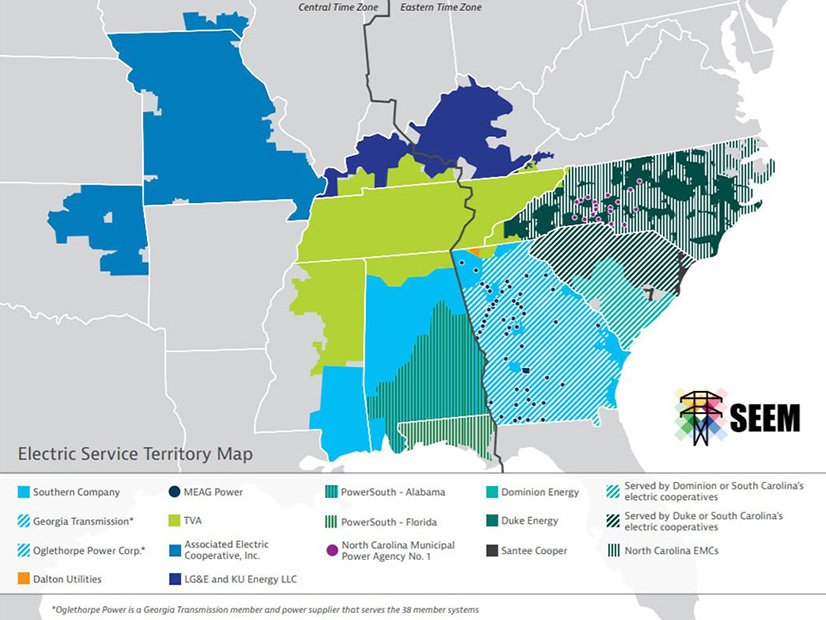
The SEEM proposal is backed by more than a dozen utilities and cooperatives in the Southeast, including Southern Co. (NYSE:SO), Duke Energy (NYSE:DUK) and the Tennessee Valley Authority. Sponsors claim the planned expansion of bilateral trading in 11 Southeastern states will reduce trading friction by introducing automation, eliminating transmission rate pancaking, and allowing 15-minute energy transactions. Proponents also claim the market will promote the integration of renewable resources such as wind and solar.

In a letter dated March 15 but filed on Wednesday, the 17 members of the state House of Representatives — all Democrats — said the SEEM sponsors “have provided no evidence that the proposed arrangement will lower energy prices, increase the adoption of renewable energy, or improve system reliability.”

“In fact, the proposal limits independent renewable energy producer participation, decreases already limited transparency in the utilities’ operation, and may increase the utilities’ ability to harm other market participants,” the letter said.

Lawmakers asked that, “regardless of [their] decision” on SEEM, commissioners call a joint federal-state technical conference aimed at:

  • determining the SEEM proposal’s impact on customer bills and renewable energy;
  • determining whether all market participants will be able to “compete on a level playing field” under SEEM;
  • assessing the potential benefits of “a reformed wholesale market that goes beyond the SEEM proposal” (examples include an independently operated RTO or energy imbalance market);
  • comparing the costs and benefits of the SEEM proposal to an RTO or EIM;
  • determining whether implementing SEEM would delay “broader wholesale reforms”; and
  • identifying how “the benefits of broader wholesale reforms can be realized in the region while preserving or enhancing state jurisdiction and prerogatives.”

SEEM Criticism Continues

SEEM members have been pushing FERC for a speedy decision on their proposal. In their response to the commission’s second deficiency letter earlier this month, the utilities requested a shortened comment period and approval of the SEEM plan by next month. (See SEEM Members Push for FERC’s Decision on Market Proposal.)

The proposal’s supporters took FERC’s “limited” second deficiency letter — comprising only three questions, compared with 12 in the commission’s first such response — as a sign that FERC is moving closer to approval. But critics of SEEM have continued to push back against the planned market expansion, uniting around the request for a conference that SEEM members have urged the commission to dismiss. (See Southeast Utilities Urge FERC Action on SEEM.)

Southeast-Energy-Exchange-Market-map-(SEEM)-Alt-FI.jpg
Map of planned SEEM territory | SEEM

One alliance of environmental groups calling themselves “Public Interest Organizations” (PIOs) has been particularly active, with multiple filings castigating the SEEM proposal for lacking transparency and creating opportunities for monopolistic behavior. (See SEEM Critics Repeat Call for Technical Conference.) The PIOs repeated their accusations in a filing last week responding to SEEM members’ latest deficiency response.

A number of other groups also chimed in. The trade organizations Advanced Energy Economy and Renewable Energy Buyers Alliance, for example, submitted a joint filing this week echoing the PIOs’ concerns about transparency and supporting the idea of a technical conference.

D.C.-based think tank R Street Institute expressed concern on Monday about the proposal’s lack of an “independent market monitor that is not answerable to the SEEM board” and asked that FERC require that the proposal be modified to account for such a position. Failing such changes, R Street contends that SEEM “may actually stifle” the goal of “expanding market opportunities to the Southeast.” A technical conference could help the commission explore alternative options for the region, R Street contends.

Another trade group, the Solar Energy Industries Association, complained that its members — along with other stakeholders — had no input into the SEEM proposal, and that proponents’ responses to FERC’s deficiency letters had shown that “it is no longer the case that the SEEM agreement may not be just and reasonable; the SEEM agreement is not just and reasonable.” SEIA asked commissioners to reject the SEEM proposal and call a technical conference to solicit “consideration of all relevant facts and circumstances, including by stakeholders most impacted.”

Energy Costs Could Impede Electrification in California, New York

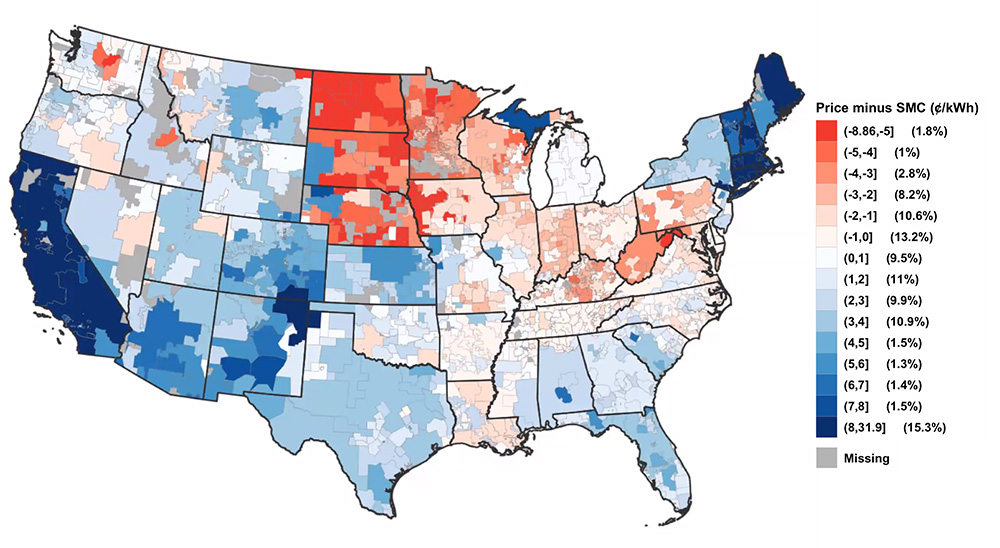
A UC Berkeley study found that high electricity prices in California, New York and most of New England could undermine efforts to electrify transportation and homes, while the “social marginal costs” of pollution from natural gas and gasoline remain unaccounted for, making the fuels seem a less expensive option to consumers.

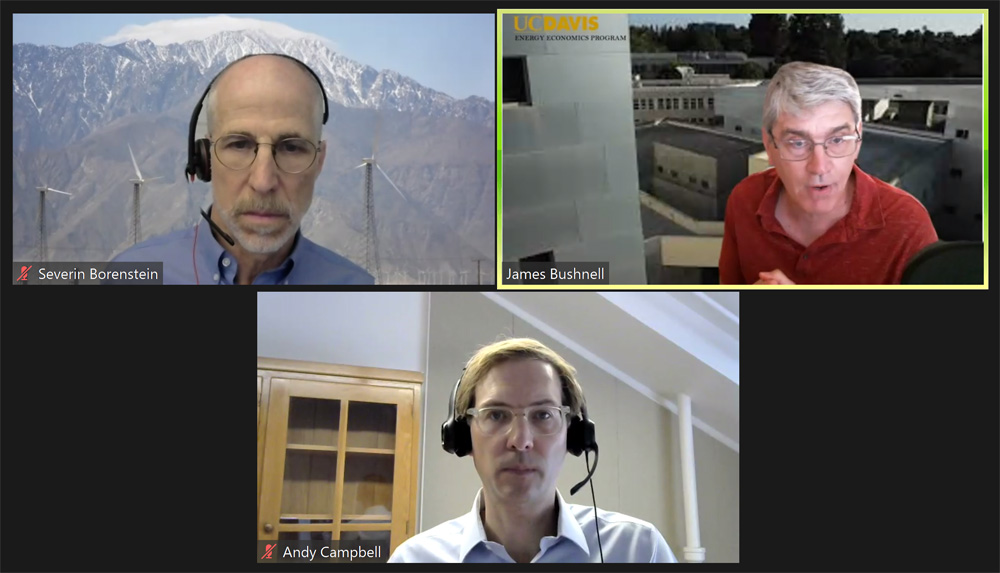
The study was authored by UC Berkeley Prof. Severin Borenstein, a member of the CAISO Board of Governors, and UC Davis Prof. James Bushnell, a member of the ISO’s Market Surveillance Committee.

A “challenge to the process of electrification that is obvious to economists, but surprisingly less prominent in policy discussions, is overcoming relative retail price disparities between the three fuels,” Borenstein and Bushnell wrote. “For many U.S. residents, electricity can be the most expensive of the three energy sources.”

In a webinar to discuss their paper Tuesday, Borenstein said the costs of fuel sources should include pollution and other societal impacts. Electricity is too expensive under such a formula in California, New York City and much of New England, and underpriced in the upper Midwest and other regions, the research found.

Borenstein-Bushnell-Campbell-(UC-Berkeley)-Content.jpg
Professors Severin Borenstein and James Bushnell speak with Energy Institute Director Andy Campbell. | UC Berkeley


In California, where renewable energy sources account for about one-third of in-state generation and more than 30% of imports, electricity supplied by large investor-owned utilities is “about three times higher than social marginal cost,” Borenstein said. Electricity is also priced well above social marginal costs (SMC) in parts of New York, Connecticut and other New England states, he said.

In contrast, states such as North Dakota, South Dakota and Minnesota have electricity costs that are low compared with the pollutants released by coal and other fossil fuel generation, the research determined.

“We find that significant pricing distortions arise in electricity, where prices can be up to four times SMC in some states, and 25% or more below SMC in other states,” Borenstein and Bushnell wrote.

Those areas are outliers, however. Much of the nation has electricity and natural gas prices that generally reflect their true costs.

“A large part of the country actually is plus or minus a couple of cents from social marginal cost prices,” Borenstein said.

Getting Prices Right

The findings are important because energy prices influence consumer choices, Borenstein said.

Mispricing fossil fuels can impede decarbonization, he suggested.

“When you get that price right [using MSC], when consumers go to make consumption decisions, they’re seeing a price for a decision that actually reflects the cost their decision would impose on society,” he said.

“If we get all of the prices to reflect social marginal costs, [when consumers are] choosing between energy sources — say, between natural gas and electricity — for heating their house, they will be making that decision based on the energy costs that actually reflect the full cost of each energy source,” Borenstein said.

Another problem is that electrification efforts may enlarge the price gap between clean electricity and fossil fuels in states such as California where electricity is mispriced.

Retail-Electricity-Price-Map-(UC-Berkeley)-Content.jpg
Retail electricity prices are highest in California and New England without “social marginal cost” factored in. | UC Berkeley


“While low-carbon electricity production sources have rapidly declined in costs, most analysts predict that ‘deep’ decarbonization will require costly investments in battery storage, transmission, and more exotic and expensive technology solutions, such as hydrogen for long-duration storage,” the paper said.

For economists, Bushnell and Borenstein wrote, “the logical solution to such a pricing gap would be carbon pricing either through a tax, cap-and-trade, or some other mechanism. This solution is complicated by the fact that there are existing taxes and other pricing distortions that have already caused fuel prices to deviate from marginal costs.”

In California, natural gas accounts for 86% of space and water heating, though efforts are underway to encourage residents to switch to electric heat pump space and water heaters. (See Calif. Energy Commission Adopts 2022 Building Code.)

“For both space heating and hot water heating, changing the volumetric prices of electricity and natural gas from their current levels to SMC would greatly alter the economics of the energy choice for these primary residential uses,” the authors wrote. “In both cases, current energy prices tilt strongly in favor of natural gas, but pricing at SMC would effectively eliminate that difference.”

For cars, “gasoline … is largely underpriced relative to SMC, a gap that is most extreme in dense urban areas most vulnerable to local air pollution,” the authors said.

California’s governor issued an executive order last year requiring all new passenger cars and trucks sold in the state to be electric vehicles or other zero-emission vehicles by 2035. The state is far from meeting that goal, however, and must exponentially increase EV sales.

That could change with accurate energy prices, Borenstein and Bushnell determined.

“Lower fuel costs are supposed to be one of the big advantages of electric vehicles, but at current rates in California — where we find gasoline is priced below SMC in most locations and electricity is priced well above SMC — we find the fuel cost advantage of EVs would increase by about $500 per year on average if each fuel were priced at SMC.”

House Democrats Reach Deal, Pass $3.5T Budget Plan

Following a night and morning of intensive negotiations between Speaker Nancy Pelosi (D-Calif.) and a group of moderate Democratic lawmakers, the U.S. House of Representatives on Tuesday passed a $3.5 trillion budget plan, with billions of dollars for moving the nation toward a carbon-free grid by 2035.

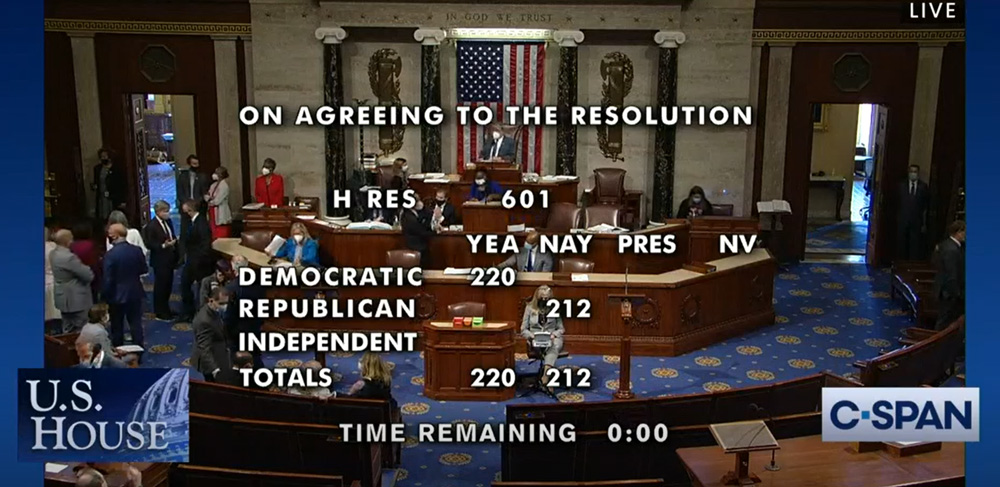
The vote was largely a procedural affair, as lawmakers voted on a rules resolution that included a provision that simultaneously passed the budget. It was split strictly along partisan lines, with all 220 Democrats providing a narrow margin over all 212 Republicans.

The vote also opened the way for debate on the $1.2 trillion bipartisan infrastructure bill, which was approved by the Senate along with the budget reconciliation bill Aug. 10-11. The reconciliation process means that Senate Democrats were able to circumvent a filibuster and pass the budget by a simple majority. (See Senate Democrats OK $3.5 Spending Package After Bipartisan Accord on Infrastructure.)

House-Budget-Vote-(C-SPAN)-Content.jpg
| C-SPAN

The impasse between Pelosi and the moderates centered on whether a vote on the infrastructure bill would be conditioned on prior passage of the budget. In a statement released Tuesday afternoon, Pelosi committed to passing the infrastructure package by Sept. 27, which was apparently enough for the moderates to join their colleagues in support of the budget.

Referring to the reconciliation process, Pelosi said, “We must keep the 51-vote privilege by passing the budget, and work with House and Senate Democrats to reach agreement in order for the House to vote on a Build Back Better Act that will pass the Senate.”

Aggressive Investments

Details on specific dollar amounts and programs in the budget remain to be hammered out in the House and Senate. However, the budget framework that Senate Majority Leader Chuck Schumer (D-N.Y.) released Aug. 9 included $198 billion for the Senate Energy and Natural Resources Committee to allocate to a range of initiatives, such as a Clean Energy Payment Program, which would pay utilities to hit specific decarbonization targets. The funding would also be used for climate research, federal procurement of energy-efficient materials and building domestic clean energy supply chains. (See Pitching Proposals for the Budget Reconciliation Bill.)

The Environment and Public Works Committee would have $67 billion to allocate to a clean energy technology accelerator focused on low-income solar and other climate-friendly technologies, as well as federal investments in energy-efficient buildings. Environmental justice investments would also be made in clean water affordability and access, healthy ports and climate equity.

While lauding these energy provisions, Pelosi and other Democrats focused more on the education, health care and other “social infrastructure” spending in the bill, such as its provisions to provide two years of free preschool education for all children in the U.S.

Rep. Frank Pallone (D-N.J.), chair of the House Energy and Commerce Committee, said the bill would help to make health care and prescription drugs more affordable. But he also promoted the budget’s clean energy provisions as a job creator. Passage of the budget would, he said, “allow us to create millions of new, homegrown jobs and combat the climate crisis by aggressively investing in clean energy and clean technology. And the moment is here to invest in a more advanced and resilient economy and toward a 100% clean economy.”

‘Better-than-even Odds’

In advance of Tuesday’s vote, industry analyst ClearView Energy Partners predicted “better-than-even odds for passage of both the [bipartisan infrastructure bill] and the party-line [budget] package, but we expect moderate Democrats in both chambers to win some of their challenges against party leaders and the largely progressive agenda the reconciliation package would pursue.”

Specifically, ClearView sees the possibility of a smaller reconciliation package that ke most of President Biden’s requested clean energy incentives but might have to compromise on his efforts to cut fossil fuel subsidies.

Gregory Wetstone, president and CEO of the American Council on Renewable Energy, was more bullish.

“Today’s House vote to pass the [fiscal year 2022] budget resolution sets the stage for Congress to finally take decisive action on the climate crisis,” Wetstone said in a statement. “A stable, long-term, full-value clean energy tax platform is foundational for decarbonizing the grid and will create millions of good-paying American jobs. Congress must act with clarity and conviction now to seize this once-in-a-generation opportunity to enact a comprehensive climate policy able to meet the challenge before us.”

Dominion Secures 10-Year Virginia Port Lease for OSW Staging

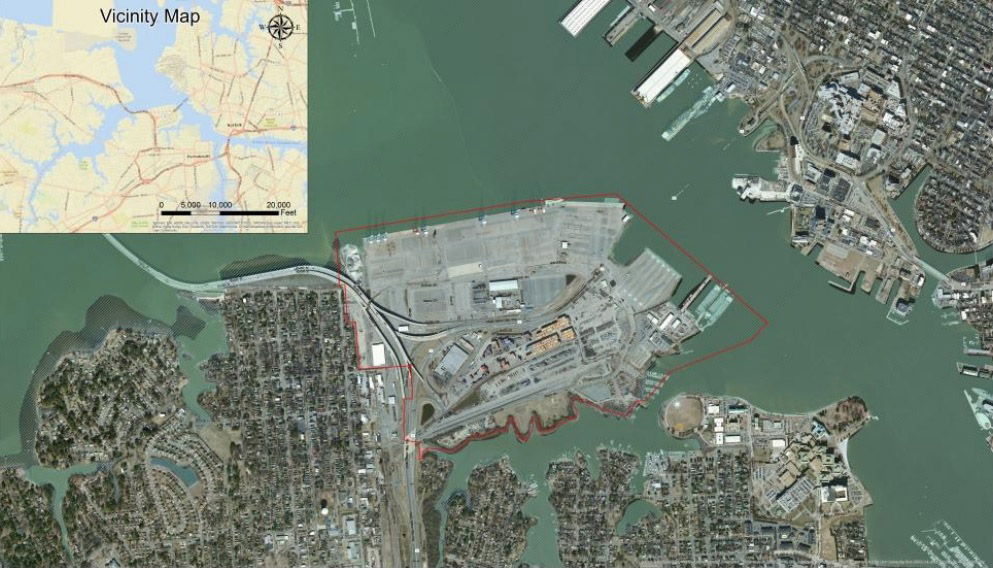
The Port of Virginia has agreed to lease 72 acres of its Portsmouth Marine Terminal to Dominion Energy (NYSE: D) for 10 years to support development of the 2.6-GW Coastal Virginia Offshore Wind (CVOW) project.

“Dominion will use the deep water, multi-use marine cargo terminal as a staging and pre-assembly area for the foundations and turbines to be constructed about 30 miles off the coast of Virginia Beach,” Gov. Ralph Northam said Wednesday in his welcome address at the Business Network for Offshore Wind’s International Partnering Forum (IPF).

Northam counted the agreement as the latest in a series of “concrete actions” the state is taking to grow its offshore wind industry.

A 2015 report from the Virginia Department of Mines, Minerals and Energy identified the state-owned port as capable of accommodating multiple OSW activities. Negotiations on Dominion’s lease accelerated in July, when the Virginia Port Authority Board of Commissioners directed the authority to finalize the agreement, according to the governor’s office.

The lease, which is valued at $4.4 million annually, has an option for two five-year renewals, the governor’s office said. The agreement also includes significant upgrades to ensure the terminal can handle the weight of turbine components.

Ørsted reached an agreement last year with the Port of Virginia for an initial 1.7-acre lease at the Portsmouth Marine Terminal through 2026, with an option to expand to an additional 40 acres.

Virginia-Port-View-(Virginia-Department-of-Mines-Minerals-and-Energy)-Content.jpg
Aerial view of the Portsmouth Marine Terminal in Virginia | Virginia Department of Mines, Minerals and Energy

The facilities comprising the Port of Virginia, which include four other marine terminals, generate $92 billion in total economic impact throughout Virginia on an annual basis, according to Northam. The state, he said, is “doing more with additional projects planned or underway to increase water and rail access, further enhancing the port’s competitiveness and value.”

Given the state’s proximity to the major East Coast OSW development areas, which are less than a day’s sail away, he said, Virginia is “the perfect hub for this booming industry.”

Since the signing of an offshore wind memorandum of understanding last October among Virginia, North Carolina and Maryland, the states have heard from stakeholders on how the partnership can help expand OSW.

“We will look at ways to enhance our state permitting process and create cross-state workforce development initiatives,” Northam said, adding that the states also will collaborate on ways that companies can work with state permitting agencies.

The Bureau of Ocean Energy Management in July announced its intention to review the CVOW project and prepare an environmental impact statement, which isn’t due until 2023 under current permitting timeframes. (See BOEM Beginning Environmental Review on Va. OSW Project.)

Industry First

Development of the 132-MW South Fork offshore wind farm has delivered a first for the U.S. and the industry with a deal for construction of the project’s substation in Texas.

Together with project partner Eversource, Ørsted awarded the offshore substation contract to Kiewit Offshore Services.

“More than 350 workers across three states will support this project with engineering, procurement and project management scopes for approximately 18 months,” CEO of Ørsted Offshore North America David Hardy said during the IPF opening plenary session.

The contract represents a crossover of skills from the oil and gas industry to offshore wind, Liz Burdock, CEO of the Business Network for Offshore Wind, said in a statement.

“The complexity and size of this major component essential to an offshore wind project will also require vendors from all over the country to supply products and services,” she said.

Kiewit will build the 1,500-ton, 60-foot-tall substation at its facility near Corpus Christi, Texas, with support from teams in Houston and Kansas, according to a statement from the companies.

“After it’s built, it will be sailed up to New York where union workers will help with the final installation and commissioning, as well as perform many other scopes for offshore and onshore parameters of the project,” Hardy said.

Kiewit expects to begin construction on the substation in November.

FERC Approves Cold Weather Standards

FERC on Tuesday approved NERC’s proposed cold weather reliability standards in an order that both completes more than two years of work by the standards development team (SDT) for Project 2019-06 while also acknowledging the likelihood of further cold weather-focused standards development work (RD21-5).

The new standards consist of EOP-011-2 (Emergency preparedness and operations), IRO-010-4 (Reliability coordinator data specification and collection) and TOP-003-5 (Operational reliability data). All are revisions to existing standards, reflecting the SDT’s commitment to avoid overly sweeping changes in response to concerns raised by stakeholders in the project’s initial stages. (See Gen Operators Cool to Winter Preparedness Standard.)

Changes from EOP-011-1 include:

  • the addition of two requirements, R7 and R8, mandating that generator owners (GOs) to implement a plan to protect their units from freezing “based on geographical location and plant configuration” and to provide maintenance and operating personnel with unit-specific training on the plan, respectively;
  • the revision of requirements related to “the consideration of the reliability impacts of cold weather conditions in transmission operator [TOP] and balancing authority emergency operating plans”;
  • changing the title of the standard, currently “Emergency operations”; and
  • updating the purpose statement to add GOs as entities responsible for compliance with the standard.

IRO-010-4 and TOP-003-5 would require reliability coordinators, TOPs and BAs to include in their data specifications provisions for reporting the cold weather information identified by the GO in the cold weather plan.

FERC also accepted NERC’s 18-month implementation plan for each of the revised standards. The implementation timeline begins on the first day of the first calendar quarter following the date of approval; hence, the standards will take effect April 1, 2023.

“This implementation plan is reasonable to accommodate entities that may need time to perform various engineering analysis; provide the required training; and develop the necessary capabilities to satisfy revised data specifications,” FERC said in its order. “Nevertheless, we strongly encourage entities that are capable of complying with the cold weather reliability standards earlier than the mandatory and enforceable date to do so.”

The commission further encouraged NERC to pursue additional measures “to support reliability during the upcoming winter season” as well as the next, before the new standards become enforceable. Such measures are already underway: NERC last week issued a Level 2 alert “intended to evaluate the bulk electric system’s winter readiness.” (See NERC Issues Cold Weather Alert.)

Future Standards Actions Likely

NERC began Project 2019-06 in response to a joint report with FERC staff on the January 2018 cold weather event, when below-average temperatures resulted in 183 generating units in SPP, MISO, the Tennessee Valley Authority and SERC Reliability experiencing either an outage or a failure to start over a five-day period.

The project faced considerable industry skepticism in its early days. SDT members frequently fielded questions from utilities about whether such an initiative was even necessary. Respondents based in northern regions said they already know how to prepare for winter without mandatory standards, while those in more temperate climates wondered what was the point of preparing for cold weather that might never come.

February’s winter storms, which led to prolonged mass outages in Texas, lent urgency to the effort. (See ERCOT: Grid was ‘Seconds and Minutes’ from Total Collapse.) In the weeks following the cold snap, NERC’s Standards Committee authorized shortening the second formal ballot and commenting period from 45 days to 25 days in hopes of submitting the standards to the Board of Trustees for approval in June. (See NERC Cold Weather Team to Seek Faster Finish.)

Even as they authorized accelerating development of these standards, NERC has made clear that more, new standards relating to cold weather preparedness are all but certain. In a media roundtable in April, CEO Jim Robb referred to “the standards as currently conceived” as a “basic framework” that will need “amendments or adjustments” in the future. (See NERC Provides Cold Weather, Cyber Updates.)

Future standards development work could arise in response to the joint inquiry on February’s storms that FERC and NERC announced just days after the crisis peaked. (See “FERC, NERC Announce Joint Inquiry,” Slow Storm Restoration Sparks Anger in Texas, South.) The report is expected to be completed by the end of the year.