Trees, Composting Key to Capturing CO2, Hawaii Task Force Hears

Hawaii’s Greenhouse Gas Sequestration Task Force (GHGSTF) convened with state and nonprofit organizations last week to discuss whether their ongoing projects can dovetail into the Hawaii 2050 Sustainability Plan to combat climate change.

The GHGSTF heard presentations from the Department of Land and Natural Resources (DLNR), Office of Planning and Sustainable Development, and the nonprofits Sustainable Coastlines and Ma’ona Community Garden to determine which efforts could be used to enhance the 2020-2030 portion of the plan.

Heather McMillen, urban and community forester with the DLNR Division of Forestry and Wildlife, said “trees are essential infrastructure for our survival” and should be formally considered infrastructure. She explained that the DLNR created the Citizen Forester Program in 2016, which uses crowdsourcing to identify and log the amount and types of trees in an area by allowing residents to upload information online. Using the town of Kailua as an example, she said the program calculated that the 5,664 trees in the area sequester about 600,000 pounds of carbon, prevent about 5.5 million gallons of water runoff, and reduce heat by 3,155 therms.

“Unlike stop signs and streetlights, trees increase in value over time … Trees cost money to maintain, but for every dollar invested, there is a $3 return, not to mention all the health and wellbeing benefits that are quite difficult to put a dollar value on,” McMillen said.

Recognition of that value is at the heart of the DLNR’s Kaulunani Project, which seeks to increase urban forestry. The project, a collaboration with the U.S. Forest Service and the National Oceanic and Atmospheric Administration, will create an online, public and interactive tree canopy viewer for the entire state in 2022. McMillen said it would “help us be strategic in our tree planting and tree care efforts going forward.” In the last 10 years, Kaulunani has given $3.6 million to 400 community projects and planted 11,164 trees and distributed 90,606 trees.

McMillen said legal red tape often prevents fully utilizing the urban tree canopy, but Hawaii could “unlock public funds and help to leverage private activities as well” by designating trees as infrastructure. She recommended that the state view trees as “a critical technology for adapting to climate change and promoting ecosystem and human resilience.”

Distributed Composting

Rafael Bergstrom, executive director of Sustainable Coastlines Hawaii, spoke about an “in-vessel” composting pilot project. The vessel his team has been testing inserts food and biowaste into a 22-foot-long metal box with a mulching machine and other components to quicken the composting process. The vessel costs $75,000.

Bergstrom said that GHGs released from biogenic sources can pose a significant problem, with biogenic emissions from processing waste into energy releasing CO2 at three times the rate of burning oil and almost on par with burning coal. “Waste energy is not a clean energy by any means,” he said, adding that agricultural land creates an estimated one-third of the surplus carbon in the air.

Bergstrom argued that composting can be a win-win investment. “Composting is a victory for all of the things that we can do to help regenerate our soils to sequester greenhouse gases out of the air and really mitigates some of our other sources of GHGs, whether that be from landfilling, or burning, and when we put food waste into landfills for instance, the release of methane.”

“Even on Oahu, where we have a waste energy plant, there are huge issues with us burning food waste and green waste in general. Thirty percent of what is going to H-Power [a waste energy recovery plant on Oahu] is both food waste and green waste, which to be frank, is just a waste,” he said.

Bergstrom explained that a single vessel can compost 300,000 pounds of waste and sequester 25 to 150 tons of CO2 per year. Compared with traditional forms of composting, “what could take two to three months in piles can be advanced in two weeks … This is a single project that really has amazing potential to scale.”

Bergstrom argued for a more efficient permitting process, saying, it took more than 200 hours of work to get a permit into the Department of Health. “So smaller scale composting really does need some amendments to help move these things forward faster.”

“Have these machines in every university, every school, every prison, every hotel, every farm, every community garden, and it decentralizes the system to the point where we don’t have a huge investment into a massive composting facility in the middle of the island where there are all sorts of transport costs,” Bergstrom said.

Chantal Chung, project manager with Ma’ona Community Garden, presented the organization’s efforts with vermicomposting, composting using worms. She said that Hawaii is inefficiently “shipping out cardboard and other things [as trash] that we can use to build our soils.”

Chung said that between May 2020 and May 2021, the garden processed more than 140,000 pounds of cardboard, paper and food waste, turning it into usable soil. Although vermicomposting may seem like an easy process, Chung said, “disabling policies and laws on the state and county levels” — along with a lack of infrastructure — create significant roadblocks. She argued for better education for businesses on how to properly set up composting practices and said the state should invest in composting infrastructure to make it easier for businesses and communities to get involved.

Danielle Bass, state sustainability coordinator and head of the statewide sustainability program with the Office of Planning and Sustainable Development, wrapped up the meeting by explaining the 2020-2030 portion of the Hawaii 2050 Sustainability Plan.

The plan shares a “common framework” with the sustainable development goals of the United Nations, Bass said.

Plan developers surveyed the public to better understand residents’ desires for the decade, concluding that they want an economy that is less focused on tourism, more diversified, rebuilds from the pandemic more sustainably and increases Hawaii’s self-sufficiency.

Though the plan is only a recommendation to state officials and businesses, Bass said she is confident that the more momentum that can be built for sustainability, the easier it will be to pass laws benefiting the environment.
Mixed Stakeholder Reception to PJM MOPR Replacement

More than two dozen comments poured in to FERC on Friday regarding PJM’s proposed replacement for the extended minimum offer price rule (MOPR-Ex), with a healthy mix of support and opposition (ER21-2582).

The RTO’s proposal, filed with the commission July 30, received criticism from merchant generators, electric cooperatives and state utility regulators. But some entities in those same groups took the opposite outlook.

Stakeholders approved the proposal in an 87-18 vote at a special Members Committee meeting held June 30. The Board of Managers gave final approval July 7, setting in motion the FERC filing. (See PJM Board Approves MOPR Rollback.) Chair Mark Takahashi had said the board selected PJM’s proposal because it “accommodates state policy and self-supply business models,” addresses “attempted exercises of buyer-side market power (BSMP)” and creates a “sustainable market design” by “keeping clearing prices consistent with supply and demand fundamentals.”

The PJM MOPR proposal calls for “maximiz[ing] transparency and market confidence” through identification of BSMP by the RTO and Monitor and proposes to “further clarify the actions of a state” that may “improperly interfere with bidding in PJM’s capacity market and FERC’s ratemaking authority.”

Market participants would be asked to sign attestations declaring they are not exercising market power or receiving state funds tied to clearing in the auction, while PJM and the Monitor would conduct “fact-specific, case-by-case reviews” if market power is suspected. Referrals would be made to the commission for a final determination.

The new rules would eliminate both the expanded MOPR created by FERC’s December 2019 ruling and PJM’s prior MOPR, which was limited to new natural gas resources. (See FERC Extends PJM MOPR to State Subsidies.)

PJM officials vowed to have the proposed changes incorporated into the 2023/24 delivery year Base Residual Auction scheduled for December pending approval by the commission. (See PJM Proposes Shifting MOPR Determinations to FERC.)

Protests

Calpine and LS Power issued a joint protest, saying the proposal “fails to include critical information” and that the MOPR modifications are “patently unjust, unreasonable, and unduly preferential and discriminatory.”

The merchant generators said the proposal resulted from a “rushed and skewed stakeholder process [after] a directive from the PJM Board of Managers to accommodate state-subsidized resources.” It would permit subsidized resources to “drive down capacity prices, without any consideration of the impact on merchant generators, who have invested billions of dollars in this market, or any concrete plan to ensure that resources required for reliability have an opportunity to recover their investment and a return on that investment.”

The Pennsylvania Public Utility Commission and the Public Utilities Commission of Ohio said the proposal would make “improvements for state policy accommodation by removing capacity resources participating in competitive and nondiscriminatory state default service procurements from being subject to buyer-side market power mitigation and affording the same treatment to competitive new natural gas capacity resources that receive no state support.”

But they said the proposal “fails to provide the necessary checks and balances to ensure that sufficient market power protections exist” through its attempt to accommodate state policies. The “unsupported and experimental accommodations” in the proposal “threaten to destabilize PJM’s capacity market” through “gaming of generally permissive rules” by market participants.

The proposal “unjustly transfers the consequences of a particular state’s policy preference(s) to all states and consumers within the PJM region,” the commissions argued. They recommended that FERC direct PJM to continue studies of the impacts of MOPR policies on competitive markets.

“Generally, we support the accommodation of state policies within the PJM markets where such policies do not lead to an unjust and unreasonable outcome,” they said. “But the state policy choices of one state should not be unreasonably foisted upon or burdensome to other PJM states when those choices result in reliability concerns or the premature displacement of competitive merchant resources.”

The Independent Market Monitor said PJM’s markets would be “better off, more competitive and more efficient with no MOPR” rather than with the RTO’s proposal, saying its solution would “effectively eliminate the MOPR while creating a confusing and inefficient administrative process that effectively makes it both unnecessary and impossible to prove buyer-side market power as PJM has defined it.” It said the commission should initiate a proceeding to establish an “orderly process to produce a balanced and effective rule for PJM.”

Old Dominion Electric Cooperative’s protest said PJM’s proposal could be interpreted to “exclude certain public power entities from accommodation of their longstanding business models while providing such protection for others.” ODEC said the tariff revisions must be clarified to “preserve the outcome and expectations from the stakeholder process and accommodate certain self-supply from electric cooperatives acting under longstanding business models.”

“Absent the assurance that they qualify as self-supply sellers and their resources can qualify for the non-exhaustive list of resources that would not be subject to a buyer-side market power inquiry,” ODEC said, “indicated cooperatives will face the same threat to their longstanding business models that Chairman Richard Glick cautioned against with the expanded MOPR. Therefore, this issue is too critical to leave any ambiguity or lack of clarity in the tariff.”

Vistra said that under the revised MOPR, the only state programs that would trigger the rule would be those that meet PJM’s definition of conditioned state support and that its application toward state programs “turns exclusively on whether PJM and the commission find that the state program at issue meets the criteria” established by the U.S. Supreme Court in Hughes v. Talen, in which the court found state policies “tethered” to federally regulated electricity markets unconstitutional.

“This approach fails because the legal framework set forth in Hughes — which the court explained was unrelated to interference with auction price signals — bears no relationship to whether a seller’s offer reflects an attempt by a state to exercise buyer-side market power,” Vistra said. “In short, PJM’s conditioned state support proposal will not provide any protection against the exercise of buyer-side market power associated with state programs.”

Vistra said the commission should reject the proposal and instruct PJM to “work towards establishing a durable MOPR framework, based on objective, economically sound principles, consistent with the commission’s statutory mandate.”

“This structure inherently invites litigation, both before the commission and in the courts, regarding the validity of state programs,” Vistra said. “A decision by PJM and the commission that a state program meets the criteria for pre-emption set forth in Hughes would lay the groundwork for subsequent court challenges seeking to invalidate the state program or policy at issue. The result would be to create additional investment uncertainty for the renewable and low-carbon resources being developed through these programs.”

Support

Although the Pennsylvania and Ohio commissions opposed the proposal, other state regulators gave their support.

The New Jersey Board of Public Utilities said it welcomed PJM’s recognition that the expanded MOPR “goes far beyond addressing the exercise of buyer-side market power” and inappropriately mitigates “nearly all resources supported by state actions.”

“The proposal provides a clear definition of buyer-side market power that is narrowly and appropriately tailored to conduct that inappropriately impacts capacity clearing prices,” the BPU said. “Regarding state policies, the proposal limits MOPR application to specifically defined conditioned state support.”

In its comments, the Maryland Public Service Commission said PJM’s proposal “rightfully recognizes the legitimate actions states have taken to shape their resource mix and refrains from applying MOPR to resources associated with these actions.”

“PJM’s filing observes that the expanded MOPR ‘ignores that state support for renewable resources has become a well established determinant of supply in the PJM region, and thus ignores the region’s actual supply-demand fundamentals,’” the PSC said. “Reforming the MOPR to account for ‘the reality of state policies’ will remove an ‘overcorrection that … works against just and reasonable rates.”

Exelon (NASDAQ:EXC) and Public Service Enterprise Group (NYSE:PEG) filed joint comments saying the MOPR is an “essential element of PJM’s capacity market design that protects suppliers and consumers from the effects of buyer-side market power.” But they said an “overbroad MOPR ensnares legitimate transactions, with severely detrimental effects for the market.” The companies said it is “critical” for the commission to “strike an appropriate balance” to “capture anticompetitive behavior without impeding legitimate transactions” in a new MOPR decision.

“PJM’s proposal avoids interfering with states’ efforts to account for the significant externalities of fossil fuel generation, which is of increasing importance to states throughout the PJM footprint,” they said. “It therefore allows the capacity market to operate more efficiently by reflecting the actual economic conditions resulting from these state initiatives. At the same time, the revised MOPR will effectively mitigate attempted exercises of buyer-side market power. PJM’s proposal therefore strikes a just and reasonable balance between deterring manipulative behavior and not burdening legitimate activity.”

The Organization of PJM States Inc. (OPSI) said it appreciated PJM’s “expedited efforts” to file tariff changes as soon as possible. It said it’s “looking forward to” the RTO taking up additional discussions on changes to the capacity market that were not addressed in the filing.

“OPSI sees an opportunity here for the commission, when approving the filing without delay, to signal to PJM the importance of continuing to work to more fully accommodate state policies and address remaining, but important, issues … to ensure states can rightfully continue as laboratories of energy innovation,” the organization said.

Additional Comments

Electric Power Supply Association (EPSA) CEO Todd Snitchler said the “weakened” MOPR proposed by PJM “infringes on states’ rights by allowing some states to impose their policy choices on others and shift the cost of subsidized power generation to out-of-state producers and consumers.”

Snitchler said the competitive results from the May capacity auction demonstrated that changes to the MOPR are not necessary right now and that PJM and its stakeholders should spend more time considering alternatives. (See Capacity Prices Drop Sharply in PJM Auction.)

Travis Kavulla, vice president of regulation for NRG Energy, tweeted that the “vestigial MOPR” proposed by PJM would “actually encourage disingenuousness in state policymaking” because one of the revisions would “tie MOPR to ‘intent’ to suppress market prices.” Kavulla said such a policy “rewards obfuscation,” noting the “recent shenanigans” in Ohio and Illinois, referring to scandals involving FirstEnergy and Commonwealth Edison. (See DOJ Orders $230 Million Fine for FirstEnergy and Ex-ComEd CEO, Officials Charged in Ill. Bribery Scheme.)

CAISO Agrees to Share More Power with EIM

The CAISO Board of Governors and Governing Body of the ISO’s Western Energy Imbalance Market voted unanimously Friday to approve a new delegation of authority over EIM matters, including a process by which FERC could resolve disputes between the two bodies.

The adopted decision resulted from a stakeholder process in which the EIM Governance Review Committee (GRC) considered revisions to EIM rules under a reassessment required by the market’s founding charter.

“Because the Western EIM will continue to expand and evolve, the important steps we’ve taken today help make sure we have the right governance structure in place for greater collaboration and coordination among the growing Western EIM membership and the California ISO,” CAISO Board Chair Angelina Galiteva said in a statement following the vote.

The vote dealt with the second, more controversial component of the GRC’s recommendations about relations between CAISO and its real-time interstate trading market, made up of entities from across the West. The two bodies approved a first set of changes in May that covered topics such as the selection of EIM Governing Body members and stakeholder engagement. (See CAISO Board Approves EIM Governance Changes.)

Both sets of changes were generally supported by stakeholders, though some expressed concern about FERC intervention in Western disputes. (See Joint CAISO-EIM Authority Debated in West and Solid Support for EIM Joint Authority Plan.)

The expanding EIM now includes 14 participants in addition to CAISO, with more scheduled to join in the next two years. Its footprint encompasses portions of 10 Western states.

CAISO said the market has saved members more than $1.4 billion since its launch six years ago.

Expanded EIM Authority

Friday’s decision increases EIM authority over issues affecting the market. CAISO tariff changes that apply to the EIM and its stakeholders now will require Governing Body and Board of Governors approval. The new shared authority will be exercised at joint meetings of the two groups, with decisions requiring majority approval by both.

“Currently, the EIM Governing Body has primary authority only for changes to real-time market rules that are EIM-specific, meaning that they apply uniquely or differently to EIM entity balancing authority areas, or for changes to generally-applicable real-time market rules where the primary driver for the change is an issue specific to the EIM entity balancing authority areas,” CAISO Vice President of External and Customer Affairs Stacey Crowley wrote in a memo to the governors and Governing Body members.

“In practice, this has meant that some tariff proposals that apply to EIM Entities or to other market participants within EIM balancing authority areas in their role as EIM participants have been outside the EIM Governing Body’s approval authority,” Crowley said.

The GRC recommended expanding the Governing Body’s scope, “so that the applicability of a proposed tariff rule in the EIM context determines whether or not it is subject to approval by both bodies,” she said.

The Board and Governing Body adopted the GRC’s recommendation that joint authority should extend to all proposals to “change or establish any CAISO tariff rules applicable to the EIM entity balancing authority areas, EIM entities, or other market participants within the EIM entity balancing authority areas, in their capacity as participants in EIM.”

In the event the two bodies cannot agree on a course of action, the revisions lay out a process that could, in rare circumstances, refer matters to FERC for dispute resolution.

In the case of an impasse, an additional staff and stakeholder process would be undertaken to resolve the matter. If that does not work, the Board of Governors and Governing Body could agree to abandon the proposal or remand it for another round of stakeholder consideration.

“Alternatively, the Board alone could authorize a FERC filing if, and only if, three conditions are met: (1) the Board, by unanimous vote, makes a finding that the bodies have reached an impasse and that exigent circumstances exist such that a revision to the tariff is critical to preserve reliability or protect market integrity; (2) the ISO would be required to include in its FERC filing any written opinion or other statement the EIM Governing Body may want to offer regarding the proposal; and (3) the EIM Governing Body would have the option to retain outside counsel to assist in preparing its written opinion or statement,” Crowley wrote.

‘A Turning Point in Collaboration’

On Aug. 2, when the GRC approved its own recommendations, GRC Chair Therese Hampton said the multistep dispute resolution plan “provides a strong incentive for both boards to resolve differences before going to FERC while also recognizing that there may be some circumstances where a filing is needed.” (See EIM Governance Review Committee OKs Power Share with CAISO.)

In the joint CAISO-EIM statement Friday, Governing Body Chair Anita Decker said that “the Western EIM’s Governing Body and the ISO’s Board of Governors approval of the Governance Review Committee’s recommendations is an important milestone and marks a turning point in collaboration and decision-making that will benefit an expanded Western market.”

“The Governance Review Committee’s recommendation was founded in substantial stakeholder engagement and symbolizes a dynamic time for the West,” Decker said. “We commend the Governance Review Committee’s impressive effort to work together with stakeholders to create this framework.”

The CAISO governors next must make implementing amendments to governance documents. The EIM Governing Body is scheduled to provide its advisory opinion on the amendments Sept. 8, followed by the Board of Governors’ consideration on Sept. 22.

Texas PUC Hearings Begin on $2.9B ERCOT Securitization

Hearings began Monday before the Texas Public Utility Commission over ERCOT’s request for a pair of debt-obligation orders to finance $2.9 billion in market debt stemming from high prices during February’s devastating winter storm.

The grid operator’s first application proposes financing the $800 million owed to ERCOT by market participants during the storm’s Feb. 12-20 emergency period (52321). The second proposes a $2.1 billion market uplift to cover short pays to the market (52322). (See “Staff File for $2.9B in Debt Recovery from Winter Storm,” ERCOT Briefs: Week of July 19, 2021.)

Both proposals are a result of legislation passed earlier this year during the 87th Texas Legislature, allowing the securitization of various debts incurred during the storm. (See Securitization Offers Texas a Way Forward.)

As of Aug. 2, the ERCOT market was short $2.98 billion from transactions during the storm.

Chris-Reeder-(Texas-Admin-Monitor)-Content.jpg
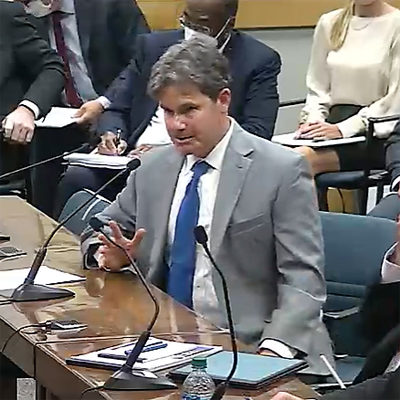
Chris Reeder, an attorney representing Calpine, speaks during the first day of hearings on ERCOT’s request to securitize $2.9 billion in market transactions. | Admin Monitor

ERCOT CFO Sean Taylor and Kenan Ögelman, vice president of commercial operations, were the only witnesses to take the stand Monday morning. They were briefly cross examined by attorneys representing Calpine and Golden Spread Electric Cooperative and fielded a few questions from the commissioners before the hearing was adjourned after 92 minutes.

Hearings on the $2.1 billion request will resume Tuesday at 1 p.m. CT.

The $800 million debt obligation would apply to amounts owed to ERCOT by market participants during the emergency period and subject to market uplift; the revenue auction receipts staff used to temporarily reduce short-pay amounts; and reasonable costs incurred by a state agency or ERCOT to implement the debt-obligation order.

The $2.1 billion debt obligation would cover “extraordinary” uplift charges assessed to the market’s load-serving entities for energy consumption during the emergency period, including reliability deployment price adder charges and ancillary service costs above the commission’s systemwide offer cap.

The grid operator has asked to recover the amount financed by imposing monthly uplift charges to qualified scheduling entities (QSEs) based on the load ratio share of their eligible LSEs. ERCOT said it doesn’t have the financial relationships between LSE and QSEs and can’t determine the eligible costs without quantifying the LSEs’ actual exposure. It asked the PUC to open a parallel proceeding to allow LSEs and the commission to determine the final uplift balance.

A group of Texas lawmakers and Lt. Gov. Dan Patrick have both filed comments in the $2.1 billion docket urging the PUC to follow the intent of House Bill 4492, which authorized the securitization, by “netting” the amount of debt generated during the storm that would be passed on to ratepayers. Netting would help account for companies that own both generators and retailers, canceling out debt so that only the net is used to determine whether or ERCOT will allow a member to qualify for its debt to be paid off by ratepayers.

Rep. Chris Paddie (R), the bill’s author, earlier filed a letter saying his bill “does not contemplate or authorize any ‘netting’ between companies.”

“If it was his intent to give taxpayer dollars to companies that profited during the storm instead of to those who were actually exposed to extraordinary costs and damages, I can confidently say that was not the understanding or intent of the Texas Senate when it passed HB 4492,” Patrick said in his filing.

During Thursday’s open meeting, the PUC opened a parallel proceeding to split the docket into a depository for comments and the verification of the type of market participants involved. The latter proceeding will be used to document the process for allocating funding; determine the amount, if any, of eligible charges that exceed $2.1 billion; and develop a methodology for pro-rating those amounts.

ERCOT Sees Demand Picking up

ERCOT’s Kristi Hobbs told the commission during its open meeting that summer heat and demand will pick up this week after statewide rains last week helped tamp down both.

Hobbs, the grid operator’s vice president of corporate strategy and PUC relations, said staff expect demand to return to the 70- to 73-GW range. ERCOT’s projected record peak of 77.1 GW this summer would break the all-time record of 74.8 GW set in August 2019, but demand has topped out at 72.9 GW so far.

Wednesday’s peak barely climbed over 60 GW as rain and cloud cover enveloped much of Texas. The week’s high peak came on Friday, when demand topped out at nearly 72 GW.

Hobbs said ERCOT is continuing its conservative operations approach, procuring greater amounts of ancillary services and doing so earlier. The grid operator began the summer with a reserve margin of 15% but has had to compensate for continued forced thermal outages and intermittent renewable resources.

“We’ll continue to evaluate our ancillary services [procurement] to ensure we’re operating in a conservative manner,” Hobbs said. “We want to make sure we continue to remind people that we have conservation in our toolkit to ask Texans to help keep the grid reliable.”

AEP Tx Project Remanded

The commission remanded AEP Texas’ (NASDAQ:AEP) application for a 345-kV transmission line in South Texas to the Office of Administrative Hearings, saying that the proposed route was $20 million more expensive than other alternatives (51912).

AEP reached a settlement with landowners over the $71.9 million project, endorsed by ERCOT as a reliability need to serve growing industrial load in the Corpus Christi area, but that did little to sway the commissioners. The agreed-upon route is at the high end of the utility’s $51.8 million to $72.9 million range.

Texas-PUC-Meeting-2021-08-19-(Texas-Admin-Monitor)-Content.jpg
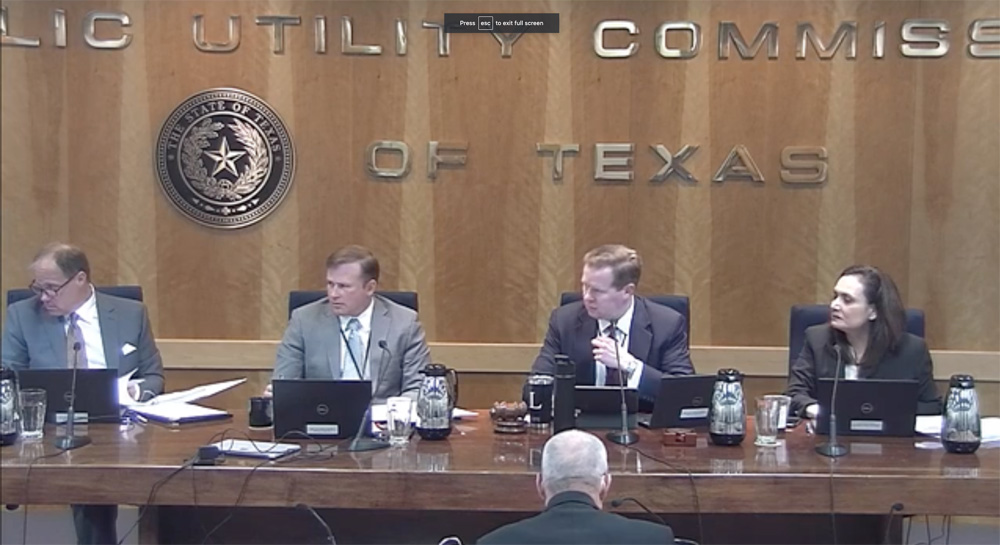
The PUC meets with four commissioners for the first time: (left to right) Jimmy Glotfelty, Will McAdams, Chair Peter Lake and Lori Cobos. | Admin Monitor

“I don’t hear a lot of enthusiasm for a 40%, $20 million increase,” Lake said. “The fastest way to get this done would be for the parties to find a reasonable settlement that doesn’t cost the ratepayers an extraordinary amount of money.”

In other actions, the PUC:

  • approved Rayburn Country Electric Cooperative’s sale of a 30-mile segment of a 138-kV line to East Texas Electric Cooperative (51776). The joint application was made in January, before Rayburn was hit with sky-high invoices during the February storm that have left the cooperative more than $640 million short to the market.
  • rejected a rulemaking request by electric retailers to limit the length of disconnection moratoriums, saying it would “jeopardize” the PUC’s ability to “align its rules with statute in a timely fashion” (52200).
  • signed off on 14 rule changes endorsed by ERCOT’s stakeholders and Board of Directors (52307).

Pennsylvania Senate Committee Disapproves of RGGI Entry Again

Members of the Pennsylvania Senate Environmental Resources and Energy Committee voted last week to approve sending another letter to regulators protesting the state’s entrance into the Regional Greenhouse Gas Initiative (RGGI).

In a 7-4 vote, the committee voiced its disapproval to the Independent Regulatory Review Commission (IRRC) of Reg. 7-559, which would establish a carbon dioxide budget trading program and pave the way for Pennsylvania to enter RGGI. The letter also announced that the committee intends to exercise its authority to extend its review of the final rulemaking for 14 days if the IRRC approves the regulation.

The committee issued a similar letter to the IRRC in February, explaining its “serious legal and policy concerns” regarding decisions by the Environmental Quality Board (EQB), the state agency tasked with crafting and evaluating the RGGI regulations.

The EQB voted 15-4 in July to back the final RGGI rules, sending them to the IRRC and state Attorney General Josh Shapiro for final review. (See PA Backs Final Rule for RGGI Entrance.) The IRRC will review the letters during its Sept. 1 meeting, and the Pennsylvania Department of Environmental Protection (DEP) expects the state to join RGGI in 2022.

Committee Chair Gene Yaw (R) said he agrees climate change is happening, but he disagrees humans are its primary driver. Yaw also denounced the promotion of clean energy production over existing coal and natural gas energy production in the state, saying green energy projects would not exist without the use of fossil fuels and mining for raw materials.

Republicans in the legislature have consistently criticized Gov. Tom Wolf (D) over his executive order in October 2019 directing state officials to develop a rulemaking for joining RGGI, arguing that the legislature is the only governmental body that can endorse such interstate compacts. (See GOP Continues Opposition to Pa. RGGI Plans.)

Yaw said Pennsylvania “loses total control” over its own energy policies and environmental concerns by joining RGGI, as carbon allowances are collectively approved by the program’s states.

“In effect Pennsylvania’s saying, ‘OK, we’re going to put our electric prices up to a popular vote. And what we have to do with our environmental concerns, you determine,’” Yaw said. “There’s nothing clearer that should go before the legislature than issues like that.”

Letter

In the letter approved last week, senators continued to argue that there is no statutory basis for the RGGI regulation and that the EQB failed to comply with the state’s Regulatory Review Act.

Republicans and other RGGI opponents have asserted that the Pennsylvania Air Pollution Control Act requires the DEP to submit regional air pollution programs to the legislature because they are a tax requiring legislation and cannot be instituted by an executive order.

The Wolf administration has argued that because RGGI auction proceeds would be used for initiatives to reduce CO2 emissions, the proceeds would be considered the administrative costs of implementing the state’s air pollution control program and not a tax. (See Pa. Releases Rulemaking to Join RGGI.)

“Suffice to say, DEP’s reliance upon section 5(a) of the Air Pollution Control Act, which was enacted in 1972, requires a monumental and unprecedented stretch of the concept of legislative intent to conclude that the 1972-73 General Assembly intended to provide DEP with the power to restructure Pennsylvania’s electricity generation through a rulemaking process,” the letter said.

Senators said information they received from PJM indicated that the RGGI regulations will “trigger double-digit consumer electricity rate increases” for customers in Pennsylvania, going as high as 18% for low- and fixed-income households. They point out that the current electricity prices for several RGGI states — Connecticut at 18.66 cents/kWh, Rhode Island at 18.49 cents, Massachusetts at 18.40 cents and New Hampshire at 17.15 cents — are the highest in the continental U.S., while Pennsylvania’s average electricity price is 9.81 cents/kWh.

“RGGI states have seen their electricity prices rise three times faster than Pennsylvania’s,” the letter said. “It would also render uncompetitive or significantly less competitive two-thirds of our state’s current electric generation capacity.”

The committee said the DEP disregarded the IRRC’s recommendation earlier this year to delay RGGI entrance by at least one year to allow for impacted industries and communities to engage. It said it received “countless comments” from organized labor, business and community leaders, and local government officials over fears RGGI will “trigger enormous economic disruptions” within Pennsylvania.

“We believe IRRC’s rejection will help pave the way for a more constructive dialogue between the governor’s office and the General Assembly to consider common-sense energy policy reforms that do not impair our economy and harm our constituents,” the committee said.

The Pennsylvania House Environmental Resources and Energy Committee endorsed a similar letter in July, saying the DEP and EQB “vastly overreached in their role as part of the executive branch of government” and are “making a serious policy decision here, which is the purview of the General Assembly.”

Senator Opinions

Sen. Carolyn Comitta (D), minority chair of the committee, asked what the committee wished to accomplish by sending another letter to the IRRC. She said a vote in favor of the letter was supporting “the past and the status quo” and the “continuation of carbon emissions impacting the environment.”

Coal generation in Pennsylvania is declining because of current market forces in favor of moving away from fossil fuels, Comitta said, not because of regulations coming from RGGI states. She said that without RGGI, there is no plan to help coal workers and communities transition to clean energy, pointing to current bills like SB15, the RGGI Investments Act, or the corresponding HB 1565 that calls for making “substantial investments” in communities impacted by the decline of fossil fuels.

“Joining RGGI at this point is a key step in stopping the worst impacts of climate change,” Comitta said. “Joining RGGI is a responsible, effective action we can take right now.”

Sen. Scott Martin (R) gave his support of the letter, citing the economic impacts of energy costs in RGGI states. Martin said he was surprised to learn that the four highest energy cost states and eight out of the top 10 are RGGI states.

Calling it “terribly frightening,” Martin said implementing RGGI by the executive branch of the government without the support of the legislature could have major implications for future legislation. He said the legislature has always been the entity to approve interstate compacts.

“The fact that these discussions aren’t going through the legislature, with over a half-billion dollars at stake, to me is very troubling, and the precedent that it’s sending is equally as troubling,” Martin said.

Sen. Joe Pittman (R) said voting on the letter was “not a waste of time” and that its content “represents thousands of families who rely on carbon-emitting electricity generation for their livelihoods.”

Pittman said there is no guarantee of RGGI revenues coming to Pennsylvania because the auctions are based on the number of generators emitting carbon and willing to pay for credits. Pittman said estimates for the amount of money Pennsylvania would receive from RGGI has fluctuated anywhere from $180 million to $500 million.

Pittman said February winter storm in Texas showed the importance of having a diverse generation mix. He also said Pennsylvania joining RGGI will shift power production to West Virginia and Ohio and negate any environmental benefits.

“It’s easy to talk about the impacts when you don’t live in the backyard of 6,000 MW of carbon-emitting electricity that happens to be keeping our lights on right now,” Pittman said.

ISO-NE Planning Advisory Committee Briefs: Aug. 18, 2021

UI Moving Ahead with Substation Floodwall in Bridgeport

United Illuminating (UI) told the ISO-NE Planning Advisory Committee on Wednesday that it intends to construct a floodwall protection system at the 345-kV Singer substation in Bridgeport, Conn., even as the cost estimate had nearly doubled from when it was first introduced in 2016.

A few substations flooded during hurricanes Irene and Sandy in 2011 and 2012, respectively. As a result, UI performed a coastal substation flood mitigation study that identified Singer as one of five substations at risk of failure from a 100-year flood event.

The project includes a floodwall reinforcement of the existing building, as well as an upgraded drainage system. The 2016 cost estimate was $12.9 million, though now it has ballooned to approximately $24 million based on updated construction pricing, according to Katelyn Davenport, lead engineer for transmission and substation asset strategy and planning at Avangrid (NYSE:AGR), UI’s parent company.

Davenport added that UI’s work would also be independent of the Bridgeport Area Resiliency Project under development and funded by a grant from the U.S. Department of Housing and Urban Development.

While Singer is located within the area that is part of the resilience project, there is insufficient detail to confirm if the project would adequately protect the station from flooding at this time, Davenport said. UI’s other prominent reasons for moving ahead include Singer’s importance to the New England bulk electric system and the risk of catastrophic flooding, which is still high 10 years after Irene and Sandy. The resiliency project also remains partially funded, and it does not meet ISO-NE’s recommended design floor elevation.

UI will get a transmission control agreement, and Davenport said it is ready to award construction contracts by the third quarter of this year and begin construction by the second quarter of 2022, with an in-service date at the beginning of 2023.

Additional Tx Pilot Study Results, Proposed Changes to Assumptions

ISO-NE shared summary results from its “Transmission Planning for the Clean Energy Transition” pilot study, which tested grid performance assumptions under high renewable penetration scenarios and quantified the tradeoffs between transmission investment and less system flexibility. The results, which could also inform future transmission needs assessments, included:

  • No potential needs were identified as a result of the proposed assumptions, and results of generator outage sensitivities were similar to results of comparable needs assessments.
  • No potential needs were identified related to low-voltage violations, though needs may arise from high-voltage results under minimum-load conditions. Under the future system predictions used for the study, potential steady-state high-voltage needs identified can likely be resolved for a cost of approximately $50 million.
  • Initial analysis revealed the potential for needs related to the performance of distributed energy resources during and after transmission system faults. Any future stability analysis in needs assessments will depend on answering questions about the details of DER modeling and performance criteria.
  • Stability concerns are not easily observed or addressed in real time. Large amounts of DER could trip or enter temporary power reduction during a significant number of hours per year. According to the study, to the extent that needs do exist related to stability, they will need to be addressed through system upgrades.

The RTO also proposes adopting the assumptions used in the study for needs assessments, solutions studies and competitive requests for transmission solutions. These assumptions are not likely to lead to thermal or steady-state low-voltage needs that are more extensive than with today’s assumptions. Steady-state high-voltage needs are not overly severe, and addressing them is relatively inexpensive.

Ongoing transient stability work regarding the modeling of DER and performance criteria will continue but will not affect assumptions on resource availability. The assumptions will ensure the continued reliability of the New England transmission system with increasing levels of clean, distributed and intermittent resources.

Draft and final reports documenting the analysis performed in the study are expected to be published by the end of the year.

FERC Seeks Evidence in PJM TOs’ Bid to Rate-base Network Upgrades

FERC staff on Friday directed PJM’s transmission owners to provide evidence to back up their claims that their ability to raise capital is being threatened because they are being forced to absorb the risks of the increasing transmission without earning any return on the assets (ER21-2282).

The TOs asked FERC on June 30 to allow them the option to fund network upgrades and add them to their rate bases. Under PJM’s “participant funding” model approved in 2004, generators provide the capital for network upgrades, and the additional infrastructure is added to rate bases at zero cost, allowing TOs to recover only their operations and maintenance expenses from network transmission customers.

As the number of network upgrades has grown to support new renewable generation, the risk of owning and operating those facilities has also increased, leaving the existing funding model “unsustainable,” the TOs said.

Environmental groups, state regulators, generators, industrial customers and the RTO’s Independent Market Monitor filed comments opposing the proposal in July, contending there is no evidence that the TOs are having trouble attracting capital. (See PJM Stakeholders Blast TOs’ Petition to Rate-base Network Upgrades.)

In a deficiency notice Friday, FERC staff also appeared skeptical, asking the TOs to provide evidence that their current return on equity rates “do not currently account for the risks of owning and operating the transmission system with the network upgrade additions” and whether the TOs’ ROE would decrease if they obtained the ability to put the upgrades in ratebase.

Staff also asked the TOs to provide a comparison of their gross plant for all transmission assets to the gross plant for participant-funded network upgrades and “any available evidence that investors have informed the PJM TOs that they hold concerns over future investments in the PJM TOs given the projected increase in network upgrades, including whether any PJM TO has been unable to raise capital for a transmission project as a result of risks associated with network upgrades.”

The TOs also were asked to describe the criteria they will use in deciding whether to initially fund individual upgrades and the disclosures they would make about their decisions.

The TOs’ response is due 30 days from the filing.

As of October 2020, PJM’s interconnection queue listed about 1,600 requests totaling 147,000 MW in new generation. Only 23% of projects and 15% of requested capacity megawatts in the queue are ultimately developed and interconnected, according to PJM’s 2020 Regional Transmission Expansion Plan report.

PJM’s TOs include Exelon (NASDAQ:EXC), American Electric Power (NASDAQ:AEP), Duke Energy (NYSE:DUK), Dominion Energy (NYSE:D), PPL (NYSE:D) and Public Service Enterprise Group (NYSE:PEG).

Conn., RI Take Substantial Hit from Tropical Storm Henri

Tropical Storm Henri slammed into southern New England on Sunday with heavy rain and winds leading to thousands of power outages in Connecticut, Rhode Island and parts of Massachusetts.

Henri made landfall near Westerly, R.I., around 12:30 p.m. Sunday, the National Weather Service reported, and later slowed down over the area with maximum sustained winds of 50 mph.

As of 4 p.m. Sunday, Eversource Energy (NYSE:ES) was reporting 29,277 out of its 1.28 million customers in Connecticut were without power, mainly concentrated east of the Connecticut River. National Grid said there were 72,438 outages in Rhode Island, including 49,050 in Washington County, where Westerly is located. Between National Grid and Eversource in Massachusetts, about 12,000 were without power in their respective service territories. United Illuminating (UI), which serves the greater New Haven and Bridgeport areas of Connecticut, had just two outages out of its more than 340,000 customers.

At a press conference Saturday, Connecticut Gov. Ned Lamont said Eversource and UI assured state officials that they had doubled the number of workers on the ground to restore potential power outages after their inadequate response during Tropical Storm Isaias, which was primarily a wind event, last August. Connecticut also received a pre-landfall presidential emergency declaration to provide the state with federal assistance in anticipation of the impacts of the storm.

Eversource, UI Plan for Major Outages

Eversource said it would declare level 2 of its emergency response plan on Sunday at 6 a.m. to prepare for up to 69% of customers in Connecticut losing power during the storm. That restoration work could last anywhere from eight to 21 days in that scenario, the utility said. Eversource tweeted Sunday that, “at this point, we expect to be on the lower end of the range. This means we do not expect a 21-day restoration effort.”

Eversource initially expected outages to as many as 50% of its customers on Friday but revised its projections upward after multiple weather forecasts and the University of Connecticut’s Outage Prediction Model showed high winds and heavy rain, potential storm surge along the shoreline and flooding in communities across the state. In addition, trees already weakened because of insects and saturated soil from recent thunderstorms could also come down by the thousands, complicating restoration work.

To facilitate restoration efforts, Eversource has 4,000 field crews, between its workers and outside contractors from as far away as Canada, positioned in cities and towns across Connecticut and at multiple staging areas across the state, including the Pratt & Whitney airfield in East Hartford.

Eversource and UI were forced to make changes in the wake of Isaias by the Take Back Our Grid Act, which directed the Public Utilities Regulatory Authority (PURA) to develop and implement performance-based regulations, including fines and reduced returns on equity. After releasing an April assessment of Eversource’s storm performance, PURA recently finalized a $28.6 million civil penalty and annual profit reductions of about $31 million against the company. The utility has appealed the ROE reduction in state court.

In June, in preparation for Tropical Storm Elsa, which produced heavy rain and wind but not widespread power outages and restoration problems, Eversource brought in 500 extra line crews and tree-trimming teams and prepositioned them with its 700 line crews and 250 tree teams. There was also an online portal for cities and towns to prioritize repair sites for Eversource’s teams. Eversource CEO Joe Nolan said it was “a good exercise” for the utility to show that “a lot of things have changed for our business.” (See Eversource Focuses on Connecticut amid Appeal of Penalties.)

UI, a subsidiary of Avangrid (NYSE:AGR), said it also had doubled the size of its field crews ahead of the storm, including line workers, tree trimming and damage assessment teams. UI will also pre-stage crews throughout its service territory to limit travel to damaged locations.

PURA Chair Marissa Gillett said during a press conference with Lamont on Sunday that the proactively deployed damage assessors from Eversource and UI, which state regulators mandated after investigating the Isaias response, will be working “as soon as safe to do so” to speed up restoration efforts. That work will focus on essential safety activities such as removing downed wires and working with municipalities to clear blocked roads.

ISO-NE said it is monitoring the storm’s path and its impact on the region’s power system. In addition, the RTO issued a precautionary operational alert on Friday in advance of the storm. It also activated its emergency preparedness plans, including increased staffing, and will remain in regular communication with Eversource, UI, generators and other resource owners throughout the storm.

PJM MRC Preview: Aug. 25, 2021

Below is a summary of the issues scheduled to be brought to a vote at the PJM Markets and Reliability Committee meeting on Wednesday. Each item is listed by agenda number, description and projected time of discussion, followed by a summary of the issue and links to prior coverage in RTO Insider.

Consent Agenda (9:05-9:10)

B. Stakeholders will be asked to endorse proposed revisions to Manual 3A: Energy Management System (EMS) Model Updates and Quality Assurance (QA) resulting from the periodic cover-to-cover review. The changes were endorsed at the August Operating Committee meeting. (See “Manual 3A Updates Endorsed,” PJM Operating Committee Briefs: Aug. 12, 2021.)

C. Members will be asked to endorse proposed revisions to Manual 6: Financial Transmission Rights resulting from the periodic cover-to-cover review. The changes include an update to section 6.8 to align language with the current approach for addressing a defaulting member’s financial transmission rights with various options. (See “Manual Revisions Endorsed,” PJM MIC Briefs: July 14, 2021.)

D. The committee will be asked to endorse proposed revisions to Manual 11: Energy & Ancillary Services Market Operations addressing five-minute long-term changes and transparency. The manual revisions were endorsed at the August Market Implementation Committee meeting. (See “Fast-start Pricing Revisions Endorsed,” PJM MIC Briefs: Aug. 11, 2021.)

E. Stakeholders will be asked to endorse proposed revisions to Manual 11: Energy & Ancillary Services Market Operations, Manual 18: PJM Capacity Market and Manual 28: Operating Agreement Accounting to address the implementation of fast-start pricing. FERC accepted PJM’s filing in May on related tariff changes with an effective date of July 1. (See “Fast-start Manual Revisions,” PJM MRC/MC Briefs: July 28, 2021.)

F. Members will be asked to endorse proposed revisions to Manual 20: PJM Resource Adequacy Analysis resulting from the periodic cover-to-cover review. PJM said the minor changes included cleaning up outdated and redundant language and ensuring the manual language follows current processes in the RTO. (See “Manual 20 Endorsed,” PJM PC/TEAC Briefs: Aug. 10, 2021.)

G. The committee will be asked to endorse proposed revisions to Manual 28: Operating Agreement Accounting resulting from the periodic cover-to-cover review. The manual changes were first endorsed at the July MIC meeting. (See “Manual Revisions Endorsed,” PJM MIC Briefs: July 14, 2021.)

Endorsements (9:10-9:30)

1. Uniform Cure Periods (9:10-9:20)

Stakeholders will be asked to endorse proposed tariff revisions to address making cure periods uniform across the tariff and the Operating Agreement. The proposed solution calls for eliminating duplicative specification of cure periods for transmission customer payment violations in section 7.3 of the tariff by referencing section 15.1.5 of the OA.

2. Working Credit Limit Definitions (9:20-9:30)

The committee will be asked to endorse the proposed solution and tariff revisions to address making the definitions of working credit limits uniform across the tariff.

Virginia Replacing Diesel School Buses with Low-Carbon Vehicles

Virginia Gov. Ralph Northam (D) announced Thursday that 83 aging diesel school buses across the state will soon be replaced with zero- or low-carbon vehicles, which will reduce the state’s greenhouse gas emissions by an estimated 10,000 tons per year.

The 39 electric buses and 44 propane vehicles going to 19 districts will be paid for with $10.5 million from Virginia’s share of the Volkswagen Environmental Trust Fund, the settlement the German automaker made for its fraudulent reporting of emissions from its vehicles in violation of the U.S. Clean Air Act. Virginia’s Department of Environmental Quality (DEQ) administers the state’s $93.6 million share of the trust to reduce air pollution in the state.

“We all benefit from transitioning away from diesel school buses and investing in clean alternatives for our transportation system,” Northam said. “I know how important clean air is for children’s health.”

In addition to the emission reductions, the replacements will also “save one million gallons of diesel fuel, equivalent to removing 2,000 cars from the road,” said DEQ Director David Paylor.

The largest of the announced grants, $2.65 million for 10 electric buses, is going to Fairfax County, a populous jurisdiction in the Washington, D.C., suburbs. The smallest grant, $26,800 for four propane buses, is going to Norfolk City in the state’s southeastern corner. The $10.5 million total is a little more than half of the $20 million bus replacement program that Northam announced in 2019.

As in many other states, transportation is the largest source of greenhouse gas emissions in Virginia — accounting for more than 40% of emissions — which makes the sector a focus for Northam’s clean energy efforts. Under the 2020 Virginia Clean Economy Act (VCEA), the state is targeting zero carbon emissions from electricity generation by 2050, and Terry McAuliffe, the Democratic candidate for governor in the upcoming November election, is pledging to push that timeline up to 2035.

However, as of 2018, annual carbon dioxide emissions in the state averaged more than 12 metric tons per capita, according to the Weldon Cooper Center for Public Service at the University of Virginia.

Propane vs. Electric

School districts across the country are looking at alternatives to their often-aging diesel buses and evaluating the pros and cons of electric versus propane-powered vehicles.

Electric vehicles offer zero-emission and lower maintenance and operating costs, but at a higher upfront cost than propane buses, which produce lower GHG emissions than diesel, as well as lower nitrogen oxide (NOx) and sulfur oxide (SOx) emissions. At present, propane buses also beat electric on range, with some school district officials saying their propane vehicles travel about 400 miles per tank versus about 100-150 miles for electric.

The cost factor is significant. For example, Albemarle County will buy two electric buses with its $530,000 grant, while rural Halifax County will be able to buy 10 propane buses with a grant of $79,820.

“Many of our families struggle to make ends meet,” said Tammy Lacks Moore, the county’s public school director of transportation. “These funds will enable us to replace 10 diesel buses without raising taxes on our already burdened population, all while making sure we are doing everything we can to help improve our community.”

Other counties that will be replacing diesel buses with propane include Chesterfield County just outside the state capital of Richmond, Newport News, Norfolk City and Virginia Beach City.

Range was a big consideration earlier this year, as the Virginia General Assembly debated a bill (HB 2118) that would have established a fund to help districts transition to electric buses, but only if the state received federal or other non-state dollars to pay for the program. The bill passed the House but stalled in the Senate.

At that time, school district officials in the hillier counties said replacing diesel buses with electric ones would be unrealistic for them, citing a list of potential problems, including battery life, charging station challenges and cost.

“Electric buses simply would not be workable in this area,” said Tim Edwards, director of transportation for Scott County Schools, in the Blue Ridge Mountains. “Scott County’s terrain is too hilly, mountainous.”

Ben Truett, head of transportation for Alleghany County Schools, agreed that electric buses “would work in cities, because of their flat terrain, but not in the mountain areas” of Virginia. “The batteries do not have enough range or power.”

The leading electric bus maker, High Point, N.C.-based Thomas Built Buses, averages 134 miles on a fully charged 220-kWh battery. Some bus routes in Alleghany and Scott counties are more than 100 miles round trip, the directors said. Given the power needed to climb steep hills, they doubt a fully charged battery would last an entire trip. Both counties run buses that get about 360 miles to a 100-gallon tank, with most requiring a top off several times a week.

Electric bus manufacturers are working on vehicles with longer ranges. For example, U.S. manufacturer Proterra is now offering electric buses that, the company says, can go 221-329 miles on a single charge.

The districts opting for electric buses pointed to their environmental benefits and operational efficiencies.

“We are, quite simply, thrilled with the award of two electric buses to Falls Church City Public Schools,” Superintendent Peter Noonan told NetZero Insider. “Environmental sustainability and resilience are core values of our community.”

Tracy Seitz, superintendent of the Middlesex County Public Schools, said her district already has two electric school buses. The two additional vehicles will double the fleet so “we can proudly say that 20% of our operating fleet is fully electric.

“MCPS has no intention of stopping at 20%,” Seitz said. “We recognize the importance of reducing carbon pollution to our environment and also providing a healthy and efficient method of transporting our students.”