The U.S. Bureau of Ocean Energy Management (BOEM) this month issued a draft environmental assessment that evaluates the potential impacts of siting new offshore wind within nearly 800,000 acres of the New York Bight.
BOEM will conduct hearings on the EA on Aug. 24 and 25 before a Sept. 9 deadline for public comment on the environmental impacts of the agency granting of rights of way (ROW) and rights of use and easement (RUE) in the region.
The American Clean Power Association on Monday issued a statement lauding BOEM for “identifying the offshore locations that are most suitable for wind energy development in the New York Bight while taking into consideration other ocean users. Commercial and recreational fishing, maritime navigation and Department of Defense activities have all been accounted for in the proposed lease areas, and potential space-use conflicts have been appropriately avoided.”
The EA covers the effects of routine and non-routine activities associated with lease and grant issuance, site characterization and site assessment, using scenarios based on BOEM’s guidance for lessees, previous lease applications and plans, and previous EAs, the agency said.
Non-routine and low-probability events and hazards that could occur include severe storms, such as hurricanes and extratropical cyclones; allisions and collisions between the site assessment structure or associated vessels and other marine vessels or marine life; spills from collisions or fuel spills resulting from generator refueling; and recovery of lost survey equipment, BOEM said.
The study did not consider the construction and operations of any commercial wind farm, which would be evaluated as part of a separate process under the National Environmental Policy Act if a lessee submits a construction and operations plan (COP).
Impact-producing factors associated with pre-construction activities include noise; air emissions; lighting; habitat degradation; vessel traffic; routine vessel discharges; bottom disturbance; and entanglement.
Comments
As part of the environmental scoping process, BOEM sought comments on the issues and alternatives to be considered in the assessment and received approximately 3,000 comments (BOEM-2021-0021).
The National Wildlife Federation, Natural Resources Defense Council and other environmental groups said they support responsible development of offshore wind energy that:
avoids, minimizes, monitors and mitigates adverse impacts on marine and coastal wildlife and their habitats;
reduces negative impacts on other ocean uses;
includes robust consultation with Native American Tribes and communities;
meaningfully engages state and local governments and stakeholders from the outset; and
uses the best available scientific and technological data to ensure science-based and stakeholder-informed decision-making.
Anbaric Development Partners said its OceanGrid is “a reasonably foreseeable project” in the bight and that “BOEM should issue its Determination of No Competitive Interest for this nonexclusive grant both expeditiously and prior to issuing the draft EA to facilitate development of planned transmission to support the upcoming lease sales.”
Further, because ROW/RUE grants do not authorize the holder to begin any construction activity, or any other activity for which an approval is required, prior to approval of a general activities plan (GAP), the potential environmental effects related to the issuance of such a grant are limited, Anbaric said.
“Lease areas should be sized to ensure that sufficient acreage is available, after avoidance of significant marine use and natural resource constraints, to support the wind energy development required to meet state procurement goals,” commented Atlantic Shores Offshore Wind, a joint venture between Shell New Energies US and EDF Renewables North America. The partnership holds a commercial lease off New Jersey for which it recently filed a COP with BOEM.
Leaseholders also require flexibility to scale up wind energy output within a lease area, which would lower the projected cost of energy, allowing for better pricing and a more competitive auction for the lease award process, Atlantic Shores said.
The EA scoping process should continue to encourage communication, coordination and cooperation among stakeholders to lend greater certainty to the development process, as opposed to a “first come, first served” approach to development, where one leaseholder is left to accommodate all development choices of an adjacent leaseholder, Atlantic Shores said.
The Fairways North and South wind energy areas, lease areas closest to Long Island, are not being considered for leasing at this time partly because of conflicts with the proposed U.S. Coast Guard shipping safety fairway, maritime traffic concerns, commercial fisheries, state preferences, marine protected species and commercial viability, BOEM said.
The Gulf Coast Power Association had planned to return to an in-person gathering for its annual fall conference but will instead revert back to a virtual format because of the delta variant-fueled rise in COVID cases and hospitalizations.
The GCPA told attendees in an email Tuesday that its Board of Directors had decided that converting the Sept. 20-22 conference to a virtual affair was “the most prudent course of action.”
“We’d very much hoped for a return to gathering in person, but the health and safety of attendees and speakers and sponsors and exhibitors guided the board’s decision,” the GCPA’s Penny Sullivan said.
The fall conference will be streamed over three afternoons. Interim ERCOT CEO Brad Jones and Public Utility Commission Chair Peter Lake are both scheduled to deliver keynote addresses.
The GCPA has not met in person since early last year. It cancelled last year’s spring summit and conducted virtual conferences last fall and this spring.
The California Energy Commission adopted new rules Tuesday allowing it to issue emergency licenses to natural gas-fired generators of 10 MW or more to help alleviate potential energy shortfalls.
The move ran counter to the CEC’s aggressive pursuit of clean energy goals, but commissioners emphasized they were acting under an emergency proclamation by Gov. Gavin Newsom that ordered state entities to waive clean air rules and other regulations to bolster generating capacity.
“Gov. Newsom’s emergency proclamation makes it very clear that all of our energy agencies have to act immediately to establish energy stability during this emergency as well as accelerating plans for construction, procurement and rapid deployment of new clean energy and storage projects,” Commissioner Karen Douglas said.
The governor’s July 30 proclamation authorized the CEC to license gas-fired generators that can deliver energy this summer and fall during evening net-peak hours, after solar goes offline. The generators must meet criteria such as operating on a “previously disturbed site” with an existing grid connection.
In response to the proclamation, the State Water Project (SWP), a major user and generator of electricity, plans to add five 30 MW units to be installed at three locations statewide this summer.
“These will be natural gas units that are hydrogen capable,” said SWP Deputy Director Ted Craddock. “So [the units] will meet our current needs and will have the capability to utilize future fuel blends of hydrogen as we move forward in our clean energy goals.”
Dire Forecast
The two orders that the commissioners unanimously approved Tuesday deal with generators that can come online before Oct. 31.
A third order that the CEC plans to take up at a future meeting will deal with emergency generation in the summer and fall of 2022, which could be worse than this summer, commission staff said.
California’s push to rely on 100% clean energy by 2045, coupled with record-breaking heat waves in the West and massive wildfires, have severely strained the state’s grid several times this year after a series of blackouts and close calls last summer.
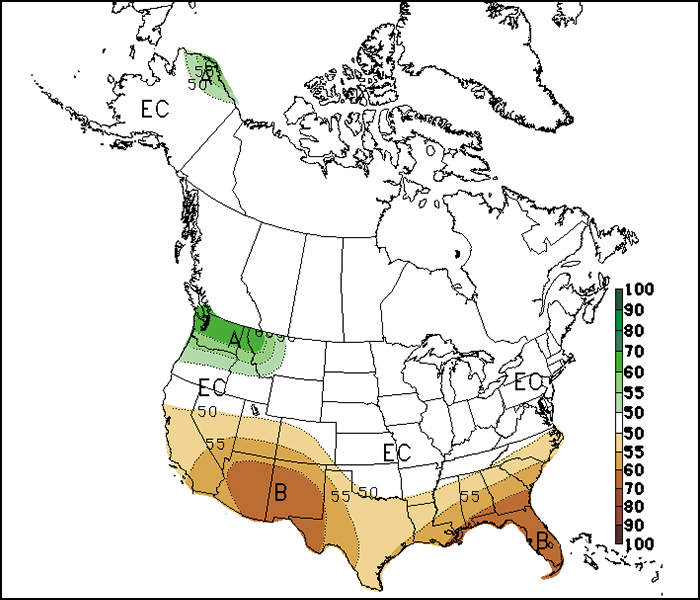
An extended drought, worsened by the driest year on record in 2021, has severely curtailed in-state hydropower. The drought could continue through at least next summer, according to a recent forecast by the National Oceanic and Atmospheric Administration.
NOAA predicted that precipitation in California will be far below average during the winter months of 2021-22, when the state receives most of its rainfall and snowfall.
The National Oceanic and Atmospheric Administration is forecasting below average precipitation for California and the Desert Southwest this winter, exacerbating drought conditions. | NOAA
In a meeting last week, the Energy Commission heard from staff members in charge of extended supply-and-demand forecasts. They said the state faces up to a 3,500 MW shortfall this year and a 5,200 MW shortfall next summer in extreme circumstances.
“Given the more extreme weather trends experienced so far this year and projections for the 2021 California drought possibly persisting into 2022, an outlook now for summer 2022 is critical,” Angela Tanghetti, a CEC electric generation program specialist, said at the commission’s Aug. 11 meeting.
CEC forecasters decreased the summer 2021 supply outlook by 1,000 MW due to low reservoir levels behind major hydroelectric dams, some of which, such as Lake Oroville, are no longer generating. (See related story, Feds Invoke First-ever Colorado River Water Restrictions.)
Next summer could see an additional 500 MW decrease in hydropower output, totaling a 1,500 MW decline, the CEC predicted.
In June, the California Public Utilities Commission ordered load-serving entities under its jurisdiction to procure 11.5 GW of new resource starting in 2023. (See CPUC Orders Additional 11.5 GW but No Gas.)
That order could start closing the gap between supply and demand two years from now, but “I think 2022 is still going to be difficult for us, even under good circumstances,” Commissioner Siva Gunda said.
“We are not out of this,” Gunda said. “It is going to be like this for at least a year, if not more.”
The Hawaii Natural Energy Institute (HNEI) will receive $6 million from the Naval Facilities Engineering Command to research wave energy conversion technology.
Part of the University of Hawaii, the HNEI will use the funds to test pre-commercial wave energy converters (WEC) at the U.S. Navy’s Wave Energy Test Site (WETS), just off Marine Corps Base Hawaii in Kaneohe Bay, Oahu, which is the only grid-connected wave energy testing site in the country. HNEI will also use a portion of the funds to test new energy infrastructure at WETS, such as subsea power storage and connection modules to allow WECs to charge various equipment and autonomous undersea vehicles (AUV).
The funds will also help HNEI explore other technologies, such as a floating oscillating water column WEC, an integrated breakwater WEC system to generate energy from waves while protecting shorelines, and a small-scale, rapid-deployment WEC for energy generation and desalination close to shore.
The University of Hawaii said in a press release that the value of wave energy is in its reliability, noting that it is “relatively consistent throughout the day and night and can be forecast with good accuracy out to a week or more, enhancing grid managers’ ability to plan for its contribution to the overall generation mix on the grid.”
The university will partner with the University of Washington and Oregon State University to “advance many such concepts under these new funds.”
HNEI set a 2021-2024 timeline for running WEC tests, including environmental monitoring, power and survivability performance assessments and additional logistics support to the Navy and to WEC developer companies.
“We are excited by the Navy’s latest investment in our work to advance wave energy through our support of WETS, particularly as it allows us to expand our research into new areas of relevance to offshore applications, such as autonomous vehicle recharge for ocean observing purposes,” Patrick Cross, research specialist in marine energy at HNEI and principal investigator for the WETS support program, said.
Nate Sinclair, WETS program manager at the Naval Facilities Engineering and Expeditionary Warfare Center, said the Navy will gain its own benefits from the research.
“Along with continuing to provide in-situ testing infrastructure and support for wave energy power to shore, we’re now making substantial investments for pursuing technology development that will lead to providing power in remote locations for Navy applications such as persistent surveillance and AUV recharging,” he said.
On its website, Hawaiian Electric Company (HECO) notes that ocean energy “is continually renewed and available 24/7,” and that “just a small portion of the energy stored in the oceans could power the world.” HECO had partnered with the Office of Naval Research to connect a 40-kW experimental buoy, developed by Ocean Power Technologies, to Oahu’s energy grid. The utility is also currently working on a power purchase agreement with an unnamed ocean thermal energy conversion company.
Calpine says it is concerned about climate change. But that doesn’t mean it will quit natural gas-fired power generation any time soon.
In its first-ever sustainability report, the privately held independent power producer — the biggest generator of electricity from natural gas and geothermal in the U.S. — rejects the notion that falling prices for renewables and energy storage will eliminate the need for gas-fired power to fill gaps in intermittent generation.
“Cost-effective pathways to deep decarbonization require that modern natural gas power plants continue to operate for decades to come,” CEO Thad Hill says in the report. “Although the use of carbon capture and sequestration and possibly the increased combustion of hydrogen in these plants can help with carbon emission levels, these plants and the combustion of some natural gas will continue to be necessary, albeit at much lower capacity factors than today.”
Despite the increasing penetration of renewables and addition of battery storage, Calpine says “existing gas-fired generation capacity will be needed for many years to come and may even need to be expanded in some regions as demand for electricity increases as other sectors seek to decarbonize.”
‘Benchmark’ of Performance
Jill Van Dalen, an assistant general counsel who oversaw the report, said the company issued it “as a benchmark of our performance to date.
“We really think it demonstrates our commitment, our leadership, our credibility in the energy sector, which is obviously undergoing fairly rapid change,” she said in an interview with RTO Insider.
Calpine operates 76 generation plants totaling 26,000 MW, all of it natural gas except for 725 MW of geothermal capacity in California and a 4-MW solar plant in New Jersey that came as part of its acquisition of Conectiv Energy from Pepco Holdings in 2010. Only 3% of its generation in 2020 was renewable.
But the company’s retail electric providers have served as offtakers for renewable energy projects, helping them to obtain financing. In January, CDP (formerly the Carbon Disclosure Project), a non-profit that runs a global disclosure system, named retailer Calpine Energy Solutions as a “silver accredited renewable energy provider,” saying it has been “one of the largest buyers of renewable energy and environmental attributes” in the U.S. over the last 20 years.
In 2019, Calpine says its “steam adjusted” CO2 emission rate was 0.4 Mt/MWh, below the 0.67 Mt/MWh average for all thermal generation.
The company touts its membership in the Natural Gas Supply Collaborative, a voluntary initiative gas purchasers that supports reducing upstream methane emissions. And it says it conducts annual optical gas imaging to identify leaks in its own gas infrastructure.
The company also is expanding into storage and carbon capture. Last month, its first battery project, the 20MW/80MWh Santa Ana Storage Project in Southern California, went into commercial operation under a 20-year resource adequacy power purchase agreement with Southern California Edison (NYSE:EIX).
Last November, the company announced a partnership with Colorado-based ION Clean Energy to build and operate an engineering-scale carbon capture project at its Los Medanos Energy Center cogeneration plant in Pittsburg, Calif., supported with funding from the Department of Energy’s National Energy Technology Laboratory. The project, which will demonstrate ION’s solvent technology, is the first carbon capture pilot at a commercially dispatched natural gas combined cycle plant in the U.S., according to Calpine.
Calpine also is working with Blue Planet on a pilot-scale CCS facility at Los Medanos. Blue Planet has developed a way to sequester carbon in cementitious building materials for use in light-weight concrete. The pilot is expected to be in operation later this year.
Founding
Van Dalen said Calpine was “founded on the principles of sustainability.”
Launched in 1984, Calpine went public in 1996, raising capital that allowed it to acquire more than 60 gas turbines and The Geysers, the world’s largest complex of geothermal power plants, over the next four years.
Following the California energy crisis of 2000-1, the company found itself overleveraged. By the end of 2005, it had declared bankruptcy with $22 billion in debt and its CEO and CFO had departed.
After selling off some assets and eliminating one-third of its workforce, it emerged from bankruptcy in 2008, again as a publicly traded company. Over the next decade, it acquired Conectiv Energy, retail provider Champion Energy and Noble Americas Energy Solutions, an independent supplier of power to commercial and industrial retail customers. In 2018, it went private in an acquisition by an affiliate of Energy Capital Partners and other investors, including Access Industries and the Canada Pension Plan Investment Board. Hill, who joined the company as chief operating officer in 2010, was named CEO in 2014.
Calpine says it has long advocated for reducing power plant emissions as a supporter of the Paris Agreement on climate change and the Obama administration’s Clean Power Plan. In recent years, it has supported an economy-wide carbon price. But with carbon pricing a political nonstarter in most of the country, Calpine’s simultaneous advocacy for competitive electric markets has gotten it cross threaded with environmentalists. It was one of three owners of gas-fired generation in PJM that filed a complaint in 2018 that prompted FERC to order the RTO to expand its minimum offer price rule to include renewables receiving state subsidies. (See Gas Gens Ask FERC for ‘Clean MOPR’ in PJM.) Urged on by new FERC leadership, PJM stakeholders voted six weeks ago to reverse the expanded MOPR. (See Stakeholders Back PJM MOPR-Ex Replacement.)
“Clean energy is canceling gas plants,” the Rocky Mountain Institute said in a blog post last September, citing the “remarkable shift from gas to clean energy” in the generation interconnection queues of ERCOT and PJM. “Gas generation is now attracting only a small fraction of investor interest compared to clean energy and will soon likely see its market share decline accordingly,” it said.
The International Energy Agency said in a study in May that “there is no need for investment in new fossil fuel supply in our net zero pathway” to escape the worst impacts of climate change. (See IEA Paints Daunting Path to Net Zero by 2050.)
Calpine insists, however, that its gas fleet is well positioned for a future in which transportation and buildings are increasingly electrified.
“If you electrify everything, you’re going to need more power. The idea that you’re somehow going to magically do away with the only dispatchable fuel type that can help the transition in times of dark or non-windy days is not realistic,” said Brett Kerr, vice president of external affairs, in an interview. “… Our units will be needed far into the foreseeable future. We may run less, and renewables may run more, and that’s ok. But we’re absolutely going to be needed to ensure the successful transition to a lower carbon future.”
The company says it is among the lowest emitting fossil fuel generators because its natural gas plants have low heat rates and are “relatively young,” at a capacity weighted average age of 20 years.
But will the company invest in any new natural gas?
“It’s tough for us to say,” Kerr responded. “We’re always looking to do more development in markets where we think it’s needed and we’re a good fit. But we generally, as a matter of course, don’t comment publicly on specific development plans. It’s fair to say we’re looking at development across the spectrum in all types of resources, but we won’t get into any of the specifics.”
How about investing in other renewables? “I would not be surprised if you saw something [additional renewable capacity] certainly within a year, if not sooner,” he responded. “I wouldn’t want to characterize it as, `Yes, we’re absolutely going to build own and operate [renewables].’ But we’re absolutely going to be engaged and we view the changing dynamics of the market to be something we’re going to be heavily involved in.”
Industry stakeholders think cybersecurity and a rapidly shifting resource mix are the greatest risks faced by the North American bulk power system, according to the 2021 ERO Reliability Risk Priorities Report released on Friday.
NERC’s Reliability Issues Steering Committee (RISC) publishes the Reliability Risk Priorities Report every two years in order to “strategically define and prioritize risks to BPS reliability.” The report is based on discussions among RISC members and industry representatives, including the annual Reliability Leadership Summit where participants discuss the impact of various risks. (See Panel: Industry Dialogue Key to Cyber Resilience.)
The committee also used the 2020 RISC Emerging Risks Survey, issued last December, to solicit “stakeholder input on the continued relevancy” of the 11 risks identified in the last report, released in November 2019. (See ‘Interdependencies’ Joins RISC’s List.) RISC performed this survey in 2019 as well but did not include detailed results in that year’s report; in addition, the new document sees electromagnetic pulse (EMP) broken out into a separate risk for the first time. Previously it was a subset of physical risk.
As with the 2019 report, reliability risks are grouped into four categories:
Grid transformation — covering BPS planning, resource adequacy and performance, loss of situational awareness, human performance and skilled workforce, control and protection systems complexity, and changing resource mix.
Security risks — physical security vulnerabilities, cybersecurity vulnerabilities and EMP.
Extreme natural events.
Critical infrastructure interdependencies.
Survey respondents were asked whether they still considered each risk from the 2019 report (as well as EMP) relevant — to which all agreed — and to rank them from 1-11 (least to most critical). RISC grouped these rankings into low (1-4), moderate (5-8) and high (9-11).
Concerns From Last Report Mostly Unchanged
Changing resource mix and cybersecurity vulnerabilities were the clear leaders of industry concern, with a substantial majority considering each a highly critical risk. EMP ranked at the bottom, with an overwhelming “low” rating and almost no “high” votes.
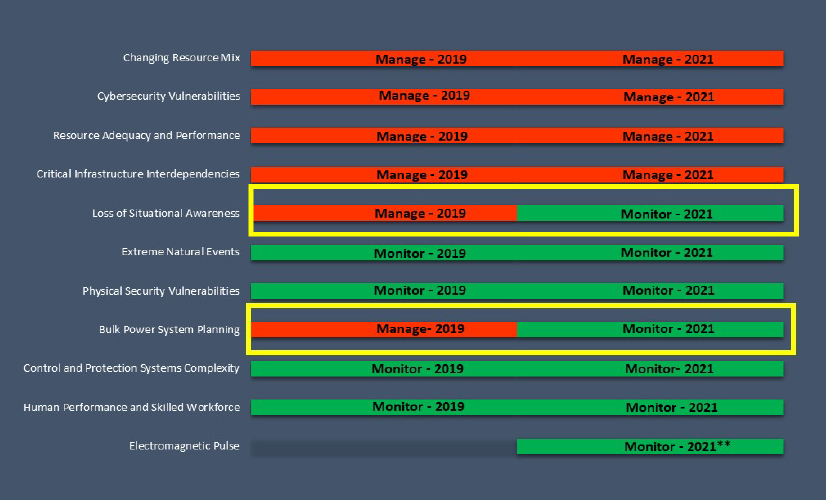
RISC also asked stakeholders to classify each risk as “manage” or “monitor.” “Manage” risks “are emerging, imminent, and pose significant threats,” requiring active planning and collaboration for mitigation. Risks identified as “monitor” are “of critical importance to BPS reliability” but don’t require additional mitigation activities beyond “established industry practices.”
The 2020 survey saw no change from the 2019 assessment for most risks other than loss of situational awareness and BPS planning, both of which went from “manage” to “monitor.” EMP, making its debut as a separate risk, was also assessed as “monitor.” Changing resource mix, cybersecurity vulnerabilities, resource adequacy and performance, and critical infrastructure interdependencies all remain managed risks, while the rest are monitored.
While industry stakeholders seem to devote the most care to the changing resource mix and cybersecurity risks, the report’s authors observed that other risks may contribute to the threat perceived from these two sources.
“With the recent grid transformation, the resource mix is increasingly characterized as one that is sensitive to extreme, widespread, and long duration temperatures as well as wind and solar droughts,” the report says. “For example, having sufficient capacity does not necessarily mean that adequate energy will be available as widespread extreme temperatures are experienced. Neighboring organizations may not necessarily always support each other as they are all experiencing the same conditions.”
Mitigation Recommended
The report also includes recommended mitigating activities to lower the impact of each category. For grid transformation, recommendations include updating data, modeling, and assessment requirements; developing an approach to “evaluate the potential impacts of energy storage on reliability;” improving BPS interconnection and operation of inverter-based resources while staying up to date on new technologies such as storage and hybrid resources; and ensuring “sufficient operating flexibility at all stages of resource and grid transformation.”
Classification of “Manage” or “Monitor” for each risk, and its change from the 2019 report. Changing resource mix, cybersecurity vulnerabilities, resource adequacy and performances and critical infrastructure interdependence all are still considered “Manage,” while loss of situational awareness and BPS planning were both reduced to “Monitor.” EMP was not given its own classification in the 2019 report because it was considered a physical security vulnerability. | NERC
Mitigations for extreme natural events include conducting special assessments of past events to identify lessons learned and create simulation models; development of tools for BPS resiliency; and understanding the impact of geomagnetic disturbances on the BPS.
Security risks attracted the most attention, with recommended mitigations involving additional assessments of the risks of various attack scenarios; continued cyber education among utility staff; development of supply chain cybersecurity best practices by the North American Transmission Forum and North American Generation Forum; creation of security performance metrics; and development of “planning approaches, models, and simulation approaches that reduce the number of critical facilities and mitigate the impact relative to the exposure to attack.”
Highlighting the heightened importance of EMPs since 2019, the report also recommends that NERC’s EMP task force “highlight key risk areas that arise from the [Electric Power Research Institute’s 2019] EMP analysis for timely industry action.” (See EPRI Report Downplays Worst-Case EMP Scenario.)
Finally, mitigation of weaknesses from critical infrastructure interdependencies involves identifying limiting conditions from other sectors that could affect the BPS; working with critical infrastructure partners to identify mutual priorities; emphasizing cross-sector issues in industry drills such as GridEx; evaluating the need for special regional assessments addressing natural gas availability and pipeline impacts; and working on communication alternatives for critical supervisory control and data acquisition information.
The PJM Market Implementation Committee on Wednesday endorsed rule changes on fast-start pricing, five-minute dispatch, solar-battery hybrids and an issue charge over the handling of energy efficiency in the capacity market. It also heard first reads on other manual revisions and Buckeye Power’s proposed changes to capacity transfer rights, which sparked opposition from the Independent Market Monitor (IMM).
Fast-start Pricing Revisions Endorsed
Stakeholders endorsed revisions to three manuals addressing the implementation of fast-start pricing.
The changes were endorsed with 228 votes in favor (94%) versus 14 votes against adoption (6%) despite concerns from the IMM.
D’Antonio said there were no changes from the red-line language in the manuals when they were presented in July.
FERC accepted PJM’s filing in an order issued in May on its fast-start tariff changes with an effective date of July 1. (See FERC Accepts PJM Fast-start Tariff Changes.) PJM filed a request to move the effective date to Sept. 1 to avoid implementation during the summer peak period, which the commission approved.
The fast-start pricing order, which necessitated manual changes, included the implementation of separate dispatch and pricing runs in day-ahead and real-time markets, the defining of fast-start resources as those with a total time to start and minimum run time of less than or equal to one hour and the offer of lost opportunity costs (LOC) to provide incentives to follow dispatch.
Section 2.1 of Manual 11 was reorganized to include new sections on fast-start-capable resources, fast-start-capable adjustment processes and eligible fast-start resources. Other manual changes featured new day-ahead sections, including energy offers used in day-ahead price calculations and day-ahead integer relaxation (a process allowing the commitment status for a fast-start resource to vary between zero and one, inclusive of zero and one).
Updates to Manual 18 included a footnote added to section 8.4A clarifying scheduled megawatts used for “excusal and bonus purposes” in performance assessment interval (PAI) settlements calculated using dispatch run locational marginal pricing (LMP).
Manual 28 is expanded with a section on dispatch differential lost opportunity cost credits, which will provide incentives for resources dispatched down in the security-constrained economic dispatch (SCED) to continue following PJM’s dispatch instructions to address the “inflexibility” of fast-start resources. It also includes an offset to avoid the double counting of commitment costs.
Zhenyu Fan, PJM senior engineer, reviewed fast-start implementation and metrics, saying the RTO continues to monitor fast-start on a daily basis “for quality control and risk mitigation.” He said PJM is ready to fully implement fast-start pricing on Sept. 1.
Catherine Tyler of the Independent Market Monitor provided an overview of the IMM’s concerns regarding the formation of ancillary service market clearing prices under some fast-start conditions.
Tyler originally called attention to section 4.2.9: Synchronized Reserve Market Clearing Price Calculation in Manual 11 at the July MIC meeting. The updated manual languages states, “In the pricing run, the cost of the marginal synchronized reserve resource may also include amortized start-up and amortized no-load costs due to integer relaxation for eligible fast-start resources.”
Tyler said the Monitor believes PJM should not implement fast-start pricing in this way because it’s “not consistent with the filings and the FERC approved Operating Agreement.” Tyler said the result of the change is that the commitment cost of the marginal unit for reserves is included in the reserve clearing price when there is no LOC.
“It’s a detailed issue, but it’s pretty straightforward to understand,” Tyler said.
Carl Johnson of the PJM Public Power Coalition said he appreciated that the IMM brought the issue forward and presented an example of what it could look like in action, but he wasn’t sure if a solution was being recommended.
“While we always want to get these things right, I’m not sure we’re in a position to advocate for a delay from the Sept. 1 start,” Johnson said.
Greg Poulos, executive director of the Consumer Advocates of the PJM States (CAPS), asked what the IMM believed the impact on costs would be if the proposed language remained the same.
Tyler said the issue doesn’t occur with a “high frequency,” but when it does occur the effect on prices is significant because amortized start-up and amortized no-load costs can be “quite large.”
“It’s a little difficult to directly quantify,” Tyler said.
Paul Sotkiewicz of E-Cubed Policy Associates said he disagreed with the IMM’s interpretation of the filing, calling it “much ado about nothing.” Sotkiewicz said PJM’s solution was “just part and parcel of co-optimization” that had already been approved by FERC.
“I think this is just a collateral attack from the IMM on PJM’s use of integer relaxation versus the method preferred by the IMM,” Sotkiewicz said.
Tyler said Sotkiewicz’s assertion was not correct and that the FERC order was clear. Tyler clarified that the impact on reserve prices is not due to co-optimization and that it is possible to implement fast-start with co-optimization without this result occurring.
The manual changes will be voted on at the Aug. 25 Markets and Reliability Committee meeting.
5-Minute Dispatch Revisions Endorsed
Members unanimously endorsed Manual 11 updates modifying and adding transparency to five-minute dispatch rules.
Stakeholders unanimously endorsed the proposed solution and associated tariff and Operating Agreement revisions at the April MRC and MC meetings. (See “Long-term 5-minute Dispatch Endorsed,” PJM MRC/MC Briefs: April 21, 2021.)
Baizman highlighted section 2.3.3.1: Capacity Resource Offer Rules, which adds a rule stating hydropower resources fall under the intermittent generation resource category and that hydropower resources that are committed capacity resources “shall meet the must-offer requirement by self-scheduling” and offering as a must-run resource.
A separate section on pump storage hydropower capacity said resources have to offer as must run or use the PJM pump storage optimization model in the day-ahead market. He said the two hydropower changes were made to conform with existing language in section K of the tariff.
Baizman said Section 2.5: Real-time Market Clearing Engine saw many edits with multiple diagrams updated and additional information added for real-time SCED optimization concerning the marginal resource identification process.
The Manual 11 changes will be voted on at the August MRC meeting.
Solar-Battery Hybrid Proposal Endorsed
Stakeholders endorsed a PJM proposal to clarify market participation by solar-battery hybrids and other mixed technology resources.
The PJM proposal, which has been worked through the DER and Inverter-based Resources Subcommittee (DIRS), received 235 votes in support (99%) with three stakeholders voting against. Members also unanimously voted to support the proposal over maintaining the status quo on the issue.
Andrew Levitt of PJM’s market design and economics department reviewed the RTO’s solar-battery hybrid resources issue. Levitt introduced the proposal at the July MIC meeting. (See “Solar-battery Hybrid Resources,” PJM MIC Briefs: July 14, 2021.)
The solar-battery hybrid resources problem statement and issue charge were originally brought forward by PJM staff and approved by stakeholders at the June 2020 MIC meeting to clarify business rules. (See “Solar-Battery Hybrids,” PJM MIC Briefs: June 3, 2020.)
The PJM proposal provides updates to the RTO’s governing documents and business manuals to clarify several aspects of market participation by solar-battery hybrid resources. The proposal introduces new definitions, including “mixed technology facility,” “hybrid resource,” “co-located resource” and “open-loop hybrid resource,” while a “standalone energy storage resource” is defined to draw a distinction between hybrid resources and other energy storage resources.
Levitt said the definitions are required to clarify new resource types and apply new or existing business rules to each resource type. For co-located resources, Levitt said, the proposal clarifies that market participation occurs separately for each underlying resource type and that metering and telemetry are required both at the point of interconnection (POI) and on one or all the underlying resource types behind the POI.
Levitt said a new “family” of models was created to include three types of solar-battery hybrid resources in the energy market:
An existing standalone energy storage resource (ESR) participation model;
An open-loop solar-battery hybrid resource model that can charge from grid, which is a type of ESR, and;
A closed-loop solar-battery hybrid resource model that cannot charge from grid and is not a type of ESR.
Market Monitor Joe Bowring said the IMM “totally” supported PJM’s proposal, saying it “enhances competition.”
Dominion Energy’s Jim Davis reviewed an alternative proposal, which was identical to PJM’s proposal except for a provision pertaining to the regulation market. Stakeholders rejected the Dominion proposal, with 69 members (34%) voting in favor.
The PJM proposal will move on to the MRC for consideration.
Energy Efficiency Add-back Issue Charge Endorsed
Members unanimously endorsed an issue charge presented by the IMM on calculating the energy efficiency (EE) add-back.
Bowring said the current treatment of the EE add-back in clearing the Base Residual Auction does not require it to match the effect of EE on the capacity market’s variable resource requirement (VRR) curve. Bowring said the result of the treatment is an artificial increase in the BRA clearing price even though EE was originally designed to be neutral.
The proposed solution calls for rewriting the manual language to permit PJM to calculate the EE add-back in the capacity market clearing so that the total EE add-back megawatts offsets the total cleared EE megawatts in the BRA.
The IMM initially requested that the “quick-fix” process be used to complete work on the issue so that PJM can use the correct EE add-back data for the upcoming 2023/24 BRA in December, but some stakeholders requested an additional month of discussion to explore options. The issue charge was amended to use the “CBIR Lite” (Consensus Based Issue Resolution) process and take two months instead of one to complete it.
After the vote, Jeff Bastian, senior consultant of PJM’s market operations, provided education on how EE is treated in the Reliability Pricing Model (RPM) for the capacity auction. Lisa Morelli of PJM facilitated a discussion on the development of the CBIR matrix.
Stakeholders made a few suggestions for interest identification of the issue on the matrix. In addition to minimizing the impact of the add-back process on clearing prices, stakeholders also called for preventing an adverse reliability impact from double-counting EE as a capacity resource and as a load forecast reduction, and ensuring a timely auction clearing.
The issue will be discussed again at the Sept. 9 MIC meeting.
Manual 15 Revisions
Tom Hauske of PJM’s performance compliance department provided a first read of the Manual 15: Cost Development Guidelines revisions regarding the incremental and no-load energy offer developed in the Cost Development Subcommittee (CDS). PJM also provided Operating Agreement and tariff revisions related to the manual changes.
Hauske said there are “quite a few changes” proposed in the manual. The main ones involve revising the no-load cost and incremental energy offer definitions to “more clearly define what costs can be included” and how they should be calculated.
Hauske said the biggest manual changes come in section 2.3 for the definition of incremental energy cost, which says, “The incremental energy cost is the cost in dollars per MWh of providing an additional MWh from a synchronized unit.” The changes also include methods for market sellers to submit sloped, stepped or block loaded incremental offers into PJM’s Markets Gateway System.
The committee will be asked to endorse the Manual 15 revisions at the September MIC meeting; the OA and tariff will be voted on by the Markets and Reliability Committee.
RPM Capacity Transfer Rights
Kevin Zemanek, director of system operations for Buckeye Power, provided a first read of Buckeye’s proposal regarding the allocation of capacity transfer rights (CTRs).
Stakeholders originally endorsed Buckeye’s issue charge at the March MIC meeting with 79% support. (See “RPM Issue Charge Endorsed,” PJM MIC Briefs: March 10, 2021.)
Zemanek said under the RPM, CTRs return to load-serving entities (LSEs) capacity market congestion revenues that occur when there’s a difference between the prices paid by load and market revenue received by cleared resources. He said CTRs permit LSEs with load inside a constrained locational delivery area (LDA) to receive a credit for the import of capacity from a lower-priced region.
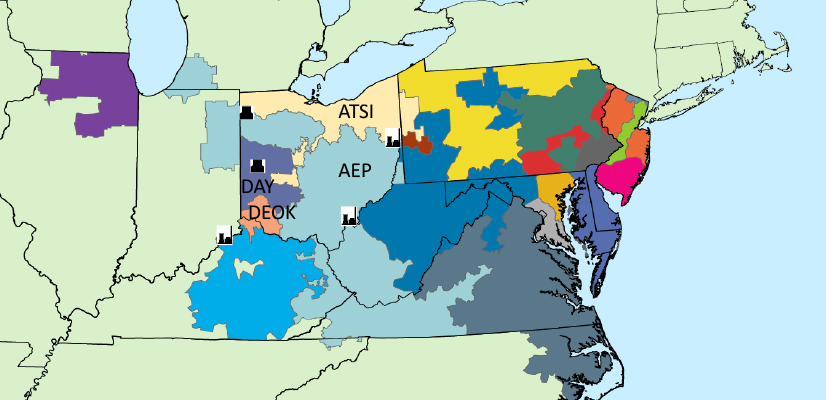
Buckeye Power’s generation and load zones. | PJM
Zemanek said PJM does not have a way to allocate CTRs directly to an LSE with network resources outside a constrained LDA but whose resources have been designed as deliverable on the LSE’s network integration transmission service agreement. Instead, Zemanek said, PJM allocates CTRs pro rata to each LSE serving load in the LDA or zone based on the LSE’s share of the zonal unforced capacity obligation.
Buckeye’s proposal calls for first allocating zonal CTRs to LSEs with historic generation resources identified as network resources in a network integration transmission service agreement (NITSA). The allocated CTRs will be “sufficient to meet the LSE’s daily unforced capacity (UCAP) load obligation but shall not exceed the total amount of the LSE’s generation capacity as identified on the LSE’s NITSA.”
The proposal would recognize generation resources and transmission rights that existed prior to the implementation of RPM but would also terminate upon the retirement of a resource or a change in the designated resource status in the NITSA. The new rules would be implemented at the next available CTR allocation process following FERC approval.
“We’re not changing the calculations for transmission constraints, and we’re maintaining reliability by keeping the total amount of CTRs the same,” Zemanek said.
Bowring opposed the proposed changes, saying that Buckeye’s approach was an attempt to use a non-market contract path approach rather than the market network approach that the CTR design was based on. He said the Buckeye approach meant that the company would be paid more and other market participants would be paid less. “It is a zero-sum game,” Bowring said.
Bowring also said the Buckeye proposal was inconsistent with the way in which the value of CTRs is defined based on delivery year forecasts rather than the results of the capacity base auction.
Bastian reviewed the megawatt quantity of qualified requests by zone to assist participants in evaluating the impact of the Buckeye proposal. Buckeye has said the impact of the current rules vary from year to year; it said the rules cost it $10 million in the 2015/16 delivery year and $2.5 million in 2016/17.
The committee will be asked to endorse the proposal at the September MIC meeting.
Texas regulators are grappling with writing weather preparedness measures for generators and transmission service providers as required by state law, a task that sounds easy enough until put into practice.
Several factors are hampering the Public Utility Commission’s work. There’s a required, in-depth study of extreme weather scenarios that is not expected to be completed in time to meet the commission’s Dec. 1 deadline for a final rulemaking.
There’s also a pending federal regulatory standard for generators that’s still almost two years away. And then there’s the harsh reality that not all generating units run or are operated the same way, a complication when writing a weatherization rule for a fleet with tens of thousands of individual units.
Barksdale English, the PUC’s director of compliance and enforcement, explains the weatherization rulemaking to the commissioners. | Admin Monitor
Barksdale English, the PUC’s director of compliance and enforcement, said Thursday that staff’s draft rulemaking is procedurally on track, although the short implementation deadline is a “big challenge.”
“We have six months to write a rule the commission has never taken up before and that it has never regulated,” English told the commissioners during a PUC work session on weatherization.
He said the proposed rule will tackle the statutory requirement that generators be prepared to operate during a weather emergency. “We have to think about what a reliability standard is, what it means to be prepared to operate during extreme weather,” he said.
According to the draft rule, ERCOT must conduct the weather study and include statistical probabilities for a range of weather scenarios in the 95th, 98th and 99th percentile probabilities. The study must address a comprehensive range of weather scenarios and must include minimum parameters for high and low temperatures, wind, humidity, precipitation and duration.
Generators must comply with either a basic or “enhanced” weather reliability standard. The basic standard requires a generator to maintain preparation measures that “reasonably ensure” it can operate at its rated capability, as defined by ERCOT under the 95th percentile of each of the weather study’s four extreme scenarios. The enhanced standard raises that threshold to the 98th percentile.
Separate standards are included for new generators and black start providers. Each generation entity is required to submit to ERCOT a study that confirms compliance with the standard and to also file an annual report to the grid operator. ERCOT must develop an inspection program that ensures each resource is inspected at least once every three years.
This fall, ERCOT plans to conduct spot checks for “every plant that had problems” during the February winter storm.
Woody Rickerson, the grid operator’s vice president of grid planning and operations, said staff has noted improvements at plants that failed during a 2011 winter event. That storm led to legislative directives that were never followed up on.
“We did see improvement before 2021,” Rickerson said.
“The only thing is, we didn’t have anything on paper,” Commissioner Will McAdams said. “Once you have something on paper, that’s a different animal.”
Without a complete weather study, the commission agreed to draft an initial set of rules and then finetune the requirements once it has the weatherization data and analysis. The initial standard will apply to those generating units that failed during the 2011 and 2021 winter storms.
“Make a plan to fix those and execute that plan,” English said, noting ERCOT will gain regulatory authority from the new rule. “So actually prepare your facility. Don’t just tell me that you identified the problem, but do something about it.”
More than 30 entities have provided comments on the proposed rulemaking.
The work session was the first of six scheduled workshops as the PUC manages the work of turning legislation and political directives into grid protocols and requirements (51617). (See “Regulators Set Future Work Sessions,” Texas Public Utility Commission Briefs: July 15, 2021.)
Texas climatologist John Nielsen-Gammon and Chris Coleman, ERCOT’s meteorologist, set the stage with an informational discussion on the state’s climate. Thermal and renewable generation experts and natural gas industry representatives discussed weatherization best practices and their lessons learned.
Joseph Younger, the Texas Reliability Entity’s director of enforcement, reliability standards and registration, said NERC’s cold weather standard remains under development, but was filed with FERC on June 17. Assuming FERC approval of Project 2019-06 and its mandatory cold weather preparedness requirements, he said the standard would not become effective for another 18 months.
The project, initiated after the 2018 cold weather event involving SPP and MISO, requires generator operators to protect their units against freezing and share their cold weather operating parameters with regulators. (See NERC Board OKs Cold Weather Standards.)
“The 2021 event could be folded into the standard through a FERC directive,” Younger said.
“NERC has a knack of doing things just in time,” Commissioner Jimmy Glotfelty said in making his first official appearance on the PUC.
Glotfelty, co-founder of Clean Line Energy Partners and a former Department of Energy official, was appointed to the PUC on Aug. 6, giving the commission a fourth member for the first time. State lawmakers passed legislation earlier this year that increased the PUC’s membership to five. (See Abbott Names Glotfelty as 4th Commissioner on Texas PUC.)
Managed-charging strategies are emerging to smooth out demand as incentives intended to encourage electric vehicle owners to charge during off-peak hours create late-night surges in power use.
The so-called “rebound timer peak” occurs when utility customers set timers to start charging their electric vehicles during the same off-peak hours, said Joseph Vellone, head of North America for EV Energy. The company offers a platform for managing home EV charging.
“Once the off-peak hours kick in … the grid will actually see a surge in load, particularly clustered around affluent, EV-rich areas,” Vellone said. Those hours might start at 8 p.m. in some areas or at midnight in others.
Vellone spoke this month during an Arizona Corporation Commission (ACC) workshop on transportation electrification. The commission will consider adoption of a statewide transportation electrification plan this year.
Managed charging was part of the discussion. Vellone listed several examples of managed-charging initiatives, including BMW’s ChargeForward program.
ChargeForward is aimed at shifting EV charging to times when more renewable energy is available, reducing strain on the grid. When an EV owner plugs in their car, the vehicle telematics system starts communicating with BMW about the state of charge. The driver indicates when they’ll need the car and how far they’ll be traveling.
The system looks at current grid and renewable energy conditions, as well as energy prices, for that location. It also factors in whether the driver prefers lower charging cost or higher use of renewable energy. EV owners receive incentives for participating in the program.
In California, Silicon Valley Clean Energy offers a managed-charging program called GridShift. The program shifts EV charging to times with off-peak rates. It alerts participants to opportunities to charge during “low-carbon events,” for which they can earn credits on their electric bill, Vellone said.
Vellone noted that managed-charging programs for EVs require a charger that’s connected to the internet.
Three Levels of Adoption
The discussion of a statewide transportation electrification plan comes after the commission issued a decision in 2019, ordering the state’s utilities to develop a long-term, comprehensive statewide transportation electrification plan.
Arizona Public Service Co. (APS) and Tucson Electric Power Co. (TEP) worked with consultants Energy and Environmental Economics (E3) to release a framework for the plan in 2019. In a second phase of their work, they released a transportation electrification plan in March.
The plan describes the two companies’ efforts to support transportation electrification in Arizona and also includes recommendations for state and local governments, transit agencies, EV service providers and representatives of underserved communities.
The plan analyzes three levels of EV adoption. A low-adoption scenario assumes EV adoption stays on its current trajectory, with a projected 249,771 light-duty EVs on the road in Arizona in 2030.
The medium-adoption scenario includes 1 million light-duty EVs in the state by 2030. A high-adoption scenario increases the number of EVs to 1.5 million in 2030, or about 20% of light-duty vehicles in the state.
A cost-benefit analysis found that the medium-adoption scenario would result in billions of dollars in savings to EV owners, electric utility ratepayers and the state as a whole.
“These benefits will not materialize without effective planning and coordination to accommodate the large-scale changes that support TE [transportation electrification] for both the transportation and electric power sectors,” the report said.
Reaching the medium-adoption goal will likely require “a significant increase in supportive policy, funding and programs, including a large scale-up of charging infrastructure and expanded education and outreach initiatives to increase awareness of TE options,” the report said.
Different Viewpoints
Some groups are urging the commission to aim for the high-adoption target.
“We support the high-adoption scenario because the utilities need to plan for and be prepared to meet their peak load,” Adam Stafford, senior staff attorney with Western Resource Advocates, said in a filing with ACC.
The high-adoption scenario would help parts of the state that are in non-attainment of federal ozone standards come into compliance, and address associated economic impacts, Caryn Potter, utility program manager for the Southwest Energy Efficiency Project (SWEEP), said in a letter filed with the commission.
In opening remarks during the workshop, Commissioner Justin Olson said the commission should not require ratepayers to subsidize an industry. Commissioner James O’Connor said he was also concerned about subsidies.
“If we’re requiring customers to pay more than that just and reasonable rate in order to subsidize another customer … for some purpose — in this case it would be in order to encourage the adoption of electric vehicles — that’s from my perspective, beyond our constitutional authority, and that’s something that we should not do,” Olson said.
Although someone could make a case that increased EV adoption would produce a public good, it’s an issue more appropriate for the Legislature, which has taxing authority, Olson said.
An environmental permit granted last year for the New England Clean Energy Connect (NECEC) transmission line could be in jeopardy after a court ruling last week vacated a land lease for the project.
Maine Department of Environmental Protection (DEP) Commissioner Melanie Loyzim told the project’s developers in a letter Friday that she is opening a proceeding to consider suspending the permit granted to the project.
The Maine Superior Court’s Aug. 10 decision to vacate a 1-mile public land lease to Central Maine Power (CMP) “represents a change in circumstance that may warrant a suspension” of the May 2020 order approving the project, Loyzim said. (See Maine Judge Vacates Public Land Lease for NECEC Tx Line.)
NECEC includes construction of 145 miles of transmission from the border with Québec to interconnect with an existing line in southern Maine for the delivery of Canadian hydropower to ISO-NE. The project received a presidential permit in January, completing the U.S. permitting process and signaling the start of construction.
But the court ruling, which said the Maine Bureau of Parks and Lands (BPL) mishandled the land lease, signals a new round of challenges for the project.
The BPL, along with Avangrid (NYSE:AGR) subsidiaries NECEC Transmission and CMP, filed a notice on Friday to appeal the court’s decision, Thorn Dickinson, CEO of NECEC Transmission, said in a statement to RTO Insider.
Maine Attorney General Aaron Frey and the Maine Department of Agriculture, Conservation and Forestry, a defendant in the lease case, are appealing the decision too, according to the Portland Press Herald.
The Natural Resources Council of Maine (NRCM), which is a plaintiff in the lease case, filed a petition following the court ruling last week asking the DEP to “issue a stay halting all new clearing and construction” for the project. It claimed that the public would “suffer irreparable injury” if construction continues on a project the company “can’t complete.”
The environmental group included the Maine Board of Environmental Protection, which is part of the DEP but has independent decision-making authority, on its stay request. Board Chair Mark Draper immediately replied, saying it is “more appropriately addressed by and is referred to [Loyzim].”
Last June, NRCM filed a request to stay the DEP’s approval of the project. The department denied it, saying that it was not urgent because CMP did not have all the necessary permits at that time to begin construction.
NRCM asked DEP to act on its request to stay construction by Tuesday, but DEP had not responded as of press time.
Neither NECEC Transmission nor NRCM responded to RTO Insider’s request for comment on Loyzim’s decision to initiate suspension proceedings.
If a suspension is imposed, it will be in effect until the Superior Court’s decision is reversed, the developer obtains a new lease or the DEP approves a new route for the line, according to Loyzim’s letter.