California is pursuing strategies to recycle lithium-ion batteries as it stakes its clean-energy future on batteries to power millions of electric vehicles and to store thousands of megawatts of solar and wind energy for later use.
Disposing batteries after they exceed their useful life could prove an environmental quagmire. The state will need to dispose of 60,000 metric tons of batteries filled with toxic chemicals and metals by 2048 under a mid-case scenario, the California Energy Commission (CEC) estimates.
“We need to develop an ecosystem of recycling batteries so that, as we electrify more and more of our transportation system, we don’t have a solid-waste disposal problem,” Commissioner Patty Monahan said during the CEC’s Aug. 11 business meeting.
During the meeting, the commission unanimously approved an initial round of funding for battery recycling projects aimed at reducing the costs and pollutants of current processes.
Today’s “state-of-art [lithium-ion battery] recycling technologies, such as pyrometallurgical and hydrometallurgical processes, suffer from high operational costs and large secondary emissions,” CEC staff wrote.
The CEC awarded $2.7 million in grants under its new effort this year to develop high-value recycling pathways for lithium-ion batteries. Its goal is to help develop technologies that recover more than 95% of the mass of cathode and anode materials and lithium contained in spent batteries.
“The purpose of this [grant] solicitation is to fund applied research-and-development projects that improve and scale high-value recycling processes for lithium-ion batteries, evaluate the performance of recovered materials compared to mined materials, and conduct environmental and economic analyses of battery recycling processes,” the CEC said.
One grant recipient — the University of California, San Diego — has “proposed direct recycling technology [that] holds the potential to address these challenges” but is unproven on a commercial scale, the university said in its grant application. “Improvements in [battery] recycling processes are needed to efficiently recover materials and to produce recycled materials with greater economic value.”
The UC San Diego plan regenerates degraded battery materials, including metals, for use in new batteries. The CEC awarded researchers $1.7 million to scale-up their process and evaluate its effectiveness.
The commission also awarded OnTo Technology more than $1 million for R&D of battery recycling processes that allow new batteries to be made with 100% recycled electrodes.
OnTo plans to collect used batteries to demonstrate its “cathode healing” process and to “scale-up capacity to be able to handle multiple kilograms per day with potential for further increases in the future,” said Ben Wender, an electric generation system program specialist in the CEC’s Energy Research and Development Division. “The project will partner with battery manufacturers to … produce new batteries with high-recycled content and compare their performance to batteries made from mined materials.”
The grants fall under the commission’s Electric Program Investment Charge (EPIC), which distributes more than $130 million in ratepayer charges annually to R&D.
“These two things need to proceed in parallel, both strengthening and building up the lithium recycling ecosystem and recovery efforts in the Salton Sea,” he said.
This summer’s climate change-related drought caught Washington government officials woefully unprepared.
For example, the state had $6.72 million set aside to deal with the 2015 drought; $1.63 million allocated for the state’s 2019 drought; and a mere $750,000 available for this year’s drought.
“We were caught off guard,” state Sen. Judy Warnick (R), chair of the Joint Legislative Committee on Water Supply During Drought, said Monday during a meeting of the committee.
The joint committee only meets during years in which a drought is declared by the state government. This year’s legislative session ended in March, and Gov. Jay Inslee did not issue a drought declaration until mid-July, blaming climate change for the dearth of water. Warnick said that weather conditions and forecasts in March did not predict a summer drought.
The joint committee held its first meeting Monday and was briefed by state climatology, financial and ecology officials.
Dave Christensen, policy and program manager for the Washington Department of Ecology Water Resources Program, said his agency did not expect the high temperatures that occurred this spring and summer, which is why it did not request drought-related allocations during the January-to-March legislative session.
The state has no designated sources from which to collect money for drought funding, said Jim Cahill, senior budget assistant to the governor for natural resources.
The declaration will speed up processing for emergency drought permits and allow temporary transfers of water rights. Washington’s available water supplies are expected to be 75% less than normal.
The cities of Seattle, Tacoma and Everett are not included in the drought emergency because they have significant amounts of stored water.
The easternmost quarter of the state is undergoing drought conditions that normally show up once or twice every 100 years, said Karin Bumbaco, assistant state climatologist.
The state does not expect enough precipitation in 2022 to make up for the 2021 shortfalls.
The committee plans to meet again soon but has not set an agenda. “We need to digest this information we received today and decide what to do to move forward with this,” said Rep. Mike Chapman (D), committee vice chair.
ERCOT’s Technical Advisory Committee has canceled Wednesday’s scheduled workshop to discuss its future membership and interaction with the incoming Board of Directors.
Chair Clif Lange, of South Texas Electric Cooperative, and Vice Chair Eric Blakey, with Just Energy, said in an email to stakeholders Monday that they decided to cancel the workshop “given feedback from multiple parties and after much consideration.”
The workshop was to be a follow-up to the committee’s testy July meeting, when members pushed back against interim CEO Brad Jones’ proposal to convert the committee into one “comprised of senior-level members from each ERCOT member organization.” (See “Members Push Back Against Revamped TAC Structure, Conservative Ops,” ERCOT Technical Advisory Committee Briefs: July 28, 2021.)
The TAC currently has 30 members comprising primarily subject-matter experts representing six different market segments. Some members argued last month that adding officer-level representatives would only slow the committee’s work down. Jones responded by saying state lawmakers have lost confidence in ERCOT’s market participant-driven processes.
“If you don’t think TAC is in the crosshairs, you’re not paying close attention,” Jones said during the July 28 meeting.
Lange and Blakey told members they will defer discussion of the committee’s structure until the new board and/or the Texas Public Utility Commission “initiate[s] discussions on it.”
The Bureau of Ocean Energy Management (BOEM) is considering a construction plan for the 132-MW South Fork offshore wind project that protects fishery habitat by reducing the number of planned turbine locations.
BOEM said Monday that it received habitat conservation recommendations from the National Oceanic and Atmospheric Administration (NOAA) that would somewhat alter the project as proposed by co-developers Ørsted and Eversource Energy (NYSE: ES).
The companies are seeking approval to build the South Fork project 19 miles southeast of Block Island, R.I., and 35 miles east of Montauk Point, N.Y., with power delivery to Long Island.
In a final environmental impact statement (EIS) for the project, BOEM said the plan for “fisheries habitat impact minimization” is its preferred alternative of the four major project alternatives it is considering. The final EIS assesses the impacts of development activities for the project as set out in the project construction and operations plan.
In addition to the habitat mitigation alternative, BOEM also is considering the project as proposed, a vessel transit lane option, and a no-action option under which the project would not be built.
BOEM expects to announce its choice in a record of decision in October.
For the habitat protection option, BOEM said it “may approve up to four fewer [turbine] locations than proposed by [the developers].” NOAA said that five of the proposed locations should be “removed from consideration because they would result in substantial adverse impacts to complex habitats,” according to the final EIS. Special siting considerations also would apply to an additional nine proposed turbine locations and the offshore substation to accommodate various sea floor habitats.
If BOEM selects the habitat protection alternative, it would only affect the configuration of the turbine locations. The total number of turbines would still fall within the proposed design scope of “up to 15 turbines and the 6- to 12-MW range,” the final EIS said.
The developers submitted an alternative site plan based on NOAA’s suggestions that could, depending on the final layout and locations used, require redesign of the cable layout and specifications.
“South Fork Wind continues to advance steadily through the federal permitting process, and we’re pleased to reach this latest milestone, the issuance of BOEM’s final EIS,” Ørsted and Eversource said in a joint statement. “South Fork Wind remains on track to be fully permitted by early 2022, with construction activities ramping up soon after on this historic, New York-first offshore wind farm.”
The vessel transit option would include a 4-nautical-mile-wide lane through the project lease area “where no surface occupancy would occur,” according to the final EIS.
BOEM formed the alternative in response to a proposal submitted last year by the Responsible Offshore Development Association to accommodate vessels traveling from southern New England and eastern Long Island ports to fishing areas.
The project developers proposed installing wind turbines with a capacity of between 6 MW and 12 MW in up to 15 of a possible 18 locations on a 1-by-1 nautical-mile grid in the project area. The vessel transit lane would eliminate five possible turbine locations and the proposed offshore substation site from consideration for development.
BOEM said it is finalizing consultations under the National Historic Preservation Act and working with the National Marine Fisheries Service (NMFS) to complete a biological opinion required by the Endangered Species Act.
The U.S. Army Corp of Engineers and NMFS plan to adopt BOEM’s final EIS for their own separate decisions regarding the South Fork project.
The NEPOOL Markets Committee devoted all three days of its summer meeting last week to continued discussion of ISO-NE’s revised proposal for FERC Order 2222 compliance and removal of the minimum offer price rule (MOPR) from the RTO’s capacity market.
Order 2222: ISO-NE Answers Questions on EAS Markets Participation
During the July MC meeting, there were several stakeholder questions during the presentation on energy and ancillary services (EAS) markets participation, to which ISO-NE wanted to provide follow-up answers, including:
understanding whether a facility can participate in different aggregations, and if multiple parties can take ownership in an aggregated resource; and
clarifying if a distributed energy resource aggregation (DERA) can participate under multiple models in the energy markets.
The RTO defines a facility as an electricity-consuming or -producing device located in homes and buildings, such as batteries, water heaters, electric vehicle chargers, HVAC systems and rooftop solar. Different capabilities of a facility can participate in different aggregations, ISO-NE said.
A facility’s energy withdrawal capability, for example, can be in a different aggregation from its demand reduction or energy injection capabilities as energy withdrawal is measured separately from demand reduction or energy injection. However, only one aggregator can register the energy withdrawal capability of a facility. Similarly, a facility’s regulation capability can be in a different aggregation from its demand reduction, energy injection or energy withdrawal capabilities but registered to only one aggregator.
In a change from its July presentation, the RTO said demand reduction and energy injection capabilities at a facility cannot be split among different aggregations. The implication was that the demand reduction capability of houses could be part of a demand response DERA and the energy injection capability could be part of a separate settlement-only DERA. ISO-NE said that was “problematic” because it would not provide the proper financial incentives for the demand response DERA to follow the dispatch instruction.
The demand response resource model avoids that problem by requiring a facility’s demand reduction and energy injection capabilities to be in the same aggregation.
Each DERA must participate under a single participation model in the energy markets based on its mix of capabilities. A DERA can choose from six energy market participation models: generator asset, binary storage facility (BSF), continuous storage facility (CSF), settlement-only DERA, demand response DERA or demand response resource.
The rules would also prohibit offering separate portions of a DERA into individual participation models because it acts as a single resource in the market, represented by a single set of requirements and offer parameters. All participation models include a specific set of requirements and offer parameters. A DERA must choose the model that best represents its combined capabilities.
However, a DERA participating under the demand response DERA, settlement-only DERA or demand response resource models in energy markets may simultaneously use the alternative technology regulation resource (ATRR) model to participate in the regulation market. DERAs that join under the generator asset, BSF or CSF models do not need to use the ATRR model to participate in the regulation market because they already include participation.
MOPR: Framing the Debate
Mark Spencer of LS Power gave a presentation making the case that eliminating the MOPR without accompanying changes to address supply-side buyer power may not yield a just and reasonable rate. The Federal Power Act, FERC precedents and the ISO‐NE tariff explicitly require regulators “to balance seller and buyer interests,” he said.
Spencer added that supplier-side mitigation reforms are needed to prevent the exercise of supplier market power for financial gain. In the current framework of the dynamic delist bid threshold (DDBT), all market participants, regardless of portfolio size or pro-rata quantity, that wish to delist must submit a cost workbook months in advance and lock in their bids. By removing the MOPR, mitigation will only be applied to existing merchant resources, not existing subsidized resources or new entry. The DDBT is calculated on the preceding auction clearing price, which is presumed to be a competitive result, and it ignores the administrative barriers that prevent market participants from submitting competitive offers
It also does not account for the effects of the MOPR elimination, which will likely result in an uncompetitive auction clearing price.
Spencer said potential solutions include:
a DDBT based on a simulated competitive result;
applying a net benefits test to determine which market participants are capable of wielding market power and allowing the others to submit competitive bids; and
examining the need for a sealed bid auction framework to address concerns of start‐of‐round market power.
PJM is looking to modify generator deliverability tests for light-load and winter periods as more renewable energy is set to come online in the coming years.
Jonathan Kern of PJM’s transmission planning department provided an update on the winter and light-load generator deliverability analysis and the proposed changes to the generator deliverability test for the light-load and winter periods at last week’s Planning Committee meeting.
Kern said the purpose of the changes is to “consider the rapidly evolving” resource mix in PJM’s planning process and to “support operational flexibility” by planning the grid to handle the expected evolving resource mix.
PJM is looking to modify each of the generator deliverability tests, Kern said, but wanted to start with the light load and winter generator deliverability procedures. Kern said those procedures have been “relatively unchanged” for many years and need better accounting for the expected higher variability of renewable resources in dispatching.
The current light-load procedure starts with a load level at 50% of the annual peak, Kern said, and is representative of November through April and the hours of 12-5 a.m. PJM is proposing to keep 50% of the annual peak but wants to shift the definition of the period of the light load to use load hours between 40% and 60% of the annual peak and to also use daytime hours and other periods of the year reaching the same 50% load level.
Kern said the change in hours is driven by the addition of solar power in the daytime hours and not simply looking at wind resources as PJM had done in the past for the light-load procedure.
“We’re currently not accounting for solar in the light-load test because it’s focused on the nighttime period,” Kern said. “So we want the light-load test to cover a broader set of hours.”
For the ratings in the light-load procedure, PJM is proposing using 59 F as the default temperature set. The light-load procedure currently uses 95 F as the default, which PJM determined is “too conservative,” Kern said.
He said PJM planning engineers spoke with several subject matter experts in operations and markets to look at historical dispatch patterns and conducted a “significant amount of testing” to develop several proposals to modify the base case dispatch, the external and internal interchange and generator ramping procedures for both winter and light-load.
PJM is still working on proposal assumptions by conducting additional analysis, Kern said, and is formulating updated language in Manual 14B to be brought to the PC for the first read before the end of the year.
Carl Johnson of the PJM Public Power Coalition asked if PJM will issue a report to give stakeholders more insight into the nature of the proposed changes and what could be expected in the future as more renewables come online.
Kern said developing the grid of the future will be one of PJM’s primary focuses over the next few years and it will be issuing white papers and reports on how the grid will need to evolve and what the RTO’s role will be in its evolution.
Patricio Rocha Garrido of PJM’s resource adequacy department reviewed the revisions to the manual, saying the minor changes included cleaning up outdated and redundant language and ensuring the manual language follows current PJM processes. The changes were first introduced at the June PC meeting. (See “Manual 20 First Read,” PJM PC/TEAC Briefs: July 13, 2021.)
The changes included removing the Reliability Pricing Model (RPM) timeline from section 1.2 of Manual 20 because it already exists in Manual 18 and clarifying language around the time period used in the creation of the load model and aspects of the capacity model in section 3.2.
Rocha Garrido said one complication in the Manual 20 changes was a parallel effort at the MRC to update the manuals resulting from discussions addressing the effective load-carrying capability (ELCC) for limited-duration and intermittent resources. Stakeholders endorsed the revisions at the July Markets and Reliability Committee meeting. (See “ELCC Manuals,” PJM MRC/MC Briefs: June 23, 2021 and “Consent Agenda Manual Endorsements,” PJM MRC/MC Briefs: July 28, 2021.)
The ELCC changes were in section 5 of Manual 20, Rocha Garrido said, which include an overview of PJM’s ELCC analysis, a description of the load model used and a description of the loss of load expectation calculation.
Members will be asked to endorse the changes at the Aug. 25 MRC meeting.
Manual 14G First Read
Terri Esterly, senior lead engineer for PJM’s markets automation and quality assurance department, provided a first read of updates to Manual 14G: Generation Interconnection Requests regarding the behind-the-meter generation (BTMG) business rules on status changes.
Esterly said the changes were the result of work done at special sessions of the Market Implementation Committee to review the existing BTMG business rules and identify gaps in the rules. Esterly presented related changes to Manual 14D at the August Operating Committee meeting. (See “Manual 14D Updates,” PJM Operating Committee Briefs: Aug. 12, 2021.)
The updates include language on megawatts changing status from BTMG, where they can net against the load, to the PJM market resource status. Esterly said the updates were intended to address conflicts with the Reliability Pricing Model (RPM) must-offer requirement and removal from generation capacity resource status business rules as well as to clarify and “adequately document” the processes related to status changes.
Esterly said most of the updates to the manual are in section 1.6.1 to clarify information required in an interconnection request to designate capability as a generation capacity or energy resource. The updated language includes a list of information required in a new services request for a BTMG unit, a definition of behind-the-meter load and a clarification on how to determine the maximum host/process loads.
The committee will be asked to vote on the manual changes at the Aug. 31 PC meeting.
Transmission Expansion Advisory Committee
Generation Deactivation Notification
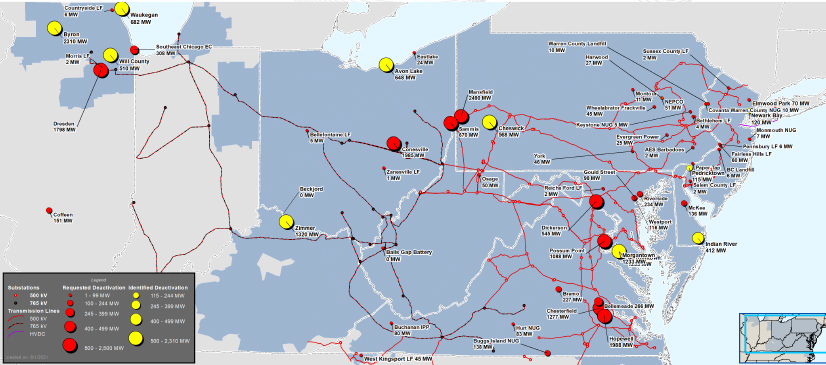
Phil Yum of PJM provided an update on 14 recent generation deactivation notifications totaling nearly 8,000 MW at last week’s Transmission Expansion Advisory Committee meeting.
Houston-based GenOn Holdings requested the Sept. 15 deactivation of the 627-MW coal-fired Avon Lake 9 Generating Station and 21-MW oil-fired Avon Lake 10 unit, both located in Ohio’s American Transmission Systems Inc. (ATSI) transmission zone, and the 568-MW coal-fired Cheswick Generating Station, in the Duquesne transmission zone in Pennsylvania.
GenOn also requested the May 31, 2022, deactivation of 1,233 MW from the coal-fired Morgantown Generating Station units 1 and 2, located in the PEPCO transmission zone in Maryland.
Yum said a reliability analysis for all five units identified some reliability violations but that new and existing baseline projects will “resolve” the identified impacts and the units can retire as scheduled.
PJM’s generation deactivation map. | PJM
Exelon requested that its two Byron nuclear units, both in the ComEd transmission zone in Illinois, be deactivated Sept. 14 and 16. The company originally announced in 2019 its intention to retire the units. It then reiterated its intention before the Illinois legislature failed to pass an energy package that would support the plants. (See Biden’s Support for Nuclear ‘Too Late’ to Save Exelon Plants.)
Yum said a reliability analysis identified fixable issues for both Byron units and that they can retire next month.
NRG Energy requested that the coal-fired Waukegan Generating Station Units 7 and 8 and the 510-MW coal-fired Will County Generating Station Unit 4, all located in the ComEd zone, be deactivated on May 31, 2022. Yum said a reliability analysis was completed and the units can retire as scheduled.
NRG also requested a May 2022 deactivation of its coal-fired 412-MW Indian River 4 Generating Station, but the reliability analysis identified the need to keep the plant operating. Yum said PJM identified seven different thermal violations, estimated to cost $117.4 million. PJM and NRG are working on solutions to allow for deactivation.
PJM also received generation deactivation notices for three additional units for May 31, 2022, including Talen Energy’s 115-MW gas- and oil-fired Pedricktown Power Plant in the Atlantic City Electric transmission zone and the 120-MW Newark Bay Power Plant in the Public Service Enterprise Group transmission zone, as well as Vistra’s 1,320-MW coal-fired William H. Zimmer Power Plant in the Duke Energy Ohio/Kentucky transmission zone. Yum said a reliability analysis is underway for each unit.
A total of 7,918 MW of generation is set to be deactivated.
Stakeholders continued to question PJM’s stance on vaccinations for its employees during last week’s Operating Committee meeting.
After Paul McGlynn’s monthly report on PJM’s operations plan in response to COVID-19, Paul Sotkiewicz of E-Cubed Policy Associates again asked when the RTO intends to mandate vaccinations for all employees working on the campus. Sotkiewicz has brought up the vaccine issue at several consecutive OC meetings. (See “COVID-19 Update,” PJM Operating Committee Briefs: July 15, 2021.)
McGlynn said PJM is “still in the same place” and not currently requiring a vaccine for its staff. He said PJM continues to monitor the situation and the metrics of the pandemic and will make changes to procedures when necessary.
Sotkiewicz said he intends to ask the question at OC meetings “until the answer changes.” He said PJM management is “being absolutely cavalier and irresponsible” to not mandate the vaccine and would like to hear directly from the PJM Board of Managers regarding the issue.
“Getting a vaccine, given the situation, should be a condition for employment, and it goes to fitness for duty,” Sotkiewicz said.
PJM’s Darlene Phillips, chair of the OC, said the RTO’s leadership team has discussed the implications of mandating vaccines.
Ken Foladare of Tangibl said he was only speaking on his own behalf when he agreed with Sotkiewicz’s stance, which Foladare said will help with “maintaining grid reliability” given the increasing positivity rate of the COVID-19 Delta variant. He said it’s a “no-brainer” for PJM to mandate vaccines for staff considering the precedent set by other major employers. He would also like to see mandatory vaccinations for stakeholders attending in-person meetings unless they have a medical exemption.
Alex Stern, director of RTO strategy for PSEG Services, said “these are very challenging issues” and that utility companies around the country are currently having the same internal conversations.
Calling it “unprecedented times,” Stern said there are legal complications in mandating vaccines that PJM staff need to take into consideration.
“This is extremely complicated, and the thing we need to do is not panic and allow management to act deliberately,” Stern said. “I say that as an individual and not for my company.”
NRBTMG Sunset Endorsed
Members unanimously endorsed sunsetting the non-retail behind the meter generation (NRBTMG) business rules issue charge.
Terri Esterly, senior lead engineer in PJM’s markets automation and quality assurance department, reviewed the status of the NRBTMG business rules issue charge originally worked on at the OC in 2019. The sunsetting issue was first presented last month at the OC. (See “NRBTMG Sunset,” PJM Operating Committee Briefs: July 15, 2021.)
Esterly said the updated Manual 13: Emergency Operations and Manual 14D: Generator Operational Requirements were endorsed at the September 2019 MRC meeting after going through the stakeholder process. (See “Non-retail BTM Generation Rules Endorsed,” PJM MRC/MC Briefs: Sept. 26, 2019.)
The updates clarified the reporting, netting and operational requirements of NRBTMG, Esterly said, and included establishing an annual reporting process to determine the total amount of NRBTMG in PJM. He said PJM’s Capacity Exchange system enhancements were released in 2020 to help facilitate the administration of NRBMTMG requirements.
Stakeholders completed the first three key work activities in the issue charge endorsed in 2019, including completing a review of the existing NRBTMG business rules in agreements and manuals, proposing changes to the existing rules and determining the level of NRBTMG in PJM. Key work activity 4 in the issue charge was designed to be triggered only when the total amount of NRBTMG in PJM approached a 3,000-MW cap.
Esterly said PJM posts the total amount of NRBTMG in the RTO each November, and it hasn’t approached the cap. The NRBTMG was 1,171.5 MW in 2019 and 1,186.4 MW in 2020.
PJM proposed to sunset the NRBTMG business rules issue charge with the intent to bring it back and resume work when the 3,000-MW cap is reached.
Manual 14D Updates
Esterly also reviewed Manual 14D: Generator Operational Requirements updates to appendix A related to behind-the-meter generation (BTMG) business rules on status changes developed in MIC special sessions. He presented related changes to Manual 14G at the August Planning Committee meeting. (See “Manual 14G First Read,” PJM PC/TEAC Briefs: Aug. 10, 2021.)
The proposed Manual 14D appendix A updates are indented to address conflicts with the Reliability Pricing Model must-offer requirement and removal from generation capacity resource status business rules, Esterly said. The updates include addressing performance obligation impacts, load impacts from status changes and participation in PJM’s load response.
In a section on designating capability as a generation capacity resource and/or an energy resource, PJM added a business rule to make it clear a new service request must be submitted for the designation. Esterly said another rule was made to clarify the process to request a change from BTMG status to generation capacity resource status.
Esterly said in the section on participation in PJM load response, the RTO added the process to indicate that a BTMG unit is participating in PJM load response by providing on-site generator data.
PJM will seek stakeholder endorsement of the manual changes at the OC meeting on Sept. 10.
Manual 3A Updates Endorsed
Stakeholders unanimously endorsed a minor update to Manual 3A regarding model information and data requirements of flow devices.
Suzie Fahr, senior analyst in PJM’s power system modeling department, reviewed the changes to Manual 3A: Energy Management System Model Updates and Quality Assurance.
Fahr called the manual update “fairly small,” saying it resulted from a compliance review.
Section 2.2 was updated to clarify instructions for a transmission owner to add, remove and/or convert a flow device and submit the associated ratings, Fahr said. All references to a “breaker” in the section were updated to flow “device,” which Fahr said more accurately described the application of flow-capable equipment.
PJM will seek endorsement of the manual update at the Markets and Reliability Committee meeting on Aug. 25 and have the new language take effect the same day.
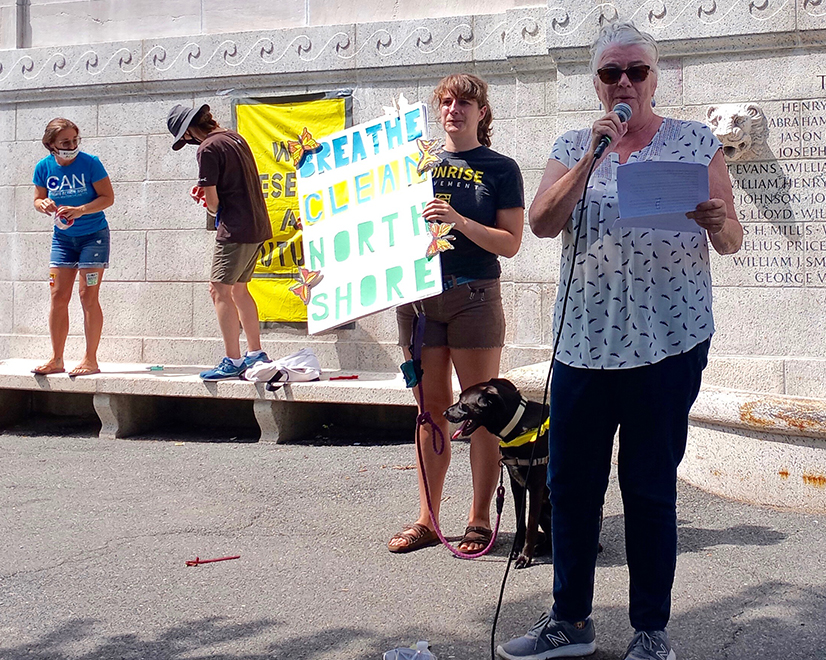
Climate activists mobilized in front of the Massachusetts State House on Saturday to criticize Gov. Charlie Baker and the state Department of Public Utilities (DPU) for supporting fossil-fuel infrastructure development in environmental justice communities.
The protest followed DPU’s approval of Massachusetts Municipal Wholesale Electric Co.’s (MMWEC) request for two $85 million bonds to build a natural gas plant in Peabody, Mass.
“They can’t have it both ways,” said Sudi Smoller, a spokesperson for grassroots group Breathe Clean North Shore, at the protest Saturday.
State leaders, Smoller added, cannot claim Massachusetts is a champion of clean energy and build a new fossil-fuel plant within a mile of eight environmental justice communities made up of minority and low-income residents.
“It goes against a provision of their Next Generation Climate Bill,” she said.
Under the new climate law signed by Baker earlier this year, any project that could affect air quality — including fossil-fuel power plants — proposed within five miles of a state-mandated environmental justice neighborhood will be required to submit an environmental impact report.
The Peabody Municipal Light Plant recently decommissioned one of its two existing peaker plants after analyzing the new environmental justice areas designated in June based on the 2020 census.
“Whatever was reviewed in 2015 should be reviewed again,” Smoller said.
MMWEC’s 55-MW peaker plant has been in the works since 2015. It would provide power for 14 communities and is expected to run 239 hours per year, emitting 7,085 tons of CO2 per year, according to the company.
But plans to build the plant were put on hold in May by MMWEC to address the environmental and health concerns raised by residents and advocacy groups, according to a statement released by the company.
Technology has changed since the project was first proposed more than five years ago, necessitating a design review, CEO Ron DeCurzio said in the statement.
Last month, MMWEC said in a subsequent statement the company feels it has adequately addressed the concerns of public officials. MMWEC eliminated a 200,000-gallon oil tank from its plans for the plant.
However, 87 Massachusetts health care professionals wrote in a letter to MMWEC that they oppose the plant entirely.
“The residents of Peabody currently have higher than state average rates of air-pollution related illnesses, and the air pollution associated with the new plant will increase mortality within the Peabody community,” the health professionals wrote.
For every 10 micrograms/cubic meter of air (ug/m3) increase of particulate matter 2.5 (PM2.5) pollution, all-cause mortality increases by 7.3%.
The Peabody Peaker Plant is projected to increase PM2.5 pollution to 21.3 ug/m3 and “can be expected to increase mortality rates in the surrounding communities,” according to the letter.
A recent study by the nonprofit research group Physicians, Scientists and Engineers for Healthy Energy suggests that peaker plants in Massachusetts are good targets for replacement with solar power and batteries.
Breathe Clean North Shore has started a petition for DPU and MMWEC to listen to the health professionals and conduct a comprehensive, up-to-date environmental and public health impact study of the plant.
The South Jersey site of three nuclear power plants will also soon become home to the state’s offshore wind manufacturing and marshalling port following Wednesday’s vote by the New Jersey Economic Development Authority (EDA) approving the lease on the site and $12.85 million in initial funding.
Public Service Enterprise Group (PSEG) owns the 122-acre site on Lower Alloways Creek, where the Salem 1, Salem 2 and Hope Creek nuclear power stations are located. The site is on the Delaware River but has good access to the offshore coastal sites where the projects will be built.
Under the lease, the authority will pay PSEG about $3.1 million a year for an initial term of 28 years, with a maximum term of 78 years, Jonathan Kennedy, managing director for infrastructure at the EDA, told the board.
The funds approved include $10.25 million for permits and project design, as well as the relocation of four buildings on the site, Kennedy said. Another $2.6 million will pay for “for critical path works, including the removal, processing and crushing of subsurface concrete from the leased premises,” according to the board approval order.
The board approval locks in a key part of New Jersey’s effort not only to create an OSW industry that can help meet the state’s clean energy goals, but to build out the sector to provide an economic and operational hub for other Mid-Atlantic states.
EDA Board Chairman Kevin Quinn called the approval of the lease “a critical step in support of the state’s onshore wind efforts.”
“These efforts are both impactful and strategic,” said Quinn, who is the founder and a partner of the investment firm Genki Advisory LLC.
Under Gov. Phil Murphy, New Jersey is working toward a goal of running on 100% clean energy by 2050, with 23% of that power coming from offshore wind. To that end, the New Jersey Board of Public Utilities (BPU) has approved three OSW projects to be located off the New Jersey coast.
The 1,100-MW Ocean Wind 1 project got the go-ahead in 2019, followed by the BPU’s authorization on June 30 of the 1,100-MW Ocean Wind 2 and the 1,510-MW Atlantic Shores projects. Together the two wind farms would produce more than half of the 7,500 MW that the state plans to approve by 2035. (See NJ Awards Two Offshore Wind Projects.)
All three of the approved projects are expected to use the New Jersey Wind Port in project development and operations, and Ocean Wind 2 and Atlantic Shores will include elements that support it. Atlantic Shores will partner with manufacturer MHI Vestas to build a manufacturing facility to build nacelles, while Ocean Wind 2 developer Ørsted has pledged to establish a nacelle assembly facility at the port in partnership with General Electric (NYSE:GE).
Nacelles are the covering or housing that contains all the generating components of a wind turbine, such as the gearbox, generator and drive train.
The lease authorization follows the EDA board’s approval in July of the hiring of New Jersey’s Tishman Construction as construction manager for the project. At that time, the board approved $150,000 to start preconstruction activities, including estimating costs, finalizing design development, preparing construction documents, evaluating constructability and developing a site logistics and mobilization plan.
The board also voted to move ahead with a memorandum of understanding between the EDA and the New Jersey BPU to accelerate workforce development for the OSW sector in the state. A board memo on the agreement states that the BPU will provide $7 million “to support the development and delivery of workforce training, education, research and innovation programs that will empower New Jerseyans to participate in the offshore wind industry.”
The MOU “will help New Jersey to achieve its offshore wind goals while also creating new opportunities for New Jersey workers,” the memo says.
MISO stakeholders made it clear last week that a separate cost-allocation design for the South subregion’s long-range transmission projects will preserve the footprint’s most notorious constraint.
Several said during a Thursday conference call on cost allocation that maintaining one set of cost-sharing principles for MISO Midwest and another for MISO South would throw a wrench into any plans to expand the transfer capability between subregions.
WEC Energy Group’s Chris Plante said disparate allocations would further “balkanize” the Midwest from the South and make a healthier transmission link between the regions even more difficult to get built.
“I disagree with having different cost allocations between the North and South,” Lauren Azar, attorney for the Sustainable FERC Project, said. “I think just from a public policy perspective, we should be strengthening the ties between North and South. We need to bolster the resilience of MISO South.”
MISO has a 1,000-MW contract path bridging its Midwest and South subregions. Seven years ago, MISO and SPP reached an agreement setting a 3,000-MW limit on subregional transfers in the north-to-south direction and a 2,500-MW limit in the other direction. MISO sometimes exceeds those limits during emergency conditions but nearly always limits exceedances to the 30-minute grace period.
Staff in late July proposed using the 2011 Multi-Value Projects’ (MVP) allocation for the Midwest, which relies on a 100% uniform, “postage stamp” rate for load. The grid operator said it would wait to propose an alternative long-range cost allocation for MISO South. (See MISO Dusts off MVP Cost Allocation for Long-range Tx Plan.)
John Wolfram, a consultant representing transmission owner Hoosier Energy, said he didn’t think FERC would endorse bifurcated allocation methods for Midwest versus South.
“I think it will deter or serve as a barrier to increasing the transfer capability between North and South, which, frankly, should be a huge component” of the long-range transmission plan, he said.
“MISO as a whole will be much better off if it has one approach,” Clean Grid Alliance’s Natalie McIntire said in agreement. “I also think we’re much more likely to get approval from FERC if we have one allocation.”
The Coalition of Midwest Power Producers’ Travis Stewart said FERC has a history of rejecting filings that propose charging different rates for the same product. He said a case in point was MISO’s futile 2016 attempt to conduct separate three-year forward capacity auctions using a sloped demand curve only for a footprint’s deregulated areas.
Some stakeholders asked MISO to provide an example of how it would split costs using two types of cost allocation on projects that touch both the Midwest and South.
Michigan Public Service Commission Chair Dan Scripps said MISO’s MVP allocation “may very well be the devil you know” and pointed out that it already enjoys FERC approval.
MISO plans to file a cost allocation for long-term transmission projects sometime in late fall. Staff said a fall deadline will allow time for FERC to issue a decision before the first long-term transmission proposals are put before the MISO Board of Directors in March. (See related story, MISO Targets March Approval for Long-term Tx Projects.)
Entergy, Southern Regulators Offer Proposal
Entergy and MISO South regulators revealed their preference for long-term transmission cost allocation during the meeting. MISO Midwest uses an energy-based postage stamp allocation, but stakeholders requested a demand-based allocation with one of three criteria:
an allocation to a regulatory body’s jurisdiction when a candidate project fulfills a policy need;
allocation of a project candidate with “quantified economic benefits” to benefiting cost allocation zones; or
a two-step allocation where project costs are first assigned to cost allocation zones that are found to have economic benefits; remaining costs are then dispersed to pricing zones that avoid developing reliability projects.
MISO South regulators and Entergy have also asked for a 1.25:1 benefit-to-cost ratio and 230-kV minimum voltage thresholds, greater than MISO’s 1:1 benefits ratio and 100-kV minimum. They both agree on a $20-million project cost threshold.
Some stakeholders pointed out that consistently high-load customers would benefit more from a demand-based allocation than an energy usage-based allocation.
Southern Renewable Energy Association Executive Director Simon Mahan said the MISO South proposal would allow Louisiana, with its heavy and constant industrial energy use, to “make out like a bandit.”
MISO is expected to adjust its allocation proposal based on the stakeholders’ discussion. The grid operator will hold another workshop on its long-range plan Aug. 27.