SPP Pondering Changes to M2M Summaries

SPP staff are re-evaluating the level of detail they provide stakeholders for their market-to-market (M2M) activities with MISO.

The reports, intended to be monthly, have left staff playing catchup in recent years. On Thursday they were only able to share with the Seams Advisory Group a summary of May’s M2M activity, which resulted in a $6.3 million settlement in SPP’s favor.

When the group next gathers virtually in September, it will be expecting to hear summaries from June and July. The reports summarize M2M settlements for binding flowgates as a result of redispatch based on the non-monitoring RTO’s market flow in relation to firm flow entitlements.

Including May, SPP has now accrued $152.3 million in settlements from MISO since the two RTOs began the M2M process in March 2015.

Staff are considering setting a threshold for flowgates with six-figure or greater settlement totals to identify “the big drivers.” May’s summary included 43 permanent and temporary flowgates that were binding for 1,405 hours. The $100,000 threshold would have reduced that total to 10 flowgates.

Steve-Gaw-(RTO-Insider-LLC)-Content.jpg
Steve Gaw, Advanced Power Alliance | ©RTO Insider LLC

“At some point, does the level of market-to-market payments trigger some action in regard to transmission analysis?” Advance Power Alliance’s Steve Gaw asked. “Everybody sees this as useful information, but at some point, this should translate into either an analysis of a better way to handle this between markets or whether there’s a transmission-congestion analysis that needs to be done.”

Clint Savoy, SPP’s senior interregional coordinator, said the M2M data “informally informs our own regional and interregional processes.”

“We’re starting to get some traction and movement on … processes between SPP and MISO,” he said.

SPP and MISO are involved in several initiatives across their seam. Of course, there’s the work to find joint transmission projects that would help reduce the RTOs’ crowded interconnection queues. Their staffs met with stakeholders Friday to discuss how best to allocate costs. (See related story, MISO, SPP Offer Idea on Joint Interconnection Tx Allocation.)

The RTOs have also reached an agreement in principle over affected-system studies. Staff are working to memorialize the policy changes in their joint operating agreement. SPP and MISO are also trying to develop a targeted market efficiency project process similar to MISO’s effort with PJM.

That’s separate from the work SPP is undertaking to strengthen its seams agreement provisions with neighboring entities to ensure “adequate emergency assistance and fairly compensate emergency energy” during situations like February’s winter storm. The RTO imported more than 7.5 GW of energy from its neighbors during the storm, the highest since the Integrated Marketplace went live in 2014.

“As usual, we have a lot of balls in the air with all of our neighbors,” Savoy said.

MISO, SPP Offer Idea on Joint Interconnection Tx Allocation

MISO and SPP have shared an early concept for cost allocation on joint transmission projects intended to ease their crowded interconnection queues.

The grid operators envision a four-stage process to split costs, including reliability and benefits analyses, project review and approval, and a study on what individual interconnection customers would owe for projects.

MISO and SPP surprised stakeholders last month by seeking stakeholders’ ideas on how to split costs on joint targeted interconnection queue projects instead of proposing their own allocation method. (See MISO, SPP Solicit Ideas on Allocating Joint Tx Costs.)

In late June, the RTOs introduced two expensive cluster projects that stand to eliminate most flowgate congestion. The $424 million and $728 million options traverse South Dakota, Minnesota and Missouri. (See MISO, SPP Name Projects to Help Queue Troubles.)

“I want to stress to everyone that we’re in the initial stages of setting a cost allocation for this effort,” SPP’s Neil Robertson told stakeholders during a virtual meeting Friday.

SPP Director of Seams and Tariff Services David Kelley said the RTOs are striving for an allocation method “flexible enough for future applications” between the two.

“We want to design something that can be applied to various situations in the future when pertinent,” Robertson said.

But Kelley said if it’s too difficult to create a multiuse allocation, MISO and SPP will settle for single-use.

MISO and SPP said the lion’s share of project costs will be divided between load and generator interconnection customers. But while the grid operators have a quantifiable way to assign project costs to load via an adjusted production cost calculation, they’re not yet sure how to nail down quantifiable benefits to interconnection customers.

“We need to keep this simple, in an approach to a cost allocation, where possible,” Robertson said.

Missouri Public Service Commission economist Adam McKinnie asked if the RTOs have any idea of how to estimate interconnection customers’ benefits.

“You asked the marquee question,” Robertson said. He added he’s been asking interconnection customers if there’s a broader way to socialize costs of new transmission among them beyond clustering the customers that require the same transmission upgrade.

He said MISO and SPP want to “assess a fair fee” to interconnection customers but that it would be a “very significant technical process” to crunch an individual customers’ unique costs. Robertson said the RTOs will probably calculate an aggregate benefit for a class of interconnection customers and may assess individual customers a per-megawatt fee based on their impact factor on the transmission project.

Robertson said stakeholders will also have to discuss how the targeted interconnection projects will receive initial funding.

The RTOs said they’ll have a more detailed proposal in the coming months.

CAISO 2020 Load Costs Rise Despite Gas Price Decline

Low hydroelectric output, a summer heat wave and high prices during evening ramps helped boost CAISO’s load-serving costs by 3% last year despite “substantially lower” natural gas prices, the ISO’s Department of Market Monitoring (DMM) found.

CAISO’s total wholesale energy costs hit $8.9 billion in 2020, translating into $42/MWh, up from $41/MWh a year earlier, the DMM said in its 2020 Annual Report on Market Issues & Performance.

When adjusted for the decline in natural gas prices and changes in greenhouse gas costs, the ISO’s wholesale costs increased by 19% per MWh last year, Amelia Blanke, DMM manager of monitoring and reporting said Thursday during a call to discuss the report.

“Within the ISO, the cost for gas, which includes greenhouse gas costs, fell by about 15.7% on a weighted basis,” Blanke said. Gas-fired resources tend sit on the margins of the CAISO market, setting the price for energy.

Hydroelectric generation accounted for about 8% of the ISO’s total supply last year, compared with 14% in 2019, 10% in 2018 and 15% in 2017.  Average hydro output this year has been lower than last year in every month but March, Blanke said.

“This has a major impact on prices in our market as our hydro generation tends to be towards the bottom of the bid stack,” she said.

Wholesale power prices were lower in the first and second quarters of last year than in 2019 as COVID-19 restrictions began to take shape. Prices in the day-ahead, 15-minute and five-minute markets were all about 45% lower year-over-year in the first quarter, dipping to their lowest levels in the second quarter (typical for the ISO), and then ramping up in the third quarter due, in part, to an August heat wave. And while prices in all three markets converged closely during the first two quarters, they diverged in the second half, with day-ahead and 15-minute prices exceeding real-time by about 20% on average.

The reduced output from hydro plants and “extreme” summer loads also caused CAISO’s market to become structurally uncompetitive for more hours than in any of the past five years. “Despite this, prices were consistent with competitive baseline levels,” the DMM said.

The DMM also found that “the market for capacity to meet local resource adequacy capacity continues to be structurally uncompetitive in most local areas.”

The report pointed to other factors contributing to last year’s rising costs:

  • Transmission congestion costs increased, particularly related to limits on lines linking Northern and Southern California.
  • Ancillary service costs jumped to $199 million from $148 million in 2019 and $177 million in 2018, driven by higher regulation and operating reserve requirements and increased third- and fourth-quarter prices.
  • Real-time imbalance offset costs increased to $177 million from $105 million a year earlier. Congestion offset costs accounted for $117 million of that amount. “As in 2018, congestion offset costs were caused largely by significant reductions in constraint limits made by grid operators in the 15-minute market relative to higher limits in the day-ahead,” the report said.
  • Bid cost recovery — or make-whole — payments rose by $3 million to $126 million, representing 1.4% of total energy costs.

CRR Losses Continue to Mount

The DMM estimated that CAISO last year paid out $70 million more in congestion revenue rights (CRRs) than it took in from its CRR auctions, continuing a pattern that has been in place since the ISO began holding the auctions. A staunch critic of the CRR auction program, the DMM says it has saddled California ratepayers with $800 million in costs since 2012 without providing them any benefit. The Monitor contends that ratepayers are unwitting participants in a process that mostly enriches sophisticated “financial entities” that own no physical generation.

CRR losses had fallen sharply to $26 million in 2019 after the ISO implemented rule changes intended to reduce revenue deficiencies from the auctions. (See FERC OKs CAISO Plan to Deal with CRR Shortfalls.) The DMM attributed last year’s increase to a small number of load-serving entities selling their allocated rights to third parties, making them subject to payouts.

During Thursday’s call, Blanke reiterated the DMM’s call for the ISO to altogether disband the auctions, prompting a testy exchange with Seth Cochran, director of market affairs for CRR trader DC Energy.

Cochran urged the DMM to consider the findings of a recent London Economics International report that concluded that PJM’s financial transmission rights market is providing certain exogenous benefits to the broader wholesale market that the DMM is not capturing in its assessment of CAISO’s CRR market.

“This is a calculation fairly direct calculation of the ratepayer losses. We’re not attempting in this to capture any kind of exogenous benefits from hedging,” Blanke responded.

“Can the [DMM] slides be annotated to reflect that? That would be an important [acknowledgement] to that slide,” Cochran said.

“If the benefits of hedging are so great, then I think we’ve recommended the ISO should just run a market between willing buyers and sellers for hedging. You know, eliminate CRRs and just replace it with a straightforward hedging market,” DMM Executive Director Eric Hildebrandt said.

“If you read the report, you’d understand the liquidity needed to get those benefits comes from having hedges sold in the network configuration. So, to separate the two is not quite the way that that would work or play out in the real world,” Cochran responded.

Looking Ahead — and Back

Speaking about longer-term trends, Blanke said that day-ahead energy costs are steadily declining as a share of wholesale market costs in CAISO, falling from 95% in 2016 to 91% last year.

“More of that is coming from an increase in real-time energy costs, which include costs for the flexible ramping product,” Blanke said.

Blanke also noted that community choice aggregators account for 30% of CAISO load, up from 2% in 2015.

“With that shift, we’ve seen an increase in the amount of long-term power purchase agreements … which really provided a basis for a lot of the competitive bidding that we’ve seen in our market,” she said.

Blanke also pointed to the continuing growth of renewable resources participating in the market in response to state mandates and carbon emissions reduction targets.

“We’re also seeing the impact in terms of the kind of weather extremes, which are becoming more common in the market footprint, especially across the wider Energy Imbalance Market footprint,” she said.

Blanke said the DMM’s findings regarding last August’s rolling blackouts in CAISO — the first for California in 20 years — match those from a joint, root cause analysis issued by the ISO, the California Public Utilities Commission and the state’s Energy Commission. (See CAISO Issues Final Report on August Blackouts.) Causes included extreme temperatures and energy demand across the West, insufficient resource adequacy requirements, faulty accounting rules that overestimated RA capacity, a derate on an intertie from the Pacific Northwest, and unexpected loss of key gas-fired resources.


CARB Plan Aims to Broaden Access to ZEVs

A California Air Resources Board (CARB) proposal would give car manufacturers a new way to earn zero-emission vehicle credits under the state’s Advanced Clean Cars program, while potentially increasing access to ZEVs in disadvantaged communities.

The proposal would provide environmental justice (EJ) credits to automakers that sell electric vehicles at a discount to community programs offering services such as ZEV car sharing. EJ credits would also be used to encourage automakers to keep ZEVs in California after their lease expires, thereby increasing the state’s supply of used ZEVs.

CARB staff presented the idea of EJ credits during a workshop on Wednesday. The workshop was part of CARB’s process for updating its Advanced Clean Cars standards for model years 2026 and beyond.

The concept of EJ credits has not been finalized, and CARB is still collecting feedback on the proposal. An Advanced Clean Cars rulemaking package is expected to be presented to the CARB board in June 2022.

Community Program Credit

CARB first adopted Advanced Clean Cars in 2012. The regulations include a low-emission vehicle (LEV) program, which sets emission standards for light- and medium-duty vehicles.

The second part of the effort is a ZEV program, which requires car manufacturers to supply a certain number of battery electric, fuel-cell electric or plug-in hybrid vehicles each year.

The ZEV program uses a system of credits, which are based on a vehicle’s range on a single charge. For example, a vehicle with a range of 100 miles receives about 1.5 credits.

Under CARB’s proposal for updating Advanced Clean Cars, a car manufacturer could use EJ credits to increase the number of credits they receive for a particular vehicle.

EJ credits would be awarded if a ZEV is sold at a discount to a community program that provides services such as car-sharing, carpooling or on-demand rides. The community program would have to serve a low-income or disadvantaged community, tribal lands within a low-income or disadvantaged community, or a community in which at least three-quarters of public-school students are eligible for free or reduced-price meals.

The amount of the discount required would range from 5 to 25%, depending on the manufacturer’s suggested retail price for the vehicle.  For example, if the MSRP was between $45,000 and $47,500, the discount provided to the community program would have to be at least 20%, or $9,000 to $9,500.

The manufacturer could receive a credit of 0.5 for each ZEV sold at a discount to a community program, or 0.4 for each plug-in hybrid. Only plug-in hybrids with six seats or more would be eligible.

Used ZEV Credit

CARB has proposed a second type of EJ credit based on the premise that low-income residents are more likely to buy used cars.

Under the proposal, a manufacturer would be able to earn 0.1 in ZEV credits if a new vehicle that is initially leased for three years in California remains registered in the state for at least a year after the lease ends.

Krista Eley from CARB’s ZEV Implementation Section noted that in California, almost a third of new vehicles are leased. And data from CARB’s Clean Vehicle Rebate Project indicate that about 70% of battery-electric vehicles have been leased rather than purchased.

But dealerships that reclaim electric vehicles after a lease often sell the vehicles to another dealer via an auction clearinghouse, and the used vehicles migrate to another state, Eley said during the workshop.

The proposed EJ credit is intended to increase the supply of used ZEVs in California.

“The potential impact of these used ZEVs coming off lease can be significant,” Eley said.

The credit would be available to ZEVs leased from 2026 to 2028, with an MSRP when new of $40,000 or less. Some of the vehicles likely to be eligible under that cap include the Nissan Leaf, Chevrolet Bolt EV, Honda Clarity Electric and Tesla Model 3, according to CARB.

NY Regulators Drop a Climate Hammer in Gas Rate Case

Regulators in New York have taken a big step in applying the state’s aggressive climate laws to the business of natural gas in the state, signaling a palpable change in how they will handle rate requests.

The Public Service Commission (PSC) on Thursday approved a three-year rate plan for National Grid’s (NYSE: NGG) downstate gas companies that contains provisions for energy efficiency, demand response, geothermal deployment and electrification to reduce natural gas demand (19-G-0309; 19-G-0310).

“Today we set a new precedent. For the first time this commission formally has made compliance with the Climate Leadership and Community Protection Act (CLCPA) part of this and all future rate cases,” said PSC Chair John B. Howard.

Brooklyn Union Gas (KEDNY) and KeySpan Gas East (KEDLI) filed rate requests in April 2019, making for “a long and arduous process” impacted by enactment into law of the CLCPA and the COVID-19 pandemic, Howard said.

NYPSC-John-Howard-(NYDPS)-Content.jpg
NYPSC Chair John B. Howard | NYDPS

The commission’s order did not include funding for the last phase of a controversial 7-mile natural gas distribution pipeline in North Brooklyn, opposed earlier this month by Senate Majority Leader Chuck Schumer (D-NY) as reported by the Daily News. (See Online Protesters Reject NY Gas Supply Plans.)

The order approves no delivery rate increases in the first year, and thereafter revenues will go up by 2% for KEDNY and 1.8% for KEDLI during the second and third years, sharp decreases from their requests which ranged from 4.1% to 19.3%.

The commission also established a process to facilitate any refunds that may result from its investigation into an alleged bribery and kickback scheme among some former employees, with $7.5 million earmarked at each company. (See NYDPS Investigating Alleged Bribery Scheme at National Grid.)

KEDNY provides natural gas to approximately 1.2 million customers in Brooklyn, Queens and Staten Island, while KEDLI provides natural gas to approximately 590,000 customers in a service territory that covers Nassau and Suffolk counties on Long Island and the Rockaways.

The PSC’s order also requires the companies to prioritize leak-prone pipe removal based on methane flow rate data; enhance their methane detection program; discontinue natural gas marketing efforts and promotion; and educate customers about alternative heating options and the emission reduction requirements of the CLCPA.

Low-income Energy Bill Help

The commission also increased the funding and reach of the low-income energy bill discount programs administered by the major electric and gas utilities, expanding the annual budget for the statewide Energy Affordability Policy (EAP) program by 54%, from $237.6 million to $366.7 million, and extending the reach of the program by 10% to an additional 95,000 customers (14-M-0565; 20-M-0266).

NYPSC-Diane-Burman-(NYDPS)-Content.jpg
NYPSC Commissioner Diane X. Burman | NYDPS

“We know that millions of New York customers are having a very difficult time paying not only their energy bills but bills writ large —rent and a variety of other must-pay bills,” Howard said. “The commission is forcing the hand of the various agencies and providers of income and related assistance to low-income New Yorkers to improve their lives and take away a great deal of anxiety.”

In 2016, the commission issued an order adopting an EAP that set a target energy burden at or below 6% of household income for all low-income households in the state. Strategies to reach the target include financial assistance to lower customers’ bills, energy efficiency measures to reduce usage, and access to clean energy sources to lower the cost of the energy itself.

“It shouldn’t matter where you live in the state of New York, what service territory, the benefits should be the same, from Buffalo to Babylon,” Howard said.

Commissioner Diane Burman expressed support for expanding the EAP, but with reservations.

“It is likely in our reaching too many more deserving people, this will require better information sharing than we are currently getting from the state Office of Temporary and Disability Assistance … [which] must prioritize fixing this,” Burman said. “Taking the time to solve the need for better information sharing will lead to more success in the goals of the energy affordability policy.”

SPP MMU Issues State of the Market Report for 2020

SPP’s Marketing Monitoring Unit on Thursday released its annual State of the Market report for 2020. The Monitor has scheduled a webinar for Aug. 25 at noon CT to discuss both it and the Spring 2021 quarterly market report, released late last month.

The MMU shared a draft of the annual report last month with SPP’s Board of Directors and Members Committee. (See “MMU Briefs Draft Market Report,” SPP Board of Directors/Members Committee Briefs: July 26-27.)

The annual report’s key conclusions include:

  • Wind generation accounted for the largest percentage of total energy produced, at 31.3%, just ahead of coal at 31%. SPP’s nameplate wind capacity increased to just over 27.3 GW in 2020, up about 22% from 2019.
  • Day-ahead market prices averaged $17.69/MWh and real-time prices averaged $16.62/MWh, a 20% drop for both from 2019 and the lowest since the Integrated Marketplace went live in 2014. The average gas price at the Panhandle Eastern hub was $1.72/MMBtu, down 11% from $1.93 the year before.
  • Total electric consumption was down about 3% in 2020 as a result of the COVID-19 pandemic. The annual peak load of 49,569 MW was also 3% lower than in 2019.

The Monitor made three new recommendations, all unrelated to the February winter storm: updating market and outage requirements to improve transmission congestion rights’ funding; improving market-to-market efficiencies by working with MISO; and raising the offer floor to ‑$100/MW.

Stakeholders Endorse but Question PJM’s Load Model

PJM stakeholders last week unanimously endorsed the 2021 reserve requirement study (RRS) but requested the RTO conduct further analysis on the impacts of extreme weather conditions.

Rocha-Garrido-Patricio-2017-06-22-RTO-Insider-FI-1.jpg""
Patricio Rocha Garrido, PJM | © RTO Insider LLC

Patricio Rocha Garrido, of PJM’s resource adequacy department, presented the results of the RTO’s load model selection process at the Planning Committee’s meeting Aug. 10. The RTO analyzed 120 load model candidates for the 2025/26 delivery year RRS, based on the 2021 PJM Load Forecast Report released in January. (See “Load Model Selection,” PJM PC/TEAC Briefs: July 13, 2021.)

PJM recommended using a 13-year load model utilizing data from 2001 to 2013, moving the time frame back one year from that in the RSS approved for 2020.

Rocha Garrido said the load model candidates were compared to PJM’s “coincident peak 1” (CP1) distribution analysis, which represents the highest load expected for the forecast year by using two separate approaches. The model selected in 2020, which used data from 2002 to 2014, was not one of the top candidates this year because of a new CP1 distribution analysis, he said.

The 2021 curve had higher loads and was a “little bit more conservative” compared to the 2020 RRS, Rocha Garrido said. PJM used a 10-year load model (2003-2012) for several years in a row before switching to a 13-year model in 2020.

The load model selection must be conducted because the coincident peak distributions from the PJM load forecast cannot be used directly in the PRISM modeling software, which is the RTO’s primary modeling tool used for conducting resource adequacy studies.

PJM-Load-Model-(PJM)-Content.jp""
PJM’s load model candidate compared to the peak day of the load forecast | PJM

PJM also recommended switching the peak week for the MISO, NYISO, Tennessee Valley Authority and VACAR regions, known collectively as the “world” in the analysis, to a different week in July so that it doesn’t coincide with its own peak. Rocha Garrido said PJM and the world have peaked on the same day nine times, the last coming on July 19, 2019.

“In PRISM, if you have the two regions peaking on the same week, that’s equivalent to peaking on the same day,” Rocha Garrido said.

Stakeholder Questions

Sotkiewicz-Paul-2013-10-15-(RTO-Insider)-Content.jpg
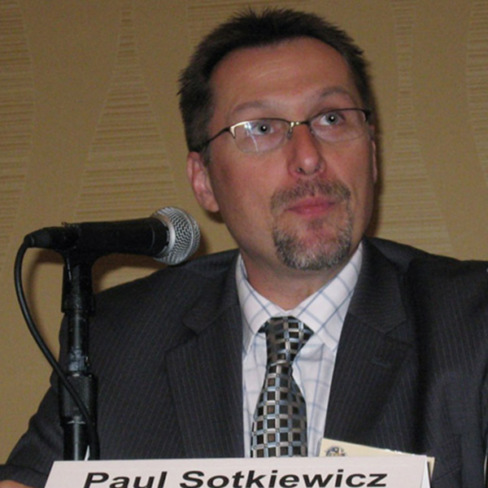
Paul Sotkiewicz, E-Cubed Policy Associates | © RTO Insider LLC

Paul Sotkiewicz of E-Cubed Policy Associates asked if it would be possible for PJM to conduct similar analysis in the Multi-Area Reliability Simulation (MARS) program, which is able to be “more granular” in data than PRISM.

Rocha Garrido said PJM conducted an overall analysis several years ago of capacity benefit results using MARS, simulating several historical years. He said the resulting analysis in MARS showed to be less valuable in formulating the load model candidates, so PJM decided to continue using PRISM.

Sotkiewicz said that in light of the U.N.’s recent Intergovernmental Panel on Climate Change report that stressed that global climate change’s effects are already happening, PJM should consider re-examining its modeling methods. (See Too Late to Stop Climate Change, UN Report Says.)

He pointed to recent events in California, where the state was depending on the ability to import power from its neighbors to cover shortages, but the exporting states were having their own energy issues with high peaks.

A similar scenario could happen in the future on PJM’s borders, Sotkiewicz said, including sharing events with NYISO and ISO-NE to the north, MISO to the west and Southern states. He said he didn’t want to cause panic among stakeholders or suggest PJM’s proposed RSS was incorrect, but he asked if there was enough diversity in the modeling to account for regions all peaking at the same time.

“Maybe this is an opportunity for us to think very seriously about this before it becomes a major problem like it is out west,” Sotkiewicz said.

Rocha Garrido said he agreed with Sotkiewicz’s concerns and that PJM has looked at potential solutions. He said one of the issues is that PRISM doesn’t have the capability to model each of PJM’s neighbors separately and data must be inserted as a “monolithic” region that doesn’t capture the diversity of the regions.

David “Scarp” Scarpignato, Calpine | © RTO Insider LLC

Calpine’s David “Scarp” Scarpignato said he has consistently raised the peaking issue and would like to see the RTO and stakeholders come up with a solution.

In 2018, stakeholders hotly debated PJM’s proposed revisions to adjust the methodology for developing the capacity model for winter peak weeks, expressing concern about how the modifications might affect capacity procurement. (See “Adequacy Analysis Approved Despite Concerns,” PJM MRC/MC Briefs: June 21, 2018.)

Scarp also said having the historical peak load coinciding with the world nine times in the last 22 years is “pretty significant” and an issue that shouldn’t be ignored. He suggested PJM come up with a way of capturing the idea without “making it binary.”

“We can’t simply say that our modeling will assume that PJM and the world don’t peak in the same week, because that doesn’t make sense,” Scarp said. “We know from empirical data that it does peak in the same weeks.”

PJM officials agreed to continue discussions at the Resource Adequacy Analysis Subcommittee.

NYISO Stakeholders OK Tariff Changes for Right of First Refusal

The NYISO Business Issues Committee on Wednesday recommended that the Management Committee approve tariff revisions to allow transmission owners to exercise a right of first refusal (ROFR) to build, own and recover the costs of upgrades to their transmission facilities in the ISO’s public policy transmission planning process.

Under the proposed changes, TOs could exercise their ROFR even if the upgrades are part of another developer’s project selected by the ISO for cost allocation.

The BIC voted 64.91% to advance the measure to the MC, which will consider whether to recommend that the Board of Directors approve the proposal and facilitate an anticipated September filing with FERC under Section 205 of the Federal Power Act. The ISO indicated that such a filing would request a decision within 60 days after filing.

The proposal is intended to apply to the current Long Island offshore wind export public policy transmission need, said Yachi Lin, NYISO senior manager for transmission planning. The filing is anticipated to be prior to an initial draft of a viability and sufficiency assessment of the need.

FERC in April confirmed that New York TOs have a federal ROFR under the ISO’s tariff and Order 1000 for upgrades to their transmission facilities, but it declined NYISO’s request for clarification that a TO exercising such upgrade rights should be treated as the developer (EL20-65). (See FERC Confirms NYTOs’ Right of First Refusal.)

The commission left open the question as to whether a new transmission facility proposal in another developer’s Order 1000 transmission solution requires the agreement of the TO that owns the existing transmission facility, a state regulatory proceeding or a court order authorizing the decommissioning.

The proposal is principally aimed at developing a mechanism for TOs to exercise the ROFR in NYISO’s public policy transmission planning process, Lin said, but it also would enhance the information used in the evaluation and selection phase of the process.

Assessing Risk

Several stakeholders asked at what point would a TO know a cost estimate for the upgrades. Another participant asked who would bear the consequences should a transmission upgrade come in late and cause another portion of the project being developed to be delayed, which would be especially significant in the event that the developer has proposed a cost cap.

The ISO has several well defined stages in the planning process, from defining a need to requesting project proposals, through to evaluation and selection, Lin said.

“There are 10 categories of metrics for evaluation and selection, and risk is one of them, so if there is any risk to project completion, it would certainly be best if developers understand their risk and then outline the mitigation measures in their proposal,” Lin said.

Cost allocation would depend on the specifics of the relevant contract; on whether a developer proposed a hard cost cap for its own capital costs and included that in the contingency; or if the developer negotiated a soft cap that included cost-sharing with ratepayers, said Carl Patka, NYISO assistant general counsel.

“If the developer wants to argue that, ‘well these are circumstances beyond my control completely, and I should be released from the obligation of my hard cap or my soft cap,’ they can make an argument, but I can’t predict for you today how that would come out at FERC,” Patka said.

Implementation Details

The current tariff provisions call for NYISO to enter into a development agreement with the selected developer, whether or not it is a TO, which under the proposed revisions is referred to as the “designated entity,” said Brian Hodgdon, NYISO senior attorney.

“The NYISO is treating the developer and TOs that exercise their right of first refusal comparably in regard to the development agreement,” Hodgdon said. “Whoever will be developing a selected public policy transmission project or a portion of it will have to enter into a development agreement now, and as we propose in the future, we would just be using the term ‘designated entity.’”

NERC Board of Trustees/MRC Briefs: Aug. 12, 2021

Standards Actions Approved

At its quarterly open meeting on Thursday, NERC’s Board of Trustees gave its assent to a cybersecurity standards project, as well as changes to the organization’s Rules of Procedure (ROP).

First up was Project 2019-02 (Bulk electric system cyber system information access management), comprising two new standards: CIP-004-7 (Cyber security — personnel and training), and CIP-011-3 (Cyber security — information protection).

The project began in May 2019 with the goal of clarifying “the CIP [Critical Infrastructure Protection] requirements related to BES cyber system information (BCSI) access [and allowing] for alternative methods, such as encryption, to be used in the protection of BCSI.” The new standards allow registered entities to use third-party services such as cloud storage, while establishing protections that entities using such services are expected to implement.

NERC’s ROP revisions apply to section 300 (Reliability standards development), Appendix 3B (Procedure for election of members of the Standards Committee) and Appendix 3D (Development of the registered ballot body (RBB)). Changes include:

  • section 300: removing the list of specific functional classes to which reliability standards may apply, clarifying when entities must withdraw members of the RBB, and replacing regional entities’ obligation to provide an updated catalog of regional criteria to NERC with a requirement to make the criteria publicly available on their websites.
  • Appendix 3B: removing or updating references to obsolete NERC standards staff titles.
  • Appendix 3D: clarifying NERC’s responsibility regarding applications to join the RBB, the organization’s ability to remove individuals from the body and entities’ obligation to withdraw additional members of the RBB when more than one member is present from the same organization.

The standards and ROP revisions will be submitted to FERC for final approval.

Reliability Report Previewed

Board members also approved the 2021 State of Reliability Report and the 2021 ERO Reliability Risk Priorities Report.

The State of Reliability Report is released each year to provide an analysis of the overall health of the bulk power system, identify performance trends and emerging reliability risks, and measure the success of mitigation activities. John Moura, NERC’s director of reliability assessment and performance analysis, said that while “fundamental day-to-day reliability operations are improving,” last year still revealed numerous areas for improvement in the BPS.

“The unprecedented stressors in 2020 challenged the system’s resilience, and we think that really puts into focus the need to plan the system with greater priority around energy assurance requirements and extreme weather conditions,” Moura said. Stresses to the system included the COVID-19 pandemic and extreme weather events such as February’s winter storms that impacted much of the Midwest and Texas. The full report is scheduled to be released next Tuesday.

The Reliability Risk Priorities Report is published every two years with the goal of informing regulators, policymakers and industry on existing and emerging risks, as well as proposed and implemented mitigation strategies. This year’s report identifies 11 major areas of risk, including a changing resource mix, cybersecurity vulnerabilities and extreme natural events. This is one fewer than the previous report, released in 2019; the list was enlarged through the addition of electromagnetic pulses. (See ‘Interdependencies’ Joins RISC’s List.)

Future Meetings Still Uncertain

The locations of future MRC and board meetings are still up in the air because of the recent surge in COVID-19 cases fueled by the more infectious Delta variant, DeFontes told participants during Thursday’s open meeting of NERC’s Member Representatives Committee. But November’s meetings, currently scheduled for Nov. 3-4 in Atlanta, will likely be held online.

“Our original hope and plan was that we would have some form of gathering in Atlanta for the MRC members and the board, and then the balance [of attendees] would be virtual,” DeFontes said. “But in light of the fact that we’re now seeing a resurgence … in places like Georgia where the vaccination rates are not that high, we’re now going to reconsider whether we will go to all virtual.”

For most of this year, NERC has been discussing a return to either fully in-person meetings or a hybrid model, with some attendees meeting physically while others attend virtually. (See NERC Considering Long-term Virtual Board Meeting Format.) However, management has repeatedly postponed the return of physical meetings in light of the ongoing pandemic. The organization’s offices in Atlanta and D.C. are still closed but will reopen for a limited number of staff after Labor Day. (See ERO Entities Remain Cautious on Return to Office.)

DeFontes said a final decision on the November board meeting will probably come “shortly after Labor Day,” adding that the board is “still hopeful” that the next meeting — currently planned to be held in New Orleans on Feb. 9-10, 2022 — can be held in person.

Smaller Turbines, Custom Vessels Define Future of Great Lakes OSW

Lake infrastructure, supply chains, viewshed and airspace considerations all point to an ideal turbine size of 6 MW for Great Lakes wind development, according to Walt Musial, manager of offshore wind at the U.S. Department of Energy’s National Renewable Energy Laboratory (NREL).

“Probably the biggest determining factor in what kind of turbines could be feasible in the Great Lakes is the limitations and constraints on vessels and how big of a vessel can come through the locks on the St. Lawrence [River],” Musial said Tuesday during a public webinar on New York’s Great Lakes wind power feasibility study.

Vessels would have to enter the Gulf of St. Lawrence from the Atlantic Ocean and pass through the channels and locks that make up the St. Lawrence Seaway to enter Lake Ontario.

NREL’s survey of traditional vessels that are performing offshore wind project installations found that those vessels are too big for the seaway system, Musial said.

As an alternative, NREL is looking at the custom design of a heavy-lift barge used for building the Windpark Fryslan in an inland bay in the Netherlands, where shallow waters prohibit passage of traditional installation vessels.

“You take several large barges that can fit through the locks or can be built on the lakes and assemble them by fastening them together and then moving a large crane onto that platform,” Musial said.

The size of the barge and the port capabilities in the area will limit the wind turbine sizes that developers could use for projects on the lakes.

GE’s 12-MW to 14-MW Haliade X wind turbine, which offshore wind developers on the U.S. East Coast plan to use, will be too big to put on the lakes, Musial said.

Great-Lakes-Study-(NYERDA)-Alt-FI.jpg
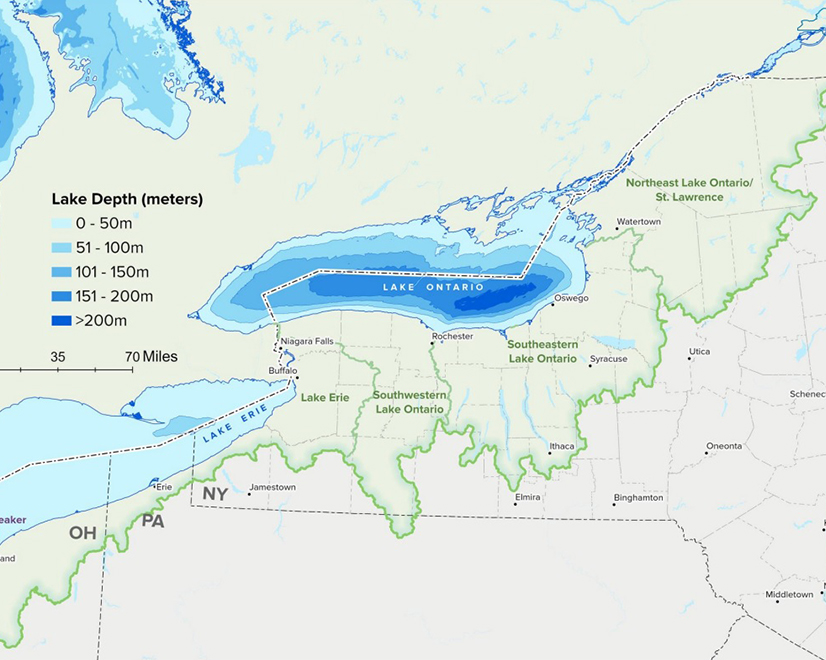
This regional snapshot shows the depth contours of Lake Erie and Lake Ontario, as well as neighboring countries, states and other areas, as they relate to New York Great Lakes Wind Feasibility Study. | New York State Energy Research and Development Authority

Instead, GE’s 6-MW Cypress wind turbine would be ideal, he said. It’s comparable to the GE 6-MW Haliade 150 wind turbines used for the Block Island Wind Farm. The Cypress has a 164-meter rotor diameter and maximum hub height of 167 meters. By comparison, the 12 MW Haliade X has a 220-meter rotor diameter and 248-meter hub height.

“There’s probably a dozen different turbine types that could be used, that would be big enough to achieve the economics we need, but small enough to meet the requirements and the limitations of the lake infrastructure,” he said.

The supply chain for 5-MW to 6-MW turbines, he added, will be easier for developers to access than offshore turbine supply chains. And the smaller size turbines will better accommodate viewsheds and regulated airspace for the lakes.

At 6-MW, he said, one wind turbine can produce enough energy in a year to power 2,800 New York homes.

Musial, along with representatives of Brattle Group and Advisian Worley Group, presented initial findings to the public on Tuesday for the ongoing feasibility study.

Last fall, the New York Public Service Commission directed the New York State Energy Research and Development Authority (NYSERDA) to identify the viability of Great Lakes wind energy as a resource. (See NY Kicks Off ‘Dynamic’ Great Lakes Wind Study.)

Final results of the study are expected by the end of the year or early next year, said Sherryll Huber, project manager for offshore wind contracts at NYSERDA. The study scope includes Lake Erie, Lake Ontario and New York communities along the shorelines.

Regulators will use the study to determine next steps, which Huber said could include no further action, directing procurement of full wind projects or commissioning an additional study or a pilot project.

Permitting Pathways

Great Lakes wind projects would have unique permitting structures compared with the regulatory environment for projects sited in the Atlantic Ocean, according to initial findings for the study from Advisian.

“Under the Submerged Lands Act, all of the waters of the Great Lakes that are between the New York coastline and the international boundary with Canada are the territorial waters of the state of New York,” Andrew Krieger, offshore wind energy specialist at Advisian, said during the meeting. In addition, the lands under territorial waters are state property.

Some of the projects could abut the border with Canada, requiring consideration of existing agreements at the national and state levels, Krieger said.

Advisian has identified 14 major federal and state consultations, permits and authorizations that would be necessary to build a Great Lakes wind project. In addition to considerations for protected species, vessel navigation and airspace, for example, Krieger said New York would have to issue an easement for the submerged land in the lakes.

There also will be several permitting pathways for projects, depending on project size or funding structure. In New York, for example, larger projects might trigger expedited review under the state’s new 94-C review process. And at the federal level, various agencies might lead National Environmental Policy Act review based on whether the federal government is funding a project.

Advisian will include a permitting chart in the final study to show integration points between the different federal agencies, information flows between developers and authorizing entities, and opportunities for public participation.