MISO: No Choice but to Double Up on 841 Compliance

MISO is priming its aging market system platform to host energy storage offers by mid-2022 but still warns that compliance with FERC Order 841 poses a risk to the market system’s replacement.

FERC in July issued without comment a second refusal to give MISO until 2025 to fully bring storage into its markets under Order 841 (ER19-465-005). The RTO had sought rehearing on the commission’s first extension denial. (See FERC Rejects MISO Request for 2nd Order 841 Delay.)

The grid operator still argues that its June 6, 2022, compliance deadline will postpone the launch of a $145-million overhaul of its market platform because the software will have to twice build a storage participation model.

Jeff Bladen, MISO’s executive director of digital strategy, told stakeholders Thursday that staff will try their best to launch a storage participation model alongside the new market platform.

“We’re doing everything we can to accelerate it based on stakeholder ask,” Bladen said during a Market Subcommittee teleconference. “We want all these deferred market products online sooner rather than later.”

Bladen warned that MISO will be building a participation model twice on two separate platforms.

“We are full steam ahead to build the storage model twice — once on the legacy system and again on the new system,” he said. “Right now, we see us on schedule, and we’re doing everything we can to get the electric storage resource launched by the [second quarter] of next year.”

MISO is slated to migrate to its new market platform in late 2024 or 2025, but Bladen said building the energy storage participation model twice might threaten that timeline.

He said the RTO “could not uncover, after many months of exploring,” any way around two full software builds of the participation plan.

Clean Grid Alliance’s Natalie McIntire thanked MISO for sticking to its original timeline after FERC’s second rejection.

“There are, I believe, at least 7,500 MW of energy storage in the MISO interconnection queue,” McIntire pointed out.

She said one reason storage development has faltered in the grid operator’s footprint is because storage owners lack “robust” participation rules and clear financial incentives to bring storage to market.

“In my mind, it’s sort of a chicken and egg problem,” McIntire said. “Once this market model and Order 841 compliance is complete, you’re going to see a lot more of it. Just because you don’t see it now, doesn’t mean there’s not a lot of it behind the dam.”

Staff is still pondering how a storage asset designated to solve transmission issues can also provide market services. That work is separate from Order 841 compliance.

MISO adviser Michael Robinson drew parallels between storage functioning in both the markets and transmission realms to an exchange between Alice and Humpty Dumpty in Lewis Carroll’s “Through the Looking Glass.”

“When I use a word, it means just what I choose it to mean — neither more nor less,” he said, quoting Humpty Dumpty. He added Alice’s reply: “The question is whether you can make words mean so many different things.”

Robinson said storage as transmission assets will probably wait before being called on for transmission purposes. “They could sit idle a long time, so let’s enhance the value-stacking,” he said.

Storage serving as transmission assets must enter the interconnection queue before participating in the markets, Robinson said. He also said storage assets, when charging, will be affecting locational marginal prices and the energy imbalance.

MISO is also drafting a workplan on how it will redefine its markets to manage a changing resource mix and more intense weather. (See MISO Begins Pondering Future Market Changes.)

“The idea is to be able to articulate and describe the needs of the system,” Senior Manager of Policy Studies Jordan Bakke said.

Bakke said the RTO will produce a report on evolving market needs by the end of the year.

Biden Executive Order Sets 50% EV Goal by 2030

President Biden on Thursday set the nation on the road to electric cars and trucks, announcing in an afternoon press conference outside the White House that the administration has set a target of 50% of cars sold in 2030 be electric or hybrid electric.

In the last several years, annual new car sales have averaged about 17 million. EV now account for about 2% of annual sales, and heavy-duty battery electric trucks are only in the prototype phase, making the presidential order one that few auto industry analysts believe can be reached.

The transportation sector of the nation’s economy is responsible for 29% of greenhouse gas emissions, the largest of any single sector, according to EPA.

The White House also announced that EPA and the Department of Transportation are continuing to work to set new corporate vehicle emission and fuel efficiency standards to replace the Trump administration’s rollback of standards set by the Obama administration.

The EPA under former President Barack Obama had called for efficiency standards to increase 5% annually through 2023. President Donald Trump’s EPA then reduced that increase to 1.5% annually. The agency on Thursday said it would increase the standards by 10% in 2023 and then 5% each year through 2026, for a corporate average of 54 mpg by that year. The agency is also working on new truck emission standards.

The administration’s EV plan includes a tax provision to motivate buyers. It would boost  the current $7,500 tax rebate to $12,500 for vehicles assembled in the U.S. in plants that meet certain labor standards. After five years, the full $12,500 would apply to vehicles that are either union-made or continue to meet “focused labor standards.”

In his remarks, the president framed his message largely in terms of global hegemony rather than one of combating climate change by decarbonizing transportation, a theme that Energy Secretary Jennifer Granholm has stressed for weeks in a series of public events. And when the president did mention climate, it was in the context of job creation.

“We’re in competition with China and many other nations for the 21st century,” Biden said. “To win, we’re going to have to make sure the future will be made in America. There’s no turning back. The question is whether [we] will lead or fall behind in the race for the future. It’s whether we’ll build these vehicles and the batteries … in the United States, [or] have to rely on other countries for those batteries. …

“Right now, China … is one of the largest and fastest growing electric vehicle markets in the world. And a key part of an electric vehicle is the battery. Right now 80% of the manufacturing capacity for these batteries is done in China.”

Noting that the infrastructure bill now pending in Congress would foster the building of 500,000 electric charging stations across the nation, Biden also said that the legislation would allow the government to fund the “retooling” of the nation’s manufacturing infrastructure through grants and loans.

We “are going to boost our manufacturing capacity [with] grants to kickstart new battery parts production, loans and tax credits to boost manufacturing … these clean vehicles. … This will help innovate manufacturing build the supply chains for batteries, semiconductors and those small computer chips that electric trucks and cars are going to be even more reliant upon as we move forward.”

Standing beside the president, Bernie Ricke — president of UAW Local 600, which represents auto workers in southeast Michigan — opened the press conference following Biden’s speech. Top national UAW labor leaders; executives from General Motors (NYSE:GM), Ford (NYSE:F) and Stellantis; and Democratic lawmakers gathered to hear the president.

The automakers issued a joint statement in support of the president’s goals.

“Today, Ford, GM and Stellantis announce their shared aspiration to achieve sales of 40 to 50% of annual U.S. volumes of electric vehicles (battery electric, fuel cell and plug-in hybrid vehicles) by 2030 in order to move the nation closer to a zero-emissions future consistent with Paris climate goals,” they said. “Our recent product, technology and investment announcements highlight our collective commitment to be leaders in the U.S. transition to electric vehicles. …

“With the UAW at our side in transforming the workforce and partnering with us on this journey, we believe we can strengthen continued American leadership in clean transportation technology through electric vehicle innovation and manufacturing.”

BMW, Ford, Honda, Volkswagen and Volvo also issued a joint statement.

“We were proud to stand with California to establish progressive new greenhouse gas regulations, and we remain committed to leading the industry in fighting against climate change. That’s why we support the administration’s goal of reaching an electric vehicle future and applaud President Biden’s leadership on reducing emissions and investing in critical infrastructure to achieve these reductions,” they said.

UAW President Ray Curry issued a separate statement in support and echoing Biden’s concerns about global competitors.

“We are at a critical time for the auto industry as countries compete to build the vehicles of the future. We are falling behind China and Europe as manufacturers pour billions into growing their markets and expanding their manufacturing. We need to make investments here in the United States,” he said.

“EEI and our member companies … commend the Biden administration for proposing new rules to help reduce emissions from passenger and other light-duty vehicles,” Edison Electric Institute President Tom Kuhn said. “We are committed to working with President Biden and other leaders across the administration to help build the electric vehicle charging infrastructure we need to accelerate the electrification of the transportation sector and reduce vehicle emissions.”

Utilities Urged to Prepare for Cold Weather Standards at NAES-NERC Conference

Cold weather preparedness loomed large over this year’s NAES-NERC Conference, with panelists taking time during the event this week to discuss the implementation of the ERO’s recently approved cold weather standards despite their enforceability being more than a year away.

The three-day conference was sponsored by  NAES, an engineering firm that helps generators, transmission owners and others comply with NERC’s reliability standards. The theme for this year’s virtual event was “Guiding Compliance: Improving Reliability.”

Events of this year lent a special urgency to the discussions, as presenters returned repeatedly to the winter storms of February that caused massive outages in Texas and the Midwest. (See ERCOT: Grid was ‘Seconds and Minutes’ from Total Collapse.)

“We had people [in Texas] that were not experienced in freeze protection, cold weather operation measures or anything like that when temperatures get that cold,” said Richard Schlottmann, senior NERC reliability specialist at NAES. “And that led to significant damage in broken piping systems that froze … which then in turn caused scheduled delays and increased costs for repairs to systems and equipment. It was one of those things where if you’ve been in it, you take it for granted, [but] you have to realize that what seems common sense to you is not really common in areas that don’t experience those things.”

The Texas freeze didn’t lead directly to NERC’s new cold weather standards, which began development in 2019, but it did prompt the organization to accelerate the project’s development in March. (See NERC Cold Weather Team to Seek Faster Finish.) NERC’s Board of Trustees approved the new standards — EOP-011-2 (Emergency preparedness and operations), IRO-010-4 (Reliability coordinator data specification and collection) and TOP-003-5 (Operational reliability data) — clearing the way for submission to FERC for approval. (See NERC Board OKs Cold Weather Standards.)

Urban Pushes Preparedness Plans

Although the new standards will not take effect for 18 months after FERC accepts them, Don Urban — principal analyst at ReliabilityFirst who served on the standard drafting team for the cold weather project — urged utilities to become familiar with their requirements so as not be caught flat footed when they do become enforceable. Urban’s presentation focused on EOP-011-2, which requires responsible entities to develop plans “to mitigate operating emergencies.”

Reviewing the “core elements” mandated by the new standard, Urban noted that the requirements for weatherization procedures are relatively broad. The standard allows utilities a degree of freedom in implementing plans that work for them, whether they are part of a standard seasonal checklist or a “totally separate procedure” applying to oncoming cold weather situations.

“I’m not a big fan of checklists,” Urban joked. “We had one entity [that] had so many checks it was unbelievable, and thank God I wasn’t the one making the rounds to check those things off. But we’re seeing some pretty comprehensive checklists; whatever works out there, that’s what you do.”

Though it was not part of the standard, Urban also advised that utilities establish a list of critical equipment and instrumentation, explaining that knowing ahead of time which equipment is most essential could help utilities to direct resources in an emergency. He also emphasized the importance of establishing an accurate idea of the conditions that facilities are able to tolerate.

“It’s surprising … there’s some facilities that still don’t know what their minimum design temperature is, or the [balancing authority] is not aware of that,” Urban said. “So we have all these options here to determine what was best for the facility; pick one of those, make sure it’s an accurate temperature and provide it to your BA.”

Urban’s presentation focused mainly on the risks to thermal generating facilities, leading some participants to question the new standard’s applicability to hydroelectric generation. In response Urban acknowledged the omission but said the team had decided to focus its efforts where it saw the biggest challenge at the moment.

“We’ve been fortunate hydro hasn’t been a problem so far,” Urban said. “We tried to target the generation that has higher risk in our footprint right now, but I think we’re going to reassess that … and maybe hydro will be rolled into the next go-around.”

Dixie Fire Explodes, Burns Historic Town

The Dixie Fire, a massive wildfire that Pacific Gas and Electric equipment is suspected of causing, exploded overnight and destroyed the historic gold rush town of Greenville, Calif., home to 1,000 residents, as it moved toward more populated areas.

Known for its Old West-style Main Street, Greenville lies 20 miles northeast of Paradise, a town of 27,000 residents destroyed by the PG&E-caused Camp Fire in November 2018.

“We lost Greenville tonight,” U.S. Rep. Doug LaMalfa (R-Calif.), who represents the area, said in an emotional video posted to Facebook. He lamented the continuing loss from the fires that have plagued the state in the past five years.

Driven by strong winds, the Dixie Fire grew by 20,000 acres to more than 322,500 acres on Wednesday and Thursday, making it the sixth largest fire in state history. It has destroyed 400 structures, but no deaths have been reported, the California Department of Forestry and Fire Protection (Cal Fire) said.

Firefighters and aircraft had “aggressively attacked large flame fronts in an effort to defend structures [Wednesday night],” the U.S. Forest Service said. “As fire entered the Greenville area, firefighting efforts shifted to assist law enforcement in evacuation efforts. A damage assessment team is being requested to evaluate damage in the Greenville community.”

Initial reports showed that about 75% of the town’s structures were destroyed, the Forest Service said.

The fire pushed Thursday toward Chester, a town of more than 2,000 residents on the west shore of Lake Almanor, a popular summer spot surrounded by homes. Thousands of residents had to evacuate as the fire approached.

“A red flag warning remains in effect today through 8 p.m. [Thursday],” the Forest Service said. “Extreme fire behavior with long range spotting, crown fire and group torching is anticipated.”

PG&E’s Possible Role

The Dixie Fire began on July 13, near where a tree had fallen onto a PG&E distribution line in the rugged Sierra Nevada foothills.

Cal Fire seized PG&E equipment as part of its investigation, which is ongoing. (See PG&E Says Its Line May Have Started Dixie Fire.)

The utility said in its second-quarter 10-Q report to the U.S. Securities and Exchange Commission on July 29 that it would likely face new liabilities from the Dixie Fire, with potentially serious consequences for the struggling company.

Dixie-Fire-in-Greenville-Calif-(US-Forest-Service-Lassen-National-Forest)-Alt-FI.jpg
The Dixie Fire burned near Greenville, Calif., on Wednesday. | U.S. Forest Service/Lassen National Forest

“While the cause of the 2021 Dixie Fire remains under investigation and there are a number of unknown facts surrounding the cause … the utility could be subject to significant liability in connection with this fire,” the report said. “If such liability were to exceed insurance coverage, it could have a material impact on [PG&E’s] … financial condition, results of operations, liquidity and cash flows.”

PG&E emerged from bankruptcy in July 2020, after a reorganization that included giving 22% of its shares to a trust for fire victims.  

The state’s largest utility was blamed for catastrophic wildfires in 2015, 2017 and 2018 that cost it tens of billions of dollars. The blazes included the Camp Fire, the state’s deadliest and most destructive wildland blaze, which killed at least 84 residents and leveled Paradise.

PG&E pleaded guilty to 84 felony counts of involuntary manslaughter in the fire.

PG&E equipment is suspected in major fires in 2019 and 2020, including the Kincade Fire in Sonoma County, for which it is being criminally prosecuted. (See Prosecutors Charge PG&E for 2019 Kincade Fire.)

It now faces charges in last year’s Zogg Fire, which killed four residents of rural Shasta County. (See PG&E Faces New Criminal Charges, Wildfire Liability.) The fire was caused by a pine tree falling on a PG&E line, Cal Fire determined.

DC Circuit Sides with Public Citizen over 2015 MISO Capacity Auction

The D.C. Circuit Court of Appeals on Friday handed Public Citizen a win in the consumer advocate’s yearslong battle against the expensive Southern Illinois capacity price produced in MISO’s 2015/16 capacity auction.

The court said FERC’s repeated decisions to uphold Zone 4’s $150/MW-day clearing price were arbitrary and capricious because they lacked explanation (20-1156).

FERC last May turned down a final rehearing bid from Public Citizen to change the price. It said clearing prices aren’t unjust simply because they are “higher than expected.” (See FERC Shelves Grievances over MISO Capacity Auction.) The D.C. Circuit blasted FERC’s logic as an “anodyne statement” and remanded the case to the commission.

The commission in 2019 closed a three-year investigation into the auction when it ruled that the RTO’s Zone 4 clearing price was just and reasonable, declining to set up an evidentiary hearing. It concluded pivotal supplier Dynegy (now Vistra by way of merger) had not withheld capacity to induce a price spike in Southern Illinois.

However, FERC didn’t make any details of its investigation public, prompting criticism from now-Chairman Richard Glick, who argued that the investigation was closed prematurely and indicated that there was evidence that Dynegy manipulated auction prices.

“Because the details of the investigation remain nonpublic, I cannot explain why I believe that [then-Chair Neil Chatterjee] erred in terminating the enforcement process. Suffice it to say that I am confident that the evidence uncovered in that investigation was more than sufficient to press ahead,” Glick wrote.

The D.C. Circuit seized on the incomplete details surrounding FERC’s analysis and investigation, agreeing with Public Citizen that commission didn’t offer a proper justification to support its decision that nothing anticompetitive occurred.

“The commission failed to adequately explain why the problems it identified in the existing auction rules affecting pricing — problems it ordered fixed going forward — did not also affect the fairness of the 2015 auction itself. That omission is particularly glaring in light of the starkly anomalous rates that the auction produced. Based on the unwonted record before the commission and the multiyear commission investigation into market manipulation that record prompted, the agency’s conclusory and unreasoned decision to sustain the 2015 auction rates does not hold up,” the court said.

Soon after the auction, FERC found MISO’s circa-2015 market power provisions flawed and ordered the RTO to reset its $155.79/MW-day maximum bid to about $25. It also directed MISO to better gauge power exports. But FERC said those new policies were to be viewed on a going-forward basis and wouldn’t impact the 2015/16 auction. (See FERC Orders MISO to Change Auction Rules.)

The court admitted it lacked the power to review FERC’s decision to close its market manipulation investigation and could not force the commission to reopen it.

“In short, under the Federal Power Act, we cannot review either the commission’s discretionary decision to close its Section 222 investigation into Dynegy or the fleeting explanation the commission gave for its action,” it said. “Public Citizen fares better with its argument that the commission failed to explain adequately its conclusion that the results of the 2015 auction for Zone 4 were just and reasonable.”

The court said FERC “fell far short of the type of reasoned explanation that the law requires” and conveyed skepticism that MISO was free to apply no-longer-valid opportunity-cost assumptions to the auction in question but not future ones.

“Most notably, the commission failed to reconcile its prospective holding that the tariff could no longer protect against anticompetitive behavior with its conclusion that the conspicuously uneven 2015 results — obtained under the same flawed tariff terms — were not similarly infected,” it said.

The court also said the “generic” assertations FERC offered in its orders were no match for the explanation that the soaring prices warranted.

“The clearing price was not just higher but was massively higher than the rates in every other zone, and substantial evidence in the record raised the question of a market failure. What this record required was nothing more and nothing less than a reasoned assessment of the evidence as a whole,“ the court wrote. “On top of that, the commission’s breezy analysis overlooks that a market participant could abide by a transmission organization’s tariff and still manipulate the market.”

While the court concurred with Public Citizen that FERC’s explanation left much to be desired, it disagreed with the group’s contention that the commission had a duty to examine capacity prices for reasonableness before they go into effect.

“That is not what the market-based rate scheme requires,” the court said.

Vistra announced last year it would close its remaining coal-fired power plants in Illinois over the decade, idling units at its Joppa, Kincaid, Baldwin and Newton plants.

Glick claimed vindication after the ruling. “As I said in my dissents from the underlying orders, there was no excuse for the commission’s failure to grapple with Public Citizen’s serious allegations of manipulative conduct or the ‘unusual magnitude of the rate increase and its incongruity with other rates within the same auction,’” he said in a statement Friday.

“I continue to believe deeply in competitive markets, but those markets can produce just and reasonable results and deliver fair rates for customers only if they are free from manipulation. Accordingly, protecting those markets must remain one of the commission’s paramount responsibilities,” he added. “The D.C. Circuit has told the commission, on several recent occasions, that it needs to do a better job interpreting its statutory responsibilities, and I intend for the commission to follow that directive.” (See related story, DC Circuit Sends LNG Approvals Back to FERC.)

PPL Announces Net-zero Goal by 2050 in Q2 Call

PPL (NYSE: PPL) said Thursday that it plans to reach net-zero carbon emissions by 2050, bumping up its original timeline by a decade.

In a call to discuss second-quarter earnings, CEO Vincent Sorgi said the company is on track to reduce carbon emissions to 70% below 2010 levels by 2035 and 80% below by 2040. Sorgi said PPL’s new net-zero emissions goal and interim targets are based on the company’s updated forecasts, analysis and business planning.

But Sorgi said the company will need breakthroughs in advanced technologies to achieve total net-zero emissions by 2050, which is why PPL is also focusing on research and development in clean energy technologies.

PPL recently announced a $50 million investment with global consulting firm Energy Impact Partners to work with other energy companies and entrepreneurs to develop sustainable technologies.

“PPL is fully committed to driving innovation to enable net-zero carbon emissions by 2050 and to ensure a balanced, responsible and just transition for our employees, communities and customers as we advance towards our clean energy goals,” Sorgi said. “Our new goal reflects our continuous evaluation of our progress and opportunities through ongoing business and resource planning efforts.”

Energy Mix

Sorgi said PPL is completing an updated, scenario-based climate assessment, evaluating the potential impacts to PPL from climate change and potential future regulations regarding carbon emissions around the country. The company’s last climate assessment report was released in 2017, Sorgi said. The updated report, slated to be released later this year, will analyze new climate scenarios such as limiting the global temperature increase to no more than 1.5 degrees Celsius.

Sorgi said PPL’s climate assessment efforts are considering current integrated resource planning (IRP) activities occurring at its Kentucky-based subsidiaries, LG&E and KU Energy. The companies are set to file their IRPs with the Kentucky Public Service Commission in October.

Based on the most recent rate case filings in Kentucky, Sorgi said, PPL expects to achieve a 70% reduction in its coal-fired capacity by 2035, 90% by 2040, and 95% by 2050 compared with 2010 baseline numbers. The 550 MW of coal-fired generation remaining in 2050 will consist of Trimble County Generating Station Unit 2, which started commercial operation in 2011 and uses clean technologies.

“Our internal view of what it could take to achieve 100% carbon-free generation by 2035, as proposed by the Biden administration, using current technologies would create significant affordability issues for our customers,” Sorgi said. “Our new commitment to achieve net-zero carbon emissions by 2050, is backed by the actions that we are and will continue to take to support a low-carbon energy system that is affordable and reliable, and provides the time needed for the technology to advance.”

UK and RI

Besides the clean energy measures, Sorgi gave an update on the sale of PPL’s U.K. utility, Western Power Distribution (WPD), and the purchase of National Grid’s Narragansett Electric in Rhode Island. (See PPL to Sell UK Business, Acquire Narragansett Electric.)

Finalized in June, the sale of WPD to National Grid netted $10.4 billion for PPL. The sale allowed PPL to retire $3.5 billion in corporate debt, and the company is examining uses for the rest of the funds, including investments in Pennsylvania and Kentucky operations or renewable energy projects and the repurchasing of company shares.

PPL expects to repurchase about $500 million of its shares by the end of the year, Sorgi said, with the company’s board of directors recently authorizing the purchase of up to $3 billion of outstanding shares. He said the board settled on the $500 million figure because it “struck a nice balance” and provided the company “financial flexibility” to continue examining other options for the money.

Sorgi said PPL is close to completing the $3.8 billion acquisition of Narragansett Electric from National Grid, with the deal expected to close by March or sooner based on final regulatory approvals. PPL is waiting for approval by FERC and the Rhode Island Division of Public Utilities and Carriers; an exact timeline for the approval has not been finalized.

“As we pursue the final regulatory approvals, we are working closely with National Grid on transition planning to ensure a seamless transition for Rhode Island customers and Narragansett employees upon closing,” Sorgi said.

Earnings

PPL reported second-quarter earnings of $19 million ($0.03/share), compared with $344 million ($0.45/share) a year earlier. The company reported a net loss of $1.82 billion (-$2.37/share) for the first six months of 2021, compared with earnings of $898 million ($1.17/share) during the same period last year.

Special items in the second quarter included a U.K. tax rate change and a loss on the early extinguishment of debt, which was partially offset by earnings from the operations of the U.K. utility business prior to the completion of its sale in June, CFO Joseph Bergstein said.

PPL posted revenue of $1.29 billion during the quarter, nearly the same as in 2020.

The price of PPL’s shares was up at the close of the market on Thursday, gaining 43 cents to $28.86.

Exelon CEO: Looming Nuclear Plant Closures will be ‘Irreversible’

Exelon (NASDAQ:EXC) CEO Chris Crane opened the company’s second quarter earnings call on Wednesday by announcing the impending closure of two Illinois nuclear plants and a new target for cutting operational greenhouse gas emissions.

Proposed federal and state legislation to provide financial support for nuclear plants will not delay or defer the shutdowns of the Byron and Dresden plants, which could result in thousands of job losses for the state economy, Crane said. “We don’t want to close these plants, but we cannot make decisions based off of legislation being passed in the future.”

Crane-Chris-2019-06-11-RTO-Insider-FI.jpg
Exelon CEO Chris Crane | © RTO Insider LLC

With shutdowns possibly “only weeks away,” he said, “it will take many years … to add enough intermittent renewable energy to get to where Illinois is [now] in terms of clean energy production. In the meantime, more than 100 million metric tons of additional carbon will be emitted over the next decade.”

The company also said it will cut operational GHG emissions by 50% over 2015 levels by 2030. Crane said the company would use “robust energy efficiency programs,” electrify the company’s light-duty fleet and develop “zero-carbon alternatives” for medium- and heavy-duty vehicles, along with investing in new equipment and processes to cut emissions from its gas plants and operations.

The company will also pilot new, low-carbon grid technologies and advocate for affordable grid decarbonization, he said. In addition, it has joined the Electric Highway Coalition, a group of 14 utilities working to deploy a “seamless network” of electric vehicle fast chargers on major highway systems across the country. The company has set a net-zero target for 2050.

Crane said hopes for a last-minute rescue for the Byron and Dresden nuclear plants have dimmed due to the slow progress on federal and state legislation. The bipartisan infrastructure bill moving through Congress contains $6 billion in funding to prop up existing nuclear plants that have been unable to compete against cheaper natural gas plants and solar and wind energy.

Path-to-Net-Zero-by-2050-(Exelon)-Content.jpg
Exelon’s Path to Net Zero by 2050 | Exelon

Another possibility is a nuclear production tax credit, said Kathleen Barrón, executive vice president for government, regulatory affairs and public policy, who noted the Democratic reconciliation bill could include a federal Clean Energy Standard that would also benefit nuclear. But, echoing Crane, she said everything is speculative at this point.

 A clean energy bill in Illinois also contained help for the state’s nuclear plants but has been stalled due to unrelated labor issues, Crane said.

The CEO said that once the plant shutdown process starts, it is irreversible. “You shut down, you cool down, you disassemble the reactor,” he said. “You offload all of the fuel into the spent fuel pool, and you relinquish the license to the Nuclear Regulatory Commission, and there is no path back from that. There is no regulatory path back.”  

Strong Quarter

Adjusted-Operating-Earnings-per-Share-for-Q2-2021-(Exelon)-Content.jpg
Exelon Adjusted Operating Earnings per Share for Q2 2021 | Exelon

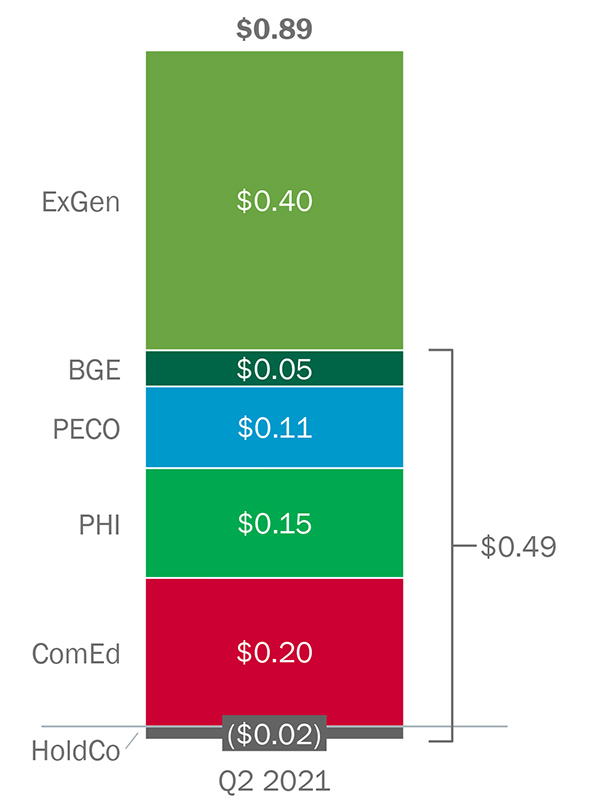
The financial results for the quarter were mixed. Chief Financial Officer Joseph Nigro reported non-GAAP adjusted earnings of $0.89/share, versus $0.55/share for the same quarter in 2020. GAAP earnings were $0.41/share, a drop from $0.53/share reported in the second quarter of 2020.

Total operating revenue for the quarter was $7.9 billion, with a net income of $401 million, according to a Form 8-K Exelon filed with the Securities and Exchange Commission on Wednesday. Nigro also said the company is still on target to meet its full 2021 earnings predictions of $2.60 to $3/share.  

The higher adjusted earnings were “driven in part by the absence of storm costs at Exelon utilities and the recovery of costs associated with ongoing investments to improve reliability and service for customers,” Nigro said, noting that the company was successful this quarter in partially recouping its first quarter losses from the winter storms in Texas.

The generation side of the business also had a strong quarter, he said, “due to unrealized and realized gains on Constellation’s technology venture investments, fewer planned nuclear outage days and realized gains in our nuclear decommissioning trust funds.” Exelon subsidiary Constellation NewEnergy Inc. is a retail power supplier of natural gas and clean energy.

Analyst Q&A

Stephen Byrd of Morgan Stanley asked for more detail on the company’s response to its losses in Texas and the ongoing discussions in the state about the changes needed to prevent future catastrophic outages.

“The plants in Texas were never designed for the weather that we saw and especially the duration of the weather that we saw,” Crane said. “So, if we go to something much lower in temperature as a design basis, we have to look at what adequately would preserve the piping. Is it insulation? Is it other types of barriers, and what’s the most economic way to get there.”

“We’ve built the model that has certain assumptions on temperature, wind speed, prolonged longevity of the weather event, that will calculate the engineering changes we need to make to the plant,” said Chief Operating Officer Bryan Hanson. “Once the weatherization standards are published and accepted in ERCOT, we can then tune that model to come up with our final outcomes and establish the price points for those plants.”

Julien Dumoulin-Smith of Bank of America asked about potential growth opportunities in the commercial and industrial sector as more and more companies set clean energy targets.

Constellation CEO James McHugh said the company already is creating products in response to customer demand,  with offtakers in the mining industry, data centers and the hydrogen business.

“They’re interested in carbon free-energy, renewable energy, and we’ve had some success in selling emission-free energy credits and other renewable type products to some of our largest C&I customers,” said McHugh. “They’re also interested in sustainability information and data around energy usage and how to be more efficient. So, there’s this burgeoning suite of different products and services that we’re working through with our team and with our customers.”

Other highlights from the call:

  • The company’s plan to split its regulated utilities and generation business, announced in February, is on track to be completed by the first quarter of 2022, Crane said.
  • On the regulatory front, Exelon’s Pepco utility won approval for new multiyear rate plans in both Washington, D.C., and Maryland, with revenue increases of $108.6 million and $52 million, respectively. Atlantic City Electric also received approval for a $41 million rate case in New Jersey.
  • Crane called attention to the company’s diversity and workforce development programs, “spanning from middle schools [and] high schools through colleges, as well as programs for work-ready, underemployed adults.” Exelon’s STEM Leadership Academy program for high school girls has started awarding full-ride two- and four-year college scholarships, which also include guaranteed internships.

Oregon Group Puts Final Touches on GHG Lands Proposal

The Oregon Global Warming Commission (OGWC) on Wednesday moved to wrap up a draft proposal to set targets for sequestering carbon in the state’s natural and working lands.

“It was very gratifying to see how much interest there is in this topic and how much engagement we were able to get,” OGWC Chair Catherine Macdonald said Wednesday during a meeting on the proposal. Macdonald, director of natural climate solutions for North America at The Nature Conservancy, noted that the draft plan generated 444 pages of public comments.

The commission includes representatives from Oregon’s Native American tribes, environmental groups, farmers and ranchers, gas and electric utilities, manufacturers and local agencies. The group was directed to develop the proposal under Gov. Kate Brown’s Executive Order 20-04, which last year required state agencies to establish measures to regulate and reduce greenhouse gas emissions in their regulatory areas. It will submit a final proposal to the governor later this month.

The draft proposal discussed Wednesday sets a tentative goal for Oregon to sequester “at least” 4 million to 7 million tons of CO2e per year in the state’s working lands and waters by 2030, over and above a 2010-2019 “business-as-usual” baseline. The target would grow to 5 to 8 MMT/year by 2050.

Those targets are tentative because of uncertainty around how much CO2 is being sequestered under current practices.

“The challenge for me is we don’t really have a clear baseline, so we don’t know whether 4 million metric tons is aggressive or not aggressive at this point, to be honest,” said OGWC member David Ford, a senior fellow with the American Forest Foundation. “I mean, we have some sense, but not really, so it’s going to be critical that, as we set a goal … [we] recognize that this isn’t the final goal, right?”

Ford said he favors creating a blue-ribbon commission to examine the issue in more depth, “because the potential might be much greater; I don’t know. But I’m looking forward to getting to that answer.”

Establishment of a blue-ribbon panel to develop an all-lands strategic plan for incentivizing climate-smart forestry “while maintaining or enhancing Oregon’s harvested wood products infrastructure” is among the recommendations in the proposal.

Finding Funding

The proposal’s key recommendations are aimed at the Oregon legislature. The OGWC advises lawmakers to position the state “to leverage federal lands and investments in climate-smart natural and working lands practices.” (More than half the land in Oregon is federally owned.) It notes “growing support” in Congress for such investments, including bills to increase funding for reforestation, incentivize farmers to carry out climate stewardship practices, “de-risk” private investments in climate-smart management practices and establish a “blue carbon” to conserve marine and coastal ecosystems.

The proposal also asks legislators to “fund and direct state agencies to take actions to advance key natural and working lands strategies.” It specifically seeks funding for the Department of Land Conservation and Development to conduct an analysis of Oregon’s statewide planning goals and “the assistance the agency provides to local governments to determine how the statewide planning goals and their implementation and support mechanisms should be enhanced to best facilitate the protection and restoration of natural and working lands to increase sequestration.”

The proposal additionally urges lawmakers to “create a sustained source of funding” to increase sequestration in state lands and waters.

At Wednesday’s meeting, commission members expressed concern that Oregon’s Department of Environmental Quality (DEQ) will not make sequestration projects eligible for funding from its Community Climate Investments (CCI) program.

That’s because the bulk of CCI funding will be used to reduce the state’s consumption of fossil fuels, DEQ Director Richard Whitman explained.

“Our rural areas of Oregon are more dependent on fossil fuel vehicles and drive further than the rest of the state,” Whitman said. Transitioning those areas to cleaner transportation will require tax credits for zero-emission vehicles, as well as investments in electric vehicle charging infrastructure, green hydrogen and alternative modes of transportation.

“We can see the pathway, but it’s going to be tough,” he said.

Whitman said the DEQ is also “frankly worried” about the state’s reliance on natural gas, which is used to heat about 40% of homes — “and that number has been growing and continues to grow.” The state’s commercial and industrial sectors are “even more dependent” on the fuel, he said.

“The main point I want to make right now is we feel responsible, given the duties that we’ve been given by the governor, for helping to make the transition [to cleaner fuels] possible and practical, and working with rural communities to help them figure out how to get off of gasoline and diesel to some degree and get more efficient and figure out cleaner ways of getting around.”

Bold, Ambitious, Practical

While the proposal found broad support in the 444 pages of submitted comments,” former OGWC member Angus Duncan said his “two antennas” went up when he saw the document’s use of the words “bold” and “ambitious” in combination with “practical,” prompting him “to wonder if words are being substituted for deeds.”

“I looked to see if the immediacy of the moment is captured in the recommendations, and while there is much to like in this draft, it does not yet to me meet the test of urgency and scale,” Duncan said Wednesday. “While there’s analytic basis in the commission’s record for a natural and working lands annual carbon-capture goal of 9.5 [million] to 15 million tons of carbon dioxide equivalent, the draft discounts these excessively by 25 to 75%.”

Duncan said the commission should at least settle on an initial sequestration goal of 9.5 MMT and adjust “down or up as the science and circumstances warrant.”

“The commission should also recommend an accelerated ramp rate to reach this goal on or before 2030, reflecting the science that says there’s no decade more important for reducing atmospheric greenhouse gases than the one we’re now entering,” Duncan said. “This would not preclude continued [timber] harvest, but we’d clearly assert that blunting climate change effects has priority over present harvest level.”

Chair Macdonald later noted that the proposal recommends that the state re-examine the sequestration targets at a minimum of every four years. “I don’t think we’re setting anything in stone, because we said that we need to update them frequently. I think if we say ‘at least,’ that indicates that we want to be more aggressive.”

“We would encourage you to be practical over being ambitious,” said Mary Anne Cooper, vice president of policy at the Oregon Farm Bureau. “Oregon cannot solve the climate crisis ourselves, and it sounds like some earlier commenters believe that we can. But if we don’t manage this right, we can effectively eliminate our ability to produce food and fiber in a sustainable way for the world, which would effectively export our industries to areas with less stringent environmental [regulations], resulting in a net negative for global climate change.”

MISO Stakeholders Demand Breather on Seasonal Auction, Accreditation

Stakeholders asked for more time during MISO’s final scheduled meeting to design a four-season capacity auction, seasonal reliability targets, and an availability-based accreditation.

Speaking during Wednesday’s Resource Adequacy Subcommittee teleconference, staff’s Scott Wright said a special stakeholder workshop in September and a RASC meeting that same month will be dedicated to drafting tariff language.

MISO says it will file a proposal with FERC at the end of September to create four independent seasonal auctions and tougher accreditation metrics. (See Discord Persists over MISO Seasonal Capacity Accreditation.)

Wright pledged an additional stakeholder workshop Aug. 19 to review the proposal.

Stakeholders said MISO’s filing timeline remains too aggressive for such a big change.

“This is completely railroaded and rammed down everyone’s throat, to be frank. We need more time on this,” Power System Engineering’s Tom Butz said.

WPPI Energy’s Steve Leovy said he was doubtful that stakeholders could gain a full understanding of the new auction design before MISO files it. “We have such a complicated framework here with accreditation, resource-adequacy hours, outage coordination and replacement requirements,” he said.

“I’m having a hard time understanding how all the pieces fit together,” said Clean Grid Alliance’s Natalie McIntire.

“We support delaying the filing so we can get it right instead of just getting it in,” the Coalition of Midwest Power Producers’ Travis Stewart said.

“All of us need to go back with this to our operators and plant operators, the people who this filing is going to affect,” WEC Energy Group’s Chris Plante said.

MISO Director of Market Design Kevin Vannoy said the grid operator’s design values resources’ contribution to reliability.

“Since 2016, roughly 75% of our emergencies have taken place outside of summer,” he said. “It’s key that we start addressing resource availability and capacity requirements outside of summer … We want to have confidence that the resources that we’re counting on are made available to us.”

MISO has been meeting with members to discuss their planning resources’ accreditation values. Its new accreditation will assign an 80% weight on a planning resource’s availability during the riskiest 3% of hours in capacity accreditation, while non-risky hours will carry the remaining 20% weight.

The RTO said if it can’t detect enough risky hours during a season for accreditation, it will supplement with a resource’s average availability during risky hours outside of the season.

The accreditation design remains a point of contention between MISO and stakeholders.

At the July 20 Entergy Regional State Committee, MISO South commissioners asked that staff consider a 60-40 weighting split for risky hours.

Entergy’s Wyatt Ellertson said his utility still doesn’t understand how MISO arrived at an 80% weight assignment. He said generation owners are always trying their best to meet demand during tight margins.

Texas Public Utility Commission economist Werner Roth said MISO sold a seasonal construct on the basis that it would better pinpoint risk in seasons. He said the plan to draw on performance during hours outside of the season for accreditation was disappointing and wouldn’t paint a true picture of seasonal risk.

David-Patton-(APPrO)-Content.jpg
MISO IMM David Patton | APPrO

MISO Independent Market Monitor David Patton criticized the RTO’s 24-hour grace period for start-up times in its accreditation as too lenient and said it should allow for only a four-hour response lead time.

“It creates the illusion of a large margin in a season,” Patton told MISO staff. “It provides too much credit to resources that are not contributing to reliability.”

Patton said that as MISO gains more renewable resources, it will be less likely to anticipate emergency conditions and could be caught off-guard with the generous lead times.

“As the system evolves, we’re going to be in a situation where the peaks are not necessarily hours we’re going to see coming 24 hours in advance. It’s like we’re trying to hang on to the old world with this 24-hour lead-time provision,” he said. “At some time, we’re going to have to acknowledge that we need a more flexible portfolio.”

MISO has also proposed that planning resource outages last no longer than 30 days during a 90-day season. Unit owners planning outages longer than a month will be disqualified from participating in a seasonal auction. If a cleared resource foresees an outage lasting longer than 30 days before the season starts, planning resources owners must procure replacement capacity for every day beyond the 30-day threshold.

Staff isn’t currently proposing any financial penalties for failure to replace capacity due to outages. The planning resources will, however, face hits to their accreditation if they fail to secure capacity replacements.

MISO will also use an existing rule that planning resource owners must notify it 20 days in advance of planned outages.

Vannoy said staff will publish the risky resource hours that accreditation will rely on months ahead of time so that generation owners can plan their outages.

Ellertson asked MISO to show generation owners the calculations behind individual resources’ accreditations so owners can see how resource hours interact with planned and forced outages.

“It’s kind of a black box to how MISO arrived at those numbers,” Ellertson said.

Minimum Capacity Requirement

MISO’s sweeping proposal also contains a new requirement that load-serving entities must demonstrate they’ve secured at least 50% of their capacity obligations prior to a season before a capacity auction.

Patton has said he disagrees with MISO’s minimum capacity requirement and has called it a solution in search of a problem that doesn’t exist. The IMM also said auction prices should motivate an adequate capacity supply.

MISO adviser Stuart Hansen said a minimum capacity requirement is a natural extension of staff’s assumption that LSEs are actively planning adequate supply to cover their obligations and not simply rely on the voluntary capacity market.

“We don’t want this to become an issue,” Hansen said.

“This is MISO throwing up its hands and saying, ‘We don’t trust the markets,’” Patton said. “It sounds very parental, to be honest …  If capacity is available [in the Planning Resource Auction], why isn’t it responsible to buy it? If you’re saying you don’t want people to rely [on the auction], you’re basically indicting your own market.”

Wright pointed out that LSEs have several checks and balances from their state authorities. He said adding one small MISO obligation wouldn’t be a burden.

“If it’s parental, so be it,” Wright said.

Patton promised to protest the filing if MISO includes the minimum capacity requirement. “If you put a flawed idea into your filing, you risk the whole thing getting thrown out,” he said.

Pilot Solar Project Proposed for Virginia’s LMI Households

About 30 low- and moderate-income (LMI) Virginia households could soon have access to their own solar power, if a pilot project proposed by the Clean Energy States Alliance (CESA) comes to fruition.

Wafa May Elamin and Nate Hausman, project directors for CESA, presented the pilot plan to the Virginia Clean Energy Advisory Board (CEAB) on July 21. Third-party leases to last 25 years would likely be the best option for these LMI households, Hausman told Net Zero Insider after the meeting, but CESA is not officially recommending that, saying instead that there should be “an open-ended financing solicitation.”

“Market economics in Virginia make it difficult for residential solar projects for LMI households to pencil out,” Hausman said during the CEAB meeting. “A fundamental precept of the program would be to guarantee that the transactions are cashflow-positive for participating LMI households,” he said afterward. “If the program ends up being structured as a leasing arrangement, that means LMI customers would save more on their electricity bills, via bill credits, from hosting a solar system than they would incur in the way of monthly lease payments to the third-party system owner.”

Hausman told NetZero Insider that the goal under the 2019 state law creating the CEAB (HB 2741) is to supply solar energy to LMI residents. Battery storage “is not contemplated” for the pilot households, he said.

As of now, the budget for the pilot program consists of $200,000 in “repurposed” federal funds from the American Recovery and Reinvestment Act, enacted during President Barack Obama’s first term. CESA was also awarded an anonymous grant to provide a year of funding to help the Virginia Department of Mines, Minerals and Energy (DMME) and CEAB develop the pilot, Elamin said. The timeline is yet to be determined, but the program will be developed in 2022 if it goes ahead. “Our overall aim is to launch a successful pilot program that can be scaled, and that will help demonstrate the case for long-term program investment and expansion,” Elamin said.

“Our goal is to provide a strong foundation for a program that could be scaled up with additional funding,” Hausman said.

The July 21 meeting followed CESA’s presentation of background market research to CEAB in March, after which the board and DMME staff gave their feedback and CESA “expanded our pilot program selection variables and re-examined potential jurisdictions for a pilot,” Elamin said. “In conjunction with DMME, we conducted informational interviews with solar providers that offer residential solar leases in other state markets.”

The proposed 30-household pilot program would require about $6,500 in direct public subsidies per solar project, he said, which comes to another $195,000 on top of the initial pilot program financing budget of $200,000. If third-party leases are used, the developer will own the projects.

Solar Energy Only for the Rich?

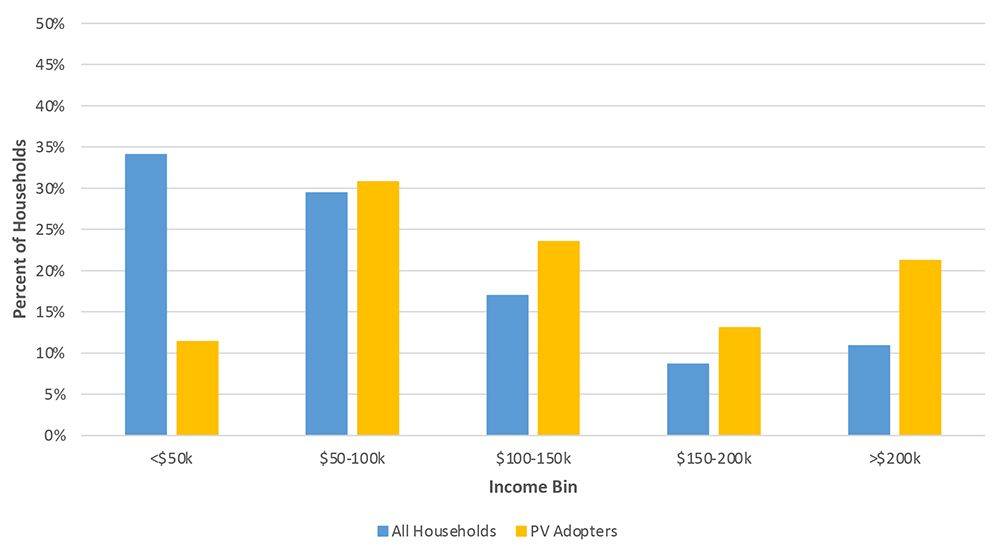
The subsidies are necessary because without them, upper-income Virginians are far likelier to go solar than LMI households. Analysis from CESA and the Lawrence Berkeley National Laboratory shows that Virginia households with 120% or more of the average median income made up 60% of all solar energy adopters in the state between 2010 and 2019, while those with less than 60% of the average made up just 10%.

“This has been static or even more tilted toward upper income in the last 10 years,” Hausman said. “If we care about solar equity, a market intervention may be in order.”

Income-distribution-of-solar-adopters-in-Virginia-(CESA)-Content.jpg
Income distribution of solar adopters in Virginia, 2010-2019 | CESA

This is not a Virginia-specific problem. LMI households pay proportionally more of their income on energy, according to the U.S. Department of Energy. “According to DOE’s Low-Income Energy Affordability Data (LEAD) Tool, the national average energy burden for low-income households is 8.6%, three times higher than for non-low-income households, which is estimated at 3%,” the department website says. “In some areas, depending on location and income, energy burden can be as high as 30%. Of all U.S. households, 44%, or about 50 million, are defined as low-income.”

Hausman said CESA is suggesting the pilot project focus on “LMI single-family homeowners who have previously participated in weatherization services.” This is because “it’s written into the statute that there has to be prior energy efficiency” by participating households.

The DMME would competitively select solar companies and provide support and outreach assistance for them to reach two or three underserved markets with focused, inclusive and community-based marketing campaigns.

“The program guarantees that solar projects are structured with contracts that are cashflow-positive for LMI participants and have no hidden fees,” Hausman told the board. There would be direct oversight of participating solar companies.

“DMME, in conjunction with the Clean Energy Advisory Board, would provide direct oversight controls over participating solar companies,” Hausman told NetZero Insider. “Presumably, DMME would retain the right to withdraw solar providers from the pilot if program expectations were not met. CESA is also recommending that, based on mandates in state law, the program focus on families with 60% or less of the state median income for streamlined eligibility.”

The “top three potential locations” CESA has identified for the pilot program are Hopewell and Petersburg, both near the state capital of Richmond, and Wise County, in the far southwestern corner of the state, on the border with Kentucky. In Hopewell, the annual median household income in 2019 was $41,600, while the other two locales came in under $40,000 apiece.

At the end of the meeting, the CEAB voted unanimously to authorize the DMME to continue working with CESA on the pilot project. The next step will be for CESA and the CEAB’s Stakeholder Engagement and Marketing Committee to reach out to stakeholders in pilot jurisdictions, such as community organizations, weatherization service providers, local utilities, municipal officials, solar installers and affordable housing providers, to solicit input on program design and viability.

That would be followed by the drafting of a timeline for pilot program development, and then a solicitation for solar providers for the pilot.