SPP Board of Directors/Members Committee Briefs: July 26-27, 2021

Grid Operator Releases Report on Performance During Winter Storm

SPP last week released a comprehensive report on what it said was the most operationally challenging week in its 80-year history: Feb. 14-20, when a winter storm resulted in the first load shed in the RTO’s history.

The report, “A Comprehensive Review of SPP’s Response to the February 2021 Winter Storm, was compiled by hundreds of SPP staff, stakeholders, regulators and the Market Monitoring Unit working together in five parallel workstreams. It recommends 22 actions, policy changes and assessments related to fuel assurance, resource planning and availability, emergency response, market design, operator tools and other critical areas.

It also points a finger at the lack of fuel, saying generation’s unavailability was “the largest contributing factor to the severity of the winter weather event’s impacts … exacerbated by record wintertime energy consumption and a rapid reduction of energy imports.”

The root cause reveals a need to develop policies that improve fuel assurance and resource adequacy and “highlights the need to further assess SPP’s ability to reliably operate the system with more intermittent and fewer baseload resources,” the report said.

The teams’ evaluations found SPP’s market typically has about 55 GW of available generation capacity in February. That capacity dipped to 35 GW during the week of Feb. 14, primarily because of higher-than-usual fuel-supply deficiencies, wind turbine freezing and other operating equipment’s struggles in extremely cold conditions.

The Board of Directors and Members Committee both approved the report July 26 during a joint meeting with the Regional State Committee. They directed staff to work on recommendations addressing the root causes and asked that additional analysis be conducted on the natural gas supply’s failure.

“That will help us to peel the layers of the onion back a little further,” Nebraska Public Power District’s Tom Kent said.

Staff were also ordered to prioritize work on the remaining recommendations, provide a project plan and quarterly progress updates, and issue letters requiring SPP’s generator operators to inform the RTO about their plans to assure generation availability for the upcoming winter.

“I know many of us don’t want to experience this again,” COO Lanny Nickell said. “Many of us around the virtual table truly believe our staff, particularly our operators, and our stakeholders made the best out of a tremendously challenging situation. We will come out on the other side of this event wiser and better prepared for the future.

“Will our best be even better next time? Absolutely,” he said.

The MMU last month released a similar report on the winter event that also zeroed in on the unavailability of natural gas supplies. (See “February Storm Review Nearly Complete; MMU Issues Report,” SPP Markets and Operations Policy Committee Briefs: July 12-13, 2021.)

Much of the SPP footprint, from the Dakotas to the Gulf Coast, went through several days of record low temperatures. Electricity usage rose to record winter levels as the RTO was forced to shed load twice for a total of almost four hours.

“We were grateful for every single megawatt we could get our hands on,” Nickell said.

“This report isn’t the end of an effort. It’s the beginning of our hard work to improve our ability to mitigate future grid emergencies,” board Chair Larry Altenbaumer said.

He said the “elephant in the room” is the nature of the gas industry’s contracts. Energy prices rose from about $18/MWh to $4,300/MWh as gas prices shot through the roof. SPP plans to coordinate with the gas industry to develop trading practices that give its members access to gas when demand is high.

“We need to find a way to really get into an advocacy mode, in conjunction with the state regulators, political leaders [and] organizations that we are a part of,” Altenbaumer said. “Unless we make that kind of comprehensive effort, this will happen again and again and again.

“That is an industry that just does not learn from the experiences it has,” he said.

FERC and NERC are expected to release their joint report on the winter event in September, while several states in SPP’s footprint are conducting their own investigations.

Last month, Basin Electric Power Cooperative and North Iowa Municipal Electric Cooperative Association filed a complaint at FERC, asking to be reimbursed $77 million by SPP for agreeing to provide energy during the event.

Admin Fee Cap Bumped 8.1%

SPP will raise its administrative fee to 46.5 cents/MWh from 43 cents, an 8.1% hike from where it has stood since 2017.

The board and members approved the Finance Committee’s recommendation after SPP’s 2021 budget forecast found a significant increase in the net revenue requirement (NRR) between 2021 and 2022; that the transmission service billing units are projected to be flat during the entire period; and that the forecast rate exceeds the tariff cap as early as next year.

The cap is calculated by dividing the budgeted NRR, including true-up from prior periods, by the tariff’s estimated amount of transmission service to be provided in the coming calendar year. The committee said setting the tariff rate cap at a higher level than the forecasted rate avoids continual adjustments to the cap and FERC filings.

“Obviously, costs are extremely important to members,” FC Chair Susan Certoma said, acknowledging the committee doesn’t yet know the cost of the winter weather recommendations and other pending initiatives.

“It’s admirable to craft a plan while the sands shifting under your feet,” Oklahoma Gas & Electric’s Usha Turner said. “Our concern is that we are struggling to manage our [day-to-day work] today. Growth is great, but are we managing the priorities we have today as Job 1? Many among your membership are not seeing that same ability to increase their spending and resources.”

Golden Spread Electric Cooperative’s Mike Wise, who sits on the FC, called the increase “more reasonable” than the 50-cent cap the committee considered.

“I don’t think the board [and] the members want to see a 50-cent cap,” Wise said. “We spent significant time and consternation dealing with this particular issue in our meetings. We did have a very difficult discussion, but we reached a collaborative number of 46.5, and it was unanimous.”

SPP is expecting a slight under-recovery for the year as the NRR and fee forecasts are both under budget, the latter because of lower billing units.

Board OKs Western Expansion, GI Queue Plan

The board approved two previously stakeholder-endorsed proposals in affirming recommendations for a policy-level agreement for members interested in joining its Western Interconnection RTO and unclogging the generation interconnection queue’s backlog of requests.

Directors and members approved the Strategic Planning Committee’s recommendation to sign off on the terms and conditions for new and existing members adding their Western transmission facilities under SPP’s tariff. The terms and conditions are only valid until April 15, 2022. Western parties intending to financially commit to the RTO will execute another commitment agreement before that date, with a projected go-live date of March 1, 2024. (See Commitment Deadline Set for SPP West Participation.)

SPP and CAISO have both been working to expand their market offerings in the Western Interconnection. Altenbaumer noted that Arizona, Colorado and Nevada regulators are all considering requiring their utilities to join RTOs.

“Clearly, the level of activity taking place in the West is increasing,” he said. “While the size of this particular RTO West is limited, it gives us a great opportunity to establish a foothold in [the Western Interconnection] … and credibility.”

“Having an option for us to have an RTO is extremely important right now,” Tri-State Generation and Transmission Association’s Joel Bladow said. “We know a good structure will come from SPP.”

The grid operator has created a DC tie task force to reach consensus with its prospective members on cost allocations and policies for the four DC ties between the Western and Eastern interconnections. SPP plans to operate single balancing authorities across the ties, with its Integrated Marketplace solving for a single market solution in both BAs.

The task force is scheduled to present its findings this fall. The expansion project’s expenditures, currently estimated to be about $30 million, are to come before the FC and board next May. SPP hopes to secure FERC approval of its governing document changes in the first half of 2023.

The prospective Western participants include Basin Electric, Colorado Springs Utilities (CSU), Deseret Power Electric Cooperative, the Municipal Energy Agency of Nebraska, Tri-State, Wyoming Municipal Power Agency, and the Western Area Power Administration’s (WAPA) Upper Great Plains-West region, Colorado River Storage Project and Rocky Mountain region.

Except for CSU, the organizations joined SPP’s Western Energy Imbalance Service (WEIS) market for its February launch before announcing their intent to explore full RTO West participation. The grid operator said CSU expects to join the WEIS in 2022 and is also exploring RTO membership.

Southwestern Public Service abstained from the Members Committee vote.

The board also approved the Strategic and Creative Re-engineering of Integrated Planning Team’s (SCRIPT) plan to resolve a four-year backlog of GI requests by 2024 and directed staff to work with the appropriate stakeholder groups in developing revision requests. (See “Renewable Developers Applaud SPP’s Plan to Reduce GI Queue’s Backlog,” SPP Markets and Operations Policy Committee Briefs: July 12-13, 2021.)

The GI queue’s backlog dates back to 2017. It comprises 533 interconnection requests for 100.3 GW of capacity, most of it wind and solar generation.

SCRIPT’s strategy is to reduce restudies through development milestones, increase financial commitments, and simplify and reduce study timelines.

“The proposal is designed with the premise that as generation projects become more developed and they are willing to place more at risk, they are much less likely to withdraw from the process,” Antoine Lucas, SPP’s vice president of engineering, told stakeholders.

WAPA’s Lloyd Linke voted against the motion, saying the agency has found the costs of connecting tribal entities to the federal transmission system “substantially larger” since joining SPP.

MMU Briefs Draft Market Report

The MMU reviewed a draft of its 2020 State of the Market Report, which has been delayed a couple of months by the Monitor’s involvement in the winter storm report.

The report will be issued during the second week of August, the Monitor said. A webinar will be scheduled to discuss that report and the MMU’s quarterly spring report.

The annual report’s key conclusions include:

    • Wind generation accounted for the largest percentage of total energy produced, at 31.3%, just ahead of coal at 31%. SPP’s nameplate wind capacity increased to just over 27.3 GW in 2020, up about 22% from 2019.
    • Day-ahead market prices averaged $17.69/MWh and real-time prices averaged $16.62/MWh, a 20% drop for both from 2019 and the lowest since the Integrated Marketplace went live in 2014. The average gas price at the Panhandle Eastern hub was $1.72/MMBtu, down 11% from $1.93 the year before.
    • Total electric consumption was down about 3% in 2020 as a result of the COVID-19 pandemic. The annual peak load of 49,569 MW was also 3% lower than in 2019.
    • Market-to-market (M2M) payments from MISO to SPP jumped to $82.8 million last year, up significantly from $17.5 million in 2019. Most of the increase occurred in the year’s last three months, typically a high-wind period.
    • The reliability unit commitment process’ make-whole payments dropped from $70 million in 2019 to $51 million in 2020. Day-ahead market make-whole payments were up, however, from $32 million in 2019 to $53 million in 2020.
    • The GI process totaled nearly 98 GW of additional resources last year. All but 5 MW are for renewable or storage projects.
    • Day-ahead and real-time congestion costs totaled over $442 million, an 8% decrease from 2019.

Wind energy “plays a significant role in the market outcomes we see, particularly with the volatility of prices and lower market prices,” MMU Executive Director Keith Collins said.

The Monitor made three new recommendations, all unrelated to the winter storm: updating market and outage requirements to improve transmission congestion rights’ funding; improving M2M efficiencies by working with MISO; and raising the offer floor to -$100/MW.

Joint Transmission Study Team Takes on Costs

SPP and MISO staff told the board and members that cost-allocation discussions with stakeholders will continue into August as the two RTOs work together to identify joint transmission projects that might ease their interconnection queues.

Lucas said the study team has completed its initial reliability and economic studies and has already shared background on the grid operators’ cost-allocation mechanisms.

“We want to be flexible around what is always a challenge, and that is developing the cost-sharing proposals that will best resolve that situation,” Lucas said. “As [MISO Executive Director of System Planning and Competitive Transmission] Aubrey [Johnson] always says, ‘The best cost-sharing approach is the one most people agree to.’ We want to get everyone in the room together and have the respective RTO staffs put together a package that facilitates the best solution.”

The team has developed two groups of projects that would best address the constraints identified in the first assessments. The economic analysis revealed downstream congestion entering the models, Lucas said, but an ensuing evaluation indicated “material improvement” in adjusted production cost savings. (See MISO, SPP Name Projects to Help Queue Troubles.)

A final portfolio is expected to be completed in September and a draft report shared in October.

Johnson said the study team has found value in learning more about each other’s processes and “working through challenges.” So close has the collaboration been between SPP and MISO that Lucas, noticing both he and Johnson were wearing light blue shirts paired with traditional blazers, remarked, “We’ve even started dressing alike.”

“I’m glad you got the memo,” SPP CEO Barbara Sugg joked.

SPP Finalizes Strategic Plan

Sugg said she was “incredibly proud” to present a new five-year strategic plan defining how SPP will actively engage with stakeholders as it stakes a leadership position among the RTOs.

The board and members unanimously approved the plan, which envisions SPP “leading our industry to a brighter future while delivering the best energy value.”

“We developed this plan during changing and uncertain times,” Sugg said. “We navigated through these challenges, including the pandemic and historic winter storm, and emerged stronger. Collaborating with our members, we’re finding creative and innovative ways to strive toward a world where people have more accessible, reliable, sustainable, flexible and affordable power.”

Bruce Rew, the grid operator’s senior vice president of operations, said the organization’s first mission statement, approved in April, sees SPP “leading our industry to a brighter future while delivering the best energy value.”

“If we’re sitting around five years from now celebrating our success, what has led us to that point?” he said. “You set a goal and do everything you can to achieve it.”

“Wherever we land at the end of five years, we’re going to be in a better place,” OG&E President and COO Peggy Simmons said.

Altenbaumer said the SPC will go through the plan’s rollout details during its September off-site workshop. He praised the plan’s quality as a result of engagement with the Members Committee, SPC and regulators.

“Those additional levels of engagement were investments that were well worth it,” he said. “There’s been a lot of work done to get to this point, but it has to be balanced with the other things that are priorities to the organization. All of that has to be done consistently with what our organizational capabilities are.”

RSC Meets Briefly

The Regional State Committee briefly conducted its quarterly business meeting before the joint updates began, honoring two of their members who have left the group.

The RSC presented both Arkansas Public Service Commissioner Kim O’Guinn and former Texas Public Utility Commission Chair DeAnn Walker with resolutions recognizing their work and time on the committee. A similar resolution was offered to SPP’s Sam Loudenslager, a liaison to the RSC who is retiring in October.

“It was an honor to serve with each and every one of you,” said an emotional Walker, who resigned from the Texas PUC in February shortly after the winter storm nearly collapsed the ERCOT grid. “Thank you for everything, and I miss all of you.”

Walker gave a special shoutout to Oklahoma Corporation Commissioner Dana Murphy, who called and texted her with frequent supportive messages during and after the storm.

Board OKs Revision Requests

The board approved several revision requests previously endorsed by the Markets and Operations Policy Committee, including a market-based approach for managing uncertainty (RR449); a new methodology for accrediting wind and solar resources (RR418); a recommendation to develop initial effective limits for reliability coordinators based upon previous experience or analysis (RR414); and a white paper on cost allocation for energy storage used as transmission assets. (See “Uncertainty Product Endorsed,” SPP Markets and Operations Policy Committee Briefs: July 12-13, 2021.)

Directors also signed off on the consent agenda, which included:

    • the Corporate Governance Committee’s recommendation to add Lincoln Electric System’s Dennis Florom and NextEra Energy Resources’ Matt Pawlowski to transmission-user seats on the SPC, and Lincoln Electric’s Emily Koenig to a TU seat on the Finance Committee.
    • staff’s mitigation plan to ease the burden on transmission planners. (See “Tx Planning Mitigation Gets OK,” SPP Markets and Operations Policy Committee Briefs: July 12-13, 2021.)
ERCOT to PUC: Outage Procedures Changes Coming

ERCOT staff last week told Texas regulators it would change its outage procedures to avoid a repeat of conservation calls made twice this spring, when an inordinate amount of forced outages reduced supplies against unexpected rises in demand. (See Texans’ Conservation Keeps ERCOT Grid Stable.)

Staff proposed protocol changes for planned outages with more than 45 days’ notice, which are currently approved with the proper lead time. The requests would be approved or rejected depending on whether “the approved aggregate amount of all outages is less than an allowable capacity for each day of the request.”

Woody-Rickerson-(Texas-Admin-Monitor)-Content.jpg
Woody Rickerson, ERCOT | Texas Admin Monitor

Woody Rickerson, ERCOT’s vice president for grid planning and operations, said during the Public Utility Commission’s open meeting Thursday that the changes would also require updates to the grid operator’s outage scheduler software. That will require vendor changes, Rickerson said, and a vendor has yet to be hired.

Staff process about 26,000 outage requests a year, with 70% classified as forced or maintenance-level outages that are submitted with less than three days’ notice. Rickerson said most of those are automatically accepted, as forced outages are considered unavoidable.

Planned outages, about 10% of the total, are also automatically accepted under current protocols. The other 20% of outages are a mix of planned, extensions and maintenance-level outages.

In other action, the PUC formally revoked the retail electric provider certificates for Griddy Energy (51859) and GB Power (51961).

Report: Geothermal Could Play Expanded Role in Decarbonization

Technological advances and regulatory changes could unlock as much as 60 GW of geothermal capacity in the U.S. by 2050, according to a recent report by the National Renewable Energy Laboratory (NREL).

The 2021 U.S. Geothermal Power Production and District Heating Market Report said that improvements in regulation and technology are fundamental to facilitating the growth of geothermal resources, both for electricity generation and district heating, said NREL Senior Geothermal Drilling Engineer Jody Robbins, lead author of the report.

Expanded geothermal for heating and cooling could also contribute to the Biden administration’s decarbonization goals to cut emissions in half by 2030 and achieve a carbon-free electric sector by 2035.

Speaking during a webinar hosted by the U.S. Department of Energy’s Geothermal Technologies Office (GTO) last week, Robbins said the addition of nine power purchase agreements in four states and recent renewable energy policy trends indicate that the geothermal sector could resume growth. Included in the PPAs are plans for the first two geothermal power plants to be built in California in a decade.

Since 2015, the geothermal power production market has experienced limited net capacity growth. Current nameplate capacity is 3.67 GW from 93 power plants, which is marginally higher than 3.62 GW from 97 plants in 2015. However, almost all capacity additions from 2000 through 2020 have been binary plants that use lower-temperature resources that produce practically no emissions.

GDH Development

There are presently 23 geothermal district heating (GDH) systems with capacity totaling 75 MW of energy in the country, ranging from the oldest installation in 1892 (Boise, Idaho) and the most recently finished in 2017 (Alturas, Calif.).

One major factor impacting GDH development is the market price of competing heat sources. A boost in GDH development in the 1980s appears to have coincided with an uptick in oil and gas prices during that time, Robbins said. However, gas price increases from 2004-2009 and oil from 2011-2014 did not correlate similarly in GDH installations. There is also a lack of federal or state incentive programs that would offset upfront GDH installation costs, in addition to an absence of local and regional stakeholder awareness and support. States once provided financial assistance to support the development of GDH systems, though most have “terminated” such programs in recent years, Robbins said, with the notable exception of California.

The levelized cost of heat (LCOH) value for GDH systems is $54/MWh on average in the U.S., slightly lower than the average European LCOH value of $69/MWh, but higher than the 2019 average U.S. residential natural gas LCOH. The estimated LCOH for existing U.S. GDH systems ranges from $15 to $105/MWh, consistent with European systems.

State and Federal Policy

In terms of policy, the U.S. has experienced two periods of robust federal support for geothermal exploration and development, both of which resulted in increased deployment.

The first period occurred in the late 1970s and early 1980s through the Public Utility Regulatory Policies Act. The second wave of support was part of the American Recovery and Reinvestment Act of 2009, which included a grant program and production tax credit extension. Also, the allowance of geothermal operators to elect the investment tax credit at a rate of 30% in 2019 and the Energy Act of 2020, which eased access to federal lands for renewable developers and accelerated the permitting process. The act additionally authorized an annual budget of $170 million for GTO’s research and development activities.

State-level geothermal legislation and policy development is active in California, Hawaii, Nevada, New Mexico, and Washington, focusing on contributions to aggressive decarbonization goals and streamlining administrative processes and permitting authorities for developing resources. Renewable portfolio standards “have probably been the most influential state policies,” Robbins said, as they can support geothermal development by requiring a certain amount of electricity sold by utilities to come from renewable energy sources.

Twenty-eight states have established geothermal power as an eligible RPS technology. California is seeing an increase in demand for geothermal electricity to the point that it has the highest economic value of renewable resources operating in the state.

Granholm Holds Court with Manufacturers to Discuss Decarbonization

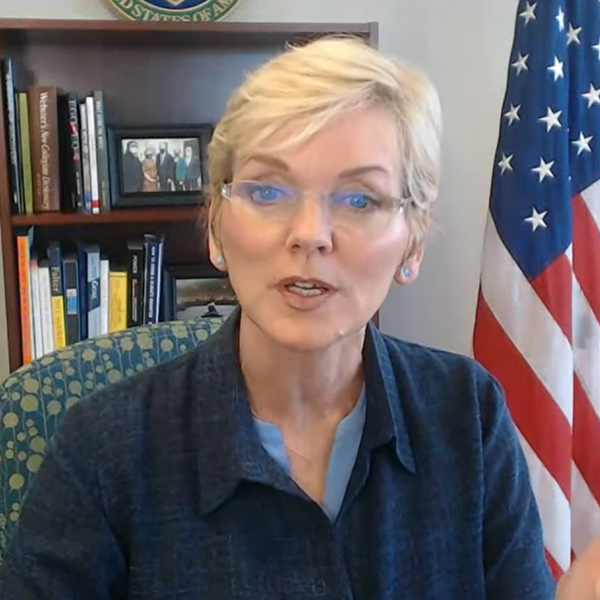
Energy Secretary Jennifer Granholm last week held a virtual roundtable discussion with representatives of several manufacturing companies to emphasize the role of the industrial sector in reaching the Biden administration’s decarbonization goals.

Jennifer-Granholm-House-Appropriations-FI.jpg
Secretary of Energy Jennifer Granholm | House Appropriations

“We are totally serious about slashing the carbon footprint of the industrial sector, and of course creating great-paying jobs while we are at it,” Granholm said, adding that the Department of Energy had declared the last week of July the “Future of Manufacturing Week.”

Those attending the discussion July 27 included a steelmaker, an automaker and an auto parts maker, who joined with directors of manufacturing and energy-efficiency organizations created by previous administrations. DOE has run such programs at least since the Obama administration to help U.S. manufacturing become more efficient. And under President Biden, that will continue with decarbonization and job creation efforts now added.

The question has been how to fund the new initiatives.

Granholm predicted that the bipartisan infrastructure bill released Sunday and a yet-to-be-finalized budget bill would be the first steps to creating 2 million new jobs every year for the next decade. (See related story, Bipartisan Infrastructure Bill Offers Funding for Grid, EVs, Cybersecurity.)

Building electric cars and the batteries that will go into them are high on the administration’s list of what must become American-dominated industries, Granholm reminded participants.

“We’re talking billions of dollars to win the global market for car 2.0, which is of course the electric vehicle, and [to build] hundreds of thousands of charging stations, and spurring domestic supply chains for batteries and electric vehicles.

“We’re talking about the extension of the 48C manufacturing tax credit to supply clean energy projects with American-made parts and equipment,” she said in reference to the administration’s tax proposals for fiscal year 2022.

“The point to passing both of these bills [is to] retool and invest in American manufacturers to win the 21st century,” Granholm said. “And there’s a big prize to be won, because the global market for clean technologies is projected to be $23 trillion. That’s with a ‘T.’”

Also joining was U.S. Rep. Haley Stevens (D-Mich.), who has introduced legislation to require the Commerce Department to establish a task force to identify manufacturing supply chain vulnerabilities.

Manufacturing is “not always what people think it is: dirty, dark and dangerous,” Stevens said. “It’s high-concept, innovative, hard work, certainly, by solving complicated problems; complex supply chains that not only span our country but, in some realities, the world, especially as the world demands our best-in-class products.”

“We know that the global economy is already transitioning to clean energy,” said Jane Flegal, senior director for industrial emissions at the White House Council on Environmental Quality. “The big question is whether those jobs and supply chains are here in the United States or somewhere else. There’s no reason those supply chains can’t be clean and can’t be in the U.S. providing jobs and opportunities for American workers across the country.”

While the Biden administration’s “whole of government” approach to cutting carbon emissions directs DOE and other federal agencies to work in tandem with business and industry to develop more efficient and cleaner technologies, the roots of the idea reach back at least to the Obama administration and the 2014 creation of Manufacturing USA, a public-private collaboration focused on modernizing the nation’s manufacturing.

Manufacturing USA evolved into 16 more focused nonprofit institutes, which together comprise the Clean Energy Smart Manufacturing Innovation Institute. The group’s director, John Dyck, explained that the focus of every program in Manufacturing USA is “to bring our collective and diverse ecosystems to bear” on manufacturing, industrial practices and supply chain problems “through public-private partnerships.”

“That means we can very quickly reach into our ecosystems, the manufacturers, the machine builders, the software vendors and, of course, academia, and do this across industry boundaries, reaching not just the large enterprises, but the small and medium manufacturers as well, and ensure that we have the most diverse and inclusive set of perspectives at the table as we look to solve problems and create new value,” he said.

The three manufacturers that have participated in previously initiated and ongoing DOE energy-efficiency programs joined the webinar to recount their successes. Though Biden frequently mentions “good union jobs” when talking about his “Build Back Better” programs to fight climate change and create a larger middle class, none of the three companies — Nucor Steel, Nissan North America and KYB Americas — are unionized. That was not mentioned.

Nissan’s Mike Clemmer, director of director of corporate and manufacturing facilities and environmental engineering, said his company is committed to a continuing relationship with DOE.

“Our business is extremely competitive. And our cost controls are obviously imperative. But we also have goals and the responsibility to improve our sustainability. Achieving our targets will require implementation of new and/or different technologies outside of our traditional processes,” Clemmer said.

He said the company is currently running a pilot efficiency program developed through a federally initiated public-private pilot program. The pilot aims to reduce energy costs for cooling of production line mechanical systems at an assembly plant in Mississippi.

Granholm did note that whatever Nissan learns from its participation will be shared with other companies, including automakers. “We need to share information with one another about best practices and learn from one another about how to reduce greenhouse gas emissions.”

KYB Americas, a subsidiary of Tokyo-based KYB, which manufactures parts for vehicles, has since 2016 been part of a DOE consulting program designed to help manufacturers increase efficiency. The Industrial Assessment Centers (IAC), located at 35 universities, offer energy-efficiency assessments to manufacturers.

Charlie Manzione, head of environmental services at KYB’s Franklin, Ind., plant, enthusiastically recounted an IAC team of seven engineers who arrived in 2016, examined operations for two days and came up with 11 recommendations to reduce the plant’s “energy intensity.”

“Since 2016 we have been reporting on reduction of our intensity to the DOE every year, and I can happily say we have reduced intensity 15%,” he said. The goal is 25% by 2023, he said.

“Now we’re looking at things like renewables, such as solar and/or wind … as well as other efficiency improvements, but we do want the IAC again; we’d like to have them come back,” Manzione said.

Nucor CEO Leon Topalian did not mention his company’s involvement in any government-initiated efficiency programs but did say that it already meets the standards of the 2015 Paris Agreement on climate change. Its mini mill operations use electric arc furnaces to make steel from scrap rather than less efficient traditional blast furnaces that make steel from iron.

“And we’re making further investments; we’re going to be cleaner; we’re going to continue our leadership position … to ensure the cleanest steels are producing the next green economy that will be built,” he said.

Biden’s goal of 30 GW of offshore wind power by 2030 “represents about 7 million tons of steel,” Topalian said.

“Where that steel comes from is vitally important. We do not need to bring those steels in from other countries that are three, four or five times dirtier than what we can produce here.”

Bipartisan Infrastructure Bill Offers Funding for Grid, EVs

The Senate on Monday began debating a bipartisan $1.2 trillion infrastructure bill, which would provide billions for grid improvements, alternative vehicle fueling, supports for existing nuclear plants and redevelopment of coal mining communities.

Lisa-Murkowski-(C-SPAN)-Content.jpg
Sen. Lisa Murkowski (R-Alaska) | C-SPAN

The text of the 2,702-page Bipartisan Infrastructure Investment and Jobs Act was released Sunday after clearing a procedural vote 66-28 on Friday, with 16 Republicans joining all 50 members of the Democratic caucus in support.

Majority Leader Chuck Schumer (D-N.Y.) said he hoped the Senate would consider amendments and approve the bill “in a matter of days,” and quickly consider a $3.5 trillion infrastructure package that Democrats hope to approve via a budget reconciliation process that is not subject to the filibuster.

The bipartisan bill includes new federal spending of about $550 billion over fiscal years 2022-26. Here are some of the highlights of the bill’s provisions on electricity and climate change, based on the bill text and a summary from the Senate Committee on Environment and Public Works:

Electric Vehicle Charging and Alternative Vehicle Fueling ($7.5 billion): The bill would support development of “publicly accessible electric vehicle charging infrastructure” as well as hydrogen, propane and natural gas fueling infrastructure along designated “alternative fuel corridors” with an emphasis on “rural, disadvantaged, and hard-to-reach communities.” The bill authorizes $2.5 billion from the Highway Trust Fund over five years for a new competitive grant program to build out alternative fuel corridors and $5 billion for a new Electric Vehicle Formula Program to provide money for states to build electric vehicle charging infrastructure. Grants would be limited to $15 million each.

Clean School Buses and Ferries ($7.5 billion): The bill includes $2.5 billion for replacing existing school buses with zero-emission buses and $2.5 billion for those running on alternative fuels. Another $2.5 billion is targeted for the replacement of existing ferries with electric or low-carbon ferries.

Port Truck Emissions Reduction Program: The bill would provide $400 million to reduce air emissions from trucks idling at port facilities.

Existing Nuclear Plants ($6 billion): Nuclear plants at risk of closing because of market conditions would be eligible to participate in a bidding process for subsidies administered by the Department of Energy.

Former Coal Sites: Section 40209 makes the sites of former coal mines and generating plants eligible for $750 million in grants for repurposing the properties as an “advanced energy property.” Qualifying technologies would include renewables (solar, hydro, wind, geothermal or hydrothermal, fuel cells, microturbines or energy storage systems and carbon capture use and sequestration). Manufacturing of electric or fuel-cell vehicles and heavy-duty hybrids also would be eligible.

Tom-Carper-(C-SPAN)-Content.jpg
Sen. Ben Cardin (D-Md.) | C-SPAN

Grid Infrastructure and Resilience: Section 40101 would provide $5 billion in grants for supplementing existing grid hardening efforts, reducing the risk of wildfire and the consequences of “disruptive events.” Eligible projects would include weatherization and fire-resistant technologies; undergrounding of electrical equipment; relocation and reconductoring of power lines; vegetation and fuel-load management and distributed energy resources. Half of the funding would be for states and tribes with the other half for entities such as electric grid operators, generators, storage operators, transmission owners and distribution providers.

Section 40103 authorizes $6 billion for demonstrations of “innovative approaches to transmission, storage, and distribution infrastructure to harden and enhance resilience and reliability.”

Section 40106 creates the “Transmission Facilitation Program,” which authorizes the Department of Energy to sign contracts for up to 50% of the capacity of new transmission lines of at least 1,000 MW or upgrades to lines of at least 500 MW to encourage other entities to contract for capacity. It allows up to $2.5 billion in borrowing at any one time. The bill prioritizes projects that enhance “capacity, efficiency, resiliency, or reliability,” including reconductoring with advanced conductors and hardware and software enabling dynamic line ratings, advanced power flow control, or grid topology optimization. Also favored would be projects that facilitate interregional transfer capacity or lower greenhouse gas emissions.

Reaction

Many interest groups expressed their support for the package after the agreement was announced and cleared procedural votes last week.

Rob-Portman-(C-SPAN)-Content.jpg
Sen. Rob Portman (R-Ohio) | C-SPAN

The Nuclear Innovation Alliance praised the inclusion of full funding for two large demonstration projects under the Advanced Reactor Demonstration Program, saying it will “catalyze private sector innovation and cement U.S. leadership in advanced nuclear technologies.”

The Business Network for Offshore Wind said it would “jumpstart offshore wind supply chain opportunities and enable states to strategically invest to develop port facilities” through funding for port and transmission upgrades and a manufacturing tax credit.

The Carbon Capture Coalition was encouraged by “provisions to scale deployment of carbon capture, removal, utilization and associated CO2 transport and geologic storage infrastructure.”

The Clean Energy Business Network urged passage, saying, “Supporting the clean energy industry would create both immediate AND long-term benefits by generating well-paid manufacturing and construction jobs in every part of the country while creating a stronger, healthier, and more resilient future.”

PSEG Close to Fossil Asset Sale

Public Service Enterprise Group (NYSE:PEG) on Tuesday said that it expects to be out of the fossil fuel business by the first quarter of next year and is pursuing ways to help meet its commitment to decarbonize by 2030, including buying a share of another offshore wind project off the Jersey Shore.

CEO Ralph Izzo said the company’s 6,750 MW of fossil generation in New Jersey, Connecticut, New York and Maryland have “gotten a significant level of interest from numerous qualified buyers.” The selling process could be concluded by September, but he is willing to let it go into early 2022, he told analysts and reporters during the company’s second-quarter earnings call.

“I just don’t want to sacrifice value for an arbitrary deadline,” he said. PSEG closed its last remaining coal-fired power plant, a 400-MW facility in Bridgeport, Conn., on May 31.

The move, part of PSEG’s effort to transform into a primarily regulated electric and gas utility, follows the sale of its 467 MW of solar generation in 17 states, which closed in the second quarter. It also comes as the company seeks to meet its June 24 commitment to accelerate its greenhouse gas reduction efforts by 20 years and reach net-zero emissions by 2030. (See PSEG Speeds up Plan to Cut Emissions.)

Offshore Wind Opportunity

Other measures that will contribute to the net-zero goal include the company’s purchase of a 25% stake in the Ocean Wind offshore wind project, Izzo said. The $1.6 billion facility developed by Ørsted, which was approved in 2019, is the first offshore wind project off the coast of New Jersey. PSEG’s investment in the project closed in the second quarter, and the company is mulling investments in other East Coast projects, including Ocean Wind 2, Izzo said.

The New Jersey Board of Public Utilities (BPU) on June 30 awarded Ocean Wind 2 and Atlantic Shores, the rights to 1,100 MW and 1,510 MW, respectively, in the state’s second offshore wind solicitation. The latter project is a 50/50 partnership between Shell New Energies and EDF Renewables North America.

“It is obviously safe to conclude that we will have some conversations with Ørsted about” Ocean Wind 2, Izzo said. He added, however, that “we have a range of conversations across several projects that are in the Mid-Atlantic region underway with Ørsted.”

But owning another share of an offshore wind project is less lucrative than providing the infrastructure for transmission services from the projects to the grid, he said. PSEG is preparing to bid on a competitive process to provide transmission infrastructure for the farms, Izzo said.

The BPU in April launched a solicitation for potential transmission solutions to deliver offshore wind energy to the grid as the state rolls out its plan to deploy 7,500 MW of offshore wind energy by 2035. (See New Jersey Seeks OSW Transmission Ideas.) The initiative will be conducted with PJM, which will provide the technical expertise, and the BPU will make the final decision.

“The potential projects can cover onshore upgrades, new onshore transmission connection facilities, new offshore transmission connection facilities and a networked offshore transmission system,” Izzo said. He said his company initially believed the solicitation had the potential to yield a nine-figure investment in transmission infrastructure, and now believes it could be a 10-figure investment.

“All of this is great progress in our decarbonization efforts and continues to demonstrate our alignment with the state’s clean energy agenda and our industry leadership on environmental stewardship,” he said.

Nuclear Subsidies

Another sign of the company’s contribution to that goal was the BPU’s award on April 26 of a three-year extension of annual $10/MWh subsidies, known as zero-emission certificates (ZECs) to three nuclear plants in the state, which are owned or part-owned by PSEG.

Izzo said the company is also pushing for a federal nuclear production tax credit and is monitoring discussions of a potential nuclear grant program to be administered by the U.S. Department of Energy.

The extension of the ZECs to PSEG “will allow us, along with stakeholders in New Jersey and at the federal level, the time we need to work on a long-term economic solution to keep our merchant nuclear fleet economically viable and preserve its currently unmatched contribution of reliable carbon-free baseload generation, the most cost-effective clean generation source available,” Izzo said.

The CEO said he also was pleased with subsidiary Public Service Electric and Gas’ recent agreement with the BPU and Division of Rate Counsel to voluntarily reduce its annual transmission revenue requirement, which includes a reduction in its base return on equity from 11.18% to 9.9%.

“This agreement is a balanced resolution that delivers timely savings to customers and resolves a significant regulatory uncertainty for PSE&G,” Izzo said in a statement. “Pending approval from the Federal Energy Regulatory Commission, the settlement is anticipated to save a typical electric residential customer approximately 3% on their monthly bills upon implementation.”

PSEG reported a net loss of $177 million ($0.35/share) for the second quarter, a drop from $451 million ($0.89/share) in the same quarter of 2020. Non-GAAP operating earnings for the second quarter of 2021 showed a more positive picture: $356 million ($0.70/share) compared to $404 million ($0.79/share) in 2020.

Izzo said in the statement that the GAAP figures “reflect an asset impairment charge related to the quarterly assessment of the likelihood and timing of potential asset sales in connection with exploring strategic alternatives for PSEG Power’s non-nuclear generating assets.” These included the sale of the solar business and potential sale of the fossil assets, he said.

After Delay, NM Moves Toward Calif. Clean Car Standards

New Mexico is heading toward adoption of California clean car standards, but environmental groups say officials are moving too slowly on approving the standards, which under the state’s current timeline could be adopted by October 2022.

The clean car standards are intended to reduce emissions from new passenger vehicles and increase the availability of zero-emission cars. New Mexico’s climate strategy, updated last year, called for public meetings on the standards starting in spring 2021 and an Environmental Improvement Board hearing later this year.

But a variety of factors have pushed back the rulemaking, according to Sandra Ely, director of the Environmental Protection Division within the New Mexico Environment Department.

One of the main factors was the COVID-19 pandemic, Ely said during a public kick-off meeting for Clean Cars New Mexico on July 21. The Environmental Protection Division includes the Occupational Safety and Health Bureau, which last year was “100% COVID all the time,” Ely said.

In addition, Ely said, the division has been focused on the proposed ozone precursor rule, which would apply to the oil and gas sector. The sector accounts for 53% of the state’s greenhouse gas emissions, while the transportation sector makes up 14%.

The ozone precursor rule addresses volatile organic compounds and nitrogen oxides, two gases that combine to create ground-level ozone. It’s expected to go to the Environmental Improvement Board next month.

“Clean cars matter,” Ely said. “But this small agency, having taken on COVID, having [moved] forward on the ozone precursor rule, cannot move at rapid speed on this, and get it done quickly, get it done efficiently, and get it done legally.”

A timeline presented during the workshop indicated that informational sessions on Clean Cars New Mexico would continue through October, with a rulemaking petition submitted in December. A board hearing on the regulations could be scheduled for May 2022, and the rules finalized by October 2022.

The federal Clean Air Act requires two full model years between finalization and enforcement of the clean cars rule.

Two-Pronged Program

The clean car standards consist of two programs. A low-emission vehicle (LEV) program sets emission standards for new light- and medium-duty vehicles, such as passenger cars, SUVs and pickup trucks. A zero-emission vehicle (ZEV) program requires car manufacturers to supply a certain number of zero-emission vehicles to dealers each year.

Under federal law, states can either follow federal vehicle-emission standards or adopt the more stringent California standards.

New Mexico adopted California’s clean car standards in 2007, but the standards were rolled back under Gov. Susana Martinez’s administration.

Environmental groups argue that because the rule would largely follow the California standard and the state already has experience with the clean car standards, adopting the standards should be fairly straightforward for New Mexico.

The groups petitioned the Environmental Improvement Board in June to establish a schedule for considering the standards that would allow for adoption of final regulations by the end of this year. That way, the rules would apply to vehicles starting with model year 2025. Cars of a particular model year are typically released during the previous calendar year.

“However, if adopted in 2022, the standards would not take effect until model year 2026, substantially slowing progress towards the state’s goals of reducing air pollution and addressing the climate crisis,” the petition said.

The groups on the petition include the Center for Civic Policy, Conservation Voters New Mexico, Natural Resources Defense Council, Plug In America, Prosperity Works, Sierra Club, Southwest Energy Efficiency Project (SWEEP) and 350 New Mexico.

The EIB considered the petition during its July 23 meeting but rejected it. According to SWEEP, two of the seven board members, Barry Bitzer and Benjamin Duval, voted against the motion to reject the petition.

As of Monday, the Environment Department had not posted a recording of the EIB’s July 23 meeting. The department didn’t respond to several messages inquiring about the board’s action.

Tammy Fiebelkorn, New Mexico representative for SWEEP, told NetZero Insider that the organization is disappointed by the EIB decision but plans to work with the Environment Department to move the process forward as quickly as possible next year.

“These rules are imperative to reach our climate goals, so quick action is needed,” Fiebelkorn said.

Clean Cars in Other States

According to the Clean Cars New Mexico website, California’s LEV/ZEV regulations have been adopted in 14 states and Washington D.C.

Several other states, including Nevada and Washington, have begun the process to adopt the standards. (See Washington Moving to Adopt Calif. Vehicle Emission Rules; Nev. Program Seeks Calif. Standards for Vehicle Emissions.)

In Nevada, the clean cars regulation is scheduled to go to the state Environmental Commission on Sept. 1. The Nevada Division of Environmental Protection (NDEP) expects the rule to be finalized by the end of the year, taking effect beginning with model year 2025 vehicles.

Nevada’s proposed regulation would allow automakers to acquire and bank early ZEV credits for model year 2022, 2023 and 2024 ZEVs.

NDEP held its most recent public workshop on the regulation on July 28. More information on Clean Cars Nevada is here.

In New Mexico, the state Environment Department is coordinating with the Albuquerque-Bernalillo County Air Quality Control Board on the Clean Cars rulemaking process.

That’s because the city of Albuquerque has its own jurisdiction over air quality regulations. The Environmental Improvement Board regulations govern air quality in other, non-tribal areas of the state.

Mississippi PSC Audit Questions MISO Membership

The Mississippi Public Service Commission is using an audit of MISO membership to question whether Entergy Mississippi should remain a member, attracting blunt criticism from several renewable energy organizations.

The PSC opened the audit in April following February’s Winter Storm Uri and load shedding in MISO South. While it’s not unusual for the PSC to audit MISO membership, the commission’s language this time hints at a breakup with the RTO (2021-AD-52).

The Mississippi commission sought comments on the utility’s possible migration to the newly formed Southeast Energy Exchange Market and the savings it might achieve there, compared to the transmission construction costs of connecting to the new market.

The PSC also requested opinions on several MISO initiatives, including interconnection queue management, long-term transmission planning and future resource mix assumptions, its plan to raise the value of lost load from $3,500/MWh to $10,000/MWh, and a proposal to move to a four-season capacity auction and availability-based resource accreditation.

The commission also solicited feedback on the limited transfer capability between MISO Midwest and MISO South.

Finally, the commission said it was looking for any other “deal-breakers … that would make it unreasonable or cost-prohibitive for Entergy Mississippi to be an RTO member.”

Dane-Maxwell-(Dane-Maxwell-for-Mississippi)-FI.jpg
Mississippi PSC Chairman Dane Maxwell | Dane Maxwell for Mississippi

“While [Entergy Mississippi’s] analysis indicates that historically RTO membership has produced significant benefits for customers, it is less clear to this and other commissions whether the long-term benefits of RTO membership exceed the long-term costs and commitments of RTO membership, especially given that the RTOs’ (including MISO) structure, services and membership continue to change significantly,” PSC Chair Dane Maxwell wrote.

Fellow Commissioner Brandon Presley said in March that Mississippi regulators should examine the fairness of MISO’s February load-shedding orders and “correct” other problems that exist within the RTO. (See “Mississippi PSC Unhappy,” MISO Underscores Need for RA Action in Winter Storm Review.)

In public MISO meetings, PSC staffer David Carr and Washington, D.C.-based commission consultants Bill Booth and Nick Puga have voiced opposition to MISO’s long-range transmission plan. Entergy Mississippi consultant Dave Harlan, constantly in touch with the commission, has questioned MISO’s predictions of a renewable-heavy resource mix. (See Entergy Consultant Under Fire for Covert Role in MISO.)

The fiercely worded audit is unlikely to force Entergy Mississippi’s exit from MISO. The utility filed comments that indicated it had no qualms about its membership. It said MISO has been able to deliver benefits for its customers and it will probably continue to do so.

The utility said that it is in the public interest to continue its MISO membership for the “foreseeable future.” Entergy estimates it has saved $246 million in energy and capacity-related costs since joining the RTO in late 2013.

Harsh Words from Renewable Advocates 

The Southern Renewable Energy Association (SREA) and other renewable power organizations didn’t mince words over their opposition to the PSC’s questions.

“Mississippi is saving tens of millions of dollars every year by staying in MISO and no analysis publicly exists to show otherwise,” the SREA wrote. “While staying in MISO clearly has its benefits, Mississippi is not maximizing its membership. The state is spending millions of dollars every year on expensive out-of-state consultants to slow improvements at MISO.

“Previous positions by Mississippi Public Service Commission staff and consultants have stalled large scale transmission expansion efforts for many years. SREA recommends that Mississippi take a more proactive role in promoting transmission expansion and generation interconnection fixes at MISO,” the organization said.

SREA added that “Mississippi ratepayers are literally making millionaires out of D.C. lawyer consultants that work to slow transmission development and restrict energy market competition.” The group requested the PSC hire an independent third party to perform a “multiple scenario quantitative and qualitative analysis” to weigh Entergy’s RTO membership options.

Incumbent utilities “employ a variety of tactics including threatening to depart the system, filing complaints at FERC, slowing down processes that would increase competition to the benefit of the ratepayer, or lobbying for passage of anti-competitive legislation” to further their interests within RTOs, SREA said.

“MISO staff will not publicly name names, document offenses, or share publicly all the specific examples of subterfuge by its own incumbent utility members that are working to oppose MISO’s independence … SREA anticipates MISO will take a simple position of providing monetary and qualitative benefits of membership, without some of the straight talk desperately needed to fix Mississippi’s role and relationship with MISO,” the organization said.

SREA also noted that the Department of Justice’s investigation into Entergy’s anti-competitive behavior — a case that spurred Entergy into RTO membership a decade ago — remains suspended, but open. It suggested that an Entergy Mississippi exit from MISO would pique the department’s interest as to whether Entergy was again restricting access to the wholesale market. 

The Sustainable FERC Project said Entergy Mississippi isn’t maximizing the benefits of its MISO partnership and said the commission “should consider how to more productively engage in MISO’s planning process to increase the benefits to Mississippi customers.”

Clean Grid Alliance agreed that the utility “has attempted to hinder progress at MISO, particularly in transmission planning.” 

The MISO interconnection queue contains 2 GW and $2.7 billion worth of renewable generation under development in Mississippi. The Alliance said further renewable development in the state could be a “game-changer for rural Mississippi.”

CGA also said if Entergy Mississippi or all Entergy companies joined the newly formed Southeast Energy Exchange Market, its customers would almost certainly see bill increases. It said Entergy should consider SPP membership before it moves to the fledging southeastern exchange.

“Currently, Entergy does not have any physical ties to MISO North, and the tie between MISO North and MISO South is very constrained, with only 1,000 MW of firm contract capacity. On the other hand, Entergy has over 40 physical ties with SPP totaling 14,000 MW. Thus, the Entergy system would be more physically integrated into the SPP RTO than it currently is in MISO,” the CGA wrote.

SREA said Entergy appears to be fond of the constricted Midwest-to-South flows.

“Many observers have noted that Entergy’s selection of MISO has enabled the utility to maintain maximum control over the region, while reducing Entergy’s exposure to competition,” the organization said. “Joining MISO has not curtailed Entergy’s anti-competitive business practices. As long as the North/South intertie remains restricted, Entergy will exert near total control over the MISO South region.”

Climate activist group 350 New Orleans said an investigation should be opened into “whether certain actions or inaction on behalf of [Entergy Corp.] subsidiaries in the MISO South subregion have resulted in placing a limitation or obstruction to benefits, reliability, and competitive electric service to the region.”

350 New Orleans pointed to the interconnectedness of MISO South and noted that it and Louisiana depend on the Grand Gulf Nuclear Power Station in Port Gibson, Miss.

“Given that this resource is a central component in resource plans throughout many years for Entergy Corp. subsidiaries in MISO South, any discussion related to subsidiaries leaving MISO relates to resources that ratepayers in New Orleans and the state of Louisiana are reliant on,” the group wrote.

MISO, an intervenor at the request of the commission, predictably touted the cost savings Entergy has achieved under its supervision. The grid operator said it saved its members a collective $3.1 billion to $3.9 billion in 2020 compared to their going it alone on the grid.

The RTO said all of its transmission planning and resource adequacy initiatives are vetted with stakeholders and necessary to the continued reliability of the footprint. It pointed out that its value of lost load has been unchanged for 10 years.

MISO also said it will continue “to evaluate cost-effectively increasing the transfer capability between the MISO Midwest and South.”

NYSERDA: Building-by-building Heat Pump Transition isn’t Going to Cut it

Transitioning New York’s approximately 4.5 million buildings to heat-pump technology will necessitate taking geothermal districts seriously.

“We need to accelerate the transition off of gas for heating, so we now need to move from building-by-building to block-by-block and community-by-community heat-pump installations,” said Donovan Gordon, director of clean heating and cooling at the New York State Energy Research and Development Authority (NYSERDA).

If the state tries to meet its 2050 goal for heat pumps building-by-building, it would have to complete at least 400 installations per day for 30 years, Gordon said at a webinar hosted by the New York Geothermal Energy Organization. “We don’t have the capacity to do that.”

As part of the state’s decarbonization pathway, half of all heating system sales must be heat pumps by 2030, and the technology must account for substantially all sales by 2050.

“We need to have ways to scale and do multiple installs of heat pumps to achieve these goals,” Gordon said.

To that end, NYSERDA launched a $15 million program earlier this year to advance the study and understanding of community-style heat-pump systems that operate through a distribution network, also known as a geothermal district.

In July, 23 project proposals won a total of $4 million under that program. Only one of the proposals is a demonstration project, and 21 are scoping studies. Another proposal is for a best-practices guidebook.

The winning proposals, Gordon said, address a handful of strategies that NYSERDA hopes to come from the two-year program, including cost reduction and resource diversity.

“Each proposer needs to demonstrate that doing the community-style approach is cheaper and more efficient than the building-by-building approach,” he said. “We’re not saying this is applicable to every situation.”

The proposals, he added, also need to explore and develop various sources of thermal energy, such as wastewater or condensate from steam thermal plants.

The long-term vision, Gordon said, is to demonstrate that community geothermal, renewables, battery and thermal storage can all come together to form a clean energy district.

NYSERDA is accepting applications through Aug. 17 for its third round of funding under the community heat-pump program.

Scoping Studies

The 21 scoping studies awarded in round 1 have various target dates for the release of their results, which will be available on the NYSERDA website, according to Dana Levy, senior adviser for clean heating and cooling. The average length of the studies is about half a year.

Results for the study of a planned 1,000-unit affordable housing project in Brooklyn will be available in October. The project is sited on one city block, but it has a public right of way that splits the block into two land parcels.

A unique feature of the study, Levy said, is that it will examine whether it makes sense to serve the buildings with one large district and navigate the permitting process for placing a private hot-water pipe across the right of way. Alternatively, the builder would create two main districts that serve subsets of the property.

Another study at Syracuse University “typifies some of the private campus opportunities for geothermal districts,” Levy said. The study, which will be available publicly in February, will examine eight of the campus buildings for their potential to make a geothermal district.

“This cluster has an interesting combination of loads,” Levy said. “They have a data center, an ice rink, restaurants and some apartments, so this will be a very interesting study of the load flattening that can come out of this sort of mix and match of building loads.”

The city of Syracuse will provide an opportunity to study how cities can tap into wastewater as a thermal source. The Onondaga County wastewater facility discharges about 62 million gallons of 45- to 75-degree water daily, according to the proposal. Those temperatures are comparable to the average ground temperatures that ground-source heat pumps access.

“It’s a huge thermal resource … so they’re going to look at about three dozen buildings in downtown Syracuse and see the best way to bridge the distance between that cluster of buildings and the sewage treatment plant, which is about 2 miles away,” Levy said. Results are expected in November.

FERC Accepts PJM ELCC Tariff Revisions

FERC last week approved PJM’s proposal to use the effective load-carrying capability (ELCC) method for determining capacity values for variable, limited-duration and combination resources (ER21-2043).

PJM stakeholders last September endorsed a revised joint stakeholder proposal to revise the RTO’s tariff and Reliability Assurance Agreement (RAA) to implement ELCC, over the objections of the Independent Market Monitor and others who said the plan was flawed and could have a profound effect on the capacity market. (See ELCC Method Endorsed by PJM Stakeholders.)

FERC initially rejected PJM’s proposed ELCC revisions in April, finding that the plan’s “transition mechanism” was “unjust, unreasonable and unduly discriminatory” (ER21-278-001). The commission had said the mechanism would discount the accredited capacity value of some ELCC resources “below their actual capacity value in order to value other ELCC resources above their actual capacity value,” but it noted that PJM’s approach to determining the accredited capacity value of variable, limited-duration and combination resources was “just and reasonable.”

In June, PJM submitted an updated ELCC proposal that removed the transition mechanism and also defined the ELCC classes in the RAA, which the commission also suggested in April. PJM said its updated ELCC proposal was nearly identical to its initial proposal besides the removal of the transition mechanism.

The updated proposal took effect Aug. 1.

ELCC Methodology

In its updated proposal, PJM argued that the ELCC construct performed several important functions, including recognizing the “diminishing returns associated with greater levels of deployment for most ELCC resource types,” ensuring that the RTO doesn’t become overdependent on a single resource with “inherent limitations.” PJM also said the methodology “recognizes the synergistic relationship among distinct resource types” across the RTO region and “evolves with a changing load shape to account for changes in the future grid such as greater electrification of heating and transportation.”

The commission found the updated proposal to be just and reasonable because it “assigns a capacity value to the portfolio of ELCC resources consistent with their collective contribution to meeting PJM’s loss of load expectation (LOLE) standard.” FERC also said the proposal “recognizes the synergistic and antagonistic interactions between ELCC resource classes, and justly and reasonably allocates ELCC capacity value amongst those resource classes.”

Both AES and the IMM argued that the ELCC was unjust and unreasonable because it “values all resources of a given class at the class average ELCC capacity value computed by PJM for that delivery year, and thereby overvalues their expected contribution to system reliability.” The protesters advocated for an ELCC framework that would “assign a lower capacity value to the ‘last’ incremental megawatt of ELCC resource capacity.”

But the commission was not persuaded by the AES arguments and contention that the ELCC framework “must preserve the capacity value of a resource at the time of interconnection.”

“We rejected PJM’s prior ELCC filing because we found unjust and unreasonable and unduly discriminatory PJM’s proposed transition mechanism, which would place a floor on ELCC capacity value for earlier vintages of resources,” FERC said in its order.

The commission also found the IMM “failed to demonstrate that PJM’s proposal to use an average method for determining ELCC values is unjust and unreasonable.” FERC said it disagreed with the assertion that PJM’s proposal would “assign an ‘incorrect’ class average capacity value to ELCC resources, in contrast to the IMM’s preferred marginal ELCC value.”

“By its nature, the ELCC method of capacity valuation depends on resources’ relative share of the resource mix, how resources’ output compares to the expected load profile, and the order in which resource classes and individual resources are modeled within the ELCC analysis,” the commission said in its order.

In its filing, PJM said it intends to continue reviewing and managing the ELCC methodology, assumptions, inputs and administrative procedures “through an annual stakeholder cycle and post an annual report on the ELCC construct” and that it intends to “provide sufficient transparency” in documentation. The RTO said it plans to post a model and data that includes simulated dispatch of demand response resources and forced, planned and maintenance outages for unlimited resources.

PJM has been formulating conforming revisions to several manuals addressing ELCC limited-duration and intermittent resources in stakeholder meetings. (See “ELCC Manuals,” PJM MRC/MC Briefs: June 23, 2021.)

“We find that, given PJM’s commitment ‘to provide sufficient transparency that interested parties have the opportunity to reproduce ELCC results to a sufficient degree of accuracy that they can anticipate future ELCC values, especially for the purposes of investment decisions,’ the measures PJM includes in the updated ELCC Proposal will provide interested entities sufficient transparency into its ELCC methodology, results and key values,” FERC said in its order.

Concurrence and Dissent

Commissioner Mark Christie dissented from the order, saying the proposal “has not been improved sufficiently” since FERC ruled on it in April and that “consumers and system reliability may well suffer.”

Christie agreed with the IMM’s opposition to the proposal and said that “the mere possibility of future refinements that may fix its fundamental flaws is speculative.”

“It comes down to this for me: PJM’s ELCC may well force consumers to pay for capacity that does not deliver or to overpay for the amount of capacity that the resource does deliver,” Christie said in his dissent. “That is both a cost problem and a reliability problem.”

Commissioner James Danly issued a separate concurrence on the order, while agreeing with Christie’s assertion that a “marginal approach to allocating capacity to individual resources would be preferable to PJM’s proposed resource-class based averaging mechanism.” But despite his view that PJM could take a better approach to the issue, Danly said it didn’t change the standard FERC must apply under a Section 205 filing.

“Should parties seek rehearing, I urge them to concentrate their pleadings on why PJM’s proposal is not just and reasonable or why it is unduly discriminatory or preferential,” Danly said in his concurrence. “That, ultimately, is all we are called upon to decide here.”